đŸ’„Join UPSC 2027,2028 Mentorship (July Batch) + XFactor Notes & Microthemes PDF

Subject: Social Justice

  • Free Breakfast Scheme,Healthy Children: Healthy Nation

    Free breakfast schemeContext

    • Under the free breakfast scheme of Tamil Nadu Government, children in government schools from Class I to Class V will get nutritious breakfast provided in their schools every morning. The scheme is aimed at encouraging more children to continue to come to school and help prevent dropouts in primary level.

    CM’s Breakfast Scheme

    • The scheme covers around 1.14 lakh students in 1,545 schools which include 417 municipal corporation schools, 163 municipality schools and 728 taluk and village panchayat-level schools.
    • The inauguration of the scheme marks an important milestone in the State’s history of providing free meals to school students.

    What is the approach for breakfast scheme?

    • Morning Breakfast: Under the morning breakfast scheme, every student is to be provided a cooked meal of 150-500 grams breakfast with sambar with vegetables. With a budget outlay of Rs33.5 crore in the initial phase, the new scheme caters to 1,14,095 primary school students from1,545 government schools.
    • Micronutrients deficiency: School administration will serve hot breakfasts to schoolchildren by 8:30 am before their classes begin. Students will be served upma, kichadi or Pongal from Monday to Friday, while rava kesari or semiya kesari will be added to the menu on Fridays.The local millets available in the area will also be part of the menu for at least two days a week.
    • Aim of the scheme: The scheme mainly aims to help students attend school hunger free and improve their nutritional status.

    Free breakfast schemeWhat do the Critics of the scheme argue?

    • Freebies: The scheme stands at the confluence of three socio-political developments: a fierce but murky political debate on freebies.
    • Mid-day meal scheme: There was no need to supplement the existing mid-day meal scheme. But going by the content of the scheme, it seems unlikely that it will bring any substantial or sustained improvements in the above mentioned aspects of nutrition, especially since T.N. is already doing well in this regard.
    • Populism: This is just a populist scheme by state government for vote bank politics.
    • Questionable outcomes: Though the scheme has the potential to ensure that children attend classes hunger free, reliable and representative data on what proportion of them attend school without having breakfast regularly is scarce. Though the State acknowledges that students tend to skip breakfast because of the school timing and their financial situation, it is important to identify which among these is the significant contributor. The present approach does not distinguish between the two.

    What the Defenders of the scheme argue?

    • Positive outcomes: Studies from other countries suggest that free breakfast schemes might help increase educational outcomes through a likely increase in school attendance and improved concentration on studies.
    • On freebies: The freebie debate strategically deploys fiscal burden as a potent tool to possibly constrain States from discharging this responsibility.

    Free breakfast schemeWhy feeding children in school is important?

    • Welfare state: The States have a responsibility to promote welfare and minimise inequalities in income as well as in facilities and opportunities among individuals and groups (Article38).
    • Global Food Security Index: The welfare responsibility of the States remains undiminished, especially since India is ranked 71out of 113 countries on the Global Food Security Index.
    • Global Hunger Index: India ranked 101 out of 116countries on the Global Hunger Index.
    • Human development index: 132 out of 191 countries on the Human Development Index. India’s mean years of schooling stood at just 6.7 years in 2020-21.
    • Inequality: Additionally, India has among the highest levels of inequality in education. This responds closely with the rising wealth inequality, as brought out by the recent Credit Suisse report.
    • Stunting and wasting: Malnourishment in children (stunting, wasting and underweight) under 5 years has reduced as per National family health survey-5 (2019-21) from 38.4% to 35.5%, 21.0% to 19.3% and 35.8% to 32.1% respectively as compared to NHFS-4 (2015-16). However present scenario is not good as compare to other developing nations in south Asia.

    Free breakfast schemeWhat are the different Existing Scheme?

    • The Midday Meal Scheme: The Midday meal is a school meal programme in India designed to better the nutritional standing of school-age children nationwide.
    • The programme supplies free lunches on working days for children in primary and upper primary classes in government, government aided, local body, Education Guarantee Scheme, and alternate innovative education centres, Madrasa supported under Sarva Shiksha Abhiyan, and National Child Labour Project schools run by the ministry of labour.
    • Serving 120 million children in over 1.27 million schools and Education Guarantee Scheme centres, the Midday Meal Scheme is the largest of its kind in the world.
    • PM-POSHAN: The name of the scheme has been changed to PM-POSHAN (Pradhan Mantri Poshan Shakti Nirman) Scheme, in September 2021, by MoE (Ministry of Education), which is nodal ministry for the scheme.
    • The Central Government also announced that an additional 24 lakh students receiving pre-primary education at government & government-aided schools would also be included under the scheme by 2022.

    Conclusion

    • India’s spending in human development enhancing welfare schemes has been very dismal. There is an urgent need for implementing innovative and effective welfare schemes to address the disruptions caused by the pandemic in the education and nutrition sectors and strengthen these sectors.

    Mains Question

    Q.Malnutrition, under-nutrition and micro-nutrition requires a different approach. Distinguish and suggest the existing policy gaps to address them.

    UPSC 2023 countdown has begun! Get your personal guidance plan now! (Click here)

  • Ayushman Bharat scheme

    ayushman bharat

    India has completed four years of Ayushman Bharat Pradhan Mantri-Jan Arogya Yojana (AB-PMJAY), the world’s largest public health insurance programme.

    What is Ayushman Bharat?

    • Ayushman Bharat is National Health Protection Scheme, which will cover over 10 crore poor and vulnerable families (approximately 50 crore beneficiaries) providing coverage upto 5 lakh rupees per family per year for secondary and tertiary care hospitalization.
    • It was launched in September 2018 by the Ministry of Health and Family Welfare.
    • It is a centrally sponsored scheme and is jointly funded by both the union government and the states.
    • It has subsumed the on-going centrally sponsored schemes – Rashtriya Swasthya Bima Yojana (RSBY) and the Senior Citizen Health Insurance Scheme (SCHIS).

    Features of the scheme

    • It will have a defined benefit cover of Rs. 5 lakh per family per year.
    • Benefits of the scheme are portable across the country and a beneficiary covered under the scheme will be allowed to take cashless benefits from any public/private empanelled hospitals across the country.
    • It will be an entitlement based scheme with entitlement decided on the basis of deprivation criteria in the SECC database.
    • The beneficiaries can avail benefits in both public and empanelled private facilities.
    • To control costs, the payments for treatment will be done on package rate (to be defined by the Government in advance) basis.

    India’s health expenditure post Ayushman Bharat

    Ans. India’s public healthcare spending is still among the lowest in the world.

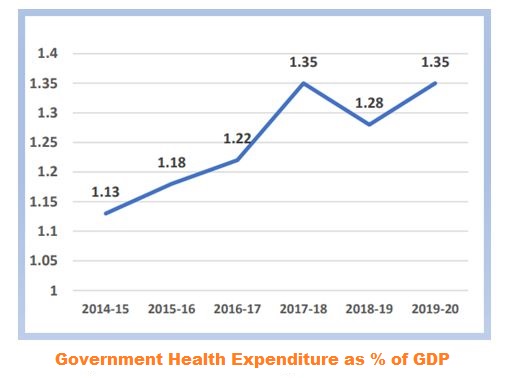
    • Total health expenditure declined to 3.2% of GDP in 2018-19 from 3.3% in 2017-18, while the government’s health expenditure (centre and state) as a percentage of GDP fell from 1.35% to 1.28% in the same period.
    • National health estimates showed the Centre’s share decreasing to 34.3% in 2018-19 from 40.8% in the previous year, while that of states rose from 59.2% to 65.7%.
    • Out-of-pocket spending as a percentage of total health expenditure declined to 48.2% in 2018-19, though it is significantly higher than the world average of 18.1% in 2019

    What about health insurance penetration?

    Ans. Retail health insurance covers a meagre 3.2% of the country’s population.

    • With a population of 1.36 billion, India is the world’s second most populous country, and is expected to surpass China soon.
    • Launched in 2018 to provide universal health coverage, AB-PMJAY, takes care of the bottom 50% of the population of approximately 700 million individuals.
    • The top 20% of the population is covered through social and private health insurance.
    • Therefore, about 30% of the population, or about 400 million, is “the missing middle”— they don’t have any financial protection for health emergencies.

    Why is sound healthcare important for the economy?

    • Covid-19 exposed the economic consequences of poor healthcare. Higher out-of-pocket healthcare spending hits savings and consumption.
    • In the work space, poor health impacts physical and mental abilities, increase turnover and lead to lower productivity.
    • Data shows that 7% of India’s population is pushed into poverty every year due to healthcare costs.

    Way forward

    • Healthcare management and disease prevention should be the focus, along with an all-encompassing healthcare system, including OPD.
    • The government also needs to pay attention on healthcare cover for “the missing middle” population.
    • As a pilot, states may allow the authority already implementing the AB-PMJAY scheme in the state to cover the missing middle.


    UPSC 2023 countdown has begun! Get your personal guidance plan now! (Click here)

  • Rising number of Rabies case

    rabiesContext

    • The death of a 12-year-old girl in Pathanamthitta has sharpened the focus on the rising number of rabies cases and the growing population of stray dogs in Kerala

    What is rabies?

    • The rabies virus attacks the central nervous system of the host, and in humans, it can cause a range of debilitating symptoms including states of anxiety and confusion, partial paralysis, agitation, hallucinations, and, in its final phases, a symptom called “hydrophobia,” or a fear of water.

    What are rabies caused by?

    • Rabies is a preventable viral disease most often transmitted through the bite of a rabid animal. The rabies virus infects the central nervous system of mammals, ultimately causing disease in the brain and death.

    Can rabies person survive?

    • Once clinical signs of rabies appear, the disease is nearly always fatal, and treatment is typically supportive. Less than 20 cases of human survival from clinical rabies have been documented.

    How long can a human live with rabies?

    • Death usually occurs 2 to 10 days after first symptoms. Survival is almost unknown once symptoms have presented, even with intensive care.

    rabiesFacts on rabies

    • What animal has the most rabies?
    • Bats
    • Wild animals accounted for 92.7% of reported cases of rabies in 2018. Bats were the most frequently reported rabid wildlife species (33% of all animal cases during 2018), followed by raccoons (30.3%), skunks (20.3%), and foxes (7.2%).

    rabiesWhat is the issue?                                  

    • There is a blame game over the rising rabies cases: With the rabies deaths causing panic and reports of residents killing stray dogs through poisoning and strangulation, there is a blame game over the rising canine population and rabies cases. Some legal experts blame it on conflicts in the Prevention of Cruelty to Animals Act, 1960 and the Animal Birth Control (Dogs) Rules, 2001; others point to the flawed implementation of birth control measures.
    • Legal battle over the issue in the Supreme Court: Canine culling campaigners and advocates of animal rights are also engaged in a protracted legal battle over the issue in the Supreme Court. V.K. Biju, a lawyer of the Supreme Court, who brought the issue of the “stray dog menace” before the apex court, contends that the root cause is the enactment of the Rules, which according to him, were passed in contravention of the parent Act, the Prevention of Cruelty to Animals Act.
    • Existence of stray dogs has adversely affected the fundamental rights of citizens: Biju says that while the Act stands for the “destruction” of stray dogs, the rules are against the “destruction” of stray dogs, including the rabies affected ones, besides providing specific protection of stray dogs. In his submission before the Supreme Court, he argues that the existence of stray dogs has adversely affected the fundamental rights of citizens, i.e. the right to life and free movement.
    • The quashing of the Rules to make India free of stray dogs: In his writ petition filed before the apex court, Biju has sought orders for the strict implementation of the Act and the quashing of the Rules to make India free of stray dogs.
    • Animal rights campaigners are apprehensive: In the light of this, animal rights campaigners are apprehensive over the campaign to cull dogs to check rabies.

    rabiesHow can we prevent rabies in animals?

    1. First, visit your veterinarian with your pet on a regular basis and keep rabies vaccinations up-to-date for all cats, ferrets, and dogs.
    2. Second, maintain control of your pets by keeping cats and ferrets indoors and keeping dogs under direct supervision.
    3. Third, spay or neuter your pets to help reduce the number of unwanted pets that may not be properly cared for or vaccinated regularly.
    4. Finally, call animal control to remove all stray animals from your neighbourhood since these animals may be unvaccinated or ill.

    How can we prevent rabies in humans?

    • Leave all wildlife alone.
    • Know the risk: contact with infected bats is the leading cause of rabies deaths in people followed by exposure to rabid dogs while traveling internationally.
    • Wash animal bites or scratches immediately with soap and water.
    • If you are bitten, scratched, or unsure, talk to a healthcare provider about whether you need postexposure prophylaxis. Rabies in people is 100% preventable through prompt appropriate medical care.
    • Vaccinate your pets to protect them and your family.

    Initiatives by Government to curb Neglected Tropical Diseases

    National Rabies Control Programme: This programme is being restructured as Integrated National Rabies Control Programme under ‘One Health Approach’, with a aim to provide vaccination to stray dogs and free vaccines through Government hospitals.

    Way forward

    • Think globally, act locally. Study and adopt global ‘best-practices’ after customising them to local needs.
    • Apply integrated approach. Follow a holistic strategy.
    • Ensure efficient and effective collaboration across various government departments.
    • Partner with Civil Society Organisations (especially with WASH – Water, Sanitation and Hygiene – sector) for ground-level implementation and monitoring.

    Mains question

    Q. What is rabies? What ethical challenges are involved in culling of stray dogs? Explain the control measures for the same.


    UPSC 2023 countdown has begun! Get your personal guidance plan now! (Click here)

  • Fighting anaemia

    anaemiaContext

    • The recent National Family Health Survey (NFHS-5) data shows anaemia rates increased from 53 per cent to 57 per cent in women and 58 per cent to 67 per cent in children in 2019-21.

    Definition of anaemia

    • The WHO defines anaemia as a condition where the number of red blood cells or the haemoglobin concentration within them is lower than normal. This compromises immunity and impedes cognitive development.

    Why anaemia is a concern?

    • Adverse effects of anaemia affect all age groups lower physical and cognitive growth and alertness among children and adolescents, and lesser capacity to learn and play, directly impacting their future potential as productive citizens.
    • Anaemia among adolescent girls (59.1 per cent) advances to maternal anaemiaand is a major cause of maternal and infant mortality and general morbidity and ill health in a community.

    What causes anaemia?

    • Imbalanced diet: Cereal-centric diets, with relatively less consumption of iron-rich food groups like meat, fish, eggs, and dark green leafy vegetables (DGLF), can be associated with higher levels of anaemia.
    • Underlying factors: High levels of anaemia are also often associated with underlying factors like poor water quality and sanitation conditions that can adversely impact iron absorption in the body.
    • Iron deficiency is major cause: A diet that does not contain enough iron, folic acid, or vitamin B12 is a common cause of anaemia.
    • Some other conditions: That may lead to anaemia include pregnancy, heavy periods, blood disorders or cancer, inherited disorders, and infectious diseases.

    anaemiaWhy is anaemia so high in the country?

    • Low vitamin intake: Iron-deficiency and vitamin B12-deficiency anaemia are the two common types of anaemia in India.
    • High population and nutrition deprivation: Among women, iron deficiency prevalence is higher than men due to menstrual iron losses and the high iron demands of a growing foetus during pregnancies.
    • Overemphasis on cereals: Lack of millets in the diet due to overdependence on rice and wheat, insufficient consumption of green and leafy vegetables could be the reasons behind the high prevalence of anaemia in India.

    What is Iron fortification?

    • Iron fortification of food is a methodology utilized worldwide to address iron deficiency. Iron fortification programs usually involve mandatory, centralized mass fortification of staple foods, such as wheat flour.

    https://www.civilsdaily.com/news/mandatory-rice-fortification-policy-should-be-re-examined/Why need iron fortification?

    • Iron deficiency anaemia is due to insufficient iron.
    • Without enough iron, the body can’t produce enough of a substance in red blood cells that enables them to carry oxygen (haemoglobin).
    • Severe anaemia during pregnancy increases risk of premature birth, having a low birth weight baby and postpartum depression. Some studies also show an increased risk of infant death immediately before or after birth.

    anaemiaSuccess story / value addition

    • Nepal’s success story to improve maternal anaemia by national action plan .

    Anaemia Mukt Bharat

    • The scheme aims to reduce the prevalence of anaemia in India.
    • It provides bi weekly iron Folic acid supplementation to all under five children through Asha workers.
    • Also, it provides biannual Deworming for children and adolescents. The scheme also establishes institutional mechanisms for advanced research in anaemia.
    • It also focuses on non-nutritional causes of anaemia.

    We need to focus on the following interventions

    • Prophylactic Iron and Folic Acid supplementation.
    • Intensified year-round Behaviour Change Communication Campaign (Solid Body, Smart Mind).
    • Appropriate infant and young child feeding practices.
    • Increase in intake of iron-rich food through diet diversity/quantity/frequency and/or fortified foods with focus on harnessing locally available resources.
    • Testing and treatment of anaemia, using digital methods and point of care treatment, with special focus on pregnant women and school-going adolescents
    • Mandatory provision of Iron and Folic Acid fortified foods in government-funded public health programmes

    Way forward

    • India’s nutrition programmes must undergo a periodic review.
    • The Integrated Child Development Services (ICDS), which is perceived as the guardian of the nation’s nutritional well-being must reassess itself and address critical intervention gaps, both conceptually and programmatically, and produce rapid outcomes.
    • The nutritional deficit which ought to be considered an indicator of great concern is generally ignored by policymakers and experts. Unless this is addressed, rapid improvement in nutritional indicators cannot happen.

    Conclusion

    • When a person is anaemic, the capacity of his blood cells to carry oxygen decreases. This reduces the productivity of the person which in turn affects the economy of the country. Therefore, it is highly important to cover Anaemia under National Health Mission.

    Mains question

    Q. “Every second adolescent girl has anaemia. Every second woman of reproductive age is anaemic”. In this context do you think Women’s empowerment will not have any meaning without tackling anaemia? Discuss.


    UPSC 2023 countdown has begun! Get your personal guidance plan now! (Click here)

  • What is National List of Essential Medicines (NLEM)?

    The latest National List of Essential Medicines (NLEM) released September 13, 2022 by the Union health ministry added 34 new medicines and dropped 26 old ones from the previous list.

    What is NLEM?

    • As per the World Health Organisation (WHO), Essential Medicines are those that satisfy the priority health care needs of the population.
    • Ministry of Health and Family Welfare hence prepared and released the first National List of Essential Medicines of India in 1996 consisting of 279 medicines.
    • The list is made with consideration to disease prevalence, efficacy, safety and comparative cost-effectiveness of the medicines.
    • Such medicines are intended to be available in adequate amounts, in appropriate dosage forms and strengths with assured quality.
    • They should be available in such a way that an individual or community can afford.

    NLEM in India

    • Drugs listed under NLEM — also known as scheduled drugs — will be cheaper because the National Pharmaceutical Pricing Authority (NPPA) caps medicine prices and changes only based on wholesale price index-based inflation.
    • The list includes anti-infectives medicines to treat diabetes such as insulin — HIV, tuberculosis, cancer, contraceptives, hormonal medicines and anaesthetics.
    • They account for 17-18 per cent of the estimated Rs 1.6-trillion domestic pharmaceutical market.
    • Companies selling non-scheduled drugs can hike prices by up to 10 per cent every year.
    • Typically, once NLEM is released, the department of pharmaceuticals under the ministry of chemicals and fertilisers adds them in the Drug Price Control Order, after which NPPA fixes the price.

    Significance of EML

    • Drawing an essential medicines list (EML) is expected to result in better quality of medical care, better management of medicines and cost-effective use of health care resources.
    • This is especially important for a resource limited country like India.
    • The list of essential medicines is intended to have a positive impact on the availability and rational use of medicines.

    Also read

    What is the NPPA’s role in fixing drug prices?


    UPSC 2023 countdown has begun! Get your personal guidance plan now! (Click here)

  • Public health should be led by doctor alone

    public healthContext

    • Doctor shortages are creating hurdles in health emergency response

    What is the crux of the article in simple words?

    • Medical qualification and expertise is necessary to deliver quality health services by medical professionals unlike by general health care workers who lack competency.

    What is public health?

    • Public health has been defined as “the science and art of preventing disease, prolonging life and promoting health through the organized efforts and informed choices of society, organizations, public and private, communities and individuals”.

    Why there is need of qualification?

    • Lack of training: Health workers have no training in public health; they are grassroots-level service providers. Asking them to be part of public health cadre trivialises the profession of public health.
    • Separate profession: It is important to understand that public health is a separate profession with a specific set of competencies.

    public healthWhat are 4 pillars of public health?

    • Academics: Academics refers to a good understanding of evidence generation and synthesis by having a good grounding in epidemiology and biostatistics. These competencies are also critical for monitoring and evaluating programmes, conducting surveillance, and interpreting data and routine reporting.
    • Activism: Public health is inherently linked to ‘social change’ and an element of activism is core to public health. Public health requires social mobilisation at the grassroots level by understanding community needs, community organisation, etc. This requires grounding in social and behavioural sciences.
    • Administration: Administration refers to administering health systems at different levels from a primary health centre to the district, State, and national level. This includes implementing and managing health programmes, addressing human resource issues, supply and logistical issues, etc. It includes microplanning of programme delivery, team building, leadership as well as financial management to some extent.
    • Advocacy: In public health, there is little that one can do at an individual level; there must be communication with key stakeholders to change the status quo at different levels of government. This requires clear enunciation of the need, analysis of alternative set of actions and the cost of implementation or non-implementation. Good communication and negotiation skills are critical to perform this function. The related subjects are health policy, health economics, health advocacy and global health.

    public healthWhat are the hurdles in absorbing others as public health professionals?

    • Lack of skill: Many doctors and other health professionals work at the grassroots level and develop a good sense of public health due to their inclination. But they do not become public health professionals as they may not have the necessary skills. Nevertheless, they are valuable.
    • Lack of critical expertise: Clinicians with training in epidemiology and biostatistics would not qualify to be public health professionals as they lack not only other essential and critical expertise but also an appropriate perspective.
    • Compromise on quality:

    Current challenges faced by public healthcare in India

    • Deficiency: The doctor-patient ratio of 1:1655 in India as against WHO norm of 1:1000 clearly shows the deficit of MBBS. While the government is working towards a solution and targeting to reach the required ratio, there is a need to relook at the overall medical education.
    • Post pandemic scenario: The lag in formal medical education has come up evidently post-pandemic when the nation saw the medical fraternity struggling to fill the doctor deficit.
    • Limited government seats: The number of seats available for medical education in India is far less than the number of aspirants who leave school with the dream of becoming doctors.
    • Lack of skills: Though the institutes are managing to hire professors and lecturers, there is a lack of technical skills. Finding faculties in clinical and non-clinical disciplines is difficult and there are very few faculty development programs for upskilling the existing lot.
    • Lack of infrastructure: The gap in digital learning infrastructure is currently the biggest challenge the sector is facing. There is an urgent need to adopt technology and have resources available to facilitate e-learning.
    • Lack of research and innovation: The medical research and innovation needs an added push as there haven’t been many ground-breaking research here. The education system needs to focus more on increasing the quality of research. Additionally since industry academia partnership is not available, hence innovation also takes a back-seat.

    Conclusion

    • By establishing new medical colleges, the government can increase student intake as well as enhance equitable access to public health as separate profession. This will attract the best and the brightest people into this discipline, which is very important for the nation’s health. This is one lesson that we should learn from the pandemic.

    Mains question

    Q. What do you understand by public health? Do you think it is a separate profession requiring a specific set of competencies? Examine.

    UPSC 2023 countdown has begun! Get your personal guidance plan now! (Click here)

  • TB mukt India

    TBContext

    • People’s participation in the ‘TB-Mukt India’ campaign can help eliminate the disease by 2025.

    What is TB?

    • A potentially serious infectious bacterial disease that mainly affects the lungs.

    How TB is caused?

    • Tuberculosis (TB) is caused by a type of bacterium called Mycobacterium tuberculosis. It’s spread when a person with active TB disease in their lungs coughs or sneezes and someone else inhales the expelled droplets, which contain TB bacteria.

    What does TB do to humans?

    • It mainly affects the lungs, but it can affect any part of the body, including the tummy (abdomen), glands, bones and nervous system.

    TBHow long has the TB infected us?

    • TB is as old as humanity itself, infecting us for at least 5,000 years. The infecting agent, a bacterium, was identified way back in 1882, by Robert Koch, signalling one of the landmark discoveries which laid the foundation of modern medicine

    Is TB painful?

    • If TB affects your joints, you may develop pain that feels like arthritis. If TB affects your bladder, it may hurt to go to the bathroom and there may be blood in your urine. TB of the spine can cause back pain and leg paralysis. TB of the brain can cause headaches and nausea.

    Can we get TB if vaccinated?

    • BCG is a vaccine for TB. This vaccine is not widely used in the United States, but it is often given to infants and small children in other countries where TB is common. The BCG vaccine is not very good at protecting adults against TB. We can still get TB infection or TB disease even if you were vaccinated with BCG.

    When do TB symptoms start?

    TB


    • TB disease usually develops slowly, and it may take several weeks before you notice you’re unwell. Your symptoms might not begin until months or even years after you were initially infected. Sometimes the infection does not cause any symptoms. This is known as latent TB.

    Is TB curable permanently?

    • TB can usually be completely cured by the person with TB taking a combination of TB drugs. The only time that TB may not be curable is when the person has drug resistant TB.

    What are drug-resistant tuberculosis?

    • Drug-resistant tuberculosis (DR-TB) is a form of antimicrobial resistance that is difficult and costly to treat. It is caused by TB bacteria that are resistant to at least one of the first-line existing TB medications, resulting in fewer treatment options and increasing mortality rates.

    Risk factors for TB include

    • Poverty
    • HIV infection.
    • Being in jail or prison (where close contact can spread infection)
    • Substance abuse.
    • Taking medication that weakens the immune system.
    • Kidney disease and diabetes.

    TB statistic for mains

    We are home to 1 in 4 of the world’s TB patients.

    Over 2.5 million Indians are infected.

    Government initiatives

    • Nikshay Poshan Yojana: in which TB patients receive Rs 500 every month while on treatment was launched. Nikshay Poshan Yojana ensure that the patients have economic support and nutrition during the required period.
    • TB Harega Desh Jeetega Campaign: was launched to accelerate the efforts to end TB by 2025. The campaign aims to initiate preventive and promotive health approaches.
    • Community-led approach: By applying “multi-sectoral and community-led” approach, the government is building a national movement to end TB by 2025.
    • Ni-kshay Mitra: Any individual or organisation can register as Ni-kshay Mitra on the Ni-kshay 2.0 portal to support people affected by the disease. The initiative intends to provide essential nutritional and social support to people with TB and root out stigma and discrimination against them.

    Some positive suggestions to eliminate TB

    • Sincere efforts need to be made to make our health systems more accessible and reliable.
    • It also required to ensure that those seeking care trust the healthcare system and get the appropriate care for completing treatment.
    • There is a need to create more labs, point of care tests, an assured drug pipeline, access to new drugs.
    • The government should also ensure counselling and support for those affected.
    • Every patient who is diagnosed late and does not receive timely treatment continues to infect others.
    • To break this cycle, government machinery at the field level should work with communities and provide free diagnosis and treatment to every affected individual.

    Conclusion

    • We have ignored TB for too long. It’s time we acknowledge the magnitude of the disease, and work harder at offering individuals equitable healthcare access and resources that the disease warrants.

    Mains question

    Q. Do you think we can eliminate TB by 2025? Discuss the roadmap and give some affirmative actions to be taken by government.

    UPSC 2023 countdown has begun! Get your personal guidance plan now! (Click here)

  • Global pandemic treaty to avert future mishap

    pandemic treatyContext

    • The outline of an essential global pandemic treaty.

    Purpose of the treaty

    • A pandemic treaty under the umbrella of the World Health Organization would build coherence and avoid fragmentation of response.

    Severity of this pandemic demands such treaty

    • COVID-19 would count as being among some of the most severe pandemics the world has seen in the last 100 years. An estimated 18 million people may have died from COVID-19, according various credible estimates, a scale of loss not seen since the Second World War.
    • Further, with over 120 million people pushed into extreme poverty, and a massive global recession, no single government or institution has been able to address this emergency singlehandedly.
    • This has given us a larger perspective of how nobody is safe until everybody is safe.

    Catchy line for value addition

    Nobody is safe until everybody is safe

    pandemic treatyThere is widespread inequity in healthcare

    • Gross inequity in distribution: Health-care systems have been stretched beyond their capacity and gross health inequity has been observed in the distribution of vaccines, diagnostics, and therapeutics across the world.
    • Irreversible consequences: While high-income economies are still recovering from the aftereffects, the socioeconomic consequences of the novel coronavirus pandemic are irreversible in low and low middle-income countries.
    • The monopolies: Held by pharma majors such as Pfizer, BioNTech, and Moderna created at least nine new billionaires since the beginning of the COVID-19 pandemic and made over $1,000 a second in profits, even as fewer of their vaccines reached people in low-income countries.
    • Skewed distribution: As of March 2022, only 3% of people in low-income countries had been vaccinated with at least one dose, compared to 60.18% in high-income countries. The international target to vaccinate 70% of the world’s population against COVID-19 by mid-2022 was missed because poorer countries were at the “back of the queue” when vaccines were rolled out.

    https://www.civilsdaily.com/yojana-archive-the-pandemic-global-synergy/India’s lead role

    • Dynamic response: India’s response to the COVID-19 pandemic and reinstating global equity by leveraging its own potential has set an example to legislators worldwide.
    • Vaccine diplomacy: India produces nearly 60% of the world’s vaccines and is said to account for 60%-80% of the United Nations’ annual vaccine procurement “vaccine diplomacy” or “vaccine maitri” with a commitment against health inequity.
    • We lead by example: India was unfettered in its resolve to continue the shipment of vaccines and other diagnostics even when it was experiencing a vaccine shortage for domestic use. There was only a brief period of weeks during the peak of the second wave in India when the vaccine mission was halted.
    • A classic example of global cooperation: As of 2021, India shipped 594.35 lakh doses of ‘Made-in-India’ COVID-19 vaccines to 72 countries a classic example of global cooperation. Among these, 81.25 lakh doses were gifts, 339.67 lakh doses were commercially distributed and 173.43 lakh doses were delivered via the Covax programme under the aegis of Gavi, the Vaccine Alliance.

    Why the treaty is needed for?

    • Data sharing: A treaty should cover crucial aspects such as data sharing and genome sequencing of emerging viruses.
    • Rapid response mechanism: It should formally commit governments and parliaments to implement an early warning system and a properly funded rapid response mechanism.
    • Health investments: Further, it should mobilise nation states to agree on a set of common metrics that are related to health investments and a return on those investments. These investments should aim to reduce the public-private sector gap.

    Conclusion

    • A global pandemic treaty will not only reduce socioeconomic inequalities across nation states but also enhance a global pandemic preparedness for future health emergencies. India must take the lead in this.

    Mains question

    Q. Nobody is safe until everybody is safe. What do you understand by this? Why there is need of global pandemic treaty?.


    UPSC 2023 countdown has begun! Get your personal guidance plan now! (Click here)

  • Mental Health in india

    mental wellnessContext

    • How to deal with mental wellness challenges in the uniformed forces

    What is stress?

    • Stress is a feeling of emotional or physical tension. It can come from any event or thought that makes you feel frustrated, angry, or nervous. Stress is your body’s reaction to a challenge or demand.

    What is mental wellness?

    • Mental wellness encompasses emotional, psychological, and social well-being. It influences cognition, perception, and behaviour. It also determines how an individual handles stress, interpersonal relationships, and decision-making.

    Why is Mental Health Important?

    • Mental health is more important now than ever before; it impacts every area of our lives. The importance of good mental health ripples into everything we do, think, or say.

    mental wellnessReasons for Persistence of Mental Illness

    • Stigma to seek help: The staggering figures are void of millions of others directly, or indirectly impacted by the challenge and those who face deep-rooted stigma, many times rendering them unable to seek help.
    • Lack of awareness: This growing challenge in dealing with mental health issues is further compounded by a lack of information and awareness, self-diagnosis, and stigma.
    • Psycho-social factors: Institutions like gender, race and ethnicity, are also responsible for mental health conditions.
    • Post-Treatment gap: There is a need for proper rehabilitation of the mentally ill persons post/her treatment which is currently not present.
    • Rise in Severity: Mental health problems tend to increase during economic downturns, therefore special attention is needed during times of economic distress.

    mental wellnessOngoing challenges in mental wellness regime

    • There is a need to expand understanding of the full scope of what uniformed Services and other mental health experts can achieve.
    • Stigma regarding mental health both domestically and around the world remains strong.
    • There is a lack of trained personnel and healthcare and public health systems in many areas of the world.
    • Training needs are broad and reach beyond direct patient care, especially regarding cultural competence, crisis communication, and consultation.
    • There is a need for expanded support for the value of multi-professional and multi-organizational integration and collaboration.

    Government Policy initiatives

    • National Mental Health Program (NMHP): To address the huge burden of mental disorders and shortage of qualified professionals in the field of mental health, the government has been implementing the NMHP since 1982.
    • Mental HealthCare Act 2017: It guarantees every affected person access to mental healthcare and treatment from services run or funded by the government.
    • Rights of Persons with Disabilities Act, 2017: The Act acknowledges mental illness as a disability and seeks to enhance the Rights and Entitlements of the Disabled and provide an effective mechanism for ensuring their empowerment and inclusion in the society
    • Manodarpan Initiative: An initiative under Atmanirbhar Bharat Abhiyan aims to provide psycho-social support to students for their mental health and well-being.

    What needs to be done?

    • Open dialogue: The practice of open dialogue, a therapeutic practice that originated in Finland, runs through many programmes in the Guidance. This approach trains the therapist in de-escalation of distress and breaks power differentials that allow for free expression.
    • Increase investment: With emphasis on social care components such as work force participation, pensions and housing, increased investments in health and social care seem imperative.
    • Network of services: For those homeless and who opt not to enter mental health establishments, we can provide a network of services ranging from soup kitchens at vantage points to mobile mental health and social care clinics.

    Conclusion

    • Persons with mental health conditions need a responsive care system that inspires hope and participation without which their lives are empty. We should endeavour to provide them with such a responsive care system.

    Mains question

    Q. Mental disorders are now among the top leading causes of health burden worldwide, with no evidence of global reduction since 1990. Examine.

    UPSC 2023 countdown has begun! Get your personal guidance plan now! (Click here)

  • Ban on Conversion Therapy for the LGBTQIA+ Community

    The National Medical Commission (NMC), the apex regulatory body of medical professionals in India, has written to all State Medical Councils, banning sexual conversion therapy and calling it a “professional misconduct”.

    What is the news?

    • The NMC has empowered the State bodies to take disciplinary action against medical professionals who breach the guideline.
    • The NMC was following a Madras High Court directive to issue an official notification listing conversion therapy as a wrong, under the Indian Medical Council (Professional Conduct, Etiquettes and Ethics) Regulations, 2002.

    What is Sexual Conversion Therapy?

    • Conversion or reparative therapy is an intervention aimed at changing the sexual orientation or gender identity of an individual.
    • It uses either psychiatric treatment, drugs, exorcism and even violence, with the aim being to make the individual a heterosexual.
    • The conversion therapy umbrella also includes efforts to change the core identity of youth whose gender identity is incongruent with their sex anatomy.
    • Often, the therapy is offered by quacks with little expertise in dealing with the issue.
    • As late as 2018, medical books listed homosexuality and lesbianism as a “perversion”.

    What are the risks?

    • The interventions under conversion therapy are provided under the false premise that homosexuality and diverse gender identities are pathological.
    • They are not; the absence of pathology means there is no need for conversion or any other like intervention.
    • Conversion therapy poses the risk of causing or exacerbating mental health conditions, like anxiety, stress and drug use which sometimes even lead to suicide.

    What is the role of the Madras High Court in the ban?

    On June 7, 2021, Justice N. Anand Venkatesh of the Madras High Court gave a landmark ruling on a case he was hearing about the ordeal of a same-sex couple who sought police protection from their parents.

    • Pending adequate legislation more protective of the community, Justice Venkatesh issued a slew of interim guidelines.
    • It aimed for the police, activists, Union and State Social Welfare Ministries, and the National Medical Commission to ensure their safety and security to lead a life chosen by them.
    • The ruling prohibited any attempt to medically “cure” or change the sexual orientation of LGBTQIA+ (lesbian, gay, bisexual, transgender, queer, intersex, asexual or of any other orientation) people.
    • It urged the authorities to take action against professionals involving themselves in any form or method of conversion therapy,” which could include the withdrawal of licence to practice medicine.
    • On July 8, 2022, the court gave an order to the NMC directing it to issue necessary official notification by enlisting ‘Conversion Therapy’ as a professional misconduct.

    What were some of the other guidelines issued by the court?

    • The court asked the Ministry of Social Justice & Empowerment to draw up a list of NGOs and other groups which could handle the issues faced by the community, and gave it a time of 8 weeks from the date of the order.
    • The court said the community should be provided with legal assistance by the District Legal Services Authority in coordination with law enforcement agencies.
    • It asked agencies to follow the Transgender Persons (Protection of Rights) Rules, 2020, and the Transgender Persons (Protection of Rights) Act, 2019, in letter and spirit.
    • The court said it was imperative to hold sensitisation programmes for an all-out effort to understand the community and its needs.

    Way forward

    • Schools and colleges must effect changes in curricula for a better understanding of the community.
    • People of a different sexual orientation or gender identity often narrate harrowing tales of bullying, discrimination, stigma and ostracization.
    • Gender-neutral restrooms should be compulsory in educational institutes and other places.
    • Parents too need to be sensitised, because the first point of misunderstanding and abuse often begins at home, with teenagers being forced to opt for “conversion” therapies.
    • Health professionals point out that even adults opting for sex reassignment surgeries need to get proper guidance like therapy pre and post operation.

    Back2Basics: Transgender Persons (Protection of Rights) Act, 2019: Key Features

    Defining Transperson

    • The act defines a transgender person as one whose gender does not match the gender assigned at birth.
    • It includes trans-men and trans-women, persons with intersex variations, gender-queers, and persons with socio-cultural identities, such as kinnar and hijra.

    Prohibition against discrimination

    • It prohibits the discrimination against a transgender person, including denial of service or unfair treatment in relation to education, employment, healthcare, access to, or enjoyment of goods, facilities, opportunities available to the public.
    • Every transgender person shall have a right to reside and be included in his household.
    • No government or private entity can discriminate against a transgender person in employment matters, including recruitment, and promotion.

    HRD measures

    • A transgender person may make an application to the District Magistrate for a certificate of identity, indicating the gender as ‘transgender’.
    • Educational institutions funded or recognised by the relevant government shall provide inclusive facilities for transgender persons, without discrimination.
    • The government must provide health facilities to transgender persons including separate HIV surveillance centres, and sex reassignment surgeries.

    Grievances redressal

    • The National Council for Transgender persons (NCT) chaired by Union Minister for Social Justice, will advise the central government as well as monitor the impact of policies with respect to transgender persons.
    • It will also redress the grievances of transgender persons.

    Legal Protection

    • The Bill imposes penalties for the offences against transgender persons like bonded labour, denial of use of public places, removal from household & village and physical, sexual, verbal, emotional or economic abuse.


    UPSC 2023 countdown has begun! Get your personal guidance plan now! (Click here)