💥Join UPSC 2027,2028 Mentorship (August Batch) + XFactor Notes & Microthemes PDF

Day: October 11, 2017

  • Civil Aviation Sector in India

    Civil Aviation Sector in India

    In India, a beginning in the air transport was made in the year 1920, when the government first decided to prepare air routes between Mumbai and Kolkata. The civil aviation work actually started in in 1924-25, but the progress was slow until the outbreak of the second World War.

    Hindustan Aeronautics Limited: The Hindustan Aircraft (now Hindustan Aeronautics Limited), was founded in 1940.  It was started at Bangalore (now Bengaluru) as a repair, overhauling and assemblage depot, has now grown into an important manufacturing plant. It has designed and manufactured trainer air-crafts. It belongs to the aerospace and defence industry. It is managed by Ministry of Defence.


    Civil Aviation Recent Developments: A Snapshot

    India is the 9th largest civil aviation market in the world, In FY17, domestic passenger traffic witnessed a growth rate of 21.5 per cent

    In FY17, airports in India witnessed a domestic passenger traffic of about 205 million people.

    Investments worth US$ 6 billion are expected in the country’s airport sector in 5 years

    India’s civil aviation market is set to become the world’s 3rd* largest by 2020 and expected to be the largest by 2030


    Growth Potential & Drivers of Indian Aviation Industry


    Airport Authority of India


    Airports & Airstrips in India


    Major Airline Operator in India


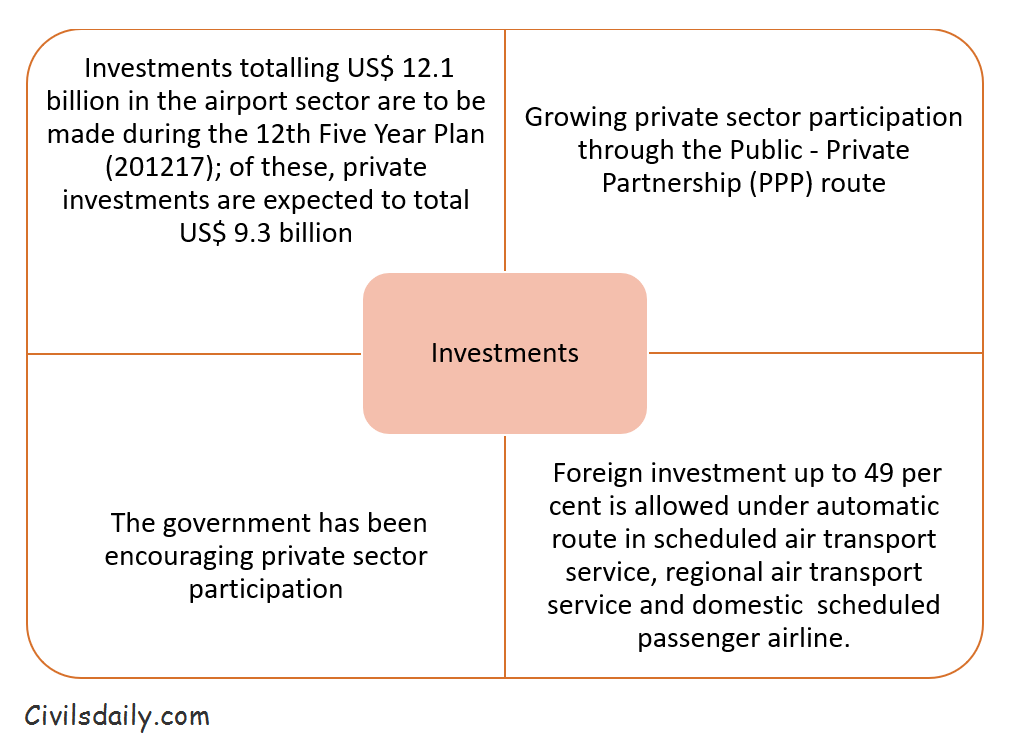
    Private Sector Participation in Airport Development

    Until 2013, AAI was the only major player involved in developing and upgrading airports in India.

    Post liberalisation, private sector participation in the sector has been increasing.

    Private sector investment increased to US$9.3 billion during the 12th Five Year Plan from US$ 5.5 billion in the previous plan.

    1. Recourse to the Public Private Partnership (PPP) model has boosted private sector investments in airports
    2. PPP route for five international airports (Delhi, Mumbai, Cochin, Hyderabad, Bengaluru) most noteworthy
    3. In Union Budget 2017, Government of India has decided to develop select airports in tier 2 cities under PPP model in order to attract investments from private players.
    4. Increasing share of private sector in equity component of major airports:
    • 74 per cent private shareholding in IGI Airport (Delhi) – owned majorly by GMR (54 per cent), Fraport AG (10 per cent), Eraman Malaysia (10 per cent); rest of the shares owned by AAI
    • 74 per cent private shareholding in CSI Airport (Mumbai) – owned majorly by GVK (50.5 per cent), Bid Services Division (Mauritius) Ltd. (13.5 per cent), ACSA Global (10 per cent); rest of the shares owned by AAI
    • 74 per cent private shareholding in RGI Airport (Hyderabad) – owned majorly by GMR (63 per cent), Malaysia Airports Holdings Berhad (11 per cent); rest of the shares owned by Government of India (13 per cent) and Government of Andhra Pradesh (13 per cent)
    • 74 per cent shareholding in Kempagowda International Airport (Bengaluru) – owned majorly by Siemens Project Ventures, Germany (40 per cent), Unique (Flughafen Zurich AG) Zurich Airport, Switzerland (17 per cent), L&T, India (17 per cent); rest of the shares owned by AAI (13 per cent) and KSIIDC, which is an agency owned by the state of Karnataka, India (13 per cent).

    In March 2017, by selling off 2 offshore bonds, GMR plans to raise US$250-300 million for refinancing their debt. In June 2017, GMR announced plans to refinance loans and divest assets in road and power sectors to cut debt so as to invest up to Rs. 7,400 (US$ 1.15 billion) crore to expand Delhi and Hyderabad airports.

    Successful PPP Model Airports in India

    Presently India has 5 PPP airports each at Mumbai, Delhi, Cochin, Hyderabad and Bengaluru, which together handle over 55 per cent of country’s air traffic.

    Government of India has approved 15 greenfield PPP projects which are expected to increase the air traffic in India. These projects would be setup in Goa, Navi Mumbai, Maharashtra, Bijapur, Gulbarga, Karnataka, Kerala, West Bengal, Madhya Pradesh, Sikkim, Puducherry and Uttar Pradesh.

    Government Initiatives in Civil Aviation Sector


    By
    Himanshu Arora
    Doctoral Scholar in Economics & Senior Research Fellow, CDS, Jawaharlal Nehru University


  • Road Transport in India

    Road Transport in India

    Classifications of Roads

    Roads are mainly classified into following Categories:


    Road Network in India


    Importance of Road Transport


    Road Development in India

    The major initiative undertaken by the government for the development of road sector are:

    • The National Highway Development Project (NHDP).
    • Pradhan Mantri Bharat Jodo Pariyojana (PMBJP): linking of major cities to National Highways.
    • Pradhan Mantri Gram Sadak Yojana (PMGSY): Construction of Rural roads.


    National Highway Development Project

    NHDP deal with the development of high quality highways. NHDP is the largest highway project undertaken in the country. It has been implemented by the National Highway Authority of India (NHAI).

    Initially, The National Highway Development Project (NHDP) consists of two major components:

    The “Golden Quadrilateral”: The Golden Quadrilateral” project will connect the four major metropolitan cities (Delhi. Mumbai, Chennai & Kolkata) with 4-6 lane highways, with a total length of about 5,850 km.

    The “North South – East West” projects: The “North South – East West” project will connect the Northern most point of the country to the Southernmost, and similarly from East to West, with a total length of about 7,300 km

    The NHDP was expected to cost Rs 540 billion, when started in 1998. The financing pattern of this project indicates that private sector participation in the form of investment amounts to only Rs 40 billion (7.4 per cent of the total).

    Over the course of the project, institutions like the World Bank, Asian Development Bank (ADB) and Japanese Bank for International Cooperation (JBIC) are expected to finance about Rs 200 billion; another Rs 200 billion of investment would be financed from the cess.

    NHDP consists of following Phases:

    1. Phase 1 and Phase 2: The phase envisages construction of 4 & 6 lane highways of about 14000 KMs. The two phases comprise construction of “Golden Quadrilateral” and North South (Sri Nagar to KanyaKumari) – East West (Silichair to Porbandar) Projects.
    2. Phase 3: The phase consists of construction of 4-6 lane National highways of 12100 KMs connecting state capitals, tourist places, industrial centres.
    3. Phase 4: The phase involved upgradation and strengthening of 20000 KMs of single/two lane national highways.
    4. Phase 5: The phase involved construction of 6 lane national highways of 6500 KMs.
    5. Phase 6 & 7: The phase 6 & 7, involved construction of 1000 KMs of expressways and construction of 700 KMs of ring roads of major towns and bypasses and other elevated roads, tunnels, underpasses on national highways respectively.


    Problems of the Road Sector


    Road Sector in India Recent Developments


    Expansion of Roadways:


    Road Development Program for North East Region

    The Special Accelerated Road Development Programme for the North-Eastern region (SARDP-NE) is aimed at developing road connectivity between remote areas in the North East with state capitals and district headquarters

    SARDP-NE is vested with the development of double-/four-lane national highways of about 7,530 kms and double-laning improving about 2,611 kms of state roads, as on FY16

    Implementation of the road development programme would facilitate connectivity of 88 district headquarters in North Eastern states to the nearest National Highways

    The project would be undertaken in following 3 phases:


    Policy Initiatives by the Government


    By
    Himanshu Arora
    Doctoral Scholar in Economics & Senior Research Fellow, CDS, Jawaharlal Nehru University
  • Infrastructure Sector in India: Growth Drivers; Government Policy Initiatives

    Growth Drivers for Infrastructure Sector in India

    Recent Government Initiatives


    Construction Sector


    Affordable Housing Scheme


    Infrastructure Development in North Eastern States


    Metro Rail and Mono Rails


    Mono Rail


    By
    Himanshu Arora
    Doctoral Scholar in Economics & Senior Research Fellow, CDS, Jawaharlal Nehru University
  • Infrastructure Development in India

    Infrastructure Development in India

    Historical Timeline

    Infrastructure Sector: Recent Developments

    FDI Flows in the Infrastructure Sector

    Infrastructure Projects Completed during 12th Five-Year Plan


    Expansion of Roads: Recent Trends

    Revenue growth of Indian Railways

    Power Generation Capacity

    • Installed capacity increased steadily over the years, posting a CAGR of 10.57 per cent in FY09–17 and stood at 326.84 (GW).
    • As of June 2017, energy generation from conventional sources stood at 307.7 billion units (BU).

    Performance of Eight Core Infrastructure Sector


    By
    Himanshu Arora
    Doctoral Scholar in Economics & Senior Research Fellow, CDS, Jawaharlal Nehru University


  • Infrastructure Sector in India: Definitions; Growth and Infrastructure Linkage

    Infrastructure Sector

    Definitions:

    Infrastructure is a key driver of the overall development of Indian economy. Infrastructure sector focuses on major infrastructure sectors such as power, roads and bridges, dams and urban infrastructure.

    “Infrastructure is generally understood as the basic building blocks required for an economy to function efficiently”.

    The National Statistical Commission headed by Dr. C. Rangarajan, attempted to identify infrastructure based on some characteristics. The Rangarajan Commission indicated six characteristics of infrastructure sectors:

    Based on these features (except b, d, and e), the Commission recommended inclusion of following in infrastructure in the first stage:

    Dr. Rakesh Mohan Committee in “The India Infrastructure Report” included:

    The World Bank treats power, water supply, sewerage, communication, roads & bridges, ports, airports, railways, housing, urban services, oil/ gas production and mining sectors as infrastructure.

    The Economic Survey considers power, urban services, telecommunications, posts, roads, ports, civil aviation, and railways under infrastructure sector.

    Why do Infrastructure Matter for Growth & Development?

    There is, indeed, a plethora of anecdotal and more technical evidence that suggests development of infrastructure can lead to growth and development of an economy.

    The argument is particularly true for the developing countries which lack adequate infrastructure facilities. Intuitively, it should make sense to assume that the more developed a country is, the higher its infrastructure facilities and hence the lower the return from additional investment in roads, railways, ports etc. However, the less developed a country is, the more likely the infrastructure is to matter, because the returns from the Infrastructure development will be much more than the cost of the projects.

    Example: A massive road-building exercise in a poorly developed state can offer a one-time boost production activity and productivity of workers in the state.

    Infrastructure Sectors & Growth

    Any modern textbook on industrial economics or industrial organization will point out that for industries that enjoy network externalities (positive spill over effects/benefits to other sectors/industries), the social rate of return has to be higher than the private rate of return in these projects—assuming that the regulation does not allow the network externality to be turned into a private rent. In other words, their impact on GDP and its growth should be high. This explains for instance why the growth impact of the telecoms sector so often come out to be high. But for specific countries or regions, this could also be true for transport or electricity.

    In general, however, all infrastructure subsectors can be good examples of sectors in which such network externalities can matter. This section reviews the main lessons available on each subsector on the growth impact of each infrastructure subsector.

    Energy Sector

    The importance of energy sector especially electricity in promoting growth and development via human development and physical development is well known. The single most reason obstructing the growth of the industrial sector in general and manufacturing in particular in India is deficiency of continuous power supply (electricity/electrification) to run factories.

    Various studies have found out that, there exist a positive impact on energy infrastructure on the growth of an economy. Therefore, investing in the energy sector may be the safest bet to achieve a high growth. This should not be a surprise, energy is indeed an input into any of the other infrastructure subsectors—for instance, water for irrigation purpose is often pumped through the electric pumps.

    Telecommunication

    The impact of telecommunication on the growth is found to be maximum. The availability of fixed line phones and mobile phone penetration have effectively transformed the Indian economy and has given boost to Businesses like BPOs and KPOs (Knowledge Processing Outsourcing).

    The recent growing research on the importance of the access to internet to increase competition in the private and public sector and from increasing competition to the higher social return and growth of industries is well documented.

    Transport

    For developing countries like India, the estimated growth effects of transport investments have been very strong. This has been a common finding in research over the last 20 years or so. This is not surprising since the transport facilities in India are weak. The main impact of improved transportation facilities on the development has to come from quality, from addressing bottlenecks or from capturing new network or suprational effects which have not been internalized in older designs of the transport networks.

    In fact, studies have found, that for most of the developing countries, the construction of Roads, Railways, Highways, Airports and Sea Ports have contributed positively towards increasing growth.

    For instance, roads are needed in Africa, if Africa wanted to match the growth rate of the rest of the world. Construction of Roads & Highways are essential to reduce differences across regions in India. Ports are needed in India, if India, wants to increase its exports and become a major player in the Global Economy.


    By
    Himanshu Arora
    Doctoral Scholar in Economics & Senior Research Fellow, CDS, Jawaharlal Nehru University
  • 11 Oct 2017 | Prelims Daily with Previous Year Questions & Tikdams

    Q.1) Consider the following statements regarding the ‘P5+1’ countries:
    1. Germany is a member of ‘P5+1’.
    2. All the five permanent members of UN Security Council are not members of ‘P5+1’
    Which of the statements given above is/are correct?
    a) 1 only
    b) 2 only
    c) Both are correct
    d) None is correct

    Q.2) The Term ‘Intifada’ is related to
    a) Spain
    b) Israel
    c) Russia
    d) Monglolia

    Q.3) Which of the followig Department/Ministry/Tribunal deals with the matter related to Anti-Dumping?
    a) Department of Industry Policy and Promotion(DIPP)
    b) Minsitry of Finance
    c) Customs, Excise and Service Tax Appellate Tribunal (CESTAT)
    d) None of the above

    Q.4) Consider the following:
    1. Indonesia
    2. Thailand
    3. Bangladesh
    Which of the above have FTA with India under aegis of ASEAN?
    a) 3 only
    b) 1 and 2 only
    c) 2 and 3 only
    d) All Of the above

    Q.5) Consider the following statements regarding FDI and FPI:
    1. FPI tends to involve establishing more of a substantial, long-term interest in the economy of a foreign country.
    2. FDI is an equity investment with a shorter time frame for investment return
    Which of the above is/are correct?
    a) 1 only
    b) 2 only
    c) Both 1 and 2
    d) Neither 1 nor 2

    Q.6) What is/are the purpose/purposes of ‘Marginal Cost of Funds based Lending Rate (MCLR)’announced by RBI?(CSE: 2016)
    1.These guidelines help improve the transparency in the methodology followed by the banks for determining the interest rates on advances
    2.these guidelines helps ensure the availability of bank credit the interest rate which are fare to the borrowers as well as the banks
    Select the correct answers using the code given below
    a) 1 only
    b) 2 only
    c) Both 1 and 2
    d) Neither 1 nor 2

    Q.7) What is/are the unique about the ‘Kharai Camel’ a breed found in India(CSE: 2016)

    1.It is capable of swimming up three kilometers in seawater
    2.Its survives by grazing on mangroves
    3.It lives in the wild and cannot be domesticated
    Select the correct answers using the code given below
    a) 1 only
    b) 2 only
    c) Both 1 and 2
    d) Neither 1 nor 2

    Q.8) Recently, our scientists have discovered a new and distinct spices of banana plant which attains a height of about 11 meters and has orange – colored form of pulp. In which part of India has been discovered?(CSE: 2016)
    a) Andaman Islands
    b) Anaimalai Forests
    c) Maikala Hills
    d) Tropical rainforest of North east


    IMPORTANT STUFF: 

    1. Daily newscards have been enriched with back2basics and note2students – Make notes daily

    2. Join Full Year Prelims TS – prelims.civilsdaily.com

    3. Solutions will be uploaded at 11.30 p.m. Click here for Solutions

    4. For attempting previous Prelims Daily Questions – Click here