Why in News?
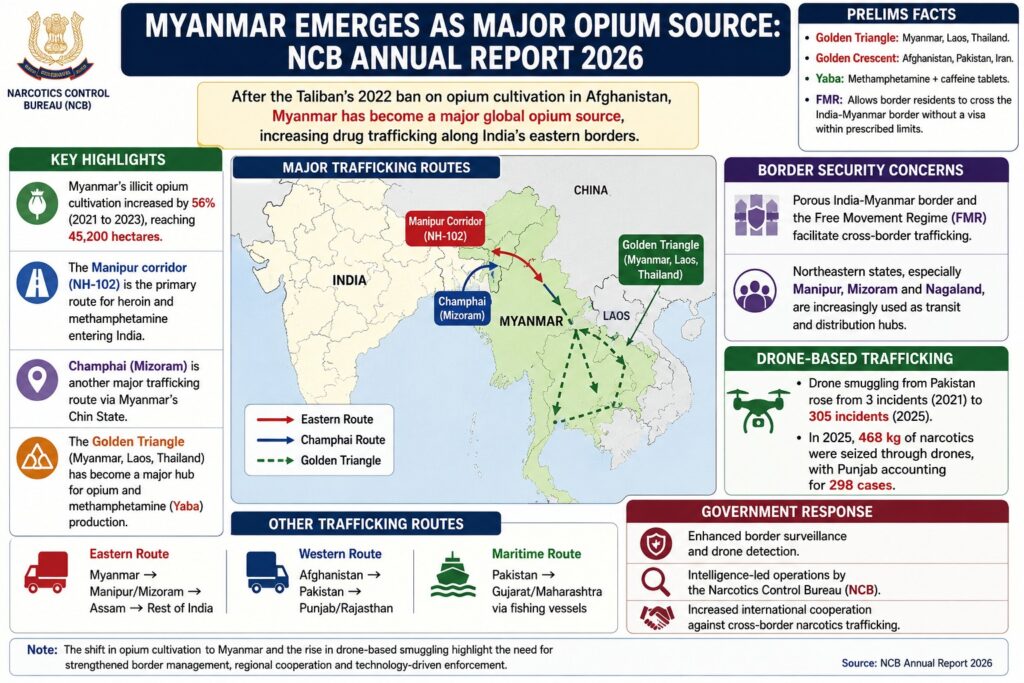
The NCB Annual Report 2026 states that after the Taliban’s 2022 ban on opium cultivation in Afghanistan, Myanmar has become a major global opium source, increasing drug trafficking along India’s eastern borders.
Key Highlights
- Myanmar’s illicit opium cultivation increased by 56% (2021 to 2023), reaching 45,200 hectares.
- The Manipur corridor (NH-102) is the primary route for heroin and methamphetamine entering India.
- Champhai (Mizoram) is another major trafficking route via Myanmar’s Chin State.
- The Golden Triangle (Myanmar, Laos, Thailand) has become a major hub for opium and methamphetamine (Yaba) production.
Border Security Concerns
- Porous India-Myanmar border and the Free Movement Regime (FMR) facilitate cross-border trafficking.
- Northeastern states, especially Manipur, Mizoram and Nagaland, are increasingly used as transit and distribution hubs.
Drone-Based Trafficking
- Drone smuggling from Pakistan rose from 3 incidents (2021) to 305 incidents (2025).
- In 2025, 468 kg of narcotics were seized through drones, with Punjab accounting for 298 cases.
Other Trafficking Routes
- Eastern Route: Myanmar → Manipur/Mizoram → Assam → Rest of India.
- Western Route: Afghanistan → Pakistan → Punjab/Rajasthan.
- Maritime Route: Pakistan → Gujarat/Maharashtra via fishing vessels.
Government Response
- Enhanced border surveillance and drone detection.
- Intelligence-led operations by the Narcotics Control Bureau (NCB).
- Increased international cooperation against cross-border narcotics trafficking.
Prelims Facts
- Golden Triangle: Myanmar, Laos, Thailand.
- Golden Crescent: Afghanistan, Pakistan, Iran.
- Yaba: Methamphetamine + caffeine tablets.
- FMR: Allows border residents to cross the India-Myanmar border without a visa within prescribed limits.