💥Join UPSC 2027,2028 Mentorship (July Batch) + XFactor Notes & Microthemes PDF

Author: Explains

  • Deen Dayal Upadhyaya Antyodaya Yojana

    It is a scheme for upliftment of urban and rural poor through enhancement of livelihood opportunities through skill development and other means

    Why the scheme?

    • To provide Skill training to the poor in cities and villages. This would make them eligible for employment and will help in poverty alleviation
    • By 2020, developed nations will have shortage of ~57 million workers & foreign companies will have to outsource work elsewhere
    • Companies require cheap but skilled labour force (India will have ~47 million new workers by 2020)
    • Every year, 12 million Indians join workforce but out of them only 10% are skilled compared to 70% in and 50% in China
    • Therefore, success of Make in India, will depend on success of this scheme
    • Also, under the current urban poverty alleviation programmes, only 790 cities and towns are covered
    • The government has decided to extend these measures to all the 4,041 statutory cities and towns, there by covering almost the entire urban population

    Rural component

    Official name: Deen Dayal Upadhyaya Grameen Kaushalya Yojana

    Under: Ministry of Rural Development

    Earlier schemes:

    • Swarnajayanti Gram Swarojgar Yojana (SGSY) was renamed as National Rural Livelihood Mission (NRLM) which was in turn converted to Aajivika
    • Aajivika has a sub-component of skill development which is now named as Deen Dayal Upadhyaya Grameen Kaushalya Yojana

    Eligibility: 15 years and above (in Aajivika, it was 18)

    Target: Train 10 Lakh rural youth by 2017

    Others:

    • Government will setup training centres in rural areas
    • Training syllabus will be designed on international standards, so that rural youth can work in the foreign companies coming to India under Make in India
    • Special attention to physically disabled persons

    Urban component

    Official name: Deen Dayal Upadhyay Antyodaya Yojana (DAY)

    Under: Ministry of Housing & Urban Poverty Alleviation (HUPA)

    Eligibility: Urban poor

    Target: Train 5 Lakh people every year

    6 Components:

    1. Setup City Livelihood Centres with Rs. 10 lakh grant
    2. Give training to each urban poor via these centres. Government will spent Rs.15k-18k on training each of them
    3. Form Urban Self Help Groups (SHG) and give Bank linkage and Rs.10,000 to each group
    4. Setup Vendor markets and give skill training to vendors as well
    5. Construction of permanent shelters for urban homeless & other essential services
    6. Help the poor to setup enterprises & give them loan at 7% interest rate

    Tie up with NSDC

    • MoHUPA signed an MoU with National Skill Development Corporation (NSDC)
    • NSDC will give training to poor, according to market needs, via its training centres
    • It will also help in identification of beneficiaries besides certification of training programmes through Sector Skill Councils (SSCs)

    SSCs– These are industry led bodies and they define standards and syllabus for different training program in given industrial sector

    • NSDC will identify beneficiaries and design their training program with help of above SSCs
    • Thus, NSDC-MoHUPA tie up will help in speedy and result oriented implementation of Deen Dayal Antyodaya Yojana


    For updates, follow- The Mammoth Task Of Skilling India


    Published with inputs from Swapnil
  • Deen Dayal Upadhyaya Gram Jyoti Yojana (DDUGJY)


    • Aim: To ensure electrification of all the un-electrified villages by 2017 in mission mode Answer in comments.>
    • The Scheme draws its inspiration from the similar pioneering scheme implemented by the Government of Gujarat
    • It will enable to initiate much awaited reforms in the rural areas
    • It focuses on feeder separation (rural households & agricultural) and strengthening of sub-transmission & distribution infrastructure including metering at all levels in rural areas Answer in comments.>
    • The scheme will replace the existing Rajiv Gandhi Grameen Vidyutikaran Yojana (RGGVY)
    • Scheme has an outlay of Rs 76000 Cr for implementation

    Why DDUGJY?

    • The rural agricultural and non-agricultural consumers of the country are generally serviced through the local distribution network which is unreliable
    • Many rural areas of the country face insufficient electricity supply, consequently the distribution utilities are forced to resort to load shedding
    • This affects the power supply to both agricultural and non-agricultural consumers
    • The demand of power in rural areas is increasing day by day due to changing consumer base, improving living standards for which augmentation of rural infrastructure needs to be regularly undertaken
    • To improve the commercial viability of power distribution, there is need for metering of all categories of the consumers

    Objectives:

    • To provide electrification to all villages
    • Feeder separation to ensure sufficient power to farmers and regular supply to other consumers
    • Improvement of Sub-transmission and distribution network to improve the quality and reliability of the supply
    • Metering to reduce the losses

    Benefits:

    • All villages and households shall be electrified
    • Increase in agriculture yield
    • Business of Small and household enterprises shall grow resulting into new avenues for employment
    • Improvement in Health, Education, Banking (ATM) services
    • Improvement in accessibility to radio, telephone, television, internet and mobile etc
    • Betterment in social security due to availability of electricity
    • Accessibility of electricity to schools, panchayats, hospitals and police stations etc
    • Rural areas shall get increased opportunities for comprehensive development
    • Key enabler in Digital India programme

    Progress:

    • Govt has achieved its annual target of electrifying 7000 villages during this (2015-16) fiscal year under DDUGJY (according to recently published data) Answer in comments>
    • However, these figures have been contested and critcised for being unrealistic
    • An analysis by The Hindu- The govt has electrified 20% of the villages that were without power at the start of this financial year (2015-16)

    Follow the story for updates- Policy Wise: India’s Power Sector


    Published with inputs from Swapnil
  • Pradhan Mantri Krishi Sinchayee Yojana (PMKSY)

    PMKSY envisages amalgamation of ongoing schemes:

    1. Accelerated Irrigation Benefit Programme (AIBP) of the Ministry of Water Resources, River Development & Ganga Rejuvenation (MoWR RD & GR)
    2. Integrated Watershed Management Programme (IWMP) of Department of Land Resources (DoLR)
    3. On Farm Water Management (OFWM) of Department of Agriculture and Cooperation (DAC)

    Ministries involved:

    1. Ministry of Rural Development- Mainly undertake rain water conservation, construction of farm pond, water harvesting structures, small check dams and contour bunding etc.
    2. MoWR RD & GR- Undertake various measures for creation of assured irrigation source, construction of diversion canals, field channels, water diversion/lift irrigation, including development of water distribution systems
    3. Ministry of Agriculture- Promote efficient water conveyance and precision water application devices like drips, sprinklers, pivots, rain-guns in the farm “(Jal Sinchan)”, construction of micro-irrigation structures to supplement source creation activities, extension activities for promotion of scientific moisture conservation and agronomic measures

    Objectives:

    • Achieve convergence of investments in irrigation at the field level
    • Har Khet ko pani- Expand cultivable area under assured irrigation
    • More crop per drop- Improve on-farm water use efficiency to reduce wastage of water & enhance the adoption of precision-irrigation and other water saving technologies
    • Enhance recharge of aquifers and introduce sustainable water conservation practices by exploring the feasibility of reusing treated municipal based water for peri-urban agriculture
    • Attract greater private investment in precision irrigation system.

    Features:

    #1. Financial outlay- Rs. 50,000 crore over a period of five years (2015-16 to 2019-20)

    #2. Bringing under a common platform- all the concerned Agencies engaged in creation/ use/ recycling/ potential recycling of water

    This will ensure that a comprehensive and holistic view of the entire “water cycle” is taken into account and proper water budgeting is done for all sectors namely, household, agriculture and industries

    #3. Decentralized State level planning and execution structure

    • This will allow states to draw up a District Irrigation Plan (DIP) and a State Irrigation Plan (SIP)
    • DIP will have holistic developmental perspective of the district, outlining medium to long term developmental plans
    • DIP will integrate three components namely, water sources, distribution network and water use application
    • These will be prepared at two levels- the block and the district

    #4. Geotagging- All structures created under the schemes will be geotagged

    Implementing Committees:

    #1. National Steering Committee (NSC):

    • It will supervise and monitor the programme at the national level
    • This is an Inter-Ministerial committee under the Chairmanship of the Prime
    • Minister with Union Ministers of all concerned Ministries

    #2. National Executive Committee (NEC):

    • It will oversee programme implementation, allocation of resources, inter-ministerial coordination, monitoring and performance assessment, addressing administrative issues etc.
    • To be constituted under the Chairmanship of the Vice Chairman, NITI Aayog

    #3. State Level Sanctioning Committee (SLSC):

    • It will administer the scheme at the state level
    • It will be Chaired by the Chief Secretary of the respective States
    • It will have all authority to sanction the project and also monitor the progress of the scheme

    #4. District Level Implementation Committee: At the district level; for ensuring last mile coordination at the field level

    Now it’s time to solve some IAS prelims questions

    1. Consider the following statements: (IAS 2015)1. The Accelerated Irrigation Benefits Programme was launched during 1996-97 to provide loan assistance to poor farmers.
      2. The Command Area Development Programme was launched in 1974-75 for the development of water-use efficiency.
      Which of the statements given above is/are correct?(a) 1 only
      (b) 2 only
      (c) Both 1 and 2
      (d) Neither 1 nor 2
    2. consider following pairs:
      Programme/ Project Ministry
      1. Drought-Prone Area Programme of Agriculture
      2. Desert Development Programme of Environment and Forests
      3. National Watershed Development Project for Rainfed Areas of Rural Development


      Which of the above pairs are correctly matched? (IAS 2014)

      1. 1 and 2 only
      2. 3 only
      3. 1, 2 and 3
      4. None
    3. What are the benefits of implementing the ‘Integrated Watershed Development Programme’? (IAS 2014)
      1. Prevention of soil runoff
      2. Linking the country’s perennial rivers with seasonal rivers
      3. Rainwater harvesting and recharge of ground water table
      4. Regeneration of natural vegetation

      Select the correct answer using the code given below.

      1. 1 and 2 only
      2. 2, 3 and 4 only
      3. 1, 3 and 4 only
      4. 1, 2, 3 and 4
    4. With reference to micro-irrigation, which of the following statements is/are correct? (IAS 2011)
      1. Fertilizer/nutrient loss can be reduced
      2. It is the only means of irrigation in dry land farming.
      3. In some areas of farming, receding of ground water table can be checked.

      Select the correct answer using the codes given below:

      (a.) 1 only (b.) 2 and 3 only (c.) 1 and 3 only (d.) 1, 2 and 3


    Suggested Readings-


    Published with inputs from Swapnil
  • From Jan Dhan to Jan Suraksha: A Journey towards Financial Inclusion and Security


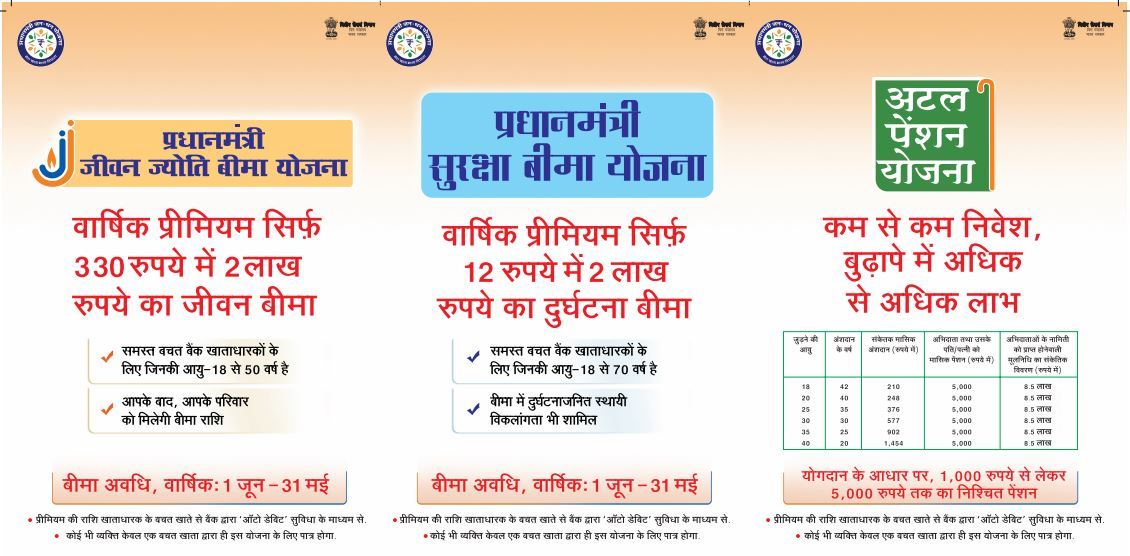
    The budget 2015-16 had announced 3 Social Security Schemes:
    #1. Pradhan Mantri Suraksha BimaYojna (PMSBY)
    #2. Pradhan MantriJeevan Jyoti Bima Yojana (PMJJBY)
    #3. Atal Pension Yojana (APY)

    Why the schemes?

    • India faces the biggest challenge of providing banking facilities and insurance coverage to all
    • Having access to institutional finance has so far remained a far cry to a vast chunk of rural population
    • As of May 2015, only 20% of India’s population has any kind of insurance and only 11% has any kind of pension scheme
    • Insurance is a way of managing risks & give necessary protections in case of financial loss
    • When one has an insurance policy, certain rights and protections are derived out of it to the person and his family
    • There is a dire need for providing social security at a very nominal cost to the millions and economic empowerment of the poor <what is social security? Why is it lacking in our country? Answer in comments.>
    • PMJDY is a major step to bring people across the country closer to institutionalized finance, and save them from the clutches of informal financiers
    • However, most of the PMJDY accounts had zero balance initially. The government aims to reduce the number of such zero balance accounts by using these schemes <what is the proportion of zero balance account now? Answer in comments.>

    PMSBY & PMJJBY:


    • Implementation: The scheme will be offered by all Public Sector General Insurance Companies and all other insurers who are willing to join the scheme and tie-up with banks for this purpose
    • Govt Contribution: Various Ministries can co-contribute premium for various categories of their beneficiaries from their budget or from Public Welfare Fund created in this budget from unclaimed money
    • Auto-debit: The premium amount will be auto debited from subscriber’s bank account
    • The schemes will be linked to the bank accounts opened under the Pradhan Mantri Jan Dhan Yojana scheme

    Criticisms of PMSBY:

    • Private banks have complained that the Govt should focus on upper middle class instead of the poorer section
    • Western scholars have argued that financial inclusion is a myth and serving such large number of people would only increase the burden and work-load of public sector

    Criticisms of PMJJBY:

    • The banks have complained that revenue received will be very low
    • Some bankers have claimed that amount they are receiving is not sufficient to cover the service costs
    • Insurers have also pointed out that no health certificate or information of pre-existing disease is required for joining

    Atal Pension Yojana

    • It focuses on the unorganized sector where nearly 400 million employees representing more than 80% of all employees are engaged <what is unorganized sector? differentiate b/w informal and unorganized? Answer in comments.>
    • The aim is to make sure that needy people could get fixed amount when they get old
    • It is the improved version of Swavalamban scheme, launched in 2010-11, which has been found lacking in clarity with regard to pension benefits at the age after 60

    Features:

    • All citizen of India aged between 18-40 years are eligible
    • A guaranteed minimum monthly pension will be provided to the subscribers varying from Rs. 1000 to Rs. 5000 per month
    • The pension amount depends on contribution by subscriber
    • Government of India will guarantee the minimum benefit of pension
    • Most interesting part of the scheme is that the government will contribute 50% of the contribution made by the subscriber or Rs. 1000 whichever is lower
    • However, contribution by the govt is available for only those who are not income tax payers and are not covered by any Statutory Social Security Schemes
    • Bank account holder of Any Bank account is eligible

    Suraksha Bandhan drive- Spreading the social security message

    • Aim: To take forward the Govt’s objective of creating a universal social security system in the country, targeted especially at the poor and the under-privileged
    • Participating Banks supported by the participating Insurance Companies are carrying out local outreach, awareness building and enrolment facilitation under the drive
    • Public service organizations supported by peoples representatives are participating in these efforts through various outreach activities such as enrolment drives, camps etc. in large numbers during this period

    Published with inputs from Swapnil
  • Pandit Deendayal Upadhyay Shramev Jayate Karyakram

    Why labour reforms?

    • Multiplicity of labour laws and the difficulty in their compliance has always been cited as an impediment to the industrial development
    • The World Bank annual report for year 2014 on Indian Labour Laws- The Indian states with flexible labour laws and easier compliance mechanism have fared better in terms of Industrial development than those where labour laws are rigid and the compliance is difficult as well
    • Ease of compliance has also been found to be important for the growth of organized sector
    • It is needed to amend the labour laws and make them flexible for the present circumstances
    • It is also important to ensure that the compliance is made easy as this will encourage the development of manufacturing industry particularly MSME sector in the country

    #1. Shram Suvidha Portal

    Aim: To create a conducive environment for industrial development Features:

    • Unique labour identification number (LIN) will be allotted to Units to facilitate online registration
    • Filing of self-certified and simplified Single Online Return by the industry Mandatory uploading of inspection Reports within 72 hours by the Labour inspectors
    • Timely redressal of grievances will be ensured with the help of the portal

    Advantage:

    • Ease in compliance of provisions related to labour
    • A step forward in promoting the ease of doing business
    • The complete database will add to the informed policy process

    #2. Labour Inspection

    Aim: To bring in transparency in labour inspection So far, the units for inspection were selected locally without any objective criteria Features:

    • Serious matters are to be covered under the mandatory inspection list
    • A computerized list of inspections will be generated randomly based on pre-determined objective criteria
    • Complaints based inspections will also be determined centrally after examination based on data and evidence
    • There will be provision of Emergency List for inspection of serious cases in specific circumstances

    Advantage: A transparent Inspection Scheme will provide a check on the arbitrariness in compliance mechanism

    #3. Universal Account Number (UAN)

    • Under the scheme, complete information for approximately 4 crore subscribers of EPF has been centrally compiled and digitized & a UAN has been allotted to all
    • The UAN is being seeded with Bank account and Aadhar Card and other KYC details for financial inclusion of vulnerable section of society
    • Camps are being organized to facilitate opening of bank account and Aadhar card for those subscribers who have no bank account or Aadhar card

    Advantage: This will ensure portability of the Social Security Benefits to the labour of organised sector across the jobs and geographic areas

    #4. Recognition of Brand Ambassadors of ITIs

    Need:

    • The Industrial Training Institutes (ITIs) in the country are the backbone of the vocational training system, only source of supply of skilled manpower to manufacturing industry
    • There are 11,500 ITIs having about 16 lakh seats. But this is grossly inadequate for supplying skilled manpower to Indian industry
    • Only 10% of the workforce has got formal or informal technical training. Only one fourth of this is formally trained
    • Whereas in South Korea, Japan, Germany, the percentage of workforce having received skills training is 96, 80 and 75 respectively
    • Therefore we need to rapidly expand certificate level vocational training if we have to succeed in our mission of ‘Make in India’
    • Also, blue collar work is not respected and regarded in the society

    Features:

    • Over 60 years of existence ITIs have given excellent technician, mechanics, entrepreneurs and professional leaders & manufacturing sector is reservoir of this success
    • They have brought name and fame in the country and abroad It is proposed to compile these success stories and publish in print and electronic form
    • These success stories shall be used for motivating youngsters and their parents
    • Such successful ITI graduates will be showcased as National Brand Ambassadors of Vocational Training

    Advantages:

    • It will serve as communicator and catalyst, taking the message of ITI vocational training to every section of society
    • Improve the brand image as well as social acceptance of the vocational training

    #5. All India Skill Competition

    Aim: To foster the healthy spirit of competitiveness among the trainee Craftsmen/ Apprentices Competitions:

    • All India Skill Competition for Craftsmen among trainees admitted under Craftsmen Training Scheme (CTS)
    • All India Competition for Apprentices among trainees admitted under Apprenticeship Training Scheme (ATS)

    #6. Apprenticeship Protsahan Yojna

    The Apprentices Act 1961 was enacted for regulating the Apprenticeship Training Scheme in the industry for imparting on-the-job training to apprentices Need:

    • Presently, there are only 2.82 lakh apprentices undergoing training against 4.9 lakh seats
    • Present framework tightly regulates the number of apprentices trade-wise, and is not attractive to youth because of low rate of stipend
    • Also, the industry is averse to participate because the scheme is not viable for the small industries
    • There are a large number of establishments including MSMEs where training facilities are available but could not be utilized so far

    Aim: To revamp the apprenticeship Scheme in India with the vision of increasing apprenticeship seats to more than 20 lakhs in next few years Components:

    • Making the legal framework friendly to both, industry and youth
    • Enhancing the rate of stipend and indexing it to minimum wages of semi-skilled workers
    • Support manufacturing units mainly and other establishments by reimbursing 50% of the stipend paid to apprentices during first two years of their training
    • Basic training component (mainly class room training part) of the curricula is being restructured on scientific principles to make it more effective, and MSMEs will be supported financially by govt

    Advantage:

    • Apprenticeship Scheme has huge potential for training the large number of young person’s to make them employable
    • Similar schemes have been highly successful in countries like Germany, China and Japan where the number of apprentices are stated to be 30, 20 & 10 million respectively
    • If properly revamped, it could also significantly contribute to ‘Make in India’ Mission

    Let’s end this article with a nice summary from The Hindu


      Follow this story for updates on labour reforms- Labour reforms in India Suggested readings:


    Published with inputs from Swapnil
  • Housing for All by 2022


    • PM Modi- ‘By the time the Nation completes 75 years of its Independence, every family will have a pucca house with water connection, toilet facilities, 24×7 electricity supply and access’
    • To achieve this objective, Govt has launched a comprehensive mission ‘Housing for All by 2022’
    • The programme is launched by the Ministry of Housing and Urban Poverty Alleviation (MoHUPA)

    Features

    • It will be implemented during 2015-2022
    • Will provide central assistance to implementing agencies through States and UTs for providing houses to all eligible families/beneficiaries by 2022
    • Will be implemented as Centrally Sponsored Scheme (CSS) except for the component of credit linked subsidy which will be implemented as a Central Sector Scheme <what’s the difference b/w centrally sponsored and central sector schemes? Answer in comments>
    • Mission with all its component has become effective from 17 June, 2015 and will be implemented upto 31 March, 2022
    • All 4041 statutory towns as per Census 2011 with focus on 500 Class I cities would be covered in three phases: Answer in comments>
    1. Phase I (April 2015 – March 2017) to cover 100 Cities selected from States/ UTs as per their willingness
    2. Phase II (April 2017 – March 2019) to cover additional 200 Cities
    3. Phase III (April 2019 – March 2022) to cover all other remaining Cities

    Ministry, however, will have flexibility regarding inclusion of additional cities in earlier phases in case there is a resource backed demand from States/ UTs

    • The mission will support construction of houses upto 30 square meter carpet area with basic civic infrastructure
    • The minimum size of houses constructed under the mission under each component should conform to the standards provided in National Building Code (NBC)
    • The houses should be designed and constructed to meet the requirements of structural safety against earthquake, flood, cyclone, landslides etc. conforming to the National Building Code and other relevant Bureau of Indian Standards (BIS) codes
    • The houses should be in the name of the female head of the household or in the joint name of the male head of the household and his wife, and only in cases when there is no adult female member in the family, the house can be in the name of male member of the household
    • Implementing Agencies should encourage formation of associations of beneficiaries under the scheme like Resident Welfare Association etc. to take care of maintenance of houses being built under the mission

    Components

    The Mission will be implemented through four verticals giving option to beneficiaries, ULBs and State Governments


    Beneficiaries

    • The mission seeks to address the housing requirement of urban poor including slum dwellers

    What is a slum? It is defined as a compact area of at least 300 people or about 60-70 households of poorly built congested tenements in unhygienic environment usually with inadequate infrastructure and lacking in proper sanitary and drinking water facilities

    • Beneficiaries include Economically weaker section (EWS) and low-income groups (LIGs)

    The annual income cap is up to Rs 3 lakh for EWS and Rs 3-6 lakh for LIG. EWS category of beneficiaries is eligible for assistance in all four verticals of the Missions whereas LIG category is eligible under only Credit linked subsidy scheme (CLSS) component of the Mission

    • A beneficiary family will comprise husband, wife, unmarried sons and/ or unmarried daughters
    • The beneficiary family should not own a pucca house either in his/ her name or in the name of any member of his/ her family in any part of India to be eligible to receive central assistance under the mission
    • The total housing shortage envisaged to be addressed through the new mission is 20 million Answer in comments>


    Follow this story for updates on housing scheme- India’s urbanisation agenda


    Published with inputs from Swapnil

     

  • Important Judgements of the Supreme Court in 2015 | Part 6


    #11. Obscene language cannot be allowed against historically respected personalities

    Devidas vs. State of Maharashtra

    Summary:

    The Apex Court in a significant judgment rendered held that in the name of artistic freedom or critical thinking or generating the idea of creativity, a poet or a writer cannot put into the voice or image of a “historically respected personality” like Mahatma Gandhi, such language, which may be obscene.

    Background:

    • A Bench of the Supreme Court comprising of Justices Dipak Misra and Prafulla C Pant was considering the appeal preferred by a bank employee
    • He was alleged for publishing a “vulgar and obscene” poem- ‘Gandhi Mala Bhetala Hota’ (‘I Met Gandhi’) using the name of Mahatma Gandhi in an in-house magazine of the Bank of Maharashtra Employees Union in 1994

    SC observations:

    • The freedom of speech and expression “has to be given a broad canvas, but it has to have inherent limitations which are permissible within the constitutional parameters
    • The Supreme Court refused to express any opinion on whether freedom of speech included the freedom to offend
    • In determining ‘obscenity’ under Section 292 IPC, the test evolved by the Apex Court is the ‘contemporary community standards test’

    The counter view:

    • The poem does not use obscene words and it does not come within the ambit and sweep of Section 292 IPC
    • The poet has expressed himself as he has a right to express his own thoughts in words
    • The poem actually expresses the prevalent situation in certain arenas and the agony and anguish expressed by the poet through Gandhi and thus, the poem is surrealistic presentation

    Section 292, IPC:

    • An object is deemed to be obscene if- It is lascivious or appeals to the pruri­ent interest or if its effect tends to deprave and corrupt person
    • Objects covered- A book, pamphlet, paper, writing, drawing, painting, representation, figure or any other object

    You may like to read the critical analysis of the judgement here.

    #12. Appointment of Archakas to be made in accordance with Agamas


    Adi Saiva Sivachariyargal Nala Sanga vs. Government of Tamil Nadu

    The Constitutional legitimacy, naturally, must supersede all religious beliefs or practices: Supreme Court

    Summary:

    The Supreme Court of India, in, has held that appointments of Archakas in temples will have to be made in accordance with the Agamas, subject to their due identification as well as their conformity with the Constitutional mandates and principles. Apex Court bench comprising of Justices Ranjan Gogoi and N.V. Ramana made this observation while disposing of a batch of Writ petitions filed against Tamil Nadu Government order regarding appointment of Archakas in temple.

    SC observations:

    • The exclusion of some and inclusion of a particular segment or denomination for appointment as Archakas would not violate Article 14 so long such inclusion/ exclusion is not based on the criteria of caste, birth or any other constitutionally unacceptable parameter
    • If the appointment as Archakas is not on the basis of caste or class, the sanctity of Article 17 or any other provision of Part III of the Constitution or even the Protection of Civil Rights Act, 1955 will not be violated
    • If any prescription with regard to appointment of Archakas is made by the Agamas, Section 28 of the Tamil Nadu Act mandates the Trustee to conduct the temple affairs in accordance with such custom or usage
    • The requirement of Constitutional conformity is inbuilt and if a custom is outside the protective umbrella of Articles 25 and 26, the law would certainly take its own course
    • The constitutional legitimacy, naturally, must supersede all religious beliefs or practices

    Published with inputs from Swapnil
  • Pradhan Mantri Mudra Yojana: Funding the unfunded


    Pradhan Mantri Mudra Yojana (PMMY) is a flagship scheme of Government of India to enable a small enterprise come into the formal financial system and get affordable credit to run his/ her business.

    • Who? Any Indian Citizen who has a business plan for a non-farm sector income generating activity
    • Credit need? Less than Rs 10 lakh
    • Possible Creditors? Banks, MFI, or NBFC

    Types of Loans provided

    Under the aegis of Pradhan Mantri MUDRA Yojana, MUDRA has already created the following products / schemes.

    • Shishu : covering loans upto 50,000/-
    • Kishor : covering loans above 50,000/- and upto 5 lakh
    • Tarun : covering loans above 5 lakh and upto 10 lakh

    Note that there is no subsidy for the loan given under PMMY. However, if the loan proposal is linked some Government scheme, wherein the Government is providing capital subsidy, it will be eligible under PMMY also.


    What is MUDRA Bank and what is its role in the MUDRA Yojna?

    • MUDRA Bank = Micro Units Development and Refinance Agency Bank
    • The Rs 20,000 crore MUDRA Bank aims to provide refinancing to small and medium enterprises, particularly those from SC & ST
    • The idea is to refinance micro-finance institutions through Pradhan Mantri Mudra Yojana
    • This bank would be responsible for regulating and refinancing all MFIs which are in the business of lending to MSME

    Are there any concerns regarding the structure or establishment of MUDRA bank?

    • The bank will be financially challenged since inception, if it is funded through non-budgetary support
    • The funds for the bank would be sourced from shortfall in the achievements of the priority sector lending (PSL) targets
    • Currently, the shortfall in the PSL targets of the domestic scheduled commercial banks are deposited in Rural Infrastructure Development Fund (RIDF) and for foreign banks in Small Enterprises Development Fund
    • The fact of the matter is that banks have been surpassing the targets in all years, since 2002, except for the last three years
    • The shortfall lies only in agricultural loans, but it would be unfair to divert the target for agriculture from RIDF to micro units

    What are some of the positive points which go in favour of such a scheme?

    • Informal sector accounts for 90% of our non-agricultural workforce, 50% of the GDP & 40% of the non-farm GDP
    • Analysts point that the Indian GDP can be raised by almost 15% if the informal sector data is incorporated in the GDP series
    • The MUDRA bank aims to boost loans and cut borrowing costs for the cash-starved domestic small businesses

    But has a direct intervention from government (to facilitate loans) worked in past?

    What are some of the prominent concerns in this area?

    • There is always a case for direct government intervention to solve any one of our many chronic problems, to justify the need for MUDRA bank
    • The govt. is trying to ensure equity through determined government action that previously drove the govt. to nationalise banks and bring priority sector lending
    • However, such ‘directed credit’ has not worked successfully in the past
    • The govt. control over banks had led to large-scale corruption and repeated recapitalisation through taxpayers’ money
    • MUDRA bank has been over-burdened with many conflicting objectives and too-many roles, viz. a lender, consultant, regulator, think tank and an agent of social change
  • Everything that you need to know about Mission Indradhanush


    Mission Indradhanush was launched by the Ministry of Health and Family Welfare, Government of India on December 25, 2014.

    Objective

    1. Aims to cover all those children by 2020 who are either unvaccinated, or are partially vaccinated against 7 vaccine preventable diseases
    2. The diseases are – diphtheria, whooping cough, tetanus, polio, tuberculosis, measles and hepatitis B

    How is the government going about the implementation?

    1. Implementation will be done in phases in a “catch up” mode – the aim is to cover all the children who have been left out or missed out for immunization
    2. Technically supported by WHO, UNICEF, Rotary International and other donor partners
    3. Phase 1 targets 201 districts | Phase 2 targets 352 districts
    4. The first round of the first phase started from 7 April 2015-World Health Day
    5. What’s interesting about the Phase 1 districts? These 201 high focus districts in the country have nearly 50% of all unvaccinated or partially vaccinated children!
    6. Out of the 201 districts, 82 districts are in just four states of UP, Bihar, Madhya Pradesh and Rajasthan

    What are the 4 pillars of strategy for Mission Indradhanush?

    #1. Meticulous planning of campaigns/sessions at all levels

    • Within the districts, the Mission will focus on the 400,000 high risk settlements identified by the polio eradication programme
    • 400,000 high risk settlements include urban slums, construction sites, brick kilns, nomadic sites and hard-to-reach areas
    • Such a planning needs a timely revision of micro plans in all blocks and urban areas in each district to ensure availability of sufficient vaccinators & vaccines

    #2. Effective communication and social mobilization efforts

    • Generate awareness and demand for immunization services through need-based communication strategies and social mobilization activities
    • Use of mass media, mid media, interpersonal communication (IPC), school and youth networks and corporates

    #3. Intensive training of the health officials and frontline workers

    • Capacity building has been the core of any social sector scheme and this just reinforces the point #1

    #4. Establish accountability framework through task forces

    • Strengthening the district task forces for immunization in all districts
    • Ensuring the use of concurrent session monitoring data to plug the gaps in implementation on a real time basis
    • Collaboration with other Ministries, ongoing programmes and international partners to promote a coordinated and synergistic approach

    For current updates, follow our story on – Mission Indradhanush – 100% health immunization coverage by 2020

  • Dedicated Freight Corridors | The Future of railways

    Freight operations on the Indian Railways are set to witness a paradigm shift with the stage-wise completion of its two dedicated freight corridors, the Western Dedicated Freight Corridor (WDFC) and the Eastern Dedicated Freight Corridor (EDFC), over the next four years, beginning 2017-18.

    Why DFCs?

    #1. Congestion:

    Indian Railways plans to handle higher freight volumes without- increase in infrastructure, increased axle load, reduction of turn-round time, reduced unit cost of transportation, rationalization of tariffs

    Example- Golden Quadrilateral Freight Corridor (GQFC)

    What is GQFC?

    • It links 4 metropolitan cities of Delhi, Mumbai, Chennai and Kolkata and its two diagonals- Delhi-Chennai & Howrah-Mumbai
    • It has a total route length of 10,122 km

    The problem with GQFC:

    • It carries more than 55% of revenue earning freight traffic of Indian Railways
    • The existing routes of Howrah-Delhi and Mumbai-Delhi are highly saturated
    • The line capacity utilization is around 115% to 150%

    #2. Single tracks:

    As mentioned in the recent rail budget- We run fast passenger trains, slow trains, goods trains all on the same track. Hence trains like Rajdhani which can achieve speeds upto 130kmph run at average 70kmph. Also goods trains have to wait to let passenger train pass and this causes also supply delays.

    #3. Chronic under-investment in the railways:

    This had led to congestion and over-utilization, along with sub-optimal freight and passenger traffic and fewer financial resources. The 12th Plan points out the urgency of investments as- If consistent growth of 7-10% per annum is to be achieved over the next 20 years, there is a pressing need for unprecedented capacity expansion of the railways for both freight and passenger traffic in a manner that has not taken place since Independence.

    #4. The surging power needs requiring heavy coal movement, booming infrastructure construction and growing international trade

    #5. Carbon emission reduction may help India claim carbon credits

    #6. Railway’s falling share of goods traffic:

    According to 12th Plan- The Indian railways transports only 36% of the total goods traffic in the country, compared to the 48% in the US and 47% in China. Whereas, nearly 57% of the total goods are transported by road in India, as compared to 22% in China and 37% in the US.

    Dedicated Freight Corridor Corporation of India (DFCCIL)


    • It is a Special Purpose Vehicle established by the Ministry of Railways in 2006
    • Aim: To undertake planning & development, mobilisation of financial resources and construction, maintenance and operation of the DFCs
    • It has been registered as a company under the Companies Act 1956

    The Corridors

    #1. Sanctioned (and under construction)

    • Western DFC: From Dadri, UP to Jawaharlal Nehru Port, Mumbai- 1,468 km
    • Eastern DFC: From Ludhiana, Punjab to Dankuni, West Bengal- 1,760 km

    #2. Planned (but not yet started)

    • East-West DFC- connecting Kolkata and Mumbai- 2,000 km
    • North-South DFC- connecting Delhi and Chennai- 2,173 km
    • East Coast DFC- connecting Kharagpur with Vijayawada- 1,100 km
    • South-West DFC- connecting Chennai and Goa- 890 km

    #3. Proposed (neither sanctioned nor planned)

    Bangalore-Chennai DFC- This DFC goes through Bangalore-Chennai Industrial Corridor promoted by Japan & India

    Advantages

    • Railways’ freight operations will see a fundamental change by operationalisation of these corridors
    • It will help the railways regain its market share of freight transport
    • Provide an efficient, reliable, safe and cheaper system of goods movement
    • Provide relief to the railways’ heavily congested GQFC along the western and eastern rail routes
    • Facilitate fresh industrial activity and multi-modal value-addition services hubs along the corridors
    • Reduction in unit cost of transportation, smaller organization and management cost, higher efficiency and lower energy consumption
    • WDFC  will mainly  benefit  export-import  container   traffic, besides petroleum,  oils and  lubricants,  imported fertilizers and coal, foodgrains, cement, salt, and iron and steel
    • EDFC will benefit traffic of coal for power plants in the northern region from coalfields in Bihar, Jharkhand and Bengal as also finished steel, foodgrains and cement

    Progress

    Remember, we have to be diplomatic while citing the progress. So here it goes…

    • The major achievements for the two sanctioned projects is the completion of negotiation for EDFC-3 Project and loan amount of US$ 650 million sanctioned by World Bank
    • 86% of the 10548 hectares land required has been acquired and most environmental clearances have been obtained
    • DFCCIL has implemented one of the best rehabilitation and resettlement packages for the people affected by the projects
    • Compensation as per the new land acquisition Act has been started with effect from 1st January, 2015
    • By mid-2016, most contracts for the Rs 81,459 crore projects are planned to be awarded

    Here’s a question for you– Differentiate between Golden Quadrilateral (GQ), Golden Quadrilateral Freight Corridor (GQFC) & Diamond Quarilateral (DQ) projects.

    Suggested readings:


    Published with inputs from Swapnil