💥Join UPSC 2027,2028 Mentorship (July Batch) + XFactor Notes & Microthemes PDF

Author: Explains

  • Decodified: The Landmark Trans-Pacific Partnership


    What is the TPP?

    Trans-Pacific Partnership (TPP) is a trade agreement between several Pacific Rim countries concerning a variety of matters of economic policy.

    The aims of the TPP include the lowering of barriers to trade in goods and services, reducing tariffs to zero by 2015. In addition, the TPP hopes to promote investment and job creation in member states.


    How does it come into reality?

    TPP initially called the Trans-Pacific Strategic Economic Partnership Agreement, the pact began as a 2005 trade agreement between Brunei, Chile, New Zealand and Singapore in an effort to integrate their economies, drive growth and create unified regulations.

    In 2008, during the Bush administration, the U.S. joined talks to expand the agreement, along with Australia, Peru and Vietnam. The U.S. trade representative under Obama, Ron Kirk, declared the American interest in forging a broad-based regional pact.

    Then, in 2010, under the new name the Trans-Pacific Partnership, Malaysia entered the discussions, followed by Canada and Mexico in 2012.

    By 2013, Japan began participating in the talks. South Korea and Taiwan have subsequently announced their interest but not formal participation.

    Though all of the negotiating parties belong to the Asia-Pacific Economic Cooperation forum (APEC), the TPP is a separate initiative but with similar goals as APEC’s proposed Free Trade Area of the Asia Pacific.


    Why the Trans-Pacific Partnership Matters?

    The Pacific accord would phase out thousands of import tariffs as well as other barriers to international trade, like Japanese regulations that keep out some American-made autos and trucks.

    It also would establish uniform rules on corporations’ intellectual property, and open the Internet even in communist Vietnam.

    It eventually would end more than 18,000 tariffs that the participating countries have placed on American exports, including autos, machinery, information technology and consumer goods, chemicals and agricultural products as varied as avocados in California and wheat, pork and beef from the Plains states.

    The trade ministers who negotiated it predicted the overall economic and political heft of the 12-nation group would turn the accord into a model for future trade agreements.

    It would overhaul the system for settling disputes between nations and foreign companies, while barring tobacco companies from using that process to block countries’ antismoking initiatives.

    It also would enforce higher standards for labor conditions and environmental protection, including wildlife-trafficking.

    How will it benefits to USA ?

    Expanding the orbit of U.S. free trade is a major foreign policy goal of the Obama administration, and as a part of its desired international “pivot” toward Asia, it hopes to increase its economic presence in the region.

    Supporters of the partnership say by lowering barriers to trade and increasing avenues for economic globalization, the enlarged $2 trillion zone of diminished tariffs would stimulate employment in U.S. and provide an incentive to invest abroad.

    Agreement hopes to show China that the U.S. will remain a committed economic partner for the nations of the Pacific Rim, without excessively provoking Beijing.

    Who opposes the TPP?

    Opposition to the proposed agreement and to the perceived influence of multinational corporations in the process has been led by public health advocates, labor groups and environmentalists and politicians.

    Some U.S. legislators have voiced concerns that the TPP requirements would prevent access to medicine in developing countries, due to excessive patent protection. Doctors Without Borders argues against “dangerous provisions that would dismantle public health safeguards enshrined in international law.”

    Many activists also focused criticisms on the intellectual property section of the proposed partnership, which, according to WikiLeaks, could have “wide-ranging effects on medicines, publishers, internet services, civil liberties and biological patents.”

    As a trade agreement, the TPP would require House and Senate majorities and then the president’s signature. Domestic American opposition has concentrated their skepticism not just on how “free” the agreement would be but also on problems with the “fast track” congressional voting procedure.

    Japanese producers in the anime and manga industry say the TPP could damage their business by allowing companies to halt imports of intellectual property, in order to protect local distributors of licensed merchandise.

    Rice farmers, as well as beef, poultry and pork producers, have mounted firm resistance to the pact, which would dramatically decrease import tariffs.

    Geopolitically, China is concerned that the partnership is designed to exclude its economic activities, while some American officials have expressed doubts whether the market-oriented pact would ever be compatible with Beijing’s command economy.

    In Europe, analysts view the TPP as a trade regime that could set a precedent for the nascent Transatlantic Trade and Investment Partnership (TTIP).


    Published with inputs from Arun
  • FMC-SEBI Merger: The Road Ahead

    Recently, FMC-SEBI merger made lot of news. Let’s try to understand the underlying issues and what benefits commodity markets will reap, after coming under SEBI.

    Before, we proceed into the issue of merger, let’s explore FMC and SEBI.

    What is Forward Markets Commission ?

    • Setup under forward contracts regulation Act.
    • Regulating commodities market since 1953.
    • Lack of powers to FMC has led to wild fluctuations & alleged irregularities.

    What is Securities Exchange Board of India ?

    • Setup in 1988 as a non statutory body for regulating the securities market.
    • In 1992, it became an autonomous body with fully independent powers.
    • Securities Contract Regulation Act 1956, gives more power to SEBI.

    Why there is a need for merger?

    In 2013, NSEL scam underlined the need for better & stronger regulator to safeguard investor interest & restore confidence.

    • To streamline the regulations & wild speculations in commodities market.
    • Fragmented regulations architecture in India.
    • To facilitate further growth of market.
    • To further expand the scope of commodity trading.
    • SEBI is better equipped to monitor commodities trading.
    • Illegal activities like dabba trading are more frequent in this segment.
    • A merged regulator will enhance the integrity of financial markets, & also boost liquidity & improve price discovery process.
    • FSLRC stressed on the need to move away from sector-wise regulation.

    How SEBI is better equipped to monitor commodities market than FMC?

    • FMC only regulated the exchange & had no direct control over the brokers.
    • SEBI has a superior surveillance, risk monitoring & enforcement mechanism.
    • Recent amendment has given SEBI, the power to access call records.
    • FMC was handicapped in terms of the regulatory & manpower resources required to police this segment.

    How SEBI can expand the scope of commodities trading ?

    • Currently , FIIs are restricted from participating in commodities trading at exchanges.
    • SEBI may allow FII participation in commodities trading going forward.
    • This will provide more depth to the markets, leading to :
      • Increase liquidity
      • Investor participation
      • Better price discovery
    • SEBI will also oversee price determination of commodities, as it has been a major issue in commodities trading.
    • If SEBI addresses this concern , then it will give big boost to participants confidence.

    What are the challenges for SEBI ?

    • Lacks knowledge about the commodities market.
    • State govt. have jurisdictional power over agricultural marketing.
    • Political sensitivities involved with farm commodities.

    What should be the future approach of Govt. to strengthen the financial markets ?

    Govt. should merge the insurance & pension regulator, making a future case of unified regulator for financial market as a whole, as suggested by FSLRC.

    Before, we wind up, let’s have a look at some international examples in this regard

    Most countries have a unified securities & commodities market regulator expect US & Japan.


    Published with inputs from Pushpendra
  • A Primer on India – Sri Lanka Foreign Relations


    The Broad Sketch of our bilateral relationship

    • India and Sri Lanka hold important position in the Asian continent based on location, people, ethnicity, culture.
    • The relationship between the two countries were good since their  independence until the Sri Lankan Civil War, with the Indian intervention through Indian Peace Keeping Force (IPKF).
    • The key issues which are important for India are  fishermen issue, Kachchatheevu, 13th amendment and the Chinese influence in Sri Lanka.

    Historical issues and their recurrence

    • Sri Lanka is very much close to India and so the Indian fishermen tend to move away into the Sri Lankan waters very often. This is a recurring issue when we follow the news everyday. But the issue arises due to the maritime demarcation between India and Sri Lanka.
    • In 1974, the Indian government recognized Kachchatheevu as a Sri Lankan territory on a conditional agreement with few provisions for the Indian fishermen.

    What are the key provisions?

    • The Indian government wanted the Sri Lankan government to allow the fishermen from India to use the Kachchatheevu Island for their fishing purposes and also to allow Indians to participate in the St.Antony’s Catholic Church festival which is held yearly once.
    • The island was given to Sri Lanka without the ratification of the Indian Parliament.
    • The provisions were included due to political agitations in Tamil Nadu.

    Ethnic conflicts and the LTTE

    It is important to understand the issue which led India into Sri Lanka

    • Sinhalas are the majority in Sri Lanka with 70% of the population.
    • The Sri Lankan Tamils, Indian Tamils and Moors are the remaining part of the population.
    • The conflict between the Tamils and Sinhalas started due to the suppressive Sinhala only Act which recognised only the Sinhalas as the citizens of Sri Lanka and it did not recognise the other ethnic minority communities.
    • This led to the Sri Lankan Civil War which began on 23rd July 1983 and lasted till 18th May 2009.
    • Liberation Tigers of Tamil Eelam (LTTE), a militant organisation was formed in 1976 to fight against Sri Lankan government and also to create a nation for the Tamils.
    • LTTE gained momentum in 1983 with the attacks against the Sri Lankan officials.
    • They occupied the northern and north eastern parts of the Sri Lanka. LTTE is one of the militant organisation in the world, believed to have been destroyed completely.

    Indian intervention in the Sri Lankan Civil War

    • The Indian intervention is one of the key issues which had its impact on Indian government.
    • The Indian military forces were deployed in Sri Lankan territories to ensure peace and security. They were named as Indian Peace Keeping Force (IPKF).
    • The deployment of  IPKF followed the Indo-Sri Lankan Accord signed in 1987 with an aim to end the Sri Lankan Civil War.
    • However the IPKF and LTTE involved in serious battle for two years till 1989, complete withdrawal of the IPKF happened in 1990.

    What is the 13th amendment?

    • The amendment aims at creating provincial councils in Sri lanka and enable Sinhalese and Tamil as national languages while preserving English as the link language.
    • Devolution of power to the provinces.
    • Merger of the northern and eastern provinces  and official status for the Tamil language.

    Assassination of Rajiv Gandhi

    • In 1991, Rajiv Gandhi was assassinated by suicide bombing by the LTTE cadre.
    • This led to a major setback in the relationship between the two countries.

    What about the commercial ties?

    • The two nations are members of SAARC , South Asia Co-operative Environment Programme, South Asian Economic Union, and BIMSTEC which helps to improve the cultural and commerce between them.
    • They signed a bilateral Free Trade Agreement in 2000 which provided huge benefits for both the sides through trading activities.
    • India and Sri Lanka are signatories of South Asia Free Trade Agreement (SAFTA).
    • NTPC India will provide assistance to setup a Thermal Power Plant in Sri Lanka which is a key development in the relationship between the two nations.

    China’s influence in Sri Lanka

    • The Chinese provided all the needs of Sri Lanka with the construction of a huge port in Hambantota.
    • China- Sri Lanka ties are closely monitored by India as the Island nation is the most important player in the Indian Ocean.
    • China has built up a good relationship with an aim to control the economic activities in the South Asian region.
    • But the influence of Chinese in Sri Lanka has given a setback in the country with no development in economy.
    • Chinese utilize them for naval activities as well.

    Government Change. What Next?

    • The change in government in India is a key factor in the relations between India- Sri Lanka.
    • With election of Maithripala Sirisena as President of Sri Lanka earlier this year and the election of Ranil Wickramasinghe as Prime Minister last month, their visits to India is of strategically important.
    • The implementation of 13th Amendment, fishermen issue, Chinese influence in the Island nation are the important issues at the moment for India with them.


  • The Concept of Currency Devaluation & The Chinese Move: Part #2

    This theme has been covered in 2 parts. Read the Part #1, here.


    Before, we proceed to understand the current move, let’s put some light on the background:

    During 1997, most of East Asian countries witnessed financial crisis. This led China to devalue its currency in order to encourage its exports.

    During 2005-06, China had come back to market-determined exchange rates , but later shifted to managed exchange rates.

    Now, let’s take a look at how the recent events unfolded

    Currently, Chinese economy is witnessing slowdown, due to dip in exports.
    Do keep in mind, that China is export-oriented economy, unlike US which is more of consumption-based economy.


    Now, let’s explore the Chinese move.

    Technically, it is depreciation because China has allowed market forces to operate in determining the exchange rates. This is the reason, you may find at times, newspaper writing depreciation.

    Now, the obvious question, why is it called devaluation ?

    Because, Central Bank of China determines when the market forces will play their role.

    Basically, before the this move, Chinese currency was a managed exchange rates, i.e. Central Bank decided the exchange rates.

    As China knew that its currency will depreciate due to economic slowdown, so it allowed market forces to operate, i.e. China withdrew from currency exchange market.

    Now, let’s dive deep into the issue.

    Few questions, which may surface into your mind, that China could have simply devalued its currency. Why does it want market forces to play a role in determining the exchange rate.

    What are the intentions behind such a move ?

    Since Chinese economy is heavily dependent on exports, therefore China wanted to make its exports cheaper & thereby boost its exports.

    China has been demanding from long time, that its currency Yuan, be made a global reserve currency at IMF.

    Now, why would IMF reject such a demand?

    Actually, IMF is a vocal supporter of free market economy, but, Chinese currency was managed by its Central Bank. Therefore, IMF rejected the demand to include Yuan in SDR.

    This was the reason Chinese central bank allowed market forces to play their role.

    Lets understand, Why would China want Yuan to be included in IMF.

    1. When a currency becomes part of SDR, then every country’s Central Bank would hold those currencies as part of their FOREX.
    2. This makes a Yuan a hard currency.
    3. Politically, a country has a major role to play in IMF, once its currency becomes part of SDR.

    Now let’s come to India, the biggest question, what will be the impact on India.

    • We are losing out in export markets with respect to China, as some common exports on which we are competing with China such as textile are facing the heat.
    • As Chinese products will become cheaper in India too, the industries aligned to domestic markets, will also face the pressure.
    • The indirect impact is that many FPI’s are moving out of India, to China and US.

    Published with inputs from Pushpendra
  • The Super Blood Moon Delights Stargazers

    On 27 September, an evening remembered for skywatchers or stargazers in most parts of the world, for they were witness to a rare celestial event, aptly described by many as “once in a generation”.

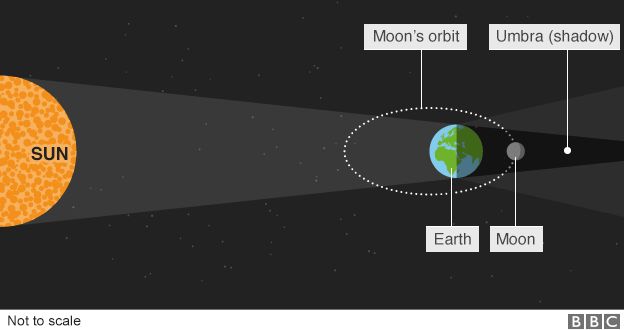
    An exceptional celestial treat is in store for sky gazers as the event, called the Super Blood Moon, saw the Supermoon phenomenon combine with a lunar eclipse (where the Sun, the Earth and a brighter, much larger Moon lined up together).

    The result? The Moon appeared blood red in colour, nearly 30% brighter.


    So, What exactly The Supermoon Is?

    A Supermoon is a phenomenon that occurs when, a full or new Moon coincides with a Moon that is nearing its minimum distance (perigee) to Earth.

    The Moon takes an elliptical orbit around Earth, which means that the average distance between the two changes from as much as 405,000km (its apogee) to as low as 363,000km at the perigee.

    Simply put, the Supermoon occurs when the Moon is at its closest to the Earth. NASA says the phenomenon can make the Moon appear larger by nearly 14% larger than its usual visible size.


    Lunar eclipse


    But, Why the Moon turns red during a total lunar ?

    During a total lunar eclipse, white sunlight hitting the atmosphere on the sides of the Earth gets absorbed and then radiated out (scattered). That is, the atmosphere filters out (scatters away) most of the blue-colored light and what’s left is the orange and red coloured light.

    This red coloured light passes through our atmosphere without getting absorbed and scattered, before the atmosphere bends it (refracts it) back out, projecting indirect, reddish light on to the Moon.

    The reddish light projected on the Moon is dimmer than the full white sunlight that the Moon typically reflects back to us. That’s because the light is indirect and because the red-coloured wave lengths are only part of what makes up the white light from the Sun that the Moon usually receives.

    When we see a sunrise or sunset from our perspective on Earth, sunlight is coming in at a low angle. It has to travel through a lot of atmosphere, scattering more and more blue-colored light as it goes until what is left when the light reaches us at these day/night transition times is the more reddish wavelengths that get through.
    But, interesting fact is that everyone may see a Moon that is brick-coloured, rusty, blood red or sometimes dark grey, depending on terrestrial conditions.

     superblood lunar eclipse


    Do you know next appearance is directly in 2033 ?

    Don’t worry, we have full coverage here.

    Sunday’s event was the first Supermoon lunar eclipse in over three decades. The last time the two phenomena combined was in 1982. The next such occurrence is expected to be 18 years later, in 2033. Sunday also saw the fourth instance of a blood Moon in the last two years as part of the “tetrad series” or a series of four consecutive total eclipses occurring at intervals of approximately six months.

    So, is that We’re basically seeing all of the sunrises and sunsets across the world, all at once, being reflected off the surface of the Moon, How amazing it is !


    Published with inputs from Arun
  • The Concept of Currency Devaluation & The Chinese Move

    This theme will be covered in 2 parts. You are reading the Part 1.

    Recently, China devalued its currency and there was so much hue and cry across the world markets. Let us try to understand these complex processes, and the implications of Chinese move.


    Broadly speaking, what is currency devaluation?

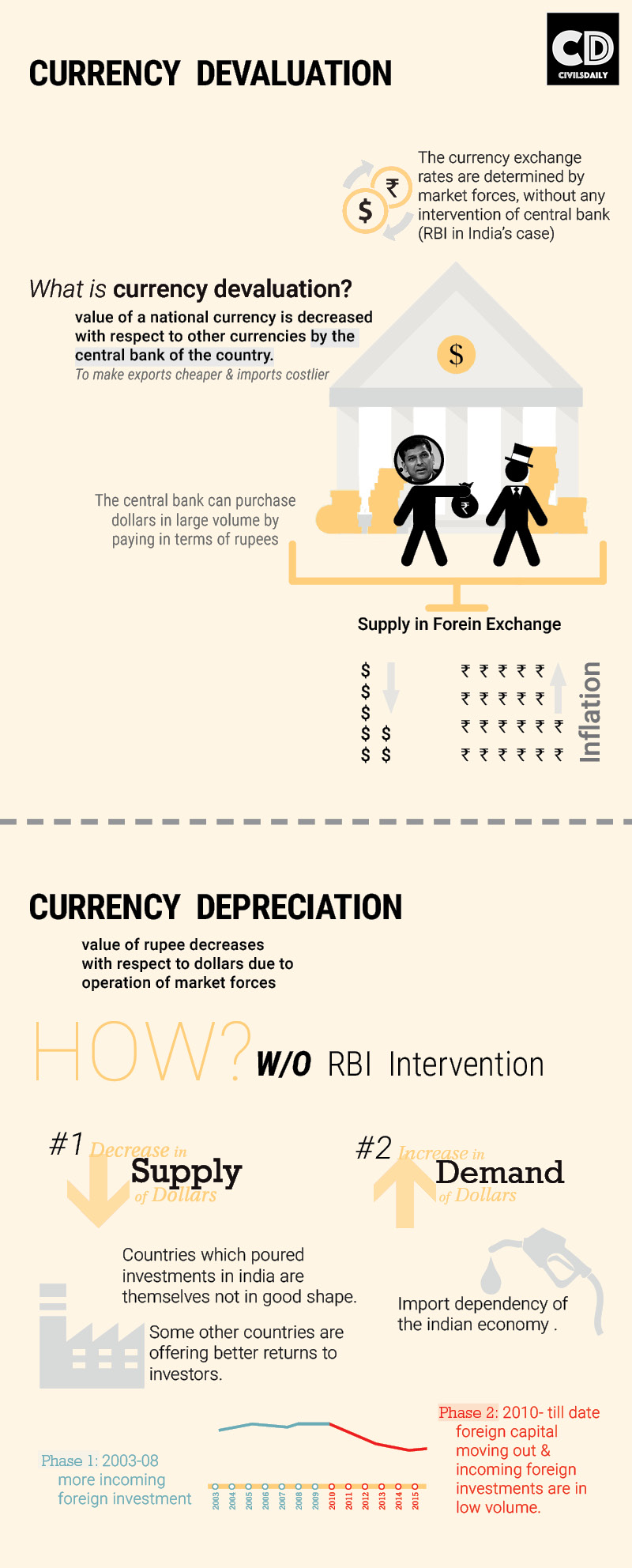
    Under currency devaluation, the value of a national currency is decreased with respect to other currencies by the central bank of the country.

    Before, we delve into the concept of devaluation, lets explore how does currency exchange rates are determined normally. The currency exchange rates are determined by market forces, without any intervention of central bank (RBI in India’s case). <Central Bank and RBI will be used interchangeably in India’s case>


    Now, we will try to understand the process of Devaluation, how it actually happens.

    So, the basic condition for devaluation to happen is that RBI has to become a player in the foreign exchange market.

    Before, we move further, lets explore who all are the players in the forex market. They are importers, exporters, investors & some dealers who deal in foreign exchange (for example exchange banks).

    What will central bank do in the foreign exchange market ?
    The central bank will change the supply of dollars in the market.

    How does it change the supply of dollars in the market?
    The central bank goes to these exchange banks & it will purchase the dollars in large volume by paying in terms of rupees. This will lead to decrease in supply of dollars.

    Now, lets understand the negative implications of such a move.
    As RBI paid in terms of rupees while purchasing dollars, it will increase the money supply in the market, leading to inflation.

    Therefore, devaluation is accompanied with selling of govt. securities.

    RBI can devalue rupee by selling it to purchase dollars in the forex market. It makes exports cheaper & imports costlier & therefore a solution to BOP crisis.


    CURRENCY DEPRECIATION:

    It is a market driven process , determined by market forces.
    Under this, the value of rupee decreases with respect to dollars due to operation of market forces.

    How do the market forces act?

    There are two ways/ causes for currency depreciation :

    #1. Decreases in supply of dollars – without RBI intervention

    This is a very realistic situation that india faced over last few years , when the foreign capital was moving out & foreign investment were not coming in huge volume.

    What could be the reasons? Countries which poured investments in india are themselves not in good shape. Some other countries are offering better returns to investors.

    Phase 1 : 2003-08 – more incoming foreign investment
    Phase 2 : 2010- till date – foreign capital moving out & incoming foreign investments are in low volume.

    #2. Increase in demand of dollars without RBI intervention

    The basic reason behind this is the import dependency of the indian economy .
    This is a traditional reason for depreciation of our currency , since we have been a net import based economy from long time.


    PS: There is another interesting blog on the same topic, written by an economics professor @Civilsdaily – Nursery Rhymes, SDRs and Devaluation of the Yuan

    While you are at it, you might want to read this as well – The Great Fall of China


  • US ke paas Google hai, China ke paas Alibaba hai, India ke paas Kya hai?

    Start-Up India Initiative has been doing the rounds for over a month now and going by the knack of the UPSC to pick-up fancy terms, let’s see if we can deep dive on this topic.


    From the ramparts of the historic Red Fort, Prime Minister announced the “Start-Up India, Stand-up India” to encourage entrepreneurship and job creation.

    Start-Up India aims to make India the hub for the “Start-Ups”.
    However, it is pertinent to discuss the roadblocks to this ambitious plan given that about 80% of the Start-Ups in India fail and also the opportunity it presents if all goes as per the plan.


    We may discuss the issue under the following heads:

    1. Regulatory impediments
    2. Risk aversion
    3. Funding Issues
    4. Gestation Period
    5. Need for Start-Ups
    6. Entrepreneurial SkillSet/ Aptitude
    7. Opportunity to absorb the young work force
    8. Role in making India developed by 2022, the PM’s mission

    Let’s start then!


  • ISRO’s growing prowess journey in launching foreign satellites

    So, you think India has made a dent in the Space world?

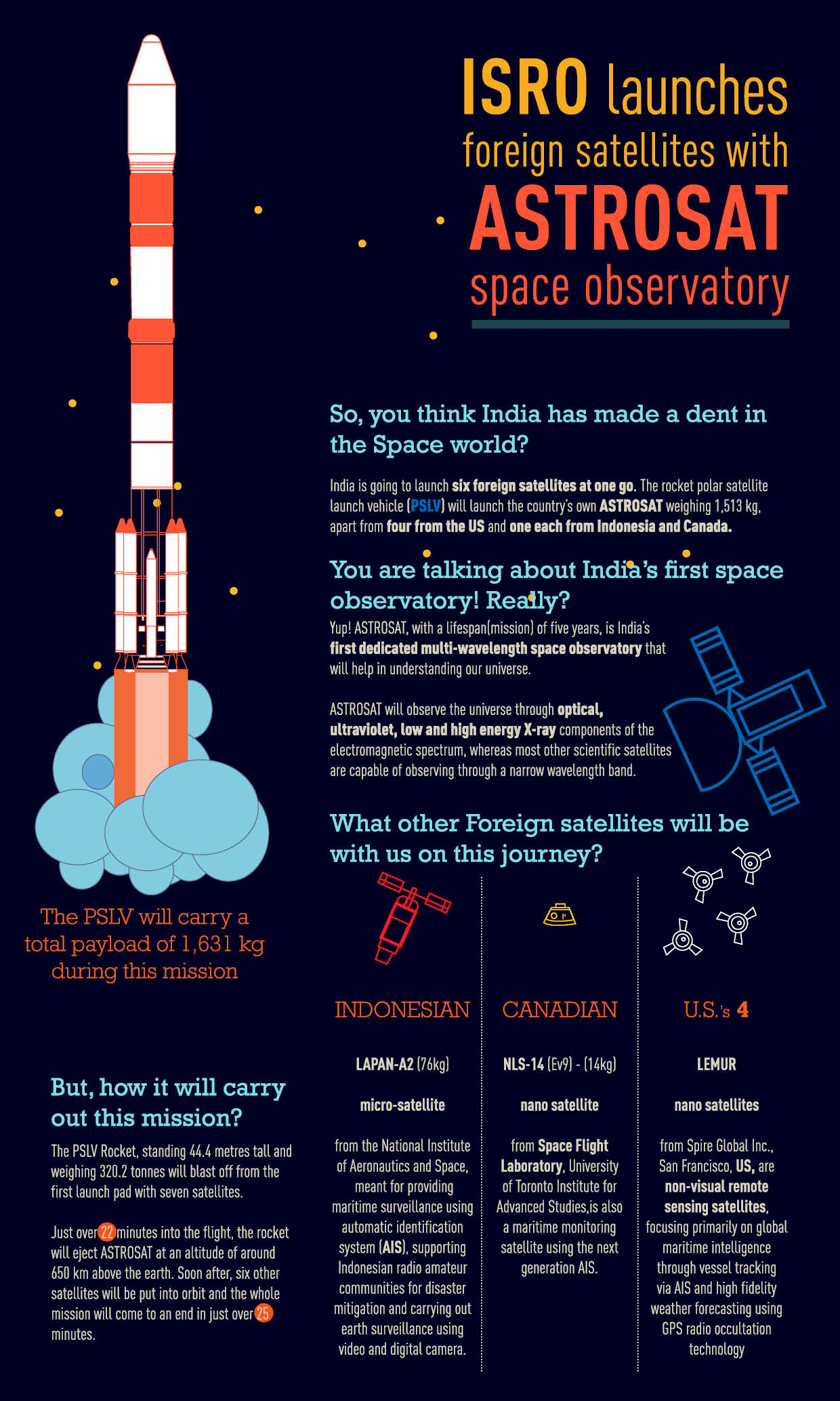
    1. India is going to launch six foreign satellites at one go. The rocket polar satellite launch vehicle (PSLV) will launch the country’s own ASTROSAT weighing 1,513 kg, apart from four from the US and one each from Indonesia and Canada.
    2. The PSLV will carry a total payload of 1,631 kg during this mission.

    But, how it will carry out this mission?

    The PSLV Rocket, standing 44.4 metres tall and weighing 320.2 tonnes will blast off from the first launch pad with seven satellites.

    Just over 22 minutes into the flight, the rocket will eject ASTROSAT at an altitude of around 650 km above the earth.Soon after, six other satellites will be put into orbit and the whole mission will come to an end in just over 25 minutes.


    You are talking about India’s first space observatory! Really?

    Yup! ASTROSAT, with a lifespan of five years, is India’s first dedicated multi-wavelength space observatory that will help in understanding our universe.

    ASTROSAT will observe the universe through optical, ultraviolet, low and high energy X-ray components of the electromagnetic spectrum, whereas most other scientific satellites are capable of observing through a narrow wavelength band.


    What other Foreign satellites will be with us on this journey?

    The Indonesian 76 kg LAPAN-A2 is a micro-satellite from the National Institute of Aeronautics and Space, meant for providing maritime surveillance using automatic identification system (AIS), supporting Indonesian radio amateur communities for disaster mitigation and carrying out earth surveillance using video and digital camera.

    The 14-kg NLS-14 (Ev9) of Space Flight Laboratory, University of Toronto Institute for Advanced Studies, is also a maritime monitoring Canadian nano satellite using the next generation AIS.

    The remaining 4 LEMUR nano satellites from Spire Global Inc., San Francisco, US, are non-visual remote sensing satellites, focusing primarily on global maritime intelligence through vessel tracking via AIS and high fidelity weather forecasting using GPS radio occultation technology, the ISRO said.

    Till date, India has launched 45 foreign satellites with stature,Isn’t it ISRO’s success makes us proud.

  • Why G4 nations need a hardball diplomacy?


    What is the G4 nations group?

    1. The G4 nations comprising Brazil, Germany, India, and Japan are 4 countries which support each other’s bids for permanent seats on the United Nations Security Council.
    2. The G4’s primary aim is the permanent member seats on the Security Council. Each of these four countries have figured among the elected non-permanent members of the council since the UN’s establishment.

    What do Brazil, Germany, India, and Japan have in common?

    Though geographically disparate, each of these states seek permanent membership on the United Nations Security Council and have the economic and political heft to make its bid not entirely unrealistic.

    Why does G4 demand Permanent membership in SC?

    According to the IMF, all countries in the current “P5” members of the Security Council and the G4 currently rank among the 10 economies with the highest nominal GDP in the world, both regarding the calculation of GDP by Purchasing Power Parity, and nominal GDP, with Italy being the only non P5 or G4 member among them.

    They also account for 9 of the world’s ten largest defense budgets, with Saudi Arabia being the only non P5 or G4 member among them. In both scenarios, the P5 and G4 countries combined account for over 60% of the world’s GDP, and around half of the world’s total population.

    Then, what’s next on the table of G4 and India, now?

    1. It is time for India and the G4 to adopt a strategy of non-cooperation towards the UNSC and the United Nations as a whole.
    2. India’s ambition for permanent membership has never been a secret. Whatever the serious powers, the only ones who count when it comes to reforming the Security Council, may say in public by way of vague endorsements of India’s push which does not commit them to any practical action, in practice they are all indifferent.
    3. More than a decade ago, India joined Brazil, Germany and Japan in the so-called Group of Four (G4) in a major push for Security Council restructuring.
    4. This faltered in the 2005 UN reform effort against determined opposition from some existing five permanent members (P5) and many regional rivals of the aspirant states.
    5. Now India has said it convene “a very substantive and significant” summit of the G4 in New York on September 26, 2015.

    Do we need a hardball diplomacy by G4 now?

    1. One essential criterion of permanent membership is the capacity and will to play hardball diplomacy. China and the US demonstrated this in their firm rejection of the G4 campaign a decade ago.
    2. The US is the strongest refusenik on the Security Council in shielding Israel from any punitive consequences for decades of defying UN resolutions.
    3. But China and Russia too have proven their hardball credentials in vetoing draft resolutions on Syria since 2011.

    Finally, can the Gandhian strategy work in this scenario? Let’s see how

    1. First, by recalling the great success of Gandhi’s non- cooperation strategy that did, after all, defeat the mighty British Empire.
    2. Second, by recognising that the Security Council is not the forum of choice for the idealists of the world.
    3. Rather, it is the epicentre of geopolitical realism where hardball tactics rule the roost as the different powers jostle furiously and use sharp elbows liberally in pursuit of hard interests.
    4. Combining the two, the conclusion is obvious. The G4 countries should engage in a deliberate and combined campaign of non-cooperation.
    5. This need not take offensive form. As Gandhi showed brilliantly, passive but polite non-cooperation is a very cost-effective strategy to force the issue against closed minds.
    6. Non-participation in Security Council elections and refuse to vote for referring or citing any country for bad behaviour, such as non-compliance with nuclear non-proliferation obligations, to the Council.
    7. They can politely remind everyone each time that as they do not believe that the council is fully legitimate, they would feel hypocritical in subjecting others to its compulsory coercive authority. Therefore they will abstain.
    8. Third and finally, since all UN peacekeeping missions are authorised by the UN Security Council, they should refuse to contribute troops, civilian personnel or funds to UN operations until such time as the council is reformed.
  • Write with Civilsdaily. Here’s how


    This post derives its meaning from this *Call to Action* post – 3 Ways to Help Civilsdaily Grow.

    If you wish to write with us, take this as a litmus test for us to know you better.

    CD Explains aspires to be the “Current Affairs for Dummies” and while we are at it, we are expected to remove facts from fluff and present crisp, approachable bites.


    But let’s put some method to this madness.

    1. We will float ~10 topics which will appear in the CD Hub under the CD Discuss mugshot.
    2. The topics will be selected from news-themes and not necessarily static newsbytes. This helps in framing a better explainer and giving a holistic view.
    3. You are expected to come up with various sub-themes and write a paragraph/ ~300 words on possible questions/ facets which can be explored by UPSC.

    Let’s take an example, shall we?

    We want to talk about Oil Politics in West Asia and India’s Foreign Policy. 

    Possible angles to explore this –

    1. Rise of ISIS militants + economics of the oil resources of Persian Gulf
    2. Politics of American interests in Middle East
    3. Unprecedented popular upsurge against the establishments of the Arab countries (~Arab Spring)
    4. India is heavily dependent on energy supplies from the Gulf region. By how much? What are we doing to hedge our risks.

    … and so on.

    There is bound to be some chaos. We are moving away from the traditional model of question-answers which you have been habituated to. But trust us, this will help you explore the topic like never before.

    You will digress and bring in much more angles to the central theme, but everything will tie up in the end and you will embrace a larger picture to tackle any question in this theme. 


    1. We will study the discussions and summarise them into easy explainers.
    2. Close to your exams, these explainers would be compiled and shipped free of cost to all those who participate in the discussions.

    So, let’s start with the first discussion right here, right now – Oil Politics in West Asia and India’s Foreign Policy.