💥Join UPSC 2027,2028 Mentorship (July Batch) + XFactor Notes & Microthemes PDF

Author: Explains

  • Polar Sciences – Arctic, Antarctic, Himalayas, etc.

    Image result for indian arctic program antarctic program

    ARCTIC

    India initiated its Arctic Research Program in 2007 with thrust on climate change in the circumpolar north. The major objectives of the Indian Research in Arctic Region are as follows:

    To study the hypothesized tele-connections between the Arctic climate and the Indian monsoon by analyzing the sediment and ice core records from the Arctic glaciers and the Arctic Ocean.
    To characterize sea ice in Arctic using satellite data to estimate the effect of global warming in the northern polar region.
    To conduct research on the dynamics and mass budget of Arctic glaciers focusing on the effect of glaciers on sea-level change.
    To carry out a comprehensive assessment of the flora and fauna of the Artic vis-àvis their response to anthropogenic activities. In addition, it is proposed to undertake a comparative study of the life forms from both the Polar Regions.


    Research Stations in the Arctic

    Himadri – India launched its first scientific expedition to the Arctic Ocean in 2007 and opened a research base named “Himadri” at the International Arctic Research Base at Ny-Alesund, Svalbard, Norway in July 2008 for carrying out studies in disciplines like Glaciology, Atmospheric Sciences & Biological Sciences.


    ANTARCTIC

    Many countries have set up research stations in Antarctica to study the climate, weather, geology, and wildlife of this unique region.

    The Indian Antarctic Program is a multi-institutional program under the control of the National Centre for Antarctic and Ocean Research, Ministry of Earth Sciences, Government of India. It was initiated in 1981 with the first Indian expedition to Antarctica. Under the program, atmospheric, biological, earth, chemical, and medical sciences are studied.

    Indian Research Stations in Antarctica

    S No. Station Description
    1 Dakshin Gangotri(1981) 1. India’s first research station in Antarctica.

    2. Currently being used as a supply base and transit camp

    2 Maitri(1989) 1. Located on the Schirmacher Oasis and has been conducting experiments in geology, geography and medicine

    2. A freshwater lake was built around Maitri- Lake Priyadarshini

    3 Bharati(2015) 1. Located beside Larsemann Hills and conducts oceanographic research.


    Antarctic Treaty System

    • The Antarctic Treaty and related agreements, collectively known as the Antarctic Treaty System (ATS), regulate international relations with respect to Antarctica, Earth’s only continent without a native human population.
    • The treaty entered into force in 1961 and currently has 53 parties.
    • The treaty sets aside Antarctica as a scientific preserve, establishes freedom of scientific investigation and bans military activity on the continent.
    • India officially acceded to the Antarctic Treaty System in 1983.

    Accomplishments of Indian scientific community in Antarctica

    1. Identification of a number of new species of bacteria from the cold habitats of Antarctica- 30 out of 240 new species discovered so far have been by Indian scientists.
    2. Identification of new genes from the bacteria as genes required for the survival of bacteria at low temperature.
    3. Identification of a number of lipases and proteases active at low temperatures and useful for the biotechnology industry.
    4. Preparation of comprehensive geological and geomorphological maps of the Schirmacher Oasis.
    5. Studies of cold adaptability of human beings in the harsh environment of Antarctica which have provided significant baseline data for use in similar studies on India’s armed forces serving in the Himalaya.


    Himansh

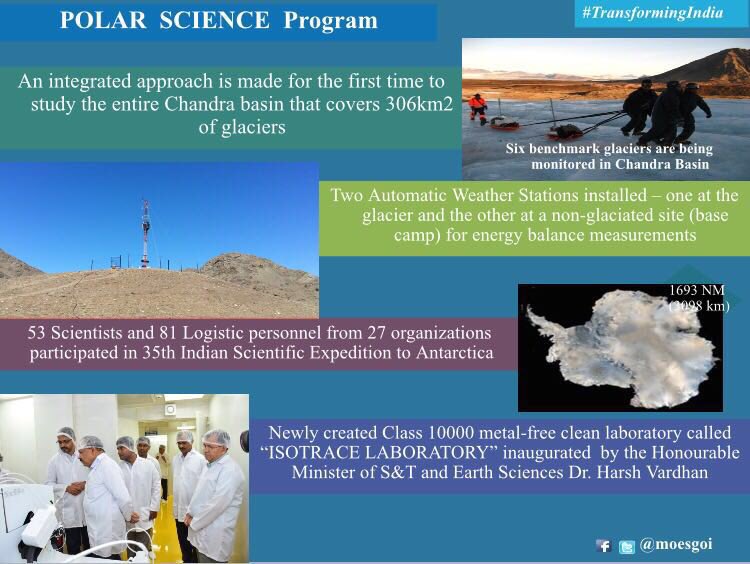
    A centre has been established as a part of Indian government’s initiative to study and quantify the Himalayan glacier responses towards climate change.

    Significance of HIMANSH

    • Help researchers to quantify the glacier melting and its relation to changing climate.

    • For undertaking surveys using Terrestrial Laser Scanners (TLS) and Unmanned Aerial Vehicles (UAV).

    • Help indigitizing the glacier motion and snow cover variations with utmost precision.

    • Some of the glacier that are already being studied under this project include Bada Shigri, Samudra Tapu,
    Sutri Dhaka, Batal, Gepang Gath and Kunzam.

  • 11th December 2018 | Prelims Daily with Previous Year Questions

    Q.1) Which of the following Asian countries is not a member of Commonwealth of Nations?

    1. Indonesia
    2. Nepal
    3. Myanmar
    4. Sri Lanka

    Select the correct alternative:

    a) 1 and 4

    b) 1, 2 and 3

    c) 2 and 4

    d) All of the above

    Inspired by: Maldives applies to rejoin Commonwealth

    https://www.civilsdaily.com/news/maldives-applies-to-rejoin-commonwealth/

    Q.2) The Noney bridge, the world’s tallest railway bridge is set to be constructed in which of the following states?

    a) Nagaland

    b) Manipur

    c) Mizoram

    d) Arunachal Pradesh

    Inspired by: India’s tallest bridge pier built in Manipur

    https://www.civilsdaily.com/news/indias-tallest-bridge-pier-built-in-manipur/

     Q.3) With reference to the International Seabed Authority (ISA), consider the following statements:

    1. ISA is an intergovernmental body that oversees mining on the high seas giving the green light for commercial exploitation.
    2. ISA has allowed India to explore an area in the Indian Ocean of 75,000 square kilometres.

    Which of the given statements is/are correct?

    a) Only 1

    b) Only 2

    c) Both 1 and 2

    d) Neither 1 nor 2

    Inspired by: India plans deep dive for seabed minerals

    https://www.civilsdaily.com/news/india-plans-deep-dive-for-seabed-minerals/

    Q.4) “In 1861, Lord Canning appointed him as the Archaeological Surveyor to the Government of India. He was responsible for excavations in Sarnath in 1837 and Sanchi in 1841. In 1871, he was made the first Director General of the Archaeological Survey of India.”

    Which of the following person/historian is referred in the above explanatory?

    a) James Prinsep

    b) Alexander Cunningham

    c) William Jones

    d) None of these

    Inspired by: The Hindu

    Q.5) With reference to Indian history, who among the following is a future Buddha, yet to come to save the world?

    a) Avalokiteshvara

    b) Lokesvara

    c) Maitreya

    d) Padmapani

    Inspired by: CSP 2018


    For Solutions – Click Here

    Prelims Daily Archive – Click here

  • 10th December 2018 | Prelims Daily with Previous Year Questions

    Q.1) Recently the International Conference on Sustainable Water Management was held. With reference to this conference, which of the given statements is/are correct?

    1. The conference was organized by NITI Aayog.
    2. It aims to create awareness of water-related problems at local, regional, national and international levels.

    Select the correct codes from following options:

    a) Both 1 and 2

    b) Only 1

    c) Only 2

    d) Neither 1 nor 2

    Inspired by: [pib] 1st International Conference on Sustainable Water Management

    https://www.civilsdaily.com/news/pib-1st-international-conference-on-sustainable-water-management/

    Q.2) Consider the following statements with respect to the Drugs and Cosmetics Act, 1940:

    1. The Drug Controller General of India (DCGI) regulates the import, manufacture and sale of medicines and medical devices.
    2. All the medical equipments and medicines registered under the act are certified by set the Bureau of Indian Standard (BIS)
    3. Even Nebulizers and Blood Pressure monitoring devices are also included in the act.

    Which of the given statements is/are correct?

    a) Only 1

    b) 1 and 2

    c) 1 and 3

    d) All are correct

    Inspired by: Four new devices notified as drugs for regulation

    https://www.civilsdaily.com/news/four-new-devices-notified-as-drugs-for-regulation/

    Q.3) With reference to the National Register of Citizens of India (NRC), which of the given statements is/are incorrect?

    1. It is a register containing names of all genuine Indian citizens residing in the states of Assam, Nagaland and Manipur.
    2. The register was first prepared after the 1951 Census of India.
    3. For NRC issue, the Citizenships Act of 1955 was never amended.

    Select the correct alternative:

    a) 2 and 3

    b) 1 and 3

    c) Only 2

    d) Only 3

    Inspired by: Centre amends rules for minorities from three nations

    https://www.civilsdaily.com/news/centre-amends-rules-for-minorities-from-three-nations/

    Q.4) The Talc or Talcum used in talcum powders is a metamorphized form of salts of:

    a) Calcium

    b) Magnesium

    c) Palladium

    d) None of these

    Inspired by: Report on ‘toxic’ talc worries India

    https://www.civilsdaily.com/news/report-on-toxic-talc-worries-india/

    Q.5) Target 5A sometimes seen in news is related to:

    a) Education

    b) Food Security

    c) Malnutrition

    d) Gender Equality

    Inspired by: [op-ed snap] She is the answer

    https://www.civilsdaily.com/news/op-ed-snap-she-is-the-answer/

    For Solutions – Click Here

    Prelims Daily Archive – Click here

  • Deep Sea Mining – Polymetallic Nodules, Polymetallic Sulphides, Cobalt-rich ferromanganese crusts

    deep sea and mineral hunters


    Polymetallic manganese nodules (PMN)
    These are small potato-sized (from millimetres to tens of centimetres in diameter) lumps of material precipitated from seawater and sediment pore water at slow rates over millions of years and occur mainly on the deep-seafloor.
    They contain approximately 24% manganese, compared to 35 to 55% manganese in land ore bodies, so they do not offer solid economics as a manganese source, but they also contain iron (14%), copper (>1%), nickel(>1%), and cobalt (0.25%).


    Polymetallic sulphides (PMS)
    PMS are formed by precipitation of metals leached by hydrothermal fluid as it interacts with the cooler ambient seawater at or beneath the seafloor at hydrothermal vent sites.
    PMS are typically composed of iron pyrite but contain varying proportions of pyrrhotite, pyrite/marcasite, sphalerite/wurtzite, chalcopyrite, bornite, isocubanite, and galena.

    Copper and zinc are the most likely metals to be recovered, but some deposits exhibit significant gold (0–20ppm) and silver (0–1200 ppm) grades as well.
    Submarine massive polymetallic sulphide bodies are principally found along the earth’s major tectonic belts.


    Cobalt-rich ferromanganese crusts
    Cobalt-rich ferromanganese crusts occur at shallower depths of <400 to about > 5000 meters in areas of significant volcanic activity.
    The crusts grow on hard-rock substrates of volcanic origin by the precipitation of metals dissolved in seawater in areas of seamounts, ridges, plateaus and where prevailing currents prevent deposition of unconsolidated sediments and occupy large areas on top of these topography highs.
    In many cases, the deposits occur within the exclusive economic zone (EEZ) of the countries.
    Similar in general composition to the polymetallic nodules, cobalt crusts are attracting investment in exploration for higher cobalt percentage (up to 2%), platinum (0.0001%) and Rare Earth Elements (REE) besides Nickel and Manganese.


    Issues 

    Related imagehttps://www.downtoearth.org.in/coverage/mining/mining-at-deep-sea-46049


    Efforts by India

    Polymetallic Nodules Programme(PNP)

    • The programme is oriented towards exploration and development of technologies for harnessing of nodules from the Central Indian Ocean Basin (CIOB) allocated to India.
    • It has 4 components viz. Survey & Exploration, Environmental Impact Assessment, Technology Development (Mining), and Technology Development (Metallurgy).
    • India is presently having an area of 75,000 square km, located about 1600 km away from her southern tip
    • India has entered into a 15-year contract with the International Seabed Authority in the year 2002 for pursuing developmental activities for polymetallic nodules in the Indian Ocean
    • India’s exclusive rights to explore polymetallic nodules from seabed in Central Indian Ocean Basin (CIOB) have been extended by five years.

    Contract with International Seabed Authority

    India’s exclusive rights to explore polymetallic nodules from seabed in Central Indian Ocean Basin (CIOB) have been extended by five years by International Seabed Authority.

    Importance

    1. India’s exclusive rights for exploration of Polymetallic Nodules in the allotted area in the Central Indian Ocean Basin will continue and would open new opportunities for resources of commercial and strategic value.

    2. India is entirely dependent on imports to meet its requirements of cobalt, which is the most strategic of the three metals (cobalt, copper and nickel). As for copper and nickel, India is in a precarious position.

    Economic significance

     Empowerment of coastal communities and attaining greater social and economic inclusion by providing Employment opportunities, skill-sets and capacities.

     Providing a boost to coastal and national economies and development of blue economy.

     Promoting entrepreneurship in new areas of economic activity and new development in electronics industry.

    Strategic advantages

     Presently, China is controlling more than 95% of rare earth metals. This move will nullify the increasing influence of China.

     It will strengthen the bilateral relationship of India with Japan, Germany and South Korea.

  • Computers, Supercomputers, Quantum Computing, etc.

    1. Five Generations of Computers

    Generation Period Technology Used
    First 1940-1956 Vacuum Tubes
    Second 1956-1963 Transistors
    Third 1964-1971 Integrated Circuits(IC)
    Fourth 1972-2010 Microprocessors
    Fifth 2010-present Artificial Intelligence

    2. Bytes

    • The number of instructions or the amount of data a computer can store in its memory is measured in bytes.

    3. Internet

    • It is a worldwide system of computer networks – a network of networks in which users at any one computer can get information from any other computer(if they have permission).

    How does the Internet work?

    https://www.youtube.com/watch?v=7_LPdttKXPc

    Administration of Internet

    • Internet Corporation for Assigned Names and Numbers(ICANN), a US non-profit organization administers the allocation of domain names and IP addresses.
    • Internet Society(ISOC) is responsible for developing internet technical standards.

    4. Supercomputers

    • A computer or an array of computers that act as one collective machine capable of processing enormous amounts of data.
    • They work at very high speeds and perform complex jobs such as nuclear research or forecasting weather patterns.
    • It channels all its power into executing a few programs as fast as possible rather than executing many programs concurrently.
    • It uses parallel processing instead of the serial processing in the case of an ordinary computer

    Supercomputers in India

    S No. Name Site
    1 SahasraT Indian Institute of Science, Bengaluru
    2 Aaditya Indian Institute of Tropical Meteorology, Pune
    3 TIFR-Cray XC30 Tata Institute of Fundamental Research, Mumbai
    4 HP Apollo 6000 Indian Institute of Technology, Delhi
    5 PARAM Yuva-2 Centre for Development of Advanced Computing(C-DAC), Pune
    6 PARAM ISHAN Indian Institute of Technology, Guwahati

    Supercomputers of the World

    5. Quantum Computing

    https://www.youtube.com/watch?v=WVv5OAR4Nik

    • Quantum computing studies computation systems that make direct use of quantum-mechanical phenomena to perform operations on data.
    • Classical computers encode information in bits. Each bit can take the value of 1 or 0. These 1s and 0s act as on/off switches that ultimately drive computer functions. Quantum computers, on the other hand, are based on qubits, which operate according to two key principles of quantum physics: superposition and entanglement.
    • Superposition means that each qubit can represent both a 1 and a 0 at the same time.
    • Entanglement means that qubits in a superposition can be correlated with each other i.e. the state of one (whether it is a 1 or a 0) can depend on the state of another.

    6. Types of Cybercrimes


    7. Cloud Computing

    https://www.youtube.com/watch?v=uYGQcmZUTaw

    • It is an Internet-based computing solution where shared resources are provided like electricity distributed on the electrical grid
    • Computers in the cloud are configured to work together and the various applications use the collective computing power as if they are running on a single system.


    IT PROJECTS IN INDIA

    1. National Supercomputer Mission(NSM)

    • The Mission envisages empowering our national academic and R&D institutions spread over the country by installing a vast supercomputing grid comprising a cluster of more than 70 high-performance computing facilities
    • The Mission would be implemented and steered jointly by the Department of Science and Technology (DST) and Department of Electronics and Information Technology (DeitY) at an estimated cost of Rs.4500 crore over a period of seven years.

    Objectives

    • To make India one of the world leaders in Supercomputing and to enhance India’s capability in solving grand challenge problems of national and global relevance
    • To empower our scientists and researchers with state-of-the-art supercomputing facilities and enable them to carry out cutting-edge research in their respective domains
    • To minimize redundancies and duplication of efforts, and optimize investments in supercomputing
    • To attain global competitiveness and ensure self-reliance in the strategic area of supercomputing technology

    Application areas

    • Climate Modelling
    • Weather Prediction
    • Aerospace Engineering
    • Computational Biology
    • Molecular Dynamics
    • Atomic Energy Simulations
    • National Security/ Defence Applications
    • Seismic Analysis
    • Disaster Simulations and Management
    • Computational Chemistry
    • Computational Material Science and Nanomaterials
    • Discoveries beyond Earth (Astrophysics)
    • Large Complex Systems Simulations and Cyber Physical Systems
    • Big Data Analytics
    • Finance
    • Information repositories/ Government Information Systems

    2. National e-Governance Plan

    • An initiative of the Government of India to make all Government services available to the citizens of India via electronic media
    • It was formulated by the Department of Electronics and Information Technology (DeitY) and Department of Administrative Reforms & Public Grievances (DAR&PG) to reduce government costs and allow citizen access to government services through Common Service Centres (CSC).
    • It comprises of 27 Mission Mode Projects(MMP) and 10 program support components.

    3. e-Kranti/National e-Governance Plan 2.0

    • It is an important pillar of the Digital India programme.
    • The vision of e-Kranti is “Transforming e-Governance for Transforming Governance”.
    • The Mission of e-Kranti is to ensure a Government wide transformation by delivering all Government services electronically to citizens through integrated and interoperable systems via multiple modes, while ensuring efficiency, transparency and reliability of such services at affordable costs.

    4. National Knowledge Network(NKN)

    • It aims to bridge the gap between rural education, urban education, and International education by interconnecting all universities, government as well as private institutions of higher learning and research with a high-speed data communication network in the country.
  • 8th December 2018 | Prelims Daily with Previous Year Questions

    Q.1) With reference to the Millets Cultivation in India, consider the following statements:

    1. It provides nutritional security and act as shield against nutritional deficiency especially among children and women.
    2. Millets are nutritionally superior to wheat.
    3. FAO will observe International Year of Millets in 2019 at India’s request.

    Which of the given statements is/are correct?

    a) Only 1

    b) Only 3

    c) 1 and 2

    d) All are correct

    Inspired by: [pib] FAO Council approves India’s proposal to observe International Year of Millets in 2023

    https://www.civilsdaily.com/news/pib-fao-council-approves-indias-proposal-to-observe-international-year-of-millets-in-2023/

    Q.2) Consider the following statements with respect to the proposed Varanasi freight village:

    1. The setting up of freight village in Varanasi is proposed by Asian Development Bank.
    2. It will be developed by the Inland Waterways Authority of India (IWAI).

    Which of the given statements is/are correct?

    a) Only 1

    b) Only 2

    c) Both 1 and 2

    d) Neither 1 nor 2

    Inspired by: Govt approves freight village in Varanasi

    https://www.civilsdaily.com/news/govt-approves-freight-village-in-varanasi/

    Q.3) The Sunspots are:

    1. The permanent spots on the Sun’s photosphere that appears darker than the surrounding areas.
    2. Sunspots usually appear in pairs of opposite magnetic polarity
    3. First observed in the 1755.

    Select the correct alternatives from following options:

    a) All are correct

    b) 1 and 2

    c) 2 and 3

    d) Only 3

    Inspired by: IISER team develops method to simulate Sunspot Cycle

    https://www.civilsdaily.com/news/iiser-team-develops-method-to-simulate-sunspot-cycle/

    Q.4) The World Bank assisted SMART project for Agribusiness and Rural Transformation was recently launched in which of the following states?

    a) Gujarat

    b) Maharashtra

    c) Karnataka

    d) Uttar Pradesh

    Inspired by: SMART project in Maharashtra villages

    https://www.civilsdaily.com/news/smart-project-in-maharashtra-villages/

    Q.5) With reference to the Electoral Bond Scheme, which of the given statements is/are incorrect?

    1. The scheme permits only natural persons to purchase bonds.
    2. The bonds are available for sale from all branches of scheduled commercial banks and some select NBFCs.
    3. The bond can be issued in denominations of ₹1,000, ₹10,000, ₹lakh, ₹10 lakh and ₹1 crore.

    Select the correct alternative from following codes:

    a) Only 1

    b) 1 and 2

    c) Only 3

    d) 2 and 3

    Inspired by: [op-ed snap] An invitation to corruption?

    https://www.civilsdaily.com/news/op-ed-snap-an-invitation-to-corruption/


    For Solutions – Click Here

    Prelims Daily Archive – Click here

  • [Video] Samachar Manthan Week 25: 3D Printing

    To know more about our Samachar Manthan course which deals with enhancing your Mains answer writing skills along with Current Affairs preparation, read & Subscribe here:

    https://www.civilsdaily.com/samachar-manthan/

  • Blockchain Technology and Bitcoins

    Note4Students 

    Question already asked in Mains. Could be asked again.

    Watch this video if you want to understand the essence of Blockchain in a very non-technical way.


    The more technical explanations are as follows –

    https://lh5.googleusercontent.com/MrRLf7tKMSgfpMA8JdJTyS9G9ZIa4MBYPuIkbONCRsLJdVfcfrcOuow2lonU_2BRMCZ_3fJFYOi6rDO2OrDJJW-JLzsLppjntFSGbMpSnMpC7f2-YfiIu0QmY_g2f2APKraUk8D84RfeHdyt6w

    Image Source

    What is Blockchain Technology?

    1. It is a decentralized digital ledger that records transactions on thousands of computers globally in such a way that the registered transactions cannot be altered retrospectively.
    2. It is a secured way of conducting online transactions and its use removes the characteristic of infinite reproducibility from a digital asset.
    3. In the case of cross-border remittances, its use enables instant transfer of money as against the current system that takes about a week for the same.

    Application

    1. It is the technology behind crypto-currencies, for example, Bitcoins.
    2. *Each block comprises of a hash pointer that acts as a link to a previous block. Along with those it comprises of a timestamp and transaction data.
    3. *Blockchains are resistant technologies to modification of the data.

    What is Bitcoin? 

    1. It is an electronic or digital currency that works on a peer-to-peer basis. It is decentralized and has no central authority controlling it.
    2. Bitcoins can be sent digitally to anyone who has a bitcoin address anywhere in the globe. One person could have multiple addresses for different purposes – personal, business and the like.
    3. A bitcoin is not printed currency but is a non-repudiable record of every transaction that it has been through. All this is part of a huge ledger called the blockchain.
    4. Bitcoins are available in bitcoin exchanges. They can be purchased from other users. A bitcoin is generated when an entity, i.e. a person or a business, uses software power to solve a mathematical puzzle that makes the blockchain more secure. The difficulty level of solving the problem is high enough to ensure that it takes time to do it.

    Advantage Associated with Bitcoin


    Problems

    1. Limitation of 21 M bitcoin currency that will last till 2040
    2. It is possible to launder money and buy illegal products. Since Bitcoins can be spent on the Internet without the use of a bank account, they offer a convenient system for anonymous purchases.
    3. Money laundering
    4. No regulation
    5. Possibility of  Hacking
    6. Degree of acceptance – Many people are still unaware of Bitcoin.
    7. Ongoing development – Bitcoin software is still in beta with many incomplete features in active development.
    8. Volatility – The total value of bitcoins in circulation and the number of businesses using Bitcoin are still very small compared to what they could be. Therefore, relatively small events, trades, or business activities can significantly affect the price.

    Question:

    Q.) What do you understand by bitcoin’s ‘hard fork’? Is ‘hard fork’ a good development? Examine.

  • India’s Nuclear Energy Program

    Note4Students

    One of the most important topics both from the point of view of prelims and mains.

    India envisages A Three Stage Programme based on the optimum utilisation of the indigenous limited uranium and abundant thorium resources.  It was formulated by Dr. Homi Bhabha in the 1950s to secure the country’s long term energy independence.

    STAGE 1 » Pressurised Heavy Water Reactor

    STAGE 2 » Fast Breeder Reactor

    STAGE 3 » Breeder Reactor

    Why the 3 stages?

    Although we have around 25% of the world’s thorium reserves, it itself is not a fissile material. It needs to undergo transmutation to U-233 in a reactor fuelled by other fissile material.

    The sequential 3-stage programme is based on a closed fuel cycle, where the spent fuel of one stage is reprocessed to produce fuel for the next stage.

    The diagram below should explain that.


    STAGE 1: PRESSURIZED HEAVY WATER REACTORS(PHWR)

    • Natural Uranium is used as a fuel and heavy water as a coolant and moderator
    • The 0.7% U-235 undergoes fission to release energy. As the remaining 99% U-238 is not fissionable, it undergoes transmutation and forms Plutonium-239(Pu-239).

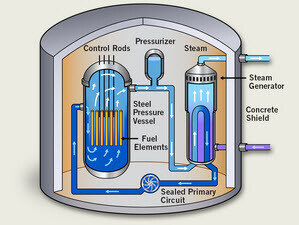
    Working of the reactor –

    Image result for Pressurized Heavy Water Reactor

    • The heat is removed from the reactor by water flowing in a closed pressurised loop
    • The heat is transferred to a second water loop through a heat exchanger.
    • The second loop is kept at a low pressure allowing the water to boil and create steam, that is used to turn the turbine-generator
    • Then the steam is condensed into water and returned to the heat exchanger

    VVER – Reactors 

    Two Russian-built VVER-1000 reactors have been in commercial operation in Kudankulam, southern India, since 2014 and 2017 respectively.


    STAGE 2: FAST BREEDER REACTORS(FBR)

    • The reactor is fuelled by a mixed oxide of U-238 and Pu-239 which have been recovered by reprocessing the spent fuel in the first stage
    • Pu-239 undergoes fission producing energy and more Pu-239 through the transmutation of U-238.

    Working of the reactor – 

    • Why fast? The neutrons are not slowed down. There is no need of a moderator
    • Why breeder? More fissionable material(Plutonium) will be present after the reaction than what was present before the reaction. It breeds fissile material.
    • In FBR, the fission chain reaction is sustained by fast moving neutrons.
    • India and Russia are the only two countries that are constructing commercial scale breeder reactors.
    • Solves 5 problems — safety, competitiveness, shortage of fuel, reprocessing and refabricating the used nuclear fuel and radioactive waste. Enforcing non-proliferation of fission materials and weapon technologies

    MBIR Project

    The multipurpose fast reactor project, known by the Russian acronym MBIR, is coming up at the International Research Centre in Dimitrovgrad located in the Ulyanovsk region in Russia.
    It is a fast reactor project follows the closed fuel cycle.
    Transitioning to closed fuel cycle which is based on fast neutron reactors can solve five essential problems:
    safety, competitiveness, shortage of fuel, reprocessing and refabricating the used nuclear fuel and radioactive waste.
    It also addresses the non-proliferation of fission materials and weapon technologies.

    The main purpose of the MBIR is to conduct large no. of reactor studies of Generation-4 nuclear systems.
    MBIR’s design includes three independent loops that can be used to test different coolants like gas, lead, molten salt and others.


    STAGE 3: THORIUM BASED REACTORS

    • It is based on the Thorium Uranium-233 Cycle.
    • Naturally occurring Thorium-232 is not a fissile material. It needs to be converted to a fissile material, U-233, by transmutation in a FBR
    • In the second stage, once sufficient Pu-239 is built up, Thorium-232 is introduced as a blanket material to be converted to Uranium-233.

    KAMINI (Kalpakkam Mini reactor) in Kalpakkam is the world’s only thorium-based experimental reactor.  It achieved criticality on 1996. Designed and built jointly by the Bhabha Atomic Research Centre (BARC) and Indira Gandhi Centre for Atomic Research (IGCAR), it produces 30 KW[3] of thermal energy at full power.


    Sites with Nuclear Power Plants

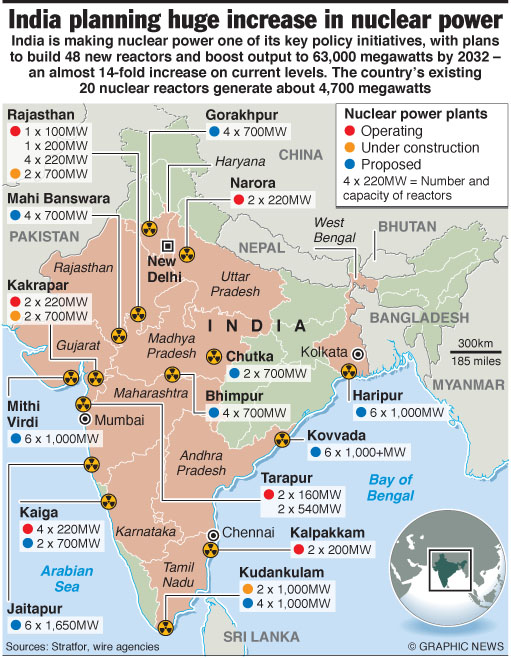
    Image result for NUCLEAR POWER plants in India graphic news


    • As of 2017, India has 22 nuclear reactors in operation in 7 nuclear power plants with an installed capacity of 6780 MWe.
    • With a total capacity of 1400 MWe, Tarapur is the largest nuclear power station in India
    • Kundankulam Nuclear Power Station started its commercial operation in March 2017


    Organisation structure


    Department of Atomic Energy(DAE) 

    • It is under the direct charge of the Prime Minister.
    • Engaged in the development of nuclear power technology and applications of radiation technology.

    Atomic Energy Commission(AEC)

    • It is the governing body of the DAE.
    • It organises and promotes atomic research and train atomic researcher in the country.
    • It is the main policy making body.

    International News

    International Thermonuclear Experimental Reactor(ITER)

    • It is an international nuclear fusion research and engineering mega project which will be the world’s largest magnetic confinement plasma physics experiment
    • What is Plasma Physics? It is the study of charged particles and fluids with interacting with self-consistent electric and magnetic fields
    • It is being built next to the Cadarache facility in Southern France
    • India is a part of ITER.

    https://www.youtube.com/watch?v=0jMGpio5d7E

    International Atomic Energy Agency(IAEA)

    • It seeks to promote the peaceful use of nuclear energy and inhibit its use for any nuclear purpose, including nuclear weapons.
    • HQ located in Vienna, Austria.
    • India is a member of the IAEA.

    Convention on Supplementary Compensation(CSC)

    • It seeks to establish a uniform global regime for compensation to victims in the unlikely event of a nuclear accident.
    • India has ratified the convention.


  • 7th December 2018 | Prelims Daily with Previous Year Questions

    Q.1) With respect to the World Intellectual Property Report 2018, consider the following statements:

    1. China leads US in numbers of patent grants.
    2. Number of patents granted to foreigners in India is always higher than that of Indians.

    Which of the given statements is/are correct?

    a) Only 1

    b) Only 2

    c) Both 1 and 2

    d) Neither 1 nor 2

    Inspired by: Number of patents granted by India shot up by 50% in 2017: UN

    https://www.civilsdaily.com/news/number-of-patents-granted-by-india-shot-up-by-50-in-2017-un/

    Q.2) Consider the following statements with respect to the Global Carbon Project (GCP):

    1. It is a project undertaken by the UN Framework Convention on Climate Change.
    2. It aims to quantify global carbon emissions and their causes.
    3. Established by the GCP in 2013 the Global Carbon Atlas is a tool for the visualisation of data related to the global carbon cycle.

    Which of the given statements is/are correct?

    a) Only1

    b) 2 and 3

    c) 1 and 3

    d) All are correct

    Inspired by: India fourth largest contributor to carbon emission

    https://www.civilsdaily.com/news/india-fourth-largest-contributor-to-carbon-emission/

    Q.3) Exercise Hand-in-Hand is an annual bilateral military exercise of India along with:

    a) Russia

    b) China

    c) Bangladesh

    d) Saudi Arabia

    Inspired by: [pib] Exercise Hand-in-Hand 2018

    https://www.civilsdaily.com/news/pib-exercise-hand-in-hand-2018/

    Q.4) The Climate Risk Index (CRI) recently seen in news is released by:

    a) UN Environment

    b) UNFCCC

    c) IPCC

    d) None of the above

    Inspired by: Extreme weather report suggests neighbours worse hit than India

    The Indian Express

     Q.5)  The Kamsale dance recently seen in news is performed in which of the following states?

    a) Kerala

    b) Karnataka

    c) Andhra Pradesh

    d) Tamil Nadu

    Inspired by: Kamsale Dance

    The Hindu


    For Solutions – Click Here

    Prelims Daily Archive – Click here