Q.1) Prime Minister’s Science, Technology and Innovation Advisory Council (PM-STIAC) was formed recently by scrapping two Scientific Advisory Committees (SAC) for the Prime Minister and the Cabinet.
Which of the following statements about PM-STIAC is/are correct?
It will be chaired by Prime Minister.
It is set to act as a high-level advisory body to several ministries and execute mission-oriented programmes for these ministries.
In last 1 year at least 20 individuals have been lynched or beaten to death in incidents across India, where rumours on WhatsApp have inspired vigilante mobs to swarm visitors accused of being child kidnappers. Dozens more have been injured in similar attacks.
Meaning
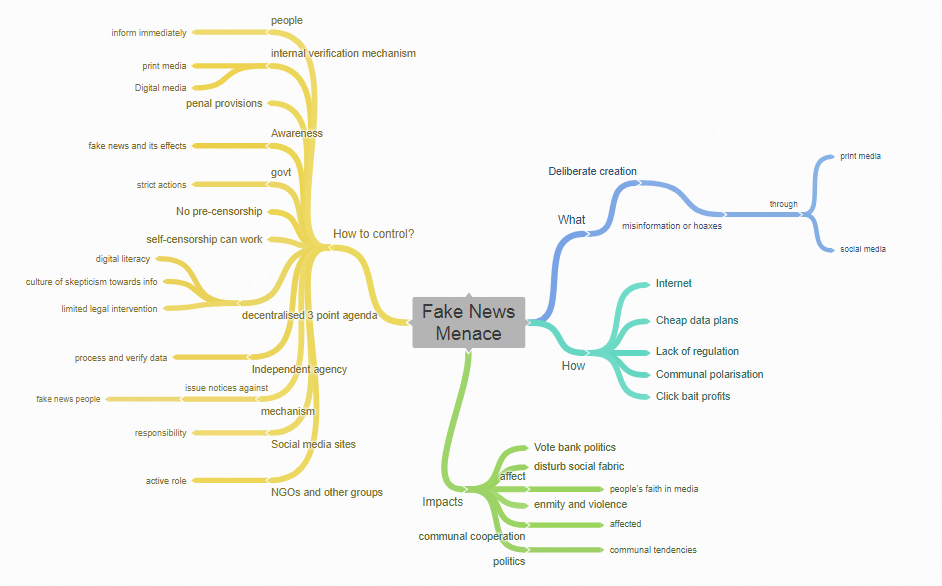
Fake news refers to the deliberate creation of misinformation or hoaxes spread via traditional print and broadcast news media or online social media shaping the belief of people around the nation and world.
What gives rise to the fake news?
Lack of regulation – The online platforms, unlike the mainstream media, do not fall under comprehensive regulation. A number of online news/information portals are being set up due to the lack of proper entry barriers. The lack of binding rules and the ability to keep owners and editors private, offers a larger scope for wrongdoing in case of online platforms.
Communal polarisation – The growing polarisation of society on ideological lines has made the job of spreading fake news easier. Also, the spread of hatred-inducing content among leaders/groups of the opposing ideologies, further deepens the prevailing communal hatred.
Reach – In the past, communal violence in India was more a localised affair. However, in recent days it is extensively being triggered through the Internet on a much larger scale. The online and mobile platforms serve like nodal agencies distributing unverified information.
Quick gains – Spreading false news is becoming a way to make advertising money through click baits. In India, numerous sites are being set up to commercialise fake news with click-bait headlines. Users are enticed with multiple link pages to click and continue reading making the content go viral.
Cheap data plans – The proliferation of technology, cheap smartphones, and reasonable data rates has enabled the democratization of online content. The flip side is that the speed of content distribution has made traditional journalistic controls of verification unfeasible.
Why is fake news dangerous?
People’s faith in social, print and electronic media reduces which could affect the benefits of these Media.
It can lead to violence between two or more communities thereby creating enmity and hatred between them.
It can disturb the social fabric of the society and tensions among communities persists for long times.
It reduces the tendencies of cooperation between different communities.
Political parties try to gain political advantages by polarizing the voter’s mind which further intensifies the tensions between different sections of society.
Politics of development takes back seat and communal tendencies emerge in politics.
In its purest form, fake news is completely made up, manipulated to resemble credible journalism and attract maximum attention and, with it, advertising revenue.
Political campaigning has progressed from mere appeals in the name of identity or loyalty or tall promises to something akin to psychological warfare. Parties that master the tools of such psych ops have a distinct edge over those stuck in the traditional mud. Fake news spreads on social media.
How can we control the fake news menace?
Pre-Censorship is Impossible
Pre-censorship of news and information, while being virtually impossible due to the speed of content creation, will also violate the guarantee of free speech under Article 19(1)(a) of the Constitution.
On the one hand, such legislation could divest individuals of autonomy.
On the other, it could bolster the power of the government to censor opinions it is uncomfortable with.
Any screening in the context of social media applications such as WhatsApp could also violate the fundamental right to privacy recognized by the Supreme Court.
Self- Censorship can work
A cautionary approach warrants avoiding overarching regulation in the form of anti-fake news legislation, irrespective of the benignity of its motivations.
Entrusting a judge, the state or companies like Facebook with the task of making an evaluation of veracity will facilitate judicial, government or private censorship.
This can breed a chilling effect and self-censorship.
A decentralized three-point agenda to address fake news
To ensure critical media literacy, with critical digital literacy as a component.
This would focus on encouraging individuals to learn the skills required to navigate the internet and question the content they are exposed to.
Users should understand the limitations of digital media.
Full Fact and Facebook’s toolkit offer useful suggestions about this. Design changes to social media platforms that flag content can also be incorporated.
To nurture a general culture of scepticism among citizens towards information
Good practices, such as verifying the source of the news and corroboration with related news, ought to be advanced in schools and through public education campaigns.
The role of the district administration and local community leaders is key in this regard.
Heartening examples such as the Satyameva Jayate programme in Kannur schools and initiatives by the superintendent of police in Gadwal demonstrate the potential of such an approach.
Limited Legal Interventions can be explored
In a limited set of situations, such as when there is threat to life or national security, targeted and proportionate legal interventions can be explored.
They should account for existing speech offences to avoid overlap.
Despite their own flaws, existing provisions on hate speech, sedition and defamation already deal with certain kinds of harm that may be substantially similar to those posed by fake news.
Other steps Which Government can take
The government must take the initiative to make all sections of the population aware of the realities of this information war and evolve a consensus to fight this war. It must also take strict action
News being spread using chatbots and other automated pieces of software should automatically be selected for special screening. Ordinary consumers of news can play a big role by, first, waking up to the reality that all they read on WhatsApp and Twitter is not the gospel truth, and then, by refusing to pass on what they cannot independently verify with other sources.
Websites that mimic well-known, credible media outlets in their name should be exposed with the vigour with which jokes are shared on social media.
Government should have independent agency to verify the data being circulated in social and other media. The agency should be tasked with presenting real facts and figures.
Government should have mechanism for immediately issuing of notice against sites/people/agencies involved in spreading fake news.
There should be a provision of effective balances and check of filtering fake posts before it getting viral.
Social media websites should be made accountable of such activities so that it becomes their responsibility to have better controlling restricting the spread of fake news.
Government should take active measures for promoting awareness among people about fake news and their consequences.
Government should enlist penal provisions to perpetrators of fake news if it causes violence or deaths.
Government should make mandatory for Print and Electronic media to have internal mechanism for verifying incidents, facts and figures.
Public should verify the accuracy and of reliability of any news or data either from government or any independent agency specifically involved in such task.
Public should not blindly trust any sensitive news and should not forward it to others.
Public should inform concerned department about any fake post as soon as they come across. They should act as active vigilant for maintaining peace and harmony in the society.
NGO’s and other civil society groups can play important role in spreading awareness about the ill effects of fake news.
Question
In the post-truth world, digitisation and fake news has become a deadly combo. Discuss. What steps can be taken to counter the menace?
Q.2) Pakistan has sought the construction of Pakal Dul and Lower Kalnai Hydel projects as a violation of the Indus Water Treaty by India. These dams are constructed on the basin of which of the following Rivers?
a) Ravi
b) Jhelum
c) Chenab
d) Beas
Inspired by: Indus water panel to discuss Pakistan’s objection to Indian projects
Reading News for UPSC is utmost important and rising number of questions year on year in UPSC Prelims is a testimony of this
We are starting a daily series where we will analyze news covered in The Hindu, Indian Express and other newspapers which are important from exam perspective and which are not
Important news would have been covered in our daily news coverage in form of newscards.
Unimportant ones will be mentioned here and a short description regarding why it is not relevant for the exam
By this deal, USA has shown a ray of hope of an end to the trade war with other countries too. Note details of NAFTA & way forward for India & other countries.
The Union Cabinet on Wednesday approved the release of an additional 2% of dearness allowance for central government employees. This increase is in accordance with the accepted formula, which is based on the recommendations of the 7th Central Pay Commission
No important points in the news from exam point of view
Government notifies electoral bonds for political donations
Why in news?
Details such as denominations, validity, and eligibility of the purchasers were announced by Finance minister for the electoral bonds scheme announced during the 2017 Budget
Electoral bonds will allow donors to remain anonymous and pay political parties using banks as intermediaries
Highlights of the scheme
Electoral bonds would be a bearer instrument in the nature of a promissory note and an interest-free banking instrument
A citizen of India or a body incorporated in India will be eligible to purchase the bond
Electoral bonds can be purchased for any value in multiples of ₹1,000, ₹10,000, ₹10 lakh, and ₹1 crore from any of the specified branches of the State Bank of India
The purchaser will be allowed to buy electoral bonds only on due fulfillment of all the extant KYC norms and by making payment from a bank account
The bonds will have a life of 15 days (15 days time has been prescribed for the bonds to ensure that they do not become a parallel currency)
They can be used to make donations to registered political parties that have secured not less than 1% of the votes polled in the last election to the Lok Sabha or Assembly
The bonds shall be available for purchase for a period of 10 days each in the months of January, April, July, and October, with an additional 30 days to be specified by the Central government in the year of a general election
The bond shall be encashed by an eligible political party only through a designated bank account with the authorized bank
Why is the name of the donor not being disclosed?
Bonds would get reflected in the balance sheet of the donors
Currently, for a very large part of donation coming to political parties by the donors, quantum and source is not known
The past experience has shown that once the names are disclosed, there is a tendency to shift to cash donations.
Bonds will ensure cleaner money coming from donors, cleaner money coming to political party and ensure significant transparency
Why was this scheme brought?
To ensure that the funds being collected by the political parties is accounted money or clean money
It will also boost digital transactions
Concerns
While the identity of the donor is captured, it is not revealed to the party or public. So transparency is not enhanced for the voter.
Also income tax breaks may not be available for donations through electoral bonds. This pushes the donor to choose between remaining anonymous and saving on taxes.
Also, privacy of the donor is compromised as the bank will know their identity.
The opposition has pointed out that the bonds will help any party that is in power because the government can know who donated what money and to whom.
It can tantalize the buyer of the bond into trading in it for profit. An example is in order. Suppose a company (not an honest one) buys bonds worth Rs 200 crore from a designated branch of the SBI. Remember electoral bonds can remain in circulation for 15 days before they find their way into a political party’s coffers. It is during this crucial period that danger lurks. Suppose a moneybag wanting anonymity is on the prowl and there is a sympathetic political party hungering for his munificence? What would happen? Well, he would buy the bonds for Rs 225 crore by paying cash to the original subscriber. Who could have thought the docile electoral bonds would electrify further the hurly-burly world of black money? In other words, there could be two owners of these bonds in the short time period of 15 days they are allowed to circulate without hindrance. Who knows there could be a third within the above example of a Johnny-come-lately offering Rs 230 to the buyer in the black market?
Way forward
Former Chief Election Commissioner S.Y. Quraishi has suggested an alternative worth exploring
A National Electoral Fund to which all donors can contribute
The funds would be allocated to political parties in proportion to the votes they get.
Not only would this protect the identity of donors, it would also weed out black money from political funding.
There can be a tax benefit for those who donate to the fund
Question
Will the electoral bonds scheme be successful in achieving the coveted objective of transparency in political funding? Critically analyse.
Reading News for UPSC is utmost important and rising number of questions year on year in UPSC Prelims is a testimony of this
We are starting a daily series where we will analyze news covered in The Hindu, Indian Express and other newspapers which are important from exam perspective and which are not
Important news would have been covered in our daily news coverage in form of newscards.
Unimportant ones will be mentioned here and a short description regarding why it is not relevant for the exam
Important news showing how one government scheme paves way for various other initiatives. Read about this and also note data related to power consumption in India. Can be quoted in Mains.
The Supreme Court has asked the Union government whether it is giving the over 40 lakh people, excluded from the National Register of Citizens (NRC) in Assam, a “second chance” to gain citizenship by allowing them to produce fresh documents to prove their Indian legacy
Watch the Video Lecture covering a topic of Week 4 of the Samachar Manthan program here:
View the topics covered in Week 1 & download detailed notes here: Click2Download
UPDATE 1
We will also provide Economic Survey & Budget Analysis Videos covering key concepts and important terms for Prelims and Mains 2018/19
Economic Survey analysis will be available from 2016 to 2018 covering trends in Indian Economy as well as key issues related to it.
We are also releasing 60+ Hours of Advanced Video Lectures on Static subjects – Polity, History, Geography, Economy
These cover the most important topics from Prelims perspective
Basic knowledge will be helpful in understanding these though it’s not mandatory
We are delighted to launch Batch 2 of Samachar Manthan as well as Samachar Manthan with Answer Writing for 2018-2019. The course is designed to help you develop a solid command on your newspaper reading and current affairs analyzing skills. Since it builds your core, it is important for both prelims and mains.
The program will cover Current Affairs from June 2018 to November 2018 (For the 6 months batch)
For Yearly batch, the coverage will be from June 2018 to May 2019
Join Batch 2 of Samachar Manthan with Answer Writing here: Click2Join
If you wish to join Batch 2 of Samachar Manthan without Answer Writing, join here: Click2Join
Samachar Manthan Yearly with Answer Writing Module (June 2018 to May 2019) – Rs 15000 + Taxes Click2Join
Samachar Manthan Yearly 2018-19 (June 2018 to May 2019) – Rs 9000 + taxes Click2Join
Our students have benefited a lot from the classes and many have done well in 2018 Prelims despite the paper being tricky. Read a few testimonials here:
What are we offering and how is it unique?
1. Mentorship and guidance taken to a whole new level
Once you enroll, you’ll be assigned a Telegram group headed by Sajal Sir and rankers like Dr. Vipin Garg AIR 20, Swapnil Pawar AIR 525 and others. Our past students have found this immensely beneficial.
A convenient way to resolve your doubts and queries.
You’ll be provided with value-added material which is very important.
You’ll have an ecosystem to study and learn from.
Above all, it will help you stay focused every day.
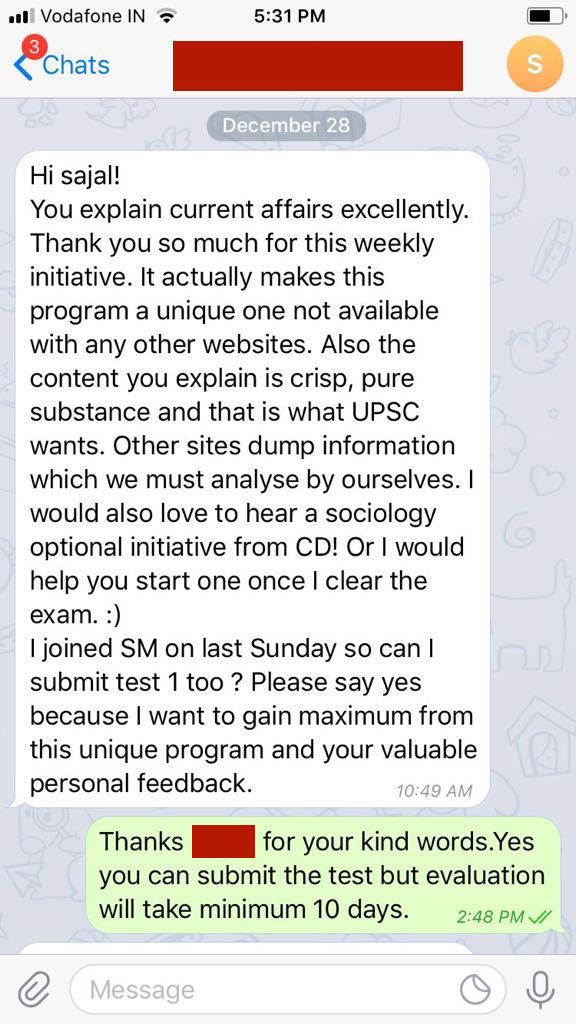
Here’s what some of our students had to say about our mentorship.
2. 4 stage structure of Video->Notes->testing->review to perfect your preparation The sequence of video->Notes->testing->review is the best way to ensure maximum retention and a rock solid preparation. Each component of the program has been meticulously crafted.
3. Our video lectures and notes on weekly CA are brief but comprehensive Packed 3-3.5 hours Weekly videos will focus on news and its importance from both prelims and mains perspective. We understand that the UPSC exam is a generalist exam. It’s more important to cover more issues than to cover one issue in more depth. Hence, we maintain a fine balance of covering cover many important news items and have a detailed discussion on selected topics which require the same. This program will also help you understand how to utilize current affairs in all your prelims and mains papers. This ideology makes this course the best utilization of your time.
Here’s what some of our students had to say about the lectures.
4. Guest Lectures on specific issues by Dr. Vipin Garg, IAS (Rank 20, UPSC 2016) and our distinguished mentor K.Siddhartha Sir. Besides the above, you will have access to our monthly magazines and weekly notes/links to important news/external material. You will have access to all modules included in our Mentorship program – Study-plan, strategy discussion, specific weaknesses, overall guidance. Since our mentors will have information about your performance
5. Weekly Mains Test and Evaluation by our team of subject experts The video and notes will be followed by a test released every weekend. It will have 10 high-quality questions. This will complete your study loop and enhance your retention. >Mains level questions with feedback. Sample review is attached.
> Answer Enhancement We chose the Question & Answer format because it is perfectly aligned with the requirements of the exam. Having information is very different from presenting it in an answer with a proper structure. This will help in better retention of prelims specific information and prepare a solid ground for your mains prep. After every 2nd test you attempt, you can reach out to our mentors for personalized feedback.
6. Current Affairs Monthly Prelims Test package This was a feedback we received from many students. They wanted appropriate focus on the current affairs program.Prime Students get their usual discount of 30%
Join Batch 2 of Samachar Manthan with Answer Writing here: Click2Join
If you wish to join Batch 2 of Samachar Manthan without Answer Writing, join here: Click2Join
Q.2) Article 169 of the Constitution of India provides for the establishment of a Legislative Council of a state. Which of the following statements about the Powers of Legislative Councils (LC) is are correct?
Legislative power of LCs is same as that of Rajya Sabha.
There is no provision for joint sittings of Legislative assembly of state and that of LCs unlike in Parliament.
Q.3) Under the Ayushman Bharat- NHPM, Trust Model is accepted for Premium Payment to the insurers. Consider the following statements about Trust Model:
Under the trust model, the premium will not be paid to an insurance company, but will be pooled into a trust.
This trust will manage and administer the health scheme and also pay the claims.
Which of the given statements is/are correct?
a) Only 1
b) Only 2
c) Both 1 and 2
d) None
Inspired by: Ayushman Bharat and concepts of insurance
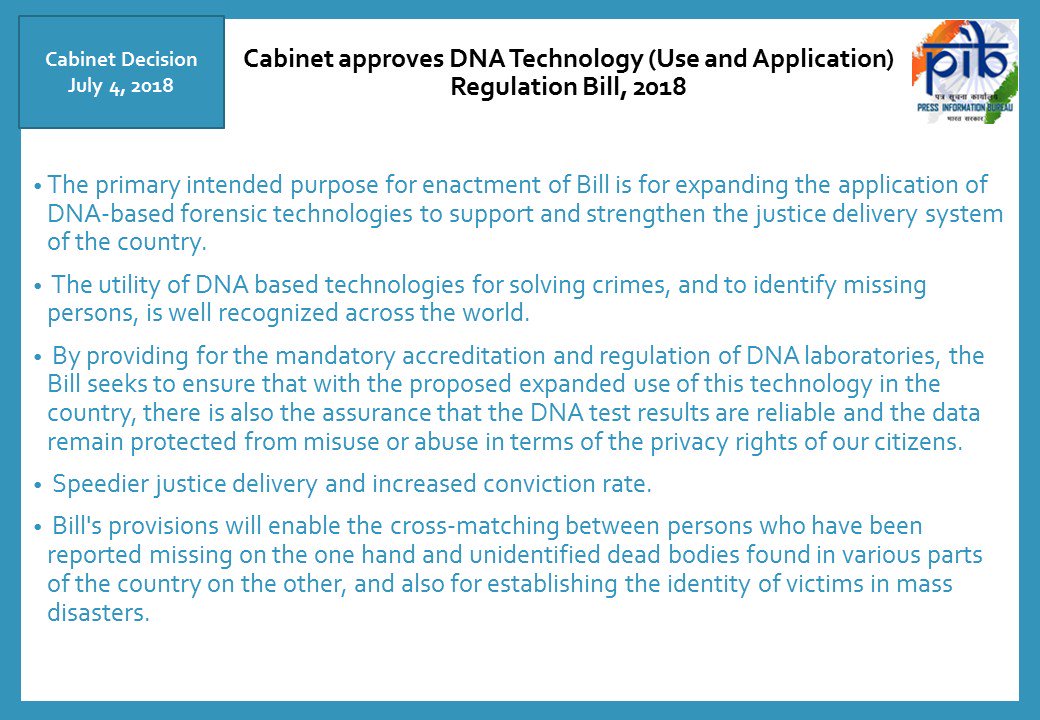
The Union Cabinet has approved The DNA Technology (Use and Application) Regulation Bill 2018.
Key features of the Bill
It allows law enforcement agencies to collect DNA samples, create “DNA profiles” and special databanks for forensic-criminal investigations.
It states that all DNA data, including DNA samples, DNA profiles and records, will be only used for identification of the person and not for any other purpose.
It creates DNA Profiling Board (DPB) that will be the final authority that will authorise the creation of State-level DNA databanks, approve the methods of collection and analysis of DNA-technologies.
It makes accreditation and regulation mandatory for DNA laboratories.
It allows the government to set up DNA databanks across India to store profiles.
These banks will maintain a national database for identification of victims, accused, suspects, undertrials, missing persons and unidentified human remains.
It also empowers the government to impose a jail term of up to 3 years and fine of up to Rs. 1 lakh on those who leak information stored in such facilities.
It prescribes similar punishment for those who seek information on DNA profiles illegally.
The objective of the Bill
Forensic DNA profiling helps in offences categorized as affecting the human body and those against property. It includes murder, rape, human trafficking, or grievous hurt and theft, burglary, dacoity.
National Crime Records Bureau (NCRB) put the number of such crimes in excess of 3 lakhs per year. Of these, only a very small proportion is being subjected to DNA testing at present.
The primary purpose of the Bill is thus to expand the application of DNA-based forensic technologies.
DNA Profiling Board
The Board, with 11 members, is supposed to be the regulatory authority that will grant accreditation to DNA laboratories and lay down guidelines, standards and procedures for their functioning.
It will advise central and state governments on “all issues relating to DNA laboratories”.
It will also be the authority to make recommendations on ethical and human rights, including privacy, issues related to DNA testing.
DNA Data Bank
A national databank of DNA profiles is proposed to be set up, along with regional databanks in every state
The new draft does not specify the location of the national databank. All regional DNA databanks will be mandated to share their information with the national databank.
Certain DNA Profiling Board-accredited labs would be authorised to carry out DNA testing and analysis. These are the only places to which DNA samples, picked up from a crime scene can be referred for analysis
Data from the analyses will need to be shared with the nearest regional DNA databank which will store it and share it with the national databank.
The databanks will maintain five sets of databases — for DNA samples picked up from crime scenes, for suspects or undertrials, and for offenders, missing persons, and unidentified dead bodies.
Significance of Bill
Bill will ensure that with proposed expanded use of DNA profiling technology in the country, there will be also assurance that DNA test results are reliable and data remain protected from misuse or abuse in terms of the privacy rights of our citizens.
It will also ensure speedier justice delivery and increased conviction rate.
It will also enable cross-matching between persons who have been reported missing on one hand and unidentified dead bodies found in various parts of the country on other, and also for establishing the identity of victims in mass disasters.
It will set in place, an institutional mechanism to collect and deploy DNA technologies to identify persons based on samples collected from crime scenes or for identifying missing persons.
The aggregate incidence of such crimes in the country, as per the statistics of the National Crime Records Bureau (NCRB) for 2016, is in excess of 3 lakhs per year.
Of these, only a very small proportion is being subjected to DNA testing at present.
It is expected that the expanded use of this technology in these categories of cases would result not only in speedier justice delivery but also in increased conviction rates, which at present is only around 30% (NCRB Statistics for 2016).
Criticisms
The main issue is whether DNA technology is foolproof, and whether the proposed law adequately addresses the possibility of abuse.
It has been argued that although DNA technology is the best method available to carry out this kind of identification, it is still probabilistic in nature.
There are chances, however remote, that a wrong match is generated. If the DNA result is taken as the ultimate evidence, no recourse will be available to an individual who has been wrongly matched.
More frequently asserted are the privacy-related objections. Questions such as whose DNA can be collected and under what circumstances, whether the consent of the individual is required, who can access the database, to what uses the DNA information can be put apart from identifying an individual, and the circumstances under which a record can be deleted, have been raised repeatedly.
It has been pointed out that information like ancestry or susceptibility to a disease, or other genetic traits, is liable to be misused.
It has also been argued that DNA tests have not led to an improvement in conviction rates in countries where it is already being followed.
Way forward
Privacy issue can be handled by adopting the best practices from the world. The Bill does not set a limit to how long someone’s DNA will keep on record. In countries like UK, DNA data of a recordable offence can be kept for only six year.
The Law Commissions report related to scientific collection of data need to be incorporated.
Maintenance of strict confidentiality with regard to keeping of records of DNA profiles and their use as recommended by Malimath report can be followed.
Safeguard to prevent illegal collection and use of DNA data as stated by A. P. Shah Committee.
Need for robust process and structure for collection of DNA samples from crime scene to the laboratory for analysis, to the DNA Bank for storage and comparison.
Question
Highlighting its key features, critically examine the DNA Technology Regulation Bill 2018. Suggest reforms, if any.
Q.5) Consider the following statements regarding Solar Energy Corporation of India Limited (SECI):
It is a company of the Ministry of New and Renewable Energy, Government of India, established to facilitate the implementation of Jawaharlal Nehru National Solar Mission
The company’s mandate has now been broadened to cover the entire renewable energy domain
Which of the above statements is/are correct?
a) 1 only
b) 2 only
c) Both 1 & 2
d) Neither 1 nor 2
Inspired by: [pib] India’s First ISTS connected Wind Power Project Commissioned


 > Answer Enhancement We chose the Question & Answer format because it is perfectly aligned with the requirements of the exam. Having information is very different from presenting it in an answer with a proper structure. This will help in better retention of prelims specific information and prepare a solid ground for your mains prep. After every 2nd test you attempt, you can reach out to our mentors for personalized feedback.