Polity is the key to success in UPSC, and here’s why:
Up to 20 questions in Prelims – 40 marks!
Command over Polity means great writing material in essays.
The knowledge of polity can be used in GS papers, IR, and national issues.
Polity concepts are highly useful in writing Ethics answer.
Master polity and your score can rise by 100 marks in Mains.
It is easy to master the subject if you know the right tricks!
This is why we believe that all UPSC aspirants who are serious about clearing Prelims in this attempt should know the 5 Most Valuable Topics in polity and the smart way of completing the syllabus in time. And we would like to share these with you for FREE in the upcoming session with Sudhanshu Sir.
For example, these are the areas that UPSC has focused on in the previous years:
And this is where these questions were sourced from:
But what about this year? Sudhanshu sir will explain, in detail, in the session.
How to complete the Polity syllabus ‘effectively.’
How to revise the syllabus in record time.
How to use the knowledge of Polity for better answer writing.
How to use the knowledge of polity for writing better essays.
How to make sure you answer ALL the polity questions in Prelims correctly.
How to use Polity to gain advantage over other candidates.
You can learn all of this and more for absolutely free in the session.
DO NOT miss this opportunity to know the right way of completing your Polity syllabus for UPSC 2022. The session is absolutely free and you can gain up to 40 MARKS in Prelims by attending this session. But there are just limited slots available so we request you to register now!
War, External aggression, armed rebellion <threat or actual>
Failure of constitutional machinery of state or can’t comply with the directions of centre
Threat to financial credit
Who declares
President after written cabinet recommendation
President
President
Parliamentary approval
w/i 1 month by both houses
w/i 2 month by both houses
w/i 2 month by both houses
Type of majority
Special
Simple
Simple
Duration
6 months from approval
6 months from approval
Indefinitely
Reapproval
Any number of times
Max 3 years
Not applicable
Revocation
By president or by LS only by simple majority
By president,
By president
Legislature and laws on state list
Continues, both parliament and state can pass laws
Suspended or dissolved and only parliament can make laws
Can issue directions to reserve money bill and finance bills for president
Executive
Continues, both union govt and state govt have powers
Dismissed, president administers through governor
Can issue direction to reduce salaries including those of supreme court and high court judge
FRs,
Art 19 automatically suspended, 20 and 21 can’t be, right to move courts for others can be suspended by presidential orders
NA
NA
Schedule 5 and 6
Schedule 5
Schedule 6
Deal with –
Scheduled area and STs in any state except ATMM
Administration of tribal areas Assam, Tripura, Meghalaya, Mizoram
Autonomy
Limited autonomy. Only tribal advisory council at state level
More autonomy, autonomous districts
Schedule area
President declares, can increase or decrease the area
Governor can organize, reorganize autonomous districts
Executive power of state
Applicable but special responsibility of governor
Same
Acts of parliament or legislature
Governor can modify the law or state that they are not applicable
same
Special Provisions for the Other States
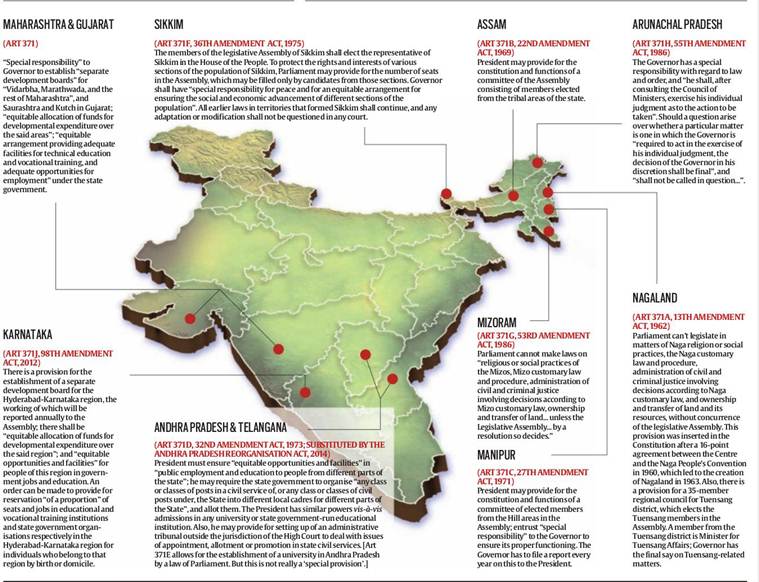
Part XXI of the Constitution The part ‘Temporary, Transitional and Special Provisions’, includes, apart from Article 370 (Temporary Provisions with respect to the State of Jammu and Kashmir) Articles 371, 371A, 371B, 371C, 371D, 371E, 371F, 371G, 371H, and 371J. These define special provisions with regard to other states of the Indian Union.
Special Provisions but not special treatment All these provisions take into account the special circumstances of individual states and lay down a wide range of specific safeguards that are deemed important for these states. In this range of Articles from 371 to 371J, Article 371I, which deals with Goa, stands out in the sense that it does not include any provision that can be deemed “special”. Article 371E, which deals with Andhra Pradesh and Telangana, too, is not that “special”. The special provisions laid down in Article 370 before it was modified were obviously much more far-reaching than the special provisions for other states, described in Articles 371, 371A-H, and 371J. The following special provisions are guaranteed by the Constitution to states other than Jammu and Kashmir: Maharashtra and Gujarat (Article 371) The Governor has a “special responsibility”- To establish “separate development boards” for “Vidarbha, Marathwada, and the rest of Maharashtra”, and Saurashtra and Kutch in Gujarat; To ensure “equitable allocation of funds for developmental expenditure over the said areas”, and “equitable arrangement providing adequate facilities for technical education and vocational training, and adequate opportunities for employment” under the state government.
Nagaland (Article 371A, 13th Amendment Act, 1962) Parliament cannot legislate in matters of Naga religion or social practices, the Naga customary law and procedure, administration of civil and criminal justice involving decisions according to Naga customary law. Parliament also cannot intervene in ownership and transfer of land and its resources, without the concurrence of the Legislative Assembly of the state.
This provision was inserted in the Constitution after a 16-point agreement between the Centre and the Naga People’s Convention in 1960, which led to the creation of Nagaland in 1963. Also, there is a provision for a 35-member Regional Council for Tuensang district, which elects the Tuensang members in the Assembly. A member from the Tuensang district is Minister for Tuensang Affairs. The Governor has the final say on all Tuensang-related matters. Assam (Article 371B, 22nd Amendment Act, 1969) The President of India may provide for the constitution and functions of a committee of the state Assembly consisting of members elected from the tribal areas of the state. Manipur (Article 371C, 27th Amendment Act, 1971) The President of India may provide for the constitution and functions of a committee of elected members from the Hill areas of the state in the Assembly, and entrust “special responsibility” to the Governor to ensure its proper functioning. The Governor has to file a report every year on this subject to the President. Andhra Pradesh and Telangana (Article 371D, 32nd Amendment Act, 1973; substituted by the Andhra Pradesh Reorganization Act, 2014) The President must ensure “equitable opportunities and facilities” in “public employment and education to people from different parts of the state”. He may require the state government to organize “any class or classes of posts in the civil service of, or any class or classes of civil posts under, the State into different local cadres for different parts of the State”, and allot them. The President has similar powers vis-à-vis admissions in any university or state government-run educational institution. Also, he may provide for setting up of an administrative tribunal outside the jurisdiction of the High Court to deal with issues of appointment, allotment or promotion in state civil services. Article 371E allows for the establishment of a university in Andhra Pradesh by a law of Parliament. But this is not really a ‘special provision’ in the sense of the other provisions in this part of the Constitution. Sikkim (Article 371F, 36th Amendment Act, 1975) The members of the Legislative Assembly of Sikkim shall elect the representative of Sikkim in the House of the People. To protect the rights and interests of various sections of the population of Sikkim, Parliament may provide for the number of seats in the Assembly, which may be filled only by candidates from those sections. The Governor shall have “special responsibility for peace and for an equitable arrangement for ensuring the social and economic advancement of different sections of the population”. All earlier laws in territories that formed Sikkim shall continue, and any adaptation or modification shall not be questioned in any court. Mizoram (Article 371G, 53rd Amendment Act, 1986) This provision lays down that Parliament cannot make laws on “religious or social practices of the Mizos, Mizo customary law and procedure, administration of civil and criminal justice involving decisions according to Mizo customary law, ownership and transfer of land… unless the Legislative Assembly… by a resolution so decides”. Arunachal Pradesh (Article 371H, 55th Amendment Act, 1986) The Governor has a special responsibility with regard to law and order, and he shall, after consulting the Council of Ministers, exercise his individual judgment as to the action to be taken. Should a question arise over whether a particular matter is one in which the Governor is “required to act in the exercise of his individual judgment, the decision of the Governor in his discretion shall be final”, and “shall not be called in question” Karnataka (Article 371J, 98th Amendment Act, 2012) There is a provision for the establishment of a separate development board for the Hyderabad-Karnataka region, the working of which will be reported annually to the Assembly. There shall be “equitable allocation of funds for developmental expenditure over the said region”, and “equitable opportunities and facilities” for people of this region in government jobs and education. An order can be made to provide for reservation “of a proportion” of seats and jobs in educational and vocational training institutions and state government organisations respectively in the Hyderabad- Karnataka region for individuals who belong to that region by birth or domicile.
GS-1 Factors responsible for the location of primary, secondary, and tertiary sector industries in various parts of the world (including India).
GS-2 India and its Neighborhood- Relations.
GS-3 Awareness in the fields of IT, Space, Computers, Robotics, Nano-technology, Bio-technology and issues relating to Intellectual Property Rights.
GS-4 Probity in Governance: Information sharing and_ transparency in government, Right to Information, Codes of Ethics, Codes of Conduct, Citizen’s Charters, Work culture, Quality of service delivery, Utilization of public funds, challenges of corruption.
HOW TO ATTEMPT ANSWERS IN DAILY ANSWER WRITING ENHANCEMENT(AWE)?
Daily 4 questions from General studies 1, 2, 3, and 4 will be provided to you.
A Mentor’s Comment will be available for all answers. This can be used as a guidance tool but we encourage you to write original answers.
You can write your answer on an A4 sheet and scan/click pictures of the same.
Upload the scanned answer in the comment section of the same question.
Along with the scanned answer, please share your Razor payment ID, so that paid members are given priority.
If you upload the answer on the same day like the answer of 1st August is uploaded on 1st August then your answer will be checked within 72 hours. Also, reviews will be in the order of submission- First come first serve basis
If you are writing answers late, for example, 1st August is uploaded on 3rd August, then these answers will be evaluated as per the mentor’s schedule.
We encourage you to write answers on the same day. However, if you are uploading an answer late then tag the mentor like @Staff so that the mentor is notified about your answer.
*In case your answer is not reviewed, reply to your answer saying *NOT CHECKED*.
Polity is the key to success in UPSC, and here’s why:
Up to 20 questions in Prelims – 40 marks!
Command over Polity means great writing material in essays.
The knowledge of polity can be used in GS papers, IR, and national issues.
Polity concepts are highly useful in writing Ethics answer.
Master polity and your score can rise by 100 marks in Mains.
It is easy to master the subject if you know the right tricks!
This is why we believe that all UPSC aspirants who are serious about clearing Prelims in this attempt should know the 5 Most Valuable Topics in polity and the smart way of completing the syllabus in time. And we would like to share these with you for FREE in the upcoming session with Sudhanshu Sir.
For example, these are the areas that UPSC has focused on in the previous years:
And this is where these questions were sourced from:
But what about this year? Sudhanshu sir will explain, in detail, in the session.
How to complete the Polity syllabus ‘effectively.’
How to revise the syllabus in record time.
How to use the knowledge of Polity for better answer writing.
How to use the knowledge of polity for writing better essays.
How to make sure you answer ALL the polity questions in Prelims correctly.
How to use Polity to gain advantage over other candidates.
You can learn all of this and more for absolutely free in the session.
DO NOT miss this opportunity to know the right way of completing your Polity syllabus for UPSC 2022. The session is absolutely free and you can gain up to 40 MARKS in Prelims by attending this session. But there are just limited slots available so we request you to register now!
In the past decade, there has been long term peace all over the Northeast region leading to new ideas flourishing and investments flowing in.
There are many examples that the North East is changing as this new breed is going into unchartered territory as the region provides more opportunities than challenges.
There are sporadic incidents, slow pace in achieving a Naga solution, but the peace has taken an irreversible stand and today in front of the mighty denim of peace for all the people.
The emerging challenge is to invent new ways of ensuring the participation of States in the formulation of national policies and motivating them for effective implementation in key development areas.
Achievements in NER
Today the North East is insurgency free.
Occasional incidents arc too insignificant in front of the grater picture.
Sooner or later the last remaining accord- the Naga Accord will be signed.
Opportunities for NER: Gateway to the East
The region is a vantage entry point to southeastern Asian markets.
Moreover, no less than five major bridges over Brahmaputra, along with the world’s longest bridge at Dhubri-Phulbari are in the various stages of construction which are going to unlock North East India completely.
The two single biggest fast-moving projects is the 1500-kilometer-long Trans Arunachal Highway from Sousa north of Teepee to Naharkatiya near Nagaland through Arunachal Pradesh. The project is worth $1.4 Billion.
The other one is the Jirbam-Imphal railway line, opening up Manipur to the vast railway network of India.
Under the Special Accelerated Road Development Programme in North-East (SARDP-NE), the Trans-Arunachal highway is being developed.
Under the initiative, a sub-regional Motor Vehicle Agreement allows buses and later private vehicles with a Bhutan, Bangladesh, India and Nepal (BBIN) permit.
Concerns
Lack of Agricultural Infrastructure: The absence of efficient cold storage chains exposes cultivators to market fluctuations.
Tourism isn’t in full capacity: Tourism, too, has not made much headway due to poor infrastructure development.
Federal Issues: There are uncoordinated and fragmented efforts by individual states.
High expenditure: Each Ministry of the Union Government is required to spend at least 10 per cent of its budget in the North-East.
Lack of investment: To harness the full potential of these sectors, significant investments will be required in upgrading the region’s infrastructure, education and skill development.
SWOT Analysis of the NER
Strengths
Several tourist attractions such as Blue Mountain (Phawngpui-Mizoram), Palak Lake (Mizoram), Kangla Fort (Manipur), Majuli (river island in Assam).
Presence of an ethnic, tribal culture each with unique customs and traditions.
The north-eastern region has a very well-performing gender development index.
Rich bamboo reserves.
The abundance of natural resources like limestone as well as water for hydropower potential.
Safe and clean, pollution-free environment.
Weakness
Lack of proper connectivity.
Limited tourism infrastructure facilities.
Scarcity of skilled and unskilled labour.
Floods and landslides in the monsoons make places inaccessible.
Landlocked states.
Opportunities
Development of the handicraft industry.
Flood management system to improve accessibility.
Linkages to existing tourism circuits.
Trade can drastically be improved by improving infrastructural facilities and accessibility.
Threats
Overuse and commercialization of eco-sensitive zones could lead to depletion of resources and weakening of attraction.
Regional connectivity concerns.
Land banks and land availability not addressed.
Migration of local people to urban areas for employment prospects.
Conclusion
The North-East region has great potential to develop not just as a self, sustaining economic unit of India but also contribute to the success story of the country, which is reflected by the PM’s focus on this region.
Maintaining consistency is one of the biggest issues faced by IAS Aspirants. Streak’s initiative is to help Aspirants in their day-to-day preparation. You can follow the monthly, weekly, and daily timetables and continue this streak until you find yourself on the final list.
Polity is the key to success in UPSC, and here’s why:
Up to 20 questions in Prelims – 40 marks!
Command over Polity means great writing material in essays.
The knowledge of polity can be used in GS papers, IR, and national issues.
Polity concepts are highly useful in writing Ethics answer.
Master polity and your score can rise by 100 marks in Mains.
It is easy to master the subject if you know the right tricks!
This is why we believe that all UPSC aspirants who are serious about clearing Prelims in this attempt should know the 5 Most Valuable Topics in polity and the smart way of completing the syllabus in time. And we would like to share these with you for FREE in the upcoming webinar with Sudhanshu Sir.
For example, these are the areas that UPSC has focused on in the previous years:
And where are these questions sourced from?
But what about this year? Sudhanshu sir will explain, in detail, in the webinar.
How to complete the Polity syllabus ‘effectively.’
How to revise the syllabus in record time.
How to use the knowledge of Polity for better answer writing.
How to use the knowledge of polity for writing better essays.
How to make sure you answer ALL the polity questions in Prelims correctly.
How to use Polity to gain advantage over other candidates.
You can learn all of this and more for absolutely free in the webinar.
DO NOT miss this opportunity to know the right way of completing your Polity syllabus for UPSC 2022. The webinar is absolutely free and you can gain up to 40 MARKS in Prelims by attending this session. But there are just limited slots available so we request you to register now!
Important Types of Bills in Parliament/Types of Majority
A Bill is a draft legislative proposal that becomes a Law upon enactment. Bills could be broadly classified into two ways:
On the basis of the source of origin:
(1) Government Bill
It is also called Public Bill. It is a Bill introduced by a minister in the government. It is the primary method of legislation.
(2) Private Member Bill
It is the bill introduced by a Member of Parliament who is not a minister.
It is important to remember that a Bill introduced by a non-minister MP of even the ruling party is called Private Member Bill.
Such bills can only be introduced and discussed on Fridays.
2. On the basis of the procedure of passage of the Bill:
(1) Ordinary Bill
An ordinary bill does not require the recommendation of the President and can be introduced in either of the Houses.
It needs only a simple majority and the second House may choose any of the following courses of action:
Pass the Bill
Reject the Bill
Propose Amendment to the Bill
No action In case the Bill is rejected or amendments which are not agreeable to the originating House are proposed or inaction for a period of 180 Parliamentary days, a deadlock is deemed to have emerged. Such a deadlock could be resolved by a joint sitting notified and summoned by President under article 108. Once notified, neither House shall proceed forth with the pending bill. When submitted to the assent of President. Such a deadlock could be resolved by a joint sitting notified and summoned by the President under article 108. Once notified, neither House shall proceed forth with the pending bill. When submitted for the assent of President, after due passage in the Parliament, he has the following options:
Give assent to the Bill and then it becomes a Law
Withhold assent
Exercise Suspensive Veto or
Exercise Pocket Veto
(2) Money Bill
It is the bill which exclusively deals with one or more money matters under article 110 which are as follows:
Imposition, alteration or abolition of a tax
Borrowing of money by the government
Custody of Consolidated Fund of India or Contingency Fund of India
Deposit or withdrawal from the above mentioned funds
Appropriation of money out of consolidated fund of India
Receipt of money upon Consolidated Fund of India or Public Accounts of India
Declaring any expenditure as expenditure charged on the Consolidated Fund of India.
Points to Remember about Money Bill
A Money Bill can be introduced only in Lok Sabha and that too only after the recommendation of the President.
It needs only a simple majorityand the speaker is required to certify it as a Money Bill prior to its transmission to Rajya Sabha.
Rajya Sabha does not have the power to amend or reject the bill but it may suggest amendments.
If Rajya Sabha does not pass the bill within 14 days the bill would be deemed as passed by the Rajya Sabha.
Deadlock is not possible.
The President may either give or withhold assent to Money Bill. But ordinarily he is expected to give his assent.
The President cannot send a Money Bill back in the House is for reconsideration as per Article 111.
(3) Financial Bill
It deals with non-money matters along with the money matters mentioned under article 110.
The differences with Money Bill are:
Money Bill exclusively deals with money matters under article 110 only.
While the money is the sole purpose of a Money Bill, the primary objective of a Financial Bill in general is something else and money is only incidental to that objective.
Financial bill requires prior recommendation of the President.
It can be introduced only in Lok Sabhaand not in Rajya Sabha.
However, the Rajya Sabha enjoys the same powers as are available in the case of an Ordinary Bill.
Even a deadlock can be a possibilitywhich could be resolved by a joint sitting.
(4) Constitutional Amendment Bill
It is a bill to amend one or more provisions of the Constitution.
Unlike money bill and financial bill it does not require prior recommendationof the President.
It can be introduced in either of the Houses and would require special majorityfor passage in each House.
There can be a deadlockbut for resolution there cannot be a joint sitting.
If a constitutional amendment bill deals with the distribution of powers between Centre and States, it would require ratification bynot less than half of the States.
Through the 24th Constitutional Amendment act 1971, it was ensured that the presidentshall give hisassent to our Constitutional Amendment Bill duly passed by the Houses.
Types of Majority
There are 4 main types of Majority. The last one being Special Majority that has 3 sub-types.
The most important Majorities will be Simple Majority and Special Majority of the 2nd kind. We will use current strength of the Lok Sabha = 545 in the examples to explain.
Absolute – More than 50% of the Total Strength of the House. Meaning
1/2 x 545 = 273 or more
This majority is never used anywhere but has a huge significance. If a political party has an Absolute Majority, it means it gets to form the govt., there is stability in the house.
Simple – Also called functional majority. It means Majority of more than 50% of members present and voting.
Lets assume the members present and voting is 300 (out of 545). We have
1/2 X 300 = 150 or more
Usage
When not stated what type of Majority in the Constitution, this majority is assumed.
Passage of Ordinary, Money and Financial Bills.
Passage of No-Confidence Motion, Confidence Motion, Vote of Thanks to the President, Censure Motion, Adjournment Motion, Calling Attention Motion.
Election of the Speaker, Dy. Speaker, Dy. Chairman of RS.
Passage of approval to President’s Rule and Financial Emergency.
Approval by LS for discontinuance of Emergency.
Effective– Means Majority of the Effective Strength of the House where Effective Strength is defined as Total Strength – No. of Vacancies. Vacancies arise due to 3 reasons – Death, Disqualification, Resignation. Some sources mention Absenteeism as a vacancy but that is incorrect.
Lets assume Number of Vacancies are 6. We have
1/2 X (545-6) = 270 or more
Usage
Removal of the VP. Initiated by the RS, requires Effective Majority in the RS, thereafter Simple Majority in the LS.
Removal of the Speaker, Dy. Speaker and Dy. Chairman of the Rajya Sabha.
Special– This majority has 3 sub-types that require some attention.
1st kind:Not less than 2/3 of the Members present and voting.
Usage (only in 2 conditions)
Passage of Resolution under Art. 249 and Art. 312.
2nd kind : Fulfills the following criteria:
i) Not less than 2/3 of the Members present and voting.
ii) Majority of the Total Strength of the House.
Eg. Out of 545, 450 Members are present and 300 vote in favor. Both the above conditions are satisfied – 300 is more than 2/3 of 450 and 300 is more than 1/2 of 545.
To make it simpler to remember, it is
Special Majority of First kind + Absolute Majority.
Usage
Passage of Constitutional Amendment Bills under Art. 368.
Approval by both Houses for the continuance of Emergency.
Removal of Judges of SC, High Court, CAG, CEC.
Approval for the creation of State Legislative Council of a State under Art. 169.
3rd kind:This is used only once – during the impeachment of the President of India. Is mentioned in Art. 61 of the Constitution.
2/3rd Majority of the Total Strength of the House.
In UPSC prelims, it is not the number of questions that you attempt but the number of mistakes you make decides whether you will score above 120 plus or even qualify at all.
Based on attempts in practice tests and number of mistakes in tests, you fall into these categories:
Red Zone category:- mistakes 25 and above
Orange zone category:- mistakes 15 to 25
Green zone category:- mistakes less than 15.
A. RED ZONE CATEGORY: You may continue to attempt only 100% sure options until you have clarity in topic and have enhanced understanding. Once you have revised the content multiple times through keywords and notes, you can increase the number of attempts. There is no space for elimination and guesswork. Watch daily videos of Streak posted by Sukanya mam or me on Civilsdaily YouTube channel and revise the topics covered in those videos.
B. ORANGE ZONE CATEGORY: This category aspirants need to bring mistakes below by 15. Complete short keyword notes for all subjects by 5th September. Avoid guess work and learn and practice the question solving techniques such as FCE (Factual Conceptual and Elimination) approach. Watch daily videos posted on YouTube by Sukanya and me for prelims. We have covered questions on most probable topics on economy, polity, and science & tech discussion. Revise those topics if need be.
C. GREEN ZONE CATEGORY: Complete all your keyword notes by September 1st. Move on to the full test only after you have completed all keywords for static and current affairs. Continue to interlink them, do 360 exercises. and bring mistakes to below 10.
WAY FORWARD FOR ALL FOR PRELIMS-2021 in the next 50 days:
1. There are no mistakes such as silly mistakes you make because either you are not reading properly or don’t remember them. Also, it happens when you are under confident or overconfident.
2. Only intelligent elimination should be opted and that also can only work if you have clarity of topics and learn things holistically.
3. Revision should be holistic. If you have not done an in-depth study of Polity, History and Environment even once, then it is high time. Do it now before September 1st and then continue revisions. Keep making a mental map of everything you study and do it actively – not passively. Keep pen and paper always ready while reading anything and note down important keywords.
4. Do not take new sources for revision. Do not fall into the trap of grabbing and learning from new materials for the same topic.
5. No need to go for a bulky compilation for Current Affairs just before exam or right now. Focus on the monthly magazine of CD or any other which you have already been referring to but “ONLY ONE SOURCE.”
The weightage of CA in prelims has declined to less than 20%; and if you continue to waste your valuable time on bulky round the year compilations, then it is not a good cost-benefit analysis. Focus on the concept part of any CA topic and link with it.
6. Try to learn from the tests as much as while solving paper and FCE approach while analysing the paper. This exercise will continue up until your last test.
7. There is no need to panic even if you score less in tests. My advice would be to go back to your sources, revise it again, and try to memorise whatever you are not able to remember easily. Then, again come back and give the test and analyse the paper and note down what you do not know.
8. Enhance your knowledge and understand and learn topics by revising previous-year papers multiple times.
9. Confidence is a function of knowledge, revision, and testing. If you have not done all these three, you will never feel confident. Hence, please make it your utmost priority. Some of my students who are part of ongoing super-25 have improved their confidence and more assured towards success in prelims
10. Prelims is something which you can only qualify with proper well-planned process – no element of luck here. All you have to do is follow the process discussed above.
This has worked for me to score up to 145 twice and always 120 plus in all 6 attempts. So, I am confident that it will work for you too.
Only barrier between your success and your failure is YOU. If required, change yourself and keep working on your strengths and weaknesses.
Please reach out to me if you face any issue or if you need any kind of support.
Thank you all.
Santosh Gupta
Prelims Coordinator, Civilsdaily
Course Coordinator for Super-25 program for Prelims-2021
Santosh Gupta sir has scored up to 145 twice in UPSC prelims and always 120 plus in all 6 attempts. He wrote all 6 mains and appeared for Interviews 3 times. He has qualified UPSC EPFO and BPSC 56-59th also. He has been teaching and mentoring UPSC aspirants for the last 5 years with tremendous interest in environment and ecology and Polity.
HOW TO ATTEMPT ANSWERS IN DAILY ANSWER WRITING ENHANCEMENT(AWE)?
Daily 4 questions from General studies 1, 2, 3, and 4 will be provided to you.
A Mentor’s Comment will be available for all answers. This can be used as a guidance tool but we encourage you to write original answers.
You can write your answer on an A4 sheet and scan/click pictures of the same.
Upload the scanned answer in the comment section of the same question.
Along with the scanned answer, please share your Razor payment ID, so that paid members are given priority.
If you upload the answer on the same day like the answer of 1st August is uploaded on 1st August then your answer will be checked within 72 hours. Also, reviews will be in the order of submission- First come first serve basis
If you are writing answers late, for example, 1st August is uploaded on 3rd August, then these answers will be evaluated as per the mentor’s schedule.
We encourage you to write answers on the same day. However, if you are uploading an answer late then tag the mentor like @Staff so that the mentor is notified about your answer.
*In case your answer is not reviewed, reply to your answer saying *NOT CHECKED*.