πŸ’₯Join UPSC 2027,2028 Mentorship (July Batch) + XFactor Notes & Microthemes PDF

Category: Ranker Webinars

  • #justiceforZsirsfamily #supportforZeeshan

    Dear students,

    It’s with a heavy heart that we inform you that our beloved Zeeshan Sir and his family are battling COVID-19 in Aurangabad. We hope he comes out of this like a Phoenix. His father is a Police Inspector in the city and, like many frontline warriors, contracted Covid which later affected the entire family including Zeeshan Sir.

    Zeeshan Sir’s lectures have benefitted lakhs of aspirants and he has been a source of inspiration for many. A force to be reckoned with. Some of his work is as follows

    It is unfortunate that someone enjoying so much goodwill has to face such odds.

    Zeeshan Sir’s father contracted Covid in the line of duty. Despite orders clearly stating that staff above 50 years of age suffering from ailments like blood pressure, diabetes, etc should not be deployed in frontline duty, when asked by superiors, he rendered his services. As a result, Covid caught hold of him.

    What’s worse is the fact that 4 female members of his family are being denied the same support that Sir and his father are receiving at Dhoot Hospital, Aurangabad.

    Some newspapers have falsely reported that Zeeshan Sir’s travel from Delhi was the reason for him getting infected. Nothing can be far from the truth as Sir took a flight 1.5 months back. 20th March Air Ticket

    It is indeed shocking that a newspaper of a decent reputation will be publishing information without verification.

    https://www.deccanherald.com/national/maharashtra-cop-family-test-positive-for-covid-19-in-aurangabad-834697.html

    Such claims are being used to dilute the fact that his father was working in the frontline protecting other families.

    The condition of 4 other female members of his family seems to be deteriorating. All Zeeshan Sir is asking is that his family is provided the same support as his father is receiving at Dhoot Hospital.

    Share the highlighted part tagged with #justiceforZsirsfamily #supportforZeeshan #aurangabad

    As a community, we need to come together and ensure we do our part to spread the word far and wide so concerned authorities take notice of the same.

  • [Prelims Spotlight] Important Summits, Conventions and Declarations (Part 1)

    Prelims Spotlight is a part of “Nikaalo Prelims 2020” module. This open crash course for Prelims 2020 has a private telegram group where PDFs and DDS (Daily Doubt Sessions) are being held. Please click here to register.

    Important Summits, Conventions and Declarations (Part 1)


    09 May 2020

    1.RAMSAR Convention on Wetlands

    Brief Intro–

    • The Convention was adopted in the Iranian city of Ramsar in 1971 and came into force in 1975 after UNESCO, the Convention’s depositary received the instruments of accession from the countries.
    • The RAMSAR Secretariat is based at the headquarters of the International Union for the Conservation of Nature (IUCN) in Gland, Switzerland.
    • World Wetlands Day is celebrated on February 2nd.

    Key Objectives-

    • An intergovernmental treaty that provides the framework for national action and international cooperation for the conservation and wise use of wetlands and their resources.

    Year-1971

    Place – Ramasar

    Key Terms-The Montreux Record – a register of wetland sites on the List of Wetlands of International Importance where changes in ecological character are of concern. It is maintained as part of the Ramsar List.

    India specific – India currently has 27 sites designated as Wetlands of International Importance (Ramsar Sites).

    2.The World Heritage Convention

    Brief Intro–

    The Convention recognizes the way in which people interact with nature, and the fundamental need to preserve the balance between the two.

    Key Objectives-

    The Convention defines the kind of natural or cultural sites which can be considered for inscription on the World Heritage List under UNESCO

    Year-1972

    3.Stockholm Conference

    Brief Intro–

    Stockholm Declaration contains 26 principles. These principles provide the basis of an International Policy for the Protection and improvement of the environment.

    Key Point-The United Nations Environment Programme (UNEP) has been established by the UNGA in pursuance of the Stockholm Conference.

    Year-1972

    4.CITES

    Brief Intro–

    To ensure that international trade in specimens of wild animals and plants does not threaten the survival of the species in the wild, and it accords varying degrees of protection to more than 35,000 species of animals and plants.

    Key Objectives-

    • It is a multilateral treaty drafted as a result of a resolution adopted in 1963 at a meeting of members of the International Union for Conservation of Nature (IUCN).
    • Although CITES is legally binding on the Parties – in other words they have to implement the Convention – it does not take the place of national laws.

    India Specific –

    The Government of India signed the Convention in July 1976, which was ratified in October 1976

    5.Convention on Supplementary Compensation for Nuclear Damage (CSC)

    Brief Intro–

    Seeks to establish a uniform global legal regime for compensation to victims in the unlikely event of a nuclear accident. It was adopted on 12 September 1997. It can enter into force after ratification by at least 5 countries having a minimum of 400,000 units of installed nuclear capacity.

    Key Objectives-

    • It provides a uniform framework for channelling liability and providing speedy compensation after the nuclear accident.
    • Seeks to encourage regional and global co-operation to promote a higher level of nuclear safety in accordance with the principles of international partnership and solidarity.
    • All states are free to participate in it regardless of their presence of nuclear installations on their territories or involvement in existing nuclear liability conventions.
    • It has been framed inconsistent with the principles of the Vienna Convention on Civil Liability for Nuclear Damage (1963) and the Paris Convention on Third Party Liability in the Field of Nuclear Energy (1960).

    India Specific –

    India has ratified Convention on Supplementary Compensation for Nuclear Damage (CSC), 1997 which sets parameters on a nuclear operator’s financial liability.

    6.Nuclear security summit

    Brief Intro–

    The Nuclear Security Summit (NSS) is a world summit, aimed at preventing nuclear terrorism around the globe. The first summit was held in Washington, D.C., United States, on April 12–13, 2010. The second summit was held in Seoul, South Korea, in 2012. The third summit was held in The Hague, Netherlands, on March 24–25, 2014. The fourth summit was held in Washington, D.C. on March 31–April 1, 2016.

    Key Objectives-

    Aimed at preventing nuclear terrorism around the globe.

    India specific-

    Prime Minister Narendra Modi attended the NSS 2016 in Washington

    7.Ashgabat Agreement

    Brief Intro–

    Ashgabat Agreement is an international transport and transit corridor facilitating transportation of goods between Central Asia and the Persian Gulf.

    Key Objectives-

    • The transit agreement provides for a transit corridor across Central Asia and the Middle East through the continuous landmass between Kazakhstan, Uzbekistan, Turkmenistan and Iran before reaching the Persian Gulf and into Oman.
    • The objective of this agreement is to enhance connectivity within Eurasian region and synchronize it with other transport corridors within that region including the International North–South Transport Corridor (INSTC).

    8.The Conference on Interaction and Confidence-Building Measures in Asia (CICA)

    Brief Intro–

    The Conference on Interaction and Confidence-Building Measures in Asia (CICA) is an inter-governmental forum for enhancing cooperation towards promoting peace, security and stability in Asia.

    Key Objectives-

    It is a forum based on the recognition that there is close link between peace, security and stability in Asia and in the rest of the world.enhancing cooperation towards promoting peace, security and stability in Asia.

    India Specific-

    India is a member of CICA

    9.Beijing declaration

    Brief Intro–

    The Beijing Declaration and Platform for Action (BPfA) is an international declaration of women’s rights set up at the UN’s landmark Fourth World Conference on Women, held in Beijing in 1995.

    Key Objectives-

    • The BPfA covers 12 key critical matters of concern and areas for action including women and poverty, violence against women and access to power and decision- making.
    • It was supported by 189 countries, including the UK, at the 1995 World Conference.gender equality and the empowerment of all women, everywhere.1995.
    • It was the outcome of The Fourth World Conference on Women: Action for Equality, Development and Peace convened by UN.

    12.The World Health Organization Framework Convention on Tobacco Control (WHO FCTC)

    Brief Intro–

    The World Health Organization Framework Convention on Tobacco Control (WHO FCTC) is a treaty adopted by the 56th World Health Assembly held in Geneva,Switzerland on 21 May 2003.

    Key Objectives-

    • It became the first World Health Organization treaty adopted under article 19 of the WHO constitution.To protect present and future generations from the devastating health, social, environmental and economic consequences of tobacco consumption and exposure to tobacco smoke” by enacting a set of universal standards stating the dangers of tobacco and limiting its use in all forms worldwide.
    • The FCTC established two principal bodies to oversee the functioning of the treaty: the Conference of the parties and the permanent Secretariat. In addition, there are over 50 different intergovernmental and nongovernmental organizations who are official observers to the Conference of the Parties.

    India Specific-

    India has hosted 7th Framework Convention on Tobacco Control (WHO FCTC).

    10.G-7

    Brief Intro–

    • The Group of Seven (G7) is an informal bloc of industrialized democraciesβ€”Canada, France, Germany, Italy, Japan, the United Kingdom, and the United Statesβ€”that meets annually to discuss issues such as global economic governance, international security, and energy policy.
    • Russia belonged to the forum from 1998 through 2014β€”then the Group of Eight (G8)β€”but was suspended after its annexation of Crimea in March of that year.

    11.G-20

    Brief Intro– It was started in 1999 as a meeting of Finance Ministers and Central Bank Governors in the aftermath of the Southeast Asian (Tiger economies) financial crisis.

    Key Objectives-

    • The Group of Twenty (G20) is the premier forum for its members’ international economic cooperation and decision-making.
    • It is deliberating forum for the governments and central bank governors from 20 major economies on economic issues and other important development challenges.
    • In 2008, the first G20 Leaders’ Summit was held in Washington DC, US. The group had played a key role in responding to the global financial crisis. It comprises total 19 countries plus the European Union (EU), representing 85% of global GDP, 80% of international trade, 65% of world’s population. Its members include Australia, Argentina, Brazil, Canada, China, India, France, Germany, Indonesia, Italy, Japan, South Korea, Mexico, Saudi Arabia, Russia, Turkey, South Africa, UK, US and EU. 4.The 2016 summit was held in Hangzhou China.
    • It was established for studying, reviewing, and promoting high-level discussion of policy issues pertaining to the promotion of international financial stability.

    India Specific-

    India is a founding member of G-20

    12.International Treaty on Plant Genetic Resources for Food and Agriculture

    Brief Intro–

    It is a comprehensive international agreement in harmony with the Convention on Biological Diversity, which aims at guaranteeing food security through the conservation, exchange and sustainable use of the world’s plant genetic resources for food and agriculture (PGRFA), as well as the fair and equitable benefit sharing arising from its use.

    Key Objectives-

    • It also recognises Farmers’ Rights, subject to national laws the protection of traditional knowledge relevant to plant genetic resources for food and agriculture.
    • The right to equitably participate in sharing benefits arising from the utilisation of plant genetic resources for food and agriculture;
    • The right to participate in making decisions, at the national level, on matters related to the conservation and sustainable use of plant genetic resources for food and agriculture.
    • It is a comprehensive international agreement in harmony with the Convention on Biological Diversity.

    India Specific-

    India has signed the International Treaty on Plant Genetic Resources for Food and Agriculture.

    13.Marrakesh treaty

    Brief Intro–

    • The treaty requires signatories to introduce national law provisions that facilitate the availability of published works in formats like Braille that are accessible to the blind and allow their exchange across borders by organizations working for the visually impaired.

    Key Objectives-

    • The pact will help import of accessible format copies from the member countries by the Indian authorized entities such as educational institutions, libraries and other institutions working for the welfare of the visually impaired.
    • The treaty will also ease translation of imported accessible format copies and export of accessible format copies in Indian languages.To create a set of mandatory limitations and exceptions for the benefit of the blind, visually impaired and otherwise print disabled (VIPs).

    14.London Declaration

    Brief Intro–

    • The London Declaration on Neglected Tropical Diseases is a collaborative disease eradication programme launched on 30 January 2012 in London.
    • It was inspired by the World Health Organization 2020 roadmap to eradicate or negate transmission for neglected tropical diseases.
    • Officials from WHO, the World Bank, the Bill & Melinda Gates Foundation, the world’s 13 leading pharmaceutical companies, and government representatives from US, UK, United Arab Emirate, Bangladesh, Brazil, Mozambique and Tanzania participated in a joint meeting at the Royal College of Physicians to launch this project.

    15.Declaration of Montreal

    Brief Intro–

    The Declaration of Montreal on Lesbian, Gay, Bisexual, and Transgender Human Rights is a document adopted in Montreal, Quebec, Canada, on July 29, 2006, by the International Conference on LGBT Human Rights which formed part of the first World Outgames.

    Key Objectives-

    • The Declaration outlines a number of rights and freedoms pertaining to LGBT and intersex people that it is proposed to be universally guaranteed.
    • It encompasses all aspects of human rights, from the guarantee of fundamental freedoms to the prevention of discrimination against LGBT people in healthcare, education and immigration.
    • The Declaration also addresses various issues that impinge on the global promotion of LGBT rights and intersex human rights.

    16. Istanbul Convention

    Brief Intro–

    • The Istanbul Convention is the first legally-binding instrument which β€œcreates a comprehensive legal framework and approach to combat violence against women” and is focussed on preventing domestic violence, protecting victims and prosecuting accused offenders. The convention aims at prevention of violence, victim protection and β€œto end with the impunity of perpetrators.
    • The Council of Europe. Only European countries have signed this convention.

    17.vienna convention on diplomatic relations

    Brief Intro–

    It is a treaty that came into force in 1964 2.It lays out the rules and regulations for diplomatic relations between countries as well as the various privileges that diplomats and diplomatic missions enjoy.

    Key Objectives-

    • One of these privileges is legal immunity for diplomats so that they don’t have to face prosecution as per their host country’s laws.
    • The Vienna Convention classifies diplomats according to their posting in the embassy, consular or international organisations such as the UN. A nation has only one embassy per foreign country, usually in the capital, but may have multiple consulate offices, generally in locations where many of its citizens live or visit.
    • Diplomats posted in an embassy get immunity, along with his or her family members. While diplomats posted in consulates too get immunity, they can be prosecuted in case of serious crimes, that is, when a warrant is issued.
    • Besides, their families don’t share that immunity.It has been ratified by 187 countries, including India.

    18.Jaipur Summit

    Brief Intro–

    • The Forum for India–Pacific Islands Cooperation (FIPIC) was launched during Hon’ble Prime Minister, Mr. Narendra Modi’s visit to Fiji in November 2014.
    • FIPIC includes 14 of the island countries – Cook Islands, Fiji, Kiribati, Marshall Islands, Micronesia, Nauru, Niue, Palau, Papua New Guinea, Samoa, Solomon Islands, Tonga, Tuvalu, and Vanuatu.
    • The second summit of the Forum for India Pacific Cooperation (FIPIC-2) in Jaipur on 21-22 August 2015 has made significant progress in strengthening India’s engagement with the 14 Pacific Island countries. Increase Cooperation Between India and 14 Pacific Countries.

    Key Objectives-

    • Though these countries are relatively small in land area and distant from India, many have large exclusive economic zones (EEZs), and offer promising possibilities for fruitful cooperation.
    • India’s focus has largely been on the Indian Ocean where it has sought to play a major role and protect its strategic and commercial interests. The FIPIC initiative marks a serious effort to expand India’s engagement in the Pacific region.
    • At this moment, total annual trade of about $300 million between the Indian and Pacific Island countries, where as exports are around $200 million and imports are around $100 million.

    19.NPT

    Brief Intro–

    The NPT is a landmark international treaty whose objective is to prevent the spread of nuclear weapons and weapons technology, to promote cooperation in the peaceful uses of nuclear energy and to further the goal of achieving nuclear disarmament and general and complete disarmament.

    Key Objectives-

    • The Treaty represents the only binding commitment in a multilateral treaty to the goal of disarmament by the nuclear-weapon States. Opened for signature in 1968, the Treaty entered into force in 1970.
    • To prevent the spread of nuclear weapons and weapons technology, to promote cooperation in the peaceful uses of nuclear energy, and to further the goal of achieving nuclear disarmament and general and complete disarmament.

    India Specific-

    India has not signed the treaty as India argues that the NPT creates a club of β€œnuclear haves” and a larger group of β€œnuclear have-nots” by restricting the legal possession of nuclear weapons to those states that tested them before 1967, but the treaty never explains on what ethical grounds such a distinction is valid.

    20.CTBT

    Brief Intro–

    • The Comprehensive Nuclear-Test-Ban Treaty (CTBT) is a multilateral treaty that bans all nuclear explosions, for both civilian and military purposes, in all environments.
    • It was adopted by the United Nations General Assembly on 10 September 1996 but has not entered into force as eight specific states have not ratified the treaty. Nuclear weapon-free
    • The treaty thus awaits signature and ratification from India, Pakistan, and North Korea and in addition requires the United States, China, Israel, Iran and Egypt (which have already signed) to formally ratify it.

    India Specific-

    Even though it is yet to sign the CTBT, India has supported the treaty’s basic principle of banning nuclear explosions by declaring a unilateral moratorium on nuclear testing. India’s expressed support to the essential requirement of the treaty makes it a de facto member of the CTBT.

  • Get ready for upcoming 6th Full Length Prelims Test (Full Syllabus) on 9th May – sample questions highlighting our methodology

    Click here to enrol for the Prime Prelims TS

    Dear students,

    31st May 2020 is the D-day for all civil service aspirants.

    “Give me six hours to chop down a tree and I will spend the first four sharpening the axe.”

    This quote by Abraham Lincoln sums up how one should prepare for that day. So before entering the battlefield alone should have enough practice. Our Prime Prelims Test series which shall enrich you to acquaint yourself with the pattern of CSE-2020, assess your abilities, rectify your mistakes and make you confident to appear on the examination day.

    Our Prime Prelims Test Series follows the same approach as that adopted by UPSC. Our team of experts is quite enriched with the UPSC pattern and focal point of the questions and hence creates more chances for the aspirants to crack civil service examination by appearing our Test Series.

    This is the time where you must have done most of your revision and are ready to face the UPSC CSP with all the josh. Thus, what better exercise would you need than the full syllabus Mock Test. This is the 1st among the four Full-Length Tests covering the whole syllabus and we have curated it as per the trend of previous 5 years of UPSC CSP.Β  You see, since 2015, this has been the general weightage of various subjects in UPSC CSP:


    Subjects Question Distribution in the year 2019 Question Distribution in the year 2018 Question Distribution in the year 2017 Question Distribution in the year 2016 Question Distribution in the year 2015
    Economy 14 16 8 Β  8 13
    Current Affair

    (including IR)

    22 28 34 Β  27 29
    History, Modern India, Indian National Movements, Art and Culture 17 15 14 Β  15 14
    Geography 14 8 7 Β  7 14
    Polity 15 13 22 Β  7 13
    Science & Technology 7 7 Β  4 Β  8 7
    Environment 11 13 Β  11 Β  18 10

    This is reflected in our mock test as well.

    History, Art & Culture: 16

    Polity and Governance: 15

    Economics: 12

    Geography: 15

    Environment: 14

    Science and Tech: 10

    International Organizations, Maps and Current Affairs: 18

    The key philosophy of our prelims TS is Evidence-based question making: The 3600 questions you face in our mocks have their relevance established in UPSC’s trend analysis. We focus on themes that are important as per UPSC so that we maximize your chances of questions overlap with the actual UPSC Prelims.

    Nothing speaks more than the facts itself rather than a mere jargon. Here is a list of 5 sample questions from the upcoming test which will help you in identifying the standards and approach we follow. (you can skip this if you want to attempt these directly in the test).Β 

    Noone but only you can assess how it will help you in being the top percentile of aspirants. You have to practice ruthlessly and civils Daily provides you with a platform to hone your skills.

    Q1. With regard to the Charter Act of 1833, consider the following statements:

    1. After the Charter Act of 1833, the East India Company ceased to be a commercial agency in India.

    2. The Charter Act of 1833 debarred those Indians from entering the public services who had not been educated in England.

    Chose the correct statements from the codes given below:

    a. 1 only

    b. 2 only

    c. Both of them

    d. Neither of them


    Q2. Which of the following rivers does have their origin in the Aravallis?

    1. Banas

    2. Sakhi

    3. Mahi

    4. Luni

    Which of the following statements are correct?

    a. 1, 2 and 3 only

    b. 1, 2 and 4 only

    c. 3 and 4 only

    d. 1 and 3 only


    Q3. Consider the following statements about Low Earth Orbit (LEO).

    1. It is an Earth-centered orbit with an altitude of 2,000 km or less.

    2. The International Space Station conducts operations in LEO.

    3. A major disadvantage of low Earth orbit is that it requires a high amount of energy for satellite placement.

    Which of the above statements is/are correct?

    a. 1 and 2 only

    b. 2 and 3 only

    c. 1 and 3 only

    d. All of them


    Q4. Which of the following provisions are enshrined the constitution of India for protection of the rights of linguistic minorities?

    1. A person can submit a representation for redressal of grievances to any authority of the state in any language used in the state.

    2. Any citizen having a distinct language or script has the right to conserve it.

    3. Instruction in the mother tongue at the primary stage of education.

    Select the correct answer using the code given below.

    a. 1 and 2 only

    b. 2 and 3 only

    c. 1 and 3 only

    d. All of them


    Q5. With reference to Statutory Grants under Article 275 of the Indian Constitution, consider the following statements:

    1. It empowers the Parliament to make grants to each and every state of India.

    2. It is given to states on the recommendation of Finance Commission.

    Which of the statements given above is/are correct?

    a. 1 only

    b. 2 only

    c. Both 1 and 2

    d. Neither of them

  • [Prelims Spotlight] The Northern and Northeastern Mountains with Important Passes

    Prelims Spotlight is a part of “Nikaalo Prelims 2020” module. This open crash course for Prelims 2020 has a private telegram group where PDFs and DDS (Daily Doubt Sessions) are being held. Please click here to register.

    The Northern and Northeastern Mountains with Important Passes


    08 May 2020

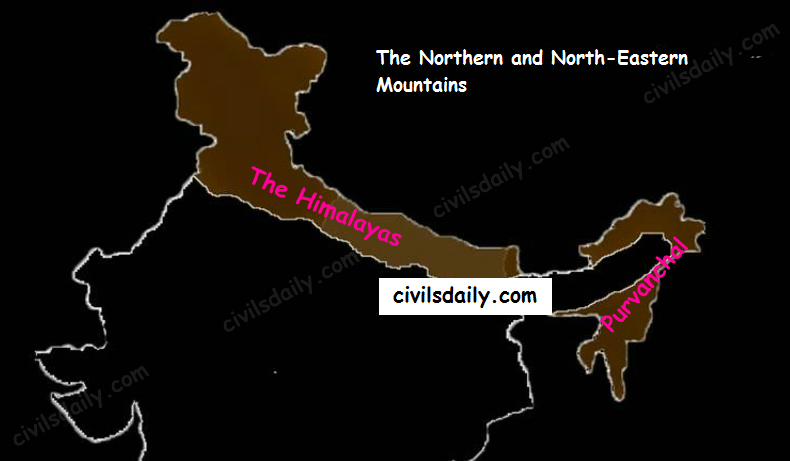
    Let’s begin with the first physiographic division. It consists of:

    • The Himalayas, and
    • The Northeastern hills (Purvanchal).
    The Physiographic Divisions of India | The Northern and Northeastern Mountains

    A) The Himalayas:

    The name β€œHimalaya” means β€œthe abode or house of snow” in Sanskrit (i.e. hima β€œsnow”, and ālaya β€œabode or house”). The Himalayas are the highest and longest of all young fold mountains of the world. The Pamir, known as the roof of the world, connects the Himalayas with the high ranges of Central Asia.

    Let’s begin by understanding how the Himalayas came into being:

    Origin and development:

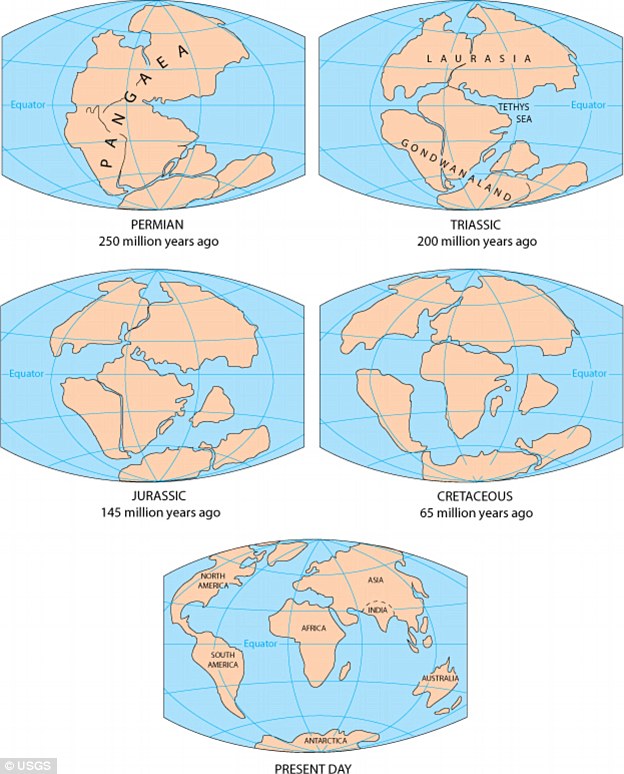
    According to the theory of Continental Drift, the world was made up of a single continent through most of the geologic time. That continent eventually separated and drifted apart; forming the seven continents we have today.

    continental-drift
    Source

    About 200 million years ago: Pangaea broke apart leading to the formation of two landmasses – β€œLaurasia in North” and β€œGondwanaland in South”. Both the landmasses were separated by a shallow sea called β€œTethys Sea”. The size of Tethys sea kept on decreasing due to movement of landmasses towards each other

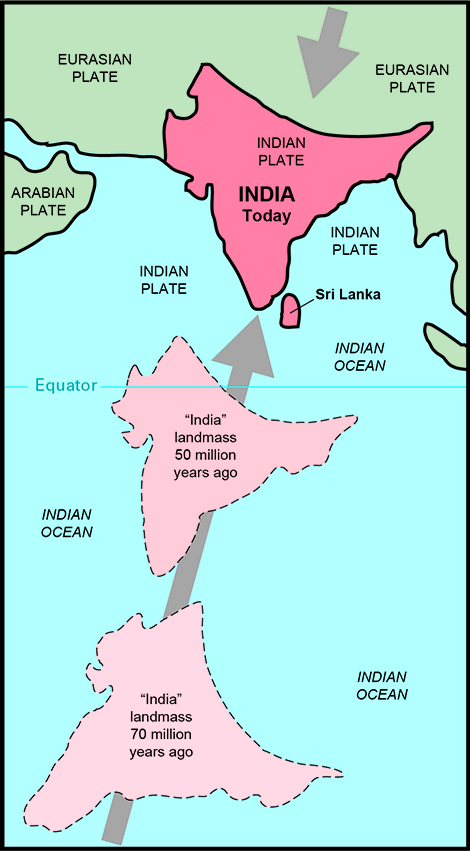
    About 40 to 50 million years ago:Β The two large landmasses, India and Eurasia, driven by plate movement, collided. As a result, the sediments accumulated in Tethys Sea (brought by rivers) were compressed, squeezed and series of folds were formed, one behind the other, giving birth to folded mountains of the Himalayas.

    India moving copy-2
    Source

    Recent studies show that India is still moving northwards at the rate of 5cm/year and crashing into the rest of Asia, thereby constantly increasing the height of Himalayas.

    Evidence to prove that the Himalayas are still rising:

    1. Fossil formation found in Shivalik hills:

    Similar fossils have also been found in the Tibet Plateau. This indicates that in the past, Tibetan plateau and Shivalik hills shared a common location, similar level and thus similar vegetation, life etc.; then Tibetan plateau got uplifted.

    2. Desiccation of lakes of Tibet:

    In the Tibet plateau, we find deposits which are generally found in lakes. This indicates that lakes once existed in Tibet but because of upliftment the water got discharged and deposits remained.

    3. Frequent Earthquakes

    4. Youthful nature of rivers (High erosion, v-shaped valleys etc.)

    The North-South Division of the Himalayas

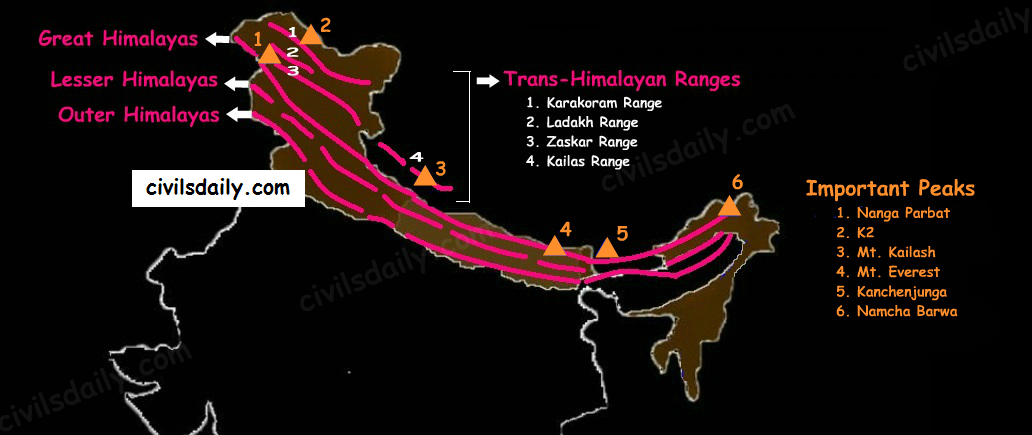
    The Himalayas consist of a series of parallel mountain ranges:

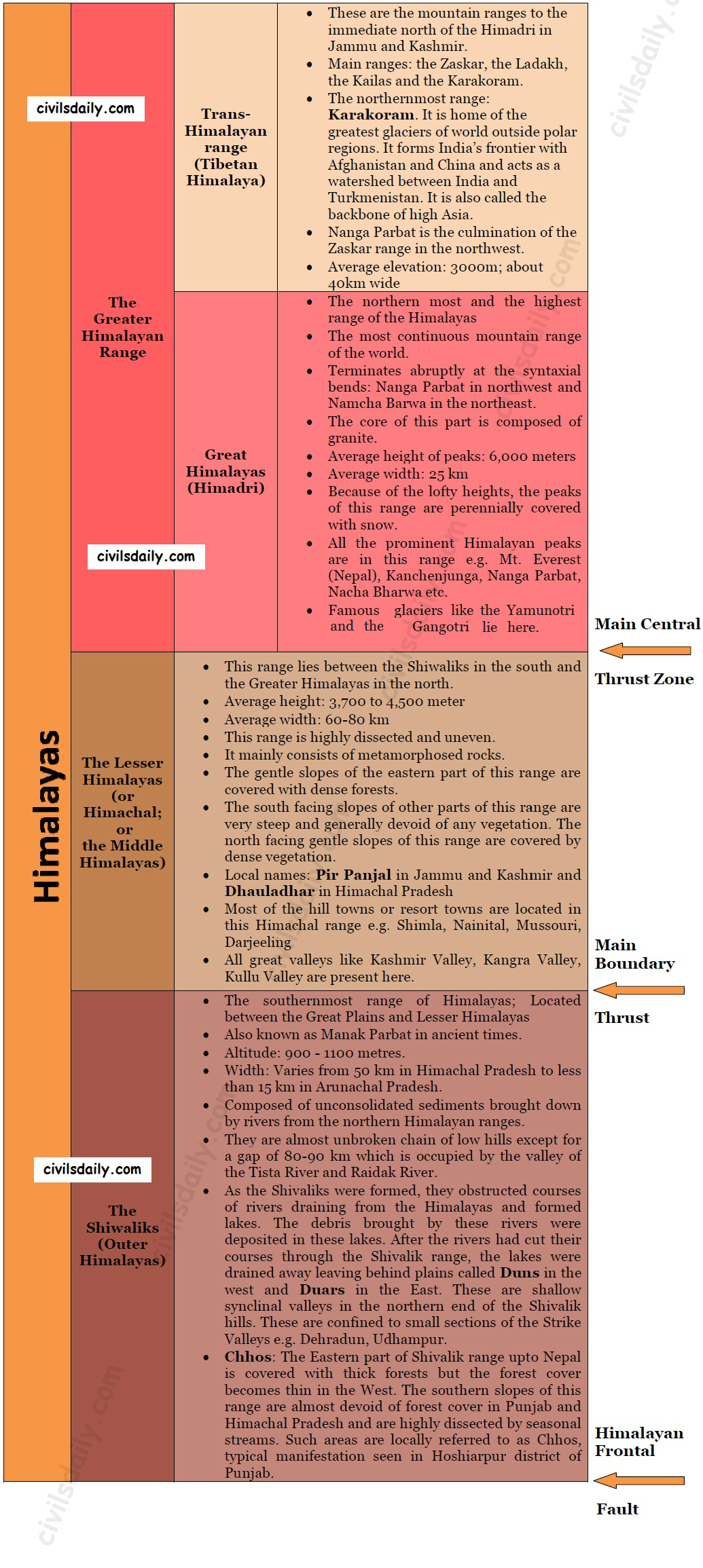
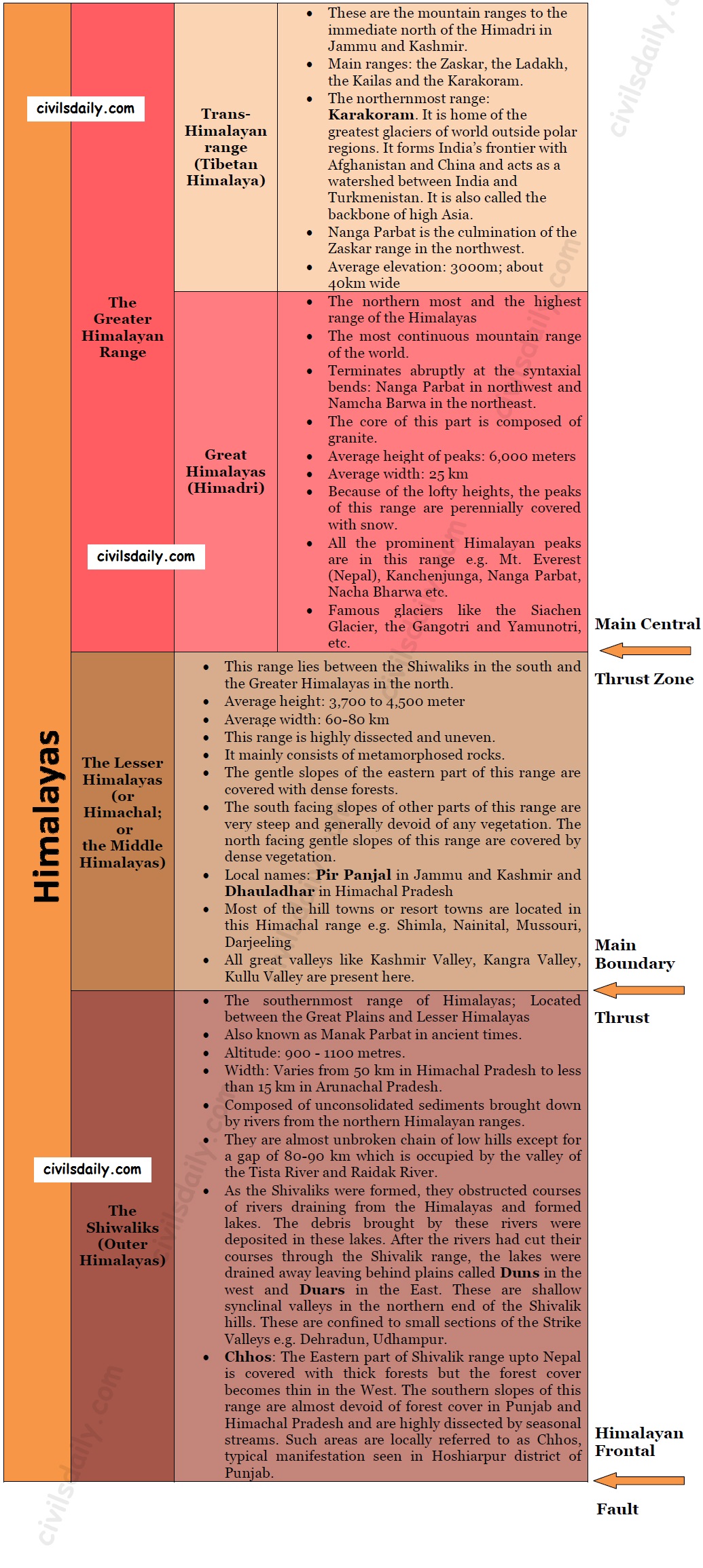
    1. The Greater Himalayan range, which includes:
      • The Great Himalayas(Himadri), and
      • The Trans-Himalayan range
    2. The Lesser Himalayas (or Himachal), and
    3. The Outer Himalayas (or Shiwalik).
    The Himalayan Ranges and Important Peaks
    • FormationΒ of these ranges: The Himadri and Himachal ranges of the Himalayas have been formed much before the formation of Siwalik range. The rivers rising in the Himadri and Himachal ranges brought gravel, sand and mud along with them, which was deposited in the rapidly shrinking Tethys Sea. In course of time, the earth movements caused folding of these relatively fresh deposits of sediments, giving rise to the least consolidated Shiwalik range.
    • Characteristic Features:
      • Notice in the map shown above that the Himalayas formΒ an arcuate curveΒ which is convex to the south.Β This curved shape of the Himalayas is attributed to the maximum push offered at the two ends on the Indian peninsula during its northward drift. In the north-west, it was done by Aravalis and in the Northeast by the Assam ranges.
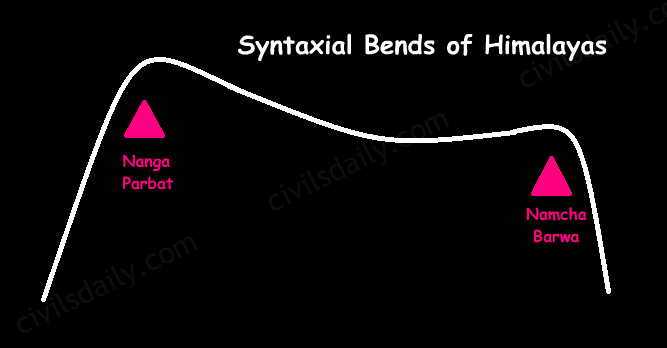
      • Syntaxis/ Syntaxial bends: The gently arching ranges of the Himalayan mountains on their Western and Eastern extremities are sharply bent southward in deep Knee-bend flexures that are called syntaxial bends. On both the ends, the great mountains appear to bend around a pivotal point. The western point is situated south of the Pamir where the Karakoram meets the Hindu Kush. A similar sharp, almost hairpin bend occurs on the eastern limit of Arunachal Pradesh where the strike of the mountain changes sharply from the Easterly to Southerly trend. Besides these two major bends, there are a number of minor syntaxial bends in other parts of Himalayas.

        Syntaxial Bends of Himalayas

      • The Himalayas areΒ wider in the west than in the east. The width varies from 400 km in Kashmir to 150 km in Arunachal Pradesh.The main reason behind this difference is that the compressive force was more in the east than in the west. That is why high mountain peaks like Mount Everest and Kanchenjunga are present in the Eastern Himalayas.
      • The ranges are separated by deep valleys creating aΒ highly dissected topography.
      • TheΒ southern slopesΒ of the Himalayas facing India are steeper and those facing the Tibetan side are generally gentler.
    • Let’s take up these Himalayan mountain ranges one by one:

      The Himalayan Ranges | the Greater Himalayan Range, the Lesser Himalayas, the Shivaliks

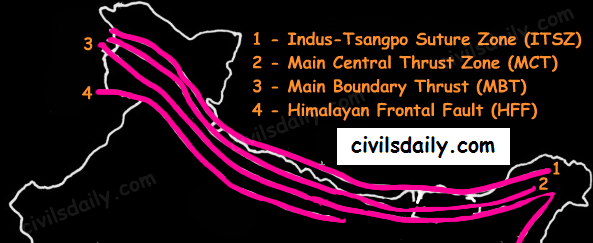
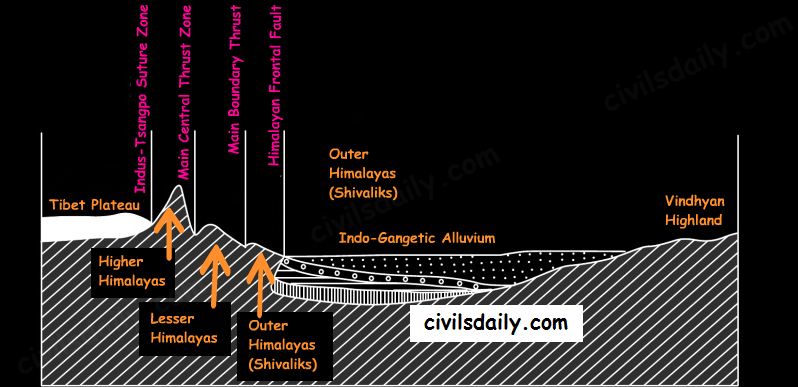
      Indus-Tsangpo Suture Zone:Β It represents a belt of tectonic compression caused by the underthrusting of the Indian shield/ plate against the Tibetan mass. It marks the boundary between Indian and Eurasian plates. The suture zone stretches from the North Western Himalayan syntaxis bordering the Nanga Parbat to the East as far as the Namche Barwa Mountain. Tha Karakoram range and the Ladakh plateau lie to the north of ITSZ and originally formed a part of the European plate.Main Central Thrust Zone:Β This separates the Higher Himalayas in the north from lesser Himalayas in the south. It has played an important role in the tectonic history of these mountains.Main Boundary Thrust: It is a reverse fault of great dimensions which extends all the way from Assam to Punjab and serves to separate the outer Himalayas from the lesser Himalayas.Himalayan Frontal Fault: It is a series of reverse faults that demarcates the boundary of the Shivalik from of the Himalayan province from the alluvial expanse of the Indo-Gangetic plains.

    Major Faults of the Himalayas – ITSZ, MCT, MBT, HFF
    The Himalayan Complex: A Cross-sectional View

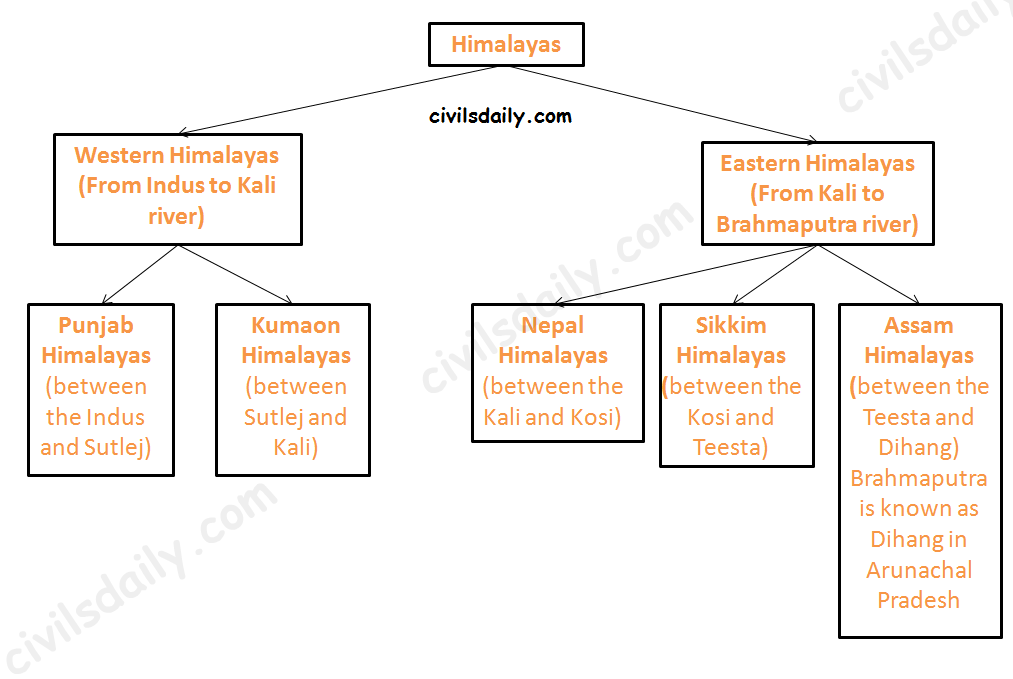
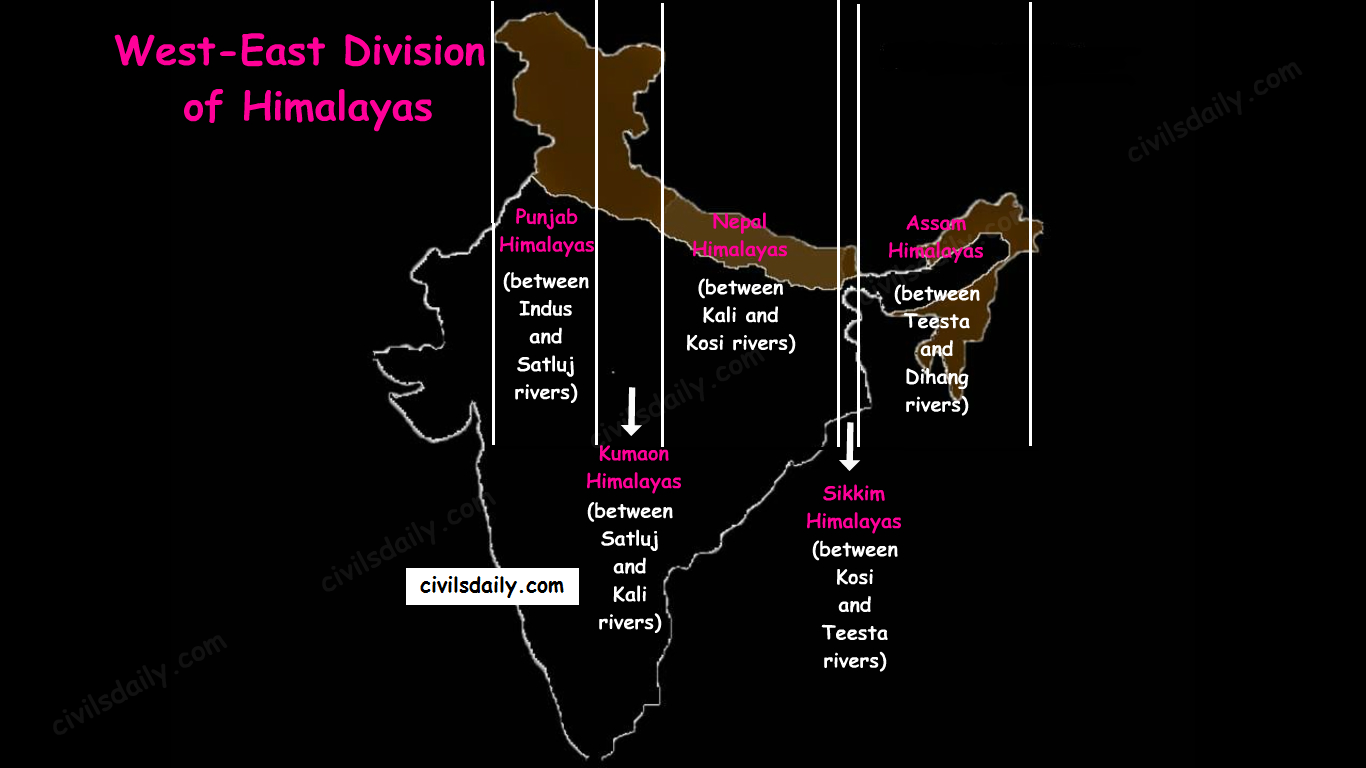
    Besides the longitudinal divisions, the Himalayas have been divided on the basis of regions from west to east:

    These divisions have been demarcated by river valleys:

    The Regional Divisions of Himalayas – the Western and Eastern Himalayas.
    1. Punjab Himalayas:
      • A large portion of Punjab Himalayas is in Jammu and Kashmir and Himachal Pradesh. Hence they are also called the Kashmir and Himachal Himalaya.
      • Major ranges: Karakoram, Ladakh, Pir Panjal, Zaskar and Dhaola Dhar.
      • The general elevation falls westwards.
      • The Kashmir Himalayas are also famous forΒ Karewa formations.
        • β€˜Karewas’ in Kashmiri language refer to the lake deposits, found in the flat-topped terraces of the Kashmir valley and on the flanks of the Pir Panjal range.
        • These deposits consist of clays, silts and sands, these deposits also show evidence of glaciation.
        • The occurrence of tilted beds of Karewas at the altitudes of 1500-1800m on the flanks of the Pir Panjal strongly suggests that the Himalayas were in process of uplift as late as Pliocene and Pleistocene (1.8mya to 10kyears ago)
        • Karewas are famous for the cultivation ofΒ Zafran, a local variety of saffron.
    2. Kumaon Himalayas
    3. Nepal Himalayas:
      • Tallest section of Himalayas
    4. Sikkim Himalayas:
      • Teesta river originates near Kanchenjunga
      • Jelep la pass- tri-junction of India- China-Bhutan
    5. Assam Himalayas:
      • Himalayas are narrower in this region and Lesser Himalayas lie close to Great Himalayas.
      • Peaks: Namcha Barwa, Kula Kangri
      • Bengal β€˜Duars’
      • Diphu pass- tri-junction of India- China-Myanmar
      • The Assam Himalayas show a marked dominance of fluvial erosion due to heavy rainfall.
    The West-East Division of Himalayas

    Glaciers and Snowline:

    Snowline: The lower limit of perpetual snow is called the β€˜snowline’. The snowline in the Himalayas has different heights in different parts, depending on latitude, altitude, amount of precipitation, moisture, slope and local topography.

    1. The snowline in the Western Himalaya is at a lower altitude than in the Eastern Himalaya. E.g. while the glaciers of the Kanchenjunga in the Sikkim portion hardly move below 4000m, and those of Kumaon and Lahul to 3600m, the glaciers of the Kashmir Himalayas may descend to 2500m above the sea level.

    • It is because of the increase in latitude from 28Β°N in Kanchenjunga to 36Β°N in the Karakoram (Lower latitude β€”> warmer temperatures β€”> higher snowline).
    • Also, the Eastern Himalayas rise abruptly from the planes without the intervention of High ranges.
    • Though the total precipitation is much less in the western Himalayas, it all takes place in the form of snow.

    2. In the Great Himalayan ranges, the snowline is at a lower elevation on the southern slopes than on the northern slopes. This is because the southern slopes are steeper and receive more precipitation as compared to the northern slopes.

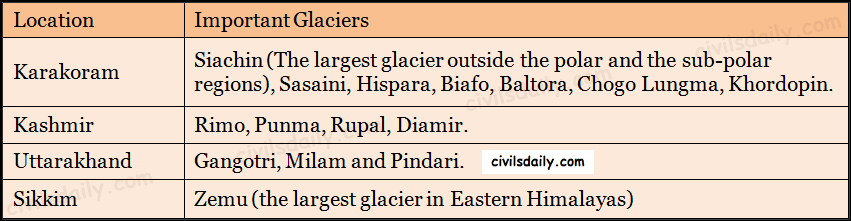
    Glaciers: The main glaciers are found in the Great Himalayas and the Trans-Himalayan ranges (Karakoram, Ladakh and Zaskar). The Lesser Himalayas have small glaciers, though traces of large glaciers are found in the Pir Panjal and Dhauladhar ranges. Some of the important glaciers are:

    Important Glaciers and their Locations

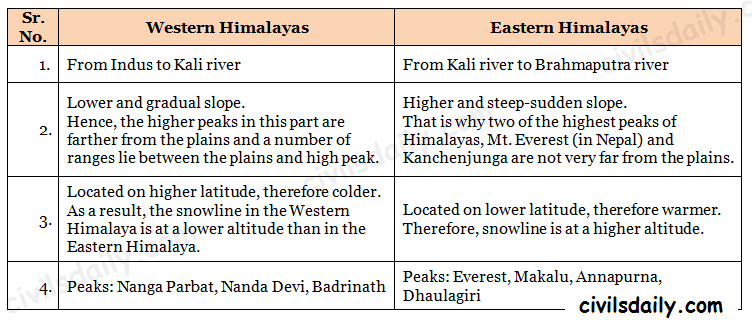
    Key differences between the Eastern and Western Himalayas:

    Key Difference between the Western and Eastern Himalayas.

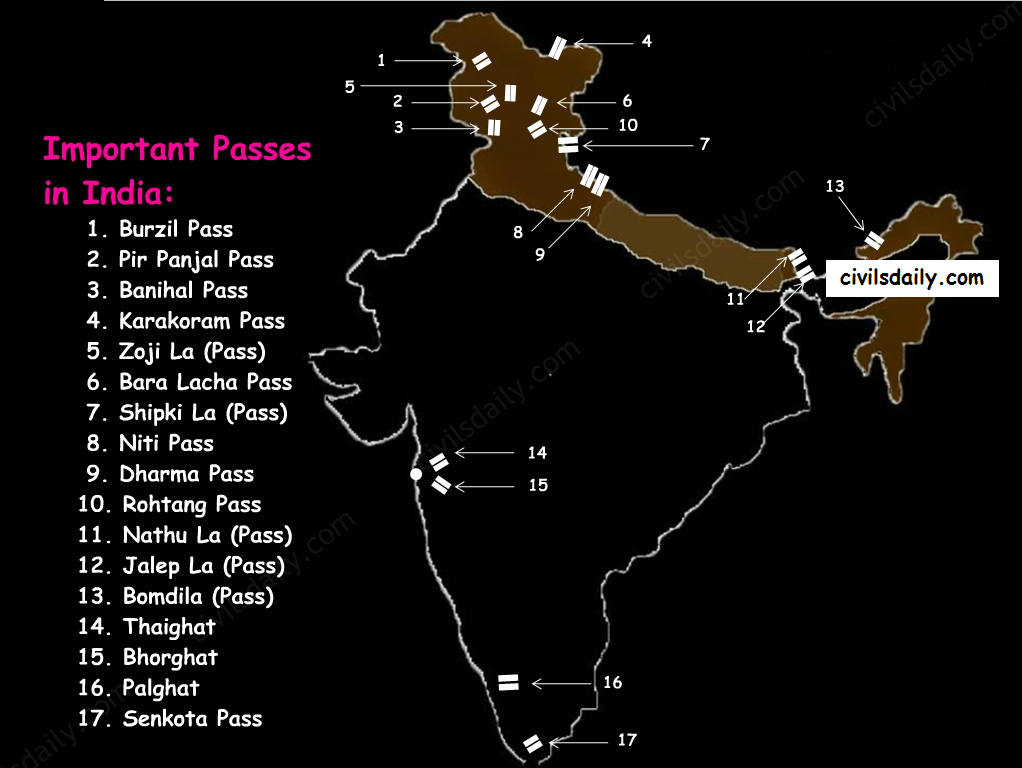
    Important Passes in India:

    A pass is a narrow gap in a mountain range which provides a passageway through the barrier.

    Important Passes in India
    1. Pir Panjal Pass – It provides the shortest and the easiest metal road between Jammu and the Kashmir Valley. But this route had to be closed down as a result of partition of the subcontinent.
    2. Banihal Pass – It is in Jammu and Kashmir. The road from Jammu to Srinagar transversed Banihal Pass until 1956 when Jawahar Tunnel was constructed under the pass. The road now passes through the tunnel and the Banihal Pass is no longer used for road transport.
    3. Zoji La (Pass) – It is in the Zaskar range of Jammu and Kashmir. The land route from Srinagar to Leh goes through this pass.
    4. Shipki La (Pass) – It is in Himachal Pradesh. The road from Shimla to Tibet goes through this pass. The Satluj river flows through this pass.
    5. Bara Lacha Pass – It is also in Himachal Pradesh. It links Mandi and Leh by road.
    6. Rohtang Pass – It is also in Himachal Pradesh. It cuts through the Pir Panjal range. It links Manali and Leh by road.
    7. Niti Pass – It is in Uttarakhand. The road to the Kailash and the Manasarovar passes through it.
    8. Nathu La (Pass) – It is in Sikkim. It gives way to Tibet from Darjeeling and Chumbi valley. The Chumbi river flows through this pass.
    9. Jalep La (Pass) – At the tri-junction of India- China-Bhutan. The Teesta river has created this pass.

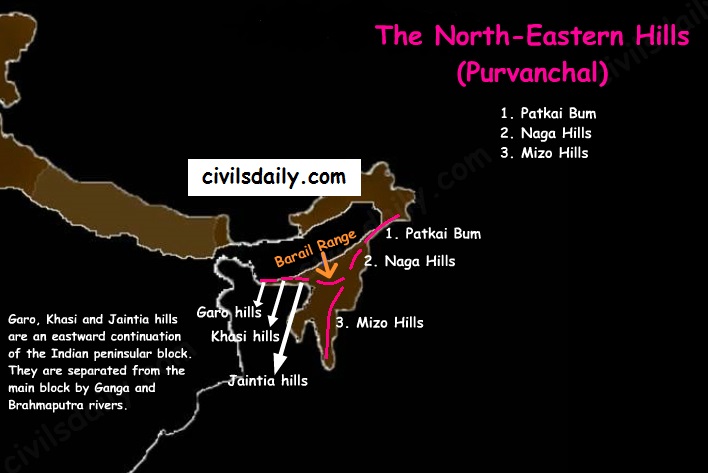
    B) The North-Eastern Hills and Mountains

    The North-Eastern Hills (Purvanchal): Patkai Bum, Naga Hills, Mizo Hills

    The Brahmaputra marks the eastern border of Himalayas. Beyond the Dihang gorge, the Himalayas bend sharply towards south and form the Eastern hills orΒ Purvanchal.

    • These hills run through the northeastern states of India.
    • These hills differ in scale and relief but stem from the Himalayan orogeny.
    • They are mostly composed of sandstones (i.e. Sedimentary rocks).
    • These hills are covered with dense forests.
    • Their elevation decreases from north to south. Although comparatively low, these hill ranges are rather forbidding because of the rough terrain, dense forests and swift streams.
    • Purvanchal hills are convex to the west.
    • These hills are composed of:
      • Patkai Bum – Border between Arunachal Pradesh and Myanmar
      • Naga Hills
      • Manipuri Hills – Border between Manipur and Myanmar
      • Mizo Hills.
    • Patkai Bum and Naga Hills form the watershed between India and Myanmar.
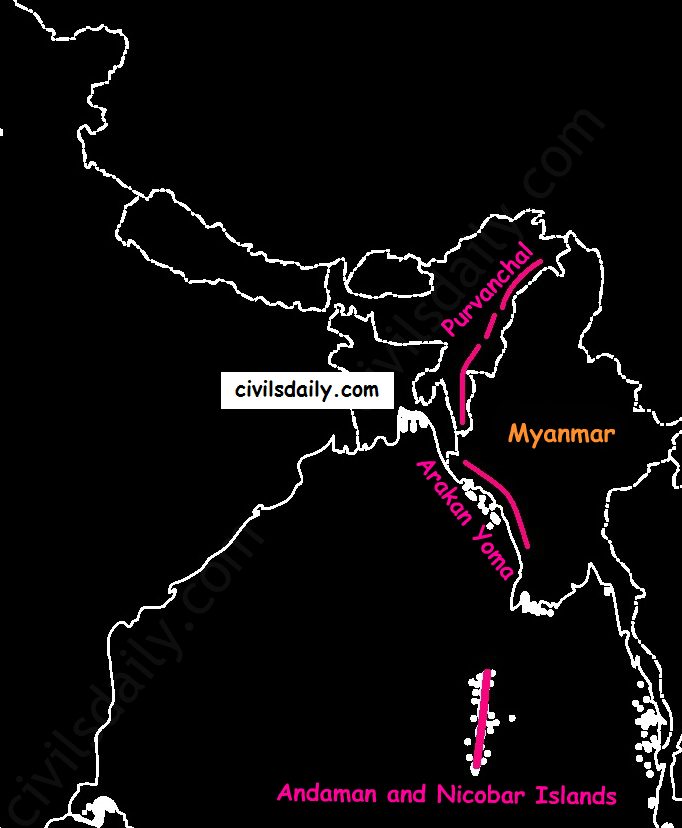
    • Extension of Purvanchal continues in Myanmar as Arakan Yoma –then Andaman and Nicobar Islands.
    Arakan Yoma – An Extension of Purvanchal in Myanmar
  • [Prelims Spotlight] Important Schemes regarding Agriculture & Allied Sectors

    Prelims Spotlight is a part of “Nikaalo Prelims 2020” module. This open crash course for Prelims 2020 has a private telegram group where PDFs and DDS (Daily Doubt Sessions) are being held. Please click here to register.

    Important Schemes regarding Agriculture & Allied Sectors


    06 May 2020

    1.1 Pradhan Mantri Krishi Sinchayee Yojana

    Objective

    ● To achieve convergence of investments in irrigation at the field level.
    ● To enhance the recharge of aquifers and introduce sustainable water conservation practices.
    ● To explore the feasibility of reusing treated municipal wastewater for peri-urban agriculture.
    ● To attract greater private investments in irrigation.
    ● To promote extension activities relating to water harvesting, water management and crop alignment for farmers and grass root level field
    functionaries.

    Salient features

    ● Decentralized State level planning and projectized execution’ structure, in order to allow States to draw up a District Irrigation Plan (DIP) and a State Irrigation Plan (SIP). These plans need to be prepared in order to access
    the PMKSY fund.
    ● It will be supervised and monitored by the Inter-Ministerial National Steering Committee (NSC) under PM with Union Ministers of all concerned Ministries. A National Executive Committee (NEC) is to be constituted under the Chairmanship of the Vice Chairman, NITI Aayog to oversee programme implementation.
    ● PMKSY has been formulated amalgamation ongoing schemes viz. Accelerated Irrigation Benefit Programme (AIBP); Integrated
    Watershed Management Programme (IWMP); and On-Farm Water Management (OFWM) component of National Mission on Sustainable
    Agriculture (NMSA).
    ● Water budgeting is done for all sectors namely, household, agriculture and industries.
    ● Investments will happen at farm level. So, farmers know what is happening and can provide valuable feedback.
    ● Recently, the Long Term Irrigation Fund has been instituted under PMKSY in NABARD for funding and fast-tracking the implementation
    of incomplete major and medium irrigation projects.

    1.2 RASHTRIYA KRISHI VIKAS YOJANA – RAFTAAR (RKVY-RAFTAAR)

    Objective

    ● To make farming a remunerative economic activity through strengthening the farmer’s efforts, risk mitigation and promoting
    agribusiness entrepreneurship.
    ● To attend national priorities through several sub-schemes.
    ● To empower youth through skill development, innovation and agri entrepreneurship based business models.

    Salient featuresΒ 

    ● RKVY, initiated in 2007 as an umbrella scheme for holistic development of agriculture and allied sectors, has been recently revamped as
    RKVY-RAFTAAR – Remunerative Approaches for Agriculture and Allied sector Rejuvenation for 2017-19 and 2019-20.
    ● It provided states with considerable flexibility and autonomy for planning and executing Programs.
    ● The decentralised planning for agriculture and allied sectors is initiated by the states through District Agriculture Plan and State Agriculture
    Plan based on agro-climatic conditions, availability of appropriate technology and natural priorities.
    ● It will incentivize states to increase allocations for agriculture and allied sectors and help in creation of post-harvest infrastructure and
    promotion of private investment in the farm sector across the country.
    ● Fund Allocation – 60:40 grants between Centre
    and States in states and 90:10 for North Eastern States and Himalayan States through following streams – o Infrastructure & Assets and Production Growth o RKVY-RAFTAAR special sub-schemes of National Priorities o Innovation
    and agri-entrepreneur development.

    Sub-schemes include

    ● Bringing Green Revolution to Eastern India
    ● Crop Diversification Program – It is being implemented in the Original Green Revolution States of Punjab, Haryana and Western Uttar Pradesh to diversify area from water-guzzling crop
    ● Reclamation of Problem Soil ● Foot & Mouth Disease – Control Program
    (FMD-CP)
    ● Saffron Mission
    ● Accelerated Fodder Development Programme (AFDP)

    1.3 NATIONAL FOOD SECURITY MISSION

    Objective

    ● Increasing production of rice, wheat, pulses, coarse cereals and commercial crops through area expansion and productivity enhancement
    in a sustainable manner.
    ● Restore soil fertility and productivity at the individual farm level.
    ● Enhancing farm level economy.

    Salient features

    ● It is a Centrally Sponsored Scheme which was launched in 2007.
    ● The approach of the scheme is to bridge the yield gap in respect of these crops through dissemination of improved technologies and farm management practices while focusing on districts which have high potential but relatively low level of productivity at present.
    ● Major Components – National Food Security Mission – Rice, National Food Security Mission – Wheat, National Food Security Mission – Pulses,
    National Food Security Mission – Coarse Cereals and National Food Security Mission –Commercial Crops.

    1.4 National Horticulture Mission

    1. To provide holistic growth of the horticulture sector through an area based regionally differentiated strategies, to enhance horticulture production, improve nutritional security and income support to farm households
    2. To establish convergence and synergy among multiple ongoing and planned programmes for horticulture development
    3. To promote, develop and disseminate technologies, through a seamless blend of traditional wisdom and modern scientific knowledge
    4. To create opportunities for employment generation for skilled and unskilled persons, especially unemployed youth.

    Scheme:

    A National Horticulture Mission was launched in 2005-06 as a Centrally Sponsored Scheme to promote holistic growth of the horticulture sector
    through an area based regionally differentiated strategies. The scheme has been subsumed as a part of Mission for Integration Development of
    Horticulture (MIDH) during 2014-15.

    What is the National Horticulture Mission?

    The National Horticulture Mission is a government mission to support horticultural production in the country. NHM is a Centrally Sponsored Scheme in which the Government of India contributes 85%, and 15% is met by the State Governments.

    Factual Information:

    ● India ranks second in the global production of fruits and vegetables next to China.
    ● Started in 2005-06.

    1.5 SOIL HEALTH CARD SCHEME

    Objective

    ● To issue soil health cards every 3 years, to all farmers of the country, so as to provide a basis to address nutrient deficiencies in fertilization practices.
    ● To strengthen the functioning of Soil Testing Laboratories (STLs) through capacity building, the involvement of agriculture students and
    effective linkage with Indian Council of Agricultural Research (ICAR) / State Agricultural Universities (SAUs).
    ● To diagnose soil fertility related constraints with standardized procedures for sampling uniformly across states.
    ● To build capacities of district and state level staff and of progressive farmers for promotion of nutrient management practices.

    Salient features

    ● It is a centrally sponsored scheme launched by the Government of India in 2015.
    ● It is being implemented through the Department of Agriculture of all the State and Union Territory Governments.
    ● Assistance is provided to the State Government to issue Soil Health Card and also develop a database to improve service delivery.
    ● Soil Health Card issued to farmers carry crop-wise recommendations of nutrients and fertilizers required for the individual farms.
    ● The experts will analyze the strength and weaknesses (micronutrients deficiency) of the soil collected from farms and suggest measures
    to deal with it.
    ● It will contain the status of his soil with respect to 12 parameters, namely N,P,K (Macronutrients); S (Secondary nutrient); Zn, Fe, Cu, Mn, Bo (Micro – nutrients); and pH, EC, OC (Physical parameters).

    1.6 PM FASAL BIMA YOJANA

    Objective

    ● To provide insurance coverage and financial support to the farmers in the event of natural calamities, pests & diseases.
    ● To stabilise the income of farmers to ensure
    their continuance in farming. ● To encourage farmers to adopt innovative and
    modern agricultural practices.
    ● To ensure flow of credit to the agriculture sector.
    Intended beneficiary.
    ● All farmers including sharecroppers and tenant farmers growing notified crops in a notified area during the season who have insurable interest in the crop are eligible.

    Salient features

    ● It replaced all other existing insurance schemes except the Restructured Weather-Based Crop Insurance Scheme (uses weather parameters as
    proxy for crop yield in compensating the cultivators for deemed crop loses) .
    ● A uniform premium of only 2% to be paid by farmers for all Kharif crops and 1.5% for all Rabi crops.
    ● In case of annual commercial and horticultural crops, the premium to be paid by farmers will be only 5%.
    ● There is no upper limit on Government subsidy so farmers will get claim against full sum insured without any reduction.
    ● The difference between the premium paid by farmers and the actuarial premium charged was paid by the Centre and state government in
    the ratio of 50:50.
    ● It is compulsory for loanee farmers availing crop loans for notified crops in notified areas and voluntary for non-loanee farmers.
    ● Yield Losses: due to non-preventable risks, such as Natural Fire and Lightning, Storm, Hailstorm, Cyclone, Typhoon, Tempest, Hurricane, Tornado.
    Risks due to Flood, Inundation and Landslide, Drought, Dry spells, Pests/ Diseases also will be covered.
    ● Post-harvest losses are also covered.
    ● Mandatory use of technology: Smart phones, drones etc., will be used to capture and upload data of crop cutting to reduce the delays in claim payment to farmers. Remote sensing will be used to reduce the number of crop cutting
    experiments.
    ● The Scheme shall be implemented on an β€˜Area Approach basis’. Defined Area (i.e., unit area of insurance) is Village or above. It can be a
    Geo-Fenced/Geo-mapped region having homogenous Risk Profile for the notified crop.
    ● Presently, 5 public sector insurers (Agriculture
    Insurance Company of India, United India Insurance Company etc.) and 13 private insurance companies are empanelled for implementation of the scheme.
    ● Recently, states have been allowed to set up their own insurance companies for implementing the scheme.

    1.7 National Mission for Sustainable Agriculture

    National Mission for Sustainable Agriculture (NMSA) has been formulated for enhancing agricultural productivity especially in rainfed areas focusing on integrated farming, water use efficiency, soil health management and
    synergizing resource conservation.

    Objectives

    ● To make agriculture more productive, sustainable, remunerative and climate resilient by promoting location specific Integrated/Composite Farming Systems
    ● To conserve natural resources through appropriate soil and moisture conservation measures
    ● To adopt comprehensive soil health management practices based on soil fertility maps, soil test based application of macro & micro nutrients, judicious use of fertilizers etc.
    ● To optimize utilization of water resources through efficient water management to expand coverage for achieving β€˜more crop per drop’.
    ● To develop capacity of farmers & stakeholders, in conjunction with other on going missions e.g. National Mission on Agriculture Extension &
    Technology, National Food Security Mission, National Initiative for Climate Resilient Agriculture (NICRA) etc., in the domain of
    climate change adaptation and mitigation measures.
    ● To pilot models in select blocks for improvingΒ  productivity of rainfed farming by mainstreaming rainfed technologies refined through NICRA and by leveraging resourcesΒ  from other schemes/Missions like Mahatma
    Gandhi National Rural Employment Guarantee Scheme (MGNREGS), Integrated Watershed Management Programme (IWMP), RKVY etc.;
    and
    ● To establish an effective inter and intra Departmental/Ministerial coordination for accomplishing key deliverables of National Mission for Sustainable Agriculture under the aegis of National Action Plan on Climate
    Change (NAPCC).

    1.8 PARAMPARAGAT KRISHI VIKAS YOJANA

    Objective

    ● Promotion of commercial organic production through certified organic farming.
    ● pesticide residue free produce and improved health of consumer
    ● Raise farmer’s income and create potential markets for traders.
    ● Motivate the farmers for natural resource mobilization for input production.
    ● Increase domestic production and certification of organic produce by involving farmers.

    Intended beneficiary
    ● Farmers doing organic farming
    ● Farmers from NE India such as Sikkim
    ● Food processing industries
    ● Organic foods – export industry

    Salient features
    ● β€œParamparagat Krishi Vikas Yojana” is an elaborated component of Soil Health Management (SHM) under National Mission of Sustainable Agriculture (NMSA).
    ● Cluster Approach: Fifty or more farmers form a cluster having 50 acre land to take organic farming. Each farmer will be provided Rs. 20000
    per acre in three years for seed to harvesting crops and to transport them to market.
    ● Government plans to form around 10 thousand clusters in three years and cover an area of 5 Lakh hectares under organic farming.

    Components –
    ● Participatory Guarantee System (PGS) certification through cluster approach – mobilization of farmers, form clusters, identification of land resources and training on organic farming and PGS Certification and
    quality control.
    ● Adoption of organic village for manure management and biological nitrogen harvesting through cluster approach –action plan for Organic Farming, Integrated Manure Management, Packing, Labelling and Branding
    of organic products of cluster.

    1.9 NATIONAL AGRICULTURAL MARKET
    (NAM)

    Objective

    ● To promote genuine price discovery
    ● Increases farmers’ options for sale and access to markets
    ● Liberal licensing of traders / buyers and commission agents. One license for a trader valid across all markets in the State
    ● Harmonisation of quality standards of agricultural produce
    ● Single point levy of market fees, i.e on the first wholesale purchase from the farmer.
    ● Provision of Soil Testing Laboratories in/ or near the selected mandi to facilitate visiting farmers to access this facility in the mandi itself

    Intended beneficiaryΒ 

    ● 585 regulated wholesale markets in states/union territories (UTs).
    ● Farmers
    ● Local traders
    ● Bulk buyers, processors
    ● Farm produce exporters
    ● Overall economy of the nation

    Salient features
    ● NAM is a pan-India electronic trading portal which seeks to network the existing APMCs and other market yards to create a unified national
    market for agricultural commodities.
    ● Small Farmers Agribusiness Consortium (SFAC) has been selected as the lead agency to implement it.
    ● Central government will provide the software free of cost to the states and in addition, a grant of up to Rs. 30 lakhs per mandi or market or
    private mandis will be given for related equipment and infrastructure requirements.
    ● New Features added to the scheme such as E-NAM Mobile App, BHIM Payment facility, MIS dashboard for better analysis and insights,
    grievance redressal mechanism for Mandi Secretaries and integration with Farmer Database to ease the registration and identification process will further strengthen e-NAM.
    ● Fund Allocation – The Scheme is being funded through AgriTech Infrastructure Fund (AITF).

    1.10 KRISHI VIGYAN KENDRAS

    Objective
    ● To be a frontline extension in agriculture, and to serve as a single window mechanism for addressing the technology needs of farmers
    ● To demonstrate location specific technologies and build capacity of farmers
    ● To serve as links between research and extension and also with farmers
    Intended beneficiary
    ● Rural youth, farm women and Farmers (skill development training)
    Salient features
    ● Indian Council of Agricultural Research (ICAR)has created a network of 645 Krishi Vigyan Kendras (KVKs) in the country and 106 more
    KVKs will be established.
    ● Directorate of Extension in State Agriculture Universities also helps KVKs in its activities.
    ● KVKs lay strong emphasis on skill development training of rural youth, farm women and farmers
    ● Provide latest technological inputs like seeds,planting materials and bio-products.
    ● Advise farmers on timely crop/enterprise related recommendations, including climate resilient technologies.
    ● Diagnose and solve problems emerging from district agro-ecosystems and lead in adoption of innovations.

    1.11 MERA GAON-MERA GAURAV

    Objective

    ● To promote direct interface of scientists withthe farmers and hasten the land to lab process.
    ● To imbibe a sense of ownership among the agricultural scientists
    ● To provide farmers with required information, knowledge and advisories on regular basis by adopting villages.

    Intended beneficiary

    ● Scientists with ground level experience
    ● Farmers

    Salient features
    ● This scheme involves scientists of the Indian Council of Agriculture Research (ICAR) and state agricultural universities.
    ● Groups of four multidisciplinary scientists each will be constituted at these institutes and universities. Each group will β€œadopt” five villages within a radius of maximum 100 km.

    1.12 Price Stabilization Fund

    Objective: to safeguard the interest of the growers and provide them financial relief when prices fall below a specified level.

    Scheme:
    ● Central Sector Scheme.
    ● To support market interventions for price control of perishable agri-horticultural commodities.
    ● PSF will be used to advance interest free loan to State Governments and Central agencies to support their working capital and other expenses on procurement and distribution interventions for such commodities.
    ● Procurement of the commodities will be undertaken directly from farmers or farmers’ organizations at farm gate/mandi and made available at a more reasonable price to the consumers.
    ● Initially the fund is proposed to be used for onion and potato only. Losses incurred, if any, in the operations will be shared between the Centre and the States.

    Framework and Funding:

    ● States will set up a revolving fund to which theCentre and State will contribute equally, i.e. 50:50.
    ● The ratio of Centre-State contribution to the State-level corpus in respect of Northeast States will, however, be 75:25.

    1.13 Mission Fingerling

    ● It is a programme to enable holistic development and management of the fisheries sector in India.
    ● The mission aims to achieve the target to enhance fisheries production from 10.79 mmt (2014-15) to 15 mmt by 2020-21 under the Blue Revolution.

    Programme:

    ● Government has identified 20 States based ontheir potential and other relevant factors to strengthen the Fish Fingerling production and Fish Seed infrastructure in the country.
    ● This program will facilitate the establishment of Fingerling rearing pond and hatcheries.
    ● This will converge in the production of 20 lakh tonnes of fish annually, which will in turn benefit about 4 million families.
    ● The implementation of this program will supplement the requirement of stocking materials in the country up to a large extent, which is a much needed input to achieve the enhanced fish production.

    1.14 Umbrella Scheme Green Revolution β€” Krishonnati Yojana

    AIM

    These schemes look to develop the agriculture and allied sector in a holistic and scientific manner to increase the income of farmers by enhancing
    production, productivity and better returns on produce.

    The Schemes that are part of the Umbrella Schemes are :-

    i. Mission for Integrated Development of Horticulture (MIDH)
    ii. National Food Security Mission (NFSM)
    iii. National Mission for Sustainable Agriculture (NMSA)
    iv. Submission on Agriculture Extension (SMAE)
    v. Sub-Mission on Seeds and Planting Material (SMSP)
    vi. Sub-Mission on Agricultural Mechanisation (SMAM)
    vii. Sub Mission on Plant Protection and Plan Quarantine (SMPPQ)
    viii. Integrated Scheme on Agriculture Census, Economics and Statistics (ISACES)
    ix. Integrated Scheme on Agricultural Cooperation (ISAC)
    x. Integrated Scheme on Agricultural Marketing (ISAM)
    xi. National e-Governance Plan (NeGP-A) The Schemes/Missions focus on
    creating/strengthening of infrastructure of production, reducing production cost and marketing of agriculture and allied produce.

    1.15 Pradhan Mantri Annadata Aay SanraksHan Abhiyan (PM-AASHA)

    1. The Scheme is aimed at ensuring remunerative prices to the farmers for their produce as announced in the Union Budget for 2018.
    2. It is expected that the increase in MSP will be translated to farmers’ income by way of robust procurement mechanism in coordination with
    the State Governments.
    The three schemes that are part of AASHA are:
    1. the Price Support Scheme (PSS)
    2. the Price Deficiency Payment Scheme (PDPS)
    3. the Pilot of Private Procurement and Stockist Scheme (PPPS)
    ● These three components will complement the existing schemes of the Department of Food and Public Distribution.
    ● They relate to paddy, wheat and other cereals and coarse grains where procurement is at MSP now.
    ● PSS – Under the PSS, physical procurement of pulses, oilseeds and copra will be done by Central Nodal Agencies.
    ● Besides, NAFED and Food Corporation of India will also take up procurement of crops under PSS.
    ● The expenditure and losses due to procurement will be borne by the Centre.
    ● PDPS – Under the PDPS, the Centre proposes to cover all oilseeds.
    ● The difference between the MSP and actual selling/modal price will be directly paid into the farmer’s bank account.
    ● Farmers who sell their crops in recognised mandis within the notified period can benefit from it.
    ● PPSS – In the case of oilseeds, States will have the option to roll out PPSS in select districts.
    ● Under this, a private player can procure crops at MSP when market prices drop below MSP.
    ● The private player will then be compensated through a service charge up to a maximum of 15% of the MSP.

    1.16 Pradhan Mantri Kisan Samman Nidhi (PM-KISAN)

    What is the news: The Central Government notified a decision to extend the benefit of β‚Ή6,000 per year under the Pradhan Mantri Kisan Samman Nidhi
    scheme to all 14.5 crore farmers in the country, irrespective of the size of their landholding.
    ● Central sector scheme

    Objective

    β—‹ To provide income support to all farmer families having cultivable land.
    β—‹ To supplement the financial needs of the farmers in procuring various inputs to ensure proper crop health and appropriate yields, commensurate with the anticipated farm income.

    Salient Features:

    ● The revised Scheme is expected to coveraround 2 crore more farmers, increasing the coverage of PM-KISAN to around 14.5 crore
    beneficiaries.
    ● Responsibility of identifying the landholder farmer family eligible for benefit under the scheme shall be of the State/UT Government.
    ● The lists of eligible beneficiaries would be published at the village level to ensure transparency.
    ● Exclusions: Certain categories of beneficiaries of higher economic status such as institutional landholders, former and present holder of constitutional posts, persons who paid income tax in the last assessment year etc. shall not be eligible for benefit under the scheme.
    β–  Professionals like doctors, engineers and lawyers as well as retired pensioners with a monthly pension of over β‚Ή10,000 and those who paid income tax in the last assessment year are also not eligible for the benefits.
    β–  For the purpose of exclusion State/UT Government can certify the eligibility of the beneficiary based on self-declaration by the beneficiaries.
    ● A dedicated PM Kisan Portal will be launched for the implementation of the scheme.
    ● This is a Central Sector Scheme and will be funded fully by the Government of India

  • [Prelims Spotlight] Important Schemes regarding Agriculture & Allied Sectors

    Prelims Spotlight is a part of “Nikaalo Prelims 2020” module. This open crash course for Prelims 2020 has a private telegram group where PDFs and DDS (Daily Doubt Sessions) are being held. Please click here to register.

    Important Schemes regarding Agriculture & Allied Sectors


    06 May 2020

    1.1 Pradhan Mantri Krishi Sinchayee Yojana

    Objective

    ● To achieve convergence of investments in irrigation at the field level.
    ● To enhance the recharge of aquifers and introduce sustainable water conservation practices.
    ● To explore the feasibility of reusing treated municipal wastewater for peri-urban agriculture.
    ● To attract greater private investments in irrigation.
    ● To promote extension activities relating to water harvesting, water management and crop alignment for farmers and grass root level field
    functionaries.

    Salient features

    ● Decentralized State level planning and projectized execution’ structure, in order to allow States to draw up a District Irrigation Plan (DIP) and a State Irrigation Plan (SIP). These plans need to be prepared in order to access
    the PMKSY fund.
    ● It will be supervised and monitored by the Inter-Ministerial National Steering Committee (NSC) under PM with Union Ministers of all concerned Ministries. A National Executive Committee (NEC) is to be constituted under the Chairmanship of the Vice Chairman, NITI Aayog to oversee programme implementation.
    ● PMKSY has been formulated amalgamation ongoing schemes viz. Accelerated Irrigation Benefit Programme (AIBP); Integrated
    Watershed Management Programme (IWMP); and On-Farm Water Management (OFWM) component of National Mission on Sustainable
    Agriculture (NMSA).
    ● Water budgeting is done for all sectors namely, household, agriculture and industries.
    ● Investments will happen at farm level. So, farmers know what is happening and can provide valuable feedback.
    ● Recently, the Long Term Irrigation Fund has been instituted under PMKSY in NABARD for funding and fast-tracking the implementation
    of incomplete major and medium irrigation projects.

    1.2 RASHTRIYA KRISHI VIKAS YOJANA – RAFTAAR (RKVY-RAFTAAR)

    Objective

    ● To make farming a remunerative economic activity through strengthening the farmer’s efforts, risk mitigation and promoting
    agribusiness entrepreneurship.
    ● To attend national priorities through several sub-schemes.
    ● To empower youth through skill development, innovation and agri entrepreneurship based business models.

    Salient featuresΒ 

    ● RKVY, initiated in 2007 as an umbrella scheme for holistic development of agriculture and allied sectors, has been recently revamped as
    RKVY-RAFTAAR – Remunerative Approaches for Agriculture and Allied sector Rejuvenation for 2017-19 and 2019-20.
    ● It provided states with considerable flexibility and autonomy for planning and executing Programs.
    ● The decentralised planning for agriculture and allied sectors is initiated by the states through District Agriculture Plan and State Agriculture
    Plan based on agro-climatic conditions, availability of appropriate technology and natural priorities.
    ● It will incentivize states to increase allocations for agriculture and allied sectors and help in creation of post-harvest infrastructure and
    promotion of private investment in the farm sector across the country.
    ● Fund Allocation – 60:40 grants between Centre
    and States in states and 90:10 for North Eastern States and Himalayan States through following streams – o Infrastructure & Assets and Production Growth o RKVY-RAFTAAR special sub-schemes of National Priorities o Innovation
    and agri-entrepreneur development.

    Sub-schemes include

    ● Bringing Green Revolution to Eastern India
    ● Crop Diversification Program – It is being implemented in the Original Green Revolution States of Punjab, Haryana and Western Uttar Pradesh to diversify area from water-guzzling crop
    ● Reclamation of Problem Soil ● Foot & Mouth Disease – Control Program
    (FMD-CP)
    ● Saffron Mission
    ● Accelerated Fodder Development Programme (AFDP)

    1.3 NATIONAL FOOD SECURITY MISSION

    Objective

    ● Increasing production of rice, wheat, pulses, coarse cereals and commercial crops through area expansion and productivity enhancement
    in a sustainable manner.
    ● Restore soil fertility and productivity at the individual farm level.
    ● Enhancing farm level economy.

    Salient features

    ● It is a Centrally Sponsored Scheme which was launched in 2007.
    ● The approach of the scheme is to bridge the yield gap in respect of these crops through dissemination of improved technologies and farm management practices while focusing on districts which have high potential but relatively low level of productivity at present.
    ● Major Components – National Food Security Mission – Rice, National Food Security Mission – Wheat, National Food Security Mission – Pulses,
    National Food Security Mission – Coarse Cereals and National Food Security Mission –Commercial Crops.

    1.4 National Horticulture Mission

    1. To provide holistic growth of the horticulture sector through an area based regionally differentiated strategies, to enhance horticulture production, improve nutritional security and income support to farm households
    2. To establish convergence and synergy among multiple ongoing and planned programmes for horticulture development
    3. To promote, develop and disseminate technologies, through a seamless blend of traditional wisdom and modern scientific knowledge
    4. To create opportunities for employment generation for skilled and unskilled persons, especially unemployed youth.

    Scheme:

    A National Horticulture Mission was launched in 2005-06 as a Centrally Sponsored Scheme to promote holistic growth of the horticulture sector
    through an area based regionally differentiated strategies. The scheme has been subsumed as a part of Mission for Integration Development of
    Horticulture (MIDH) during 2014-15.

    What is the National Horticulture Mission?

    The National Horticulture Mission is a government mission to support horticultural production in the country. NHM is a Centrally Sponsored Scheme in which the Government of India contributes 85%, and 15% is met by the State Governments.

    Factual Information:

    ● India ranks second in the global production of fruits and vegetables next to China.
    ● Started in 2005-06.

    1.5 SOIL HEALTH CARD SCHEME

    Objective

    ● To issue soil health cards every 3 years, to all farmers of the country, so as to provide a basis to address nutrient deficiencies in fertilization practices.
    ● To strengthen the functioning of Soil Testing Laboratories (STLs) through capacity building, the involvement of agriculture students and
    effective linkage with Indian Council of Agricultural Research (ICAR) / State Agricultural Universities (SAUs).
    ● To diagnose soil fertility related constraints with standardized procedures for sampling uniformly across states.
    ● To build capacities of district and state level staff and of progressive farmers for promotion of nutrient management practices.

    Salient features

    ● It is a centrally sponsored scheme launched by the Government of India in 2015.
    ● It is being implemented through the Department of Agriculture of all the State and Union Territory Governments.
    ● Assistance is provided to the State Government to issue Soil Health Card and also develop a database to improve service delivery.
    ● Soil Health Card issued to farmers carry crop-wise recommendations of nutrients and fertilizers required for the individual farms.
    ● The experts will analyze the strength and weaknesses (micronutrients deficiency) of the soil collected from farms and suggest measures
    to deal with it.
    ● It will contain the status of his soil with respect to 12 parameters, namely N,P,K (Macronutrients); S (Secondary nutrient); Zn, Fe, Cu, Mn, Bo (Micro – nutrients); and pH, EC, OC (Physical parameters).

    1.6 PM FASAL BIMA YOJANA

    Objective

    ● To provide insurance coverage and financial support to the farmers in the event of natural calamities, pests & diseases.
    ● To stabilise the income of farmers to ensure
    their continuance in farming. ● To encourage farmers to adopt innovative and
    modern agricultural practices.
    ● To ensure flow of credit to the agriculture sector.
    Intended beneficiary.
    ● All farmers including sharecroppers and tenant farmers growing notified crops in a notified area during the season who have insurable interest in the crop are eligible.

    Salient features

    ● It replaced all other existing insurance schemes except the Restructured Weather-Based Crop Insurance Scheme (uses weather parameters as
    proxy for crop yield in compensating the cultivators for deemed crop loses) .
    ● A uniform premium of only 2% to be paid by farmers for all Kharif crops and 1.5% for all Rabi crops.
    ● In case of annual commercial and horticultural crops, the premium to be paid by farmers will be only 5%.
    ● There is no upper limit on Government subsidy so farmers will get claim against full sum insured without any reduction.
    ● The difference between the premium paid by farmers and the actuarial premium charged was paid by the Centre and state government in
    the ratio of 50:50.
    ● It is compulsory for loanee farmers availing crop loans for notified crops in notified areas and voluntary for non-loanee farmers.
    ● Yield Losses: due to non-preventable risks, such as Natural Fire and Lightning, Storm, Hailstorm, Cyclone, Typhoon, Tempest, Hurricane, Tornado.
    Risks due to Flood, Inundation and Landslide, Drought, Dry spells, Pests/ Diseases also will be covered.
    ● Post-harvest losses are also covered.
    ● Mandatory use of technology: Smart phones, drones etc., will be used to capture and upload data of crop cutting to reduce the delays in claim payment to farmers. Remote sensing will be used to reduce the number of crop cutting
    experiments.
    ● The Scheme shall be implemented on an β€˜Area Approach basis’. Defined Area (i.e., unit area of insurance) is Village or above. It can be a
    Geo-Fenced/Geo-mapped region having homogenous Risk Profile for the notified crop.
    ● Presently, 5 public sector insurers (Agriculture
    Insurance Company of India, United India Insurance Company etc.) and 13 private insurance companies are empanelled for implementation of the scheme.
    ● Recently, states have been allowed to set up their own insurance companies for implementing the scheme.

    1.7 National Mission for Sustainable Agriculture

    National Mission for Sustainable Agriculture (NMSA) has been formulated for enhancing agricultural productivity especially in rainfed areas focusing on integrated farming, water use efficiency, soil health management and
    synergizing resource conservation.

    Objectives

    ● To make agriculture more productive, sustainable, remunerative and climate resilient by promoting location specific Integrated/Composite Farming Systems
    ● To conserve natural resources through appropriate soil and moisture conservation measures
    ● To adopt comprehensive soil health management practices based on soil fertility maps, soil test based application of macro & micro nutrients, judicious use of fertilizers etc.
    ● To optimize utilization of water resources through efficient water management to expand coverage for achieving β€˜more crop per drop’.
    ● To develop capacity of farmers & stakeholders, in conjunction with other on going missions e.g. National Mission on Agriculture Extension &
    Technology, National Food Security Mission, National Initiative for Climate Resilient Agriculture (NICRA) etc., in the domain of
    climate change adaptation and mitigation measures.
    ● To pilot models in select blocks for improvingΒ  productivity of rainfed farming by mainstreaming rainfed technologies refined through NICRA and by leveraging resourcesΒ  from other schemes/Missions like Mahatma
    Gandhi National Rural Employment Guarantee Scheme (MGNREGS), Integrated Watershed Management Programme (IWMP), RKVY etc.;
    and
    ● To establish an effective inter and intra Departmental/Ministerial coordination for accomplishing key deliverables of National Mission for Sustainable Agriculture under the aegis of National Action Plan on Climate
    Change (NAPCC).

    1.8 PARAMPARAGAT KRISHI VIKAS YOJANA

    Objective

    ● Promotion of commercial organic production through certified organic farming.
    ● pesticide residue free produce and improved health of consumer
    ● Raise farmer’s income and create potential markets for traders.
    ● Motivate the farmers for natural resource mobilization for input production.
    ● Increase domestic production and certification of organic produce by involving farmers.

    Intended beneficiary
    ● Farmers doing organic farming
    ● Farmers from NE India such as Sikkim
    ● Food processing industries
    ● Organic foods – export industry

    Salient features
    ● β€œParamparagat Krishi Vikas Yojana” is an elaborated component of Soil Health Management (SHM) under National Mission of Sustainable Agriculture (NMSA).
    ● Cluster Approach: Fifty or more farmers form a cluster having 50 acre land to take organic farming. Each farmer will be provided Rs. 20000
    per acre in three years for seed to harvesting crops and to transport them to market.
    ● Government plans to form around 10 thousand clusters in three years and cover an area of 5 Lakh hectares under organic farming.

    Components –
    ● Participatory Guarantee System (PGS) certification through cluster approach – mobilization of farmers, form clusters, identification of land resources and training on organic farming and PGS Certification and
    quality control.
    ● Adoption of organic village for manure management and biological nitrogen harvesting through cluster approach –action plan for Organic Farming, Integrated Manure Management, Packing, Labelling and Branding
    of organic products of cluster.

    1.9 NATIONAL AGRICULTURAL MARKET
    (NAM)

    Objective

    ● To promote genuine price discovery
    ● Increases farmers’ options for sale and access to markets
    ● Liberal licensing of traders / buyers and commission agents. One license for a trader valid across all markets in the State
    ● Harmonisation of quality standards of agricultural produce
    ● Single point levy of market fees, i.e on the first wholesale purchase from the farmer.
    ● Provision of Soil Testing Laboratories in/ or near the selected mandi to facilitate visiting farmers to access this facility in the mandi itself

    Intended beneficiaryΒ 

    ● 585 regulated wholesale markets in states/union territories (UTs).
    ● Farmers
    ● Local traders
    ● Bulk buyers, processors
    ● Farm produce exporters
    ● Overall economy of the nation

    Salient features
    ● NAM is a pan-India electronic trading portal which seeks to network the existing APMCs and other market yards to create a unified national
    market for agricultural commodities.
    ● Small Farmers Agribusiness Consortium (SFAC) has been selected as the lead agency to implement it.
    ● Central government will provide the software free of cost to the states and in addition, a grant of up to Rs. 30 lakhs per mandi or market or
    private mandis will be given for related equipment and infrastructure requirements.
    ● New Features added to the scheme such as E-NAM Mobile App, BHIM Payment facility, MIS dashboard for better analysis and insights,
    grievance redressal mechanism for Mandi Secretaries and integration with Farmer Database to ease the registration and identification process will further strengthen e-NAM.
    ● Fund Allocation – The Scheme is being funded through AgriTech Infrastructure Fund (AITF).

    1.10 KRISHI VIGYAN KENDRAS

    Objective
    ● To be a frontline extension in agriculture, and to serve as a single window mechanism for addressing the technology needs of farmers
    ● To demonstrate location specific technologies and build capacity of farmers
    ● To serve as links between research and extension and also with farmers
    Intended beneficiary
    ● Rural youth, farm women and Farmers (skill development training)
    Salient features
    ● Indian Council of Agricultural Research (ICAR)has created a network of 645 Krishi Vigyan Kendras (KVKs) in the country and 106 more
    KVKs will be established.
    ● Directorate of Extension in State Agriculture Universities also helps KVKs in its activities.
    ● KVKs lay strong emphasis on skill development training of rural youth, farm women and farmers
    ● Provide latest technological inputs like seeds,planting materials and bio-products.
    ● Advise farmers on timely crop/enterprise related recommendations, including climate resilient technologies.
    ● Diagnose and solve problems emerging from district agro-ecosystems and lead in adoption of innovations.

    1.11 MERA GAON-MERA GAURAV

    Objective

    ● To promote direct interface of scientists withthe farmers and hasten the land to lab process.
    ● To imbibe a sense of ownership among the agricultural scientists
    ● To provide farmers with required information, knowledge and advisories on regular basis by adopting villages.

    Intended beneficiary

    ● Scientists with ground level experience
    ● Farmers

    Salient features
    ● This scheme involves scientists of the Indian Council of Agriculture Research (ICAR) and state agricultural universities.
    ● Groups of four multidisciplinary scientists each will be constituted at these institutes and universities. Each group will β€œadopt” five villages within a radius of maximum 100 km.

    1.12 Price Stabilization Fund

    Objective: to safeguard the interest of the growers and provide them financial relief when prices fall below a specified level.

    Scheme:
    ● Central Sector Scheme.
    ● To support market interventions for price control of perishable agri-horticultural commodities.
    ● PSF will be used to advance interest free loan to State Governments and Central agencies to support their working capital and other expenses on procurement and distribution interventions for such commodities.
    ● Procurement of the commodities will be undertaken directly from farmers or farmers’ organizations at farm gate/mandi and made available at a more reasonable price to the consumers.
    ● Initially the fund is proposed to be used for onion and potato only. Losses incurred, if any, in the operations will be shared between the Centre and the States.

    Framework and Funding:

    ● States will set up a revolving fund to which theCentre and State will contribute equally, i.e. 50:50.
    ● The ratio of Centre-State contribution to the State-level corpus in respect of Northeast States will, however, be 75:25.

    1.13 Mission Fingerling

    ● It is a programme to enable holistic development and management of the fisheries sector in India.
    ● The mission aims to achieve the target to enhance fisheries production from 10.79 mmt (2014-15) to 15 mmt by 2020-21 under the Blue Revolution.

    Programme:

    ● Government has identified 20 States based ontheir potential and other relevant factors to strengthen the Fish Fingerling production and Fish Seed infrastructure in the country.
    ● This program will facilitate the establishment of Fingerling rearing pond and hatcheries.
    ● This will converge in the production of 20 lakh tonnes of fish annually, which will in turn benefit about 4 million families.
    ● The implementation of this program will supplement the requirement of stocking materials in the country up to a large extent, which is a much needed input to achieve the enhanced fish production.

    1.14 Umbrella Scheme Green Revolution β€” Krishonnati Yojana

    AIM

    These schemes look to develop the agriculture and allied sector in a holistic and scientific manner to increase the income of farmers by enhancing
    production, productivity and better returns on produce.

    The Schemes that are part of the Umbrella Schemes are :-

    i. Mission for Integrated Development of Horticulture (MIDH)
    ii. National Food Security Mission (NFSM)
    iii. National Mission for Sustainable Agriculture (NMSA)
    iv. Submission on Agriculture Extension (SMAE)
    v. Sub-Mission on Seeds and Planting Material (SMSP)
    vi. Sub-Mission on Agricultural Mechanisation (SMAM)
    vii. Sub Mission on Plant Protection and Plan Quarantine (SMPPQ)
    viii. Integrated Scheme on Agriculture Census, Economics and Statistics (ISACES)
    ix. Integrated Scheme on Agricultural Cooperation (ISAC)
    x. Integrated Scheme on Agricultural Marketing (ISAM)
    xi. National e-Governance Plan (NeGP-A) The Schemes/Missions focus on
    creating/strengthening of infrastructure of production, reducing production cost and marketing of agriculture and allied produce.

    1.15 Pradhan Mantri Annadata Aay SanraksHan Abhiyan (PM-AASHA)

    1. The Scheme is aimed at ensuring remunerative prices to the farmers for their produce as announced in the Union Budget for 2018.
    2. It is expected that the increase in MSP will be translated to farmers’ income by way of robust procurement mechanism in coordination with
    the State Governments.
    The three schemes that are part of AASHA are:
    1. the Price Support Scheme (PSS)
    2. the Price Deficiency Payment Scheme (PDPS)
    3. the Pilot of Private Procurement and Stockist Scheme (PPPS)
    ● These three components will complement the existing schemes of the Department of Food and Public Distribution.
    ● They relate to paddy, wheat and other cereals and coarse grains where procurement is at MSP now.
    ● PSS – Under the PSS, physical procurement of pulses, oilseeds and copra will be done by Central Nodal Agencies.
    ● Besides, NAFED and Food Corporation of India will also take up procurement of crops under PSS.
    ● The expenditure and losses due to procurement will be borne by the Centre.
    ● PDPS – Under the PDPS, the Centre proposes to cover all oilseeds.
    ● The difference between the MSP and actual selling/modal price will be directly paid into the farmer’s bank account.
    ● Farmers who sell their crops in recognised mandis within the notified period can benefit from it.
    ● PPSS – In the case of oilseeds, States will have the option to roll out PPSS in select districts.
    ● Under this, a private player can procure crops at MSP when market prices drop below MSP.
    ● The private player will then be compensated through a service charge up to a maximum of 15% of the MSP.

    1.16 Pradhan Mantri Kisan Samman Nidhi (PM-KISAN)

    What is the news: The Central Government notified a decision to extend the benefit of β‚Ή6,000 per year under the Pradhan Mantri Kisan Samman Nidhi
    scheme to all 14.5 crore farmers in the country, irrespective of the size of their landholding.
    ● Central sector scheme

    Objective

    β—‹ To provide income support to all farmer families having cultivable land.
    β—‹ To supplement the financial needs of the farmers in procuring various inputs to ensure proper crop health and appropriate yields, commensurate with the anticipated farm income.

    Salient Features:

    ● The revised Scheme is expected to coveraround 2 crore more farmers, increasing the coverage of PM-KISAN to around 14.5 crore
    beneficiaries.
    ● Responsibility of identifying the landholder farmer family eligible for benefit under the scheme shall be of the State/UT Government.
    ● The lists of eligible beneficiaries would be published at the village level to ensure transparency.
    ● Exclusions: Certain categories of beneficiaries of higher economic status such as institutional landholders, former and present holder of constitutional posts, persons who paid income tax in the last assessment year etc. shall not be eligible for benefit under the scheme.
    β–  Professionals like doctors, engineers and lawyers as well as retired pensioners with a monthly pension of over β‚Ή10,000 and those who paid income tax in the last assessment year are also not eligible for the benefits.
    β–  For the purpose of exclusion State/UT Government can certify the eligibility of the beneficiary based on self-declaration by the beneficiaries.
    ● A dedicated PM Kisan Portal will be launched for the implementation of the scheme.
    ● This is a Central Sector Scheme and will be funded fully by the Government of India

  • CSE Prelims 2020 Deferred – New date to be announced on 20th.

    Click to fill the form: Samanvaya for IAS 2021

    The official UPSC website – https://www.upsc.gov.in/

    has a yellow strip running the announcement that

    The Civil Services (Prel.) Examination-2020, scheduled to be held on 31/05/2020, stands deferred. Decision on fresh date of the Examination will be made available on 20/05/2020 after assessing the situation.

    Video for the same is attached –

    It was logical plus we knew it from our sources that the exam would be shifted. However, we didn’t want to disclose this because regardless of the shifting of the exam, your study schedule should remain the same.

    Over 80% of our students have already communicated with us on changes in strategy and how they should optimize in these uncertain times.Β Β 

    You just have to take 5 minutes out and fill this form: Samanvaya For IAS 2021. Go ahead. Dont wait for anyone.