AWE Program took a break for a few months so that you all can get back on the drawing boards and revise for the UPSC Civil Services Prelims 2020. Well, the AWE Program is back!
We request all students to renew their subscription for the upcoming months. Let’s keep the momentum going.
We are working hard to make the program more featureful, highlight the best answers, show the competency levels of students.
What was it that initially made Great Britain bleed but subsequently helped it to secure a smashing victory in the second world war? Enigma it was. Alan Turing built the “Turing Machine” that helped decrypt the seemingly unbreakable German Code. Then something very astonishing followed. Great Britain exploited the loopholes of the Enigma itself and the Germans lost without having the slightest hint of Enigma being compromised.
For a UPSC Aspirant, isn’t the “unpredictable” paper setting pattern of UPSC a modern-day Enigma? But what if there was a “Turing Machine” that could break into this “Unbreakable” code of UPSC? For your amusement, there is one.
Talking about UPSC Civil Services Prelims, mock test series has become a Categorical Imperative. But which one truly breaks the “UPSC Enigma”? How about one made by Frontline Warriors themselves (Veteran Aspirants) who have successfully cleared prelims five or six times consecutively? Isn’t the collective wisdom of these “Alan Turings” the closest version of a “UPSC Turing Machine”?
Now, Let me speak about the test in question. It’s the first test of the newly launched Prelims Test Series for 2021 by CivilsDaily. It’s a Basic Polity Test. Let’s see how it is the first step towards breaking the “UPSC Enigma”:
CD Special Questions:
These questions are special due to their;
Mind-Twisting Nature (Deceptive questions that fool you exactly as UPSC does in the real exam)
Exclusiveness (These Perspectives / Themes are only available in CD tests).
Have a look –
Q.1) Consider the following statements with reference to Political parties:
The Constitution of India explicitly recognizes political parties as power-wielding institutions.
The Constitution of India provides criteria to determine National Party Status.
Which of the statements mentioned above is/are correct?
a. 1 only
b. 2 only
c. Both 1 and 2
d. Neither 1 nor 2
Try guessing the right answer to this seemingly simple question.
2. Tikdams:
These are Logical Solving Techniques that help you attempt questions despite having little or no idea about the question. It’s almost like getting a master key to the prelims paper. Have a look –
Q.2) Consider the following statements regarding a joint sitting of Parliament:
The provision of joint sitting is not applicable to a Constitutional Amendment Bill.
In the absence of the Speaker of Lok Sabha, the Chairman of Rajya Sabha presides over the Joint Sitting.
Which of the statements given above is/are correct?
a. 1 only
b. 2 only
c. Both 1 and 2
d. Neither 1 nor 2
The test explains this basic question by using a Technique we call “Master Shifu” (assuming you don’t know the correct answer).
3. Evidence-Based Question Framing:
To keep close to the real demand of the exam. Have a look –
Q.3) Which of the following is/are not the Directive Principles of State Policy based on Socialist principles?
Free legal aid to the poor.
Participation of workers in the management of industries.
Protection and improvement of the environment.
Select the correct answer using the codes given below:
a. 1 and 2 only
b. 2 only
c. 2 and 3 only
d. 3 only
Now, UPSC has asked multiple questions on the orientation of DPSPs. You can’t afford to err on a probable question that may be asked on similar lines.
4. Is the test really BASIC?
Framing random questions irrespective of the difficulty level of the tests is like serving the same wine in different bottles. Have a look –
Q.4) Consider the following articles of the Indian Constitution:
Article 16
Article 29
Article 14
Which of the above articles reveal the Secular character of the Indian state?
a. 1 only
b. 2 and 3 only
c. 1 and 3 only
d. 1, 2 and 3
The motive to incorporate such questions in the basic test is to garner a general idea of the topics before you as an aspirant are mentally ready to face the advanced tests.
5. Conceptual vs Factual Categorisation:
It lets you realize your comparative strength in different types of questions. Have a look –
Q.5) Consider the following statements with reference to Directive Principles of State Policy:
The basic aim of DPSPs is to set up political democracy.
They put positive obligations on the state.
Which of the statements mentioned above is/are correct?
a. 1 only
b. 2 only
c. Both 1 and 2
d. Neither 1 nor 2
Now, this is a basic Conceptual question. If you get this wrong, you need to rework the concepts of DPSPs.
Now, look at this question –
Q.6) Which of the following statements with reference to the Emergency Powers of the President is/are correct?
He can declare National Emergency even before the onset of war.
He must be communicated in writing for declaration of National Emergency by the Union Cabinet.
He can suspend Fundamental Rights during the National Emergency.
Select the correct answer from the codes given below:
a. 1 only
b. 2 and 3 only
c. 1 and 3 only
d. 1, 2 and 3
This is a plain factual question. If you get this wrong, you need to memorize Emergency Provisions even more meticulously.
So come be a part of our “UPSC Enigma” Breaking Endeavour. Like Great Britain, we shall emerge VICTORIOUS.
We’re overjoyed to announce the launch of Samachar Manthan for IAS 2021 – our flagship program for Current Affairs.
Absolutely no part of the IAS exam syllabus gets the level (even similar) of attention or emphasis as is received by Current Affairs. It is as ubiquitous as Oxygen on Earth, and for the exam, it’s importance is of similar magnitude.
In this informative article, we’ll discuss what makes Current Affairs indispensable for every stage of the IAS exam, and how to cover them and utilise them. (Check out the questions and links provided below)
As a would-be administrator, UPSC expects you to be fully aware of happenings in the local, national and international level. You must be aware of the current and future potential/problem/challenges faced by the society, economy, polity, governance structure, etc.. It’s not just about information and knowledge, you must have a sound understanding of the interconnectedness of various issues and topics.
UPSC questions are interesting and at the same time challenging. Most of the times, UPSC uses current issues and links it with basic fundamental concepts in questions, which becomes tricky to answer. Take this question.
Q) “The Central Administration Tribunal which was established for redressal of grievances and complaints by or against central government employees nowadays is exercising its powers as an independent judicial authority.” Explain. (UPSC 2019 Mains, GS Paper 2)
Here you’ll be using static part i.e. CAT and its powers ( most probably from Laxminkant for Polity), but Current Affairs will come in explaining the latter part, i.e. how CAT is using its mandate to act as an independent judicial authority.
Using Current Affairs will also give a context to this question and will bring relevance to your answer. Without interlinking it with Current Affairs your answer will be incomplete.
Current Affairs in Prelims
Pick up the UPSC prelims syllabus and guess what is mentioned in the first sentence. Yes, Current Affairs.
2016 onwards UPSC Prelims exam has been dominated by Current Affairs. Questions are being compiled directly from newspapers. Even the static part asked in Pre is asked because it was related to some current event in one way or the other.
Number of questions (out of 100) in UPSC prelims directly from Current Affairs.
Importance of CA in mains
Have a look at UPSC previous years mains question papers and you’ll be amazed to know the number of questions asked that are directly influenced by Current Affairs.
Number of Questions (out of 20) asked directly from Current Affairs in UPSC Mains.
Even for GS Paper1 which is considered to be dominated by static part of the syllabus from History, Culture, Geography, etc., this holds true. Look at the questions from GS Paper 1 here and observe the Current Affairs orientation.
Q1.) What are the challenges to our cultural practices in the name of secularism? (UPSC 2019)
Q2.) Are we losing our local identity for the global identity? Discuss. (UPSC 2019)
Q3.) Safeguarding the Indian art heritage is the need of the moment. Discuss. (UPSC 2018)
Q4.) Throw light on the significance of the thoughts of Mahatma Gandhi in the present times. (UPSC 2018)
Q5.) Discuss the factors for localization of agro-based food processing industries of North-West India. (UPSC 2019)
Similarly, in GS Paper 2, the questions have to be interlinked with Current Affairs but a majority of them are directly from the CA. These are some of the previous year questions.
Q1.) ‘Too little cash, too much politics, leaves UNESCO fighting for life.’ Discuss the statement in the light of US’ withdrawal and its accusation of the cultural body as being ‘anti-Israel bias’.( UPSC 2019)
Q2.) In the light of recent controversy regarding the use of Electronic Voting Machines (EVM), what are the challenges before the Election Commission of India to ensure the trustworthiness of elections in India? (UPSC 2018)
Q3.) Whether the Supreme Court Judgement (July 2018) can settle the political tussle between the Lt. Governor and elected government of Delhi? Examine. (UPSC 2018)
In GS Paper 3, as you can see from the above table, almost 95% of the questions are from Current Affairs. (Pick up the last year’s paper)
Importance in Essays
Topics curated in the Essay exam may seem random and abstract but all of them are highly relevant in the context of Current Affairs. They are there because the central idea of the topic was in the news.
Decide for yourself, these are the topics from Section B in UPSC 2019 Essay paper:
South Asian societies are woven not around the state, but around their plural cultures and plural identities
Neglect of primary health care and education in India are reasons for its backwardness
Biased media is a real threat to Indian democracy
Rise of Artificial Intelligence: the threat of jobless future or better job opportunities through reskilling and upskilling
Importance in interview
In Personality Tests often your opinions are asked on various issues and even from information provided in your DAF. Current Affairs make you aware of the surrounding and allow you to give practical answers to the problems faced by the country. Even till the last minute interview candidates can be seen with newspapers in their hands.
Other than all these stages Currents Affairs important for many of the Optional papers also.
Understanding and realising the importance of current affairs is just one part of the puzzle. You might be struggling with hundreds of other questions like- What all to read? From where to cover CA? What is important for Pre and what’s for Mains? How to make use of CA? (Yup, difficult questions)
Samachar Manthan’s philosophy (It should be yours too!)
1. Diversified and comprehensive coverage
Your coverage should be extensive if not exhaustive. Various sources must be referred to, which include newspapers (The Hindu, The Indian Express, LiveMint, etc.), magazines (Yojana, Kurukshetra, EPW, Down to Earth), important websites (PIB, PRS, govt ministries, IDSA, etc.).
At Civilsdaily it’s done by a team under Sajal Sir, that goes through six national newspapers and four magazines, daily.
They research them thoroughly, go in and out of every news and find information relevant for UPSC. Carefully selected relevant news is analyzed and delivered in a weekly lecture spanning over 3 hours. Click to know more.
2. Segregating important from unimportant.
It includes two components: News you must cover and the one you can ignore. And from the important news, Prelims and Mains worthy information is extracted.
Important news
One should be able to anticipate what news could form a basis for UPSC mains question. Almost all aspirants struggle to segregate important news from the junk.
The following are the previous year questions that are directly based on the news pieces from popular publications like Down to Earth, LivemMint, Scroll, The Wire. The link of the sources has been given with the questions.
Q1.) If an amendment bill to the Whistleblowers Act, 2011 tabled in the Parliament is passed, there may be no one left to protect.” Critically evaluate. (Source: Scroll.in)
Q2.) What can France learn from the Indian Constitution’s approach to secularism? (Source: The Wire)
Q3.) How can the mountain ecosystem be restored from the negative impact of development initiatives and tourism? (Source: Down To Earth)
Q4.) The public expenditure management is a challenge to the government of India in the context of budget-making during the post-liberalization period. Clarify it. (Source: Livemint)
What to ignore?
While your coverage should be comprehensive, there is news which you should ignore else you’re duplicating your efforts or wastingyour time or doing both, and hence, bringing inefficiency to your preparation.
Examples: Op-ed with repeated themes on COVID and Fiscal stimulus.
Then there are news items like these, as given below. Have a look at them. Ignore them.
3. Extracting UPSC relevant information from the news
Now, this is the Holy Grail. If you fail to extract UPSC relevant information from the important current affairs, all your effort will go in vain. It is the most important skill and takes time to perfect it. Even students with multiple UPSC interview experiences struggle at this stage.
On how to do it, take the example of this news regarding Reverse Repo Rate.
News: How the reverse repo rate became the benchmark interest rate in the Indian economy?
The following are the mains and prelims worth topics that can be extracted from this single news item.
Mains relevant: Critically examine the efficacy of reverse repo rate as the benchmark interest rate in the Indian economy. “
Rather than just learning and mugging up the information, the focus should be on understanding various dimensions, interlinkages, related issues, and conceptual clarity w.r.t. static parts as well.
5. Utilising information from Current Affairs.
It’s the ultimate purpose of doing Current Affairs. And being able to do this, you must be very regular with CA-based Mains answer writing, solving prelims questions and identifying errors and making required changes.
(Current Affairs based Mains answer writing is an important component of Samachar Manthan 2021)
Answer writing must become second nature of an IAS aspirant. “Rome wasn’t built in a day, but they were laying bricks every hour.“
6. Evaluation and active learning
Getting your views (in the form of answers) evaluated is an important step. You’ll not only know what mistakes you are committing but you’ll also learn important answer writing skills. Answer enhancement must be the focus (it’s in Samachar Manthan 2021).
(Through our platform Habitat and Civilsdaily’s Handholding, we’ll ensure that you are right on track.)
There is no doubt that Current Affairs is an important part of IAS exam preparation. But it should be done in a planned and strategic manner where every action of yours is objectively defined and results, measurable.
Should you have any doubt or query reach out to us at hello@civilsdaily.com or call us at +91 8929987787.
SET YOUR ALARM FOR 10 PM. WEBINAR LINK SHARED BELOW.
Dear friends,
It fills us with immense pleasure to introduce you all to Debraj Das, IPS (UPSC 2018). He will be joining us for a frank and heart-to-heart conversation this Sunday, 7th June 2020. You don’t want to miss out on this.
A 2018 batch IPS officer, Debraj is currently undergoing training at SVPNPA, Hyderabad. An IIT Kharagpur graduate (2009 batch), he cleared this prestigious UPSC exam in his third attempt. Being a working professional all through his preparation, he could spare only 3 hours/day. There are thing other than his dedication and consistency that led him to success. He will be sharing these success mantras with you.
In the lockdown season 1, 2, 3, we talked with more than 1500 candidates who were preparing for IAS 2021.
95% of the IAS 2021 aspirants talked with our mentors to align their preparation strategies, time table, current affairs coverage and fine-tine their exam-taking skills.
100% of the IAS 2021 aspirants who became our students loved the habitat chat portal which we opened for them, exclusively
Here’s what we can help you with:
Working Junta? If you are preparing for IAS 2021 and working simultaneously, we can help you design a timetable that fits right in your hectic schedule.
First-time prep? If you are in last year of college or thinking of dropping a year and preparing for IAS 2021 full time, we can help you pick the right books and craft a practical & personal strategy
Once done, we will call you within 24 hours or so.
What happens when you fill this form? How does a call help you?
1. Identifying your weaknesses
Over 80% of students who claimed to have revised NCERTs twice were unable to answer basic questions. Many were not comfortable with at least 1 GS subject and Optional. Many struggled with ‘What went wrong’ after 2-3 years of hard work. Our mentors will provide free preliminary assignments so we can assess your preparedness and suggest accurate strategies.
2. Strategy and study plan discussions
Over 90% of students couldn’t stick to a plan. Study plans and strategies are iterative in nature and we want to help you with that. Many are unable to perform in tests despite preparing hard. This could be due to a variety of factors – lack of adequate prep, jitters in the exam hall, inadequate revision, lack of practice of test series or just a bad day at work. Tell us what you think went wrong and we’ll figure out a way to get you over the line next time.
3. Helping you understand the exam better – which books to read, different approaches, etc. Over 60% of students we talked to did not find NCERTs relevant and saw no point in being thorough with them.
4. Lack of motivation
We have all had those days when it’s been hard to motivate ourselves to hit the books and just study. It happens to the best of us sometimes and for some of us, it happens more frequently. And it is understandable, Civil Service preparation is a long and often lonely process. Every aspirant, from toppers to those who have quit have been overwhelmed by this process at some point in time. Working alone is monotonous and helps you keep motivated by ensuring you are actively and passively studying every day. Focused telegram groups to foster discussions.
It fills us with immense pleasure to introduce you all to Debraj Das, IPS (UPSC 2018). He will be joining us for a frank and heart-to-heart conversation this Sunday, 7th June 2020. You don’t want to miss out on this.
“The Power of Compounding” – Debraj Das, IPS
Time: 10:00 pm
Date: 7th June 2020, Sunday
Note: Invitation to the webinar will be sent to your registered email id.
There will be a Q/A session where Debraj sir will be answering your questions.
A 2018 batch IPS officer, Debraj is currently undergoing training at SVPNPA, Hyderabad. An IIT Kharagpur graduate (2009 batch), he cleared this prestigious UPSC exam in his third attempt. Being a working professional all through his preparation, he could spare only 3 hours/day. There are thing other than his dedication and consistency that led him to success. He will be sharing these success mantras with you.
Out of the 100 applicants, only 8 responded to the follow-up email (of course the responses for others are awaited and we might receive them in a day or 2).
We wanted to take a minute to help you understand how challenging teaching and mentoring the next generation of civil servants can be.
1. Video lectures
We have received videos where Laxmikanth is being read out line by line. These have gained some following on certain platforms.
But This is not how a great lecture is planned. There has to be a creative process behind what is going to be taught. Clearly articulating your methodology & innovations is a sure-shot way of impressing us.
*At CD our next version is always better than our previous*
2. Mains Related
When it comes to mains related competencies, your test series attempts are the most important reference point for us.
Your actual marks in the exam are a good indicator. But we want people who can keep repeating the good marks they have gotten. The only way for us to know that is to analyse your test series attempts.
This is especially true for essay and ethics. We have received applications from essay toppers but their test series attempts were very average. They lacked the necessary punchlines and a great flow. How can we be sure that you will have rock-solid suggestions for students who are already at an advanced stage of preparation?
One has to be a deep thinker, a deep reader having clarity of thought and expression to take our students to the next level.
3. Mentorship
Mentorship is something we have explored at length in the past 1 year. What we look for is patience. Students in their first year of prep are slow. They take their time to absorb things. No matter how hard you try, they will end up wasting time following conventional wisdom doing things due to fear of missing out.
Mentors have to tolerate all this. They invest so much time and effort and at times dont get the appreciation they deserve.
Hoping that the above note helps you present yourselves better.
We are delighted to launch Prime Prelims Test Series 2021 for IAS 2021. It will start from 13th June 2020.
Prime Prelims TS, is our flagship programme for a complete Prelims preparation. Our oldest & most loved offering, it takes a giant leap this year with 6 key differentiators and 3 ‘exclusive’ features.
38 Tests (8 Basic, 8 Advanced, 10 Current Affairs, 8 Full Length, 4 CSAT)
It aims to build your core competencies in a graded manner; from basic, advanced and then to UPSC+ level. Focus is on conceptual clarity, coverage of syllabus and developing a personalized strategy to attempt a UPSC Prelims paper.
The 3600 questions you face in our mocks have their relevance established via UPSC’s trend analysis. We focus on themes that are important as per UPSC so that we maximize your chances of questions overlap with the actual UPSC Prelims.
2. Civilsdaily’s Innovation: Tagging
Tagging helps us to ensure balanced coverage of static and current affairs, setting optimum difficulty level, keeping the paper relevance to UPSC syllabus and pattern, and cover all important themes. It’ll help you to analyse and understand the expectation of the UPSC in a better way.
Subject/Sub-subject tagging ensures that a balanced paper is presented to you with an emphasis on important themes. It helps you discover your subject-specific blindspots and rectify them. We disclose our coverage.
Question Type Tags: Helps you understand the mix of questions and equip yourself in multifaceted question forming. Learn about question typeshere.
Difficulty Level Tags, Conceptual/Factual Tags: These tags don’t leave you guessing about your weaknesses. If you miss a difficult factual question, it’s absolutely fine. In fact, it’s desirable as you don’t score a negative.
3. Tikdams for mastering the art of intelligent guesstimates:
Tikdam techniques is a very important skill which can boost your score by 30+ marks. It will prepare you and enhance your ability to perform under pressure (& lack of information).
We not only impart but make you practice these skills in our Test Series.
You’ll be assigned to an exclusive group on Civilsdaily’s Habitat, it’s headed by Sajal sir, Ajay sir, Ravi sir, Zeeshan sir and rankers like Dr Vipin Garg (AIR 20), Swapnil Pawar (AIR 525) and others.
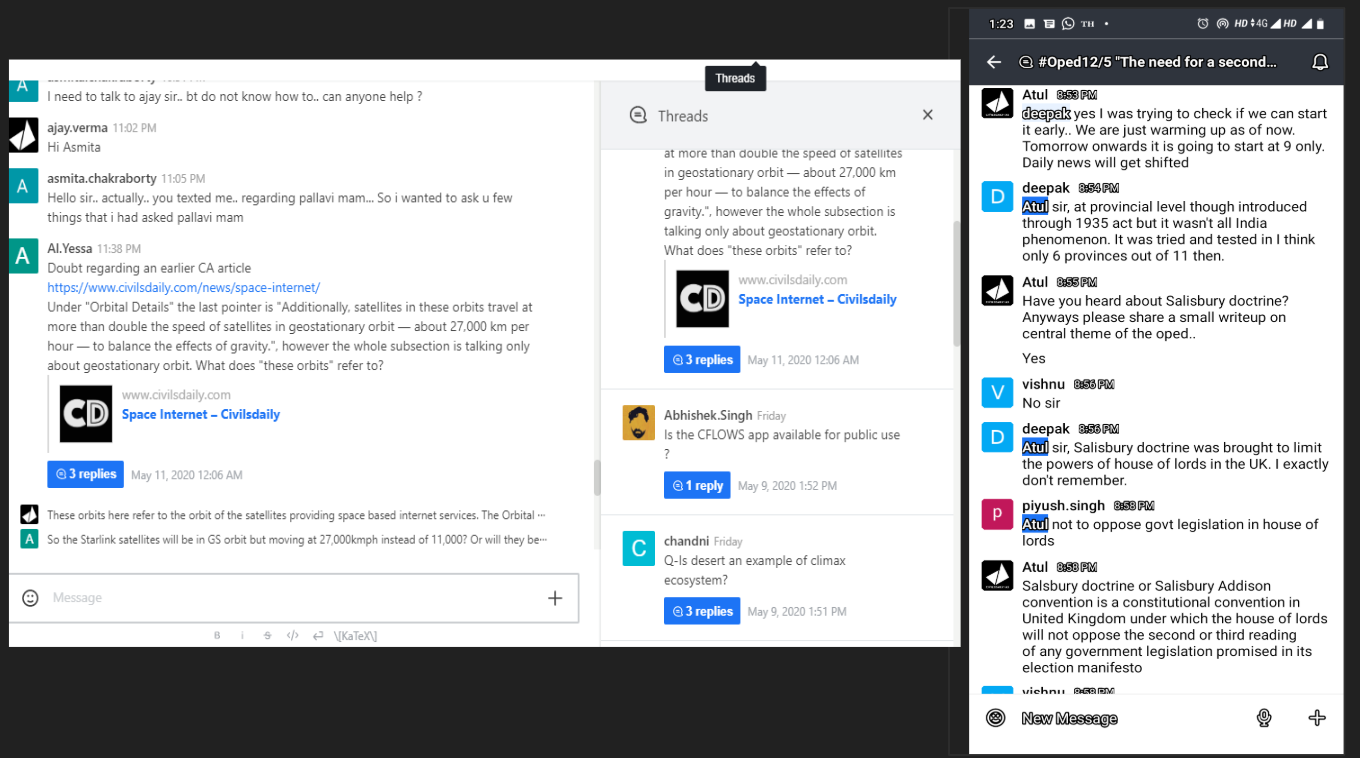
Habitat is where everything comes together: learning, doubt clearing, notes, references, mentors, and a focussed community. You’re going to learn and discuss like never before.
What is there on Habitat?
#DDS sessions – Dedicated sessions every day to resolve doubts in real-time. Never keep a doubt to yourself.
An ecosystem for co-learning and active learning.
A highly motivated community to bring flexibility and consistency to your preparation.
Daily news analysis and Op-ed discussion sessions on Habitat.
Other activities like revisions, quizzes, test discussion, CSAT, etc. are also planned.
Tests are not just about assessment. They should be accompanied by learning. Following crucial & independent modules are a part of this package.
Advanced Lecture Series is yet another nifty way of revisiting the tricky, factual and sometimes technical aspects of the static syllabus. 60+ hours of videos – most helpful when you advance to the L2 & L3 tests and very rewarding for senior UPSC students.
CD’s Monthly Magazines: We walk the extra mile with Monthly Magazine Combo (12 months of all good content at CD). These magazines are a brand in themselves and have been a preference of Toppers for years. Click here for CD magazines.
Program inclusion:
38 Tests
8 Basic tests
8 Advanced tests
10 Current Affairs
8 Full-Length Tests
4 CSAT tests
Advanced Lecture Series
Civilsdaily’s Monthly Magazine Combo
Civilsdaily’s Handholding
Admission to the exclusive group on Civilsdaily’s Habitat.
This is what our students have to say about our mock tests..
Feedback for 2020 Prelims MocksFeedback for 2020 Prelims Mocks
Union Public Service Commission (UPSC) has notified that it will announce the Civil Services exam (prelims) date on June 5.
The exam, was scheduled to be held on May 31, has been postponed for the second time in a month.
What to do now?
Many students wasted a lot of time in thinking and speculating.
Now take this as an opportunity to get back on track. Streamline your preparation. Give mock tests. Identify the shortcomings in your preparation. Cover those areas. Revise.
Those who kept their minds and continued their preparation, now they are ahead of you.
UPSC Prelims 2020 is going to be held sooner than later. Don’t waste your time now.


 38 Tests (8 Basic, 8 Advanced, 10 Current Affairs, 8 Full Length, 4 CSAT)