💥Join UPSC 2027,2028 Mentorship (July Batch) + XFactor Notes & Microthemes PDF

Category: Ranker Webinars

  • [Prelims Spotlight] Important Groupings Related to India

    Prelims Spotlight is a part of “Nikaalo Prelims 2020” module. This open crash course for Prelims 2020 has a private telegram group where PDFs and DDS (Daily Doubt Sessions) are being held. Please click here to register.

    Important Groupings Related to India


    05 May 2020

    Trans-Pacific Partnership

    • The Trans-Pacific Partnership (TPP), or the Comprehensive and Progressive Agreement for Trans-Pacific Partnership (CPTPP), is a trade agreement between Australia, Brunei Darussalam, Canada, Chile, Japan, Malaysia, Mexico, New Zealand, Peru, Singapore, the United States (until 23 January 2017) and Vietnam
    • The TPP began as an expansion of the Trans-Pacific Strategic Economic Partnership Agreement (TPSEP or P4) signed by Brunei Darussalam, Chile, New Zealand, and Singapore in 2005
    • The TPP contains measures to lower both non-tariff and tariff barriers to trade and establish an investor-state dispute settlement (ISDS) mechanism
    • The agreement will enter into force after ratification by all signatories if this occurs within two years
    • APEC members may accede to the TPP, as may any other jurisdiction to which existing TPP members agree. After an application for membership is received, a commission of parties to the treaty negotiates conditions for accession.

    BRICS

    • BRICS is the acronym coined for an association of five major emerging national economies: Brazil, Russia, India, China and South Africa.
    • Originally the first four were grouped as “BRIC” (or “the BRICs”), before the induction of South Africa in 2010.
    • The BRICS members are known for their significant influence on regional affairs; all are members of G20.
    • Since 2009, the BRICS nations have met annually at formal summits. China hosted the 9th BRICS summit in Xiamen on September 2017, while Brazil hosted the most recent 11th BRICS summit on 13-14 November 2019.

    New Development Bank and the Fortaleza Declaration

    • During the sixth BRICS Summit in Fortaleza (2014), the leaders signed the Agreement establishing the New Development Bank (NDB).
    • In the Fortaleza Declaration, the leaders stressed that the NDB will strengthen cooperation among BRICS and will supplement the efforts of multilateral and regional financial institutions for global development, thus contributing to collective commitments for achieving the goal of strong, sustainable and balanced growth.
    • The bank was established in July 2015 by the BRICS countries (Brazil, Russia, India, China and South Africa).
    • The aim of the bank is to mobilize funding for infrastructure and sustainable development.
    • Its ownership structure is unique, as the BRICS countries each have an equal share and no country has any veto power.
    • In this sense, the bank is a physical expression of the desire of emerging markets to play a bigger role in global governance.
    • NDB was created to help fill the funding gap in the BRICS economies and was intended to grow its global scope over time.
    • The bank, with its subscribed capital base of US$50bn, is now poised to become a meaningful additional source of long-term finance for infrastructure in its member countries.

    Regional Comprehensive Economic Partnership (RCEP)

    • The Regional Comprehensive Economic Partnership (RCEP) is a trade deal that was being negotiated between 16 countries.
    • They include the 10 ASEAN members and the six countries with which the bloc has free trade agreements (FTAs) — India, Australia, China, Korea, Japan, and New Zealand.
    • The purpose of the deal is to create an “integrated market” spanning all 16 countries.
    • This means that it would be easier for the products and services of each of these countries to be available across the entire region.

    RCEP – India

    • It comprises half of the world population and accounts for nearly 40% of the global commerce and 35% of the GDP. RCEP would have become the world’s largest FTA after finalisation, with India being the third-biggest economy in it.
    • Without India, the RCEP does not look as attractive as it had seemed during negotiations.
    • Divided ASEAN – ASEAN has been keen on a diversified portfolio so that member states can deal with major powers and maintain their strategic autonomy. ASEAN member states have tried to keep the U.S. engaged in the region.
    • Act East policy has been well received. With China’s rise in the region, ASEAN member states have been keen on Indian involvement in the region.
    • Indo-Pacific – India’s entire Indo-Pacific strategy might be open to question if steps are not taken to restore India’s profile in the region.
    • Rejected China’s dominance – India signalled that, despite the costs, China’s rise has to be tackled both politically and economically.

    Shanghai Cooperation Organisation (SCO)

    • After the collapse of the Soviet Union in 1991, the then security and economic architecture in the Eurasian region dissolved and new structures had to come up.
    • The original Shanghai Five were China, Kazakhstan, Kyrgyzstan, Russia and Tajikistan.
    • The SCO was formed in 2001, with Uzbekistan included. It expanded in 2017 to include India and Pakistan.
    • Since its formation, the SCO has focused on regional non-traditional security, with counter-terrorism as a priority:
    • The fight against the “three evils” of terrorism, separatism and extremism has become its mantra.
    • Today, areas of cooperation include themes such as economics and culture.

    India’s entry to the SCO

    • India and Pakistan both were observer countries.
    • While Central Asian countries and China were not in favour of expansion initially, the main supporter — of India’s entry in particular — was Russia.
    • A widely held view is that Russia’s growing unease about an increasingly powerful China prompted it to push for its expansion.
    • From 2009 onwards, Russia officially supported India’s ambition to join the SCO. China then asked for its all-weather friend Pakistan’s entry.

    The Bay of Bengal Initiative for Multi-Sectoral Technical and Economic Cooperation (BIMSTEC)

    • The Bay of Bengal Initiative for Multi-Sectoral Technical and Economic Cooperation (BIMSTEC) is a regional organization comprising seven Member States lying in the littoral and adjacent areas of the Bay of Bengal constituting a contiguous regional unity. This sub-regional organization came into being on 6 June 1997 through the Bangkok Declaration.
    • The regional group constitutes a bridge between South and South-East Asia and represents a reinforcement of relations among these countries.
    • BIMSTEC has also established a platform for intra-regional cooperation between SAARC and ASEAN members.  The BIMSTEC region is home to around 1.5 billion people which constitute around 22% of the global population with a combined gross domestic product (GDP) of 2.7 trillion economies. In the last five years, BIMSTEC Member States have been able to sustain an average 6.5% economic growth trajectory despite a global financial meltdown.

    SAARC & SAARC Countries

    • The South Asian Association for Regional Cooperation (SAARC) is a regional intergovernmental organization and geopolitical union in South Asia.  Its member states include Afghanistan, Bangladesh, Bhutan, India, Nepal, the Maldives, Pakistan and Sri Lanka.  SAARC was founded in Dhaka in 1985.
    • Its secretariat is based in Kathmandu.
    • The organization promotes the development of economic and regional integration.
    • It launched the South Asian Free Trade Area in 2006.
    • SAARC maintains permanent diplomatic relations at the United Nation as an observer and has developed links with multilateral entities.
    • Observers Of SAARC: – States with observer status include Australia, China, the European Union, Iran, Japan, Mauritius Myanmar, South Korea and the United States.

    Association of Southeast Asian Nations (ASEAN)

    • The Association of Southeast Asian Nations is a regional intergovernmental organization comprising ten Southeast Asian countries
    • It promotes Pan-Asianism and intergovernmental cooperation and facilitates economic, political, security, military, educational and socio-cultural integration amongst its members and other Asian countries
    • It members are Indonesia, Malaysia, the Philippines, Singapore, Thailand, Brunei, Cambodia, Laos, Myanmar, and Vietnam
    • ASEAN shares land and maritime borders with India, China
    • ASEAN is an official United Nations Observer.

    The Nuclear Suppliers Group (NSG)

    • The Nuclear Suppliers Group (NSG) is a group of nuclear supplier countries that seeks to contribute to the non-proliferation of nuclear weapons through the implementation of two sets of Guidelines for nuclear exports and nuclear-related exports.
    • One of the critical elements for inclusion into the NSG is that the member countries need to signatories of the NPT, a proposal which India has categorically disagreed.
    • However considering India’s history of nuclear non-proliferation, the US and subsequently the NSG have shown some recognition and granted India with the waiver of dealing with other countries for nuclear technology.

    Recent Developments

    • Present Indian government embarked to pursue the ambitious goal of NSG membership aggressively.
    • The prime minister visited countries like the USA, Netherlands, Mexico, and Portugal to secure support from these countries.
    • US administration under Obama and Donald trump reiterated their support for Indian entry to the NSG. Russia also extended its support.
    • NSG takes a decision based on a consensus of the member countries. So it is important to secure the support of each and every member country.
    • China is against the granting membership. Insisted on a criteria-based approach for the non-NPT (Nuclear Non-Proliferation Treaty) signatory countries.
    • China has also maintained that for non-NPT members some definite criteria should be evolved rather than granting country-specific waivers. At other times, it has stated that Pakistan also has similar credentials to join the NSG; and that if India is admitted; Pakistan should also be admitted simultaneously.
    • Some other countries, including Turkey, Switzerland, Mexico and New Zealand, were among those which have stressed on the criteria-based approach, without opposing India’s application outright.

    Organisation for the Prohibition of Chemical Weapons (OPCW)

    • OPCW is an intergovernmental organization and the implementing body for the Chemical Weapons Convention, which entered into force on 29 April 1997
    • The OPCW, with its 193 member states, has its seat in The Hague, Netherlands, and oversees the global endeavour for the permanent and verifiable elimination of chemical weapons
    • The organization promotes and verifies the adherence to the Chemical Weapons Convention, which prohibits the use of chemical weapons and requires their destruction
    • Verification consists both of evaluation of declarations by member states and onsite inspections
    • The OPCW has the power to say whether chemical weapons were used in an attack it has investigated
    • The organization was awarded the 2013 Nobel Peace Prize “for its extensive efforts to eliminate chemical weapons”

    The Australian Group

    • The Australia Group is a multilateral export control regime (MECR) and an informal group of countries (now joined by the European Commission) established in 1985 (after the use of chemical weapons by Iraq in 1984) to help member countries to identify those exports which need to be controlled so as not to contribute to the spread of chemical and biological weapons
    • The group, initially consisting of 15 members, held its first meeting in Brussels, Belgium, in September 1989. With the incorporation of India on January 19, 2018, it now has 43 members, including Australia, the European Commission, all 28 member states of the European Union, Ukraine, and Argentina
    • The name comes from Australia’s initiative to create the group. Australia manages the secretariat
    • The initial members of the group had different assessments of which chemical precursors should be subject to export control
    • Later adherents initially had no such controls
    • Today, members of the group maintain export controls on a uniform list of 54 compounds, including several that are not prohibited for export under the Chemical Weapons Convention but can be used in the manufacture of chemical weapons
    • In 2002, the group took two important steps to strengthen export control
    • The first was the “no-undercut” requirement, which stated that any member of the group considering making an export to another state that had already been denied an export by any other member of the group must first consult with that member state before approving the export
    • The second was the “catch-all” provision, which requires member states to halt all exports that could be used by importers in chemical or biological weapons programs, regardless of whether the export is on the group’s control lists.
    • Delegations representing the members meet every year in Paris, France
    WTO
    • US, UK and a few other countries set up, an interim organisation about trade named GATT (General Agreement on Tariff and Trade) in 1947
    • GATT was biased in favour of the developed countries and was called informally as the Rich men’s club.
    • So, the developing countries insisted on setting up the International Trade Organisation (ITO)
    • That’s the reason, the United Nations Conference on Trade and Development (UNCTAD) was set up in 1964 as an alternative, on the recommendation of the UN committee
    • Next development comes in Uruguay Round of GATT, it sought to expand the scope of the organisation by including, services, investment and intellectual property rights (IPR)
    • Agreements were ratified by the legislatures of 85 member-countries by year-end 1994.
    • On such rectification, the WTO started functioning from Jan 1, 1995, Marrakesh Agreement>

    Functions of WTO

    • The WTO deals with regulation of trade in goods, services and intellectual property between participating countries.
    • It provides a framework for negotiating trade agreements and a dispute resolution process aimed at enforcing participants’ adherence to WTO agreements, which are signed by representatives of member governments and ratified by their parliaments.

    G20

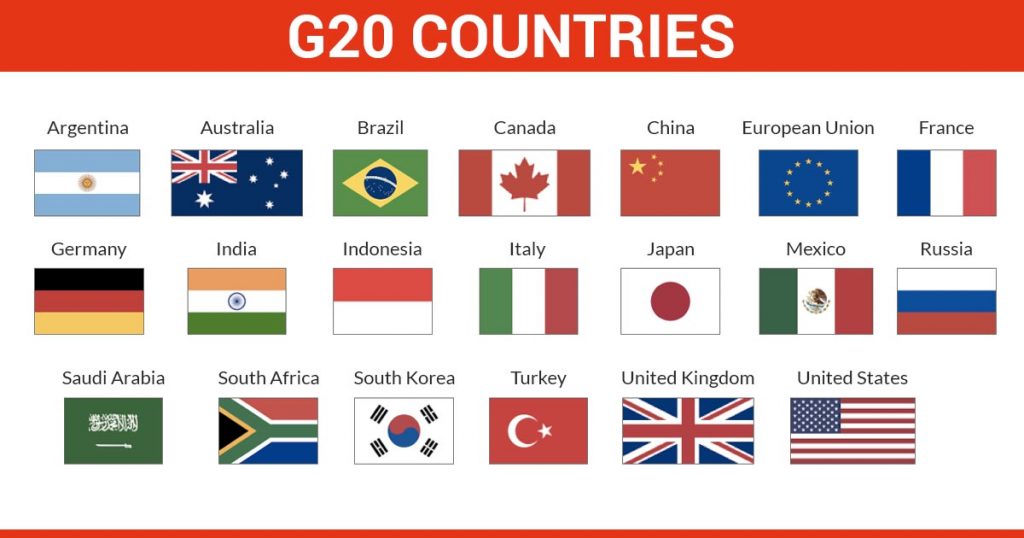
    • Formed in 1999, the G20 is an international forum of the governments and central bank governors from 20 major economies.
    • Collectively, the G20 economies account for around 85 percent of the Gross World Product (GWP), 80 percent of world trade.
    • To tackle the problems or the address issues that plague the world, the heads of governments of the G20 nations periodically participate in summits.
    • In addition to it, the group also hosts separate meetings of the finance ministers and foreign ministers.
    • The G20 has no permanent staff of its own and its chairmanship rotates annually between nations divided into regional groupings. 

    Aims and objectives

    • The Group was formed with the aim of studying, reviewing, and promoting high-level discussion of policy issues pertaining to the promotion of international financial stability.
    • The forum aims to pre-empt the balance of payments problems and turmoil on financial markets by improved coordination of monetary, fiscal, and financial policies.
    • It seeks to address issues that go beyond the responsibilities of any one organisation.

    Member Countries

    The members of the G20 consist of 19 individual countries plus the European Union (EU).

    • The 19 member countries of the forum are Argentina, Australia, Brazil, Canada, China, France, Germany, India, Indonesia, Italy, Japan, Mexico, Russia, Saudi Arabia, South Africa, South Korea, Turkey, United Kingdom and the United States.
    • The European Union is represented by the European Commission and by the European Central Bank.

     Who are the G20 Sherpas?

    • A Sherpa is the personal representative of a head of state or government who prepares an international summit, particularly the annual G7 and G20 summits.
    • Between the summits, there are multiple Sherpa conferences where possible agreements are laid out.
    • This reduces the amount of time and resources required at the negotiations of the heads of state at the final summit.
    • The Sherpa is generally quite influential, although they do not have the authority to make a final decision about any given agreement.
    • The name is derived from the Sherpa people, a Nepalese ethnic group, who serve as guides and porters in the Himalayas, a reference to the fact that the Sherpa clears the way for a head of state at a major summit.

    G7

    • The G7 or the Group of Seven is a group of the seven most advanced economies as per the International Monetary Fund (IMF).
    • The seven countries are Canada, USA, UK, France, Germany, Japan and Italy. The EU is also represented in the G7.
    • These countries, with the seven largest IMF-described advanced economies in the world, represent 58% of the global net wealth ($317 trillion).
    • The G7 countries also represent more than 46% of the global gross domestic product (GDP) based on nominal values, and more than 32% of the global GDP based on purchasing power parity.
    • The requirements to be a member of the G7 are a high net national wealth and a high HDI (Human Development Index).


  • 80% IAS 2021 Aspirants struggle with time table. Talk to us, OK?

    80% IAS 2021 Aspirants struggle with time table. Talk to us, OK?

    Click to fill the form: Samanvaya for IAS 2021


    5 minutes, or 10 minutes, no more than that. That’s all the time we will need to get to know each other before we start talking about your IAS Preparation strategies.

    Last week we chatted with about 850+ aspirants via our Samanvaya outreach – 65% were full-time aspirants and 35% were preparing for it along with their job. Here’s what we chatted about:

    1. Working Junta? If you are preparing for IAS 2021 and working simultaneously, we can help you design a timetable that fits right in your hectic schedule.
    2. First-time prep? If you are in last year of college or thinking of dropping a year and preparing for IAS 2021 full time, we can help you pick the right books and craft a practical & personal strategy

    You just have to take 5 minutes out and fill this form: Samanvaya For IAS 2021

    Once done, we will call you within 24 hours or so.


    What happens when you fill this form? How does a call help you?

    1. Identifying your weaknesses

    Over 80% of students who claimed to have revised NCERTs twice were unable to answer basic questions. Many were not comfortable with at least 1 GS subject and Optional. Many struggled with ‘What went wrong’ after 2-3 years of hard work. Our mentors will provide free preliminary assignments so we can assess your preparedness and suggest accurate strategies.

    2. Strategy and study plan discussions

    Over 90% of students couldn’t stick to a plan. Study plans and strategies are iterative in nature and we want to help you with that. Many are unable to perform in tests despite preparing hard. This could be due to a variety of factors – lack of adequate prep, jitters in the exam hall, inadequate revision, lack of practice of test series or just a bad day at work. Tell us what you think went wrong and we’ll figure out a way to get you over the line next time.

    3. Helping you understand the exam better – which books to read, different approaches, etc. Over 60% of students we talked to did not find NCERTs relevant and saw no point in being thorough with them.

    4. Lack of motivation

    We have all had those days when it’s been hard to motivate ourselves to hit the books and just study. It happens to the best of us sometimes and for some of us, it happens more frequently. And it is understandable, Civil Service preparation is a long and often lonely process. Every aspirant, from toppers to those who have quit have been overwhelmed by this process at some point in time. Working alone is monotonous and helps you keep motivated by ensuring you are actively and passively studying every day. Focused telegram groups to foster discussions.

    Click to fill the form: Samanvaya for IAS 2021

  • [Prelims Spotlight] Important Keywords in Budget and Eco Survey

    Prelims Spotlight is a part of “Nikaalo Prelims 2020” module. This open crash course for Prelims 2020 has a private telegram group where PDFs and DDS (Daily Doubt Sessions) are being held. Please click here to register.

    Important Keywords in Budget and Eco Survey


    04 May 2020

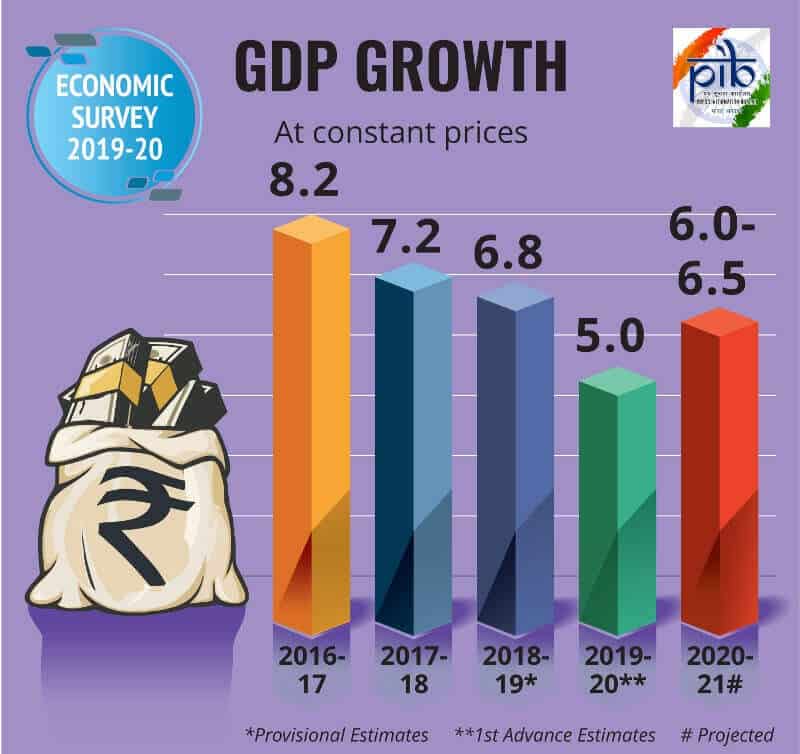
    The Union Minister for Finance & Corporate Affairs, Smt. Nirmala Sitharaman presented the Economic Survey 2019-20 in the Parliament today. The Key Highlights of the Survey are as follows:

    Wealth Creation: The Invisible Hand Supported by the Hand of Trust

    • The big idea from the Economic Survey 2019-20 is the need to push towards increasing the number of wealth creators in the Indian economy.
    • The Survey states that to achieve the goal of becoming a $5-trillion economy, the invisible hand of markets will need the support of “the hand of trust”.

    Wealth Creation

    • Essentially, this means that regulation and rules in the economy should be such that they make it easy to do business but not turn into crony capitalism.
    • The Survey states: “The invisible hand needs to be strengthened by promoting pro-business policies to:
    1. Provide equal opportunities for new entrants, enable fair competition and ease doing business,
    2. Eliminate policies that unnecessarily undermine markets through government intervention,
    3. Enable trade for job creation, and
    4. Efficiently scale-up the banking sector to be proportionate to the size of the Indian economy.”

    How can this be done?

    • The Survey introduces the idea of “trust as a public good that gets enhanced with greater use”.
    • In other words, it states that policies must empower transparency and effective enforcement using data and technology to enhance this public good.
    • A key element here is the need to increase the opportunities for new entrants.
    • “Equal opportunity for new entrants is important because… a 10 per cent increase in new firms in a district yields a 1.8 per cent increase in Gross Domestic District Product (GDDP)”.
    • According to the Survey, the right policy mix can boost job creation

    Focus on Ethical Wealth Creation

    • The Survey emphasised on the importance of ‘Ethical Wealth Creation’, as the key to making India $5 trillion economies by 2025.
    • Krishnamurthy V. Subramanian, the Chief Economic Adviser of Ministry of Finance has done a commendable job in producing a thought-provoking masterpiece on ‘ethical wealth creation.

    Pro-business versus Pro-markets Strategy

    • Survey says that India’s aspiration of becoming a $5 trillion economy depends critically on:
    1. Promoting a ‘pro-business’ policy that unleashes the power of competitive markets to generate wealth.
    2. Weaning away from ‘pro-crony’ policy that may favour specific private interests, especially powerful incumbents.
    • Pro-crony policies such as discretionary allocation of natural resources till 2011 led to rent-seeking by beneficiaries while the competitive allocation of the same post-2014 ended such rent extraction.

    Strengthening the invisible hand by promoting pro-business policies to:

    1. Provide equal opportunities for new entrants.
    2. Enable fair competition and ease doing business.
    3. Eliminate policies unnecessarily undermining markets through government intervention.
    4. Enable trade for job creation.
    5. Efficiently scale-up the banking sector.
    • Introducing the idea of trust as a public good, which gets enhanced with greater use.
    • The survey suggests that policies must empower transparency and effective enforcement using data and technology.

    Entrepreneurship at the Grassroots

    • Entrepreneurship as a strategy to fuel productivity growth and wealth creation.
    • India ranks third in a number of new firms created, as per the World Bank.
    • New firm creation in India increased dramatically since 2014:
    1. 2 % cumulative annual growth rate of new firms in the formal sector during 2014-18, compared to 3.8 % during 2006-2014.
    2. About 1.24 lakh new firms created in 2018, an increase of about 80 % from about 70,000 in 2014.
    • The survey examines the content and drivers of entrepreneurial activity at the bottom of the administrative pyramid – over 500 districts in India.
    • New firm creation in services is significantly higher than that in manufacturing, infrastructure or agriculture.
    • Survey notes that grassroots entrepreneurship is not just driven by necessity.
    • A 10 percent increase in registration of new firms in a district yields a 1.8 % increase in Gross Domestic District Product (GDDP).

    Impact of education on entrepreneurship

    • Literacy and education in a district foster local entrepreneurship significantly:
    1. The impact is most pronounced when literacy is above 70 per cent.
    2. New firm formation is the lowest in eastern India with the lowest literacy rate (59.6 % as per 2011 Census).
    • Physical infrastructure quality in the district influences new firm creation significantly.
    • Ease of Doing Business and flexible labour regulation enable new firm creation, especially in the manufacturing sector.
    • Survey suggests enhancing ease of doing business and implementing flexible labour laws can create maximum jobs in districts and thereby in the states.

    Divestment in public sector undertakings

    • The Survey has aggressively pitched for divestment in PSUs by proposing a separate corporate entity wherein the government’s stake can be transferred and divested over a period of time.
    • The survey analysed the data of 11 PSUs that had been divested from 1999-2000 and 2003-04 and compared the data with their peers in the same industry.
    • Further, the survey has said privatized entities have performed better than their peers in terms of net worth, profit, return on equity and sales, among others.
    • The government can transfer its stake in listed CPSEs to a separate corporate entity.
    • This entity would be managed by an independent board and would be mandated to divest the government stake in these CPSEs over a period of time.
    • This will lend professionalism and autonomy to the disinvestment programme which, in turn, would improve the economic performance of the CPSEs.

    Golden jubilee of bank nationalization: Taking stock

    • The survey observes 2019 as the golden jubilee year of bank nationalization
    • Accomplishments of lakhs of Public Sector Banks (PSBs) employees cherished and an objective assessment of PSBs suggested by the Survey.
    • Since 1969, India’s banking sector has not developed proportionately to the growth in the size of the economy.
    • India has only one bank in the global top 100 – same as countries that are a fraction of its size: Finland (about 1/11th), Denmark (1/8th), etc.
    • A large economy needs an efficient banking sector to support its growth.

    The onus of supporting the economy falls on the PSBs accounting for 70 % of the market share in Indian banking:

    1. PSBs are inefficient compared to their peer groups on every performance parameter.
    2. In 2019, investment for every rupee in PSBs, on average, led to the loss of 23 paise, while in NPBs it led to the gain of 9.6 paise.
    3. Credit growth in PSBs has been much lower than NPBs for the last several years.

    Solutions to make PSBs more efficient:

    • Employee Stock Ownership Plan (ESOP) for PSBs’ employees
    • Representation on boards proportionate to the blocks held by employees to incentivize employees and align their interests with that of all shareholders of banks.
    • Creation of a GSTN type entity that will aggregate data from all PSBs and use technologies like big data, artificial intelligence and machine learning in credit decisions for ensuring better screening and monitoring of borrowers, especially the large ones.

    Doubts regarding GDP Growth

    • GDP growth is a critical variable for decision-making by investors and policymakers. Therefore, the recent debate about the accuracy of India’s GDP estimation following the revised estimation methodology in 2011 is extremely significant.
    • As countries differ in several observed and unobserved ways, cross-country comparisons have to be undertaken by separating the effect of other confounding factors and isolating effect of methodology revision alone on GDP growth estimates.
    • Models that incorrectly over-estimate GDP growth by 2.7 % for India post-2011 also misestimate GDP growth over the same period for 51 out of 95 countries in the sample.

    Fiscal Developments

    • Revenue Receipts registered a higher growth during the first eight months of 2019-20, compared to the same period last year, led by considerable growth in Non-Tax revenue.
    • Gross GST monthly collections have crossed the mark of Rs. 1 lakh crore for a total of five times during 2019-20 (up to December 2019).
    • Structural reforms undertaken in taxation during the current financial year:
    • Change in the corporate tax rate.
    • Measures to ease the implementation of GST.
    • Fiscal deficit of states within the targets set out by the FRBM Act.
    • Survey notes that the General Government (Centre plus States) has been on the path of fiscal consolidation.

    External Sector

    Balance of Payments (BoP):

    • India’s BoP position improved from US$ 412.9 bn of forex reserves in end-March, 2019 to US$ 433.7 bn in end September 2019.
    • Current account deficit (CAD) narrowed from 2.1% in 2018-19 to 1.5% of GDP in H1 of 2019-20.
    • Foreign reserves stood at US$ 461.2 bn as on 10th January 2020.

    Global trade:

    • India’s merchandise trade balance improved from 2009-14 to 2014-19, although most of the improvement in the latter period was due to more than 50% decline in crude prices in 2016-17.
    • India’s top five trading partners continue to be USA, China, UAE, Saudi Arabia and Hong Kong.

    Exports:

    • Top export items: Petroleum products, precious stones, drug formulations & biologicals, gold and other precious metals.
    • Largest export destinations in 2019-20 (April-November): United States of America (USA), followed by the United Arab Emirates (UAE), China and Hong Kong.
    • The merchandise exports to GDP ratio declined, entailing a negative impact on BoP position.
    • A slowdown of world output had an impact on reducing the export to GDP ratio, particularly from 2018-19 to H1 of 2019-20.
    • Growth in Non-POL exports dropped significantly from 2009-14 to 2014-19.

    Imports:

    •  Top import items: Crude petroleum, gold, petroleum products, coal, coke & briquettes.
    •  India’s imports continue to be largest from China, followed by USA, UAE and Saudi Arabia.
    •  Merchandise imports to GDP ratio declined for India, entailing a net positive impact on BoP.
    • Large Crude oil imports in the import basket correlates India’s total imports with crude prices. As crude price raises so does the share of crude in total imports, increasing imports to GDP ratio.

    Logistics industry of India:

    • Currently estimated to be around US$ 160 billion.
    • Expected to touch US$ 215 billion by 2020.
    • According to World Bank’s Logistics Performance Index, India ranks 44th in 2018 globally, up from 54th rank in 2014.

    Direct investments and remittances:

    • Net FDI inflows continued to be buoyant in 2019-20 attracting US$ 24.4 bn in the first eight months, higher than the corresponding period of 2018-19.
    • Net FPI in the first eight months of 2019-20 stood at US$ 12.6 bn.
    • Net remittances from Indians employed overseas continued to increase, receiving US$ 38.4 billion in H1 of 2019-20 which is more than 50% of the previous year level.

    External debt:

    • Remains low at 20.1% of GDP as at end September, 2019.
    • After significant decline since 2014-15, India’s external liabilities (debt and equity) to GDP increased at the end of June, 2019 primarily by increase in FDI, portfolio flows and external commercial borrowings (ECBs).

    Monetary Management and Financial Intermediation

    Monetary policy:

    • Remained accommodative in 2019-20.
    • Repo rate was cut by 110 basis points in four consecutive MPC meetings in the financial year due to slower growth and lower inflation.
    • However, it was kept unchanged in the fifth meeting held in December 2019.
    • In 2019-20, liquidity conditions were tight for initial two months; but subsequently it remained comfortable.

    Prices and Inflation

    Inflation Trends:

    • Inflation witnessing moderation since 2014
    • Consumer Price Index (CPI) inflation increased from 3.7 per cent in 2018-19 (April to December, 2018) to 4.1 per cent in 2019-20 (April to December, 2019).
    • WPI inflation fell from 4.7 per cent in 2018-19 (April to December, 2018) to 1.5 per cent during 2019-20 (April to December, 2019).

    Drivers of CPI – Combined (C) inflation:

    • During 2018-19, the major driver was the miscellaneous group
    • During 2019-20 (April-December), food and beverages was the main contributor.
    • Among food and beverages, inflation in vegetables and pulses was particularly high due to low base effect and production side disruptions like untimely rain.

    Cob-web Phenomenon (Cyclical fluctuations in inflation) for Pulses:

    • Farmers base their sowing decisions on prices witnessed in the previous marketing period.
    • Measures to safeguard farmers like procurement under Price Stabilization Fund (PSF), Minimum Support Price (MSP) need to be made more effective.

    The volatility of Prices:

    • The volatility of prices for most of the essential food commodities with the exception of some of the pulses has actually come down in the period 2014-19 as compared to the period 2009-14.
    • Lower volatility might indicate the presence of better marketing channels, storage facilities and effective MSP system.

    Essential Commodities Act is outdated

    • The Centre’s imposition of stock limits in a bid to control the soaring prices of onions over the last few months actually increased price volatility, according to the ES.
    • The finding came in a hard-hitting attack in the report against the Essential Commodities Act (ECA) and other “anachronistic legislation” and interventionist government policies, including drug price control, grain procurement and farm loan waivers.
    • The Centre invoked the Act’s provisions to impose stock limits on onions after heavy rains wiped out a quarter of the Kharif crop and led to a sustained spike in prices.
    • However the Survey showed that there was actually an increase in price volatility and a widening wedge between wholesale and retail prices.
    • The lower stock limits must have led the traders and wholesalers to offload most of the kharif crop in October itself which led to a sharp increase in the price volatility.

    Agriculture

    • Agricultural productivity is also constrained by a lower level of mechanization in agriculture which is about 40 % in India, much lower than China (59.5 %) and Brazil (75 %).
    • With regard to the Agri sector, the Survey argued that the beneficiaries of farm loan waivers consume less, save less, invest less and are less productive.
    • It added that the government procurement of foodgrains led to a burgeoning food subsidy burden and inefficiencies in the markets, arguing for a shift to cash transfers instead.

    Food Management

    • The share of agriculture and allied sectors in the total Gross Value Added (GVA) of the country has been continuously declining on account of relatively higher growth performance of non-agricultural sectors.
    • GVA at Basic Prices for 2019-20 from ‘Agriculture, Forestry and Fishing’ sector is estimated to grow by 2.8 %.

    Services Sector

    The increasing significance of services sector in the Indian economy:

    1. About 55 % of the total size of the economy and GVA growth.
    2.  Two-thirds of the total FDI inflows into India.
    3. About 38 per cent of total exports.
    4. More than 50 % of GVA in 15 out of the 33 states and UTs.

    Social Infrastructure, Employment and Human Development

    • The expenditure on social services (health, education and others) by the Centre and States as a proportion of GDP increased from 6.2 % in 2014-15 to 7.7 % in 2019-20 (BE).
    • India’s ranking in the Human Development Index improved to 129 in 2018 from 130 in 2017:
    • With 1.34 % average annual HDI growth, India is among the fastest-improving countries
    • Gross Enrolment Ratio at secondary, higher secondary and higher education level needs to be improved.
    • Gender disparity in India’s labour market widened due to a decline in female labour force participation especially in rural areas:
    • Around 60 % of productive age (15-59) group engaged in full-time domestic duties.

    Sustainable Development and Climate Change

    • India moving forward on the path of SDG implementation through well-designed initiatives
    • SDG India Index:
    1. Himachal Pradesh, Kerala, Tamil Nadu, Chandigarh are front runners.
    2. Assam, Bihar and Uttar Pradesh come under the category of Aspirants.
    • India hosted COP-14 to UNCCD which adopted the Delhi Declaration: Investing in Land and Unlocking Opportunities.
    • COP-25 of UNFCCC at Madrid:
    1. India reiterated its commitment to implement the Paris Agreement.
    2. COP-25 decisions include efforts for climate change mitigation, adaptation and means of implementation from developed country parties to developing country parties.
  • [Prelims Spotlight] Important UN Organizations in News

    Prelims Spotlight is a part of “Nikaalo Prelims 2020” module. This open crash course for Prelims 2020 has a private telegram group where PDFs and DDS (Daily Doubt Sessions) are being held. Please click here to register.

    Important UN Organizations in News


    02 May 2020

    United Nation Overview:

    • The United Nations is an international organization founded in 1945.  It is currently made up of 193 Member States.  The mission and work of the United Nations are guided by the purposes and principles contained in its founding Charter.
    • Due to the powers vested in its Charter and its unique international character, the United Nations can take action on the issues confronting humanity in the 21st century, such as peace and security, climate change, sustainable development, human rights, disarmament, terrorism, humanitarian and health emergencies, gender equality, governance, food production, and more.
    • The UN also provides a forum for its members to express their views in the General Assembly, the Security Council, the Economic and Social Council, and other bodies and committees. By enabling dialogue between its members, and by hosting negotiations, the Organization has become a mechanism for governments to find areas of agreement and solve problems together.
    • The main organs of the UN are the General Assembly, the Security Council, the Economic and Social Council, the Trusteeship Council, the International Court of Justice, and the UN Secretariat.  All were established in 1945 when the UN was founded.

    General Assembly

    • The General Assembly is the main deliberative, policymaking and representative organ of the UN. All 193 Member States of the UN are represented in the General Assembly, making it the only UN body with universal representation.
    • Each year, in September, the full UN membership meets in the General Assembly Hall in New York for the annual General Assembly session, and general debate, which many heads of state attend and address. Decisions on important questions, such as those on peace and security, admission of new members and budgetary matters, require a two-thirds majority of the General Assembly.
    • Decisions on other questions are by a simple majority.  The General Assembly, each year, elects a GA President to serve a one-year term of office.

    Security Council

    The Security Council has primary responsibility, under the UN Charter, for the maintenance of international peace and security.  It has 15 Members (5 permanent and 10 non-permanent members). Each Member has one vote. Under the Charter, all Member States are obligated to comply with Council decisions. The Security Council takes the lead in determining the existence of a threat to the peace or act of aggression. It calls upon the parties to a dispute to settle it by peaceful means and recommends methods of adjustment or terms of the settlement. In some cases, the Security Council can resort to imposing sanctions or even authorize the use of force to maintain or restore international peace and security.  The Security Council has a Presidency, which rotates, and changes, every month.

    Economic and Social Council

    The Economic and Social Council is the principal body for coordination, policy review, policy dialogue and recommendations on economic, social and environmental issues, as well as the implementation of internationally agreed development goals. It serves as the central mechanism for activities of the UN system and its specialized agencies in the economic, social and environmental fields, supervising subsidiary and expert bodies.  It has 54 Members, elected by the General Assembly for overlapping three-year terms. It is the United Nations’ central platform for reflection, debate, and innovative thinking on sustainable development.

    Trusteeship Council

    The Trusteeship Council was established in 1945 by the UN Charter, under Chapter XIII, to provide international supervision for 11 Trust Territories that had been placed under the administration of seven Member States, and ensure that adequate steps were taken to prepare the Territories for self-government and independence. By 1994, all Trust Territories had attained self-government or independence.  The Trusteeship Council suspended operation on 1 November 1994. By a resolution adopted on 25 May 1994, the Council amended its rules of procedure to drop the obligation to meet annually and agreed to meet as occasion required — by its decision or the decision of its President, or at the request of a majority of its members or the General Assembly or the Security Council.

    International Court of Justice

    The International Court of Justice is the principal judicial organ of the United Nations. Its seat is at the Peace Palace in the Hague (Netherlands). It is the only one of the six principal organs of the United Nations not located in New York (United States of America). The Court’s role is to settle, in accordance with international law, legal disputes submitted to it by States and to give advisory opinions on legal questions referred to it by authorized United Nations organs and specialized agencies.

    Secretariat

    The Secretariat comprises the Secretary-General and tens of thousands of international UN staff members who carry out the day-to-day work of the UN as mandated by the General Assembly and the Organization’s other principal organs.  The Secretary-General is the chief administrative officer of the Organization, appointed by the General Assembly on the recommendation of the Security Council for a five-year, renewable term. UN staff members are recruited internationally and locally, and work in duty stations and on peacekeeping missions all around the world.  But serving the cause of peace in a violent world is a dangerous occupation. Since the founding of the United Nations, hundreds of brave men and women have given their lives in its service.


  • “I was casual about my preparation but still, I cleared the exam…twice”

    “I was casual about my preparation but still, I cleared the exam…twice”

    Click here to fill the Samanvaya form for IAS 2020-21, tell us about your preparation. 

    UPSC


    “I was never serious but I cleared the exam”.

    “Truth be told, I didn’t study Laxmikant and still got through”.

    “UPSC is just like university exams. All the hype is unnecessary”.

    Every once in a while, we have been forwarded topper talks where casual claims like the above are made. Though unintentional, they end up harming the aspirants preparing for the exam right now.

    Year Number of candidates who applied Number of candidates who took prelims Number of candidates who qualified for mains Number of candidates who took mains exam Number of candidates who appeared for interview Final number of candidates who got selected for posts
    2018 10,65,552 4,93,972 10,468 1994 759
    2017 9,57,590 4,56,625 13,366 2568 990
    2016 11,35,943 4,59,659 15445 2961 1,099
    2015 9,45,908 4,65,882 15008 15,008 2797 1078
    2014 9,47,428 4,46,623 16706 16286 3308 1236
    2013 7,76,604 3,24,279 14800 14178 3001 1122
    2012 5,50,080 2,71,442 12795 12190 2674 998
    2011 4,99,120 2,43,236 11837 11237 2415 999
    2010 5,47,698 2,69,036 12271 11865 2589 965
    2009 4,09,110 1,93,091 11894 11516 2431 989
    2008 3,25,433 1,67,035 11669 11330 2136 881
    2007 3,33,680 1,61,469 9158 8886 1883 734

    Click here to fill the Samanvaya form for IAS 2020-21, tell us about your preparation. 

    There are 2 factors at play – the level of competition and the format of the exam.

    1. As you can see from 2012 to 2014, approx 4L new aspirants ( close to 80%) were added. This increased the competition substantially.

    2. 2015 saw changes in the exam formatCSAT became a qualifying paper. Meaning its marks were no longer added to the final prelims score. CSAT paper certainly gave an edge to engineering, MBA students who were used to solving such questions with more accuracy and speed.

    But with this paper gone, students from all backgrounds stood at an equal footing. No one having an inherent advantage over the other. The GS focused prelims paper made the mains competition very intense.  

    3. 2017 saw fundamental changes in the way the questions for the prelims paper were designed.

    • The number of direct, straightforward questions came down. These questions used to be directly lifted from the base books.
    • Many questions were unpredictable and not for conventional materials that you would read.

    As a result, a lot of students who were reaching the interview stage started struggling with prelims.

    And this format has been continuing till now – 2018, 2019, and will most certainly continue in 2020.

    More often than not, our students suggest strategies that they’ve discussed with a distant friend or cousin who cleared the exam before 2015 (at times their uncles who cleared the exam in the 90s).

    Very simply put, the competition is intense leaving lesser scope for errors. 

    From the above analysis, it is clear that aspirants from a different era had altogether different concerns and challenges.

    Someone who prepared/cleared the exam before 2015 might not appreciate how difficult and tricky prelims have become. Students who didnt focus their prelims attempt

    And they might not have a nuanced understanding of what the exam requires today, the importance of making notes, etc.

    We always recommend students to consult people who have appeared for the recent 2-3 prelims. Because they are well aware of the most recent trends.

    Our team has the largest repository of best practices and knowledge that has been accumulated over the years. Our programs provide the best support that will give you a fighting chance to clear the exams.

    Click here to fill the Samanvaya form for IAS 2020-21, tell us about your preparation. 

  • Get ready for upcoming 5th Full Length Prelims Test (Full Syllabus) on 2nd May – sample questions highlighting our methodology

    Click here to enrol for the Prime Prelims TS

    Dear students,

    31st May 2020 is the D-day for all civil service aspirants.

    “Give me six hours to chop down a tree and I will spend the first four sharpening the axe.”

    This quote by Abraham Lincoln sums up how one should prepare for that day. So before entering the battlefield alone should have enough practice. Our Prime Prelims Test series which shall enrich you to acquaint yourself with the pattern of CSE-2020, assess your abilities, rectify your mistakes and make you confident to appear on the examination day.

    Our Prime Prelims Test Series follows the same approach as that adopted by UPSC. Our team of experts is quite enriched with the UPSC pattern and focal point of the questions and hence creates more chances for the aspirants to crack civil service examination by appearing our Test Series.

    This is the time where you must have done most of your revision and are ready to face the UPSC CSP with all the josh. Thus, what better exercise would you need than the full syllabus Mock Test. This is the 1st among the four Full-Length Tests covering the whole syllabus and we have curated it as per the trend of previous 5 years of UPSC CSP.  You see, since 2015, this has been the general weightage of various subjects in UPSC CSP:


    Subjects Question Distribution in the year 2019 Question Distribution in the year 2018 Question Distribution in the year 2017 Question Distribution in the year 2016 Question Distribution in the year 2015
    Economy 14 16 8   8 13
    Current Affair

    (including IR)

    22 28 34   27 29
    History, Modern India, Indian National Movements, Art and Culture 17 15 14   15 14
    Geography 14 8 7   7 14
    Polity 15 13 22   7 13
    Science & Technology 7 7   4   8 7
    Environment 11 13   11   18 10

    This is reflected in our mock test as well. (Current affairs has been amalgamated in the various subject list)

    History, Art & Culture: 20

    Polity and Governance: 19

    Economics: 16

    Geography: 18

    Environment: 17

    Science and Tech: 10

    The key philosophy of our prelims TS is Evidence-based question making: The 3600 questions you face in our mocks have their relevance established in UPSC’s trend analysis. We focus on themes that are important as per UPSC so that we maximize your chances of questions overlap with the actual UPSC Prelims.

    Nothing speaks more than the facts itself rather than a mere jargon. Here is a list of 5 sample questions from the upcoming test which will help you in identifying the standards and approach we follow. (you can skip this if you want to attempt these directly in the test). 

    Noone but only you can assess how it will help you in being the top percentile of aspirants. You have to practice ruthlessly and civils Daily provides you with a platform to hone your skills.

    Q1. In India, which of the following review the independent regulators in sectors like telecommunications, insurance, electricity, etc.?

    1. Ad Hoc Committees set up by the Parliament

    2. Parliamentary Department Related Standing Committees

    3. Finance Commission

    4. Financial Sector Legislative Reforms Commission

    5. NITI Aayog

    Select the correct answer using the code given below:

    a. 1 and 2 only

    b. 1,3 and 5 only

    c. 2, 4 and 5 only

    d. 3, 4 and 5 only


    Q2. Consider the following factors:

    1. Differences in Density

    2. The Earth’s Rotation

    3. The Planetary Winds

    The origin and the nature of ocean currents depend on which of the above?

    a. 1 and 2 only

    b. 2 and 3 only

    c. 1 and 3 only

    d. All of them


    Q3. Which of the following statements are correct regarding the Phylum Porifera?

    1. Members of this phylum are commonly known as sponges.

    2. They are generally marine and symmetrical in nature.

    Select the correct answer from the codes given below:

    a. 1 only

    b. 2 only

    c. Both of them

    d. Neither of them


    Q4. Consider the following statements regarding the Minars built during medieval India:

    1. The primary use of Minars was for Azaan, but its great height symbolised the might and power of the ruler.

    2. The Chand Minar was built at Delhi and is one of the most striking Minars of the medieval times.

    Which of the statements given above is/ are correct?

    a. 1 only

    b. 2 only

    c. Both of them

    d. Neither of them


    Q5. Consider the following statements:

    1. W.C. Bonnerjea was the first Indian to become a member of the British Parliament.

    2. Satyendra Prasad Sinha was the first Indian to become a member of Viceroy’s Council.

    3. G.V. Mavalankar was the first Speaker of the Central Legislative Assembly.

    Which of the statements given above is/are correct?

    a. 1 and 2 only

    b. 2 and 3 only

    c. 1 and 3 only

    d. All of them

  • [Prelims Spotlight] Important Financial Institutions in News

    Prelims Spotlight is a part of “Nikaalo Prelims 2020” module. This open crash course for Prelims 2020 has a private telegram group where PDFs and DDS (Daily Doubt Sessions) are being held. Please click here to register.

    Important Financial Institutions in News


    01 May 2020

    Development Finance Institutions

    The Need of DFIs

    Classification of DFIs

    All India DFIs Special DFIs Investment Institutions Refinance Institutions State Level DFIs
    Industrial Finance Corporation of India

    Industrial Development Bank of India

    Small Industries Development Bank of India (SIDBI)

    ICICI

    ICICI ceased to be a DFI and converted into a Bank on 30 March 2002.

    IDBI was converted into a Bank on 11 October 2004.

    EXIM Bank

    IFCI Venture Capitalist Fund

    Tourism Finance Corporation of India.

    IDFC.

    LIC

    Union Trust of India.

    General Insurance Corporation.

    National Housing Board.

    NABARD.

    State Financial Corporation.

    State Industrial Development Corporations.


    All India Development Finance Institutions

    IFCI ICICI IDBI SIDBI
    IFCI was the first DFI to be setup in 1948. It was setup in January 1995. The IDBI was initially set up as a Subsidiary of the RBI. In February 1976, IDBI was made fully autonomous. SIDBI was setup as a subsidiary of IDBI in 1989.
    With Effect from 1 July 1993, IFCI has been converted into Public Limited Company. With effect from April 2002, ICICI has been converted into a Bank. The IDBI was designated as apex organisation in the field of Development Financing. However, it was converted in a bank wef Oct 2004. The SIDBI was designated as apex organisation in the field of Small Scale Finance.The Union Budget of 1998-99 proposed the delinking of SIDBI from IDBI.
    The key function of IFCI was; granting long-term loans(25 years and above); Guaranteeing rupee loans floated in open markets by industries; Underwriting of shares and debentures; Providing guarantees for industries. The key functions of ICICI were; to provide long term or medium term loans or equity participation; Guaranteeing loans from other private sources; providing consultancy services to industry. The key functions of IDBI were; it provides refinance against loans granted to industries; it subscribed to the share capital and bond issues of other DFIs; it also acted as the coordinator of DFIs at all India level. The key function of SIDBI was; to provide assistance to small scale units; initiating steps for technological up gradation and modernization of SSIs; expanding the marketing channel for the Small Scale Industries product; promotion of employment creating SSIs.
    IFCI was a public sector DFI. The ICICI differed from IFCI and IDBI with respect to ownership, management and lending operation. ICICI was a Private sector DFI. It was a Public sector DFI.


    Investment Institutions

    Union Trust of India Life Insurance Company General Insurance Corporation
    The UTI was setup on Nov 1963 after Parliament passed the UTI Act. LIC was set up in 1956 after the insurance business was nationalised. The GIC was formed by the central government in 1971.
    The objective of UTI was to channel the savings of people into equities and corporate debts. The flagship scheme of the UTI was called Unit Scheme 64. The objective of LIC is to provide assistance in the form of term loans; subscription of shares and debentures;resource support to financial institutions and Life insurance coverages. The GIC had four subsidiaries; National Insurance Co; New India Assurance; Oriental Insurance; and United India Insurance.
    In 2002, the Union Cabinet had decided to split UTI into UTI 1 and UTI 2 as a result of the prolonged crisis in UTI. The General Insurance Nationalisation Amendment Act, 2002, has delinked the GIC from its four subsidiaries.


    Commercial Banks

    • Organised under the Banking Companies Act, 1956
    • They operate on a commercial basis and its main objective is profit.
    • They have a unified structure and are owned by the government, state, or any private entity.
    • They tend to all sectors ranging from rural to urban
    • These banks do not charge concessional interest rates unless instructed by the RBI
    • Public deposits are the main source of funds for these banks

    What are cooperative banks?

    • Cooperative banks are financial entities set up on a co-operative basis and belonging to their members.
    • This means that the customers of a cooperative bank are also its ownersThey are registered under the States Cooperative Societies Act and they come under the RBI regulation under two laws:
    • Banking Regulations Act, 1949
    • Banking Laws (Cooperative Societies) Act, 1955
    • They aim to promote savings and investment habits among people, especially in rural areas.
    • These banks are broadly classified under two categories – Rural and Urban.
    • The rural cooperative credit institutions can be further classified into:
    • Short-term cooperative credit institutions
    • Long-credit institutions

    The short-term credit institutions can further be sub-divided into:

    • State cooperative banks
    • District Central Cooperative banks
    • Primary Agricultural Credit Societies

    Long-term institutions can either be:

    • State Cooperative Agricultural and Rural Development Banks (SCARDBs), or
    • Primary Cooperative Agriculture and Rural Development Banks (PCARDBs)
    • Urban Cooperative Banks (UCBs) can be further classified into scheduled and non-scheduled.
    • The scheduled and unscheduled can either be operating in a single state or multi-state

    Regional Rural Banks (RRBs)

    • RRBs have Scheduled Commercial Banks operating at the regional level in different states of India. They are recognized under the Regional Rural Banks Act, 1976 Act.
    • They have been created with a view of serving primarily the rural areas of India with basic banking and financial services.
    • However, RRBs may have branches set up for urban operations and their area of operation may include urban areas too.
    • The area of operation of RRBs is limited to the area covering one or more districts in the State.

    Their functions

    RRBs also perform a variety of different functions. RRBs perform various functions in the following heads:

    • Providing banking facilities to rural and semi-urban areas
    • Carrying out government operations like disbursement of wages of MGNREGA workers, distribution of pensions etc.
    • Providing Para-Banking facilities like locker facilities, debit and credit cards, mobile banking, internet banking, UPI etc.
    • Small financial banks etc.

    About NABARD

    • NABARD is an apex development financial institution in India, headquartered at Mumbai with regional offices all over India.
    • It is India’s specialised bank in providing credit for Agriculture and Rural Development in India.
    • The Bank has been entrusted with “matters concerning policy, planning and operations in the field of credit for agriculture and other economic activities in rural areas in India”.
    • It was established on the recommendations of B.Sivaraman Committee on 12 July 1982 to implement the NABARD Act 1981.
    • NABARD supervises State Cooperative Banks (StCBs), District Cooperative Central Banks (DCCBs), and Regional Rural Banks (RRBs) and conducts statutory inspections of these banks.

    About National Housing Bank

    • NHB is an All India Financial Institution (AIFl), set up in 1988, under the National Housing Bank Act, 1987.
    • The National Housing Policy, 1988 has envisaged the setting up of NHB as the Apex level institution for housing.
    • It is an apex agency established to operate as a principal agency to promote housing finance institutions both at local and regional levels.
    • It aims to provide financial and other support incidental to such institutions and for matters connected therewith.

    EXIM Bank

    • EXIM stands for Export-Import
    • Export-Import Bank of India is a wholly-owned Govt. of India entity
    • Established in 1982
    • HQ : New Delhi
    • Aim : financing, facilitating and promoting foreign trade of India.
    • The EXIM bank extends Line of Credit (loC) to overseas financial institutions, regional development banks, sovereign governments and other entities abroad.
    • Thus the EXIM Banks enables buyers in those countries to import developmental and infrastructure, equipment’s, goods and services from India on deferred credit terms.
    • The bank also facilitates investment by Indian companies abroad for setting up joint ventures, subsidiaries or overseas acquisitions.

    International Financial Services Centres

    • IFSCs are intended to provide Indian corporates with easier access to global financial markets, and to complement and promote further development of financial markets in India.
    • An IFSC enables bringing back the financial services and transactions that are currently carried out in offshore financial centres by Indian corporate entities and overseas branches/subsidiaries of financial institutions (FIs) to India.
    • This is done by offering business and regulatory environment that is comparable to other leading international financial centres in the world like London and Singapore.
    • The first IFSC in India has been set up at the Gujarat International Finance Tec-City (GIFT City) in Gandhinagar.

    Banks Board Bureau

    • Banks Board Bureau is an autonomous body of Union Government of India
      It is tasked to improve the governance of Public Sector Banks, recommend the selection of chiefs of government-owned banks and financial institutions and to help banks in developing strategies and capital raising plans
    • It will have three ex-officio members and three expert members in addition to Chairman
    • Financial services secretary, deputy governor of the Reserve Bank of India and secretary- public enterprises are BBB’s ex-officio members

    Non-Banking Financial Companies

    • A Non-Banking Financial Company (NBFC) is a company registered under the Companies Act, 1956 engaged in the business of loans and advances, acquisition of shares/stocks/bonds/debentures/securities issued by Government or local authority or other marketable securities of a like nature, leasing, hire-purchase, insurance business, chit business but does not include any institution whose principal business is that of agriculture activity, industrial activity, purchase or sale of any goods (other than securities) or providing any services and sale/purchase/construction of immovable property.
    • A non-banking institution which is a company and has a principal business of receiving deposits under any scheme or arrangement in one lump sum or in instalments by way of contributions or in any other manner is also a non-banking financial company (Residuary non-banking company).

    NBFCs are doing functions similar to banks. What is the difference between banks & NBFCs?

    NBFCs lend and make investments, and hence their activities are akin to that of banks; however, there are a few differences as given below:

    1. NBFC cannot accept demand deposits;
    2. NBFCs do not form part of the payment and settlement system and cannot issue cheques drawn on itself.
    3. Deposit insurance facility of Deposit Insurance and Credit Guarantee Corporation is not available to depositors of NBFCs, unlike in case of banks.
    4. Unlike Banks which are regulated by the RBI, the NBFCs are regulated by multiple regulators; Insurance Companies- IRDA, Merchant Banks- SEBI, Micro Finance Institutions- State Government, RBI and NABARD.
    5. The norm of Public Sector Lending does not apply to NBFCs.
    6. The Cash Reserve Requirement also does not apply to NBFCs.

    Classification and Categorization of NBFCs

    Asset Finance Company AN AFC is a company which is a financial institution whose principle business is the financing of physical assets such as automobiles, tractors, machines etc.
    Investment Company AN IC is any company which is a financial institution carrying on its principle business of acquisitions of securities.
    Loan Company LC is a financial institution whose primary business is of providing finance by making loans and advances.
    Infrastructure Finance Company IFC is an NBFC which deploys 75% of its total assets in infrastructure loans and has a minimum net owned fund of Re 300 Crore.
    Systematically Important Core Investment Company CIC is an NBFC carrying on the business of acquisition of shares and securities. CIC must satisfy the following conditions:It holds not less than 90% of its Total Assets in the form of investment in equity shares, preference shares, debt or loans in group companies;

    Its investments in the equity shares (including instruments compulsorily convertible into equity shares within a period not exceeding 10 years from the date of issue) in group companies constitutes not less than 60% of its Total Assets;

    (c) it does not trade in its investments in shares, debt or loans in group companies except through block sale for the purpose of dilution or disinvestment;

    (d) it does not carry on any other financial activity referred to in Section 45I(c) and 45I(f) of the RBI Act, 1934 except investment in bank deposits, money market instruments, government securities, loans to and investments in debt issuances of group companies or guarantees issued on behalf of group companies.

    (e) Its asset size is ₹ 100 crore or above and

    (f) It accepts public funds

    Infrastructure Debt Fund NBFC IDF NBFC primary role is to facilitate long term flow of debt into infrastructure projects. Only Infrastructure Finance Companies can sponsor IDF.
    Micro Finance NBFC MFI NBFC is a non-deposit taking NBFC having not less than 85% of its assets in the nature of qualifying assets which satisfy the following criteria:a) loan disbursed by a NBFC-MFI to a borrower with a rural household annual income not exceeding ₹ 1,00,000 or urban and semi-urban household income not exceeding ₹ 1,60,000;

    b. loan amount does not exceed 50,000 in the first cycle and 1,00,000 in subsequent cycles;

    c. total indebtedness of the borrower does not exceed 1,00,000;

    d. tenure of the loan not to be less than 24 months for the loan amount in excess of 15,000 with prepayment without penalty;

    e. loan to be extended without collateral;

    f. aggregate amount of loans, given for income generation, is not less than 50 per cent of the total loans given by the MFIs;

    g. loan is repayable on weekly, fortnightly or monthly instalments at the choice of the borrower