Reviews will be provided in a week. (In the order of submission- First come first serve basis). In case the answer is submitted late the review period may get extended to two weeks.
*In case your answer is not reviewed in a week, reply to your answer saying *NOT CHECKED*. If Parth Sir’s tag is available then tag him.
For the philosophy of AWE and payment, check here: Click2Join
Reviews will be provided in a week. (In the order of submission- First come first serve basis). In case the answer is submitted late the review period may get extended to two weeks.
*In case your answer is not reviewed in a week, reply to your answer saying *NOT CHECKED*. If Parth Sir’s tag is available then tag him.
For the philosophy of AWE and payment, check here: Click2Join
We are delighted to launch Mains Essential Program 2021 for IAS 2021 exam. It is going to start from 21st June 2020.
Our flagship program, MEP 2021 is a personalized and Mentor guided comprehensive and intensive program for GS Mains papers.
22 Tests (14 Subject-wise + 8 Full syllabus Tests)
There is no doubt about Mains exam being the most important stage of the UPSC. It’s also becoming more and more unpredictable, analytical, and dynamic than ever before.
The focus in MEP 2021 will be on making students understand the requirement of Mains questions, its elements, utilizing information, and imparting answer writing skills for that.
Our previous year’s Mains tests have had an exceptional hit ratio in 2019 and 2018 UPSC Mains.
Why MEP 2021? (Our Philosophy)
1. Question Formulation
It happens under a team of experienced Civilsdaily’s faculty. Questions framed are from the most important UPSC relevant themes and papers are based on the latest pattern of UPSC.
Our questions specifically state:
Whether they are straightforward or thought-provoking/analytical.
Whether they have subparts.
Why this question – similar previous year questions, the importance of the theme, etc.
CD Innovation – Star marked questions We go the extra mile and craft unique, intellectually-stimulating questions. Marked with a star, these questions reward analytical ability and critical thinking.
2. One-to-One Discussion on every checked copy
We believe in personalized individual attention. This is the biggest reason why you should join our TS. Students can schedule a call within 2 days of receiving their checked copies.
A one-to-one discussion with Mentor will not only highlight your weaknesses but will also help in tracking your improvements over the subsequent tests. It will also ensure consistency, continuity, and progressive improvement.
3. Answer Checking
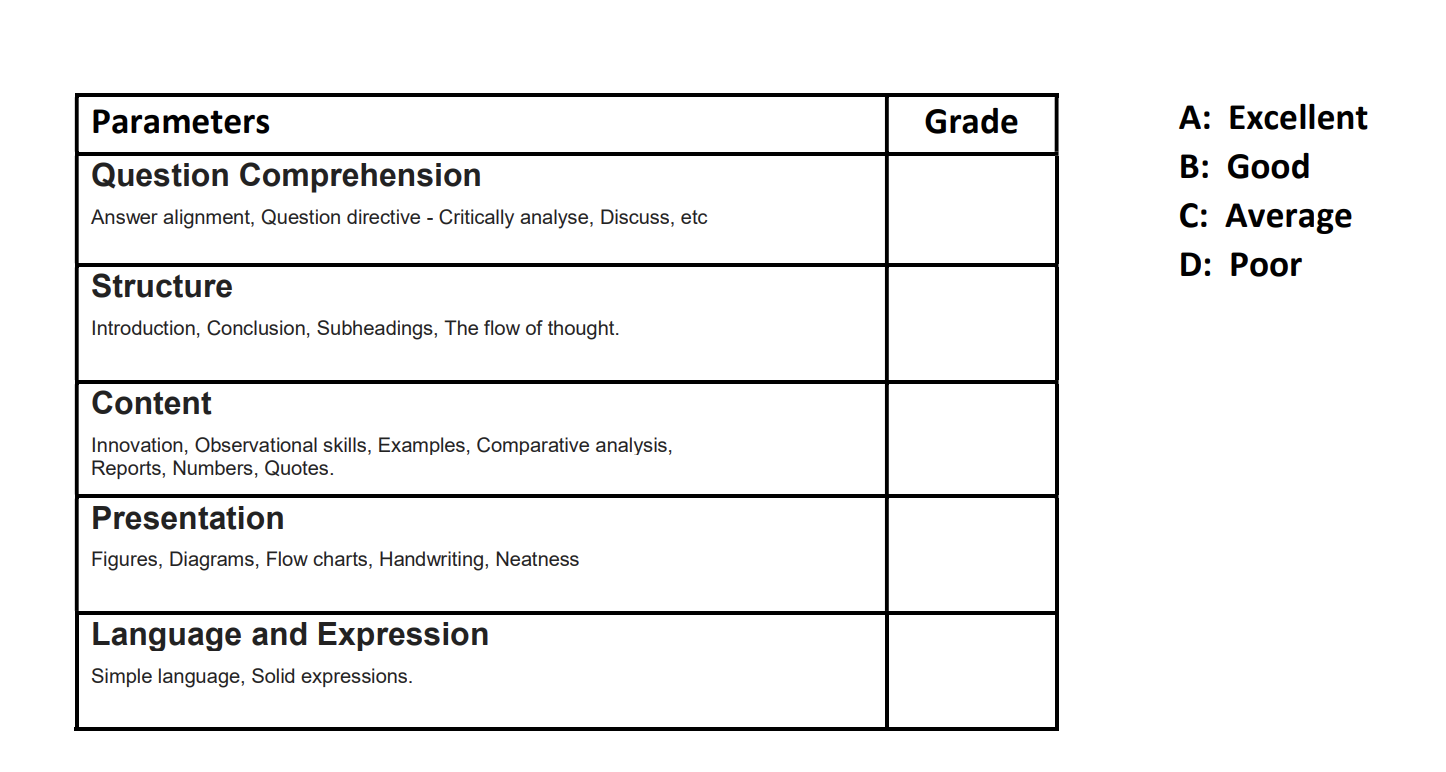
Our evaluation focusses on multiple dimensions and parameters like structure, flow, presentation, contextuality, relevance to question, analytical excellence, and cross-domain inter-linkages than simply on superficial, memory-based lapses.
More than just simply providing information, our model answers cover all the aspects of a question and provide enriching points to the student. They also include:
For ‘thought-provoking/analytical‘ type of questions, we’ll provide the best way to approach them.
Alternate introductions
Sub-headings and categorization to enhance readability and answer structure.
Colour coding for main arguments, reports, data, scholars, etc.
Every test is discussed thoroughly in the video lecture. An in-depth explanation of every question, demand from it, and the ways in which it could have been answered are discussed. Mentors will also be sharing answer writing strategies with students so that they can gain extra marks in Mains.
6. Civilsdaily’s Handholding
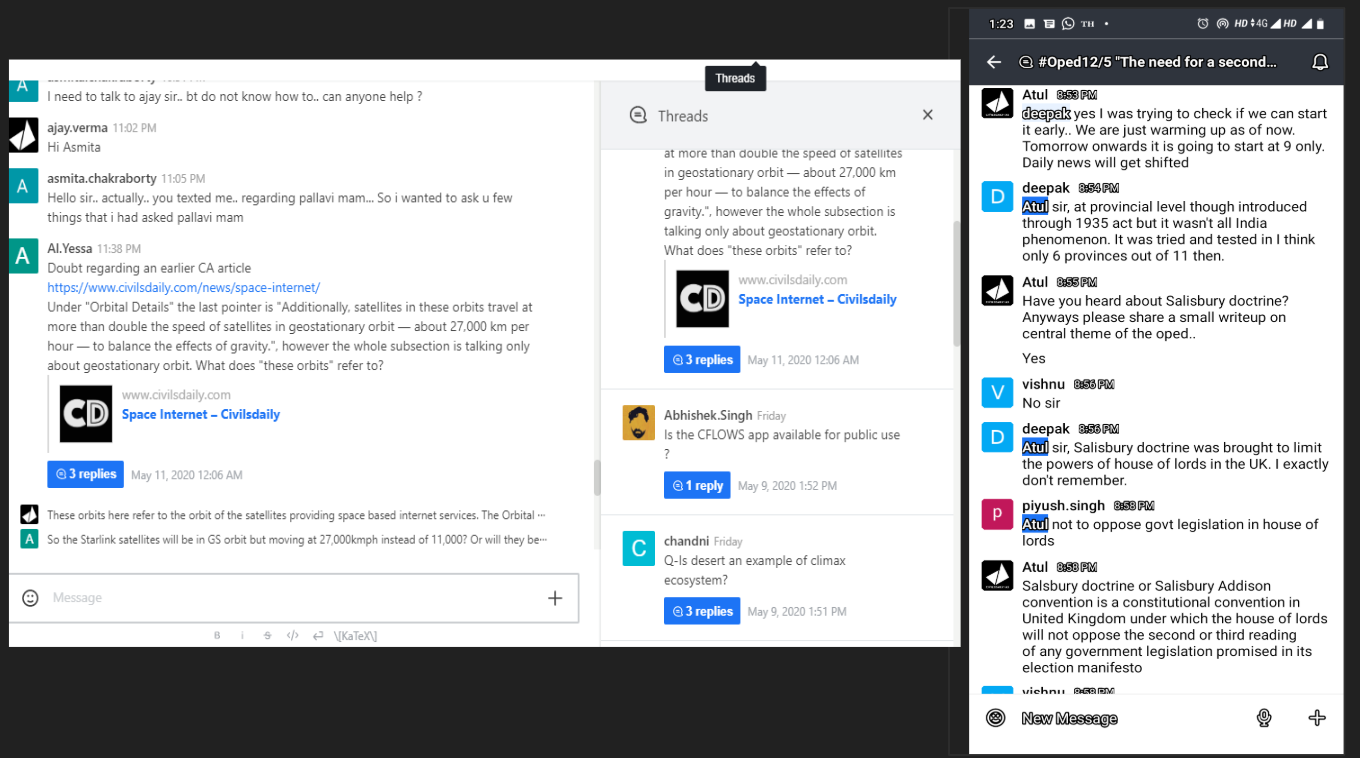
You’ll be assigned to a special group on Civilsdaily’s Habitat, it’s headed by Sajal Sir, Atul Sir, Ravi Sir and rankers like Dr. Vipin Garg (AIR 20), Swapnil Pawar (AIR 525) and others.
Habitat is where everything comes together learning, doubt clearing, notes, references, mentor’s support, and a focussed community. You’re going to learn and discuss like never before.
How will your queries be resolved?
The moment you have a query, you post it in the group. At 11 PM, 3 AM, doesn’t matter. No need to schedule a call, or drop an email. Just drop a chat. Once our team is up, it will be resolved.
More often than not, your peers will take part in your doubt discussions adding a lot of value.
Besides doubts, what else is there on Habitat?
#DDS sessions – We have dedicated sessions every day to resolve doubts in real-time. Never keep a doubt to yourself.
An ecosystem for co-learning and active learning.
A highly motivated community to bring flexibility and consistency to your preparation.
That’s not all, we’ve Daily news analysis and Op-ed discussion sessions on Habitat. Other activities like revisions, quizzes, test discussion, CSAT, etc. are also planned.
Civilsdaily’s Habitat – Desktop and Mobile view
7. Value-added material
Current affairs magazines – Civilsdaily’s Magazines are the best in terms of comprehensive coverage, superb design, and high readability. Get them here.
Listicles and other relevant study material – Supplementary content provided will be helpful in covering multiple related questions.
Program inclusion:
Tests (14 Subject-wise + 8 Full Syllabus) and Model Answers
Video Discussion
On phone One-to-One discussion of checked copy, with Mentor
Civilsdaily’s Handholding
Civilsdaily’s Habitat special group
Civilsdaily’s Magazines, Listicles, and other relevant study material
This is what our students have to say..
Kamya Misra, Mains Test series, UPSC 2018Kunal Aggarwal, Mains Test Series, UPSC 2018From Quora answer. (Read the full answer here)
Reviews will be provided in a week. (In the order of submission- First come first serve basis). In case the answer is submitted late the review period may get extended to two weeks.
*In case your answer is not reviewed in a week, reply to your answer saying *NOT CHECKED*. If Parth Sir’s tag is available then tag him.
For the philosophy of AWE and payment, check here: Click2Join
Reviews will be provided in a week. (In the order of submission- First come first serve basis). In case the answer is submitted late the review period may get extended to two weeks.
*In case your answer is not reviewed in a week, reply to your answer saying *NOT CHECKED*. If Parth Sir’s tag is available then tag him.
For the philosophy of AWE and payment, check here: Click2Join
In introduction we have to briefly explain why we should preserve and promote our language and culture in general.
The question is pretty much straight forward and in the body one must discuss the relevance of preserving and promoting the language, culture and art of the tribals. List out various schemes and policies in this direction – Guru Shishya Parampara, shilpgram, octave, National Cultural Exchange Programme (NCEP) etc.
We have to conclude our answer by reasserting the significance of such schemes and policies.
Answer-
Introduction:
India has traditionally been the home of different cultures and people. Unity in diversity is one of the most prominent features in the people of India. Among the diversified population a significant portion is comprised of the tribal people, the original inhabitants of the land. The tribal culture of India and their traditions and practices pervade almost all of the aspects of Indian culture and civilization.
Body:
To preserve & promote various forms of folk art and culture of the tribals throughout the country, the Government of India has set up seven Zonal Cultural Centres (ZCCs) with headquarters at Patiala, Nagpur, Udaipur, Prayagraj, Kolkata, Dimapur and Thanjavur. These ZCCs organize various cultural activities and programme all over the country on regular basis. These ZCCs under Ministry of Culture are also implementing a number of schemes for promoting the folk/tribal art and culture,details of which are as below
Award to Young Talented Artists: The Scheme “Young Talented Artists” is carried out to encourage and recognize the young talents especially in the field of rare art forms. Talented youngsters of the age group of 18-30 years are selected and given a onetime cash award of Rs.10,000/-.
Guru Shishya Parampara: This scheme envisages transmitting our valued traditions to the coming generations. Disciples are trained under veterans in art forms which are rare and vanishing. Rare and vanishing art forms of the region are identified and eminent exponents are selected to carry out the training programme in ‘Gurukula’ tradition. The monthly remuneration for Guru – Rs. 7,500/-, Accompanist – Rs. 3,750/- and Pupils – Rs. 1,500/- each for the period of six month to maximum 1 year for one scheme. The names of the Gurus are recommended by the State Cultural Affairs Departments.
Theatre Rejuvenation: To promote theatre activities including stage shows and Production oriented workshops, etc. Honorarium Up to Rs. 30,000/- per show excluding TA & DA is paid. The groups finalized on the basis their credentials as well as the merit of project submitted by them.
Research & Documentation: To preserve promote and propagate vanishing visual and performing art forms including folk, tribal and classical in the field of music, dance, theatre, literature, fine arts etc. in print/ audio – visual media. The art form is finalized in consultation with state Cultural Department.
Shilpgram: To promote folk and tribal art and crafts of the zone by organizing seminar,workshops, exhibitions, craft fairs, design development and marketing support to the artisans living in the rural areas.
Octave: To promote and propagate the rich cultural heritage of North East region comprising of eight States namely Arunachal Pradesh, Assam, Meghalaya, Mizoram, Sikkim, Nagaland, Manipur
and Tripura to the rest of India.
National Cultural Exchange Programme (NCEP): It can be termed as the lifeline of the Zonal Cultural Centers. Under this scheme, various festivals of performing arts, exhibitions, yatras etc are organized in member States. Artists from other zones/states are invited to participate in these programme. Participation of artists from the Zone in festivals held in other parts of the country are also facilitated. Zonal centers also participate in Major festivals happening in member States by arranging performances during these festivals where large number of audience get chance to enjoy and understand art forms of other regions. These festivals provide opportunity to taste and understand various cultures of our country.
Conclusion:
Tribal culture in India should be appreciated to understand the uniqueness of their culture. Warm hospitality, simple ways of living and sincere judgment of the opinions are some of the traits that mark the tribal cultures of India. Their custom depicts their belief in simplicity. Most of the tribes in India have their own gods and goddesses that reflects the dependence of Tribal people on nature. Except for the few most of the tribes in India is sociable, hospitable, and fun loving along with strong community bonds. Some of the tribes shares patriarchal cultural ties and some of the tribal societies are women oriented. They have their own festivals and celebrations. The tribal people are clinging to their identity despite of the external influences that threatened the tribal culture especially after their post-independence turbulent period.
The question is about the concept of ethical due diligence, so in introduction we have to define what is diligence.
In the body we have to discuss the concept of diligence. Then highlight its importance in civil services – why is it essential to profess due diligence? To what extent is it required by civil servants etc. Also discuss how to inculcate it
We have to conclude with significance of diligence in civil services.
Employment has been a recurring theme of the UPSC papers. Consider 2014 question ” “While we flaunt India’s demographic dividend, we ignore the dropping employability” What are we missing while doing so? Where will the jobs that India desperately needs come from? Explain.
So, in this question, in your intro, you should cite figures about the low employability of Indian youth from any employability report.
In the body, focus on the issues that skill education in India faces-such as regulatory issues, financing issues, placement issues etc.
In suggestions, regulatory changes, proper financing and use of technology can be included.
Conclude by stressing how focusing on skill education through skill universities could contribute to increasing the skills and employability of Indian youth.
In the intro, you can briefly state what do you mean by fiscal decentralisation.
In the body, focus on the factors like FRBM limits on state, reducing the debt/GDP ratio, conditions on the state by the central government while increasing the borrowing limits, issue of GST and compensation for revenue loss, and the issue of tax devolution to the states and role Finance Commission could play by emphasising on such issues in its report.
Conclude by stressing the need for addressing the issue faced by the states and how the Finance Commission could suggest the measures in its report to address such issues.
We have all had those days when it’s been hard to motivate ourselves to hit the books and just study. It happens to the best of us sometimes and for some of us, it happens more frequently.
And it is understandable, Civil Service preparation is a long and often lonely process. Every aspirant, from toppers to those who have quit have been overwhelmed by this process at some point in time.
Working alone is monotonous and helps you keep motivated by ensuring you are actively and passively studying every day.
This is where our 3 tier mentoring comes in:
#1. 1st step starts with this Samanvaya call: Once you fill in the form, we get on a 30-40 minute call with you to understand your prep level, working/ study constraints, current strategies and create a step by step plan for next week, next month and so on
#2. You are given access to our invite-only chat platform, Habitat where you can ask your daily doubts, discuss your test-prep questions and have real-time, live sessions on news and op-eds and find your optional groups
#3. The third and most personalized tier is the 1 on 1 mentor allotment who stays with you through the course of your preparation – always-on chat & on scheduled calls to help you assess, evaluate and chart the next milestone of your IAS 2021 journey
Who are you?
Working Junta? If you are preparing for IAS 2021 and working simultaneously, we can help you design a timetable that fits right in your hectic schedule.
First-time prep? If you are in last year of college or thinking of dropping a year and preparing for IAS 2021 full time, we can help you pick the right books and craft a practical & personal strategy