💥Join UPSC 2027,2028 Mentorship (July Batch) + XFactor Notes & Microthemes PDF

Category: Ranker Webinars

  • [Prelims Spotlight] Important IR Pacts in News

    Prelims Spotlight is a part of “Nikaalo Prelims 2020” module. This open crash course for Prelims 2020 has a private telegram group where PDFs and DDS (Daily Doubt Sessions) are being held. Please click here to register.

    Important IR Pacts in News


    23 April 2020 

    Joint Press Statement 14th Meeting of India-France Joint Working Group on Counter-Terrorism

    • India and France held the 14th Meeting of Joint Working Group on Counter-Terrorism in New Delhi on February 28, 2020
    • Both sides condemned terrorism in all its forms and manifestations and stressed the need for strengthening international cooperation to combat terrorism in a comprehensive and sustained manner.
    • They exchanged views on current counter-terrorism challenges including countering radicalization, combating the financing of terrorism, preventing the use of the internet for terrorist purposes, threats posed by internationally designated terrorist entities as well as cross-border terrorism in South Asian region.
    • Both sides stressed upon the need to deny safe havens and sources of financing to terrorists.
    • It was decided that the next meeting of the Joint Working Group on Counter-Terrorism shall be held in France in 2021 on a mutually convenient date.

    US-Taliban Pact

    • The US and Taliban signed an agreement for “Bringing Peace to Afghanistan”, which will enable the US and NATO to withdraw troops in the next 14 months.
      The pact is between the “Islamic Emirate of Afghanistan which is not recognized by the United States as a state and is known as the Taliban” and the US.
    • The four-page pact was signed between Zalmay Khalilzad, US Special Representative for Afghanistan Reconciliation, and Mullah Abdul Ghani Baradar, political head of the Taliban.

    Comprehensive Global Strategic Partnership

    • Prime Minister Modi and President Trump pledged to deepen defence and security cooperation, especially through greater maritime and space domain awareness and information sharing; joint cooperation; exchange of military liaison personnel; advanced training and expanded exercises between all services and special forces; closer collaboration on co-development and co-production of advanced defence components, equipment and platforms; and partnership between their defence industries.
    • Prime Minister Modi and President Trump resolved to enhance the security of their homelands through cooperation and to jointly fight international crimes like human trafficking, terrorism and violent extremism, drug-trafficking and crimes in cyberspace.

    List of MoUs/Agreements exchanged and announced during State Visit of President of Portugal

    • Memorandum of Understanding for Cooperation for Setting Up a National Maritime Museum
    • Heritage Complex in Lothal (Gujarat) between Portuguese Ministry of Defence and the Indian Ministry of Shipping.
    • MOU between Economic and Food Safety Authority (ASAE) and DPIIT, Ministry of Commerce or co-operation in the field of industrial and intellectual property rights Co-operation Agreement on Maritime Transport and Port Development between India and  Portugal.
    • MoU between the Portuguese Diplomatic Institute and Foreign Service Institute for training

    Israel-Palestine Peace Plan

    • The Israel-Palestine peace plan or the West Asia peace plan is the proposal unveiled by U.S. President Donald Trump
    • This plan seeks to address most of the contentious issues in the conflict.
    • The solutions, Mr. Trump has proposed to almost all of these issues, favour the Israeli positions.
    • He seeks to give to the Israelis, Jerusalem and part of the West Bank.
    • With his plan, he is actually pushing to revive the stalled two-state talks between the Israelis and the Palestinians, but on his own terms.

    What is the plan?

    • The Palestinian refugees, who were forced out from their homes during the 1948 Arab-Israeli war that followed the declaration of the state of Israel in historic Palestine, would not be allowed to return.
    • Jerusalem would be the undivided capital of Israel, with Palestine gaining its capital in the east of the city.
    • In return, Israel would freeze further settlement activities on the West Bank for 4 years (the time for negotiations).
    • During this period, the Palestinian Authority should dismiss its current complaints at the International Criminal Court against Israel and refrain itself from taking further actions.
    • It should crack down on certain terrorist groups like the Hamas

    US-Guatemala Asylum Deal

    • In July 2019, the then President of Guatemala signed an asylum deal with the US.
    • Under the “safe third country” agreement, migrants have to apply for asylum in the first country they land in.
    • If they fail to do so and proceed to the second country, they can be sent back to the first country.
    • The US first signed such an agreement with Canada in 2002.

    What is the US-Guatemala agreement

    • In 2019, the US administration signed “safe third country” agreements with the Northern Triangle countries of Guatemala, El Salvador, and Honduras.
    • This made it more difficult for refugees to seek asylum in the US.
    • This agreement allowed the US to send asylum seekers from third countries to Guatemala.
    • So far, Guatemala is the only country which has implemented the agreement.
    • Unless migrants apply for protection in Guatemala before proceeding to the US, they are sent back to Guatemala

    Indo-German Partnership

    • German Chancellor Angela Merkel is the first foreign leader to visit India after Jammu and Kashmir was officially bifurcated into two Union Territories on October 31
    • Germany and India signed 17 agreements and five joint declarations of intent in fields spanning space, civil aviation, maritime technology, medicine, yoga and education.

    PM Modi’s Saudi Visit – Future Investment Initiative Forum

    • The forum is formally called the Future Investment Initiative and was launched in 2017.
    • The Indian PM will be joining Brazil’s president, Jair Bolsonaro, U.S. President Trump’s senior adviser and son-in-law, Jared Kushner.
    • Other leading international figures also join at the annual international forum popularly known as “Davos in the Desert”.
    • It seeks to elevate Saudi Arabia’s international economic engagement.
    • It is part of Crown Prince Mohammed bin Salman’s (MbS’s) efforts to rapidly transform Saudi the economy under the “Vision 2030” that he unveiled in 2016.

    Mamallapuram Summit – India and China

    • PM Modi and Chinese President Xi Jinping recently held an informal summit in the ancient coastal town of Mamallapuram or Mahabalipuram in Tamil Nadu.
    • The two countries convened their first Informal Summit in central China’s Wuhan in April 2018, where they exchanged views on issues of global and bilateral significance.
    • Irrespective of the rhetoric of a Wuhan spirit, the relationship is facing difficulties, reflected in a number of disputes between the two countries.

    Informal Summits

    • Informal Summits act as supplementary exchanges to annual Summits and other formal exchanges such as the G20 Summit, EU-India Summit and the BRICS Summit among others.
    • It allows for direct, free and candid exchange of views between countries, something that may not be possible to do through formal bilateral and multilateral meetings that are agenda-driven.
    • Informal Summits may not take place on a fixed annual or biennial schedule; they are impromptu in the sense that they take place when a need for them is perceived by the concerned nations.

    Wuhan Spirit

    • Wuhan Spirit is in line with the five principles of peaceful coexistence (Panchsheel) jointly advocated by China and India in the 1950s.
    • Wuhan Spirit highlighted To form the “backbone” of economic globalization, and they should jointly make positive contributions to global peace and development.
    • To cooperate, for the first time ever, on a joint project in Afghanistan.
      China has indicated that India’s refusal to join the Belt and Road Initiative will not come in the way of economic cooperation.

    Extradition Treaty between India and Belgium

    • Recently, the Union Cabinet has approved the signing and ratifying of the Extradition Treaty between the Republic of India and the Kingdom of Belgium.
    • This will replace the pre-Independence Extradition Treaty between Great Britain and Belgium of 1901 that was made applicable to India through the exchange of Letters in 1958.
    • The Treaty provides a legal framework for seeking the extradition of terrorists, economic offenders, and other criminals from and to Belgium.

    Multilateral Export Control Regimes

    • MECR is voluntary and non-binding agreements created by the major supplier countries that have agreed to co-operate in their effort to prevent and regulate the transfer of certain military and dual-use technology.
    • It aims at preventing the proliferation of Weapons of Mass Destruction (WMD).
    • They are independent of the United Nations.
    • Their regulations apply only to members and it is not obligatory for a country to join.
    • India is now a member of three of the four MECRs, except the Nuclear supplier Group.

    There are currently four such regimes under MECR

    • The Nuclear Suppliers Group (NSG), for the control of nuclear-related technology.
    • The Australia Group (AG) for control of chemical and biological technology that could be weaponized.
    • The Missile Technology Control Regime (MTCR) for the control of rockets and other aerial vehicles capable of delivering weapons of mass destruction.
    • The Wassenaar Arrangement on Export Controls for Conventional Arms and Dual-Use Goods and Technologies.

    Joint Economic Trade Committee

    • JETCO provides a forum to United Kingdom companies to enhance their links and develop new partnerships with India business and decision-makers.
      Government to Government negotiations, which address issues of market liberalization and market access, are conducted through the JETCO process.
    • The UK India Business Council plays a key role in feeding the views of the UK business community into JETCO process with a view to achieving favourable outcomes for UK companies.
    • One of the key objectives of the JETCO process is to unveil opportunities for London’s most prominent institutional investors to invest in India.

  • [Prelims Spotlight] National Parks, Biosphere Reserves, Wildlife Sanctuaries in India – Part 2

    Prelims Spotlight is a part of “Nikaalo Prelims 2020” module. This open crash course for Prelims 2020 has a private telegram group where PDFs and DDS (Daily Doubt Sessions) are being held. Please click here to register.

    National Parks, Biosphere Reserves, Wildlife Sanctuaries in India – Part 2


    22 April 2020 

    Conservation of Wildlife:

    1. The Government of India enacted the Wild Life (Protection) Act 1972 with the objective of effectively protecting the wildlife of this country and to control poaching, smuggling and illegal trade in wildlife and its derivatives.

    • The act extends to the whole of India except J&K which has its own wildlife act.
    • It has 6 schedules which give varying degrees of protection.
      • Schedule I and part II of Schedule II provide absolute protection and offences under these are prescribed the highest penalties.
      • The penalties for Schedule III and Schedule IV are less and these animals are protected.
      • Schedule V includes the animals which may be hunted. These are the Common crow, Fruit bats, Mice & Rats only.
      • Schedule VI contains the plants, which are prohibited from cultivation and planting.

    2. A National Board for Wildlife (NBWL), chaired by the Prime Minister of India provides for a policy framework for wildlife conservation in the country.

    3. The National Wildlife Action Plan (2002-2016) was adopted in 2002, emphasizing the people’s participation and their support for wildlife conservation. The Draft National Wildlife Action Plan (NWAP) 2017-31 envisages 17 focus areas, including a new area linking wildlife planning to climate change.

    4. The Indian Constitution entails the subject of forests and wildlife in the Concurrent list thus laying the responsibility of wildlife conservation on both the Centre and the State. The Federal Ministry acts as a guiding torch dealing with the policies and planning on wildlife conservation, while the provincial Forest Departments are vested with the responsibility of implementation of national policies and plans.

    5. Specialized projects: To save the endangered species of animals, specialised projects are being implemented with international cooperation (WWF, UNDP, UNEP, IUCN) as well as on a stand-alone basis e.g.

    1. Project Tiger 1973
    2. Operation Crocodile 1975
    3. Project Rhinoceros 1987
    4. Project Snow Leopard
    5. Project Elephant 1988

    More recently, the Black Buck (chinkara), the Great Indian Bustard (godawan) and the snow leopard etc. have been given full or partial legal protection against hunting and trade throughout India.

    6. The Protected Areas of India:

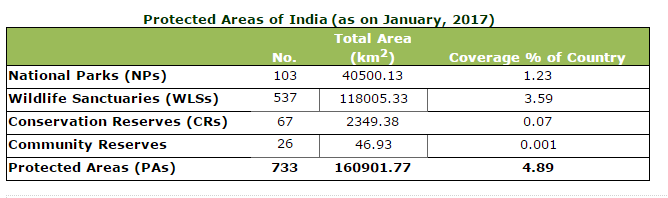
    Protected areas are those in which human occupation or at least the exploitation of resources is limited. These are defined according to the categorization guidelines for protected areas by the International Union for Conservation of Nature (IUCN). There are several kinds of protected areas, which vary by level of protection depending on the enabling laws of each country or the regulations of the international organizations involved.

    There are 4 categories of the Protected Areas in India viz,

    • National Parks,
    • Sanctuaries,
    • Conservation Reserves, and
    • Community Reserves.

    Source

    Let’s look at these in detail:

    • National Park:
      • A National park is an area with enough ecological, geo-morphological and natural significance with rich fauna and flora, which is designed to protect and to develop wildlife or its environment.
      • National parks in India are IUCN category II protected areas.
      • Activities like grazing, hunting, forestry or cultivation etc. are strictly prohibited. No human activity is permitted inside the national park except for the ones permitted by the Chief Wildlife Warden of the state.
      • India’s first national park was established in 1936 as Hailey National Park, now known as Jim Corbett National Park, Uttarakhand.
      • There are 104 existing national parks in India covering an area of 40501.13 km2, which is 1.23% of the geographical area of the country (National Wildlife Database, May 2019).
    • Wildlife Sanctuary:
      • Any area other than area comprised with any reserve forest or the territorial waters can be notified by the State Government to constitute as a sanctuary if such area is of adequate ecological, faunal, floral, geomorphological, natural. or zoological significance, for the purpose of protecting, propagating or developing wildlife or its environment.
      • The difference between a Sanctuary and a National Park mainly lies in the vesting of rights of people living inside. Unlike a Sanctuary, where certain rights can be allowed, in a National Park, no rights are allowed. No grazing of any livestock is permitted inside a National Park while in a Sanctuary, the Chief Wildlife Warden may regulate, control or prohibit it.
      • There are a total of 551 wildlife sanctuaries in India.
    • Conservation reserves and community reserves in India:
      • These terms denote the protected areas of India which typically act as buffer zones to or connectors and migration corridors between established national parks, wildlife sanctuaries and reserved and protected forests of India.
      • Such areas are designated as Conservation Reserves if they are uninhabited and completely owned by the Government of India but used for subsistence by communities and Community Reserves if a part of the lands is privately owned.
      • These protected area categories were first introduced in the Wildlife (Protection) Amendment Act of 2002 − the amendment to the Wildlife Protection Act of 1972.
      • These categories were added because of reduced protection in and around existing or proposed protected areas due to private ownership of land, and land use.

    7. Biosphere Reserves: A biosphere reserve is an area of land or water that is protected by law in order to support the conservation of ecosystems, as well as the sustainability of mankind’s impact on the environment.

    • Each reserve aims to help scientists and the environmental community figure out how to protect the world’s plant and animal species while dealing with a growing population and its resource needs.
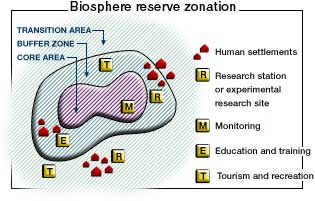
    • To carry out the complementary activities of biodiversity conservation and sustainable use of natural resources, biosphere reserves are traditionally organized into 3 interrelated zones, known as:
      • the core area,
      • the buffer zone, and
      • a transition zone or ‘area of cooperation.
    Source
    • The purpose of the formation of the biosphere reserve is to conserve in situ all forms of life, along with its support system, in its totality, so that it could serve as a referral system for monitoring and evaluating changes in natural ecosystems.
    • Presently, there are 18 notified biosphere reserves in India. Ten out of the eighteen biosphere reserves are a part of the World Network of Biosphere Reserves, based on the UNESCO Man and the Biosphere (MAB) Programme list.
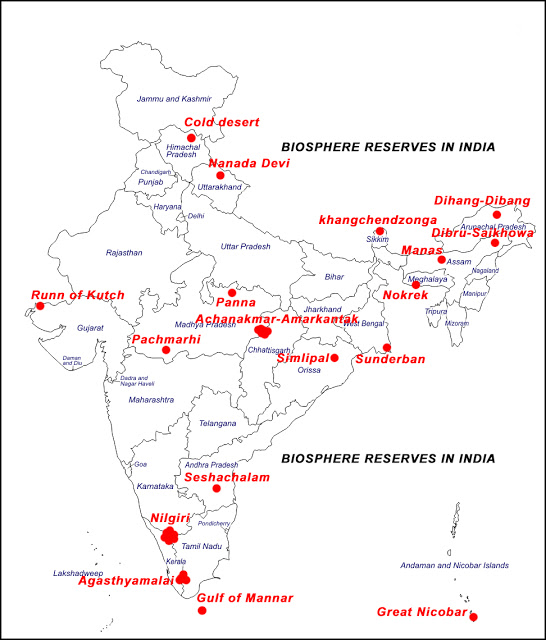

    Click here for the list of National Parks/Wild Life Sanctuaries and Biosphere Reserves

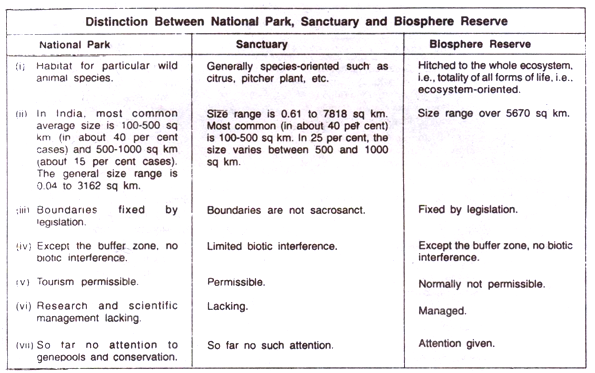
    How is a biosphere reserve different from a national park/ wildlife sanctuary?

    Biosphere Reserves of India protect larger areas of natural habitat (than a National Park or Wildlife Sanctuary). Biosphere Reserves may cover multiple National Parks, Sanctuaries and reserves as well.

    Ex. the Nilgiri Biosphere covers: Bandipur National park, Mudumalai Tiger Reserve, Silent Valley National Park, Nagarhole National Park, Mukurthi National Park and is usually a contiguous area.

    Some of the other differences are listed in the image below:
    Source

    8. Some other important Conservation Sites:

    • Tiger reserves – Project Tiger was launched by the Government of India in the year 1973 to save the endangered species of tiger in the country. Starting from nine (9) reserves in 1973 the number has now grown up to fifty (50) in 2016.
    • Elephant reserves
    • RAMSAR Wetland Sites [Related Reading: Everything that you need to know about Wetlands, A complete list of RAMSAR wetland sites in India can be found here]
    • UNESCO World Heritage Sites (Natural, Cultural and Mixed) – Places listed by the United Nations Educational, Scientific and Cultural Organization as of special cultural or physical significance.
    • Marine Protected Areas
    • Important Bird Areas

    9. Role of communities: Communities have played a vital role in the conservation and protection of wildlife in India. E.g.

    • Sariska Tiger Reserve: In Sariska tiger reserve Rajasthan villagers have fought against mining by citing the wildlife protection act. In many areas, villagers themselves are protecting habitats and explicitly rejecting government involvement.
    • Bhairodev Dakav Sonchuri: The inhabitants of five villages in the Alwar district of Rajasthan have declared 1200 hectares of forests as the Bhairodev Dakav Sonchuri declaring their own set of rules and regulation which do not allow hunting, and are protecting the wildlife against any outside encroachments.
    • Bishnoi villages: In and around Bishnoi villages in Rajasthan, herds of blackbuck, Nilgai and peacocks can be seen as an integral part of the community and nobody harms them.


  • [Prelims Spotlight] Important Sessions of Indian National Congress

    Prelims Spotlight is a part of “Nikaalo Prelims 2020” module. This open crash course for Prelims 2020 has a private telegram group where PDFs and DDS (Daily Doubt Sessions) are being held. Please click here to register.

    Important Sessions of Indian National Congress


    21 April 2020 

    Important sessions of Congress

    • 1885- 1st, Bombay, presided by W.C. Banerjee
    • 1887- Badruddin Tyabji became 1st Muslim to preside over congress session
    • 1907- Surat, Ras Bihari Ghosh not Bose, split in Congress between moderates and extremists
    • 1916- Lucknow, Reunion on congress, Lucknow pact between Congress and Muslim league
    • 1919 – Amritsar, Motilal Nehru Jallianwala Bagh Massacre is condemned
    • 1920 – Nagpur C.Vijayraghavachair a new constitution for reorganized
    • 1924 – Belgaum Mahatma Gandhi.
    • 1927 – Madras M.A.Ansari, adoption of Independent Resolution, resolved to boycott the Simon Commission
    • 1929- Lahore, J.L. Nehru, Purna Swaraj Resolution
    • 1931- Karachi, Vallabh Bhai, Resolution on Fundamental Rights and National Economic Programme.
    • 1936 – April, Lucknow Jawaharlal Nehru, urged the Congress to adopt Socialism as its goal
    • 1938- Haripura, S.C. Bose, National Planning Committee under J.L. Nehru

    Leaders of the session

    • Womesh Chandra Bonnerjee was the president of the first session of the Indian National Congress.
    • Annie Beasant was the first female President of the Indian National Congress.
    • Sarojini Naidu was the first Indian woman president of the Indian National Congress.
    • Badruddin Tyabji was the first Muslim President of the Indian National
      Congress.
    • Rahimtulla Sayani was the second Muslim President of the Indian National
      Congress.
    • George Yule was the first European President of the Indian National Congress.
    • Dadhabhai Naoroji was the first Parsi President of the Indian National Congress.
    • Sankaran Narayan was the first & the only Keralite President of the Indian National Congress Session.
    • Hakim Ajmal Khan was the only person to be appointed as the President of INC, All India Muslim League & All India Khilafat Committee.


  • [Prelims Spotlight] Species in News

    Prelims Spotlight is a part of “Nikaalo Prelims 2020” module. This open crash course for Prelims 2020 has a private telegram group where PDFs and DDS (Daily Doubt Sessions) are being held. Please click here to register.

    Species in News


    20 April 2020 

    Trimeresurus Salazar

    • Salazar’s pit viper belongs to the genus Trimeresurus Lacépède comprising “charismatic venomous serpents with morphologically as well as ecologically diverse species”.
    • Pit vipers are venomous snakes distinguished by their heat-sensing pit organs between the eye and the nostril.
    • The name was inspired by Salazar Slytherin, the co-founder of J.K. Rowlings’ fictional Hogwarts School of Witchcraft and Wizardry.

    Himalayan Ibex

    IUCN/WPA Status:    Least Concern / Schedule I

    • Himalayan Ibex (Capra ibex sibirica) is widely found in arid and rocky mountain of Karakoram, Hindukush and Himalayas of Gilgit-Baltistan.
    • The males are characterized by heavy body, large horns, long bears while females have small body small horns.
    • The threats that Himalayan ibex face are the illegal hunting, human disturbance, habitat loss and competition for forage with domestic livestock.

    Red Panda

    IUCN Red List Status: Endangered

    • The red panda (Ailurus fulgens) is a mammal native to the eastern Himalayas and southwestern China.
    • Its wild population is estimated at fewer than 10,000 mature individuals and continues to decline due to habitat loss and fragmentation, poaching, and inbreeding depression.
    • Despite its name, it is not closely related to the giant panda
    • The animal has been hunted for meat and fur, besides illegal capture for the pet trade.
    • An estimated 14,500 animals are left in the wild across Nepal, Bhutan, India, China and Myanmar.
    • About 5,000-6,000 red pandas are estimated to be present in four Indian states – Arunachal Pradesh, Meghalaya, Sikkim and West Bengal.
    • The diminishing habitat is a major threat to the species which is a very selective feeder and survives on selected species of bamboos.

    About South Asia Wildlife Enforcement Network (SAWEN)

    • SAWEN is a Regional network is comprised of eight countries in South Asia: Afghanistan, Bangladesh, Bhutan, India, Maldives, Nepal, Pakistan and Sri Lanka.
    • It aims at working as a strong regional intergovernmental body for combating wildlife crime by attempting common goals and approaches for combating illegal trade in the region.
    • The South Asia region is very vulnerable to illegal traffic and wildlife crimes due to the presence of precious biodiversity and large markets as well as traffic routes for wildlife products in the south East Asian region.
    • The collaboration in harmonizing as well as enforcing the wildlife protection in the region is considered very important for effective conservation of such precious biodiversity.
    • India adopted the Statute of the SAWEN and became its formal member in 2016.

    Swamp wallaby

    IUCN Status: Least Concerned

    • The swamp wallaby is a small macropod marsupial of eastern Australia. It is likely the only mammal pregnant and lactating all lifelong.
    • Female wallabies and kangaroos have two uteri and two separate ovaries.
    • At the end of a pregnancy in one uterus, a new embryo develops in the other uterus.
    • Kangaroos and wallabies regularly have an embryo in the uterus, a young joey in the pouch, and a third semi-dependent young at foot, still drinking its mother’s milk.

    How it is different from Kangaroo?

    • In kangaroos, the new embryo is conceived a day or two after the previous birth.
    • In the swamp wallaby (Wallabia bicolor), the new conception happens one or two days before the previous joey is delivered.

    Eurasian Otters

    • IUCN Status: Near Threatened
    • Species in India: Smooth-coated, Asian small-clawed and Eurasian Otters
    • Habitat: Smooth-coated — all over India; Asian small-clawed — only in the Himalayan foothills, parts of the Eastern and southern Western Ghats; Eurasian — Western Ghats and Himalayas.
    • Diet comprises several small animals, mainly crabs and small fishes.
    • Lives in small packs, is mostly nocturnal, but can be diurnal in areas which are less disturbed.

    Thanatotheristes

    • Tyrannosaurs were one of the largest meat-eating dinosaurs to have ever lived, with very large and high skulls, and the best known among them is the Tyrannosaurus rex, celebrated in the Jurassic Park series.
    • The 79-million-year-old fossil that the researchers have found is the oldest tyrannosaur known from northern North America.
    • Thanatotheristes preyed on large plant-eating dinosaurs such as the horned xenoceratops and the dome-headed colepiochephale.
    • The research suggests that tyrannosaurs did not have one general body type; rather different tyrannosaur species evolved distinct body sizes, skull forms and other such physical features.
    • The fossil specimen is important to understand the Late Cretaceous period, which is the period when tyrannosaurs roamed the Earth.

    Flame-throated Bulbul

    IUCN status: Least Concern

    • The Flame-throated Bulbul is endemic to southern peninsular India where it is locally distributed in southern Andhra Pradesh, eastern Karnataka, Goa, Orissa, eastern Kerala and northern Tamil Nadu.
    • It prefer habitats like rocky, scrub-covered hills mostly in the Eastern Ghats and central peninsular India but also in some places in the Western Ghats.
    • It is a Schedule – IV bird under the Wildlife (Protection) Act, 1972.

    Archaea

    • Archaea (singular archaeon) are a primitive group of microorganisms that thrive in extreme habitats such as hot springs, cold deserts and hypersaline lakes.
    • These slow-growing organisms are also present in the human gut, and have a potential relationship with human health.
    • They are known for producing antimicrobial molecules, and for anti-oxidant activity with applications in eco-friendly waste-water treatment.
    • Archaea are extremely difficult to culture due to challenges in providing natural conditions in a laboratory setting.
    • As archaea are relatively poorly studied, very little is known about how archaea behave in the human body.
    • The organism has potential gene clusters that helps maintain the metabolism of the archaea to survive in extreme harsh conditions.

    Steppe Eagle

    • A lone endangered steppe eagle (Aquila nipalensis) has been sighted by a group of birdwatchers in a paddy field near Vijayawada.
    • The Steppe Eagle is a migratory raptor which has undergone extremely rapid population declines within all its range.
    • It breeds in Russia, Kazakhstan, and Mongolia during the winter season.
    • Steppe eagle is the second-largest migratory eagle species to India.
    • IUCN Status: It has moved from ‘Least Concern’ to ‘Endangered’

    IVF of White Rhinos

    • Researchers had created another embryo — the third — of the nearly extinct northern white rhino. This is seen as a remarkable success in an ongoing global mission to keep the species from going extinct.
    • IVF is a type of assisted reproductive technology used for infertility treatment and gestational surrogacy.
    • A fertilised egg may be implanted into a surrogate’s uterus, and the resulting child is genetically unrelated to the surrogate.
    • Some countries have banned or otherwise regulate the availability of IVF treatment, giving rise to fertility tourism.
    • Restrictions on the availability of IVF include costs and age, in order for a woman to carry a healthy pregnancy to term.
    • IVF is generally not used until less invasive or expensive options have failed or been determined unlikely to work.

    Types of Rhinos

    • The northern white is one of the two subspecies of the white (or square-lipped) rhinoceros, which once roamed several African countries south of the Sahara.
    • The other subspecies, the southern white is, by contrast, the most numerous subspecies of rhino, and is found primarily in South Africa.
    • There is also the black (or hook-lipped) rhinoceros in Africa, which too, is fighting for survival, and at least three of whose subspecies are already extinct.
    • The Indian rhinoceros is different from its African cousins, most prominently in that it has only one horn.
    • There is also a Javan rhino, which too, has one horn, and a Sumatran rhino which, like the African rhinos, has two horns.

    Greylag goose

    • Greylag goose, a migratory specie was recently spotted in Telangana
    • This is the third recorded sighting of the large-sized bird in Telangana, which makes it ‘eligible’ to be the latest addition to the State’s exhaustive list of birds.
    • As per scientific and accepted norms, a species has to be seen three different times in three different places, or by three independent observers, before it can be accepted as an addition to a State’s list.
    • The Greylag geese are common visitors to North India in winters, and are found mostly in wetlands there feeding generally on aquatic weeds and grass.
    • IUCN Status: Least Concerned.

    Chinese paddlefish

    • The Chinese paddlefish (Psephurus gladius) was an iconic species, measuring up to 7 m in length, dating back from 200 million years ago, and therefore swimming the rivers when dinosaurs ruled the Earth.
    • Its ancestral home was the Yangtze River.
    • It was once common in the Yangtze, before overfishing and habitat fragmentation — including dam building — caused its population to dwindle from the 1970s onwards.
    • Between 1981 and 2003, there were just around 210 sightings of the fish. The researchers estimate that it became functionally extinct by 1993, and extinct sometime between 2005-2010.

    Senna spectabilis

    • The Senna spectabilis species was planted as avenue trees in Wayanad. The vayal ecosystem (marshy land) of the forest area now has this plant in large numbers.
    • The spread is posing a major threat to the forest areas of the reserve, owing to its quick growth and coppicing character.
    • The tree species was found in nearly 10 sq km area of the 344.44 sq km sanctuary around five years ago.
    • The plant has started to invade the adjacent Bandipur and Nagarhole tiger reserves in Karnataka and the Mudumalai tiger reserve in Tamil Nadu.
    • Now, it had invaded to more than 50 sq km of the sanctuary Wayanad WLS.
    • A recent study of the Ferns Nature Conservation Society recorded the presence of the plant in 78.91 sq km area of the sanctuary.

    Locusts

    • Locusts are certain species of short-horned grasshoppers that have a swarming phase.
    • Swarming refers to a collective behaviour in which locusts aggregate together just like flocks of birds.
    • These insects are usually solitary, but under certain circumstances they become more abundant and change their behaviour and habits, becoming grouped.
    • They form bands of wingless nymphs which later become swarms of winged adults.
    • Both the bands and the swarms move around and rapidly strip fields and cause damage to crops.
    • The adults are powerful fliers; they can travel great distances, consuming most of the green vegetation wherever the swarm settles.

    Bar-headed goose

    • IUCN conservation status: Least Concern.
    • The Bar-headed geese (Anser Indicus) are found in central China and Mangolia and they breed there.
    • They start migration to the Indian sub-continent during the winter and stay here till the end of the season.
    • They return to their homes by crossing the Himalayan ranges.
    • Their migration has been a fascination for birders as they cross the Himalayas on one of the most high-altitude migrations in the world.

    Himalayan gold’

    • Caterpillar fungus (Ophiocordyceps Sinensis) is a fungal parasite of larvae (caterpillars) that belongs to the ghost moth.
    • It is endemic to the Tibetan Plateau, including the adjoining high Himalaya (3,200-4,500 metres above sea level).
    • It is locally known as Kira Jari (in India), Yartsagunbu (in Tibet), Yarso Gumbub (Bhutan), Dong Chong Xia Cao (China) and Yarsagumba (in Nepal).
    • In the Indian Himalayas, the species has been documented in the region from the alpine meadows of protected areas such as Nanda Devi Biosphere Reserve, Askot Wildlife Sanctuary, Kanchendzonga Biosphere Reserve and Dehan-Debang Biosphere Reserve.

    About Gangetic Dolphins

    • The Gangetic river dolphins can only live in freshwater, are blind and catch their prey in a unique manner, using ultrasonic sound waves.
    • These dolphins prefer deep waters and, as per WWF, they are distributed across seven states in India: Assam, Uttar Pradesh, Madhya Pradesh, Rajasthan, Bihar, Jharkhand and West Bengal.
    • Their numbers have dwindled in the last few decades mainly because of direct killing, habitat fragmentation by dams and barrages and indiscriminate fishing.

    Protection status

    • The Gangetic river dolphins were officially discovered in 1801 and are one of the oldest creatures in the world along with some species of turtles, crocodiles and sharks, a/c to the World Wildlife Fund (WWF).
    • They once lived in the Ganges-Brahmaputra-Meghna and Karnaphuli-Sangu river systems of Nepal, India, and Bangladesh, but are now mostly extinct from many of its early distribution ranges, as per WWF.
    • In 2009, the Gangetic dolphins were declared India’s National Aquatic animal during the first meeting of the erstwhile National Ganga River Basin Authority (NGRBA).
    • It is placed under the “endangered” category by the IUCN.
    • Additionally, the Gangetic dolphins have been included in Schedule -I of the Wildlife Protection Act, 1972, which means they have the highest degree of protection against hunting.
    • They are also one among the 21 species identified under the centrally sponsored scheme, “Development of Wildlife Habitat”.

    Trachischium apteii

    • It was found under fallen logs inside a thickly forested area of the Tally Valley Wildlife Sanctuary near the town of Ziro in Arunachal Pradesh during a field expedition by researchers in July 2019.
    • It belongs to a group of fossorial snakes that live mostly underground, and surface mainly during or after a heavy monsoon shower.
    • Due to the burrowing habits of species of this genus, snakes belonging to the group are seldom seen and hence remain poorly studied.
    • This could have been one of the reasons that the species had eluded the researchers.

    Pliosaurs

    • Over 150 million years ago, enormous reptiles swam the Jurassic oceans.
    • The largest aquatic carnivorous reptiles that have ever lived, they are often dubbed “sea monsters”.
    • Scientifically, they are placed in the suborder Pliosauroidea, whose members are called pliosaurs.
    • Interest in these giants has been revived with the recent discovery of their bones in a cornfield in the Polish village of Krzyzanowice. Remains of pliosaurs are rare in Europe.

    What makes them special?

    • They measured over 10 metres in length and could weigh up to several dozen tons.
    • They had powerful, large skulls and massive jaws with large, sharp teeth.
    • Their limbs were in the form of fins.

    Swietokrzyskie Mountains

    • The Swietokrzyskie Mountains are a mountain range in central Poland.
    • In the Jurassic era, the Swietokrzyskie Mountains area is believed to have been an archipelago of islands, where there were warm lagoons and shallow sea reservoirs, home to the marine reptiles discovered by the palaeontologists.
    • The locality where the remains were discovered is considered to be rich in the fossils of coastal reptiles. Researchers now hope to find more remains in the coming months.


  • [Prelims Spotlight] LANDMARK JUDGMENTS OF THE SUPREME COURT OF INDIA

    Prelims Spotlight is a part of “Nikaalo Prelims 2020” module. This open crash course for Prelims 2020 has a private telegram group where PDFs and DDS (Daily Doubt Sessions) are being held. Please click here to register.

    LANDMARK JUDGMENTS OF THE SUPREME COURT OF INDIA


    18 April 2020 

    Champakam Dorairajan State of Madras,1951

    • In this case caste-based reservations were struck down by the court, as against Article 16(2) of the Constitution.
    • With regard to the admission of students to the Engineering and Medical Colleges of the State, the Province of Madras had issued an order which, fixed number of seats for particular communities.
    • It noticed that while Cl. (1) Art. 29 protects the language, script or culture of a section of the citizens, cl. (2) guarantees the fundamental right of an individual citizen.
    • This right can not be denied to the city only on grounds of religion, race, caste, language or any of them.
    • If a citizen who seeks admission into any such educational institution has not the requisite academic qualifications and is denied admission on that ground, he certainly cannot be heard to complain of an infraction of his fundamental right under this Article.
    • This case resulted in the First Amendment of the Constitution of India.

    Berubari Union case (1960)

    • This case was regarding the Parliament’s power to transfer the territory of Berubai to Pakistan. The SC examined Article 3 in detail and held that the Parliament cannot make laws under this article in order to execute the Nehru-Noon agreement.
    • Hence, the 9th Amendment Act was passed to enforce the agreement.

    Golaknath State of Punjab 1967

    • The Apex court held that law made by the Parliament shall not be such that infringes and takes away the fundamental rights of the citizen which are provided by the Constitution of India.
    • Law made by a Parliament in a law under Article 13 of the Constitution.
    • Further, the constitution can be amended.
    • The judgement was overruled by 24th amendment.
    • The judgement was restored and its scope was extended in Keshavnand Bharti case.

    Madhav Jiwaji Rao Scindia Union of India, 1970

    • The infamous case, Madhav Jiwaji Rao Scindia v. Union of India deals with Article 18 of the Constitution of India.
    • It abolishes all special titles.
    • The Supreme Court in this case held the 1970 Presidential order as invalid,.
    • This decision of the court led to abolishing titles and privileges of India’s erstwhile princely rulers.
    • It even abolished privy purses of India’s erstwhile princely rulers.

    Kesavananda Bharati State of Kerala, 1973

    • The bench in the present case comprised of 13 judges.
    • This is the largest bench till date in the Indian judicial history.
    • The Supreme Court gave Parliament power to amend any part of Constitution of India.
    • The court further added that such amendment shall not take away the fundamental rights of the citizen which are provided by the Constitution of India.
    • Such law is a law under article 13 of the constitution.
    • This case is also referred as Fundamental rights case.

    Indira Gandhi vs. Raj Narain, 1975

    • The Supreme Court held clause 4 of 39th amendment as unconstitutional and void as it was outrightly denied of the right to equality enshrined in Article 14.
    • The apex Court also added basic features of the constitution to list laid down in Keshavananda Bharti case.
    • They are stated below:
      • democracy,
      • judicial review,
      • rule of law.
    • Further, the court added jurisdiction of the Supreme Court under Article 32, which deals with writs basically also forms the basic structure of the constitution.

    D.M. Jabalpur v. S. Shukla, 1976

    • The apex court in the infamous case of A.D.M. Jabalpur v. S. Shukla was a case during prevailing of emergency in the country.
    • Right to move to the court for enforcement of fundamental rights guaranteed under constitution stands suspended.
    • This even includes Article 14, 21 and 22.
    • In later amendment, it was held that Article 21 and 22 cannot be suspended during the time of emergency.

    Maneka Gandhi vs. Union of India, 1978

    • The case is considered a landmark case as it gave a new and highly varied interpretation of the meaning of ‘life and personal liberty’ under Article 21 of the Constitution.
    • This law which prescribes a procedure for depriving a person of “personal liberty” has to fulfill the requirements of Articles 14 and 19 also.
    • Also, it expanded the horizons of freedom of speech and expression. The case saw a high degree of judicial activism.
    • One of the significant interpretation of this case is the discovery of inter-connections between the three Articles 14, 19 and 21.
    • It was finally held by the court that the right to travel and go outside the country is included in the right to personal liberty guaranteed under Article 21.

    Minerva Mills Union of India,1980

    • The Supreme Court of India, strengthened the doctrine of the basic structure which was propounded earlier in the Keshavananda Bharti Case and held social welfare laws should not infringe fundamental rights.
    • Few changes made by the 42nd Amendment Act were declared as null and void.
    • It laid foundation of judicial review of the laws and judgements in the courts of India.
    • Judicial review is dealt in Article 13(2) of thee Constitution of India.

    Shah Bano Begum case (1985)

    • Milestone case for Muslim women’s fight for rights. The SC upheld the right to alimony for a Muslim woman and said that the Code of Criminal Procedure, 1973 is applicable to all citizens irrespective of their religion.
    • This set off a political controversy and the government of the day overturned this judgement by passing the Muslim Women (Protection on Divorce Act), 1986, according to which alimony need be given only during the iddat period (in tune with the Muslim personal law)

    Olga Tellis v. Bombay Municipal Corporation, 1985

    • This case came before the Supreme Court as a writ petition.
    • 5 judge-bench gave decision allowing petitioners who live on pavements and in slums in the city of Bombay to stay on the pavements against their order of eviction.
    • The court also held that right to livelihood is a right to life as per Article 21.
    • Though the slum resident agreed not to challenge the decision of Municipal Corporation.
    • Court held that one’s fundamental right cannot be waived

     MC Mehta v. Union of India, 1986

    • MC Mehta filed a Public Interest Litigation for escape of poisonous gases by a plant in Bhopal.
    • The court in this case extended the scope of Article 21 and 32 of the Constitution of India.
    • The case is also famous as Bhopal Gas Tragedy.
    • Finally, the court granted interim compensation of 250 crores to the victims.
    • Though High Court asked Union Carbide to pay compensation of 350 crores to the victim.

    SR Bommai v. Union of India, 1993

    • The court in this case curtailed power of President under Article 356 of the constitution of India.
    • It also held that secularism is the basic structure of the Constitution.
    • It laid the existence of Ram Temple in the disputed area.
    • It held the case to larger bench for demolition of Babri Masjid.

    Rajagopalv. State of Tamil Nadu, 1994

    • The court in this case, decided that the right to privacy subsisted even if a matter becomes one of public record and hence right to be let alone is part of personal liberty.
    • This comes under the perview of Article 21
    • The case is also known as auto Shankar case.
    • The judges held that the petitioners have a right to publish, what they allege to be the life story/autobiography of Auto Shankar insofar as it appears from the public records, even without his consent or authorization.
    • There is a violation of the right to freedom of expression..

     Vishaka State of Rajasthan, 1997

    • This case came before the Supreme Court as a Public Interest Litigation against State of Rajasthan and Union of
    • India by Vishakha and other women groups.
    • The petitioners demanded enforcement fundamental rights for working women under Articles 14, 19 and 21 of the Constitution.
    • For this, Vishaka Guidelines were issued.

    Dimensions

    • The judgment also provided basic definitions of sexual harassment at the workplace along with provided guidelines to deal with the same.
    • Employers shall initiate appropriate action in accordance with concerned criminal law by making a complaint with the appropriate authority.
    • Disciplinary actions should be taken.
    • Threw light on compliance mechanism and workers’ initiative.

    D.K. Basu v. State of West Bengal

    • In this case, the Supreme Court laid down detailed guidelines to be followed by the central and state investigating agencies.
    • It related all cases dealing with arrest and detention
    • The court held that till legal provisions are made in that behalf as preventive measures.
    • Court held that any form of torture or cruel inhuman or degrading treatment.
    • Even it occurs during interrogation, investigation or otherwise, falls within the ambit of Article 21.

    Supreme Court Advocates-on Record Association v. Union of India, 1993

    • It overruled S P Gupta v. Union of India.
    • Court held primacy of Chief justice cannot be taken away in appointment and transfer of judges of Supreme Court and High Courts.
    • It recommended the constitution of collegiums of judges for the same.
    • The case is named as the Second judge transfer case.
    • It was later overruled a committee called NJAC was appointed for appointment and transfer of judges of Supreme Court and High Courts.
    • It was again overruled and NJAC was held unconstitutional in Supreme Court Advocates-on Record Association v. Union of India, 2014

    Subramanian swamy vs. Unlon of India,2016

    • The Supreme Court upheld the Constitutional Validity of Sections 499 to 502[[Chapter XXIl] of Indian Penal Code relating to Criminal Defamation.
    • The Bench comprising of Justices Dipak Misra and PC. Pant held that the right to Life under Article 21 includes right to reputation.
    • The Bench has dismissed the Petitions filed by Subramanian Swamy, Rahul Gandhi and Arvind Kejriwal challenging the law relating to Criminal Defamation in India.
    • Criminal Defamation law not unconstitutional.

    I.R Coelho and State of Tamil Nadu 2007

    • This judgement held that if a law is included in the 9th Schedule of the Indian Constitution, it can still be examined and confronted in court. The 9th Schedule of the Indian Constitution is a list of acts and laws which cannot be challenged in a court of law.
    • The Waman Rao ruling ensured that acts and laws mentioned in the IX schedule till 24 April 1973, shall not be changed or challenged, but any attempt to amend or add more acts to that schedule, will suffer close inspection and examination by the judiciary system

    Aruna Shanbaug Case (2011)

    • The SC ruled that individuals had a right to die with dignity, allowing passive Euthanasia with guidelines. The need to reform India’s laws on euthanasia was triggered by the tragic case of Aruna Shanbaug who lay in a vegetative state (blind, paralysed and deaf) for 42 years

     Lily Thomas and Union Of India (2013)

    • The SC ruled that any MLA, MLC or MP who was found guilty of a crime and given a minimum of 2 years imprisonment would cease to be a member of the House with immediate effect.

     National Legal Services Authority and Union of India (2014)

    • This case resulted in the recognition of transgender persons as a third gender. The SC also instructed the government to treat them as minorities and expand the reservations in education, jobs, education, etc.

    FURTHER READING:

    A.K. Gopalan Case (1950): (Interpreted key Fundamental Rights including Article 19 and 21)

    • This is a significant decision of the Supreme Court because it represented the first case where the court meaningfully examined and interpreted key fundamental rights enlisted in the constitution including article 19 and 21. The contention was whether, under the writ of habeas corpus and the provisions of the preventive detention act, there was a violation of the fundamental rights entitled in article 13, 19, 21 and 22.
    • The Supreme Court restricted the scope of fundamental rights by reading them in isolation of article 21 and 22 which provided guidelines for preventive detention. The Supreme Court iterated that the term ‘due process’ prevented the courts from engaging in substantive due process analysis in determining the reasonableness of the level of the process provided by the Legislature.

    Shankari Prasad Case (1951): (Amendability of Fundamental Rights)

    • In this case, the validity of the first constitutional amendment which added Article 31-A and 31-B of the
    • Constitution was challenged. The first time, the question whether fundamental rights can be amended under Article 368 came for consideration of the Supreme Court.
    • The Supreme Court rejected the contention that in so far as the First Amendment took away or abridged the fundamental rights conferred by Part III it should not be upheld in the light of the provisions of article 13(2).

    Dimensions

    • Therefore “law” in article 13 must be taken to mean rules or regulations made in the exercise of ordinary legislative power and not amendments to the Constitution made in the exercise of constituent power. Article 13 (2) did not affect amendments made under article 368.

    Berubari Union case (1960): (Parliament’s power to make amendments under Article 3 and Article 368)

    • In this case, conflict arose regarding the power of the parliament to transfer the territory of Berubari to Pakistan.
    • The detailed examination of article 3 was done by the Supreme Court on a reference made by the President in 1960. The Supreme Court held that the Parliament of India is not competent to make a law under article 3 for the implementation of the Nehru-Noon Agreement.
    • This was followed by an amendment of the constitution by parliament using the power of Article 368. The result was the Constitution (9th Amendment) Act 1960.
    • The Supreme Court gave a very narrow judgement that the preamble was not an integral part of the constitution and therefore it is not enforceable in a court of law.

    C. Golaknath case (1967): (Validity of the First and Seventeenth Amendments and described the scope of Article 13)

    • The validity of the First and Seventeenth Amendments to the Constitution in so far as they affect the fundamental rights was again challenged is this case. The fourth amendment was also challenged.
    • The Supreme Court adopted a doctrine of prospective overruling under which the three constitutional amendments concerned would continue to be valid. Moreover, the Supreme Court held that article 368 dealt only with the procedure for amendment and an amendment to the Constitution is made as part of the normal legislative process. It is, therefore, a “law” for the purpose of article 13 (2).
    • To get over the decision of the Supreme Court in Golaknath’s case the Constitution 24th Amendment Act was passed in 1971 in which changes to articles 13 and 368 was made.

    Kesvananda Bharti case (1973): (Defined the Basic Structure of the Indian Constitution)

    • The Supreme Court reviewed the decision in Golaknath v. The state of Punjab and considered the validity of the 24th, 25th, 26th and 29th Amendments. The Court held that although no part of the constitution, including fundamental rights, was beyond the amending power of Parliament, the “basic structure of the Constitution could not be abrogated even by a constitutional amendment.
    • It is a landmark judgement of the Supreme Court of India, and is the basis in Indian law for the exercise of the Indian judicial of the power to judicially review, and strike down amendments to the Constitution of India passed by the Indian Parliament which conflict with the Constitution’s basic structure.
    • The judgment also defined the extent to which the Indian Parliament could restrict the right to property, in pursuit of land reform and the redistribution of large landholdings to cultivators, overruling previous decisions that suggested that the right to property could not be restricted.

    Indira Gandhi v. Raj Narayan case (1975): (Disputes relating to elections involving the Prime Minister of India)

    • The concept of basic structure was reaffirmed in Indira Nehru Gandhi v. Raj Narayan case. The Supreme Court applied the theory of basic structure and struck down Clause(4) of article 329-A, which was inserted by the 39th Amendment in 1975 on the ground that it was beyond the amending power of the parliament as it destroyed the basic feature of the constitution.

    Dimensions

    • The amendment was made to the jurisdiction of all courts, including the Supreme Court, over disputes relating to elections involving the Prime Minister of India.
    • Some basic features of the Constitution were listed in this case which is considered as unamendable such as sovereign democratic republic status, equality of status and opportunity of an individual, secularism and freedom of conscience and religion and rule of law.

    Menaka Gandhi case (1978): (Significant towards the transformation of the judicial review on Article 21)          

    • This case is a landmark judgement which played the most significant role towards the transformation of the judicial view on Article 21 of the Constitution of India so as to imply many more fundamental rights from article 21. A writ petition was filed by Maneka Gandhi under Article 32 of the Constitution in the Supreme Court.
    • The main issues of this case were whether the right to go abroad is a part of the right to personal liberty under Article 21 and whether the Passport Act prescribes a ‘procedure’ as required by Article 21 before depriving a person of the right guaranteed under the said article.
    • A new doctrine of a post-decision theory was evolved and the most significant interpretation was made on the interconnections between the three articles 14, 19 and 21.
    • It was finally held by the court that the right to travel and go outside the country is included in the right to personal liberty guaranteed under Article 21. The Court ruled that the mere existence of an enabling law was not enough to restrain personal liberty. Such a law must also be “just, fair and reasonable”.

    Minerva mills case (1980): (Basic Structure which includes Parliament’s power to amend and the power of Judicial Review)

    • In this case, the validity of the 42nd amendment act was challenged on the ground that they are violative of the ‘basic structure’ of the Constitution. The Supreme Court struck down clauses (4) and (5) of the article 368 and it was ruled by the court that a limited amending power itself is a basic feature of the Constitution.
    • The court held that the amendment made to Article 31C is invalid on the ground that they violate two basic features of the Constitution that are the limited nature of the parliament of the power to amend and the power of judicial review.
    • The Judgement of the Supreme Court thus makes it clear that the Constitution is the Supreme, not the Parliament. Parliament cannot have unlimited amending power so as to damage or destroy the Constitution to which it owes its existence and also derives its power from.

    Waman Rao Case (1981): (Validity of 9th Schedule and demarcarting the date of 24th april 1973)

    • Supreme Court in Waman Rao case once again reiterated and applied the doctrine of the basic features of the Constitution. In this case, the implications of the basic structure doctrine for Article31-B were re-examined.
    • The Court drew a line of demarcation on April 24th, 1973 (the date of Kesavananda Bharti’s decision) and held it should not be applied retrospectively to reopen the validity of any amendment to the Constitution, which took place prior to 24-04-1973. It meant all the amendments which added to the Ninth Schedule before that date were valid.
    • All future amendments were held to be challengeable on the grounds that the Acts and Regulations, which they inserted in the Ninth Schedule, damaged the basic structure. The decision of this case is a landmark one in the constitutional jurisprudence of India. This case has helped in determining a satisfactory method of preserving the settled position and to address grievances pertaining to the violation of fundamental rights.

    R. Bommai case (1994): (Misuse of Article 356 of the Constitution of India)

    • R. Bommai case was a landmark judgment of the Supreme Court of India, where the Court discussed provisions of Article 356 of the Constitution of India and related issues. This case had a huge impact on CentreState Relations. The judgement attempted to curb blatant misuse of Article 356 of the Constitution of India, which allowed President’s rule to be imposed on state governments.
    • Bommai v. The Union of India raised a serious question of law relating to the Proclamation of President’s Rule and dissolution of Legislative assemblies according to Article 356 of the Constitution of India. This verdict stopped the misuse of Article 356 (imposition of the president rule).

  • (Breaking news!) UPSC Prelims 2020 to be postponed. What to do now?

    Friends,

    In a TV interview Dr Jitendra Singh, MoS informed that UPSC Prelims 2020 has to be postponed due to prevailing COVID-19 situation in the country.

    Other decisions regarding new dates will be taken only after 3rd May 2020, he added.

    Watch the clip here: https://youtu.be/U68fXY1TFaM?t=1396

    This has finally brought clarity to the aspirants who were getting distracted due to speculations and rumours.

    Register here for Nikaalo Prelims 2020 – FLTs

    What to do now?

    Many students wasted a lot of time in thinking and speculating.

    Now take this as an opportunity to get back on track. Streamline your preparation. Give mock tests. Identify the shortcomings in your preparation. Cover those areas. Revise.

    Those who kept their minds and continued their preparation, now they are ahead of you.

    UPSC Prelims 2020 is going to be held sooner than later. Don’t waste your time now.

    About Nikaalo Prelims 2020 – FLTs

    It is a power pack for UPSC Prelims 2020comprising 8 GS full-length tests, 3 CSAT tests. 

    High-quality Nikaalo Prelims handouts and in-depth discussion on Telegram group will take place.

    Fees: Only Rs. 500 + taxes 

    Register here for Nikaalo Prelims 2020 – FLTs


    Stay safe. Stay strong.


  • Get ready for upcoming 4th Full Length Prelims Test (Special Focus on Latest Acts/Schemes/Policies Part 2) on 18th April – sample questions highlighting our methodology

    Click here to enrol for the Prime Prelims TS

    Dear students,

    31st May 2020 is the D-day for all civil service aspirants.

    “Give me six hours to chop down a tree and I will spend the first four sharpening the axe.”

    This quote by Abraham Lincoln sums up how one should prepare for that day. So before entering the battlefield alone should have enough practice. Our Prime Prelims Test series which shall enrich you to acquaint yourself with the pattern of CSE-2020, assess your abilities, rectify your mistakes and make you confident to appear on the examination day.

    Our Prime Prelims Test Series follows the same approach as that adopted by UPSC. Our team of experts is quite enriched with the UPSC pattern and focal point of the questions and hence creates more chances for the aspirants to crack civil service examination by appearing our Test Series.

    Every year various ministries of the Government of India launches and reviews various schemes for the welfare of the society. UPSC Civil Services candidate is expected to know about all such schemes which are being launched and implemented by the Government. Hence, UPSC includes many questions from the Government schemes and yojanas in the Prelims exam. This second part of the scheme test focuses on this aspect and helps you in building a strong base which will help you cover a good ground in the revision.

    The key philosophy of our prelims TS is Evidence-based question making: The 3600 questions you face in our mocks have their relevance established in UPSC’s trend analysis. We focus on themes that are important as per UPSC so that we maximize your chances of questions overlap with the actual UPSC Prelims.

    Nothing speaks more than the facts itself rather than a mere jargon. Here is a list of 5 sample questions from the upcoming test which will help you in identifying the standards and approach we follow. (you can skip this if you want to attempt these directly in the test). 

    Noone but only you can assess how it will help you in being the top percentile of aspirants. You have to practice ruthlessly and civils Daily provides you with a platform to hone your skills.

    Q1. Consider the following statements regarding Pradhan Mantri Gramin Awaas Yojana:

    1. The houses are allotted in the name of the senior-most person in the house. 2. State Governments are responsible for the construction of the houses.

    Which of the statements mentioned above is/are correct?

    a. 1 only

    b. 2 only

    c. Both of them

    d. Neither of them


    Q2. Angikaar campaign, which was recently seen in the news has been launched for:

    a. Awareness campaign to keep the Ganga river pollution-free.

    b. It is a nationwide campaign to shun single-use plastic in all over India in three phases.

    c. A mass movement for collective action to build mass awareness and promote innovative solutions for controlling the mosquito.

    d. Social behaviour change of beneficiaries of completed houses under Pradhan Mantri Awas Yojana (Urban).


    Q3. Which of the following statements regarding the Saakshar Bharat programme is/are correct?

    1. It goes beyond reading, writing & arithmetic and seeks to create awareness on social disparities and general wellbeing.

    2. It provides for coverage of only rural areas in the eligible districts.

    Select the correct answer using the code given below:

    a. 1 only

    b. 2 only

    c. Both of them

    d. Neither of them


    Q4. Which of the following statements with reference to ‘Rashtriya Vayoshri Yojana’, is/are correct?

    1. ‘Rashtriya Vayoshri Yojana’ is a centrally sponsored scheme launched by the Union Ministry of Health & Family Welfare.

    2. It is a scheme for providing physical aids and Assisted Living Devices for Senior Citizens belonging to BPL category.

    3. Beneficiaries of the scheme have to be aged more than 80 years to avail the benefits.

    Select the correct answer from the codes given below:

    a. 1 and 2 only

    b. 2 and 3 only

    c. 1 and 3 only

    d. All of them


    Q5. Identify the correct statement(s) about the ‘Jal Jeevan Mission (JJM)’:

    1. It is a programme for restoring all the minor irrigation tanks and lakes.

    2. Department of Drinking Water and Sanitation is the concerned authority.

    Choose the correct option from the codes given below:

    a. 1 only

    b. 2 only

    c. Both of them

    d. Neither of them