💥Join UPSC 2027,2028 Mentorship (July Batch) + XFactor Notes & Microthemes PDF

Category: Ranker Webinars

  • How to study hard without ever burning out? Simplifying UPSC 2024 Preparation | Fill Samanvaya, a Free 1-on 1 mentorship session

    How to study hard without ever burning out? Simplifying UPSC 2024 Preparation | Fill Samanvaya, a Free 1-on 1 mentorship session

    Get FREE Ranker’s Strategy and 1-1 session for UPSC 2024


    Given the fierce competition, the extensive and complicated syllabus, and the unpredictable nature of the UPSC, there is some truth to the claim that passing the UPSC exam is a much more difficult task than imagined.

    On the other hand, winning this UPSC battle becomes much simpler for those who work hard in the right direction, under a strategy, followed consistently. Remember! UPSC demands absolute perfection in terms of execution.

    If you are not enjoying the process of working hard for UPSC prep, it is time to evaluate your prep and simplify it.

    Civilsdaily

    Now, Absolute perfection is impossible to achieve in a single day. And for this reason, the adage “Only practice makes a man perfect” is true. However, this statement varies for all UPSC candidates because only perfect practice makes a difference.

    Mantri Maurya cleared IAS on his 4th Attempt. He was relentless about improving himself in order to serve the country he loves dearly.


    Book FREE Samanvaya 1-1 mentorship session with IAS/IPS rankers


    Table of Content


    What Does Hard Work Mean?

    Given an example, taking the UPSC-CSE with 50%, 60%, 70%, or even 85% syllabus coverage will not ensure your success. If you have only finished half of the syllabus, there are many competitors who have revised 3X times. It means they have done 300% preparation for the exam.

    To catch up with the competition you have to put in extra hours, extra effort, and a lot of dedication. Day in and day out, you have to cover the syllabus, make linkages, analyze and practice.

    And you have to do this for a major part of a year. Consistently. Like a machine.

    Why do 99.99% of Aspirants fail to do so?

    In the pursuit of success in the UPSC exam, it is not hard work that is the key ingredient separating the winners from the rest, but consistent hard work in the ‘right direction’.

    Therefore, it is crucial for an aspirant to adopt a work ethic that emphasizes persistence, determination, and a relentless pursuit of excellence. 

    Despite understanding the importance of studying hard and consistently, many UPSC aspirants struggle with burnout. You might have tried to study for UPSC for 10-12 hours/per day for a week or so, only to be unable to continue the following week.

    Burnout occurs when aspirants push themselves beyond their limits, leading to physical and mental exhaustion. This can result in a lack of motivation, decreased productivity, and an inability to focus on the task at hand.

    The reasons for burnout can vary, including poor time management, lack of a well-structured study plan, unrealistic expectations, and inadequate self-care. To overcome burnout and achieve success in the UPSC exam, it is crucial to address these issues and find a sustainable way of maintaining consistency in your preparation.

    Remember, your mental and physical wellness is your entire life, whereas UPSC-CSE is only a step in your life. If you are not enjoying working hard for UPSC-CSE, it is time to consider how you might simplify it for yourself.


    Book FREE Samanvaya 1-1 mentorship session with IAS/IPS rankers and Simplify your UPSC journey


    How does Samanvaya Mentorship work? Introducing 3 layers of mentorship: Get IAS or UPSC ranker as your mentor

    1. We’ll schedule your 1-1 session with an IAS mentor who will get on a detailed on-call discussion around your UPSC prep situation. Understanding your challenges, strengths, weaknesses, time availability, your learning style, etc.

    Knowing yourself is very important to do a year-long exam like UPSC-CSE. Why do you want to be an IAS Officer, when you can apply for any other job? Which subjects are your strengths, and which are your weaknesses? What part of the syllabus presents an opportunity to score higher? What are the threats i.e. How is your preparation compared to other aspirants?

    There are no one-size-fits-all answers to these questions. What might be your strength, would be a weakness for another. If not preparing for CSAT is your threat, then the same need not be applicable to another aspirant. UPSC-CSE appears to be a competition against others but at its core, it’s a competition with yourself. It’s pushing yourself to be better than what you used to be before. Also, these are very important questions that one needs an answer to, not once but many times during their preparation

    What will be Addressed in Your Free 1-on-1 Counselling Session?

    1. How you can align your UPSC-Preparation in time available to you? (Working professional/college aspirant has diff time availability than a full time aspirant and so on..)

    2. Based on this, when would be the best time for you to attempt UPSC-CSE

    3. Tailor made strategy, timetable and targets for you.

    4. Booklist, FREE resources. What kind of Optional you must choose?

    5. How to prepare for Prelims & Mains in the same day?

    6. Any personal issues you are facing which you would like to share with us.

    7. Giving confidence and motivation boosters.

    8. Areas you should work hard and areas you can work smart

    2. You are directed and given access to relevant resources and an invite-only Telegram group, where you can ask your daily doubts, discuss your test-prep questions and have real-time, live sessions on news and op-eds, and find your optional groups.

    3. The third and the most personalized tier is the 1 on 1 mentor allotment who stays with you through the course of your UPSC preparation – always-on chat and on scheduled calls to help you assess, evaluate, and chart the next milestone of your IAS 2023-24 journey.

    We will also connect you to a UPSC ranker or IAS, who will mentor you in this journey.

    Layer 1: You will be assigned a dedicated in-house mentor who will keep track of our progress from the start till your final interview.

    Layer 2: Sajal Singh sir and the team will be constantly with you through various programs like Samachar Manthan, Prelims, Essay, etc.

    Layer 3: A UPSC IAS ranker (one who has cleared this exam) will be supervising your progress as your super mentor.

    Super Mentors like Areeba (AIR-109), Mantri (AIR-28), Soham, and IPS Shubham will help you to make strategies as per your need and devise a timetable that suits you.

    Book FREE Samanvaya 1-1 mentorship session with IAS/IPS rankers


    Who should fill Samanvaya?

    1. Working Junta? If you are preparing for IAS 2023-24 and working simultaneously, we can help you design a timetable that fits right into your hectic schedule.
    2. First-time prep? If you are in the last year of college or thinking of dropping a year and preparing for IAS 2023-24 full-time, we can help you pick the right books and craft a practical & personal strategy.
    3. UPSC Veteran?

    You just have to take 5 minutes out and fill out this form: Samanvaya For IAS 2023-24

    Once done, we will call you within 24 hours or so.

    What The Hindu opined about Civilsdaily Mentorship

    Karishma Nair, AIR 14 was also Sajal sir’s student
    AIR 65, Pranav mentored under Sajal sir for UPSC 2020

    Book FREE Samanvaya 1-1 mentorship session with IAS/IPS rankers


  • Nikaalo Prelims Spotlight || External Sectors, Schemes- Socio economic Development, Poverty and Planning

    Dear Aspirants,

    This Spotlight is a part of our Mission Nikaalo Prelims-2023.

    You can check the broad timetable of Nikaalo Prelims here

    Session Details

    YouTube LIVE with Parth sir – 1 PM  – Prelims Spotlight Session

    Evening 04 PM  – Daily Mini Tests

    Telegram LIVE with Sukanya ma’am – 06 PM  – Current Affairs Session

    Join our Official telegram channel for Study material and Daily Sessions Here


    3rd May 2023

    External Sectors of India 

    All economic activities of an economy which take place in foreign currency fall in the external sector such as balanced of payment, export, import, foreign investment, external debt, current account, capital account, exchange rates etc.

    FOREX RESERVES

    Foreign exchange reserves are assets denominated in a foreign currency that are held on reserve by a central bank. These may include foreign currencies, bonds, treasury bills and other government securities.

    Forex Reserves Consist of:

    • Bank deposits

    • Gold

    • Special drawing rights (SDRS)

    • Reserve tranche position (RTP)

    • Foreign currency assets (FCA)

    • Government securities

    SDR

    • SDR is an international reserve asset, created by the IMF in 1969.

    • Value of the SDR is based on a basket of five currencies- Dollar, Euro, Renminbi, Yen, and Pound Sterling.

    • It is neither a currency nor a claim on the IMF. Rather, it is a potential claim on the freely usable currencies of IMF members.

    EXCHANGE RATE

    Exchange rate is Price at which one currency is converted into or exchanged for another currency.

    Various Exchange rates mechanism:

    FIXED EXCHANGE RATE

    FLOATING EXCHANGE RATE

    MANAGED FLOATING RATE

    Complete intervention of Authority (government or central bank) in determination of the currency exchange rate.

    Market forces(demand and supply) determine the value of currency

    No role of authority

    Exchange rate is largely determined by market forces.

    In crisis, central banks may intervene to stabilize the exchange rate

    NEER vs REER

    Nominal Effective Exchange Rate (NEER)

    Real Effective Exchange Rate (REER)

    Weighted average of bilateral nominal exchange rates of the home currency in terms of foreign currencies

    Weighted average of nominal exchange rates, adjusted for inflation.

    It is the exchange rate of one currency against a basket of currencies, weighted according to trade with each country (not adjusted for inflation).

    Is calculated on the basis of NEER.

    Captures inflation differentials between country and its major trading partners and reflects the degree of external competitiveness

    CURRENCY CONVERTIBILITY

    Currency convertibility is the ease with which the currency of a country can be freely converted into any other foreign currency or gold at market determined exchange rate.

    Partial Convertibility:

    • Portion allowed by the government which can be converted into foreign currency with least restrictions.

    • Union Budget for 1992-93, introduced it on current account under Liberalized Exchange Rate Management System (LERMS)

    • Also known as Dual exchange system.

    • Presently partial convertibility still operational on capital account.

    Full Convertibility:

    • Freedom to convert domestic currency into any foreign currency and vice versa without any regulatory intervention.

    • Dual exchange rate system got automatically abolished and LERMS was now based upon the open market exchange.

    • In 1994, the Government of India declared full convertibility of Rupee on Current account.

    Tarapore Committee I (1997) and II (2006):

    • Constituted by the RBI for suggesting a roadmap on full convertibility of Rupee on Capital Account.

    Advantages of capital account convertibility:

    • Availability of large funds
    • Reduction in cost of capital.
    • Greater financial competitiveness.
    • Increase in FII/FPI flow.

    BALANCE OF PAYMENT

    A systematic record of all economic transactions between the residents of one country with the residents of the other country in a financial year.

    It consists of balance of trade, balance of current account and capital account.

    Balance of trade: Difference between the monetary value of a nation’s exports and imports over a certain time period.

    Balance of payments divides transactions in two accounts:

    Current account

    Capital account

    Current Account

    Invisible

    Visible

    Goods(+)

    Services [+)

    Income

    1. Dividend

    2. Interest

    3. Profit

    Transfer [+]

    1. Gift

    2. Donation

    3. Remittance

    Capital account [+]

    Investment [+]

    1.Sovereign 2.Commercial

    NRI account [+]

    1. Gift

    2.Donation 3.Remittance

    Loan (+)

    1 FDI 2. FII/FPI


    CURRENT ACCOUNT

    CAPITAL ACCOUNT

    Meaning

    • Records imports and exports of visible and invisibles

    • Short term implication transactions

    • Covers only earnings and spending.

    • Excludes any borrowings and lending.

    • Shows capital expenditure and income for country

    • Long term implication transactions

    • Only includes borrowings and lending by a country

    Components

    • Visible trade(Export and Import of goods-Merchandise transactions )

    • Invisible trade(Export and Import of services)

    • Unilateral transactions

    • Direct Investment (FDI)

    • Portfolio Investment (FPI)

    • Loans / External commercial borrowing (ECB)

    • Non-resident’s investment in Bank, Insurance, Pension schemes.

    • RBI’s foreign exchange reserve

    Deficit (CAD)

    • If the value of the goods and services imported exceeds the value of those exported.

    • Current Account deficit = Trade gap(export – import) + Net current transfers (foreign aid) + Net factor income (Interest, Dividend)

    • When more money is flowing out of a country to acquire assets and rights abroad

    Surplus

    • If the value of the goods and services exported exceeds the value of those imported.

    • Money is flowing into the country, but these inflows reflect changes in the ownership of national assets by way of sale or borrowing.

    Convertibility

    • Current account convertibility relates to the removal of restrictions on payments relating to the international exchange of goals, services and factor incomes.

    • Capital account convertibility refers to a liberalization of a country’s capital transactions such as loans and investment.

    Current status

    • Allowed Full convertibility

    • Only Partial convertibility

    EXTERNAL DEBT

    Part of a country s debt which has been borrowed from foreign creditors which includes private commercial banks, international financial institutions such as the World Bank, International Monetary Fund (IMF), and sovereign governments.

    Types of external debts:

    Short term debt: Maturity period 1 year or less

    Long term debt: Maturity period more than 1 year

    Sovereign debt : Bonds issued by the national government in any foreign currency to generate funds to meet its financial expenses.

    Schemes- Socio economic Development, Poverty and Planning

    Refer to the schemes compilation.

     
  • Nikaalo Prelims Spotlight || RBI, Inflation and Monetary Policy, Money Market and Capital Market


    Dear Aspirants,

    This Spotlight is a part of our Mission Nikaalo Prelims-2023.

    You can check the broad timetable of Nikaalo Prelims here

    Session Details

    YouTube LIVE with Parth sir – 7 PM  – Prelims Spotlight Session

    Evening 04 PM  – Daily Mini Tests

    Join our Official telegram channel for Study material and Daily Sessions Here


    1st May 2023

    Inflation

    Understanding Inflation

    Inflation: Inflation is when the overall general price level of goods and services in an economy is increasing. As a consequence, the purchasing power of the people are falling. 

    Inflation Rate: Inflation Rate is the percentage change in the price level from the previous period. 

    Inflation Rate= {(Price in year 2 – Price in year 1)/ Price in year 1} *100

    Whole sale Price Index: WPI is used to monitor the cost of goods and services bought by producer and firms rather than final consumers. The WPI inflation captures price changes at the factory/wholesale level.

    GDP Deflator: GDP Deflator is the ratio of nominal GDP to real GDP. The nominal GDP is measured at the current prices whereas the real GDP is measured at the base year prices. 

    The Difference

    Consumer Price Index GDP Deflator
    CPI reflects the price of goods and services bought by the final consumers. GDP deflator reflects the price of all the goods and services produced domestically.
    Example: Suppose the price of a satellite to be launch by ISRO increases. Even though the satellite is part of the GDP of India, but it is not a part of normal CPI index, since we don’t consume satellite. The price rise of the ISRO satellite will be reflected in GDP deflator.
    Similarly, India produces some crude oil, but most of the oil/petroleum is imported from the West Asia, as a result, when the price of oil/petroleum product changes, it is reflected in CPI basket as petroleum products constitute a larger share in CPI. The price change of oil products is not reflected much in the GDP deflator since we do not produce much crude oil.
    The CPI compares the price of a fixed basket of goods and services to the price of the basket in the base year. The GDP deflator compares the price of currently produced goods and services to the price of the same goods and services in the base year. Thus, the group of goods and services used to compute the GDP deflator changes automatically over time.

    Producer Price Index

    PPI measures the average change in the sale price of goods and services either as they leave the place of production or as they enter the place of production. Moreover, PPI includes services also.

    The PPI measure the price changes from the perspective of the seller and differs from CPI which measures price changes from buyer perspective.

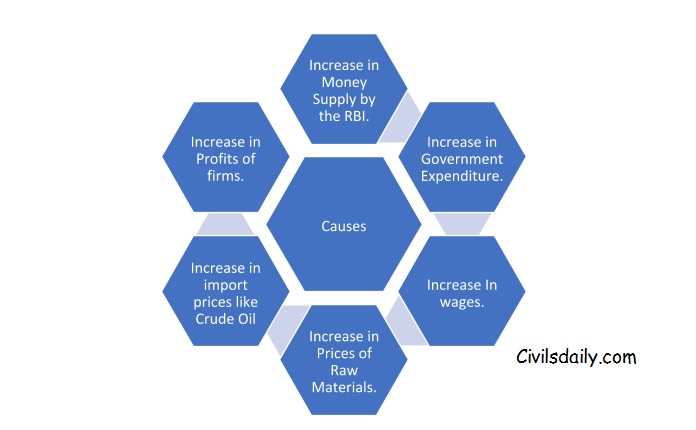
    Causes of Inflation

    Inflation is mainly caused either by demand Pull factors or Cost Push factors. Apart from demand and supply factors, Inflation sometimes is also caused by structural bottlenecks and policies of the government and the central banks. Therefore, the major causes of Inflation are:

    • Demand Pull Factors (when Aggregate Demand exceeds Aggregate Supply at Full employment level).
    • Cost Push Factors (when Aggregate supply increases due to increase in the cost of production while Aggregate demand remains the same).
    • Structural Bottlenecks (Agriculture Prices fluctuations, Weak Infrastructure etc.)
    • Monetary Policy Intervention by the Central Banks.
    • Expansionary Fiscal Policy by the Government.

    Demand and Supply factors can be further sub divided into the following:

    Inflationary Gap: the Inflationary gap is a situation which arises when Aggregate demand in an economy exceeds the Aggregate supply at the full employment level.

    Deflationary Gap: Deflationary Gap is a situation which arises when Aggregate demand in the economy falls short of Aggregate Supply at the full employment level.

    Stagflation:  The falling growth along with rising prices makes cost push inflation more dangerous than the demand-pull inflation. The situation of rising prices along with falling growth and employment is called as stagflation.

    Hyperinflation: Hyperinflation is a situation when inflation rises at an extremely faster rate. The rate of inflation can increase from 50 times to 300 times. The major causes of the hyperinflation are; government issuing too much currency to finance its deficits; wars and political instabilities and unexpected increase in people’s anticipation of future inflation.

    Structural Inflation

    • Structuralist Inflation is another form of Inflation mostly prevalent in the Developing and Low-Income Countries.
    • The Structural school argues that inflation in the developing countries are mainly due to the weak structure of their economies.

    Deflation: Deflation is when the overall price level in the economy falls for a period of time.Deflation is when, for instance, the price of a basket of goods has fallen from Rs 100 to Rs 80. It’s the reduction in overall prices of goods.

    Disinflation: Disinflation is a situation in which the rate of inflation falls over a period of time. Remember the difference; disinflation is when the inflation rate is falling from say 5% to 3%.

    Headline versus Core Inflation

    The headline inflation measure demonstrates overall inflation in the economy. Conversely, the core inflation measures exclude the prices of highly volatile food and fuel components from the inflation index.

    Core inflation excludes the highly volatile food and fuel components and therefore represents the underlying trend inflation. 

    Banking and Monetary Policy

    What is monetary policy?

    As the name suggests it is policy formulated by monetary authority i.e. central bank which happens to be RBI in case of India.

    It deals with monetary i.e money matters i.e. affects money supply in the economy.

    Eg. CRR,SLR,OMO,REPO etc

    What is fiscal policy then?

    It is formulated by finance ministry i.e. government. It deals with fiscal matters i.e. matters related to government revenues and expenditure.

    Revenue matters- tax policies, non tax matters such as divestment, raising of loans, service charge etc

    Expenditure matters– subsidies, salaries, pensions, money spent on creation of capital assets such as roads, bridges etc.

    Monetary policy and fiscal policy together deal with inflation.


    Let us now understand how RBI formulates monetary policy to control inflation

    It’s clear from what we have learnt so far that to control inflation, RBI will have to decrease money supply or increase cost of fund so that people do not demand goods and services.

    Tools available with RBI


    1. Quantitative tools or general tools- they affect money supply in entire economy- housing, automobile, manufacturing, agriculture- everything.

    They are of two types

    1. Cash Reserve Ratio (CRR)– as the name suggests, banks have to keep this proportion as cash with the RBI. Bank cannot lend it to anyone. Bank earns no interest rate or profit on this.Bank cannot lend it to anyone. 
    2. Statutory Liquidity Ratio (SLR)-  As the name indicates banks have to set aside this much money into liquid assets such as gold or RBI approved securities mostly government securities. Banks earn interest on securities but as yield on govt securities is much lower banks earn that much less interest.

    RBI Tools for Controlling Credit/Money Supply

    Broadly speaking, there are two types of methods of controlling credit.

    Measure of Money Supply in India

    M1 M2 M3 M4
    It is also known as Narrow Money. It is a broader concept of the money supply. It is also known as Broad Money. M4 includes all items of M3 along with total deposits of post office saving accounts.
    M1= C+DD+OD

    C= Currency with Public.

    DD= Demand Deposit with the public in the Banks.

    OD= Other Deposits held by the public with RBI.

    M2= M1 + Saving deposits with the post office saving banks.

    M1 is distinguished from M2 because the post office saving deposits are not as liquid as Bank deposits.

    M3 = M1+ Time Deposits with the Bank.

    Time deposits serve as a store of wealth and represent a saving of the people and are not as liquid as they cannot be withdrawn through cheques or ATMs as compared to money deposited in Demand deposits.

    M4= M3+Total Deposits with Post Office Saving Organisations.

    M4 however, excludes National Saving Certificates of Post Offices.

    It is the most liquid form of the money supply.   M3 is the most popular and essential measure of the money supply. The monetary committee headed by late Prof Sukhamoy Chakravarty recommended its use for monetary planning in the economy. M3 is also called Aggregate Monetary Resource  


    FINANCIAL MARKETS

    • Financial Markets refers to the system consisting of financial institutions, financial instruments, regulatory bodies and organisations
    •  It facilitates flow of debt and equity capital.
    • Financial Institutions (Banks), Development financial Institutions (NABARD, SIDBI, IDBI etc.) and Non-Banking Financial Institutions form Financial Institutions. Ø Financial Instruments are shares, bonds, debentures etc.

    Financial markets consist of two major segments:

    (l) Money Market: the market for short term funds;

    (2) Capital Market: the market for long and medium term funds.

    MONEY MARKET

    According to the RBI, “The money market is the centre for dealing mainly of short character, in monetary assets; it meets the short term requirements of borrowers and provides liquidity or cash to the lenders.

    It is a place where short term surplus investible funds at the disposal of financial and other institutions and individuals are bid by borrowers, again comprising institutions and individuals and also by the government.

    Functions of Money Market

    • To maintain monetary equilibrium: It means to keep a balance between the demand for and supply of money for short term monetary transactions.
    • To promote economic growth: Money market can do this by making funds available to various units in the economy such as agriculture, small scale industries, etc.
    • To provide help to Trade and Industry: Money market provides adequate finance to trade and industry. Similarly it also provides facility of discounting bills of exchange for trade and industry.
    • To help in implementing Monetary Policy: It provides a mechanism for an effective implementation of the monetary policy.
    • To help in Capital Formation: Money market makes available investment avenues for short term period. It helps in generating savings and investments in the economy.
    • Money market provides non-inflationary sources of finance to government.

    Instruments of money market

    Treasury Bills: They are promissory notes issued by the RBI on behalf of the government as a short term liability and sold to banks and to the public. The maturity period ranges from 14 to 364 days. They are the negotiable instruments, i.e. they are freely transferable. No interest is paid on such bills but they are issued at a discount on their face value.

    Commercial Bills: They are also called Trade Bills or Bills of Exchange. Commercial bills are drawn by one business firm to another in lieu of credit transaction. It is a written acknowledgement of debt by the maker directing to pay a specified sum of money to a particular person. They are short-term instruments generally issued for a period of 90 days. These are freely marketable. Banks provide working capital finance to firms by purchasing the commercial bills at a discount; this is called ‘discounting of bills’.

    Commercial Paper (CP): The CP was introduced in 1990 on the recommendation of the Vaghul Committee. A commercial paper is an unsecured promissory note issued by corporate with net worth of atleast Rs 5 crore to the banks for short term loans. These are issued at discount on face value for a period of 14 days to 12 months. These are issued in multiples of Rs 1 lakh subject to a minimum of Rs 25 lakh.

    Certificate of Deposit (CD): The CD was introduced in 1989 on the recommendation of the Vaghul Committee. These are issued by banks against deposits kept by individuals and institutions for a period of 15 days to 3 years. These are similar to Fixed Deposits but are negotiable and tradable. These are issued in multiples of Rs. 1 lakh subject to a minimum of Rs25 lakh.

    CAPITAL MARKET

    The capital market is the market, for medium and long term funds. It consists of all the financial institutions, organizations and instruments which deal in lending and borrowing transaction of over one year maturity.

    It is of following two types:

    Primary Market

    Secondary Market

    It issues security for the first time. Example- Initial public offer and follow on public offer.

    Existing securities are bought and sold.

    Firms issue shares to public.

    One investor sells it to another investor.

    Price is fixed by the firms.

    Price is fixed on the basis of demand and supply.

    Firms raise money for long-term investment.

    Companies benefit from the secondary markets.

    There is no specific geographical location.

    There is no specific geographical location.

    SEBI is the regulator for this market.

    SEBI is the regulator for this market as well.

    GILT-EDGED MARKET

     The Gilt-edged market refers to the market for government and semi government securities, backed by the RBI.

    It is known so because the government securities do not suffer from the risk of default and are highly liquid.

    The RBI is the sole supplier of such securities. These are demanded by commercial banks, insurance companies, provident funds and mutual funds.

    The gilt-edged market may be divided into two parts- the Treasury bill market and the government bond market. Treasury bills are issued to meet short-term needs for funds of the government, while government bonds are issued to finance long-term developmental expenditure. 


  • Nikaalo Prelims Spotlight || Pattern of Economic Indicators & Fiscal Policy


    Dear Aspirants,

    This Spotlight is a part of our Mission Nikaalo Prelims-2023.

    You can check the broad timetable of Nikaalo Prelims here

    Session Details

    YouTube LIVE with Parth sir – 7 PM  – Prelims Spotlight Session

    Evening 04 PM  – Daily Mini Tests

    Join our Official telegram channel for Study material and Daily Sessions Here


    1st May 2023

    Patterns of Economic Indicators

    An economic indicator is a statistic about an economic activity. Economic indicators allow analysis of economic performance and predictions of future performance. One application of economic indicators is the study of business cycles.

    NATIONAL INCOME
    • National Income is the total value of all final goods and services produced by the country in certain year. The growth of National Income helps to know the progress of the country.
    • In other words, the total amount of income accruing to a country from economic activities in a year’s time is known as national income.
    • National Income includes payments made to all resources in the form of wages, interest, rent and profits.
    NATIONAL INCOME ACCOUNTING (NIA)
    • National Income Accounting is a method or technique used to measure the economic activity in the national economy as a whole.
    • It is the bookkeeping system which measures the level of economic activity in a given time period
    • NIA sets rules and definition to measure aggregate economic activity and tries to summarise the performance of the economy
    Indicators: GDP
    • Gross Domestic Product is the market value of all the goods and services produced within the domestic territory of a country during a specified time period, usually one year.
    • Accounting Year = Fiscal Year; for India it is 1st of April to 31st of March (next year)
    • Will include the income generated by MNCs in India

    Domestic Territory = Political frontiers of the country including its territorial waters+ Embassies/Consulates + Military Establishments of the country abroad + Ships/Aircrafts/Fishing Vessels/Oil Rigs belonging to the residents of the country

    GDP does not include :
    • Capital goods (e.g. machinery) are included in GDP, but intermediate goods (e.g. raw materials) are not.
    • Intermediate goods and services are not included to avoid double counting.
    • Same good can be final (you consuming milk ) or intermediate (milk in the restaurant) depending on the usage.
    GROWTH RATE &GDP DEFLATOR
    • Growth Rate (%) = [GDP (Present year – Last Year) / Last Year] x 100
    • But, quantitatively the production may not have improved (From 1 kg garlics to 2 kg garlics), and only because of inflation in the prices (₹ 10/kg garlic to ₹ 100/kg) the growth rate may be appear high.
    • Therefore (to remove the inflation impact on growth rate), we must select a base year, and convert the current prices to constant prices.
    • The ratio of these GDPs is called ‘GDP deflator’, it presents a picture of inflation like CPI and WPI but, unlike CPI & WPI it’s not based on a fixed basket of commodities.
    • These figures are revised as the new data arrives / previous data is cross verified & corrected.
    GDP AND NATIONAL INCOME
    Gross National Income (GNI)
    • According to OECDà GNI as GDP + NET receipts from abroad (wages, interest, profit, rent) plus net taxes & subsidies receivable from abroad. Here, ‘Wages and salaries’ from abroad = ‘Guest’ workers who reside abroad for less than 12 months and whose centre of economic interest remains in their home country
    National Disposable Income
    • National Disposable Income= NNP + Other Current Transfers from rest of the world (remittances, gift, donations etc.)National Disposable Income gives an idea of what is the maximum amount of goods and services the domestic economy has at its disposal.
    Personal Disposable Income
    • Personal Income – Personal Tax Payments (e.g. income tax) – Non-tax Payments (e.g. fines)

    Fiscal Policy

    What is Fiscal Policy? Fiscal Policy deals with the revenue and expenditure policy of the Govt. The word fiscal has been derived from the word ‘fisk’ which means public treasury or Govt funds.

    Objectives of Fiscal Policy

    The following are the objectives of the Fiscal Policy:

    1. Higher Economic Growth
    2. Price Stability
    3. Reduction in Inequality

    What are the components of Fiscal Policy?

    There are three components of the Fiscal Policy of India:

    1. Government Receipts
    2. Government Expenditure
    3. Public Debt

    Government Receipts

    The categorisation of the government receipts is given below:

    1. Revenue Receipt
      • Tax Revenue
        • Direct Tax
        • Indirect Tax
      • Non-Tax Revenue
        • Fees
        • License and Permits
        • Fines and Penalties, etc
    2. Capital Receipt
      • Loans Recovery
      • Disinvestments
      • Borrowing and other liabilities

    Government Expenditure

    There are two classifications of public expenditure:

    1. Revenue Expenditure – It is a recurring expenditure:
      • Interest Payments
      • Defence Expenses
      • Salaries to Central Government employees, etc are examples of  revenue expenditure
    2. Capital Expenditure – It is a non-recurring expenditure
      • Loans repayments
      • Loans to public enterprises, etc.


  • [Sansad TV] Perspective: 5 Years of Khelo India

    [Sansad TV] Perspective: 5 Years of Khelo India

    Central Idea: 5 Years of Khelo India

    • The Khelo India Mission has completed 5 years. It is a GOI program aimed at providing international standard sports infrastructure and promoting fitness for citizens.
    • The ultimate goal is to make India a sporting nation, and the program has been running since 2018, supporting over 2500 athletes in different disciplines.
    • The success of Khelo India and its challenges will be discussed in this edition of the article.

    What is Khelo India Mission?

    • Khelo India is a national program launched by the Indian government in 2018 with the aim of promoting sports and fitness in India.
    • The program seeks to provide sports infrastructure of international standards to budding athletes, promote a holistic approach towards fitness for citizens, and ultimately make India a sporting nation.
    • It focuses on encouraging and promoting sports at the grassroots level and providing access to sporting facilities and infrastructure to all citizens, regardless of their economic background or geographical location.
    • It also aims to develop and train coaches who can provide high-quality coaching and training to athletes at the grassroots level, identify young talent and provide financial assistance.
    • The program also emphasizes the importance of teamwork, socialization, and the participation of girls in sports.

    Achievements of the program

    (1) Support to Young Athletes

    • 2500 young athletes are being supported with Rs. 6.28 lakhs annually under the scheme and are being identified to represent India at international competitions.
    • Successful athletes are further being inducted into Target Olympic Podium Scheme (TOPS) for higher levels of training. 110 Khelo India athletes are part of TOPS.

    (2) Organizing Competitions

    • To ensure competition opportunities for young athletes, 5 Khelo India Youth Games with 43K participants have been organized.
    • Khelo India Leagues are held throughout the year, with a special focus on girl athletes. More than 1.25 lakh girls have participated in it.

    (3) Sports Infrastructure Created

    • To ensure sports infrastructure availability in remote corners of India, 946 Khelo India Centers have been set up.
    • By August 15, 2023, 1000 KICs are expected to be operational, giving every district in India a sports facility for the training of grassroots-level athletes.

    (4) Indigenous Games Inducted

    • A special emphasis on indigenous games under Khelo India has ensured the popularity of India’s traditional sporting disciplines like Gatka, Thang-Ta, Mallakhamb, Kalaripayattu and Yoga.
    • These games have also been included in KIYG to give athletes an impetus to practice them.

    Significance of the Program

    • Promoting the importance of sports and fitness: The program promotes the importance of sports and fitness in one’s life, as playing sports inculcates team spirit, and develops strategic and analytical thinking, leadership skills, goal setting, and risk-taking.
    • Improving confidence and social skills: Participation in the program has helped athletes improve their confidence, teamwork, leadership skills, and socialization. The program emphasizes the importance of teamwork, providing opportunities for children to learn how to work with others and manage different personalities, find their way as leaders etc.
    • Encouraging the participation of girls in sports: The program emphasizes the participation of girls in sports, providing them with a great opportunity to showcase their talents.
    • Promoting diversity and inclusivity: The program’s emphasis on indigenous games and the participation of girls in sports is also a significant step in promoting diversity and inclusivity in sports.
    • Creating world-class sports infrastructure: The program aims to create world-class sports infrastructure in the country, including training facilities, stadiums, and sports complexes. This will help create a conducive environment for athletes to train and compete at the highest level.
    • Promoting sports for development and peace: The program aims to promote sports for development and peace by using sports, physical activity, and play to attain specific development and peace objectives.

    Various challenges

    • Lack of awareness and participation: One of the significant challenges of the Khelo India program is a lack of awareness among the masses. Despite the program’s efforts to promote sports and fitness at the grassroots level, many people are still not aware of the program’s existence, which affects participation.
    • Infrastructure challenges: Another challenge faced by the Khelo India program is infrastructure challenges. Despite the program’s efforts to create world-class sports infrastructure in the country, many areas still lack the necessary infrastructure, including training facilities, stadiums, and sports complexes.
    • Shortage of trained coaches: The program’s success is also dependent on the availability of trained coaches who can provide high-quality coaching and training to athletes at the grassroots level. However, there is a shortage of trained coaches, which affects the program’s effectiveness.
    • Funding issues: The program’s effectiveness is also dependent on funding. Despite the government’s efforts to provide financial assistance to promising athletes, more funding is needed to create world-class sports infrastructure and to support athletes in their training and development.
    • Lack of support for indigenous games: Although the program aims to promote indigenous games, there is still a lack of support and infrastructure for these games, which affects their popularity and development.
    • Gender bias and lack of opportunities: Despite the program’s efforts to promote the participation of girls in sports, there is still a gender bias in many areas, and girls often face a lack of opportunities and support, affecting their ability to participate and excel in sports.

    Other initiatives for sports promotion

    The Ministry of Youth Affairs & Sports has formulated the following schemes to promote sports in the country, including in rural, tribal and backward areas:

    • Assistance to National Sports Federations
    • Special Awards to Winners in International sports events and their Coaches
    • National Sports Awards, Pension to Meritorious Sports Persons
    • Pandit Deendayal Upadhyay National Sports Welfare Fund
    • National Sports Development Fund; and
    • Running Sports Training Centres through Sports Authority of India

    Benefits of Augmenting Sports

    • Alternative career development: For those for whom opportunities are few, and jobs are scarce, sport becomes a powerful mobility device. A strong sports sector encourages an average/ poor academic student to make a career in sports.   
    • Reaping demographic dividend: India is having a very young population and is soon going to become the world’s youngest country. In such a scenario, a robust sports sector can help in reaping the potential demographic dividend. 
    • Revenue generation: Developing robust sports infrastructure in the country will allow India to host a greater number of international events. Such hosting boosts tourism in the country and results in enhancing the revenue and employment in the region. Ex. IPL
    • Promotes the spirit of Unity in Diversity: People cheer for the Indian athletes and Indian teams at international events. An improvement in sports automatically fosters the spirit of brotherhood amongst the people of diverse nations. For instance, the Pan India support enjoyed by Indian cricket team enhances belongingness between India’s north and south. 

    Way forward

    • Increasing awareness and outreach: The government can increase awareness and outreach efforts to promote the program and encourage more people to participate in sports and fitness activities.
    • Promoting indigenous games: The government can promote indigenous games by providing the necessary infrastructure, support, and funding for these games to increase their popularity and development.
    • Ensuring gender equality: The government can ensure gender equality by promoting the participation of girls in sports and providing equal opportunities and support for both male and female athletes.
    • Collaboration with private sector: The government can collaborate with the private sector to increase funding and support for sports and fitness activities.
    • Uniformity in sports activities: Sports being a state subject, uniformity in sports activities across various states in India is essential to provide equal sporting opportunities to all citizens of the country.
    • Collective action for talent development: To develop a talent pipeline, it is necessary to take collective action to create a system and environment where young talent is spotted and nurtured.
    • Integration of sports with education: To introduce a sports culture in India, there is a need to integrate sports with education, making it a mandatory part of the curriculum.
    • Increase allocation of funds: The allocation of funds to sports, as a percentage of the budget, can be increased to broad-base sports in the country and provide adequate funding for sports development.
    • Spreading awareness in society: There is also a need to develop a sports culture in the whole country by spreading awareness in society and educating people about the benefits of sports in life.

    Get an IAS/IPS ranker as your personal mentor for UPSC 2024 | Schedule your FREE session and get the Prelims prep Toolkit!

  • Nikaalo Prelims Spotlight || Government schemes- II


    Dear Aspirants,

    This Spotlight is a part of our Mission Nikaalo Prelims-2023.

    You can check the broad timetable of Nikaalo Prelims here

    Session Details

    YouTube LIVE with Parth sir – 7 PM  – Prelims Spotlight Session

    Evening 04 PM  – Daily Mini Tests

    Join our Official telegram channel for Study material and Daily Sessions Here


    28th Apr 2023

    Government schemes- I

    Kindly refer to schemes compilation.

  • Nikaalo Prelims Spotlight || Government schemes- I


    Dear Aspirants,

    This Spotlight is a part of our Mission Nikaalo Prelims-2023.

    You can check the broad timetable of Nikaalo Prelims here

    Session Details

    YouTube LIVE with Parth sir – 7 PM  – Prelims Spotlight Session

    Evening 04 PM  – Daily Mini Tests

    Join our Official telegram channel for Study material and Daily Sessions Here


    27th Apr 2023

    Government schemes- I

    Kindly refer to schemes compilation.

  • [Sansad TV] In Focus: Cinematograph (Amendment) Bill 2023

    [Sansad TV] In Focus: Cinematograph (Amendment) Bill 2023

    Context

    • India is the world’s largest producer of films, and this industry is growing rapidly.
    • However, piracy in the entertainment and music industry has been a problem for decades leading to huge revenue loss for this sector.
    • Aiming to curb piracy in film content and protect the creative industry, Union Cabinet approved the Cinematograph (Amendment) Bill, of 2023.
    What is the Cinematograph Act, 1952?
    : The Cinematograph Act of 1952, was enacted by the Parliament to ensure that films are shown in accordance with the limits of tolerance of society. The Act establishes the Central Board of Film Certification (CBFC, or the censor board) to certify films. Under the Act, the Board scrutinizes the films following the procedure laid down in the Act and can either reject or grant a certificate, valid for ten years. The Act authorizes the police to perform search and seizure actions if the film is being exhibited in contravention of any of the provisions of the Act.

    Cinematograph Amendment Bill, 2023: Key Highlights

    cinema

    Aims/Proposals

    Details
    AmendmentThe bill proposes to amend the Cinematograph Act, 1952
    Harsher PenaltyThe act has provisions for harsher penal provisions for film piracy
    New Age CategoriesIt introduces new sub-age categories for films to bring about uniformity in categorisation across platforms
    Perpetual CertificationThe certification once given will be perpetual
    New Sub-age based CertificationUA-7+’, ‘UA-13+’, and ‘UA-16+’ in place for 12 years
    AlignmentThe act will be aligned with Supreme Court judgments
    RecertificationRecertification of the edited film for television broadcast
    Public ExhibitionOnly Unrestricted Public Exhibition category films can be shown on television
    UniformityIt will make the act provisions in line with the provisions of the Jammu and Kashmir Reorganisation Act, 2019 to maintain uniformity

    Stringent Laws against Piracy

    Details
    Imprisonment and PenaltyIt includes imprisonment for three years and a Rs 10 lakh penalty for those found involved in piracy
    Legal OffenceThe act of piracy will be a legal offense, and even transmitting pirated content will be punishable

    Indian Cinema: A Backgrounder

    • The history of Indian cinema dates back to the late 19th century, with the screening of the Lumiere Brothers’ short films in Bombay (now Mumbai) in 1896.
    • Dadasaheb Phalke is considered to be the father of Indian cinema.
    • The first Indian-made film, Raja Harishchandra, was released by him in 1913 and marked the beginning of Indian cinema.
    • The first Indian talkie, Alam Ara, was released in 1931, marking a new era in Indian cinema.

    Contribution of Indian Cinema to the Society

    • Entertainment: Indian cinema has been the biggest source of entertainment for people of all ages and backgrounds. From the early silent movies to the latest high-budget blockbusters, cinema has always been a popular form of entertainment in India.
    • National Integration: Indian cinema has played a crucial role in bringing people from different regions, cultures, and religions together. Hindi cinema, in particular, has become a unifying force for people all over the country.
    • Employment: The film industry provides employment opportunities to millions of people directly or indirectly, including actors, writers, directors, technicians, set designers, and more. This contributes to the overall economic growth of the country.
    • Education and Awareness: Movies can be a powerful tool for educating and raising awareness about various social issues. Many films have addressed social issues such as poverty, gender inequality, and corruption, among others.
    • Promotion of Culture: Indian cinema has helped promote and preserve Indian culture by showcasing traditional dances, music, and stories. Indian cinema also contributes to the country’s international image and soft power, with films and stars gaining popularity across the globe.
    • Technological advancements: Indian cinema has played a significant role in the development of new technologies in the entertainment industry. It has led to advancements in sound and visual effects, camera technology, and more.

    Economic Impact

    • Revenue source: Indian cinema is a major contributor to the country’s economy, with a revenue of over Rs 180 billion in 2019. The govt earns significant revenue from taxes on film production, distribution, and exhibition.
    • Employment generation: It provides direct and indirect employment to millions of people across the country, including actors, producers, directors, and camera crew, technicians, and support staff.
    • Allied sectors: The film industry also provides a boost to related industries such as advertising, hospitality, tourism, and fashion.
    • Entertainment economy: Cinema houses and multiplexes generate revenue through ticket sales, concessions, and merchandise sales. Services such as music albums, merchandise, and tourism to filming locations.

    Social impacts of Indian Cinema

    • Social cause: Many movies have addressed important social issues like poverty, gender inequality, caste discrimination, and communal violence, creating awareness and encouraging discussions about these topics.
    • Breaking gender stereotypes: The portrayal of strong female characters in movies has challenged traditional gender roles and has had a positive impact on the status of women in Indian society.
    • Accessible entertainment: Cinema has helped break down barriers between different social classes by providing affordable entertainment that is accessible to people from all walks of life.
    • Inspirational aspects: Movies have also served as a source of inspiration for many people, especially the youth, who look up to their favourite stars and aspire to emulate them.

    Role in nation building

    • Promotion of Social Harmony: Indian cinema has played an essential role in promoting social harmony by creating content that showcases the diversity and cultural richness of India. For instance, the movie ‘Lagaan’ (2001) showcased the spirit of communal harmony and depicted how people from different religions and communities could come together to achieve a common goal.
    • Inculcation of Moral Values: Indian cinema has also played a crucial role in inculcating moral values among the masses. Movies like ‘Taare Zameen Par’ (2007) highlighted the importance of empathy, compassion, and understanding towards children with special needs, while ‘Swades’ (2004) showcased the significance of social responsibility and patriotism.
    • Creating Awareness about Social Issues: Indian cinema has also been successful in creating awareness about various social issues prevalent in the country. For instance, the movie ‘Padman’ (2018) aimed to raise awareness about menstrual hygiene and broke the taboo surrounding it. Similarly, the movie ‘Pink’ (2016) highlighted the issue of consent and the importance of women’s safety and empowerment.

    Issues with Indian Cinema

    • Portrayal of violence and sexuality: Many films depict violent acts and sexual content, which can have a negative impact on viewers, particularly on younger audiences.
    • Reinforcement of stereotypes: Women are often portrayed as submissive and objectified, while members of certain castes and religions are portrayed in a negative light.
    • Promotion of materialism: Many films promote materialism, consumerism, and extravagance, which can encourage viewers to adopt unrealistic expectations and values.
    • Lack of diversity: Although Indian cinema has made progress in recent years, there is still a lack of diversity in terms of representation of different communities, especially in mainstream films.
    • Undue commercialization: The Indian film industry is heavily commercialized, which can lead to a focus on profit rather than on producing quality content.  
    • Nepotism: The practice of giving preference to family members or friends in the industry, often at the expense of more deserving and talented individuals is more prevalent.

    Way forward

    • Revising the certification process:  The process should be more transparent and accountable, and filmmakers should be given a chance to appeal any decision.
    • Protecting artistic freedom: The government should ensure that the certification process does not infringe upon artistic freedom.  
    • Encouraging regional cinema: The government should encourage and promote regional cinema by providing incentives, tax breaks, and subsidies to filmmakers.  
    • Promoting cultural diversity: The government should encourage filmmakers to explore different cultures and promote intercultural dialogue through cinema.
    • Combating piracy: Piracy is a major issue in the film industry and it hurts the revenues of filmmakers and the government.  
    • Developing film infrastructure: The government should invest in the development of film infrastructure such as studios, post-production facilities, and film schools.  

    Get an IAS/IPS ranker as your personal mentor for UPSC 2024 | Schedule your FREE session and get the Prelims prep Toolkit!

  • Get a Realistic Picture of Your UPSC Prelims 2023 readiness: All India Mock Test Answer Key Discussion with 10,000+ Aspirants | Get Free Strategy Call, Discussion Lecture, & PDF Material| Hurry Up & Register Now

    Get a Realistic Picture of Your UPSC Prelims 2023 readiness: All India Mock Test Answer Key Discussion with 10,000+ Aspirants | Get Free Strategy Call, Discussion Lecture, & PDF Material| Hurry Up & Register Now

    All India Smash Mock Test: Live Discussion and Strategy Session for Prelims 2023

    1-1 Discussion of Test-1

    All India FREE Mock Test Answer Key Discussion (GS) for UPSC-CSE 2023: 30th April (Sunday) 2023 || Offline (Delhi Center) + Online


    Don’t know where you stand in the UPSC Prelims 2023 competition?

    Get a reality check!

    10000+ aspirants are going to appear for India’s biggest UPSC Prelims mock test.

    Attempt CivilsDaily’s Prelims Mock – high-quality UPSC-level questions in real-exam hall simulating conditions.


    Why this mock test is essential for you?

    1. All Questions are based on the Most Probable Topics for UPSC Prelims 2023

    2. Post-test detailed discussion on 1st May (Monday) at 1 pm (Live online) lecture will include:

    • How to analyze this test?
    • Explanation of Important concepts you should know
    • PDF notes of the explanation
    • Discussion on the ideal number of FLTs you should attempt
    • How to include mocks in your Prelims prep schedule?
    • Harnessing X-factor and Utilizing Elimination Techniques

    But just attempting mocks is not enough. There must be a follow-up

    UPSC Prelims 2023:- This is going to be an eye-opener.

    Details: Time & Venue

    • Test Date: 30th April 2023 (Sunday)
    • Timings: GS Paper 1 from 9:30 am
    • Discussion Date: 1st May 2023, (Monday) from 2:30 pm
    • Duration for tests: 2 hrs
    • Language: English
    • Mode: Online/Offline
    • Test Fee: FREE for all

    Venue:

    • Offline – CivilsDaily IAS, Delhi center
      • (Address: 1 LGF, Apsara Arcade, Karol Bagh, near Metro station gate number 7, Delhi)
    • Online- The link will be emailed to you.

    Discussion of All India FREE Mock Test for UPSC-CSE 2023: 29th April 2023

    CivilsDaily will assign a dedicated mentor for the post-test process. It will include a detailed test discussion, a one-to-one mentorship call to highlight your weak areas and issues in preparation. A timetable and strategy will be shared with you and relevant Smash Prelims select PDF notes will be shared for FREE.

    What students will get after the mock-Tests?

    1. Detailed post-test analysis over a call
    2. Mentorship session to help you with situational awareness wrt UPSC Prelims 2023
    3. Smash Prelims select notes

    CivilsDaily will assign a dedicated mentor for the post-test process. It will include a detailed test discussion, a one-to-one mentorship call to highlight your weak areas and issues in preparation. A timetable and strategy will be shared with you and relevant Smash Prelims select PDF notes will be shared for FREE.


    BTW Enrollment for Zeeshan sir’s Dominate Prelims 2.0 is open.

    Click on Join Now for more details

    1-1 with Zeeshan Sir for FREE & Avail attractive Discount