HOW TO ATTEMPT ANSWERS IN DAILY ANSWER WRITING ENHANCEMENT(AWE)?
Daily 4 questions from General studies 1, 2, 3, and 4 will be provided to you.
A Mentor’s Comment will be available for all answers. This can be used as a guidance tool but we encourage you to write original answers.
You can write your answer on an A4 sheet and scan/click pictures of the same.
Upload the scanned answer in the comment section of the same question.
Along with the scanned answer, please share your Razor payment ID, so that paid members are given priority.
If you upload the answer on the same day like the answer of 11th February is uploaded on 11th February then your answer will be checked within 72 hours. Also, reviews will be in the order of submission- First come first serve basis
If you are writing answers late, for example, 11th February is uploaded on 13th February , then these answers will be evaluated as per the mentor’s schedule.
We encourage you to write answers on the same day. However, if you are uploading an answer late then tag the mentor like @Staff so that the mentor is notified about your answer.
*In case your answer is not reviewed, reply to your answer saying *NOT CHECKED*.
Dinesh sir, the senior IAS Faculty from Civilsdaily will discuss the most important aspects of the UPSC exam – How to attempt UPSC Prelims MCQs? and in that he will share tips and hacks to attempt successfully questions that pull you into negative marking by confusing you.
Intelligent Elimination Techniques for UPSC Prelims 2023-24
10 smart hacks for MCQ option elimination
You will be able to solve many questions with almost no or relatively less information by using these techniques.
Given the voluminous nature of the UPSC exam syllabus, it is almost impossible for a candidate preparing for UPSC to expect a complete revision of all textbooks and the entire syllabus right before the examination; however, revision is critical to scoring well and passing the examination. As a result, most aspirants rely on self-made notes for quick revision during exam days to overcome this challenge.
Making notes is not only an important part of UPSC preparation but also it is the main part of active learning. One cannot expect to clear even the Prelims unless he prepares his notes and regularly revises them. Take any UPSC topper from any year, and you will find that almost all of them used note-taking as part of their UPSC preparation strategy.
Day 3: 13th Nov, 12 noon (Sunday)
Dimple Chouhan ma’am, CD’s Senior IAS Mentor will discuss how to make UPSC notes for GS-Current Affairs for Pre+Mains. She will also share value-added 2-3 paged crisp and comprehensive notes so that students get proper guidance…
Apart from the above, an IAS aspirant must know how to deal with offbeat questions.
Day 1: UPSC FREE Workshop by AIR 109, UPSC 2021, Areeba Nomaan was concluded successfully. In case you missed it, Register for the Recorded session, PDF & Notes
UPSC is nothing but a difficult battle. Every year Lakhs of aspirants face only fail because they accept self-defeat. Sajal sir said, “UPSC is the most UNPREDICTABLE PUBLIC SERVICE COMMISSION’.
‘The Journey of UPSC something different.
Civilsdaily
During the preparation journey, an aspirant should be doubly sure of his/her strategy and all those IMP themes that only can work in the exam hall. It’s not good to go ahead without knowing the most possible loopholes.
You have to be Prelims, Mains ready even before 2 months of Prelims itself. And only then you can catch your IAS/IPS dream on the very 1st attempt.
True success involves the full use of your power and strategy. Most of the time it happens that an aspirant works very hard but he/she does not achieve success because they lack clarity.
REGISTER FOR RECORDED SESSION | Day 1: 11th Nov, 5:30 pm (Friday) | The most important Masterclass by AIR 109, UPSC 2021, Areeba Nomaan | Post-session important PDFs, videos, and notes will be shared for FREE.
Acknowledging the need to ensure sure success in UPSC in the very 1st attempt, AIR 109, UPSC 2021, Areeba Nomaan, CD’s Super Mentor will take the IMP masterclass on cracking UPSC 2023-24 in just one attempt + Important themes and strategy…She will be giving a 6 months strategy for UPSC 2023 Prelims aspirants as well.
Key Takeaways of Masterclass with AIR 109, UPSC 2021, Areeba Nomaan, Super Mentor of Civilsdaily. Other than those mentioned above we will be discussing the following points:
1. Analysing the trend of UPSC and devising an evolving adaptive strategy.
2. How to cover the syllabus? The syllabus, not the books, must be completed. Focussing on the essentials first.
3. What are the best books to refer to? Based on the last 10-year UPSC-CSE paper analysis.
4. Recognize the UPSC requirement. What kinds of test series are useful? Which mock test series should be avoided?
5. Complete UPSC-CSE Preparation Timeline for a Working Professional
6. The skill of taking notes. What topics necessitate notes and which do not?
7. Working hard in the right direction vs. working hard in the wrong direction Is it possible to be successful solely by studying hard?
8. There are only two consolidated sources for current events. What exactly are they?
9. Revision techniques that are common, standard, and used frequently. What exactly are they?
10. And many more IMP points of UPSC Prep that only a Topper can disclose
Venue: This Workshop will be held in both offline and online mode. You can attend in CivilsDaily’s Delhi center offline, and for Online mode, we will share a Zoom link in your email. Please register.
Address: CivilsDaily IAS, 1 LGF, Apsara Arcade, Pusa Rd Next to Gate No 7, Karol Bagh, Delhi
What The Hindu mentioned about Civilsdaily Mentorship
The Hindu has acknowledged the success rate of CD’s Smash mains Mentorship
Non-reporting of sexual assault against a minor child despite knowledge is a serious crime, held the Supreme Court under the POCSO Act.
It further added that such non-reporting is more often than not done in an attempt to shield the offenders of the crime.
What is POCSO Act?
The Ministry of Women and Child Development championed the introduction of the Protection of Children from Sexual Offences (POCSO) Act, 2012.
The Act has been enacted to protect children from offences of sexual assault, sexual harassment and pornography and provide for establishment of Special Courts for trial of such offences.
The Act was amended in 2019, to make provisions for enhancement of punishments for various offences so as to deter the perpetrators and ensure safety, security and dignified childhood for a child.
Features of the Act
Gender neutrality: The Act is gender neutral and regards the best interests and welfare of the child. The Act calls for mandatory reporting of sexual offences. A false complaint with intent to defame a person is punishable under the Act.
Definition of Child: The Act defines a child as any person below eighteen years of age.
Definitions of sexual abuses: It defines different forms of sexual abuse, including penetrative and non-penetrative assault, as well as sexual harassment and pornography.
Prevents child trafficking: People who traffic children for sexual purposes are also punishable under the provisions relating to abetment in the Act.
Preventing re-victimization of child: Adequate provisions are made to avoid re-victimization of the Child at the hands of the judicial system.
Sensitization of Police: The Act assigns a policeman in the role of child protector during the investigation process.
Child friendly investigation: The Act stipulates that such steps must be taken which makes the investigation process as child-friendly as possible.
Speedy disposal: The Act provides for the establishment of Special Courts for the trial of such offences and stipulates that the case is disposed of within one year from the date of reporting of the offence.
What is the rationale behind the legislation?
Multiple facets of crime: New forms of child abuse like online bullying, harassment and Child Pornography have emerged to a greater extent.
Exception handling: As per the last available data from the National Crime Records Bureau of child rape cases came up before the courts under the POCSO Act read with Indian Penal Code Section 376.
Larger conviction: Less than three per cent cases ended in convictions, pointing to the need for better access to justice for all, and not just more stringent conviction in a small percentage of cases.
Deterrence against crime: There is the belief that harsher punishments will deter people from committing child rape.
Zero-tolerance: Lastly, the disgust for the crime makes the perpetrator ‘deserving’ of death penalty.
Issues with the Law
Recurrence of such crime: In the context of child rape, many preventive measures and policies do have a definitive impact on preventing child rape.
Lower conviction: The conviction rates are low under the Protection of Children from Sexual Offences Act, 2012.
Investigation bottlenecks: There is lack of specialised investigators, prosecutors, judges, mental health professionals, doctors, forensic experts and social workers.
Protection bottlenecks: Inadequate child protection and rehabilitation services, lack of compliance with child-friendly legal procedures are some other concerns.
Under-reporting: A large proportion of perpetrators are family members or those close to or known to the family. This results in massive underreporting of such crimes.
Protection of convicts: This concern will only intensify with death penalty, as the child’s family often settles a case of known person preventing him to the gallows.
Vulnerability: The arbitrariness of the death penalty in India also arises from the discriminatory impact of the choice of what constitutes ‘rarest of rare’.
Delay of trials: The Kathua Rape case took 16 months for the main accused to be convicted whereas the POCSO Act clearly mentions that the entire trial and conviction process has to be done in one year.
Communal Politicization: Considering rapes on communal angles is another challenge. The Unnao rape case and Kathua rape case are some of the examples.
Way forward
The social menace of child rape requires sustained planning, engagement, and investment of resources by the government.
The need of the hour is to prioritise prevention activities against abuse, creating safe (physical and online) environments for children.
Developing a comprehensive outreach system to engage parents, schools, communities, NGOs partners and local governments as well as police and lawyers is needed.
This will ensure better implementation of the legal framework, policies, national strategies and standards.
HOW TO ATTEMPT ANSWERS IN DAILY ANSWER WRITING ENHANCEMENT(AWE)?
Daily 4 questions from General studies 1, 2, 3, and 4 will be provided to you.
A Mentor’s Comment will be available for all answers. This can be used as a guidance tool but we encourage you to write original answers.
You can write your answer on an A4 sheet and scan/click pictures of the same.
Upload the scanned answer in the comment section of the same question.
Along with the scanned answer, please share your Razor payment ID, so that paid members are given priority.
If you upload the answer on the same day like the answer of 11th February is uploaded on 11th February then your answer will be checked within 72 hours. Also, reviews will be in the order of submission- First come first serve basis
If you are writing answers late, for example, 11th February is uploaded on 13th February , then these answers will be evaluated as per the mentor’s schedule.
We encourage you to write answers on the same day. However, if you are uploading an answer late then tag the mentor like @Staff so that the mentor is notified about your answer.
*In case your answer is not reviewed, reply to your answer saying *NOT CHECKED*.
GS-2 Constitution of India- historical underpinnings, evolution, features, amendments, significant provisions and basic structure.
GS-3 Government Budgeting.
GS-4 Aptitude and foundational values for Civil Service, integrity, impartiality and non-partisanship, objectivity, dedication to public service, empathy, tolerance and compassion towards the weaker sections.
HOW TO ATTEMPT ANSWERS IN DAILY ANSWER WRITING ENHANCEMENT(AWE)?
Daily 4 questions from General studies 1, 2, 3, and 4 will be provided to you.
A Mentor’s Comment will be available for all answers. This can be used as a guidance tool but we encourage you to write original answers.
You can write your answer on an A4 sheet and scan/click pictures of the same.
Upload the scanned answer in the comment section of the same question.
Along with the scanned answer, please share your Razor payment ID, so that paid members are given priority.
If you upload the answer on the same day like the answer of 11th February is uploaded on 11th February then your answer will be checked within 72 hours. Also, reviews will be in the order of submission- First come first serve basis
If you are writing answers late, for example, 11th February is uploaded on 13th February , then these answers will be evaluated as per the mentor’s schedule.
We encourage you to write answers on the same day. However, if you are uploading an answer late then tag the mentor like @Staff so that the mentor is notified about your answer.
*In case your answer is not reviewed, reply to your answer saying *NOT CHECKED*.
8th Nov 2022, 1 pm IPS Shubham and Minakshi ma’am will be LIVE | Register below for the Anthropology webinar | Post-registration we will share toppers’ Anthro notes and will add to Anthro Telegram group
Anthropology is one of the most popular and high-scoring optional subjects for UPSC CSE. Rankers like AIR 1, Anudeep Durishetty have been taking this optional and clearing the exam.
Short and relatively static syllabus, easily covered and comprehended by both science and non-science grad students, and the time it takes to cover the syllabus (less than 3 months) make it a great optional.
However, there are various challenges that are faced by students.
Guidance is limited unlike other optionals like PSIR, geography, history, sociology etc.
Conceptual clarity and command over the answer writing are required, just mugging up will not help to score marks in this optional. This is ignored by aspirants.
Personalized mentoring is not available in this optional that’s why aspirants are facing difficulties with their answer writing and most of the time complete (ineffectively and insufficiently) the syllabus by self-studies.
IPS Shubham sir and Minakshi ma’am will be taking up Anthropology webinar
Through this webinar, we will clear all the doubts and guiding you in a strategic manner.
GS-2 Important aspects of governance, transparency and accountability, e-governance applications
GS-3 Conservation, environmental pollution and degradation, environmental impact assessment.
GS-4 Aptitude and foundational values for Civil Service, integrity, impartiality and non-partisanship, objectivity, dedication to public service, empathy, tolerance and compassion towards the weaker sections.
HOW TO ATTEMPT ANSWERS IN DAILY ANSWER WRITING ENHANCEMENT(AWE)?
Daily 4 questions from General studies 1, 2, 3, and 4 will be provided to you.
A Mentor’s Comment will be available for all answers. This can be used as a guidance tool but we encourage you to write original answers.
You can write your answer on an A4 sheet and scan/click pictures of the same.
Upload the scanned answer in the comment section of the same question.
Along with the scanned answer, please share your Razor payment ID, so that paid members are given priority.
If you upload the answer on the same day like the answer of 11th February is uploaded on 11th February then your answer will be checked within 72 hours. Also, reviews will be in the order of submission- First come first serve basis
If you are writing answers late, for example, 11th February is uploaded on 13th February , then these answers will be evaluated as per the mentor’s schedule.
We encourage you to write answers on the same day. However, if you are uploading an answer late then tag the mentor like @Staff so that the mentor is notified about your answer.
*In case your answer is not reviewed, reply to your answer saying *NOT CHECKED*.
Israel’s former Prime Minister Benjamin Netanyahu is on the brink of a dramatic comeback, after partial election results showed he was on course to win a majority in parliament with the far right’s help.
Netanyahu is its master and Israel is a nation now shaped more by the right wing – and perhaps its most extreme elements – than at any point in its history.
Netanyahu’s comeback: Implications on the World
Netanyahu has proven himself inherently risk-averse when it comes to acting on matters of war and peace.
Crackdown on Palestine: The confrontation with Palestinians in the West Bank or in Jerusalem, between Israeli Jews and Arabs will likely grow.
Iranian rhetoric: On Iran, Netanyahu’s rhetoric will intensify. The US will have an opportunity to intensify its crackdown on Iran.
Implications on India
Netanyahu’s likely victory could see an upward trajectory in Indo-Israel ties, which flourished while he was in power till 2021.
Over this, Prime Minister Modi congratulated Netanyahu for his success in the Israeli general elections and said he looks forward to continuing their joint efforts to deepen the India-Israel strategic partnership.
A quick recap of bilateral ties
In January this year, India and Israel marked 30 years of full diplomatic relations.
Israel had opened its embassy in Delhi in February 1992.
The Indian Embassy in Tel Aviv opened on May 15 that year.
How PM Modi and Netanyahu re-shaped India-Israel Relations?
(1) First ever visit by Indian PM
An advocate of strong bilateral ties with India, Netanyahu was the second Israeli PM to visit India in January 2018.
PM Modi made his historic visit to Israel, the first by an Indian Prime Minister, in July 2017 when the ‘chemistry’ between the two leaders became the subject of intense discussion.
(2) Trade
The strong relations between the two nations can be gauged from the fact that the bilateral merchandise trade grew from $200 million in 1992 to $7.86 billion during 2021-2022.
The balance of trade is highly in India’s favour.
Discussions around a Free Trade Agreement are underway, but it has not matched the heightened hype so visible with Netanyahu in power.
(3) Strategic Partnership
India and Israel elevated their bilateral relations to a strategic partnership during Modi’s visit to Israel.
Since then, the relationship between the two countries has focused on expanding knowledge-based partnership, which includes collaboration in R&D, including boosting the ‘Make in India’ initiative.
India’s relations with Israel progressed with I2U2 (India, Israel, the United States and the United Arab Emirates).
Reasons for India prioritizing Israel
India’s exclusion from OIC: The formation of an Organisation of Islamic Cooperation (OIC) in 1969 which neglected the sentiments of Indian Muslims by blocking India’s membership to this group by Pakistan is one of the primary triggers for the change instance.
Backing of Kashmir: India has received no backing from the Arab countries on the Kashmir Issue. There have been no serious attempts by the Arab world to put pressure on Pakistan to reign in the cross-border insurgency in Kashmir.
Support in crucial wars: Israel supported India during the Indo-Pak wars even before full diplomatic ties were established.
India’s US allegiance: With the collapse of the Soviet Union and the rise of the US as a superpower, India started aligning itself with the US, and this further added to our improved relations with Israel.
Deviation from NAM: After decades of Non-Alignment and Pro-Arab policy, in 1992 India changed its stance and established full diplomatic ties with Israel.
Support at global forums: Israel has always been a vocal supporter of India’s permanent seat in the UNSC.
Technology: India’s world-class institutes of higher education could benefit from the strong culture of research and high-end innovation that thrives in Israel.
Israeli interests in India
Huge Indian markets: India presents a massive market for Israel’s manufactured goods and technology.
Respect for religion: India has for long enjoyed great goodwill among Israel’s citizens as the only country in the world where Jews have not faced anti-Semitism.
Support for holocaust survivors: There are many instances of Jews under Hitler’s persecution finding shelter in India including some that were said to have been facilitated by Nehru. The minuscule Jew community was able to rise to eminence in various fields.
Haifa war support: Israel cherishes its admirers in India for its ability to thrive in spite of very adverse situations in its short history as an independent nation.
Why is Israel India’s most crucial partner?
[A] Military Collaboration
Against terrorism: India and Israel have increased collaboration in military ventures since both nations face the threats of rising radical terrorism and separatism.
Arms trade: India is the largest buyer of Israeli military equipment and Israel is the second-largest defense supplier to India after Russia.
Security: Working groups in areas of border management, internal security and public safety, police modernization, and capacity building for combating crime, crime prevention, and cybercrime were established.
Defence R&D: IAI is developing the Barak 8 missile for the Indian Navy and Indian Air Force which is capable of protecting sea vessels and ground facilities from aircraft and cruise missiles.
[B] Agriculture collaboration
India has chosen Israel as a strategic partner (G2G) in the field of agriculture.
This partnership evolved into the Indo-Israel Agricultural Project (IIAP), under the Indo-Israel Action Plan, based on an MOU signed by Indian and Israeli ministers of Agriculture in 2006.
The partnership aims to introduce crop diversity, increase productivity & increase water use efficiency.
India has a lot to learn from the dryland agriculture of Israel. The Economic Survey 2016-17 batted for Indo-Israel cooperation in drip-irrigation technologies.
Various deterrents in ties
Bilateral Trade and investment still below potential: From just $200 million in 1992, bilateral trade (excluding defense) peaked at about $5 billion in 2012 but since then it has dropped to about $4 billion. Also, bilateral trade has not diversified much—diamonds and chemicals still make up for the large chunk of the pie.
Connectivity between the two countries is still poor with just one direct flight from Mumbai 3 times a week and no direct flights from Delhi.
Historical retrenchment: India’s consistent support for a sovereign, independent, viable, and united Palestinian state with East Jerusalem as its capital, living within secure and recognized borders, side by side, and at peace with Israel and Pro-Arab stance has been a sticky point.
Limited People to People ties and cultural differences: Israelis and Indian approach business differently and often find it difficult to get on the same page.
India’s support for Palestinian Cause: Though formal ties were established in 1992, the ideological divide resurfaces time and again due to India’s affinity for Palestine.
Way forward
Indian policy appears to be guided primarily by strategic considerations.
There is a strong need to use soft power diplomacy to build people-to-people bridges and to add to economic benefits through robust inter-country tourism.
The Indian and Israeli markets do not compete with one another but complete one another.
A potential quadrilateral with US and UAE can help this relationship soar to new heights.
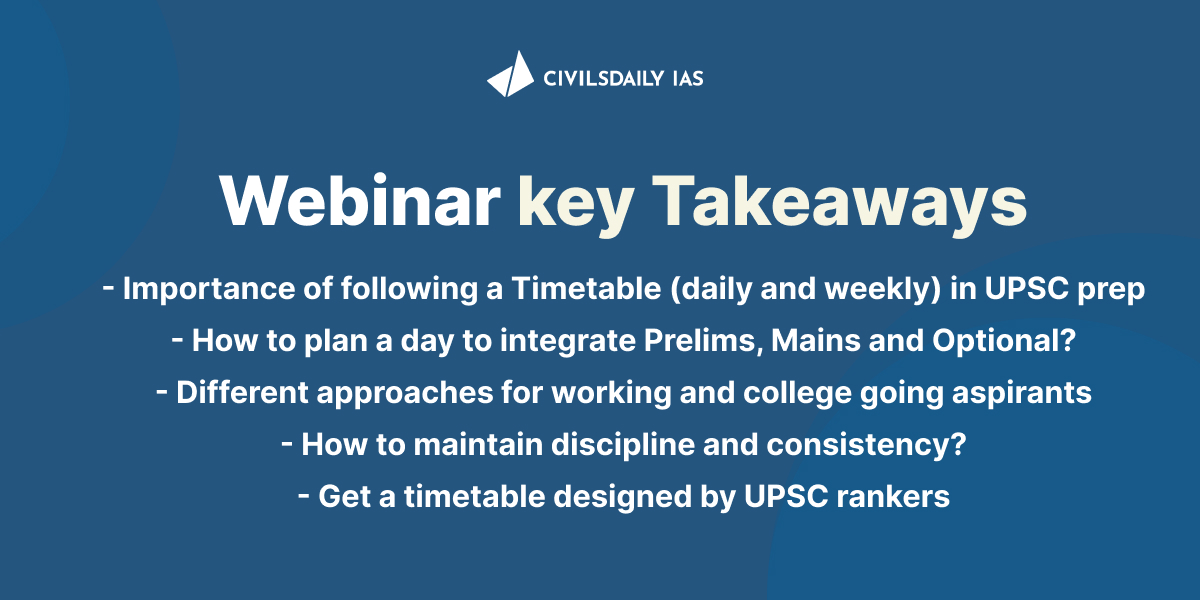
The mismanagement of time for any UPSC aspirant, whether a working professional or a full-time one, is caused by a lack of understanding of how to divide time according to the priority and relevance of the syllabus.
What is mismanagement of time?
It has 3 dimensions
Spend a lot of time on Prelims only
Starting Answer writing and Optional Subject after prelims
Not following a segregated daily approach
Examinees are often advised to devote at least 12 months to prepare for the civil service examinations. But, these 12 months even may run short if you don’t have a proper/flexible timetable. The importance of planning, discipline, and consistency for UPSC preparation comes from making a timetable and planning in a manner that is balanced and integrated, which means it should include UPSC prelims, Mains, and Optional preparation.
You mustn’t waste time if you have limited time and still wish to pass the exam because the syllabus is comprehensive and often open-ended, it needs bright covering with a select few sources.
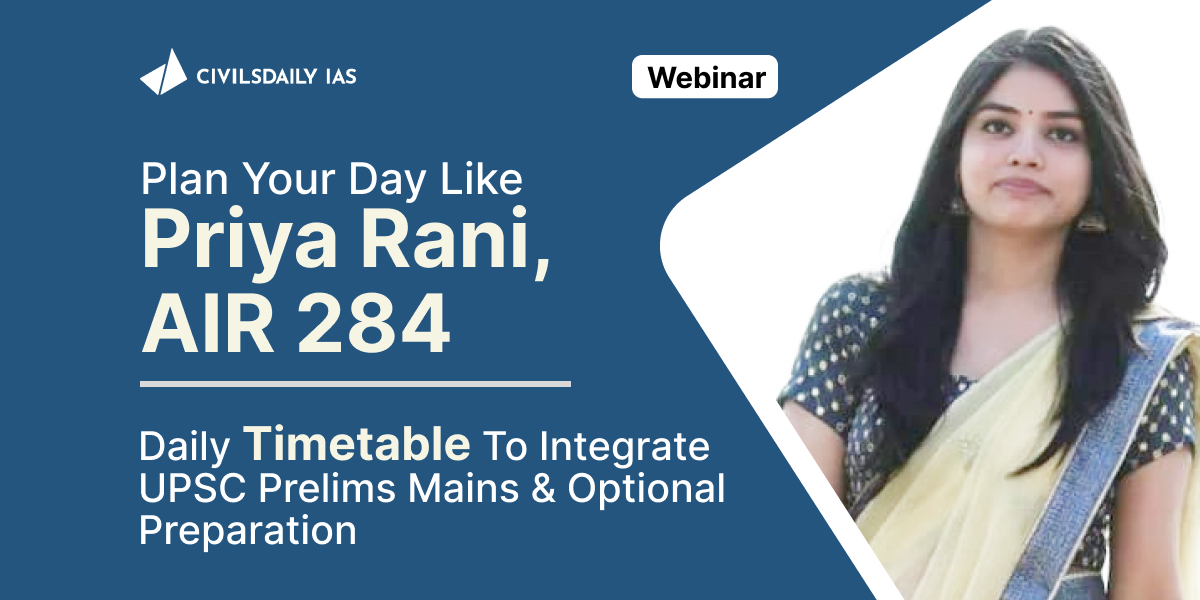
Acknowledging the need to ensure a holistic flexible timetable/daily routine, Priya Rani AIR 284 is taking up a webinar masterclass to help you make a timetable and impart skills to plan your day for a holistic and integrated preparation.
A safe and a secure world is a shared responsibility. When threats like terrorism, drug trafficking, corruption and organized crime are global, the response to them cannot just be local.
That was PM Modi’s emphasis at the 90th Interpol General Assembly, recently held in New Delhi.
Interpol will turn 100 next year. Now is the time to calibrate to counter emergent challenges.
What is INTERPOL?
The Interpol, or International Criminal Police Organization, is an inter-governmental organization comprising 195 member countries, which helps police forces in all these countries to better coordinate their actions.
It was set up in 1923 by 19 countries in the wake of an urgent need to facilitate cooperation between police across borders.
It enables member countries to share and access data on crimes and criminals and offers a range of technical and operational support.
It is run by a secretary general with its headquarters in Lyon, France, with a global complex for innovation in Singapore, and several satellite offices in different regions.
India accepted Interpol membership in June 1956.
The General Assembly is the apex governing body of Interpol that meets every year to discuss its functioning.
Key functions of INTERPOL
Global police-level cooperation: Interpol is a global organisation that provides a platform for cooperation between the police forces of various member countries even between countries that do not have existing diplomatic relations.
Database of crime and criminals: It also manages databases with information on crimes and criminals which are accessible in real-time to member countries.
Investigative and training support: It lends investigative and training support such as forensics, analysis, and assistance in locating fugitives around the world.
Combating global crimes: Interpol also plays a key role in combating crimes across three global areas namely terrorism, cybercrime and organized crime which pose a significant threat in the current era.
Key challenges to global security
At present countries across the world are facing unprecedented complexity in the criminal threat landscape with threats including-
Cybercrime
Cross-border terrorism
Drug trafficking and
Women and child sexual abuse
All these crimes are interlinked. Here is how?
Mixed nature of crime: Transnational organised crime continues to thrive due to illicit networks that operate on the strength of money laundering.
Radicalization: In recent years, terrorism is not only spreading in physical space but has started spreading its presence through online radicalization and cyber threats.
Financial crimes: Corruption and money laundering threaten people in every aspect of their lives across the world. So are the payment frauds.
Environmental crime: This includes illicit cross-border trade in wildlife.
Why need INTERPOL?
Rising criminality has caused law enforcement to come under strain.
In a democratic polity, police forces have to act with restraint, within the boundaries of legal procedures.
Lawbreakers enjoy the ease of mobility and access to the internet. There is no diminishing trend of these threats within sight.
How is INTERPOL equipped to curb transnational crimes?
Interpol uses 19 databases and tools for issuing alerts, sharing information about criminals and their modus operandi.
It has a huge repository of fingerprints, DNA profiles, facial recognition kits, cyber-enabled financial crimes, and property crimes, among others.
Providing information about crime and criminals in the digital space, preventing abuse of cyberspace and stalling hackers on the dark web are areas where Interpol’s global security architecture is used.
Interpol issues colour-coded notices of various hues — red, yellow, blue, black, orange, green and purple.
INTERPOL and India
A large number of red corner notices have been issued at the request of Indian law enforcement, resulting in the detention of several accused and convicted fugitives.
India, as one of the oldest and strongest members of Interpol, has been involved in productive engagements over the years.
Several operations have been undertaken by the CBI with Interpol.
Limitations of INTERPOL
Vague composition: In its composition, Interpol is like the UN. But it is not meant for dispute resolution. It is designed to assist the police forces of member nations.
Not a policing body: Interpol is neither an investigative agency like the CBI nor a front-line police force.
Assistive role: It is mandated to share information and provide back-end technical assistance to law enforcement agencies.
Not an independent organization: Interpol action against notorious fugitives is consequential upon commensurate action from member nations where the fugitives might be seeking shelter.
More of a bilateral tool: Interpol cannot act on its own. The desired legal course of action depends on bilateral arrangements like mutual legal assistance treaties.
How can India leverage INTERPOLs benefit?
India becoming the fifth-largest economy in the world, and on the path to becoming the third-largest in the near future.
The country has created a positive impact by bringing down terrorist-related violence.
Moreover, India is now an acknowledged technology powerhouse.
This demographic dividend of a large and young technology-oriented workforce in startups can be utilised for upgrading the security architecture.
Indian skill development resources through capacity building programmes run by the CBI training academy are used periodically by the international police fraternity.
Way forward
There should be close collaboration between global security organisations such as the Interpol, United Nations Security Council (UNSC) and Financial Action Task Force (FATF).
It is important that these security organisations reposition their strategies in line with the realities of the current century and the latest advancements.
In this context, India must push for the establishment of the Comprehensive Convention on International Terrorism (CCIT) which was proposed by India in 1996.
It is time for Indian coaxial engagements with Interpol and other member nations to accelerate further, both bilaterally and multilaterally.