💥Join UPSC 2027,2028 Mentorship (August Batch) + XFactor Notes & Microthemes PDF

Distribution: weekly

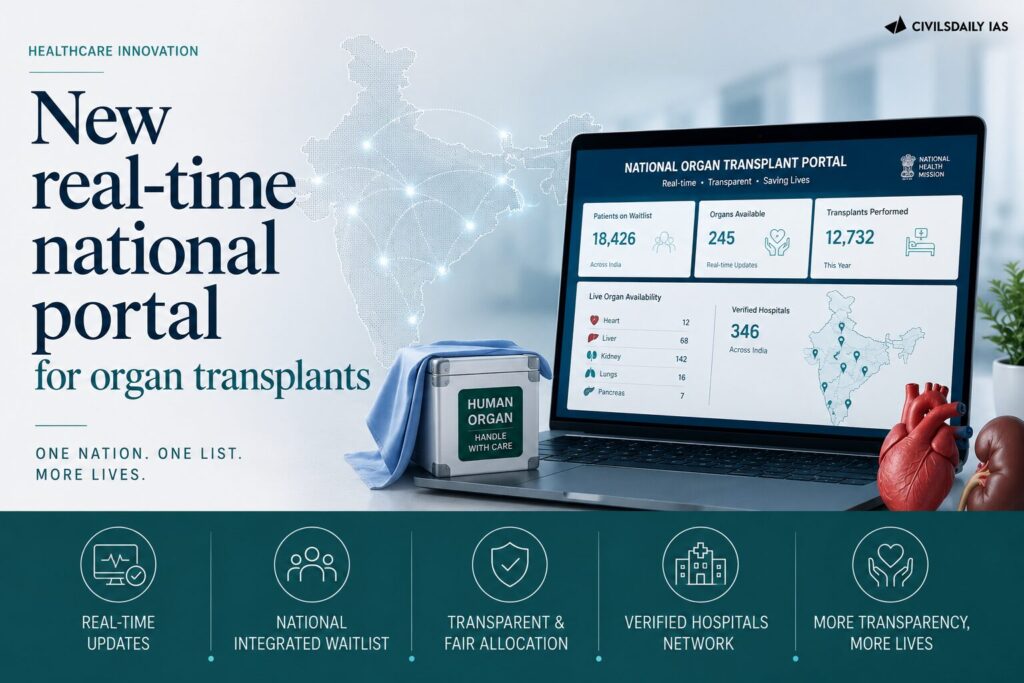
  • New real-time national portal for organ transplants

    Why in the News?

    The National Organ and Tissue Transplant Organisation (NOTTO) has launched a real-time national portal and mobile application to streamline organ transplantation by creating a unified waiting list, enabling national swap donations, and improving transparency.

    Key Features

    • National Waiting List: Creates hospital, State, regional and national waiting lists.
    • Real-time Allocation: Enables transparent organ allocation across India.
    • National Swap Donor Pool: Matches incompatible donor-recipient pairs across the country.
    • Aadhaar-linked Organ Pledge: Links donor pledges with Aadhaar for better verification.
    • Outcome Tracking: Hospitals upload follow-up data to monitor transplant outcomes.

    How does the Portal Work?

    • Patients are registered by authorised transplant hospitals.
    • Allocation follows the sequence: Hospital → State → Regional → National pool.
    • Kidney Allocation: Donor hospital retains one kidney and sends the other to the nearest matching government hospital.
    • Supports super-urgent transplant requests through the portal.

    Significance

    • Improves transparency and equity in organ allocation.
    • Expands the pool for compatible donor matching.
    • Reduces dependence on manual coordination.
    • Creates a national transplant database for better monitoring.

    Challenges

    • Different States follow different organ allocation policies.
    • NOTTO cannot mandate uniform allocation rules.
    • Low deceased organ donation rates remain a major constraint.
    • Portal effectiveness depends on accurate hospital data entry.

    Back2Basics

    • NOTTO: National Organ and Tissue Transplant Organisation.
    • Parent Body: Directorate General of Health Services (DGHS), Ministry of Health and Family Welfare (MoHFW).
    • Legal Basis: Transplantation of Human Organs and Tissues Act, 1994 (THOTA).
    • Network: Works with Regional Organ and Tissue Transplant Organisations (ROTTOs) and State Organ and Tissue Transplant Organisations (SOTTOs).

    [2023] Consider the following statements:
    Statement-I: India’s public sector health care system largely focuses on curative care with limited preventive, promotive and rehabilitative care.
    Statement-II: Under India’s decentralized approach to health care delivery, the States are primarily responsible for organizing health services.
    Which one of the following is correct in respect of the above statements?

    [A] Both Statement-I and Statement-l are correct and Statement-II is the correct explanation for Statement-I.

    [B] Both Statement-I and Statement-II are correct and Statement-is not the correct explanation for Statement-l.

    [C] Statement-l is correct but Statement-II is incorrect.

    [D] Statement-I is incorrect but Statement-Il is correct.

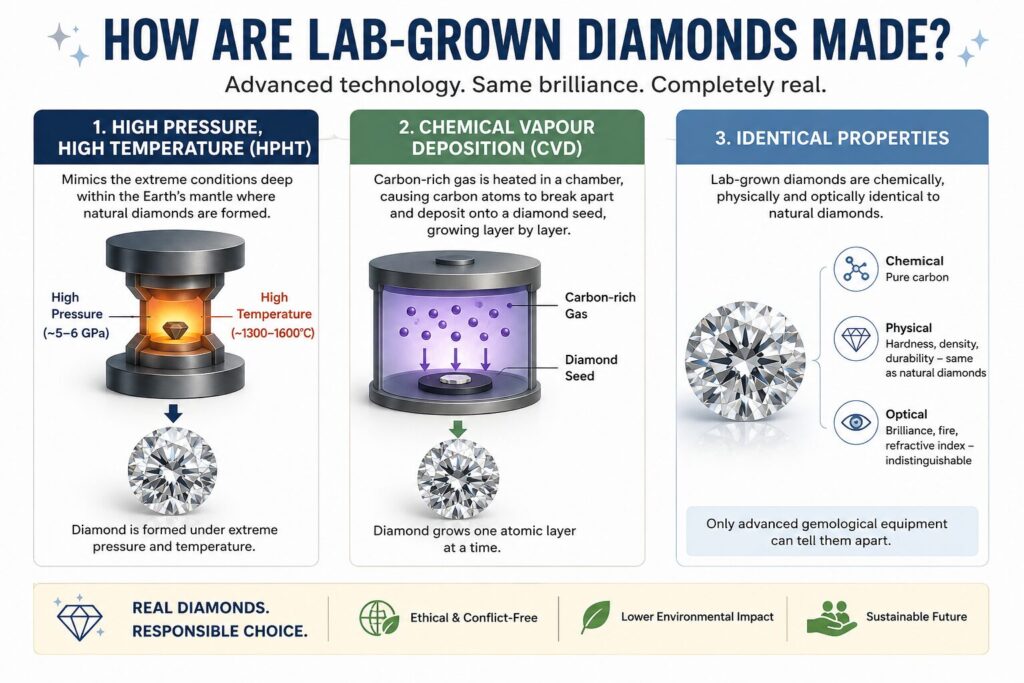
  • Why lab-grown diamonds are a sustainable alternative to mined stones

    Why in the News?

    With natural diamond reserves declining and concerns over environmental damage, conflict diamonds and forced labour, India is promoting Lab-Grown Diamonds (LGDs) through the India Centre for Lab-Grown Diamond (InCent-LGD) at Indian Institute of Technology (IIT) Madras.

    What is the Kimberley Process?

    • Kimberley Process Certification Scheme (KPCS): An international certification system launched in 2003 to prevent conflict (blood) diamonds from entering global trade.
    • Limitation: Difficult to trace the geographic origin of diamonds, enabling smuggling.

    Significance of Lab-Grown Diamonds

    • Lower water, land and environmental footprint.
    • Fully traceable and ethically sourced.
    • More affordable than mined diamonds.
    • Used in jewellery, cutting tools, drilling, semiconductors and quantum computing.

    India’s Initiative

    • Union Budget 2023-24 announced support for indigenous LGD production.
    • InCent-LGD established at IIT Madras with a ₹243 crore grant from the Ministry of Commerce and Industry.
    • Focuses on developing indigenous diamond seeds, machinery and manufacturing technology.

    [2018] Which one of the following foreign travellers elaborately discussed about diamonds and diamond mines of India?

    [A] Francois Bernier

    [B] Jean-Baptiste Tavernier

    [C] Jean de Thevenot

    [D] Abbe Barthelemy Carre

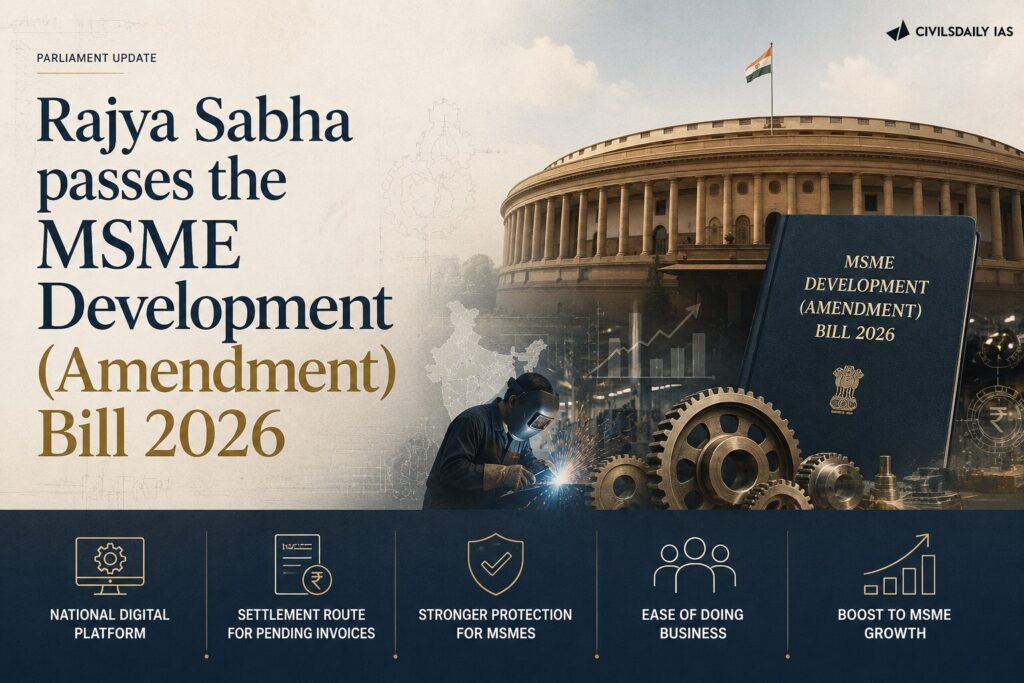
  • Rajya Sabha passes the MSME Development (Amendment) Bill 2026

    Why in the News?

    The Rajya Sabha passed the Micro, Small and Medium Enterprises (MSME) Development (Amendment) Bill, 2026, replacing the MSME Development Act, 2006. It aims to improve formalisation and liquidity by introducing a digital registration platform and mandatory invoice settlement through Trade Receivables Discounting System (TReDS).

    Key Provisions

    • National Digital Registration: Free, voluntary online registration for MSMEs.
    • Mandatory TReDS: Central Public Sector Enterprises (CPSEs) must settle MSME invoices through the Trade Receivables Discounting System (TReDS).
    • Updated Framework: Replaces the 2006 Act governing MSME classification, credit and delayed payments.
    • Objective: Improve timely payments while balancing business interests.

    What is TReDS?

    • Trade Receivables Discounting System (TReDS) is a Reserve Bank of India (RBI) regulated electronic platform where MSMEs sell approved invoices to financiers for immediate cash.
    • Process: MSME uploads invoice → financiers bid → MSME gets upfront payment → buyer pays financier on the due date.

    Why is the Amendment Needed?

    • Delayed payments reduce MSME working capital.
    • Easier registration promotes formalisation and access to credit.
    • Institutional credit has grown, but access remains uneven.

    Importance of MSMEs

    • Contribute 31% of Gross Domestic Product (GDP).
    • Account for 36% of manufacturing output.
    • Contribute 41% of exports.
    • Second largest employer after agriculture.

    Challenges

    • Voluntary registration may exclude many firms.
    • TReDS mandate covers only CPSEs.
    • Smaller firms may struggle to attract financiers.
    • Weak enforcement and digital literacy remain concerns.

    MSME Classification

    • Micro: Investment ≤ ₹2.5 crore; Turnover ≤ ₹10 crore
    • Small: Investment ≤ ₹25 crore; Turnover ≤ ₹100 crore
    • Medium: Investment ≤ ₹125 crore; Turnover ≤ ₹500 crore

    Key Initiatives

    • Udyam Registration Portal
    • MSME Samadhaan
    • Trade Receivables Discounting System (TReDS)
    • Priority Sector Lending (PSL)

    “[2023] Consider the following statements with reference to India:

    1. According to the ‘Micro, Small and Medium Enterprises Development (MSMED) Act, 2006’, the ‘medium enterprises’ are those with investments in plant and machinery between Rs. 15 crore and Rs. 25 crore.

    2. All bank loans to the Micro, Small and Medium Enterprises qualify under the priority sector.

    Which of the statements given above is/are correct?

    (a) 1 only

    (b) 2 only

    (c) Both 1 and 2

    (d) Neither 1 nor 2.

  • Mounting rupee pressure weighs on India’s external trade

    Why in the News

    The rupee has depreciated about 9% against the US dollar over a year, moving from around Rs 87.5 to Rs 95.4 to the dollar. The fall exposes how far India’s trade balance now depends on external shocks it does not control, rather than on domestic competitiveness.

    What is the Real Effective Exchange Rate (REER)?

    1. Meaning: The Real Effective Exchange Rate (REER) is the value of the rupee against a trade weighted basket of partner currencies, adjusted for inflation differences between the countries.
    2. What it signals: A falling REER means Indian goods are becoming cheaper abroad in real terms, which should aid exports but also signals weakening currency strength.
    3. Recent movement: The REER fell between 9% and 11.7% over the period, tracking the nominal depreciation of the rupee.

    What is driving the rupee’s depreciation?

    1. US tariff action: US tariffs on Indian goods rose as high as 50% from August 2025, before being reduced to 10% from February 2026, disrupting export earnings.
    2. Portfolio outflows: Foreign Portfolio Investors (FPI) pulled capital out of Indian markets, reducing dollar inflows and pressuring the currency.
    3. West Asia conflict: The conflict around the Strait of Hormuz raised crude oil prices, widening the oil import bill.
    4. Structural import dependence: India remains dependent on imports for electronics, Active Pharmaceutical Ingredients (API) and critical minerals, keeping import demand high regardless of the rupee’s level.

    Why does the depreciation worsen rather than correct the trade gap?

    1. Widening deficit: The trade deficit widened to $333.6 billion in 2025-26, showing that a cheaper rupee has not narrowed the import bill.
    2. Inelastic imports: Import dependence on energy and critical inputs means volumes do not fall much when the rupee weakens, so the import bill rises in rupee terms.
    3. Export limits: Tariff barriers in key markets cap the export gains a weaker rupee would normally deliver.

    What are the challenges to stabilizing the rupee and the trade balance

    1. Import concentration: Heavy reliance on a few import categories, energy, electronics and critical minerals, leaves the deficit exposed to global price swings.
    2. Reserve drawdown: Defending the rupee through Reserve Bank of India (RBI) dollar sales draws down foreign exchange reserves and cannot continue indefinitely.
    3. Imported inflation: A weaker rupee raises the cost of imported fuel and inputs, feeding into domestic inflation.
    4. Capital flow volatility: FPI flows can reverse quickly with shifts in US interest rates, making the rupee vulnerable to sudden outflows.
    5. Manufacturing gap: Without deeper domestic manufacturing of electronics and pharmaceutical inputs, the structural import bill stays high across cycles.

    Conclusion

    The rupee’s slide is driven mainly by external forces, US tariffs, portfolio outflows and oil prices, not by weaker domestic fundamentals alone. A cheaper currency has failed to correct the trade deficit because import demand is inelastic and export gains are capped by tariffs. Reducing import dependence in energy, electronics and critical minerals is the only durable route to a stronger external position.

    PYQ Relevance

    [UPSC 2020] With reference to the international trade of India at present, which of the following statements is/are correct?

    1. India’s merchandise exports are less than its merchandise imports. 2. India’s imports of iron and steel, chemicals, fertilisers and machinery have decreased in recent years. 3. India’s exports of services are more than its imports of services. 4. India suffers from an overall trade/current account deficit.

    Select the correct answer using the code given below: (a) 1 and 2 only (b) 2 and 4 only (c) 3 only (d) 1, 3 and 4 only

    Answer: (d)

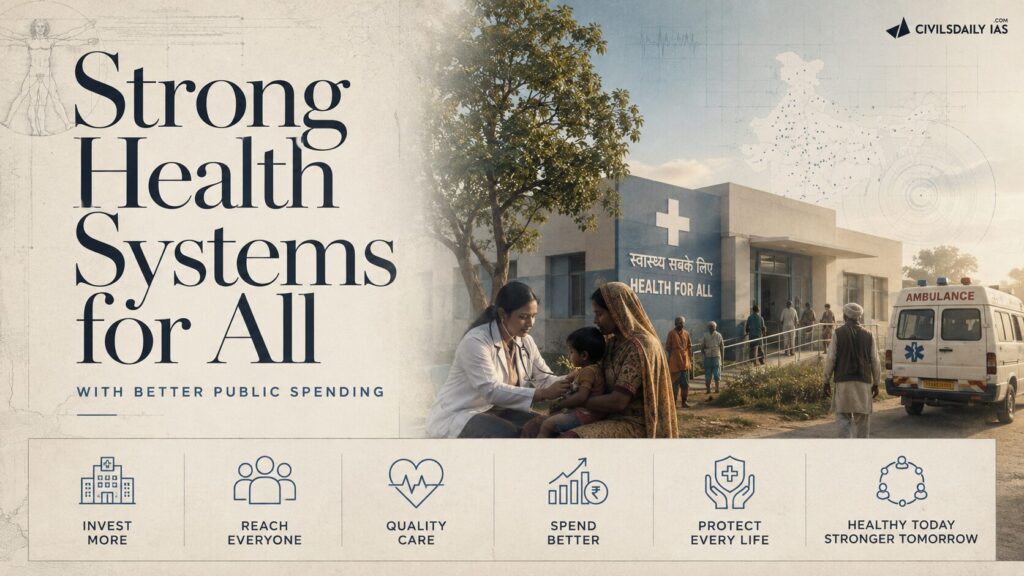
  • [3rd August 2026] The Hindu OpED: Strong health systems for all with better public spending 

    PYQ Relevance
    [UPSC 2024] In a crucial domain like the public healthcare system, the Indian State should play a vital role to contain the adverse impact of marketisation of the system. Suggest some measures through which the State can enhance the reach of public healthcare at the grassroots level.
    Linkage: The PYQ focuses on strengthening public healthcare through better financing and governance. The article shows how efficient spending, preventive care, and stronger governance can improve grassroots healthcare despite limited funds.

    Mentor’s Comment

    As donor countries reduce health aid and developing countries face rising debt repayments, increasing health funding for low- and middle-income countries (LMICs) is not a realistic option in the near future. The focus has therefore shifted to using existing health budgets more effectively through full utilisation of funds, greater investment in preventive and public health, and better governance. However, while improving efficiency is essential, it cannot fully overcome the basic problem of inadequate per-person health spending.

    Why does the LMIC health financing gap appear to be narrowing but is actually widening?

    1. GDP-share convergence: The health expenditure gap between LMICs and high-income countries as a share of GDP narrowed from 2.05 percentage points in 2000 to 1.68 percentage points in 2023.
    2. Per capita divergence: In per capita terms, the same gap has expanded more than three-fold over the same period.
    3. Absolute shortfall: Per capita public spending on universal health coverage in LMICs, including government expenditure and off-budget aid, is about half the minimum benchmark identified by the World Bank.
    4. Misleading metric: A GDP-share comparison understates the real resource gap. LMIC economies and populations are growing, so per capita spending is the more accurate measure of unmet need.

    Why can LMICs no longer count on external aid or fiscal headroom to close this gap?

    1. DAH peak and reversal: Development assistance for health (DAH) peaked in 2021 during the COVID-19 pandemic and has declined sharply since.
    2. US cuts: The United States, historically the source of over a third of global DAH, announced a 67% cut to foreign assistance in early 2025.
    3. Allied cuts: The United Kingdom, France, and Germany followed with cuts of 39%, 35%, and 12% respectively.
    4. Projected decline: The OECD projects health funding could fall by up to 60% from its 2022 peak.
    5. Debt burden: Global public debt reached $102 trillion in 2024. Developing countries owed $31 trillion of this, growing twice as fast as advanced-country debt since 2010.
    6. Crowding out: Developing countries paid a record $921 billion in net interest payments in 2024, leaving less fiscal space for health.

    Why does allocated health money not reach the ground in LMICs?

    1. Execution rates: LMIC health budgets are executed at 85-90%, lower than execution rates for the general budget and for education.
    2. Deprioritisation at implementation: Underspending against allocation amounts to a deprioritisation of health at the implementation stage, even when the budget itself was adequate on paper.
    3. India infrastructure mission: A parliamentary panel found only about two-thirds of the allocation for the flagship health infrastructure mission was spent in 2024-25.
    4. India disease programmes: Within the National Health Mission, only 26% of the money earmarked for communicable and non-communicable disease programmes was used that year.
    5. Category-wise variation: Wage and salary budgets are implemented in full. Spending on goods and services is underutilised. Health workers are left without adequate supplies and equipment.

    Why does the composition of health spending matter as much as its volume?

    1. Curative bias: A large share of public health spending goes to curative care at the secondary and tertiary levels rather than preventive, primary care.
    2. India preventive share: India spends less than one-fourth of public health money on preventive care, per London School of Hygiene & Tropical Medicine estimates.
    3. Public goods logic: Public health money delivers the highest impact when spent on classic public goods such as infectious disease control or sanitation, where market failure prevents private provision.
    4. Evidence on outcomes: Public health spending markedly improves infectious disease outcomes through access, vaccination, and sanitation. It does far less for maternal, child, and non-communicable disease outcomes.
    5. Emerging pressure: Ageing populations will increase the need for spending on chronic disease risk factors, early detection, and management.

    How does governance quality determine whether health spending converts into health outcomes?

    1. Governance-spending interaction: Countries with lower corruption and stronger bureaucratic quality see greater positive effects of public health spending on outcomes such as child mortality.
    2. Converse risk: Increasing spending where governance is weak does not reliably improve outcomes.
    3. Decentralisation challenge: Growing decentralisation of service delivery makes subnational governance quality increasingly central to health outcomes.
    4. PFM components: Budget credibility, timely cash disbursement, and flexible budgets that can respond to unforeseen circumstances such as pandemics are central to good public finance management.
    5. Provider involvement: Involving public health providers in budget processes improves both their accountability and motivation.
    6. Procurement: Improving procurement processes helps achieve greater value for money in health-sector resources.

    Does spending health money better substitute for spending more, or does it merely defer the underlying financing question?

    1. Efficiency as necessity, not choice: With external aid contracting and fiscal space shrinking, efficiency reforms are being pushed as the primary lever, not because they are sufficient but because more money is currently unavailable.
    2. Limits of efficiency: Even full execution and optimal prioritisation cannot close a financing gap that stems from an absolute shortfall in per capita resources relative to benchmarks.
    3. Equity argument: Returns to health spending are greatest exactly where outcomes are poorest. Underfunded LMICs stand to lose the most from a financing pullback that efficiency measures alone cannot offset.
    4. Unresolved question: The article does not specify how the residual financing gap, after full execution and reprioritisation, will eventually be closed.

    Conclusion

    The contraction of development assistance for health and the fiscal squeeze from rising public debt have made the additional-financing pathway to closing LMIC health gaps unreliable. The immediate policy response must be to spend existing health budgets more fully, reprioritise toward preventive and public-goods spending, and strengthen governance and public finance management. These measures improve outcomes per rupee spent but do not eliminate the underlying financing shortfall. Since returns to health spending are highest where outcomes are worst, the case for restoring adequate financing remains unresolved.

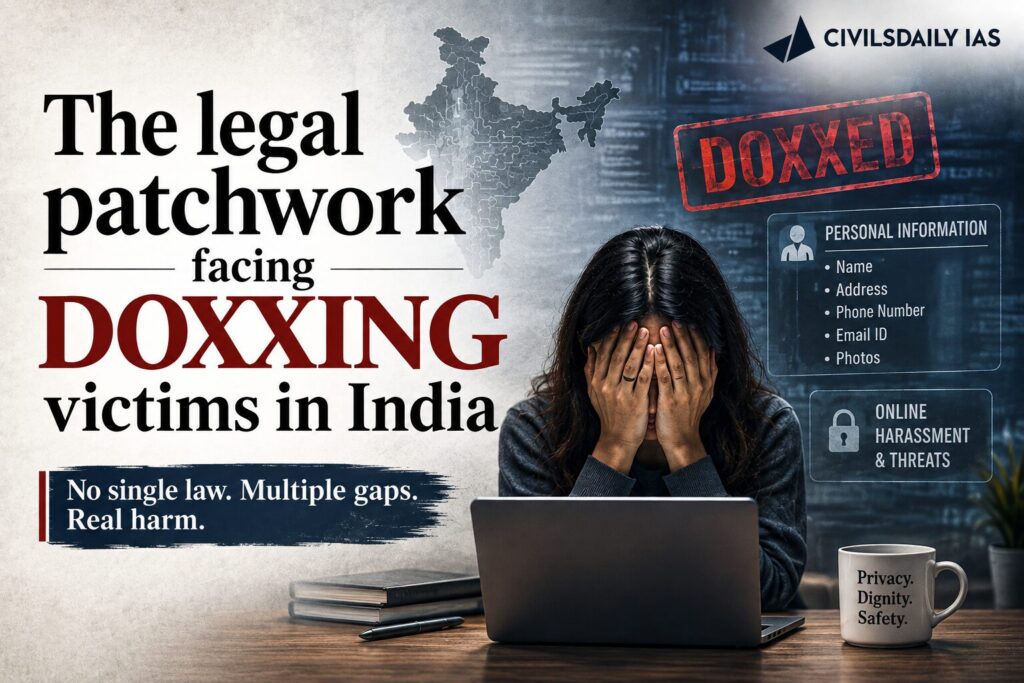
  • The legal patchwork facing doxxing victims in India

    Why in the News?

    The online targeting of women protesters has highlighted the absence of a dedicated law against doxxing in India, forcing victims to rely on scattered legal provisions.

    What is Doxxing?

    • Doxxing is the unauthorised public disclosure of a person’s private or personal information online to harass, intimidate or threaten them.
    • It can lead to stalking, identity theft, threats and physical harm.

    Existing Legal Framework

    • Bharatiya Nyaya Sanhita (BNS), 2023: Provisions relating to stalking, criminal intimidation and harassment.
    • Information Technology (IT) Act, 2000: Covers privacy violations and unauthorised disclosure of personal information.
    • Information Technology (Intermediary Guidelines and Digital Media Ethics Code) Rules, 2021: Prescribe due diligence obligations for online platforms and provide safe harbour protection.

    Challenges

    • No specific offence for doxxing under Indian law.
    • Delays in content removal and prosecution.
    • Difficulty in fixing platform liability due to safe harbour provisions.
    • Rising digital threats to privacy and safety.

    Prelims Facts

    • The Digital Personal Data Protection (DPDP) Act, 2023 governs the processing of personal digital data but does not specifically criminalise doxxing.
    • Safe Harbour under Section 79 of the Information Technology (IT) Act, 2000 protects intermediaries from liability if they comply with due diligence requirements.

    [2024] Under which of the following Articles of the Constitution of India, has the Supreme Court of India placed the Right to Privacy?

    (a) Article 15

    (b) Article 16

    (c) Article 19

    (d) Article 21

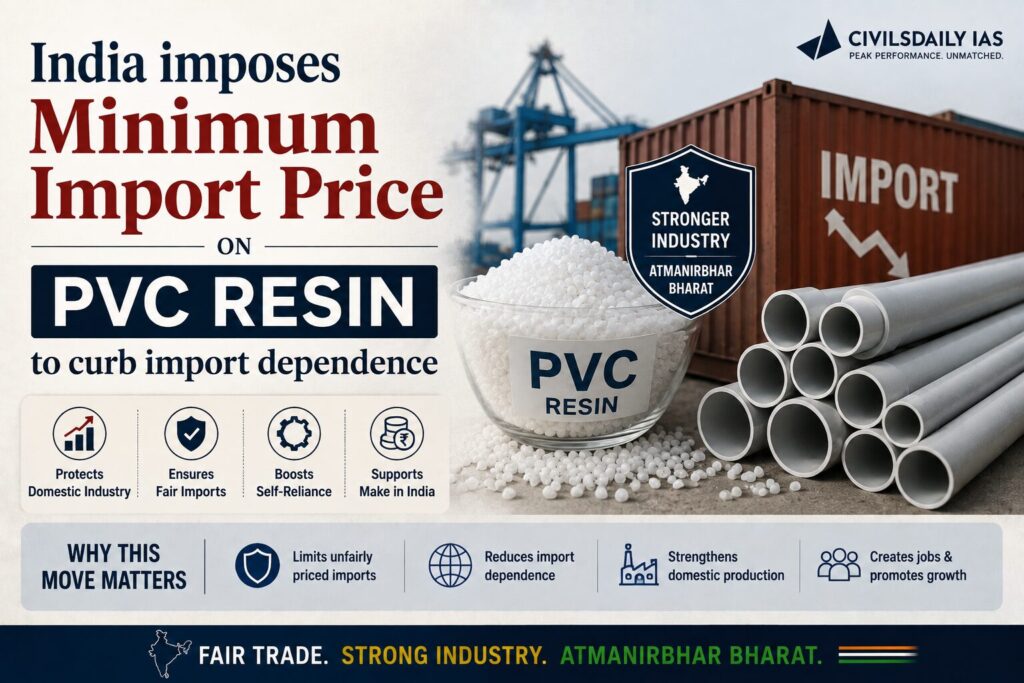
  • India imposes Minimum Import Price on PVC resin to curb import dependence

    Why in the News?

    The Government has imposed a Minimum Import Price (MIP) of US$0.766/kg on PVC (Polyvinyl Chloride) Suspension Resin to protect domestic manufacturers from cheap imports.

    What is MIP?

    • Minimum Import Price (MIP) is the minimum price below which a product cannot be imported.
    • It protects domestic industries from low-priced imports.
    • Unlike anti-dumping duty, MIP applies to all imports, irrespective of the exporting country.

    What is DGTR?

    • The Directorate General of Trade Remedies (DGTR) investigates unfair trade practices.
    • It recommends: Anti-dumping duties, Countervailing duties, and Safeguard measures

    Why was MIP Imposed?

    • Protect domestic PVC manufacturers from cheap imports.
    • Address import dependence due to insufficient domestic production.
    • Exemptions are available for:
      • Export Oriented Units (EOUs)
      • Special Economic Zones (SEZs)
      • Advance Authorisation Scheme imports.

    Challenges

    • Higher input costs for PVC-based industries.
    • Possible disputes at the World Trade Organization (WTO).
    • Does not address the domestic capacity gap.
    • Requires strict customs enforcement against under-invoicing.

    Prelims Facts

    • India uses MIP, anti-dumping duty, countervailing duty and safeguard duty as trade remedy measures.
    • PVC (Polyvinyl Chloride) is a widely used plastic in pipes, cables, packaging and construction.
    • DGTR functions under the Department of Commerce, Ministry of Commerce and Industry.

    [2020] With reference to the international trade of India at present, which of the following statements is/are correct?

    1.India’s merchandise exports are less than its merchandise imports.
    2.India’s imports of iron and steel, chemicals, fertilisers and machinery have decreased in recent years.
    3.India’s exports of services are more than its imports of services.
    4.India suffers from an overall trade/current account deficit.
    Select the correct answer using the code given below:
    a) 1 and 2 only
    b) 2 and 4 only
    c) 3 only
    d) 1, 3 and 4 only

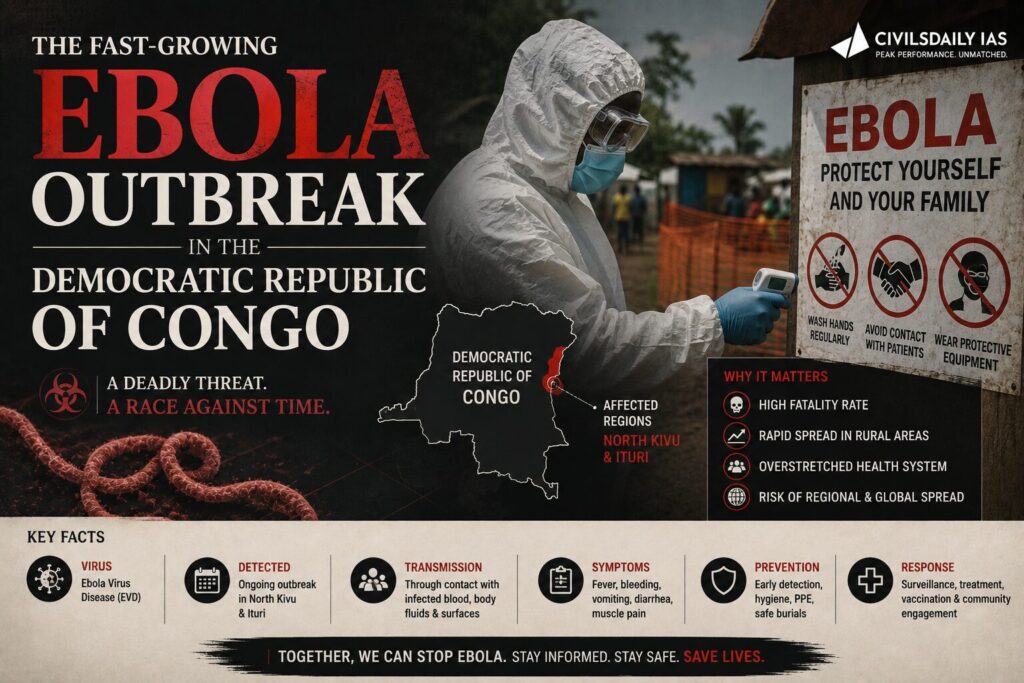
  • The fast-growing Ebola outbreak in the Democratic Republic of Congo

    Why in the News?

    The Democratic Republic of Congo (DRC) is facing its largest Ebola outbreak, with 3,605 cases and 1,587 deaths, caused by the Bundibugyo strain, for which no approved vaccine exists.

    What is a PHEIC?

    • A Public Health Emergency of International Concern (PHEIC) is the World Health Organization’s (WHO) highest level of global health alert.
    • Declared when an outbreak poses a cross-border public health risk and requires international coordination.

    Why is the Outbreak Difficult to Control?

    • Caused by the Bundibugyo ebolavirus (BDBV) strain, with no approved vaccine or treatment.
    • Ongoing conflict hampers movement of health workers and supplies.
    • Weak healthcare infrastructure and community distrust delay detection and isolation.

    Response Measures

    • Oxford ChAdOx1 BDBV vaccine is undergoing clinical trials.
    • India has supplied emergency medicines to support relief efforts.
    • Surveillance, contact tracing and isolation remain the primary control measures.

    Prelims Facts

    • Ebola Virus Disease (EVD) is a severe viral haemorrhagic fever caused by Ebolaviruses.
    • It spreads through direct contact with infected body fluids of humans or animals.
    • The Bundibugyo virus (BDBV) is one of the six known Ebola virus species.
    • The World Health Organization (WHO) declared the outbreak a Public Health Emergency of International Concern (PHEIC).

    [2025] With reference to monoclonal antibodies, consider the following:

    I. They are man-made proteins.

    II. They stimulate the patient’s immune system to fight the specific disease.

    III. They are produced using animal cells only.

    Which of the statements given above are correct?

    (a) I and II only

    (b) II and III only

    (c) I and III only

    (d) All the three

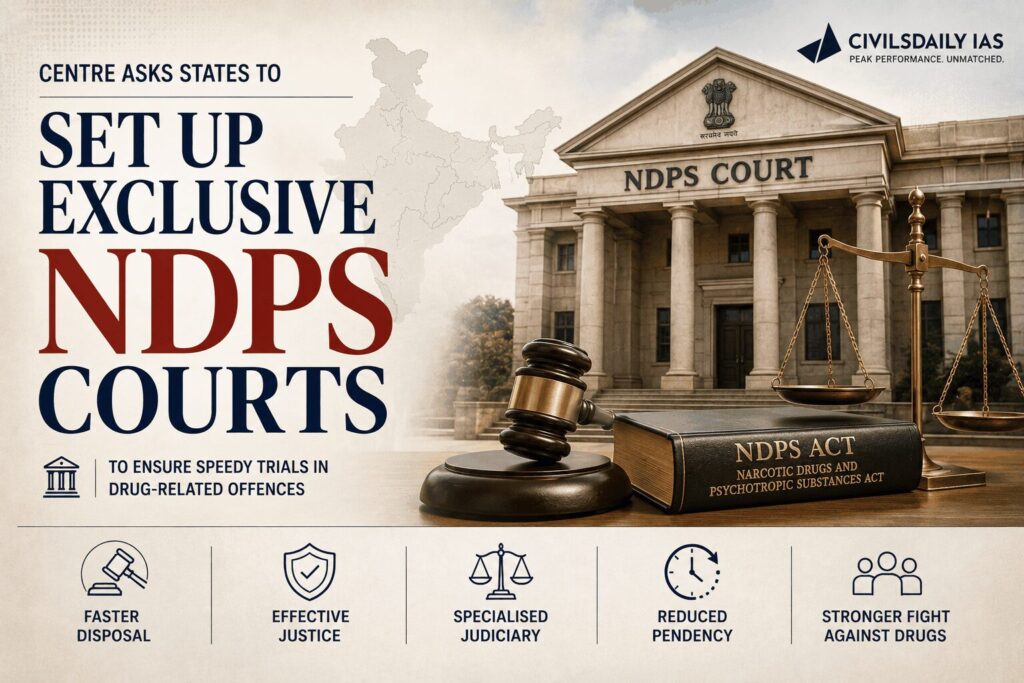
  • Centre asks states to set up exclusive NDPS courts

    Why in the News?

    The Ministry of Home Affairs (MHA) has directed States and Union Territories to establish exclusive NDPS courts to tackle the backlog of nearly 39 lakh drug-related cases. However, 22 States are yet to comply.

    What is the NDPS Act?

    • The Narcotic Drugs and Psychotropic Substances (NDPS) Act, 1985 is India’s primary law to regulate and prohibit narcotic drugs and psychotropic substances.
    • The Narcotics Control Bureau (NCB) is the apex agency for enforcement.
    • The Narco-Coordination Centre (NCORD) coordinates anti-drug efforts among Central and State agencies.

    Why Exclusive NDPS Courts?

    • Speed up disposal of nearly 39 lakh pending cases.
    • Ensure specialised and faster trials for drug offences.
    • Improve conviction rates and reduce judicial delays.

    Significance

    • Strengthens deterrence against drug trafficking.
    • Helps curb crimes linked to money laundering, organised crime and terror financing.
    • Enhances India’s internal security, especially along vulnerable border regions.

    Challenges

    • 22 States have not yet established exclusive NDPS courts.
    • Need for adequate judges, prosecutors and infrastructure.
    • Court reforms must be complemented by effective enforcement and rehabilitation.

    Is it Mandatory?

    • Legally: The NDPS Act empowers State Governments to establish Special Courts, but it does not make exclusive NDPS courts mandatory in every district.
    • Administratively: The Ministry of Home Affairs (MHA) has strongly directed States and Union Territories to establish exclusive NDPS courts due to the huge backlog. While this directive is not directly enforceable like a statute, States are expected to comply in the interest of effective criminal justice and internal security.

    Prelims Facts

    • NCORD was established in 2016 to improve inter-agency coordination against drug trafficking.
    • NDPS Act, 1985 replaced the Opium Act, 1857, the Opium Act, 1878, and the Dangerous Drugs Act, 1930.
    • The NCB functions under the Ministry of Home Affairs (MHA).

    [2018, GS3, 15 marks] India’s proximity to two of the world’s biggest illicit opium-growing states has enhanced her internal security concerns. Explain the linkages between drug trafficking and other illicit activities such as gunrunning, money laundering and human trafficking. What counter-measures should be taken to prevent the same?”

  • Nasha Mukt Yuva for Viksit Bharat Sankalp Abhiyan launched

    Why in the News?

    The government launched the Nasha Mukt Yuva for Viksit Bharat Sankalp Abhiyan, a nationwide anti-drug campaign from 28,000+ locations with a 100-week action plan to promote a drug-free youth for Viksit Bharat 2047.

    About the Campaign

    • A national drug awareness and demand reduction campaign targeting youth.
    • Launched simultaneously from 28,000+ locations.
    • Over 1 crore youth participated in the anti-drug pledge.
    • Includes a 100-week activity plan for sustained community engagement.

    Significance

    • Strengthens the demand reduction pillar of India’s anti-drug strategy.
    • Promotes awareness, prevention and rehabilitation alongside enforcement.
    • Supports the vision of a healthy workforce for Viksit Bharat 2047.

    Challenges

    • Sustaining community participation over 100 weeks.
    • Expanding de-addiction and counselling infrastructure.
    • Measuring the campaign’s long-term impact.
    • Success depends on parallel action against drug trafficking.

    Prelims Facts

    • Implemented under the Ministry of Youth Affairs and Sports (MYAS).
    • Complements the Nasha Mukt Bharat Abhiyaan (NMBA) launched by the Ministry of Social Justice and Empowerment (MoSJE).
    • Focuses on awareness, prevention, rehabilitation and youth participation.