💥Join UPSC 2027,2028 Mentorship (August Batch) + XFactor Notes & Microthemes PDF

Distribution: weekly

  • Supreme Court extends Section 498A cruelty protection to live in relationships

    Why in the News

    The Supreme Court held that protection against cruelty under Section 498A of the Indian Penal Code (IPC), 1860 extends to women in live-in relationships, provided the partners share a genuine intent to marry. The ruling is based on Article 14 (Right to Equality).

    What is Section 498A?

    • Penalized cruelty by a husband or his relatives against a woman.
    • Now corresponds to Section 85 of the Bharatiya Nyaya Sanhita (BNS), 2023.
    • Traditionally applied only to legally valid marriages.

    Supreme Court Ruling

    • Adopted a purposive interpretation to address changing social realities.
    • Extended protection to women in live-in relationships where there is: A relationship in the nature of marriage, and A genuine intent to marry.
    • Held that denying such protection violates Article 14.

    Why is the Domestic Violence Act Not Enough?

    • The Protection of Women from Domestic Violence (PWDV) Act, 2005 covers women in relationships in the nature of marriage.
    • However, it provides civil remedies such as: Protection orders, Residence orders, and Maintenance
    • Section 85, BNS provides criminal punishment, offering stronger deterrence.

    Challenges

    • Difficulty in proving intent to marry.
    • Limited documentary evidence in live-in relationships.
    • Possibility of misuse.
    • Overlap between civil remedies under the PWDV Act and criminal proceedings.

    Important Constitutional Provisions

    • Article 14: Equality before law.
    • Article 21: Right to life and personal liberty, including dignity and autonomy.

    Landmark Judgments

    • D. Velusamy v. D. Patchaiammal (2010): Defined “relationship in the nature of marriage.”
    • Indra Sarma v. V.K.V. Sarma (2013): Laid down factors for determining live-in relationships under the PWDV Act.

    [2019] Which Article of the Constitution of India safeguards one’s right to marry the person of one’s choice?

    (a) Article 19

    (b) Article 21

    (c) Article 25

    (d) Article 29

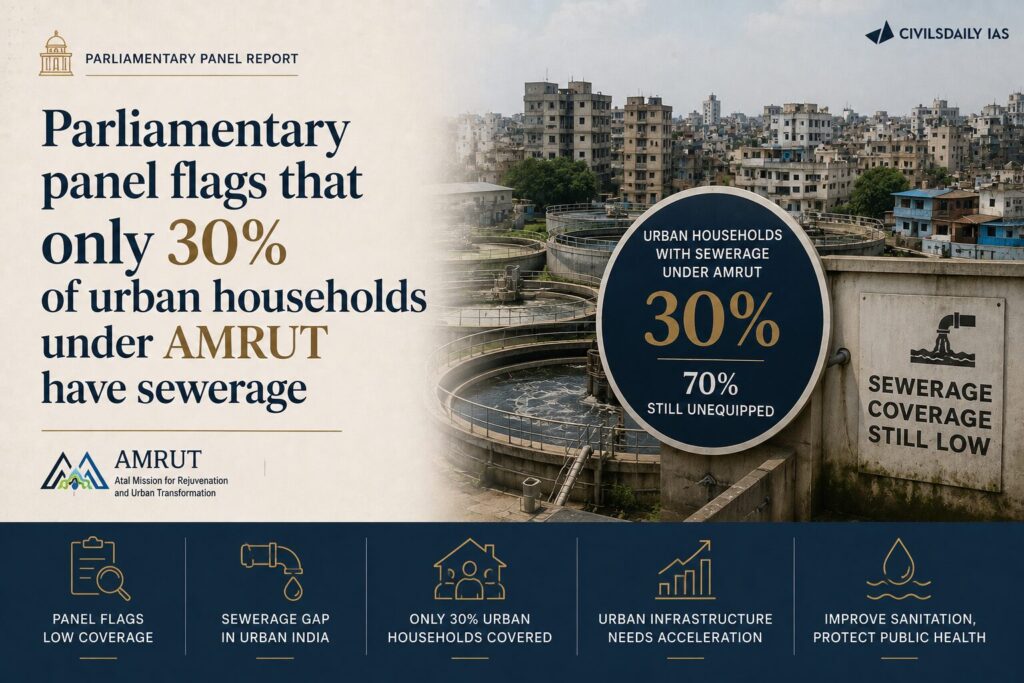
  • Parliamentary panel flags that only 30% of urban households under AMRUT have sewerage

    Why in the News

    The Parliamentary Standing Committee on Housing and Urban Affairs reported that only about 30% of urban households under the Atal Mission for Rejuvenation and Urban Transformation (AMRUT) have a sewerage connection. It flagged slow progress and inter state gaps in sanitation infrastructure.

    What is AMRUT?

    1. Flagship civic scheme: AMRUT is the Union government’s flagship urban civic infrastructure mission, providing water supply, sewerage, septage, stormwater drains and green spaces.
    2. Two phases: AMRUT (2015 to 2021) covered 500 cities, and AMRUT 2.0 (from 2021) covers all statutory towns with a focus on universal water and sewerage coverage.

    What did the parliamentary panel find?

    1. Low sewerage coverage: Of 11.32 crore urban households, only 3.44 crore had sewerage connections and 2.84 crore relied on septage systems, per the City Water Balance Plans (2025).
    2. Inter state variation: Madhya Pradesh, Tamil Nadu, West Bengal, Odisha, Jharkhand and Bihar depend more on septage than on sewer networks.
    3. Network gap: Of 59,261 km of approved sewer network, only 27,418 km has been laid so far.

    Why does the sewerage gap persist?

    1. Small share of projects: Of 8,743 projects approved under AMRUT 2.0, only 594 (about 6.79%) relate to sewerage and septage management.
    2. Slow completion: Only 104 of those 594 sewerage projects (17.51%) are complete, while 398 (67%) remain under implementation.
    3. Funds pending: Only Rs 22,762 crore of the Rs 66,059 crore committed as central assistance has been released.

    What did the committee recommend?

    1. Database and audit: The Ministry should build a database of existing sewer networks, functional status and household connectivity gaps and carry out periodic assessments.
    2. End manual cleaning: Manual cleaning of sewers and septic tanks should be eliminated.

    Challenges to urban sanitation delivery

    1. Weak urban local bodies: Municipal bodies often lack the finances and technical staff to build and operate sewage treatment plants.
    2. Trunk versus last mile: Laying trunk sewer lines without household connections leaves treatment capacity underused.
    3. Cost recovery: User charges for sewerage are politically difficult, so operation and maintenance is chronically underfunded.
    4. Land and legacy: Retrofitting sewer networks into dense, unplanned settlements is slow and expensive.
    5. Faecal sludge gap: Cities dependent on septic tanks lack faecal sludge treatment plants, so untreated waste re enters water bodies.

    AMRUT

    1. Launched in 2015 by the Ministry of Housing and Urban Affairs.
    2. Aims at universal household water supply and sewerage or septage coverage in urban areas.
    3. AMRUT 2.0, launched in 2021, targets all statutory towns and water body rejuvenation.
    4. Beneficiaries are urban households, with a stated focus on the urban poor.

    [2022] Consider the following statements
    1. The India Sanitation Coalition is a platform to promote sustainable sanitation and is funded by the Government of India and the World Health Organization.
    2. The National Institute of Urban Affairs is an apex body of the Ministry of Housing and Urban Affairs in Government of India and provides innovative solutions to address the challenges of Urban India.
    Which of the statements given above is/are correct?

    [A] 1 only

    [B] 2 only

    [C] Both 1 and 2

    [D] Neither 1 nor 2

  • Supreme Court extends mandatory third party motor insurance and floats a no-insurance, no fuel pilot

    Why in the News

    The Supreme Court extended mandatory Third-Party Motor Insurance to 4 years for new cars and 6 years for new two-wheelers. It also proposed a “No Insurance, No Fuel” pilot to improve compliance.

    What is Third-Party Motor Insurance?

    • Mandatory under Section 146 of the Motor Vehicles Act, 1988.
    • Covers compensation for injury, death, or property damage caused to a third party.
    • Does not cover damage to the insured vehicle or owner.

    Supreme Court Directions

    • Mandatory third-party cover:
      • 4 years for new cars.
      • 6 years for new two-wheelers.
    • Link Automatic Number Plate Recognition (ANPR) cameras with:
      • Insurance Information Bureau of India (IIB)
      • VAHAN portal.
    • Enable police to verify insurance in real time through mobile applications.
    • Explore a “No Insurance, No Fuel” pilot.

    Why is Enforcement Needed?

    • Around 56% of vehicles reportedly operate without valid third-party insurance.
    • Victims face delays in compensation.
    • Insurance often lapses after the initial mandatory period.

    Challenges

    • Lack of integration among IIB, VAHAN, and police databases.
    • Low renewal rates, especially for two-wheelers.
    • Concerns over denying fuel as an essential service.
    • Weak penalties and limited rural enforcement.

    Comprehensive vs Third-Party Insurance

    • Third-Party Insurance: Mandatory; covers third-party losses only.
    • Comprehensive Insurance: Optional; covers both third-party liability and damage to the insured vehicle.

    Key Platforms

    • VAHAN: National vehicle registration database managed by Ministry of Road Transport and Highways (MoRTH).
    • ANPR: Automatic Number Plate Recognition technology for vehicle identification.
    • IIB: Insurance Information Bureau of India, maintains insurance-related databases.

    Insurance Regulatory and Development Authority of India (IRDAI)

    • Established under: Insurance Regulatory and Development Authority Act, 1999.
    • Headquarters: Hyderabad.
    • Functions: Regulates insurance companies and intermediaries. Protects policyholders’ interests. Prescribes solvency, pricing, and disclosure norms.
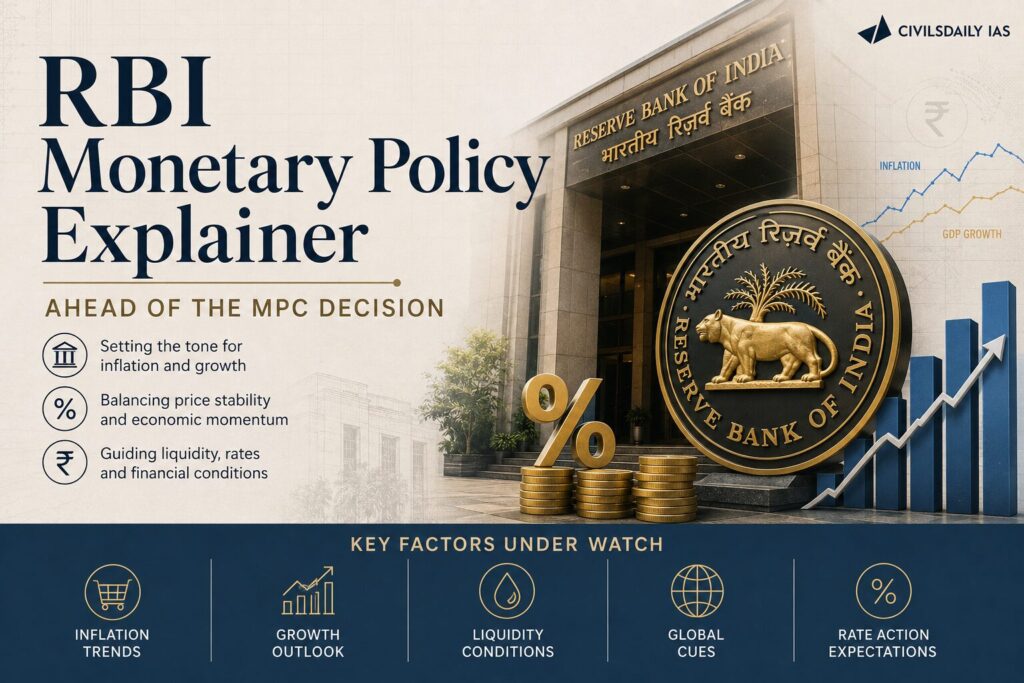
  • RBI monetary policy explainer ahead of the MPC decision

    Why in the News

    The Monetary Policy Committee (MPC) of the Reserve Bank of India (RBI) is set to announce its bi-monthly monetary policy. Most analysts expect it to keep the repo rate unchanged amid global economic uncertainty.

    What is the Monetary Policy Committee (MPC)?

    • The MPC decides the policy repo rate to maintain price stability while supporting economic growth.
    • Constituted under: Reserve Bank of India Act, 1934 (amended in 2016).
    • It meets every two months to review inflation and growth.

    Repo Rate & Inflation Target

    • Repo Rate: The interest rate at which the RBI lends short-term funds to commercial banks.
    • Inflation Target: 4%, with a tolerance band of 2%-6% under the Flexible Inflation Targeting (FIT) framework.

    Factors Considered by MPC

    • Rising crude oil prices.
    • US-Iran geopolitical tensions.
    • Weak monsoon and El Niño increasing food inflation.
    • Mixed domestic growth indicators.
    • Policy stance of major central banks (US Fed, ECB, BoJ, BoE).

    Challenges

    • Time lag in monetary policy transmission.
    • Supply-side inflation (food and fuel) beyond RBI’s control.
    • Balancing inflation with economic growth.
    • External risks affecting capital flows and the rupee.
    • Uncertain global and domestic economic conditions.

    Value Addition

    • Flexible Inflation Targeting (FIT): Adopted in 2016 to maintain inflation at 4% ± 2%.
    • Monetary Policy Tools: Repo Rate, Standing Deposit Facility (SDF), Cash Reserve Ratio (CRR), Statutory Liquidity Ratio (SLR), and Open Market Operations (OMOs).

    “[2017] Which of the following statements is/are correct regarding the Monetary Policy Committee (MPC)?
    1. It decides the RBI’s benchmark interest rates.
    2. It is a 12-member body including the Governor of RBI and is reconstituted every year.
    3. It functions under the chairmanship of the Union Finance Minister.
    (a) 1 only
    (b) 1 and 2 only
    (c) 3 only
    (d) 2 and 3 only

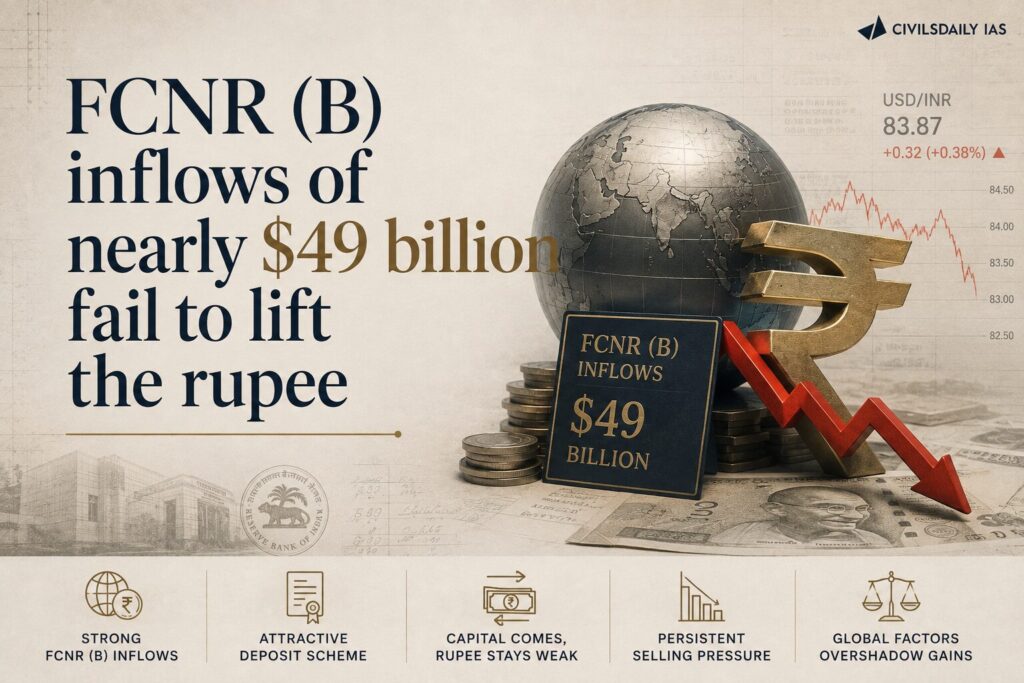
  • FCNR (B) inflows of nearly $49 billion fail to lift the rupee

    Why in the News

    India received nearly USD 49 billion during June-July 2026 through the Foreign Currency Non Resident (Bank) [FCNR(B)] swap window, foreign loans, and bond investments. However, the Indian Rupee (INR) remained stable at around ₹95.38/USD, unlike the sharp appreciation seen under a similar scheme in 2013.

    What are FCNR(B) Deposits and the Swap Window?

    FCNR(B) Deposits

    • Foreign currency term deposits maintained by Non-Resident Indians (NRIs) with Indian banks.
    • Protect depositors from exchange rate risk.
    • Tenure: 1-5 years.

    Swap Window

    • A facility by the Reserve Bank of India (RBI) where banks swap FCNR(B) dollar deposits for rupees.
    • Since dollars go directly to the RBI, they do not increase dollar supply in the forex market.

    Why Didn’t the Rupee Strengthen?

    • Dollar inflows bypassed the open forex market.
    • RBI sold dollars to stabilize the rupee amid global uncertainty.
    • Banks hedged future foreign currency liabilities.
    • Higher crude oil prices and a stronger US dollar offset the impact of inflows.

    Challenges

    • Strong US dollar and geopolitical risks.
    • Lower Foreign Direct Investment (FDI) inflows.
    • Rising crude oil prices widening the Current Account Deficit (CAD).
    • Risk of reversal of FCNR(B) deposits after the swap window ends.

    Value Addition

    • Spot Market: Immediate currency exchange.
    • Forward Market: Currency exchange at a future date and predetermined rate.
    • Foreign Exchange Reserves comprise:
      • Foreign Currency Assets (FCA) (largest component)
      • Gold
      • Special Drawing Rights (SDRs)
      • IMF Reserve Position

    Back2Basics:

    • FCNR(B): Foreign Currency Non Resident (Bank) Deposit.
    • Eligible: NRIs and Overseas Citizens of India (OCIs).
    • Tenure: 1-5 years.
    • Exchange Rate Risk: Borne by the bank/RBI, not the depositor.

    “[2017] Which of the following has/have occurred in India after its liberalization of economic policies in 1991?
    1. Share of agriculture in GDP increased enormously.
    2. Share of India’s exports in world trade increased.
    3. FDI inflows increased.
    4. India’s foreign exchange reserves increased enormously.
    (a) 1 and 4 only
    (b) 2, 3 and 4 only
    (c) 2 and 3 only
    (d) 1, 2, 3 and 4

  • SEBI Closing Auction Session goes live and moves index closing values

    Why in the News

    The Closing Auction Session (CAS) became operational from 3 August 2026 for stocks with Derivative Contracts. During its initial days, the National Stock Exchange (NSE) Nifty 50 and Bombay Stock Exchange (BSE) Sensex recorded unusually large differences in their closing values.

    What is the Closing Auction Session (CAS)?

    • The Closing Auction Session (CAS) is a dedicated 20-minute trading block (3:15 PM to 3:35 PM) introduced by SEBI on August 3, 2026.
    • It pools end-of-day buy and sell orders for eligible stocks to discover a single equilibrium closing price, replacing the final 30-minute VWAP method.

    What is Volume Weighted Average Price (VWAP)?

    • The Volume Weighted Average Price (VWAP) is the average price of a stock weighted by the trading volume, giving greater importance to prices with higher traded volumes.

    Why did Nifty and Sensex Diverge?

    • Separate CAS order books on the NSE and BSE.
    • Different index composition (Nifty 50: 50 stocks; Sensex: 30 stocks).
    • Different weightages of constituent stocks.
    • Initial adjustment to the new auction mechanism.

    Challenges

    • Temporary benchmark divergence.
    • Higher tracking error for Exchange Traded Funds (ETFs) and index funds.
    • Residual risk of price manipulation.
    • Liquidity concerns in less-traded stocks.
    • Operational adaptation by brokers and investors.

    Key Concept:

    • Equilibrium Price: The price at which the maximum quantity of buy and sell orders can be matched during the auction.
    • Derivative Contracts: Financial instruments whose value is derived from an underlying asset such as stocks or indices. Examples: Futures Contracts and Options Contracts
    • Collectively known as the Futures and Options (F&O) segment.

    Securities and Exchange Board of India (SEBI)

    • Established: 1988 (Statutory status in 1992).
    • Governing Act: Securities and Exchange Board of India Act, 1992.
    • Headquarters: Mumbai.
    • Functions: Protect investors. Regulate and develop the securities market. Regulate stock exchanges, mutual funds, and market intermediaries.
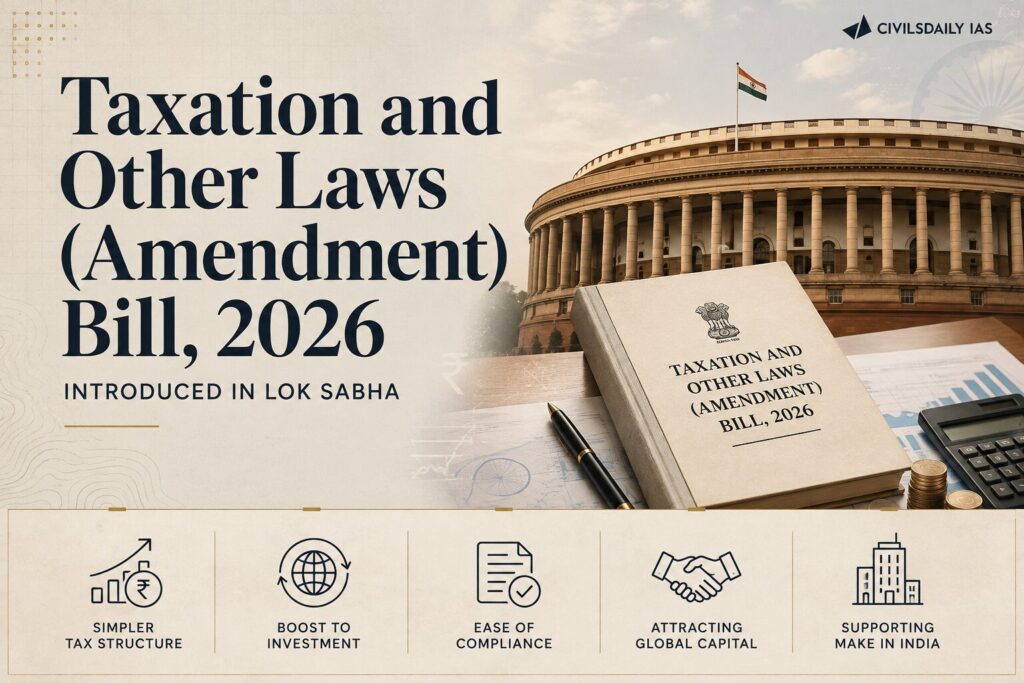
  • Taxation and Other Laws (Amendment) Bill, 2026 introduced in Lok Sabha

    Why in the News?

    The Finance Minister introduced the Taxation and Other Laws (Amendment) Bill, 2026 in the Lok Sabha to amend tax and payment laws, improve tax certainty, attract foreign investment, and support the Make in India initiative.

    Key Highlights

    • Amends the Payment and Settlement Systems Act, 2007, Income-tax Act, 2025, and Finance Act, 2026.
    • Replaces the Income-tax (Amendment) Ordinance, 2026 with a permanent law.
    • Simplifies tax exemptions for foreign companies using Indian data centres.
    • Allows leased data centres to avail tax benefits.
    • Facilitates relocation of foreign fund managers to India without creating a taxable business presence.
    • Restores dividend tax exemption for REITs and InvITs under the new tax regime.

    Other Legislative Business

    • Discussion on Demands for Excess Grants (FY 2022-23).
    • Introduction of the Appropriation (No. 3) Bill, 2026 to regularise excess government expenditure.
    • Statements on implementation of Parliamentary Standing Committee recommendations.
    • Consideration of the Bankers’ Books Evidence Bill, 2026 to modernise evidence laws for digital banking.

    Appropriation Bill

    • Authorises the government to withdraw money from the Consolidated Fund of India to meet approved expenditure.
    • Required under Article 114 of the Constitution.

    Demands for Excess Grants

    • Presented when actual government expenditure exceeds the amount approved by Parliament.
    • Examined by the Public Accounts Committee (PAC) before parliamentary approval.
    • Constitutional Basis: Article 115.

    Bankers’ Books Evidence Bill, 2026

    • Seeks to modernise legal provisions governing bank records by recognizing digital banking and electronic records.
  • Strategic stockpiling of critical minerals under the National Critical Mineral Mission

    Why in the News

    India committed Rs 500 crore in 2025 towards critical mineral stockpiling under the National Critical Mineral Mission (NCMM). The commitment exposes a tension between long gestation domestic mining and the immediate supply risk that flows from dependence on China for processed minerals and rare earth elements.

    What is the National Critical Mineral Mission (NCMM)?

    1. Mandate: The NCMM is a scheme launched in 2025 to build a framework for self reliance across the critical mineral value chain, from exploration to processing.
    2. Stockpiling seed: It allocated Rs 500 crore in 2025 towards building strategic reserves of critical minerals.

    What are critical minerals and rare earth elements?

    1. Critical minerals: These are minerals essential to the economy and national security whose supply faces a high risk of disruption, such as lithium and cobalt.
    2. Rare earth elements (REEs): These are a set of 17 metallic elements used in permanent magnets, electronics and defence systems, most of which are refined in China.

    Why must a reserve hold processed minerals and not raw ores?

    1. Refining lead time: Converting raw ore into usable inputs needs onshore capacity with a long lead time, so raw stock is of little use during a shock.
    2. Composition rule: A reserve must hold refined rare earth oxides, processed minerals and finished components such as permanent magnets.
    3. Midstream gap: India’s midstream refining capacity is nascent, so supply agreements must cover intermediate goods rather than raw material.
    4. Storage integrity: Refined oxides are sensitive to moisture and oxidation, requiring climate controlled and nitrogen atmosphere warehousing.
    5. Rotation cycle: Reserves cannot stay static, so the government must release older stock into the market while procuring fresh supplies.

    What do international frameworks show about coordinated stockpiling?

    1. Quad Critical Minerals Initiative Framework: The Quadrilateral Security Dialogue (Quad) launched this USD 20 billion framework in 2025 to fortify regional supply chains.
    2. G7 Evian summit 2026: The Group of Seven (G7) reiterated a commitment to establishing a standards based market for critical minerals.
    3. Modelling caution: If seven major economies simultaneously built six month reserves, aggregate demand could consume 34% of annual global cobalt supply and 10% of lithium supply.

    Why can uncoordinated stockpiling worsen the shortage it aims to solve?

    1. Demand inflation: Uncoordinated buying inflates global demand and deepens the very shortages stockpiling is meant to ease.
    2. Volatility risk: It heightens the price volatility that a reserve is supposed to hedge against.
    3. Limits of price floors: A guaranteed minimum purchase price addresses underinvestment but rarely addresses scarcity.
    4. Dynamic price bands: A band with a floor near USD 12,000 and a ceiling near USD 30,000 triggers coordinated buying below the floor and releases above the ceiling.

    What are the challenges to critical mineral stockpiling?

    1. Capital intensity: Specialised storage demands heavy and continuous capital expenditure, commercial expertise and multi stakeholder involvement.
    2. Material decay: Reserves risk technological obsolescence and physical decay unless constantly rotated. (Nickel and cobalt powders or precursor materials must be constantly tested and rotated back into active commercial supply chains before their chemical integrity drops.)
    3. Access in friend shoring: Collaboration with industrialised powers requires hedging mechanisms so access matches the size of India’s contribution.
    4. Delayed releases: Reserve releases can be blocked by vetoes, so pre agreed market and geopolitical triggers are needed to automate them.
    5. Sidelining of emerging economies: Larger consumers can crowd out India unless minimum guaranteed allocation baselines are fixed.
    6. China concentration: China dominates the mining and processing of several rare earths, giving it leverage over prices and export flows. Past export restrictions on gallium, germanium, and graphite demonstrated how Beijing’s dominance allows it to instantly manipulate global export flows and drive up input costs for rival manufacturing nations.

    Conclusion

    India’s optimal strategy is to join a coordinated stockpiling platform, potentially housed within the G7, which also covers Quad members. This lets India tap a mature ecosystem without bearing the full cost of independent reserves, provided it secures staggered procurement, automatic release triggers and guaranteed allocation baselines.

    Back2Basics:

    National Critical Mineral Mission (NCMM)

    1. Nodal ministry: Ministry of Mines.
    2. Launched: 2025.
    3. Aim: self reliance across the critical mineral value chain covering exploration, mining, processing and recycling.
    4. Coverage: domestic exploration, overseas asset acquisition, stockpiling and building a processing ecosystem.
    5. Stockpiling outlay: Rs 500 crore seeded in 2025.

    PYQ Relevance

    “[2026] Which of the following statements about Rare Earth Elements (REEs) and Critical Minerals is/are correct?
    1. Modern technological innovations including Artificial Intelligence, robotics and space exploration extensively utilise Rare Earth Elements (REEs).
    2. China has the highest share in mining of REEs followed by India.
    3. The Government of India launched the National Critical Mineral Mission (NCMM) in 2025 to establish a robust framework for self-reliance in the critical mineral sector.
    4. Rare Earth Elements are a set of 13 metallic elements.
    (a) 1 and 3 only
    (b) 3 only
    (c) 1, 3 and 4
    (d) 1, 2 and 4

  • Why the Iran war didn’t cause a fertiliser crisis

    Why in the News?

    The United States-Israel versus Iran war and the effective closure of the Strait of Hormuz triggered a severe global energy supply shock, yet India’s urea supply held up. Government-pushed diversification of liquefied natural gas (LNG) sourcing lifted urea output to 71.5 lakh tonnes in April-June 2026, up 5.4% year-on-year. The contrast is that the same proactiveness was not replicated for phosphatic fertilisers, leaving di-ammonium phosphate and complex fertilisers exposed.

    What are the main fertiliser nutrients?

    1. Nutrient roles: Urea supplies nitrogen (N); di-ammonium phosphate (DAP) supplies phosphorus (P); muriate of potash (MOP) supplies potassium (K). Complex fertilisers blend N, P, K and sulphur (S).
    2. Feedstock links: Urea depends on natural gas as feedstock. DAP and complex fertilisers depend on phosphoric acid, sulphur and ammonia.

    What kept urea supply stable through the shock?

    1. Feedstock disruption: Before the war, 53-54% of India’s LNG imports came from Qatar and the United Arab Emirates. Shipping blockades and strikes on liquefaction infrastructure broke these contracts.
    2. Sourcing pivot: The government pushed public firms to diversify LNG sourcing, buying more from the United States, Oman, Nigeria, Angola and others. This pivot to the spot market meant higher prices but secured supply.
    3. Output recovery: Urea production fell to 17.5 lakh tonnes in March 2026 from 24.7 lakh tonnes a year earlier, then recovered to 25.4 lakh tonnes by June. Cumulative April-June output of 71.5 lakh tonnes exceeded the previous year.
    4. Import surge: India imported 25.1 lakh tonnes of urea in April-June 2026, up from 8.4 lakh tonnes a year earlier. Higher import costs were not passed on to farmers.

    Why did DAP and complex fertilisers stay tight?

    1. Sulphur bottleneck: Sulphur is needed to make sulphuric acid, which breaks down rock phosphate into phosphoric acid. Without both acids, there can be no DAP, single super phosphate or complex fertilisers.
    2. Price spike: Sulphur landed prices reached about $1,100 per tonne against a normal $150-250 range. The spike predated the war, worsened by Ukrainian drone strikes on Russian refineries.
    3. Phosphoric acid costs: Imported phosphoric acid prices rose from $1,055 per tonne in early 2025 to $1,700 for the July-September 2026 quarter. This steady climb squeezed domestic manufacturers.
    4. No diversification: Unlike urea, phosphatic fertiliser sourcing was not widened. Reduced domestic output was combined with lower imports.

    What is the El Nino monsoon factor?

    1. Rainfall deficit: El Nino-induced monsoon deficiency left June-July all-India rainfall 12.6% below normal. Kharif sowing area fell 2.9% from last year.
    2. Subdued demand: Weak rainfall reduced fertiliser offtake, easing pressure on supply. This contrasts with the surplus monsoon scrambles of 2024 and 2025.

    What are the challenges to fertiliser security?

    1. Import dependence: India depends heavily on imports for sulphur, phosphoric acid and ammonia. Concentrated West Asian sources leave it exposed to conflict.
    2. Subsidy pressure: Shielding farmers from higher costs inflates the fertiliser subsidy bill beyond budget estimates. Sustaining it requires additional provisions for DAP and complex fertilisers.
    3. Single-choke geography: Much feedstock still transits the Strait of Hormuz. A single choke point can disrupt multiple nutrients at once.
    4. Phosphate concentration: Few global suppliers dominate phosphoric acid and sulphur. Price-setting power rests with them during shortages.
    5. Election-linked stocking: Upcoming State elections raise pressure to guarantee rabi-season supply. Political timelines complicate purely economic supply planning.

    Conclusion

    Proactive supply-side management, chiefly LNG diversification and pre-emptive urea imports, insulated India’s nitrogen supply from the worst energy shock in decades. The unresolved vulnerability is phosphatic and complex fertilisers, where sulphur and phosphoric acid sourcing was not diversified and prices continue to climb.

    Back2Basics

    1. Urea: Nitrogen fertiliser made from natural gas; the most consumed fertiliser in India and heavily subsidised.
    2. DAP: Di-ammonium phosphate, a phosphorus source dependent on imported phosphoric acid.
    3. Nutrient Based Subsidy: Regime under which non-urea fertilisers (DAP, MOP, complex) receive a fixed per-nutrient subsidy.
    4. Urea pricing: Sold at a statutory notified price with the gap met by subsidy under the Department of Fertilizers.
    5. Key choke point: Strait of Hormuz, the transit route for much of India’s LNG and fertiliser feedstock.

    The New Urea Policy 2015:

    1. It aims to maximize domestic production, promote energy efficiency in manufacturing units, and rationalize government subsidy burdens.

    Core Objectives

    1. Boost Domestic Output: Increase indigenous manufacturing capacity to reduce reliance on foreign imports.
    2. Energy Conservation: Set strict specific energy consumption targets for production units to lower carbon footprints.
    3. Subsidy Rationalization: Streamline financial support and cut down government expenditure on the sector.

    Key Measures

    1. Neem Coating: Mandated all domestic producers to coat 100% of subsidized urea with neem oil, stopping illegal diversion to non-agricultural sectors.
    2. Energy Grouping: Categorized gas-based plants into distinct groups to fix realistic and progressive energy efficiency norms.
    3. Protected Pricing: Ensured continuous and timely supply of fertilizer to farmers without increasing the retail price

    PYQ Relevance

    [UPSC 2023] What are the direct and indirect subsidies provided to farm sector in India? Discuss the issues raised by the World Trade Organization (WTO) in relation to agricultural subsidies.

    Linkage: UPSC has consistently examined agricultural subsidies, their fiscal implications, and India’s compliance with WTO rules. The article shows how rising global fertiliser and LNG prices increase India’s subsidy burden while the government continues to shield farmers through subsidised urea and nutrient-based support for non-urea fertilisers

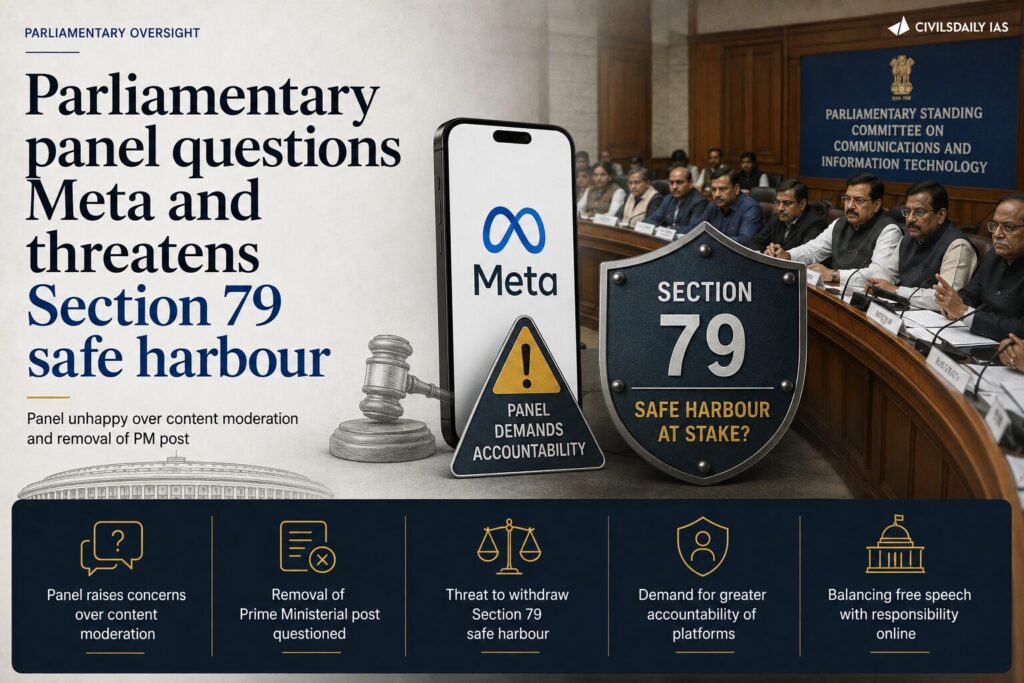
  • Parliamentary panel questions Meta and threatens Section 79 safe harbour

    Why in the News?

    The Parliamentary Standing Committee on Communications and Information Technology questioned Meta over the temporary removal of the Prime Minister’s Facebook post and warned of withdrawing safe harbour protection under Section 79 of the Information Technology Act, 2000.

    What is Section 79?

    • Grants safe harbour protection to intermediaries, shielding them from liability for third-party content.
    • Applies only if intermediaries:
      • Follow due diligence requirements.
      • Do not create or modify user content.
      • Comply with lawful government or court directions.

    Who is an Intermediary?

    • An entity that stores or transmits third-party content, such as Social media platforms, Internet Service Providers (ISPs), and Search engines
    • Hosts user-generated content without being its author.

    Key Findings

    • A Prime Ministerial Facebook post was temporarily restricted.
    • The Parliamentary Committee sought:
      • An explanation and audit trail from Meta.
      • Assurance against future recurrence.
    • The issue revived the debate on intermediary liability and platform accountability.

    Challenges

    • Withdrawal of safe harbour may encourage excessive content removal.
    • Risks chilling free speech and legitimate dissent.
    • Platforms cannot realistically pre-screen billions of posts.
    • Balancing accountability with freedom of expression remains difficult.

    Back2Basics

    • Information Technology Act, 2000: Governs cyber laws and intermediary liability in India.
    • IT Rules, 2021: Prescribe due diligence obligations for intermediaries.
    • Shreya Singhal v. Union of India (2015): Supreme Court held that content takedown under Section 79 generally requires a court order or government notification.

    [2017] In India, it is legally mandatory for which of the following to report on cyber security incidents?

    1. Service providers

    2. Data Centres

    3. Body corporate.

    Select the correct answer using the code given below:

    (a) 1 only

    (b) 1 and 2 only

    (c) 3 only

    (d) 1, 2 and 3.