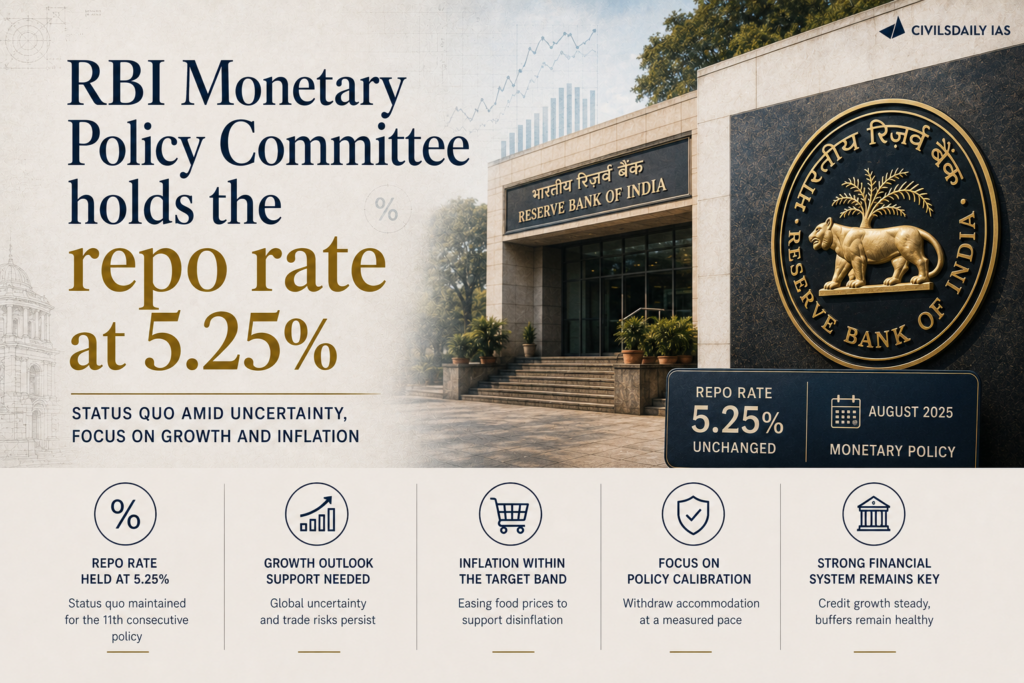
The Monetary Policy Committee (MPC) of the Reserve Bank of India (RBI) has kept the policy repo rate unchanged at 5.25%, balancing inflation risks against the need to support economic growth amid global uncertainties.
What is the Monetary Policy Committee (MPC)?
Statutory body: Constituted under the Reserve Bank of India Act, 1934 (amended in 2016).
Composition: Six members:
Three RBI members: Governor (Chairperson), Deputy Governor in charge of Monetary Policy, and one RBI nominee.
Three external members: Appointed by the Central Government.
Decision-making: Each member has one vote; in case of a tie, the Governor has a casting vote.
Mandate: Maintain Consumer Price Index (CPI) inflation at 4%, with a tolerance band of 2% to 6%.
What did the MPC decide?
Repo rate unchanged: Retained at 5.25%.
Policy stance: Continues to remain neutral.
Liquidity corridor:
Standing Deposit Facility (SDF):5.0%
Marginal Standing Facility (MSF):5.5%
Bank Rate:5.5%
Growth outlook: Real GDP growth projected at 6.7%.
Inflation outlook: CPI inflation rose to 4.4% in June 2026, crossing the 4% target after remaining below it for 16 months.
Why did the MPC maintain the status quo?
Global uncertainties: Rising crude oil prices and geopolitical tensions in West Asia pose inflation risks.
Monsoon concerns: An El Nino driven deficient monsoon could increase food inflation.
Data dependent approach: The MPC prefers to wait for clearer inflation and growth signals before changing policy rates.
Back2Basics: Reserve Bank of India (RBI)
Established:1935 under the Reserve Bank of India Act, 1934.
Functions: Monetary authority of India, Banker to the Government, Banker to banks, Regulator and supervisor of the banking system, and Manager of foreign exchange reserves.
Major monetary policy instruments:Repo Rate, Standing Deposit Facility (SDF), Marginal Standing Facility (MSF), Cash Reserve Ratio (CRR), Statutory Liquidity Ratio (SLR), Open Market Operations (OMOs)
“[2017] Which of the following statements is/are correct regarding the Monetary Policy Committee (MPC)? 1. It decides the RBI’s benchmark interest rates. 2. It is a 12-member body including the Governor of RBI and is reconstituted every year. 3. It functions under the chairmanship of the Union Finance Minister. Select the correct answer using the code given below: (a) 1 only (b) 1 and 2 only (c) 3 only (d) 2 and 3 only
PYQ Relevance [UPSC 2016] To what extent is Article 370 temporary? Discuss future prospects. Linkage: The PYQ directly tests the constitutional character of Article 370 that this article’s central event revolves around. Now after its abrogation the theme extends to statehood demand of J&K.
Mentor’s Comment
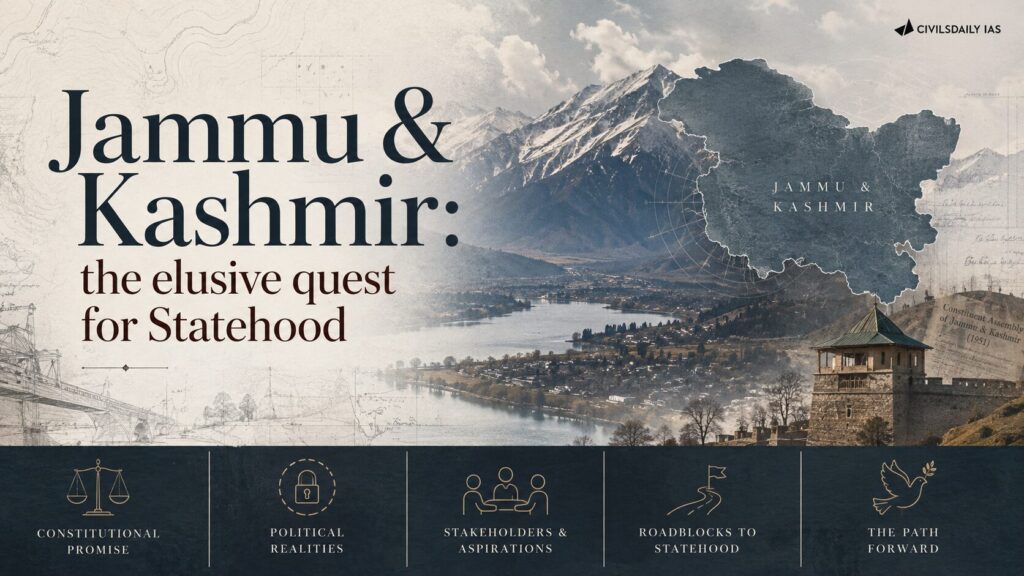
August 5, 2026, marks seven years since Jammu and Kashmir’s special status under Article 370 was revoked; August 9 will mark seven years since it lost Statehood. Seven years on, the promised trade-off of temporary central control for security and economic growth remains unfulfilled, even as the Lieutenant-Governor’s unaccountable powers have expanded further.
Has the trade-off of temporary central control for security and economic growth delivered its promised outcomes?
No formal emergency, emergency-scale measures: The 2019 actions were accompanied by troop deployment, detention of over 5,000 political leaders and cadre, curfew, and a communications blockade, without any emergency being formally declared.
Violence has spread, not receded: Terrorist attacks continued in 2025 at Pahalgam in April and Delhi’s Red Fort in November, and violence spread to previously dormant areas such as Poonch-Rajouri and adjoining districts.
Economic convergence has reversed: J&K’s per capita income as a share of the national average fell from 79.9% in 2013-14 to 76.6%, per the J&K Economic Survey 2025-26, a decline of 3.3 percentage points.
Unemployment remains structurally high: Overall unemployment is close to twice the national average; graduate unemployment stands at 23.9%.
Peaceful response met with intensified control: Kashmiris responded to the Pahalgam attack with peace marches and candlelit demonstrations, but the Union Home Ministry responded with the most militarised Amarnath Yatra in J&K’s history, routine PSA and UAPA charges, summons to over 2,000 people after a single incident, near-continuous curfews, and the highest number of internet shutdowns of any region in the country since 2019.
What made the process of revoking Article 370 and Statehood constitutionally unprecedented?
Executive fiat over Article 370: Article 370 was hollowed out through executive action; the Governor later stated he was directed by the Union Home Minister to sign.
Legislative fiat over Statehood: Statehood was removed through Parliament without consulting J&K’s people or its elected political leadership.
First such downgrade since 1956: J&K became the first State since Delhi in 1956 to lose Statehood.
Basic structure implications: Together, the two actions represent a departure from constitutional principles and the basic structure of the Union.
Treated as an exception, not a precedent: The actions were framed as specific to a conflict-ridden J&K rather than examined as part of a broader strain on India’s constitutional democracy.
Why have judicial and administrative checks failed to restore accountable government in J&K?
Prolonged judicial deference: The Supreme Court allowed the Union’s security-justification argument to stand unchallenged for four years before weakly recommending that Statehood be restored “as soon as possible.”
No timeline since: Three years after that recommendation, the Court has not heard petitions seeking a definite restoration timeline.
No test of necessity: At no point has the Court examined the Union’s measures against constitutional or pragmatic standards of necessity.
Six-month limit bypassed: The Constitution caps emergency conditions at six months, yet J&K has remained under emergency-like conditions for seven years without formal invocation.
Lieutenant-Governor holds core powers: Under the 2024 Transaction of Business Rules, the Lieutenant-Governor, an appointee, controls the administration, police, and government prosecutors, despite J&K having had an elected government since 2024.
Powers still expanding: The Lieutenant-Governor has since been granted emergency powers over telecommunications.
High Court strictures without reform: The J&K High Court has repeatedly criticised the police’s misuse of draconian laws, without this leading to institutional reform.
Why is the security-driven justification for prolonged unaccountable rule fundamentally flawed?
Moral flaw: The claim that subjugation is a means to a desirable end conceals the fact that subjugation is a repugnant end in itself, never a legitimate means.
Pragmatic flaw: Subjugation breeds disaffection, which expresses itself as violence once peaceful means of expression are disallowed, a pattern India has already experienced under colonial rule.
Empirical failure confirms the flaw: The continued rise and spread of violence, alongside declining economic indicators, demonstrates that the justification has failed on its own practical terms.
Judicial non-scrutiny entrenches the flaw: The absence of any judicial test of the argument’s utility has allowed it to function as a durable substitute for accountable governance rather than a genuinely temporary emergency measure.
What would it take for J&K to move from unaccountable control to democratic accountability?
Constitutional design points to elected government: The Constitution recognises an elected administration as the only structure capable of delivering accountability.
Downstream institutions depend on it: An independent legislature, institutional oversight, autonomous bodies, and a free media all require an elected administration to develop.
Civil society space is conditional: Civil society gains room to push for reform under an elected administration that it lacks under an appointed one.
Renewed political campaign: J&K’s National Conference has renewed the campaign for Statehood restoration, earlier pursued only fitfully by the Congress, now framed explicitly around accountability.
A record of “ugly firsts”: J&K has been the first State to see wide use of semi-lethal pellet guns (2016), the first to lose special status and Statehood (2019), and the first to undergo a communal delimitation altering Jammu’s demography through additional Hindu-majority constituencies (2022).
A possible “positive first”: The 2024 State election produced a majority for the pluralist National Conference-Congress alliance despite the delimitation exercise, showing that engineered political outcomes can be overcome through the ballot; Statehood restoration would be a fitting next “first.”
Conclusion
Seven years of Central rule in Jammu and Kashmir have not delivered the promised improvements in security or economic development. Instead, power has become concentrated in the Lieutenant Governor, reducing the role of the elected government. The argument that prolonged Central control is necessary for security is flawed because it weakens democratic accountability and can increase public alienation. Restoring Statehood remains the constitutional path to accountable governance, but it requires timely political and judicial action rather than indefinite delay.
A spent SpaceX Falcon 9 upper stage is expected to impact the Einstein Crater on the Moon on 5 August 2026. The event provides a rare scientific opportunity while highlighting gaps in international laws governing lunar activities and space debris.
What is the Outer Space Treaty?
The Outer Space Treaty (1967) is the foundation of international space law.
Governs activities in outer space, including the Moon and other celestial bodies.
Prohibits national sovereignty claims over outer space (Article II).
Requires exploration for the benefit of all countries and peaceful purposes.
What is a Controlled Source Impact?
An impact where the mass, speed, and trajectory of the object are known beforehand.
Helps scientists accurately study:
Crater formation.
Lunar dust (ejecta) behaviour.
Surface composition.
What is ATLAC?
Action Team on Lunar Activity Consultation (ATLAC) is a United Nations (UN) working group.
Works on developing norms for: Lunar landing coordination, Lunar dust mitigation, and Space debris management.
Why is the Impact Significant?
Rare opportunity to study the Moon through a known artificial impact.
Improves understanding of lunar dust, crucial for future lunar missions and habitats.
Similar to NASA’s Lunar Crater Observation and Sensing Satellite (LCROSS) Mission (2009), which confirmed the presence of water ice.
Challenges
No treaty specifically regulates lunar debris or spent rocket stages.
No legal protection for lunar heritage sites (e.g., Shiv Shakti Point).
Increasing commercial and national missions raise collision risks.
Slow consensus-based UN rule-making.
Chandrayaan-3
Launched by: Indian Space Research Organisation (ISRO) in 2023.
Achievement: First soft landing near the Moon’s south pole; India became the 4th country to achieve a soft landing on the Moon.
Shiv Shakti Point: Name of the Vikram lander’s landing site.
Components: Vikram Lander and Pragyan Rover.
[2009] India has recently landed its Moon Impact Probe (MIP) on the Moon. Among the following countries, which one landed such probe on the Moon earlier?
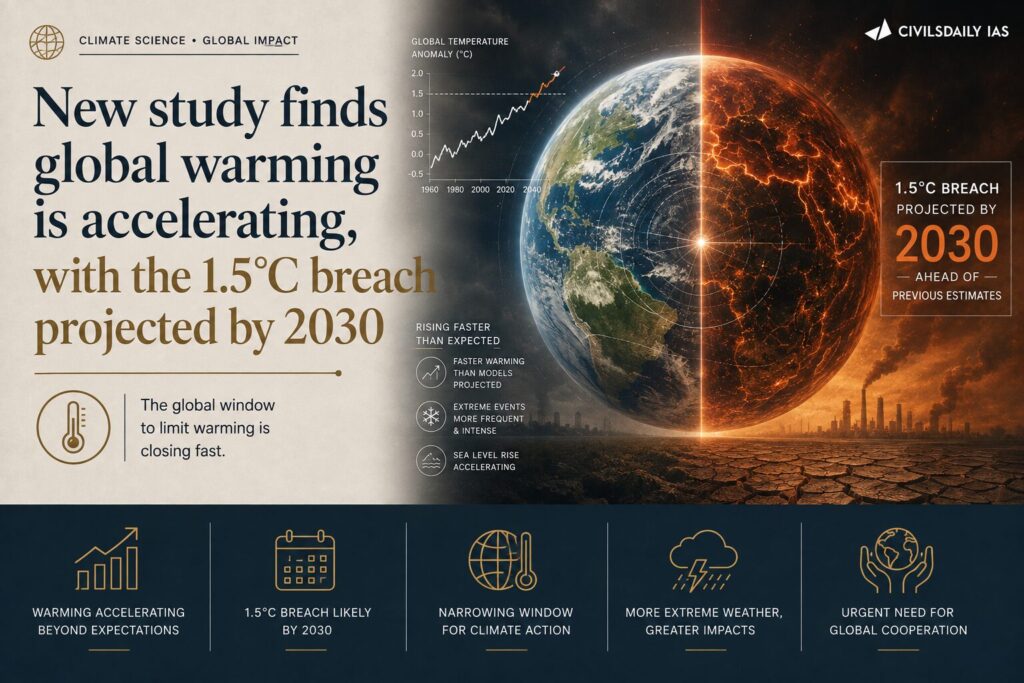
A study in the journal Geophysical Research Letters reports evidence that global warming is accelerating, not merely continuing. After removing natural noise from five temperature datasets, the authors find the last decade warmed faster than any previous decade on record, and project the 1.5 degree Celsius threshold being breached by 2030.
What is the 1.5 degree Celsius threshold?
Paris target: Under the Paris Agreement, 2015, countries agreed to hold warming well below 2 degrees Celsius above pre industrial levels and to pursue efforts to limit it to 1.5 degrees Celsius.
Why 1.5 matters: Beyond 1.5 degrees Celsius, risks of extreme heat, sea level rise, and ecosystem collapse rise sharply, making it the central guardrail of climate policy.
What are aerosols and the masking effect?
Aerosols: Aerosols are tiny particles from sources such as burning fossil fuels that reflect sunlight and exert a cooling effect on the atmosphere.
How cooling works: Light-colored particles bounce sunlight back into space and help make clouds brighter, which lowers temperatures.
The cooling mask: This pollution has acted like an invisible shield, hiding a portion of the total heat trapped by greenhouse gases
Unmasking: As pollution controls cut aerosols, their cooling effect fades and the full warming from greenhouse gases is felt, an effect the study describes as a disappearing cooling mask.
Why is measuring acceleration difficult?
Noisy temperatures: Global temperatures fluctuate year to year because of natural factors like volcanic eruptions and changes in solar activity. (Volcano noise includes the seismic vibrations, audible sounds, and infrasound produced by subsurface magma movement, degassing, and eruptions. Solar noise refers to intense bursts of radio waves and energetic emissions naturally broadcast by the Sun.)
Masked trend: These events can temporarily hide the underlying human caused warming, making it hard to prove the rate itself is rising.
How did the study establish acceleration?
Multiple datasets: The authors analysed five major global temperature datasets to avoid relying on any single record.
Statistical subtraction: They used statistical methods to remove the influence of volcanic and solar noise, isolating the human driven trend.
High confidence: After removing the noise, they were more than 98% certain the jump in warming rate was real rather than a short lived fluctuation, dating the change to around 2015.
Timing: This change or acceleration in the rate of warming was identified to have begun around 2015 .
Why does the faster pace matter?
Shrinking timeline: Under the earlier, slower rate, the world expected more time before breaching 1.5 degrees Celsius, and the accelerated pace brings the breach forward to 2030.
Twin drivers: Greenhouse gas emissions remain the primary cause, while falling aerosol pollution adds to the acceleration.
What are the challenges to limiting warming to 1.5 degrees Celsius?
Continued emissions growth: Global carbon dioxide emissions remain near record highs, driven by fossil fuel use in power, industry, and transport.
Aerosol paradox: Cutting air pollution saves lives but removes a cooling effect, accelerating near term warming.
Shrinking carbon budget: The remaining budget consistent with 1.5 degrees Celsius is small and shrinks with every year of high emissions.
Slow energy transition: Renewable growth has not yet displaced fossil fuels fast enough to cut absolute emissions.
Feedback loops: Melting ice, thawing permafrost, and forest loss release additional carbon and reduce reflectivity, reinforcing warming.
Finance and equity gaps: Developing countries lack the finance and technology transfer needed to decarbonise while meeting development needs.
Conclusion
The study reframes the problem from steady warming to an accelerating one, advancing the likely 1.5 degree Celsius breach to 2030. The central unresolved issue is that cleaning the air removes a cooling shield, so only deep and sustained cuts in greenhouse gases can slow the pace.
Back2Basics:
Paris Agreement
Adopted: 2015 at the 21st Conference of the Parties (COP21), entering into force in 2016.
Convening body: United Nations Framework Convention on Climate Change (UNFCCC).
Core goal: Limit warming well below 2 degrees Celsius, pursuing 1.5 degrees Celsius above pre industrial levels.
Mechanism: Nationally Determined Contributions, updated every five years, with a global stocktake to assess collective progress.
PYQ Relevance
[UPSC 2022] Discuss global warming and mention its effects on the global climate. Explain the control measures to bring down the level of greenhouse gases which cause global warming, in the light of the Kyoto Protocol, 1997.
Linkage: The question examines the causes, impacts and mitigation of global warming through international climate frameworks. The article adds recent evidence that global warming is accelerating, highlighting the need for faster emission cuts to achieve Paris Agreement goals.
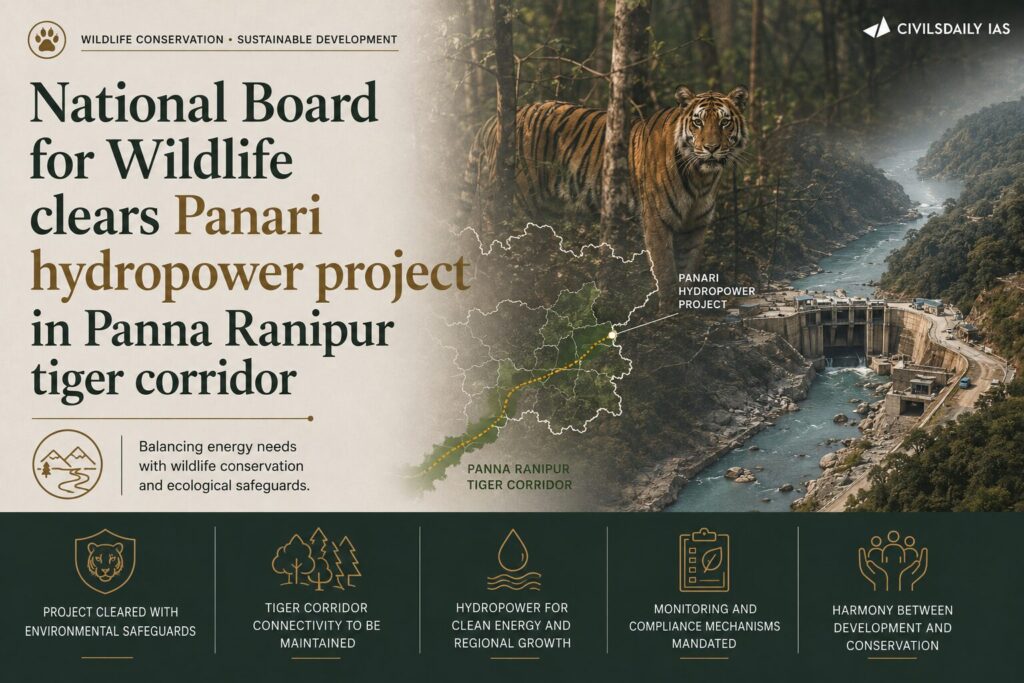
The Standing Committee of the National Board for Wildlife (NBWL) recommended wildlife clearance for the 1,800 MW Panari Pumped Storage Hydropower Project in the Panna-Ranipur Tiger Corridor, despite concerns that it could fragment a critical wildlife corridor.
How does a Pumped Storage Hydropower Project (PSH) work?
Uses two reservoirs at different elevations.
During low electricity demand, water is pumped to the upper reservoir.
During peak demand, water is released to generate electricity.
Acts as a grid-scale energy storage system for renewable energy.
What is the Panna-Ranipur Tiger Corridor?
Connects Panna Tiger Reserve (Madhya Pradesh) with Ranipur Tiger Reserve (Uttar Pradesh).
Facilitates movement of tigers, leopards, and sloth bears.
Ensures genetic exchange and healthy wildlife populations.
A wildlife corridor is a natural passage connecting fragmented habitats, enabling movement, migration, breeding, and genetic exchange among wildlife populations.
Why was the Project Cleared?
NBWL Standing Committee approved it based on recommendations of:
Loss of habitat connectivity and genetic diversity.
Cumulative impacts of multiple infrastructure projects.
Mitigation Measures
Construction of three 30-metre-wide wildlife overpasses.
Relocation of muck dumping and project facilities outside the corridor.
Realignment of project infrastructure to reduce habitat disturbance.
Back2Basics: Panna Tiger Reserve
Designation: Tiger reserve and UNESCO Biosphere Reserve, in Madhya Pradesh.
Location: Panna and Chhatarpur districts, on the Vindhyan ranges along the Ken River.
Distinction: Site of a successful tiger reintroduction after its tiger population was lost around 2009.
Linked project: Adjoins the Ken Betwa river linking project, India’s first interlinking of rivers.
“[2020] Among the following Tiger Reserves, which one has the largest area under ‘Critical Tiger Habitat’? (a) Corbett (b) Ranthambore (c) Nagarjunsagar-Srisailam (d) Sunderbans
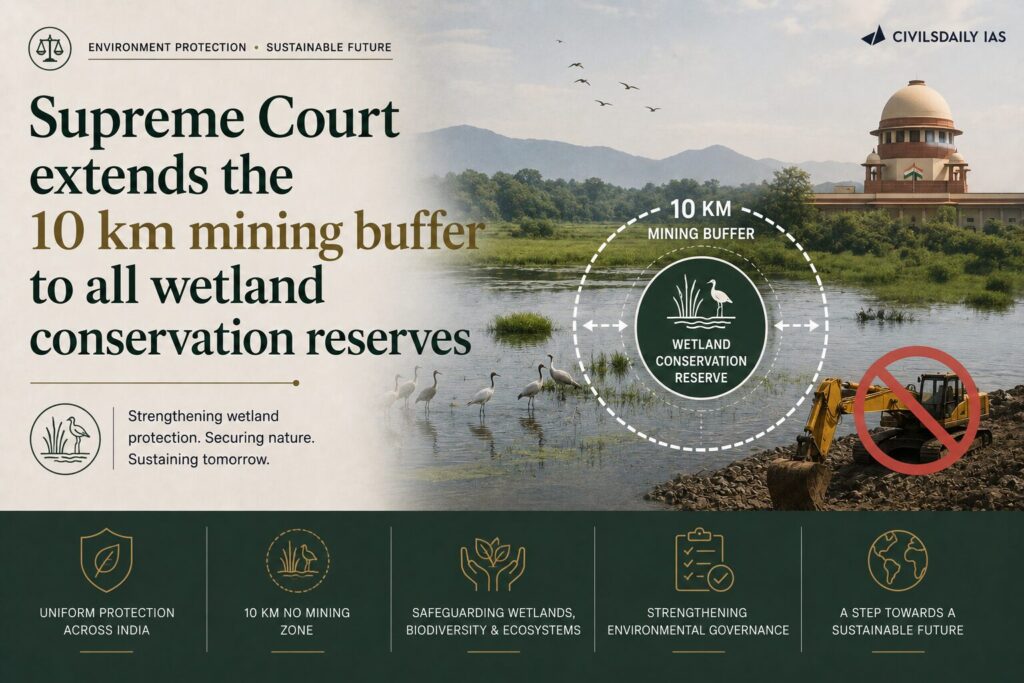
The Supreme Court clarified that its ban on mining within a 10 km radius of the Asan Conservation Reserve (a Ramsar Site) applies to all Wetland Conservation Reserves across India unless approved by the Standing Committee of the National Board for Wildlife (NBWL) and the Ministry of Environment, Forest and Climate Change (MoEFCC).
What is a Conservation Reserve?
A protected area category created under the Wildlife (Protection) Act, 1972 (through the 2002 Amendment).
Covers government-owned land adjacent to National Parks and Wildlife Sanctuaries.
Protects habitats and wildlife corridors with community participation.
What is an Eco-Sensitive Zone (ESZ)?
A buffer area notified under the Environment (Protection) Act, 1986 around National Parks and Wildlife Sanctuaries.
Restricts activities such as mining, industries, and large-scale construction to reduce ecological impacts.
Supreme Court Ruling
Extended the 10 km mining restriction to all Wetland Conservation Reserves.
Recognized wetlands as a distinct ecologically sensitive category.
Mining within the buffer requires approval from the NBWL Standing Committee and MoEFCC.
Why is the Ruling Significant?
Protects wetlands from mining and habitat degradation.
Recognizes the importance of catchment areas for wetland health.
Ensures uniform protection for wetland conservation reserves across India.
Challenges
Incomplete mapping and notification of wetlands.
Encroachment and land-use change.
Pollution and eutrophication.
Weak enforcement by State Wetland Authorities.
Development pressures from mining and infrastructure projects.
Value Addition
Ramsar Convention
International treaty for the conservation and wise use of wetlands.
Adopted in 1971 at Ramsar, Iran.
India became a Contracting Party in 1982.
Wetlands (Conservation and Management) Rules, 2017
Regulate conservation and management of notified wetlands.
Implemented through State Wetland Authorities.
Back2Basics
National Board for Wildlife (NBWL)
Statutory body under the Wildlife (Protection) Act, 1972.
Ramsar Site: Since 2020 (Uttarakhand’s first Ramsar Site).
Formed by the Asan Barrage at the confluence of the Asan and Yamuna rivers.
Important wintering habitat for migratory birds.
“[2019] Consider the following statements: 1. Under Ramsar Convention, it is mandatory on the part of the Government of India to protect and conserve all the wetlands in the territory of India. 2. The Wetlands (Conservation and Management) Rules, 2010 were framed by the Government of India based on the recommendations of Ramsar Convention. 3. The Wetlands (Conservation and Management) Rules, 2010 also encompass the drainage area or catchment regions of the wetlands as determined by the authority. (a) 1 and 2 only (b) 2 and 3 only (c) 3 only (d) 1, 2 and 3
The Supreme Court directed the Centre, States, and Union Territories to implement Standard Operating Procedures (SOPs) within four weeks to curb digital arrest cyber fraud, including freezing mule accounts, strengthening grievance redressal, and improving cybercrime coordination.
What is a Digital Arrest Scam?
A cyber fraud where scammers impersonate police or enforcement agencies through video/audio calls.
Victims are falsely told they are under “digital arrest” and coerced into transferring money.
What is a Mule Account?
A bank account used to receive and transfer proceeds of cyber fraud.
Often opened by unsuspecting or paid individuals.
Banks can impose temporary debit holds to prevent fraudulent withdrawals.
What is the Indian Cyber Crime Coordination Centre (I4C)?
A nodal agency under the Ministry of Home Affairs (MHA) for coordinating India’s response to cybercrime.
Operates the National Cyber Crime Reporting Portal (NCRP) and the 1930 Cyber Helpline.
Supreme Court Directions
Reserve Bank of India (RBI) to issue SOPs for temporary debit holds on mule accounts.
States/UTs to operationalise:
State Cyber Crime Coordination Centres.
e-Zero FIR mechanism.
Strengthen grievance redressal, money restoration, and public awareness.
Challenges
Cross-border cybercrime networks.
Rapid movement of funds through mule accounts and cryptocurrencies.
Weak inter-agency coordination.
SIM spoofing and fake identities.
Low public awareness, especially among the elderly.
Value Addition
e-Zero FIR
Enables registration of a cybercrime complaint without jurisdictional barriers.
The complaint is later transferred to the appropriate police station.
Citizen Response to Financial Cyber Fraud
Call 1930 immediately.
Report the incident on the National Cyber Crime Reporting Portal (NCRP).
Early reporting increases the chances of freezing fraudulent transactions.
Back2Basics: Indian Cyber Crime Coordination Centre (I4C)
Parent Ministry: Ministry of Home Affairs (MHA).
Established: 2020.
Key Components:
National Cyber Crime Reporting Portal (NCRP).
1930 Financial Cyber Fraud Helpline.
Mandate: Coordinate law enforcement, banks, telecom operators, and other stakeholders to prevent and investigate cybercrime.
“[2017] In India, it is legally mandatory for which of the following to report on cyber security incidents? 1. Service providers 2. Data Centres 3. Body corporate (a) 1 only (b) 1 and 2 only (c) 3 only (d) 1, 2 and 3
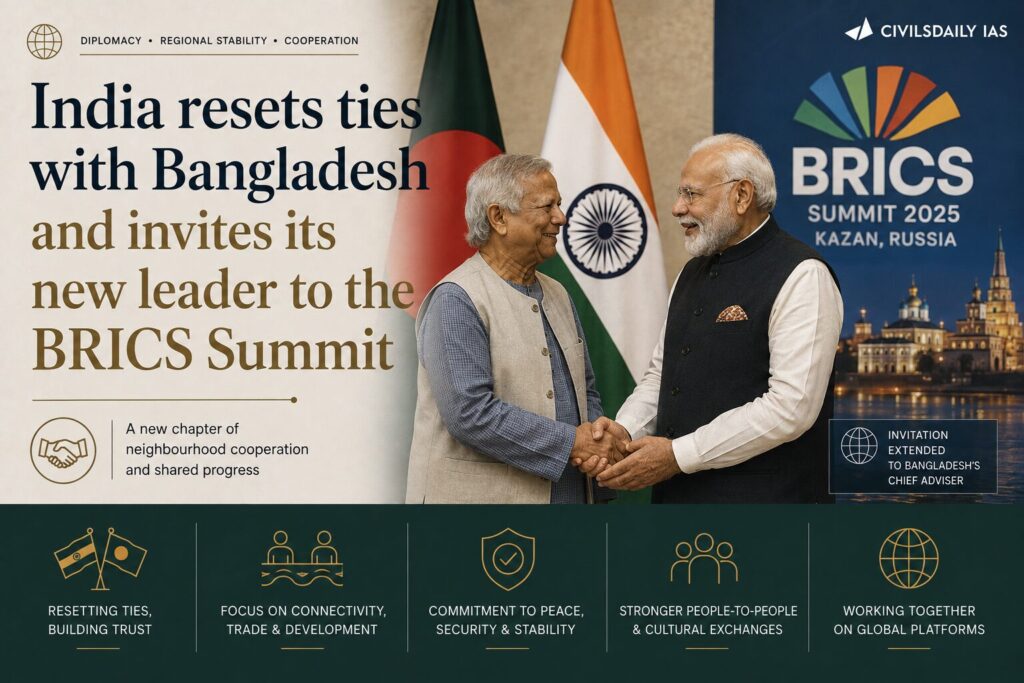
India distanced itself from former Bangladesh Prime Minister Sheikh Hasina’s public event in Delhi while inviting Bangladesh’s new leader to the 18th BRICS Summit in his capacity as BIMSTEC Chair, signalling a recalibration of ties with Dhaka.
What is BIMSTEC?
Bay of Bengal Initiative for Multi-Sectoral Technical and Economic Cooperation (BIMSTEC) is a regional organization established in 1997 to promote economic, technical, and security cooperation in the Bay of Bengal region.
Members: Bangladesh, Bhutan, India, Myanmar, Nepal, Sri Lanka, and Thailand
Secretariat: Dhaka, Bangladesh.
What is the BRICS Outreach Session?
A special session where BRICS invites leaders of regional organizations and partner countries.
Bangladesh was invited in its capacity as the current BIMSTEC Chair.
Why is India Recalibrating Ties?
Relations changed after Bangladesh’s political transition.
India has resumed engagement with the new government through diplomatic outreach and restoration of visa services.
Anti-India sentiment in sections of Bangladeshi society.
Sheikh Hasina’s presence in India.
Teesta River water-sharing dispute.
Border management, smuggling, and illegal migration.
Security of minorities.
Growing Chinese strategic and economic influence in Bangladesh.
[2026] Match List I (BIMSTEC Centre) with List II (Location): A. BIMSTEC Cultural Industries Observatory B. BIMSTEC Energy Centre C. BIMSTEC Centre for Weather and Climate D. BIMSTEC Technology Transfer Facility 1. NOIDA 2. Bengaluru 3. Colombo 4. Thimphu (a) A-3, B-2, C-1, D-4 (b) A-3, B-1, C-2, D-4 (c) A-4, B-2, C-1, D-3 (d) A-4, B-1, C-2, D-3
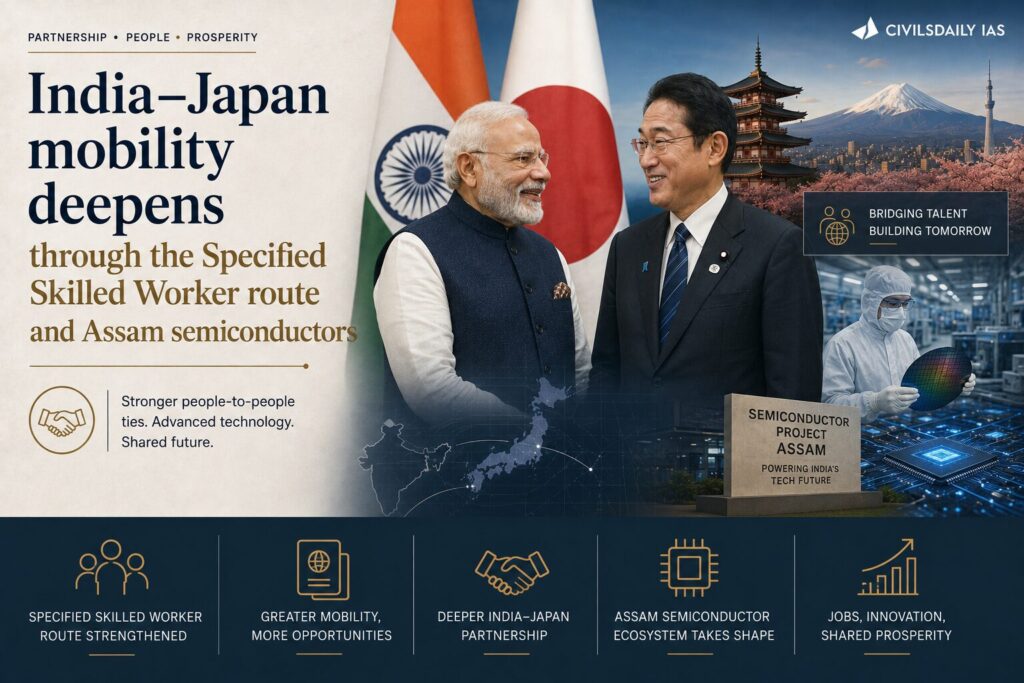
Youth from India’s Northeast are training as caregivers and agriculture workers for an ageing Japan under the Specified Skilled Worker (SSW) programme. This channels India’s demographic surplus into Japan’s labour shortage and links mobility to investment such as Japanese financed projects and the Assam semiconductor ecosystem.
What is the Specified Skilled Worker (SSW) programme?
Residence status from 2019: Japan introduced the SSW status of residence in 2019 to let blue collar foreign workers obtain a working visa for up to five years.
Eligibility: Applicants must pass a Japanese language test and a specified skills exam in one of 16 fields, including nursing care, food and beverage manufacturing and industrial products.
What is Official Development Assistance (ODA) through JICA?
JICA loans: The Japan International Cooperation Agency (JICA) is Japan’s development agency that extends concessional ODA loans for infrastructure and social projects.
Northeast footprint: JICA finances road corridors in Meghalaya, health facilities in Mizoram, Nagaland and Assam, and is joining Assam’s semiconductor ambitions.
What is the A-SEMI project?
Assam semiconductor ecosystem: The Assam Semiconductor Ecosystem on Manufacturing and Innovation (A-SEMI) is a state government project with JICA, alongside Tata Electronics’ assembly and testing facility expected to begin production this year.
Research linkage: A Japanese firm signed a memorandum with IIT Guwahati for collaborative research in semiconductor manufacturing.
Why is Japan turning to foreign workers?
The 2040 problem: Japan’s working population is projected to fall from 66.34 million in 2025 to 55.42 million in 2040, threatening severe labour shortages.
Ageing pressure: By 2040 there will be three seniors aged 65 and above for every teenager under 15.
Scaled intake: Japan expects to accept 8.05 lakh Specified Skill Workers by the end of March 2029, with highest demand in industrial manufacturing, food and beverages and nursing care.
How does this pathway serve India and the Northeast?
Remittances: A caregiver in Japan can send home Rs 50,000 to Rs 60,000 a month, far above local nursing wages of around Rs 15,000.
State backing: Assam subsidises SSW training fees, Manipur University opened a Japanese Language Centre, and Mizoram signed agreements with training centres.
Cultural affinity: Widespread interest in Japanese media and easier physical assimilation draw young people from the region into the programme.
Where does India stand among Japan’s foreign workforce?
China leads: China was the largest foreign resident group in Japan at the end of 2025 with 9.3 lakh residents.
Ahead of India:Vietnam, South Korea, the Philippines and Nepal all rank above India in resident numbers.
India’s small slice: There were 53,974 Indian nationals in Japan as of December 2024, a fraction of the foreign worker pool.
The joint target: India and Japan set an aspirational target of exchanging more than 5,00,000 personnel in both directions over five years, including 50,000 skilled personnel from India.
What are the challenges to India Japan labour mobility?
Language barrier: School level Japanese proves inadequate for daily workplace use, slowing settlement and placement.
Migration safeguards: Ensuring legal, documented channels is essential to prevent exploitation of workers moving abroad.
Skill drain: Trained nurses and caregivers leaving India can deepen shortages in the Northeast’s own health system.
Small scale: Placement numbers remain nascent relative to Japan’s demand and India’s demographic potential.
Isolation and costs: New arrivals face social loneliness and heavy documentation and relocation costs before earning.
Certification bottlenecks: Delays such as the Certificate of Eligibility can stall departures despite cleared exams.
Conclusion
India Japan mobility is at an early but expanding stage, with the SSW route, JICA financed projects and the A-SEMI semiconductor plan tying labour flows to investment. The next milestone is the launch of the A-SEMI project and progress towards the joint target of 5,00,000 personnel over five years, alongside Japan’s planned intake of 8.05 lakh Specified Skill Workers by March 2029.
Back2Basics:
Japan International Cooperation Agency (JICA)
Type: Japan’s governmental agency for delivering Official Development Assistance (ODA).
Headquarters: Tokyo, Japan.
Mandate: Provides concessional loans, grants and technical cooperation for infrastructure and social development in partner countries.
India role: A major bilateral development partner financing metro rail, connectivity, health and industrial projects, including in the Northeast.
PYQ Relevance
[UPSC 2019]The time has come for India and Japan to build a strong contemporary relationship, one involving global and strategic partnership that will have a great significance for Asia and the world as a whole.” Comment.
Linkage: The question examines the strategic and economic dimensions of the India-Japan Special Strategic and Global Partnership. The article shows how India-Japan ties are expanding beyond infrastructure to skilled mobility, human resource cooperation and semiconductor collaboration, deepening the strategic partnership.
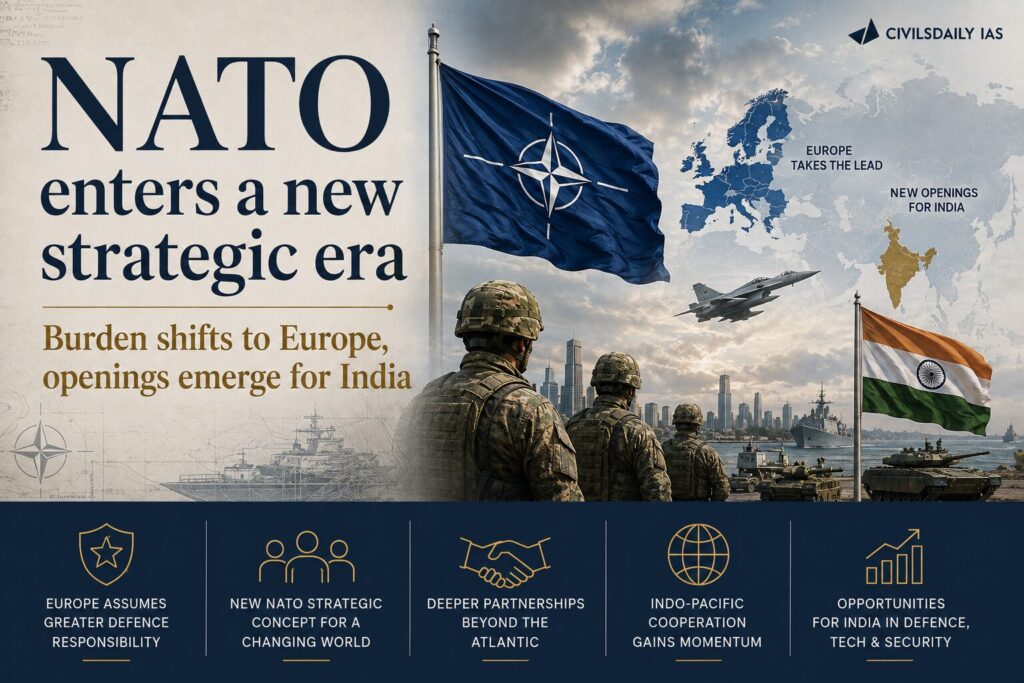
The 36th North Atlantic Treaty Organization (NATO) Summit held in Ankara (July 2026) highlighted a shift in transatlantic security, with the United States (US) urging European allies to take greater responsibility for conventional defence, allowing Washington to focus more on the Indo-Pacific.
What is NATO?
North Atlantic Treaty Organization (NATO) is a military alliance established in 1949 under the Washington Treaty.
Based on collective defence under Article 5, where an attack on one member is considered an attack on all.
Members: 32 countries (including Finland and Sweden).
Key Developments
US expects European allies to assume primary responsibility for conventional defence.
Greater emphasis on burden-sharing through higher defence spending.
US continues as NATO’s: Nuclear guarantor. Strategic enabler. Political leader.
Evolution of NATO
NATO 1.0 (1949-1991): Cold War; deterrence against the Soviet Union.
NATO 2.0 (1991-2022): Eastward expansion and operations in the Balkans and Afghanistan.
NATO 3.0 (2022 onwards): Europe strengthens conventional defence while the US focuses increasingly on the Indo-Pacific.
Significance for India
Greater US strategic focus on the Indo-Pacific.
Enhanced opportunities for India-Europe cooperation in: Defence manufacturing. Artificial Intelligence (AI). Cybersecurity. Semiconductors. Space technology.
Supports India’s strategic autonomy through diversified partnerships.
Challenges
Burden-sharing disagreements among NATO members.
Europe’s dependence on US military capabilities.
Industrial capacity constraints.
Continuing Russia-Ukraine conflict.
Simultaneous security commitments in Europe and the Indo-Pacific.
Value Addition
Article 5: The cornerstone of NATO, providing collective defence. It has been invoked only once, after the 11 September 2001 (9/11) terrorist attacks on the United States.
Article 10: Allows European states to join NATO by unanimous agreement of existing members.
NATO and India
India is not a NATO member.
India engages with several NATO members through bilateral defence cooperation while maintaining strategic autonomy.
“[2024] Consider the following pairs: Country : Reason for being in the news 1. Argentina : Worst economic crisis 2. Sudan : War between the country’s regular army and paramilitary forces 3. Turkey : Rescinded its membership of NATO How many of the pairs given above are correctly matched? (a) Only one pair (b) Only two pairs (c) All three pairs (d) None of the pairs