The Steel Authority of India Limited (SAIL) supplied 5,700 tonnes of indigenous defence grade steel for three Indian Navy ships, INS Dunagiri, INS Agray, and INS Sanshodhak, commissioned on 21 June 2026. The move strengthens India’s defence indigenisation under Atmanirbhar Bharat and Make in India.
Key Highlights
SAIL supplied 100% of the special steel requirement (5,700 tonnes) for INS Dunagiri (Stealth Frigate), INS Agray (ASW Shallow Water Craft), and INS Sanshodhak (Survey Vessel)
Steel supplied DMR 249A grade hot rolled sheets and plates (Defence grade steel).
Manufactured at Bokaro Steel Plant, Bhilai Steel Plant, and Rourkela Steel Plant
Production of DMR grade plates has been expanded, especially at the Special Plate Plant, Rourkela, to meet defence needs.
What is DMR 249A Steel?
DMR (Defence Metallurgical Research) 249A is a high strength, low alloy steel developed for naval warships.
Features: High tensile strength, Excellent weldability, High toughness, Corrosion resistance in marine environments, and Better survivability under combat conditions.
Other Major Naval Platforms Using SAIL Steel: INS Vikrant, INS Nilgiri, INS Himgiri, INS Udaygiri, INS Ajay, INS Nistar, and INS Anjadeep
The Ministry of Statistics and Programme Implementation (MoSPI) will launch the Index of Services Production (ISP) in July 2026 as India’s first monthly indicator to measure short term growth in the services sector.
What is ISP?
Index of Services Production (ISP) is a monthly high frequency indicator that measures changes in the real output (volume) of the formal services sector relative to a base year.
It is the services sector counterpart of the Index of Industrial Production (IIP).
Key Highlights
Nodal Ministry: Ministry of Statistics and Programme Implementation (MoSPI).
Base Year:2024-25.
First Trial Release:14 July 2026 (for 2025-26 and April 2026).
Release Frequency: Monthly, with a 60 day time lag.
Compiled using a fixed weight Laspeyres Volume Index.
Weights are based on Gross Value Added (GVA) of service sectors.
Objectives
Complement the Index of Industrial Production (IIP).
Provide high frequency data on the services sector.
Improve economic forecasting and business cycle analysis.
Strengthen evidence based policymaking.
Coverage
Included Sectors: Wholesale and retail trade, Transport, Banking and insurance, Telecommunications, Hotels and restaurants, Real estate, Professional, scientific and technical services, Arts, entertainment and recreation
To be Included Later: Health services and Education services (after availability of ASISSE data).
Data Sources
Administrative data: Air Transport, Railways, Banking and Insurance.
GST (GSTR-1 outward supplies): Most service industries.
Annual Survey of Incorporated Services Sector Enterprises (ASISSE): Health and Education.
Why is ISP Important?
Services contribute over 50% of India’s Gross Value Added (GVA) since 2013-14.
Provides timely tracking of service sector performance.
Enables faster policy response and economic monitoring.
Aligns India with international statistical practices.
Limitations
Covers only the formal services sector.
Excludes: Public administration and defence, Government health and education, Social work without accommodation, Household services, Activities of extraterritorial organisations, Gambling and betting, Other predominantly non market and informal services.
What is the proposed compilation formula?
ISP is proposed to be compiled using a fixed-weight Laspeyres Volume Index
Measures changes in output using fixed base year weights.
Widely used for indices such as IIP due to ease of comparison over time.
[2020] Consider the following statements: 1.The weightage of food in the Consumer Price Index (CPI) is higher than that in the Wholesale Price Index (WPI). 2.The WPI does not capture changes in the prices of services, which the CPI does. 3.The Reserve Bank of India uses WPI as its key measure of inflation to decide changes in policy rates. Which of the statements given above is/are correct?
PYQ Relevance[UPSC 2025] “India aims to become a semiconductor manufacturing hub. What are the challenges faced by the semiconductor industry in India? Mention the salient features of the India Semiconductor Mission” Linkage: The PYQ is directly linked to the India Semiconductor Mission as a key initiative for building integrated manufacturing ecosystems (similar to TSMC) to achieve global industrial leadership
Mentor Comment
This article highlights the shift from “innovation-led growth” to “innovation-led global leadership.” For UPSC, do not restrict the discussion to R&D or startups. Link it with Atmanirbhar Bharat, Make in India, Startup India, India Semiconductor Mission, National Quantum Mission, IndiaAI Mission, Digital Public Infrastructure (UPI, Aadhaar, ONDC), Ease of Doing Business, and Industrial Policy.
Why in the News?
India is launching major technology missions in semiconductors, artificial intelligence, quantum computing, and space. India’s prior experience with early-mover technologies — semiconductors in the 1970s, indigenous computing in the 1980s, and the Simputer in 1998 — shows a consistent pattern of abandoning innovations before they reach global commercial scale.
Why has early technological leadership repeatedly failed to produce globally dominant Indian industries?
SCL and the semiconductor gap: India established Semiconductor Complex Limited (SCL) in the 1970s, but limited capital, small manufacturing scale, inconsistent policies, and a public sector focus prevented the creation of a competitive semiconductor ecosystem.
ECIL and the strategic-commercial divide: Established in 1967, ECIL developed indigenous computers and control systems under technology embargoes. However, its emphasis on strategic self reliance rather than market competition limited industrial expansion.
Simputer and ecosystem constraints: The Simputer (1998) anticipated many smartphone features, but inadequate venture capital, weak component supply chains, limited software platforms, and a small consumer market prevented global scaling.
Structural pattern: The recurring challenge was not a lack of innovation but weak commercialisation, insufficient capital mobilisation, and underdeveloped innovation ecosystems.
Apple as a counterfactual: Apple converted a similar computing vision into a global technology leader through integrated hardware, software, and supply chain capabilities, highlighting the scaling infrastructure India lacked.
Where has India demonstrated successful technology scaling, and what conditions enabled it?
Pharmaceuticals: India emerged as the “pharmacy of the world” and a leading vaccine producer through process innovation, cost efficiency, and export orientation.
Supercomputing (PARAM): The PARAM programme showed that sustained public investment with clear performance goals can build globally recognised indigenous capabilities.
Aadhaar and UPI: Built for nationwide scale, these digital public infrastructures transformed identity and payments, promoted financial inclusion, and became global models.
Scaling mechanism: Success came when technologies were designed for mass adoption rather than limited institutional use, creating ecosystems that generated industries and global impact.
Frugal innovation advantage: Missions like Chandrayaan and Mangalyaan proved that cost effective engineering can deliver world class outcomes, offering a strong model for future AI, semiconductor, and quantum technologies.
What do international examples reveal about the institutional conditions required to convert technological invention into dominant industries?
Taiwan (TSMC): Taiwan created a dedicated semiconductor foundry model backed by sustained state industrial policy, long-term capital, and export-orientation from the outset. TSMC now holds over 50% of the global foundry market — built on the same window India identified in the 1970s.
South Korea (Samsung): South Korea used state-directed credit, mandatory technology transfer conditions in foreign investment, and chaebol-scale domestic investment to build Samsung’s semiconductor and electronics empire. Strategic intent was matched with commercial ambition.
United States (AI and space commercialisation): The US transitioned defence and research investments into commercial platforms through procurement policy, deep venture capital markets, and university-industry linkages. NASA’s Commercial Crew Programme is an example of public mission enabling private scaling.
The common design feature: In each case, the state defined a commercial outcome — not only a technical capability — as the measure of success. Public funding was structured to de-risk private investment rather than substitute for it.
Limitation of the comparison: These examples developed within large domestic or allied-market demand bases. India’s scaling challenge is to build global demand for Indian-origin platforms, which requires a different export and partnership strategy.
What institutional and policy conditions must India establish for the current technology missions to produce globally competitive enterprises rather than repeating the earlier pattern?
Redefine the success metric: Public technology missions must measure success by commercial market share and global deployment, not by indigenous capability certificates or pilot completions.
Capital architecture: Venture capital, patient institutional capital, and public de-risking mechanisms must operate together. Scientific excellence funded without a commercialisation pathway reproduces institutional silos.
Ecosystem design from day one: Supply chains, software platforms, developer communities, and consumer or enterprise markets must be designed into missions at inception, not added after technical milestones are achieved.
Mandate commercial accountability in public institutions: Institutions such as C-DAC, ISRO’s commercial arm, and any new semiconductor entity must carry explicit commercial performance obligations alongside strategic mandates.
Quantum and healthcare applications: For quantum computing, the competitive advantage lies in reducing infrastructure costs and developing practical applications in drug discovery, materials science, and climate modelling domains, where India has existing scientific depth.
Conclusion
India’s technology history does not reveal a failure of scientific capability. It reveals a consistent failure to build the commercial ecosystems, capital structures, and institutional mandates required to scale invention into globally competitive industries. The countries that will lead the next technological era may not be those that invent first. They will be those that scale fastest. India’s current missions in AI, semiconductors, quantum computing, and space represent a second opportunity to claim the leadership positions it identified and then vacated in earlier technology cycles. Seizing that opportunity requires replacing the measure of self-reliance — from technical capability achieved to global market position built.
The Union Government amended the Foreign Contribution (Regulation) Rules, 2011, introducing stricter norms for NGOs receiving foreign funds under the Foreign Contribution (Regulation) Act (FCRA), 2010.
New Registration Requirements
NGOs must register under one or more of five categories: Social, Economic, Educational, Cultural, and Religious
Must specify: Exact purpose of foreign contribution. State/UT-wise area of operation.
Separate fee payable for each category and each State/UT.
Enhanced Disclosure
NGOs must disclose: Websites, Social media accounts, Publications (books, magazines, newspaper articles), and Annual activities and geographical scope.
Expanded Definition of “Key Functionary”
Now includes: Office-bearers, Directors, Trustees, Partners, Karta/Head of Hindu Undivided Family (HUF), Governing body members, and Any person controlling or managing the organization.
Restrictions
NGOs with foreign nationals (except Persons of Indian Origin) as key functionaries will generally not be eligible unless specifically permitted by the Central Government.
Educational and cultural activities must remain strictly non-political.
Religious activities exclude proselytisation.
Penalties
Minimum fine: ₹1 lakh.
Misuse of foreign funds or use for unapproved purposes/States: 30% of the amount involved or ₹1 lakh, whichever is higher.
Similar penalties for Excess administrative expenditure, Speculative investments, and Unauthorized receipt or utilization of foreign contributions.
Regulates acceptance and utilization of foreign contributions and hospitality by individuals, associations, and NGOs.
Administered by the Ministry of Home Affairs (MHA).
Objectives: Ensure foreign funds do not adversely affect Sovereignty and integrity of India, National security, Public interest, and Democratic institutions
[2021] At the national level, which ministry is the modal agency to ensure effective implementation of the scheduled Tribes and Other Traditional Forest Dwellers (Recognition of Forest Rights) Act, 2006?
[A] Ministry of Environment, Forest and Climate Change
Union Minister Sarbananda Sonowal highlighted V. O. Chidambaranar Port Authority as a model for sustainable maritime development, releasing its first Sustainability Report and launching several green and digital initiatives.
Key Highlights
Net carbon emissions reduced by 45%.
Renewable energy offsets nearly 94% of the port’s energy consumption equivalent.
Carbon intensity per tonne of cargo reduced by nearly 50% over the last four years.
Recognized as a Scope-2 Emission Free Port for its transition to clean energy.
Green Hydrogen Initiative
Hosts India’s first Green Hydrogen pilot project at a major port.
Featured in an Indian Institute of Management Calcutta case study titled “The Hydrogen Pivot”.
Education & Innovation
Kendriya Vidyalaya, VOC Port commenced academic activities for the 2026-27 session.
MoU signed with Gati Shakti Vishwavidyalaya for Maritime logistics research, Skill development, Sustainable port operations, and Centre of Excellence in Maritime Logistics & Port Management.
Digital Transformation
Launched PortGPT, making VOC Port the first major port in India to introduce an enterprise-grade generative AI mobile application for Operational efficiency, Knowledge management, and Data-driven decision-making.
Scope-2 Emissions
Indirect greenhouse gas emissions from purchased electricity, steam, heating, or cooling consumed by an organization.
Defined under the Greenhouse Gas (GHG) Protocol.
Green Hydrogen
Produced through electrolysis of water using renewable energy.
Emits zero carbon dioxide during production.
Key pillar of India’s National Green Hydrogen Mission.
[2023] Consider the following pairs : Port—–Well known as 1.Kamarajar Port—-First major port in India registered as a company 2.Mundra Port—–Largest privately owned port in India 3.Visakhapatnam—-Largest container port in India
The Department of Administrative Reforms and Public Grievances (DARPG) released the 46th CPGRAMS Monthly Report for States/UTs, highlighting public grievance redressal performance and capacity-building initiatives.
Public Grievance Redressal
Public Grievances (PG) received:85,900
PG cases redressed:84,365
Total pending cases (31 May 2026):2,13,190
22 States/UTs have more than 1,000 pending grievances.
State Performance
Highest disposals:
Uttar Pradesh: 27,030 cases
Maharashtra: 9,476 cases
User Participation
New CPGRAMS users registered:65,174
Registrations from Uttar Pradesh:11,365
Feedback collected by Call Centre:78,830
From States/UTs: 32,283
Common Service Centres (CSCs)
CPGRAMS integrated with 5 lakh+ CSCs and 2.5 lakh Village Level Entrepreneurs (VLEs).
8,562 grievances registered through CSCs during May 2026.
Sevottam Scheme
FY 2022-23 to FY 2026-27 (till May):1,175 training programmes conducted and 38,693 officers trained.
New Initiative: Samadhan Didi, an AI-enabled Voice Chatbot, launched on 30 May 2026 to improve digital public grievance redressal.
CPGRAMS (Centralized Public Grievance Redress and Monitoring System)
An online platform for citizens to lodge grievances against Central Ministries, Departments, and States/UTs.
Developed and managed by DARPG.
Enables tracking, monitoring, and time-bound disposal of grievances.
Sevottam Scheme: A quality management framework aimed at improving Citizen charters, Public grievance redressal, and Service delivery excellence
[2021] With reference to the Union Government, consider the following statements: 1. N. Gopalaswamy Iyengar Committee suggested that a minister and a secretary be designated solely for pursuing the subject of administrative reform and promoting it. 2. In 1970, the Department of Personnel was constituted on the recommendation of the Administrative Reforms Commission, 1966, and this was placed under the Prime Minister’s charge. Which of the statements given above is/are correct?
PYQ Relevance[UPSC 2024] Describe the context and salient features of the Digital Personal Data Protection Act, 2023 Linkage: Data sovereignty is a critical pillar of digital sovereignty, aimed at keeping sensitive information under domestic jurisdiction and protecting it from foreign access.
Mentor’s Comment
Digital sovereignty is no longer limited to data localization; it encompasses control over digital infrastructure, cloud services, semiconductors, AI, software, and defence technologies. For UPSC, link this topic with Atmanirbhar Bharat, Digital Public Infrastructure (UPI, Aadhaar, ONDC), National Security, Semiconductor Mission, AI governance, cyber security, and strategic autonomy. A balanced answer should advocate indigenous innovation, higher R&D spending, private sector participation, and trusted international partnerships rather than complete technological isolation.
Why in the News?
Recent incidents, including the compromise of Indian CCTV networks through foreign software, the denial of digital services to Nayara Energy due to EU sanctions, and India’s growing focus on semiconductor manufacturing, indigenous digital platforms, and trusted technology partnerships such as Pax Silica, have renewed the debate on India’s digital sovereignty and technological self reliance.
What is digital sovereignty?
Digital sovereignty is a nation’s ability to control its digital infrastructure, data, technologies, and critical digital services without undue dependence on foreign entities.
Why is it important for India?
Strategic Autonomy: Ensures independent decision making in technology and security. Eg: Indigenous UPI and RuPay payment systems.
National Security: Protects critical infrastructure from external interference. Eg: Reducing reliance on foreign cloud platforms for defence data.
Data Sovereignty: Keeps sensitive data under domestic jurisdiction. Eg: Government authentication and cloud services hosted on Indian platforms.
Economic Competitiveness: Promotes innovation and domestic digital industries. Eg: India’s semiconductor ecosystem and digital public infrastructure.
Why does dependence on foreign digital infrastructure pose risks?
National Security Risk: Foreign entities may compromise critical infrastructure. Eg: CCTV networks allegedly compromised through EseeCloud software.
External Sovereign Control: Foreign governments can influence technology providers. Eg:Microsoft’s denial of services to Nayara Energy following EU sanctions.
Data Security: Sensitive information may become accessible to foreign jurisdictions. Eg: Cloud companies compelled to share data with home governments.
Defence Vulnerability: Software controlled abroad may affect military capabilities. Eg:GPS restrictions during the 1999 Kargil conflict.
Economic Disruption: Suspension of digital services can halt business operations. Eg: Loss of access to corporate email and collaboration platforms.
How can India strengthen its digital sovereignty?
Indigenous Innovation: Develop domestic digital infrastructure and technologies. Eg:UPI, RuPay, NavIC, Zoho adoption in government systems.
Private Sector Participation: Encourage competitive domestic technology development. Eg: Private sector involvement in the Advanced Medium Combat Aircraft (AMCA).
Trusted International Partnerships: Develop technologies through strategic collaborations. Eg:BrahMos missile programme and Pax Silica initiative.
Higher R&D Investment: Strengthen innovation capacity and technological leadership. Eg: Increasing R&D expenditure beyond the current 0.74% of GDP.
Which global practices can India adopt for digital sovereignty?
Sovereign Digital Platforms: Develop domestic alternatives for government services. Eg:France replacing Microsoft Teams and Zoom with a sovereign platform.
Independent Cloud Infrastructure: Reduce reliance on foreign cloud providers. Eg:European Union’s sovereign cloud initiatives.
Localization of Critical Software: Promote indigenous productivity and enterprise software. Eg:Germany, Denmark, and the Netherlands exploring domestic alternatives.
Trusted Technology Partnerships: Build technology ecosystems with like minded nations. Eg:Pax Silica initiative on AI and supply chain security.
Public Private Innovation Model: Government support with private sector execution. Eg:U.S. defence production and procurement model.
What are the implications of enhancing India’s digital sovereignty?
Strategic Autonomy: Reduces dependence on foreign powers for critical technologies. Eg:NavIC providing indigenous satellite navigation.
National Security: Improves resilience against cyber threats and external coercion. Eg: Indigenous defence software and secure cloud infrastructure.
Economic Growth: Strengthens domestic digital industries and high value manufacturing. Eg: Expansion of the semiconductor and AI ecosystem.
Technological Leadership: Encourages innovation and global competitiveness. Eg: Success of Digital Public Infrastructure (DPI) such as UPI.
Resilient Supply Chains: Minimizes disruptions from geopolitical tensions and sanctions. Eg: Diversified technology partnerships through Micron and Pax Silica.
Global Influence: Positions India as a trusted technology and digital governance leader. Eg: Export of India’s DPI model to partner countries.
Conclusion
Digital sovereignty is the cornerstone of India’s technological security, economic resilience, and strategic autonomy. By strengthening indigenous innovation, investing in R&D, promoting public private collaboration, and building trusted global partnerships, India can reduce external vulnerabilities and emerge as a secure, self reliant, and globally competitive digital power in an increasingly technology driven world.
The issue is in the news following a proposal under the Jan Vishwas framework to centrally publish all government edicts and treat any non publicly accessible edict as null and void. The debate has also gained attention after the Indian Roads Congress (IRC) issued a takedown notice against the public sharing of its road safety standards, raising questions about whether government standards and safety regulations should be freely accessible as part of the law and public knowledge.
What are government edicts?
Government Edicts: Government edicts are legally binding instruments issued by the State, including laws, rules, regulations, notifications, circulars, guidelines, standards, SOPs, and government orders that govern citizens and institutions.
Why should they be public?
Rule of Law: Citizens cannot obey laws they cannot access. Eg: Public access to Indian Roads Congress (IRC) standards.
Legal Transparency: Prevents hidden or “shadow” regulations. Eg: Central publication of government notifications.
Democratic Accountability: Enables public scrutiny of government actions. Eg: Citizens reviewing road safety standards.
Access to Justice: Ensures equal knowledge of legal obligations. Eg:MSMEs accessing compliance standards without barriers.
Citizen Empowerment: Creates an informed citizenry and participatory governance. Eg: Engineers and researchers using public standards.
Why is public access to safety standards important for democracy?
Public Safety: Open standards improve compliance and reduce risks. Eg:Helmet and building safety standards.
Right to Information: Citizens have a right to know rules affecting their lives. Eg: Free access to drinking water quality standards.
Transparency: Prevents arbitrary enforcement of technical regulations. Eg: Publicly available road construction norms.
Ease of Doing Business: Reduces compliance costs for businesses. Eg: MSMEs accessing manufacturing standards.
Inclusive Governance: Eliminates information asymmetry. Eg: Contractors and citizens following the same safety norms.
How can the Jan Vishwas framework improve legal transparency?
Centralized Repository: All government edicts available on one digital platform. Eg: Expansion of India Code.
Removal of Shadow Instruments: Makes regulations, circulars, guidelines, and SOPs publicly accessible. Eg: Publishing notifications and standards.
Null and Void Principle:Unpublished edicts should have no legal force. Eg: Citizens cannot be penalized under inaccessible rules.
Digital Governance: Creates searchable and regularly updated legal databases. Eg: Online repository of standards and regulations.
Regulatory Certainty: Improves predictability and compliance. Eg: Uniform interpretation of safety standards.
Which global practices can India adopt for open government standards?
Open Government Doctrine: Laws belong to the public domain. Eg: U.S. Supreme Court principle, “No one should own the law.”
Public Interest Access: Mandatory safety standards should be freely accessible. Eg:European Union constitutional jurisprudence.
Open Licensing: Government information can be reused without restrictions. Eg:UK Open Government Licence.
Works of Government Policy: Government publications should not be subject to restrictive copyright. Eg:U.S. federal government works are in the public domain.
Digital Legal Repository: Ensures centralized access to legal materials. Eg: Government portals providing free legal documents.
What are the implications of making government standards freely accessible?
Strengthened Rule of Law: Ensures equal access to legal obligations. Eg: Public availability of BIS and IRC standards.
Improved Public Safety: Promotes better implementation of technical standards. Eg: Compliance with building and road safety norms.
Economic Growth: Lowers compliance costs and encourages innovation. Eg: Support for Make in India and MSMEs.
Greater Transparency and Accountability: Reduces regulatory opacity. Eg: Open access to government notifications and guidelines.
Enhanced Democratic Participation: Creates informed stakeholders. Eg: Researchers, civil society, and courts using open government standards.
Knowledge as a Public Good: Publicly funded information should benefit everyone. Eg:BIS making Indian Standards freely available online.
Conclusion
Government edicts and mandatory safety standards are public goods that form the foundation of the rule of law, transparency, and democratic accountability. Ensuring their free and universal accessibility through the Jan Vishwas framework can strengthen legal certainty, public safety, ease of doing business, and citizen empowerment, reaffirming the principle that “no one should own the law.”
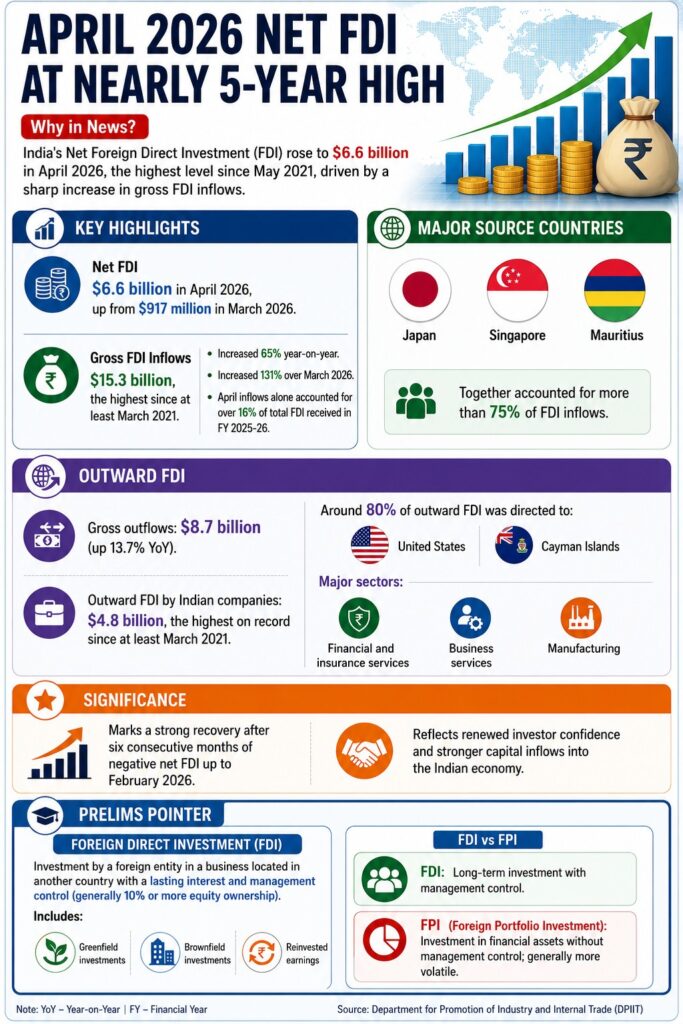
India’s Net Foreign Direct Investment (FDI) rose to $6.6 billion in April 2026, the highest level since May 2021, driven by a sharp increase in gross FDI inflows.
Key Highlights
Net FDI:$6.6 billion in April 2026, up from $917 million in March 2026.
Gross FDI Inflows:$15.3 billion, the highest since at least March 2021.
Increased 65% year-on-year.
Increased 131% over March 2026.
April inflows alone accounted for over 16% of total FDI received in FY 2025-26.
Major Source Countries
Japan, Singapore, and Mauritius
Together accounted for more than 75% of FDI inflows.
Outward FDI
Gross outflows:$8.7 billion (up 13.7% YoY).
Outward FDI by Indian companies:$4.8 billion, the highest on record since at least March 2021.
Around 80% of outward FDI was directed to United States and Cayman Islands
Major sectors Financial and insurance services, Business services, and Manufacturing
Significance
Marks a strong recovery after six consecutive months of negative net FDI up to February 2026.
Reflects renewed investor confidence and stronger capital inflows into the Indian economy.
Foreign Direct Investment (FDI)
Investment by a foreign entity in a business located in another country with a lasting interest and management control (generally 10% or more equity ownership).
Includes Greenfield investments, Brownfield investments, and Reinvested earnings
FDI vs FPI
FDI: Long-term investment with management control.
FPI (Foreign Portfolio Investment): Investment in financial assets without management control; generally more volatile.
[2021] Consider the following: 1. Foreign currency convertible bonds 2. Foreign institutional investment with certain conditions 3. Global depository receipts 4. Non-resident external deposits Which of the above can be included in Foreign Direct Investments?
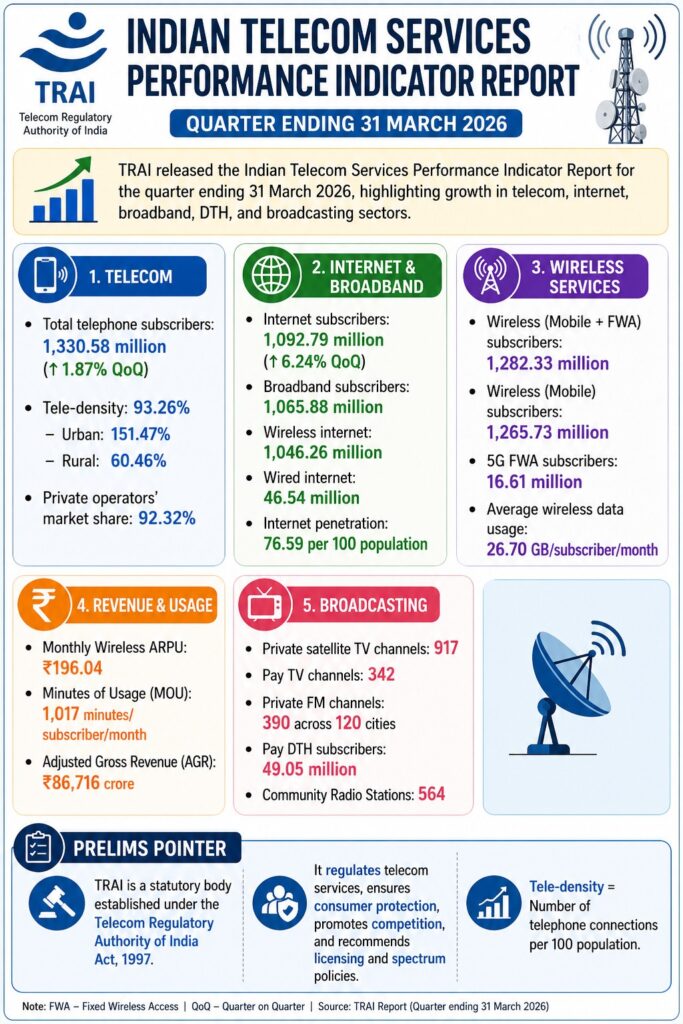
TRAI released the Indian Telecom Services Performance Indicator Report for the quarter ending 31 March 2026, highlighting growth in telecom, internet, broadband, DTH, and broadcasting sectors.
Telecom
Total telephone subscribers:1,330.58 million (↑1.87% QoQ).
Tele-density:93.26%: Urban: 151.47% and Rural: 60.46%
Private operators’ market share:92.32%.
Internet & Broadband
Internet subscribers:1,092.79 million (↑6.24% QoQ).
Average wireless data usage:26.70 GB/subscriber/month.
Revenue & Usage
Monthly Wireless ARPU:₹196.04.
Minutes of Usage (MOU):1,017 minutes/subscriber/month.
Adjusted Gross Revenue (AGR):₹86,716 crore.
Broadcasting
Private satellite TV channels:917
Pay TV channels:342
Private FM channels:390 across 120 cities
Pay DTH subscribers:49.05 million
Community Radio Stations:564.
Prelims Pointer
TRAI is a statutory body established under the Telecom Regulatory Authority of India Act, 1997.
It regulates telecom services, ensures consumer protection, promotes competition, and recommends licensing and spectrum policies.
Tele-density = Number of telephone connections per 100 population.
[2019] With reference to communications technologies, what is/are the difference/differences between LTE (Long-Term Evolution) and VoLTE (Voice over Long-Term Evolution)? 1. LTE is commonly marketed as 3G and VoLTE is commonly marketed as advanced 3G. 2. LTE is data-only technology and VoLTE is voice-only technology. Select the correct answer using the code given below.