💥Join UPSC 2027,2028 Mentorship (August Batch) + XFactor Notes & Microthemes PDF

Distribution: weekly

  • Competition panel penalizes Google

    The Competition Commission of India (CCI) has imposed a ₹1,337.76-crore penalty on Google for abusing its dominant position in multiple markets in the Android mobile device ecosystem.

    What did Google do?

    • Google had abused its dominance in the licensing of its operating system for smart mobile devices, app store market for Android smart mobiles among others.
    • The CCI examined various practices of Google with respect to its licensing and various proprietary mobile applications, including Play Store, Google Search, Google Chrome, YouTube, etc.

    About Competition Commission of India

    • CCI is the competition regulator in India.
    • It is a statutory body responsible for enforcing The Competition Act, 2002 and promoting competition throughout India and preventing activities that have an appreciable adverse effect on competition in India.
    • It was established on 14 October 2003. It became fully functional in May 2009.

    Its establishment

    • A need was felt to promote competition and private enterprise especially in the light of 1991 Indian economic liberalization.
    • The idea of CCI was conceived and introduced in the form of The Competition Act, 2002 by the Vajpayee government.
    • The Competition Act, 2002, as amended by the Competition (Amendment) Act, 2007, follows the philosophy of modern competition laws.
    • The Act prohibits anti-competitive agreements, abuse of dominant position by enterprises, and regulates combinations (acquisition, acquiring of control, and Merger and acquisition), which causes or likely to cause an appreciable adverse effect on competition within India.


    UPSC 2023 countdown has begun! Get your personal guidance plan now! (Click here)

  • An Indian Pioneer of ORT

    ORT

    Context

    • In the demise of Dilip Mahalabnis on October 16 we lost a pioneering public health physician the ORS pioneer who helped save millions of lives. In 1978, a Lancet editorial termed ORS the most important medical advance in this century.

    Background

    • ORT was first introduced worldwide in the 1970s to treat millions of children suffering from severe dehydration in crisis-stricken and impoverished areas. At the time, the world’s leading general medical journal The Lancet called ORT “potentially the most important medical advance since penicillin.”
    • A Lancet editorial in 1978 termed it “potentially the most important medical advance this century”.

    Interesting story of Dilip Mahalabnis and invention of ORT

    • Mahalanabis was trained as a paediatrician and joined the Cholera Research Programme of the Johns Hopkins University Center for Medical Research and Training (JHCMRT) in Calcutta in 1966.
    • His team was treating cases of the cholera epidemic in a camp in Bangaon, West Bengal that housed 3,50,000 refugees but ran out of intravenous fluids. He thought that it would be opportune to use ORS. As no ORS packets were available, they mixed salt and sugar solution (ORS) in drums and administered it to the cholera patients in the camps.
    • The library of the JHCMRT was converted into a factory. This was not a mandated mode of treatment and at great personal risk, Mahalanabis chose to respond to the humanitarian crisis in this manner.
    • It was evident in two to three weeks’ time that not only was the therapy working but that it was possible to administer ORT through volunteers (in the absence of a sufficient number of trained workers).
    • It was subsequently analyzed that ORS reduced mortality due to cholera or acute diarrhoeal diseases in these camps from 40 per cent to 5 per cent. They coined the term “oral saline” and rest is the story.

    ORT

    What is Oral Rehydration Therapy (ORT)?

    • A fluid to correct dehydration: Oral Rehydration Therapy (ORT) entails drinking water with modest amounts of sugar and salts, specifically sodium and potassium to correct dehydration due to fluid losses from diarrhoea.
    • ORT ingredients: ORT combines three ingredients such as salts, sugars and water to quickly reverse the signs of dehydration. Through the process of osmosis, the salts and sugars pull water into your bloodstream and speed up rehydration.
    • Essential electrolytes which replenish Blood: ORT also replenishes your blood with essential electrolytes (minerals) that are lost due to intense exercise, exposure to extreme weather conditions, or diarrhea and other illnesses. Water doesn’t contain electrolytes and so, ironically, water alone cannot cure dehydration like ORT.
    • An effective electrolyte: Administration of fluids through the intravenous route used to be the mainstay of management of cholera till the results of a study demonstrated that an oral solution of glucose and electrolytes was effective for replacing water and electrolyte losses.
    • Quick and efficient: The translation of the basic science concept to quick and efficient practice was, however, not easy. And that is the fascinating story and sterling contribution of Mahalanabis and his co-workers on ORT.

    What is Dehydration?

    • Dehydration occurs when you use or lose more fluid than you take in, and your body doesn’t have enough water and other fluids to carry out its normal functions. If you don’t replace lost fluids, you will get dehydrated.

    ORT

    What is Disease Cholera?

    • Cholera is an acute diarrhoeal infection caused by ingestion of food or water contaminated with the bacterium Vibrio cholerae that can kill within hours if left untreated.
    • Most of those infected will have no or mild symptoms and can be successfully treated with oral rehydration solution. Cholera affects both children and adults.
    • Provision of safe water and sanitation is critical to prevent and control the transmission of cholera and other waterborne diseases.
    • Cholera remains a global threat to public health and an indicator of inequity and lack of social development.

    Recent outbreak of cholera In India

    • Cholera is said to be endemic in India. However, the reported cases in India tend to be much lesser than the actual numbers, say doctors and experts.
    • The number of cases is rising in India because we still lack the basic sanitation, hygiene and access to clean water in many communities,
    • The country reports nearly 20,000 to 30,000 cases of cholera every year, usually during the monsoon season of July to September.
    • Climate change adds up another layer to the cholera outbreak.

    Contribution of ORT to the world.

    • As a perfect alternative over the prevailing doctrine: ORT was in marked contrast to the then prevailing doctrine of patients being given only sips of water without food, euphemistically called “resting the stomach”, often worsening the underlying malnutrition.
    • For Diarrhoea: An estimated 54 million diarrhoeal deaths were averted by ORT alone between 1978 and 2008, such was the magnitude of its beneficial impacts. ORT for the management of severe diarrhea was developed in the latter half 1960s. WHO launched a worldwide campaign in 1978 to reduce mortality related to diarrhea, with ORT as one of the key elements.
    • For cholera: Administration of fluids through the intravenous route used to be the mainstay of management of cholera till the results of a study demonstrated that an oral solution of glucose and electrolytes was effective for replacing water and electrolyte losses
    • Cholera pandemic: This period coincided with the seventh cholera pandemic (El Tor biotype) that started in Indonesia in 1961 and spread to East Pakistan (Bangladesh) by 1963 and to India in 1964. Though experiments with ORS were underway, the WHO responded in 1970 by distributing large amounts of intravenous fluids – a move marked by high transportation costs and limited utilization on account of a shortage of a trained health workforce. The focus of the Southeast Asia Treaty Organization (SEATO), through the Cholera Research Laboratory in Dhaka, was to find a vaccine to protect the US troops from cholera attacks in Southeast Asia.
    • One solution for everyone: Athletes; people with illnesses, especially babies and toddlers; seniors; military personnel stationed in extreme climates; air travelers who lose electrolytes every time they fly: They all stand to dramatically improve their health and well-being with ORT.

    ORT

    Conclusion

    • Dilip Mahalanabis pioneered a simple and effective solution for diarrhoea that saves millions of lives which can be considered as one of the greatest contributions of Indian in medical sciences. To carry the carry legacy forward young scientists should step in.

    Mains Question

    Q. What do you Understand by Oral Rehydration Therapy? How it could be effective in tackling the yearly outbreaks of Cholera in India and the world. Discuss.

    UPSC 2023 countdown has begun! Get your personal guidance plan now! (Click here)

  • China’s total trade surplus with India ‘surpasses $1 trillion’

    china

    The favourable trade balance that China has enjoyed with India, since bilateral trade began to boom in the early 2000s, has now exceeded $1 trillion.

    India-China bilateral trade

    • In 2021, annual two-way trade crossed $100 billion for the first time, reaching $125.6 billion, with India’s imports accounting for $97.5 billion, pegging the imbalance at close to $70 billion.
    • This is certainly a healthy deficit compared to the industrial development in both nations.

    A quick backgrounder

    • Trade ties began to boom since the early 2000s.
    • This was driven largely by India’s imports of Chinese machinery and other equipment.
    • It rose up from $3 billion in the year 2000 to $42 billion in 2008, the year China became India’s largest trading partner.

    The Hindi-Chini buy buy

    • A third of machinery and almost two-fifths of organic chemicals that India purchases from the world come from China.
    • Automotive parts and fertilizers are other items where China’s share in India’s import is more than 25 per cent.
    • Several of these products are used by Indian manufacturers in the production of finished goods, thus thoroughly integrating China in India’s manufacturing supply chain.
    • For instance India sources close to 90 per cent of certain mobile phone parts from China.

    India’s export to China

    • Even as an export market, China is a major partner for India.
    • China is the third-largest destination for Indian shipments.
    • At the same time, India only accounts for a little over two percent of China’s total exports, according to the Federation of Indian Export Organisation (FIEO).

    Should we worry about this?

    • Trade deficits/surpluses are just accounting exercises and having a trade deficit against a country doesn’t make the domestic economy weaker or worse off.
    • In this light, India’s trade imbalance with China should not be viewed in isolation.
    • For instance, pharmaceuticals that India exports to the world require ingredients that are imported from China.
    • Chinese imports of Indian seafood are one area that has recently shown robust growth and carries scope to grow in future.

    So, having a trade deficit is good?

    • Of course NOT. Running persistent trade deficits across all countries raises two main issues.
    1. Availability of foreign exchange reserves to “buy” the imports.
    2. Lack of domestic capacity to produce most efficiently.

    Can we ban trade with China?

    Ans. Certainly NOT!

    • It will hurt the Indian poor the most: This is because the poor are more price-sensitive. For instance, if Chinese TVs were replaced by either costlier Indian TVs or less efficient ones, unlike poor, richer Indians may buy the costlier option.
    • It will punish Indian producers and exporters: Several businesses in India import intermediate goods and raw materials, which, in turn, are used to create final goods — both for the domestic Indian market as well as the global market (as Indian exports).
    • Pharma sector could be worst hit: For instance, of the nearly $3.6 billion worth of ingredients that Indian drug-makers import to manufacture several essential medicines, China catered to around 68 per cent.
    • Ban will barely hurt China: According to the United Nations Conference on Trade and Development (UNCTAD) data for 2018, 15.3% of India’s imports are from China, and 5.1% of India’s exports go to China.
    • Chinese money funds Indian unicorns: India and China have also become increasingly integrated in recent years. Chinese money, for instance, has penetrated India’s technology sector, with companies like Alibaba and Tencent strategically pumping in billions of dollars into Indian startups such as Zomato, Paytm, Big Basket and Ola.
    • India will lose policy credibility: It has also been suggested that India should renege on existing contracts with China. This can be detrimental to India’s effort to attract foreign investment.

    China is our Frenemy. Here is why.

    • The first thing to understand is that turning a border dispute into a trade war is unlikely to solve the border dispute.
    • Worse, given India and China’s position in both global trades as well as relative to each other, this trade war will hurt India far more than China.
    • Again, these measures will be most poorly timed since the Indian economy is already at its weakest point ever — facing a sharp GDP contraction.

    Way forward

    • In the long term, under the banner of self-reliance, India must develop its domestic capabilities and acquire a higher share of global trade by raising its competitiveness.
    • But no country is completely self-sufficient and that is why trade is such a fantastic idea.
    • For the long run, a more effective strategy needs to be built to provide an ecosystem that addresses the cost disability of Indian manufacturing leading to such imports.


    UPSC 2023 countdown has begun! Get your personal guidance plan now! (Click here)

  • TN bans online ‘Games of chance’ and Gambling

    Online gambling and online games of chance have been banned in Tamil Nadu. At the same time, the other online games will be regulated.

    What is Online Gaming?

    • Online games refer to games that are played over some form of computer network, most often the Internet.

    Types of gaming

    • The types of online gaming include:
    1. E-sports (well-organized electronic sports which include professional players) ex. Chess
    2. Fantasy sports (choosing real-life sports players and winning points based on players’ performance) ex. MPL cricket
    3. Skill-based (mental skill) ex. Archery
    4. Gamble (based on random activity) ex. Playing Cards, Rummy

    Online gaming sector in India

    • In the past few years, India’s nascent online gaming industry witnessed an unprecedented rise, catapulting it to the top five mobile gaming markets in the world.
    • Registering a growth rate of 38%, online gaming is the next sunrise industry.
    • Currently, there are more than 400 gaming companies in India, and it is home to 420 million online gamers, second only to China, according to an analysis by KPMG.

    Why is the gaming industry booming in India?

    1. Digital India boom in the gaming industry
    2. Narrowing of the digital divide
    3. IT boom

    Other factors promoting the boom

    1. Growing younger population
    2. Higher disposable income
    3. Inexpensive internet data
    4. Introduction of new gaming genres, and
    5. Increasing number of smartphone and tablet users

    Prospects of online gaming

    • State List Subject:  The state legislators are, vide Entry No. 34 of List II (State List) of the Seventh Schedule, given exclusive power to make laws relating to betting and gambling.
    • Distinction in laws: Most Indian states regulate gaming on the basis of a distinction in law between ‘games of skill’ and ‘games of chance’.
    • Classification on dominant element: As such, a ‘dominant element’ test is utilized to determine whether chance or skill is the dominating element in determining the result of the game.
    • Linked economic activity: Staking money or property on the outcome of a ‘game of chance’ is prohibited and subjects the guilty parties to criminal sanctions.
    • ‘Game of Skill’ debate: Placing any stakes on the outcome of a ‘game of skill’ is not illegal per se and may be permissible. It is important to note that the Supreme Court recognized that no game is purely a ‘game of skill’ and almost all games have an element of chance.

    Need for regulation

    • No comprehensive regulation:  India currently has no comprehensive legislation with regards to the legality of online gaming or boundaries that specify applicable tax rates within the betting and gambling industry.
    • Ambiguity of the sector: The gaming sector is nascent and is still evolving, and many states are bringing about legislation seeking to bring about some order in the online gaming sector.
    • State list subject: Online gaming in India is allowed in most parts of the country. However, different states have their own legislation with regards to whether online gaming is permitted.
    • Economic advantage: Well-regulated online gaming has its own advantages, such as economic growth and employment benefits.

    Issues with online gaming

    • Gaming addiction: Numerous people are developing an addiction to online gaming. This is destroying lives and devastating families.
    • Compulsive gaming: Gaming by children is affecting their performance in schools and impacting their social lives & relationships with family members. Ex. PUBG
    • Impact on psychological health: Online games like PUBG and the Blue Whale Challenge were banned after incidents of violence and suicide.
    • Threat to Data privacy: Inadvertent sharing of personal information can lead to cases of cheating, privacy violations, abuse, and bullying.
    • Betting and gambling: Online games based on the traditional ludo, arguably the most popular online game in India, have run into controversy, and allegations of betting and gambling.

    Why hasn’t a comprehensive law yet materialized?

    • Earlier, states like Tamil Nadu, Telangana, Andhra Pradesh, and Karnataka also passed laws banning online games.
    • However, they were quashed by state High Courts on grounds that an outright ban was unfair to games of skill:
    1. Violation of fundamental rights of trade and commerce, liberty and privacy, speech and expression;
    2. Law being manifestly arbitrary and irrational insofar as it did not distinguish between two different categories of games, i.e. games of skill and chance;
    3. Lack of legislative Competence of State legislatures to enact laws on online skill-based games.

    Way forward

    • Censoring: Minors should be allowed to proceed only with the consent of their parents — OTP verification on Aadhaar could resolve this.
    • Awareness: Gaming companies should proactively educate users about potential risks and how to identify likely situations of cheating and abuse.
    • Regulating mechanism: A Gaming Authority in the central government should be created.
    • Accountability of the gaming company: It could be made responsible for the online gaming industry, monitoring its operations, preventing societal issues, suitably classifying games of skill or chance, overseeing consumer protection, and combatting illegality and crime.
    • All-encompassing legislation: the Centre should formulate an overarching regulatory framework for online games of skill. India must move beyond skill-versus-chance debates to keep up with the global gaming industry.

    UPSC 2023 countdown has begun! Get your personal guidance plan now! (Click here)

  • Lothal: ‘Oldest Dock in the World’, to get heritage complex

    lothal

    Prime Minister has reviewed the construction of the National Maritime Heritage Complex (NMHC) site at Gujarat’s Lothal via video conferencing.

    Where is Lothal?

    • Lothal was one of the southernmost sites of the Indus Valley civilization, located in the Bhal region of what is now the state of Gujarat.
    • The port city is believed to have been built in 2,200 BC. Lothal was a thriving trade centre in ancient times, with its trade of beads, gems and ornaments reaching West Asia and Africa.
    • The meaning of Lothal (a combination of Loth and (s) thal) in Gujarati is “the mound of the dead”.
    • Incidentally, the name of the city of Mohenjo-daro (also part of the Indus Valley Civilisation, now in Pakistan) means the same in Sindhi.
    • In the region, it can be compared with other Indus port towns of Balakot (Pakistan), Khirasa (in Gujarat’s Kutch) and Kuntasi (in Rajkot).

    When was it discovered?

    • Indian archaeologists started the search for cities of the Harappan Civilisation post-1947 in Gujarat’s Saurashtra.
    • Archaeologist SR Rao led the team which discovered a number of Harappan sites at the time, including the port city of Lothal.
    • Excavation work was carried out in Lothal between February 1955 and May 1960.
    • Adjacent to the excavated areas stands the archaeological site museum, where some of the most prominent collections of Indus-era antiquities in India are displayed.

    How was it identified as port city?

    • The National Institute of Oceanography in Goa discovered marine microfossils and salt, gypsum crystals at the site, indicating that sea water once filled the structure and it was definitely a dockyard.
    • It had the world’s earliest known dock, connecting the city to an ancient course of the Sabarmati river.
    • A metropolis with an upper and a lower town had in on its northern side a basin with vertical wall, inlet and outlet channels which has been identified as a tidal dockyard.
    • Satellite images show that the river channel, now dried, would have brought in considerable volume of water during high tide, which would have filled the basin and facilitated sailing of boats upstream.

    What heritage value does it hold?

    • Lothal was nominated in April 2014 as a UNESCO World Heritage Site, and its application is pending on the tentative list of UNESCO.
    • It is the only port-town of the Indus Valley Civilisation.
    • Its heritage value is comparable to following ancient port-towns around the world-
    1. Xel Ha (Peru)
    2. Ostia (Port of Rome)
    3. Carthage (Port of Tunis) in Italy
    4. Hepu in China,
    5. Canopus in Egypt
    6. Gabel (Byblos of the Phoenicians),
    7. Jaffa in Israel,
    8. Ur in Mesopotamia
    9. Hoi An in Vietnam

    Building up of Heritage Complex

    • The project began in March 2022, and is being developed at a cost of Rs 3,500 crore.
    • It will have several innovative features such as Lothal mini-recreation, which will recreate Harappan architecture and lifestyle through immersive technology.
    • It has four theme parks – Memorial theme park, Maritime and Navy theme park, Climate theme park, and Adventure and Amusement theme park.


    UPSC 2023 countdown has begun! Get your personal guidance plan now! (Click here)

  • GRAP Stage II kicks in as Delhi’s air quality may turn ‘very poor’

    The Commission for Air Quality Management directed New Delhi authorities to enforce stage II of the Graded Response Action Plan (GRAP) with immediate effect.

    Graded Response Action Plan (GRAP)

    • In 2014, when a study by the WHO found that Delhi was the most polluted city in the world, panic spread in the Centre and the state government.
    • Approved by the Supreme Court in 2016, the plan was formulated after several meetings that the Environment Pollution (Prevention and Control) Authority (EPCA) held with state government and experts.
    • The result was a plan that institutionalized measures to be taken when air quality deteriorates.
    • GRAP also works as an emergency measure.
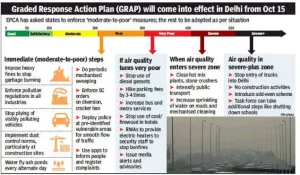
    • It includes strict measures such as a ban on the entry of heavy vehicles, the odd-even road rationing restrictions, and a halt of construction work – each of which is likely to be impractical at a time when the pandemic has exacted heavy economic costs and public transport has been seen as an infection risk.

    How does it work?

    • As such, the plan does not include action by various state governments to be taken throughout the year to tackle industrial, vehicular and combustion emissions.
    • When the air quality shifts from poor to very poor, the measures listed under both sections have to be followed since the plan is incremental in nature.
    • If air quality reaches the severe+ stage, GRAP talks about shutting down schools and implementing the odd-even road-space rationing scheme.

    Measures taken under GRAP

    1) Severe+ or Emergency

    (PM 2.5 over 300 µg/cubic metre or PM10 over 500 µg/cu. m. for 48+ hours)

    • Stop entry of trucks into Delhi (except essential commodities)
    • Stop construction work
    • Introduce odd/even scheme for private vehicles and minimise exemptions
    • Task Force to decide any additional steps including shutting of schools

    2) Severe

    (PM 2.5 over 250 µg/cu. m. or PM10 over 430 µg/cu. m.)

    • Close brick kilns, hot mix plants, stone crushers
    • Maximise power generation from natural gas to reduce generation from coal
    • Encourage public transport, with differential rates
    • More frequent mechanized cleaning of road and sprinkling of water

    3) Very Poor

    (PM2.5 over 121-250 µg/cu. m. or PM10 over 351-430 µg/cu. m.)

    • Stop use of diesel generator sets
    • Enhance parking fee by 3-4 times
    • Increase bus and Metro services
    • Apartment owners to discourage burning fires in winter by providing electric heaters during winter
    • Advisories to people with respiratory and cardiac conditions to restrict outdoor movement

    4) Moderate to poor

    (PM2.5 over 61-120 µg/cu. m. or PM10 over 101-350 µg/cu. m.)

    • Heavy fines for garbage burning
    • Close/enforce pollution control regulations in brick kilns and industries
    • Mechanized sweeping on roads with heavy traffic and water sprinkling
    • Strictly enforce a ban on firecrackers


    UPSC 2023 countdown has begun! Get your personal guidance plan now! (Click here)

  • India’s Direct Benefit Transfer Schemes

    Transfer

    Context

    • Last week, the International Monetary Fund (IMF) lauded India’s Direct Benefit Transfer (DBT) Scheme as a “logistical marvel” that has reached hundreds of millions of people and specifically benefitted women, the elderly and farmers. Paolo Mauro, Deputy Director in the IMF’s Fiscal Affairs Department, praised the role of technological innovation in achieving this feat.

    What is Direct Benefit Transfer(DBT)?

    • With the aim of reforming Government delivery system by re-engineering the existing process in welfare schemes for simpler and faster flow of information/funds and to ensure accurate targeting of the beneficiaries, de-duplication and reduction of fraud Direct Benefit Transfer (DBT) was started on 1st January, 2013.
    • DBT Mission was created in the Planning Commission to act as the nodal point for the implementation of the DBT programmes. The Mission was transferred to the Department of Expenditure in July, 2013 and continued to function till 14.9.2015. To give more impetus, DBT Mission and matters related thereto has been placed in Cabinet Secretariat under Secretary (Co-ordination & PG).

    Transfer

    Efforts behind the efficient DBT

    • Mission-mode approach for financial inclusion: Government endeavoured to open bank accounts for all households, expanded Aadhaar to all, and scaled up the coverage of banking and telecom services.
    • Public Finance Management System through Aadhar: It evolved the Public Finance Management System and created the Aadhaar Payment Bridge to enable instant money transfers from the government to people’s bank accounts.
    • Participation of various stakeholders for extensive UPI: The Aadhaar-enabled Payment System and Unified Payment Interface further expanded interoperability and private-sector participation.
    • Directly receiving of subsidies: This approach not only allowed all rural and urban households to be uniquely linked under varied government schemes for receiving subsidies directly into their bank accounts but also transferred money with ease.

    What is the Present status of DBT?

    • The status of JAM trinity (Jan Dhan Aadhar Mobile)
    • By 2022, more than 135 crore Aadhaar’s have been generated,
    • There are 47 crore beneficiaries under Pradhan Mantri Jan Dhan Yojana,
    • Mobile subscribers number more than 120 crores.
    • Riding on this network, the DBT programme has reached commanding heights towards achieving the government’s vision of “sabka vikas”.
    • Last mile banking through Bank Mitras: 5 lakh Bank Mitras delivering branchless banking services.
    • DBT applicable to government schemes: Becoming the major plank of the government’s agenda of inclusive growth, it has 318 schemes of 53 central ministries spanning across sectors, welfare goals and the vast geography of the country.

    Transfer

    How benefits are delivered through DBT?

    • DBT in rural areas: In rural Bharat, DBT has allowed the government to provide financial assistance effectively and transparently to farmers with lower transaction costs be it for fertilisers or any of the other schemes including the PM Kisan Samman  Nidhi, PM Fasal Bima Yojana, and PM Krishi Sinchayi Yojana  thus becoming the backbone for supporting the growth of the agricultural economy.
    • DBT in urban area: In urban India, the PM Awas Yojana and LPG Pahal scheme successfully use DBT to transfer funds to eligible beneficiaries.
    • Benefits under MGNAREGA: The benefits received under the Mahatma Gandhi National Rural Employment Guarantee Act and Public Distribution System drive the rural demand-supply chain.
    • Various assistance programmes: Various scholarship schemes and the National Social Assistance Programme use the DBT architecture to provide social security.
    • Scheme for rehabilitation: DBT under rehabilitation programmes such as the Self Employment Scheme for Rehabilitation of Manual Scavengers opens new frontiers that enable social mobility of all sections of society.
    • DBT as last mile support in Pandemic: The efficacy and robustness of the DBT network were witnessed during the pandemic. It aided the government to reach the last mile and support the most deprived in bearing the brunt of the lockdown. From free rations to nearly 80 crore people under the Pradhan Mantri Garib Kalyan Yojana, fund transfers to all women Jan Dhan account holders and support to small vendors under PM-SVANidhi, DBT helped the vulnerable to withstand the shock of the pandemic.

    Transfer

    What are the reasons for successful DBT schemes?

    • An enabling policy regime: Proactive government initiatives and supportive regulatory administration allowed the private and public sector entities in the financial sector to overcome longstanding challenges of exclusion of a large part of the population.
    • Creation of a dedicated ecosystem: These are essential elements of the pioneering ecosystem created by the government for the aggressive rollout of the ambitious DBT programme, achieving impressive scale in a short span of six years.

    Conclusion

    • Direct Benefit Transfer has transformed the welfare aspect of the governance. Going forward digital and financial literacy, robust grievance redressal, enhancing awareness and an empowering innovation system are some of the aspects that would require continued focus. This would play a vital role for India in meeting the diverse needs of its population and ensuring balanced, equitable and inclusive growth.

    Mains Question

    Q.Enlist the schemes that comes under DBT. How DBT has changed the lives of needy people in urban and rural India?

    UPSC 2023 countdown has begun! Get your personal guidance plan now! (Click here)


  • International Solar Alliance approves funding mechanism

    To bolster investments in solar power projects, the International Solar Alliance (ISA), in its General Assembly approved the ‘Solar Facility’, a payment guarantee mechanism.

    What is Solar Facility?

    • It is expected to stimulate investments into solar projects through two financial components:
    1. Solar Payment Guarantee Fund and
    2. Solar Insurance Fund
    • The thrust of the facility is to attract private capital to flow into “underserved markets” in Africa.
    • The ISA would aim to crowdsource investments from various donors across the globe and proposed projects in Africa would be able to purchase payment guarantees or partial insurance premium from these funds.

    Why such move?

    • ISA’s mission is to unlock US $1 trillion (₹80 lakh crore) of investments in solar power by 2030 while reducing cost of the technology and its financing.

    What is International Solar Alliance (ISA)?

    • The ISA is an alliance of more than 121 countries, most of them being sunshine countries, which lie either completely or partly between the Tropic of Cancer and the Tropic of Capricorn.
    • It is headquartered in Gurugram, India.
    • The primary objective of the alliance is to work for efficient exploitation of solar energy to reduce dependence on fossil fuels.
    • The alliance is a treaty-based inter-governmental organization.
    • The initiative was launched by PM Modi at the India Africa Summit and a meeting of member countries ahead of the 2015 United Nations Climate Change Conference in Paris in November 2015.

    Objectives of the ISA

    • To mobilize investments of more than USD 1000 billion by 2030
    • To take coordinated action for better harmonization, aggregation of demand, risk and resources, for promoting solar finance, solar technologies, innovation, R&D, capacity building etc.
    • Reduce the cost of finance to increase investments in solar energy in member countries
    • Scale up applications of solar technologies in member countries
    • Facilitate collaborative research and development (R&D) activities in solar energy technologies among member countries
    • Promote a common cyber platform for networking, cooperation and exchange of ideas among member countries

    What does ISA formation signify?

    • Climate action commitment: It symbolizes about the sincerity of the developing nations towards their concern about climate change and to switch to a low-carbon growth path.
    • Clean energy: India’s pledge to the Paris summit offered to bring 40% of its electricity generation capacity from non-fossil sources (renewable, large hydro, and nuclear) by 2030.
    • Global electrification: India has pledged to let solar energy reach to the most unconnected villages and communities and also towards creating a clean planet.
    • Global cooperation: It is based on world cooperation irrespective of global boundaries.
    • India’s Soft power: For India, possible additional benefits from the alliance can be a strengthening of ties with the major African countries and increasing goodwill for India among them.

    Key initiatives

    [A] Global Solar Atlas

    • ISA alliance has partnered with World Bank to launch Global Solar Atlas at an ISA event at the World Future Energy Summit in Abu Dhabi.
    • Global Solar Atlas is a free online tool that displays annual average solar power potential at any location in the world and thus identify potential sites for solar power generation.

    [B] OSOWOG Initiative

    • Under the ISA project, India envisaged having an interconnected power transmission grid across nations for the supply of clean energy.
    • The vision behind the OSOWOG mantra is ‘The Sun Never Sets’ and is a constant at some geographical location, globally, at any given point of time.
    • With India at the fulcrum, the solar spectrum can easily be divided into two broad zones viz. far East which would include countries like Myanmar, Vietnam, Thailand, Lao, Cambodia etc. and far West which would cover the Middle East and the Africa Region.

    Implementation

    • The OSOWOG would have three phases.
    1. Phase I: Middle East, South Asia and South-East Asia would be interconnected
    2. Phase II: Solar and other renewable energy resources rich regions would be interconnected
    3. Phase III: Global interconnection of the power transmission grid to achieve the One Sun One World One Grid vision

    Benefits of the project

    • Attracting investment: An interconnected grid would help all the participating entities in attracting investments in renewable energy sources as well as utilizing skills, technology and finances.
    • Poverty alleviation: Resulting economic benefits would positively impact poverty alleviation and support in mitigating water, sanitation, food and other socio-economic challenges.
    • Reduced project cost: The proposed integration would lead to reduced project costs, higher efficiencies and increased asset utilization for all the participating entities.

    Various challenges

    • Lack of Funding: Providing the money for promoting solar electricity among the members is a challenge. The Alliance has very little money of its own.
    • Expensive implementation: The cost of power has two components. The variable cost is the payment made for the numbers of units of electricity purchased. In addition, the buyer is required to pay a certain amount towards the fixed cost of solar supply.
    • Battery-based Storage: Solar electricity is available only during the day when the sun shines. Thus, the storage of electricity is a difficult task.
    • Cross-border transmission: Solar electricity has to overcome the roadblocks of transmission.  Cross-border transmission of electricity requires the establishment of transmission lines from the producer to the consumer country.
    • Peak hour load:  The demand for electricity, however, is more during the morning and evening which are called “peak hours”. But it can be produced when the sun is shining.
    • Climate change: Sudden overcast and rainfall in many parts of the tropics has been a major issues these days. Such weather hampers solar energy production
    • Desired global consensus: It is hindered with the issues of intricate geopolitics, unfavourable economics, unwarranted globalisation and undue centralization that act against the concept.
    • Highly ambitious: In a nation like India, it took us this long to connect all the regions of the country through a national grid and we are talking about ‘one world, one grid’.

    Way forward

    • ISA should focus on its core goals such as- aggregating demand, tariff, technical collaborations, and financial assistance for achieving its target.
    • It further needs to ensure that solar benefits are clear and tangible to users beyond its cost ambitions.
    • ISA should demonstrate business models that are viable for users, suppliers and financiers.
    • Further, the alliance should support member countries in implementing policies to expedite these business models.
    • Geo-politically, this is being touted as a clever strategy however financially and technology-wise, this has to make sense.


    UPSC 2023 countdown has begun! Get your personal guidance plan now! (Click here)
  • What are Foreign Currency Non-Resident (FCNR) deposits?

    The RBI’s 2013 FCNR scheme to buffer the rupee against steep declines and rebuild foreign exchange reserves is unlikely to prove fruitful in the current crisis as economic fundamentals are different.

    What are FCNR deposits?

    • Back in 2013, the RBI had offered to swap the U.S. dollars banks had raised via foreign currency non-resident (FCNR) deposits or foreign currency funding for rupees at concessional rates.
    • A FCNR is a bank account for NRIs to maintain a Fixed Deposit account in India.
    • This account allows one as an NRI to save money earned in the currency form of the country you’ve originally earned the money from.
    • FCNR deposits can hold currencies like US Dollars, Pounds Sterling, Euro, Japanese Yen, Australian Dollars and Canadian Dollars.
    • Interest on such deposits is exempt for income tax.

    How do they operate?

    • These deposit accounts are a term deposit account, not savings.
    • Once can withdraw your money before the date of maturity, and there will be no charges, but the interest will not be paid until after a year is complete.

    Benefits offered

    • FCNRs are just like what FDs are for resident Indians, except in foreign currency.
    • They work as great investment options for NRIs to invest in the country for a start, before looking for other avenues in investments on the stock market.
    • Because the money is being held in those currencies, the risk of exchange rate fluctuations is eliminated.

    Why in news?

    • Forex reserves have tumbled about $110 billion from a peak of $642 billion in September last year.
    • A significant reason behind this is RBI’s currency market intervention.


    UPSC 2023 countdown has begun! Get your personal guidance plan now! (Click here)

  • Japan seeks GI tag for Nihonshu, an alcoholic beverage

    nihonshu

    The Embassy of Japan, New Delhi, has filed an application seeking Geographical Indication (GI) tag for nihonshu/Japanese sake, an alcoholic beverage.

    Why in news?

    • It is learnt that this is the first time a product from Japan has filed for a tag at the Geographical Indication Registry in Chennai.

    What is Nihonshu?

    • Nihonshu is regarded as a special and valuable beverage made from fermenting rice.
    • People traditionally drink nihonshu on special occasions, such as festivals, weddings or funerals, but it is also consumed on a daily basis.
    • Thus, it is an integral part of the lifestyle and culture in Japan.
    • The sake market (almost all are nihonshu) is the second largest brewed liquor (such as beer) market in Japan.

    How is it made?

    • For making nihonshu three main raw materials – rice, koji-kin (a type of fungal spore) and water – are required.
    • Its production follows an alcoholic fermentation method called parallel multiple fermentation and involves raw material treatment, koji making, starter culture making, mash making, pressing, heat sterilisation and bottling.
    • The rice and koji used should originate in Japan.

    Try this PYQ:

    Q.Which of the following has/have been accorded ‘Geographical Indication’ status?

    1. Banaras Brocades and Sarees
    2. Rajasthani Daal-Bati-Churma
    3. Tirupathi Laddu

    Select the correct answer using the code given below:

    (a) 1 only

    (b) 2 and 3 only

    (c) 1 and 3 only

    (d) 1, 2 and 3


    [wpdiscuz-feedback id=”kwp9fobhbd” question=”Please leave a feedback on this” opened=”1″]Post your answers here.[/wpdiscuz-feedback]


    Back2Basics:  Geographical Indication

    • A GI is a sign used on products that have a specific geographical origin and possess qualities or a reputation that are due to that origin.
    • Nodal Agency: Department for Promotion of Industry and Internal Trade (DPIIT), Ministry of Commerce and Industry
    • India, as a member of the World Trade Organization (WTO), enacted the Geographical Indications of Goods (Registration and Protection) Act, 1999 w.e.f. September 2003.
    • GIs have been defined under Article 22 (1) of the WTO Agreement on Trade-Related Aspects of Intellectual Property Rights (TRIPS) Agreement.
    • GI is granted for a term of 10 years in India. As of today, more than 300 GI tags has been allocated so far in India (*Wikipedia).
    • The tag stands valid for 10 years.


    UPSC 2023 countdown has begun! Get your personal guidance plan now! (Click here)