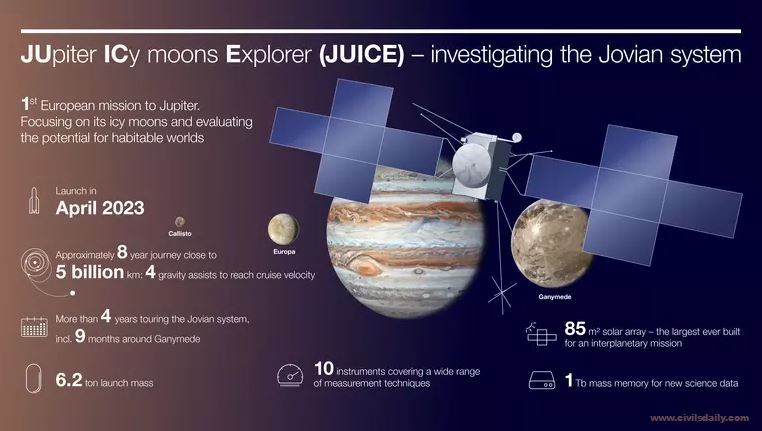
European scientists are preparing to execute a first-of-its-kind ‘Double Slingshot’ orbital maneuver to guide the JUICE probe towards Jupiter using a double slingshot technique.
About JUICE Mission:
Details
Launch
By European Space Agency (ESA) on April 14, 2023, Ariane 5 rocket
To study Jupiter’s Moons
Aim
Investigating the potential for life on Jupiter’s moons and understanding the Jovian system
Mission Duration
Approximately 12 years
Expected arrival at Jupiter in July 2031
Primary Objectives
Ganymede Exploration: Study its surface, subsurface, magnetic field, and potential subsurface ocean to assess habitability.
Europa Exploration: Investigate the surface, subsurface, and potential ocean beneath the ice; analyze interactions with Jupiter’s magnetosphere to assess its potential to support life.
Callisto Exploration: Study its surface, geological diversity, and possible subsurface ocean; understand its history of impacts and tectonic activity.
Jupiter System Exploration: Analyze Jupiter’s atmosphere, magnetosphere, and their interactions with the moons; study the dynamics of the magnetosphere and its influence on the surrounding environment.
Key Instruments
JANUS: Jovis, Amorum ac Natorum Undique Scrutator (Optical Camera)
RIME: Radar for Icy Moons Exploration
J-MAG: JUICE Magnetometer
MAJIS: Moons and Jupiter Imaging Spectrometer
Significance
First interplanetary spacecraft to the outer Solar System planets not launched by the United States
First mission set to orbit a moon other than Earth’s Moon
What is theDouble Slingshot Maneuver?
The JUICE probe will first use the moon’s gravity to set itself on the correct trajectory towards Earth.
Immediately after, it will useEarth’s gravity to slow down and redirect towards Venus and, eventually, Jupiter.
Significance of the Gravity Assist
This technique, used for decades in space exploration, involves using a planet or moon’s gravity to alter the speed or direction of a spacecraft.
It is unique as it involves back-to-back gravity assists using both the moon and Earth’s gravity, which has never been attempted before.
PYQ:
[2020] The experiment will employ a trio of spacecraft flying in formation in the shape of an equilateral triangle that has sides one million kilometres long, with lasers shining between the craft.” The experiment in question refers to
Many individuals, organizations, and zoos in India currently possess living specimens of exotic animal species listed under Schedule IV of the Wild Life (Protection) Act, 1972.
These exotic species must be reported and registered as mandated by the Ministry of Environment, Forest and Climate Change in the PARIVESH 2.0 Portal.
Legal Framework for Reporting of Animals in Possession
The Living Animal Species (Reporting and Registration) Rules, 2024, were notified under Section 49 M of the Wild Life (Protection) Act via a Gazette Notification on February 28, 2024.
Who Must Register: Any person or entity in possession of a living specimen of species listed in Schedule IV of the Wild Life (Protection) Act, 1972.
Failure to report and register these species within the stipulated time frame may result in penal actions.
About Schedule IV of the WPA
Details
Protection Level
Provides legal protection to species, prohibiting their hunting, capture, or trade. Protection is less stringent compared to Schedules I & II.
Offenses and Penalties
Violations can lead to fines and imprisonment, but penalties are generally less severe than those for species in higher schedules.
New Amendment (2022)
The Wildlife (Protection) Amendment Act, 2022, inserted a new Schedule IV for specimens listed in the CITES Appendices.
Examples of Species
Flamingos, Hares, Falcons, Kingfishers, Magpie, and Horseshoe Crabs.
Purpose
Ensures legal protection to prevent exploitation and population decline of species that are not critically endangered but still need protection.
General Protection Role
Plays an important role in broader conservation efforts, offering safeguards to a wider range of species in India.
PYQ:
[2020] If a particular plant species is placed under Schedule VI of The Wildlife Protection Act, 1972, what is the implication?
(a) A licence in required to cultivate that plant.
(b) Such a plant cannot be cultivated under any circumstances.
(c) It is a Genetically Modified crop plant.
(d) Such a plant is invasive and harmful to the ecosystem.
A recent study published in Physical Review Letters by Indian researchers has revealed that a universal standard for measuring quantum non-locality is impossible.
What is Quantum Nonlocality?
Quantum Nonlocality is a mysterious connection between distant objects that challenges the classical idea of local realism, where no faster-than-light communication is allowed.
It’s crucial for technologies like secure communication, random number generation, and cryptographic key creation.
Easy Explanation:
Imagine two particles that are created together and then move far apart, even to opposite ends of the universe.
In classical physics, any effect on one particle would need a signal to travel to the other, taking time.
But in quantum physics, Quantum Nonlocality means these particles are instantly connected, affecting each other no matter the distance, as if linked by an invisible thread that works faster than light.
Historical Background: Bell’s Theorem (1964)
Physicist John Stewart Bell introduced a theorem that challenged the classical idea of ‘local realism’ in quantum systems.
Local Realism: In classical physics, objects are believed to have definite properties independent of observation and are only influenced by their immediate surroundings.
Quantum Challenge: Bell demonstrated that in quantum systems with multiple, distant parts, correlations appear that cannot be explained by local realism.
Bell’s theorem was confirmed through experiments, leading to the recognition of quantum nonlocality, which was honored with the 2022 Physics Nobel Prize.
Recent Research and Findings
The research demonstrates that a universal standard for measuring and comparing quantum nonlocality is impossible.
It shows that the nature of nonlocality varies based on the type of correlation, with infinite unique points on the correlation boundary.
There is no single, universal resource in the realm of quantum nonlocality; instead, each nonlocal resource is unique, capable of performing specific tasks that others cannot.
This observation plays a key role in secure communication, random number certification, and cryptographic key generation.
PYQ:
[2022] Which one of the following is the context in which the term “qubit” is mentioned?
Leonard Hayflick, the renowned biomedical researcher who made a discovery about the limits of cell division in somatic cells (Hayflick Limit) has passed away at 98.
What is the Hayflick Limit?
In the early 1960s, Hayflick discovered that somatic (non-reproductive) cells have a finite number of divisions, typically between 40-60 times.
This phenomenon, the ‘Hayflick limit’ suggests that aging occurs because cells eventually stop dividing.
This leads to the accumulation of senescent cells that contribute to the aging process.
The “ultimate Hayflick limit” for humans is estimated to be around 125 years.
Beyond this, no amount of lifestyle changes or medical interventions can extend the human lifespan.
Hayflick’s discovery has been applied to cells from various animals, revealing different Hayflick limits based on species’ lifespans.
Ex. Galapagos turtles, have cells that can divide approximately 110 times, whereas laboratory mice have a much lower limit of around 15 divisions.
Broader Implications and Research
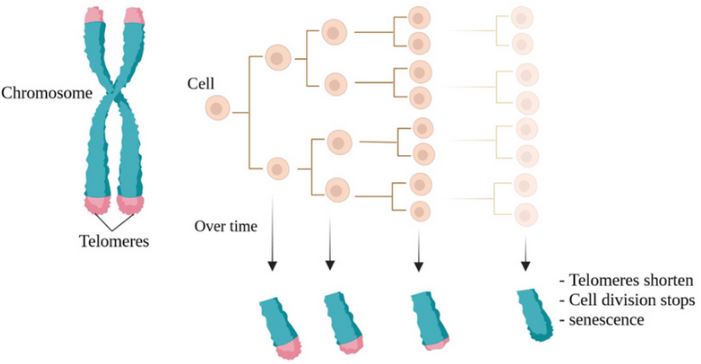
Hayflick’s discovery led to the discovery of telomeres in the 1970s.
Telomeres are protective DNA sequences at the ends of chromosomes, which shorten with each cell division.
When telomeres reach a critical length, cell division stops, which correlates with the Hayflick limit.
In the 1980s, scientists discovered telomerase, a protein capable of replenishing telomeres, which is naturally active in cancer cells, allowing them to bypass the Hayflick limit.
PYQ:
[2011] Regular intake of fresh fruits and vegetables is recommended in the diet since they are a good source of antioxidants. How do antioxidants help a person maintain health and promote longevity?
(a) They activate the enzymes necessary for vitamin synthesis in the body and help prevent vitamin deficiency
(b) They prevent excessive oxidation of carbohydrates, fats and proteins in the body and help avoid unnecessary wastage of energy
(c) They neutralize the free radicals produced in the body during metabolism
(d) They activate certain genes in the cells of the body and help delay the ageing process
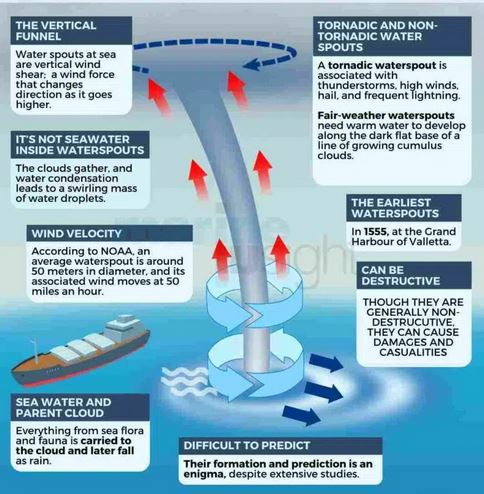
A yacht sank off the coast of Sicily, Italy after being hit by a Waterspout.
What are Waterspouts?
A waterspout is a rotating column of air and mist over a water body.
It is a weaker relative of tornadoes and typically lasts for about five minutes, although it can occasionally last up to 10 minutes.
Size and Strength:
Average diameter: Around 165 feet.
Wind speeds: Can reach up to 100 km/hr.
Waterspouts are more common in tropical waters but can form anywhere with high humidity and relatively warm water temperatures compared to the overlying air.
Types of Waterspouts:
Tornadic Waterspouts
These are actual tornadoes that either form over water or move from land to water.
They are associated with severe thunderstorms and can be accompanied by high winds, large hail, and dangerous lightning.
Fair-Weather Waterspouts:
These are more common and form only over water during fair weather.
They are generally smaller and less dangerous than tornadic waterspouts.
PYQ:
[2020] Consider the following statements:
1. Jet streams occur in the Northern Hemisphere only.
2. Only some cyclones develop an eye.
3. The temperature inside the eye of a cyclone is nearly 10ºC lesser than that of the surroundings.
Which of the statements given above is/are correct?
PYQ Relevance: Mains: Q.1 Bring out the constructive programmes of Mahatma Gandhi during the Non-Cooperation Movement and Civil Disobedience Movement. (UPSC IAS/2021) Q.2 Can the strategy of regional-resource-based manufacturing help in promoting employment in India? (UPSC IAS/2019)
Note4Students:
Prelims: Khadi and Village Industries Commission (KVIC);
Mains:Challenges related to khadi industry;
Mentor comments: The khadi industry in India is a vital segment of the textile sector, known for its hand-spun and hand-woven fabrics made from cotton, silk, and wool. It plays a crucial role in generating employment, particularly in rural areas, with millions of artisans involved in its production. The industry has seen significant growth, with khadi production valued at ₹1,904.5 crore (USD 255.8 million) in FY21, up from ₹1,520.8 crore (USD 204.3 million) in FY17. Promoted by the Khadi and Village Industries Commission (KVIC), khadi symbolizes India’s heritage and commitment to sustainable practices.
Let’s learn —
Why in the News?
The Prime Minister’s ‘Har Ghar Tiranga’ campaign highlights moral contradiction, as machine-made polyester flags, often imported, overshadow the significance of our national flag.
The Flag Code of India has historically required the national flag to be made of “hand spun and hand-woven wool/cotton/silk khadi bunting”
Significance of Khadi Industries:
Second Largest Employer: After agriculture, the khadi industry is the second largest industry to provide employment opportunities to the unemployed and rural people
Preserving Heritage: Khadi is a national heritage fabric of India with a unique identity and a rich tradition dating back to ancient times.
Symbol of Freedom Struggle: Khadi was the fabric of the freedom struggle, with Mahatma Gandhi launching the movement of ‘spin your own cloth and buy hand-spun cloth’ in 1921
Eco-friendly Production: The production of khadi focuses on the environment right from the beginning, using locally manufactured raw materials without chemicals and energy resources.
The reason behind the Khadi procurement has fallen:
Neglect of Mandates: Government departments are reportedly ignoring or overruling mandates requiring them to procure khadi. For instance, many departments shifted to other materials, resulting in a drop in khadi purchases from ₹50-60 crore per year to ₹32 crore over a decade.
Amendment to the Flag Code: In 2022, the Government amended the Flag Code of India to allow for the use of machine-made polyester bunting for the national flag, which historically required khadi.
Tax Exemption for Polyester Flags: The government exempted polyester flags from the Goods and Services Tax (GST), placing them on the same tax footing as khadi flags.
Indefinite Strike by Khadi Producers: The Karnataka Khadi Gramodyoga Samyukta Sangha (KKGSS), the sole national flag manufacturing unit accredited by the Bureau of Indian Standards, resorted to an indefinite strike to protest the government’s actions, which they view as detrimental to the khadi industry.
Market Regulation Failures: The khadi market lacks effective regulation, leading to the sale of khadi produced from semi-mechanized charkhas alongside traditional hand-spun khadi. This situation creates confusion among consumers and undermines the authenticity of traditional khadi.
Lack of Global Promotion: The government has failed to establish a global audience for Indian handlooms, particularly khadi. For instance, khadi’s share remains very low, accounting for less than 0.22% of the total textile sector exports.
Economic Pressures on Workers: Khadi spinners and weavers are facing economic hardships, with wages remaining low at ₹200-₹250 per day despite their labour-intensive work.
Impact of Policy Changes: Recent policy changes, such as the introduction of the Goods and Services Tax (GST), have placed additional burdens on handloom workers. The GST applies to both finished khadi products and raw materials, increasing costs for producers.
Khadi and Village Industries Commission (KVIC)
•Establishment: The KVIC was established in April 1957 by the Government of India under the Khadi and Village Industries Commission Act. It is a statutory body aimed at promoting and regulating the khadi and village industries in India. •Objectives: The KVIC has three main objectives: 1. Social Objective: To provide employment in rural areas. Economic Objective: To produce saleable articles. 2. Wider Objective: To create self-reliance among people and build a strong rural community spirit.
•Affiliation and Oversight: The KVIC oversees approximately 5,600 registered khadi institutions and 30,138 cooperative societies across India. It collaborates with 30 State Khadi and •Village Industry Boards (KVIBs) to implement its programs at the state level.
•Trademark Protection: KVIC holds exclusive rights to the “Khadi” and “Khadi India” trademarks, ensuring that the term is used correctly and protecting the integrity of khadi products in the market.
Way forward:
Revitalize Government Mandates & Incentivize Khadi Procurement: Reinforce mandates requiring government departments to prioritize khadi procurement and introduce subsidies or tax incentives for using traditional hand-spun khadi, ensuring fair competition against synthetic alternatives.
Global Promotion & Fair Wages: Launch targeted campaigns to promote khadi internationally, increasing its market share while ensuring that khadi spinners and weavers receive fair wages through direct government support and better pricing mechanisms.
India’s 78th Independence Day is a time to reflect on our significant successes and setbacks. We should learn from both to make quicker progress towards the Prime Minister’s vision of a Viksit Bharat@2047 by 2047.
Key Aspects of Viksit Bharat@2047
Economic Growth: The vision aims to elevate India to the status of the world’s third-largest economy and strive for a $30 trillion economy by 2047.
Environmental Sustainability: Viksit Bharat aims to preserve biodiversity and mitigate climate change impacts through restoration and conservation efforts.
Social Progress: The initiative seeks to build an inclusive society that respects cultural diversity and ensures the dignity and well-being of all citizens.
Good Governance: Effective governance is a cornerstone of the Viksit Bharat vision, focusing on accountability, transparency, and sound policies that are responsive to the needs of the people.
Youth Engagement: Recognizing the potential of India’s youth, the government has launched initiatives like the “Voice of Youth” portal to encourage young people to contribute ideas for achieving the goals of Viksit Bharat.
Economic Challenges
Weak Domestic Demand: Stagnant or declining demand for goods and services due to low-income growth, high inflation, unemployment, and the impact of the Covid-19 pandemic.
High Unemployment: Despite rapid growth, unemployment remains a serious issue, worsened by the pandemic. The unemployment rate in India rose to 8.1 per cent in April 2024 from 7.4 per cent in March 2024, according to CMIE’s Consumer Pyramids Household Survey.
Poor Infrastructure: India lacks adequate infrastructure like roads, railways, ports, power, water and sanitation, hampering economic development. The infrastructure gap is estimated at around $1.5 trillion.
Balance of Payments Deterioration: India runs a persistent current account deficit, with imports exceeding exports. Exports and imports decreased by 6.59% and 3.63% respectively in 2022.
High Private Debt Levels: India has witnessed a significant rise in debt levels in recent years.
According to the Reserve Bank of India (RBI), the total non-financial sector debt reached 167% of GDP in March 2020, up from 151% in March 2016.
Household debt in India rose to 40.10% of GDP in the fourth quarter of 2023, up from 39% in the previous quarter.
Military Challenges
Securing Borders: Despite conflicts with Pakistan and China, India has reasonably managed border security. However, the rapid rise of China poses economic and military challenges.
China’s Growing Influence: Almost all of India’s neighbours are moving closer to China, necessitating better policy and diplomacy to secure India’s interests and ensure regional stability.
Military Modernization and Resource Allocation: India’s dependence on foreign arms imports, despite efforts to promote self-reliance through initiatives like “Make in India,” highlights the need for a robust domestic defense industry.
The country has been the largest arms importer from 2018 to 2022, indicating ongoing challenges in achieving military self-sufficiency
Suggestive measures: (Way forward)
Agricultural Reforms: Investment in agricultural research and development, irrigation, and land-lease markets is vital. Building value chains for perishables can enhance food security and adapt to climate challenges.
Nutritional Security: Transitioning from mere food security to nutritional security is crucial, addressing issues like child malnutrition, which affects 35% of children under five.
Support for Farmers: Implementing subsidies for pulses and other sustainable crops can encourage healthier diets and environmental benefits. The government should provide financial incentives to farmers to shift from water-intensive crops to pulses.
Infrastructure Development: Continued investment in infrastructure, including transportation and digital connectivity, is essential for economic growth and improving citizens’ quality of life.
Education and Skill Development: Reforms in education to prioritize skill development and innovation are necessary to prepare the workforce for emerging industries and ensure inclusive growth.
Healthcare Initiatives: Expanding access to affordable healthcare services nationwide is critical for enhancing public health and productivity.
Mains PYQ:
Q Foreign Direct Investment (FDI) in the defence sector is now set to be liberalized: What influence this is expected to have on Indian defence and economy in the short and long run? (UPSC IAS/2016)
A recent study by Thomas Pikettyand colleagues highlights a dramatic rise in wealth and income inequality in India over the past few decades, with a sharp increase particularly from 2014 to 2022.
The analysis from ” Gallup World Poll (GWP) Survey (2019-23)” for India
Note: The GWP measures corruption through individual perceptions, asking respondents whether they believe corruption is widespread.
Income Inequality: The survey data indicates a significant rise in income inequality, with the top 1% controlling over 40% of total wealth in India, a stark increase from 12.5% in 1980.
The top 1% of income earners now receive 22.6% of the country’s total pre-tax income, up from 7.3% in 1980.
Rent-Seeking Behavior: The persistence of rent-seeking behavior among wealthy investors, which diverts resources from productive uses to securing unwarranted gains from government entities.
Judicial Trust and Corruption: Trust in the judiciary can play a significant role in curbing corruption. Higher trust correlates with lower perceived corruption levels.
Mutual Fund vs Fixed deposits: Speculative investments, such as mutual funds, largely drive income inequality, while savings in fixed deposits and post offices help curb it.
Inequality promotes corruption: The study finds that higher income inequality causes widespread corruption, while greater confidence in the judiciary helps reduce it.
What is our present methodology for counting inequality?
Piketty’s Measure: Thomas Piketty’s measure compares the income share of the top 1% to that of the bottom 50%. This highlights the growing disparity in income distribution effectively.
Consumption vs Income Inequality: Inequality is traditionally measured using consumption expenditure surveys by the National Sample Survey Office (NSSO). However, consumption inequality tends to be lower than income inequality.
Use of Multiple Data Sources: Researchers often combine data from various sources, including national accounts, tax data, and recent surveys like the Periodic Labour Force Surveys (PLFS) and Consumer Pyramid Household Survey (CPHS).
Gini Index and Other Metrics: The Gini index is frequently used to quantify inequality, but it has limitations, being less sensitive to changes at the income distribution extremes.
Issues Associated with measuring income inequality:
Data quality and availability: There has been a noted decline in the reliability of household surveys since 2011-12, making it difficult to obtain accurate and comparable data. For example, The 55th NSS round showed a dramatic decline in poverty estimates, which many experts deemed misleading due to the survey’s methodological flaws.
Underreporting of wealth: Surveys may underreport wealthier households’ consumption, leading to inaccurate inequality assessments. For example, the Household Consumption Expenditure Survey (HCES) 2022-23 reported a significant drop in rural and urban poverty levels. However, critics argue that these figures may not accurately reflect the reality of wealthier households
Comparability with other countries: India’s reliance on consumption data rather than income data can result in mischaracterization as a low-inequality country in international comparisons.
Focus on labor income: Some reports focus only on labor income, ignoring other income sources and skewing the understanding of overall inequality. For example, studies have shown that the income share of the top 10% in India has grown significantly, while labour income alone does not reflect this concentration adequately
Complexity of income dynamics: Accurately assessing inequality is challenging due to the influence of economic policies, globalization, and market forces. For instance, Researchers have noted that the absence of comprehensive tax data beyond 2017-18 adds uncertainty to the analysis of income inequality trends
Way forward:
Improve Data Collection and Methodologies: There is an urgent need to enhance the quality and reliability of household surveys and other data sources.
Broadening Income Metrics Beyond Labor Income: To better capture the full spectrum of income inequality, it’s essential to include non-labor income sources, such as capital gains, property income, and speculative investments.
Mains PYQ:
Q It is argued that the strategy of inclusive growth is intended to meet the objective of inclusiveness and sustainability together. Comment on this statement. (UPSC IAS/2019)
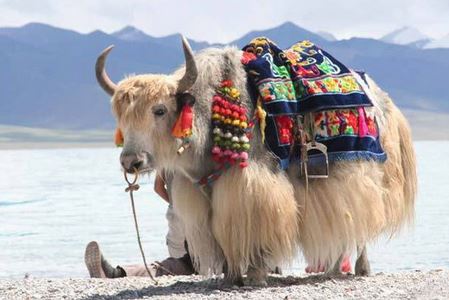
Around 40 Chinese yaks ventured into Indian Territory in the “Demchok” area of eastern Ladakh and are currently under the control of the local villagers.
Grazing land issue at LAC:
Nomads from both sides traditionally access grazing grounds across the LAC.
Indian nomads have been stopped by Chinese soldiers when crossing to the Chinese side.
Demchok nomads lost access to Lungkar Valley in 2022 and Nilung Valley in 2017.
Loss of these areas has negatively impacted the livelihoods of border residents.
China expanded its presence on the Indian side of Charding nala (adjacent to Demchok) since 2020 stand-off.
About Himalayan Yaks in India:
Details
Species
Belongs to the Bovini tribe, including bison, buffaloes, and cattle.
Adaptation
Can tolerate extreme cold, down to -40°C; adapted for high altitudes with long, insulating hair.
Cultural Significance
Valued by Himalayan peoples;
Linked to Tibetan Buddhism legend of Rinpoche.
Raising Method
Traditionally reared under a transhumance system; involves significant hardship.
Habitat
Endemic to the Tibetan Plateau and high-altitude regions.
Altitude Preference
Thrives above 14,000 feet; typically climbs to 20,000 feet and rarely descends below 12,000 feet.
Japanese foreign and defence ministers have arrived in India to participate in the India-Japan 2+2 ministerial meeting.
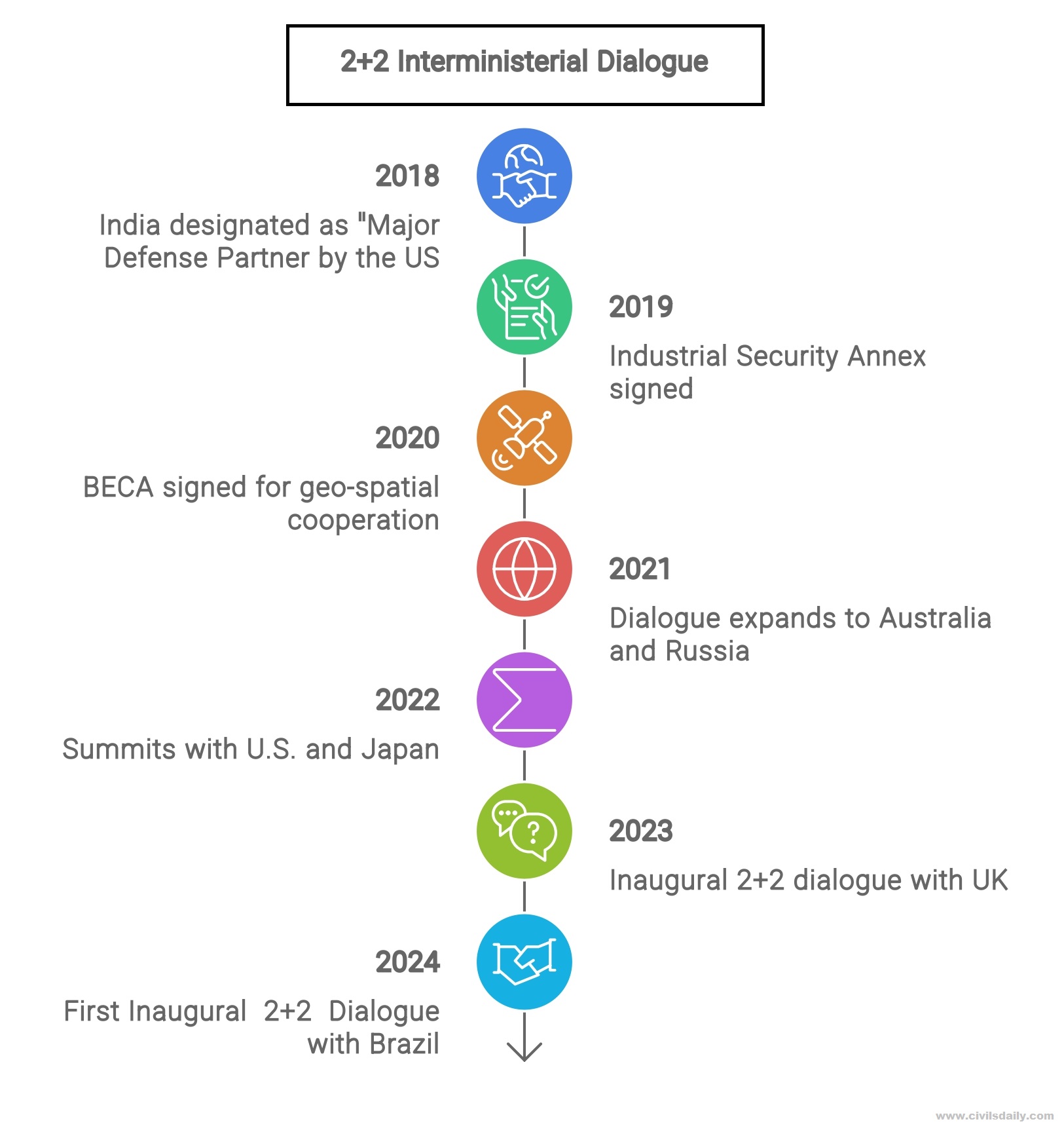
About2+2 Ministerial Dialogue
The 2+2 Ministerial Dialogue is a diplomatic summit held annuallysince 2018, initially between India and the US.
It later expanded to include Japan, Australia, Russia, and the United Kingdom.
This dialogue involves the Foreign and Defense Ministers of participating countries and focuses on strengthening bilateral relations and addressing common concerns.
The dialogue replaced the Strategic and Commercial Dialogue during a 2017 agreement between PM Narendra Modi and President Donald Trump.
First Summit was held on September 6, 2018, between India and the US in New Delhi, involving discussions on defense partnerships and strategic cooperation.
Key Milestones:
What are the key priorities of the Indo-Japan 2+2 Dialogue?
Update Security Cooperation: Revising the 2008 security agreement to reflect current strategic needs.
Promote a Free Indo-Pacific: Collaborating to ensure a free, open, and stable Indo-Pacific region.
Engage in Strategic Talks: Holding strategic discussions between foreign and defense ministers to boost bilateral ties.
Address Regional Security: Discussing key issues like Chinese assertiveness, the Russia-Ukraine war, and the Gaza crisis.
Coordinate Quad Efforts: Exploring cooperation within the Quad framework, including a potential summit.
PYQ:
[2020] Quadrilateral Security Dialogue (Quad) is transforming itself into a trade bloc from a military alliance, in present times Discuss.
![[20th August 2024] The Hindu Op-ed: The ‘livery of India’s freedom’ is under threat](https://www.civilsdaily.com/wp-content/uploads/2024/08/20-Aug-1568x882.jpg)