💥Join UPSC 2027,2028 Mentorship (July Batch) + XFactor Notes & Microthemes PDF

Distribution: yearly

  • [pib] Mission SAGAR

    As part of India’s outreach amidst the ongoing COVID-19 pandemic, ships have departed for Maldives, Mauritius, Seychelles, Madagascar and Comoros, to provide Food Items, COVID related Medicines including HCQ Tablets and Medical Assistance Teams under Mission Sagar.

    Mission SAGAR, unlike other missions, can create confusion with the name and its purpose. Make note of such special cases. UPSC can ask such questions as one liner MCQs.

    Mission SAGAR

    • As part of the mission, INS Kesari would enter the Port of Male in the Republic of Maldives, to provide them 600 tons of food provisions.
    • The deployment is in consonance with the PMs vision of Security and Growth for All in the Region ‘SAGAR’.
    • This deployment is in line with India’s role as the first responder in the region and builds on the excellent relations existing between these countries to battle the COVID-19 pandemic and its resultant difficulties.
    • The operation is being progressed in close coordination with the Ministries of Defence and External Affairs, and other agencies of the govt.

    Back2Basics

    SAGAR Programme (Security and Growth for All in the Region)

    • SAGAR is a term coined by PM Modi in 2015 during his Mauritius visit with a focus on the blue economy.
    • It is a maritime initiative which gives priority to the Indian Ocean region for ensuring peace, stability and prosperity of India in the Indian Ocean region.
    • The goal is to seek a climate of trust and transparency; respect for international maritime rules and norms by all countries; sensitivity to each other`s interests; peaceful resolution of maritime issues; and increase in maritime cooperation.
    • It is in line with the principles of the Indian Ocean Rim Association.

    IORA (Indian Ocean Rim Association)

    • Established in 1997 in Ebene Cyber City, Mauritius.
    • First established as Indian Ocean Rim Initiative in Mauritius on March 1995 and formally launched in 1997 by the conclusion of a multilateral treaty known as the Charter of the IORA for Regional Cooperation.
    • It is based on the principles of Open Regionalism for strengthening Economic Cooperation particularly on Trade Facilitation and Investment, Promotion as well as Social Development of the region.
  • Economy and the challenges ahead

    Various projections of growth paint a grim picture of the Indian economy as well as the global economy. This article analyses the sector-wise impact and comes with the GVA projections for 2020-21. The government has to deal with serious challenges like financing huge fiscal deficits. So, what will be the growth rate for 2020-21 and what will be the size of GVA? Read to know!

    Projections of growth and uncertainty

    • Various institutions have assessed India’s growth prospects for 2020-21 ranging from 0.8% (Fitch)to 4.0% (Asian Development Bank).
    • This wide range indicates the extent of uncertainty and tentative nature of these forecasts.
    • The International Monetary Fund (IMF) has projected India’s growth at 1.9%, China’s at 1.2%, and the global growth at (-) 3.0%.
    • The actual growth outcome for India would depend on: 1) the speed at which the economy is opened up 2) the time it takes to contain the spread of virus, and, 3) the government’s policy support.

    Health of India economy before the crisis

    • India slid into the novel coronavirus crisis on the back of a persistent economic downslide.
    • There was a sustained fall in the saving and investment rates with unutilised capacity in the industrial sector.
    • In 2019-20, there was a contraction in the Centre’s gross tax revenues in the first 11 months during April 2019 to February 2020, at (-) 0.8%.
    • These trends continue to beset the Indian economy in this crisis.

    Growth prospects for 20-21 from the output side

    • In 2019-20, which would serve as the base year, India may show GVA growth of about 4.4%,
    • This is well below the Central Statistics Office’s second advance estimate of 9%.
    • The IMF’s GDP growth estimate for 2019-20 is at 2%.
    • GVA is divided into eight broad sectors. Although all sectors have been disrupted, some may be affected less than the others. We divide the output sectors in four groups.
    • Group A- This group is likely to suffer minimum disruption.
    • Agriculture and allied sectors, and public administration, defence.
    • Despite some labour shortage issues, agriculture sector may show near-normal performance.
    • The public and defence services have been nearly fully active, with the health services at the forefront of the the COVID-19 fight.
    • For the group A sectors, it may be possible to achieve 90% of the 2019-20 growth performance.
    • Group D- This group is likely to suffer maximum disruption.
    • This includes, trade, hotels, restaurants, travel and tourism under the broad group of “Trade, Hotels, Transport, Storage and Communications”.
    • This sector may be able to show 30% of 2019-20 growth performance.
    • Group B
    • This comprises sectors which may suffer average disruption showing 50% of 2019-20 growth performance.
    • These sectors are mining and quarrying, electricity, gas, water supply and other utility services, construction, and financial, real estate and professional services.
    • Group C
    • In this group come manufacturing which has suffered significant growth erosion in 2019-20.
    • It is feasible to stimulate this sector by supporting demand.
    • In this case a 40% performance factor on the average growth of the preceding three years is applied.

    So, what are the estimates for 2020-21 GVA?

    • Considering these four groups together, a GVA growth of 2.9% is estimated for 2020-21.
    • Realising this requires strong policy support, particularly for the manufacturing sector which has a weight of 17.4%.
    • It is also based on the assumption that the Indian economy may move on to positive growth after the first quarter.
    • In the first quarter, GVA growth will be negative.

    Policy support for the growth

    • Monetary policy initiatives undertaken so far include a reduction in the repo rate to 4.4%, the reverse repo rate to 3.75%, and cash reserve ratio to 3%.
    • The Reserve Bank of India has also opened several special financing facilities.
    • These measures need to be supplemented by an appropriate fiscal stimulus.
    • Cash-constrained central and State governments have taken expenditure reducing measures by announcing freezing of enhancements of dearness allowance and dearness relief.
    • This may result in savings of ₹37,000 crore for the Centre and about ₹82,000 crore for the States, together amounting to 6% of GDP.
    • There is also talk of substantially reducing non-salary defence expenditure.
    • With lower petroleum prices, fertilizer and petroleum subsidies may be reduced.
    • These expenditure cuts are contemplated to keep the fiscal deficit under some control.

    Fiscal stimulus and fiscal deficit

    • Fiscal stimulus can be of three types:
    • 1) Relief expenditure for protecting the poor and the marginalised.
    • 2) Demand-supporting expenditure for increasing personal disposable incomes or government’s purchases of goods and services, including expanded health-care expenditure imposed by the novel coronavirus, and,
    • 3) Bailouts for industry and financial institutions.
    • The Centre had earlier announced a relief package of ₹1.7-lakh crore.
    • The Centre’s budgeted fiscal deficit of 3.5% of GDP may have to be enhanced substantially to 1) make up for the shortfall in budgeted revenues; 2) account for a lower than projected nominal GDP for 2020-21, 3) provide for a stimulus.
    • Thus, the Centre’s fiscal deficit may increase to 6.0% of GDP.
    • Expenditure on the construction of hospitals, roads and other infrastructure and purchase of health-related equipment and medicines require prioritisation.
    • These expenditures will have high multiplier effects.
    • Similar initiatives may be undertaken by the State governments which may also enhance their combined fiscal deficit to about 0% of GDP to account for 3.0% of GDP under their respective Fiscal Responsibility Legislation/Law and to provide for the shortfall in their revenues and some stimulus.

    Challenges

    • Financing of the fiscal deficit poses a major challenge this year.
    • On the demand side, the Central (6.0%) and State governments (4.0%) and Central and State public sector undertakings (3.5%).
    • These together present a total public sector borrowing requirement (PSBR) of 13.5% of GDP.
    • Against this, the total available resources may at best be 9.5% of GDP.
    • The gap of 4.0% points of GDP may result in increased cost of borrowing for the Central and State governments.

    Consider the question, “Examine the sector-wise damage caused to the economy due to Covid-19 pandemic. What were the fiscal and monetary measures taken to mitigate the damage and challenges faced by the government in meeting the required revenue demands.”

    Conclusion

    The gap in requirement of resources and availability may be bridged by enhancing net capital inflows including borrowing from abroad and by monetising some part of the Centre’s deficit. The monetisation of debt can at best be a one-time effort. This cannot become a general practice. 


    Back2Basics: What is GVA?

    • GVA it is a measure of total output and income in the economy.
    • It provides the rupee value for the amount of goods and services produced in an economy after deducting the cost of inputs and raw materials that have gone into the production of those goods and services.
    • It also gives sector-specific picture like what is the growth in an area, industry or sector of an economy.
    • While GVA gives a picture of the state of economic activity from the producers’ side or supply side, the GDP gives the picture from the consumers’ side or demand perspective.
    • Both measures need not match because of the difference in treatment of net taxes.
    • GDP = GVA + taxes on products – subsidies on products
  • What is Stringency Index?

    India enforced one of the strongest lockdowns at an early phase of case growth. Now, an index created by the University of Oxford quantifies that.

    The Stringency Index provides a computable parameter to evaluate the effectiveness of the nationwide lockdown in India.

    What is Stringency Index?

    • It is among the metrics being used by the Oxford COVID-19 Government Response Tracker.
    • The Tracker involves a team of 100 Oxford community members who have continuously updated a database of 17 indicators of government response.
    • These indicators examine containment policies such as school and workplace closings, public events, public transport, stay-at-home policies.
    • The Stringency Index is a number from 0 to 100 that reflects these indicators. A higher index score indicates a higher level of stringency.

    What does the Stringency Index tell us?

    • It provides a picture of the stage at which any country enforced its strongest measures.
    • Oxford provides an overlay of countries’ death curve and their stringency score.
    • Some countries saw their deaths just begin to flatten as they reached their highest stringency, such as Italy, Spain, or France.
    • As China pulled stronger measures, its death curve plateaued.
    • In countries such as the UK, the US, and India, the Oxford graphs find that the death curve has not flattened after strictest measures were enforced.

    How does India compare with others?

    • The Index has found that India indeed had one of the strongest lockdown measures in the world — at a 100 score since March 22.
    • When compared to other countries with the similar or higher caseload, India called its strict lockdown at a much earlier point on its case and death curves.
    • These 18 other countries had more than 500 cases when they called their strictest lockdown, while India had 320.
    • Again, India had only four deaths on March 22, when its score reached 100, while most countries had more deaths at that point (except Switzerland; no deaths).
    • Spain called for its strictest measures later in its case and death count than all others. Sweden has had the most liberal measures in this set, and Iran the second most liberal.
  • The Resistance Front (TRF)


    (Image Source: The Economic Times)


    A newly floated outfit, the Resistance Front, has come under the scanner of enforcement agencies for its suspected links with the banned Lashkar-e-Taiba (LeT).

    This is a very significant development with respect to India’s concern against terrorism. Terrorism and the terror outfits are increasingly becoming more institutionalized and ‘the Resistance Front’ is an another move towards it.

    ‘The Resistance Front’

    • TRF, which is owning up terror attacks in Kashmir these days, is an offshoot of the terrorist group Lashkar-e-Taiba and is also associated with other terror outfits such as Hizbul Mujahideen, Jaish-e-Mohammed.
    • Various reports claim that after the abrogation of Article 370 in J&K, Pakistan decided to increase the terror activities in the Valley.
    • However, facing international pressure and to protect itself from being blacklisted by the Financial Action Task Force (FATF), Pakistan decided to launch a new terror group with a new identity.
    • Various Indian security agencies operating in Kashmir feel that the ‘TRF’ was formed due to the pressure on Pakistan from the FATF to cut down on the funding of the terrorist groups.

    A new strategy justifying terrorism

    • The word ‘resistance’ has been used by Pakistan and the Inter-Services Intelligence (ISI) to put in place a new strategy for supporting terrorism against India.
    • Pakistan’s plan is to rebrand the terrorists operating under the umbrella of JeM, LeT and Hizbul as “non-religious” rebellion.
    • Pakistan wants to project Kashmiri terrorism as a resistance movement by Kashmiris. So far Hizbul and LeT have come under TRF’s umbrella.

    Must read:

    https://www.civilsdaily.com/news/explained-amendments-to-the-uapa/


    Back2Basics: What is the FATF?

    • FATF is an intergovernmental organization founded in 1989 on the initiative of the G7 to develop policies to combat money laundering.
    • The FATF Secretariat is housed at the Organisation for Economic Co-operation and Development (OECD) headquarters in Paris.
    • It holds three Plenary meetings in the course of each of its 12-month rotating presidencies.
  • What is Urban Ozone?

    A Manchester (UK) based research has found that the nationwide lockdown may be leading to the generation of a dangerous pollutant, urban ozone.

    The Ozone is formed due to different factors in the Troposphere and the Stratosphere (where the ozone acts as a protective layer). Note these differences from prelims perspective.

    Urban Ozone

    • The photochemical production of ozone may become more important in urban areas during summertime in these low conditions of oxides of nitrogen.
    • As nitrogen oxides reduce, photochemical production may become more efficient and can lead to higher ozone concentrations in the summertime.
    • The higher summer temperatures increase emissions of biogenic hydrocarbon from natural sources such as trees. These biogenic hydrocarbons significantly affect urban ozone levels.
    • While ozone is important for screening harmful solar UV radiation when present higher up in the atmosphere, it can be a danger at the Earth’s surface and can react to destroy or alter many biological molecules.

    Back2Basics: Ozone Gas

    • It is a gas that occurs both in the Earth’s upper atmosphere and at ground level.
    • Ozone occurs in two layers of the atmosphere. The layer closest to the Earth’s surface is the troposphere.
    • Here, ground-level or “bad” ozone is an air pollutant that is harmful to breathe and it damages crops, trees and other vegetation. It is the main ingredient of urban smog.
    • The stratospheric or “good” ozone protects life on Earth from the sun’s harmful ultraviolet (UV) rays.

    Formation of Ozone

    • Ozone is produced naturally in the stratosphere when highly energetic solar radiation strikes molecules of oxygen, and cause the two oxygen atoms to split apart in a process called photolysis. If a freed atom collides with another O2, it joins up, forming ozone.
    • The majority of tropospheric ozone formation occurs when nitrogen oxides (NOx), carbon monoxide (CO) and volatile organic compounds (VOCs), react in the atmosphere in the presence of sunlight, specifically the UV spectrum.
  • Rare Black Panther spotted in Netravali Wildlife Sanctuary

    A rare Black Panther was spotted in the Netravali WLS in South Goa.

    There are many WLS and National Park in the tiny state of Goa. Unlike others, they rarely find any mention in news. Here a quick revision for you.

    Make sure to locate them on map.

    • Bhagwan Mahavir Wildlife Sanctuary,

    • Bondla Wildlife Sanctuary,

    • Netravali Wildlife Sanctuary,

    • Cotigao Wildlife Sanctuary,

    • Mhadei Wildlife Sanctuary,

    • Salim Ali Bird Sanctuary,

    • Anshi National Park.

    Black Panther

    • Black Panther or Black Leopard is a color variant of spotted Indian leopards, reported from densely forested areas of south India, mostly from the state of Karnataka.
    • A black panther is the melanistic colour variant of any Panthera, particularly of the leopard (P. pardus) in Asia and Africa, and the jaguar (P. onca) in the Americas.
    • They are also known as the ghost of the forest.

    About Netravali Wildlife Sanctuary

    • Netravali Wildlife Sanctuary is located in South-Eastern Goa, India.
    • It constitutes one of the vital corridors of the Western Ghats and covers an area of about 211 sq.km.
    • Netravali or Neturli is an important tributary of River Zuari, which originates in the sanctuary.
    • Forests mostly consist of moist deciduous vegetation interspersed with evergreen and semi-evergreen habitat; there are also two all-season waterfalls in the sanctuary.
    • The Gaur or Indian Bison, Malabar giant squirrel, four-horned antelope or chousingha, leopard, black sloth bear along with a host of other predators and herbivores find home in the sanctuary.
  • [pib] Kailash – Mansarovar Yatra Route from Dharchula to Lipulekh

    The Border Roads Organisation (BRO) has completed the construction of road from Dharchula to Lipulekh along the China Border, famously known as Kailash-Mansarovar Yatra Route.

    We can expect a prelims question asking to arrange few passes from West to East or vice versa. Click here to get through all such Himalayan Passes.

    Darchula – Lipulekh road

    • The road is an extension of Pithoragarh-Tawaghat-Ghatiabagarh road. In this 80 Km road, the altitude rises from 6000 feet to 17,060 feet.
    • It originates from Ghatiabagarh in Uttarakhand and terminates at Lipulekh Pass, the gateway to Kailash Mansarovar.
    • With the completion of this project, the arduous trek through treacherous high-altitude terrain can now be avoided by the Pilgrims of Kailash Mansarovar Yatra and the period of journey will be reduced by many days.

    (Note: The Lipulekh Pass links Uttarakhand with China’s Tibetan Autonomous Region.)

    Significance

    • At present, the travel to Kailash Mansarovar takes around two to three weeks through Sikkim or Nepal routes.
    • Lipulekh route had a trek of 90 Km through high altitude terrain and the elderly yartris faced lot of difficulties.
    • Now, this yatra will get completed by vehicles.

    Also read:

    The Northern and Northeastern Mountains | Part 2


    Back2Basics: Border Roads Organisation (BRO)

    • The BRO develops and maintains road networks in India’s border areas and friendly neighboring countries and functions under the Ministry of Defence.
    • It is entrusted for construction of Roads, Bridges, Tunnels, Causeways, Helipads and Airfields along the borders.
    • Officers from the Border Roads Engineering Service (BRES) and personnel from the General Reserve Engineer Force (GREF) form the parent cadre of the Border Roads Organisation.
    • It is also staffed by officers and troops drawn from the Indian Army’s Corps of Engineers on extra regimental employment.
    • The BRO operates and maintains over 32,885 kilometers of roads and about 12,200 meters of permanent bridges in the country.
  • Law to deal with pandemics

    India lacks specific legislation to deal with pandemics like COVID. While NDMA 2005 and Epidemic Diseases Act 1897 has been invoked to deal with the present situation, both acts lack specific provision in dealing with the pandemics. Here we can take lessons from UK’s Coronavirus Act and Singapore’s regulations to create a well-drafted Indian COVID 19 law.

    Which acts were used for enforcing lockdown?

    • The home ministry issued directions to State governments and district authorities under the Disaster Management Act of 2005.
    • Under the Act, the National Disaster Management Authority (NDMA) was set up under the Prime Minister, and the National Executive Committee (NEC) was chaired by the Home Secretary.
    • The State governments and authorities exercised powers under the Epidemic Diseases Act of 1897 to issue further directions.
    • District authorities such as the Commissioner of Police have consequently issued orders to impose Section 144 of the Criminal Procedure Code in public places.

    Issues with the laws used for lockdown

    • The invoking of the Disaster Management Act has allowed the Union government to communicate seamlessly with the States.
    • But serious questions remain whether the Act was originally intended to or is sufficiently capable of addressing the threat of a pandemic.
    • The use of the archaic Epidemic Diseases Act reveals the lack of requisite diligence and responsiveness of government authorities in providing novel and innovative policy solutions to address a 21st-century problem.
    • Another serious problem is that any violation of the orders passed would be prosecutable under Section 188 of the Indian Penal Code.
    • But section 188 of IPC is a very ineffective and broad provision dealing with disobedience of an order issued by a public servant.

    The UK and Singapore’s laws to deal with the pandemic

    • U.K’s Coronavirus Act, 2020: It deals with issues including emergency registration of healthcare professionals, temporary closure of educational institutions, audio-visual facilities for criminal proceedings, powers to restrict gatherings, and financial assistance to industry.
    • Singapore’s Infectious Diseases Regulations, 2020: These regulations provides for the issuance of stay orders which can send ‘at-risk individuals’ to a government-specified accommodation facility.
    • Both U.K.’s and Singapore’s laws set out unambiguous conditions and legally binding obligations.
    • As such, under Singaporean law, the violators may be penalised up to $10,000 or face six months imprisonment or both.
    • In contrast, Section 188 of the Indian Penal Code has a fine amount of ₹200 to ₹1,000 or imprisonment of one to six months.
    • Even then, proceedings under Section 188 can only be initiated by private complaint and not through a First Information Report.
    • As such, offences arising out of these guidelines and orders have a weak basis in terms of criminal jurisdiction thereby weakening the objectives of the lockdown.

    Problems in the government’s approach

    • The Union government showed no inclination towards drafting or enacting COVID-19-specific legislation that could address all the issues pre-emptively.
    • There has been little clarity on a road map to economic recovery.
    • A consolidated, pro-active policy approach is absent.
    • In fact, there has been ad hoc and reactive rule-making, as seen in the way migrant workers have been treated.
    • This has also exposed the lack of coordination between the Union and State governments.

    Consider the question, “Unlike many countries which legislated specific acts to deal with Covid-19 pandemic, India was already equipped with acts which enabled it to deal with the pandemic. Describe the acts and their provisions used to deal with the pandemic. What were the issues  with these provisions?”

    Conclusion

    In past instances, the Union government has not shied away from promulgating ordinances. These circumstances call out for legislative leadership, to assist and empower States to overcome COVID-19 and to revive their economic, education and public health sectors.


    Back2Basics: National Disaster Management Act 2005

    • On 23 December 2005, the Government of India enacted the Disaster Management Act.
    • The act envisaged the creation of the National Disaster Management Authority (NDMA), headed by the Prime Minister.
    • The act also provides for State Disaster Management Authorities (SDMAs) headed by respective Chief Ministers.
    • NDMA and SDMAs spearhead and implement a holistic and integrated approach to Disaster Management in India.
    • The NDMA was formally constituted on 27thSeptember 2006, in accordance with the Disaster Management Act, 2005 with Prime Minister as its Chairperson and nine other members, and one such member to be designated as Vice-Chairperson.
    • According to the Disaster Management Act, 2005 a disaster is defined as-
    • A catastrophe, mishap, calamity or grave occurrence in any area, arising from natural or manmade causes, or by accident or negligence which results in substantial loss of life or human suffering or damage to, and destruction of, property, or damage to, or degradation of, environment, and is of such a nature or magnitude as to be beyond the coping capacity of the community of the affected area.
    • The MHA has defined a disaster as an “extreme disruption of the functioning of a society that causes widespread human, material, or environmental losses that exceed the ability of the affected society to cope with its own resources.

    Epidemic Diseases Act  1897

    • The Epidemic Diseases Act is routinely enforced across the country for dealing with outbreaks of diseases such as swine flu, dengue, and cholera.
    • The colonial government introduced the Act to tackle the epidemic of bubonic plague that had spread in the erstwhile Bombay Presidency in the 1890s.
    • Using powers conferred by the Act, colonies authorities would search suspected plague cases in homes and among passengers, with forcible segregations, evacuations, and demolitions of infected places.
    • Historians have criticised the Act for its potential for abuse.
    • In 1897, the year the law was enforced, Lokmanya Tilak was punished with 18 months’ rigorous imprisonment after his newspapers Kesari and Mahratta admonished imperial authorities for their handling of the plague epidemic.

    Provisions of the 1897 Epidemic Diseases Act

    • The Act is one of the shortest Acts in India, comprising just four sections. It aims to provide for the better prevention of the spread of Dangerous Epidemic Diseases.
    • The then Governor-General of colonial India had conferred special powers upon the local authorities to implement the measures necessary for the control of epidemics.
    • Although, the act does define or give a description of a “dangerous epidemic disease”.

    Its various sections can be summarized as under

    • The first section describes all the title and extent, the second part explains all the special powers given to the state government and centre to take special measures and regulations to contain the spread of disease.
    • The second section has a special subsection 2A empowers the central government to take steps to prevent the spread of an epidemic, especially allowing the government to inspect any ship arriving or leaving any post and the power to detain any person intending to sail or arriving in the country.
    • The third section describes the penalties for violating the regulations in accordance with Section 188 of the IPC. Section 3 states, “Six months’ imprisonment or 1,000 rupees fine or both could be charged out to the person who disobeys this Act.”
    • The fourth and the last section deals with legal protection to implementing officers acting under the Act.
  • Transforming the Military

    The COVID blaze caused economic disruption and now even the military is feeling the heat. The military is grappling with multiple issues like freezing of fresh capital acquisition and delay in procurement. But this could also be considered as an opportunity to transform the Indian military. 4 areas where this transformation could start are discussed in this article. Read to know more.

    The difference in approaches to security

    • Pakistan’s approach: Pakistan stagnates in an existential-threat-based and India-centric approach to national security.
    • What is China’s approach? China’s expansive global strategy and unbridled capability-based development surge have overcome the dangers of direct competition with the US.
    • It has closed the gap through an “indirect approach to international security”.
    • This indirect approach looks at building on strengths in areas such as cyberspace, non-contact warfare, economic and diplomatic coercion.

    So, what should be India’s approach to security?

    • Strategic guidelines for India’s must shift from a threat-based methodology to a multi-disciplinary capability.
    • An outcome-based orientation to fit with the nation’s power aspirations.

    4 most critical means to kick-start the transformation:

    1. Creation of indigenous defence capability

    • Doing this without brushing away the short and medium-term requirement of selective imports will be the key to a calibrated march to self-sufficiency.

    2. Leadership

    • India’s military leadership is very hierarchical and sequential in its approach.
    • However, this same leadership has superb operational skills and possesses a quick understanding of technology, tactics, techniques and procedures.
    • Consequently, strategic leaders need to be identified and their transition towards becoming more than mere executors of operational plans and campaigns needs to be enabled.
    • Multi-disciplinary thinking, lateral assimilation and a world-view are among the specific skill-sets that need to be nurtured.

    3. Training and Education

    • Training and education form the next two silos in the process of transformation.
    • The US example: Several military officers at the colonel level — fresh out of war colleges and the university environment where they spend a year of education (not training) — are posted at the Pentagon and NATO HQ.
    • Here, they work alongside civilians, politicians, lawmakers, not forgetting their own joint leadership.
    • In such an environment, it is not difficult to mark, train and recognise talent in ways that go beyond the mere rank structure.
    • It is high time India goes down that road because even though economic globalisation may be on hold for a while post-COVID-19, there is going to be a flattening of the world from a security perspective.
    • There will be common threats that would need to be fought jointly by nations.
    • The three pre-requisites in these silos will be an amalgam of 1)service-centric and joint operations expertise, 2) operational acumen in a global environment, and 3) broad-based education that develops intellectual capital.
    • Training in the Indian military is top-notch and needs a little tweaking to help officers and men understand the rules of engagement in a Volatile, Uncertain, Complex and Ambiguous (VUCA) world.
    • It is diversified education at all levels of leadership that is a weak area.

    4. Jointness and integration

    • Finally, the silo of jointness and integration without losing identities and compromising competencies is an outcome that needs to be chased down with focus and determination.

    Consider the question based on the issues discussed in the article “Strategic guidelines for India’s security managers must shift from a threat-based methodology to a multi-disciplinary capability and outcome-based orientation to fit with the nation’s power aspirations. Based on some expert committee reports, discuss the ways which the Indian military follow to achieve the transformation to satisfy the nation’s power aspirations.”

    Conclusion

    Some difficulties caused to the military due to COVID pandemic should be considered as an opportunity. It should be an opportunity to evolve a transformational culture in the Indian military. This should be based on clear political guidelines driven by existing and futuristic capabilities, expected strategic outcomes and anticipated strategic challenges.


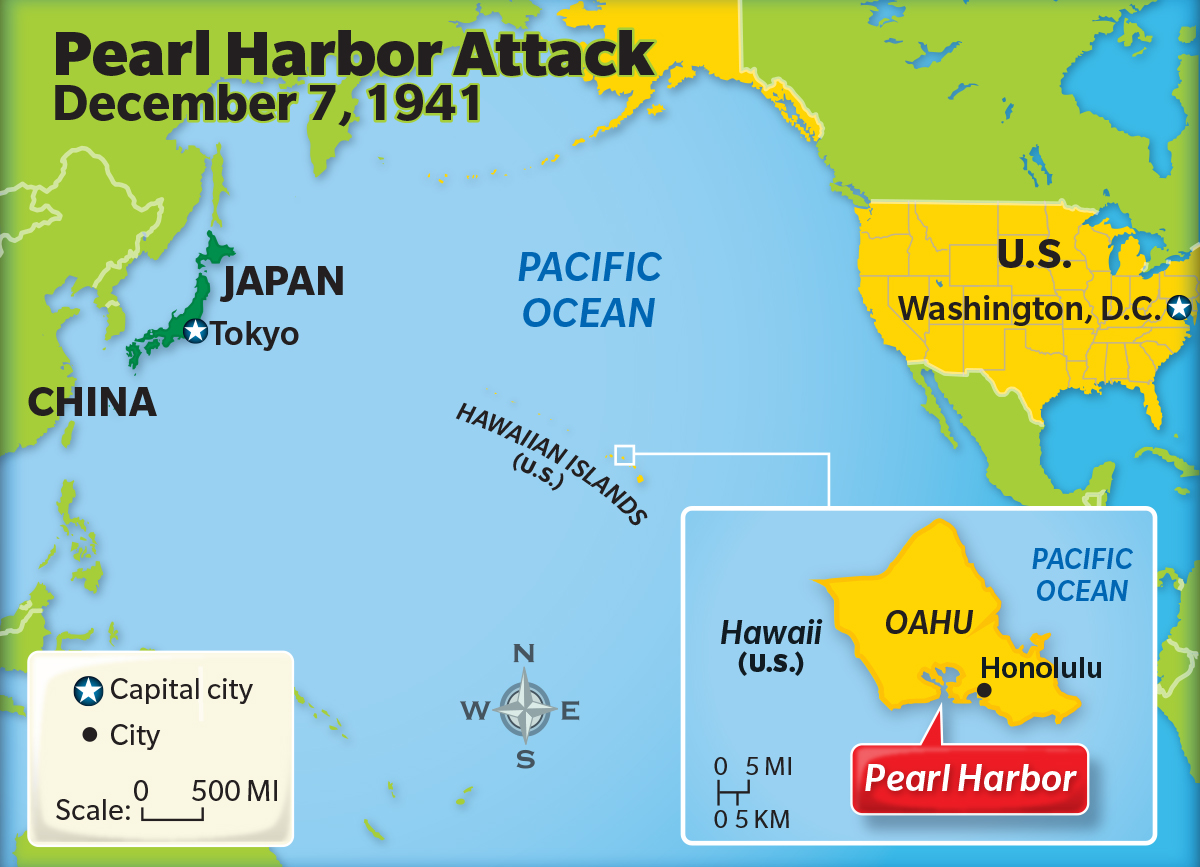
  • Attack on Pearl Harbor (1941)

    US President Mr Trump has said the COVID-19 pandemic is a worse “attack” on the U.S. than either Pearl Harbor or 9/11.

    Practice Question :

    Discuss how the world order changed post Pearl Harbour attack with context to the US hegemony in Asia-Pacific.

    Attack on Pearl Harbor

    • The December 7, 1941 attack on Pearl Harbour was among the most significant moments of the World War II.
    • It signalled the official entry of the US into the hostilities, which eventually led to the dropping of nuclear bombs on the Japanese cities of Hiroshima and Nagasaki in 1945.
    • Significantly, in December 2016, Shinzo Abe became the first sitting Japanese Prime Minister to visit Pearl Harbour.

    What led up to the attack on Pearl Harbour?

    • Before Japan attacked Pearl Harbour in 1941, relations between the US and Japan were already worsening.
    • In 1910, Japan annexed Korea and, in 1937, it invaded China, sending alarm bells ringing in the US and other Western powers about Japan’s manifest expansionist agenda.
    • Between December 1937 and January 1938, an episode which is referred to as the “Nanking Massacre” or the “Rape of Nanking”, occurred — Japanese soldiers killed and raped Chinese civilians and combatants.
    • Japanese historians estimate that anywhere between tens of thousands and 200,000 Chinese were killed.
    • The US was against Japan’s aggression in China, and imposed economic sanctions and trade embargoes after its invasion.

    Immediate causes

    • Japan was reliant on imports for oil and other natural resources — this was one of the reasons why it invaded China and later French Indo-China (present-day Vietnam, Laos and Cambodia).
    • The intention was to take control of the major Chinese ports to have access to resources such as iron, rubber, tin, and most importantly, oil.
    • In July 1941, the US ceased exporting oil to Japan.
    • Negotiations between the two countries ended with the “Hull Note”, the final proposal delivered to Japan by the US. Essentially, the US wanted Japan to withdraw from China without any conditions.
    • Ultimately, the negotiations did not lead to any concrete results, following which Japan set its task for Pearl Harbour in the last week of November 1941.
    • Japan considered the attack to be a preventive measure against the US interfering with Japan’s plans to carry out military operations in some parts of Southeast Asia.

    What happened at Pearl Harbour?

    • About 7.55 am on December 7, 1941, about 180 aircraft of the Imperial Japanese Navy attacked the US Naval base at Pearl Harbour on the island of Oahu in Hawaii.
    • The bombing killed over 2,300 Americans and destroyed the battleships USS Arizona and USS Oklahoma.
    • Roughly 160 aircraft were destroyed, and 150 were damaged.

    Impact on the US

    • In the short term, the American naval presence in the Pacific was severely weakened.
    • However, the Japanese had largely ignored the harbour’s infrastructure, and many of the damaged ships were repaired on-site and returned to duty.
    • American opinion immediately shifted to favouring war with Japan, a course that would conclude with Japan’s unconditional surrender less than four years later.