💥Join UPSC 2027,2028 Mentorship (July Batch) + XFactor Notes & Microthemes PDF

Distribution: yearly

  • Spanish Plan for Phased Easing of Lockdown

    • Spain’s Prime Minister has presented a four-phase lockdown exit strategy for the country.
    • It’s imperative for India to learn from global examples for easing lockdown without doing away with health concerns.

    With the nearing end of nationwide lockdown, various exit strategies are being discussed for a smooth restart.

    Spain’s exit strategy

    • The opening up of the lockdown will begin with phase 0 throughout Spain, except for a few islands that will already be in phase 1 by then.
    • A week later, provinces will enter phase 1, which will last for two weeks and the remaining phases will also last for two weeks each.
    • In total, the de-escalation will take at least six weeks to be complete.

    Phase 0: The preparation phase

    • De-escalations in this phase include opening up of takeaway facilities at restaurants and opening up of some other establishments such as hair salons.
    • From May 2, individuals will be able to go out for a walk or to exercise alone or with people they stay with. In this phase, professional athletes will be able to access individual training sessions.
    • Children aged 14 years or younger have been allowed to go out for walks from April 26.

    Phase 1: The initial phase

    • Begins on May 11. Small businesses will be allowed to open under strict security measures.
    • For instance, gyms can open for people who want to train individually and by appointment.
    • Further, hotels and tourist accommodations will be allowed to open, excluding the common areas and with certain restrictions in place.
    • Places of worship will also be allowed to open, limiting their capacity to one-third. Owners of terrace bars can open their establishments but with 30 per cent capacity.
    • In this phase, some degree of social contact with a limited number of people may also be allowed, subject to what the conditions are then.

    Phase 2: The intermediate phase

    • Begins on May 25.Will include the resumption of hunting and sport fishing, and the opening of cinemas and auditorium theatres at one-third of their capacity.
    • Visits to monuments and cultural facilities, such as exhibition halls and conference rooms, will resume with one-third occupancy.
    • Cultural shows will be allowed with less than 50 people in closed spaces. In the outdoors, shows and events can be held with less than 400 people provided they are seated.
    • All places of worship will have to limit their capacity to 50 per cent.

    Phase 3: The advanced phase

    • Begins on June 8 and provided the situation is under control, general mobility will be made more flexible.
    • Wearing masks will be recommended when people venture outside, especially on public transport. In commercial settings, capacities will be restricted to 50 per cent.
    • Beaches may also open in this phase. The movement of people into other provinces or islands is restricted until the de-escalation process is complete.
  • Ganga water improves during lockdown

    The Ganga water quality has improved remarkably during the lockdown period. This highlights the importance of synergy for absolute symbiosis between nature and man as the need of the hour.

    Context

    • The novel coronavirus lockdown (COVID-19) pandemic has put millions in the throes of adversity — and yet, there is a reason to celebrate.
    • Over a month into the nationwide lockdown, air and water pollution levels have shrunk and the wildlife is free.
    • Of 36 monitoring units placed in the Ganga, water quality at 27 points was found suitable for bathing and propagation of wildlife and fisheries in the lockdown period

    Status of rivers in India

    • India’s water bodies are in a poor state. The rivers are becoming dumpyard for untreated sewage and industrial waste.
    • In the name of economic growth, most rivers and streams have been turned into sewer canals and are getting difficult to be treated.
    • It is estimated that every day, almost 40 million litres of wastewater enters rivers and other water bodies; only 37 per cent is adequately treated.
    • A Centre Pollution Control Board (CPCB) report showed that critically polluted river stretches in the country have increased from 302 stretches in 2016 to 351 stretches in 2018.
    • The finding was based on Biological Oxygen Demand (BOD).

    Ganga

    • According to CPCB, more than half of wastewater treatment plants in the basin do not comply with the discharge norms.
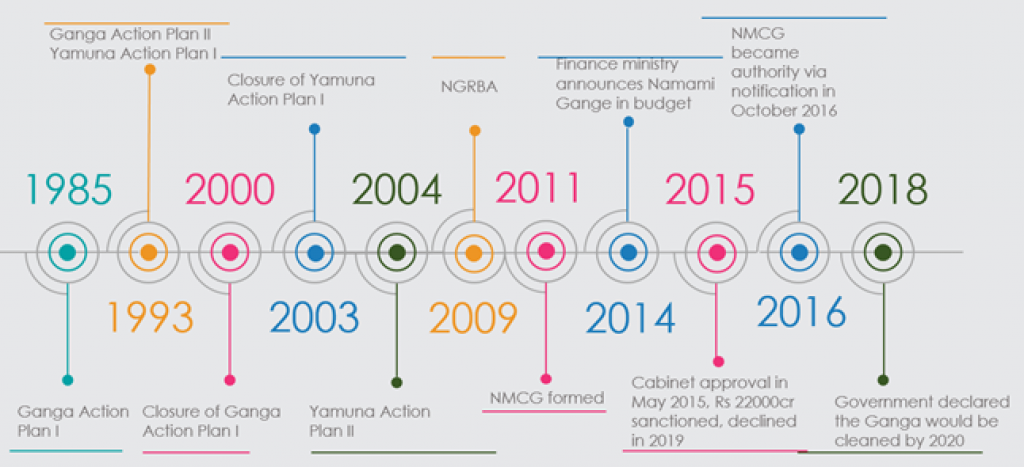
    • Since 1985, several programmes and schemes have been launched to clean the Ganga. It began with the Ganga Action Plan I, followed by Ganga Action Plan II.

    • In 2015, the biggest-ever initiative, Namami Gange was launched with a budget of over Rs 20,000.
    • Despite numerous programmes and huge funds, the Ganga still runs polluted.

    The causes

    • More than 80 per cent of pollution in the Ganga is due to domestic sewage from surrounding towns and villages. The rest is contributed by industrial waste.
    • During the lockdown, domestic sewage would have increased owing to increased demand for water to maintain hand-washing hygiene. Industrial waste, however, stopped entering the Ganga.
    • Other activities such as tourism, fairs, bathing and cloth washing near the ghats were curtailed. Experts said these observations reflected that domestic sewerage was not the only cause of concern.
    • When sewage is mixed with industrial effluents, it gets difficult for the river to assimilate pollution.
    • One more reason was high number of western disturbances which brought rain and improved the flow in the river leading to dilution.

    COVID-19’s gift to Ganga

    • After the nationwide lockdown was imposed, within 10 days signs of improvement in water quality started surfacing.
    • At Varanasi’s Nagwa Nala, the Dissolved Oxygen (DO) values were found increased to 6.8 milligram/litre against 3.8 mg/l on March 6, showcasing an extraordinary improvement of 79 per cent in DO values.
    • 30 per cent of the total BOD load was due to industries along the river, which amounted to 130-150 tons per day.
    • Since all major polluting industries are closed, the toxic load is off the river.

    Surprisingly better

    • Ganga water at Haridwar and Rishikesh was reported fit for drinking due to 500 per cent decrease in sewage and industrial effluents.
    • A dip in the number of visitors at ghats in Haridwar also helped the river water quality.
    • The Ganga water has become fit for ‘achaman’, which means ritual sipping, after a long time.

    Bringing the ambitions to reality

    There is an urgent need to:

    • Reinvestigate the main source of pollution in Ganga and reorient all river cleaning policies and programmes based on lockdown findings.
    • Industries need to strictly adhere to discharge norms accompanied with strong enforcement of laws and regulations vis-a-vis strong monitoring and vigilance framework.
    • Setting up of effective interventions to clean rivers, reliable, representative and comprehensive data collected at high frequency in a disaggregated manner.
    • There is an urgent need to expand the network of monitoring stations on the Ganga, the Yamuna and tributaries of Ganga in more places.
    • Over-extraction and over-exploitation of Ganga’s waters have rendered long stretches of the river completely dry for much of the year. There is a need to maintain ecological flow to keep it clean for longer run.
    • Education and awareness needs to be carried out strategically.

    Back2Basics: Biochemical Oxygen Demand

    • BOD is the amount of dissolved oxygen needed (i.e. demanded) by aerobic biological organisms to break down organic material present in a given water sample at certain temperature over a specific time period.
    • The BOD value is most commonly expressed in milligrams of oxygen consumed per litre of sample during 5 days of incubation at 20 °C and is often used as a surrogate of the degree of organic pollution of water.
    • BOD is similar in function to chemical oxygen demand (COD), in that both measure the amount of organic compounds in water.
    • However, COD is less specific, since it measures everything that can be chemically oxidized, rather than just levels of biodegradable organic matter.
  • Religious Freedom and India

    The U.S. Commission on International Religious Freedom (USCIRF) has downgraded India to the lowest ranking, “countries of particular concern” (CPC) in its 2020 report.

    Religious freedom in India has been a contested issue since decades. Recent moves by the govt. since the abrogation of Art. 370 which triggered the riots in Delhi has left a big scar on the secular fabric of India.

    About USCIRF

    • It is a U.S. federal government commission created by the International Religious Freedom Act (IRFA) of 1998.
    • Its principal responsibilities are to review the facts and circumstances of violations of religious freedom internationally.

    Accusing India of religious intolerance

    • USCIRF has placed India alongside China, North Korea, Saudi Arabia and Pakistan.
    • India was categorised as a “Tier 2 country” in last year’s listing.
    • This is the first time since 2004 that India has been placed in the CPC category.
    • The commission also recommended that the U.S. government take stringent action against India under the “International Religious Freedom Act” (IRFA).

    What led India to lower its religious freedom?

    • India took a sharp downward turn in 2019 due to concerns about the Citizenship Amendment Act, the proposed National Register for Citizens, anti-conversion laws and the situation in Jammu and Kashmir.
    • The report accuses India using its strengthened parliamentary majority to institute national-level policies violating religious freedom across India.
    • The panel reported harassment and violence against religious minorities to continue with impunity, and engaged in and tolerated hate speech and incitement to violence against them.

    India’s reaction

    • The Centre reacted sharply to the USCIRF report terming it “biased and tendentious” and rejected its observations.
    • The biased and tendentious comments against India are not new. But on this occasion, its misrepresentation has reached new levels.
    • Major panellists of USCIRF dissented with the recommendation on India as being ‘too harsh’ and that ended up placing the country alongside what they termed as “rogue nations” like China and North Korea.
    • India regards the accusations as inaccurate and unwarranted and questioned the body’s “locus standi” in India’s internal affairs.

    US’s religious activism: Unwelcomed by all

    • The US earlier this month has announced the launch of a 27-nation International Religious Freedom Alliance, which aim to adopt a collective approach in protecting and preserving religious freedom across the world.
    • Among the prominent countries to join the alliance are Brazil, the United Kingdom, Israel, Ukraine, the Netherlands and Greece.
    • The USCIRF has been accused worldwide of being biased towards focusing on the persecution of Christians and of being anti-Muslim & Hinduphobic. It panels various controversial personalities.
  • [pib] Petersberg Climate Dialogue

    India along with 30 countries deliberated on issues of Climate Change in first-ever virtual Petersberg Climate Dialogue.

    Climate change negotiations are somehow put to a halt due to ongoing pandemic. Such small dialogues are keeping alive the spirit of climate action.

    Petersberg Climate Dialogue

    • It has been hosted by Germany since 2010 to provide a forum for informal high-level political discussions, focusing both on international climate negotiations and the advancement of climate action.
    • This year’s virtual Dialogue was co-chaired by Germany and the UK.
    • The dialogue was crucial because of the efforts to contain coronavirus as well as countries preparing to move into the implementation phase of the Paris Agreement 2015 in the post-2020 period.

    India’s Contributions

    • Expressing solidarity with the world as it combats the COVID 19 pandemic the Union Minister highlighted how COVID – 19 has noticed that we can survive on less.
    • India pushed for having climate technology as an open source available to all countries at affordable prices.
    • India stressed on climate finance and urged to plan for 1 trillion USD in grants to the developing world immediately.
    • India focussed on the opportunity that the world has today to accelerate renewable energy deployment and creating new green jobs in the renewable energy and energy efficiency sector.
  • Recovery from COVID-19 is an opportunity to create economies that are more resilient and fair

    This article discusses the three principles which could form the basis for recreation of the economy devastated by the Covid-19. The first is adopting the economies of “scope” instead of economies of scale. The second is about governance and focus on bottom-up approach. And third is about empowering the people.

    Impact of Covid-19 on the ideology of globalisation

    • The history of the globalisation has turned out to be very brief.
    • In 2020, the global COVID-19 pandemic has forced millions of Indians to return to their villages.
    • Jetsetters have been locked in their gated communities.
    • Global supply chains have been broken apart.
    • People are scrambling for essentials from local suppliers.
    • The ideology of globalisation has hit realities on the ground.

    Recovery from COVID-19 is an opportunity to create economies that are more resilient and fair. The following three architectural principles must apply.

    1. Replace economies of scale by the economies of scope

    • COVID-19 has settled, for now, the debate between free-trade evangelists and advocates of industrial policy.
    • The vulnerability of global supply chains: A complex global economy in which local producers obtain scale (and lower costs) by supplying products for global markets is vulnerable to shutdowns anywhere.
    • The resilience of local economies: Local economies that have a variety of capabilities within them, albeit on smaller scales, are more resilient.
    • Therefore, local economic webs must be strengthened, in preference to global supply-chains.
    • “Make in India,” which was dismissed by free traders as a reversion to pre-1991 economic policies, has become a necessity.
    • Make in India is necessary to maintain supplies of essentials and to create employment for the hundreds of millions of Indians with fragile incomes who have been badly shaken by the lock-down of the Indian economy.

    2. Local systems solution to global problems

    • Local systems solutions are essential for global systemic problems.
    • Privatisation: Garrett Hardin had coined the expression, “The Tragedy of the Commons”, in 1968.
    • The Tragedy of the Commons is a term for the proposition that a resource that belongs to everybody will not be cared for by anybody.
    • This supported policies to privatise public property, ostensibly for the benefit of everybody and became the dominant school of economics from the 1970s onwards.
    • A different explanation: Elinor Ostrom, who was awarded the Nobel Prize for economics in offered a different explanation for the tragedy of the commons.
    • She argued that common resources are well-managed when those who benefit from such resources the most are in close proximity to them.
    • For her, the tragedy occurred when external groups exerted their power (politically, economically or socially) to gain a personal advantage.
    • Bottom-up approach: She was greatly supportive of the “bottom-up” approach to issues: Government intervention could not be effective unless supported by individuals and communities.
    • The world is facing challenges of ecological sustainability and persistent inequalities, which seem to get worse with the prevailing paradigm of economic growth.
    • These challenges are described in the 17 Sustainable Development Goals (SDGs).
    • They cut across national boundaries.
    • They also span several domains of expertise and institutional mandates.
    • The final, 17th goal states the principle by which all the goals will be achieved — “partnerships”.

    Actions theory Vs. Systems thinking

    • Action theory: The prevalent action theory, used by governments, businesses and philanthropic organisations to solve complex problems, focuses on breaking complex problems into components and then tackling the components in separate silos.
    • Problems caused by the actions theory: This widely prevalent theory of action has contributed greatly to causing the systemic, interconnected problems the SDGs now aim to address.
    • What is systems thinking: Effective action to address multiple challenges together requires “systems thinking” — that is, a systemic vision spanning across the problems.
    • Systems thinking is essential, amongst experts at the top and amongst partners on the ground.
    • Several organisations are promoting collaborative action with systems thinking on the ground in India.
    • Kudumbashree in Kerala has proven the power of community action.
    • The Foundation for Ecological Security, guided by Elinor Ostrom’s ideas, is working in many Indian states.
    • Dainik Bhaskar is promoting “SDG chaupals” in Indian villages.

    3.  Empowering the people

    • The third principle for the new economy is, empower the people, the fundamental requirement for genuine democracy.
    • India’s Constitution seeks self-governance in India’s towns and villages.
    • These are not being implemented by governments and policy experts who do not want to give up power to the people.
    • India lives in its villages, Mahatma Gandhi had said. Most of India still does.
    • And many, who had migrated to cities looking for jobs, are returning, shaken by the pandemic.
    • Gandhi was a systems thinker. For Gandhi, the global village was an abstract concept.
    • This cannot be realised until local villages and towns become harmonious communities, where people live in harmony with each other and with nature around them.

    The corona crisis has laid bare some of the problems associated with globalisation. It has forced a rethink of the economic policies and model adopted by the world. Against this backdrop, a question can be asked by the UPSC that demands the analysis of problems that have surfaced and solutions. For ex. “Covid-19 pandemic has brought into a sharp focus some inherent problems associated with the globalisation. In this context suggest the ways to make the Indian economy resilient to such shocks and fair to all the sections of society”

    Conclusion

    COVID-19 marks the end of the economics’ paradigm of the Washington Consensus. New models of economies, and new rules of global governance, must be bottom-up, not top-down. That’s how the whole world can move from relief, to recovery, and into resilience.


    Back2Basics: What was the Washington Consensus?

    • The Washington Consensus refers to a set of free-market economic policies supported by prominent financial institutions such as the International Monetary Fund, the World Bank, and the U.S. Treasury.
    • A British economist named John Williamson coined the term Washington Consensus in 1989.
    • The ideas were intended to help developing countries that faced economic crises.
    • In summary, The Washington Consensus recommended structural reforms that increased the role of market forces in exchange for immediate financial help.
    • Some examples include free-floating exchange rates and free trade.
  • It will take fiscal boldness now to relieve financial distress

    The article discusses the fiscal response of the government to deal with the corona crisis. Fiscal response to the 2008 financial crisis was higher in terms of GDP percentage. Also, a comparison with emerging peer economic indicates that India might be running the tighter fiscal policy in the time of crisis. The article suggests higher spending by going beyond the traditional fiscal space.

    A possible explanation for moderate fiscal response by the government

    • The Indian government has till now come up with an insipid fiscal response to the ongoing economic crisis.
    • Long battle: One view is that the government does not want to fire all its bullets in what threatens to be a long battle. It wants to time its interventions.
    • Weak public finances: The other possible explanation for this fiscal timidity is that India has entered this crisis with weak public finances.

    Comparison with finances at the 2008 financial crisis

    • The combined official fiscal deficit of the Union plus state governments was at its lowest level in many decades.
    • The economic boom of the preceding four years had led to higher tax collections pouring into the treasury.
    • The massive increase in spending announced in the budget of February 2008 was with an eye on the national election scheduled a year later, rather than in anticipation of a coming storm.
    • Then followed the second wave of fiscal expansion after the North Atlantic financial crisis hit Indian shores seven months later.
    • Back then, India’s effective fiscal stimulus over two years was a substantial 4.3% of gross domestic product (GDP).
    • In 2020, the crisis-driven spending plan announced by the government so far is less than 1% of GDP.
    • There could yet be a big fiscal push in the coming days.

    Tighter fiscal policy in crisis compared to other emerging economies

    • Some of the budget estimates released a few days ago by the International Monetary Fund are telling.
    • In 2018, the total fiscal deficit of the Indian government as a proportion of GDP was 2.4 percentage points higher than the average for Asian emerging markets.
    • India is expected to end 2020 with a total fiscal deficit that will be 2.5 percentage points lower than Asia’s average.
    • In other words, India ran a looser fiscal policy compared to the rest of Asia in normal times, but is likely to run a tighter fiscal policy than its regional peers in a crisis year.
    • Something similar can be seen in estimates for public debt.
    • Asian public debt as a proportion of GDP is expected to go up by nine percentage points in 2020.
    • The comparable figure for India is 2.9 percentage points. (These estimates are being cited with full knowledge that forecasting models break down during extreme events.)

    Funding extra expenditure through money creation

    • Lack of traditional fiscal space should not hold the government back in a crisis situation.
    • There are many options outside the consensus macro playbook.
    • Money creation: A commonly cited option right now is funding extra expenditure through money creation rather than borrowing.
    • The size of the Reserve Bank of India (RBI) balance sheet as a percentage of nominal GDP is close to its 35-year average.
    • There is scope for printing more money right now.
    • Lower inflationary pressure: And the inflationary consequences are likely to be muted because of the lower velocity of money amid a demand collapse.
    • Public finances in the future: Getting public finances back on track is a battle that lies in the future.
    • A rapid recovery in economic activity would be the best solution.
    • Otherwise, history tells us that countries have brought down their public debt numbers through some combination of financial repression, austerity, higher taxes and inflation.
    • Some element of capital controls could also be back in play.

    Need for increasing discretionary government spending

    • The collapse in tax revenues as the economy is shut down will automatically lead to a rise in India’s fiscal deficit.
    • However, there is a need for an increase in discretionary government spending as well.
    • Economists have shown that spending multipliers are higher than tax multipliers in India.
    • In other words, the increase in economic output for every unit increase in the fiscal deficit is higher when the government spends rather than changes tax rates.
    • State’s spending Vs. Union spending: Spending by states gives more bang for the buck than equivalent spending by the Union government.

    “Below the line measures” to support the economy

    • Also, there are options other than direct spending to support the economy.
    • Countries such as Germany, the UK, Italy, France and South Korea have complemented traditional fiscal expansions with “below the line” measures such as loans and guarantees to companies.
    • In an excellent recent study, analysts estimate that more than half of Indian corporate balances sheets will be unable to meet expenses with zero revenues.
    • They are careful to point out that their analysis is based on extreme assumptions that there is no fall in their wage bills, no revenues, and no access to fresh credit.

    One of the common suggestions we have been coming across is the spending by the government by printing money. In this article, the second important suggestion is below the line measures. Take note of these measures and options available with the government.

    Way forward

    • The poor need income support for their very survival. That should be at the top of any democratic government’s list of
    • However, protecting Indian companies from a financial collapse also matters, because otherwise, the economy will see a reduction in its capital stock, which will be needed both for a rapid recovery as well as job creation once the worst is over.
    • There are contagion risks in financial markets as well, going by what has happened to some mutual funds that were invested in bonds.

    Conclusion

    These are extraordinary times that require extraordinary measures. The danger from a delayed fiscal programme is that hysteresis may set in, as companies run out of money and supply chains are broken, damaging our economic prospects in the medium term.


  • ‘Trends in World Military Expenditure’ Report, 2019

    The annual report ‘Trends in World Military Expenditure, 2019’ was released by the Stockholm International Peace Research Institute (SIPRI), a Swedish think tank.

    Military expenditure across the World

    • The global military expenditure rose to $1917 billion in 2019 with India and China emerging among the top three spenders, according to the report.
    • In 2019, the top five largest spenders — U.S. ($732 bn), China, India, Russia ($65.1 bn) and Saudi Arabia ($61.9 bn) — accounted for 62% of the global expenditure.
    • China’s military expenditure reached $261 billion in 2019, a 5.1% increase compared with 2018, while India’s grew by 6.8% to $71.1 billion.
    • In Asia and Oceania, other than India and China, Japan ($47.6 bn) and South Korea ($43.9 bn) were the largest military spenders.

    What drives India’s military spending?

    • India’s tensions and rivalry with both Pakistan and China are among the major drivers for its increased military spending.
    • While India’s defence spending excluding pensions, which constitute a significant part, has been growing in absolute terms, it has been going down as a percentage of its GDP as noted by the report.

    Significant rise

    • India’s expenditure in 2019 was 6.8% more than that in 2018.
    • It grew by 259% over the 30-year period of 1990–2019, and by 37% over the decade of 2010–19.

    The Defence expenditure in India is increasing every year in absolute terms, implying higher spending while there has been very selective modernisation of the armed forces. Critically analyse.

  • Global Terrorism Index (GTI) 2019

    A report compiled by NITI Aayog has questioned the methodology adopted by an Australian based institute to rank India as the seventh-worst terrorism affected country.

    Despite of being a global threat, there is yet no consensus on the definition of terrorism. Despite the considerable discussion, the formation of a comprehensive convention against international terrorism by the United Nations has always been impeded by the lack of consensus on a definition.

    Global Terrorism Index (GTI)

    • GTI is a report published annually by the Institute for Economics and Peace (IEP).
    • The index provides a comprehensive summary of the key global trends and patterns in terrorism since 2000.
    • It produces a composite score in order to provide an ordinal ranking of countries on the impact of terrorism.
    • It is an attempt to systematically rank the nations of the world according to terrorist activity.
    • The index combines a number of factors associated with terrorist attacks to build an explicit picture of the impact of terrorism, illustrating trends, and providing a data series for analysis by researchers and policymakers.

    Its database

    • The GTI is based on data from the Global Terrorism Database (GTD).
    • The GTD is collected and collated by the National Consortium for the Study of Terrorism and Responses to Terrorism (START) at the University of Maryland.
    • It has codified over 190,000 cases of terrorism.
    • The GTI covers 163 countries, covering 99.7% of the world’s population.

    India’s ranking

    • India has moved to the seventh position from the previous years eighth in the annual Global Terrorism Index (GTI) 2019.
    • India has ranked ahead of conflict-ridden countries such as the Democratic Republic of Congo, South Sudan, Sudan, Burkina Faso, Palestine and Lebanon.

    Why such ranking matters?

    • The positioning in the global indices impacted investments and other opportunities.
    • The purpose was to see which of the indices can be used to drive reforms or which of these would require some amount of engagement with the publishing agency to make the indices more relevant.

    Issues with GTI

    • The GTD was based solely on “unclassified media articles, with more than 100 structured variables such as each attack’s location, tactics and weapons, perpetrators, casualties and consequences etc.
    • The large diversity in definitions of terrorism amongst countries, and the lack of a universally accepted definition of terrorism, leads to a great deal of ambiguity in calculating and understanding GTI reports.
    • IEP’s economic impact of terrorism model does not account for costs for countering violent extremism and long-term economic impacts on business activity, production and investment.
    • Indeed, the GTI 2019 report itself states that a great majority of property damage values from terrorist incidents are coded in the GTD as ‘unknown,’ resulting in 1 out 4 parameters scoring nil for most countries.
    • Similarly, the definition of mass shootings used in the GTI is limited to ‘indiscriminate rampages in public places resulting in four or more victims killed by the attacker,’ leaving out lone-wolf attacks.

    Highly irrelevant data

    • The absence of a robust data collection and analysis methodology, and any engagement with Governments facing the scourge of terrorism, means that the GTI has low direct value for policymakers.
    • It cannot be used as an aid to understand and alleviate challenges to countries from domestic and cross border terrorism.
  • RBI should preserve its inflation credibility

    This article by Urjit Patel elaborates on the recent actions of the RBI which are likely to result in making the role of MPC redundant. Some of the moves cited are injection of liquidity by the RBI and reduction of reverse repo rate by the RBI. Implications such actions could have for the macroeconomic stability are also discussed.

    Stimulus package after the 2008 financial crisis and problems created by it

    • Following the global financial crisis of 2007-08, India, like many other countries, embarked on a stimulus.
    • The pump-priming did not end too well.
    • Inflation and bad loans: By 2013, India crossed or approached double-digit figures in inflation and the national fiscal deficit, in addition to looming bad loans.
    • Taper tantrum: In summer 2013, when the Federal Reserve indicated a possible reversal of its ultra-accommodative policy, macroeconomic parameters for India were so weak that it got caught up in the “taper tantrum” and experienced external sector fragility.

    Inflation targeting and the role of MPC

    • While fiscal excesses and financial sector stress remain issues today, India has improved significantly on at least one dimension — namely, inflation — which has also stabilised the external sector.
    • How was this beneficial progress achieved?
    • Starting in September 2013, the Reserve Bank of India (RBI) initiated an effort to build credibility with domestic savers and international investors on maintaining inflation at prudent levels.
    • Three years thereafter, the RBI Act was amended to put in place a flexible inflation targeting framework.
    • A Monetary Policy Committee (MPC), comprising of RBI representatives and external members appointed by the Government of India, was enjoined with the legal mandate of managing the policy (repo) rate.
    • MPC was mandated to keep consumer price inflation at a target level of 4 per cent, while keeping in mind economic growth.

    Assessment of MPC’s performance

    • By objective measures, the MPC framework until recently worked rather well.
    • It lent transparency and democratic accountability to the process of interest-rate setting.
    • Combined with efforts on managing food inflation, it has brought inflation closer to the target.
    • It has contributed to tempering household inflation expectations.
    • It has kept borrowing costs in the economy at reasonable levels in spite of the high level of government borrowing and several other distortions.
    • Appreciation by the rating agencies: Indeed, rating agencies and multilateral institutions repeatedly mention the MPC and the inflation targeting framework as a landmark structural reform towards sound macroeconomic management.

    Latest monetary actions by RBI that reduced MPC’s role

    • Since last year, a series of monetary actions by the RBI have left the MPC’s decision on the policy rate partly redundant, diluted the accountable process of monetary decision-making.
    • This has put at stake the sanctity of the MPC framework.
    • With a stated intention to improve the transmission of monetary policy to households and corporations, the RBI has pumped unprecedented levels of money (close to Rs 7 trillion) into the banking system.
    • It has done so mostly by purchasing government bonds but partly also by purchasing dollars.
    • No desired results: Given impaired financial sector balance-sheets, transmission to economic growth has been at best muted; liquidity is no silver bullet to durably address financial sector stress.
    • The primary effect of excessive liquidity has, instead, been to monetise the government’s expenditures and keep its borrowing costs low.
    • With its declared aim not being met satisfactorily, the RBI has doubled down on liquidity supply, with the same outcome.
    • An important casualty has been the MPC framework.
    • Contradictory actions: At times, even when the MPC has kept the policy rate unchanged, the RBI has injected yet more liquidity to move medium-term interest rates down.
    • The two actions have been noted to be in direct contradiction of each other.
    • If the objective is to move medium-term rates, why not build consensus within the MPC to cut the policy rate more aggressively and communicate the rationale?
    • Change in reverse repo by the RBI: Further, given the enormous liquidity glut, every night banks park liquidity with the RBI at a (reverse repo) rate lower than the policy rate and which is not set by the MPC; nevertheless, this rate used to be changed only as part of the MPC Resolution.
    • Lately, the RBI has moved reverse repo rate progressively lower than the policy rate; recently.
    • It has done so outside of the MPC meeting cycle and not as part of the MPC Resolution.
    • There are straightforward tools in liquidity management to ensure that in surplus conditions also, the central bank transacts with banks at the policy rate — technically, by switching from “deficit” to “floor” system of liquidity management.
    • Such a switch is routinely adopted by central banks when they provide excess liquidity; the RBI has chosen not to do so.

    What are the implications?

    • The net effect is that market interest rates are being increasingly controlled by the RBI rather than the MPC.
    • Indeed, there is a proposal that the rate at which the RBI absorbs liquidity be still lower, likely divorced from the policy rate set by the MPC.
    • The spirit of the MPC framework enshrined in the RBI Act is being violated.
    • It is unclear how the MPC can be expected to satisfy its legal mandate if what it seeks to achieve via the setting of the policy rate is in conflict with, or compromised by, the RBI’s liquidity management.
    • These developments have the potential to pose risks for India’s macroeconomic stability going forward.
    • The implicit monetisation of fiscal expenditures through government bond purchases by the RBI in the secondary market has postponed the recognition of the untenable fiscal reality.
    • The delay has meant the government has had limited policy space since the onset of COVID.
    • Supply-chain disruptions due to measures taken to contain the pandemic raise the possibility of cost-push inflationary pressures, especially given the excessively easy fiscal and monetary conditions.
    • This can abruptly raise economy-wide borrowing rates, inflict losses on banks, and imperil financial stability.
    • If the gains in inflation credibility built by the MPC framework are dissipated by ineffective policies and operations, both household and investor expectations for inflation in India could unhinge.
    • Worse, it could instigate turmoil in the external sector.
    • Excessively low bank deposit rates may induce some non-resident deposits to exit the country.

    A question based on the issue of RBI’s action and its implication for MPC and overall economy can be asked by the UPSC, for ex- “The MPC framework has performed well in delivering on its mandate. Yet, there were some actions by the RBI recently which could be perceived as inimical to the functions of the MPC. Discuss.”

    Conclusion

    In a highly unpredictable time such as this, the RBI should preserve its inflation credibility. The decision on monetary policy actions based on voting by committee members, provision of inflation and growth forecasts in the resolution statement, and coordination of rate-setting and liquidity management, need to be adhered to.


    Back2Basics: What is MPC?

    • The Reserve Bank of India Act, 1934 (RBI Act) was amended by the Finance Act, 2016,  to provide for a statutory and institutionalised framework for a Monetary Policy Committee, for maintaining price stability, while keeping in mind the objective of growth.
    • The Monetary Policy Committee is entrusted with the task of fixing the benchmark policy rate (repo rate) required to contain inflation within the specified target level.
    • The meetings of the Monetary Policy Committee are held at least 4 times a year and it publishes its decisions after each such meeting.
    • As per the provisions of the RBI Act, out of the six Members of Monetary Policy Committee, three Members are from the RBI and the other three Members of MPC are appointed by the Central Government.
    • Governor of the RBI is ex officio Chairman of the committee.
  • Sharp fall in oil prices is opportunity for India to increase stockpile

    This article highlights the opportunity that the sharp drop in the oil prices presents to India. It also highlights several issues with India’s strategic petroleum reserves and suggests ways to deal with them. We have covered an article from livemint on the same topic in the past week.

    Negative price in the international market for WTI crude oil

    • Oil prices continue to decline globally, with crude hitting multi-decade lows, as global demand evaporates.
    • Earlier last week, in unprecedented price action, the near-month contract for West Texas Intermediate (WTI) sweet crude oil dropped to -$37.63 a bbl.
    • A negative price has never before been registered for a major global crude oil benchmark.
    • The extreme price action is a signal that there is a global oil glut with few places to store oil.
    • Global oil markets have been severely disrupted.
    • While WTI does not feature in India’s basket, Brent Crude Oil, which does, is trading around $25 a barrel, the lowest in 18 years.

    Price of oil: The silver lining of the future recovery

    • Even as India suffers from a lockdown, a silver lining for future recovery and reconstruction is the price of oil.
    • Given India’s growth aspirations and lack of self-sustaining oil production, a sharp reduction in oil prices is a bonanza.
    • Normally, reduced oil prices would translate into surplus for the consumers and a fiscal bonus for the government through increased tax collections.
    • However, given that the demand for petrol has slumped, those gains will not accrue right away.
    • Opportunity for India: India should look at this as an opportunity to strengthen its energy security by buying oil and filling up our Strategic Petroleum Reserves (SPR).
    • Considering that India was the third-largest consumer of energy in the world, as well as the third-largest importer of oil in 2018, we are particularly vulnerable to oil price fluctuations.
    • The dramatic reduction in oil prices offers a once-in-a-generation opportunity for us to fill up our reserves in an extremely cost-effective way.

    India’s Strategic Petroleum Reserve (SPR) Programme

    • Currently, we do maintain an emergency stockpile of oil reserves: Under the existing Strategic Petroleum Reserves programme, India claims to have 87 days of reserves.
    • Out of this, refiners maintain 65 days of oil storage and the rest of the reserves are held in underground salt caverns maintained by Indian Strategic Petroleum Reserves Limited (ISPRL).
    • The existing and planned capacity for the underground reserves is 10 and 12 days of import cover for crude oil respectively.

    Following point highlights the importance and various issues with India’s Strategic Petroleum Reserves (SPR). SPR plays an important role in India’s energy security.  A question based on its role may be asked by the USPC “Assess the importance of Strategic Petroleum Reserves for India and what are the issues associated with that need to be improved?”

    Issues with the strategic reserves

    • First, capacity does not directly translate into utilisation, which is partly because oil is an expensive commodity most days of the year.
    • In 2019, the average closing price of a barrel of crude was $57.05.
    • In 2018, it was $64.90, and in 2017, U$50.84.
    • Of the existing 10 days of capacity, only about 50 per cent is utilised.
    • The second issue is with regard to the refinery holdings.
    • In India, the SPR arrangement between the oil refineries and the Union or state governments is not specified well, though most of the refineries that hold stock are publicly-owned companies.
    • In fact, a breakdown of which refineries hold SPR and in what form (crude or refined) or information about where they are located is not publicly available.

    Need for transparency in relation to SPR

    • The first step, therefore, should be to introduce transparency and accountability in relation to the SPR.
    • The procedures, protocols and facts about Indian SPR storage require greater public and parliamentary scrutiny, just like India’s other strategic reserves (for instance, foreign exchange).
    • For this, there should be timely and reliable dissemination of information.
    • Instead, it is now shrouded in secrecy.
    • The ambiguity surrounding mobilisation process: The lack of transparency around our SPR holdings is compounded by the ambiguity surrounding the mobilisation process.
    • SPR reserves are meant to be used in emergencies, where time is likely to be of the essence.
    • The SPR mobilisation process could be made more efficient by laying out designated roles for different agencies to avoid redundancies in times of crisis.
    • There should be role and process clarity regarding SPR mobilisation.
    • For instance, to begin with, there should be clarity on who (or which agency) can define an emergency and therefore order a mobilisation.

    Diversification of SPR

    • Further, in order to mitigate risks better, India should look to diversify its SPR holdings.
    • Diversification can be 1)Based on geographical location (storing oil either domestically or abroad), storage location (underground or overground) and 2) Product type (oil can be held in either crude or refined form).
    • Storage and transportation costs could be saved by diversifying geographically.
    • 3) Diversification could also be in the form of ownership — either publicly owned through ISPRL or by private oil companies, such as ADNOC of Abu Dhabi.
    • The private companies could fill up the SPR when prices are low and take advantage of price arbitrage.
    • This could achieve a degree of price stability and reduce the cost for India to buy such large quantities of oil.
    • The only requirement for this to work is to have a clear contract with the private companies about the mandatory minimum level of stock that they should preserve for use in emergency times.

    Storing oil abroad

    • With oil dirt-cheap, if we can purchase more than we can store in our existing facilities, why not go abroad for more storage space?
    • For instance, one option could be to operationalise, modernise, and add to the oil tanking facilities at Trincomalee in Sri Lanka.
    • Another opportunity would be to enter into a strategic partnership with Oman (Ras Markaz) for oil storage.
    • Partnership with Oman would also help India avoid the potential bottleneck of the straits of Hormuz.
    • Geopolitical risk factor: Since many of these places could potentially be vulnerable to geopolitical risks, only a small part of India’s overall SPR strategy should involve storing abroad.

    Conclusion

    Energy is and will remain vital to India’s aspirations for growth. The sharp fall in the price of oil presents an opportunity for the Union government to increase its SPR stockpile and achieve a degree of energy security.