💥Join UPSC 2027,2028 Mentorship (July Batch) + XFactor Notes & Microthemes PDF

Distribution: yearly

  • Stress test of leadership in pandemic

    The article discusses the three stages involved in successfully dealing with the pandemic. In the next part, it goes on to explain the factors that determine the success or failure of the governments. In the last week, we read about the success story of Kerala and underlying reasons. This article is also written on similar lines.

    Stages in the pandemic response

    • Disease outbreaks, even global pandemics, are scarcely new. The playbook for dealing with them, therefore, is well understood and has been honed by practices and lessons gleaned from hard-fought battles.
    • A first stage is an early clear-eyed recognition of the incoming threat, and, in the case of COVID-19 at least, requires the unpalatable decision to lock down society.
    • Ideally, this is done with full consideration of how to support the most vulnerable members of society, especially in a country such as India, where so many survive hand-to-mouth.
    • This is a phase aimed at buying time, of flattening the epidemic curve, so that public health facilities are not overwhelmed.
    • And, for using this time, paid for by collective sacrifice, to secure the personal protective equipment (PPE) and medical supplies necessary to save lives.
    • The second phase of the pandemic response is slowly to ease the burden on the economy by permitting a measured return of business activity so that livelihoods and supply chains can be restored.
    • This stage can only be safely executed if accompanied by a war-footing expansion of testing capacity so that new infections can be identified and isolated at once, allowing contact tracing to be implemented by masses trained to do this crucial and painstaking work in communities across the country.
    • The final stage, which for COVID-19 seems a lifetime away, is a mass vaccination programme and then the full rebuilding of economic and social life.
    • None of this is easy, but, like an examination in a dreaded subject, one’s only hope is early and persistent preparation and, at crunch time, remembering the lessons learned.

    The above-mentioned stages are sort of a template that seems to have gained acceptance for dealing with the pandemic. A question based on it, like “What are the various stages involved in government’s response to deal with a pandemic?”

    Following three factors make the difference between successful and failed response

    1. Leadership problems in global politics

    • The defensive finger-pointing, opportunistic politicking and xenophobic posturing are shown by some leaders amid pandemic.
    • This is not a crisis that can be tackled without robust and multidimensional international cooperation between nations.
    • We are watching in real-time the benefits of intellectual collaboration that does not stop at national borders.
    • From the epidemiologists to the medical community identifying more effective treatments, to the research scientists racing to find a vaccine, we are benefiting from collaboration.
    • But the nationalistic turn in global politics over the past two decades has reduced investment in and undermined the legitimacy of the very institutions that facilitate international partnership at the very time they are needed most.
    • Prime Minister Narendra Modi did well to convene the leaders of the South Asian Association for Regional Cooperation (SAARC) nations in mid-March to discuss the possibility of a regional response.
    • But that video-conference call also highlighted that there have been no summit-level meetings of SAARC since 2014.
    • Similarly, United States President Donald Trump demanded that the U.S. end funding of the World Health Organization (WHO).
    • This not only endangers American lives by cutting off his own administration’s access to vital international data.
    • But also directly affects India which receives significant funding and expertise from WHO with ~10% of its overall WHO financing in 2019 coming directly from the U.S.

    2. The whole-of-the-government strategy

    • Pandemic response requires a whole-of-government strategy, for which political will and legitimate leadership are vital to convene and maintain.
    • Germany and Kerala provide two powerful though different examples of this in action.
    • In Germany, in spite of a high level of federalism that gives its States (Länder) a lot of power, Chancellor Angela Merkel’s ability to mobilise the entire system has allowed Germany to emerge as a success story in Europe.
    • In Kerala, State Chief Minister Pinarayi Vijayan convened a State response team at the earliest possible moment and has provided the full weight of his office in support of a coordinated public health strategy that has been accepted by the State’s citizens who have learned to trust the government in such situations.
    • Yet these two examples stand out in part for how rare they are.
    • Consider again the cautionary tale of the U.S. where some State Governors have yet to issue stay-at-home orders.

    3. The robust public health system

    • We are seeing first hand the consequences of starving public health systems of necessary funds and resources.
    • The comparative advantage of the private sector is efficiency; the need of the hour in pandemic response is redundancy, or, more precisely, excess capacity.
    • Most hospitals do not need invasive ventilators normally, just as they do not need vast stocks of PPE and extra intensive care units beds, but these are essential goods right now as we brace ourselves for a flood of sick patients into hospitals.
    • Watching the advanced health-care system of northern Italy buckle under the unimaginable pressures to which it was exposed over the past six weeks should be a cautionary tale for all countries that thought turning health care over to private actors was responsible governance. It is not.
    • Again, consider Kerala, which has consistently ranked at the top of State rankings for health expenditures.
    • Kerala has, a well-functioning local public health system capable of implementing the test-isolate-trace protocols critical for fighting COVID-19.

    Conclusion

    With the central role of leadership and governance underlined in the successful dealing with the pandemic, leadership across the world need to come together to coordinate at all levels in dealing with the problems that are not bound by any border.

  • Qissa Khwani Bazaar massacre and the Khudai Khidmatgars

    • Qissa Khwani Bazaar is a renowned market place in the city of Peshawar.
    • Before the Partition, the marketplace was also the site of a massacre perpetrated by British soldiers against non-violent protesters of the Khudai Khidmatgar movement on April 23, 1930.

    We can expect a possible mains question inspired from this newscard. The question could be like- “Discuss the role of Abdul Ghaffar Khan and his Khudai Khidmatgar in infusing the Gandhian principle of non-violence in the Frontiers of India “.

    The Red Shirts:  Khudai Khidmatgars

    • The Khudai Khidmatgar was a non-violent movement against the British occupation of the Indian subcontinent led by Abdul Ghaffar Khan, a Pashtuns freedom fighter, in the North-West Frontier Province.
    • Over time, the movement acquired a more political colour, leading to the British taking notice of its growing prominence in the region.
    • Following the arrest of Khan and other leaders in 1929, the movement formally joined the Indian National Congress after they failed to receive support from the All-India Muslim League.
    • Members of the Khudai Khidmatgar were organised and the men stood out because of the bright red shirts they wore as uniforms, while the women wore black garments.

    Why did the massacre happen?

    • Abdul Ghaffar Khan and other leaders of the Khudai Khidmatgar were arrested on April 23, 1930 by British police after he gave a speech at a gathering in the town of Utmanzai in the North-West Frontier Province.
    • A respected leader well-known for his non-violent ways, Khan’s arrest spurred protests in neighbouring towns, including Peshawar.
    • Protests spilled into the Qissa Khwani Bazaar in Peshawar on the day of Khan’s arrest. British soldiers entered the market area to disperse crowds that had refused to leave.
    • In response, British army vehicles drove into the crowds, killing several protesters and bystanders. British soldiers then opened fire on unarmed protestors, killing even more people.
    • Historical records suggest the British attempted to deploy the Garhwal Regiment against the civilians in the marketplace, but two platoons of this respected regiment refused to shoot at unarmed protesters.
    • In retaliation, British officials court-martialled the platoon members with upto eight years of imprisonment.

    Aftermath of the massacre

    • The British ramped up the crackdown on Khudai Khidmatgar leaders and members following the Qissa Khwani Bazaar massacre.
    • In response, the movement began involving young women in its struggle against the British, a decision in line with tactics adopted by revolutionaries across undivided India.
    • Women were able to move undetected with more ease than men.
    • According to accounts by Khudai Khidmatgar activists, the British subjected members of the movement to harassment, abuse and coercive tactics adopted elsewhere in the subcontinent.
    • This included physical violence and religious persecution. Following the recruitment of women in the movement, the British also engaged in violence, brutality and abuse of women members.

    Khudai Khidmatgars  gets wasted into history

    • British adopted their tactic of sowing divisions on religious grounds in the North-West Frontier Province as well, in an attempt to weaken the Khudai Khidmatgar.
    • In a move that surprised the British government, in August 1931, the Khudai Khidmatgar aligned themselves with the Congress party, forcing the British to reduce the violence they were perpetrated on the movement.
    • The Khudai Khidtmatgar opposed Partition, a stance that many interpreted as the movement not being in favour of the creation of the independent nation of Pakistan.
    • Post 1947, the Khudai Khidmatgar slowly found their political influence decreasing to such an extent that the movement and the massacre 90 years ago in the Bazaar has been wiped out from collective memory (of Pakistan).
  • [Burning Issue] India’s Amended FDI Norms amidst Hostile Takeover Efforts by China


    For India, the problem lies that, trade with China has often been viewed as a positive in a relationship without any positive sentiment.

    Post-Doklam, the Wuhan ‘reset’ with China was premised largely on India and China working towards a more robust economic relationship.

    Yet, China’s reluctance to adequately address Indian concerns and the challenges posed by sectors like trade and health also emerging as traditional national security threats in the Sino-Indian matrix meant that New Delhi had had to finally bite the bullet.

    FDI is an all-season hot topic for both prelims as well as mains. Reading the Burning Issue will make you aware of its scope. We can expect a mains question like –  Recent amendment in the FDI Policy aims for curbing opportunistic takeovers/acquisitions of Indian companies. Elucidate.

    Context

    • The Government of India has reviewed the extant Foreign Direct Investment (FDI) policy for curbing opportunistic takeovers/acquisitions of Indian companies due to the current COVID-19.
    • The Indian policy revision is meant for sectors and enterprises other than defence, space, atomic energy and sectors and activities “prohibited for foreign investment”.
    • It was understood that the Indian decision was a response to the news of an incremental purchase of shares in HDFC by the People’s Bank of China.

    Background

    What is Foreign Direct Investment (FDI)?

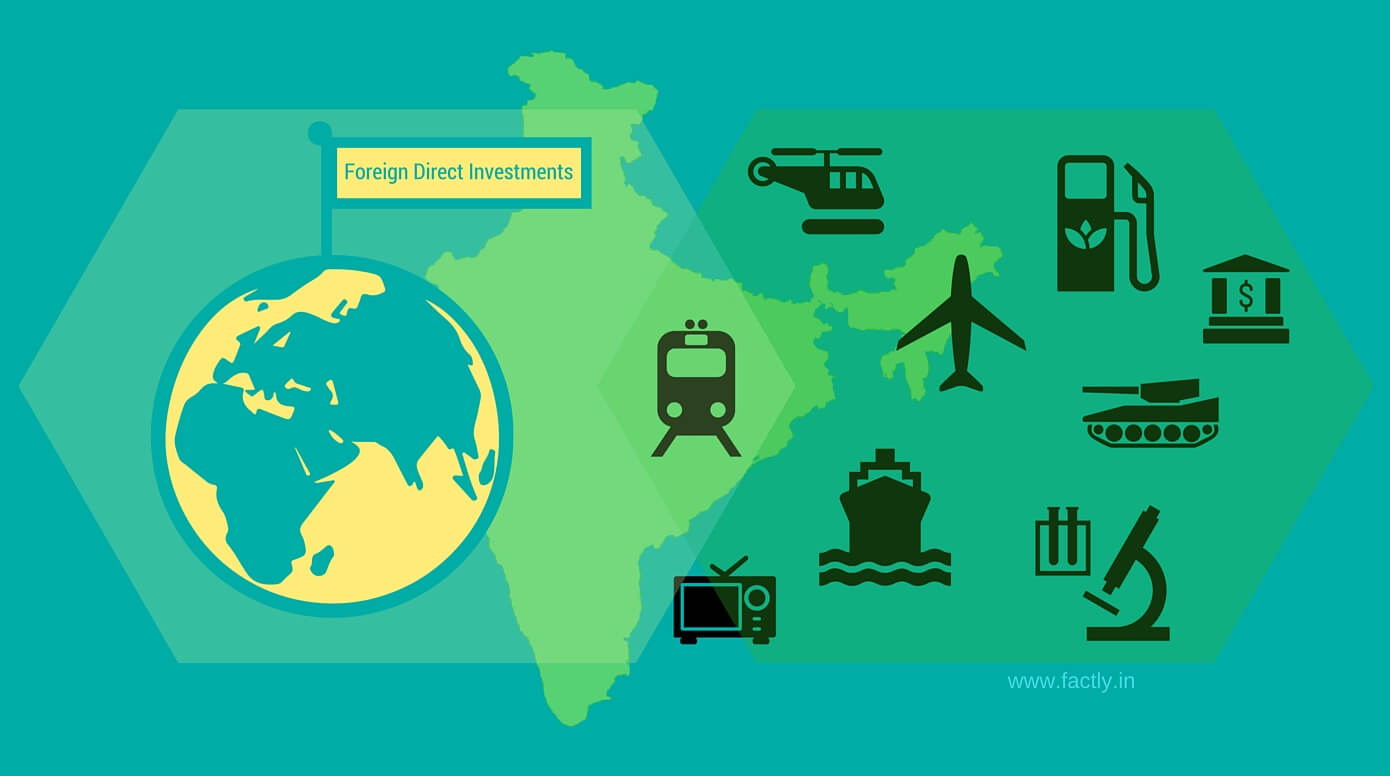
    An FDI is an investment in the form of a controlling ownership in a business in one country by an entity based in another country. It means where a foreign company, generally an MNC, may invest in a country in any of the following 3 forms:

    1) Set up a plant or project to manufacture a commodity- consumer goods, capital goods, automobile, aircraft, ships etc. It may also engage itself in construction activity- highways, roads, bridges, ports, airports, real estate etc.

    2) Setup a network for providing services- banking, insurance, shipping, telecom, software, civil aviation etc.

    3) Only provide technology by way of Technology Transfer through any company of the country. It can provide technology only or provide technology along with #1 & #2 above

    Why Foreign Investors go for FDI?

    • To take advantage of cheaper wages in the country, special investment privileges such as tax exemptions offered by the country as an incentive
    • To gain tariff-free access to the markets of the country
    • To acquire a lasting interest in enterprises operating in the target country

    What attracts FDI?

    • The growth rate of the source economy is an important determinant
    • The political and economic stability of the target region
    • How ‘open’ the economy is towards foreign trade (both imports and exports)
    • The policies, rules, regulations and loopholes incidental thereto
    • For example, Mauritius has been the top FDI source for India due to the later (loophole) reasons

    FDI in India

    • Foreign investment was introduced in 1991 under Foreign Exchange Management Act (FEMA), driven by then FM Manmohan Singh.
    • There are two routes by which India gets FDI.

    1) Automatic route: By this route, FDI is allowed without prior approval by Government or RBI.

    2) Government route: Prior approval by the government is needed via this route. The application needs to be made through Foreign Investment Facilitation Portal, which will facilitate the single-window clearance of FDI application under Approval Route.

    • India imposes a cap on equity holding by foreign investors in various sectors, current FDI in aviation and insurance sectors is limited to a maximum of 49%.
    • In 2015 India overtook China and the US as the top destination for the Foreign Direct Investment.

    Chinese contribution

    • Almost 18 of India’s 23 unicorns have investments from China.
    • According to a report, China has remarkable investments in the tech sector in India.
    • “TikTok, the video app, has 200 million subscribers and has overtaken YouTube in India.
    • Alibaba, Tencent and ByteDance rival the US penetration of Facebook, Amazon and Google in India.
    • Chinese smartphones like Oppo and Xiaomi lead the Indian market with an estimated 72 per cent share, leaving Samsung and Apple behind.

    What is the recent amendment all about?

    • The govt. has amended para 3.1.1 of extant FDI policy as contained in Consolidated FDI Policy, 2017.
    • In the event of the transfer of ownership of any existing or future FDI in an entity in India, directly or indirectly, resulting in the beneficial ownership, such subsequent change in beneficial ownership will also require Government approval.

    The present position and revised position in the matters will be as under:

    Earlier Position

    • A non-resident entity can invest in India, subject to the FDI Policy except in those sectors/activities which are prohibited.
    • However, a citizen of Bangladesh or an entity incorporated in Bangladesh can invest only under the Government route.
    • Further, a citizen of Pakistan or an entity incorporated in Pakistan can invest, only under the Government route, in sectors/activities other than defence, space, atomic energy and sectors/activities prohibited for foreign investment.

    Revised Position

    • A non-resident entity can invest in India, subject to the FDI Policy except in those sectors/activities which are prohibited.

    [spot the difference]

    • However, an entity of a country, which shares a land border with India or where the beneficial owner of investment into India is situated in or is a citizen of any such country, can invest only under the Government route.
    • Further, a citizen of Pakistan or an entity incorporated in Pakistan can invest, only under the Government route, in sectors/activities other than defence, space, atomic energy and sectors/activities prohibited for foreign investment.

    What do these restrictions mean?

    • FDI from rest of the countries could come in through the automatic route in sectors where it is allowed such as automobiles, auto parts, construction, asset reconstruction, agriculture, single-brand retail, manufacturing, coal, gems & jewellery, and textiles, capital goods, pharmaceuticals, electronic systems and ports and shipping etc.
    • If FDI is made from investors in China and six other neighbouring countries it will need to have prior government approval.
    • Earlier, these restrictions were applicable only on Pakistan and Bangladesh.

    What led India to change the FDI norms?

    • Chinese investments sometimes do follow a pattern. At the peak of the debt crisis, there was a massive inflow of Chinese direct investment into the European Union.
    • In 2010, the total stock of Chinese direct investment in the EU was just over €6.1bn, less than what was held by India, Iceland or Nigeria.
    • By the end of 2012, Chinese investment stock had quadrupled, to nearly €27bn. This was partly opportunistic buying because assets were cheap.
    • It was a structural secular shift in Chinese outbound investment, from securing natural resources in developing countries to acquiring brands and technology in developed countries.
    • Chinese firms are quite ready for discount deals, where domestic companies are reeling under an economic crisis spurred on by the coronavirus pandemic.

    Impact on investments

    • The amended policy brings every kind of Chinese investors to India within the ambit of government approval reducing the space for private business negotiations.
    • The decision would face difficulties, especially if the government tried to attribute nationality to venture capital funds.
    • China has argued that the barriers set by the Indian side for investors from specific countries violate WTO’s principle of non-discrimination, and go against the general trend of liberalization and facilitation of trade and investment.

    China’s objection raises an important question:

    Is India’s revision of its FDI policy valid under international investment law?

    1) Invoking WTO

    • It is important to note that the entry or regulation of FDI into a country is not governed by the World Trade Organization (WTO).
    • The multilateral WTO Agreements mainly regulate disciplines on trade in goods and services, and intellectual property and not the right to regulate foreign investment per se.

    2) Emergency provisions

    • Many international agreements, including WTO Agreements, provide exceptions for extraordinary measures taken in times of emergencies.
    • The WHO has classified the COVID-19 crisis as a public health emergency of international concern.
    • Therefore, any measures that a country considers necessary for the protection of its essential security interests, which are taken in time of war or other emergencies, are not considered to be in contravention of its international commitments.
    • A state’s commitment to trade and investment liberalization certainly does not include forfeiture of its essential security interests.

    3) A more bilateral issue (if considered any)

    • Disputes over the regulation of FDI would normally be considered under the dispute settlement mechanisms of a bilateral investment treaty (BIT).
    • However, currently, there are no bilateral investment treaties between India and China.
    • Therefore, China lacks the ability to challenge India’s amendment to its FDI policy under a BIT arbitration mechanism as well.

    Conclusion


    • India’s revised FDI policy clearly intends to protect an essential security interest and cannot be considered inconsistent with the relevant WTO Agreements.
    • The amendments are not aimed at any one country but at curbing “opportunistic” takeovers of Indian firms, many of which are under strain.
    • The amendments are not prohibiting investments. Only the approval route for these investments has been changed.
    • Before India, the European Union and Australia had initiated similar measures. These, again, were seen as being targeted at Chinese investments.

    Way Forward

    • India is unlikely to be bullied as its FDI moves are on an extremely strong legal footing. But it is important to address the larger picture.
    • The financial and strategic exploitation of a pandemic-induced economic slowdown is reprehensible and unquestionably needs urgent attention.
    • Considering the injury caused to China’s status as a responsible stakeholder (being failed at share information of coronavirus), Beijing would be wise to avoid actions that risk a reaffirmation of its bad faith.
    • Particularly at a time when manufacturing companies are exiting its shores and Chinese capital is increasingly becoming unwelcome, India needs to adopt a more conciliatory approach.

    Also read:

    FDI in Indian economy


    References

    https://www.theweek.in/news/biz-tech/2020/04/23/the-great-wall-against-china-understanding-india-new-foreign-investment-rules.html

    https://www.orfonline.org/expert-speak/india-fires-a-salvo-at-china-65011/

    https://indianexpress.com/article/explained/why-india-tightened-fdi-rules-and-why-its-china-thats-upset-6374693/

  • Don’t waste the oil crisis

    This article discusses the factors that contributed to oil prices falling below zero, and where the prices are headed in the near future. There are suggestions for India to make the most of this oil crisis. In the last week, we covered the same topic but its focus was on increasing the storage capacity. This article also covers the geopolitical implications of oil prices remaining low for long.

    What negative price of the benchmark US crude WTI mean?

    • The collapse in the price of WTI reflected a technical peculiarity of futures trading.
    • Paper traders would normally have had two options- 1) To let their contract expire and take physical delivery 2) To pass on the contract to someone else.
    • The US was running out of crude oil storage capacity and traders knew they could not “risk” taking delivery.
    • There was no physical space to hold the product.
    • So their only option was to sell the contract.
    • On the last day before the contracts expired, the traders in desperation “paid” to offload their risk.
    • There was no physical transaction of oil.
    • The current future price is back in positive territory.

    The world running out of oil storage capacity

    • The world and not just the US was fast running out of storage capacity.
    • Production in excess of demand: This was because oil production was way in excess of demand.
    • The latter had crashed by almost 30 million barrels a day or mbd (the equivalent of OPEC’s entire production) because of the COVID-induced lockdown of transportation and industry.
    • The price of the other crude benchmarks had also dropped but not the same extent — the North Sea Brent fell, for instance, to $15/bbl, a level not seen since 1999.
    • The reason was that unlike the WTI, which is traded in the US and therefore dependent on US inland storage capacity, the other crudes have access to seaborne storage (oil tankers).
    • This latter capacity is, however, fast filling up and the price of these crudes may also hit historic lows.

    So, where the oil prices are headed?

    • Oil prices will be volatile downwards until demand picks up and/or supply is further cut.
    • Demand will depend on the curve of post-COVID economic recovery.
    • Supply will rest on the outcome of further discussions amongst OPEC, Russia and, ironically, the US.
    • OPEC and Russia had earlier this month agreed to cut production by 10 mbd.
    • But clearly, this is not enough and further cutbacks have to be agreed on.
    • Whatever the scenario for economic recovery or supply constraints, there is a slim likelihood of crude oil prices reaching the average price levels of 2019 ($64) over the next 12 months or so.
    • More likely, they will be volatile downwards with $50 as the ceiling and with no floor.
    • This “low for longer” price outlook raises two issues for India’s policy-makers.

    As India depends on imports for over 80% of its oil requirements, oil prices have wide implications for the financial health of India. Safe oil supply lines are essential for its energy security. Both these points are important from the UPSC point of view. Following two points deal with these two factors.

    Two issues that India’s policy-makers need to consider-

    1. Disruption of oil supply lines and problems of diaspora

    • Every oil producer with no exception will face a budgetary crisis.
    • Some, like Saudi Arabia, the UAE and Kuwait will finance their social and economic commitments by cutting costs, increasing debt and drawing down on their sovereign reserves.
    • Others like Iran, Iraq, Nigeria and Venezuela, who have no such cushion and whose credit ratings are junk, will confront deepening political and social crises.
    • Economic plan: India should build into its economic plans the possibility that its traditional oil supply routes could get disrupted.
    • And that its diaspora, whose remittances are of significance, could face disproportionate hardship as these economies retrench.

    India has the largest diaspora in the world and sends as much as $80 billion back home as remittances. So, any impact on diaspora in oil economies has implication for India from this perspective as well.

    2. Empower the oil traders and remove bureaucratic control

    • On the day prices hit negative territory, it is unclear whether the trading experts in our oil PSUs had the flexibility to even contemplate “buying” the WTI futures contract for June, taking delivery, shipping it to India and storing it someplace.
    • It is also not clear whether they had the authority to lock in low prices through forward contracts.
    • Storage capacity and WTI quality mismatch: There is a shortage of storage capacity in India and a mismatch between the quality of WTI and the requirements of our refineries.
    • India cannot leverage the current market conditions of low and volatile oil prices to our national advantage unless we empower the traders and leave them unencumbered from bureaucratic control.
    • Most importantly, protect them from the three Cs ( CVC, CBI and CAG) in case their trade goes awry.

    Conclusion

    This oil market crisis could be made to work to our advantage. We must not waste this opportunity. There is a need to remove the bureaucratic hurdles in our PSUs, increasing storage capacity and sound financial planning by the government to make the most of this oil crisis.


    Back2Basics: What is WTI  and Brent crude benchmark?

    • West Texas Intermediate (WTI), also known as Texas light sweet, is a grade of crude oil used as a benchmark in oil pricing.
    • This grade is described as light crude oil because of its relatively low density, and sweet because of its low sulfur content.

    Brent Crude

    • Brent Crude is a trading classification of sweet light crude oil that serves as one of the two main benchmark prices for purchases of oil worldwide.
    • This grade is described as light because of its relatively low density, and sweet because of its low sulphur content.

    Futures contract

    • In finance, a futures contract is a standardized legal agreement to buy or sell something at a predetermined price at a specified time in the future, between parties not known to each other.
    • The asset transacted is usually a commodity or financial instrument.
  • Why US’s offer of financial aid to Greenland has angered Denmark?

    Context

    • The US had last year sent a proposal to “purchase” Greenland from the Nordic nation.
    • This proposal follows plans by the US government to open a consulate in Nuuk, Greenland’s capital.
    • This move is being considered to be “extremely provocative” interference by the US.

    Go for a detailed map reading of the Arctic region. It has been in news for several times this year.

    Why is the US opening a consulate in Greenland?

    • The US is opening a consulate in Greenland after nearly seven decades of closing its first consulate after the Second World War.
    • Russia has been steadily expanding its military presence in the Arctic and China has done its bit on the economic front.

    US’s interests in Greenland

    1) Domestic interest

    • The US claims that its aid is to ensure “sustainable growth” in the autonomous island.
    • It also cited Russia’s “aggressive behavior and increased militarisation in the Arctic” and China’s “predatory economic interests” as reasons for the decision.
    • The US acquiring new territory under Trump would appeal to the nationalistic and imperialistic views of Americans.
    • Acquiring Greenland would also secure Trump’s position in US history of having been the third president to add land to the country’s territory.

    2) Strategic interest

    • Due to climate change, the Arctic ice is melting at an accelerated rate, opening up water routes for military and maritime trade.
    • This is in addition to global superpowers and regional players vying for control over Greeland’s vast untapped natural resources.

    3) Economic interest

    • Greenland is also a resource-rich landmass, strategically located between the Arctic Sea and the Atlantic Ocean, with some of the largest deposits of rare-earth metals, including iron-ore, uranium, and by-products of zinc, neodymium, praseodymium, dysprosium and terbium.
    • These rare-earth metals are used in the production of electric cars, mobile phones and computers.
    • For the longest time, China has been the world’s largest supplier of these rare-earth metals and has expanded its acquisitory plans by excavating mines across the African continent.
    • An acquisition of Greenland would make the US less reliant on China for these rare-earth metals.
    • Greenland, as a part of the Arctic region, also has large deposits of undiscovered oil and gas, resources that the US always wants more of.

    The US obsession

    • Trump’s interest in Greenland is almost an extension of his world view and US foreign policy in his administration.
    • Purchasing another country or territory is unusual, but the US government has done this twice before.
    • Erstwhile President Thomas Jefferson acquired Louisiana from the French in 1803 and the second time when President Andrew Johnson purchased Alaska from Russia in 1867.

    Back2Basics: Greenland

    • Greenland is the world’s largest island located between the Arctic and Atlantic oceans, east of the Canadian Arctic Archipelago.
    • It is an autonomous territory within the Kingdom of Denmark.
    • Though physiographically a part of the continent of North America, Greenland has been politically and culturally associated with Europe
    • The majority of its residents are Inuit, whose ancestors migrated from Alaska through Northern Canada, gradually settling across the island by the 13th century.
  • What is Operation Twist?

    The Reserve Bank of India (RBI) has announced simultaneous purchase and sale of government bonds in a bid to soften long-term yields under its Operation Twist.

    Operation Twist

    • Operation Twist is a move taken by U.S. Federal Reserve in 2011-12 to make long-term borrowing cheaper.
    • It first appeared in 1961 as a way to strengthen the U.S. dollar and stimulate cash flow into the economy.
    • It is the name given to a Federal Reserve monetary policy operation that involves the purchase and sale of bonds.
    • The operation describes a form of monetary policy where the bank buys and sells short-term and long-term bonds depending on their objective.

    Its genesis

    • The name “Operation Twist” was given by the mainstream media due to the visual effect that the monetary policy action was expected to have on the shape of the yield curve.
    • If we visualize a linear upward sloping yield curve, this monetary action effectively “twists” the ends of the yield curve, hence, the name Operation Twist.
    • To put another way, the yield curve twists when short-term yields go up and long-term interest rates drop at the same time.

     Back2Basics: Open Market Operations

    • Open market operations are the sale and purchase of government securities and treasury bills by RBI or the central bank of the country.
    • The objective of OMO is to regulate the money supply in the economy.
    • When the RBI wants to increase the money supply in the economy, it purchases the government securities from the market and it sells government securities to suck out liquidity from the system.
    • OMO is one of the tools that RBI uses to smoothen the liquidity conditions through the year and minimise its impact on the interest rate and inflation rate levels.
  • Mobile Virology Research and Diagnostics Laboratory (MVRDL)

    The Defence Research and Development Organisation (DRDO) has developed a mobile virology research lab.

    We can expect a  prelim question on BSL ratings as the term is widely appearing in news these days.

    About the MVRDL

    • The MVRDL is the combination of a bio-safety level (BSL)-3 lab and a BSL-2 lab and was set up in a record time of 15 days.
    • It can process 1,000-2,000 samples a day.
    • The mobile lab will be helpful in carrying out a diagnosis of COVID-19 and in virus-culturing for drug screening, convalescent plasma-derived therapy, comprehensive immune profiling of patients towards vaccine etc.

    What are Biosafety Level (BSL) Ratings?

    • A BSL is a set of biocontainment precautions required to isolate dangerous biological agents in an enclosed laboratory facility.
    • The levels of containment range from the lowest biosafety level 1 (BSL-1) to the highest at level 4 (BSL-4).
    • BSL-1 is suitable for work with well-characterized agents which do not cause disease in healthy humans.
    • BSL- 2 is suitable for work involving agents of the moderate potential hazard to personnel and the environment.
    • BSL-3 is appropriate for work involving microbes which can cause serious and potentially lethal disease via the inhalation route.
    • BSL-4 is the highest level of biosafety precautions and is appropriate for work with agents that could easily be aerosol-transmitted within the laboratory and cause severe to fatal disease in humans for which there are no available vaccines or treatments.
  • Recent amendments to FDI policy – a boon or a bane?

    This article deals with the recent changes made by the government in the FDI policy. The major change was that the government approval route was made mandatory for investment coming from certain countries. There are certain ambiguities and issues with the latest changes.These are discussed here.

    What changes were made in the FDI policy?

    • Government approval route for investment: Investment is permitted through government route only in the following cases-
    • 1) An entity situated in a country which shares a land border with India.
    • 2) Where the owner of investment into India is situated in or is a citizen of any such country.
    • Further, any transfer of ownership of any existing or future foreign direct investment (FDI) in an entity in India (indirectly or indirectly) resulting in the beneficial ownership falling within the purview of the above restrictions, would require the government’s approval.

    Ambiguities arising due to press note

    • There appear to be certain ambiguities arising from the press note and the amendments to the Rules.
    • The usage of the term “FDI” in the press note and the relevant amendments to Rule 6(a) of the Rules, seem to suggest that the restrictions are on investments that are structured as FDI.
    • FDI is defined under the Rules to mean investment through equity instruments by a person resident outside India in an unlisted Indian company, or in 10% or more of the post issue paid-up equity capital on a fully diluted basis of a listed Indian company
    • The restriction doesn’t seem to be on investments by an FPI registered with SEBI.
    • FPI is permitted to invest in listed or to be listed Indian companies’ securities, in the manner set out in Schedule II of the Rules.
    • Also not on investments under the FVCI route.
    • Investment through FVCI is an investment in the securities of Indian companies operating in certain specific sectors, in the manner set out in Schedule VII of the Rules.
    • It is also unclear if “foreign investments” in LLPs, not being FDI, would also be subject to these restrictions.
    • This ambiguity is further amplified by the subject line of the press note, which reads “curbing opportunistic takeovers/acquisitions of Indian companies”, without making any reference to LLPs.
    • And the amendments to Rule 6(a) of the Rules, which only pertain to investments in equity instruments of an Indian company under Schedule I of the Rules.

    The points mentioned here add to our understanding of FDI and issues with it. A question based on the issue can be asked, for ex-“What are the reasons for a steady decline in FDI in India? To what extent FDI poilcy is responsible for this?”

    Difficulties in seeking government approval

    • The requirement of seeking government approval may also pose operational difficulties for many entities.
    • For instance, the approval requirement seems to be applicable in all cases of further investments irrespective of the threshold.
    • It applies whether or not such investments are in the form of rights issue (where all or almost all existing shareholders also participate) or preferential allotments.
    • Which results in causing some amount of hardship for entities to raise further capital, especially where entities already have existing investments from investors situated in countries like China.
    • The amendments to the Rules also do not attempt to clarify the applicability of the approval requirements where there is no change in the shareholding percentage of the investor pursuant to a follow-on investment.
    • Another aspect which is important, is the usage of the terms “directly or indirectly” in the context of transfer/ divestment of beneficial ownership of existing FDI, to entities in/ citizens of a country which shares a land border with India.
    • This may require global acquisitions of entities in other jurisdictions which have subsidiaries/ investee companies in India, by a person in one of India’s neighbouring countries, to be subject to the approval requirements, thereby impacting timelines for closing.

    No restrictions on external commercial borrowings (ECB)

    • There are presently no such commensurate restrictions under the ECB regulations.
    • Therefore, an eligible borrower could avail ECB from a recognised lender.
    • That includes a foreign equity holder in one of India’s neighbouring countries which are FATF compliant for any immediate funding requirements.
    • Any conversion of the ECB or any part thereof, into shares of the Indian company, would be subject to the restrictions and approval requirements under the FDI policy and the Rules.

    Conclusion

    The government/RBI should provide necessary clarifications on these issues and ambiguities at the earliest. With there being no sunset clause presently contemplated on the applicability of these restrictions, only time will tell if the amendments to the Rules are a boon to the economy and a step in the right direction, or otherwise.


    Back2Basics: What is ‘Rights issue’

    • Cash-strapped companies can turn to rights issues to raise money when they really need it.
    • In these rights offerings, companies grant shareholders the right, but not the obligation, to buy new shares at a discount to the current trading price.
    • A rights issue is an invitation to existing shareholders to purchase additional new shares in the company.
    • This type of issue gives existing shareholders securities called rights.
    • With the rights, the shareholder can purchase new shares at a discount to the market price on a stated future date.
    • The company is giving shareholders a chance to increase their exposure to the stock at a discount price.
    • Until the date at which the new shares can be purchased, shareholders may trade the rights on the market the same way that they would trade ordinary shares.
    • The rights issued to a shareholder have value, thus compensating current shareholders for the future dilution of their existing shares’ value.
    • Dilution occurs because a rights offering spreads a company’s net profit over a larger number of shares.
    • Thus, the company’s earnings per share, or EPS, decreases as the allocated earnings result in share dilution.

    What is the Limited Liability Partnership (LLP)?

    • LLPs are a flexible legal and tax entity that allows partners to benefit from economies of scale by working together while also reducing their liability for the actions of other partners.
    • In a general partnership, all partners share liability for any issue that may arise.
    • The LLP is a formal structure that requires a written partnership agreement and usually comes with annual reporting requirements depending on your legal jurisdiction.

    What is the FVCI route of investment?

    • Foreign Venture Capital Investor’ (FVCI) means an investor incorporated and established outside India and registered with Securities and Exchange Board of India under Securities and Exchange Board of India (Foreign Venture Capital Investors) Regulations, 2000.
    • The amount of consideration for all investment by an FVCI has to be received/made through inward remittance from abroad through banking channels or out of funds held in a foreign currency account and/ or a Special Non-Resident Rupee (SNRR) account maintained by the FVCI with an AD bank in India.
    • The foreign currency account and SNRR account shall be used only and exclusively for transactions under the relevant Schedule.
  • Highlights of the World Press Freedom Index, 2020


    India has dropped two places on a global press freedom index to be ranked 142nd out of 180 countries in the annual World Press Freedom Report.

    Press freedom  especially after the abrogation of Art. 370 in J&K was profoundly debated back then.  We can expect a mains question like-

    “Reasonable restrictions to the freedoms enjoyed by media are necessary while addressing the concerns of national security.  Critically comment.”

    World Press Freedom Index

    • The Press Freedom Index is an annual ranking of countries compiled and published by Reporters Without Borders.
    • It is based upon the organization’s own assessment of the countries’ press freedom records.
    • It intends to reflect the degree of freedom that journalists, news organisations, and netizens have in each country, and the efforts made by authorities to respect this freedom.
    • The report is partly based on a questionnaire which asks questions about pluralism media independence, environment and self-censorship, legislative framework, transparency, and infrastructure.

    Highlights on India

    • The report said that with no murders of journalists in India in 2019, as against six in 2018.
    • However, there have been constant press freedom violations, including police violence against journalists, ambushes by political activists, and reprisals instigated by criminal groups or corrupt local officials.

    Global scenario

    • Norway is ranked first in the Index for the fourth year running.
    • India ranked better than its neighbours Pakistan (145) and Bangladesh (151), but worse than Sri Lanka (127) and Nepal (112).
    • China at 177th position is just three places above North Korea, which is at 180th.

    Various threats to press freedom

    • Across the world, press freedom is under pressure from aggressive authoritarian regimes.
    • The media is also facing a technological crisis, due to a lack of democratic guarantees and a democratic crisis following polarization and repressive policies, the report reads.
    • In addition comes a crisis of trust following growing suspicion and even hatred of the media, and an economic crisis and impoverishing of quality journalism.
    • Among other issues, the report has listed coordinated social media hate campaigns against journalists reporting on issues that “annoy right-wing followers”, criminal prosecutions to gag journalists critical of authorities and police violence against journalists.
  • [pib] VidyaDaan 2.0 Programme for e-learning content contributions

    The Union HRD Ministry has e-launched VidyaDaan 2.0 program for inviting e-learning content contributions.

    There are various web/portals/apps with peculiar names such as YUKTI, DISHA, SWAYAM etc. Their core purpose is similar with slight differences. Pen them down on a separate sheet under the title various digital HRD initiatives.

    Add one more to this list.

    VidyaDaan

    • ‘Vidya Daan’ is a digital program to enable contributions to improve teaching & learning.
    • It encourages the sharing of high quality, curated, relevant & curriculum-linked digital content.
    • This program attempts to synergize countrywide developments in the field of education by providing schools all over India, from the Metro cities to the smallest villages with good quality e-content.

    How does it work?

    • VidyaDaan has a content contribution tool that provides a structured interface for the contributors to register and contribute different types of content (such as, explanation videos, presentations, competency-based items, quizzes etc.), for any grade (from grade 1 to 12), for any subject as specified by the states/UTs.

    About phase 2.0

    • The programme has been re-launched due to the increasing requirement for e-learning content for students especially in the backdrop of the situation arising out of COVID- 19.