💥Join UPSC 2027,2028 Mentorship (July Batch) + XFactor Notes & Microthemes PDF

Distribution: yearly

  • [op-ed snap] Falling short of aspirations

    Context

    The Budget can be judged in terms of its effect on rural demand, investment and private sentiments– all critical elements for recovery. While the Budget offers hope on the last count, it leaves much to be desired on several other parameters.

    Skill development allocation- 3000 Crore

    • Unmet Demand: There is a huge, unmet demand for teachers, paramedical staff and caregivers, and skilled workers.
      • Need for quality education and skills: Well-paying jobs are created in the organised services and industry but require candidates with quality education and skills.
      • Both elude India’s youth due to the poor quality of education and lack of opportunities to acquire practical skills.
      • Skilling will require massive investment and concerted efforts.
      • What could have been done? The Budget could have given tax incentives to companies to provide internships and on-site vocational training to unemployed youth.
      • The country cannot afford to let the world’s largest workforce waste this way.

    On flagship welfare schemes

    • The MGNREGA is allocated ₹61,500 crore, which is less than ₹71,000 crore for the current fiscal year.
    • PM-KISAN: Going by the last year, disbursement under the PM-KISAN will also be less than budgeted, unless the beneficiary base is expanded.
    • Good schemes for increasing demand: These two schemes are good instruments for income transfers to small and marginal farmers, landless labour who spend most of their income and generate demand for a wide range of goods and services.
      • Higher disbursement under these schemes would have benefited most sectors of the economy. Budgetary allocations for health and education are also well below what is needed.
    • Micro-irrigation schemes for 100 water-stressed: Focus of schemes such as micro-irrigation schemes for 100 water-stressed districts is welcome and so is a modest increase in allocations for agriculture and rural development schemes.
    • Rural roads, cold storage, and logistical chains are crucial for the growth of income and employment in rural India, as the multiplier effects of rural infrastructure investment on growth and employment are large and extensive.
    • ₹1.7 lakh crore for transportation infrastructure: The allocation of ₹1.7 lakh crore for transportation infrastructure is also a welcome step. If the public investment infrastructure actually materialises, it will lend credence to the government’s stated commitment to revive the investment cycle –to spur job-creating growth.
    • To pull in private investment, public funding should be front-loaded in under-implementation projects.
    • Small irrigation and rural road projects are also relatively easy to complete and deliver immense benefits to several sectors.

     Bonds Market development  and startups

    • Need for the corporate bond market: The fundamental problem of infrastructure finance is the asset-liability mismatch which can be addressed only by developing a vibrant ‘corporate bond market.
    • No focus on the corporate bond market: The focus of the Budget is the multiple schemes for government bonds mainly through additional room for foreign portfolio investors and exchange-traded funds in government bonds.
      • Need for the well-developed market: Government’s moves are welcome but not enough. A well-developed bond market should draw upon-
      • Domestic insurance funds.
      • Pension funds and
      • Mutual funds-which are capable of investing in corporate bonds across different schemes.
    • Startups: The other leg of the “aspirational” Budget is the startups.
      • Some relief on the tax they have to pay and on taxation of the Employee Stock Option Plans is welcome.
      • Reluctance to abolish angel tax: But the reluctance to abolish the angel tax that results in harassment of start-ups and their investors is unfathomable.

    Scheme for NBFC

    • Allowing NBFCs into TReDS: Another welcome feature is the scheme to allow the non-banking financial companies into the Trade Receivables Discounting System (TReDS).
      • TReDS is an ecosystem that aims to facilitate the financing and settling of trade-related transactions of small entities with corporate and other buyers, including government departments and public sector undertakings.

    Changes in provisions for SMEs and their problems

    • Audit threshold increased to 5 crore: To reduce the compliance burden on small retailers, traders and shopkeepers who comprise the Small and Medium-sized Enterprises (SMEs) sector, the threshold for audit of the accounts has been increased from ₹1 crore to ₹5 crores for those entities that carry out less than 5% of their business transactions in cash.
    • Restructuring window increased: A provision in the budget extended the window for the restructuring of loans for micro, small and medium-sized enterprises till March 31, 2021.
    • Problems faced by the SMEs
      • Input tax rate higher for input than for the final goods: For many products produced by these enterprises, the tax rates are higher for inputs than the final goods.
      • High taxes on imports and exports: In addition, many SMEs suffer from high taxes on imports of raw material and exports of intermediary services by them.

    Other provision made to revive the private sector 

    • Recognising the need to revive the dying spirit of the private sector, several provisions have been made in the budget to revive the spirit of the private sector like-
      • Decriminalisation of several civil offences by firms under the Companies Act.
      • The abolition of dividend distribution tax (DDT).
      • The assurance that tax-related disputes will be considered with compassion.
      • The scheme to reimburse to exporters assorted duties, such as excise duty on transport fuels and electricity.

    Conclusion

    Everything considered the future of the economy will turn on whether the government delivers on the promises of public investment and the promises made to different sections of society including the taxpayer and companies. When it comes to reviving private sentiments, actions will speak much louder than the budgetary promises.


  • Finance Commission

    • The report of the Fifteenth Finance Commission, along with an Action Taken Report, was tabled in Parliament.
    • The Commission, headed by N K Singh, had submitted its Report to the President in December 2019.
    • The government had accepted the recommendations of the Commission “in substantial measure a/c to FM.

    The Finance Commission and its purpose

    • Article 280 of the Constitution requires that a Finance Commission be constituted to recommend the distribution of the net proceeds of taxes between the Centre and states, and among the states.
    • Much has changed since the First Commission was set up in November 1951 under the Chairmanship of K C Neogy, a former member of the Constituent Assembly and diwan of a princely state.
    • The President has appointed 14 more Commissions since then.

    Why need Finance Commission?

    • The framers of the Constitution were seeking to address the vertical imbalance between the taxation powers and expenditure and responsibilities of the federal government and the states, and the horizontal imbalance, or inequality, between states that were at different stages of development.
    • Ensuring inclusiveness is, therefore, a key mandate of the Finance Commission.
    • That means assigning weights to things like population, the fiscal distance between the top ranked states and the others, etc.
    • It is not that the best-performing state will be allocated the highest share — even if delivery execution and governance are better — rather, the effort will be to narrow the development gap between states.

    Constitution of the Finance Commission

    • The Finance Commission Rules, 1951, lay down the criteria for being members of the constitutional body.
    • Members:
    1. those having special knowledge of finance and accounts of government with wide knowledge and experience in financial matters and in administration,
    2. or with special knowledge of economics, and
    3. those who have been qualified to be appointed as a judge of a High Court

    Notable members

    • In the years following the reforms of the 1990s, Commissions have been headed by reputed economists and administrators — from A M Khusro, who headed the Eleventh Finance Commission, to Chakravarthi Rangarajan, Vijay Kelkar, and Y V Reddy, who were Chairmen of subsequent Commissions.
    • Senior politicians like K Brahmananda Reddy, Y B Chavan and N K P Salve had helmed earlier Commissions.
    • Before N K Singh, an economist and career administrator who subsequently joined politics, the last politician in this role was K C Pant, who then went on to be Deputy Chairman of the Planning Commission.

    Changing role of the Finance Commission

    • What has changed dramatically since the 1950s, when the First Commission presented its recommendations on the transfer of resources between the Centre and the states, is the scale of distribution of tax proceeds.
    • From 10% of the total tax receipts of the Centre in 1950, it rose to a record 42% after the recommendations of the Fourteenth FC headed by Y V Reddy — a share that made previous awards look conservative, and sat well with the spirit of cooperative federalism.
    • The Fifteenth FC has recommended that this allocation be reduced by a percentage point to 41% in order to meet the security and special needs of the erstwhile state of Jammu and Kashmir.
    • The other significant change has been in the equation between the central and state governments as a result of the recommendations of the Twelfth FC which reshaped lending by the federal government to states.
    • The Fourteenth Commission recommended the creation of a Fiscal Council; the Thirteenth had set out detailed measures on implementing GST with a grand bargain for states.
  • [pib] National Mission on Quantum Technologies & Applications

    The Finance Minister in budget 2020 has announced a National Mission on Quantum Technologies & Applications (NM-QTA).

    What is Quantum Technology?

    • Quantum Technology is based on the principles of quantum theory, which explains the nature of energy and matter on the atomic and subatomic level.
    • It concerns the control and manipulation of quantum systems, with the goal of achieving information processing beyond the limits of the classical world.
    • Its principles will be used for engineering solutions to extremely complex problems in computing, communications, sensing, chemistry, cryptography, imaging and mechanics.
    • This key ability makes quantum computers extremely powerful compared to conventional computers when solving certain kinds of problems like finding prime factors of large numbers and searching large databases.

    What is Quantum Mechanics?

    • It is a fundamental theory in physics which describes nature at the smallest – including atomic and subatomic – scales.
    • At the scale of atoms and electrons, many of the equations of classical mechanics, which describe how things move at everyday sizes and speeds, cease to be useful.
    • In classical mechanics, objects exist in a specific place at a specific time.
    • However, in quantum mechanics, objects instead exist in a haze of probability; they have a certain chance of being at point A, another chance of being at point B and so on.

    About NM-QTA

    • The mission will function under the Department of Science & Technology (DST).
    • It will be able address the ever increasing technological requirements of the society, and take into account the international technology trends.
    • The mission will help prepare next generation skilled manpower, boost translational research and also encourage entrepreneurship and start-up ecosystem development.

    Why such mission?

    • Quantum technologies are rapidly developing globally with a huge disruptive potential.
    • The range of quantum technologies is expected to be one of the major technology disruptions that will change entire paradigm of computation, communication and encryption.
    • It is perceived that the countries who achieve an edge in this emerging field will have a greater advantage in garnering multifold economic growth and dominant leadership role.
    • It has become imperative both for government and industries to be prepared to develop these emerging and disruptive changes.
    • It will establish standards to be applied to all research and help stimulate a pipeline to support research and applications well into the future.

    Also read: https://www.civilsdaily.com/news/quantum-supremacy/

  • Species in news: Flame-throated Bulbul

    The flame-throated bulbul, also called the Rubigula, was chosen as the mascot of the 36th National Games to be held in Goa. It is the State bird of Goa.

    Flame-throated Bulbul

    IUCN status: Least Concern

    • The Flame-throated Bulbul is endemic to southern peninsular India where it is locally distributed in southern Andhra Pradesh, eastern Karnataka, Goa, Orissa, eastern Kerala and northern Tamil Nadu.
    • It prefer habitats like rocky, scrub-covered hills mostly in the Eastern Ghats and central peninsular India but also in some places in the Western Ghats.
    • It is a Schedule – IV bird under the Wildlife (Protection) Act, 1972.
  • Key Highlights of Economic Survey 2019-20


    The Union Minister for Finance & Corporate Affairs, Smt. Nirmala Sitharaman presented the Economic Survey 2019-20 in the Parliament today. The Key Highlights of the Survey are as follows:

    Wealth Creation: The Invisible Hand Supported by the Hand of Trust

    [Covered in a separate newscard]

    Survey posits that India’s aspiration to become a $5 trillion economy depends critically on:

    1. Strengthening the invisible hand of the market.
    2. Supporting it with the hand of trust.

    Pro-business versus Pro-markets Strategy

    • Survey says that India’s aspiration of becoming a $5 trillion economy depends critically on:
    1. Promoting ‘pro-business’ policy that unleashes the power of competitive markets to generate wealth.
    2. Weaning away from ‘pro-crony’ policy that may favour specific private interests, especially powerful incumbents.
    • Pro-crony policies such as discretionary allocation of natural resources till 2011 led to rent-seeking by beneficiaries while competitive allocation of the same post 2014 ended such rent extraction.

    Strengthening the invisible hand by promoting pro-business policies to:

    1. Provide equal opportunities for new entrants.
    2. Enable fair competition and ease doing business.
    3. Eliminate policies unnecessarily undermining markets through government intervention.
    4. Enable trade for job creation.
    5. Efficiently scale up the banking sector.
    • Introducing the idea of trust as a public good, which gets enhanced with greater use.
    • Survey suggests that policies must empower transparency and effective enforcement using data and technology.

    Entrepreneurship at the Grassroots

    • Entrepreneurship as a strategy to fuel productivity growth and wealth creation.
    • India ranks third in number of new firms created, as per the World Bank.
    • New firm creation in India increased dramatically since 2014:
    1. 2 % cumulative annual growth rate of new firms in the formal sector during 2014-18, compared to 3.8 % during 2006-2014.
    2. About 1.24 lakh new firms created in 2018, an increase of about 80 % from about 70,000 in 2014.
    • Survey examines the content and drivers of entrepreneurial activity at the bottom of the administrative pyramid – over 500 districts in India.
    • New firm creation in services is significantly higher than that in manufacturing, infrastructure or agriculture.
    • Survey notes that grassroots entrepreneurship is not just driven by necessity.
    • A 10 percent increase in registration of new firms in a district yields a 1.8 % increase in Gross Domestic District Product (GDDP).

    Impact of education on entrepreneurship

    • Literacy and education in a district foster local entrepreneurship significantly:
    1. Impact is most pronounced when literacy is above 70 per cent.
    2. New firm formation is the lowest in eastern India with lowest literacy rate (59.6 % as per 2011 Census).
    • Physical infrastructure quality in the district influences new firm creation significantly.
    • Ease of Doing Business and flexible labour regulation enable new firm creation, especially in the manufacturing sector.
    • Survey suggests enhancing ease of doing business and implementing flexible labour laws can create maximum jobs in districts and thereby in the states.

    Divestment in public sector undertakings
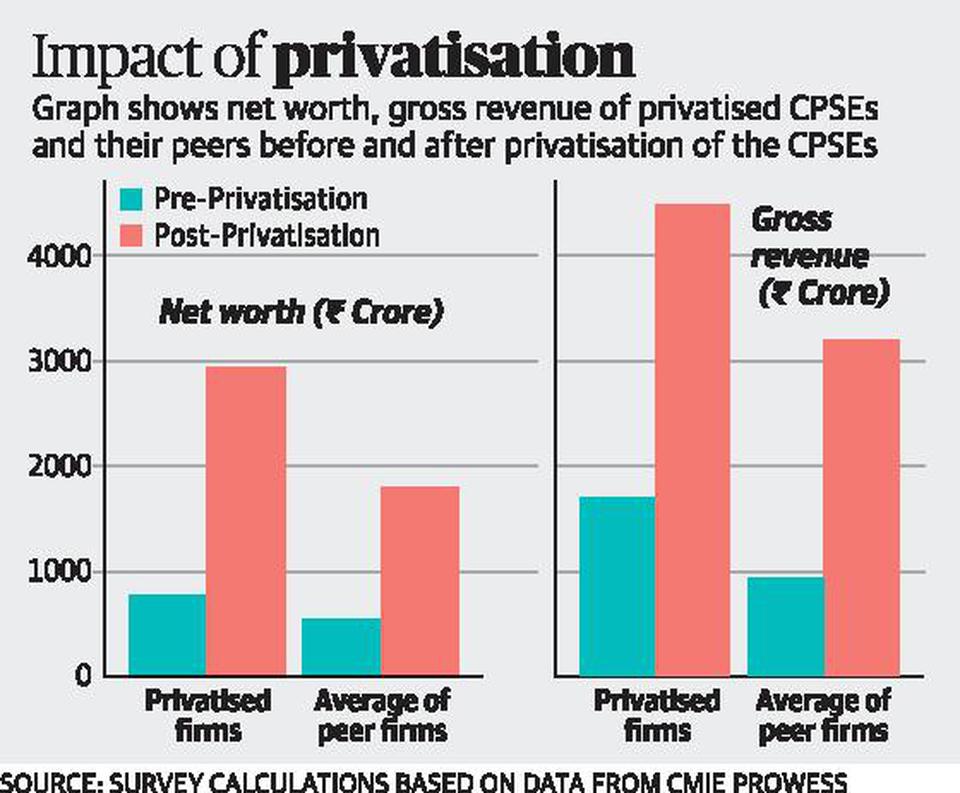
    • The Survey has aggressively pitched for divestment in PSUs by proposing a separate corporate entity wherein the government’s stake can be transferred and divested over a period of time.
    • The survey analysed the data of 11 PSUs that had been divested from 1999-2000 and 2003-04 and compared the data with their peers in the same industry.
    • Further, the survey has said privatized entities have performed better than their peers in terms of net worth, profit, return on equity and sales, among others.
    • The government can transfer its stake in listed CPSEs to a separate corporate entity.
    • This entity would be managed by an independent board and would be mandated to divest the government stake in these CPSEs over a period of time.
    • This will lend professionalism and autonomy to the disinvestment programme which, in turn, would improve the economic performance of the CPSEs.

    Golden jubilee of bank nationalization: Taking stock

    • The survey observes 2019 as the golden jubilee year of bank nationalization
    • Accomplishments of lakhs of Public Sector Banks (PSBs) employees cherished and an objective assessment of PSBs suggested by the Survey.
    • Since 1969, India’s Banking sector has not developed proportionately to the growth in the size of the economy.
    • India has only one bank in the global top 100 – same as countries that are a fraction of its size: Finland (about 1/11th), Denmark (1/8th), etc.
    • A large economy needs an efficient banking sector to support its growth.

    The onus of supporting the economy falls on the PSBs accounting for 70 % of the market share in Indian banking:

    1. PSBs are inefficient compared to their peer groups on every performance parameter.
    2. In 2019, investment for every rupee in PSBs, on average, led to the loss of 23 paise, while in NPBs it led to the gain of 9.6 paise.
    3. Credit growth in PSBs has been much lower than NPBs for the last several years.

    Solutions to make PSBs more efficient:

    • Employee Stock Ownership Plan (ESOP) for PSBs’ employees
    • Representation on boards proportionate to the blocks held by employees to incentivize employees and align their interests with that of all shareholders of banks.
    • Creation of a GSTN type entity that will aggregate data from all PSBs and use technologies like big data, artificial intelligence and machine learning in credit decisions for ensuring better screening and monitoring of borrowers, especially the large ones.

    Doubts regarding GDP Growth
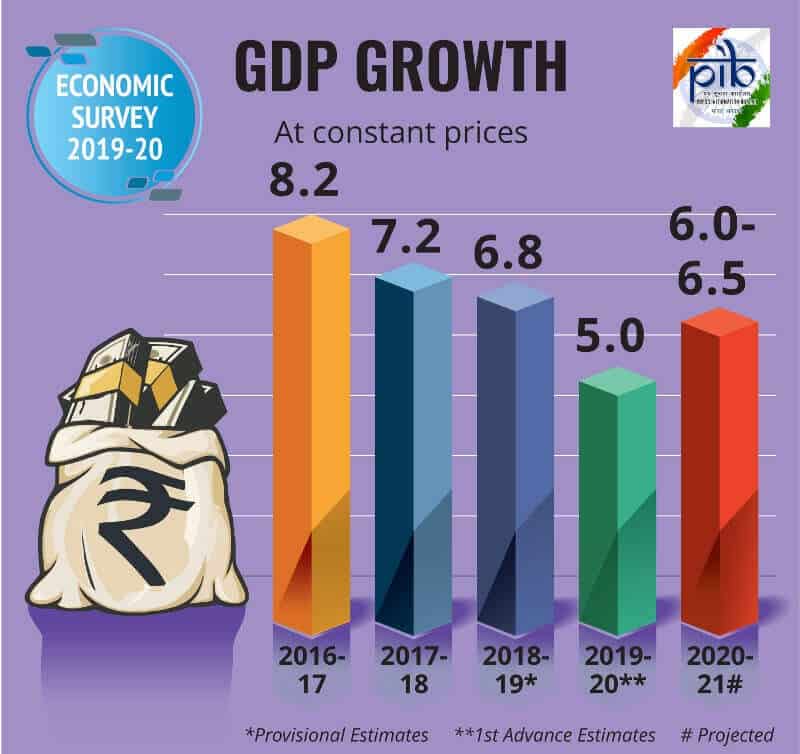
    • GDP growth is a critical variable for decision-making by investors and policymakers. Therefore, the recent debate about accuracy of India’s GDP estimation following the revised estimation methodology in 2011 is extremely significant.
    • As countries differ in several observed and unobserved ways, cross-country comparisons have to be undertaken by separating the effect of other confounding factors and isolating effect of methodology revision alone on GDP growth estimates.
    • Models that incorrectly over-estimate GDP growth by 2.7 % for India post-2011 also misestimate GDP growth over the same period for 51 out of 95 countries in the sample.

    Fiscal Developments

    • Revenue Receipts registered a higher growth during the first eight months of 2019-20, compared to the same period last year, led by considerable growth in Non-Tax revenue.
    • Gross GST monthly collections have crossed the mark of Rs. 1 lakh crore for a total of five times during 2019-20 (up to December 2019).
    • Structural reforms undertaken in taxation during the current financial year:
    • Change in corporate tax rate.
    • Measures to ease the implementation of GST.
    • Fiscal deficit of states within the targets set out by the FRBM Act.
    • Survey notes that the General Government (Centre plus States) has been on the path of fiscal consolidation.

    External Sector

    Balance of Payments (BoP):

    • India’s BoP position improved from US$ 412.9 bn of forex reserves in end March, 2019 to US$ 433.7 bn in end September, 2019.
    • Current account deficit (CAD) narrowed from 2.1% in 2018-19 to 1.5% of GDP in H1 of 2019-20.
    • Foreign reserves stood at US$ 461.2 bn as on 10th January, 2020.

    Global trade:

    • India’s merchandise trade balance improved from 2009-14 to 2014-19, although most of the improvement in the latter period was due to more than 50% decline in crude prices in 2016-17.
    • India’s top five trading partners continue to be USA, China, UAE, Saudi Arabia and Hong Kong.

    Exports:

    • Top export items: Petroleum products, precious stones, drug formulations & biologicals, gold and other precious metals.
    • Largest export destinations in 2019-20 (April-November): United States of America (USA), followed by United Arab Emirates (UAE), China and Hong Kong.
    • The merchandise exports to GDP ratio declined, entailing a negative impact on BoP position.
    • Slowdown of world output had an impact on reducing the export to GDP ratio, particularly from 2018-19 to H1 of 2019-20.
    • Growth in Non-POL exports dropped significantly from 2009-14 to 2014-19.

    Imports:

    •  Top import items: Crude petroleum, gold, petroleum products, coal, coke & briquittes.
    •  India’s imports continue to be largest from China, followed by USA, UAE and Saudi Arabia.
    •  Merchandise imports to GDP ratio declined for India, entailing a net positive impact on BoP.
    • Large Crude oil imports in the import basket correlates India’s total imports with crude prices. As crude price raises so does the share of crude in total imports, increasing imports to GDP ratio.

    Logistics industry of India:

    • Currently estimated to be around US$ 160 billion.
    • Expected to touch US$ 215 billion by 2020.
    • According to World Bank’s Logistics Performance Index, India ranks 44th in 2018 globally, up from 54th rank in 2014.

    Direct investments and remittances:

    • Net FDI inflows continued to be buoyant in 2019-20 attracting US$ 24.4 bn in the first eight months, higher than the corresponding period of 2018-19.
    • Net FPI in the first eight months of 2019-20 stood at US$ 12.6 bn.
    • Net remittances from Indians employed overseas continued to increase, receiving US$ 38.4 billion in H1 of 2019-20 which is more than 50% of the previous year level.

    External debt:

    • Remains low at 20.1% of GDP as at end September, 2019.
    • After significant decline since 2014-15, India’s external liabilities (debt and equity) to GDP increased at the end of June, 2019 primarily by increase in FDI, portfolio flows and external commercial borrowings (ECBs).

    Monetary Management and Financial Intermediation

    Monetary policy:

    • Remained accommodative in 2019-20.
    • Repo rate was cut by 110 basis points in four consecutive MPC meetings in the financial year due to slower growth and lower inflation.
    • However, it was kept unchanged in the fifth meeting held in December 2019.
    • In 2019-20, liquidity conditions were tight for initial two months; but subsequently it remained comfortable.

    Prices and Inflation

    Inflation Trends:

    • Inflation witnessing moderation since 2014
    • Consumer Price Index (CPI) inflation increased from 3.7 per cent in 2018-19 (April to December, 2018) to 4.1 per cent in 2019-20 (April to December, 2019).
    • WPI inflation fell from 4.7 per cent in 2018-19 (April to December, 2018) to 1.5 per cent during 2019-20 (April to December, 2019).

    Drivers of CPI – Combined (C) inflation:

    • During 2018-19, the major driver was the miscellaneous group
    • During 2019-20 (April-December), food and beverages was the main contributor.
    • Among food and beverages, inflation in vegetables and pulses was particularly high due to low base effect and production side disruptions like untimely rain.

    Cob-web Phenomenon (Cyclical fluctuations in inflation) for Pulses:

    • Farmers base their sowing decisions on prices witnessed in the previous marketing period.
    • Measures to safeguard farmers like procurement under Price Stabilization Fund (PSF), Minimum Support Price (MSP) need to be made more effective.

    Volatility of Prices:

    • Volatility of prices for most of the essential food commodities with the exception of some of the pulses has actually come down in the period 2014-19 as compared to the period 2009-14.
    • Lower volatility might indicate the presence of better marketing channels, storage facilities and effective MSP system.

    Essential Commodities Act is outdated

    • The Centre’s imposition of stock limits in a bid to control the soaring prices of onions over the last few months actually increased price volatility, according to the ES.
    • The finding came in a hard-hitting attack in the report against the Essential Commodities Act (ECA) and other “anachronistic legislations” and interventionist government policies, including drug price control, grain procurement and farm loan waivers.
    • The Centre invoked the Act’s provisions to impose stock limits on onions after heavy rains wiped out a quarter of the kharif crop and led to a sustained spike in prices.
    • However the Survey showed that there was actually an increase in price volatility and a widening wedge between wholesale and retail prices.
    • The lower stock limits must have led the traders and wholesalers to offload most of the kharif crop in October itself which led to a sharp increase in the price volatility.

    Agriculture

    • Agricultural productivity is also constrained by lower level of mechanization in agriculture which is about 40 % in India, much lower than China (59.5 %) and Brazil (75 %).
    • With regard to the agri sector, the Survey argued that the beneficiaries of farm loan waivers consume less, save less, invest less and are less productive.
    • It added that the government procurement of foodgrains led to a burgeoning food subsidy burden and inefficiencies in the markets, arguing for a shift to cash transfers instead.

    Food Management

    • The share of agriculture and allied sectors in the total Gross Value Added (GVA) of the country has been continuously declining on account of relatively higher growth performance of non-agricultural sectors.
    • GVA at Basic Prices for 2019-20 from ‘Agriculture, Forestry and Fishing’ sector is estimated to grow by 2.8 %.

    Services Sector

    Increasing significance of services sector in the Indian economy:

    1. About 55 % of the total size of the economy and GVA growth.
    2.  Two-thirds of total FDI inflows into India.
    3. About 38 per cent of total exports.
    4. More than 50 % of GVA in 15 out of the 33 states and UTs.

    Social Infrastructure, Employment and Human Development

    • The expenditure on social services (health, education and others) by the Centre and States as a proportion of GDP increased from 6.2 % in 2014-15 to 7.7 % in 2019-20 (BE).
    • India’s ranking in Human Development Index improved to 129 in 2018 from 130 in 2017:
    • With 1.34 % average annual HDI growth, India is among the fastest improving countries
    • Gross Enrolment Ratio at secondary, higher secondary and higher education level needs to be improved.
    • Gender disparity in India’s labour market widened due to decline in female labour force participation especially in rural areas:
    • Around 60 % of productive age (15-59) group engaged in full time domestic duties.

    Sustainable Development and Climate Change

    • India moving forward on the path of SDG implementation through well-designed initiatives
    • SDG India Index:
    1. Himachal Pradesh, Kerala, Tamil Nadu, Chandigarh are front runners.
    2. Assam, Bihar and Uttar Pradesh come under the category of Aspirants.
    • India hosted COP-14 to UNCCD which adopted the Delhi Declaration: Investing in Land and Unlocking Opportunities.
    • COP-25 of UNFCCC at Mandrid:
    1. India reiterated its commitment to implement Paris Agreement.
    2. COP-25 decisions include efforts for climate change mitigation, adaptation and means of implementation from developed country parties to developing country parties.
    • Forest and tree cover:
    1. Increasing and has reached 80.73 million hectare.
    2. 56 % of the geographical area of the country.
    • The numbers of stubble-burning incidents in 2019 were the least in four years, the Economic Survey says.
  • Thalinomics: the Economics of a plate of food in India


    • The Economic Survey 2019-20 states that affordability of vegetarian Thalis improved 29 per cent from 2006-07 to 2019-20 while that for non-vegetarian Thalis by 18 per cent.
    • Affordability of Thalis vis-à-vis a day’s pay of a worker has improved over time, indicating improved welfare of the common person.
    • The Survey says that food is not just an end in itself but also an essential ingredient in the growth human capital and therefore important for national wealth creation.

    The term ‘Thalinomics’

    • The conclusion has been drawn on the basis of “Thalinomics: the Economics of a plate of food in India” – an attempt to quantify what a common person pays for a Thali across India.
    • Price data from the Consumer Price Index for industrial workers for around 80 centers in 25 States and UTs from April 2006 to October 2019 has been used for the study.
    • Using the dietary guidelines for Indians, the price of Thalis is constructed.
    • The Survey states that across India and also the 4 regions- North, South, East and West- it is found that the absolute prices of a vegetarian Thali have decreased significantly since 2015-16 though the price has increased in 2019.
    • This is owing to the sharp downward trend in the prices of vegetables and dal in contrast to the previous trend of increasing prices.
    • As a result, an average household of 5 individuals that eats two vegetarian Thalis a day, gained around Rupees 10887, on average per year, while a non-vegetarian household gained Rupees 11787, on average per year.

    Shift in Thali dynamics

    • The Survey states that 2015-16 can be considered as a year when there was a shift in the dynamics of Thali prices.
    • Many reform measures were introduced since 2014-15 to enhance the productivity of the agricultural sector as well as efficiency and effectiveness of agricultural markets for better and more transparent price discovery.
  • Strategy for boosting Wealth Creation

    • The big idea from the Economic Survey 2019-20 is the need to push towards increasing the number of wealth creators in the Indian economy.
    • The Survey states that to achieve the goal of becoming a $5-trillion economy, the invisible hand of markets will need the support of “the hand of trust”.

    Wealth Creation

    • Essentially, this means that regulation and rules in the economy should be such that they make it easy to do business but not turn into crony capitalism.
    • The Survey states: “The invisible hand needs to be strengthened by promoting pro-business policies to:
    1. Provide equal opportunities for new entrants, enable fair competition and ease doing business,
    2. Eliminate policies that unnecessarily undermine markets through government intervention,
    3. Enable trade for job creation, and
    4. Efficiently scale up the banking sector to be proportionate to the size of the Indian economy.”

    How can this be done?

    • The Survey introduces the idea of “trust as a public good that gets enhanced with greater use”.
    • In other words, it states that policies must empower transparency and effective enforcement using data and technology to enhance this public good.
    • A key element here is the need to increase the opportunities for new entrants.
    • “Equal opportunity for new entrants is important because… a 10 per cent increase in new firms in a district yields a 1.8 per cent increase in Gross Domestic District Product (GDDP)”.
    • According to the Survey, the right policy mix can boost job creation.

    Levers for furthering Wealth Creation

    The Survey identifies several levers for furthering Wealth Creation, which are:

    • entrepreneurship at the grassroots as reflected in new firm creation in India’s districts;
    • promote ‘pro-business’ policies that unleash the power of competitive markets to generate wealth as against ‘pro-crony’ policies that may favour incumbent private interests;
    • eliminate policies that undermine markets through government intervention, even where it is not necessary;
    • integrate ‘Assemble in India’ into ‘Make in India’ to focus on labour intensive exports and thereby create jobs at a large scale;
    • efficiently scale up the banking sector to be proportionate to the size of the Indian economy and track the health of the shadow banking sector;
    • use privatization to foster efficiency. The Survey provides careful evidence that India’s GDP growth estimates can be trusted.

    Is this push for wealth creators new?

    • This is an extension of what PM said during his Independence Day speech in August last year, where he stressed on the need for the country to view “wealth creators” differently.
    • Those who create wealth for the country, those who contribute in the country’s wealth creation — they all are serving the nation as well.
    • We should not look at wealth creators with apprehension and doubt their intentions; we should not look down upon them.
    • The PM had also said there was a need in the country to give such wealth creators due respect and credit.
    • He had said that this change is required because “If no wealth is created, no wealth can be distributed”.

    Focus on Ethical Wealth Creation

    • The Survey emphasised on the importance of ‘Ethical Wealth Creation’, as the key to making India $5 trillion economy by 2025.
    • Krishnamurthy V. Subramanian, the Chief Economic Adviser of Ministry of Finance has done a commendable job in producing a thought-provoking masterpiece on ‘ethical wealth creation.
  • Dividend Distribution Tax (DDT)


    Finance Minister announced abolition of DDT to be paid by companies in her budget speech.

    What is DDT?

    • A dividend is a return given by a company to its shareholders out of the profits earned by the company in a particular year.
    • Dividend constitutes income in the hands of the shareholders which ideally should be subject to income tax.
    • However, the income tax laws in India provide for an exemption of the dividend income received from Indian companies by the investors by levying a tax called the DDT on the company paying the dividend.

    Who were required paid DDT?

    • Any domestic company which is declaring/distributing dividend is required to pay DDT at the rate of 15% on the gross amount of dividend as mandated under Section 115O of the Income Tax Act.
    • DDT was also applicable on mutual funds.

    Why it is scrapped?

    • Every MNE investing in India is faced with the question of tax-efficient repatriation of profits that accumulate here.
    • The dividend that the holding company would receive would have already suffered substantial tax in India, although indirectly.
    • The foreign company would normally be required to pay tax on the dividend so received in its home jurisdiction.
    • DDT being a tax in the Indian company and the foreign company not paying taxes directly on such dividend income in India, it would not be able to claim foreign tax credit in its home jurisdiction.
    • This resulted in a double whammy for foreign companies as, at a group level, they suffered double taxation.
  • Public Health Emergency of International Concern (PHEIC)


    The World Health Organization (WHO) has declared the novel Coronavirus infection a Public Health Emergency of International Concern (PHEIC). In the past decade, WHO has declared public health emergencies for outbreaks including swine flu, polio and Ebola.

    What is PHEIC?

    Definition: Under the International Health Regulations (IHR), a public health emergency is defined as “an extraordinary event which is determined, as provided in these Regulations: to constitute a public health risk to other States through the international spread of disease; and to potentially require a coordinated international response”.

    What criteria does the WHO follow to declare PHEIC?

    • PHEIC is declared in the event of some “serious public health events” that may endanger international public health.
    • The responsibility of declaring an event as an emergency lies with the Director-General of the WHO and requires the convening of a committee of members.

    Implications of a PHEIC being declared

    • There are some implications of declaring a PHEIC for the host country, which in the case of the coronavirus is China.
    • Declaring a PHEIC may lead to restrictions on travel and trade.
    • However, several countries have already issued advisories to their citizens to avoid travelling to China, while others are airlifting their citizens from it.
  • [pib] National Commission for Indian System of Medicines

    The Union Cabinet has given its approval for proposal of Official Amendments in the National Commission for Indian System of Medicine Bill, 2019 (NCIM) which is pending in the Rajya Sabha.

    About the Commission

    • The main objective of establishing NCIM is to promote equity by ensuring adequate supply of quality medical professionals and enforce high ethical standards in all aspects of medical services in Indian System of Medicine.
    • The Commission will promote availability of affordable healthcare services in all parts of the country.
    • The Commission has been structured to streamline the functions related to academic standards, evaluation, assessment and accreditation of educational institutions pertaining to Indian System of Medicine.

    Composition

    • The NCISM will consist of 29 members, appointed by the central government.
    • A Search Committee will recommend names to the central government for the post of Chairperson, part time members, and presidents of the four autonomous boards set up under the NCISM.
    • These posts will have a maximum term of four years.
    • The Search Committee will consist of five members including the Cabinet Secretary and three experts nominated by the central government (of which two should have experience in any of the fields of Indian System of Medicine).

    Functions

    Functions of the NCISM include:

    • framing policies for regulating medical institutions and medical professionals of Indian System of Medicine,
    • assessing the requirements of healthcare related human resources and infrastructure,
    • ensuring compliance by the State Medical Councils of Indian System of Medicine of the regulations made under the Bill, and
    • ensuring coordination among the autonomous boards set up under the Bill.