💥Join UPSC 2027,2028 Mentorship (July Batch) + XFactor Notes & Microthemes PDF

Distribution: yearly

  • China commences construction of Mega Dam over Brahmaputra

    Why in the News?

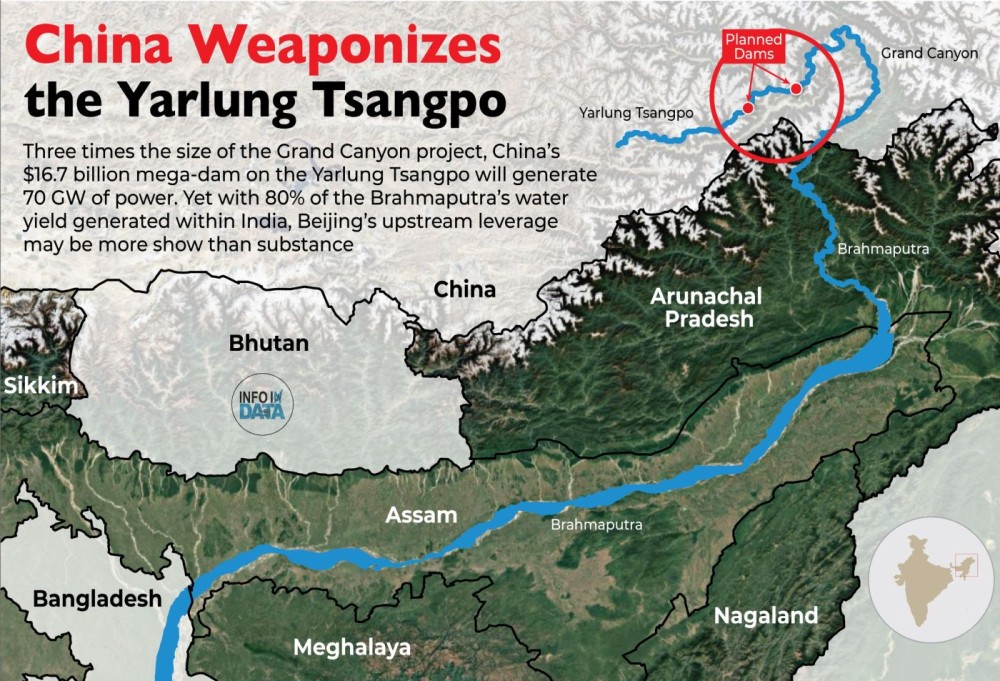
    China has commenced the construction of a massive hydropower project on the Yarlung Tsangpo river (Brahmaputra in India) in southeastern Tibet.

    China commences construction of Mega Dam over Brahmaputra

    About the Mega Dam Project on Brahmaputra (Yarlung Tsangpo):

    • Location: Nyingchi, southeastern Tibet, on the Yarlung Tsangpo River (Brahmaputra in India).
    • Project Size: Estimated investment of 1.2 trillion yuan (USD 167 billion).
    • Components: Comprises five cascade hydropower stations.
    • Power Generation: Expected to produce 300 billion kilowatt-hours (kWh) of electricity annually.
    • Objective:
      • Contribute to China’s carbon neutrality target by 2060.
      • Meet local power needs in Tibet and supply electricity to other Chinese provinces.
    • Concerns:
      • Environmental risks in a seismically active and ecologically fragile zone.
      • Geopolitical tensions with downstream countries (India, Bangladesh).
      • Potential impact on river flow and water availability downstream.
    • Strategic Significance: Close to India-China border, raising concerns amid existing border disputes.

    What if China stops Brahmaputra Water? 

    You should know: Three Gorges Dam 

    • Location: On the Yangtze River, Hubei province, central China.
    • Completed: Fully operational since 2012.
    • Type: Hydroelectric gravity dam – the world’s largest power station by installed capacity.
    • Power Generation Capacity: Around 22.5 gigawatts (GW).
    • Notable Impact:
      • Helped in flood control, navigation, and electricity supply.
      • Also criticized for ecological damage, displacement of over 1 million people, and increased seismic risk.


    [UPSC 2011] The Brahmaputra, Irrawady and Mekong rivers originate in Tibet and flow it through narrow and parallel mountain ranges in their upper reaches. Of these rivers, Brahmaputra makes a “U” turn in its course to flow into India. This “U” turn is due to:

    (a) Uplift of folded Himalayan series

    (b) Syntaxial bending of geologically young Himalayas

    (c) Geo-tectonic disturbance in the tertiary folded mountain chains

    (d) Both (A) and (B) above


  • Places in news: Bitra Island

    Why in the News?

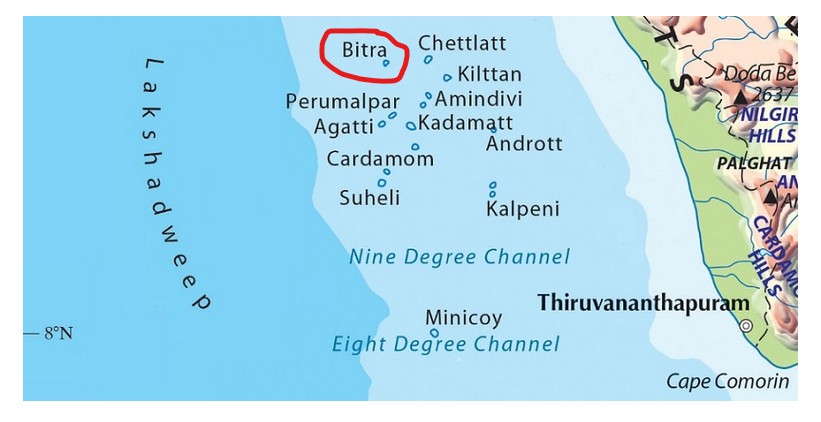
    The Lakshadweep administration has proposed the acquisition of Bitra Island, the smallest inhabited island in the archipelago, for national defence purposes.

    bitra

    About Bitra Island:

    • Location: Situated in the Arabian Sea; part of the Amindivi subgroup of the Lakshadweep archipelago
    • Distance from Mainland: ~483 km west of Kochi  
    • Land Area: 0.10–0.18 square kilometres
    • Population: ~271–350 (as of 2025)
    • Language and Livelihood
      • Languages Spoken: Malayalam, Mahl, and English
      • Economic Activities: Fishing, coconut farming, and emerging ecotourism (birdwatching, snorkeling, diving)
    • Climate:
      • Type: Tropical monsoon (similar to Kerala)
      • Temperature Range: 25–35°C
      • Annual Rainfall: ~1600 mm
      • Monsoon Season: Mid-May to mid-September; sea access is limited
    • Historical and Cultural Significance:
      • History: Populated around 1945
      • Pilgrimage Site: Hosts a shrine to Arab saint Malik Mulla

    Strategic Importance:

    • Location: Close to key international shipping lanes in the Arabian Sea
    • Surveillance Advantage: Ideal point for maritime monitoring
    • Military Utility: Suitable for naval installations and coastal defence
    • Maritime Awareness: Enhances India’s preparedness in the western seaboard
    [UPSC 2014] Which one of the following pairs of islands is separated from each other by the ‘Ten Degree Channel’?

    Options: (a) Andaman and Nicobar* (b) Nicobar and Sumatra (c) Maldives and Lakshadweep (d) Sumatra and Java


  • Javelin Anti-Tank Guided Missiles (ATGMs)

    Why in the News?

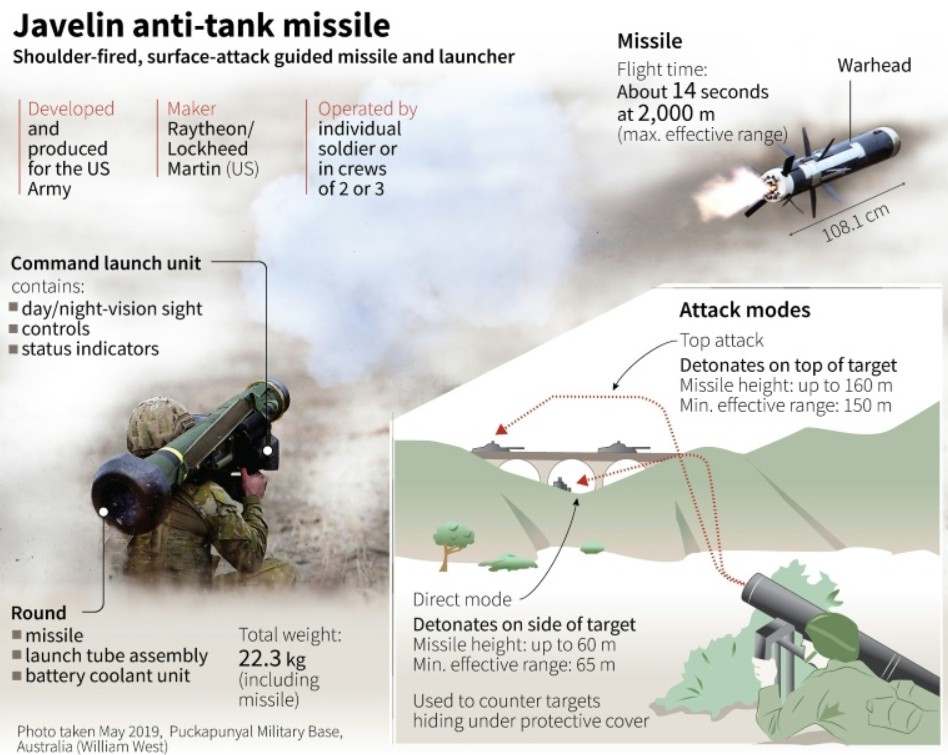
    India has formally submitted a Letter of Request (LoR) to the United States seeking the co-production of Javelin anti-tank guided missiles (ATGMs) under the ‘Make in India’ initiative.

    Javelin Anti-Tank Guided Missiles (ATGMs)

    About the Javelin Missile:

    • About: American-made man-portable anti-tank guided missile (ATGM).
    • Developers: Jointly developed by Raytheon and Lockheed Martin.
    • Purpose:
      • Defeats heavily armoured vehicles such as main battle tanks.
      • Effective against bunkers, fortifications, and helicopters.
    • Operational Since: Entered service with the U.S. military in 1996.

    Key Features:

    • Range:
      • Standard effective range: 2.5 km.
      • Advanced variants: Can reach up to 4 km.
    • Weight: Approximately 5.11 kg.
    • Technology:
      • Employs a “fire-and-forget” system.
      • No need for operator guidance after launch.
    • Target Engagement Modes:
      • Direct attack mode: For conventional engagement.
      • Top-attack mode: Hits the weaker top armour of tanks.
    • Mobility & Safety:
      • Soldiers can relocate or reload immediately after launch.
      • Uses infrared guidance allowing quick post-launch cover.
    [UPSC 2018] What is “Terminal High Altitude Area Defense (THAAD)”, sometimes seen in the news?

    Options: (a) An Israeli radar system (b) India’s indigenous anti-missile programme (c) An American anti-missile system* (d) A defence collaboration between Japan and South Korea


  • ‘Pact for the Future’ Agreement

    Why in the News?

    India has renewed its call for time-bound reforms of the UN Security Council and reaffirmed support for the ‘Pact for the Future’ to strengthen global cooperation.

    About the ‘Pact for the Future’ Agreement:

    • Origin: Adopted at the UN Summit of the Future (September 2024).
    • Purpose: To reinvigorate multilateralism and strengthen global cooperation on contemporary and emerging challenges.
    • Scope: Comprises 56 commitments spanning development, peace, digital governance, and institutional reforms.
    • Annexes:
      1. Global Digital Compact: Sets frameworks for AI, digital access, and rights.
      2. Declaration on Future Generations: Mainstreams long-term thinking in policymaking.
    • Inclusivity: Drafted through multi-year negotiations involving member states, civil society, and global institutions.
    • Implementation and Review Mechanism:
      • Implementation through intergovernmental processes led by relevant UN agencies.
      • First formal review at the 83rd UNGA (2028) at the Head of State/Government level.
      • Monitoring via national/international accountability frameworks.

    Notable Features and Challenges:

    • Historic Significance:
      • One of the broadest international agreements in scope.
      • Embodies a “new multilateralism” for adapting the UN to modern realities.
    • Controversies:
      • Not unanimously adopted – Russia, Iran, and others objected to elements they found insufficient or overambitious.
    • Criticisms:
      • Lacks detailed mechanisms for enforcement and implementation.
      • Disagreements persist on UNSC reform, disarmament timelines, and climate financing.
  • Wind Stilling Effect in the Indo-Gangetic Plain (IGP)

    Why in the News?

    A satellite-based study (2003–2020) of 141 Indian cities revealed a surprising aerosol pattern — southern cities act as pollution hotspots, while many northern cities form ‘clean islands’ due to a phenomenon called the Wind Stilling Effect.

    Key Highlights of the Study:

    • Conducted by: The Indian Institute of Technology Bhubaneswar.
    • Method: Used high-resolution aerosol optical depth data to track pollution.
    • Focus: Examined how urbanisation interacts with natural and transported pollution.
    • Surprising Insight: Many northern cities were not major aerosol hotspots, contrary to assumptions.
    • Classification of Cities: Two categories based on aerosol levels relative to surrounding areas:
      • Urban Aerosol Pollution Islands-
        • Location: Predominantly in southern and southeastern India.
        • Characteristics: Cities had higher aerosol levels than nearby rural surroundings.
        • Pollution Source: Mostly local emissions from vehicles, construction, and industries.
        • Absence of External Influence: Minimal contribution from long-range dust or biomass burning.
      • Urban Aerosol Clean Islands-
        • Location: Observed in northwestern India and the Indo-Gangetic Plain.
        • Pattern: Cities had lower aerosol levels than nearby upwind (southwest) areas.
        • Mechanism: Incoming pollutants were blocked or deflected, creating a “clean island” effect.
        • Downwind Evidence: Northeast (downwind) sides showed equal or lower aerosol levels compared to city centres.

    About the Wind Stilling Effect:

    • Overview: A phenomenon where dense urban infrastructure reduces surface wind speed, altering local airflow.
    • Barrier Formation: Slowed winds create atmospheric stagnation zones, especially on the upwind side.
    • Pollution Blocking: Long-range pollutants like Thar Desert dust or biomass smoke are slowed or blocked.
    • Misleading Cleanliness: Cities appear cleaner not due to lower emissions, but due to pollution deflection.
    • Seasonality: Most evident during the pre-monsoon season, when dust transport is high and cloud cover is minimal.
    [UPSC 2010] If there were no Himalayan ranges, what would have been the most likely geographical impact on India ?

    1. Much of the country would experience the cold waves from Siberia. 2. Indo-gangetic plain would be devoid of such extensive alluvial soils. 3. The pattern of monsoon would be different from what it is at present.

    Which of the statements given above is/are correct ?

    Options: (a) 1 only (b) 1 and 3 only (c) 2 and 3 only (d) 1, 2 and 3*


  • Planetary Formation observed around HOPS‑315 Star

    Why in the News?

    A study in Nature has provided the first observational evidence of solid rock forming from vapour in a distant star system HOPS-315, marking early planet formation.

    About HOPS-315:

    • Type: A young star system located in the Orion constellation.
    • Protoplanetary Disc: Surrounded by a flat, rotating disc of gas and dust, where new planets can form.
    • Orientation: The disc’s tilt offers a clear line of sight from Earth, allowing deep observation.
    • Observational Tools:

    Clue on New Planet Formation:

    • Rock Vapour Crystallisation: Scientists captured rock vapour cooling and forming crystals, marking the first direct observation of solid matter forming around a star.
    • Detected Elements:
      • Silicon monoxide gas at 470 Kelvin, close to the star.
      • Crystalline silicates such as forsterite, enstatite, and silica found within 2.2 astronomical units of the star.

    Scientific Significance:

    • Similarity to Earth: The crystallisation mimics processes found in primitive meteorites on Earth.
    • Chemical Confirmation: Suggests universal chemical processes in early planet formation across star systems.
    • Location of Minerals: Crystals were detected in the disc’s atmosphere, not in stellar outflows.
    • Temperature Conditions: Simulations confirmed dust vaporises and re-forms into solids at around 1300 Kelvin.
    • Formation Stage: Marks the earliest stage of rocky planet formation ever observed.
    [UPSC 2015] The term ‘Goldilocks Zone’ is often seen in the news in the context of-

    Options: (a) the limits of habitable zone above the surface of the Earth (b) regions inside the Earth where shale gas is available (c) search for the Earth-like planets in outer space* (d) search for meteorites containing precious metals


  • Realities behind the global experiment of ‘remote work’ 

    Why in the News?

    A new “Global Survey of Working Arrangements” (2024–25) by the Ifo Institute and Stanford University has spotlighted the growing mismatch between workers’ desire for remote work and its actual availability worldwide.

    Why does a gap remain between the preference for remote work and its adoption?

    • Employer Reluctance Due to Team Dynamics: Many managers believe that remote work reduces collaboration, innovation, and team bonding. Eg: In India’s tech sector, firms like TCS and Infosys have mandated office returns to maintain team culture.
    • Cultural Bias Toward Presenteeism: In several countries, especially in Asia, being physically present at work is linked to loyalty and productivity. Eg: Japanese companies often expect employees to stay late in office, even if not productive, as a show of commitment.
    •  Inadequate Home Infrastructure: Remote work demands reliable internet, quiet spaces, and ergonomic setups, which are lacking for many, especially in urban India or Southeast Asia. Eg: A Mumbai-based employee may live in a 1BHK flat with family, limiting concentration and comfort.
    • Health and Mental Well-being Concerns: Long-term remote work has led to increased backaches, eye strain, and mental stress due to isolation and blurred work-life boundaries. Eg: A Microsoft global report showed rising burnout levels among fully remote workers during the pandemic.

    How do culture and infrastructure hinder remote work in Asia?

    • Cultural Preference for Physical Presence: Many Asian workplaces equate being physically present with dedication and productivity. Eg: In Japan and South Korea, staying late in the office is considered a sign of commitment, discouraging remote setups.
    • Hierarchical Management Style: Traditional Asian work cultures rely on face-to-face supervision and top-down communication, making remote work less trusted. Eg: In India, many managers still believe in monitoring employee performance through in-person interactions.
    • Weak Digital and Housing Infrastructure: Many households lack reliable internet, private workspaces, or quiet environments, especially in urban slums or dense family homes. Eg: In Indonesia or the Philippines, remote employees often face disruptions due to unstable power or cramped living conditions.

    What is Remote work?

    Remote work (also known as work from home or telecommuting) is a work arrangement where employees perform their job duties outside of a traditional office environment, typically from their home or another location of their choice, using digital tools and internet connectivity.

    What are the gender implications of remote work trends?

    • Increased Unpaid Care Work for Women: Remote work has led to a disproportionate care burden on women, affecting their productivity and well-being. Eg: According to a 2022 UN Women report, women globally spent 3 times more hours on unpaid care work than men during the pandemic, even while working from home. In India, this gap was wider due to joint family setups and lack of domestic help.
    • Improved Flexibility, Aiding Workforce Re-entry: Remote work has provided flexible job opportunities for women who otherwise drop out due to childcare or household responsibilities. Eg: A 2021 LinkedIn report found that 60% of Indian women professionals preferred remote jobs to maintain work-life balance, and 30% rejoined the workforce post-pandemic due to such options.
    • Risk of Career Stagnation and Isolation: Remote women employees often face reduced visibility, leading to fewer promotions or leadership roles. Eg: A 2023 McKinsey study found that women working remotely were 1.5 times less likely to be promoted compared to their in-office peers, especially in mid-career roles.

    Why are employers reluctant to allow full remote work?

    • Concerns Over Productivity and Supervision: Employers fear a drop in productivity and difficulty in monitoring performance when employees work remotely full-time. They believe in-person settings enable better oversight, collaboration, and accountability.
    • Impact on Organisational Culture and Innovation: Physical workplaces are seen as essential for team bonding, mentorship, and creative brainstorming, which are harder to replicate virtually. Employers worry that remote work weakens organisational culture and slows innovation.

    What are the steps taken by the Indian Government?

    • Remote Work in SEZ Rules: The government amended the Special Economic Zones (SEZ) Rules (2006) by adding Rule 43A, allowing 100% of IT/ITeS employees in SEZs to work remotely for up to one year, extendable with permission.
    • Inclusion in New Labour Codes: The Occupational Safety, Health and Working Conditions Code, 2020 and the Social Security Code, 2020brought home-based workers under their ambit, addressing safety, health, and social protection for remote employees.

    What measures can ensure remote work is fair and sustainable? (Way forward)

    • Clear Legal and Social Protection Framework: Establish comprehensive labour regulations covering working hours, overtime, health and safety, and right to disconnect for remote workers. This helps prevent exploitation, burnout, and ensures work-life balance.
    • Inclusive Digital Infrastructure and Skill Development: Invest in pan-India broadband access, especially in rural and Tier-2/3 cities, and promote digital literacy programs. This ensures equal opportunities and reduces the urban-rural digital divide, making remote work accessible to all.

    Mains PYQ:

    [UPSC 2022] Explore and evaluate the impact of ‘Work From Home’ on family relationships.

    Linakge: The Unfinished Revolution of Remote Work,” delves into the complexities of remote work beyond just its flexibility and freedom. It highlights several key realities that make the “revolution of remote work” far more complicated than initially imagined.  This question directly addresses one of the significant “realities” and impacts of remote work, specifically focusing on “family relationships”.
  • [pib] Ashokan Pillars of Rampurva and Lauriya Nandangarh

    Why in the News?

    A replica of the Ashoka Pillar was unveiled at Waskaduwa Sri Subhuthi Viharaya highlighting Buddhism in Sri Lanka.

    The original pillars, like those at Rampurva and Lauriya Nandangarh in Bihar, are key symbols of India’s Buddhist and Mauryan heritage and are on UNESCO’s Tentative List.

    [pib] Ashoka Pillars of Rampurva and Lauriya Nandangarh

    About Rampurva Ashoka Pillars (West Champaran, Bihar):

    • Location: Near the Nepal border in West Champaran district, Bihar.
    • Discovery: Found by archaeologist Alexander Cunningham, Lamb Carlleyle in 1876.
    • Pillars: Two monolithic sandstone pillars, 300 meters apart:
      • Lion Capital Pillar: Contains Major Pillar Edicts I–VI in Brahmi script.
      • Bull Capital Pillar: Known for artistic refinement and Persian-inspired motifs.
    • Design Features:
      • Polished sandstone with Mauryan craftsmanship.
      • Height: 12–15 meters; Weight: Up to 50 tons.
      • Lion Capital: Preserved at Indian Museum, Kolkata.
      • Bull Capital: Housed at Rashtrapati Bhavan, New Delhi; praised for its lifelike form and “velvet touch” finish.
      • Decorative motifs include rosette, palmette, and acanthus—showing Persian influence.
    • Legend: Marks the site of Buddha’s renunciation near the Anoma River.

    About Lauriya Nandangarh Ashoka Pillar (West Champaran, Bihar):

    • Location: 22–28 kilometers northwest of Bettiah town.
    • Surviving Structure: Only one complete pillar remains from an original group.
    • Material and Size:
      • Made of Chunar sandstone.
      • Stands about 12 meters above ground with ~3 meters underground; Weighs over 50 tons.
    • Capital Design:
      • Features a seated lion with hind legs extending beyond the abacus.
      • The abacus is adorned with hamsa (flying geese), symbolizing spiritual liberation.
    • Inscriptions:
      • Engraved with Major Pillar Edicts I–VI in Brahmi script, dated to 244 BCE.
      • Promotes dharma, non-violence, religious tolerance, and compassion.
    • Symbolism:
      • The lion capital represents Mauryan imperial strength and Buddha’s Sakya lineage.
      • The lion’s open mouth symbolizes the dissemination of Ashoka’s ethical and Buddhist teachings.
    [UPSC 2019] In which of the following relief sculpture inscriptions is ‘Ranyo Ashoka’ (King Ashoka) mentioned along with the stone portrait of Ashoka?

    Options: (a) Kanganahalli* (b) Sanchi I (c) Shahbazgarhi (d) Sohgaura


  • [pib] 10 years of Winter Fog Experiment (WiFEX)

    Why in the News?

    The Winter Fog Experiment (WiFEX) at Delhi’s IGI Airport, has marked 10 years of pioneering research on dense winter fog in North India.

    [pib] 10 years of Winter Fog Experiment (WiFEX)

    About Winter Fog Experiment (WiFEX):

    • Purpose: It is a long-term, open-field research project dedicated to studying winter fog—a major hazard in North India.
    • Launch: Initiated in 2015 at Indira Gandhi International Airport, New Delhi.
    • Lead Institution: Managed by the Indian Institute of Tropical Meteorology (IITM) under the Ministry of Earth Sciences.
    • Supporting Agencies: Supported by the India Meteorological Department (IMD) and the National Centre for Medium Range Weather Forecasting.
    • Objective: To understand fog variability, dynamics, and microphysics, and to improve fog forecasting across the Indo-Gangetic Plain.

    Key Features:

    • Network: Began at Indira Gandhi International Airport; expanded to Jewar Airport (Noida) and Hisar (Haryana).
    • Instruments Used: Includes micrometeorology towers, ceilometers, and high-frequency sensors.
    • Data Collected: Covers temperature profiles, humidity, wind, turbulence, soil heat flux, and aerosol concentrations.
    • Scientific Goal: To model the full fog life cycle and develop operational forecasting systems.
    • Next Phase – WiFEX-II:
      • Will provide localized, runway-specific fog forecasts.
      • Will expand to more airports for real-time winter decision-making.

    Outcomes:

    • Forecasting Model: A high-resolution fog prediction model with 3-km resolution and 85% accuracy for very dense fog (visibility <200 metres).
    • Operational Benefits: Reduced flight delays and diversions; enhanced runway safety.
    • Research Insights: Clarified the role of air pollution, urban heat islands, and land-use changes in fog formation.
    • Significance:
      • Aviation Planning: Helps airlines, pilots, and passengers manage winter fog disruptions.
      • Science-Policy Link: Demonstrates successful collaboration between scientific institutions and public policy to address climate and aviation challenges.
    [UPSC 2014] Photochemical smog is a resultant of the reaction among-

    Options: (a) NO2, O3 and peroxyacetyl nitrate in the presence of sunlight ** (b) CO2, O2, and peroxyacetyl nitrate in the presence of sunlight (c) CO, CO2, and NO2 at low temperature (d) high concentration of NO2, O3 and CO in the evening


  • [pib] PRATIBHA Setu Initiative

    Why in the News?

    The Union Public Service Commission (UPSC) has launched the PRATIBHA Setu initiative to channel the potential of civil service aspirants who reach the interview stage but do not make the final merit list.

    About PRATIBHA Setu:

    • Meaning: Stands for Professional Resource And Talent Integration – Bridge for Hiring Aspirants.
    • Purpose: Connects candidates who cleared the interview stage of Union Public Service Commission exams but didn’t make the final merit list with verified employers.
    • Launch: Rolled out during CSE Examination 2023 results; evolved from the Public Disclosure Scheme (2018).
    • Objective: Utilizes the Union Public Service Commission’s rigorous selection process to support alternate career pathways for high-performing aspirants.
    • Talent Pool:
      • Scale: Over 10,000 high-performing candidates available for recruitment.
      • Merit-Based: Offers employers access to a pre-tested, well-evaluated talent group.

    Key Features:

    • Eligibility:
      • Included: Civil Services, Indian Forest Service, Engineering Services, Central Armed Police Forces, Combined Medical Services, etc.
      • Excluded: National Defence Academy, Naval Academy, and certain Limited Departmental Competitive Examinations.
    • Access for Recruiters: Organizations register using Corporate Identification Number through the Ministry of Corporate Affairs portal.
    • Platform Tools:
      • Functions: Dashboard for shortlisting, wish-listing, and making selections or rejections.
      • Data Access: Employers can view candidates’ educational profiles and contact details in digital format.

    Impact:

    • Candidate Benefit: Opens alternate career paths for deserving UPSC aspirants.
    • Employer Advantage: Enables transparent and efficient hiring from India’s top talent.
    • Wider Utility: Extends the relevance of the UPSC selection process beyond final appointments.
    [UPSC 2020] In the context of India, which one of the following is the characteristic appropriate for bureaucracy?

    Options: (a) An agency for widening the scope of parliamentary democracy (b) An agency for strengthening the structure of federalism (c) An agency for facilitating political stability and economic growth (d) An agency for the implementation of public policy*