💥Join UPSC 2027,2028 Mentorship (August Batch) + XFactor Notes & Microthemes PDF

GS Paper: GS1

  • Who was Lord Curzon, the Viceroy of India who partitioned Bengal in 1905?

    The 119-year-old Curzon Gate in Bardhaman in West Bengal is at the centre of a political row.

    Who was Lord Curzon?

    • Born in 1859, Curzon was a British conservative politician who was educated at the elite institutions of Eton and Oxford.
    • He served as Under-Secretary of State for India (1891-1892), and for Foreign Affairs (1895-1898), before being appointed Viceroy of India in 1899.
    • As viceroy, his administration was known for intense activity and emphasis on efficiency.
    • He stated in his budget speech in 1904, “Efficiency of administration is, in my view, a synonym for the contentment of the governed”.

    Rise to infame

    • Of all the Viceroys of India, Curzon is possibly the most criticised — he is the man who partitioned Bengal in 1905, and triggered a wave of Bengali nationalism that contributed to the wider Indian national movement.
    • He was also one of the more openly imperialist of viceroys, and a man who saw Britain’s rule over India as critical to the survival of empire.
    • In 1900, Curzon famously stated, “We could lose all our [white settlement] dominions and still survive, but if we lost India, our sun would sink to its setting.”

    His works

    • Curzon created a separate Muslim majority province of the North-West Frontier Province, sent a British expedition to Tibet and established a separate police service.
    • He was instrumental in establishing the Archaeological Survey of India, in order to study and protect historical monuments.
    • Early on in his career, Curzon earned some praise from his colonial subjects for taking action against Europeans in a number of high-profile racist attacks against Indians.
    • In 1899, he punished white soldiers for raping a woman in Rangoon; he disciplined soldiers of the 9th Lancers for beating an Indian cook in Sialkot to death in 1902.
    • He had tried unsuccessfully to get the Calcutta High Court to change the meagre punishment given to an Assam tea manager for murdering a “coolie”.

    Why was he disliked then?

    • Curzon was both vexed and enraged by the growing nationalist movement in India and he sought to throttle the growing aspirations of the educated Indian middle class.
    • A staunch imperialist, he took a series of extremely unpopular measures, including passing, in 1899, the Calcutta Municipal Amendment Act.
    • He reduced the number of elected representatives in the Calcutta Corporation.
    • Among others was the Indian Universities Act (1904), that placed Calcutta University under government control, and the Indian Official Secrets Amendment Act (1904) which reduced the freedom of the press even further.
    • Ironically though, it was his biggest and most reviled decision — to partition Bengal in 1905 — that led to a spurt in nationalist sentiment and revitalized the Congress.

    How and why did the partition of Bengal take place?

    • Calcutta was the capital of the British Raj, and Bengal Presidency was one of the largest provinces in India, populated by more than 78 million people.
    • It was such a huge province encompassing present-day West Bengal, Bangladesh, Bihar, parts of Chhattisgarh, Odisha, and Assam.
    • For long, the British had maintained that Bengal was too large to efficiently manage and administer; it was also believed that with Calcutta as the nerve centre of the educated nationalists, the resistance to colonial rule would only increase.
    • Home Secretary H H Risley noted in 1904, “Bengal united is a power; Bengal divided will pull in several different ways.

    Actual course of Partition

    • In July 1905, Curzon announced the partition of Bengal into two provinces.
    • East Bengal and Assam, with a population of 38 million, was predominately Muslim, while the western province, called Bengal, and was reduced to 55 million people, primarily Hindus.
    • Protests began almost immediately after the announcement, with meetings taking place in more than 300 cities, towns, and villages across Bengal.

    What were the consequences of the partition?

    • In opposition to the partition, nationalist leaders organized a campaign a boycott British goods and institutions and encouraged the use of local products.
    • After a formal resolution was passed at a meeting in Calcutta in August 1905, the Swadeshi movement began.
    • Students were at the forefront of the movement, which was characterized by boycotts of British educational institutions and law courts, and large bonfires of imported cotton textiles.
    • There was a surge in nationalist rhetoric, and the song ‘Bande Mataram’, set to music by Rabindranath Tagore, became the informal anthem of the movement.
    • The Swadeshi movement and boycott was not restricted to Bengal, and spread to other parts of the country, including Punjab, Maharashtra, and parts of the Madras Presidency.
    • A number of secret societies, such as the Anushilan Samiti of Bengal, sought to overthrow British rule through violent means.
    • Revolutionary groups used bombs, attempted to assassinate colonial officials, and engaged in armed robberies to finance their activities.

    (Irreversible) Revocation of the Partition

    • In 1905, Curzon resigned and returned to England after losing a power struggle with the commander-in-chief of the British Army, Lord Kitchener.
    • The protests continued after his exit, and the colonial government in 1911 announced the reunification of Bengal.
    • Thenceforth the capital of the Raj was shifted from Calcutta to Delhi.


    UPSC 2023 countdown has begun! Get your personal guidance plan now! (Click here)

  • Panch prans for better India

    Context

    • PM Modi’s Independence Day speech outlined agenda for a radical transformation of society and nation.

    What are 5 resolves given by PM?

    • Take pride in India’s history.
    • The power of unity.
    • Duties of citizens, such as those of the PM and CMs.
    • Advance with greater conviction and the determination of a developed India.
    • Get rid of any signs of slavery.

    Detail analysis 5 resolves of pm

    (1)First pran: The first pran is about inculcating a culture of thinking big and at scale.

    • The first vow is for the country to move ahead with a big resolve. And that big resolution is of a developed India; and now we should not settle for anything less than that. Big resolution!
    • Some examples include the world’s largest financial inclusion programme, the largest vaccination drive, the largest health insurance programme and the largest social security schemes.

    (2)Second pran: The second Pran is that in no part of our existence, not even in the deepest corners of our mind or habits should there be any ounce of slavery. It should be nipped there itself.

    • Now, 100 per cent this slavery of hundreds of years has kept us bound, has forced us to keep our emotions tied up, have developed distorted thinking in us.
    • We have to liberate ourselves from the slavery mind set which is visible in innumerable things within and around us. This is our second Pran Shakti.

    (3)Third pran: The third Pran is that we should feel proud of our heritage and legacy.

    • Since it is this same legacy which had given India its golden period in the past. And it is this legacy that has an innate capability of transforming itself with time.
    • It is this rich heritage that transcends tests of tide and times. It embraces the new. And hence we should be proud of this heritage.

    (4)Fourth pran: Fourth pran which is equally important is unity and solidarity.

    • Amongst 130 million countrymen when there is harmony and bonhomie, unity becomes its strongest virtue.
    • “Ek Bharat Shreshtha Bharat” – is one of the unifying initiatives to actuate the dream of the fourth Pran.

    (5)Fifth pran: Fifth Pran is the duty of the citizens, in which even the Prime Minister, Chief Minister cannot be an exclusion.

    • As they are also responsible citizens and have a duty towards the nation. This virtue is going to be the vital life force if we want to achieve the dreams we have for the next 25 years.

    Challenges before India in next 25 years

    • Skill development and employment for the future: workforce According to the World Economic Forum’s report “The Future of Jobs 2018”, more than half of Indian workers will require reskilling by 2022 to meet the talent demands of the future. They will each require an extra 100 days of learning, on average.
    • Socioeconomic inclusion of rural India: By 2030, 40% of Indians will be urban residents. However, there will also be more than 5,000 small urban towns (50,000-100,000 persons each) and more than 50,000 developed rural towns (5,000-10,000 persons each) with similar income profiles, where aspirations are fast converging with those of urban India.
    • A healthy and sustainable future: As India marches forward, it faces new challenges in health and sustainable living, even as it has achieved key health targets such as polio eradication.

    Conclusion

    • The nation should now only be setting big goals. That big goal is a developed India and nothing less.

    Mains question

    Q. What are the challenges India will face in next 25 years? Discuss the panch pran resolves of PM showing how they will address these challenges.

    UPSC 2023 countdown has begun! Get your personal guidance plan now! (Click here)
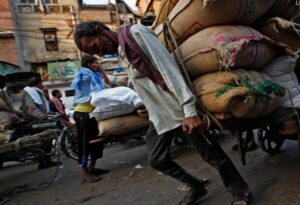
  • Labour policies need to change for better quality livelihoods

    Context

    • One of the biggest economic fallout of the pandemic has been the deteriorating labour market conditions.
    • Given the ebb and flow of the pandemic, the growth recovery is likely to be fragmented and will weigh on the number and types of jobs available.

    What is quality and sustainable livelihood?

    • “A livelihood comprises the capabilities, assets and activities required for a means of living. A livelihood is sustainable when it can cope with and recover from stresses and shocks and maintain or enhance its capabilities and assets both now and in the future, while not undermining the natural resource base.’’

    Sustainable livelihoods objectives

    • improved access to high-quality education, information, technologies and training and better nutrition and health;
    • a more supportive and cohesive social environment;
    • more secure access to, and better management of, natural resources;

    Definition of labour welfare

    • Labour welfare relates to taking care of the well-being of workers by employers, trade unions, governmental and non-governmental institutions and agencies.
    • Welfare includes anything that is done for the comfort and improvement of employees and is provided over and above the wages.

    Why labour law is needed

    • Labour law aims to correct the imbalance of power between the worker and the employer; to prevent the employer from dismissing the worker without good cause; to set up and preserve the processes by which workers are recognized as ‘equal’ partners in negotiations about their working conditions etc.

    Constitutional mandate

    • Article 41 – The state shall within the limits of its economic capacity and development make effective provision for securing the right to work, to education and to public assistance in cases of unemployment, old age, sickness and disablement and in other cases of underserved want.
    • Article 42 – The state shall make provision for securing just and humane conditions of work and for maternity relief.

    Challenges in labour welfare in India

    • Technical glitches: Under the Constitution of India, Labour is a subject in the concurrent list where both the Central and State Governments are competent to enact legislations. As a result, a large number of labour laws have been enacted catering to different aspects of labour e.g. occupational health, safety, employment etc.
    • Loopholes: Because of the predominantly heavy handed labour regulations (also called as Inspector Raj) with exploitable gaps, the MNCs and domestic organizations have resorted to alternate ways i.e. employing contract labour at less than half the payroll of a permanent employee.
    • Gaps in labour laws: One of the main reasons for labour reforms is the concept of contract labour. Trade Unions suggest that this concept itself should be removed. There is stringent hiring and firing process defined in Industry Disputes Act. It makes it mandatory for the organization to seek Government permission before removing an employee.

    Global best practices  

    • Universal basic income pilot project: For two years Finland’s government gave 2,000 unemployed citizens €560 a month with no strings attached. It was the first nationwide basic income experiment. The concept is slowly becoming difficult for people to ignore.

    How will dynamic policies and labour codes respond?

    • Labour productivity: It is likely to improve with both employees and employers developing a sense of being partners in wealth creation.
    • Labour reform: A transparent environment in terms of workers’ compensation, clear definition of employee rights and employer duties.
    • Compliance un-burdening: Simplified labour codes making compliance easier are likely to attract investments.
    • Formalization of the economy: With more workers in the organized sector, leakage in terms of direct as well as indirect taxes may be plugged.

    Conclusion

    • The guiding principle for India’s labour policy reformers should not merely be ring fencing jobs but safeguarding workers through social assistance, re-employment support (such as that which is provided in several Western nations) and skill building, and supporting employers in employee training and development.

    Mains question

    Q. Why there is need to make labour policies more dynamic? Do you think universal basic income approach will be the best way forward for achieving quality livelihood?

    UPSC 2023 countdown has begun! Get your personal guidance plan now! (Click here)


  • Long road ahead: Towards women empowerment

    Context

    • Gender parity is not recovering, according to the Global Gender Gap Report 2022. It will take another 132 years to close the global gender gap.
    • As crises are compounding, women’s workforce outcomes are suffering and the risk of global gender parity backsliding further intensifies.

    Why in news?

    • India has one of the world’s lowest female labour force participation rates (LFPR).
    • This means the productive potential of half of the population goes unutilized.

    What is women’s empowerment all about?

    • Women’s empowerment can be defined to promoting women’s sense of self-worth, their ability to determine their own choices, and their right to influence social change for themselves and others.

    Why it is needed?

    • Human resource: Empowerment of women is a necessity for the very development of a society, since it enhances both the quality and the quantity of human resources available for development.
    • Sustainable development: Women’s empowerment and achieving gender equality is essential for our society to ensure the sustainable development of the country.

    Constraints in women empowerment

    • Illiteracy: Illiteracy has been found as major constraints for the attainment of women Empowerment in the nation. It is the rate of literacy which governs the reservation, takeover and competition among women for their right in country. Female child are less privileged for attaining schools.
    • Discriminatory nature of male towards female: In India, since the olden days, the men have been in control of politics, social, economical as well as cultural and traditional spheres of life.
    • Religious and cultural beliefs: This is another important constraint of women’s empowerment in India which tightens up the female population. It is because of unknowing believes and following superstitions.
    • Less participation of women in political field: In particular, women them self involves less in the political filed. Their participation is very insignificant in political issues and right as compared to male population.

    What happens if we don’t act?

    • Economical losses: Evidence shows that economic disempowerment of women can result in losses of 10% of GDP in industrialized economies and over 30% in South Asia and in the Middle East and North Africa.
    • Work opportunities: India’s GDP could grow by nearly ₹3 trillion if women were brought into the labour market and given access to formal, ‘decent’ work opportunities.

    Case study

    Mahila Sanatkar a craftswomen cooperative located in Hyderabad.

    Economic and social  effects: It  is  noticeable  some  social  results  such  as  skill building, self-confidence  enhancement,  the  mobility acquired  by the  women.

    What is needed to improve women’s welfare?

    • Community sensitization: Persistent effort must be directed toward community sensitization to root out patriarchal social norms.
    • Directional efforts: In addition to enforcing existing regulations like minimum wages, there must be supportive ancillary policies including childcare; secure transport; lighting; safety at work; and quotas in hiring, corporate boards, and politics to foster more  women  in  leadership.
    • Universal social mobilization: Identification and inclusion of the poor remains a challenge. There is need to develop community resource persons for participatory identification of poor.
    • Training, Capacity Building & Skill Upgradation: There is lack of appropriate training plans, quality training and availability of expert training institutions.
    • Universal Financial Inclusion: Lack of uniform financial management systems at all tiers of SHGs has impacted the growth in bank accounts, improvement in financial literacy, and absorption capacity of community members.
    • Multiple & Diversified Livelihoods: There is lack of progressive leadership for inclusiveness of small-sized enterprises at the federal level. Market/ forward linkages, is largely missing.

    Conclusion

    • If we improve women’s labour force participation, not only do we harness the massive productive potential of half of the population, but their earnings will yield enormous dividends for the future of the country and economy.

    Mains question

    Q. What do you consider as true women empowerment? Assess the constraints for the same and give directional efforts needed to overcome it.  

    UPSC 2023 countdown has begun! Get your personal guidance plan now! (Click here)


  • What is causing Arctic Amplification?

    Finnish researchers have found that the Arctic is heating four times faster than the rest of the planet.

    Arctic is warming faster

    • The warming is concentrated in the Eurasian part of the Arctic, where the Barents Sea north of Russia and Norway is warming at an alarming rate — seven times faster than the global average.
    • Other studies indicate that the Arctic amplification is four times the global rate.

    What is Arctic Amplification?

    • Global warming has hastened due to anthropogenic forces or human activities since pre-industrial times and has increased the planet’s average temperature by 1.1 degrees Celsius.
    • While changes are witnessed across the planet, any change in the surface air temperature and the net radiation balance tend to produce larger changes at the north and south poles.
    • This phenomenon is known as polar amplification; these changes are more pronounced at the northern latitudes and are known as the Arctic amplification.

    What causes amplification?

    • Among the many global warming-driven causes for this amplification, the ice-albedo feedback, lapse rate feedback, water vapour feedback and ocean heat transport are the primary causes.
    • Sea ice and snow have high albedo (measure of reflectivity of the surface), implying that they are capable of reflecting most of the solar radiation as opposed to water and land.
    • In the Arctic’s case, global warming is resulting in diminishing sea ice.
    • As the sea ice melts, the Arctic Ocean will be more capable of absorbing solar radiation, thereby driving the amplification.
    • The rate at which the temperature drops with elevation i.e. lapse rate decreases with warming.
    • Studies show that the ice-albedo feedback and the lapse rate feedback are responsible for 40% and 15% of polar amplification respectively.

    What do the previous studies say?

    • The extent of Arctic amplification is debated, as studies show various rates of amplification against the global rate.
    • Studies have shown that the Arctic was warming at twice the global rate prior to the beginning of the 21st century.
    • Already the Arctic surface air temperature has likely increased by more than double the global average over the last two decades.

    What are the consequences of Arctic warming?

    • The causes and consequences of Arctic amplification are cyclical — what might be a cause can be a consequence too.
    • The Greenland ice sheet is melting at an alarming rate, and the rate of accumulation of sea ice has been remarkably low since 2000.
    • This is also marked by young and thinner ice replacing the old and thicker ice sheets.
    • Greenlandic ice sheet holds the second largest amount of ice, after Antarctica, and therefore it is crucial for maintaining the sea level.
    • In 2019, this was the single biggest cause for the rise in the sea level, about 1.5 metres.

    Visible impacts

    • If the sheet melts completely, the sea level would rise by seven metres, capable of subsuming island countries and major coastal cities.
    • The warming of the Arctic Ocean and the seas in the region, the acidification of water, changes in the salinity levels, are impacting the biodiversity, including the marine species and the dependent species.
    • The warming is also increasing the incidence of rainfall which is affecting the availability and accessibility of lichens to the reindeer.
    • The Arctic amplification is causing widespread starvation and death among the Arctic fauna.
    • The permafrost in the Arctic is thawing and in turn releasing carbon and methane which are among the major greenhouse gases responsible for global warming.
    • Experts fear that the thaw and the melt will also release the long-dormant bacteria and viruses that were trapped in the permafrost and can potentially give rise to diseases.

    What is the impact on India?

    • In recent years, scientists have pondered over the impact the changing Arctic can have on the monsoons in the subcontinent.
    • The link between the two is growing in importance due to the extreme weather events the country faces, and the heavy reliance on rainfall for water and food security.
    • A study says that reduced sea ice in the Barents-Kara sea region can lead to extreme rainfall events in the latter half of the monsoons — in September and October.
    • The changes in the atmospheric circulation due to diminishing sea ice combined with the warm temperatures in the Arabian Sea contribute to enhanced moisture and drive extreme rainfall events.

    Steps taken by India

    • In 2014, India deployed IndARC, India’s first moored-underwater observatory in the Kongsfjorden fjord, Svalbard.
    • It aims to monitor the impact of the changes in the Arctic Ocean on tropical processes such as the monsoons.


    UPSC 2023 countdown has begun! Get your personal guidance plan now! (Click here)

  • Practice of talaq-e-hasan not so improper: Supreme Court

    The Supreme Court has prima facie observed that the Muslim personal law practice of talaq-e-hasan is “not so improper”.

    What is Talaq-e-hasan?

    • Talaq-e-hasan is a form of divorce by which a Muslim man can divorce his wife by pronouncing talaq once every month over a three-month period.

    Why did the apex court say this?

    • The SC Bench said a Muslim woman has the option to divorce by the process of khula by returning the dower (mahr) or something else that she received from her husband or without returning anything.
    • This can be as per agreed by the spouses or Qadi’s (court) decree depending on the circumstances.

    Petitioner’s contention

    • The petitioner argued that talaq-e-hasan and other forms of unilateral extra-judicial divorce is an evil plague similar to sati.
    • Talaq-e-hasan is arbitrary, irrational and contrary to Articles 14, 15, 21 and 25 and international conventions on civil rights and human rights, the petition submitted.
    • There should be a gender neutral, religion neutral, uniform grounds of divorce and uniform procedure of divorce for all citizens, it read.
    • The petitioner argued that the practice in question was “neither harmonious with the modern principles of human rights and gender equality nor an integral part of Islamic faith”.
    • The practice discriminates against Muslim women as they cannot resort to it against their husbands.

    Why in news?

    • The apex court, while striking down triple talaq in the Shayara Bano case, did not address the issue of talaq-e-hasan.
    • The unilateral practice of divorce was is definitely defies morality.


    UPSC 2023 countdown has begun! Get your personal guidance plan now! (Click here)

  • Five years after SC verdict, talaq petitioners living as ‘half-divorcees’

    Five years after the Supreme Court’s five-judge Bench under then CJI J.S. Khehar invalidated instant triple talaq in August 2017, the women petitioners continue to live a life of half-divorcees.

    What is triple talaq?

    • ‘Triple Talaq’ is a procedure of divorce under the Sharia Law which is a body of the Islamic law.
    • Under this, a husband can divorce his wife by pronouncing ‘Talaq’ thrice.
    • The Supreme Court invalidated instant triple talaq in the Shayara Bano versus the Union of India case while refraining from commenting on the state of their marriages directly.

    What was the issue all about?

    • The case dates back to 2016 when the Supreme Court had sought assistance from the then Attorney General Mukul Rohatgi on pleas challenging the constitutional validity of “triple talaq”.
    • The hearing also included cases of “nikah halala” and “polygamy”, to assess whether Muslim women face gender discrimination in cases of divorce.
    • The issue gained political momentum on March 2017 when the Personal Law Board (AIMPLB) told the Supreme Court that the issue of triple talaq falls outside the judiciary’s realm.
    • However, on August 22, the Supreme Court set aside the decade-old practice of instant triple talaq saying it was violative of Article 14 and 21 of the Indian Constitution.

    Why was triple talaq abolished?

    • In spite of protests by Muslim women and activists world-wide the procedure was most prevalent throughout the country.
    • There are several instances where ‘triple talaq’ has enabled husbands to divorce arbitrarily, devoid of any substantiation.
    • Oral talaq or ‘triple talaq’ delivered through social media platforms like Skype, text messages, email and WhatsApp have become an increasing cause of worry for the community.
    • The ‘triple talaq’ has been abolished in 21 countries including Pakistan, but is still prevalent in India.
    • The Centre reasons that these practices are against constitutional principles such as gender equality, secularism, international laws etc.
    • When these practices are banned in Islamic theocratic countries, the practices could have absolutely no base in religion and are only prevalent to permit the dominance of men over women.

    Why in news now?

    • Half-divorce: Technically still married, practically divorced, they enjoy no conjugal rights nor receive any regular maintenance from the estranged husbands.
    • Cannot remarry: Practically abandoned, the women cannot remarry in the absence of a legally valid divorce.
    • No legal action: After the verdict, none of the men were visited by law enforcement bodies and told to take back their wives.
    • No legal implementation: Further, no arrests could be made for giving instant triple as the Muslim Women (Protection of Rights on Marriage) Act, 2019 came into force long after the pronouncement of instant talaq.


    UPSC 2023 countdown has begun! Get your personal guidance plan now! (Click here)

  • Who was Kakasaheb Gadgil?

    The Gadgil Wada of Pune was recently lighted into tricolour for the 75th anniversary of Independence.

    Gadgil Wada was where plans for the reconstitution of the socialist Rashtra Seva Dal took place in early 1940s, with socialists like S.M. Joshi, N.G. Gore, Shirubhau Limaye and Kakasaheb in the lead.

    Kakasaheb Gadgil

    • Gadgil was an Indian freedom fighter and politician from Maharashtra, India.
    • He was also a writer. He wrote in both Marathi and English.
    • Gadgil graduated from Fergusson College in Pune in 1918, and obtained a degree in Law in 1920.
    • In India’s pre-independence days, freedom fighters Lokmanya Tilak, Mahatma Gandhi, Jawaharlal Nehru, and Vallabhbhai Patel influenced Gadgil.
    • He joined the Indian National Congress in 1920, immediately after obtaining his law degree and started his active participation in the national freedom movement.
    • He suffered imprisonment from the ruling British government eight times for the participation.

    Notable work during freedom struggle

    • In India’s pre-independence days, Gadgil served as the secretary of Poona District Congress Committee (1921–25), the president of Maharashtra Pradesh Congress Committee (1937–45).
    • He was elected to the central Legislative Assembly in 1934.
    • Gadgil was a pioneer in social reform movements in Maharashtra in the 1930s.
    • During the Civil Disobedience Movement, which began in 1930, Gadgil was listed as a leader for the Maharashtra Civil Disobedience Committee and the Pune War Council.
    • He was associated with several public associations and institutions, including Sarvajanik Sabha, Pune; Young Men’s Association, Pune; Maharashtra Youth League, Bombay; Pune Central Cooperative Bank; and Pune Municipality.

    Service after India’s independence

    • Between 1947 and 1952 Gadgil served as a minister in the first central cabinet of independent India.
    • He held the portfolios of Public Works, and Mines and Power.
    • In his first year in the central Cabinet, he initiated the project of building a military-caliber road from Pathankot to Srinagar via Jammu in Kashmir as a part of India’s activities in the 1947 Indo-Pakistan War.
    • As a cabinet minister, he also initiated the important development projects pertaining to Bhakra, Koyna, and Hirakund dams.
    • He was a member of the Congress Working Committee from 1952 to 1955.
    • His son Vitthalrao Gadgil was a veteran congressman and MP from Pune Lok Sabha constituency, and his grandson Anant Gadgil is currently spokesman for Maharashtra Pradesh Congress Committee.

    Authorship

    • Gadgil wrote several books and articles on politics, economics, law, and history.
    • The following are some of Gadgil’s books:
    1. Pathik (autobiography)
    2. Rajya Shastra Wichar
    3. Shubha Shastra
    4. Waktrutwa Shastra
    5. Gyanbache Arthashastra
    6. Government from Inside
    7. Shikhancha Itihaas (history of Sikhs)


    UPSC 2023 countdown has begun! Get your personal guidance plan now! (Click here)

  • Women heroes of India’s freedom struggle, mentioned by PM in his I-Day speech

    In his Independence Day address to the nation the Prime Minister paid tributes to women freedom fighters for showing the world the true meaning of India’s “nari shakti”. A look at the women he named in his speech:

    Rani Laxmibai

    • The queen of the princely state of Jhansi, Rani Laxmibai is known for her role in the First War of India’s Independence in 1857.
    • Born Manikarnika Tambe in 1835, she married the king of Jhansi.
    • The couple adopted a son before the king’s death, which the British East India Company refused to accept as the legal heir and decided to annex Jhansi.
    • Refusing to cede her territory, the queen decided to rule on behalf of the heir, and later joined the uprising against the British in 1857.
    • Cornered by the British, she escaped from Jhansi fort. She was wounded in combat near Gwalior’s Phool Bagh, where she later died.
    • Sir Hugh Rose, who was commanding the British army, is known to have described her as “personable, clever…and one of the most dangerous Indian leaders”.

    Jhalkari Bai

    • A soldier in Rani Laxmibai’s women’s army, Durga Dal, she rose to become one of the queen’s most trusted advisers.
    • She is known for putting her own life at risk to keep the queen out of harm’s way.
    • Till date, the story of her valour is recalled by the people of Bundelkhand, and she is often presented as a representative of Bundeli identity.
    • According to Ministry of Culture’s Amrit Mahotsav website, “Many Dalit communities of the region look up to her as an incarnation of God and also celebrate Jhalkaribai Jayanti every year in her honour.”

    Durga Bhabhi

    • Durgawati Devi, who was popularly known as Durga Bhabhi, was a revolutionary who joined the armed struggle against colonial rule.
    • A member of the Naujawan Bharat Sabha, she helped Bhagat Singh escape in disguise from Lahore after the 1928 killing of British police officer John P Saunders.
    • During the train journey that followed, Durgawati and Bhagat Singh posed as a couple, and Rajguru as their servant.
    • Later, as revenge for the hanging of Bhagat Singh, Rajguru, and Sukhdev, she made an unsuccessful attempt to kill the former Punjab Governor, Lord Hailey.
    • Born in Allahabad in 1907 and married to Hindustan Socialist Republican Association (HSRA) member Bhagwati Charan Vohra, Durgawati, along with other revolutionaries, also ran a bomb factory in Delhi.

    Rani Gaidinliu

    • Born in 1915 in present-day Manipur, Rani Gaidinliu was a Naga spiritual and political leader who fought the British.
    • She joined the Heraka religious movement which later became a movement to drive out the British. She rebelled against the Empire, and refused to pay taxes, asking people to do the same.
    • The British launched a manhunt, but she evaded arrest, moving from village to village.
    • Gaidinliu was finally arrested in 1932 when she was just 16, and later sentenced for life. She was released in 1947.
    • Then PM Nehru described Gaidinliu as the “daughter of the hills”, and gave her the title of ‘Rani’ for her courage.

    Rani Chennamma

    • The queen of Kittur, Rani Chennamma, was among the first rulers to lead an armed rebellion against British rule.
    • Kittur was a princely state in present-day Karnataka.
    • She fought back against the attempt to control her dominion in 1824 after the death of her young son. She had lost her husband, Raja Mallasarja, in 1816.
    • She is seen among the few rulers of the time who understood the colonial designs of the British.
    • Rani Chennamma defeated the British in her first revolt, but was captured and imprisoned during the second assault by the East India Company.

    Begum Hazrat Mahal

    • After her husband, Nawab of Awadh Wajid Ali Shah, was exiled after the 1857 revolt, Begum Hazrat Mahal, along with her supporters, took on the British and wrested control of Lucknow.
    • She was forced into a retreat after the colonial rulers recaptured the area.

    Velu Nachiyar

    • Many years before the revolt of 1857, Velu Nachiyar waged a war against the British and emerged victorious. Born in Ramanathapuram in 1780, she was married to the king of Sivagangai.
    • After her husband was killed in battle with the East India Company, she entered the conflict, and won with support of neighbouring kings.
    • She went on to produce the first human bomb as well as establish the first army of trained women soldiers in the late 1700s.
    • Her army commander Kuyili is believed to have set herself ablaze and walked into a British ammunition dump.
    • She was succeeded by her daughter in 1790, and died a few years later in 1796.


    UPSC 2023 countdown has begun! Get your personal guidance plan now! (Click here)

  • Reaping our demographic dividend

    Context

    • India’s biggest strength is its ‘demographic dividend’ and people need to fully leverage it to fast-track the country’s progress in various sectors

    Why in news

    • The 2022 edition of the World Population Prospects (WPP) of the United Nations has projected that India may surpass China as the world’s most populous country next year.
    • The report estimates that India will have a population of 1.66 billion in 2050, ahead of China’s 1.317 billion around that time.

    What is demographic dividend?

    • Demographic dividend, as defined by the United Nations Population Fund, is “the economic growth potential that can result from shifts in a population’s age structure, mainly when the share of the working-age population is larger than the non-working-age share of the population”.

    Current status for India

    • India entered the demographic dividend opportunity window in 2005-06 and will remain there till 2055-56.
    • This is the period when the working age ratio is equal to or more than 150% and the dependency ratio is equal to or lower than 66.7%, generally taken as the cut-off for the demographic dividend window.

    How India can leverage this dividend

    (1) Investment in right direction

    • Investments in human and physical infrastructure will need to be scaled up dramatically to promote entrepreneurship and create jobs.
    • Investment in education is crucial for ensuring that working-age people are prepared for the demands of the economy.
    • Increase spending on health
    • Increase investments in Research and Development

    (2) Absorption of labour into productive employment

    • Promote entrepreneurship and job creation
    • Service sector like tourism, logistics should be promoted
    • Skill development of the working-age population so that they can turn out to be productive for the country’s economy

    Challenges in reaping this

    • Drastic quality improvement: India’s challenge is to create conditions for faster growth of productive jobs outside of agriculture, especially in the organized manufacturing and in services.
    • Severe shortages: India currently faces a severe shortage of well trained, skilled workers. Large sections of the educated workforce have little or no job skills, making them largely Unemployable.
    • Dismal health sector: A closer look implies various factors such as poor health which although obvious, play a major role in the poor performance of working population.
    • Socio economic dimensions: The status of institutions in India regarding caste discrimination, gender inequalities, widening income gap between the rich and the poor, religious differences, inefficient and slow legal system- all contribute to the poor standard of living of the masses.

    Government steps

    • National Skill Development Corporation (NSDC): incorporated on 31st July, 2008, is a first-of-its-kind Public Private Partnership (PPP) in India set up to facilitate the development and upgrading of the skills of the growing Indian workforce through skill training programs.
    • National Skill Development Agency: Currently, skill development efforts are spread across approximately20 separate ministries, 35 State Governments and Union Territories and the private sector.
    • National Skill Certification and Money Reward Scheme: encouragement is given for skill development for youth by providing monetary rewards for successful completion of approved training programs.

    Way forward

    • Strategies exist to exploit the demographic window of opportunity that India has today, but they need to be adopted and implemented.
    • The dreams of huge income flow and resultant economic growth due to demographic dividend could be realized only when we inculcate the required skills in the work force to make it as competent as its counterparts in the developed world.

    Important data for mains

    • India’s working-age population has numerically outstripped its non-working age population.
    • India’s total fertility rate (TFR) has declined from 2.2 in 2015-16 to 2.0 in 2019-21, indicating the significant progress of population control measures, revealed the report of the fifth round of the National Family Health Survey (NFHS-5).
    • The TFR is the average number of children born to a woman in her lifetime.

    Mains question

    Q. Do you think the right has come that India should adopt moving away policy from population control towards reaping its demographic dividends? Critically examine.