💥Join UPSC 2027,2028 Mentorship (July Batch) + XFactor Notes & Microthemes PDF

GS Paper: GS3-19.Disaster and Disaster Management.

  • [12th March 2026] The Hindu OpED: A seismic decision: On revision to India’s earthquake zoning, rollback 

    PYQ Relevance[UPSC 2021] Discuss about the vulnerability of India to earthquake related hazards. Give examples including the salient features of major disasters caused by earthquakes in different parts of India during the last three decades.Linkage: It highlights India’s seismic vulnerability and the need for accurate hazard assessment. The revision of the earthquake zoning framework and adoption of probabilistic seismic hazard assessment strengthen disaster preparedness and risk mapping.

    Mentor’s Comment

    The rollback of the Bureau of Indian Standards (BIS) revision of India’s earthquake zoning framework has revived debate over seismic risk assessment. The proposed revision sought to replace the simplified fixed seismic zoning model with probabilistic seismic hazard assessment, a method widely used globally. It also introduced a new high-risk Zone VI covering vulnerable regions such as Kashmir and the Himalayan belt. However, stricter zoning raised economic concerns, as construction costs could increase by about 20% with a one-zone rise and nearly one-third with two zones

    Why does India require a revised earthquake zoning framework?

    1. Urban Expansion and Risk Exposure: Rapid urbanisation increases population and infrastructure in seismically vulnerable areas. Large infrastructure such as metro systems, dams, highways, and power stations require updated seismic design standards.
    2. Disaster Preparedness: Accurate zoning enables safer city planning, infrastructure design, and disaster management strategies. It reduces casualties and economic losses during earthquakes.
    3. Climate and Disaster Resilience: Earthquake-resilient infrastructure contributes to broader climate-resilient development and sustainable cities.
    4. Infrastructure Protection: Critical infrastructure projects must incorporate seismic design standards to prevent catastrophic failure during earthquakes.

    What is the current earthquake zoning system in India?

    1. Fixed Zoning Model: India currently uses a simplified seismic zoning map, dividing the country into fixed categories based on historical seismic activity.
    2. Seismic Zones: India’s seismic classification includes Zones II, III, IV and V, with Zone V representing the highest risk areas.
    3. Limitations of Fixed Zoning: Fixed zones rely heavily on past earthquake records and may not fully capture future seismic probabilities or micro-level risk variations.
    4. Urban Planning Integration: These zones influence building codes, infrastructure design standards, and urban planning guidelines.

    What changes were proposed in the BIS revision?

    1. Probabilistic Seismic Hazard Assessment (PSHA): Introduces probability-based simulations to estimate earthquake intensity and frequency rather than relying solely on historical data.
    2. Introduction of Zone VI: Adds a new highest-risk seismic zone, covering Kashmir, parts of the Himalayan belt, Kutch in Gujarat, and the northeast.
    3. Improved Risk Modelling: Uses dynamic modelling of ground motion probabilities to improve earthquake preparedness.
    4. Alignment with Global Practice: Aligns India’s seismic risk assessment methodology with advanced economies and seismically active regions worldwide.

    Why did the proposed revision face opposition?

    1. Economic Cost: Construction costs could rise significantly.
      1. One-zone increase: Costs may rise by around 20%.
      2. Two-zone increase: Costs may rise by nearly one-third.
    2. Infrastructure Cost Escalation: High-value projects such as metro systems, dams, and power stations may face substantially higher structural design costs.
    3. Development Concerns: Urban planners fear stricter zoning could slow infrastructure development in economically fragile regions.
    4. Housing Informality: Nearly 80% of India’s housing stock lies in the informal sector, raising concerns that stricter regulations may increase unregulated construction.

    What are the broader governance and policy challenges?

    1. Institutional Coordination: The proposal faced resistance from multiple agencies including Ministry of Housing and Urban Affairs, Home Affairs, Central Water Commission, and National Dam Safety Authority.
    2. Policy Consultation Gap: Large regulatory changes require extensive consultation across government agencies, industry stakeholders, and technical experts.
    3. Balancing Safety and Affordability: Stricter building standards improve safety but increase construction costs and housing affordability pressures.
    4. Implementation Capacity: Enforcement challenges remain significant due to informal housing markets and limited regulatory capacity.

    How does the debate intersect with climate and sustainability goals?

    1. Construction Sector Emissions: The construction sector is among the largest dispersed sources of carbon emissions in India.
    2. Infrastructure Lifecycle: Seismic-resilient structures reduce the need for reconstruction after disasters, lowering long-term carbon and economic costs.
    3. Resilient Urban Development: Disaster-proof infrastructure supports climate adaptation strategies and sustainable urbanisation.

    Conclusion

    Revising India’s earthquake zoning framework remains essential for ensuring disaster-resilient urban growth and infrastructure safety. However, scientific improvements must be accompanied by broad institutional consultation, economic feasibility assessments, and strong implementation mechanisms. A balanced framework that integrates advanced risk modelling with practical governance capacity is critical for strengthening India’s long-term disaster resilience.

  • NDMA’s first ever guidelines for identification of disaster victims

    Why in the News

    The National Disaster Management Authority (NDMA) has issued India’s first Standard Operating Procedures for Disaster Victim Identification. This comes after several recent mass fatality incidents such as the Air India plane crash in Ahmedabad, the chemical factory explosion in Sanand, floods in Dharali, and the Balrampur earthquake.

    Earlier, India did not have a uniform national system to identify disaster victims. Identification was often ad hoc, poorly coordinated, and slow, causing logistical problems and long delays for families. The new guidelines shift India from fragmented local practices to a standardised, scientific, and dignity-based national framework for handling disaster victims.

    Why were Disaster Victim Identification Guidelines Needed?

    1. Absence of Standardisation: Lack of a national protocol resulted in inconsistent identification methods across States.
    2. Operational Gaps: Shortage of forensic experts, poor inter-agency coordination, and logistical constraints delayed identification.
    3. Humanitarian Deficit: Families faced prolonged uncertainty due to delayed or incorrect identification of remains.
    4. Rising Mass Fatality Events: Increase in industrial accidents, floods, fires, earthquakes, and aviation disasters heightened systemic risk.

    What is the Scope of the NDMA Guidelines?

    1. Applicability: Covers identification of victims in mass fatality incidents across natural and man-made disasters.
    2. Geographical Reach: Designed for uniform adoption across States, districts, and local administrations.
    3. Lifecycle Coverage: Extends from disaster site management to final handover of identified remains to families.

    What Forensic and Scientific Methods are Prescribed?

    1. Forensic Archaeology: Supports recovery and documentation of remains at disaster sites.
    2. Forensic Odontology: Enables identification through dental records.
    3. DNA Profiling: Facilitates identification when bodies are fragmented or decomposed.
    4. Anthropology and Pathology: Assists in age, sex, and injury profiling.
    5. Medical Records Integration: Enables cross-verification using antemortem data.

    How do the Guidelines Address Operational Challenges?

    1. Inter-Agency Coordination: Defines roles of police, forensic teams, health authorities, and district administration.
    2. Logistical Planning: Addresses gaps in storage, transport, and preservation of remains.
    3. Administrative Clarity: Reduces jurisdictional overlaps between local, State, and Central agencies.
    4. Capacity Constraints: Acknowledges shortage of forensic branches and specialists across States.

    How is Sensitivity Towards Victims’ Families Ensured?

    1. Cultural Sensitivity: Mandates respect for community customs during handling of remains.
    2. Counselling Support: Emphasises emotional support for affected families.
    3. Transparent Communication: Ensures timely and accurate dissemination of identification status.
    4. Dignified Handling: Treats victim identification as both a technical and humanitarian exercise.

    Who Drafted the Guidelines and How Were They Developed?

    1. Institutional Leadership: Drafted under NDMA’s Joint Advisor.
    2. Expert Committee: Included specialists in forensics, archaeology, odontology, and pathology.
    3. Learning from Past Disasters: Incorporated lessons from earthquakes, floods, industrial accidents, and aviation crashes.
    4. Consultative Process: Involved State governments and central agencies over multiple years.

    Conclusion

    The NDMA’s Disaster Victim Identification guidelines institutionalise scientific rigour, administrative clarity, and humanitarian ethics in post-disaster management. By standardising procedures nationwide, they strengthen disaster governance, enhance public trust, and ensure dignity and closure for affected families.

    PYQ Relevance 

    [UPSC 2018] Describe various measures taken in India for Disaster Risk Reduction (DRR) before and after signing ‘Sendai Framework for DRR (2015-2030)’. How is this framework different from ‘ Hyogo Framework for Action, 2005’?

    Linkage: The question relates to GS-III disaster management, highlighting India’s shift from relief-based response under Hyogo to risk reduction and institutional accountability under the Sendai Framework. Sendai embeds ethics in disaster governance by stressing human dignity, compassion, and state responsibility in disaster response.

  • Disaster Victim Identification (DVI) Guidelines 

    Why in the News?

    India has released its first ever national guidelines and Standard Operating Procedures for Disaster Victim Identification (DVI) to address long standing gaps in identifying victims of mass fatality disasters.

    What is Disaster Victim Identification (DVI)?

    • A scientific and systematic process to identify deceased persons in mass fatality incidents
    • Used in air crashes, earthquakes, floods, fires, industrial accidents and terror attacks
    • Ensures accurate identification and dignified handover of remains to families

    Organisations Involved

    • National Disaster Management Authority as nodal agency
    • National Forensic Sciences University for technical and drafting support
    • State police, health departments, forensic laboratories and emergency responders
    • Aligned with global best practices of Interpol DVI framework

    Aim of the Guidelines

    • Ensure accurate identification and legal certification of deaths
    • Create a uniform national protocol for mass fatality management
    • Integrate modern forensic science and digital tools into disaster response
    [2014] Consider the following statements: 1. Animal Welfare Board of India is established under the Environment (Protection) Act, 1986. 

    2. National Tiger Conservation Authority is a statutory body. 

    3. National Ganga River Basin Authority is chaired by the Prime Minister. 

    Which of the statements given above is/are correct? 

    (a) 1 only (b) 2 and 3 only (c) 2 only (d) 1, 2 and 3

  • NDMA’s first ever guidelines for identification of disaster victims

    Why in the News

    The National Disaster Management Authority (NDMA) has issued India’s first Standard Operating Procedures for Disaster Victim Identification. This comes after several recent mass fatality incidents such as the Air India plane crash in Ahmedabad, the chemical factory explosion in Sanand, floods in Dharali, and the Balrampur earthquake.

    Earlier, India did not have a uniform national system to identify disaster victims. Identification was often ad hoc, poorly coordinated, and slow, causing logistical problems and long delays for families. The new guidelines shift India from fragmented local practices to a standardised, scientific, and dignity-based national framework for handling disaster victims.

    Why were Disaster Victim Identification Guidelines Needed?

    1. Absence of Standardisation: Lack of a national protocol resulted in inconsistent identification methods across States.
    2. Operational Gaps: Shortage of forensic experts, poor inter-agency coordination, and logistical constraints delayed identification.
    3. Humanitarian Deficit: Families faced prolonged uncertainty due to delayed or incorrect identification of remains.
    4. Rising Mass Fatality Events: Increase in industrial accidents, floods, fires, earthquakes, and aviation disasters heightened systemic risk.

    What is the Scope of the NDMA Guidelines?

    1. Applicability: Covers identification of victims in mass fatality incidents across natural and man-made disasters.
    2. Geographical Reach: Designed for uniform adoption across States, districts, and local administrations.
    3. Lifecycle Coverage: Extends from disaster site management to final handover of identified remains to families.

    What Forensic and Scientific Methods are Prescribed?

    1. Forensic Archaeology: Supports recovery and documentation of remains at disaster sites.
    2. Forensic Odontology: Enables identification through dental records.
    3. DNA Profiling: Facilitates identification when bodies are fragmented or decomposed.
    4. Anthropology and Pathology: Assists in age, sex, and injury profiling.
    5. Medical Records Integration: Enables cross-verification using antemortem data.

    How do the Guidelines Address Operational Challenges?

    1. Inter-Agency Coordination: Defines roles of police, forensic teams, health authorities, and district administration.
    2. Logistical Planning: Addresses gaps in storage, transport, and preservation of remains.
    3. Administrative Clarity: Reduces jurisdictional overlaps between local, State, and Central agencies.
    4. Capacity Constraints: Acknowledges shortage of forensic branches and specialists across States.

    How is Sensitivity Towards Victims’ Families Ensured?

    1. Cultural Sensitivity: Mandates respect for community customs during handling of remains.
    2. Counselling Support: Emphasises emotional support for affected families.
    3. Transparent Communication: Ensures timely and accurate dissemination of identification status.
    4. Dignified Handling: Treats victim identification as both a technical and humanitarian exercise.

    Who Drafted the Guidelines and How Were They Developed?

    1. Institutional Leadership: Drafted under NDMA’s Joint Advisor.
    2. Expert Committee: Included specialists in forensics, archaeology, odontology, and pathology.
    3. Learning from Past Disasters: Incorporated lessons from earthquakes, floods, industrial accidents, and aviation crashes.
    4. Consultative Process: Involved State governments and central agencies over multiple years.

    Conclusion

    The NDMA’s Disaster Victim Identification guidelines institutionalise scientific rigour, administrative clarity, and humanitarian ethics in post-disaster management. By standardising procedures nationwide, they strengthen disaster governance, enhance public trust, and ensure dignity and closure for affected families.

    PYQ Relevance 

    [UPSC 2018] Describe various measures taken in India for Disaster Risk Reduction (DRR) before and after signing ‘Sendai Framework for DRR (2015-2030)’. How is this framework different from ‘ Hyogo Framework for Action, 2005’?

    Linkage: The question relates to GS-III disaster management, highlighting India’s shift from relief-based response under Hyogo to risk reduction and institutional accountability under the Sendai Framework. Sendai embeds ethics in disaster governance by stressing human dignity, compassion, and state responsibility in disaster response.

  • [23rd January 2026] The Hindu OpED: A dangerous march towards a Himalayan ecocide

    PYQ Relevance

    [UPSC 2019] Vulnerability is an essential element for defining disaster impact and its threat to people. How and why can vulnerability to disasters be characterized? Discuss different type of vulnerability with reference to disasters.

    Linkage: This PYQ tests conceptual clarity on disaster vulnerability under GS-III (Disaster Management), especially the classification of physical, environmental, social, and institutional vulnerabilities. The article demonstrates how institutional and environmental vulnerabilities amplify natural hazards into recurring disasters.

    Mentor’s Comment

    This article analyses the growing ecological and governance crisis in the Indian Himalayas, reflected in frequent disasters and infrastructure decisions that ignore scientific and policy safeguards. Using the Char Dham road-widening project as an example, it shows how unsafe land use, poor engineering choices, and weak policy coordination are increasing disaster risks in a highly fragile mountain region.

    Why in the news?

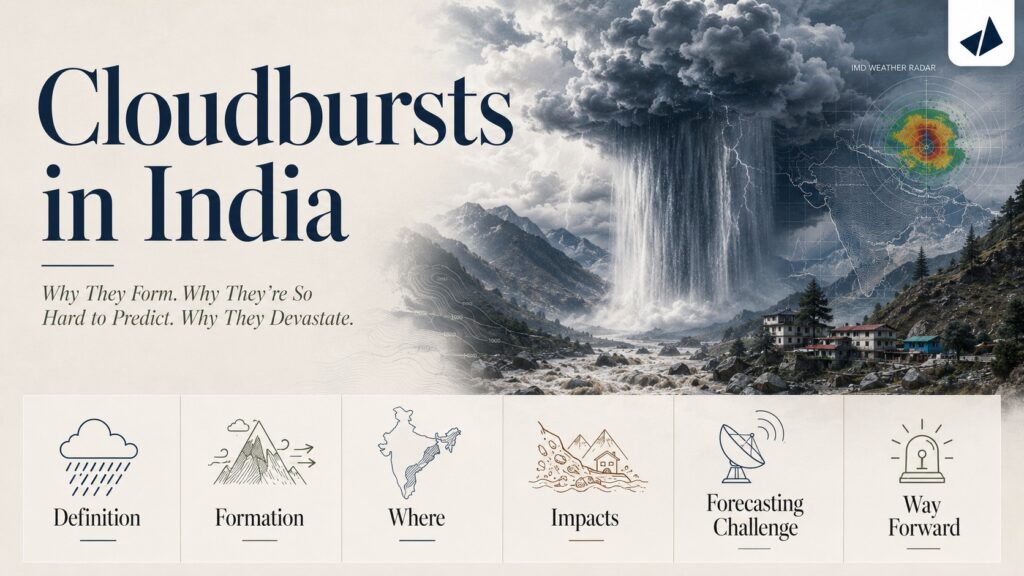
    The Himalayas experienced nearly 331 days of climate impacts in 2025, resulting in over 4,000 deaths, with Himachal Pradesh and Uttarakhand bearing the heaviest toll. Despite repeated disasters from cloudbursts, landslides, avalanches, and flash floods, the government has approved large-scale infrastructure expansion in disaster-prone zones. This includes the felling of nearly 7,000 Deodar trees for the Char Dham road-widening project.

    Why is the Himalayan disaster risk escalating?

    1. Climate intensification: High-altitude regions have warmed 50% faster than the global average since 1950, increasing extreme rainfall, glacial melt, and flash floods.
    2. Near-continuous exposure: 2025 recorded 331 days of climate impacts, indicating a permanent hazard regime rather than seasonal extremes.
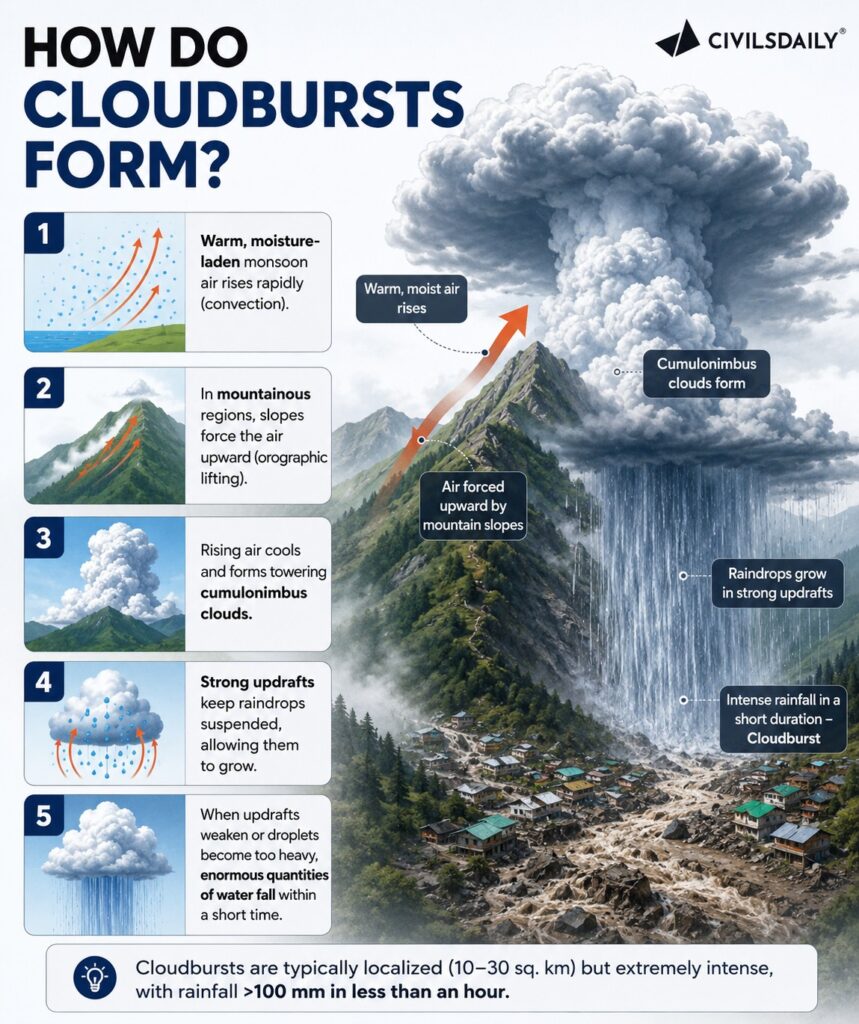
    3. Hazard convergence: Cloudbursts, landslides, avalanches, and land subsidence increasingly interact to produce compound disasters.

    Why is infrastructure expansion central to the crisis?

    1. Unsafe land use: Cutting unstable slopes for wide highways, drilling tunnels without adequate geological surveys, and large hydropower construction directly destabilise fragile terrain.
    2. Slope destabilisation: Excessively steep hill-cutting violates the natural angle of repose of Himalayan geology, creating permanent instability.
    3. Muck dumping: Indiscriminate disposal of excavated debris into rivers and slopes accelerates erosion and flood risk.

    What makes the Char Dham road-widening project problematic?

    1. Incorrect road standard: Adoption of the DL-PS (12-metre paved surface) standard in a disaster-prone region contradicts ecological and geological constraints.
    2. Project fragmentation: Bypassing a comprehensive Environmental Impact Assessment through artificial project segmentation.
    3. Scale of impact: Nearly 700 km of widened roads have generated over 800 active landslide zones, frequently closing strategic border routes.
    4. Delayed remedies: Retrofitting slopes with fibreglass bolts and wire mesh comes eight years after large-scale destabilisation, limiting effectiveness.

    Why are Deodar forests ecologically irreplaceable?

    1. Slope stabilisation: Extensive root systems bind fragile soils, reducing landslides and debris flows.
    2. Avalanche buffering: Forest cover acts as a natural barrier against glacial debris and snow avalanches.
    3. River health: Deodar forests regulate water temperature, sustain dissolved oxygen, and maintain water quality in snowmelt-fed streams.
    4. Microbial regulation: Antimicrobial compounds from leaf litter suppress harmful bacteria while promoting beneficial microbial communities.
    5. Legal recognition: Located within the Bhagirathi Eco-Sensitive Zone (≈4,000 sq km), established in 2012 to protect the Ganga’s last pristine stretch.

    Why is ‘tree translocation’ scientifically flawed?

    1. Ecological specificity: Centuries-old Deodars perform site-specific functions that cannot be replicated elsewhere.
    2. Functional loss: Uprooting effectively nullifies root-based slope stabilisation and microbial regulation.
    3. Absence of alternatives: No suitable terrain exists to recreate identical ecological conditions.

    How does governance failure amplify disaster risk?

    1. Policy contradiction: Current development initiatives violate the National Mission for Sustaining the Himalayan Ecosystem (NMSHE).
    2. Mandate dilution: NMSHE prioritises glacier monitoring, biodiversity protection, hazard mitigation, and sustainable livelihoods, but lacks implementation authority.
    3. Short-termism: Persistent prioritisation of immediate economic gains over long-term disaster resilience.
    4. Regulatory erosion: Repeated warnings by the National Green Tribunal remain weakly enforced.

    Why is climate change a ‘risk multiplier’ in the Himalayas?

    1. Erratic rainfall: Intensifies cloudbursts and flash floods.
    2. Glacial melt acceleration: Creates a dangerous ‘water-peak phase’ of high runoff and catastrophic floods.
    3. Future scarcity: Post-glacier retreat phase leads to prolonged water scarcity and drought.

    What human behaviours worsen ecological stress?

    1. Unregulated tourism: Exceeds carrying capacity in fragile zones.
    2. Vehicular pressure: Heavy traffic on unstable mountain roads increases slope stress.
    3. Waste mismanagement: Absence of functional solid-waste systems contaminates water sources.

    Conclusion

    Disaster resilience in the Himalayas is no longer optional but foundational to national security, ecological stability, and economic sustainability. Infrastructure decisions that ignore geological reality and ecological limits convert development into systemic risk. Scientific planning, policy coherence, and accountability must precede expansion in one of India’s most climate-sensitive landscapes.

  • SC ruling on post-facto clearances sets environmental law back by decades

    Introduction

    The Environmental Impact Assessment (EIA) is a preventive system requiring environmental clearance before a project begins. In 2025, the Supreme Court’s Vanashakti judgment banned all post-facto clearances as unconstitutional. In a new 2:1 ruling, the Court has now recalled that decision, warning that continuing the ban would cause “devastating” consequences and jeopardise major public investments. This marks a clear shift away from earlier strictures on environmental approvals.

    Why in the news?

    The Supreme Court’s recent endorsement of post-facto environmental clearances marks a sharp break from earlier rulings where such permissions were held illegal. For the first time, industries operating without prior approval may regularise their violations by paying penalties. This undermines the preventive purpose of Environmental Impact Assessments (EIAs), weakens compliance in a country already facing severe pollution challenges. The ruling enables violators to bypass mandatory safeguards like public hearings and ecological assessments, allowing large-scale industries to operate first and seek approval later.

    Understanding Ex Post Facto Environmental Clearances

    Meaning and Basic Idea

    • Retrospective approvals: Permissions granted after a project has already started construction, expansion, or operation without the mandatory prior Environmental Clearance (EC).
    • Departure from preventive logic: Converts a forward-looking safeguard into a mechanism to regularise completed violations.

    Intended Purpose: Rare exceptions: Initially justified only for unusual situations where procedural lapses occurred without deliberate violation.

    Actual Use: Regularisation tool: Gradually used to “legalise” ongoing or completed activities that had bypassed due environmental scrutiny.

    Legal Context

    1. EPA, 1986 as foundation: The Environment (Protection) Act establishes prior approval as the norm for activities affecting the environment.
    2. EIA 1994 & 2006 notifications: Both frameworks emphasise that major projects, industrial, mining, construction, must undergo assessment before commencement.

    Supreme Court’s Stand in the Vanashakti Judgment (2025)

    Key Findings

    1. Invalidation of government provisions: Struck down specific notifications and office memoranda that enabled retrospective clearances.
    2. Violation of environmental principles: Held that such clearances contradict the precautionary principle, which seeks to prevent harm at the outset.

    Judicial Observations

    1. Labelled as serious illegality: The Court stated that post-facto approvals erode environmental rule of law.
    2. Restriction on future permissions: Directed that no further mechanisms be created to enable or replicate retrospective ECs. 

    How Does the Ruling Change India’s Environmental Safeguards?

    1. Shift from Prevention to Regularisation: India’s environmental law is built on prior approval, but the ruling legitimises post-violation approvals. This weakens deterrence and changes the core architecture of environmental governance.
    2. Dilution of Public Hearings: Many industrial activities will now bypass public consultations, one of the most important safeguards under the EIA process.
    3. Weakening of the No-Fault Liability Principle: Earlier, industries operating without clearance faced closure; now they may continue operating after paying monetary penalties.
    4. Increased Environmental Risk: Projects threatening forests, rivers, and air quality gain legal pathways to operate retrospectively, exacerbating existing ecological crises.

    How Has Policy Drift in Recent Years Enabled Post-Facto Approvals?

    1. Draft EIA Notification 2020: Attempted to institutionalise post-facto approvals and reduce public participation, an approach the ruling now indirectly validates.
    2. Forest Conservation Act Amendments (2023): Redefined “forests” to exclude large tracts of land, enabling diversion without scrutiny and bypassing earlier safeguards.
    3. Coastal Regulation Zone (CRZ) Dilution (2018): Relaxed no-development zones and allowed extensive construction in vulnerable coastal areas.
    4. Expansion of Exemptions: Over 45 industrial categories have been exempted from prior clearances in the past decade.
    5. Legalisation of Violations: Historical decisions like TN Godavaraman protected forests strictly, but recent changes enable easier diversion and commercial use.

    Why Is the Ruling Especially Concerning for India’s Current Environmental Crisis?

    1. Extreme Pollution Levels: With 83 of the world’s 100 most polluted cities in India, any weakening of safeguards directly harms public health.
    2. Children’s Health Impact: Delhi’s children lose up to 10 years of lung function, highlighting the urgency of strict compliance.
    3. Carcinogenic Exposure: Farmers in Punjab and Haryana inhale toxic particulates every winter, worsening respiratory health.
    4. Hospital Overload: Urban hospitals deal with chronic respiratory disease surges every winter.
    5. Climate-Driven Disasters: Cyclones, erosion, and floods already strain ecosystems; weaker laws increase vulnerability.

    How Does the Ruling Affect Democratic Accountability?

    1. Reduced Public Participation: By enabling post-facto approvals, the ruling sidelines communities, especially those in pollution-affected regions.
    2. Bypassing Transparency: Industries may avoid public hearings and statutory scrutiny.
    3. Weakening of Citizen Rights: The apex court’s earlier stance held the environment as part of Article 21’s right to life; this shift undermines that framework.
    4. Centralisation of Power: State-level mechanisms become redundant if industries secure clearances retrospectively.

    What Long-Term Risks Does the Judgment Create?

    1. Systematic Legal Erosion: A decade-long pattern of exempting industries and diluting norms is now legitimised judicially.
    2. Encouragement of Violations: Industries may prefer paying a penalty over compliance, cheaper and faster.
    3. Increased Ecological Degradation: Forests, rivers, coasts, and air quality may deteriorate further due to weakened oversight.
    4. Regulatory Capture: Industries gain disproportionate influence over environmental decision-making.
    5. Undermining Global Climate Commitments: India’s commitments under the Paris Agreement require stronger, not weaker, compliance frameworks.

    Conclusion

    The Supreme Court’s endorsement of post-facto clearances marks a turning point in India’s environmental jurisprudence. While the ruling attempts to balance economic development and compliance, it risks normalising illegality and weakening safeguards that exist to protect public health, ecological integrity, and constitutional rights. At a time of worsening pollution and climate vulnerability, India needs stronger, not diluted, environmental governance.

    PYQ Relevance

    [UPSC 2014] What role do environmental NGOs and activists play in influencing Environmental Impact Assessment (EIA) outcomes for major projects in India? Cite four examples with all important details.

    Linkage: With post-facto clearances weakening formal EIA safeguards, NGOs become vital watchdogs ensuring accountability. This topic links directly to environmental governance, EIA dilution, and current judicial-policy debates.

  • India’s disaster response, a slippery slope for federalism

    Introduction

    The Wayanad tragedy of July 2024, claiming nearly 300 lives and destroying thousands of homes, revealed deep weaknesses in India’s disaster financing structure. Though Kerala estimated losses at ₹20,820 crore, the Union approved only ₹260 crore, signalling a widening disconnect between State needs and Union allocations. As climate disasters intensify, India’s disaster-risk financing model shows visible drift, raising questions on fiscal federalism, institutional design, and equity.

    Why in the news

    The Wayanad landslides (July 2024) brought focus to an unprecedented gap between State-estimated losses (₹20,820 crore) and Union-approved relief (₹260 crore). For the first time, the mismatch was so steep that the State sought a special memorandum to claim recovery support. This experience, mirroring similar delays in Himachal, Uttarakhand, Assam, and Odisha, highlights growing centralisation of disaster financing, outdated relief norms, and procedural bottlenecks that slow down urgent aid.

    Where is the drift in India’s disaster financing framework?

    1. Two-tier structure: SDRF (shared) and NDRF (Union-funded) forms the legal basis under Disaster Management Act, 2005; however, practice diverges from cooperative design.
    2. Outdated norms: Relief amounts, like ₹6 lakh for death and ₹1.2 lakh for fully damaged houses, have not kept pace with current needs.
    3. Limited use flexibility: States face constraints using SDRF funds beyond notified categories, leaving gaps during reconstruction needs.
    4. Delayed releases: Sequential approvals (State-Centre-High-level committees) slow down disbursal even during severe calamities.

    Why does classification and discretion weaken the system?

    1. Ambiguous disaster definition: The Act gives no clarity on what qualifies as a ‘severe’ disaster for NDRF aid, leaving room for variable central discretion.
    2. Procedural-not automatic triggers: India relies on approvals; unlike global practices using rainfall thresholds, satellite data, or actuarial triggers.
    3. Bias in allocations: Finance Commission criteria use population and geography proxies; actual vulnerability (poverty, hazard exposure) gets underestimated.

    How did the Wayanad episode reveal institutional deficiencies?

    1. Unspent SDRF balances: Kerala had ₹780 crore in SDRF and earlier deposits but faced constraints using them due to rigid rules.
    2. Cuts in interest support: ₹529 crore Centre interest-free support was withdrawn, reducing flexibility.
    3. Mismatch in severity classification: Landslides treated as “severe disaster” only after delays, reducing timely access to NDRF.
    4. Comparative delays: Similar underfunding seen in Himachal, Uttarakhand, Assam, Nagaland, and Karnataka after recent floods.

    How can global models inform India’s reforms?

    1. US FEMA: Catastrophe declarations based on clear, measurable thresholds; faster releases.
    2. Mexico FONDEN: Automatic fund release beyond rainfall limits; rules-based framework.
    3. Philippines model: Quick-response funds tied to rainfall-fatality indices.
    4. Australia: Funds tied to State expenditure and accountability.
    5. African/Caribbean insurance pools: Satellite-data triggers reduce discretion and delays.

    What is needed to restore India’s federal spirit?

    1. Sixteenth Finance Commission: Expected to overhaul financing architecture, align relief norms to actual costs, revise allocation formulas, and integrate vulnerability indicators.
    2. Unified disaster authority: A national, airshed-like authority beyond NCR to manage transboundary disaster risks.
    3. Stable fiscal autonomy: Allow States greater control over disaster funds without excessive approvals.
    4. Rules-based financing: Objective, measurable triggers (rainfall intensity, satellite data, loss-to-GSDP ratio) to reduce delays.

    Conclusion

    India’s disaster-response financing, originally structured for cooperative federalism, has shifted toward centralised discretion, resulting in mismatches between actual losses and approved relief. The Wayanad landslides demonstrate the urgent need for rules-based, automatic, and scientifically triggered fund release mechanisms. Strengthening fiscal autonomy, updating norms, and adopting global best practices are essential for a resilient, federal, and future-ready disaster management system.

    PYQ Relevance

    [UPSC 2020] Discuss the recent measures initiated in disaster management by the Government of India departing from the earlier reactive approach.

    Linkage: The question aligns with the article’s focus on outdated, reactive SDRF-NDRF procedures and delays exposed during the Wayanad disaster. It reinforces the need for proactive, rules-based, science-triggered disaster financing and stronger federal coordination.


  • Low-Pressure Area in Bay of Bengal (November 2025) 

    Why in the news?

    According to the India Meteorological Department (IMD), a low-pressure area formed over the Bay of Bengal on November 22, 2025. It is expected to intensify into a depression by November 24 and move west-northwestwards.

    What Has the IMD Reported?  

    a) Formation: Low-pressure area formed near the Malacca Strait over the South Andaman Sea. It arose due to a cyclonic circulation.

    b) Likely Path: Expected to move west-northwestwards. Likely to intensify into a depression over southeast Bay of Bengal & adjoining south Andaman Sea by November 24.

    c) Further IntensificationCould intensify further over the southwest Bay of Bengal within 48 hours after formation. IMD is uncertain whether it will develop into a cyclonic storm.

    d) State Impact (Odisha & Coastal Areas): System is far from Odisha coastdry weather Farmers in coastal and southern regions have started harvesting mature paddy in anticipation of possible heavy rains. The State Agriculture Department has not yet issued advisories.

    (2015) In the South Atlantic and South-Eastern Pacific regions in tropical latitudes, cyclone does not originate. What is the reason? 

    (a) Sea surface temperatures are low 

    (b) Inter-Tropical Convergence Zone seldom occurs 

    (c) Coriolis force is too weak 

    (d) Absence of land in those regions

  • Setting up an early warning system for the Himalayas poses unique challenges

    Introduction

    The recent rise in Himalayan disasters highlights the urgent need for early warning systems. The 2024 Down To Earth report shows that between 1900 and 2022, India recorded 687 disasters, with 240 in the Himalayan region alone. Disasters include glacial lake outbursts, flash floods, landslides, wildfires, and earthquakes. What was once a region of five disasters between 1902–1962 now witnesses a major event almost every month.

    The combination of climate change, infrastructure expansion, and data inaccessibility has created a perfect storm for recurring disasters.

    Why in the News?

    In October 2025, Mount Everest’s Tibetan side witnessed a sudden blizzard and heavy snowfall, trapping climbers and villagers, a scene that epitomized the Himalayan fragility. At the same time, floods and landslides in Nepal and Darjeeling killed dozens. These incidents are part of an alarming rise in Himalayan disasters, making early warning systems a national security and developmental priority. Unlike coastal or plain regions, setting up Early Warning Systems (EWS) in the Himalayas poses terrain-specific, logistical, and data-related hurdles, which the government and scientists are now racing to overcome.

    Why Are the Himalayas Experiencing So Many Disasters?

    1. Climate Change Impact: Rapid glacier retreat, erratic precipitation, and temperature rise have increased frequency of floods and glacial lake outbursts.
    2. Unregulated Development: Road expansion, hydropower tunnels, and tourism infrastructure disturb fragile slopes.
    3. Population Pressure: Rising habitation and migration to high-altitude zones expose more people to risk.
    4. Data Scarcity: Sparse weather stations and inaccessible terrain reduce real-time monitoring.
    5. Cascading Disasters: Earthquakes trigger landslides that block rivers, leading to floods and dam bursts.

    Why Are Early Warning Systems Hard to Establish in the Himalayas?

    1. Topographic Challenge: Remote valleys, deep gorges, and shifting glaciers hinder sensor installation and data transmission.
    2. Energy & Connectivity Gaps: Lack of stable power and internet networks limit continuous monitoring.
    3. Institutional Fragmentation: Multiple agencies, IMD, NDMA, SASE, and state authorities, work in silos.
    4. High Cost of Equipment: Advanced sensors and AI-based models require large funding, which is often project-based, not permanent.
    5. Local Integration Issues: Absence of local awareness and training hinders EWS adoption and response effectiveness.

    What Have Been the Major Successes or Promising Models?

    1. Swiss Alps Example: In Switzerland’s Blatten village, an EWS prevented a glacial lake collapse by alerting authorities, saving hundreds of lives.
    2. China’s EWS (2022): The Chinese Academy of Sciences created a Himalayan EWS using satellite and AI-based modeling to forecast flash floods and glacial lake outbursts.
    3. Indian Precedents:
      1. IMD and ISRO collaboration on satellite-based flood forecasting.
      2. Uttarakhand’s Rainfall & Landslide Monitoring Network under NDMA.
      3. AI-based predictive systems being piloted by IIT Roorkee for early landslide alerts.

    What Are the Key Steps Needed for India’s Himalayan EWS Framework?

    1. Integration with National Data Systems: Unify IMD, ISRO, NDMA, and local data into a National Himalayan EWS Grid.
    2. Local Capacity Building: Train local panchayats, mountain police, and disaster volunteers in EWS interpretation.
    3. AI & Drone-Based Monitoring: Employ machine learning to analyze terrain shifts and use drones for data relay.
    4. Community Ownership: Encourage “Last-Mile Ownership”, enabling communities to maintain sensors and report anomalies.
    5. Cross-Border Cooperation: Engage with Nepal, Bhutan, and China under the HKH (Hindu Kush Himalaya) framework for data sharing.

    Relevant Policy and Institutional Frameworks

    1. Sendai Framework for Disaster Risk Reduction (2015–2030): Calls for risk-informed, multi-hazard early warning systems.
    2. National Disaster Management Plan (2019): Prioritizes mountain-specific disaster risk management.
    3. National Mission for Sustaining the Himalayan Ecosystem (NMSHE): Focuses on climate-resilient planning for mountain ecology.
    4. NITI Aayog Report on Himalayan States (2018): Advocates “mountain-centric” governance and monitoring systems.

    Conclusion

    Himalayan resilience is India’s climate frontier. Without an integrated and accessible early warning system, each new disaster deepens ecological and social fragility. Establishing a rugged, community-driven, AI-supported Himalayan EWS is not just a scientific necessity, it is a moral and developmental imperative. Science, policy, and local wisdom must converge to safeguard India’s “Water Tower of Asia.”