💥Mains Ready By December. Smash Mains & Smash PYQ Admissions Open

GS Paper: GS3-08.Issues related to direct and indirect farm subsidies and MSP

  • Farmers’ Demands over Minimum Support Price (MSP) Guarantee

    Farmers’ Demands over Minimum Support Price (MSP) Guarantee

    Introduction

    • More than 200 farmers’ unions from Punjab plan to march to Delhi, demanding a legal guarantee for Minimum Support Price (MSP).
    • The imposition of Section 144 across Delhi highlights the significance of this protest.

    Behind the Protest: Key Demands

    • Legal Guarantee for MSP: Farmers demand a law to enforce MSP for all crops, aligned with the recommendations of the Dr. M S Swaminathan Commission.
    • Full Debt Waiver: Complete debt waiver for farmers and laborers.
    • Land Acquisition Act Implementation: Implementation of the Land Acquisition Act of 2013, with provisions for farmer consent and fair compensation.
    • Withdrawal from WTO: India’s withdrawal from the World Trade Organization (WTO) and freezing of all free trade agreements.
    • Pensions for Farmers: Provision of pensions for farmers and farm laborers.
    • Compensation for Protest Deaths: Compensation for farmers who lost their lives during protests, including job opportunities for their family members.
    • Scrapping of Electricity Amendment Bill 2020: Rejection of the Electricity Amendment Bill 2020.
    • Enhanced MGNREGA Benefits: Increase in the number of days of employment under MGNREGA, higher daily wage, and linkage with farming activities.
    • Penalties for Fake Seeds and Pesticides: Imposition of strict penalties on companies producing fake seeds, pesticides, and fertilizers.
    • National Commission for Spices: Establishment of a national commission for spices such as chili and turmeric.
    • Indigenous Peoples’ Rights: Ensuring the rights of indigenous peoples over water, forests, and land.

    Why such furore over MSP?

    • Market Dynamics: Farmers often operate in a buyer’s market, lacking the bargaining power to influence prices for their produce.
    • Need for Stability: MSP provides farmers with a safety net, ensuring they receive a minimum price for their crops regardless of market fluctuations.

    What is the Minimum Support Price (MSP)?

    • History of MSP:
    1. MSP in India originated in response to food shortages in the 1960s, notably during the Bihar famine of 1966–1967.
    2. Agricultural Price Commission (APC) was established in 1965 to implement price policies like procurement at pre-decided prices and MSP.
    3. Over time, the APC evolved into the Commission for Agricultural Costs and Prices (CACP) in 1985, with broader terms of reference.
    • Announcement: The government bases its announcement on the recommendations given by the Commission for Agricultural Costs & Prices (CACP).
    • Formulae for Calculation:
    1. A2: Costs incurred by the farmer in production of a particular crop. It includes several inputs such as expenditure on seeds, fertilisers, pesticides, leased-in land, hired labour, machinery and fuel
    2. A2+FL: Costs incurred by the farmer and the value of family labour
    3. C2: A comprehensive cost, which is A2+FL cost plus imputed rental value of owned land plus interest on fixed capital, rent paid for leased-in land
    • National Commission of Farmers also known as the Swaminathan Commission (2004) recommended that the MSP should at least be 50 per cent more than the weighted average CoP, which it refers to as the C2 cost.
    • The government maintains that the MSP was fixed at a level of at least 1.5 times of the all-India weighted average CoP, but it calculates this cost as 1.5 times of A2+FL.
    • Crops covered are-
    1. The CACP recommends MSPs for 22 mandated crops and fair and remunerative price (FRP) for sugarcane.
    2. The mandated crops include 14 crops of the kharif season, 6 rabi crops and 2 other commercial crops.

    Criticism of MSP and Alternatives

    • Economists’ Perspective: Many economists criticize government-fixed MSPs, advocating for income support schemes as a more efficient alternative.
    • Income Support Schemes: Direct income support offers fixed payments to farmers, irrespective of crop choice or market conditions, aiming to provide stable income.

    Approaches to Guarantee MSP

    • Conventional Methods: Historically, MSP was enforced through mandatory buyer payments or government procurement. However, these methods face challenges in implementation and sustainability.
    • Price Deficiency Payments (PDP): PDP offers an alternative approach, wherein the government compensates farmers for the difference between MSP and market price, without physical procurement.

    PDP Models in Practice

    [1] Madhya Pradesh: Bhavantar Bhugtan Yojana

    • Model: It experimented with PDP but encountered challenges in sustainability and central support.
    • Operational Mechanism: Market price is determined based on average modal rates in APMC mandis, with payments backed by sale agreements, weighment slips, and payment letters.

    [2] Haryana: Bhavantar Bharpai Yojana

    • Model: It combines physical procurement with PDP, demonstrating feasibility in certain crops.
    • Operational Platform: BBY operates on the ‘Meri Fasal, Mera Byaura’ portal, where farmers register their details and area sown under different crops.
    • Registration Process: Registration for kharif and rabi crops is open during specific periods, followed by crop area verification through satellite imaging.
    • Hybrid Approach: Haryana combines physical procurement with PDP under BBY, depending on the gap between MSP and market price.
    • Payment Structure: PDP rates are fixed, derived from average quotes at the National Commodity and Derivatives Exchange, with farmers paid based on the three-year average yield for their block/sub-district.

    Way Forward

    • Scaling PDP Nationwide: A nationwide PDP scheme, with central funding, could incentivize states to adopt similar models, leveraging existing market infrastructure for efficient MSP delivery.
    • Infrastructure Development: Investing in market infrastructure and transaction recording systems is crucial for widespread MSP implementation, ensuring transparency and accountability.

    Conclusion

    • Policy Implications: The debate over MSP guarantee underscores the need for balanced policies that address farmers’ concerns while ensuring market efficiency.
    • Alternative: Exploring innovative mechanisms like PDP alongside traditional approaches can offer a viable solution to the challenge of MSP guarantee, benefiting farmers across diverse agricultural landscapes.

    Back2Basics: National Commission on Farmers, 2004 (MS Swaminathan Commission)

    • Established in 2004 under the chairmanship of Prof. M. S. Swaminathan.
    • Submits five reports between December 2004 and October 2006.
    • Reflects priorities outlined in the Common Minimum Programme.

    Key Recommendations

    • Addressing Agrarian Distress: Implement holistic national policy for farmers; Ensure farmers’ control over resources like land, water, credit, and markets.
    • Land Reforms: Distribute surplus land and prevent diversion of agricultural land; Advocate for inserting “Agriculture” in the Concurrent List of the Constitution.
    • Water Management: Ensure sustained water access and promote rainwater harvesting.
    • Infrastructure Investment: Increase public investment in agricultural infrastructure; Promote conservation farming and soil health.
    • Credit and Financial Support: Expand rural credit, lower interest rates, and establish agriculture risk fund; Provide debt restructuring and health insurance to farmers.
    • Food Security: Establish universal public distribution system and nutrition support programs.
    • Preventing Farmers’ Suicides: Provide measures to prevent farmers’ suicides, including health insurance and debt restructuring.
    • Market Reforms: Promote farmers’ organizations, improve MSP implementation, and market reforms.
    • Employment Opportunities: Focus on creating productive employment opportunities and improving wage parity.
    • Bioresources: Preserve traditional rights, conserve biodiversity, and enhance crop and animal breeds.
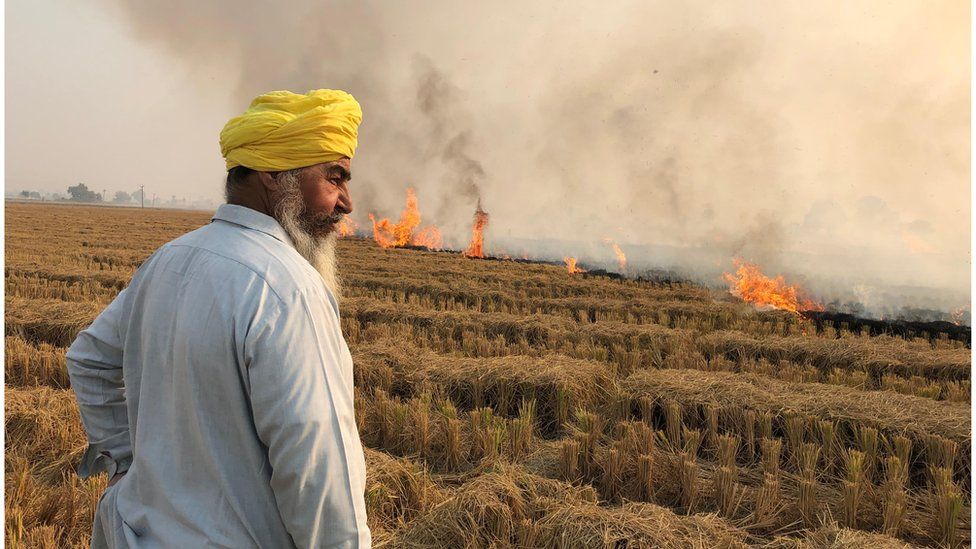
  • Ashok Gulati writes: How subsidies for paddy in Punjab are choking Delhi

    Stubble burning: Why it continues to smother north India - BBC News

    Central idea 

    The Supreme Court addresses urgent concerns over Delhi’s severe air pollution, emphasizing the need to immediately halt stubble burning in neighboring states like Punjab. Stubble burning, contributing nearly 38% to pollution, poses health risks, and the court advocates for swift measures, including economic incentives, to shift farmers away from paddy cultivation.

    Key Highlights:

    • Supreme Court urges adjoining states to curb stubble burning as Delhi’s air quality index breaches 400.
    • Biomass burning, particularly stubble burning, contributes significantly to Delhi’s pollution, posing health risks and potential loss of 11.9 years of life for residents.
    • Urgent action required to control stubble burning in Punjab, which accounts for a major portion of pollution.

    Challenges:

    • Stubble burning persists despite attempts to stop, revealing a breakdown in law and order.
    • Inefficient alternatives and lack of farmer incentives contribute to the continuation of stubble burning.
    • Over-reliance on rice and wheat in the Public Distribution System leads to environmental harm and health issues.

    Key Phrases:

    • Decision Support System for air quality management.
    • Air Quality Life Index report by the University of Chicago’s Energy Policy Institute.
    • Greenhouse gas emissions from paddy cultivation in Punjab.
    • Subsidy on paddy cultivation and its impact on farmers’ choices.

    Analysis:

    • Biomass burning, especially stubble burning, is a major contributor to Delhi’s pollution, overshadowing the impact of transport and construction.
    • The Supreme Court emphasizes the need to cut paddy cultivation in Punjab-Haryana and suggests alternatives to curb stubble burning.
    • Economic incentives and policy changes are crucial to wean farmers away from paddy cultivation and address environmental concerns.

    Key Data:

    • Biomass burning, mainly stubble burning, accounts for 37.85% of Delhi’s pollution.
    • Punjab farmers receive a subsidy of almost Rs 30,000/ha for paddy cultivation.
    • Loss of 11.9 years of life for Delhi residents due to pollution.

    Key Facts:

    • The water table in Sangrur, Punjab, has gone down by 25 meters in the last 20 years.
    • Stubble burning remains a significant challenge despite efforts by officials.

    Key words for mains answer value addition:

    • Stubble burning.
    • Public Distribution System.
    • Decision Support System.
    • Air Quality Life Index.
    • Greenhouse gas emissions.

    Way Forward:

    • Implement strong measures to control stubble burning, making the local Station House Office (SHO) responsible.
    • Incentivize farmers to switch from paddy to pulses, oilseeds, and millets to create a crop-neutral incentive structure.
    • Encourage private sector investment in ethanol plants based on maize to reduce reliance on paddy and lower air pollution from vehicular traffic.
    • Limit paddy procurement by state agencies in areas with fast-depleting water tables and where farmers continue stubble burning.
    • Promote a diversified market by offering nutritious crops through fair price shops, reducing reliance on rice and wheat and minimizing environmental impact.
  • Centre revises Fertilizer Subsidy  

    Fertilizer Subsidy  

    Central Idea

    • The Union Cabinet has announced revisions to the per-kilogram subsidy rates for nitrogen, phosphorus, potassium, and sulphur fertilizers under the nutrient-based regime, distinguishing between the October-March and April-September periods.

    Subsidy Rate Changes

    • Nitrogen (N): The subsidy per kilogram for nitrogen has decreased by 38% between the first half of FY-24 and the October-March period.
    • Phosphorus (P): Phosphorus subsidy has been reduced by 49%.
    • Potassium (K): Subsidy for potassium has seen an 84% reduction.
    • Sulphur (S): Sulphur subsidy has been lowered by 32.5% during the same period.

    Why discuss this?

    • Fertilizer subsidies have been an integral part of India’s agricultural landscape since the Green Revolution of the 1970s-80s.
    • This overview delves into the concept of fertilizer subsidies, their disbursement, and associated challenges.

    Understanding Fertilizer Subsidy

    • Origins: Fertilizer subsidies emerged during the Green Revolution to boost agricultural productivity.
    • Subsidized Pricing: Fertilizer subsidy entails farmers purchasing fertilizers at prices below the Maximum Retail Price (MRP), often lower than market rates.
    • Determining Subsidy Rates: Subsidy rates are influenced by the average price of imported fertilizer over the preceding six months.

    Recipient and Payment of Subsidy

    • Beneficiary: While fertilizer companies receive the subsidy, it ultimately benefits farmers who procure fertilizers at rates lower than market prices.
    • Direct Benefit Transfer (DBT): Since March 2018, the government introduced a DBT system, where subsidy payments to companies occur post-actual sales to farmers via retailers.
    • Retailer’s Role: Each of India’s 2.3 lakh retailers is equipped with a point-of-sale (PoS) machine linked to the Department of Fertilizers’ e-Urvarak DBT portal.
    • Neem-Coated Urea Illustration: Neem-coated urea serves as an example. The government fixes its MRP at Rs. 5,922.22 per tonne, while domestic production costs about Rs. 17,000 per tonne. The variance is covered by the central government through subsidy disbursement.

    Non-Urea Fertilizers

    • Decontrolled Pricing: Non-urea fertilizers have pricing determined by companies rather than government intervention.
    • Two Categories: These non-urea fertilizers are categorized into DAP (Diammonium Phosphate) and MOP (Muriate of Phosphate).
    • Flat Subsidy: The government provides a uniform per-tonne subsidy to maintain soil nutrition levels and ensure the affordability of other fertilizers.

    Challenges Associated with Fertilizer Subsidies

    • Low Nitrogen Use Efficiency (NUE): Indian soil exhibits low NUE, primarily found in Urea, leading to excessive use and groundwater pollution.
    • Groundwater Contamination: Excessive fertilizer application contributes to groundwater contamination.
    • Overuse: Urea applied to the soil results in losses as NH3 (Ammonia) and Nitrogen Oxides, surpassing WHO-prescribed limits, particularly in Punjab, Haryana, and Rajasthan.
    • Health Impacts: Nitrate-contaminated water poses health risks, including “blue baby syndrome” in humans.

    Conclusion

    • Fertilizer subsidies are a crucial aspect of Indian agriculture, aiding farmers by reducing the cost of essential inputs.
    • However, challenges such as overuse, groundwater pollution, and health concerns warrant a comprehensive approach to ensure sustainable and responsible fertilizer usage in the country.
  • Centre raises MSP for Rabi Crops

    Central Idea

    • The Cabinet Committee on Economic Affairs (CCEA) has increased the Minimum Support Prices (MSP) for all Rabi crops for the financial year 2024-25.

    Understanding MSP

    • Policy Framework: MSP is a government policy designed to safeguard farmers’ income. Unlike subsidized grains in the Public Distribution System (PDS), it isn’t an entitlement but a part of administrative decision-making.
    • MSP Commodities: The Centre currently fixes MSPs for 23 agricultural commodities, guided by recommendations from the Commission for Agricultural Costs and Prices (CACP).
    • No Legal Backing: There is currently NO statutory backing for these prices, nor any law mandating their enforcement.

    Fixing MSPs

    • Factors Considered: CACP considers multiple factors when recommending MSP for a commodity, notably the cost of cultivation.
    • Key Determinants: These determinants encompass supply and demand dynamics, domestic and global market prices, parity with other crops, implications for consumers and the environment, and terms of trade between agriculture and non-agriculture sectors.
    • 5 Times Formula: The 2018-19 Budget introduced a “pre-determined principle” where MSPs should be set at 1.5 times the production cost, simplifying CACP’s role to estimating production costs and applying the formula.

    Production Cost Calculation

    • Three Cost Categories: CACP calculates three production cost categories for each crop, at both state and all-India average levels.
    • A2: Encompasses all paid-out costs directly incurred by the farmer, such as seeds, fertilizers, labor, land lease, fuel, and irrigation.
    • A2+FL: Includes A2 and imputes a value for unpaid family labor.
    • C2: A comprehensive cost accounting for rentals and forgone interest on owned land and capital assets in addition to A2+FL.

    Back2Basics:

    Rabi Crops Kharif Crops Zaid Crops
    Growing Season Winter (sown in Oct-Dec) Monsoon (sown in Jun-Jul) Summer (sown in Feb-Apr)
    Harvest Season Spring (harvested in Mar-Apr) Autumn (harvested in Oct-Nov) Early Autumn (harvested in May-Jun)
    Examples Wheat, barley, peas, gram Rice, maize, cotton, soybean Cucumber, watermelon, muskmelon
    Water Requirement Relies mainly on rainfall Relies on monsoon rains Requires irrigation and supplemental water
    Temperature Grows in cooler temperatures Grows in warmer temperatures Grows in hot temperatures
    Crop Rotation Often used in crop rotation Less commonly used in crop rotation Usually not part of crop rotation
  • MSP as a legal right: Pros and Cons

    What’s the news?

    • For years, farmers have been demanding a legal guarantee of the minimum support price (MSP), calculated according to the Swaminathan Commission formula.

    Central idea

    • The significance of MSP lies in its role in maintaining agricultural viability and preventing farmers from falling into debt and bankruptcy. However, the current MSP system falls short of its objectives, leaving most farmers without much-needed support. This op-ed emphasizes the need for a farmer-centric agricultural policy and a radical shift in approach to secure MSP with a legal guarantee.

    Minimum support price (MSP)

    • MSP is the price at which the government procures crops directly from farmers. It is calculated to be at least one-and-a-half times the cost of production incurred by the farmers.
    • The MSP serves as a minimum guaranteed price for specific crops that the government considers remunerative and deserving of support for farmers.

    Agriculture’s Role in the National Economy

    • Employment and Livelihood: Agriculture is the largest source of employment and livelihood for about 50 percent of the country’s population, especially in rural areas. It provides direct and indirect employment for millions of people.
    • Contribution to GDP: Agriculture contributes around 17–18 percent to India’s Gross Domestic Product (GDP). Although the share of agriculture in the overall GDP has been declining over the years due to the growth of other sectors, it remains a crucial component of the economy.
    • Food Security: The agricultural sector plays a critical role in ensuring food security for the nation. By producing a variety of food crops like rice, wheat, pulses, fruits, and vegetables, it caters to the dietary needs of the population and helps manage food inflation.
    • Source of Raw Materials: Agriculture is the primary source of raw materials for various industries, including textiles, sugar, jute, and vegetable oil. It provides the necessary inputs for industrial production, contributing to the overall industrial growth of the country.
    • Export Earnings: Agricultural exports, such as rice, spices, tea, coffee, and cotton, generate foreign exchange earnings for the country. This helps improve the balance of trade and supports economic growth.
    • Rural Development: The growth of agriculture has a significant impact on rural development. It improves rural infrastructure, raises the standard of living, and creates opportunities for the development of allied industries and services in rural areas.
    • Poverty Alleviation: Agriculture remains an essential tool in poverty alleviation as it provides income and employment opportunities to the rural population, which is often more susceptible to poverty.

    Important role of MSP

    • Ensuring Income Security: MSP provides a minimum guaranteed price for farmers’ produce. It protects them from price fluctuations and market risks, ensuring a stable income for their efforts and investment in farming.
    • Preventing Distress Sales: With MSP in place, farmers are less likely to resort to distress sales of their crops during times of market downturns.
    • Encouraging Crop Diversification: The MSP system covers a range of crops, including cereals, pulses, oil seeds, and more. By providing a remunerative price for diverse crops, it encourages farmers to adopt crop diversification, contributing to agricultural sustainability and food security.
    • Government Procurement: MSP sets a benchmark for government procurement of crops. The government procures crops at MSP through various agencies like FCI and state agencies, thereby supporting farmers and maintaining buffer stocks for food distribution.
    • Addressing Regional Imbalances: MSP implementation considers regional variations in production costs and helps bridge the income gap between farmers in different regions. It addresses regional imbalances and ensures equitable growth in the agriculture sector.

    Inadequacies of the MSP

    • Limited Coverage: The current MSP system leaves the majority of farmers without much-needed support. Only around 6% of farmers in the country benefit from MSP, while the remaining face challenges in accessing remunerative prices for their produce.
    • Debt and Bankruptcy: Despite MSP being introduced as a safety net, farmers still struggle with debt and bankruptcy. The average debt burden on a farmer’s family is over Rs 1 lakh, despite the subsidies provided by the government.
    • Natural Disasters and Market Risks: Farmers remain vulnerable to natural disasters and market forces, making their income uncertain and apprehensive. Climate change adds complexity to farming, and farmers cannot be left at the mercy of such unpredictable factors.
    • Insufficient Market Regulation: Middlemen exploit farmers, leading to a significant difference between the price at which farmers sell their produce and the price at which consumers buy the same produce. This lack of market regulation affects farmers’ income adversely.
    • Inadequate MSP Calculation: The MSP calculation method may not fully reflect the input costs, market trends, and other economic factors, leading to an ineffective MSP for farmers.
    • Rising Debt: The outstanding loan on farmers has increased significantly over the years, indicating the insufficiency of MSP and minimal increases in support prices.

    Swaminathan Commission Recommendations

    • Calculation of MSP: The Swaminathan Commission recommended that MSP be calculated by adding 50 percent profit to the C2 cost (comprehensive cost including imputed value of family labor) for crops. This method takes into account various input costs incurred by farmers, including labor, seeds, fertilizers, and other expenses.
    • Expanded Coverage: The Commission suggested expanding the scope of MSP to cover a wide range of agricultural produce, including crops like ginger, garlic, turmeric, chili, and all agricultural produce and horticulture.

    The Call for a Legal Guarantee of MSP

    • Addressing Rising Debts: The outstanding loan to farmers has significantly increased over the years, reaching Rs 23.44 lakh crore in 2021–22. Legalizing MSP would offer a sustainable solution, reducing farmers’ dependence on debt.
    • Fulfilling Promises: A legal guarantee makes MSP a binding obligation, ensuring farmers receive the promised prices for their crops and avoiding selling at lower rates.
    • Empowering Farmers: Legalized MSP enhances farmers’ bargaining power and enables informed decisions in cropping and marketing.
    • Supporting Sustainable Agriculture: MSP legislation promotes sustainable agriculture, diversification, and resilience against climate change.
    • Promoting Farmer-Centric Policy: A Legal Guarantee of MSP emphasizes a farmer-centric approach, safeguarding their rights, interests, and livelihoods.

    Way forward

    • Reforming Agribusiness and Ensuring Fair Compensation:
      1. Promote farmer producer organizations (FPO’s) and cooperatives.
      2. Facilitate direct market access to reduce dependence on intermediaries.
    • Adhering to the Swaminathan Commission’s Guidelines:
      1. Follow the MSP calculation as per the Swaminathan Commission’s recommendations.
      2. Consider comprehensive costs, including labor and input expenses.
    • Promoting Sustainable Agriculture Practices:
      1. Encourage the adoption of sustainable farming practices and climate-resilient crop varieties.
      2. Invest in agricultural research and extension services for modern technologies.
    • Ensuring Access to Credit and Insurance:
      1. Strengthen credit facilities for farmers.
      2. Provide insurance coverage to manage risks effectively.
    • Investing in Rural Infrastructure:
      1. Improve irrigation facilities, storage, and transportation networks.
      2. Reduce post-harvest losses and improve market access.
    • Promoting Agro-tourism and Direct Marketing:
      1. Encourage agro-tourism for additional income.
      2. Establish farmers’ markets and e-commerce platforms for direct marketing.

    Conclusion

    • The demand for a legal guarantee of MSP is a just and crucial step towards safeguarding the livelihoods of farmers. Providing farmers with a dignified life is not just a moral obligation but an economic imperative, as the growth of the agricultural sector directly impacts the nation’s prosperity.
  • Centre hikes Kharif crop Minimum Support Price (MSPs)

    The Centre has set the Minimum Support Price (MSP) for 17 kharif crops and variants.

    What is MSP?

    • The MSP assures the farmers of a fixed price for their crops, well above their production costs.
    • MSP, by contrast, is devoid of any legal backing. Access to it, unlike subsidized grains through the PDS, isn’t an entitlement for farmers.
    • They cannot demand it as a matter of right. It is only a government policy that is part of administrative decision-making.
    • The Centre currently fixes MSPs for 23 farm commodities based on the Commission for Agricultural Costs and Prices (CACP) recommendations.

    Fixing of MSPs

    • The CACP considered various factors while recommending the MSP for a commodity, including the cost of cultivation.
    • It also takes into account the supply and demand situation for the commodity; market price trends (domestic and global) and parity vis-à-vis other crops; and implications for consumers (inflation), environment (soil and water use) and terms of trade between agriculture and non-agriculture sectors.

    What changed with the 2018 budget?

    • The Budget for 2018-19 announced that MSPs would henceforth be fixed at 1.5 times of the production costs for crops as a “pre-determined principle”.
    • Simply put, the CACP’s job now was only to estimate production costs for a season and recommend the MSPs by applying the 1.5-times formula.

    How was this production cost arrived at?

    • The CACP projects three kinds of production cost for every crop, both at the state and all-India average levels.
    • ‘A2’ covers all paid-out costs directly incurred by the farmer — in cash and kind — on seeds, fertilizers, pesticides, hired labor, leased-in land, fuel, irrigation, etc.
    • ‘A2+FL’ includes A2 plus an imputed value of unpaid family labor.
    • ‘C2’ is a more comprehensive cost that factors in rentals and interest forgone on owned land and fixed capital assets, on top of A2+FL.

    How much produce can the government procure at MSP?

    • The MSP value of the total production of the 23 crops worked out to around Rs 10.78 lakh crore in 2019-20.
    • Not all this produce, however, is marketed. Farmers retain part of it for self-consumption, the seed for the next season’s sowing, and also for feeding their animals.
    • The marketed surplus ratio for different crops is estimated to range differently for various crops.
    • It ranges from below 50% for ragi and 65-70% for bajra (pearl millet) and jawar (sorghum) to 75% for wheat, 80% for paddy, 85% for sugarcane, 90% for most pulses, and 95%-plus for cotton, soybean, etc.
    • Taking an average of 75% would yield a number of just over Rs 8 lakh crore.
    • This is the MSP value of production that is the marketable surplus — which farmers actually sell.

    Nature of MSP

    • There is currently no statutory backing for these prices, nor any law mandating their enforcement.

    Farmers demand over legalization

    • Legal entitlement: There is a demand that MSP based on a C2+50% formula should be made a legal entitlement for all agricultural produce.
    • Private traders’ responsibility: Some says that most of the cost should be borne by private traders, noting that both middlemen and corporate giants are buying commodities at low rates from farmers.
    • Mandatory purchase at MSP: A left-affiliated farm union has suggested a law that simply stipulates that no one — neither the Government nor private players — will be allowed to buy at a rate lower than MSP.
    • Surplus payment by the govt.: Other unions have said that if private buyers fail to purchase their crops, the Government must be prepared to buy out the entire surplus at MSP rates.
    • Expansion of C2: Farm unions are demanding that C2 must also include capital assets and the rentals and interest forgone on owned land as recommended by the National Commission for Farmers.
  • [pib] Price Support Scheme (PSS)

    Central Idea

    • Procurement Ceilings for Pulses: The government has removed the procurement ceilings of 40% for tur, urad, and masur under the Price Support Scheme (PSS) operations for 2023-24.

    What is Price Support Scheme (PSS)?

    • Physical procurement: The Price Support Scheme (PSS) involves the physical procurement of pulses, oilseeds, and copra by Central Nodal Agencies.
    • Nodal Agencies: The National Agricultural Cooperative Marketing Federation of India (NAFED) and the Food Corporation of India (FCI) are the designated agencies responsible for procuring crops under the PSS.
    • Implementation: The scheme is implemented in collaboration with state governments, who exempt the procured commodities from mandi tax and provide logistical support, including gunny bags and working capital.

    Need for such scheme

    • Balancing farmer and consumer interests: The PSS strikes a balance between the welfare of farmers and consumers, ensuring fair returns for farmers and affordable prices for consumers.
    • Remunerative prices: The primary objectives of the PSS are to provide remunerative prices to farmers, encouraging increased investment and production, while ensuring affordable prices and availability for consumers.
    • Encouraging production: By offering a guaranteed price, the PSS incentivizes farmers to invest in agricultural production, leading to increased output and self-sufficiency.
    • Consumer welfare: The scheme aims to protect the interests of consumers by ensuring a stable supply of essential commodities at reasonable prices, reducing intermediation costs.
    • Market intervention: The PSS acts as a market intervention measure, stabilizing prices, and mitigating the risks faced by farmers due to market fluctuations and unforeseen circumstances.
    • Support for agricultural growth: The scheme is part of the government’s broader efforts to support agricultural growth, enhance farmer income, and promote food security in the country.

    Why in news?

    • Notified Essential commodities: On June 2, 2023, the government imposed stock limits on tur and urad by invoking the Essential Commodities Act, 1955.
    • Prevent hoarding: The imposition aims to prevent hoarding and unscrupulous speculation, as well as improve affordability for consumers.
    • Applicability and declaration: Stock limits are applicable to wholesalers, retailers, big chain retailers, millers, and importers, who are required to declare their stock position on the portal of the Department of Consumer Affairs.

    Enforcement of Stock Limits by State Governments:

    • Directives to state governments: The Department of Consumer Affairs has directed state governments to ensure strict enforcement of the stock limits in their respective states.
    • Monitoring and verification: States have been asked to monitor prices and verify the stock position by coordinating with various warehouse operators.
    • Cooperation from warehousing corporations: Central Warehousing Corporation (CWC) and State Warehousing Corporations (SWCs) have been requested to provide details of tur and urad stocks held in their warehouses.
  • MSP: Must be Effective

    msp

    Context

    • The CACP recommendations on Minimum Support Prices (MSP) for the mandated six Rabi crops wheat, barley, gram, lentil, rapeseed and mustard, and safflower are arrived by considering several factors.

    What is MSP?

    • MSP is a part of India’s Agriculture Price Policy. The MSP for various crops is announced by the central government at the beginning of every crop season on the recommendation of CACP.
    • MSP is price at which the government purchases crops from the farmers. It is the guaranteed ‘minimum floor price’ that farmer must get from the government in case the market price of the crops falls below the MSP.
    • The Rationale behind MSP is to support the farmer from excess fall in the crop prices, it is like an insurance policy for the farmers to save them from price falls.
    • The most important aim of the MSP policy is to save the Indian farmer from making distress sales. In the event of glut and bumper harvest, when market prices fall below the announced MSP, the government through its agencies buys the entire stock offered by the farmers at the MSP.

    What are the factors included in MSP calculation?

    • Factors taken into consideration are as follows:
    1. Cost of production,
    2. Supply and demand situation of various crops in domestic and global markets,
    3. Domestic and world prices along with trade opportunities,
    4. Terms of trade between agriculture and non-agriculture sector,
    5. Optimal utilization of land, water and other production resources,
    6. A minimum of 50 per cent mark-up over the cost of production.

    msp

    Why the relook at MSP calculation is necessary?

    • Though on the surface the list looks comprehensive, there are two missing concerns given the present-day challenges, necessitating a change in the MSP formula.
    1. Acreage
    2. Water usage
    • Rising MSP leads to water conflict: There is ample data-based evidence to show the causal relation between acreage and MSP movements. Rising MSPs of water-intensive crops has resulted in some of the water conflicts over river basins as shown by recent studies in the Cauvery and the Teesta River basins.
    • MSP for rice and wheat: This is also because MSP for rice and wheat, where government agencies like Food Corporation of India play a role in procurement, has created a reference for market prices. Ever since the MSP was introduced in the late 1970s, it became the “floor” price-setter for rice and wheat.
    • Higher MSP for water consuming cereals: Between 1980 and 2000, the MSPs of rice and wheat increased at a much faster rate than those of the “coarse” cereals (like jowar, bajra and ragi) which eventually led to movement of the terms-of-trade (defined as ratio of prices of competing crops, e.g., rice and millets) in Favour of the water-consuming cereals.
    • Shifting of High acreage to High MSP crop: This led to acreages moving largely in Favour of water consuming staples, whose crop-water requirements are many times of that of the drier millets. In the case of Cauvery and Teesta, the introduction of dry season paddy and its expansion created reliance on irrigation thereby Fuelling demand for water.
    • Non promotion of rabi millets: Though the MSP formula claims to take into account land and water use, it needs to be noted here that there is a need for Rabi millets (e.g., ragi) to be promoted through MSPs. This is because the millets are less water-consuming as compared to many other alternatives including wheat. However, there does not seem to be any MSP announced for Rabi millets.
    • Higher MSP for less water consuming crop is needed: In the process, it will be crucial to take into consideration the estimates of irrigation water need for specific crops, redefine the Rabi basket by including millets, and declare a higher MSP for less water-consuming crops vis-à-vis the high-water consuming crops.

    msp

    Nutritional security in MSP calculation

    • Nutritional security is not included in MSP calculation: The other consideration that is missing from the MSP formula is the consideration of the nutritional security. Ideally, the MSP regime should remunerate those crops that have a higher nutritional value per unit of resource use.
    • Rabi crops are more water efficient: Ragi is the most efficient water user in producing calories. Bajra followed by wheat and ragi are the better performers in terms of water efficiency in producing iron. For the case of fiber, ragi is the most water efficient crop followed by barley and maize demonstrating the same water efficiency.
    • Rabi crops are nutrition rich: Maize is the most efficient water user in producing carbohydrates with ragi being second and wheat third. With reference to fat production, bajra takes the first position followed by ragi and wheat. Ragi is the best performer in the case of calcium production. Wheat and ragi do equally well with phosphorus production per unit of water at the margin.
    • Missing MSP estimate: However, so far, the MSP formula has not taken into consideration the health and the nutritional aspect. Irrespective of the season, the nutritional aspect needs to be figured into the MSP recommendations, and more nutritional crops should command higher support prices.

    Conclusion

    • Present MSP regime is biased in Favor of rice and wheat. MSP can be utilized as great tool to achieve crop diversification by incentivizing cultivation of water efficient and nutrition rich millets. India can achieve the regional as well as financial balance in distribution of MSP by proper estimation of MSP and promotion accordingly.

    Mains Question

    How is MSP calculated? Analyse the linkages of MSP and water conflict and suggest the solution to overcome the water inefficiency by MSP.

    UPSC 2023 countdown has begun! Get your personal guidance plan now! (Click here)


  • About 41.5 crore Indians out of multi-dimensional poverty since 2005-06

    poverty

    About 41.5 crore people exited poverty in India during the 15-year period between 2005-06 and 2019-21, out of which two-thirds exited in the first 10 years, and one-third in the next five years, according to the global Multidimensional Poverty Index (MPI).

    What is global MPI?

    • The global Multidimensional Poverty Index (MPI) is an international measure of acute poverty covering over 100 developing countries.
    • It complements traditional income-based poverty measures by capturing the severe deprivations that each person faces at the same time with respect to education, health and living standards.
    • The global MPI was developed by OPHI with the UN Development Programme (UNDP) for inclusion in UNDP’s flagship Human Development Report in 2010.
    • It has been published in the HDR ever since.

    poverty

    Multidimensional poverty in India: Major improvements

    poverty

    • The report shows that the incidence of poverty fell from 55.1% in 2005-06 to 16.4% in 2019-21 in India.
    • Deprivations in all 10 MPI indicators saw significant reductions as a result of which the MPI value and incidence of poverty more than halved.
    • Improvement in MPI for India has significantly contributed to the decline in poverty in South Asia.
    • It is for the first time that it is not the region with the highest number of poor people, at 38.5 crore, compared with 57.9 crore in Sub-Saharan Africa.
    • Bihar, the poorest State in 2015-2016, saw the fastest reduction in MPI value in absolute terms.

    Long way towards alleviation

    • Despite the strides made, the report notes that the ongoing task of ending poverty remains daunting.
    • India has by far the largest number of poor people worldwide at 22.8 crore, followed by Nigeria at 9.6 crore.
    • Two-third of these people live in a household in which at least one person is deprived in nutrition.
    • There were also 9.7 crore poor children in India in 2019-2021 — more than the total number of poor people, children and adults combined, in any other country covered by the global MPI.

    Why multi-dimensional poverty does persist in India?

    Poverty is not just the absence of income, money and/or money-like resources required to meet needs.

    • Multiple disadvantages: A person who is poor can suffer multiple disadvantages at the same time – for example they may simultaneously have:
    1. Poor health or malnutrition
    2. Lack of clean water or electricity
    3. Poor quality of livelihood options
    4. Little/No schooling
    5. Disempowerment
    6. Threats of violence
    7. Climate change vulnerability etc.

    Other factors include:

    1. Limited financial resources
    2. Material deprivation
    3. Social isolation
    4. Exclusion and powerlessness
    5. Physical and psychological ill-being
    • Multiple dimensions: Focusing on one factor alone, such as income, is not enough to capture the true reality of poverty. National MPI ensures a holistic approach towards defining poverty at the national level.
    • More comprehensive: MP measures can be used to create a more comprehensive picture. They reveal who is poor and how they are poor – the range of different disadvantages they experience.
    • Better targeting: As well as providing a headline measure of poverty, multidimensional measures can be broken down to reveal the poverty level in different areas of a country and among different sub-groups of people.
    • Priority definition for target groups: It offers statistics that determine the national priorities by using a set of dimensions, indicators with respect to the urban and rural areas of India along with an indicator-wise deconstruction and breakdown.

    Various govt. interventions to for poverty alleviation

    (I) Food Security

    • National Food Security Act 2013 (also ‘Right to Food Act’): It aims to provide subsidized food grains to approximately two thirds of the country’s 1.2 billion people.

    (II) Employment and Skilling

    • National Rural Livelihood Mission (NRLM)Ministry of Rural Development started NRLM 2011 to evolve out the need to diversify the needs of the rural poor and provide them jobs with regular income on a monthly basis.
    • Mahatma Gandhi National Rural Employment Guarantee Act (MGNREGA) – In 2005 Ministry of Rural Development initiated MGNEREGA to provide 100 days of assured employment every year to every rural household. One-third of the proposed jobs would be reserved for women.

    (III) Income Support

    • PM Jan Dhan Yojana (PMJDY): The Ministry of Finance in 2014 initiated PMJDY that aimed at direct benefit transfer of subsidy, pension, insurance, etc., and attained the target of opening 1.5 crore bank accounts. The scheme particularly targets the unbanked poor.
    • PM Kisan Samman Nidhi (PM KISAN): PM KISAN is an initiative by the government of India in which all farmers will get up to ₹6,000 per year as minimum income support.

    Various challenges

    • Pauperization: Every year a huge number is added to the population pool of the country. To exemplify, this pandemic has led to severe pauperization of migrant workers.
    • Regional divide: Incidence of extreme poverty continues to be much higher in rural areas than in urban areas.
    • Jobless growth: Despite rapid growth and development, an unacceptably high proportion of our population continues to suffer from severe and multidimensional deprivation.
    • Inadequate resources: The resources allocated to anti-poverty programmes are inadequate and there is a tacit understanding that targets will be curtailed according to fund availability.
    • Implementation bottlenecks: Lack of proper implementation and right targeting has been legacy issues in India. There has been a lot of overlapping of schemes.


    UPSC 2023 countdown has begun! Get your personal guidance plan now! (Click here)

  • What is the PM PRANAM Scheme?

    In order to reduce the use of chemical fertilisers by incentivising states, the Union government plans to introduce a new scheme – PM PRANAM, which stands for PM Promotion of Alternate Nutrients for Agriculture Management Yojana.

    What is the PM PRANAM scheme?

    • The proposed scheme intends to reduce the subsidy burden on chemical fertilisers.
    • This burden if uneased, is expected to increase to Rs 2.25 lakh crore in 2022-2023, which is 39% higher than the previous year’s figure of Rs 1.62 lakh crore.
    • The scheme will not have a separate budget and will be financed by the “savings of existing fertiliser subsidy” under schemes run by the Department of fertilisers.

    Subsidies under the PRANAM

    • Further, 50% subsidy savings will be passed on as a grant to the state that saves the money and that 70% of the grant provided under the scheme can be used for asset creation related to technological adoption of alternate fertilisers.
    • It would create alternate fertiliser production units at village, block and district levels.
    • The remaining 30% grant money can be used for incentivising farmers, panchayats, farmer producer organisations and self-help groups that are involved in the reduction of fertiliser use and awareness generation.
    • The government will compare a state’s increase or reduction in urea in a year, to its average consumption of urea during the last three years.

    How much fertiliser does India require?

    • The kharif season (June-October) is critical for India’s food security, accounting for nearly half the year’s production of foodgrains, one-third of pulses and approximately two-thirds of oilseeds.
    • A sizable amount of fertiliser is required for this season.
    • The Department of Agriculture and Farmers Welfare assesses the requirement of fertilisers each year before the start of the cropping season, and informs the Ministry of Chemical and fertilisers to ensure the supply.
    • The amount of fertiliser required varies each month according to demand, which is based on the time of crop sowing, which also varies from region to region.
    • For example, the demand for urea peaks during June-August period, but is relatively low in March and April, and the government uses these two months to prepare for an adequate amount of fertiliser for the kharif season.

    Why is the scheme being introduced?

    • Due to increased demand for fertiliser in the country over the past 5 years, the overall expenditure by the government on subsidy has also increased.
    • The final figure of fertiliser subsidy touched Rs 1.62 lakh crore in 2021-22.
    • The total requirement of four fertilisers — Urea, DAP (Di-ammonium Phosphate), MOP (Muriate of potash), NPKS (Nitrogen, Phosphorus and Potassium) — increased by 21% between 2017-2018 and 2021-2022, from 528.86 lakh metric tonnes (LMT) to 640.27 LMT.
    • PM PRANAM, which seeks to reduce the use of chemical fertiliser, will likely reduce the burden on the exchequer.
    • The proposed scheme is also in line with the government’s focus on promoting the balanced use of fertilisers or alternative fertilisers in the last few years.

    Try this PYQ:

    Q.What are the advantages of fertigation in agriculture? (CSP 2020)

    1.Controlling the alkalinity of irrigation water is possible.
    2.Efficient application of Rock Phosphate and all other phosphatic fertilizers is possible.
    3.Increased availability of nutrients to plants is possible.
    4.Reduction in the leaching of chemical nutrients is possible.

    Select the correct answer using the code given below:
    (a) 1, 2 and 3 only

    (b) 1,2 and 4 only

    (c) 1,3 and 4 only

    (d) 2, 3 and 4 only


    [wpdiscuz-feedback id=”5sbme0lwks” question=”Please leave a feedback on this” opened=”1″]Post your answers here.[/wpdiscuz-feedback]


    UPSC 2023 countdown has begun! Get your personal guidance plan now! (Click here)