💥Join UPSC 2027,2028 Mentorship (July Batch) + XFactor Notes & Microthemes PDF

GS Paper: GS1

  • [pib] National List of Intangible Cultural Heritage (ICH)

    The Union Ministry for Culture has launched the National List of Intangible Cultural Heritage (ICH) of India.

    Various art forms (either tangible or intangible) are hotspots for Prelims. We can expect a direct description based question. For example, a question based on Manipuri Sankirtana was asked in CSP 2017.

    National List of ICH

    Following UNESCO’s 2003 Convention for Safeguarding of Intangible Cultural Heritage, this list has been classified into five broad domains in which intangible cultural heritage is manifested:

    • Oral traditions and expressions, including language as a vehicle of the intangible cultural heritage
    • Performing arts
    • Social practices, rituals and festive events
    • Knowledge and practices concerning nature and the universe
    • Traditional craftsmanship

    Why need such a list?

    • India houses a repository of unique ICH traditions, 13 of which have also been recognized by UNESCO as Intangible Cultural Heritage of Humanity.
    • The National ICH List is an attempt to recognize the diversity of Indian culture embedded in its intangible heritage.
    • The list aims to raise awareness about the various intangible cultural heritage elements from different states of India at the national and international level and ensure their protection.
    • This initiative is also a part of the Vision 2024 of the Ministry of Culture.

    Pls go through this link for complete details of  13 ICH : https://www.indiaculture.nic.in/national-list-intangible-cultural-heritage-ich

  • Matterhorn Mountain of the Swiss Alps

    Switzerland has expressed solidarity with India in its fight against the coronavirus pandemic by projecting the tricolour on the famous Matterhorn Mountain in the Swiss Alps.

    It has been long time since a question on global mountains/mountain ranges has not been asked in the prelims. Gear up for the uncertainty. Make a special sheet of geographical locations in news.

    Mt. Matterhorn

    • The Matterhorn is a mountain of the Alps, separating the main watershed and border between Switzerland and Italy.
    • It is a large, near-symmetric pyramidal peak in the extended Monte Rosa area of the Pennine Alps, whose summit is 4,478 metres.
    • It is one of the highest summits in the Alps and Europe (Mont Blanc being highest).
    • The four steep faces, rising above the surrounding glaciers, face the four compass points and are split by the Hörnli, Furggen, Leone/Lion, and Zmutt ridges.

    Its formation

    • The Matterhorn is mainly composed of gneisses originally fragments of the African Plate before the Alpine orogeny.
    • The mountain’s current shape is the result of cirque erosion due to multiple glaciers diverging from the peak, such as the Matterhorn Glacier at the base of the north face.

    Back2Basics: Alps mountain range

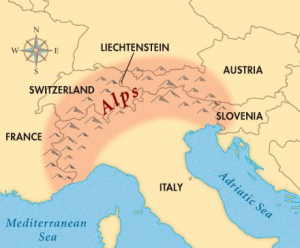
    • The Alps are the highest and most extensive mountain range system that lies entirely in Europe.
    • It stretches approximately 1,200 kilometres across eight Alpine countries (from west to east): France, Switzerland, Monaco, Italy, Liechtenstein, Austria, Germany, and Slovenia.
    • The mountains were formed over tens of millions of years as the African and Eurasian tectonic plates collided.
    • Extreme shortening caused by the event resulted in marine sedimentary rocks rising by thrusting and folding into high mountain peaks such as Mont Blanc and the Matterhorn.
    • Mont Blanc spans the French–Italian border, and at 4,809 m (15,778 ft) is the highest mountain in the Alps.
  • Ambedkar and the Poona Pact

    Yesterday was the birth anniversary of Dr B.R. Ambedkar, the chief architect of our constitution. On that occasion, author of the news (originally published in TH) highlights the significance of Poona Pact in the formation of our Constitution.

    The Poona Pact of 1932 is a landmark event in India’s struggle for independence. It marked the start of social justice movement in the country under the leadership of Dr. Ambedkar.

    What is Poona Pact?

    • In late September 1932, B.R. Ambedkar negotiated the Poona Pact with Mahatma Gandhi.
    • The background to the Poona Pact was the Communal Award of August 1932, which, among other things, reserved 71 seats in the central legislature for the depressed classes.
    • The Award was made by then British PM Ramsay MacDonald on 16 August 1932 to extended separate electorate.
    • It aimed to grant separate electorates in British India for the Forward Caste, Lower Caste, Muslims, Buddhists, Sikhs, Indian Christians, Anglo-Indians, Europeans and then Untouchables.
    • Gandhi, who was opposed to the Communal Award, saw it as a British attempt to split Hindus, and began a fast unto death to have it repealed.

    How Poona Pact defeated the Communal Award?

    • Reserved seats: In a settlement negotiated with Gandhi, Ambedkar agreed for depressed class candidates to be elected by a joint electorate.
    • More representation: On his insistence, slightly over twice as many seats (147) were reserved for the depressed classes in the legislature than what had been allotted under the Communal Award.
    • Doors opened for Public Services: In addition, the Poona Pact assured a fair representation of the depressed classes in the public services while earmarking a portion of the educational grant for their uplift.
    • Social acceptance: The Poona Pact was an emphatic acceptance by upper-class Hindus that the depressed classes constituted the most discriminated sections of Hindu society.
    • Increased political say: It was also conceded that something concrete had to be done to give them a political voice as well as a leg-up to lift them from backwardness they could not otherwise overcome.

    Significance of the pact

    • The concessions agreed to in the Poona Pact were precursors to the world’s largest affirmative programme launched much later in independent India.
    • It would also not have been lost on him that Muhammad Ali Jinnah, with the separatist tendencies strongly backing him, was watching and waiting to take advantage of the evolving situation.
    • A slew of measures was initiated later to uplift Scheduled Castes and Scheduled Tribes.

    Major outcomes

    • The Poona Pact emphatically sealed Ambedkar’s leadership of the depressed classes across India.
    • He made the entire country, and not just the Congress Party, morally responsible for the uplift of the depressed classes.
    • Most of all he succeeded in making the depressed classes a formidable political force for the first time in history.
  • Using knowledge-era technology to bridge the urban-rural gap

    This article puts forward the idea of using knowledge-era technology to minimise the difference between rural and urban areas. In the first part, it elaborates the reasons and circumstances that led to the neglect of rural areas and development in urban areas. In the next part, the idea of using knowledge-era technologies to close the gaps between rural and urban areas is explored.

    Why Urbanisation is spreading and how it led to the neglect of rural areas?

    • Better opportunities: The tendency to migrate to urban areas has been a natural consequence of better opportunities that got created there — in contrast to life in rural areas becoming increasingly unsustainable.
    • Centralisation: The industrial-era dynamics that led to centralisation in support of mass production or massive scale-up was clearly a major one.
    • This, in turn, also led to the concentration of higher education/capacity building processes to urban centres where there was job growth, quite to the detriment of the much larger rural area.
    • Problems in education and training: The education and training environment became myopic, essentially meeting the manning requirements to run systems created by others.
    • Our education with its inherent problems led to little confidence in creating one’s own systems to address needs independent of others.
    • Demographic dividend: India’s importance grew primarily because of her demographic dividend and the large market that her people constituted and not because of the systems and technologies.
    • Neglect of rural India: Rural India suffered severe neglect in the process, probably as a result of poor job opportunities there and education having lost its role as an enabler of local development.
    • However, the country is learning to create systems and technologies to address her needs. The exercise is, by and large, urban-centric.

    UPSC asked about the quality of urban life in 2014, and the trends of labour migration in 2015. This article touched upon both of these themes.

    Using the knowledge-era technology to close the urban-rural gap

    • We are now in the knowledge era.
    • And knowledge-era technologies, in contrast to industrial-era technologies, promote democratisation (social media, for example) and facilitate decentralisation (work from home).
    • It should thus be possible for an adequately educated and trained youth residing in a rural domain to support a significant part of the manufacturing and service needs of urban areas.
    • Just as an urban youth can support a significant part of the knowledge and application needs in rural areas.
    • With technologies like additive manufacture, internet of things, and artificial intelligence, well-trained people can address needs in both urban and rural areas from wherever they are.
    • Thus, the knowledge era should, in principle, become a significant income leveller between the urban and rural domains, with a large rise in the overall national income.
    • As we focus on capacity building of rural youth, the opportunities in rural areas should, in principle, become higher than those in urban areas since the rural segment can now benefit from all three sectors of the economy- agriculture, manufacturing and services.

    The idea of “cillage”

    • In the knowledge era, with emphasis on capability and capacity building of rural youth in terms of holistic education, appropriate technology and enhanced livelihood, there is a possibility for a more balanced distribution of income as well as population.
    • This would, however, need knowledge bridges to be built between cities and villages, and the creation of an ecosystem which has been conceptualised as a “cillage” — a synergistic combination of city and village.
    • Bridging the knowledge gap between a city and a village would also bridge the income gap between the two.
    • This will also lead to a faster bridging of the gap between the average individual income in India and that in industrially advanced countries.
    • Democratisation promoted by knowledge technologies, if properly leveraged, can in principle reduce disparities, which, unfortunately, are on the rise today.

    How to realise the idea of cillage?

    • Integrated and holistic approach: Developing a “cillage” ecosystem would need a rooted and integrated approach to holistic education and research, technology development and management, as well as technology-enabled rural livelihood enhancement.
    • It would take a while for the rural youth to become empowered enough to convert the challenges into opportunities in rural areas.
    • The emergence of a new-age society is an inevitability.
    • How soon the rural domain can embrace it and how concurrently, comprehensively that can happen, is the real challenge.
    • That will decide whether India will gain in the knowledge era or lag as it did in the industrial era.

    Look at one more question from 2015-“Smart cities in India cannot sustain without smart villages. Discuss this statement in the backdrop of rural-urban integration”.  The ideas discussed here in this article help us to deal with such questions.

    Can Covid-19 speed up the realisation of cillage?

    • The process could also be seen as the migration of a set of experiences and skills to villages.
    • We can look at this as a potential two-way bridge for a new relationship between cities and villages.
    • It will be the bridge in which not all need to return to cities, but can rather meet the needs of cities as well as villages by remaining in villages.
    • Several initiatives will be needed to realise such a possibility.
    • Facilitating a number of new skills, technologies and support systems that can further leverage current capabilities of these people for starting a new enterprise would be important.
    • Immediate arrangements to facilitate their livelihood, and leveraging their present capabilities could help retain at least some of these people in villages.
    • It could trigger a faster movement towards an inevitable long-term equilibrium.
    • Going forward, we should take knowledge activities to a higher level so that the products and services created by these people become more competitive.
    • Looking at disruptive technologies for exploiting local opportunities should follow.

    Conclusion

    Given that the new normal after Covid-19 would, in any case, be quite different, the right course would be to channelise the stimulus caused by this crisis towards accelerating the shift to a new normal. This will not only help a more dispersed population, but will also reduce disparities and lead to faster growth of the economy.

  • Who are the Nihangs?

    The Patiala incident in which a group of Nihangs attacked a Punjab police officer has put the spotlight on the Nihangs.

    This newscard focuses on Nihang cult of Sikhism. Though in news for a different purpose, it is significant for prelims.

    Who is a Nihang?

    • Nihang is an order of Sikh warriors, characterized by blue robes, antiquated arms such as swords and spears, and decorated turbans surmounted by steel quoits.
    • Etymologically the word Nihang stems more from the Sanskrit word nihshank which means without fear, unblemished, pure, carefree and indifferent to worldly gains and comfort.
    • The word Nihang also occurs in a hymn in the Guru Granth Sahib, where it alludes to a fearless and unrestrained person.

    When was the order formed?

    • Formation of Nihang order can be traced back to the creation of the Khalsa by Guru Gobind Singh in 1699.

    How were Nihangs different from other Sikhs, and other Sikh warriors?

    • As per an account by the East India Company’s Colonel James Skinner (1778-1841), Khalsa Sikhs were divided into two groups.
    • Those who put on blue attire which Guru Gobind Singh used to wear at the time of battle and those who do not follow any restrictions on the colour of their dress.
    • Both of them follow the profession of soldiery and are brave without peer in the art of musketry and chakarbazi, and the use of quoits.
    • Nihangs observe the Khalsa code of conduct in its strictest sense.
    • They do not profess any allegiance to an earthly master. Instead of saffron they hoist a blue Nishan Sahib (flag) atop their shrines.

    What is their role in history?

    • Nihangs had a major role in defending the Sikh panth after the fall of the first Sikh rule (1710-15) when Mughal governors were killing Sikhs, and during the onslaught of Afghan invader Ahmed Shah Durrani (1748-65).
    • Nihangs also took control of the religious affairs of the Sikhs at Akal Takht in Amritsar.
    • They did not consider themselves subordinate to any Sikh chief and thus maintained their independent existence.
    • At Akal Takht, they held the grand council (Sarbat Khalsa) of Sikhs and pronounced the resolution (Gurmata) passed.
    • During Operation Bluestar in June 1984, some Nihangs, namely Ajit Singh Poohla, collaborated with the Punjab police to eliminate militants.
  • Meru Jatra Festival

    Odisha’s Ganjam district administration has banned the Meru Jatra festival and congregations related to it at temples on the occasion of Mahavishub Sankranti.

    Festive fairs in India are known for their age-old traditions and some historic background.  Meru Jatra is one of such fairs. We can expect a match the pairs question on such fairs.

    Meru Jatra

    • In Southern Odisha, the Meru Yatra festival is celebrated as the end of the month-long Danda nata dance festival.
    • Thousands of devotees gather at the Shakti Pitha shrine in the Taratarini Temple because it is one of the auspicious days during the Chaitra Yatra.
    • People from all over the state eat festive chhatua and drink Bel Pana to mark the occasion.

    What is Danda nata?

    • Danda as the name implies, is self-inflicted pain, which the danduas (people who participate in the festival) undergo to pay their obeisance to the lord Kali.
    • It is also a form of worshipping the lord Shiva and his consort Parvati.
    • The origin of the festival is generally traced to 8th and 9th AD after the decadence of Buddhism in Orissa.
  • Earth’s seismic noise levels

    Scientists at the British Geological Survey (BGS) reported a change in the Earth’s seismic noise and vibrations amid the coronavirus lockdown. This change has been monitored through a space-based seismograph.

    Ever heard of space-based monitoring of seismic activities?  This topic creates a scope for potential prelims question…

    What is seismic noise?

    • In geology, seismic noise refers to the relatively persistent vibration of the ground due to a multitude of causes.
    • It is the unwanted component of signals recorded by a seismometer– the scientific instrument that records ground motions, such as those caused by earthquakes, volcanic eruptions, and explosions.
    • This noise includes vibrations caused due to human activity, such as transport and manufacturing, and makes it difficult for scientists to study seismic data that is more valuable.
    • Apart from geology, seismic noise is also studied in other fields such as oil exploration, hydrology, and earthquake engineering.

    How are vibrations generated?

    • We measure ground vibrations from earthquakes using seismometers.
    • These are incredibly sensitive so they also pick up other sources of vibration too, including human activity, such as road traffic, machinery and even people walking past.
    • All these things generate vibrations that propagate as seismic waves through the Earth.

    Reasons for the decline

    • Due to the enforcement of lockdown measures around the world to tackle the novel coronavirus pandemic, the Earth’s crust has shown reduced levels of vibration.

    How do the reduced noise levels help scientists?

    • The seismic noise vibrations caused by human activity are of high frequency (between 1-100 Hz), and travel through the Earth’s surface layers.
    • Usually, to measure seismic activity accurately and reduce the effect of seismic noise, geologists place their detectors 100 metres below the Earth’s surface.
    • However, since the lockdown, researchers were able to study natural vibrations even from surface readings, owing to lesser seismic noise.
    • Due to lower noise levels, scientists are now hoping that they would be able to detect smaller earthquakes and tremors that had slipped past their instruments so far.


  • [pib] Diverse names of harvesting festival

    The nation today celebrates the festival of harvest, Vaishakhi under diverse names. Vaisakhi celebrates the solar new year, based on the Hindu Vikram Samvat calendar.

    Vaishakhi

    • Vaisakhi also known as Baisakhi is a historical and religious festival in Sikhism.
    • It is usually celebrated on 13 or 14 April every year which commemorates the formation of Khalsa panth of warriors under Guru Gobind Singh in 1699.
    • In Sikhism, Vaisakhi marks the start of the Khalsa in 1699 by Guru Gobind Singh.

    Other names

    • Maha Bishuba Pana Sankranti (Odisha)
    • Bikhu or Bikhauti (Kumaon region of Uttarakhand)
    • Bisu (Tulu region of Karnataka)
    • Bohag Bihu (Assam)
    • Puthandu (Tamil Nadu)
    • Vishu (Kerala)

    Note: Harvest festivals are significant events. Do try to remember their names as one can expect a match the pair question.

  • Assamese Gamosa 

    The COVID-19 pandemic has made the Assamese gamosa, a decorative cotton towel, evolve from memento to mask.

    Gamosa

    • The Gamosa is an article of significance for the people of Assam.
    • It is generally a white rectangular piece of cloth with primarily a red border on three sides and red woven motifs on the fourth (in addition to red, other colors are also used).
    • Although cotton yarn is the most common material for making/weaving gamosas, there are special occasion ones made from Pat silk.

    Types

    • Assam has traditionally had two types of gamosas the uka and the phulam.
    • The uka or plain kind is used to wipe sweat or dry the body after a bath.
    • The phulam is decorated with floral motifs to be gifted as a memento or during festivals such as Bihu.

    Significance

    • Cultural historians say the gamosa came to symbolise Assamese nationalism in 1916 when the Asom Chatra Sanmilan, a students’ organisation was formed, followed by the Assam Sahitya Sabha, a literary body.
    • Wearing the phulam gamosa around the neck became a standard for cultural identity.
    • Thegamosa’s graph as a symbol of protest rose during the anti-foreigners Assam Agitation from 1979 to 1985.
    • The gamosa staged a comeback as a political statement with the protests against the Citizenship (Amendment) Act from mid-December 2019.
  • Third mass bleaching of Great Barrier Reef

    A survey has found record sea temperatures had caused the third mass bleaching of the 2,300-kilometre Great Barrier Reef system in just five years.

    What is Coral Bleaching?

    • When corals face stress by changes in conditions such as temperature, light, or nutrients, they expel the symbiotic algae zooxanthellae living in their tissues, causing them to turn completely white.
    • This phenomenon is called coral bleaching.
    • The pale white colour is of the translucent tissues of calcium carbonate which are visible due to the loss of pigment-producing zooxanthellae.

    About Great Barrier Reef

    • The Great Barrier Reef is the world’s largest coral reef system composed of over 2,900 individual reefs and 900 islands.
    • It is stretched for over 2,300 kilometres over an area of approximately 344,400 square kilometres.
    • The reef is located in the Coral Sea, off the coast of Queensland, Australia.

    Importance of Corals

    Coral reefs are some of the most diverse and valuable ecosystems on Earth.

    • They support more species per unit area than any other marine environment, including about 4,000 species of fish, 800 species of hard corals and hundreds of other species.
    • This biodiversity is considered key to finding new medicines for the 21st century. Many drugs are now being developed from coral reef animals and plants as possible cures for cancer, arthritis, human bacterial infections, viruses, and other diseases.
    • Healthy coral reefs support commercial and subsistence fisheries as well as jobs and businesses through tourism and recreation.
    • Local economies receive billions of dollars from visitors to reefs through diving tours, recreational fishing trips, hotels, restaurants, and other businesses based near reef ecosystems.
    • Coral reef structures also buffer shorelines against 97 percent of the energy from waves, storms, and floods, helping to prevent loss of life, property damage, and erosion.
    • When reefs are damaged or destroyed, the absence of this natural barrier can increase the damage to coastal communities from normal wave action and violent storms.

    Back2Basics

    Coral Reefs

    • Coral reefs are built by and made up of thousands of tiny animals—coral “polyps”—that are related to anemones and jellyfish.
    • Polyps are shallow water organisms which have a soft body covered by a calcareous skeleton. The polyps extract calcium salts from sea water to form these hard skeletons.
    • The polyps live in colonies fastened to the rocky sea floor.
    • The tubular skeletons grow upwards and outwards as a cemented calcareous rocky mass, collectively called corals.
    • When the coral polyps die, they shed their skeleton on which new polyps grow.
    • The cycle is repeated for over millions of years leading to accumulation of layers of corals shallow rock created by these depositions is called reef.