đŸ’„Join UPSC 2027,2028 Mentorship (July Batch) + XFactor Notes & Microthemes PDF

GS Paper: GS1

  • [pib] Petersberg Climate Dialogue

    India along with 30 countries deliberated on issues of Climate Change in first-ever virtual Petersberg Climate Dialogue.

    Climate change negotiations are somehow put to a halt due to ongoing pandemic. Such small dialogues are keeping alive the spirit of climate action.

    Petersberg Climate Dialogue

    • It has been hosted by Germany since 2010 to provide a forum for informal high-level political discussions, focusing both on international climate negotiations and the advancement of climate action.
    • This year’s virtual Dialogue was co-chaired by Germany and the UK.
    • The dialogue was crucial because of the efforts to contain coronavirus as well as countries preparing to move into the implementation phase of the Paris Agreement 2015 in the post-2020 period.

    India’s Contributions

    • Expressing solidarity with the world as it combats the COVID 19 pandemic the Union Minister highlighted how COVID – 19 has noticed that we can survive on less.
    • India pushed for having climate technology as an open source available to all countries at affordable prices.
    • India stressed on climate finance and urged to plan for 1 trillion USD in grants to the developing world immediately.
    • India focussed on the opportunity that the world has today to accelerate renewable energy deployment and creating new green jobs in the renewable energy and energy efficiency sector.
  • New list of names of tropical cyclones over north Indian Ocean

    The India Meteorological Department (IMD) has released a new list containing 169 names of future tropical cyclones that would emerge in the Bay of Bengal and the Arabian Sea.

    When is the name of a Tropical Cyclone declared?

    • Names are declared when TCs are diagnosed with maximum sustained surface wind-speed of 34 knots (62 kmph) or more as per Global Data Processing and Forecasting System (GDPFS) Manual of WMO.
    • Panel Members’ names will be listed alphabetically country-wise.

    We can expect a statement based prelim question like – Which of the following criterion are followed while naming a tropical cyclone?

    Who is involved in the naming of Tropic Cyclone?

    • Worldwide there are six regional specialised meteorological centres (RSMCs) and five regional Tropical Cyclone Warning Centres (TCWCs) mandated for issuing advisories and naming of tropical cyclones.
    • IMD is one of the six RSMCs to provide tropical cyclone and storm surge advisories to 13 member countries under WMO/ESCAP Panel.
    • The panel countries include Bangladesh, India, Iran, Maldives, Myanmar, Oman, Pakistan, Qatar, Saudi Arabia, Sri Lanka, Thailand, United Arab Emirates and Yemen.
    • RSMC, New Delhi is also mandated to name the Tropical Cyclones developing over the North Indian Ocean (NIO) including the Bay of Bengal and the Arabian Sea.

    Since when did naming begin?

    • The WMO/ESCAP Panel on Tropical Cyclones (PTC) at its twenty-seventh Session held in 2000 in Muscat, agreed in principle to assign names to the tropical cyclones in the Bay of Bengal and the Arabian Sea.
    • After long deliberations among the member countries, the naming of the tropical cyclones over the north Indian Ocean commenced from September 2004.
    • This list contained names proposed by the eight member countries of WMO/ESCAP PTC, viz., Bangladesh, India, Maldives, Myanmar, Oman, Pakistan, Sri Lanka and Thailand.

    Why name Cyclones?

    The naming of Tropical Cyclones (TC) helps the scientific community, disaster managers, media and general masses to-

    • identify each individual cyclone.
    • create awareness of its development.
    • remove confusion in case of simultaneous occurrence of TCs over a region
    • remember a TC easily
    • rapidly and effectively disseminate warnings to a much wider audience

    Major criteria adopted for naming

    • The proposed name should be neutral to (a) politics and political figures (b) religious believes, (c) cultures and (d) gender
    • The name should be chosen in such a way that it does not hurt the sentiments of any group of the population over the globe
    • It should not be very rude and cruel in nature
    • The maximum length of the name will be eight letters
    • The Panel reserves the right to reject any name if any of the criteria above are not satisfied
    • The names of tropical cyclones over the north Indian Ocean will not be repeated. Once used, it will cease to be used again.

    Back2Basics

    https://www.civilsdaily.com/news/explained-naming-of-cyclones/

  • Raja Ravi Varma, the painter who helped Indians bring their gods home

    April 29 is the birth anniversary of the famed Indian painter Raja Ravi Varma (1848-1906), remembered for giving Indians their western, classical representations of Hindu gods and goddesses.

    Raja Ravi Varma

    • Varma was born into aristocracy at Kilimanoor in the erstwhile Travancore state of present-day Kerala and was closely related to its royal family.
    • At the age of 14, Varma was patronised by Ayilyam Thirunal, the then ruler of Travancore, and went on to receive training in watercolours from Ramaswamy Naidu, the royal painter.
    • Later, Varma studied oil painting with the British painter Theodore Jensen.
    • Apart from Travancore, Varma also worked for other wealthy patrons such as the Gaekwad of Baroda.

    Major works

    • A prolific artist, Varma is believed to have made around 7,000 paintings before his death.
    • Varma worked on both portrait and landscape paintings and is considered among the first Indian artists to use oil paints.
    • Apart from painting Hindu mythological figures, Varma also made portraits of many Indians as well as Europeans.
    • His most famous works include Damayanti Talking to a Swan, Shakuntala Looking for Dushyanta, Nair Lady Adorning Her Hair, and Shantanu and Matsyagandha.

    His legacy

    • He continues to be regarded as the most important representative of the Europeanized school of painting in India.
    • His 1873 painting, Nair Lady Adorning Her Hair, won Varma prestigious awards including Governor’s Gold Medal when it was presented in the Madras Presidency and Certificate of Merit at an exhibition in Vienna.
    • In 1904, the British colonial government awarded Varma with the Kaiser-i-Hind Gold Medal.
    • In 2013, a crater on the planet Mercury was named in his honour.
  • How the ozone layer hole over Arctic closed?

    Recently the EU’s Copernicus Atmosphere Monitoring Service (CAMS) announced that a hole in the Arctic ozone layer, believed to be the biggest reported, has closed.

    What healed the hole in the Ozone?

    • The ozone hole’s closing was because of a phenomenon called the polar vortex, and not because of reduced pollution levels due to Covid-19 lockdowns around the world.
    • The hole in the North Pole’s ozone layer, which was first detected in February, had since reached a maximum extension of around 1 million sq km.

    Ozone hole

    • The ‘ozone hole’ is not really a hole — it refers to a region in the stratosphere where the concentration of ozone becomes extremely low in certain months.
    • Ozone, made up of three oxygen atoms, occurs naturally in small amounts.
    • Roughly 10 km to 40 km up in the atmosphere (the layer called the stratosphere), the ozone layer is sunscreen, shielding Earth from harmful ultraviolet radiation.
    • Manufactured chemicals deplete the ozone layer. Each spring over Antarctica (it now springs there), atmospheric ozone is destroyed by chemical processes.
    • This creates the ozone hole, which occurs because of special meteorological and chemical conditions that exist in that region.

    The importance of the ozone layer

    • Ozone (chemically O3, a molecule of three oxygen atoms) is found mainly in the upper atmosphere, an area called the stratosphere, between 10 and 50 km from the earth’s surface.
    • Though it is talked of as a layer, ozone is present in the atmosphere in rather low concentrations.
    • Even at places where this layer is thickest, there are not more than a few molecules of ozone for every million air molecules.
    • They perform a very important function. By absorbing the harmful ultraviolet radiations from the sun, the ozone molecules eliminate a big threat to life forms on earth.
    • UV rays can cause skin cancer and other diseases and deformities in plants and animals.

    Why this year’s hole was massive?

    • This year, the ozone depletion over the Arctic was much larger.
    • Scientists believe that unusual atmospheric conditions, including freezing temperatures in the stratosphere, were responsible.
    • Cold temperatures (below -80°C), sunlight, wind fields and substances such as chlorofluorocarbons (CFCs) were responsible for the degradation of the Arctic ozone layer.
    • Although Arctic temperatures do not usually fall as low as in Antarctica, this year, powerful winds flowing around the North Pole trapped cold air within what is known as the polar vortex.
    • By the end of the polar winter, the first sunlight over the North Pole initiated this unusually strong ozone depletion—causing the hole to form.

    How long it will take for complete recovery?

    • As per the Scientific Assessment of Ozone Depletion data of 2018, the ozone layer in parts of the stratosphere has recovered at a rate of 1-3 per cent per decade since 2000.
    • At these projected rates, the Northern Hemisphere and mid-latitude ozone is predicted to recover by around 2030, followed by the Southern Hemisphere around 2050, and polar regions by 2060.

    Also read: Polar Vortex

    https://www.civilsdaily.com/news/whats-causing-extreme-cold-in-us-midwest/

  • Who was Lord Basaveshwara?

    Prime Minister has offered his homage to the 12th-century social reformer Basaveshwara on his birth anniversary.

    Vaishnavism and Shaivism are the two most profound strands of Bhakti Movement in Indian history. Enlist all the Bhakti Saints and their theistic philosophy and teachings. Try to spot the minute differences between them.

    Lord Basaveshwara

    • Basaveshwara or Basavanna was an Indian 12th-century statesman, philosopher, a poet and Lingayat saint in the Shiva-focussed Bhakti movement and a social reformer in Karnataka.
    • He lived during the reign of the Kalyani Chalukya/Kalachuri dynasty.
    • He was active during the rule of both dynasties but reached his peak of influence during the rule of King Bijjala II in Karnataka, India .

    Founder of Lingayat cult

    • The traditional legends and hagiographic texts state Basava to be the founder of the Lingayats.
    • However, modern scholarship relying on historical evidence such as the Kalachuri inscriptions state that Basava was the poet-philosopher who revived, refined and energized an already existing tradition.

    His Philosophy

    • Basava’s Lingayat theology was a form of qualified nondualism, wherein the individual Atman (soul) is the body of God, and that there is no difference between Shiva and Atman (self, soul).
    • Basava’s views finds places in Vedanta school, in a form closer to the 11th century Vishishtadvaita philosopher Ramanuja.

    Famous works

    • Basavanna spread social awareness through his poetry, popularly known as Vachanaas.
    • Basavanna rejected gender or social discrimination, superstitions and rituals but introduced Ishtalinga necklace, with an image of the Shiva Liáč…ga to every person regardless of his or her birth.
    • As the chief minister of his kingdom, he introduced new public institutions such as the Anubhava Mantapa (or, the “hall of spiritual experience”) which welcomed men and women from all socio-economic backgrounds.

    Back2Basics: Bhakti Movement

    • The Bhakti movement refers to the theistic devotional trend that emerged in medieval Hinduism.
    • It originated in eighth-century south India and spread northwards.
    • It swept over east and north India from the 15th century onwards, reaching its zenith between the 15th and 17th century CE.
    • It has traditionally been considered as an influential social reformation in Hinduism, and provided an individual-focused alternative path to spirituality regardless of one’s birth or gender
    • Salvation which was previously considered attainable only by men of Brahmin, Kshatriya and Vaishya castes, became available to everyone.
  • Qissa Khwani Bazaar massacre and the Khudai Khidmatgars

    • Qissa Khwani Bazaar is a renowned market place in the city of Peshawar.
    • Before the Partition, the marketplace was also the site of a massacre perpetrated by British soldiers against non-violent protesters of the Khudai Khidmatgar movement on April 23, 1930.

    We can expect a possible mains question inspired from this newscard. The question could be like- “Discuss the role of Abdul Ghaffar Khan and his Khudai Khidmatgar in infusing the Gandhian principle of non-violence in the Frontiers of India “.

    The Red Shirts:  Khudai Khidmatgars

    • The Khudai Khidmatgar was a non-violent movement against the British occupation of the Indian subcontinent led by Abdul Ghaffar Khan, a Pashtuns freedom fighter, in the North-West Frontier Province.
    • Over time, the movement acquired a more political colour, leading to the British taking notice of its growing prominence in the region.
    • Following the arrest of Khan and other leaders in 1929, the movement formally joined the Indian National Congress after they failed to receive support from the All-India Muslim League.
    • Members of the Khudai Khidmatgar were organised and the men stood out because of the bright red shirts they wore as uniforms, while the women wore black garments.

    Why did the massacre happen?

    • Abdul Ghaffar Khan and other leaders of the Khudai Khidmatgar were arrested on April 23, 1930 by British police after he gave a speech at a gathering in the town of Utmanzai in the North-West Frontier Province.
    • A respected leader well-known for his non-violent ways, Khan’s arrest spurred protests in neighbouring towns, including Peshawar.
    • Protests spilled into the Qissa Khwani Bazaar in Peshawar on the day of Khan’s arrest. British soldiers entered the market area to disperse crowds that had refused to leave.
    • In response, British army vehicles drove into the crowds, killing several protesters and bystanders. British soldiers then opened fire on unarmed protestors, killing even more people.
    • Historical records suggest the British attempted to deploy the Garhwal Regiment against the civilians in the marketplace, but two platoons of this respected regiment refused to shoot at unarmed protesters.
    • In retaliation, British officials court-martialled the platoon members with upto eight years of imprisonment.

    Aftermath of the massacre

    • The British ramped up the crackdown on Khudai Khidmatgar leaders and members following the Qissa Khwani Bazaar massacre.
    • In response, the movement began involving young women in its struggle against the British, a decision in line with tactics adopted by revolutionaries across undivided India.
    • Women were able to move undetected with more ease than men.
    • According to accounts by Khudai Khidmatgar activists, the British subjected members of the movement to harassment, abuse and coercive tactics adopted elsewhere in the subcontinent.
    • This included physical violence and religious persecution. Following the recruitment of women in the movement, the British also engaged in violence, brutality and abuse of women members.

    Khudai Khidmatgars  gets wasted into history

    • British adopted their tactic of sowing divisions on religious grounds in the North-West Frontier Province as well, in an attempt to weaken the Khudai Khidmatgar.
    • In a move that surprised the British government, in August 1931, the Khudai Khidmatgar aligned themselves with the Congress party, forcing the British to reduce the violence they were perpetrated on the movement.
    • The Khudai Khidtmatgar opposed Partition, a stance that many interpreted as the movement not being in favour of the creation of the independent nation of Pakistan.
    • Post 1947, the Khudai Khidmatgar slowly found their political influence decreasing to such an extent that the movement and the massacre 90 years ago in the Bazaar has been wiped out from collective memory (of Pakistan).
  • Festivals in news: Ambubachi Mela

    The Ambubachi Mela at Guwahati’s Kamakhya Temple has been cancelled this year due to COVID-19.

    Many festivals this year have been cancelled for the first time in their recorded history. Few of them were – Thrisur Pooram Festival, Pandharpur Jatara and now, the Ambubachi Mela. Do read about the Medaram Jatara (held in February) as well. Take note of each of them and their speciality along with the respective state of celebration.

    Ambubachi Mela

    • Ambubachi Mela, a four-day fair to mark the annual menstruation of the goddess at Kamakhya temple in Guwahati has begun.
    • Legends say the temple atop the Nilachal Hills, whose northern face slopes down to the Brahmaputra River, was built by the demon king Narakasura.
    • But records are available only from 1565 when Koch king Naranarayana had the temple rebuilt.
    • Kamakhya is one of 51 shaktipeeths or holy sites for the followers of the Shakti cult, each representing a body part of the Sati, Lord Shiva’s companion.
    • The temple’s sanctum sanctorum houses the yoni – female genital – symbolised by a rock.

    Significance

    • Temple priests said the ritualistic fair celebrating the Goddess’ period is one of the reasons why taboo associated with menstruation is less in Assam compared to other parts of India.
    • The attainment of womanhood of girls in Assam is celebrated with a ritual called Tuloni Biya, meaning small wedding.

    Similar place

    • A similar custom is followed at the Devi Temple at Chengannur town in Alleppey district of Kerala.
    • The temple is shut for the days the Goddess there is believed to undergo her period.
  • Earth Day 2020 and its significance

    Yesterday, April 22nd was celebrated as Earth Day, an international event celebrated around the world to pledge support for environmental protection.

    The Earth Day designation by UN and its first observance have confusing difference. Make note of that. We can expect a question based on that. Also read about Earth Overshoot Day.

    What is Earth Day?

    • In 2009, the United Nations designated April 22 as ‘International Mother Earth Day’.
    • Earth Day aims to “build the world’s largest environmental movement to drive transformative change for people and the planet.”
    • Earth Day was first observed in 1970, when 20 million took to the streets to protest against environmental degradation.
    • The event was triggered by the 1969 Santa Barbara oil spill, as well as other issues such as smog and polluted rivers.
    • The landmark Paris Agreement, which brings almost 200 countries together in setting a common target to reduce global greenhouse emissions, was signed on Earth Day 2016.

    Significance of this year

    • The year 2020 marks the 50th anniversary of the annual celebrations.
    • This year’s theme for Earth Day is ‘climate action’.
  • Daporijo Bridge and its significance

    A key bridge over the Subansiri River in Arunachal Pradesh close to the Line of Actual Control (LAC) was constructed by the Border Roads Organisation (BRO) in record 27 days.

    North-East has seen the construction of a series of bridges by BRO in recent times post-Doklam standoff. Make a note of all such bridges and the corresponding rivers over which they are built.

     Daporijo Bridge

    • This Bridge is one of the two over River Subansiri which connect Daporji in North Subansiri dist. with rest of state.
    • This and the other bridge at Tamin sustaining more than 600 villages and troops strength of around 3000 personnel manning the LAC which includes disputed Areas of Asaphila and Maza.
    • All supplies, rations, constructional material and medicines pass over this bridge.
    • The new bridge now can withstand 40 tonnes of weight allowing a safe passage for heavier vehicles catering for the requirements of the Indian Army as well as future infrastructure development requirements.

    Significance

    • India has speeded up the construction of critical infrastructure in its northeast in the past half a dozen years including airports, railways and roads with an eye on China that has motorable roads right up to the border.
    • Arunachal Pradesh was the scene of the 1962 India-China border conflict that ended badly for India. China on its parts claims all of the state as “Southern Tibet.”
    • Of the 3488 km long Line of Actual Control with China 1126 lies with Arunachal Pradesh alone.
    • The two countries are yet to demarcate their border with the two sides patrolling the LAC but reporting incursions by the other side since the frontier is not clearly marked.
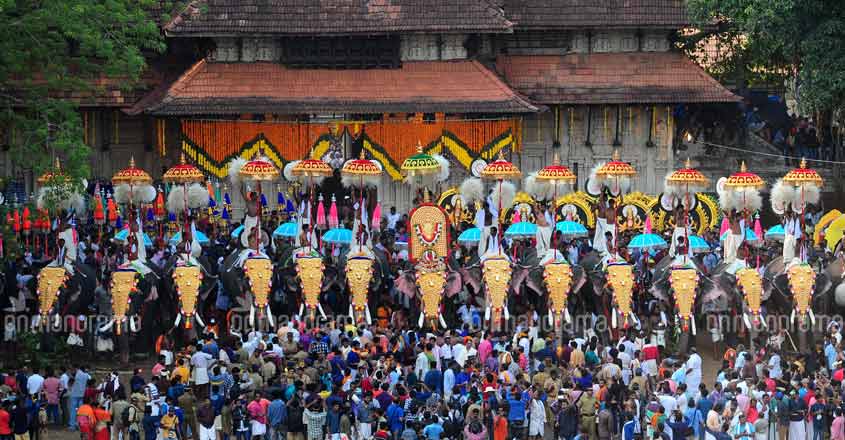
  • Festival in news: Thrissur Pooram

    For the first time since its inception, Thrissur Pooram, considered as mother of all poorams in Kerala, has been cancelled earlier this month.

    Note the cultural terms in the newscard. As the name itself suggests the state of celebration, it very unlikely to be asked in the ‘fest-state’ format.  Rather UPSC can ask – “The  terms X, Y, Z …. are associated with which of the following reknown festival?”

    Thrissur Pooram

    • Thrissur Pooram is an annual Hindu festival held in Kerala.
    • It is held at the Vadakkunnathan Temple in Thrissur every year on the Pooram day – the day when the moon rises with the Pooram star in the Malayalam Calendar month of Medam.
    • It is the largest and most famous of all poorams.
    • Thrissur Pooram was the brainchild of Raja Rama Varma, famously known as Sakthan Thampuran, the Maharaja of Cochin (1790–1805).

    Actual course of the festival

    • The Pooram is centred on the Vadakkunnathan Temple, with all these temples sending their processions to pay obeisance to the Shiva, the presiding deity.
    • The Pooram officially begins with a flag hoisting ceremony (Kodiyettam).
    • All the participating temples of Thrissur Pooram are present for the ceremony, and there is a light firework to announce the commencement of the festival.
    • The seventh day of the pooram is the last day. It is also known as “Pakal Pooram”.