đŸ’„Join UPSC 2027,2028 Mentorship (July Batch) + XFactor Notes & Microthemes PDF

GS Paper: GS1

  • Person in news: Gopal Krishna Gokhale

    The Prime Minister has paid tributes to Gopal Krishna Gokhale on his birth anniversary.

    These days, personality-based prelims questions are quite prevalent.

    Q.) He wrote biographies of Mazzini, Garibaldi, Shivaji and Shri Krishna; stayed in America for some time; and was also elected to the Central Assembly. He was – (CSP 2018)

    a) Aurobindo Ghosh

    b) Bipin Chandra Pal

    c) Lala Lajpat Rai

    d) Motilal Nehru

    Gopal Krishna Gokhale (1866-1915)

    • Gokhale was a liberal political leader and a social reformer during the Freedom Movement.
    • Gokhale was a senior leader of the Indian National Congress (INC) and the founder of the Servants of India Society.
    • Through the Society as well as the Congress and other legislative bodies he served in, Gokhale campaigned for Indian self-rule and for social reforms.

    Gokhale and INC

    • Gokhale became a member of the INC in 1889, as a protĂ©gĂ© of social reformer MG Ranade.
    • He was the leader of the moderate faction of the Congress party that advocated reforms by working with existing government institutions.

    Quest for political reforms

    • Gokhale’s mentor, justice M.G. Ranade started the Sarvajanik Sabha Journal.
    • Gokhale’s deposition before the Welby Commission on the financial condition of India won him accolades.
    • He played a leading role in bringing about Morley-Minto Reforms (1909), the beginning of constitutional reforms in India.

    Servants of India Society

    • In 1905, when Gokhale was elected president of the INC and was at the height of his political power, he founded the Servants of India Society.
    • It aimed to specifically further one of the causes dearests to his heart: the expansion of Indian education.
    • The Society took up the cause of promoting Indian education in earnest, and among its many projects organised mobile libraries, founded schools, and provided night classes for factory workers.

    Involvement in the government

    • In 1899, Gokhale was elected to the Bombay Legislative Council.
    • He was also elected to the Imperial Council of the Governor-General of India as a non-officiating member representing Bombay Province.

    Mentor to Gandhi

    • Gokhale was famously a mentor to Mahatma Gandhi in the latter’s formative years.
    • In 1912, Gokhale visited South Africa at Gandhi’s invitation.
    • As a young barrister, Gandhi returned from his struggles and received personal guidance from Gokhale, including a knowledge and understanding of India and the issues confronting common Indians.
    • By 1931, Gandhi emerged as the leader of the Indian Independence Movement. In his autobiography, Gandhi calls Gokhale his mentor and guide.

    His literary works

    • In 1908, Gokhale founded the Ranade Institute of Economics.
    • He started the English weekly newspaper, The Hitavad (The people’s paper).
    • He also published a daily newspaper titled Jnanaprakash, which allowed him to voice his reformist views on politics and society.

    With inputs from https://en.wikipedia.org/wiki/Gopal_Krishna_Gokhale

  • Florence Nightingale and her legacy

    The 200th birth anniversary of Florence Nightingale, founder of modern nursing, falls tomorrow on May 12.

    Personality based questions sometimes find their way in the Prelims. For example:

    Q) A recent movie titled The Man Who Knew Infinity is based on the biography of – (CSP 2016)

    (a) S. Ramanujan

    (b) S. Chandrasekhar

    (c) S. N. Bose

    (d) C. V. Raman

    Who was Florence Nightingale?

    • Nightingale (1820-1910), who had considerable mathematical skills, is credited with being the first healthcare professional to use data to show that infection control improves health outcomes.
    • Through her career, she stressed a practice that is relevant as ever today — handwashing.

    Nurse and mathematician

    • Her signature effort came during the Crimean War (1854-56), when she answered a government call for nurses and took a posting in Turkey.
    • This is where she earned the name ‘Lady with the Lamp’, for walking around patients’ beds at night, holding a lamp. Here she did her pioneering work with statistics.
    • When she arrived, diseases such as cholera and typhus were rife in the hospitals.
    • Nightingale collected data, calculated the mortality rate, and showed that an improvement of sanitary methods would reduce the number of deaths.
    • The mortality rate dropped from 60% to 42.7% by February 1855, and to 2.2% by the spring.

    • She used her data to create graphics, the most famous of which is a polar area diagram (pictured) that used areas to represent variations in death rate.
    • The blue wedges from the center of the circle represent area for the deaths from Preventable or Mitigable diseases, the red wedges measured from the center is deaths from wounds, & the black wedges measured from the center is the deaths from all other causes.
    • The blue wedges, representing death by sickness, are far bigger than those representing wounds.
  • Attack on Pearl Harbor (1941)

    US President Mr Trump has said the COVID-19 pandemic is a worse “attack” on the U.S. than either Pearl Harbor or 9/11.

    Practice Question :

    Discuss how the world order changed post Pearl Harbour attack with context to the US hegemony in Asia-Pacific.

    Attack on Pearl Harbor

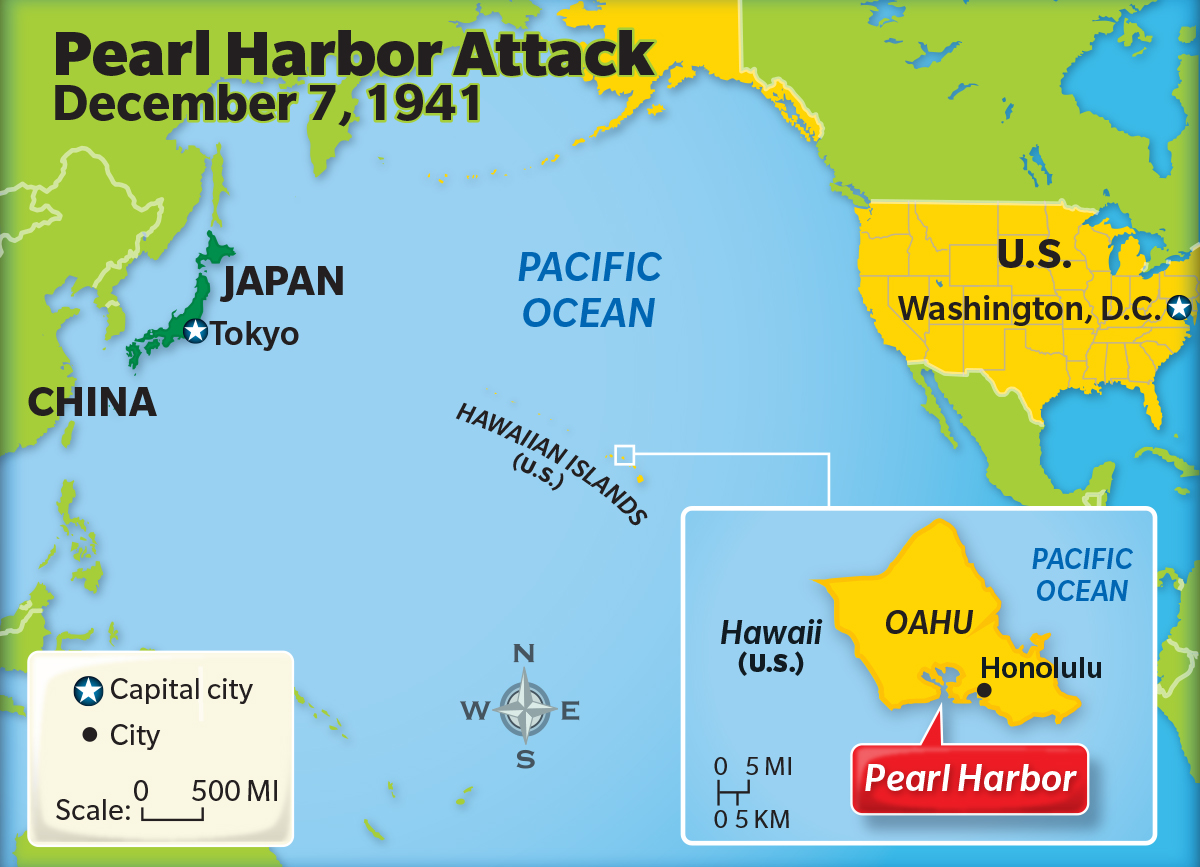
    • The December 7, 1941 attack on Pearl Harbour was among the most significant moments of the World War II.
    • It signalled the official entry of the US into the hostilities, which eventually led to the dropping of nuclear bombs on the Japanese cities of Hiroshima and Nagasaki in 1945.
    • Significantly, in December 2016, Shinzo Abe became the first sitting Japanese Prime Minister to visit Pearl Harbour.

    What led up to the attack on Pearl Harbour?

    • Before Japan attacked Pearl Harbour in 1941, relations between the US and Japan were already worsening.
    • In 1910, Japan annexed Korea and, in 1937, it invaded China, sending alarm bells ringing in the US and other Western powers about Japan’s manifest expansionist agenda.
    • Between December 1937 and January 1938, an episode which is referred to as the “Nanking Massacre” or the “Rape of Nanking”, occurred — Japanese soldiers killed and raped Chinese civilians and combatants.
    • Japanese historians estimate that anywhere between tens of thousands and 200,000 Chinese were killed.
    • The US was against Japan’s aggression in China, and imposed economic sanctions and trade embargoes after its invasion.

    Immediate causes

    • Japan was reliant on imports for oil and other natural resources — this was one of the reasons why it invaded China and later French Indo-China (present-day Vietnam, Laos and Cambodia).
    • The intention was to take control of the major Chinese ports to have access to resources such as iron, rubber, tin, and most importantly, oil.
    • In July 1941, the US ceased exporting oil to Japan.
    • Negotiations between the two countries ended with the “Hull Note”, the final proposal delivered to Japan by the US. Essentially, the US wanted Japan to withdraw from China without any conditions.
    • Ultimately, the negotiations did not lead to any concrete results, following which Japan set its task for Pearl Harbour in the last week of November 1941.
    • Japan considered the attack to be a preventive measure against the US interfering with Japan’s plans to carry out military operations in some parts of Southeast Asia.

    What happened at Pearl Harbour?

    • About 7.55 am on December 7, 1941, about 180 aircraft of the Imperial Japanese Navy attacked the US Naval base at Pearl Harbour on the island of Oahu in Hawaii.
    • The bombing killed over 2,300 Americans and destroyed the battleships USS Arizona and USS Oklahoma.
    • Roughly 160 aircraft were destroyed, and 150 were damaged.

    Impact on the US

    • In the short term, the American naval presence in the Pacific was severely weakened.
    • However, the Japanese had largely ignored the harbour’s infrastructure, and many of the damaged ships were repaired on-site and returned to duty.
    • American opinion immediately shifted to favouring war with Japan, a course that would conclude with Japan’s unconditional surrender less than four years later.
  • [pib] Seasonal rapid advancement of Surging Glaciers in Karakoram Range

    Indian researchers have found a seasonal advancement in 220 surge-type glaciers in the Karakoram Range of Ladakh.

    Points to note:

    1) Open you map and revise the glaciers of Himalayan region.

    2) Glacial landforms as Geographic phenomenon.

    What are Glacial Surges?

    Click here to see the animated view

    • Glacial surges are short-lived events where a glacier can advance substantially, moving at velocities up to 100 times faster than normal.
    • Until recently, most glaciologists believed that a glacier’s physical characteristics, such as its thickness and shape, and the properties of the terrain it sits on determining whether it can surge.
    • Now, it is proved to believe an external factor also plays a major role: water from precipitation and melting.
    • Pooling on the surface, it can infiltrate the glacier through crevasses and reach its base, warming, lubricating, and, ultimately, releasing the ice.

    Why surging in the Karakoram is a concern?

    • The behaviour of these glaciers, which represent 40% of the total glaciated area of the Karakoram, goes against the normal trend.
    • Surging of glaciers is potentially catastrophic as it can lead to the destruction of villages, roads and bridges.
    • It can also advance across a river valley and form the ice-dammed lake.
    • These lakes can form catastrophic outburst floods.
    • Therefore, monitoring of glacier surges, ice-dammed lake formation, and drainage is of paramount importance.

    Which are these glaciers?

    • The scientists focused on the Shispare and Muchuhar glaciers, former tributaries of the once larger Hasanabad Glacier situated in Hunza Valley, Gilgit-Baltistan.

    Significance of the study

    • The Surge-type glaciers oscillate between brief (months to years) rapid flow and lengthy (tens to hundreds of years) slow flow or stagnation, which are called the ‘active’ (or ‘surge’) and ‘quiescent’ phases, respectively.
    • This unsteady glacier flow makes it difficult to accurately assess individual glacier mass balances using in-situ observations.
    • The study will help to understand the diversity of glacial behaviour and help make accurate assessments of individual glacier mass balances for disaster planning and management.
  • What is Cinco de Mayo and why is it celebrated?

    Cinco de Mayo, or fifth of May in Spanish, also called Battle of Puebla Day, is an annual celebration observed in Mexico and the US that marks the former’s military victory on its soil over French forces in 1862.

    Possible mains question:

    Q. The French colonization attempts went beyond India and had a global reach. Comment.

    French advent in Mexico

    • In the 1860s, Mexico had been severely weakened by lengthy wars over the previous two decades – the Mexican-American War (1846-48) and the internal Reform War (1858-61).
    • As a result, in 1861, the then President Benito JuĂĄrez announced a temporary moratorium of two years on repaying Mexico’s foreign debts.
    • In response, troops from Britain, Spain, and France invaded Mexico, demanding reimbursement.
    • By April 1862, Britain and Spain negotiated with Mexico and withdrew.
    • France, which at the time was led by Emperor Napoleon III, decided to establish an empire in Mexican territories with the support of the local landowning classes.
    • France also intended to curb US power in North America.

    The Battle of Puebla

    • In late 1861, a French fleet attacked the Mexican port of Veracruz on the country’s eastern coast and landed a large army that drove the JuĂĄrez government into retreat.
    • As they moved from Veracruz to capital Mexico City, the French encountered stiff resistance from Mexican forces.
    • At Puebla, over 100 km ahead of Mexico City, a poorly equipped and outnumbered Mexican force decisively defeated the advancing French troops on May 5, 1862, killing over a thousand.
    • The event marked a significant political victory of Mexican republicans and President JuĂĄrez and helped establish a sense of national unity in the country.

    Cinco de Mayo: Present-day significance

    • In Puebla, Cinco de Mayo is celebrated annually with speeches, parades, and by reenacting episodes of the 1862 battle.
    • The city today houses a museum dedicated to the battle, and the actual battlefield is maintained as a park.
    • In the US, in the mid-20th century, the celebration became a way for immigrants from Mexico to express pride in their heritage.
    • Later, Cinco de Mayo also became popular with other demographics in the country when the festivities were linked with Mexican alcoholic beverages.
    • As the celebration assumed greater importance in the country, many have criticised the negative stereotypes of Mexicans that were perpetuated as a result, as well as the promotion of excessive drinking.
  • Bay of Bengal Boundary Layer Experiment (BoBBLE)

    A team from IISc Bengaluru and UK based researchers has created a blueprint for accurate prediction of monsoon, tropical cyclones and another weather-related forecast under the BoBBLE Experiment.

    Aspirants must note:

    1) BoBBLE is headed by which organizations?

    2) Its purpose and application

    What is BoBBLE?

    • The Bay of Bengal Boundary Layer Experiment or BoBBLE in short is a project funded by Union Ministry of Earth Sciences and the Natural Environment Research Council of UK.
    • BoBBLE tries to determine, quantify and model ocean-atmosphere interactions that drive variability in the South Asian monsoon.
    • The experiment created a blueprint for future weather system observational experiments for accurately forecasting monsoon rainfall.

    Why need BoBBLE?

    • The Bay of Bengal (BoB) plays a fundamental role in controlling the weather systems that make up the South Asian summer monsoon system.
    • In particular, the southern BoB has cooler sea surface temperatures (SST) that influence ocean-atmosphere interaction and impact the monsoon.
    • Compared to the southeastern BoB, the southwestern BoB is cooler, more saline receives much less rain, and is influenced by the summer monsoon current (SMC).
    • To examine the impact of these features on the monsoon, the BoB Boundary Layer Experiment (BoBBLE) was undertaken.

    BONUS:

    1) How technology development in monsoon forecasting can benefit realizing the dream of doubling farmers income by 2022?

    2) Discuss the role of Bay of Bengal in monsoon dynamics. (Hint: the link between the two lies in Indian Ocean Dipole (IOD))

    How is the experiment carried out?

    • BoBBLE will deploy two ships, six ocean gliders and eight floats to collect an unprecedented range of oceanic and air-sea flux observations.
    • These will occupy locations in the southwest and southeast Bay, as well as tracing east-west and north-south paths between those locations, measuring ocean temperature, salinity and currents.

    With inputs from http://www.walker.ac.uk/research/projects/bay-of-bengal-boundary-layer-experiment-bobble/

  • [pib] River erosion in Ladakh Himalayas

    Indian researchers have studied rivers in Ladakh Himalaya, bringing out 35 thousand-year histories of river erosion and identified hotspots of erosion and wide valleys that act buffer zones.

    Click here to read more about the Himalayan river systems and its orogeny

    Erosion hotspot: Ladakh region

    • The Ladakh Himalaya forms a high altitude desert between Greater Himalayan ranges and Karakoram Ranges.
    • The Indus and its tributaries are major rivers flowing through the terrain.
    • The Zanskar River is one of the largest tributaries of the upper Indus catchment, draining orthogonally through highly deformed Zanskar ranges.

    Zanskar: A major river in Ladakh

    • Two prominent tributaries of Zanskar River are the Doda and Tsrap Lingti Chu, which confluence at Padam village in the upper valley to form the Zanskar River.
    • Zanskar catchment was explored to understand the landform evolution in the transitional climatic zone, using morpho-stratigraphy and study of landforms like valley fill terraces, alluvial fans (triangle-shaped deposit of gravel, sand, and even smaller pieces of sediment, such as silt).

    Zanskar Padam

    • Zanskar river makes a deep gorge in its lower reaches with the headwaters in upper Zanskar makes wide basin called as Padam.
    • The basin stores large amount of sediments in form of fans and river terrace deposits
    • The research suggested that the wide valley of Padam, with an area of 48 square km, in the upper Zanskar, has stored a vast amount of sediments in these landforms.
    • Thus Padam valley is a hotspot of sediment buffering in the Zanskar.

    Sediment study reveals the erosion

    • The study suggested that most sediments were derived from Higher Himalayan crystalline that lies in the headwater region of Zanskar.
    • It was found out that dominant factors responsible for sediment erosion were deglaciation and Indian Summer Monsoon derived precipitation in the headwaters despite the presence of a geomorphic barrier (the deep, narrow gorge).

    Significance of the study

    • The scientists have traced where the rivers draining Himalaya and its foreland erode the most and identify the zones that receive these eroded sediments and fill up.
    • The study will help understand river-borne erosion and sedimentation, which are the main drivers that make large riverine plains, terraces, and deltas that eventually become the cradle to evolving civilizations.
    • It will also help study the dynamics of devastating floods created by these Himalayan rivers in recent times.
    • Thus, the understanding of water and sediment routing becomes crucial while developing infrastructure and for other development works in the river catchment area.
  • Why May 1 is observed as Labour Day?

    Today (May 1) is May Day, also known as International Workers’ Day and as Labour Day in different parts of the world. It is an occasion that commemorates the contributions of workers and the historic labour movement.

    Personality based history question in the UPSC CSE prelims is on the way to become the new normal. Kindly note all such phenomena in the news which tend to invoke some aspects of the modern Indian history. You can find all such news here.

    The Haymarket incident

    • While observed as an ancient northern hemisphere spring festival, May 1 became associated with the labour movement in the late 19th century, after trade unions and socialist groups designated it as a day in support of workers.
    • It was decided to do so in memory of the Haymarket affair of 1886, in Chicago in the United States, in which a peaceful rally in support of workers led to a violent clash with the police, leading to the deaths of 4 civilians and 7 police officers.
    • Many of the agitationists, who were protesting workers’ rights violations, straining work hours, poor working conditions, low wages and child labour, were arrested and served terms of life imprisonment, death sentences, etc., and those who died were hailed as “Haymarket Martyrs”.
    • The incident is believed to have given the workers’ movement a great impetus.

    Linked to the Russian Revolution

    • In 1889, The Second Communist International, an organisation created by socialist and labour parties, declared that May 1 would be commemorated as International Workers’ Day from then on.
    • Finally, in 1916, the US began to recognise eight-hour work timings after years of protests and uprisings.
    • In 1904, the International Socialist Congress at Amsterdam called on to demonstrate energetically on the First of May for the legal establishment of the 8-hour day.
    • After the Russian Revolution in 1917, the celebration was embraced by the Soviet Union and the Eastern bloc nations during the Cold War– becoming a national holiday in many of them.
    • Parades were a part of the celebration– the one at Moscow’s Red Square was attended by top Communists leaders and displayed Soviet military might.

    Indian Case

    • In India, May Day was first celebrated on May 1, 1923, after the Labour Kisan Party of Hindustan initiated and Comrade Singaravelar (Singaravelu Chettiar) helmed the celebrations.
    • Chettiar was known for being one of the leaders of Self Respect Movement in the Madras Presidency and for his fight for the rights of backward classes.
    • In one of his meetings, Chettiar passed a resolution stating the government should allow everybody a national holiday on Labour Day.
  • Festival in news: Chithirai Festival

    For the first time, in place of Madurai’s Chithirai Festival, a simple celestial union is set to take place that will be streamed online.

    Match the pair based question can be asked from festivals as such. Recently, the following festivals were in the news: Ambubachi Mela, Thrisoor Puram, Meru Jatara, Nagoba Jatara etc.

    Chithirai Festival

    • Chithirai Festival or Chithirai Thiruvizha is an annual celebration celebrated in the city of Madurai during the month of April.
    • It is celebrated during the Tamil month of Chithirai.
    • It lasts for one month of which the first 15 days mark the celebrations of the coronation of Goddess Meenakshi and the Marriage of Lord Sundareswara and Goddess Meenakshi.
    • The next 15 days mark the celebrations of the Journey of Lord Alagar from Kallazhagar temple in Alagar Koyil to Madurai.

    About Meenakshi Temple

    • The ancient city of Madurai, more than 2,500 years old, was built by the Pandyan king, Kulashekarar, in the 6th century B.C.
    • But the reign of the Nayaks marks the golden period of Madurai when art, architecture and learning flourished expansively.
    • The most beautiful buildings in the city including its most famous landmark, the Meenakshi temple, were built during the Nayak rule.
    • Located in the heart of the city, the Meenakshi-Sundareshwarar temple is dedicated to goddess Meenakshi, the consort of lord Shiva.
    • The sculpted pillars are adorned with the exquisite murals that celebrate the ethereal beauty of princess Meenakshi and the scenes of her wedding with Lord Shiva.
    • The pillars depict scenes from the wedding of Meenakshi and Sundareswarar. There are 985 richly carved pillars here and each one surpasses the other in beauty.
  • Religious Freedom and India

    The U.S. Commission on International Religious Freedom (USCIRF) has downgraded India to the lowest ranking, “countries of particular concern” (CPC) in its 2020 report.

    Religious freedom in India has been a contested issue since decades. Recent moves by the govt. since the abrogation of Art. 370 which triggered the riots in Delhi has left a big scar on the secular fabric of India.

    About USCIRF

    • It is a U.S. federal government commission created by the International Religious Freedom Act (IRFA) of 1998.
    • Its principal responsibilities are to review the facts and circumstances of violations of religious freedom internationally.

    Accusing India of religious intolerance

    • USCIRF has placed India alongside China, North Korea, Saudi Arabia and Pakistan.
    • India was categorised as a “Tier 2 country” in last year’s listing.
    • This is the first time since 2004 that India has been placed in the CPC category.
    • The commission also recommended that the U.S. government take stringent action against India under the “International Religious Freedom Act” (IRFA).

    What led India to lower its religious freedom?

    • India took a sharp downward turn in 2019 due to concerns about the Citizenship Amendment Act, the proposed National Register for Citizens, anti-conversion laws and the situation in Jammu and Kashmir.
    • The report accuses India using its strengthened parliamentary majority to institute national-level policies violating religious freedom across India.
    • The panel reported harassment and violence against religious minorities to continue with impunity, and engaged in and tolerated hate speech and incitement to violence against them.

    India’s reaction

    • The Centre reacted sharply to the USCIRF report terming it “biased and tendentious” and rejected its observations.
    • The biased and tendentious comments against India are not new. But on this occasion, its misrepresentation has reached new levels.
    • Major panellists of USCIRF dissented with the recommendation on India as being ‘too harsh’ and that ended up placing the country alongside what they termed as “rogue nations” like China and North Korea.
    • India regards the accusations as inaccurate and unwarranted and questioned the body’s “locus standi” in India’s internal affairs.

    US’s religious activism: Unwelcomed by all

    • The US earlier this month has announced the launch of a 27-nation International Religious Freedom Alliance, which aim to adopt a collective approach in protecting and preserving religious freedom across the world.
    • Among the prominent countries to join the alliance are Brazil, the United Kingdom, Israel, Ukraine, the Netherlands and Greece.
    • The USCIRF has been accused worldwide of being biased towards focusing on the persecution of Christians and of being anti-Muslim & Hinduphobic. It panels various controversial personalities.