India is hosting the UNESCO’s World Heritage Committee meeting for the first time in New Delhi.
Theme: “World Heritage in the 21st Century: Building Capacities and Exploring Opportunities for Youth.”
About the World Heritage Young Professional Forum
The World Heritage Young Professionals Forum is an initiative by UNESCO to engage young professionals in the field of heritage conservation.
The first World Heritage Young Professionals Forum was organized in 1995.
The primary aim is to engage young professionals in heritage conservation and management through capacity building, networking, and awareness-raising.
Back2Basics: UNESCO World Heritage Sites
Description
UNESCO World Heritage Sites
Landmarks or areas selected by UNESCO for their cultural, historical, scientific, or other significant value, legally protected by international treaties.
Importance
World Heritage Sites represent collective and preservative interests of humanity, signifying remarkable accomplishments and intellectual history.
Selection Criteria
Sites must be already-classified landmarks, unique and significant culturally or physically, such as ancient ruins, historical structures, cities, monuments, etc.
Conservation
World Heritage Sites require practical conservation to protect them from risks like trespassing, uncontrolled access, or administrative negligence.
World Heritage Committee
Selects and monitors World Heritage Sites, manages the World Heritage Fund, and provides financial assistance. Composed of 21 states parties elected for a four-year term.
Membership
India is not a member of the World Heritage Committee.
PYQ:
[2014] Consider the following international agreements:
The International Treaty on Plant Genetic Resources for Food and Agriculture
The United Nations Convention to Combat Desertification
The World Heritage Convention
Which of the above has / have a bearing on the biodiversity?
After 46 years, the sacred treasury of Shree Jagannath Temple, Puri, known as Ratna Bhandar, was reopened amid years of legal battles, controversies, and debates.
About the Ratna Bhandar
The Ratna Bhandar stores the gold and jewels offered by devotees to the deities Lord Jagannath, Lord Balabhadra, and Goddess Subhadra.
It is located adjacent to the prayer hall on the north side of the temple.
It consists of two sections: the ‘Bhitar Bhandar’ (Inner Treasury) and the ‘Bahar Bhandar’ (Outer Treasury), with the last inventory in 1978 noting significant amounts of gold and silver items in both chambers.
Legend says, Odisha’s King Anangabhima Dev (1211 to 1238) donated 2.5 lakh madhas of gold to prepare jewellery for the almighty.
The Odisha government passed the Jagannath Temple Act, 1952 to have a greater role in the temple’s management, which included maintaining an inventory of the offerings in the Puri collectorate’s Record Room.
Recent Developments:
The safety of the Ratna Bhandar is managed by the Temple’s Committee, chaired by the titular ‘King of Puri’ and includes IAS officers and other state-appointed members.
Originally, keys to the Ratna Bhandar were held by the Puri royal family, temple committee, and collectorate, with significant changes in ownership and access protocols over the years due to legal rulings.
The recent reopening involved breaking the locksof the inner chamber as they could not be opened traditionally, following strict procedures.
About Jagannath Puri Temple
The Jagannath Temple is an important Vaishnavite temple dedicated to Jagannath, a form of Sri Krishna in Puri in Odisha.
The present temple was rebuilt from the 10th century onwards, on the site of an earlier temple, and begun by Anantavarman Chodaganga Deva, the first king of the Eastern Ganga dynasty.
The Puri temple is famous for its annual Ratha Yatra, or chariot festival, in which the three principal deities are pulled on huge and elaborately decorated temple cars.
Its Architecture:
With its sculptural richness and fluidity of the Oriya style of temple architecture, it is one of the most magnificent monuments of India.
The huge temple complex covers an area of over 400,000 square feet and is surrounded by a high fortified wall.
This 20 feet high wall is known as Meghanada Pacheri.
Another wall known as kurma bedha surrounds the main temple.
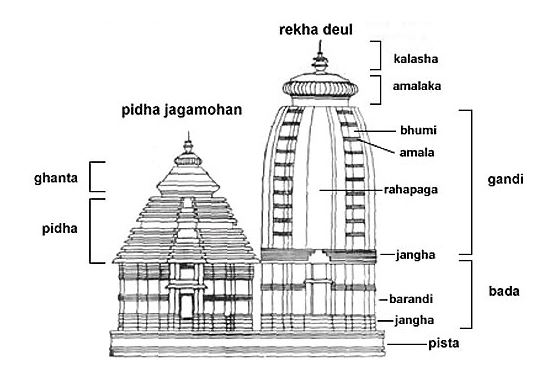
The temple has four distinct sectional structures, namely:
Deula, Vimana or Garba griha (Sanctum sanctorum) where the triad deities are lodged on the ratnavedi (Throne of Pearls). In Rekha Deula style;
Mukhashala (Frontal porch);
Nata mandir/Natamandapa, which is also known as the Jagamohan (Audience Hall/Dancing Hall), and
Bhoga Mandapa (Offerings Hall)
PYQ:
[2012] The Nagara, the Dravida and the Vesara are the:
(a) Three main racial groups of the Indian subcontinent
(b) Three main linguistic divisions into which the languages of India can be classified
(c) Three main styles of Indian temple architecture
(d) Three main musical Gharanas prevalent in India
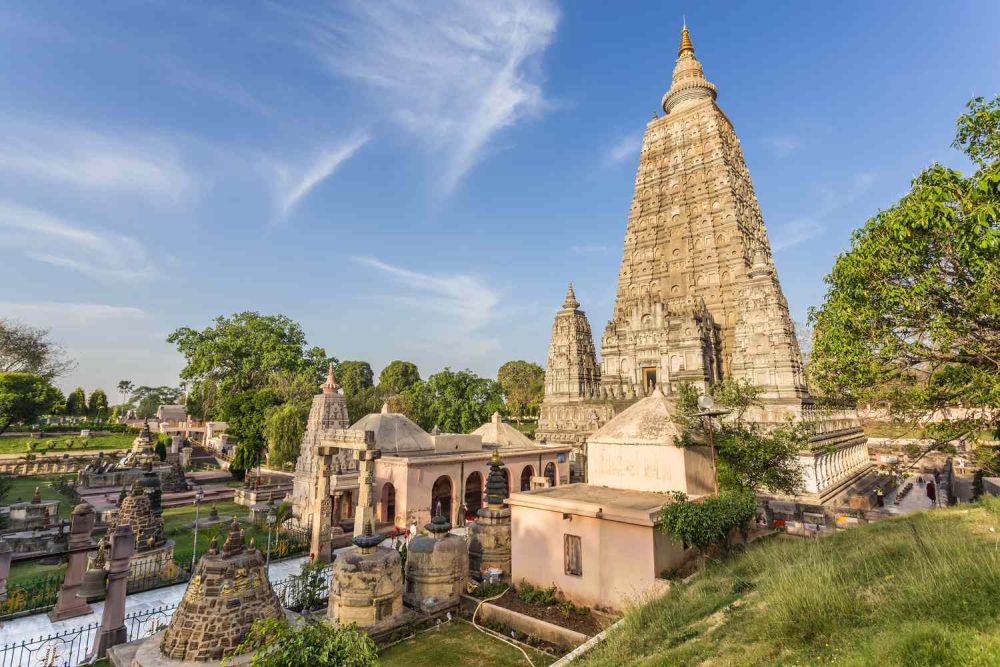
Significance: Marks the location where Buddha attained enlightenment.
UNESCO Status: World Heritage Site since 2002.
Historical Importance: One of the four holy sites related to Buddha’s life (Enlightenment).
Original Construction: Built by Mauryan Emperor Ashoka around 260 BCE.
Reconstruction: Reconstructed in brick during the late Gupta period (5th or 6th centuries).
Archaeological Finds: Indicates a site of veneration since the Mauryan period; Vajrasana (Diamond Throne) dated to the third century BCE.
Main Temple Structure: Dates from the 6th century CE, incorporates parts from 2nd or 3rd century CE.
Architectural Features: Two large shikhara towers, the largest over 55 meters high; influenced Jain, Hindu, and Buddhist architecture globally.
Materials: Made mostly of brick covered with stucco.
Bodhi Tree: A direct descendant of the original tree under which Buddha attained enlightenment.
Traditional Accounts: Describes 7 weeks Buddha spent meditating after enlightenment at various spots within the complex.
Decline and Revival: Declined after the Huna and early Islamic invasions; revived under the Pala Empire (8th-12th century); declined again after 12th century CE invasions by Turk armies.
Ratna Bhandar of Jagannath Puri Temple
Location: Puri, Odisha
Significance: Important Vaishnavite temple dedicated to Jagannath, a form of Sri Krishna
History: Rebuilt from the 10th century onwards, begun by Anantavarman Chodaganga Deva, first king of the Eastern Ganga dynasty
Annual Event: Famous for its annual Ratha Yatra (chariot festival) where three principal deities are pulled on huge, elaborately decorated temple cars
Architecture: Oriya style of temple architecture; complex covers over 400,000 square feet, surrounded by a high fortified wall (Meghanada Pacheri); main structures include Deula (Sanctum sanctorum), Mukhashala (Frontal porch), Nata mandir/Natamandapa (Audience Hall/Dancing Hall), Bhoga Mandapa (Offerings Hall)
Ratna Bhandar:
Context: The sacred treasury of Shree Jagannath Temple, Puri, known as Ratna Bhandar, was reopened after 46 years amid legal battles and controversies
Contents: Stores gold and jewels offered by devotees to the deities Lord Jagannath, Lord Balabhadra, and Goddess Subhadra
Location: Adjacent to the prayer hall on the north side of the temple.
Sections: Consists of two sections: the ‘Bhitar Bhandar’ (Inner Treasury) and the ‘Bahar Bhandar’ (Outer Treasury)
Historical Significance: Legend says Odisha’s King Anangabhima Dev (1211 to 1238) donated 2.5 lakh madhas of gold to prepare jewelry for the deities
Management: Safety managed by the Temple’s Committee chaired by the titular ‘King of Puri’; keys held by the Puri royal family, temple committee, and collectorate with changes over the years
Recent Developments: Reopened by breaking the locks of the inner chamber due to inability to open traditionally, following strict procedures
Also in news:World Heritage Young Professional Forum
India is hosting the UNESCO’s World Heritage Committee meeting for the first time in New Delhi.
Theme: “World Heritage in the 21st Century: Building Capacities and Exploring Opportunities for Youth.”
The World Heritage Young Professionals Forum is an initiative by UNESCO to engage young professionals in the field of heritage conservation.
The first World Heritage Young Professionals Forum was organized in 1995.
The primary aim is to engage young professionals in heritage conservation and management through capacity building, networking, and awareness-raising.
PYQ:
[2012] The Nagara, the Dravida and the Vesara are the:
(a) Three main racial groups of the Indian subcontinent
(b) Three main linguistic divisions into which the languages of India can be classified
(c) Three main styles of Indian temple architecture
(d) Three main musical Gharanas prevalent in India
The Census Act, 1948 ought to be revised to mandate the inclusion of caste enumeration as a regular part of the Census process, incorporating specific questions in the questionnaire to gather this data systematically, rather than leaving it subject to discretionary decisions by the Union executive.
Why a Caste Census?
Social Relevance: Caste remains a significant social determinant in India, influencing access to opportunities, resources, and representation. A caste census is essential to understand and address caste-based inequalities and social stratification accurately.
Policy Formulation: Constitutionally mandated policies such as reservations in education, employment, and legislative bodies rely on caste-based data to ensure effective implementation. Detailed enumeration helps in identifying beneficiaries, preventing misclassification, and ensuring equitable distribution of benefits.
Administrative Precision: Detailed caste-wise data is crucial for administrative purposes, including planning and allocation of resources. It helps in targeting development programs and policies for specific caste groups based on their socio-economic status and needs.
Historical Context: India has a history of caste-based discrimination and marginalization. A caste census provides empirical evidence of existing disparities, enabling the government and civil society to design interventions aimed at promoting social justice and equality.
The arguments against caste Census
Social Divisiveness: Critics argue that emphasizing caste through a census could perpetuate social divisions and caste identities. They fear that highlighting caste differences could exacerbate tensions and hinder national unity.
Administrative Complexity: Conducting a caste census is seen as administratively challenging due to the sheer number of caste groups in India, estimated to be thousands, many of which are region-specific. Critics argue that accurately enumerating and categorizing these castes could pose logistical difficulties and lead to inaccuracies.
Political Implications: There are concerns that caste-based data could be misused for electoral gains and political manoeuvring. Critics argue that caste enumeration might lead to demands for increased reservations and create further divisions along caste lines in political representation and decision-making processes.
How an attempt at caste Census failed
Constitutional Mandate: The Constitution of India provides for reservations in education (Article 15(4)) and public employment (Article 16(4)) for OBCs. Enumerating OBCs in the Census is essential to effectively implement these constitutional provisions and ensure accurate representation.
Policy Implementation: Detailed caste-wise data is necessary for effective policy formulation and implementation related to reservations, social justice, and welfare schemes targeting OBC communities. It helps in identifying deserving beneficiaries and avoiding wrongful inclusions or exclusions.
Judicial Imperative: The Supreme Court of India, in various rulings like Indra Sawhney case (1992), has underscored the importance of accurate caste data for upholding reservation policies and ensuring social justice. The court has emphasized the need for periodically revising the OBC list based on updated census data.
Local Governance and Representation: Post the 73rd and 74th Amendments to the Constitution, which introduced reservations for OBCs in local bodies (panchayats and municipalities), accurate caste data at the local level is crucial for fair representation and effective governance.
How an attempt at caste Census failed
Poor Design and Execution: The Socio-Economic and Caste Census (SECC)-2011, conducted through Union Ministries of Rural Development and Urban Development, lacked the expertise and experience needed for sociological surveys
Legal and Administrative Challenges: The SECC-2011 was not conducted under the Census Act, 1948, which meant it lacked the legal framework and procedural clarity required for a comprehensive census.
Way forward:
Amendment of Census Act: Amend the Census Act, 1948, to explicitly include caste as a parameter for enumeration. This legal revision will provide a clear mandate and framework for conducting a comprehensive caste Census, ensuring adherence to standardised procedures and data collection methodologies.
Expert Involvement and Public Consultation: Engage sociological and anthropological experts to develop a detailed list of caste categories specific to each state. Publish the draft list online for public review and feedback, facilitating transparency and accuracy in caste enumeration.
Mains PYQ:
Q Caste system is assuming new identities and associational forms. Hence, the caste system cannot be eradicated in India.” Comment. (UPSC IAS/2018)
Q) What are the salient features of the National Food Security Act, of 2013? How has the Food Security Bill helped in eliminating hunger and malnutrition in India? (UPSC IAS/2021) Q) Discuss the main objectives of Population Education and point out the measures to achieve them in India in detail. (UPSC IAS/2020)
Prelims: India is regarded as a country With a “Demographic Dividend” This is due to (UPSC IAS/2011) (a) Its high population in the age group below 15 years. (b) Its high population in the age group of 15-64 years. (c) Its high population in the age group above 65 years. (d) Its high total population.
Note4Students:
Prelims: World Population Day; Demographic Dividend;
Mentor comment: Over the decades, the world has seen significant demographic changes, with declining fertility rates and increasing life expectancy globally. India has also made notable progress, with fertility rates falling below replacement level and improvements in maternal and child health indicators. However, population dynamics continue to pose challenges that require attention and proactive measures. As the world approaches the 2030 target for the Sustainable Development Goals, understanding a country’s population trends is crucial to tailoring solutions and driving progress.
Let’s learn!
__
Why in the news?
The day July 11, was established by the United Nations as the ‘World Population Day’ in 1989, to raise awareness about global population issues and their impact on development, the environment, and individual well-being.
World Population – Then and Now: 1. The decades of the 1960s and 1970s were scary as the global population was growing at a yearly rate of 2%. 2. The Total Fertility Rate of the world has dropped from around five children per woman in 1950, to 2.3 children per woman in 2023.
About Malthus Theory of Population 1. Thomas Malthus’ Theory of Population, proposed in 1798, posited that population growth would outpace food production, leading to widespread famine and poverty. 2. He believed population grows exponentially while food production increases linearly. However, advancements in agriculture and technology have prevented the catastrophic outcomes he predicted.
India’s population dynamics – The main components:
Fertility:According to the National Family Health Survey (NFHS)-5, India’s total fertility rate (TFR) decreased from 3.4 to 2 between 1992 and 2021, dropping below the replacement level of 2.1.
Mortality: There has been a significant drop in the mortality rate as well. The average life expectancy of Indians has also increased over time.
Aging Population: India is experiencing a demographic shift, towards an aging population. According to the 2011 Census, individuals aged 60 years and above constituted 8.6% of the total population. The figure is projected to rise to 19.5% by 2050.
Migration:
Urbanization: Rapid Rural-to-Urban migration is straining urban infrastructure.
Gender Equality: Women’s labor force participation and political representation are crucial for sustainable development
But what do these changing dynamics signify?
India’s population dynamics are intertwined with its ‘development’ scenario. The reduction in fertility signifies a transition toward smaller family norms. It has many implications for the Social Development as follows:
•Demographic Dividend: A smaller dependent population can lead to a larger working-age population, potentially boosting economic growth. •Healthcare and Living Standards: Declining mortality rates and increasing life expectancy indicate improvements in healthcare and living standards. •Population Ageing: Requires long-term planning for geriatric care and social security benefits. •Gender Equality: Women’s labour force participation, which is straggling, their notable absence from Political representation, and their unending plight within society. Ensuring women’s rights and participation is essential for sustainable development.
India’s Journey towards the Sustainable Development Goals (SDGs)
Poverty Reduction (SDG 1)
The population living below the poverty linereduced from 48% to 10% between 1990 and 2019.
Government Initiatives:
Mahatma Gandhi National Rural Employment Guarantee Act (MGNREGA) was critical in addressing rural poverty.
Janani Suraksha Yojana (2005) increased institutional deliveries and reduced health expenditures for poor families.
Food Security and Nutrition (SDG 2)
India became self-sufficient in crop production after the Green Revolution hence, the proportion of the population suffering from hunger reduced from 18.3% in 2001 to 16.6% in 2021. However, India still contributes a third of the global burden of malnutrition.
Government Initiative:
POSHAN Abhiyaan (2018) aims to improve nutrition, but achieving ‘Zero Hunger’ by 2030 remains challenging.
Health Improvements (SDG3)
Maternal Mortality Rate (MMR) decreased from 384.4 in 2000 to 102.7 in 2020.
Under-five mortality rate and infant mortality rate significantly reduced post-2000s. Improvements in quality and coverage of healthcare, but still need to reach targets.
What needs looking into?
Population Dynamics: India needs to harness demographic dividend by creating job opportunities for the youth by addressing the rising burden of non-communicable diseases (NCDs) and strengthening social safety nets.
Nutrition: The government needs to increase budgetary allocation for health and nutrition sectors and strengthen nutrition programs to address malnutrition.
Gender Equality: Empowering socio-economically the section of vulnerable women and adopting a gender-equal approach in policy and development initiatives.
Collaborative Approach: Encouraging a multi-sectoral collaboration and ensuring a strong political will to drive progress efficiently.
Recently the Annual Survey of Unincorporated Sector 2022-23 revealed higher shares of women owners and workers in southern and some eastern states, and lower in western, northern, and central states.
Gender disparity in India concerning working-owners and unpaid family workers:
Prevalence of Women in Unpaid Family Worker Roles: Data from the Annual Survey of Unincorporated Sector 2022-23 reveals that women are predominantly represented as unpaid family workers.
For instance, in Telangana, while 43% of working owners are women, a substantial 59% are unpaid family workers, illustrating a significant gender disparity.
Lower Representation of Women as Working Owners: Across India, the proportion of women in working-owner roles is considerably lower compared to men.
For example, in Telangana, women constitute 43% of working owners, reflecting a gender gap where men are more likely to own and operate businesses.
Regional Trends Highlighting Gender Disparities: The southern states, such as Telangana, Karnataka, and Tamil Nadu, display a relatively higher share of women in both working-owner and unpaid family worker roles.
Despite this, the overall pattern shows more men in ownership positions and more women in unpaid roles, reinforcing the gender imbalance.
Sector-Specific Disparities: In the manufacturing sector, women’s representation as working-owners and hired workers is lower than in unpaid family roles.
For example, in Telangana, women constitute 52% of formal hired workers but only 26% of informal hired workers, indicating a disparity in employment types and compensation.
National Overview of Gender Roles: On a national level, the survey indicates that the share of women in unincorporated enterprises varies by state and job type.
While women play a significant role in unpaid family work, their representation as working owners remains limited.
This trend is consistent across different regions, with southern states showing relatively better but still imbalanced gender representation in the workforce.
The reason behind these issues:
Cultural and Societal Norms: Traditional gender roles in India often assign women the responsibility of unpaid domestic and family work, limiting their opportunities for paid employment and entrepreneurship.
Access to Resources and Opportunities: Women often have less access to financial resources, credit, and capital needed to start and run businesses compared to men. This financial barrier restricts their ability to become working-owners.
Work-Life Balance and Family Responsibilities: Women typically bear a disproportionate share of caregiving and household responsibilities, limiting their availability for formal employment and entrepreneurial activities.
Network and Mentorship Gaps: Women often have fewer professional networks and mentorship opportunities, which are crucial for business growth and career advancement.
Steps taken by the Indian Government:
Scheme/Initiative
Year
Objective
Key Features
Beti Bachao Beti Padhao (BBBP)
2015
Address declining child sex ratio and empower girls through education
· Awareness and advocacy campaigns
· Enforcement of PC&PNDT Act
· Improving enrolment of girls in schools
One Stop Centres (OSC)
2015
Provide integrated support and assistance to women affected by violence
· Medical aid
· Police assistance
· Legal aid
· Psycho-social counseling
· Temporary shelter
Ujjwala Yojana
2016
Provide LPG connections to women from BPL households to safeguard their health
· Clean cooking fuel
· Reduce health hazards associated with unclean fuels
Mahila Shakti Kendra (MSK)
2017
Empower rural women through community participation
· Interface for rural women to approach government
· Skill development training at grassroots level
Nari Shakti Puraskar
2015
Recognize exceptional work in empowering women and promoting gender equality
· Highest civilian honors for women
· Conferred by the President of India on International Women’s Day
Way forward:
Enhance Access to Financial Resources and Training: Implement targeted financial programs to provide women with easier access to credit, grants, and capital needed to start and grow businesses. This can include microfinance initiatives, low-interest loans, and financial literacy training.
Strengthen Legal and Social Support Systems: Enforce and improve existing gender equality laws and policies to ensure women’s rights in the workforce and in business ownership. This includes better implementation of anti-discrimination laws and providing legal support to women entrepreneurs.
Mains question for practice:
Q Despite various government initiatives and policies aimed at promoting gender equality, significant gender disparities persist in the ownership and workforce participation in unincorporated enterprises across different regions of India. Discuss the reasons behind these disparities and suggest measures to address them.15M
Mains PYQ:
Q “Though women in post-Independent India have excelled in various fields, the social attitude towards women and feminist movement has been patriarchal.” Apart from women education and women empowerment schemes, what interventions can help change this milieu? (UPSC IAS/2021)
Observations made by previous historians who had found painted pottery and coins from the Shatavahana empire and the pre-historic period were once again in the news.
About Chandravalli Caves (also known as Ankali Math)
Chandravalli, a cave temple near Chitradurga, is also a pre-historic site.
Observations at the Site:
Previous excavations were carried out by Mortimer Wheeler under the guidance of the Archaeological Survey of India in 1947.
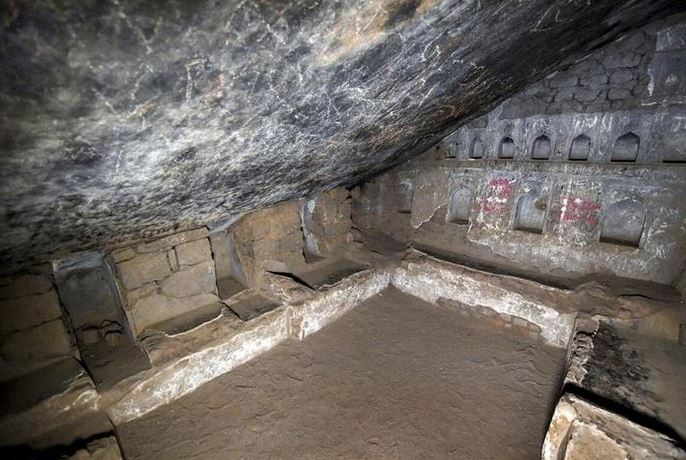
The cave features multiple chambers including a puja place with a shivlinga, a drawing room, a bedroom, and a water outlet connected to an internal tank.
The caves are accessible only through a narrow entrance, with interiors visible only with the help of a powerful torch hence they are also called as “Dark Caves”.
Presently, Excavations have revealed artifacts such as coins, painted bowls, and earthen pots from various dynasties such as the Hoysala, the Satavahana, and the Vijayanagara.
Excavation reports show that human habitation existed here even during the Iron Age.
Historical Aspect:
They were named after a saint from Ankalagi in Belagavi district who is believed to have settled here.
The cave also contains a rock inscription of Mayurasharma, the founder of the Kadamba dynasty, dating back to AD 450.
About Kadamba dynasty
The Kadambas of Goa were vassals of the Chalukya dynasty of Kalyana. In recognition of his assistance in defeating the Rashtrakutas, Chalukyan emperor Tailapa II appointed Kadamba Shasthadeva as the provincial governor (Mahamandaleshwara) of Goa.
In 960 AD, Shasthadeva captured the city of Chandavara from the Shilaharas and later seized control of the port of Gopakapattana, which is present-day Goa.
Talara Nevayya’s son Gundayya may have fought alongside Shasthadeva in the conquest of the port but died in the battle after successfully capturing it.
Coins from Indian kings like Krishnaraja Wodeyar III, Krishnadevaraya, various Satavahana kings, and Viraraya of the Hoysala kingdom have been discovered.
Among the foreign coins found are denarii of Roman ruler Augustus Caesar and a coin of Chinese Han dynasty Emperor Wu Ti.
Geographical Aspects:
The area is semi-arid with scrub vegetation and a stream running through it.
These caves are surrounded by three hills: Chitradurga, Kirabanakallu, and Jolagudda.
PYQ:
[2021] Which one of the following statements is correct?
(a) Ajanta Caves lie in the gorge of Waghora river.
(b) Sanchi Stupa lies in the gorge of Chambal river.
(c) Pandu-lena Cave Shrines lie in the gorge of Narmada river.
(d) Amaravati Stupa lies in the gorge of Godavari river.
A cave painting discovered in the limestone cave of Leang Karampuangon Sulawesi Island, Indonesia, dates back at least 51,200 years.
The painting features a scene with three part-human, part-animal figures interacting with a wild pig, depicted in red pigment.
Study Details:
Published in the journal Nature, the study titled ‘Narrative cave art in Indonesia by 51,200 years ago’ used a new dating technique to determine the age of the artwork.
The study involved 23 researchers from Griffith University, Southern Cross University, and the Indonesian National Research and Innovation Agency.
Use of Uranium-based Dating:
A new dating technique utilizes uranium series (U-series) analysis on calcite deposits above cave art.
The laser-based analysis measures uranium-thorium ratios to accurately date paintings, highlighting significant age revisions for cave art in Sulawesi.
About Leang Karampuang Cave
Leang Karampuang Cave is situated in the Maros-Pangkep karst region of South Sulawesi, Indonesia.
The cave is renowned for its ancient rock art and archaeological findings, providing insights into early human civilization in the region.
It features some of the oldest known hand stencils and paintings of animals, believed to be created by early humans.
Key features of the Cave Paintings:
A painted scene depicting humans interacting with a pig on the cave wall.
The artwork features a pig standing upright alongside three smaller human-like figures, all painted in a single shade of dark red pigment.
This painting predates the cave art found in El Castillo, Spain, dating back around 40,800 years ago, marking it as older than European cave paintings.
Significance of the Painting
According to researchers, the figures in the painting depict dynamic action, suggesting a narrative or story being told.
The discovery pushes back the origin of figurative art among Homo sapiens, indicating a rich history of storytelling through visual art in early human societies.
While Neanderthals began cave markings earlier, around 75,000 years ago, these were primarily non-figurative.
The Sulawesi cave art suggests an advanced cultural and artistic development among early humans, predating similar European art by millennia.
Contemporary Period in the Indian Subcontinent:
Homo sapiens had already migrated to various parts of the Indian subcontinent by this time.
Evidence suggests human habitation in India dates back to at least 70,000 years ago, with notable archaeological sites like Bhimbetka in Madhya Pradesh showing signs of early human activity and rock art.
PYQ:
[2017] The painting of Bodhisattva Padmapani is one of the most famous and oft-illustrated paintings at
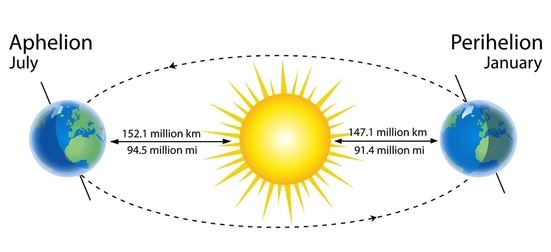
Early on July 5, the Earth reached aphelion, its farthest distance from the sun in our year-long journey around our nearest star.
What is Aphelion?
Aphelion is a term used in astronomy to denote the point in the orbit of a planet or celestial body where it is farthest from the Sun.
The Earth’s orbit around the Sun is not a perfect circle but rather an ellipse, with the Sun situated at one of the two foci of the ellipse.
Aphelion marks the moment when Earth is at its maximum distance from the Sun along this elliptical path.
The concept of aphelion was crucial in Johannes Kepler‘s formulation of his laws of planetary motion during the 17th century.
How far is the Earth from the Sun at aphelion?
At aphelion, which occurs around July 4th– 5th each year, the Earth is approximately 152.1 million kilometers (about 94.5 million miles) away from the Sun.
This distance is about 3.3% greater than its average distance from the Sun, known as its semi-major axis, which is about 147.1 million kilometers.
Does aphelion affect temperatures on Earth?
Aphelion has a slight effect on temperatures on Earth, but its impact is minimal compared to other factors such as axial tilt and atmospheric circulation patterns.
Despite being farther from the Sun during aphelion, the Earth’s tilt towards the Sun during the northern hemisphere’s summer results in warmer temperatures for that region.
This phenomenon is primarily responsible for the seasons on Earth.
What would happen if there were no aphelion?
If Earth’s orbit were perfectly circular, without aphelion or perihelion (the closest point to the Sun), the distance between Earth and the Sun would remain constant throughout the year.
This scenario would result in less variation in seasonal temperatures between the northern and southern hemispheres.
The distinct seasons that we experience today, which are essential for ecological diversity and agricultural cycles, would be significantly altered.
PYQ:
[2013] Variations in the length of daytime and night time from season to season are due to-
(a) The earth’s rotation on its axis
(b) The earth’s revolution round the sun in an elliptical manner
July 4 commemorates the 248th Independence Day of the United States, celebrating the signing of the Declaration of Independence, the foundational document that established the US as a union of states freed from British rule.
Why did the colonists want Independence from Britain?
Lack of Representation: Colonists were discontented with British policies that imposed taxes and laws without colonial representation in the British Parliament, which they viewed as unjust and oppressive.
Policy Shifts: After the French and Indian War, Britain ended its policy of salutary neglect and imposed stricter controls on the colonies, including prohibitions on westward expansion and new taxes through acts like the Stamp Act and Tea Act.
Ideas of Freedom: Influenced by Enlightenment ideals of liberty and equality, colonists began to articulate grievances against monarchical rule and asserted their natural rights to self-governance.
Resistance Movements: Events like the Boston Tea Party symbolized widespread resistance to British taxation and policies, galvanizing colonial unity and determination for independence.
Armed Conflict: The escalation from protests and boycotts to armed conflict (beginning in 1775) underscored the colonies’ resolve to break away from British control and establish their own governance.
What happened in the lead up to American independence?
Formation of Continental Congress: Colonists formed the Continental Congress to coordinate resistance efforts and explore avenues for negotiation with Britain, which ultimately failed due to British refusal to grant representation.
Boycotts and Protests: Colonists attempted economic boycotts of British goods and engaged in protests against oppressive British policies, marking a period of growing dissent and opposition.
Outbreak of War: By 1775, clashes between colonial militias and British troops erupted into open warfare, solidifying the shift from grievances to armed struggle for independence.
Declaration of Independence: The Continental Congress formally declared the colonies’ independence on July 2, 1776, followed by the adoption and signing of the Declaration of Independence on July 4, 1776.
Continental Army and Allies: The colonies secured military support and alliances, crucially from France, which helped sustain their war effort against British forces.
How was the Declaration of Independence formulated?
Committee of Five: A committee including Thomas Jefferson, John Adams, Benjamin Franklin, Roger Sherman, and Robert R. Livingston was appointed to draft the Declaration of Independence.
Thomas Jefferson’s Role: Jefferson, primarily responsible for drafting, drew on Enlightenment philosophy and his earlier writings to articulate the principles of natural rights and grievances against British tyranny.
Drafting Process: The committee reviewed Jefferson’s draft, incorporating edits and revisions suggested by Adams, Franklin, and others before presenting the final version to the Continental Congress.
Adoption and Signing: On July 4, 1776, the Continental Congress formally adopted the Declaration of Independence, which was signed by 56 delegates representing the thirteen colonies, solidifying their break from British rule.
Legacy of equality and rights as a foundation: The Declaration’s proclamation of equality and rights laid the foundation for American ideals of democracy and independence, shaping the course of American history and inspiring similar movements worldwide.
Conclusion: The Declaration of Independence, adopted on July 4, 1776, marked a pivotal moment as the American colonies asserted their sovereignty, based on Enlightenment ideals, igniting a global pursuit of liberty and democratic principles.
Mains PYQ:
Q American Revolution was an economic revolt against mercantilism. Substantiate. (UPSC IAS/2013)