💥UPSC 2026, 2027, 2028 UAP Mentorship (March Batch) + Access XFactor Notes & Microthemes PDF

Search results for: “”

  • Russia blocks agreement on Nuclear Non-proliferation Treaty (NPT)

    Russia has blocked the agreement on the final document of a four-week review of the Nuclear Non-proliferation Treaty (NPT).

    Why in news?

    • The NPT review conference is supposed to be held every five years but was delayed because of the COVID-19 pandemic.
    • This marked the second failure of its 191 state parties to produce an outcome document.
    • The last review conference in 2015 ended without an agreement because of serious differences over establishing a Middle East zone free of weapons of mass destruction.

    About Nuclear Non-proliferation Treaty (NPT)

    • Between 1965 and 1968, the treaty was negotiated by the Eighteen Nation Committee on Disarmament, a United Nations-sponsored organization based in Geneva, Switzerland.
    • Opened for signature in 1968, the treaty entered into force in 1970.
    • The NPT is an international treaty whose objective is
    1. To prevent the spread of nuclear weapons and weapons technology
    2. To promote cooperation in the peaceful uses of nuclear energy and
    3. To further the goal of achieving nuclear disarmament and general and complete disarmament
    • The treaty defines nuclear-weapon states as those that have built and tested a nuclear explosive device before 1 January 1967; these are the United States (1945), Russia (1949), the United Kingdom (1952), France (1960), and China (1964).

    Non-members of the treaty

    • Four UN member states have never accepted the NPT, three of which possess or are thought to possess nuclear weapons: India, Israel, and Pakistan.
    • In addition, South Sudan, founded in 2011, has not joined.

    Issues in Nuclear Disarmament

    • Notion of Nuclear ‘Haves’ and ‘Have-Nots’: The proponents of disarmaments are themselves nuclear armed countries thus creating a nuclear monopoly.
    • Concept of Peaceful Nuclear Explosion (PNE): conducted for non-military purposes such as mining.

    Why didn’t India join NPT?

    • India is one of the only five countries that either did not sign the NPT or signed but withdrew, thus becoming part of a list that includes Pakistan, Israel, North Korea, and South Sudan.
    • India always considered the NPT as discriminatory and had refused to sign it.
    • India maintains that they are selectively applicable to the non-nuclear powers and legitimised the monopoly of the five nuclear weapons powers.

    India’s commitment for de-nuclearization

    India has always batted for a universal commitment and an agreed global and non-discriminatory multilateral framework.

    • It has outlined a working paper on Nuclear Disarmament submitted to the UN General Assembly in 2006.
    • India participated in the Nuclear Security Summit process and has regularly participated in the International Conferences on Nuclear Security organised by the International Atomic Energy Agency (IAEA).
    • India is also a member of the Nuclear Security Contact Group (but has signed off the Nuclear Non-Proliferation Treaty (NPT)).
    • India has expressed its readiness to support the commencement of negotiations on a Fissile Material Cut-off Treaty (FMCT).
    • India couldn’t join the Comprehensive Nuclear-Test-Ban Treaty (CTBT) due to several concerns raised by India.
    • India has piloted an annual UNGA Resolution on “Measures to Prevent Terrorists from Acquiring Weapons of Mass Destruction” since 2002, which is adopted by consensus.

    Way forward

    • India has actively supported and contributed to the strengthening of the global nuclear security architecture.
    • There is a need for the international community to pay closer attention to the illicit proliferation of networks of nuclear weapons, their delivery systems, components and relevant technologies.
    • India hopes that the international community will continue to work towards realising our collective aspiration for a nuclear weapon-free world.


    UPSC 2023 countdown has begun! Get your personal guidance plan now! (Click here)

  • Lifetime perks for former CJIs, SC Judges

    The Centre amended the Supreme Court Judges Rules the second time in a week to provide chauffeurs (car driver) and domestic help for retired Chief Justices of India and Supreme Court judges for their entire lifetime.

    Perks for Retired CJs

    • Retired CJIs would also get secretarial assistants.
    • The staff would be paid the salary and allowances of regular employees of the Supreme Court.
    • The first series of amendments in the Rules on August 23 had allowed retired Chief Justices of India and Supreme Court judges chauffeurs, secretarial assistants and security cover only for a year.
    • There was no mention of “domestic help”, who would be an employee in the level of junior court assistant.

    What else?

    • The judiciary had recently raised concerns about attacks on judges.
    • Hence the benefit of 24-hour security cover has been extended to five years for retired Chief Justices and three years for retired judges of the Supreme Court.
    • Besides, former CJIs and retired judges of the top court can get their monthly mobile phone and Internet bills reimbursed to the extent of ₹4,200.
    • A retired CJI is also entitled to a rent-free Type VII accommodation, other than the designated official residence, in New Delhi for six months immediately after retirement.

    Why such move?

    • The government is one of the biggest litigants in the Supreme Court.
    • There has been public debate on whether post-retirement benefits dangled by the government could influence the judicial work of serving judges.


    UPSC 2023 countdown has begun! Get your personal guidance plan now! (Click here)

  • What is a Full Court Meeting?

    Within hours of taking over, the new Chief Justice of India Uday Umesh Lalit called a meeting of the ‘full court’ where the judges discussed how to deal with issues relating to listing and backlog of cases.

    What is a Full Court Meeting?

    • A full court meeting literally means one which is attended by all the judges of the court.

    When is it held?

    • There are no written rules dealing with this.
    • As per convention, full-court meetings are called by the Chief Justice of India to discuss issues of importance to the judiciary.
    • The senior designations of practising advocates in the Supreme Court and high courts are also decided during the full court meetings.

    What is the significance of a full court meeting?

    • The basic idea is to take everyone along.
    • Full court meetings are an ideal occasion to arrive at common solutions to deal with problems that beset the country’s legal system and to make any amends, if necessary, in the administrative practices of the court.

    How frequently is it held?

    • As a full court meeting is convened at the discretion of the Chief Justice of India, it does not follow any particular calendar.
    • Full court meetings have been held many times in the past.
    • In March 2020, it was convened to discuss demands by associations of lawyers to close the court till further notice following the Covid-10 outbreak.
    • Also, a full court meeting held on May 7, 1997 decided that “every Judge should make a declaration of all his/her assets in the form of real estate or investment” held in own name or in the name of spouse or any person dependent.

    Do you know?

    Justice Uday Umesh Lalit, sworn in as the 49th Chief Justice of India on Saturday, will be the sixth head of the Indian judiciary to have a tenure of less than 100 days.

    Lalit will demit office on November 8 with a tenure of 74 days.

    Justice Kamal Narain Singh, who was the CJI between November 25, 1991 and December 12, 1991, had a tenure of 18 days.

    Justice S Rajendra Babu had a tenure of 30 days as the chief justice of India between May 2, 2004 and May 31, 2004.

    Justice J C Shah had a tenure of 36 days when he was the CJI between December 17, 1970 and January 21, 1971.

    Justice G B Patnaik had a 41-day tenure as the head of the Indian judiciary when he held the office of the CJI from November 8, 2002 to December 18, 2002.

    Justice L M Sharma had a tenure of 86 days as the CJI when he was in office between November 18, 1992 and February 11, 1993.

    Tap to read more about appointment of CJIs.

    UPSC 2023 countdown has begun! Get your personal guidance plan now! (Click here)

  • What is Positive Indigenisation List (PIL)?

    In line with the effort to promote self-reliance in defence manufacturing, the Defence Minister has approved the third Positive Indigenisation List (PIL) of 780 strategically important line replacement units (LRU).

    What is a Positive Indigenisation List (PIL)?

    • The positive indigenisation list essentially means that the Armed Forces—Army, Navy, and Air Force—will only procure the listed items from domestic manufacturers.
    • The manufacturers could be private sector players or Defense Public Sector Undertakings (DPSUs).
    • This concept was rolled out in the Defence Acquisition Procedure (DAP) 2020.

    Why in news?

    • This third list is different from the three PILs announced for the armed forces.
    • This list is in continuation to the two PILs of LRUs, sub-systems, assemblies, sub-assemblies and components that were published in December 2021 and March 2022.
    • These lists contain 2,500 items which are already indigenised and 458 (351+107) items which will be indigenised within the given timelines.
    • Out of the 458 items, 167 items (163 from the first PIL, and four from the second PIL) have been indigenised, so far, it stated.

    Other steps taken by the Centre to boost defence production

    • Licensing relaxation: Measures announced to boost exports since 2014 include simplified defence industrial licensing, relaxation of export controls and grant of no-objection certificates.
    • Lines of Credit: Specific incentives were introduced under the foreign trade policy and the Ministry of External Affairs has facilitated Lines of Credit for countries to import defence product.
    • Policy boost: The Defence Ministry has also issued a draft Defence Production & Export Promotion Policy 2020.
    • Budgetary allocation: In addition, a percentage of the capital outlay of the defence budget has been reserved for procurement from domestic industry.
    • Defence Industrial Corridors: The government has also announced 2 dedicated Corridors in the States of TN and UP to act as clusters of defence manufacturing that leverage existing infrastructure, and human capital.
    • Long-term vision: The vision of the government is to achieve a turnover of $25 bn including export of $5 bn in Aerospace and Defence goods and services by 2025.
    • Push for self-reliance: The govt has identified the Defence and Aerospace sector as a focus area for the ‘Aatmanirbhar Bharat’ or Self-Reliant India initiative.

    Issues retarding defence indigenization

    • Excess reliance on Public Sector: India has four companies (Indian ordnance factories, Hindustan Aeronautics Limited (HAL), Bharat Electronics Limited (BEL) and Bharat Dynamics Limited (BDL)) among the top 100 biggest arms producers of the world.
    • Policy delays: In the past few years, the government has approved over 200 defence acquisition worth Rs 4 trillion, but most are still in relatively early stages of processing.
    • Lack of Critical Technologies: Poor design capability in critical technologies, inadequate investment in R&D and the inability to manufacture major subsystems and components hamper the indigenous manufacturing.
    • Long gestation: The creation of a manufacturing base is capital and technology-intensive and has a long gestation period. By that time newer technologies make products outdated.
    • ‘Unease’ in doing business: An issue related to stringent labour laws, compliance burden and lack of skills, affects the development of indigenous manufacturing in defence.
    • Multiple jurisdictions: Overlapping jurisdiction of the Ministry of Defence and Ministry of Industrial Promotion impair India’s capability of defence manufacturing.
    • Lack of quality: The higher indigenization in few cases is largely attributed to the low-end technology.
    • FDI Policy: The earlier FDI limit of 49% was not enough to enthuse global manufacturing houses to set up bases in India.
    • R&D Lacunae: A lip service to technology funding by making token allocations is an adequate commentary on our lack of seriousness in the area of Research and Development.
    • Lack of skills: There is a lack of engineering and research capability in our institutions. It again leads us back to the need for a stronger industry-academia interface.

    Way forward

    • Reducing import dependence: India was the world’s second-largest arms importer from 2014-18, ceding the long-held tag as the largest importer to Saudi Arabia, says 2019 SIPRI report.
    • Security Imperative: Indigenization in defence is critical to national security also. It keeps intact the technological expertise and encourages spin-off technologies and innovation that often stem from it.
    • Economic boost: Indigenization in defence can help create a large industry which also includes small manufacturers.
    • Employment generation: Defence manufacturing will lead to the generation of satellite industries that in turn will pave the way for a generation of employment opportunities.


    UPSC 2023 countdown has begun! Get your personal guidance plan now! (Click here)

  • Places in news: Taiwan Strait

    India has for the first time referred to what it called “the militarization of the Taiwan Strait”, marking a rare instance of New Delhi appearing to comment on China’s actions towards Taiwan.

    What is the news?

    • Two American warships have recently sailed very close to China through Taiwan Strait.
    • This has intimidated the China which is already fuming due to the visit of Nancy Pelosi.

    Taiwan Strait

    • The Taiwan Strait is a 180-kilometer wide strait separating the island of Taiwan and continental China (and Asia of course).
    • The strait is part of the South China Sea and connects to the East China Sea to the north.
    • The narrowest part is 130 km wide.

    Issues over Taiwan Strait

    • The Taiwan Strait is itself a subject of an international dispute over its political status.
    • China claims to enjoy sovereignty, sovereign rights and jurisdiction over the Taiwan Strait” and regards the waterway as “internal territorial waters” instead of being international waters.
    • This means that the Chinese government denies any foreign vessel having the freedom of navigation in the strait.
    • This position has drawn strong objections from the western World.

    India’s change of stance

    • India has followed a “One China policy” since its recognition of the PRC in 1949, and only maintains trade and cultural relations with Taiwan.
    • India routinely reiterated this policy until 2008 after which it stopped mentioning it in official statements.
    • This is a demand that China usually asks of most countries in official declarations.

    Why is India shifting its stance?

    • China often make provocative statements claiming Arunachal Pradesh.
    • It often moves to issue “stapled visas” to Indian citizens in Jammu and Kashmir and Arunachal.


    UPSC 2023 countdown has begun! Get your personal guidance plan now! (Click here)

  • 29th August 2022| Daily Answer Writing Enhancement(AWE)

    Topics for Today’s questions:

    GS-1        Social empowerment, communalism, regionalism & secularism.

    GS-2        Important International institutions, agencies and fora- their structure, mandate. 

    GS-3        Conservation, environmental pollution and degradation, environmental impact assessment.

    GS-4        Contributions of moral thinkers and philosophers from India and the world.

    Question 1)


    Q.1 Recognising unpaid work of women is a necessary but challenging task. Discuss. (10 Marks)


    Question 2)

    Q.2 State the functions of the United Nations Human Rights Council. Also, discuss the issues faced by the Council in the promotion and protection of human rights around the globe. (10 Marks)

    Question 3)

    Q.3 As the world copes with the repercussions of carbon emissions, there is growing pressure to achieve climate-compatible growth. In this context what do you understand by the term green finance? Discuss how it will help to achieve climate-compatible growth along with limitations of green finance. (10 Marks)

    Question 4)  

    Q.4 The teachings of Arya Samaj present key ethical lessons for present day India. Discuss. (10 Marks)


    HOW TO ATTEMPT ANSWERS IN DAILY ANSWER WRITING ENHANCEMENT(AWE)?

    1. Daily 4 questions from General studies 1, 2, 3, and 4 will be provided to you.

    2. A Mentor’s Comment will be available for all answers. This can be used as a guidance tool but we encourage you to write original answers.

    3. You can write your answer on an A4 sheet and scan/click pictures of the same.

    4.  Upload the scanned answer in the comment section of the same question.

    5. Along with the scanned answer, please share your Razor payment ID, so that paid members are given priority.

    6. If you upload the answer on the same day like the answer of 11th  February is uploaded on 11th February then your answer will be checked within 72 hours. Also, reviews will be in the order of submission- First come first serve basis

    7. If you are writing answers late, for example, 11th February is uploaded on 13th February , then these answers will be evaluated as per the mentor’s schedule.

    8. We encourage you to write answers on the same day. However, if you are uploading an answer late then tag the mentor like @Staff so that the mentor is notified about your answer.

    *In case your answer is not reviewed, reply to your answer saying *NOT CHECKED*. 

    1. For the philosophy of AWE and payment: 

  • Construction and demolition waste

    Construction and demolitionContext

    • Huge amounts of construction and demolition waste in a residential area is hazardous for human health and warrants immediate disposal.

    Why in news?

    • The Twin towers in Noida, Uttar Pradesh were demolished by controlled implosion. Their being located in a residential neighbourhood of Noida makes it even more essential to introduce interventions to mitigate pollution and waste, post-demolition.

    What is construction and demolition waste?

    • Construction and demolition wastes (CDW) are the status of building materials after the end life of buildings. CDW could be concrete, steel, wood products, asphalt shingles, and bricks from building.

    What is waste management?

    • Waste management refers to the activities and actions required to manage waste from its start till its disposal. This includes collection, transport, treatment and disposal of waste together with monitoring and regulation.

    Construction and demolitionWhy they should be managed properly?

    • Waste management and diligent planning becomes critical for regulation of humongous solid waste being generated every day. With growing urbanization and rise of smart cities on the offing the issue of solid waste management becomes even more imperative.

    Data to remember

    62 million tons of waste is generated annually in the country at present.

    India manages to recover and recycle only about 1 per cent of its construction and demolition (C&D) waste, says new CSE analysis.

    Construction and demolitionWhat are the impacts of construction waste on the environment and human health?

    • Air: Disassembling and shredding of construction waste generate dust or large particulates into the surroundings and affects the respiratory health of waste management workers and others.
    • Water: (Landfills are not properly designed to hold construction waste + Illegal dump sites + Improper recycling & disposal of e-waste) = compounds leach into the ground = Groundwater gets toxified due to heavy metals from demolition waste.
    • Soil: Soil is contaminated by direct contact with contaminants from construction waste or its by-products from recycling & disposal + indirectly through irrigation. Soils become toxic when substances such as lead, mercury, cadmium, arsenic, and polychlorinated biphenyl’s (PCBs) are deposited in landfills. Contaminated soils have bad impacts on microbes and plants => the pollutants reach higher animals or humans through the food chain.

    Construction And Demolition Waste Management Rules, 2016 – Salient Features

    1.Duties of waste Generators

    • Construction and demolition waste must be separated by each waste generator, and it must be deposited at a collection site or given to authorised processing companies.
    • Should take care to prevent any trash or depositing that could block vehicles, the general public, or drains.
    • Before beginning building, demolition, or remodelling work, large generators (those that create more than 20 tonnes or more in a single day or 300 tonnes per project in a month) must submit a waste management plan and obtain the necessary approvals from the local authorities.
    • Large generators must have an environmental management strategy to address any environmental problems resulting from building and demolition work, storage, transportation, and waste disposal and recycling.
    • The waste from large generators must be divided into four streams, including concrete, soil, steel, wood, and plastics, as well as bricks and mortar.
    • The appropriate fees for collection, transportation, processing, and disposal must be paid by large generators according to the notices issued by the competent authorities.

    2.Duties of Service providers and Contractors

    • Within six months of the rules’ notification, the service providers are required to develop a thorough waste management plan for the waste produced under their control.
    • They must also remove all construction and demolition waste independently or through a third party after consulting with the relevant local authority.

    3.Duties of State Government and Local Authorities

    • Within one and a half years after the date of the final notice of these regulations, the responsible State Government department dealing with land should offer suitable locations for the establishment of the storage, processing, and recycling facilities for construction and demolition waste.
    • In order to prevent long-term disruption of the processing plant, the Town and Country Planning Department must include the location in the authorised land use plan.
    • In municipal and government contracts, materials created from building and demolition waste must be purchased and used to the tune of 10–20%.
    • The local authority must install suitable bins for garbage collection, removal at regular intervals, and transportation to suitable facilities for processing and disposal.
    • Large generators of construction and demolition waste must submit a comprehensive plan or undertaking before Local Authorities may approve the waste management plan;
    • Seek help from the relevant authorities for the safe disposal of any nuclear waste or building and demolition debris contaminated with hazardous or toxic materials from industry;
    • Local Authorities must provide the generator with the necessary incentives for salvaging, processing, and/or recycling, preferably on-site;
    • Million plus cities (based on the 2011 Indian census) must commission the processing and disposal facility within 1.5 years of the date of final announcement of these regulations.
    • Local Authorities will build a database and update it once a year.

    4.Duties of Central Pollution Control Board, State Pollution Control Board or Pollution Control Committee

    • Construction and demolition waste management operating rules must be created by the Central Pollution Control Board.
    • The construction and demolition waste processing plant will receive authorization from SPCB.
    • The involved local bodies will keep an eye on how these guidelines are being applied.
    • Send an annual report to the State Government and the Central Pollution Control Board.

    Construction and Demolition Waste Management – Concerns

    • In spite of the aforementioned, industry and state pollution control boards operate poorly.
    • In India, between 25 and 30 million tonnes of C&D waste are produced each year, but barely 5 percent of it gets treated.
    • It is noteworthy that dirt, sand, and gravel make up 36% of C&D waste. This waste affects soil fertility and poses a threat to public health in cities.
    • The almost total lack of recycling also violates India’s obligations to reduce carbon emissions.
    • The need to recycle C&D waste is critical.
    • This is due to the fact that widespread sand mining is already eroding river beds and ultimately aggravating flood damage.

    Some positive suggestions

    • Need robust estimation and characterisation of C&D waste to design systems for material recovery: Cities need comprehensive assessment and quantification of C&D waste generation, to plan adequate infrastructure and systems for treatment and management.
    • Need of documentation: Cities must create easily accessible databases of buildings and their physical and legal attributes. Construction/demolition permits need to be inventorised with associated waste management plans attached.
    • Preparing for waste management from new generation material: Expanded polystyrene insulation (EPS), Styrofoam, plastic spacers, bituminous material and asbestos embedded within new wall assemblies are a recycling challenge. This needs special attention.
    • Infrastructure projects need to set up their own recycling facilities: DMRC has done so. Concrete can be easily recycled. Butt excavated waste is a challenge. Other infrastructure projects like highway and roadwork find recycling of bituminous material waste challenging. Globally, proactive prevention of waste is undertaken through modification of existing on site construction practices etc.
    • Responsibility of the construction Industry: The current system provides no incentive to the construction agencies for managing their own waste via waste reduction and on-site reuse and recycling. The Rules have created a push by creating a legal requirement for waste management but the financial drivers are missing. This requires fiscal strategy.

    Conclusion

    • Environmental and material challenges associated with the Construction and Demolition waste problem need urgent and immediate attention nation-wide to recover material, protect environment, and for clean air.

    Mains question

    Q. India manages to recover and recycle only about 1 per cent of its construction and demolition waste analyse the constraints in it. Also suggest some positive measures to address this challenge.

    UPSC 2023 countdown has begun! Get your personal guidance plan now! (Click here)

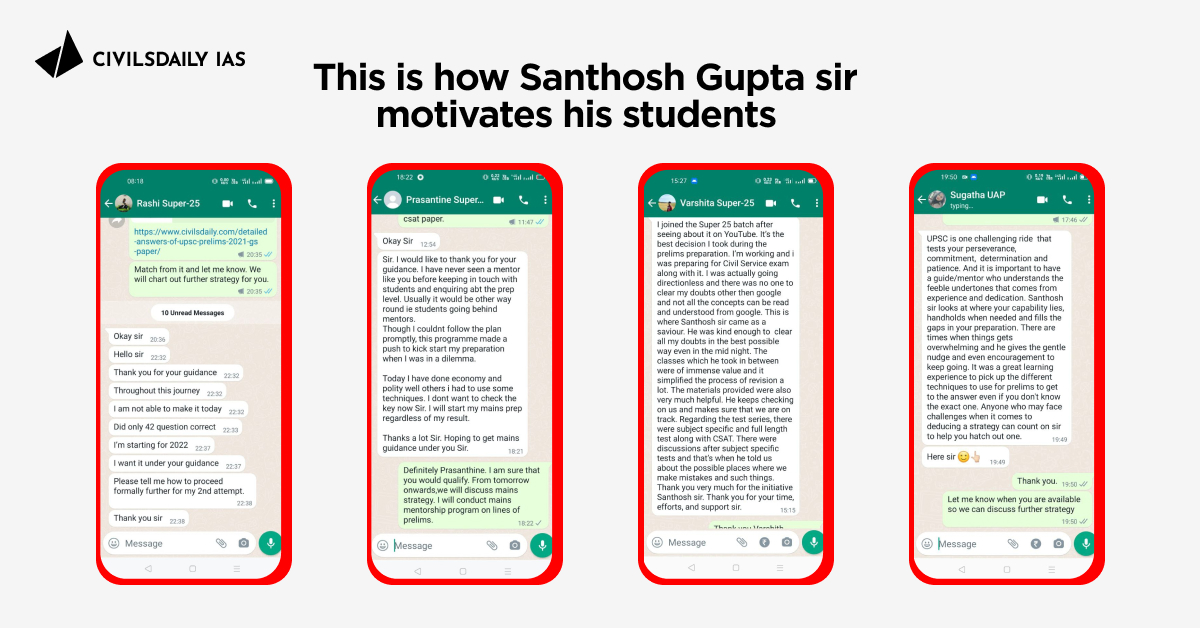
  • How to tackle the unpredictability of UPSC for IAS Prelims 2023-24? | Inside- video session by Santosh sir. Get a FREE mentorship call.

    How to tackle the unpredictability of UPSC for IAS Prelims 2023-24? | Inside- video session by Santosh sir. Get a FREE mentorship call.

    Is there any doubt that UPSC Prelims is the toughest stage? It is the great filter that weeds out the not-so-serious candidates but at times many serious ones too.

    Candidates need to hammer on the importance of logical thinking, develop an exam hall-specific mindset, and the art of intelligent guessing with good preparation as essential ingredients to crack the prelims exam for quite some time.

    Santosh sir here in this video gives explains why you should start preparing for UPSC 2023 right now. He touches upon five variables/factors that a student must consider at this moment: The Time factor, Priorities, Efforts, Guidance/Mentorship, and the most important of all- Right approach. Watch the video below.

    What he talks about in this video:

    A. 10+10+10 questions rule
    B. Balancing and using Knowledge vs Logic in attempting questions
    C. 4 types of questions and different types of logic
    D. Quantifying mistakes


    How to bounce back from failure in Prelims

    While there could be many reasons for failing in Prelims like insufficient syllabus coverage, mocks or test series not attempted, no proper planning, lack of conceptual understanding, etc but the major one is lack of guidance, preparation analysis, and course correction at regular intervals.

    To tackle all these Santosh sir, the mentor in chief for the CD Prelims program talks about 7 steps to smashing IAS Prelims

    1. Revising and covering syllabus through small measurable targets
    2. Make Short and smart notes of most important and relevant keywords/topics
    3. Attempting and analyzing past year UPSC Prelims papers (2000- 2022)
    4. Attempt Test:  Logical approach
    5. Analysis of the Mistakes: Fewer mistakes > Higher score through FCA/E approach 
    6. Revision of the topics where you made mistakes
    7. Analysis of the test, revision and discussion with Santosh sir
    Tavishi failed thrice in the Prelims before but after joining Santosh sir’s mentorship cleared Prelims 2022 in her 4th attempt. Schedule a call with Tavishi’s mentor

    (CLICK) SCHEDULE A CALL WITH TAVISHI’S MENTOR FOR FREE

    You are 8 times more likely to clear Prelims 2023 with Santosh sir’s mentorship

    SCHEDULE A FREE MENTORSHIP CALL FOR PRELIMS 2023 | GET SANTOSH SIR’S NOTES | CLICK AND FILL UP THE FORM


    You are 8 times more likely to clear Prelims 2023 with Santosh sir’s mentorship under the Smash Prelims program

    About Santosh Gupta sir

    Santosh Gupta sir has scored above 140 twice in UPSC prelims and always 120 plus in all 6 attempts. He wrote all 6 mains and appeared for Interviews 3 times. He has qualified UPSC EPFO and BPSC 56-59th also. He has been teaching and mentoring UPSC aspirants for the last 5 years.

    Success Stories by the students of Santosh sir

    From failing twice-thrice to clearing Prelims 2022
  • Get IAS Officer as Mentor

    with carefully designed Super Mentorship Program

    Unlock your full potential by learning that matter most and become IAS Officer in 1st Attempt

    Register for the Program

    [contact-form-7 id=”904d797″ title=”Ads_2″]

    To get up to 15% OFF on Course Fee

    What will you Get?

    Layer 1: You will be assigned a dedicated in-house mentor who will keep track of our progress from start till your final interview.

    Layer 2: Civilsdaily and the team will be constantly with you through various programs like Samachar Manthan, Prelims, Essay, etc.

    Layer 3: A UPSC IAS ranker (one who has cleared this exam) will be supervising your progress as your super mentor.

    Know your Super Mentors…

    many more

    Civilsdaily IAS Coaching Institute is one of the top UPSC coaching in India as it gives a well-planned route map to crack the Civil Service Exam.

    The Hindu has solemnly acknowledged Civilsdaily’s high rated mentorship program…

    UPSC Test series & Mock Test

    Did you Know?

    Every year, more than 25% of the officers selected through the UPSC Civil Services Examination are students of Civilsdaily.

    Over 200 Selections in UPSC CSE 2021 from Civilsdaily…

    Best Online Coaching for UPSC
  • Strong gender norms of japan reducing gender equality

    Gender norms Context

    • Japan ranked lowest among the developed countries in the World Economic Forum’s Global Gender Gap Index 2022 due to its prevalent gender norms.

    What Is a Gender-equal Society?

    • A society in which both women and men shall be given equal opportunities to participate voluntarily in activities in all fields as equal partners, and be able to enjoy political, economic, social and cultural benefits equally as well as to share responsibilities.

    What is sexism in simple words?

    • Prejudice or discrimination based on sex especially discrimination against women. Behaviour, conditions, or attitudes that foster stereotypes of social roles based on sex.

    What is the meaning of gender norms?

    • Gender norms are social principles that govern the behaviour of girls, boys, women, and men in society and restrict their gender identity into what is considered to be appropriate. Gender norms are neither static nor universal and change over time.

    Gender norms Persistent gender norms in japan

    • Men should work outside the home.
    • Genders should be brought up differently.
    • Women are more suited to household work and child rearing than men.
    • Full time housewives are valuable to society because of their family raising role.

    What is womenomic’s?

    • “Womenomics”, a theory linking the advancement of women to increased development rates. The concept, originally defined by the Japanese Prime Minister Abe.

    What is women’s empowerment all about?

    • Women’s empowerment can be defined to promoting women’s sense of self-worth, their ability to determine their own choices, and their right to influence social change for themselves and others.

    gender norms

    Measures toward the Realization of a Gender-equal Society

    • Promoting the Participation of Women in National Advisory Councils and Committees.
    • Recruiting and Promoting of Female National Public Officers.

    What is needed to improve women’s welfare?

    • Community sensitization: Persistent effort must be directed toward community sensitization to root out patriarchal social norms.
    • Directional efforts: In addition to enforcing existing regulations like minimum wages, there must be supportive ancillary policies including childcare; secure transport; lighting; safety at work; and quotas in hiring, corporate boards, and politics to foster more  women  in  leadership.

    Key fact

    Japan is the world’s fourth largest economy.

    Conclusion

    • Due to the labour shortage in Japan, women are undoubtedly an essential resource for the nation. Hence, they should also be further involved in policy-making and social decisions such as gender inequality solving and feasible Womenomic’s adjustments for the next future.

    Mains question

    Q. Japan’s struggle with gender parity teaches us that investing in women’s education and health may have limited impact if that society is trapped in gender norms that restrict women from capitalising these investments for themselves, the society and the country. Critically analyse.

    UPSC 2023 countdown has begun! Get your personal guidance plan now! (Click here)

More posts