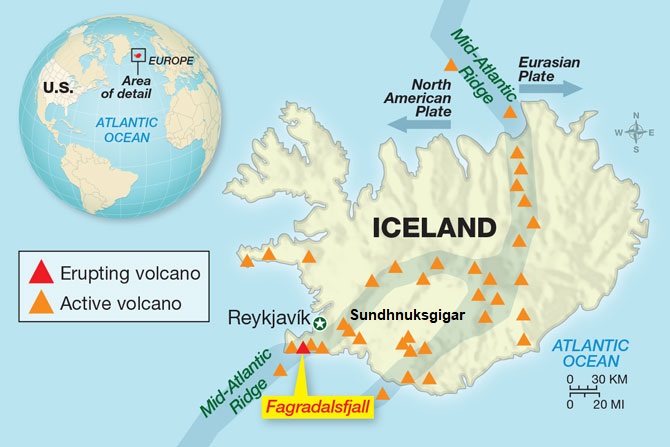
Southwest Iceland witnessed the eruption of the Sundhnuksgigar volcano, triggering evacuations in the nearby areas.
About Sundhnuksgigar Volcano
Sundhnuksgigar is a row of craters just outside the town of Grindavik on the Reykjanes peninsula
It is situated on the Mid-Atlantic Ridge, a divergent boundary where the Eurasian and North American tectonic plates are moving apart.
What is a Volcano?
A volcano is a fissure or vent in the Earth’s crust through which gases, molten rock materials (lava), ash, steam, sulphur dioxide etc., are expelled during an eruption.
These openings occur where the rock layers in the Earth’s crust are relatively weak.
Volcanic activity is categorized as an endogenic process, originating from within the Earth.
Depending on the explosivity of the volcano, various extrusive and intrusive landforms can be formed.
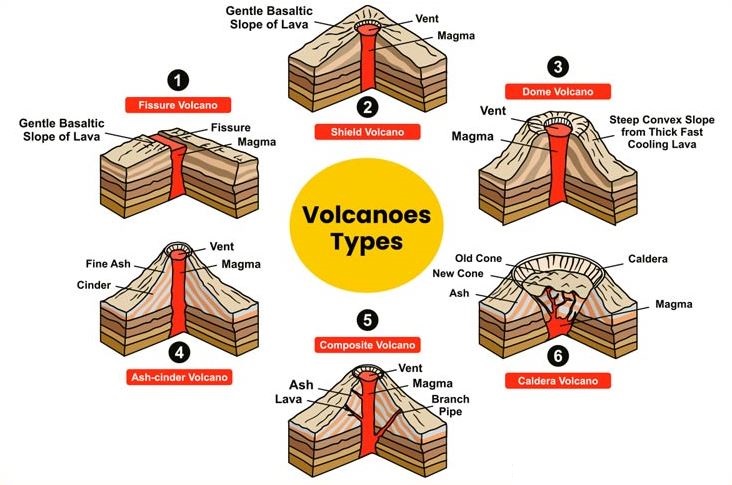
Different types of volcanoes can be classified based on the frequency of eruption and the nature of the eruption:
1. Frequency of eruption:
Active volcanoes: Frequent eruptions in Pacific Ring of Fire: New Zealand, Southeast Asia, Japan, western Americas. Linked to plate tectonics, like Kilauea and Santa Maria. High seismicity, volcanic activity.
Dormant Volcanoes: These are not currently erupting but have the potential to erupt again in the future. An example is Mount Kilimanjaro in Tanzania, the highest mountain in Africa.
Extinct or inactive volcanoes: These have not erupted in the distant geological past. Dhinodhar Hill in Gujarat is an example.
2. Nature of Eruption:
Shield Volcanoes: Largest and least explosive volcanoes, formed from basalt lava. Often low in explosivity, except when water interacts. Hawaiian volcanoes exemplify this..
Composite Volcanoes: Volcanoes with cooler, thicker lava, built up through explosive eruptions. Layer ash, pyroclastic material, and lava flow. Examples: Mayon, Fuji, Rainier.
Calderas: The most explosive volcanoes, prone to collapsing inward during eruptions rather than building upwards. The resulting depressions are called calderas.
Flood Basalt Provinces: These volcanoes erupt highly fluid lava that travels long distances, covering vast areas with thick basalt flows.
Reasons for Iceland’s Volcanism
Tectonic Activity: Iceland is situated on the Mid-Atlantic Ridge, where the Eurasian and North American plates diverge. This creates volcanic rift zones where magma rises to the surface, leading to eruptions.
Hotspots: Additionally, Iceland is positioned over a hotspot, contributing to heightened volcanic activity. Hotspots are areas where magma from the mantle rises towards the surface, fueling eruptions.
Subglacial Volcanism: Iceland’s volcanic activity is not limited to the surface; some eruptions occur beneath glaciers, leading to explosive interactions between lava and ice. These subglacial eruptions can produce powerful steam explosions, ash clouds, and catastrophic floods known as jokulhlaup.
PYQ:
[2021] Mention the global occurrence of volcanic eruptions in 2021 and their impact on the regional environment.
[2013] Consider the following:
Electromagnetic radiation
Geothermal energy
Gravitational force
Plate movements
Rotation of the earth
Revolution of the earth
Which of the above are responsible for bringing dynamic changes on the surface of the earth?
The James Webb Space Telescope (JWST), launched by NASA, has unveiled a groundbreaking find It has captured imagery of the universe’s earliest-known galaxy, revealing unexpected brightness and size given its formation during the universe’s infancy.
James Webb Space Telescope (JWST)
JWST is a joint venture between NASA, the European Space Agency (ESA) and the Canadian Space Agency (CSA) launched in December 2021.
It is an orbiting infrared observatory that will complement and extend the discoveries of the Hubble Space Telescope, with longer wavelength coverage and greatly improved sensitivity.
Webb was formerly known as the “Next Generation Space Telescope” (NGST) and it was renamed in 2002 after a former NASA administrator, James Webb.
It will be a large infrared telescope with an approximately 6.5-meter primary mirror.
JWST is positioned at the Earth-Sun L2 Lagrange point, 5 million km away.
It consists of a mirror, spanning 6.5 meters in diameter compared to Hubble’s 2.4 meters, as well as its specialized instruments optimized for infrared observations.
Key Objectives:
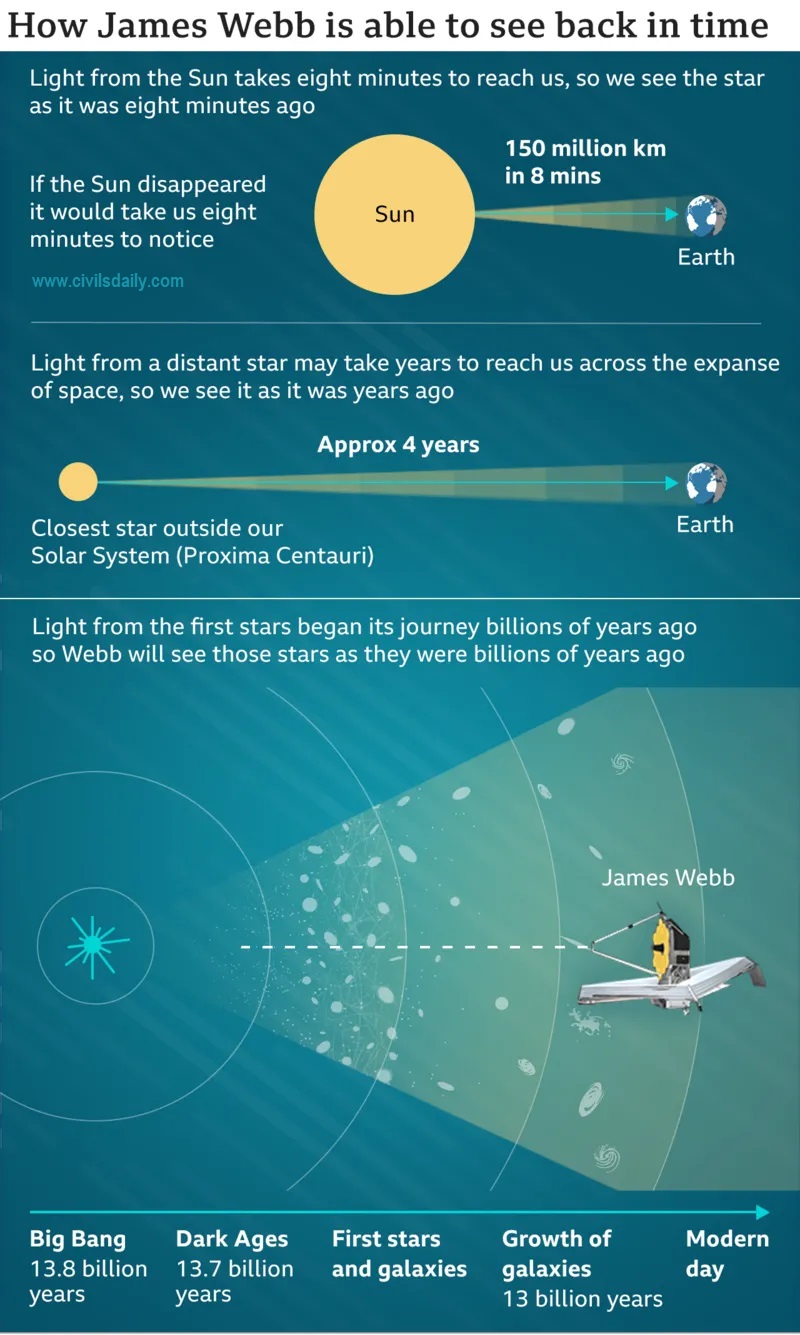
JWST observes deeper into the universe than Hubble.
Observes celestial objects from earlier epochs.
Enables the detection of light from the universe’s earliest stars, dating back over 13.5 billion years.
About JADES-GS-z14-0 Galaxy
Named JADES-GS-z14-0, this galaxy was formed approximately 290 million years after the Big Bang.
Spanning about 1,700 light-yearsacross, it consists of a mass equivalent to 500 million stars akin to our Sun.
Despite its ancient age, the galaxy is actively generating stars at a rapid pace, producing around 20 new stars annually.
Scientific Insights:
Historical Context: Previously, the earliest-known galaxy was dated to approximately 320 million years post-Big Bang, indicating the significance of this new discovery.
Luminosity Theories: While hypotheses suggest various explanations for the galaxy’s luminosity, including supermassive black holes or unusually bright stars, further research is required to validate these theories.
PYQ:
[2012] Which of the following is/are cited by the scientists as evidence/evidence for the continued expansion of the universe?
Detection of microwaves in space
Observation of redshift phenomenon in space
Movement of asteroids in space
Occurrence of supernova explosions in space
Select the correct answer using the codes given below:
Both Online Mode and Offline Mode (Delhi ORN Centre and Pune Centre)
Our open tests have the highest hit ratios because we follow 2 simple principles, 5 categories, and 80 themes.
1.4 categories of questions
The actual UPSC prelims paper can be said to follow broadly 5 categories – 1. Core, 2. Non-core, 3. Logical, 4. Ultra-hard (Skippable). We are aligning very closely with this distribution.
1. Core: These questions are from core sources like standard books, monthly magazines, and Atomic Notes. You are expected to answer ALL of these questions correctly.
[2023] Consider the following organizations/ bodies in India:
1. The National Commission for Backward Classes
2. The National Human Rights Commission
3. The National Law Commissions
4. The National Consumer Disputes Redressal CommissionHow many of the above are constitutional bodies?
(a) Only one
(b) Only two
(c) Only three
(d) All four
2. Non-core: These questions are 1 level above what is present in core sources. E.g. Political Parties during the freedom movement, Ancient Medieval terms, and terms around Buddhism Jainism.
[2023] Consider the following statements:
1. India has more arable area than China.
2. The proportion of irrigated area is more in India as compared to China.
3. The average productivity per hectare in Indian agriculture is higher than that in China.
How many of the above statements are correct?
(a) Only one
(b) Only two
(c) All three
(d) None
3. Logical: Not solvable by knowledge alone but through logical approach.
[2023] Consider the following statements:
1. Some mushrooms have medicinal properties.
2. Some mushrooms have psychoactive properties
3. Some mushrooms have insecticidal properties
4. Some mushrooms have bioluminescent properties.
How many of the above statements are correct?
(a) Only one
(b) Only two
(c) Only three
(d) All four
4. Ultra-hard (Skippable): Needs to be skipped (if attempted by student, it’s a case of over-attempt. Because knowing what not to attempt is as important as knowing what to attempt.
[2023] Consider the following fauna:
1. Lion-tailed Macaque
2. Malabar Civet
3. Sambar Deer
How many of the above are generally nocturnal or most active after sunset?
(a) Only one
(b) Only two
(c) All three
(d) None
2. 80 most repeated UPSC themes
We are being very precise. We won’t ask you a broad question on Species.
When it comes to high-profile species like tigers, elephants, and other critically endangered species, UPSC is asking for conservation efforts or behavioural patterns. We will ask you something similar. We are this detail-oriented.
This is true for all subjects. For instance, in Economics, detailed questions on inflation, bonds, differentiated banks, etc. are more difficult.
We have 80 detailed themes and our questions will be framed on similar lines.
[CSP2017]Q. The term ‘M-STrIPES’ is sometimes seen in the news in the context of
(a)Captive breeding of Wild Fauna
(b)Maintenance of Tiger Reserves
(c)Indigenous Satellite Navigation System
(d)Security of National Highways
[CSP2020]Q. Among the following Tiger Reserves, which one has the largest area under “Critical Tiger Habitat”?
(a) Corbett
(b) Ranthambore
(c) Nagarjunsagar-Srisailam
(d) Sunderbans
[CSP2021]Q. With reference to Indian elephants, consider the following statements:
1.The leader of an elephant group is a female.
2.The maximum gestation period can be 22 months.
3.An elephant can normally go on calving till the age of 40 years only.
4.Among the States in India, the highest elephant population is in Kerala.
Which of the statements given above is/are correct?
(a) 1 and 2 only
(b) 2 and 4 only
(c) 3 only
(d) 1, 3 and 4 only
Bonus – Top 50 will get FREE access to Dominate Prelims Test Series + Discount on Smash Mains Program!
Begin your UPSC Prep for 2025 by Guidance from Wardah Khan (IFS, AIR 18). It is an Open House event with Wardah as the our special guest to help new UPSC Aspirants with a Complete Preparation Strategy for UPSC 2025 – Prelims till Interview.
We are thrilled to have Wardha Khan (AIR 18) at Civilsdaily Delhi HQ.
She will be taking a session on a Comprehensive UPSC Strategy for 2025 Aspirants (Prelims till Interview).
About Wardha
Originally from Prayagraj, Wardha’s educational journey began in her hometown, but later shifted to Noida.
Despite numerous challenges (including failing the first attempt due to CSAT), she continued her education. She completed her schooling up to Class 10 and then pursued commerce. For her undergraduate studies, Wardha enrolled at Delhi University.
Initially motivated by a desire to contribute to her family’s financial stability, Wardha took up a corporate job. However, her aspiration to serve the nation through civil services led her to leave her job and fully dedicate herself to UPSC exam preparation.
Wardha’s journey is a testament to her resilience, determination, and the unwavering support from her mother. Her success story is truly inspiring.
Read what Wardah has to say about her way of preparation:
“Hi, I am Wardah Khan, and I have secured AIR 18 this year. The reason why I will be taking this Seminar is I don’t want serious aspirants to commit the same mistakes that I did.
While I was good in GS Paper (Prelims) in my first attempt, I flunked CSAT. It was tough, but I promised myself that I will come back stronger, and fortune favoured me this time.
Throughout my preparation journey, I relied heavily on Online Medium for preparation, and used PYQs extensively. This was the X-factor in this attempt, and I am sure that while you may have your way of preparation, preparing through PYQs is something which will act as a differentiator.
Join me Offline at Civilsdaily Delhi HQ, where I will be sharing a Step-by-Step preparation strategy from Prelims till the Interview, & share methodologies I used to clear this exam.”
Discuss Notes Making, Answer Writing, & PYQs based preparation with her.
Join Wardah OFFLINE at our Delhi Centre (3rd June, 2:30 PM)
The Koya tribe in Andhra Pradesh is facing a cultural crisis due to stricter liquor regulations enforced by the Special Enforcement Bureau (SEB).
About Koya tribe
Koya are one of the few multi-racial and multi-lingual tribal communities in India.
They live in the forests, plains, and valleys on both sides of the Godavari River which lies in Andhra Pradesh. Many also live in the states of Madhya Pradesh and Orissa.
They believe their main deity still resides in a cave in the Bastar region.
Cultural Crisis (Disruption of Traditions):
Mahua liquor is brewed from the flowers of the Mahua tree which is integral to Koya cultural and religious ceremonies including naming ceremonies, weddings, and death anniversaries.
Police raids and seizures of Mahua liquor disrupt these traditions causing cultural shocks within the community. For example, recently the naming ceremony of Madakam Janakamma’s child was held without Mahua liquor due to SEB raids.
Tribal Rights (Legal Challenges and Rights):
The Andhra Pradesh Prohibition Act, 1995, does not exempt the Koya tribe from brewing and storing Mahua liquor, despite its cultural significance.
The Panchayat (Extension to Scheduled Areas) Act (PESA), 1996empowers the gram sabha to protect tribal traditions and culture but its implementation is questionable as SEB raids continue unabated.
Koya villagers are often coerced into paying bribes to avoid legal charges, highlighting the tension between law enforcement and tribal rights.
Impact on Collection(Economic Consequences):
Many Koya households have ceased Mahua flower collection due to fear of police raids, significantly affecting their primary source of income.
Destruction of freshly collected flowers during raids further disincentivizes collection, reducing the supply of Mahua flowers to weekly markets (shandies) where they are exchanged for essential goods.
Guardians of Culture (Preservation of Heritage):
The Koya tribe, especially those not displaced by the Polavaram irrigation project, are seen as custodians of their culture. However, displacement and integration with non-tribal communities threaten their cultural identity.
Local leaders and activists argue for the need to empower Koya women with training in producing value-added products from Mahua flowers, rather than undermining their traditional practices and economic activities.
Legal and Policy Measures
Amend the Andhra Pradesh Prohibition Act, 1995: Introduce exemptions or special provisions that recognize and protect the traditional brewing and usage of Mahua liquor for cultural and religious purposes by the Koya tribe.
Strengthen Implementation of PESA Act: Ensure that the Panchayat (Extension to Scheduled Areas) Act (PESA), 1996, is fully implemented. Empower Gram Sabhas to have a greater say in protecting tribal traditions, including the brewing of Mahua liquor.
Conclusion: The enforcement actions by the SEB, while aimed at regulating liquor, pose a significant threat to the Koya tribe’s cultural heritage and economic well-being. Balancing legal regulations with respect for tribal traditions and rights is crucial to preserving the Koya way of life.
Mains PYQ:
Q What are the two major legal initiatives by state since Independence, addressing discrimination against Scheduled Tribes (ST) ? (UPSC IAS/2017)
A global report highlights a significant rise in unhealthy food consumption in India, surpassing intake of vegetables, fruits, and other nutritious foods.
Global Food Policy Report 2024: Food Systems for Healthy Diets and Nutrition was released by “theInternational Food Policy Research Institute (IFPRI)”.
About CGIAR:
CGIAR (formerly the Consultative Group on International Agricultural Research) is a global partnership uniting organizations engaged in research for a food-secure future.
Focus: Its mission focuses on reducing poverty, enhancing food and nutrition security, and improving natural resources and ecosystem services.CGIAR conducts research and partners with other organizations to transform global food systems and ensure equitable access to sustainable, healthy diets.
Emerging Trends in India:
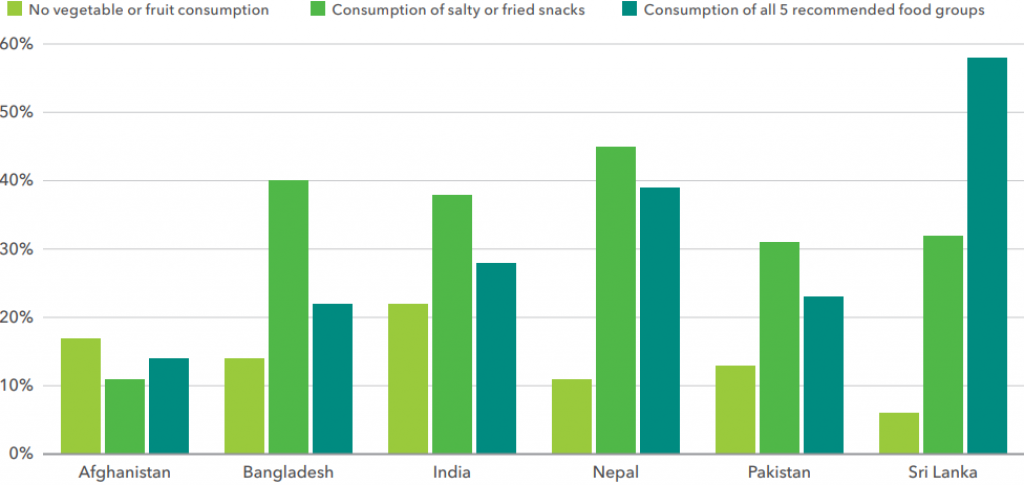
Increase in consumption of unhealthy food: There is a significant increase in the consumption of unhealthy foods such as salty or fried snacks compared to nutritious options like vegetables and fruits. About 38% of the population consumes unhealthy foods, while only 28% consume all five recommended food groups.
The consumption of processed foods and ready-made convenience foods is rising. From 2011 to 2021, malnutrition in India increased from 15.4% to 16.6%.The prevalence of overweight adults rose from 12.9% in 2006 to 16.4% in 2016.
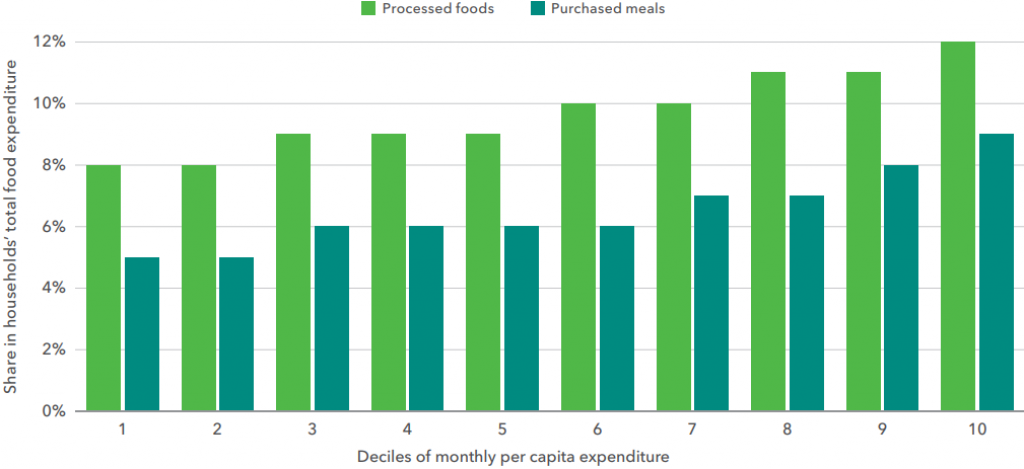
Processed food consumption is on the rise in India
South Asian Highlights
Processed Food Consumption: Increasing intake of processed foods like chocolates, salty snacks, beverages, and ready-made meals in India and other South Asian countries.
Malnutrition Rates: High levels of undernutrition and micronutrient deficiencies coexist with rising rates of overweight, obesity, and diet-related noncommunicable diseases (NCDs).
Food Budget Trends: Packaged food spending in India’s household food budgets nearly doubled from 6.5% to 12% between 2015 and 2019.
Issue of Double Malnutrition:
Double malnutrition refers to the coexistence of undernutrition and micronutrient deficiencies with overweight and obesity, or diet-related noncommunicable diseases (NCDs).
High levels of undernutrition (stunting and wasting) and micronutrient deficiencies persist even as overweight and obesity rates increase.
More than two billion people, especially in Africa and South Asia, cannot afford a healthy diet.
Dietary Guidelines by ICMR:
The Indian Council of Medical Research (ICMR) released 17 dietary guidelines to promote healthy eating.
Guidelines emphasize reading food labels to make informed choices and minimizing the consumption of high-fat, sugar, salt, and ultra-processed foods.
The guidelines highlight the importance of diverse diets over cereal-centric agriculture and food policies.
ICMR advises against the misleading information often presented on packaged foods.
Way forward:
Strengthen Nutritional Policies: Develop and enforce policies that promote the consumption of nutritious foods. Implement taxes on unhealthy foods and subsidies for fruits, vegetables, and other micronutrient-rich foods.
Regulate Processed Foods: Implement strict regulations on the marketing of unhealthy foods, especially targeting children.
Mains PYQ:
Q How far do you agree with the view that the focus on the lack of availability of food as the main cause of hunger takes the attention away from ineffective human development policies in India? (15) (UPSC IAS/2018)
On May 21, severe turbulence over Myanmar caused one death and 70 injuries on a Singapore Airlines flight. Qatar Airways had 12 minor injuries on May 26.
What is Turbulence?
Turbulence, unpredictable air motion caused by eddies and vertical currents, ranges from minor bumps to severe disruptions, often associated with fronts and thunderstorms.
Flight Turbulence
Types of Flight Turbulence
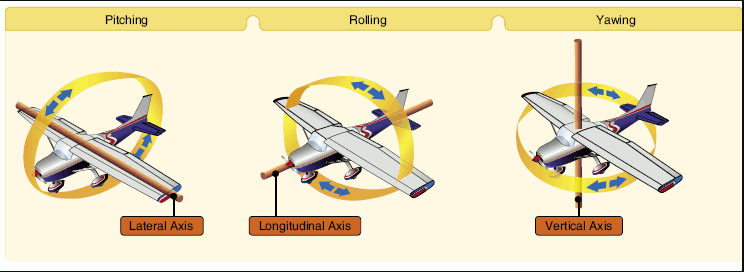
Note: Attitude is the angular difference measured between an aeroplane’s axis and the line of the Earth’s horizon.
Light Turbulence: Slight erratic changes in the aircraft’s orientation.
Moderate Turbulence: Notable changes in altitude and attitude, but the aircraft remains under control.
Severe Turbulence: Significant and sudden changes of altitude and attitude, momentarily losing control.
Extreme Turbulence: The aircraft is violently tossed about and is almost impossible to control.
Causes of Flight Turbulence
Mechanical Turbulence: Caused by friction between the air and the ground, especially over irregular terrain and man-made obstacles. Includes ‘mountain waves’ over mountain ranges.
Convective/Thermal Turbulence: Resulting from hot air rising rapidly and cooler air descending, creating convective air currents. Often occurs during the approach.
Frontal Turbulence: Created by the lifting of warm air by a sloping frontal surface and friction between opposing air masses, commonly near thunderstorms.
Wind Shear: Caused by changes in wind direction and/or speed over specific distances, found in temperature inversion areas, troughs, lows, and around jet streams.
Clear Air Turbulence (CAT): Occurs at high altitudes outside of clouds, often near jet streams, and is difficult to predict or see.
Impact of Climate Change on Flight Turbulence
Increased Incidence: Studies indicate a rise in severe turbulence, particularly CAT, with the growth in air traffic and climate change.
Jet Stream Intensification: Climate change strengthens jet streams, increasing the frequency and severity of turbulence.
Mountain Wave and Near-Cloud Turbulence: Predictions suggest these types of turbulence will also intensify with climate change, leading to more frequent and severe occurrences globally.
Way forward:
Safety Measures: Continuous improvement in aircraft design, weather forecasting, and pilot training helps mitigate the risks associated with turbulence.
Passenger Advice: Passengers are advised to keep their seat belts fastened as much as possible to avoid injuries during unexpected turbulence.
Regulatory Recommendations: Aviation authorities recommend better communication, real-time information sharing, and enhanced training to prevent turbulence-related incidents.
Mains PYQ:
Q Most of the unusual climatic happenings are explained as an outcome of the El-Nino effect. Do you agree? (UPSC IAS/2014)
The Centre for Citizen Science and Biodiversity Informatics, Kerala Forest Research Institute (KFRI), has organised the event “Monsoon Croaks Bioblitz 2024”.
About Monsoon Croaks Bioblitz, 2024:
This program aims to document Kerala’s frog species during the monsoon season.
Objective: Cultivate scientific curiosity among the public and raise awareness about frog conservation through social media platforms, such as posters and articles.
Bioblitz Definition: It’s an intensive survey conducted over time to identify and document as many species as possible within a designated area, a popular participatory survey method globally.
Project Details:
Participation: People of all ages can contribute by uploading frog photographs and sounds via the iNaturalist app.
Data Utilization: Scientific observations collected during the bioblits will contribute to the Global Biodiversity Information Facility (GBIF), facilitating biodiversity awareness, habitat conservation, and climate change research.
Need for such an event
Monsoon heralds a festive season for frogs, marking their peak activity and breeding period.
However, the survival of frogs, crucial indicators of ecosystem health, faces threats from climate change, habitat loss, and water pollution.
As a result, 41% of the world’s frog species are on the IUCN Red List of endangered species, including those in Kerala.
Results of 2023:
In 2023, KFRI conducted the Monsoon Croaks project, witnessing enthusiastic participation from citizens across Kerala.
Highlights: Around 200 citizen scientists uploaded 1,223 observations, identifying approximately 80 amphibian species, including those listed on the IUCN Red List.
Notable Species: The top most observed species is the Wayanad Bush Frog (Pseudophilautus wynaadensis).
Following closely is the Asian Common Toad (Duttaphrynus melanostictus).
Other important amphibian species recorded in the bioblitz include:
Indian companies “external commercial borrowings” nearly doubled in FY24, reaching $49.2 billion, according to RBI data.
Key Statistics:
Disbursements: ECB disbursements stood at $38.4 billion in FY24, a significant increase from $23.8 billion in FY23, underscoring the growing reliance on overseas markets for funding.
Domestic Pressure: High interest rates in the domestic system have led to increased pressure, prompting companies to explore ECBs as a viable funding alternative.
External Commercial Borrowing (ECBs) in India:
Details
Definition
Loans provided by non-resident lenders in foreign currency to Indian borrowers.
Usage
Widely used by Indian corporations and PSUs to access foreign funds.
Instruments Covered
Commercial bank loans, buyers’ credit, suppliers’ credit, securitised instruments (floating rate notes, fixed-rate bonds), credit from official export credit agencies, and commercial borrowings from multilateral financial institutions.
Regulation
Monitored and regulated by the Department of Economic Affairs (DEA) under the Ministry of Finance, Government of India, along with the Reserve Bank of India.
Contribution
Contributed between 20 and 35% of total capital flows into India in 2012.
Recent Changes
RBI raised ECB limit for infrastructure finance companies from 50% to 75% of owned funds.
Guideline Changes
RBI allowed all eligible borrowers to raise ECB up to USD 750 million per financial year under the automatic route (2019).
Utilisation of Funds
25% of ECB can be used to repay rupee debt; 75% should be allocated for new projects.
Regulatory Framework
Governed by the Foreign Exchange Management Act, 1999.
Routes for Raising ECBs
Automatic Route and Approval Route.
Automatic Route: Cases examined by AD (Authorized Dealer) Category-I Banks.
Approval Route: Borrowers submit requests to RBI through their AD banks for examination.
Maturity Period
ECBs can only be raised for a specific period known as the Minimum Average Maturity Period (MAMP).
Advantages Offered
ECBs offer the opportunity to secure substantial funding.
These funds typically come with longer-term repayment options.
Interest rates on ECBs are generally lower compared to domestic borrowing rates.
ECBs are denominated in foreign currencies, providing corporations with access to foreign currency to fulfil import needs such as machinery procurement.
PYQ:
[2019] Consider the following statements :
Most of India’s external debt is owed by governmental entities.
All of India’s external debt is denominated in US dollars.
Which of the statements given above is/are correct?
![[UPSC Topper Open House ’25/26] Prep Strategy for UPSC 2025 – Prelims till Interview](https://www.civilsdaily.com/wp-content/uploads/2024/06/Wardha_web_230-1-1-1568x882.jpg)