The 75th Independence Day coincides with another milestone in the country’s history — it was on August 15, 1972, that the Postal Index Number (PIN) was introduced in India.
As the PIN code turns 50 on Monday, we look at its history and evolution.
Why was the PIN code introduced?
According to the Department of Posts, there were 23,344 post offices, primarily in urban areas, in India at the time of Independence.
But, the country was growing rapidly and the postal network had to keep pace.
The PIN code was meant to ease the process of mail sorting and delivery in a country where different places, often, have the same or similar names, and letters are written in a wide variety of languages.
How does the PIN code work?
The PIN is made up of six digits.
The first number indicates the postal region — Northern, Eastern, Western, Southern; and number 9, which signifies the Army Postal Service.
The second number denotes a sub-region, and the third represents the sorting district.
The remaining numbers narrow the geography further to the specific post office making the delivery.
Who was the person behind the initiative?
The person behind the initiative was Shriram Bhikaji Velankar, additional secretary in the Union Ministry of Communications and a senior member of the Posts and Telegraphs Board.
Velankar was also a Sanskrit poet of eminence who had been conferred the President’s Award for Sanskrit in 1996, three years before he died in Mumbai.
He had set up a cultural group in Mumbai, called the Dev Vani Mandiram, which worked to create awareness about Sanskrit in India and foreign countries.
Velankar was also the chairman of the World Philatelic Exhibition, called Indipex, which was held in New Delhi in 1973 and featured 120 countries.
He retired from his government service on December 31, 1973.
What are some parallel systems followed world over?
Globally, in the US, the Zone Improvement Plan (ZIP) code was introduced July 1, 1963, under the aegis of the Postal Service Nationwide Improved Mail Service plan to improve the speed of mail delivery.
Under the old system letters went through about 17 sorting stops – the new system was going to be considerably less time-consuming utilizing newer, more mechanical systems.
Is the PIN code still relevant?
With the spread of the Internet, when people are sending fewer letters, it is easy to question the relevance of the PIN code.
But try to order food delivery or a parcel over online shopping and the importance of Velankar’s work in India will become evident.
Procrastination is the act of unnecessarily delaying or postponing decisions or actions. For a UPSC aspirant, it is a sure-shot killer of their IAS dream.
A certain UPSC dream killer.
You decide to study a particular topic or write answers for the day – You get distracted or are lazy or simply confused- You put off these for later and promise to do them tomorrow – That tomorrow never comes – You realize that you have wasted your time – You regret – You are sad the whole day thinking about it – You waste the whole day mourning your wasted time – You realize you have wasted another day – Days turn to weeks and weeks to months. And it is yet another wasted attempt.
Procrastination is often detrimental to people’s ability to successfully pursue their goals.
It also results in anxiety, low self-esteem, demotivation, low confidence, stress, and at times depression. A good chunk of UPSC aspirants face these issues.
CivilsDaily’s mentorship ensured Working Professional aspirants like Mourya, AIR 28 made the best use of the time they have. Click and Talk to Mourya’s mentor
We need to understand why we procrastinate
After talking to thousands of aspirants and Rankers from CivilsDaily we came to a conclusion that almost 99% of the aspirants procrastinate, to varying degrees. You are not alone. There are several reasons for putting things off for a later time:
1. Fear of failure, or performing badly in the initial stages of preparation is one of the chief reasons. Aspirants often feel underconfident and not prepared to start writing answers, or attempting a Prelims Mock.
2. Overthinking, mostly about irrelevant things – due to ignorance, excess of information. Most of the IAS aspirants waste a lot of time thinking a lot on the best resources, reading a lot of irrelevant books, discussing and fantasizing about various political concepts, etc. You gotta stop it.
3. Perfectionismor waiting for the most appropriate time– 95% is not good as 100%. But its a lot better than zero
It’s tempting to want the best UPSC resources, collect the finest of the notes, try to memorize every concept before you start writing your first answer, or attempt your first IAS Prelims mock.
Don’t wait till you have covered the whole GS syllabus to write your first Essay or first answer. Writing daily answers, even if they are not of UPSC standard will take you a long way to actually writing UPSC level answers in the actual UPSC Mains exam hall.
4. Fear of the wrong choice- any decision is better than no decision. But when a lot of time (attempts), finances, and efforts are at stake the informed decision is the best. Talk to a senior mentor to decide on optional, when, and how to start writing answers, when to start attempting the mock tests, and other important decisions.
5. Boring topics, culture, geography, CSAT, writing long essays. You can’t delegate here, and nor can you leave it, especially when you have time. Talk to some senior, mentor, or teacher who will point out important topics, will help make it a fun activity, or chart out a plan to cover the ‘boring topics’.
You need to understand the reasons why you are procrastinating before you can begin to tackle it.
Aspirants and people, in general, shy away from routines, timetables, systems, and processes because they want to have “freedom” or maybe due to ignorance. But in order to get things done, you need a process, bound by certain rules. It will include:
Breaking down the whole syllabus into small chunks (chapters and sections).
Setting a clear plan of action for the coming week and months, daily targets which are flexible as per your time requirement, and considering other factors. Click here to get a timetable made by UPSC Ranker
Make yourself accountable to the process or mentor so that you are executing (covering the syllabus, giving tests, etc.) on a daily basis.
Measuring your progress on a regular basis. This is best done by a senior or someone experienced who can evaluate your progress based on the tests, and answer writing.
Not fearing bad performance, but instead understanding where you went wrong and how to improve.
Why do you need a mentor to help you fight procrastination?
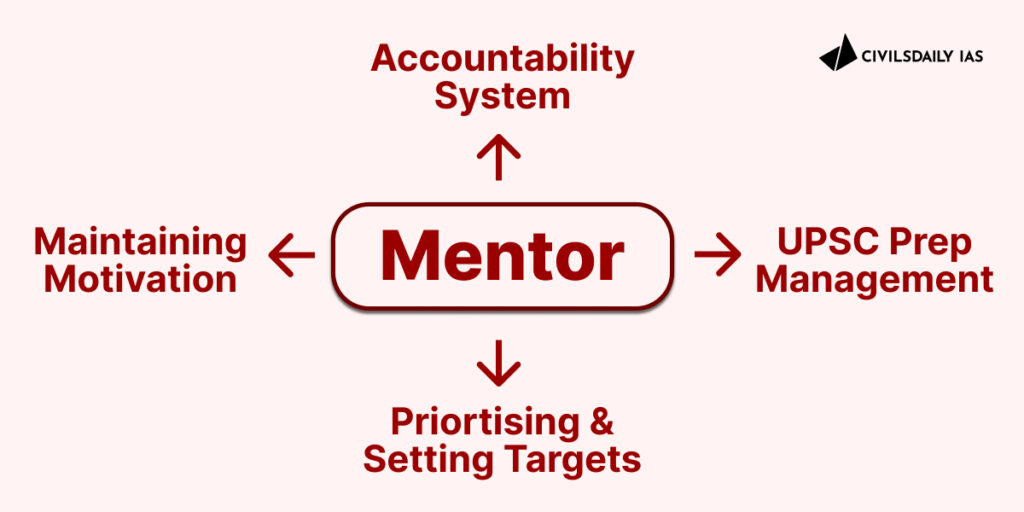
1. Setting an accountability system in place: If you make yourself accountable to someone else, you’re far more likely to achieve your goals. Ask them to check in on your progress from time to time.
2. Setting your own deadlines never works. We rarely respect self-imposed deadlines because we don’t feel too bad about breaking promises we’ve made to ourselves. But we do respect promises we make to others.
Introducing three layers of Mentorship with IAS/UPSC Ranker as your mentor.
3. Prioritising and target setting: A experienced mentor will help you prioritize topics beforehand and set targets. At times aspirants leave topics or subjects like Ethics, Optional till the post-prelims preparation phase. A mentor will integrate these into your preparation from the start.
4. Maintaining motivation and emotional self-control: Not always you will be in a jolly mood or motivated. UPSC prep is a long journey and there will be bouts of lows. An experienced mentor who has gone through the same journey helps in maintaining sanity during the UPSC process.
Mentoring UPSC aspirants like an elder brother.
How does Samanvaya Mentorship work? Introducing 3 layers of mentorship: Get IAS or UPSC ranker as your mentor
1. 1st step starts with this Samanvayacall: Once you fill in the form, we get on a 30-40 minute call with you to understand your prep level, working/ study constraints, and current strategies and create a step-by-step plan for the next week, next month and so on.
2. You are directed and given access to relevant resources and invite-only platform, Habitat where you can ask your daily doubts, discuss your test-prep questions and have real-time, live sessions on news and op-eds, and find your optional groups.
Daily target monitoring.
3. The third and the most personalized tier is the 1 on 1 mentor allotment who stays with you through the course of your UPSC preparation – always-on chat and on scheduled calls to help you assess, evaluate, and chart the next milestone of your IAS 2023-23 journey.
We will also connect you to a UPSC ranker or IAS, who will mentor you in this journey.
Layer 1: You will be assigned a dedicated in-house mentor who will keep track of our progress from start till your final interview.
Layer 2: Sajal Singh sir and the team will be constantly with you through various programs like Samachar Manthan, Prelims, Essay, etc.
Layer 3: A UPSC IAS ranker (one who has cleared this exam) will be supervising your progress as your super mentor.
Who are you?
Working Junta? If you are preparing for IAS 2023-24 and working simultaneously, we can help you design a timetable that fits right in your hectic schedule.
First-time prep? If you are in the last year of college or thinking of dropping a year and preparing for IAS 2023-24 full-time, we can help you pick the right books and craft a practical & personal strategy.
In our interaction with almost 12,000 working professional aspirants (those with a full-time job and preparing for UPSC CSE) over the past couple of months it was revealed that Time management and consistency were the major issue to their preparation.
This is something you aspirants can’t avoid and move on. This Sunday we conducted another power-packed FREE Masterclass session with an IPS officer.
Dilpreet Singh was a CivilsDaily’s mentorship and Samachar Manthan student. He was a Mechanical Engineer who cleared PCS twice and was a working professional at the time of his UPSC attempt which landed him an AIR 237 and IPS.
Why time management?
Time management with the help of a mentor makes your preparation effective.
Time management is a #UPSCskill that tops all other skills in this long journey. Moreover, the complexity and vastness of the syllabus, unpredictability and ever-changing pattern of the UPSC exam, and cut-throat competition necessitate you to invest your time wisely.
Over that, if you are a working professional, college student, or homemaker, and preparing for this exam, and if you don’t have a workable timetable, you won’t be able to stay consistent and your preparation will suffer.
There is no consistency and discipline without time-management. You need guidance for that.
Consistency is the key
Masterclass details
Dilpreet took up an interactive session (1-1 questions) from the aspirants on time management, timetable, and staying consistent. This session in particular is a must for UPSC aspirants who are working professionals and in general, for all aspirants with a serious time crunch.
Other than the points mentioned above we will be discussing the following issues as well.
Management of Priorities – UPSC, family, life, and work.
Reducing time on non-priorities and maintaining focus on daily and weekly targets.
Planning ahead, making targets, staying consistent w.r.t targets and your UPSC preparation.
How should the syllabus be approached to complete it 2 months before UPSC Prelims?
Balancing prelims-mains on one hand and GS-current affairs on the other.
How to determine the primary focus areas of the Prelims, Mains, and Personality tests?
How to apply bookish as well as classroom knowledge to the exam?
As we celebrate the nation @75 , we must also reflect on the mixed nature of our democracy
Definition of democracy
“Government of the people, by the people and for the people” were the words used by Abraham Lincoln in the year 1863 while talking about democracy.
Purpose of democracy
Cornerstones of democracy include freedom of assembly, association, property rights, freedom of religion and speech, inclusiveness and equality, citizenship, consent of the governed, voting rights, freedom from unwarranted governmental deprivation of the right to life and liberty, and minority rights.
Background
India is a parliamentary democratic secular republic in which the president of India is the head of state & first citizen of India and the prime minister of India is the head of government.
It is based on the federal structure of government, although the word is not used in the Constitution itself.
How it has performed
(1)Political front
India is the world’s the largest democracy proved success in accommodation of group and regional demands in a complex, quasi-federal, polity.
During the first general election in the 1951 India had 54 political parties and now it has grown up to 464 in the 2014 general election as an evident of deepening of the democratic process.
In the first General election 1951, 173 million citizens were given right to vote.
In the 16th general election in 2014, the size of the electorate had increased to 814 million.
(2) Social front
The democratic process has brought about a shift of political power from the middle and higher castes and classes of urban society to backward classes who are now the politically most influential ones in the country.
They have won reservations for themselves in legislatures and government services as were accorded to the Scheduled Castes and Scheduled Tribes after independence through Constitutional provisions.
(3) Economic Front
These include strategic affairs and security, politico-legal democratic governance as well as society and economy.
India has been able to emerge as a regional power in Asia and super power in south Asia backed by its economic, military and nuclear capabilities.
Contradictions in democracy
Performance of Bureaucracy: Dishonest officials to protect themselves from the consequences of their wrong-doings have largely exploited constitutional protection for the Services under Article 311.
Administration of Justice: Judicial system has not been able to meet even the modest expectations of the society. Its delays and costs are frustrating, its processes slow and uncertain. People are pushed to seek recourse to Extra-legal methods for relief. Trial system both on the civil and criminal side has utterly broken down.
Areas of Concern: There is a fundamental breach of the constitutional faith on the part of the Governments and their method of governance lies in the neglect of the people who are the ultimate source of all political authority.
Regionalism: Issues of national integrity and security have not received adequate and thoughtful attention. Mechanisms for the assessment of early warning symptoms of social unrest are absent.
Corruption: The increasing instability of elected governments is attributable to opportunistic politics and unprincipled defections.
Some positive suggestions to government
Feedback: The Government should hear criticism rather than rejecting it outrightly. Suggestions on eroding democratic values need a thoughtful, and respectful response.
Freedom of press: The press and the judiciary which are considered the pillars of India’s Democracy, require to be independent of any executive interference.
Opposition: strong democracy requires strong opposition. Without an alternative choice, the very objective of election to provide a check on arbitrary power gets defeated.
Way forward
The institutionalization of constitutional democracy has helped the people of India realize the importance of democracy and inculcate democratic sensibilities among them.
At the same time, it is important that all the government organs work in harmony to uphold the trust people of the country have held in them and ensure the objectives of true democracy.
Mains question
Q.We are celebrating Azadi ka amrit mahotsav India @75, trace the journey of democracy critically by providing some suggestions for robust democracy.
India’s biggest strength is its ‘demographic dividend’ and people need to fully leverage it to fast-track the country’s progress in various sectors
Why in news
The 2022 edition of the World Population Prospects (WPP) of the United Nations has projected that India may surpass China as the world’s most populous country next year.
The report estimates that India will have a population of 1.66 billion in 2050, ahead of China’s 1.317 billion around that time.
What is demographic dividend?
Demographic dividend, as defined by the United Nations Population Fund, is “the economic growth potential that can result from shifts in a population’s age structure, mainly when the share of the working-age population is larger than the non-working-age share of the population”.
Current status for India
India entered the demographic dividend opportunity window in 2005-06 and will remain there till 2055-56.
This is the period when the working age ratio is equal to or more than 150% and the dependency ratio is equal to or lower than 66.7%, generally taken as the cut-off for the demographic dividend window.
How India can leverage this dividend
(1) Investment in right direction
Investments in human and physical infrastructure will need to be scaled up dramatically to promote entrepreneurship and create jobs.
Investment in education is crucial for ensuring that working-age people are prepared for the demands of the economy.
Increase spending on health
Increase investments in Research and Development
(2) Absorption of labour into productive employment
Promote entrepreneurship and job creation
Service sector like tourism, logistics should be promoted
Skill development of the working-age population so that they can turn out to be productive for the country’s economy
Challenges in reaping this
Drastic quality improvement: India’s challenge is to create conditions for faster growth of productive jobs outside of agriculture, especially in the organized manufacturing and in services.
Severe shortages: India currently faces a severe shortage of well trained, skilled workers. Large sections of the educated workforce have little or no job skills, making them largely Unemployable.
Dismal health sector: A closer look implies various factors such as poor health which although obvious, play a major role in the poor performance of working population.
Socio economic dimensions: The status of institutions in India regarding caste discrimination, gender inequalities, widening income gap between the rich and the poor, religious differences, inefficient and slow legal system- all contribute to the poor standard of living of the masses.
Government steps
National Skill Development Corporation (NSDC): incorporated on 31st July, 2008, is a first-of-its-kind Public Private Partnership (PPP) in India set up to facilitate the development and upgrading of the skills of the growing Indian workforce through skill training programs.
National Skill Development Agency: Currently, skill development efforts are spread across approximately20 separate ministries, 35 State Governments and Union Territories and the private sector.
National Skill Certification and Money Reward Scheme: encouragement is given for skill development for youth by providing monetary rewards for successful completion of approved training programs.
Way forward
Strategies exist to exploit the demographic window of opportunity that India has today, but they need to be adopted and implemented.
The dreams of huge income flow and resultant economic growth due to demographic dividend could be realized only when we inculcate the required skills in the work force to make it as competent as its counterparts in the developed world.
Important data for mains
India’s working-age population has numerically outstripped its non-working age population.
India’s total fertility rate (TFR) has declined from 2.2 in 2015-16 to 2.0 in 2019-21, indicating the significant progress of population control measures, revealed the report of the fifth round of the National Family Health Survey (NFHS-5).
TheTFR is the average number of children born to a woman in her lifetime.
Mains question
Q. Do you think the right has come that India should adopt moving away policy from population control towards reaping its demographic dividends? Critically examine.
The Ministry of Social Justice and Empowerment (MoSJ&E) is now preparing to undertake a nationwide survey to enumerate all people engaged in the hazardous cleaning of sewers and septic tanks.
Why such move?
Cleaning of sewers and septic tanks has led to at least 351 deaths since 2017.
Various initiatives for sanitation workers
The ministry now has proper distinction between sanitation work and manual scavenging.
The practice of manual scavenging no longer takes place in the country as all manual scavengers had been accounted for and enrolled into the rehabilitation scheme, said the ministry.
The enumeration of sanitization workers is soon to be conducted across 500 AMRUT (Atal Mission for Rejuvenation and Urban Transformation) cities, as a part of National Action Plan for Mechanised Sanitation Ecosystem (NAMASTE).
The NAMASTE scheme aims to eradicate unsafe sewer and septic tank cleaning practices.
Manual Scavenging in India
Manual scavenging is the practice of removing human excreta by hand from sewers or septic tanks.
India banned the practice under the Prohibition of Employment as Manual Scavengers and their Rehabilitation Act, 2013 (PEMSR).
The Act bans the use of any individual for manually cleaning, carrying, disposing of or otherwise handling in any manner, human excreta till its disposal.
In 2013, the definition of manual scavengers was also broadened to include people employed to clean septic tanks, ditches, or railway tracks.
The Act recognizes manual scavenging as a “dehumanizing practice,” and cites a need to “correct the historical injustice and indignity suffered by the manual scavengers.”
Why is it still prevalent in India?
Low awareness: Manual scavenging is mostly done by the marginalized section of the society and they are generally not aware about their rights.
Enforcement issues: The lack of enforcement of the Act and exploitation of unskilled labourers are the reasons why the practice is still prevalent in India.
High cost of automated: The Mumbai civic body charges anywhere between Rs 20,000 and Rs 30,000 to clean septic tanks.
Cheaper availability: The unskilled labourers, meanwhile, are much cheaper to hire and contractors illegally employ them at a daily wage of Rs 300-500.
Caste dynamics: Caste hierarchy still exists and it reinforces the caste’s relation with occupation. Almost all the manual scavengers belong to lower castes.
Various policy initiatives
Prohibition of Employment as Manual Scavengers and their Rehabilitation (Amendment) Bill, 2020: It proposes to completely mechanise sewer cleaning, introduce ways for ‘on-site’ protection and provide compensation to manual scavengers in case of sewer deaths.
Prohibition of Employment as Manual Scavengers and their Rehabilitation Act, 2013: Superseding the 1993 Act, the 2013 Act goes beyond prohibitions on dry latrines, and outlaws all manual excrement cleaning of insanitary latrines, open drains, or pits.
Rashtriya Garima Abhiyan: It started national wide march “Maila Mukti Yatra” for total eradication of manual scavenging from 30th November 2012 from Bhopal.
Prevention of Atrocities Act: In 1989, the Prevention of Atrocities Act became an integrated guard for sanitation workers since majority of the manual scavengers belonged to the Scheduled Caste.
Compensation: As per the Prohibition of Employment of Manual Scavengers and their Rehabilitation (PEMSR) Act, 2013 and the Supreme Court’s decision in the Safai Karamchari Andolan vs Union of India case, a compensation of Rs 10 lakh is awarded to the victims family.
National Commission for Safai Karamcharis (NCSK): It is currently a temporary non-statutory body that investigates the conditions of Safai Karamcharis (waste collectors) in India and makes recommendations to the Government.
Not every UPSC aspirant has an IAS uncle or bhaiya to guide them in this UPSC journey. Moreover, due to the sheer competition in this exam, vast and complex syllabus, and the unpredictable nature of UPSC clearing this exam becomes a task not all can achieve.
Aspirants due to lack of guidance get stuck in a vicious cycle of back-to-back failures. We at CivilsDaily understand the importance of mentorship and we have upgraded our mentorship program to include three layers in Super Mentorship Program:
Layer 1: You will be assigned a dedicated in-house mentor who will keep track of our progress from start till your final interview.
Layer 2: Sajal Singh sir and the team will be constantly with you through various programs like Samachar Manthan, Prelims, Essay, etc.
Layer 3: A UPSC IAS ranker (one who has cleared this exam) will be supervising your progress as your super mentor.
Baloch separatism under the Baloch Liberation Army (BLA) has been an ongoing issue in Pakistan since the birth of the nation in 1947.
Who are the BLA fighters?
The BLA announced itself in 2005 with a rocket attack on a paramilitary camp in Balochistan Kohlu during a visit by then President Pervez Musharraf.
It is a nationalist militant group that has been waging an insurgency for Baloch self-determination and a separate homeland for the Baloch people.
Rise of Baloch nationalism
While the BLA’s armed insurgency is about two decades old, demands of Baloch nationalists for political autonomy and threats of secession date back to 1947.
The Khan of Kalat (who claimed sovereignty over the four princely states of Kalat, Lasbela, Kharan and Makran) held out for independence, and the Pakistan Army forced his accession in March 1948.
Between 1973 and 1977, the Zulfikar Ali Bhutto-led government sent in the Pakistan Army to crush a leftist guerilla war inspired by the liberation of Bangladesh.
The tribal sardars of Balochistan, who had been at the forefront of Baloch nationalism, and were co-opted by the state in the late 1970s, grew rebellious again.
The insurgency gathered momentum from 2006, after the Pakistan Army killed the Bugti sardar, Nawab Akbar Khan Bugti, who had been also been a chief minister and governor of the province.
Why it is gaining momentum now?
The Pakistan Army’s operations against Baloch nationalists over the last two decades have seen hundreds of disappearances, and other alleged human rights violations.
Baloch nationalists also see the sudden influx of jihadist groups in the province as a move by the Pakistan security establishment to counter their nationalist demands.
In 2012, the US Congress convened a hearing on Balochistan and supported the demand for a free Baloch land.
In a significant shift in policy, back then in 2016, PM Modi had made a reference to the Baloch freedom struggle in his Independence Day speech.
Why does Balochistan matters?
Balochistan borders Afghanistan and Iran.
The people are mostly tribal with secular principles and are admirers of ties with India.
With gas, oil, copper and gold deposits, it is the most resource-rich of Pakistan’s four provinces.
It makes up half of Pakistan’s area, but has only 3.6% of its population.
Pakistan alleges that theinsurgency is backed by India.
This is the region where a former Indian Navy officer Kulbhushan Jadhav was abducted from Iran and charged for espionage supporting Baloch activism in Pakistan.
Many Baloch activists had beenseeking asylum and has applied for Indian citizenship. New Delhi neither confirmed nor deny the reports.
Why did BLA target the Chinese now?
The BLA claimed it attacks Chinese nationals because Beijing ignored warnings not to enter deals and agreements regarding Balochistan before the province had been “liberated”.
Baloch people see China-Pakistan Economic Corridor (CPEC) as a neo-colonist move against their sovereignty.
Among China’s major projects in Balochistan is the port of Gwadar, strategically located near the Strait of Hormuz – a crucial oil shipping route in the Arabian Sea.
The security of its nationals in Pakistan has become a major issue for Beijing, especially since it launched the CPEC.
Such attacks has literally stalled the work in progress of CPEC projects making it a sheer failure.
Significance of recent events
It is rare that the BLA deployed female suicide bombers. Recent attack was done by a highly educated lady and mother of two.
This is also the first time that a non-jihadist ethno-nationalist group has deployed a woman suicide bomber in the manner of Sri Lanka’s LTTE.
According to security experts familiar with the Baloch insurgency, it marks a worsening security situation in Pakistan.
As the training camps are alleged by Pakistan to be in Afghanistan, the incident may also be a pointer to Pakistan’s loss of control over the Talibans.
The Centre has invoked the Essential Commodities Act of 1955 to ask States to monitor and verify the stocks of Arhar/Tur Dal available with traders.
Essential Commodities Act
The ECA, 1955 was established to ensure the delivery of certain commodities or products, the supply of which, if obstructed due to hoarding or black marketing, would affect the normal life of the people.
The list of items under the Act includes drugs, fertilizers, pulses, and edible oils, as well as petroleum and petroleum products.
The Centre can include new commodities as and when the need arises, and takes them off the list once the situation improves.
Additionally, the government can also fix the maximum retail price (MRP) of any packaged product that it declares an “essential commodity”.
How ECA works?
(1) Centre notifying stock limit holding
If the Centre finds that a certain commodity is in short supply and its price is spiking, it can notify stock-holding limits on it for a specified period.
The States act on this notification to specify limits and take steps to ensure that these are adhered to.
Anybody trading or dealing in the commodity, be it wholesalers, retailers or even importers are prevented from stockpiling it beyond a certain quantity.
(2) States can opt-out
A State can, however, choose not to impose any restrictions.
But once it does, traders have to immediately sell into the market any stocks held beyond the mandated quantity.
What happens for non-compliance?
As not all shopkeepers and traders comply, State agencies conduct raids to get everyone to toe the line and the errant are punished.
The excess stocks are auctioned or sold through fair price shops.
This improves supplies and brings down prices.
Ex: The Union Government has brought masks and hand-sanitizers under the ECA to make sure that these products, key for preventing the spread of Covid-19 infection, are available to people at the right price and in the right quality. Later this move was reverted.
The government utilizes the buffer of agri-horticultural commodities like pulses, onion, etc. built under Price Stabilization Fund (PSF) to help moderate the volatility in prices.
Recent amendments to the ECA
In 2020, the EC Act was amended for the stock limit to be imposed only under exceptional circumstances such as famine or other calamities.
Exceptional circumstances: It allowed the centre to delist certain commodities as essential, allowing the government to regulate their supply and prices only in cases of war, famine, extraordinary price rises, or natural calamities.
Commodities de-regulated: The commodities that have been deregulated are food items, including cereals, pulses, potatoes, onion, edible oilseeds, and oils.
Exceptions provided
The government regulation of stocks will be based on rising prices, and can only be imposed if there is
A 100% increase in retail price in the case of horticultural produce and
A 50% increase in retail price in the case of non-perishable agricultural food items
These restrictions will not apply to stocks of food held for public distribution in India.
The Social Justice and Empowerment Ministry has launched the ‘SMILE-75’ initiative for comprehensive rehabilitation of persons engaged in begging in 75 identified municipalities as a part of the celebrations of 75 years of Independence.
SMILE Scheme
SMILE is an acronym for Support for Marginalised Individuals for Livelihood and Enterprise.
This scheme is a sub-scheme under the ‘Central Sector Scheme for Comprehensive Rehabilitation of persons engaged in the act of Begging’.
It also focuses on rehabilitation, provision of medical facilities and intervention, counselling, education, skill development, economic linkages to transgender persons.
It covers several comprehensive measures including welfare measures for persons who are engaged in the act of begging.
The focus of the scheme is extensively on rehabilitation, provision of medical facilities, counselling, basic documentation, education, skill development, economic linkages and so on.
Its implementation
The scheme would be implemented with the support of State/UT Governments/Local Urban Bodies, Voluntary Organizations, Community Based Organizations (CBOs), institutions and others.
The scheme provides for the use of the existing shelter homes available with the State/UT Governments and Urban local bodies for rehabilitation of the persons engaged in the act of Begging.
In case of the non-availability of existing shelter homes, new dedicated shelter homes are to be set up by the implementing agencies.