The Ukraine crisis has come to a head with Russia biting the bullet and launching “a full-scale invasion of Ukraine.
Russian invasion and response of the West
Hours before the invasion, the western countries had imposed a new round of sanctions against Moscow (targeting Russian individuals and banks linked to Mr. Putin’s regime).
German Chancellor Olaf Scholz suspended certification of Nord Stream 2, a major gas pipeline between Russia and his nation.
The European Union has announced a “massive” package of sanctions.
Incoherence in response: the West has been incoherent in its response — not being able to present a united front, and worse, not even speaking the same language at times.
For the West, this has been a moment when it has been found wanting — a lack of imagination, lack of will and lack of leadership, all rolled into producing a lackadaisical response to the one of most serious security crises in decades.
France has used this moment of crisis in trying to showcase its own leadership credentials.
Lack of trans-Atlantic engagement: It turns out that even Mr. Biden has not been able to build the trans-Atlantic engagement around common objectives to be pursued collectively.
Energy dependence: With the EU importing 39% of its total gas imports and 30% of oil from Russia, and with the Central and Eastern European countries being almost 100% dependent on Russian gas, the reasons for internal EU dissonance are not that difficult to fathom.
Implications for Indo-Pacific
Emboldening China: This ineffectual western response has emboldened not only Russia but also China as the focus of the West is in danger of moving away from the Indo-Pacific.
The Russia-China ‘axis’ is only getting stronger as the two nations seem ready to take on the West that seems willing to concede without even putting up a fight.
Conclusion
Today, the balance of power is once again in flux, and as China develops a strategic partnership with Russia, the future of the West-led global order will be defined by how effectively it responds to the crisis in Ukraine.
On February 24, Russian President Vladimir Putin launched “special military operations” with the objective of “demilitarising Ukraine” but not “occupying” it.
Why it was a crisis in the making?
Redrawing national boundaries by force: After 1945, this is the second time that national boundaries are being redrawn by force; the first was the 1999 North Atlantic Treaty Organization (NATO) air strikes on Serbian forces that led to the creation of Kosovo.
Russian and Chinese protests about NATO undertaking “out of area operations” without United Nations Security Council approval carried little weight.
After the fall of the Berlin Wall in late-1989, then U.S. Secretary Of State had assured the Soviet President that “there would be no extension of NATO’s jurisdiction one inch to the east”.
Rather than look for a new European security framework, the newly independent Baltic and central European states sought security in a U.S.-led NATO.
Beginning in 1999, NATO has added 14 new members in stages.
At the NATO summit in 2008, at U.S. President George Bush’s urging, an in-principle opening for Ukraine and Georgia was announced, though France and Germany, conscious of Russian concerns, successfully opposed defining a time frame.
Later that year, Russia intervened in Georgia on the grounds of protecting the Russian minorities and took over the northern provinces of Abkhazia and South Ossetia.
Annexation of Crimea: In 2014 Mr. Putin annexed Crimea.
For Russia, Crimea is vital as the peninsula hosts Russia’s Black Sea fleet, providing it access to the Mediterranean and its bases at Latakia and Tartus in Syria.
Despite no timeline for membership, Ukraine was made a NATO Enhanced Opportunity Partner in 2020.
The presence of British and U.S. warships in the Black Sea began to increase.
In 2019, the U.K. entered into a cooperation agreement with Ukraine to develop two new naval ports, Ochakiv on the Black Sea and Berdyansk on the Sea of Azov, a move that Russia saw as potentially threatening.
Beginning with NATO’s bombing of Serbia in 1999, interventions in Afghanistan, Iraq and Libya and colour revolutions to engineer regime changes, the U.S.’ unilateral withdrawal from the Anti-Ballistic Missile (ABM) Treaty in 2002 coupled with missile defence deployments in Poland and Romania, Russia’s grievances were accumulating.
Faltering diplomacy
France and Germany initiated talks between Ukraine and Russia under the Normandy format leading to the Minsk agreements, in 2014 and 2015.
The first was for a ceasefire between Ukraine and the Russian-backed separatists and the second was between Ukraine, Russia, the two separatist regions of Luhansk and Donetsk and the Organization for Security and Co-operation in Europe (OSCE).
Supportive declarations by France and Germany were intended to address Russian security concerns.
Ukraine undertook to introduce certain constitutional amendments to provide a degree of autonomy to the two provinces and Russia was to assist in withdrawal of all foreign forces.
However, neither side implemented and positions have only hardened since.
Russia’s threatening moves made NATO members, especially the Baltic states (Estonia, Latvia and Lithuania) and the central Europeans like Poland and Romania, especially nervous.
Finally, NATO remained united but unable to provide an off-ramps solution.
Implications for Russia
NATO has been rejuvenated, the trans-Atlantic unity strengthened and Russia’s economic ties with Europe have been adversely impacted.
Given Russia’s considerable foreign exchange reserves, of nearly $640 billion, sanctions imposed by the U.S. and EU may not hurt immediately but eventually will begin to bite both the oligarchs and the common people.
Worse, Russia will become more dependent on China — for political support as well as a market for its energy exports.
This will eventually weaken its hand in central Asia.
Conclusion
For Mr Putin challenge is to constrain the adversary’s options while increasing one’s own options and space for manoeuvre. His actions this week may yield tactical gains but hardly pass the test for strategic victory.
For the past 1 year, you might be learning in a way where you know there are gaps but you are unable to bridge them. It is possible that you have revised the syllabus 5-10 times, it is also possible that you have solved 1000s of MCQs and it is quite possible that you have given 2-3 attempts. Yet you are scoring in the 90s and failed to qualify for Prelims by a whisker.
It’s now all about fast tracking your learning and making the best use of these 100 days to change your prelims result altogether.
Did you know that a score of 85 can be increased to 110 with just 10 correct questions? Only 10 correct questions can help you get 26.66 marks!
Now that you are convinced that it’s not all that hard to score above 120+ in Prelims, Santosh sir will tell you how can you see this improvement in the next 100 days.
What will you Learn in this Free Live Webinar by Santosh Sir
1. What is the 5-point strategy to keep in mind for Prelims 2022? It’s never to late to implement them even if you have missed these for long.
2. What are the Prelims Specific Focus topics for 2022? Know the static + current affairs topics under each subject with maximum weightage.
3. What is the 3-step process for 5 revisions till prelims? In case you have only done few revisions till now, know how to squeeze two more revisons for all subjects.
4. How to maintain consistency for the next 100 days? Have 4 study slots in a day.
5. Surprise questions from current affairs. Based on Previous Year Papers, what were the surprise questions in the preceding years and what can be expected this year?
6. Last minute notes for last minute revision. How to make quick-shorthand notes which you can revise a day before exam?
7. What are the difficult topics in every subject which can negatively affect your Prelims score? Know the sources to refer to improve your conceptual clarity.
The last 15 minutes of the session will be in Q&A format and all participants are welcome to clear their doubts with Santosh Sir.
Prelims might only be the first stage of UPSC, but it’s undoubtedly the toughest one. Sometimes, staying focused and knowing in-and-out of the exam is the only way to remain optimistic and confident.
It is being perceived as a tightrope walk for India, taking a more neutral stance on the Russia-Ukraine war.
It is widely said that India’s statement at the UN lacked condemnation of the Russian invasion.
War makes no sense to anyone. But during these circumstances, we may raise one question:
“Why the West is pretending to need India against the war in Ukraine?”
Ans. For a country that claims to be a vishwaguru or world teacher, India’s shortsighted stance on critical geopolitical is a big surprise to the world.
Another narrative is– The west in spite of averting the crisis alone, is seeking our help. They are just trying to demonize India (as they usually did). They understand India’s interests and compulsions perfectly.
India-Ukraine Relations: A backgrounder
With a population of over 40 million and an area of about 600,000 sq km, Ukraine is one of the largest countries in Europe.
India has an extensive bilateral relationship with Ukraine, spanning all spheres of cooperation. India was one of the first countries to recognize Ukraine.
India recognized the Republic of Ukraine as a sovereign country in December 1991 and established diplomatic relations in January 1992.
The Embassy of India in Kyiv was opened in May 1992. Ukraine opened its Mission in Delhi in February 1993 – its first in Asia.
(1) Trade
Bilateral trade between the two countries has grown significantly in the last 25 years.
As per data from the Indian government, the bilateral trade between the two nations stood at $2.3 billion so far this fiscal, compared with $2.5 billion in the last fiscal (FY21).
India is Ukraine’s largest export destination in the Asia-Pacific and the fifth largest overall export destination.
(2) Diplomacy
India and Ukraine have signed several MOUs/Agreements in many spheres.
These include Diplomatic relations, visa matters, consular matters, trade and commercial matters, space, science and technology, defense, etc.
(3) Culture
There is a great interest in Indian culture in Ukraine at the public level, covering various aspects such as dances, yoga, philosophy, Ayurveda and spirituality.
Many Indian movies have also been shot in Ukraine, for example most recent being the ‘Bahubali 2: The Conclusion’.
A small but vibrant Indian community lives in Ukraine, comprising mostly of business professionals and students.
There are about 18,000 Indian students studying in Ukraine, mainly in the field of medicine.
Why is Russia invading Ukraine now?
Undoing historic injustice: President Putin has frequently accused Ukraine of being taken over by extremists, ever since its pro-Russian president, Viktor Yanukovych, was ousted in 2014 after months of protests against his rule.
Ukraine’s affinity towards West and NATO: Russia has long resisted Ukraine’s move towards the European Union and the West’s defensive military alliance, NATO.
So-called ‘oppression’ in Ukraine: It is now clear that Russia is seeking to overthrow Ukraine’s democratically elected government. Its aim is that Ukraine be freed from oppression and “cleansed of the Nazis”.
Why is this war a no-lesser significant event?
Russia’s attack on Ukraine’s sovereignty and territorial integrity is a clear violation of the rules-based international order.
First war of the century: These are terrifying times for the world, witnessing a major power invading a European neighbour for the first time since World War II.
Annexation of a democratic nation: For Europe’s leaders, this invasion has brought some of the darkest hours since the 1940s.
Covid disruptions: The global economic landscape, in a post-Covid situation, is in a shambles.
Intense militarization: The military industrial complex everywhere will be strengthened. As more and more armament is used up in the conflicts and more arms are manufactured.
Heading up towards mutually assured destruction
India’s position on this war so far
(1) India is subtle to Russia
New Delhi has taken a subtle pro-Moscow position on the question of Russian attacks against Ukraine.
This pro-Russia tilt is not just the position of the Indian government, but is something, somewhat surprisingly, shared by much of the Indian strategic community as well.
(2) Evacuation of Indians remain a priority
Ukraine has sought India’s support in its fight against the Russian forces.
In an emotional appeal, Ukrainian ambassador urged PM Modi for a personal intervention.
Hundreds of Indian students remain stranded in Ukraine and its border which is seemingly India’s topmost priority.
How would the war impact India?
(1) Economic Impact
This war has immediate consequences for global trade, capital flows, financial markets and access to technology.
It can hurt Asia through multiple channels, such as:
Tighter global financial conditions
Elevated uncertainty and the risk of weaker global demand
Higher commodity prices, especially oil
(2) Impact on diaspora
According to Ukraine’s Ministry of Education and Science, there are around 18,095 Indian students in the country. In 2020, 24 per cent of its overseas students were from India.
Ukrainian medical colleges are a godsend for students who are unable to get seats in government colleges or afford the hefty prices charged by private institutions in India.
(3) Geo-political impact
(discussed below)
India’s dilemma
India may not share a border with either Russia or Ukraine, and as many intellectual elites have already argued, the case for New Delhi not taking sides is straightforward.
The West’s critical sanctions will inhibit any nation (including India) from doing business with Russia and potentially diversify Russia-India ties.
India needs Russia
Arms trade: Russia is one of India’s largest arms suppliers and a key strategic ally. More than half of India’s arms imports between 2016-2020 were from Russia.
Independent foreign policy: India’s special and privileged strategic partnership with Russia as a totem of Indian strategic autonomy.
Multi-polarity and institutional reforms: India shares Russia’s goal of a multipolar world. It is a member of Shanghai Cooperation Organization (SCO), and of BRICS, a loose grouping of Brazil, Russia, India, China and South Africa.
What message has India’s silence conveyed?
India is neither openly criticizing nor endorsing Russian actions.
However, this radio silence is seen as an endorsement of war.
Why is India silent?
Ans. The elephant in the room is China. Because “Power often triumphs principles.”
China’s political patronage to Russia: A deepening global crisis would allow Russia to deepen its ties with China for political support, market access and technology.
Decline of US hegemony: A US-led international order now seems pretty much over, anchored as it was by financial imperialism through dollar-dependence, a petro-dollar market and via strategic military dominance.
Open opportunism for China: It is likely to use this opportunity to exhaust America’s foreign policy attention-capital away from its strategic objectives in the Indo-Pacific and Europe.
Balancing China: This circumstances could negatively affect the coordinated approach that Delhi seeks among like-minded partners to balance China.
Western narratives of India’s position
Maintaining influence: India’s recent effort aims to “reclaim” or expand its “sphere of influence” in the Indian subcontinent.
Endorsing unification through revivalism: It creates a rhetoric around the integrated creation of Akhand Bharat is part of the thought process of right wing factions.
India’s territorial overtures for future: There have been voices of reclaiming Pakistan occupied Kashmir using the clouds of this war.
Is India doing a mistake?
Russian justifications for its actions against Ukraine are similar to those Beijing makes versus India:
Historical claims on territory
Ethnic Linkages
This military action would go against the respect for territorial integrity and sovereignty for which India frequently advocates.
Moscow may or may not be able to moderate Chinese antagonism towards New Delhi.
The hawks and the far right wing will gain popularity due to this war.
Threats remain to India
This war on Ukraine could have major implications for India’s strategic calculus:
Increasing Chinese assertion: It will no doubt embolden China and its territorial ambitions.
Sanctions on defense trade: India may be sanctioned by the US if it continues with the S-400 missile system deal, but also could extend to future defense purchases.
Pakistan Proximity: Pressure from the West on Russia will move it closer to India’s adversaries, China and Pakistan.
Options for India
There are four potential options India can/could choose from:
Condemn
Support
Stay silent or
Express displeasure and call for diplomacy
The first option will pit India against Russia, the second will pit it against the U.S. and its allies, the third option will be read as pro-Russia, and the fourth option — which it has taken — is the least harmful.
Way forward
Geopolitical priority: India’s Russia tilt should be seen not just as a product of its time-tested friendship with Moscow but also as a geopolitical necessity.
Upholding morality: However, with the rise of right-wing populism and authoritarianism across the globe, moments such as this in history, warrant bold, corrective action – and more importantly, a principled, moral outlook.
Upholding democratic principles: Silently siding with Russian imperial nostalgia, India’s “balanced posturing” and silent endorsement of the Russian president may hurt India’s credentials as a democratic republic.
No factionist divisions: India must also make it clear to coercing countries that their “with us or against us” formulations are hardly constructive. There are no innocents in this conflict.
Ukrainian authorities said that radiation levels had increased in the Chernobyl exclusion zone after the Russian Invasion.
What is Chernobyl Disaster?
The Chernobyl disaster was a nuclear accident that occurred on 26 April 1986 at the No. 4 reactor in the Chernobyl Nuclear Power Plant, near the city of Pripyat in the north of Ukraine (formerly USSR).
It is considered the worst nuclear disaster in history both in cost and casualties.
It is one of only two nuclear energy accidents rated at seven—the maximum severity—on the International Nuclear Event Scale.
The other such incident was the 2011 Fukushima Daiichi nuclear disaster in Japan.
Destruction caused
Some sources state that two people were killed in the initial explosions, whereas others report that the figure was closer to 50.
Dozens more people contracted serious radiation sickness; some of them later died.
Between 50 and 185 million curies of radionuclides (radioactive forms of chemical elements) escaped into the atmosphere.
This is several times more radioactivity than that created by the atomic bombs dropped on Hiroshima and Nagasaki, Japan.
This radioactivity was spread by the wind over Belarus, Russia, and Ukraine and soon reached as far west as France and Italy.
Aviation and defence colossus Boeing delivered India’s 12th maritime surveillance and anti-submarine warfare P-8I aircraft.
P-8I Aircraft
It is a multi-mission aircraft with state of the art sensors, proven weapons systems, and a globally recognised platform.
The first aircraft produced by Boeing flew in 2009, and has been in service with the US Navy since 2013, the same year as the Indian Navy.
Apart from India and the US, it has been chosen by six other militaries in the world.
The aircraft has two variants — the P-8I, which is manufactured for the Indian Navy, and the P-8A Poseidon.
The aircraft is designed for long-range anti-submarine warfare (ASW), anti-surface warfare (ASuW), and intelligence, surveillance and reconnaissance (ISR) missions.
Naval operations
While the Indian Navy uses it for maritime operations, the aircraft was also used in eastern Ladakh in 2020 and 2021, when the standoff with China was at its peak.
The aircraft for the Indian Navy are called P-8I, and have replaced the ageing Soviet/Russian Tupolev Tu-142s.
Specifications and features
The P-8I can fly as high as 41,000 feet, and has a short transit time, which reduces the size of the Area of Probability when searching for submarines, surface vessels or search and rescue survivors.
The aircraft has two engines, and is about 40 metres long, with a wingspan of 37.64 metres.
Each aircraft weighs about 85,000 kg, and has a top speed of 490 knots, or 789 km/hour.
It requires a crew of nine, and has a range of 1,200+ nautical miles, with 4 hours on station, which means about 2,222 km.
According to Boeing, more than 140 P-8 aircraft have “executed more than 400,000 mishap-free flight-hours around the globe”.
India’s first Dugong conservation reserve will be built in Tamil Nadu for the conservation of Dugong, a marine mammal.
Dugong Conservation Reserve
The reserve will spread over an area of 500 km in Palk Bay on the southeast coast of Tamil Nadu.
Palk Bay is a semi-enclosed shallow water body with a water depth maximum of 13 meters.
Located between India and Sri Lanka along the Tamil Nadu coast, the dugong is a flagship species in the region.
Dugong: The sea cow
Dugong or the sea cow is the State animal of Andaman & Nicobar Islands.
This endangered marine species survive on seagrass and other aquatic vegetation found in the area.
It is the only herbivorous mammal that is strictly marine and is the only extant species in the family Dugongidae.
Dugongs are usually about three-meter long and weigh about 400 kg.
Dugongs have an expanded head and trunk-like upper lip.
Elephants are considered to be their closest relatives. However, unlike dolphins and other cetaceans, sea cows have two nostrils and no dorsal fin.
Their habitat
Distributed in shallow tropical waters in the Indo-Pacific region, in India, they are found in the Gulf of Kutch, Gulf of Mannar, Palk Bay, and Andaman & Nicobar Islands.
Dugongs are long-living animals, that have a low reproductive rate, long generation time, and high investment in each offspring.
The female dugongs do not bear their first calf until they are at least 10 and up to 17 years old.
A dugong population is unlikely to increase more than 5% per year. They take a long time to recover due to the slow breeding rate.
Causes of extinction
Having being declared vulnerable, the marine animal calls for conserving efforts.
Studies have suggested the reasons for the extinction of the animal such as slow breeding rate, fishing, and the loss of habitat.
They are also known to suffer due to accidental entanglement and drowning in gill-nets.
Conservation in India
The conservation reserve can promote growth and save vulnerable species from the verge of extinction.
Dugongs are protected in India under Schedule 1 of the Indian Wildlife Act 1972 which bans the killing and purchasing of dugong meat.
IUCN status: Vulnerable
Try answering this PYQ:
Q. With reference to ‘dugong’, a mammal found in India, which of the following statements is/are correct?
It is a herbivorous marine animal.
It is found along the entire coast of India.
It is given legal protection under Schedule I of the Wildlife (Protection) Act, 1974.
Select the correct answer using the code given below:
(a) 1 and 2 only
(b) 2 only
(c) 1 and 3 only
(d) 3 only
[wpdiscuz-feedback id=”np1li6ujy1″ question=”Please leave a feedback on this” opened=”1″]Post your answers here.[/wpdiscuz-feedback]
Did you know that the success rate for UPSC Exams is just 0.1%? Out of 10 lakh students who appear for the exam annually, only 700 make it to the final list. Hence, don’t make the mistake of delaying your UPSC 2023 preparation any further!
Write down the syllabus, open your books, stay updated to current affairs and create a timetable that can help you sail through Prelims & Mains! Sajal sir will lay out the whole process for you based on his experience of 6 UPSC interviews and successful mentorship of 400 UPSC Toppers!
Also, even after watching the entire video you are unsure of how to streamline your preparation, you can book your slot for Samanvaya free 1-on-1 mentorship program over here. Anyone who registers in 24 hours will get Free Tikdam (Art of Elimination Technique) Handbook from AIR 20, 2015 Topper Vipin Garg.
UPSC Civil Services Exam is conducted every year to induct officers into All India Services like IAS, IPS, IFS and IRS. Known for being one of the most rigorous exams in India, over ten lakh candidates vie for 700-900 vacancies every year. These challenges, however, shouldn’t deter you from cracking UPSC-CSE in 2023.
The Holy Trinity of UPSC-CSE Preparation
Before you begin your preparation for the UPSC Exam, you need to ace the Holy Trinity of clearing UPSC-CSE – hard work, strategy and guidance. Most toppers believe in putting 70% of their efforts into self-studies. They then invest 20% of their time in honing their strategy. Finally, about 10% of their preparation goes into seeking guidance from experienced UPSC mentors.
There are three qualifying stages in UPSC-CSE – Prelims, Mains and Interview. The preliminary examination is based on objective questions, the mains examination requires one to write explanatory answers, and the interview is a personality test. With the advent of digital media, you can prepare for all three stages online in an integrated manner.
Develop a deep Knowledge of the syllabus
Realize the extent of your preparation even before you start. It would help if you memorized the entire UPSC syllabus and understood the nature and scope of every sub-topic. You must also know the right books in the market for every subject and the unnecessary ones. Going through the previous year papers will give you a glimpse of the pattern of questions asked under each topic. Sometimes, aspirants are unaware of their strong and weak points. Getting timely assistance from a UPSC mentor is crucial at this point.
Creating a plan with measurable outcomes is critical for this exam. An ideal schedule will have syllabus coverage, revision, and tests for both prelims and mains on a daily basis. It’s important to set weekly and monthly targets to stay on track for an entire year. However, following a topper’s strategy blindly without understanding your pace of learning makes you disoriented in the long run. Every aspirant should have a personalized study plan by a mentor that is tailored to their learning curve. A smart strategy is experimental only at the initial stages while you try to understand your comfort zones. However, after three months or so, it needs to provide stability to your preparation.
Current Affairs is the lifeblood of UPSC preparation. However, there is so much news every day that an average aspirant struggles to keep up. To streamline current affairs preparation, you must connect news events to the topics in your books. Doing so can make it easier for aspirants to recall essential facts and score better in the exam. A mentor can give you an idea and work along with you to track the right news topics for UPSC in the initial peroiod.
Out of 9 papers in GS Mains, two of them will be based on a subject of your choice from the 48 options provided by UPSC-CSE. Before selecting an optional, narrow down the 3-4 based on your educational background. After going through the previous year question papers and the study material, consult with a mentor which could be the most scoring subject amongst the three subjects. The objective is to score above 100 marks out of 250 in your optional papers.
While studying a topic, it’s essential to know what kind of questions would appear in this section from Mains point of view. Any aspirant must practice answering questions on Mains G subjects and Essays. Not just answer-writing, but evaluation and feedback of those answers by a trusted mentor will considerably improve your marks. Getting constructive criticism at the outset will help you implement the best technique to write answers. Having your essays examined will ensure you make a habit of avoiding blunders in the exam hall.
Getting the appropriate advice may save you a lot of time and effort. Why waste time learning by trial-and-error when you can simplify the process with proper guidance through one-on-one UPSC mentorship?
Why Should You Opt for a Free 1-on-1 Mentorship from Civilsdaily Mentor to Understand UPSC than Follow Generic Advice on Youtube?
You have heard the same advice over and over again in many youtube videos by toppers and UPSC coaches — Revise every topic three times, study so-and so books for the exam and practice test series. However is it helping you much?
Jasmine Kaur also felt the same way, before she got in touch with Santosh sir. Despite revising three times and reading the same books like other toppers, she was not able to clear prelims. After Santosh sir’s mentorship, she easily cleared the exam in 2021.
It’s always better to opt for personalised mentorship than generic advice on youtube which can clash with your capacity. And here at Civilsdaily, we provide it absolutely for free!
How does Samanvaya, Free 1-on-1 Mentorship help you clear UPSC 2023 in one shot?
Our philosophy behind MENTORSHIP is to get you out of this Snooze cycle. This ensures that you are the BEST VERSION of yourself in this journey. If you are under the impression that mentorship is weekly calls you attend, then you are mistaken, my friend. Trust us, your mentor will be your ‘FRIEND, PHILOSOPHER AND GUIDE’.
TO EACH THEIR OWN – Every aspirant is different. Their strengths and weaknesses are different. Their time availability is also different. Identifying this is important so you don’t end up making unrealistic targets and lose momentum. Your mentor will make sure you start slow but remain consistent to build your confidence. Making your schedule structured based on our experience of working with 2500+ students is our first priority.
TRACK YOUR PROGRESS – When you see yourself grow, it becomes easier to motivate yourself to push boundaries. Tracking your progress can happen in many ways like mentorship calls or chat sessions or by regular tests. The idea is to ensure that you don’t go off track in your preparation, and even if you do, we have your back.
EVOLUTION – A constant guidance is important to bring consistency to your UPSC preparation. Guidance is not about clearing your doubts or asking you to study when you don’t. It is also about the evolution of your preparation. This is where you and your mentor work as a team. A constant effort to PLAN AND BUILD UP YOUR ABILITY to learn in a faster and more efficient way.RECEIVE PERSONAL GUIDANCE FOR UPSC (REGISTER HERE)
TALK IT OUT – The biggest hurdle in achieving your highest level of consistency is the emotional part. Every now and then, you. surround yourself with negative thoughts, you feel scared and depressed. Instead of resolving these emotional issues, you avoid them as it seems like a waste of your precious time. You have to understand that ignoring emotional troubles does not solve them. What your doing is building an emotional time bomb that may burst a week before your mains or prelims! This is where your MENTOR AS A FRIEND comes in. All our mentors have been through this journey. We understand your fears and anxieties. So, TALK IT OUT.
Don’t let inconsistency keep you away from your dreams.
How has Civilsdaily Mentorship, helped Aspirants become Toppers?
The most difficult challenge faced by EVERY candidate is inconsistency. Be it inconsistency in studies, answer-writing practice, covering the syllabus, or revision, every candidate finds it difficult to cope with. Buthow do successful candidates manage to FIGHT Inconsistency so consistently?
In UPSC 2020, Civilsdaily helped 80+ students secure ranks in their exams. In the top 100, every 3rd ranker was a Civilsdaily student.
A very recent success story would be Vishwa Shah, student of Civilsdaily Mentor, Sukanya Ma’am. Vishwa has cleared the GPSC exam to become the Deputy Superintendent of Police in Gujarat. He has penned a thank-you note yesterday. Heartiest Congratulations to Vishwa!
One of our other Civilsdaily Student, Shubham Nagargojecleared the exams in 2020 to become an IPS Officer. Shubham was gracious enough to let us know how he felt about Civilsdaily Samanvaya Guidance under Parth sir.
To know how all of them cleared the exam with our mentorship, visit the UnherdPodcast.https://www.youtube.com/embed/SJ88ihHyqRg?feature=oembed&enablejsapi=1&origin=https://www.civilsdaily.com
Now that results are announced for UPSC 2021 Prelims, out of 15 out of 25 students of Santhosh Gupta sir have been recommended to Mains. One such student, Rahul expresses his gratitude and extends his appreciation.https://www.youtube.com/embed/JisjYSfTzaM?feature=oembed&enablejsapi=1&origin=https://www.civilsdaily.com
Most of our Mentors like Sudhanshu sir, Sajal sir, Santhosh sir, Pravin sir, Parth Verma sir and Sukanya Ma’am were UPSC aspirants themselves and have attended UPSC Mains more than five times and UPSC Interview more than twice. Hence their mentorship is always a blend of the best test series, comprehensive notes and current affairs knowledge.
All of them dedicate their time weekly to give 1-on-1 mentorship to every student where they discuss last week’s performance and next week’s approach.
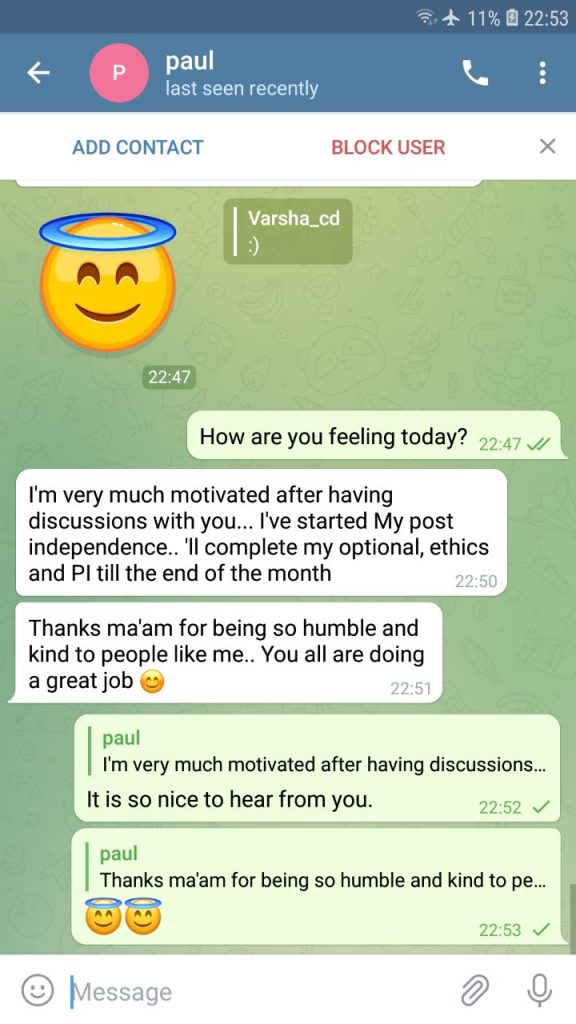
Be it Telegram, Whatsapp or Habitiat channels, they are always available and clear student’s doubts in a turnaround time of 24 Hours.
Why Civilsdaily Mentors are the GPS for Your UPSC-CSE Preparation
Remember there is always light at the end of the tunnel and if you want to get out of the tunnel you have to follow the direction of the light! Our mentors’ give you direction which is divided into daily modules. All you have to do is study and complete them on time.
How are Current Civilsdaily Students Gearing up for UPSC-CSE 2022?
Initially, our Civilsdaily student Smriti wasn’t confident about Prelims when she began her preparation. Though she had joined Civilsdaily in 2020, she started studying for UPSC-CSE back in 2019. At that time, Smriti had enrolled in multiple institutes. Though, most of these institutes had promised a personal mentor, she was unable to get in touch with them on a daily basis. Also those mentors never scheduled test-series on a weekly basis. Hence, despite preparing for a year, Smriti had scored only 35 marks out of 200 in her first test series by Civilsdaily.
She then started writing 20-25 test series over the course of UAP 2021 and in her last test, her scores have drastically improved. She now scores in the range of 130-135 marks in prelims’ and 110+ in mains’ papers.
In Smriti’s own words she describes her Samanvaya Mentorship Experience to be —
“Our parents provide us financial and emotional support, friends provide us moral support and the right mentor gives you logistic and logical support for UPSC. There are days when I felt I won’t be able to compete against lakhs of aspirants. That’s when my mentor, Ravi sir reminded me of my improvement and encouraged me that I can crack it with the same consistency. We need someone, who tells us we are performing well especially when we cannot see that ourselves. The mentorship at Civilsdaily helped me become mentally stronger as a person. In other institutes, mentors are allotted only for doubt resolution. But at Civilsdaily, I am getting end-to-end mentorship via value added notes, classes, test series and detailed evaluation.”
Similarly our another Civilsdaily student, Ashishsums up his Samanvaya experience with Civilsdaily mentor,Pravin Sir, “Because of Pravin sir’s support, I am able to understand a topic in lesser time.”
This is how Pravin sir evaluates Ashish’s Mains Test Series every week. After every test series evaluation, Pravin sir schedules a 1 hour call to discuss how Ashish can improve his marks and the sources he can refer for key topics.
It’s Your Turn Get the Free 40 Min Counselling Session By a CD Mentor
Civilsdaily mentors are so dedicated, consistent and focused for your UPSC goal, that you will eventually become focused into turning your dreams to reality.
At the core of Civilsdaily UPSC mentorship, lies the fact that each one of you will have a unique journey while preparing for the exam. Some will get through on the first attempt without much effort while others will take both more time and more effort.
We want to understand you better to help you optimize your journey so you can focus on the right things and not waste time on the wrong ones. We are asking you to tap into the valuable experiences of mentors who underwent the same grind and realize the pitfalls and understand the shortcuts to make it.