Reading News for UPSC is utmost important and rising number of questions year on year in UPSC Prelims is a testimony of this
We are starting a daily series where we will analyze news covered in The Hindu, Indian Express and other newspapers which are important from exam perspective and which are not
Important news would have been covered in our daily news coverage in form of newscards.
Unimportant ones will be mentioned here and a short description regarding why it is not relevant for the exam
Very important judgment related to quota in jobs and other benefits across various states especially when the migrant issue is going on. Note important points.
The Supreme Court has adjourned till the second week of January 2019 the hearing on petitions challenging the constitutional validity of Article 35A saying it would wait for the panchayat polls to get over in December.
No important points in this news. Article 35A has been covered in detail previously.
Cabinet approves the Trafficking of Persons Bill, 2018
Human Trafficking Bill, 2018
Why in news
The Trafficking of Persons (Prevention, Protection and Rehabilitation) Bill, 2018, has been passed by the Lok Sabha recently.
What is human trafficking?
The action or practice of illegally transporting people from one country or area to another, typically for the purposes of forced labour or commercial sexual exploitation.
As per the definition given by the United Nations Office on Drugs and Crime (UNODC) – ‘Trafficking in Persons as the recruitment, transportation, transfer, harbouring or receipt of persons, by means of the threat or use of force or other forms of coercion, of abduction, of fraud, of deception, of the abuse of power or of a position of vulnerability or of the giving or receiving of payments or benefits to achieve the consent of a person having control over another person, for the purpose of exploitation
Exploitation shall include, at a minimum, the exploitation of the prostitution of others or other forms of sexual exploitation, forced labour or services, slavery or practices similar to slavery, servitude or the removal of organs.’
Status of human trafficking in India
As per data released by the National Crime Records Bureau (NCRB), human trafficking numbers rose by almost 20% in 2016 against the previous year.
NCRB said there were 8,132 human trafficking cases last year against 6,877 in 2015, with the highest number of cases reported in West Bengal (44% of cases), followed by Rajasthan (17%). Of the 15,379 victims who were caught in trafficking, 10,150 were female and 5,229 males.
Schemes and initiatives launched by Government to tackle human trafficking
Ministry of Home Affairs has set up of a dedicated nodal Cell in the MHA for prevention of trafficking. The cell is responsible for providing state governments with the necessary research, studies and information.
The ministry organises workshops for NGOs on issues relating to trafficking of children for commercial sexual exploitation. A special module for counsellors of trafficked victims has been formulated.
Training to all stakeholders such as police, government officials, etc. to better understand the situation and hence respond properly to a suspicious activity or person.
The MWCD runs Shelter based homes Short Stay Homes, Swadhar Homes for women in difficult circumstances.
Ujjawala: A comprehensive scheme for prevention of Trafficking and Rescue and Rehabilitation and Re-integration of victims of trafficking for commercial sexual exploitations.
Why this law?
No single law: Currently, there is no single law dealing with human trafficking and the crime is covered under different acts administered by at least half-a-dozen ministries, including WCD, home, labour, health, Indian overseas affairs and external affairs. More often than not, this results in lax enforcement.
Trafficking on the rise: Statistics reveal that heinous crimes like trafficking is on the rise. This is shocking and calls for a comprehensive mechanism to tackle the situation
The weakness of the ITPA 1956 act: The law is inadequate as it talks only about prostitution which is an outdated concept for human trafficking.
Highlights of Bill:
Aggravated forms of trafficking
It takes into consideration aggravated forms of trafficking. It includes trafficking for purpose of forced labour, begging, trafficking of a woman or child for the purpose of marriage or under the pretext of marriage or after marriage, trafficking by administering chemical substance or hormones on a person for the purpose of early sexual maturity etc.
It comprehensively addresses transnational nature of the crime.
Punishment
It prescribes punishment for promoting and facilitating the trafficking of the person. It includes producing, printing, issuing or distributing unissued, tampered or fake certificates, registration or stickers as proof of compliance with Government requirements or commits fraud for procuring or facilitating the acquisition of clearances and necessary documents from Government agencies.
The punishment prescribed under it ranges from rigorous minimum 10 years to life and fine not less than Rs. 1 lakh. In order to break the organized nexus, both at the national and international level, it mandates for attachment & forfeiture of property and also proceeds for the crime.
Confidentiality of victims and witnesses
It deals with the confidentiality of victims and witnesses and complainants by not disclosing their identity. It will be maintained by recording their statement through video conferencing (it will help trans-border and inter-State crimes).
Trial and repatriation
It has provision for time-bound trial and repatriation of the victims. It will be within a period of 1 year from taking into cognizance.
It provides immediate protection of rescued victims and their rehabilitation. T
The victims will be entitled to interim relief immediately within 30 days to address their physical, mental trauma etc. and further appropriate relief within 60 days from the date of filing of charge sheet.
Rehabilitation Fund
It creates Rehabilitation Fund for the first time.
It will be used for the physical, psychological and social well-being of the victim including education, skill development, health care and psychological support, legal aid, safe accommodation etc.
It mandates designation of courts in each district for the speedy trial of the cases.
Institutional mechanisms
It creates dedicated institutional mechanisms at District, State and Central level. They will be responsible for prevention, protection, investigation and rehabilitation work related to trafficking.
The tasks of Anti-Trafficking Bureau at the national level will be performed by National Investigation Agency (NIA).
Anti-trafficking bureau:
The bill proposes the establishment of a national anti-trafficking bureau, which shall be entrusted with the gamut of issues aimed at controlling and tackling the menace under various forms.
Functions include coordination, monitoring and surveillance of illegal movement of persons and prevention.
The bureau will also be entrusted with increasing cooperation with authorities in foreign countries for boosting operational and long-term intelligence for investigation of trafficking cases and driving in mutual legal assistance.
The significance of the bill:
Human Trafficking is the third largest organized crime violating basic human rights. At present, there is no specific law to deal with this crime. The bill addresses the issue of human trafficking from point of view of prevention, rescue and rehabilitation.
The Bill addresses one of the most pervasive yet invisible crimes affecting most vulnerable persons especially women and children.
It will make India leader among South Asian countries to combat trafficking, as UNODC and SAARC nations are looking forward to India to take lead by enacting this law.
Criticism/challenges
(a) Drafting error
It proposes a minimum three-year sentence for producing, publishing, broadcasting or distributing any type of material that promotes trafficking or exploitation
A/c to Section 36 “any propaganda material that promotes trafficking of person or exploitation of a trafficked person in any manner” has wide amplitude as Bill does not define what constitutes “promotion”.
For example, in moralistic eyes, any sexual content online could be seen as promoting lustful interests, and thus also promoting trafficking.
(b) Will Promote censorship
In June 2016, the Union government banned 240 escort sites for obscenity even though it cannot do that under Section 69A or Section 79 of the Information Technology Act, or Section 8 of the Immoral Traffic (Prevention) Act.
In July 2015, the government asked internet service providers (ISPs) to block 857 pornography websites sites on grounds of outraging “morality” and “decency”, but later rescinded the order after widespread criticism.
If historical record is any indication, Section 36 in this present Bill will legitimize such acts of censorship.
(c) The excessive scope of the bill
Section 39 proposes a weaker standard for criminal acts by proposing that any act of publishing or advertising “which may lead to the trafficking of a person shall be punished” (emphasis added) with imprisonment for 5-10 years.
In effect, the provision mandates punishment for vaguely defined actions that may not actually be connected to the trafficking of a person at all.
The excessive scope of this provision is prone to severe abuse since, without any burden of showing a causal connection, it could be argued that anything “may lead” to the trafficking of a person.
(d) Multiplicity of institutions
The bill is silent on whether existing institutional structures – such as child protection units at the state, district, block and community levels established under the Integrated Child Protection Scheme – will work parallel to the proposed institutions under the anti-trafficking bill. This can give rise to the distinct possibility of child victims of trafficking being passed around from one authority to another.
(e) Consent of Victim is disregarded
The bill will lead to greater surveillance and adult victims will be sent to rehabilitation homes or repatriated to their places of origin. There is no provision provided if ‘victims’ do not want to go to rehabilitation or accept repatriation which is against Article 19(1)(g) of the Constitution which guarantees the fundamental right to work.’
(g) Illegal organ trade ignored
Bill doesn’t address the issue of illegal organ and skin trading, which is a form of human trafficking. There are thousands of victims who complain of being duped after being lured to migrate and sell their organs for hefty money (often deceitfully).
Way forward
Further measures that can be undertaken
Increase prosecutions and convictions for all forms of trafficking
Developing Standard operating procedures for Victim Identification and training officials in the same.
Improving Inter-state co-ordination.
Developing a national action plan to combat trafficking.
Conclusion
Trafficking of persons (Prevention, Protection and Rehabilitation) Bill is an important legislative step in dealing with the pervasive malaise of human exploitation and trade in humans. It is comprehensive in its coverage, lays down an institutional mechanism, provides for international cooperation and is sensitive towards the needs of the victim.
Question
Human trafficking is a grim reality in India. In this context critically examine the recently passed ‘The Trafficking of Persons (Prevention, Protection and Rehabilitation) Bill, 2018’.
Reading News for UPSC is utmost important and rising number of questions year on year in UPSC Prelims is a testimony of this
We are starting a daily series where we will analyze news covered in The Hindu, Indian Express and other newspapers which are important from exam perspective and which are not
Important news would have been covered in our daily news coverage in form of newscards.
Unimportant ones will be mentioned here and a short description regarding why it is not relevant for the exam
A good editorial discussing the importance of fiscal consolidation for India. Must read for understanding concepts as well as quoting various points in Mains.
The lynching of persons across the nation has been a cause for concern. Now a GoI appointed committee has suggested measures to tackle it. Note important points to quote as suggestions in Mains answers.
High discharge of water from China, the highest in 50 years, is threatening to submerge at least 12 villages flanking river Siang in Arunachal Pradesh
Hydrological experts said the “unusually high” discharge indicates sudden release of water from man-made barriers or a natural dam that was formed due to landslides caused by major earthquakes in the Tibetan region of China in November 2017
Q.1) Prime Minister’s Science, Technology and Innovation Advisory Council (PM-STIAC) was formed recently by scrapping two Scientific Advisory Committees (SAC) for the Prime Minister and the Cabinet.
Which of the following statements about PM-STIAC is/are correct?
It will be chaired by Prime Minister.
It is set to act as a high-level advisory body to several ministries and execute mission-oriented programmes for these ministries.
In last 1 year at least 20 individuals have been lynched or beaten to death in incidents across India, where rumours on WhatsApp have inspired vigilante mobs to swarm visitors accused of being child kidnappers. Dozens more have been injured in similar attacks.
Meaning
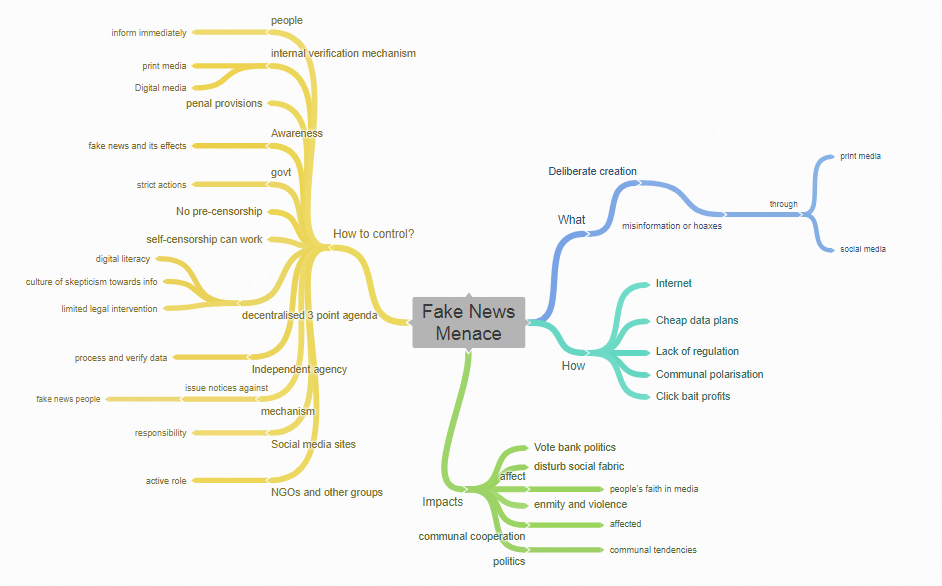
Fake news refers to the deliberate creation of misinformation or hoaxes spread via traditional print and broadcast news media or online social media shaping the belief of people around the nation and world.
What gives rise to the fake news?
Lack of regulation – The online platforms, unlike the mainstream media, do not fall under comprehensive regulation. A number of online news/information portals are being set up due to the lack of proper entry barriers. The lack of binding rules and the ability to keep owners and editors private, offers a larger scope for wrongdoing in case of online platforms.
Communal polarisation – The growing polarisation of society on ideological lines has made the job of spreading fake news easier. Also, the spread of hatred-inducing content among leaders/groups of the opposing ideologies, further deepens the prevailing communal hatred.
Reach – In the past, communal violence in India was more a localised affair. However, in recent days it is extensively being triggered through the Internet on a much larger scale. The online and mobile platforms serve like nodal agencies distributing unverified information.
Quick gains – Spreading false news is becoming a way to make advertising money through click baits. In India, numerous sites are being set up to commercialise fake news with click-bait headlines. Users are enticed with multiple link pages to click and continue reading making the content go viral.
Cheap data plans – The proliferation of technology, cheap smartphones, and reasonable data rates has enabled the democratization of online content. The flip side is that the speed of content distribution has made traditional journalistic controls of verification unfeasible.
Why is fake news dangerous?
People’s faith in social, print and electronic media reduces which could affect the benefits of these Media.
It can lead to violence between two or more communities thereby creating enmity and hatred between them.
It can disturb the social fabric of the society and tensions among communities persists for long times.
It reduces the tendencies of cooperation between different communities.
Political parties try to gain political advantages by polarizing the voter’s mind which further intensifies the tensions between different sections of society.
Politics of development takes back seat and communal tendencies emerge in politics.
In its purest form, fake news is completely made up, manipulated to resemble credible journalism and attract maximum attention and, with it, advertising revenue.
Political campaigning has progressed from mere appeals in the name of identity or loyalty or tall promises to something akin to psychological warfare. Parties that master the tools of such psych ops have a distinct edge over those stuck in the traditional mud. Fake news spreads on social media.
How can we control the fake news menace?
Pre-Censorship is Impossible
Pre-censorship of news and information, while being virtually impossible due to the speed of content creation, will also violate the guarantee of free speech under Article 19(1)(a) of the Constitution.
On the one hand, such legislation could divest individuals of autonomy.
On the other, it could bolster the power of the government to censor opinions it is uncomfortable with.
Any screening in the context of social media applications such as WhatsApp could also violate the fundamental right to privacy recognized by the Supreme Court.
Self- Censorship can work
A cautionary approach warrants avoiding overarching regulation in the form of anti-fake news legislation, irrespective of the benignity of its motivations.
Entrusting a judge, the state or companies like Facebook with the task of making an evaluation of veracity will facilitate judicial, government or private censorship.
This can breed a chilling effect and self-censorship.
A decentralized three-point agenda to address fake news
To ensure critical media literacy, with critical digital literacy as a component.
This would focus on encouraging individuals to learn the skills required to navigate the internet and question the content they are exposed to.
Users should understand the limitations of digital media.
Full Fact and Facebook’s toolkit offer useful suggestions about this. Design changes to social media platforms that flag content can also be incorporated.
To nurture a general culture of scepticism among citizens towards information
Good practices, such as verifying the source of the news and corroboration with related news, ought to be advanced in schools and through public education campaigns.
The role of the district administration and local community leaders is key in this regard.
Heartening examples such as the Satyameva Jayate programme in Kannur schools and initiatives by the superintendent of police in Gadwal demonstrate the potential of such an approach.
Limited Legal Interventions can be explored
In a limited set of situations, such as when there is threat to life or national security, targeted and proportionate legal interventions can be explored.
They should account for existing speech offences to avoid overlap.
Despite their own flaws, existing provisions on hate speech, sedition and defamation already deal with certain kinds of harm that may be substantially similar to those posed by fake news.
Other steps Which Government can take
The government must take the initiative to make all sections of the population aware of the realities of this information war and evolve a consensus to fight this war. It must also take strict action
News being spread using chatbots and other automated pieces of software should automatically be selected for special screening. Ordinary consumers of news can play a big role by, first, waking up to the reality that all they read on WhatsApp and Twitter is not the gospel truth, and then, by refusing to pass on what they cannot independently verify with other sources.
Websites that mimic well-known, credible media outlets in their name should be exposed with the vigour with which jokes are shared on social media.
Government should have independent agency to verify the data being circulated in social and other media. The agency should be tasked with presenting real facts and figures.
Government should have mechanism for immediately issuing of notice against sites/people/agencies involved in spreading fake news.
There should be a provision of effective balances and check of filtering fake posts before it getting viral.
Social media websites should be made accountable of such activities so that it becomes their responsibility to have better controlling restricting the spread of fake news.
Government should take active measures for promoting awareness among people about fake news and their consequences.
Government should enlist penal provisions to perpetrators of fake news if it causes violence or deaths.
Government should make mandatory for Print and Electronic media to have internal mechanism for verifying incidents, facts and figures.
Public should verify the accuracy and of reliability of any news or data either from government or any independent agency specifically involved in such task.
Public should not blindly trust any sensitive news and should not forward it to others.
Public should inform concerned department about any fake post as soon as they come across. They should act as active vigilant for maintaining peace and harmony in the society.
NGO’s and other civil society groups can play important role in spreading awareness about the ill effects of fake news.
Question
In the post-truth world, digitisation and fake news has become a deadly combo. Discuss. What steps can be taken to counter the menace?
Q.2) Pakistan has sought the construction of Pakal Dul and Lower Kalnai Hydel projects as a violation of the Indus Water Treaty by India. These dams are constructed on the basin of which of the following Rivers?
a) Ravi
b) Jhelum
c) Chenab
d) Beas
Inspired by: Indus water panel to discuss Pakistan’s objection to Indian projects
Reading News for UPSC is utmost important and rising number of questions year on year in UPSC Prelims is a testimony of this
We are starting a daily series where we will analyze news covered in The Hindu, Indian Express and other newspapers which are important from exam perspective and which are not
Important news would have been covered in our daily news coverage in form of newscards.
Unimportant ones will be mentioned here and a short description regarding why it is not relevant for the exam
By this deal, USA has shown a ray of hope of an end to the trade war with other countries too. Note details of NAFTA & way forward for India & other countries.
The Union Cabinet on Wednesday approved the release of an additional 2% of dearness allowance for central government employees. This increase is in accordance with the accepted formula, which is based on the recommendations of the 7th Central Pay Commission
No important points in the news from exam point of view
CD is in the process of transforming how students prepare for exams.
We are looking for kick-ass teachers and mentors with exceptional command over UPSC syllabus and diverse knowledge beyond standard books.
Candidates should
1. Either have exhausted their attempts or should no longer be appearing for exams
2. Should be willing to relocate to Delhi
3. Working with us full-time
4. Preference to those already worked in reputed institutes
What can you gain out of the association?
Both intellectual and financial growth. By joining us at this stage, you will grow as we grow. You will be a part of a journey that can alter the whole UPSC preparation scenario
If you are interested in applying to this position, fill up the google form here: Click2Apply
No Phone Calls please!
We will be considering applications received only over the given Google form. Please fill up the form from the link given in this post for your job application so that we can better scrutinize your application.
Government notifies electoral bonds for political donations
Why in news?
Details such as denominations, validity, and eligibility of the purchasers were announced by Finance minister for the electoral bonds scheme announced during the 2017 Budget
Electoral bonds will allow donors to remain anonymous and pay political parties using banks as intermediaries
Highlights of the scheme
Electoral bonds would be a bearer instrument in the nature of a promissory note and an interest-free banking instrument
A citizen of India or a body incorporated in India will be eligible to purchase the bond
Electoral bonds can be purchased for any value in multiples of ₹1,000, ₹10,000, ₹10 lakh, and ₹1 crore from any of the specified branches of the State Bank of India
The purchaser will be allowed to buy electoral bonds only on due fulfillment of all the extant KYC norms and by making payment from a bank account
The bonds will have a life of 15 days (15 days time has been prescribed for the bonds to ensure that they do not become a parallel currency)
They can be used to make donations to registered political parties that have secured not less than 1% of the votes polled in the last election to the Lok Sabha or Assembly
The bonds shall be available for purchase for a period of 10 days each in the months of January, April, July, and October, with an additional 30 days to be specified by the Central government in the year of a general election
The bond shall be encashed by an eligible political party only through a designated bank account with the authorized bank
Why is the name of the donor not being disclosed?
Bonds would get reflected in the balance sheet of the donors
Currently, for a very large part of donation coming to political parties by the donors, quantum and source is not known
The past experience has shown that once the names are disclosed, there is a tendency to shift to cash donations.
Bonds will ensure cleaner money coming from donors, cleaner money coming to political party and ensure significant transparency
Why was this scheme brought?
To ensure that the funds being collected by the political parties is accounted money or clean money
It will also boost digital transactions
Concerns
While the identity of the donor is captured, it is not revealed to the party or public. So transparency is not enhanced for the voter.
Also income tax breaks may not be available for donations through electoral bonds. This pushes the donor to choose between remaining anonymous and saving on taxes.
Also, privacy of the donor is compromised as the bank will know their identity.
The opposition has pointed out that the bonds will help any party that is in power because the government can know who donated what money and to whom.
It can tantalize the buyer of the bond into trading in it for profit. An example is in order. Suppose a company (not an honest one) buys bonds worth Rs 200 crore from a designated branch of the SBI. Remember electoral bonds can remain in circulation for 15 days before they find their way into a political party’s coffers. It is during this crucial period that danger lurks. Suppose a moneybag wanting anonymity is on the prowl and there is a sympathetic political party hungering for his munificence? What would happen? Well, he would buy the bonds for Rs 225 crore by paying cash to the original subscriber. Who could have thought the docile electoral bonds would electrify further the hurly-burly world of black money? In other words, there could be two owners of these bonds in the short time period of 15 days they are allowed to circulate without hindrance. Who knows there could be a third within the above example of a Johnny-come-lately offering Rs 230 to the buyer in the black market?
Way forward
Former Chief Election Commissioner S.Y. Quraishi has suggested an alternative worth exploring
A National Electoral Fund to which all donors can contribute
The funds would be allocated to political parties in proportion to the votes they get.
Not only would this protect the identity of donors, it would also weed out black money from political funding.
There can be a tax benefit for those who donate to the fund
Question
Will the electoral bonds scheme be successful in achieving the coveted objective of transparency in political funding? Critically analyse.