💥UPSC 2026, 2027, 2028 UAP Mentorship (March Batch) + Access XFactor Notes & Microthemes PDF

Search results for: “”

  • Food Processing Industry: Forward, Backward Linkages; Food Processing Industry and Economic Development

    Food Processing Industry: Scope, Importance & Significance in Economic Development

    The Economic Linkage Effects of Food Processing Industry

    Linkages is a phenomenon which measures the capability of an industry to generate demand for the products of the other industries. Form the point of view of development strategy, linkages are one of the essential feature of an industry. Linkages are of three types: Forward, Backward and sideways.

    Forward Linkage: It is when, the establishment of a processing industry can lead to the development and establishment of the number of advanced stage industries. Example, Forest Industry, when established as a base industry, results in establishment of vast number of advanced processing industries like: manufacturing of paper, paper bags, stationary, boxes made of paper, cartons, wooden boxes etc.

    There are many other examples: products such as vegetable oils and rubber are used in a wide variety of manufacturing industries; based on the preparation of hides and skins, tanning operations can be started, as can the manufacture of footwear and other leather goods.

    Backward Linkage: The feedback effects generated by a base industry on the development of the base sector is called backward linkage. The development of the food processing industry has many feed back effects on the agriculture sector itself.

    For Example, once a food processing industry is established, it results in increasing the demand of raw materials provided by the agriculture sector. The establishment of processing facilities is itself an essential first step towards stimulating both consumer demand for the processed product and an adequate supply of the raw material.

    The provision of transport, power and other infra-structural facilities required for agro-industries also benefits agricultural production. The development of these and other industries provides a more favourable atmosphere for technical progress and the acceptance of new ideas in farming itself.

    Sideways Linkage: Sideways linkages are mostly derived from the use of by products and waste products of the main base industrial activity. For example: many food processing industries using agriculture raw materials produce waste that can be used further in production of fuel, bio-fuels, paper pulp and fertilizer. The production of sugar results in production of molasses as a waste product, which is used by the Alcohol Brewing industry in the production of ethanol.

    The capacity of Food Processing industry to generate demand and employment in other industries is the important aspect of the processing industry. It works because of processing industry growing potential for activating backward, forward and sideway linkages.

    The Food Processing Industry and Economic Development

    Backward Channel

    Forward Channel.

    The growth of Food Processing Industry at different stages of Development.

    The Initial Stage/Less Developed Countries

    The Intermediate Stage/Middle Income Countries

    The More Advanced Middle-Income Stage

    The Final Stage/Developed Countries


    By
    Himanshu Arora
    Doctoral Scholar in Economics & Senior Research Fellow, CDS, Jawaharlal Nehru University


  • Food Processing Industry: Food Based Industry versus Non- Food Based; Location, Upstream, Downstream Requirements.

    Food Processing Industry: Location, Upstream, Downstream Requirements

    Food Based Agro-processing Industry versus Non- Food Based Agro-Processing Industry

    Upstream versus Downstream Food Processing Industries.

    Potential for Food Processing Industry in India

    Advantages of the Food Processing Industries

    Factors Determining Location of Food Processing Industries

    There are, however, few exceptions:

    • For most grains (cereals), shipment of the raw material in bulk is frequently easier, while many bakery products are highly perishable and thus require production to be located close to the market.
    • Oilseeds (except for the more perishable ones such as olives and palm fruit) are also an exception and can be transported equally easily and cheaply in raw form or as oil, cake or meal, so there is more technical freedom of choice in the location of processing.
    • The same is true for the later stages of processing of some commodities. For example, while raw cotton loses weight in ginning, which is consequently carried out in the producing area, yarn, textiles and clothing can all be transported equally easily and cheaply.

    Technical and Exports Considerations in deciding location

    • Where there is a high degree of technical freedom in the choice of location, industries have frequently tended to be located in proximity to the markets because of the more efficient labour supply, better infrastructure and lower distribution costs in the large market centres.
    • With production for export, this factor has often tended to favour the location of processing in the importing country. This tendency has been reinforced by other factors, including the need for additional raw materials and auxiliary materials (particularly chemicals) that may not be readily available in the raw material-producing country; the greater flexibility in deciding the type of processing according to the end use for which the product is required; and the greater regularity of supply and continuity of operations that are possible when raw materials are drawn from several different parts of the world.
    • However, with improved infrastructure, enhanced labour efficiency and growing domestic markets in the developing countries, there is increased potential for expanding such processing in the countries where the raw materials are produced.
    • In addition, with growing liberalization of world trade, more developing countries will be able to take advantage of lower labour costs to expand their exports of agro-industrial products.


    By
    Himanshu Arora
    Doctoral Scholar in Economics & Senior Research Fellow, CDS, Jawaharlal Nehru University


  • Food Processing Industry: Definition and Dimensions; Channels of Transitions; Inter linkages between Agriculture and Industry.

    Food Processing Industry in India

    Food Processing Industry: Definition and Dimensions

    Understanding the Channels of Transitions

    Food Economy and Industrial sector have traditionally been viewed as two separate sectors of the economy. They differ both in terms of their characteristics (role in economic growth, share in GDP, share in total output, role in poverty reduction etc.) and potential to generate employment.

    The Food sector or Agriculture is considered to be a traditional sector of the economy. Agriculture has been considered the hallmark of First stage development with features like:

    The Industrial sector is considered to be a modern sector of the economy and represents the second and most important stage of development. The Industrial sector has modern features like:

    The Transition from Agriculture to Industry:

    1. Over the years, with the development of the economy, the traditional agriculture sector becomes less and less productive due to disguised employment (large no of people working on a small land without contributing to production increase).
    2. At this Juncture, the agriculture sector with excess supply of labour will start supplying labour force to the Industries and manufacturing sector.
    3. The disguised labour employed in the agriculture sector will become more productive in the factories, where they will contribute in Increasing production.
    4. At the same time, the remaining labour force in the agriculture sector will also become more productive (no of people are working is equal to no of people required) and their wages will increase.
    5. This is how a standard economy makes transition from low productive agriculture sector to high productive industrial sector. The degree of this transition and Industrialisation has been taken to be the most important indicator of a country’s progress along the development path.

    The New literature on Changing Role & Interlinkages between Agriculture and Industry


    By
    Himanshu Arora
    Doctoral Scholar in Economics & Senior Research Fellow, CDS, Jawaharlal Nehru University


  • Public Private Partnership Models: Contracting, Build Operate Transfer, Design Build Finance Operate (DBFO), Concessions, Build Operate Transfer, EPC Model, Swiss Challenge Model, HAM Model.

    Public Private Partnership Models


    PPP Model: Contracting


    PPP Model: Build Operate Transfer


    PPP Model: Design Build Finance Operate (DBFO) Concessions

    PPP Model: Concessions
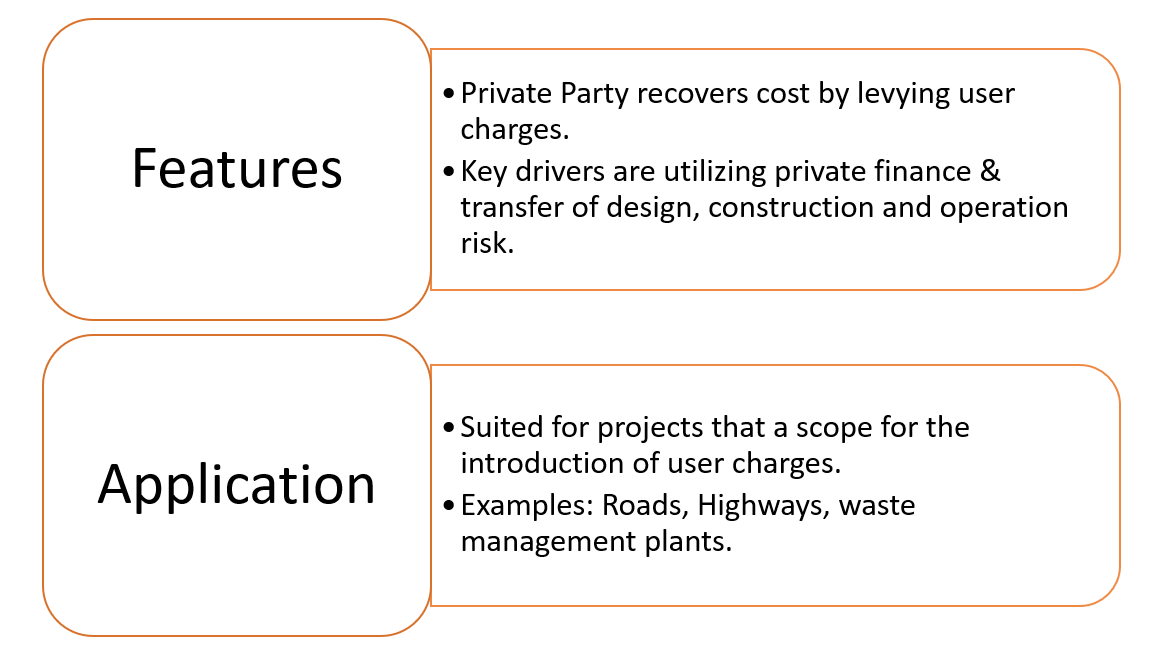
    PPP Model: Private ownership of Asset

    The private sector remains responsible for design, construction and operation of an infrastructure facility and in some cases the public sector may relinquish the right of ownership of assets to the private sector.

    Three main types of PPP models with private ownership of assets:

    Model: Build Operate Transfer.

    The private sector builds, owns and operates a facility, and sells the product/service to its users or beneficiaries. This is the most common form of private participation in the power sector in many countries (examples are numerous).

    For a BOO power project, the Government (or a power distribution company) may or may not have a long-term power purchase agreement (commonly known as off-take agreement) at an agreed price from the project operator.

    In many respects, licensing may be considered as a variant of the BOO model of private participation. The Government grants licences to private undertakings to provide services such as fixed line and mobile telephony, Internet service, television and radio broadcast, public transport, and catering services on the railways. However, licensing may also be considered as a form of “concession” with private ownership of assets. Licensing allows competitive pressure in the market by allowing multiple operators, such as in mobile telephony, to provide competing services.

    Why BOO may be beneficial?

    • It is argued that by aggregating design, construction and operation of infrastructure services into one contract, important benefits could be achieved through creation of synergies.
    • As the same entity builds and operates the services, and is only paid for the successful supply of services at a pre-defined standard, it has no incentive to reduce the quality or quantity of services.
    • Compared with the traditional public sector procurement model, where design, construction and operation aspects are usually separated, this form of contractual agreement reduces the risks of cost overruns during the design and construction phases or of choosing an inefficient technology, since the operator’s future earnings depend on controlling costs.
    • The public sector’s main advantages lie in the relief from bearing the costs of design and construction, the transfer of certain risks to the private sector and the promise of better project design, construction and operation.

    Private Finance Initiative (PFI) model:

    In this model, the private sector similar to the BOO model builds, owns and operates a facility. However, the public sector (unlike the users in a BOO model) purchases the services from the private sector through a long-term agreement.

    PFI projects therefore, bear direct financial obligations to the government in any event. In addition, explicit and implicit contingent liabilities may also arise due to loan guarantees provided to lenders and default of a public or private entity on non-guaranteed loans.

    In the PFI model, asset ownership at the end of the contract period may or may not be transferred to the public sector. The PFI model also has many variants.

    Divestiture Model:

    In this form a private entity buys an equity stake in a state-owned enterprise. However, the private stake may or may not imply private management of the enterprise. True privatization, however, involves a transfer of deed of title from the public sector to a private undertaking. This may be done either through outright sale or through public floatation of shares of a previously corporatized state enterprise.

    Major Issues in PPP Development.

    Risk is inherent in all PPP projects as in any other infrastructure projects. The main types of risks include:

    Recent Advancements in PPP Models

    EPC MODEL: Engineering, Procurement and Construction.

    EPC is a popular model being adopted globally in many projects like road construction, roof-top solar projects, etc. Before government chose EPC over PPP in 2014, road construction rate had dwindled significantly to around just 3km per day.

    Problems faced by private Players under PPP(BOT) leading to inefficient implementation:

    1. Delay in land acquisition by the govt and institutional clearances like forest clearance, defence land handovers hampered pace of construction.
    2. Under PPP, capital completely or partly was to be raised by private player through issuing private equity bonds and borrowing from banks. But –
    3. Due to delayed implementation, private players weren’t able to pay back loan in time adding to NPA in banks, eventually instigating many banks to stop lending loans
    4. Delayed implementation also affected fund raising through private equities as they couldn’t find investors for new ventures
    5. Another area where private players faced difficulty was in assessing the traffic on roads and subsequent designing of roads.
    6. Due to Above mentioned problems the balance sheets of builders were over stretched and thus forced them to exit projects.
      Highway sector in India is responsible for job creation for millions of people and has a multiplier effect on the economy. Hence government took immediate measures to boost the sector by adopting EPC Model and the acronym stands for Engineering, Procurement and Construction.

    How is EPC different and better than PPP?

    1. Govt here bears the entire financial burden and funds the project. Capital is either raised by issuing bonds like NHAI bonds or by taking steps to secure road toll receivables post construction. Note that the fund here is not raised through banks.
    2. Govt now takes care of clearances, acquiring land and estimating the traffic a very huge exercise that had to be done by private parties earlier.
    3. With decreased risk on private builders and increased incentives for early road construction, it creates comfortable base to lure investors to carry on the EPC work i.e. the contractor now designs the installation, procures the necessary materials and builds the project, either directly or by subcontracting part of the work.
    4. Timeline required to construct reduces remarkably.
    5. In a nutshell, while the government takes responsibility of raising capital, procuring clearances and such, the private builder constructs roads. Thus, significant surge in road construction pace is expected.

    Recent decision of NDA govt in Mar 2016 to develop, operate and maintain the wayside amenities alongside National highways across India through EPC model is another example for an EPC project.

    HAM MODEL

    What is Hybrid annuity model?

    • HAM is a Combination of EPC model and BOT-Annuity model. Under this model. The government will provide 40 percent of the project cost to the developer to start work while the remaining investment has to be made by the developer.

    Why do we require HAM?

    • Most of the earliest highway projects allocated through PPP mode were implemented through BOT –TOLL MODE. under this model the private party is selected to build, maintain and operate the road based on the fact that which private bidder offered maximum sharing of toll revenue to the government. Here, all the risks- land acquisition and compensation risk, construction risk (i.e risk associated with cost of project), traffic risk and commercial risk lies with the private party.  The private party is dependent on toll for its revenues. The government is only responsible for regulatory clearances.
    • To reduce the risk for private player, and to attract private players, The second model of PPP i.e. BOT-ANNUITY model was introduced under which the private player would built, maintain and operate the Project and government would pay the private player annually fixed amount of annuity. Though it was a better model than BOT-TOLL because it reduced traffic and commercial risk however cost risk remained as private player was solely responsible for the cost incurred in the project.
    • In last few years many of the highway projects were stuck due to various reasons like Loss of promoter’s interest, Land acquisition issue, environmental reasons, excessive and unrealistic bidding by the private players and Lack of fund availability for private players due to high NPAs of the banks and lack of long term financing options in India.
    • To counter this and to remove the deficiencies of government brought in EPC model. EPC stands for engineering, procurement and construction. It is a model of contract b/w the government and private contractor. The EPC entails the contractor build the project by designing, installing and procuring necessary labour and land to construct the infrastructure, either directly or by subcontracting. Under this system the entire project is funded by the government rather than the PPP model where there is cost sharing. The project is awarded via bidding. Thus, it shifts all the risk from the private players to the government and is the other extreme of BOT model where all risk was borne by the private player

    Key features Of HAM MODEL

    http://www.economictimes.indiatimes.com/photo/50749984.cms

    • Under this the government will pay 40 per cent of the project cost to the concessionaire during the construction phase in five equal installments of 8 per cent each.
    • . Revenue collection would be the responsibility of the National Highways Authority of India (NHAI); developers will be paid in annual instilments over a specified period of time.
    •  An important feature of the hybrid annuity model is allocation of risks between the partners—the government and the developer/investor. While the private partner continues to bear the construction and maintenance risks as in BOT (toll) projects, it is required only to partly bear the financing risk. The developer is insulated from revenue/traffic risk and inflation risk, which are not within its control.
    •  In the hybrid annuity model, one need not bring 100 per cent of finance upfront and since 40 per cent is available during the construction period, only 60 per cent is required to be arranged for the long term. This makes it attractive and viable for the private player to invest in Highway projects. It also reduces burden on the Government as unlike EPC, the government has to provide only 40% of the project cost.

    Conclusion

    • By adopting the Model as the mode of delivery, all major stakeholders in the PPP arrangement – the Authority, lender and the developer, concessionaire would have an increased comfort level resulting in revival of the sector through renewed interest of private developers/investors in highway projects and this will bring relief thereby to citizens / travelers in the area of a respective project.It will facilitate uplifting the socio-economic condition of the entire nation due to increased connectivity across the length and breadth of the country leading to enhanced economic activity.


    Swiss Challenge Model

    What is Swiss Challenge model?

    A ‘Swiss Challenge’ is a way to award a project to a private player on an unsolicited proposal. Such projects may not be in the bouquet of projects planned by the state or a state-owned agency, but are considered given the gaps in physical or social infrastructure that they propose to fill, and the innovation and enterprise that private players bring.

    The government may enter into direct negotiations with a private player who submits a proposal and, if they cannot agree on the terms of the project, consider calling for bids from other interested players. In one variant of the Challenge, the government awards bonus points to the project’s ideate; in another, it calls for comparative bids, but gives the first right of refusal to the original player. All this is generally disclosed upfront.

    Swiss Challenge model in India

    At least half-a-dozen states have used the Swiss Challenge to award projects in sectors including IT, ports, power and health. Gujarat included it in the Gujarat Infrastructure Development Act, 1999, and in 2006, amended the Act to provide for direct negotiation. It was subsequently made part of the Andhra Pradesh Infrastructure Development Enabling Act and Punjab Infrastructure (Development & Regulation) Act. Rajasthan and Madhya Pradesh have included it in their guidelines for infra projects. At the central level, the Draft Public Private Partnership Rules, 2011, allow the Swiss Challenge only in exceptional circumstances — that too in projects that provide facilities to predominantly rural areas or to BPL populations.

    What are the advantages?

    Globally, there aren’t too many good examples of Swiss Challenge projects. South Africa, Chile, Korea, Indonesia, the Philippines and Taiwan have seriously considered, awarded and implemented unsolicited projects. The obvious advantages are that it cuts red tape and shortens timelines, and promotes enterprise by rewarding the private sector for its ideas. The private sector brings innovation, technology and uniqueness to a project, and an element of competition can be introduced by modifying the Challenge.

    And what are the problems?

    The biggest concerns are the lack of transparency and competition while dealing with unsolicited proposals. Governments need to have a strong legal and regulatory framework to award projects under the Swiss Challenge method. It can potentially foster crony capitalism, and allow companies space to employ dubious means to bag projects. Given that governments sometimes lack an understanding of risks involved in a project, direct negotiations with private players can be fraught with downsides. In general, competitive bidding is the best method to get the most value on public-private partnership projects. The government might also end up granting significant concessions in the nature of viability gap funding, commercial exploitation of real estate, etc., without necessarily deriving durable and long-term social or economic benefits.

    Is the Swiss Challenge suited to India?

    The jury is still out on the success of public-private partnership (PPP) in infra projects. There have been several controversies around large scale PPP projects. Construction costs jumped significantly in the case of the Mumbai Metro, and then Chief Minister Prithviraj Chavan did some loud thinking on whether the government should take over the company promoted by Anil Ambani after it sought a threefold increase in fares just before commencement last year. There were serious issues related to the international airport and the Airport Metro line in Delhi. The government has now brought PPP projects under the ambit of the CAG, so there is some scrutiny of projects where significant concessions including land at subsidised rates, real estate space, viability gap funding, etc. are granted by the government. But there is still no strong legal framework at the national level, and such projects may be challenged in case of a lack of transparency or poor disclosures. Bureaucrats, who ultimately sign off on such projects, continue to be afraid to take calls that might face an investigation later. In the absence of transparency, and a strong element of competition, such projects may be prone to legal challenges. Smaller projects are better off in this respect.

    Government of India Initiatives for Revamping of PPP Models.

    Viability Gap Funding.

    Viability Gap Funding (VGF) Means a grant one-time or deferred, provided to support infrastructure projects that are economically justified but fall short of financial viability. The lack of financial viability usually arises from long gestation periods and the inability to increase user charges to commercial levels. Infrastructure projects also involve externalities that are not adequately captured in direct financial returns to the project sponsor. Through the provision of a catalytic grant assistance of the capital costs, several projects may become bankable and help mobilise private investment in infrastructure.

    Government of India has notified a scheme for Viability Gap Funding to infrastructure projects that are to be undertaken through Public Private Partnerships. It will be a Plan Scheme to be administered by the Ministry of Finance with suitable budgetary provisions to be made in the Annual Plans on a year-to- year basis.

    The quantum of VGF provided under this scheme is in the form of a capital grant at the stage of project construction. The amount of VGF will be equivalent to the lowest bid for capital subsidy, but subject to a maximum of 20% of the total project cost. In case the sponsoring Ministry/State Government/ statutory entity propose to provide any assistance over and above the said VGF, it will be restricted to a further 20% of the total project cost.

    Support under this scheme is available only for infrastructure projects where private sector sponsors are selected through a process of competitive bidding. The project agreements must also adhere to best practices that would secure value for public money and safeguard user interests. The lead financial institution for the project is responsible for regular monitoring and periodic evaluation of project compliance with agreed milestones and performance levels, particularly for the purpose of grant disbursement. VGF is disbursed only after the private sector company has subscribed and expended the equity contribution required for the project.

    India Infrastructure Finance Company Limited.

    IIFCL was set up in 2006 to provide long term debt for infrastructure projects. Infrastructure projects are typically long gestation projects and require debt of longer maturity. The provision of long term funds from commercial banks is restricted due to their asset-liability mismatch. IIFCL tries to address the above constraints in long term debt financing of infrastructure.

    IIFCL provides financial assistance to commercially viable projects, which includes projects implemented by a public sector company; a private sector company; or a private sector company selected under a Public Private Partnership (PPP) initiative. Priority is given to those PPP projects awarded to private companies, which are selected through competitive bidding process.

    Only projects pertaining to following sectors are eligible for financing from IIFCL:

    1. Road and bridges, railways, seaports, airports, inland waterways and other transportation projects;
    2. Power;
    3. Urban transport, water supply, sewage, solid waste management and other physical infrastructure in urban areas;
    4. Gas pipelines;
    5. Infrastructure projects in Special Economic Zones;
    6. International convention centres and other tourism infrastructure projects;
    7. Cold storage chains;
    8. Warehouses;
    9. Fertilizer Manufacturing Industry

    IIFCL raises funds from domestic as well as external markets on the strength of government guarantees. The mode of lending is either long term debt; refinance to banks and financial institutions for loans granted by them to infrastructure companies; takes out finance; subordinate debt and any other mode approved by Government from time to time. The total lending by IIFCL is limited to 20% of the Total Project Cost.

    In 2008, a wholly owned subsidiary of IIFCL, IIFCL (UK) Ltd, was established in London with the objective of utilising the foreign exchange reserves of RBI to fund off-shore capital expenditure of Indian companies implementing infrastructure projects in India.

    Infrastructure Debt Funds.

    The term Debt Fund is generally understood as an investment pool which invests in debt securities of companies. However, an Infrastructure Debt Fund(IDF) registered in India refers to a company or a Trust constituted for the purpose of investing in the debt securities of infrastructure companies or Public Private Partnership Projects. Thus, in contrast to the general understanding of the term, IDF does not refer to a Scheme floated by a mutual fund or such other organizations but to the Company or Trust who is investing in debt securities. An IDF can float various Schemes for financing infrastructure projects.
    Purpose

    IDF is a distinctive attempt to address the issue of sourcing long term debt for infrastructure projects in India. Union Finance Minister in his Budget Speech of 2011-12 had announced setting up of IDFs to accelerate and enhance the flow of long term debt in infrastructure projects. IDFs are meant to

    1. supplement lending for infrastructure projects
    2. provide a vehicle for refinancing the existing debt of infrastructure projects presently funded mostly by commercial banks

    Structure& Regulation

    These Funds can be established by Banks, Financial Institutions and Non- Banking Financial Companies (NBFCs).

    IDFs can be set up either as a company or as a trust. A trust based IDF would normally be a Mutual Fund (MF) that would issue units while a company based IDF would normally be a form of NBFC that would issue bonds. Further, a trust based IDF (MF) would be regulated by SEBI; and an IDF set up as a company (NBFC) would be regulated by RBI.

    IDF –MF can be sponsored (sponsor is akin to a promoter) by any NBFC which includes an Infrastructure Finance Company(IFC). However, IDF-NBFC can be sponsored only by an IFC.

    Investors

    The investors in IDFs would primarily be domestic and off-shore institutional investors, especially Insurance and Pension Funds who have long term resources. Banks and Financial Institutions would only be allowed to invest as sponsors / promoters of an IDF subject to certain conditions. The foreign investors eligible to invest in IDFs include FIIs/Sub-accounts, NRIs, HNIs, QFIs and long term foreign investors such as Sovereign Wealth Funds, Multilateral Agencies, Pension Funds, Insurance Funds and Endowment Funds. To attract funds, an exemption from income tax for IDF has been provided and also the withholding tax has been reduced to 5% from 20% on the interest payment on the borrowings of IDFs.

    An IDF-MF would raise resources through issue of rupee denominated units of minimum 5-year maturity, which would be listed in a recognized stock exchange and tradable among investors. It would have to invest minimum 90% of its assets in the debt securities of infrastructure companies or SPVs across all infrastructure sectors, project stages and project types. The returns on assets of the IDF will pass through to the investors directly, less the management fee. The credit risks associated with the underlying projects will be borne by the investors and not by the IDF. This structure is focused on investors who can afford to take risk. An existing mutual fund can also launch an IDF Scheme.

    An IDF-NBFC would raise resources through issue of either rupee or dollar denominated bonds of minimum 5-year maturity, which would be tradable among investors. It would invest in debt securities of only Public Private Partnership projects which have a buyout guarantee and have completed at least one year of commercial operation.

    Buyout guarantee implies compulsory buyout by the Project Authority (which refers to the government agency who is awarding the contract or who is entering into a concession agreement with the private party) in the event of termination of concession agreement.

    Refinance (essentially means replacing an older loan issued by a financial institution with a new loan offering better terms) by IDF would be up to 85% of the total debt covered by the concession agreement. Senior lenders would retain the remaining 15% for which they could charge a premium from the infrastructure company. Here, the credit risks associated with the underlying projects will be borne by the IDF. This structure is focused on investors who are risk-averse.


    By
    Himanshu Arora
    Doctoral Scholar in Economics & Senior Research Fellow, CDS, Jawaharlal Nehru University
  • Public-Private Partnership Model: Definitions; Need for PPP; Prerequisites.

    Public-Private Partnership Model

    Definitions:


    A PPP Project means a project based on a contract or concession agreement, between a Government or statutory entity on the one side and a private sector company on the other side, for delivering a service on payment of user charges. The rights and obligations of all stakeholders including the government, users and the concessionaire flow primarily out of the respective PPP contracts.

    Unlike private projects where prices are generally determined competitively and Government resources are not involved, PPP projects typically involve transfer of public assets, delegation of governmental authority for recovery of user charges, private control of monopolistic services and sharing of risks and contingent liabilities by the Government.

    The justification for promoting PPP lies in its potential to improve the quality of service at lower costs, besides attracting private capital to fund public projects. For creating a transparent, fair and competitive environment, the Government of India has been relying increasingly on standardising the documents and processes for award and implementation of PPP projects.

    A poorly structured PPP contract can easily compromise user interests by recovery of higher charges and provision of low quality services.

    It can also compromise the public exchequer in the form of costlier or uncompetitive bids as well as subsequent claims for additional payments or compensation.

    The process of structuring PPPs is complex and it is, therefore, necessary to rely on experienced consultants for procuring financial, legal and technical advice in formulating project proposals and bid documents for award and implementation of PPP projects in an efficient, transparent and fair manner.

    Model Concession Agreement (MCA) forms the core of public private partnership (PPP) projects in India. The MCA spells out the policy and regulatory framework for implementation of a PPP project. It addresses a gamut of critical issues pertaining to a PPP framework like mitigation and unbundling of risks; allocation of risks and returns; symmetry of obligations between the principal parties; precision and predictability of costs & obligations; reduction of transaction costs and termination. The MCA allocates risk to parties best suited to manage them.

    Planning Commission developed the first version of the Model Concession Agreement (MCA). This was done considering the need to standardize documents and processes for the PPP framework in the country for ensuring uniformity, transparency and quality in development of large-scale infrastructure projects.

    Subsequently, the Planning Commission had developed various other versions of the MCA considering the different PPP modes like Built Operate Transfer (BOT) (Toll), BOT (Annuity), Design, Build, Operate and Transfer (DBOT) and Operate Maintain and Transfer (OMT) addressing to a significant extent, the changing needs of the sector.

    Why Governments Prefers PPP?


    Advantage of PPP: Graphical Analysis


    Prerequisites of PPP Models


    By
    Himanshu Arora
    Doctoral Scholar in Economics & Senior Research Fellow, CDS, Jawaharlal Nehru University
  • Investment Models: Public Sector Led Investment Model; Private Sector Led Investment Model

    Investment Models

    Public Sector Led Investment Model

    Advantages of Public Investment Model

    Private Investment Model

    The Supply Side:


    The Demand Side:


    By
    Himanshu Arora
    Doctoral Scholar in Economics & Senior Research Fellow, CDS, Jawaharlal Nehru University


  • 9 Oct 2017 | Prelims Daily with Previous Year Questions & Tikdams

    Q.1) Boundaries of ‘Lithuania'(which was recently in news) touches with
    1. Baltic Sea
    2. Latvia
    3. Poland
    4. Belarus
    Select the correct option using the codes given below.
    a) 1, 2, 3 and 4
    b) 1, 2 and 3 only
    c) 2 and 3 only
    d) 1 only

    Q.2) Indra Sawhney vs Union Of India was related to
    a) Reservation
    b) Fundamental Rights
    c) Fundamental Duties
    d) Basic Structure of the Indian Constitution

    Q.3) Which of the following gases are Green House Gases(GHG)?
    1. Carbon Dioxide
    2. Carbon Monoxide
    3. Methane
    4. Ozone
    Select the correct option using the codes given below.
    a) 1, 2, 3 and 4
    b) 1, 3 and 4 only
    c) 2 and 3 only
    d) 1, 2 and 4 only

    Q.4) With reference to the ‘Enforcement Directorate’ which of the following statements is/are correct?
    1. It is part of the Department of Revenue.
    2. It is headquartered in the New Delhi.
    Select the correct option using the codes given below.
    a) 1 only
    b) Neither 1 nor 2
    c) 2 only
    d) Both are correct

    Q.5) Recently, the Indian Navy has thwarted a piracy attempt on a Liberian vessel in the Gulf of Aden. The Gulf of Aden touches the boundaries of which of the following countries?
    1. Yemen
    2. Somalia
    3. Sudan
    Select the correct option using the codes given below.
    a) 1, 2 and 3
    b) 1 and 3 only
    c) 1 and 2 only
    d) 2 and 3 only

    Q.6) ‘Net metering’ is sometimes seen in the news in the context of promoting the
    a) Production and use of solar energy by the households/consumers
    b) Use of piped natural gas in the kitchens of households
    c) Installation of CNG kits in motor cars
    d) Installation of water meters in urban households

    Q.7) ‘India’s ranking in ease of doing Business Index’ is sometimes seen in the news. Which of the following have declared that ranking?
    a) Organization of Economic Cooperation and development (OECD)
    b) World Economic Forum
    c) World Bank
    d) World trade Organization (WTO)

    Q.8) Banjaras during the medieval period of Indian history were
    a) Agriculture
    b) Warriors
    c) Weavers
    d) Traders


    IMPORTANT STUFF: 

    1. Daily newscards have been enriched with back2basics and note2students – Make notes daily

    2. Join Full Year Prelims TS – prelims.civilsdaily.com

    3. Solutions will be uploaded at 11.30 p.m. Click here for Solutions

    4. For attempting previous Prelims Daily Questions – Click here

  • 08 Oct 2017 | Target Mains | 7th Weekly Test with Official Answers

    Attempt the questions individually by clicking on them.

    Q.1) According to UN Comtrade, a significant drop in China’s low-end manufacturing over the coming decades would leave a large gap for lower-cost countries to exploit.  How can India reap the benefits of China’s shift from low-end, labour-intensive manufacturing in the wake of unemployment crisis faced by it?

    https://thewire.in/184571/can-india-capitalise-chinas-shift-away-low-end-manufacturing/

    Rising wages in the Chinese manufacturing market is leading to erase the competitiveness of cheaper Chinese goods. This is in turn resulting in other developing economies replacing China in these sectors viz Apparels, Textiles, leather goods etc.

    Abundant supplies of low-cost labour, government incentives, tax exemptions and an efficient customs administration are the critical factors that need to be considered by India to replace China in the low end, low cost manufacturing sector.

    • Labour force: India has large supplies of cheaper labour (estimated 1.72 US dollars per hour in 2015) and world’s largest working age population which needs to be utilised to reap its full potential.
    • Probable sectors: Leather, apparels, Textiles are sectors in which India already has strong foundations and needs to be given more tax incentives.. Eg. Leather industries in Mumbai and Kanpur.
    • Services may not sustain India’s growth trajectory:It has been argued by the IMF that Indian manufacturing sector needs to increase its share in the GDP in order to sustain India’s growth trajectory. Hence, China’s gradual decline in the sector will create global demand for Indian goods.
    • Innovative initiatives like Make in India, Skill India, Delhi-Mumbai Industrial Corridor etc need to be implemented with focus on low cost manufacturing.
    • The RBI differentiator: Unlike the Chinese interventions changing the way its currency fluctuates; Indian central bank does not allow such interventions. This curbs fluctuations and speculations in currency markets and will allow more certainty to its manufactured products.
    • Competitive advantage over other Asian economies: India has a huge English-speaking working population and it should use this competitive advantage over other countries like Malayisa, Thailand, Vietnam and South Korea who are also vying to fill the vacuum created by China.

    According to a Delloite survey of 2016 it has been argued that India will spurt to 5th rank, from the current 11th rank, in the list of top manufacturing hubs of the world (USA, China, Japan and Germany being the top 4).


    Q.2.) India’s healthcare suffers from quality, quantity, footprint, access and affordability issues. Discuss the major problems of India’s healthcare system? Also discuss what needs to be done to improve the condition of public healthcare in India?

    http://www.livemint.com/Opinion/6S9Hvo31dR3aA8h7snIWKL/What-ails-Indias-public-healthcare.html

    Articles 41, 42, 45 and 45 of the Indian constitution talk about providing efficient healthcare to various sections of society. However, India has not been able to fulfil this obligation in its spirit.

    Major bottlenecks in India’s healthcare system-

    • Lack of sufficient spending: India spends only 1.5% of its GDP on public healthcare. India also spends lowest per capita on health.
    • Inadequate professional manpower: There is acute shortage of professional manpower in healthcare sector with lack of supply of specialised doctors, which in turn is due to lack of sufficient Post Graduate seats in medical colleges
    • Insufficient infrastructure: Acute shortage of secondary and tertiary hospitals
    • Lack of accessibility and affordability: 62 per cent of medical costs are met through out of pocket expenses. The high out-of-pocket expenses in India stem from the fact that 76 percent of Indians do not have health insurance.
    • Disproportionate spread of skilled professionals: Majority of healthcare professionals are concentrated in urban areas, leaving rural areas underserved
    • Structural inadequacies: The hospitals are, as we said, understaffed and under-financed, forcing patients to visit private medical practitioners and hospitals.

    Way forward in this situation-

      • Increase in public spending: The Union Budget of 2017-18 has increased expenditure on healthcare by 27 per cent.
      • Insurance for all: enrolling all BPL families in the country in health-insurance programmes. This will help in lowering the out of pocket expenses of poor households.


    • Encouraging indigenous knowledge via Ministry of AYUSH: Diversification of knowledge and utilising potential of scientific heritage will help reach out to masses with different needs.


    • IT and IT enabled services through mobile and internet technology – Innovative apps like Swastha Bharat, ANMOL-ANM and e-RaktKosh.
    • The National Innovation Council should encourage creative solutions to India specific problems.

    Healthcare sector is in dire need of restructure and reform. In this case the report of        Dr.A. Pangariya Committee (2016) assumes immense significance and needs to be implemented in spirit.


    Q.3.) Sharjah ruler’s recent Kerala visit shows that States can play an important role in not only implementing foreign policy, but also in formulating it.  Critically analyse.

    http://www.thehindu.com/opinion/lead/states-in-indian-diplomacy/article19803262.ece?homepage=true

    India is the one fastest emerging developing nation. This requires a nation to have a proactive foreign policy that involves active participation from both Center and the States. The Andhra Pradesh Chief Minister negotiated with foreign governments to make Hyderabad an IT capital, prompting even presidents and prime ministers to visit the city on state visits and the recent visit by Sharjah ruler to Kerala highlights this fact.

    The importance of States in foreign policy formulation


    • The Constitutional provision-


    • Article 37 under Directive Principles of State Policy provides that states shall endeavor to promote international peace and security and maintain honorable relations with nations.
    • Also Article 365 also provides for the Centre to give directions to States to implement foreign policy decisions.
    1. Competitive Federalism– The engagements of the states with various nations helps to foster competitive and cooperative federalism.
    2. Global practices– In USA, Japan, Singapore and China, states play an important and effective role in foreign policy formulation attracting much required foreign investment.
    3. Technology Transfer- Example the states of Maharashtra and Gujarat will participate in the recent Shinkensen Bullet Train project.
    4. The sates of Maharashtra, Tamil Nadu, Uttar Pradesh are collaborating with UK, Japan and USA for the Smart City Mission.
    5. Strategic importance– The North eastern states have helped in establishing strategic agreements with neighbouring countries thus, securing external security.
    6. Broad based policy formulation– It is the result of healthy policy exchange between the Centre and the States.
    7. The states actions will help benefitting Indian Diaspora– Example: Maximum Indians in Gulf region are from Kerala.

    However, there are some concerns regarding the larger role for states in foreign policy formulation-

    1. National Interests may be subjudiced by the States– Examples : The Chief Minister of West Bengal stopped then Prime Minister from signing an agreement on sharing of Teesta waters with Bangladesh after the agreement was negotiated and in the Italian marine case Kerala itself had insisted that the Italian marines should be tried in India and punished here, causing a rift in India’s relations with the European Union.
    2. Lack of expertise at the State level–  The States must also develop expertise on foreign affairs to be able to take responsible decisions in their interaction with foreign lands.

    Way Forward

    1. There is a need for a new structure in MEA in which the states are fully represented. Also, Ministry of External Affairs should have offices in key states.
    2. Think tanks should be established in states to facilitate policy options and to provide inputs to the states and the Centre.
    3. States should be encouraged to form strong relations with countries in which they have a special interest on account of proximity or the presence of diaspora from that State.

    The Ministry of External Affairs now has a States division, which keeps in touch with the States which is a very positive step. But, the larger interests of India on the global scene should not be put at stake.


    Q.4 ) President’s recent visit to Djibouti and Ethiopia suggests India is finally waking up to the extraordinary geopolitical significance of a region that is called the Horn of Africa. Discuss the significance of this region for India. How can India counter China’s strategic advances in the region?

    http://indianexpress.com/article/opinion/columns/raja-mandala-india-and-djiboutis-geopolitical-scrum-ram-nath-kovind-abroad-visit-4871697/

    The Horn of Africa at the confluence of the Red Sea and the Indian Ocean connecting Africa, the Middle East and Asia and the region’s multiple conflicts inter-state and intra-state  have made it a very attractive piece of geopolitical real estate. The four different states Somalia, Ethiopia, Eritrea and Djibouti constitute Horn of Africa.

    India is initiating re-engagement in this area for modern India has a long tradition of critical involvement in the Horn.

    Significance of the Horn of Africa

    1. Horn of Africa can be a gateway to India’s greater role in the African region with respect to its rich resource base.
    2. The new reliance on the sea lines of communication for India’s economic growth saw the rejuvenation of India’s maritime sensibility. Almost 95 percent of the trade by volume takes place through oceans and Red sea is the linchpin.
    3. The trade route of Suez Canal is very important for India and Horn of Africa is a choke point.
    4. It provides a node for India to manage its affairs in the countries of Asia minor and Middle East, exampleYemen crisis at a time its relations with Pakistan are strained.
    5. To counter the growing International influence in the region especially of China has recently opened first ever foreign military base for China.  France, which ruled Djibouti during the colonial era, has the largest concentration of its foreign legions in the country.
    6. To contain Piracy in the region especially off the coast of Somaila- Japan in 2011 acquired a facility to support its anti-piracy operations in the Gulf of Aden.
    7. The countries of the Horn of Africa can help India in future at various global fora such as UNSC, NSG, etc.
    8. Asia Africa growth corridor- It will essentially be a sea corridor linking Africa with India and other countries of South-East Asia and Oceania by rediscovering ancient sea-routes and creating new sea corridors.

    Chinas presence in the region has been increasing which is a cause of worry for India. India can counter Chinas strategic advances in the region by

    1. Increasing Diplomatic relations that is, opening embassys in the countries of Horn of Africa like Djibouti will help in India’s reengagement with the region.
    2. Greater engagement with the region through organizations like AARDO, International Solar Alliance, East African Community etc.
    3. Defense Engagement with the region can be enhanced by India through defense exports, surveillance, defense exercises and anti piracy operations.
    4. Engagement with the Indian diaspora in the region be enhanced.
    5. India should provide for greater help to the region in the areas of pharmaceutical that is genric medicines and telemedicine.

    Although India is a late starter in the region, she can still play a vital role in the development of the region thereby increasing her sphere of influence.


    Q.5) While investment in new projects is always a good idea, what is an even better idea for a country like India, especially at the helm of an economic slowdown is the upgradation of it’s existing infrastructure. Analyse.

    http://www.thehindu.com/todays-paper/tp-opinion/tackling-the-economic-slowdown/article19787811.ece

    Economic growth has slowed for five consecutive quarters, that is from late 2015-16 onwards. The economy needs a shot in the arm in the form of a fiscal stimulus which will transform the economy, and that its policies will have long-term favorable consequence. More investments and new projects are no doubt good for the economy and will encourage private investment boosting growth. However, Greater public investment must now flow into the repair and reconstruction of infrastructure which is better rationale approach.

    Investments a good idea!

    Investment is an immediate source of demand as firms that invest buy goods and services to do so, but it also expands the economy’s capacity to produce. Not only does increased public investment increase demand and quicken growth but it may be expected to encourage private investors, as the market for their goods expands.

    The supply side focus at usual cases has made it easier for private firms to produce. But considering demand shortage in the economy, the immediate thing to do is to expand public investment in infrastructure which will set the tone for momentum recovery.

    The argument made for  new land and labour market reforms as a pre-requisite for accelerating growth today must be able to account for how the economy came close to achieving 10% growth in the late 1980s.

    But upgrading the existing infrastructure is a better idea:

    • Repair and reconstruction of India’s creaking infrastructure is the direction in which greater public investment must now flow. It is the most direct and potent measure that can be undertaken to address the slowdown the economy is experiencing.
    • Other things being the same, increased public investment leads to a higher deficit, which is the gap between the government’s expenditure and its receipts.
    • There is resistance to governments running a deficit for fear that it may be inflationary.  So any plan for increasing the rate of growth, not just at the present moment but in general, must reckon with agricultural shortages. 
    • Banks are already reeling under NPA problems and twin balance sheet problems. This, coupled with low investments levels in the economy, would further dampen it if any new project/scheme is announced.
    • The existing infrastructure programmes are mired by misadministration and it entails bring governance reforms rather than anything new.
    • With the economy already adjusting to effects of GST and demonetisation, any new step would impede that process.
    • We are also facing the problems of overcapacity in the sectors of steel, which makes it imperative that we take remedial steps to increase the demand.

    Thus, in essence, there exists immense opportunities for India to strengthen its existing infrastructure and economy which would address the problems of poverty, poor investment levels, unemployment, low growth etc. thus preparing the ground for the success of new projects and programmes thus creating a virtuous development cycle for the economy.


    Q.6)   Police reforms have been long awaited in India despite directions given by the Supreme Court on police reforms. Discuss the major police reforms needed in India.

    http://www.thehindu.com/todays-paper/tp-opinion/awaiting-police-reforms/article19793527.ece

    The police even today are not very trusted by the people. They are perceived as a force which is partisan, politicized, and generally not very competent. The Indian Police Foundation was inaugurated in 2015 to mount pressure on State governments to implement the directions of the Supreme Court on police reforms (Prakash Singh v. Union of India).

    The pertaining challenges being faced by police force in the country:

    • Collection and analysis of preventive intelligence especially pertaining to terrorists and insurgents is weak.
    • Criminal Investigation: Standards have declined sharply in the last few years. Unfortunately, the so-called premier investigation agencies like state CIDs and the CBI are no exception.
    • Vacancies: Many states continue to have huge vacancies. Even the apex court’s direction to fill these posts has not yielded the desired results.
    • Outdated arms and equipment: Most state police forces continue to use obsolete equipment and arms, and lack the latest technology that would help in investigation and intelligence-gathering.
    • Lack of Organization
    • Lack of proper training

    It is in the above context that the court in 2006 had issued seven binding directions to implement those reforms enumerated below:

    • Institutional:
    • Constitute a National Security Commission to appoint chiefs of Central Armed Forces.
    • Constitute a State Security Commission to lay down policy, evaluate performance and ensure operational autonomy.
    • A Police Establishment Board to oversee transfers, pensions etc
    • A Police Complaint Authority to look into allegations of serious misconduct.
    • Administrative:
    • Separation of wings of investigation and law and order is a must needed reform to increase transparency and efficiency
    • Secure the tenure of officers at DGP level
    • Implement Lokpal to oversee functioning of CBI
    • Increased Manpower and Capital infusion is as necessary as the above.
    • The modernization of forces with keeping them abreast with changing crime dynamics like cybercrimes, use of technology followed by adequate training to execute is very necessary as suggested by ARC.
    • International collaboration for better intelligence gathering and best practices from INTERPOL and others will enhance their capacity.

    There has been a call for SMART police. Besides the above said reforms, Police forces need to adapt and show temperament in setting themselves as examples to win back the trust of people.


    Q.7 )  In what ways has urbanization in cities affected the rural migrants in India? What steps need to be taken to preserve cultural & social values of rural migrants in cities?

    http://www.livemint.com/Opinion/hsaQJmzFMas9VpkkDMkqSK/Do-rural-migrants-favour-class-or-caste-in-the-city.html

    Urbanization refers to the population shift from rural to urban areas which is the gradual increase in the proportion of people living in urban areas. It has influenced the rural-urban dynamics of migration patterns.

    Urbanization in cities has been happening at a rapid pace and has affected the rural migrants in the following ways:

    • Most of the migrants have temporarily relocated their families to the city. Instead, they circulate between village and city several times a year. Such circular migrants are an important population in India, with estimates suggesting they number between 60 million and 90 million.
    • Absence of systematic information, portrayals of these communities premised on stereotypes or anecdotes.
    • Most migrant communities are assumed to replicate village society in the city, and stay tightly wedded to their caste communities.
    • They are moulded into adopting class-based identities and attitudes practically upon arrival.
    • The competition has manifested in the practice of wage-cutting, where one migrant undercuts another to gain employment from prospective employers at labour chowks.
    • The caste and region has shaped migrant preferences for political candidates running in destination city elections, and in their rural regions of origin. 

    Steps need to be taken to preserve cultural & social values of rural migrants in cities:

    • Through TRIFED, MG BUNKAR Yojana, the indigenous artisanship and craftsmanship of local rural migrants can be promoted.
    •  Affordable rural housing through Housing For All scheme needs to be incorporated.
    • Schemes like Stand Up India should cater to the rural entrepreneur demands and aspirations of rural women and youth.
    • Civil society and young volunteers from cities can be engaged to bring about the social values of these rural migrants and generate awareness of various government schemes.
    • Skill training and upgradation through Skill India Mission should reach them.
    • Cluster based approach to rural urban development can be adopted.

    Though growing population is urban areas is a big challenge and initiatives to arrest this growth is utmost important, preserving social and cultural values of rural migrants is equally important. An integrated approach towards this issue besides the steps mentioned will go a long way in addressing this natural process of migration.


    Q.8 ) “An incremental, technology-neutral approach to the adoption of electric vehicles is the way forward for Automobile Sector in India” Comment.

    https://www.civilsdaily.com/hybrid-electric-vehicle-2/

    Introduction:

    • The automobile industry is one of the key drivers that boost the economic growth of the country. Increasing number of vehicles which uses fossil fuels as energy poses threat to environment as they release harmful gases which cause many health hazards. Vehicular emissions have been identified as one of the important reason for climate change in recent time. To deal with the situation, Government has adopted various measures such as shifting from BS 4 to BS 6 by 2020, NeMP, FAME-India etc.
    • In this regard Technology neutral approach for the adoption of electric run vehicles seems to be the another milestone remedy to effectively deal with the environmental problems apart from addressing various other issues.

    Electric Vehicles in India:

    • In order to promote the use of hybrid vehicles Union Government has launched Faster Adoption and Manufacturing of Hybrid and Electric Vehicles (FAME)-India Scheme. This is simply supporting the hybrid or electric vehicles market development and its manufacturing eco-system in the country in order to achieve self sustenance in stipulated period.
    • Hybrid electric vehicles (HEVs) are powered by an internal combustion engine or other propulsion source that can run on conventional or alternative fuel in combination with an electric motor that uses energy stored in a battery. HEVs combine the benefits of high fuel economy and low tail pipe emissions with the power and range of conventional vehicles.

    Advantages of Electric Vehicle:

    • Environment Friendly: One of the biggest advantages of Electrical vehicle over gasoline powered vehicle is that it runs cleaner and has better gas mileage which makes it environment friendly.
    • Employment Generation: India went through a radical transformation from a minor manufacturer of automobiles to the fastest growing auto-hub within a short span. This has contributed towards huge employment generation by providing direct and indirect employment to 32 million people with an annual turnover of nearly 6,00,000 crore rupees.
    • Less dependence on Fossil Fuels: A Hybrid car is much cleaner and requires less fuel to run which means less emissions and less dependence on fossil fuels. This in turn also helps to reduce the price of gasoline in domestic market.
    • Built From Light Materials: Electric Vehicles are made up of lighter materials which mean less energy is required to run. The engine is also smaller and lighter which also saves much energy.
    • Financial Benefits: Electric Vehicles are supported by many credits and incentives that help to make them affordable. Lower annual tax bills and exemption from congestion charges comes in the form of less amount of money spent on the fuel.
    • Higher Resale Value: With continuous increase in price of gasoline, more and more people are turning towards hybrid cars. The result is that these green vehicles have started commanding higher than average resale values.

    However, certain disadvantages are also associated with Electric vehicle which becomes important to deal in order to promote its use in India:

    • Adequate Charging Points: The government will have to ensure that adequate charging points are available at every reach.
    • Meeting the demand: The government would have to ensure that it meets the demand that is created by this mechanism. Hence, more electricity generating sources will have be developed with the availability of electricity all the time.
    • Cost: The high cost associated would this will have to be garnered. Issuing municipal bonds for this can be of great help.
    • Presence of High Voltage in Batteries: In case of an accident, the high voltage present inside the batteries can prove lethal. There is a high chance of you getting electrocuted in such cases which can also make the task difficult for rescuers to get other passengers and driver out of the car.

    Conclusion:

    • In order to promote Electrical Vehicle use and its production in India, the Government needs to push more aggressively for the Pure Electric Vehicle which uses energy stored in batteries obtained from the grid and support the full range of electric technologies for other vehicle segments with a clear roadmap for the evolution towards Fuel Cell Vehicles (FCVs).
    • Hopefully, to reduce fossil fuel consumption, lower pollution and encourage electric mobility, a more holistic approach needs to be adopted by the government.

    Q. 9 ) Kigali agreement on phasing down climate-damaging HFCs is one of the historic steps in global fight against climate change. Discuss the significance of this agreement. Do you think India will be a beneficiary of this agreement? Examine.

    https://www.civilsdaily.com/kigali-agreement-prospects-and-issues/

    Hints:

    • Kigali is a capital city of a tiny African country Rwanda where world leaders have gathered on Oct 15, 2016 in order to sign an amendment to Montreal Protocol which came to be known as the Kigali Agreement.
    • As per the agreement, 197 UN member countries expected to reduce the manufacture and use of Hydro-fluoro-carbons (HFCs) (Potential Green House Gas) by roughly 80-85% from their respective baselines till 2045.
    • HFCs are world’s fastest growing green house gas largely used in refrigerants in home and car air conditioners. HFCs tap thousands of times more heat in the Earth’s atmosphere than carbon dioxide (CO2).
    • This proved to be an historic agreement where phase down is expected to arrest the global average temperature rise up to 0.5 degrees C by 2100.

    Significance of Kigali Agreement:

    • Montreal Protocol initially conceived only to plug gases that were destroying the ozone layer, but now the latest Kigali agreement includes gases responsible for global warming including HFCs.
    • Paris agreement that will come into force by 2020 doesn’t legally bind countries to their promises to cut emissions but the currently amended Montreal Protocol will bind countries to their HFC reduction schedules from 2019.
    • There are also penalties for non-compliance as well as clear directives that developed countries provide enhanced funding support estimated at billions of dollars globally.
    • Grants for research and development of affordable alternatives to hydro-fluoro-carbons will be the most immediate priority.
    • This agreement along with the recently ratified Paris agreement pushes countries to cap global warming to “well below 2 degrees Celsius” by 2100.
    • Kigali Agreement has shown a considerable flexibility in approach while setting phase-down targets for different economies accommodating their developmental aspirations, different socio-economic compulsions, and scientific & technological capabilities.

    How it benefits India?

    • With Developed nations agreeing to cut 70 per cent of their HFC use by 2029, India will start reducing its HFC consumption when the developed countries would have reduced their consumption by 70 per cent. Thus giving sufficient time for India to phase out HFCs.
    • The Agreement upholds the principle of Common but Differentiated Responsibilities and Respective Capabilities, which means the agreement recognizes the development imperatives of high-growth economies like India, and provides a realistic and viable roadmap for its implementation.
    • With the recent agreement, India gets to participate in a positive global climate action, while gaining time to allow its heating, ventilation and air-conditioning sectors to grow and refrigerant manufacturers to find a comfortable route to transition and cost of alternatives to fall. Analysts also concluded that Kigali agreement is fair to the realities of India’s future economic development.

    However, there remain certain challenges towards realization of this goal such as:

    • Financial implications: Industries have to either invest in R & D to find out the substitutes for HFCs or they have to buy patented substances and technologies from other MNCs. Consequently, the cost of production will increase which may ultimately shrink the buyer base for their products.
    • Technological implications: Some of the developed nations have already started using substitutes of HFCs in their products and have a sound technological knowledge about their use. Without technology transfer or research, it would be difficult for domestic industries to compete with them in global as well as domestic market.

    Conclusion:

    • There is no doubt that the Kigali agreement on phasing down climate-damaging HFCs is one of the historic steps in global fight against climate change. It will play substantial role in holding global temperature rise below 2°C by 2100 as agreed in Paris agreement.
    • Similarly the deal would provide a mechanism for countries like India to access and develop technologies that leave a low carbon footprint. The deal keeps the Paris agreement on track and along with a new deal to cap aviation emissions, it is overwhelmingly positive.

    Q.10) It is commented that success of UDAN scheme will depend on proper implementation and traffic demand/load factors. Critically comment.

    https://www.civilsdaily.com/udan-scheme-opportunities-and-challenges/

    Hints:

    • The Ude Desh ka Aam Nagrik (UDAN) Scheme is an endeavour to make regional air connectivity easy. It aims to stimulate regional connectivity with flights covering distances up to 800 km through a market based mechanism.
    • The scheme is a component of the National Civil Aviation Policy (NCAP) which was released on June 15, 2016, aims at making flying affordable by capping fares at Rs. 2500 per seat per hour. Airfare for a 1-hour journey of approximately 500 km on a fixed wing aircraft or for 30 minute journey on a helicopter would be capped at Rs. 2,500.
    • A major reason for the poor regional air connectivity in India is that airlines do not find it lucrative to operate from small cities. The government has tried to address this concern by an adroit combination of subsidies and fare caps.

    Criticisms:

    • UDAN is a market-based policy intervention that builds on similar programmes in the US, Canada and Australia. It is also consistent with universal service approaches established for other network-based services such as railways and telecom. The aviation business has high operating costs, which include aircraft, capital charges, airport charges, cabin crew, fuel and maintenance.
    • Unless there is sufficient air traffic, airlines will not be able to generate necessary revenues to cover their operating costs and recover their cost of capital. It is self-evident that airlines will not fly unprofitable routes.
    • In order to compensate the losses born by the aviation company, the government will provide subsidy in the form of Viability Gap Funding. There is no strict mechanism to put on effective check on this VGF and the chances of mismanagement seem to high. This will further cost on the government exchequer increasing fiscal burden in the time of economic stress.
    • Providing regional air connectivity is an important policy goal for the government. Such services deliver a host of benefits by fulfilling latent consumer demand for convenient travel, making businesses and trade more efficient, unlocking India’s tourism potential, enabling fast medical service and promoting national integration.
    • Moreover, building connections to tier-2 and tier-3 cities also generates powerful network effects with many regional passengers transferring on to the national aviation network between tier-1cities. However, this requires huge infrastructural development and at the same time proper security system for effective traffic management and also is a time consuming process.
    • One of the biggest challenges in developing regional routes is the lack of depth in the market, translating into low load factors.
    • Also, there is no mechanism to monitor the beneficiary for using UDAN scheme. This will also affect other flights which are already under operation in a specific route in terms of number of passenger, traffic congestion and competition etc.
    • The schemes finances and supports airlines only for three years under the perception that within three years the routes will become sustainable. It also does not consider the hike in oil prices within three years and Airline’s high levy of Air Turbine Fuel is also an area of concern.

    Conclusion:

    • UDAN will jump start regional air connectivity and strengthen the overall aviation network at a modest market-discovered price. Passengers will benefit from enhanced air services, airlines will see more traffic on their metro routes and India will gain through faster economic growth and national integration. Thus UDAN will surely be a meaningful contributor to India’s overall transformation.
    • However, the success of the scheme is well dependent on various factors and if properly managed, will boost the aviation sector in India within the reach of poor.

    Ethics Questions

    Q.11) “Civil Servants should be fully aware to office politics, however they should be minimally concerned with it”. Critically examine the statement.

    Civil Servants are expected to work in offices within various organization. For them it is important they should know about office polities so that they know what is going on in the organization. Being aware about the politics gives him a view of the way things are progressing. At the same time, however, it is essential they should not be affected by this politics or make themselves a part of any of the group otherwise it will lead to split within the organization finally leading to decrease in the efficiency of the workers.

    It is important the civil servants should make sure that the internal politics of the workers does not affect the work performance of the organization. For this he should strike a balance with the workers. If the civil servants themselves become a part of office politics, it will lead to biasness and the leader showing favour towards a particular group and this will give rise to factionalism and split. So, it is responsibility of the civil servants to make sure that the efficiency of workers does not get affected due to office politics of organization.


    Q.12) There is a popular station House Officer of an urban police station. Under his jurisdiction, several cases of Motor Bike/Scooter theft, mobile phone theft and pickpocket have been reported. Most of these cases have not been properly attended and investigated by thepolice. The citizens are annoyed because of this. The SHO has decided to bring a citizen charter to focus on these issues in a time bound manner.

    Suppose you are SHO of the concerned Police Station. Draw out a citizen charter and suggest how you will bring continuous improvement in the charter. Also discuss merits/ demerits of your citizen charter.

    Before preparing the citizen charter, detailed discussion could be made with the subordinates and prominent citizens. Having decided upon the priorities, necessary capacity building of the organization including necessary infrastructure, training could have been ensured.

    • Citizen charter could be a follows.
    1. Name of the office – XYZ Police Station, Delhi
    2. Types of services being provided –

    (i) Registering of complaints an spot of theft, pickpocketing,etc.

    (ii) Action on the complaint to be taken as soon as possible.

    (iii) The police department will ensure to cooperate with the citizens to resolve their cases.

    1. Detailed information about services- Can be obtained from the reception. Also available on the website.
    2. Name /telephone no of Grievance Redressal office – Mr. ‘B’ with telephone no and ‘e’ mail.

    (time to be specified) Grievances to be redressed within 3 days.


    Merit of the Charter – Charter is a modest start through which time bound delivery of service are being promised. Every services are being delivered time bound. Formats and all necessary informations are available both on reception and on organization website. Since subordinates have been consulted while preparing the charter, they will provide assistance in preparing the charter and they will provide all assistance to make it succeed.

    Difficulties – since it is time bound delivery of services, hence initially some difficulties are bound to come. There could be large number of grievance petitions and hence the concerned office and other members will have to take necessary extra steps for redressal. Touts and other corrupt people could also work against the charter so that it may fail and their golden days are returned.

    Revision and upgrading the charter – After 6 month a third party evaluation by a team comprising of retired officials, citizen groups/people could be done and having satisfied with the result it could be upgraded like online registration of application etc., could be attempted.


More posts
