💥UPSC 2026, 2027, 2028 UAP Mentorship (March Batch) + Access XFactor Notes & Microthemes PDF

Search results for: “”

  • Concept of e-Governance and its advantages

    In the arena of advanced technology, e-government has distinct place and it facilitates to huge number of customers to perform their task speedily. As the Internet supported digital communities grow, they present the national governments with numerous challenges and opportunities.

    e-Governance which also known as electronic governance is basically the application of Information and Communications Technology to the processes of Government functioning in order to bring about ‘Simple, Moral, Accountable, Responsive and Transparent’ governance (Governance for The Tenth Five Year Plan (2002-2007), Planning Commission, November, 2001 ).

    E-governance involve the use of ICTs by government organisations for exchange of information with citizens, businesses or other government departments, faster and more efficient delivery of public services, improving internal efficiency, reducing costs / increasing revenue, re-structuring of administrative processes and improving quality of services.

    Concept of e-Governance

    E governance has gained more popularity in convoluted business world. Many management scholars have described the concept of e governance which is emerging as an important activity in the business field.

    It is established that E-governance is the application of information and communication technologies to transform the efficiency, effectiveness, transparency and accountability of informational and transactional exchanges with in government, between government & govt. agencies of National, State, Municipal and Local levels, citizen & businesses, and to empower citizens through access & use of information (Mahapatra, 2006).


    Use by government agencies of information technologies (such as Wide Area Networks, the Internet, and mobile computing) that have the ability to transform relations with citizens, businesses, and other arms of government.

    These technologies can serve a variety of different ends: better delivery of government services to citizens, improved interactions with business and industry, citizen empowerment through access to information, or more efficient government management. The resulting benefits can be less corruption, increased transparency, greater convenience, revenue growth, and or cost reductions.

    -World Bank, on E-governance


    A transparent smart e-Governance with seamless access, secure and authentic flow of information crossing the interdepartmental barrier and providing a fair and unbiased service to the citizen.

    – Dr. APJ Abdul Kalam


    Historical review and current position of e-governance

    It has been documented that in the decade of nineties, there was major Global shifts towards increased deployment of IT by governments due to emergence of the World Wide Web. The technology as well as e-governance enterprises have come a long way since then. With the upsurge in Internet and mobile connections, people are learning to utilize their new mode of access in various ways. They have started expecting more and more information and services online from governments and corporate organizations to advance their public, professional and personal lives.

    Objectives of E-governance

    The tactical objective of e-governance is to support and streamline governance for all parties such as government, citizens and businesses through effective use of ICTs.

    E-governance evolution in India

    The notion of e-governance evolved in India during the seventies with a focus on development of in house government applications in the areas of defence, economic monitoring, planning and the deployment of information technology to manage data intensive functions related to elections, census, and tax administration.

    In Indian scenario, there were great efforts of the National Informatics Center (NIC) to join all the district headquarters during the eighties. In the beginning of nineties, IT technologies were improved by ICT technologies to extend its use for broader sectorial applications with policy emphasis on reaching out to rural areas and taking in greater inputs from NGOs and private sector as well.

    There has been an increasing involvement of international donor agencies under the framework of e-governance for development to catalyse the expansion of e-governance laws and technologies in developing nations.

    Stages of e-Governance

    It is apparent in various research studies that e-Governance is fundamentally linked with the development of computer technology, networking of computers and communication systems. In developing nations such technologies and systems became available with observable time lag as compared to developed nations.

    When appraising the e-governance model in India, it is established that with the liberalization of the economy from the early 1990s onwards, there has been a convergence in the availability of progressive technologies and opportunities in this field.

    The inception of e-Governance proceeded through four stages in India

    1. Computerisation: In the first stage, with the availability of personal computers, majority of Government offices are well equipped with computers. The use of computers began with word processing, quickly followed by data processing.
    2. Networking: In this stage, some units of a few government organizations are connected through a hub leading to sharing of information and flow of data between different government entities.
    3. On-line presence: In the third stage, with increasing internet connectivity, a need was felt for maintaining a presence on the web. This resulted in maintenance of websites by government departments and other entities. Generally, these web-pages/ web-sites contained information about the organizational structure, contact details, reports and publications, objectives and vision statements of the respective government entities.
    4. Online interactivity: A natural significance of on-line presence was opening up of communication channels between government entities and the citizens, civil society organizations etc. The main objective of this stage was to lessen the scope of personal interface with government entities by providing downloadable Forms, Instructions, Acts, Rules.

    It has been observed that there was more emphasis on automation and computerization, state governments have also endeavored to use ICT tools into connectivity, networking, setting up systems for processing information and delivering services.

    At a micro level, this has ranged from IT automation in individual departments, electronic file handling and workflow systems, access to entitlements, public grievance systems, service delivery for high volume routine transactions such as payment of bills, tax dues to meeting poverty alleviation goals through the promotion of entrepreneurial models and provision of market information.

    The push has varied across initiatives, with focusing on facilitating the citizen-state interface for various government services, and others focusing on bettering livelihoods. Every state government has taken the initiative to form an IT task force to outline IT policy document for the state and the citizen charters have started appearing on government websites.

    Advantages of e-governance

    E-Governance is improvement in governance which is enabled by the resourceful use of Information and Communications Technology. 

    E governance brings better access to information and excellence services for inhabitants. It also brings simplicity, efficiency and accountability in government.

    Through the use of ICT to governance combined with comprehensive business process reengineering would lead to simplification of complicated processes, simplification in structures and changes in statutes and regulations.

    E governance is advantageous to citizens and government as rapid growth of communications technology and its adoption in governance would support to bring government machinery to the doorsteps of the citizens.

  • Monetary Policy Agreement in India

    Monetary Policy Agreement

    What is Monetary Policy Agreement?

    • In 2015 The Government of India and Reserve Bank of India signed a Monetary Policy Framework Agreement. The new monetary policy framework was formed following the recommendations of a committee headed by RBI Deputy Governor Urjit Patel.
    • The objective of monetary policy framework is to primarily maintain price stability while keeping in mind the objective of growth.
    • As per the agreement, RBI would set the policy interest rates and would aim to bring inflation below 6 per cent by January 2016 and within 4 per cent with a band of (+/-) 2 per cent for 2016-17 and all subsequent years.
    • The central bank will be deemed to have missed its target if consumer inflation is at more than 6 percent or at less than 2 percent for three consecutive quarters starting in the 2015/16 fiscal year.
    • If the central bank misses the inflation target, it will send a report to the government citing reasons and remedial actions.
    • The central bank will also need to give an estimated time-period within which it expects to return to the target level.

    Significance of Monetary Policy Agreement 

    • While the agreement gives a free hand to the RBI Governor to decide on the monetary policy measures to achieve the inflation target, it also requires the RBI to give out to the Central Government a report in case the target is missed for a period of time. Thus, it is a fine balance between autonomy and accountability.
    • The World over, the Central banks are moving towards an inflation targeting based criteria for managing monetary policy. The MPA is a step in that direction.
    • The MPA will put India into the League of Nations that followed a rule based monetary policy mechanism.

    Monetary policy committee

    What is the MPC?

    • The monetary policy committee framework will replace the current system where the RBI governor and his internal team have complete control over monetary policy decisions. While a technical advisory committee advises the RBI on monetary policy decisions, the central bank is under no obligation to accept its recommendations.
    • The committee will have six members, with three appointed by the Reserve Bank of India (RBI) and the remaining nominated by an external selection committee. The RBI governor will have the casting vote in case of a tie.
    • According to the Finance Bill, the committee will consist of the RBI governor, the deputy governor in charge of monetary policy and one official nominated by the central bank.
    • The other three members will be appointed by the central government through a search committee.
    • This search committee will comprise of the cabinet secretary, the secretary of the Department of Economic Affairs, the RBI governor and three experts in the field of economics or banking as nominated by the central government.
    • The members of the MPC appointed by the search committee shall hold office for a period of four years and shall not be eligible for re-appointment.
    • The idea to set up a monetary policy committee was mooted by a RBI-appointed committee led by deputy governor Urjit Patel in 2014.
    • The current members of the MPC are:
      1. Governor: DR Urijit Patel
      2. DY Governor RBI: DR Viral Acharya
      3. Executive Director RBI: Michael Patra
      4. External Member: Prof. Pami Dua
      5. External Member: Prof. Chetan Ghate
      6. External Member: Prof Ravindra Dholakia

    Analysis of the MPC

    • There is very little to disagree about the desirability of transitioning from the current decision process to that of an MPC, imparting as it does a greater diversity of views, specialized experience and independence of opinion.
    • With the introduction of the monetary policy committee, the RBI will follow a system similar to the one followed by most global central banks. The US Federal Reserve sets its benchmark rate—the Fed funds rate—through the Federal Open Market Committee (FOMC). The Bank of England’s monetary policy committee is made up of nine members.
    • Setting up of MPC would make monetary policy making more democratic since currently, the RBI governor alone decides key interest rates. The committee will take a decision based on the majority vote. Each member will have one vote.
    • The final composition of MPC announced by the government seems to tread the middle path as it tries to address concerns over excessive government influence over monetary policy in the country Which the draft MPC invoked since under it proposed to strip the Governor of veto vote on the monetary policy besides powers for the government to appoint four of the six members.. The government, however, has reserved the right to send its views to the monetary policy committee, if needed.
    • Communicating the rationale of monetary policy actions is central to both the credibility of the central bank and to enable the incidence targets of the policy to adjust behavior appropriately.

    By
    Himanshu Arora
    Doctoral Scholar in Economics & Senior Research Fellow, CDS, Jawaharlal Nehru University

  • Monetary Policy tools and Money Supply in India

    RBI Tools for Controlling Credit/Money Supply

    Broadly speaking, there are two types of methods of controlling credit.

    Bank Rate Policy

    • Bank rate is the minimum rate at which the central bank of a country provides a loan to the commercial bank of the country.
    • Bank rate is also called discount rate because the central bank provides finance to commercial banks by rediscounting bills.
    • The RBI uses bank rate to control credit in the economy.
    • For instance, in an inflationary scenario, the RBI increases the Bank Rate, which increases the cost of borrowing for commercial banks, this would discourage the commercial bank from borrowing from the RBI, hence lending in the economy will fall along with increase in lending rates by commercial bank, increase in lending rate will discourage investment and hence Aggregate Demand will fall. A fall in AD will reduce income and output in the economy. Thus, Inflation will Subside.

    Open Market Operations

    • OMO are another important instrument of credit control.
    • OMO means the purchase and sale of securities by the RBI.
    • For instance, in an inflationary scenario, the RBI will start selling government securities, the selling of securities will reduce money supply from the system (Since the buyer of the securities will pay for them in Rupee, hence currency from the system goes out), reduction in money supply will lead to reduction in funds with the commercial banks, which further reduce their lending capability. A fall in lending thus contracts credit in the economy.
    • However, there are certain limitations that affect OMO viz; underdeveloped securities market, excess reserves with commercial banks, indebtedness of commercial banks, etc.

    Cash Reserve Ratio

    • Banks in India are required to keep certain proportions of their deposits in the form of cash with themselves as reserves.
    • If the legal CRR is 10%, then the bank will have to keep Rs 100 as reserves against the deposit of Rs 1000.
    • If at any time, the RBI decides to increase the CRR from 10 to 20%, then bank have to keep Rs 200 as reserves against the deposit of Rs 1000. This will reduce the credit in the economy as the banks now have less money to lend (800 in our example), less lending means less borrowing and investment and hence reduction in income and aggregate demand.
    • Similarly, a reduction in CRR from 10 to 5%, will reduce the reserve requirement and hence increases the lending capacity of the banks. Increased lending will lead to increased investment, increase investment will increase AD and Income.

    CRR Controversy

    Context: Time and again many Bankers and economists have recommended scrapping of CRR. With Banks facing rising NPA in recent years, demand has again been raised my few experts to scrap CRR.

    Why CRR should be abolished

    • All banks put together maintained a cash balance of Rs3,14,900 crore with the RBI every day, and this keeps on growing with the growth in deposits of the banking industry. This huge amount does not earn any interest for the banks. If you calculate the interest on this amount at the average lending rate of banks, say at 10%, the total loss to the banking industry is in excess of Rs31,000 crore per year.
    • According to many Bankers, CRR policy had denied the country growth, and its abolition would allow banks to lower the lending rate.
    • Since the RBI did not pay any interest, the CRR acted like a tax on the banking system, placing the banks at a competitive disadvantage versus non-banking financial companies and mutual funds who do not require to pay CRR.
    • According to experts, the loss to the banking sector due to CRR was Rs 21,000 crore.
    •  If a bank falls short of its CRR requirements, the RBI collects interest on the shortfall from the bank at the bank rate as if the defaulting bank has borrowed that money from the central bank. While the RBI’s action is justified, as it is the only way the central bank can enforce discipline among the banks, this is a source of irritation to the Banks.
    • Most of the central banks in developed countries have dispensed with the system of CRR and have been using the tool for open market operations to control inflation.

    Why should it not be abolished?

    • CRR system act as a hedging strategy for banks. CRR is important as it provides banks with the immediate liquidity of their own. Since bank operates on a minimum reserve system, any bad situation like bank run will push millions of depositors withdrawing their money at the same time. In such a situation if banks have its liquidity reserves it will stop the banking system from total collapse.
    • Till the time the crisis day doesn’t come this is just blocked fund which is not put to full use, but when the crisis day comes CRR serves a useful purpose – surely banks and thereby customers have to bear the cost, but it comes at the price of increased safety.
    • CRR and SLR are two Safety Valves built in the system by prudent bankers to protect banks from all types of adversities.
    • If a bank falls short of its CRR requirements, the RBI collects interest on the shortfall from the bank at the bank rate as if the defaulting bank has borrowed that money from the central bank. While the RBI’s action is justified, as it is the only way the central bank can enforce discipline among the banks, this is a source of irritation to the SBI.
    • A few years ago RBI had ceased to pay an interest rate on CRR, which affects the commercial banks. This is one of the main reasons why SBI chairman wanted CRR to be abolished.

    Liquidity Adjustment Facility

    • LAF is a monetary policy instrument which allows commercial bank and primary dealers to borrow money through repurchasing agreement or repos/reverse repos.
    • LAF is used to aid banks in adjusting day to day fluctuations in liquidity.
    • RBI extends LAF facility only to commercial banks (excluding RRBs) and Primary dealers.
    • LAF allowed banks to park their excess money with the RBI in case of excess liquidity or to avail liquidity from the RBI at the time of deficit on an overnight basis against the collateral of government securities.
    • The operations of LAF are conducted by way of repos and reverse repos.
    • Repos or Repurchase Agreements is an instrument which allows banks to borrow money from the RBI to manage short term needs of liquidity against the selling of government securities with an agreement to repurchase the same government securities at a predetermined date and rate. The rate at which the RBI lends to the banks is called Repo Rate.
    • Reverse Repo is an instrument which allows the RBI to borrow from the banks by lending government securities. The rate at which the Banks lends to the RBI is called Reverse Repo Rate.
    • Repo injects money into the system whereas Reverse Repo takes money out of the system.
    • The RBI increases the Repo Rate during the time of inflation and decreases the Repo Rate during the time of deflation and low growth.
    • The important point to remember is that the window of LAF does not allow the banks to borrow the unlimited amount from the RBI. The Banks are permitted to borrow only a limited percentage of its Net Demand and Time Liabilities under LAF window.

    Marginal Standing Facility

    • MSF is a new scheme announced by the RBI in the year 2011-12.
    • MSF is a penal rate at which banks can borrow money from the RBI over and above of what they can borrow from the RBI under the LAF window.
    • MSF is a penal rate and is always fixed at a higher rate than the Repo rate.
    • The MSF would be a penal rate for banks, and the banks can borrow funds by pledging government securities within the limits of the statutory liquidity ratio.
    • The scheme has been introduced by RBI with the main aim of reducing volatility in the overnight lending rates in the inter-bank market and to enable smooth monetary transmission in the financial system.

    Statutory Liquidity Ratio

    • SLR is that percentage of the deposits which the banks have to hold with themselves in highly liquid government securities.
    • SLR is one of the many arrows in the RBI’s monetary policy quiver. These are used, sometimes in isolation, sometimes in combination, to manage the money supply, interest rates and credit availability in the country.
    • The SLR is an important tool of monetary policy, and its primary aim is to ensure that banks always have enough liquidity (cash and cash equivalent securities) to honour depositor’s demands and that they don’t lend away all their funds.
    • The current rate of SLR is 20%. It simply means that the bank has to invest 20 Re out of every 100 Rupee deposited with him in government securities.
    • The SLR is being used by the RBI to tighten or easing money supply in the economy. For instance, a 50 BPS reduction in SLR will leave more money with the banks to lend. More lending means more investment and hence more income and growth.
    • Over the years, the use of CRR and SLR as instruments of monetary control has been reduced. From 37-38 percent in the early 1990s, the RBI has reduced the SLR to 20 percent now. But this is still significant to influence credit and rates.
    • The RBI doesn’t always prefer bringing out the big guns in its monetary tools armament for fear of causing collateral damage — the risk of stoking inflation due to a repo rate cut.
    • In such situations, SLR can be an effective pistol, so to speak. Reducing SLR can free up banks’ funds, which if deployed for lending can boost investment cycle. The RBI lowering SLR this time was broadly seen as an attempt to revive the slack credit demand in the economy.

    Bank Base Rate

    • The Base Rate is the minimum interest rate of a bank below which it is not permissible to lend, except in some cases if allowed by the RBI.
    • BR is the minimum interest rate that a bank must charge because below the base rate it is not viable for the bank to lend.
    • The base rate, introduced with effect from 1st July 2011 by the Reserve Bank of India, is the new benchmark rate for lending operations of banks.
    • Thus, all categories of domestic rupee loans should be priced only with reference to the Base Rate.
    • The reason for introducing Base Rate was to bring out the transparency in bank lending rates as well as to improve monetary transmission mechanism.
    • Base Rate has replaced the previous benchmark prime lending rate (BPLR) which bank charged to its most trustworthy customers.
    • The committee constituted under the than DY Governor of the RBI Deepak Mohanty recommended the abolishment of the BPLR and establishment of more transparent Base Rate.

    Qualitative Measure of the RBI

    Fixing Margin Requirements

    • The margin refers to the “proportion of the loan amount which is not financed by the bank”. Or in other words, it is that part of a loan which a borrower has to raise in order to get finance for his purpose.
    • A change in a margin implies a change in the loan size. This method is used to encourage credit supply for the needy sector and discourage it for other non-necessary sectors. This can be done by increasing margin for the non-necessary sectors and by reducing it for other needy sectors.
    • Example, If the RBI feels that more credit supply should be allocated to agriculture sector, then it will reduce the margin and even 85-90 percent loan can be given.

    Consumer Credit Regulation

    • Under this method, consumer credit supply is regulated through hire-purchase and instalment sale of consumer goods. Under this method, the down payment, instalment amount, loan duration, etc., is fixed in advance. This can help in checking the credit use and then inflation in a country.

    Publicity

    • This is yet another method of selective credit control. Through it, Central Bank (RBI) publishes various reports stating what is good and what is bad in the system. This published information can help commercial banks to direct credit supply in the desired sectors. Through its weekly and monthly bulletins, the information is made public, and banks can use it for attaining goals of monetary policy.

    Credit Rationing

    • Central Bank fixes credit amount to be granted. Credit is rationed by limiting the amount available for each commercial bank. This method controls even bill rediscounting. For certain purpose, the upper limit of credit can be fixed, and banks are told to stick to this limit. This can help in lowering banks credit exposure to unwanted sectors.

    Moral Suasion

    • It implies to pressure exerted by the RBI on the Indian banking system without any strict action for compliance with the rules. It is a suggestion to banks. It helps in restraining credit during inflationary periods. Commercial banks are informed about the expectations of the central bank through monetary policy. Under moral suasion, central banks can issue directives, guidelines and suggestions for commercial banks regarding reducing credit supply for speculative purposes.

    Control Through Directives

    • Under this method the central bank issue frequent directives to commercial banks. These directives guide commercial banks in framing their lending policy. Through a directive, the central bank can influence credit structures, the supply of credit to a certain limit for a specific purpose. The RBI issues directives to commercial banks for not lending loans to the speculative sector such as securities, etc. beyond a certain limit.

    Direct Action

    • Under this method, the RBI can impose an action against a bank. If certain banks are not adhering to the RBI’s directives, the RBI may refuse to rediscount their bills and securities. Secondly, RBI may refuse credit supply to those banks whose borrowings are in excess to their capital. The Central bank can penalize a bank by changing some rates. At last, it can even put a ban on a particular bank if it does not follow its directives and work against the objectives of the monetary policy.

    Measure of Money Supply in India

    M1 M2 M3 M4
    It is also known as Narrow Money. It is a broader concept of the money supply. It is also known as Broad Money. M4 includes all items of M3 along with total deposits of post office saving accounts.
    M1= C+DD+OD

    C= Currency with Public.

    DD= Demand Deposit with the public in the Banks.

    OD= Other Deposits held by the public with RBI.

    M2= M1 + Saving deposits with the post office saving banks.

    M1 is distinguished from M2 because the post office saving deposits are not as liquid as Bank deposits.

    M3 = M1+ Time Deposits with the Bank.

    Time deposits serve as a store of wealth and represent a saving of the people and are not as liquid as they cannot be withdrawn through cheques or ATMs as compared to money deposited in Demand deposits.

    M4= M3+Total Deposits with Post Office Saving Organisations.

    M4 however, excludes National Saving Certificates of Post Offices.

    It is the most liquid form of the money supply. M3 is the most popular and essential measure of the money supply. The monetary committee headed by late Prof Sukhamoy Chakravarty recommended its use for monetary planning in the economy. M3 is also called Aggregate Monetary Resource


    By
    Himanshu Arora
    Doctoral Scholar in Economics & Senior Research Fellow, CDS, Jawaharlal Nehru University

  • Monetary Policy in India: Inflation, deflation, Recessionary and Inflationary Scenarios

    How Monetary Policy Works

    The Inflation 

    The Deflation

    How RBI Controls Recession

    The Recessionary Scenario

    The Relationship between Interest Rate and Bond Prices.

    The Bond Price and Interest Rate always have an inverse relationship with each other.

    How RBI Controls Inflation

    The Inflationary Scenario


    By
    Himanshu Arora
    Doctoral Scholar in Economics & Senior Research Fellow, CDS, Jawaharlal Nehru University

  • Central Banking in India: Functions of RBI

    Central Banking in India

    Key Facts:

    • In the monetary system of all countries, the central bank occupies a most important place.
    • The Central Bank is an apex institution of the monetary system which regulates the functioning of the commercial banks of a country.
    • The Central Bank of India is ‘Reserve Bank of India’.
    • A Central Bank is primarily meant to promote the financial and economic stability of the country.
    • The Central Bank of a country promotes economic growth and stability and controls inflation

    Functions of the Central Banks/RBI

    Issue of Currency Notes

    • Under section 22 of RBI Act, the bank has the sole right to issue currency notes of all denominations except one-rupee coins and notes.
    • The one-rupee notes and coins and small coins are issued by Central Government, and their distribution is undertaken by RBI as the agent of the government.
    • The RBI has a separate issue department which is entrusted with the issue of currency notes.

    Banker to The Government

    • The RBI acts as a banker agent and adviser to the government. It has an obligation to transact the banking business of Central Government as well as State Governments.
    • Example, RBI receives and makes all payments on behalf of the government, remits its funds, buys and sells foreign currencies for it and gives it advice on all banking matters.
    • RBI helps the Government – both Central and state – to float new loans and manage public debt.
    • On behalf of the central government, it sells treasury bills and thereby provides short-term finance.

     Banker’s bank And Lender of Last Resort

    • RBI acts as a banker to other banks. It provides financial assistance to scheduled banks and state co-operative banks in the form of rediscounting of eligible bills and loans and advances against approved securities.
    • RBI acts as a lender of last resort. It provides funds to the bank when they fail to get it from any other source.
    • It also acts as a clearing house. Through RBI, banks make inter-banks payments.

     Controller of Credit

    • RBI has the power to control the volume of credit created by banks. The RBI through its various quantitative and qualitative measures regulates the money supply and bank credit in an economy.
    • RBI pumps in money during recessions and slowdowns and withdraws money supply during an inflationary period.

    Manages Exchange Rate and Is Custodian of the Foreign Exchange Reserve

    • RBI has the responsibility of removing fluctuations from the exchange rate market and maintaining a competitive and stable exchange rate.
    • RBI functions as custodian of nations foreign exchange reserves.
    • It has to maintain a fair external value of Rupee.
    • RBI achieves its objective through appropriate monetary and exchange rate policies.

    Collection and Publication of Data

    • The RBI collects and compiles statistical/data information on banking and financial operations, prices, FDIs, FPIs, BOP, Exchange Rate and industries etc., of the economy.
    • The Reserve Bank of India publishes a monthly Bulletin/publication for the same.
    • It not only provides information but also highlights important studies and investigations conducted by RBI.

      Regulator and Supervisor of Commercial Banks

    • The RBI has wide powers to supervise and regulate the commercial and co-operative banks in India.
    • RBI issues licenses regulate branch expansion, manages liquidity and Assets, management and methods of working of commercial banks and amalgamation, reconstruction and liquidation of the banks.

    Clearing House Functions

    • The RBI acts as a clearing house for all member banks. This avoids unnecessary transfer of funds between the various banks.

    Measures of Credit Control in India

    The management of the money supply and credit control is an important function of the Reserve Bank of India. The money supply has an important bearing on the functioning of the economy.

    By
    Himanshu Arora
    Doctoral Scholar in Economics & Senior Research Fellow, CDS, Jawaharlal Nehru University

  • Monetary Economics: Barter System, Definition, Function and Evolution of Money

    The Barter System

    Money as a medium of exchange was not used in the early history of mankind. Exchange of the goods was not very frequent as households were self-sufficient. Whatever exchange took place between the households was in the form of barter, that is, exchange of goods for other goods.

    The barter system does not provide for the direct purchase of goods since there was no common unit of account and medium of exchange (Money).

    Note for Students: Example, if a person grows only wheat and after his self-consumption, he wants to exchange it for apple. He can do so only if the other person having apples wants wheat. If that is not the case, no exchange will take place. This problem is called double coincidence of wants.

    Moreover, if they both agree to trade an apple for wheat, then the next problem is how to determine how much apple is worth one kg of wheat and vice versa. Both the individuals will argue for more of another person commodity in return of his. Therefore, exchange of goods will be limited and most of the time will not take place at all.

    Difficulties under Barter System of Trade

    To overcome the problems of Barter trade, early humans started devising a system of payments and exchange that allows direct purchase of goods using any instrument that has following features:

    • A unit of Account (it must be measured)
    • High Liquidity
    • It can be stored
    • It must be wanted by everyone (It should have high demand)
    • It can be exchanged easily (Medium of Exchange)

    Evolution of Money

    Commodity Money Metallic Money Paper Money
    In the very beginning, there exist few commodities which were needed by everyone. Commodities like arrows, bows, sea shells which are used mostly in hunting become the first form of medium of exchange and hence acted as money. With further progress of civilisation commodity money is replaced by precious items like Gold and Silver for monetary use. Gold and Silver largely formed the Metallic Money. The advent of State and political structure had given rise to a new form of money which although has no underlying value but has a guarantee by the governments. The government guaranteed money is known as Paper Money.
    In the second stage of the evolution, when the early human shifted from hunting to agriculture, animals like cattle’s, goats, sheep become the medium of exchange and acted as money. The Metallic money offered several advantages.

    They were easy to handle. They can be easily stored.

    They do not deteriorate.

    They have the right degree of scarcity which made them valuable for all, hence acted as a perfect medium of exchange.


    Paper money acted as money not because it has some value (unlike gold which has high value) but simply because they are guaranteed by the governments and are scared.

    With time, paper money took the form of Bank Notes to be printed by the Central Banks.

    Since commodities have certain limitations like lack of a standard unit of account, limited supply and natural factors etc. Their use limited and replaced by other forms of money. With time and technology, the hard form of gold and silver was replaced by coinage system (gold and silver coins) which were to widely used as money. The last stage of evolution of money was in the form of Bank Deposits Especially Demand deposits, which people hold with the commercial banks and that can be withdrawn at any time. Thus, providing high liquidity.

    Money and its Functions

    Definition of Money:

    “Anything which is widely accepted in payment of goods or in the discharge of other kind of payment obligations”.

    “Money can be defined as anything that is generally acceptable as a medium of exchange and at the same time act as a measure and a store of value”.

    Economist has simply defined money as “Money is what Money does”. That is money is anything which performs the function of money.

    Functions of Money:

    The four main functions of money are;

    Medium of Exchange Store of Value Measure of Value Standard of Payments
    A can sell goods to B and in return can demand money for his sale.

    B can use the money to buy other goods from C.

    As long as the money is accepted, the process of exchange keeps on happening.

    This feature of money is known as Medium of Exchange.

    Money act as a store of value.

    Money being the most liquid asset is the most convenient way to store wealth.

    Thus, money can be stored as an asset.

    It thus, becomes very important that the good chosen as money should be such that can be easily stored.

    The case for other liquid assets like gold or real estate is different; they first have to be sold and converted into money. The money realised from them can be used to buy goods and services.

    Money serves as a common measure of value or a unit of account.

    As the value of all goods and services are now measured in terms of money, the relative comparison of goods is possible.

    Each commodity has its own price and monetary value now. A car is worth Rupee 10 Lakh, and A kg of apple is worth Rupee 100. One can simply pay the price and buy car or apple.

    Money also serves as a standard mode of Deferred payments.

    If a loan is taken today, it will be paid back in future time using the money.

    The loan amount is measured in terms of money and is paid back in money.


    Modern Monetary Systems

    Convertible Paper Money/Full Reserve System In-convertible/ Fiat Money Minimum Reserve System
    Paper money has come to occupy a very important place in the modern monetary system of almost all the countries.

    The term paper money applies only to the notes issued by the government and the central banks.

    With the passage of time, the relative scarcity of gold and silver has increased. Therefore, the governments find it very difficult to back all their legal currency with an equal value of gold and silver. Thus, nowadays paper currency is of inconvertible type. The ‘Minimum Reserve System’ is the current form of currency system practised World over and in India too since 1957.
    For quite a long time, Paper money remained a convertible paper money. Under this system, money is convertible into standard coins made of gold and silver.

    The Paper money issued by the governments and central banks was fully backed by the gold and reserve of equal value. Therefore, this paper currency system is called ‘Full Reserve System’.

    Under the Inconvertible monetary system, money is not convertible into gold or silver or other precious metals.

    The paper money issued by the central banks is not backed by underlying precious metal. The issuing authorities is not responsible to convert the paper notes into gold and silver.

    Thus, the currency notes issued by the Central Banks are ‘Fiat Money’, that is, they are issued by a ‘Fiat’ (which means ‘Order’) of the government.

    Fiat Paper money is in the form legal tender promised by the governments. Since they are legal tender, they can be widely used to purchase goods and services.

    Under this system, the central banks are required to keep only a minimum amount of gold and other approved securities (In India the RBI is required to keep Rupee 200 Crores).

    On the basis of minimum reserve, the central banks can issue the currency in any number subject to the economic condition of the country.


    Importance and Significance of Money

    By
    Himanshu Arora
    Doctoral Scholar in Economics & Senior Research Fellow, CDS, Jawaharlal Nehru University


  • Citizen’s Charter: Importance, Objective, Features, Problems faced in implementation, Guidelines

    In any nation, there is a need of good governance for sustainable development, both economic and social.

    The three major aspects highlighted in good governance are transparency, accountability and responsiveness of the administration.

    What is Citizen’s Charter?

    Citizens’ Charters initiative is a response to the mission for solving the problems which a citizen meets, day in and day out, while dealing with the organisations providing public services.

    The charter is the declaration of commitment to superiority in service to customers of the department. The citizen charter declares the standards for various services offered. It includes expectations of the Organisation from the Citizens for fulfilling its commitment. Citizen charter is available on India post website.

    The concept of Citizens’ Charter protects the trust between the service provider and its users.

    Citizens’ Charter was first expressed and implemented in the United Kingdom by the Conservative Government of John Major in 1991 as a national programme with aim to constantly improve the quality of public services for the people of the country so that these services respond to the needs and wishes of the users.

    Importance of Citizen’s Charter in India

    1. To make administration accountable and citizen friendly.
    2. To ensure transparency.
    3. To take measures to improve customer service.
    4. To adopt a stakeholder approach.
    5. To save time of both Administration and the citizen.

    Objective of the Citizens’ Charter

    Fundamental objectives of Citizens’ Charter are as follows:

    Goal of Citizens’ Charter is to empower the citizen in relation to public service delivery.  

    Six principles of the Citizens’ Charter movement as originally framed were:

    1. Quality: Improving the quality of services
    2. Choice: Wherever possible
    3. Standards: Specify what to expect and how to act if standards are not met
    4. Value: For the taxpayers’ money
    5. Accountability: Individuals and Organisations
    6. Transparency: Rules/ Procedures/ Schemes/Grievances

    Later on, these were elaborated by the Labour Government as following nine principles of Service Delivery (1998):

    1. Set standards of service
    2. Be open and provide full information
    3. Consult and involve
    4. Encourage access and the promotion of choice
    5. Treat all fairly
    6. Put things right when they go wrong
    7. Use resources effectively
    8. Innovate and improve
    9. Work with other providers
    10. The Indian Scenario

    Since many years, in India, noteworthy progress has been made in the field of economic development. This, along with a considerable increase in the literacy rate, (from 51.63% to 65.38% in the last decade) has made Indian citizens increasingly aware of their rights.

    Citizens have become more articulate and expect the administration not merely to respond to their demands but also to anticipate them. It was in this climate that since 1996 a consensus had evolved in the Government on effective and responsive administration.

    Department of Administrative Reforms and Public Grievances in Government of India (DARPG) initiated the task of coordinating, formulating and operationalising Citizens’ Charters.

    Guidelines for formulating the Charters as well as a list of do’s and don’ts were communicated to various government departments/organisations to enable them to bring out focused and effective charters.

    For the formulation of the Charters, the government agencies at the Centre and State levels were advised to constitute a task force with representation from users, senior management and the cutting edge staff.

    Principally, an adaptation of the UK model, the Indian Citizens’ Charter has an additional constituent of ‘expectations from the clients’. Involvement of consumer organisations, citizen groups, and other stakeholders in the formulation of the Citizens’ Charter is highlighted to confirm that the Citizens’ Charter fulfills the needs of the users.

    Regular monitoring, review and evaluation of the Charters, both internally and through external agencies, are commanded.

    Till April, 2006, 111 Citizens’ Charters had been articulated by the Central Government Ministries/ Departments/ Organisations and 668 Charters by various agencies of State Governments & Administrations of Union Territories.

    Most of the national Charters are posted on the government’s websites and are open to public scrutiny. The organisations with Citizens’ Charters are advised to give publicity to their Charters through such means as print/ electronic media and awareness crusades.

    Salient Features of a Citizen’s Charter 

    The salient features of a Citizen’s Charter are:

    1. Agreed and published standards for service delivery;
    2. Openness and information about service delivery;
    3. ‘Choice’ and Consultation with users;
    4. Courtesy and helpfulness in service delivery; and
    5. Provision of redressal of grievances.

    Let us elaborate these points:

    Standards: The Charter should lay out explicit standards of service delivery so that users understand what they can reasonably expect from service providers. These standards should be time‐bound, relevant, accurate, measurable and specific. The actual performance vis‐à‐vis the standards adopted must be published and independently validated. The tendency among organizations to develop targets and standards based on their own convenience as opposed to the needs of the citizens must be avoided.

    Information and openness: A key attribute of good service is the availability of relevant and concise information to the users at the right time and at the right place. The Charters should contain, in plain language, full and accurate information about services available, levels and quality of service to be expected, available channels for grievance redressal etc. Handbooks, guides, posters, websites are some of the channels through which information can be provided to citizens.

    Choice and consultation: The Charter should provide choice of services to users wherever practicable. There should be regular and systematic consultation with the users of the service to fix service standards and to ascertain quality of service delivery.

    Courtesy and helpfulness: The Charter can help embed a culture of courteous and helpful service from public servants. In addition, small initiatives such as ‘name badges’, ‘May I help you’ counters etc. can go a long way in building customer confidence.

    Grievance redressal and complaints handling: There is a strong link between the provision of quality service and effective handling of complaints. Firstly, by facilitating and responding to complaints, the causes for complaint can be reduced. Secondly, by identifying ‘trends’ in complaints, the service provider can resolve systemic and recurring problems.

    Problems faced in implementing the Charters

    As indicated, the Citizens’ Charters initiative in India had started in 1997 and the Charters formulated are in embryonic stage of implementation. Introduction of a new thought is always difficult in any organisation. Introduction and implementation of the concept of Citizens’ Charter in the Government of India was much more complicated due to the old bureaucratic set up/procedures and the rigid attitudes of the work force.

    The major obstacles encountered in this initiative were:

    1. The general perception of organisations which formulated Citizens’ Charters was that the exercise was to be performed because there was a direction from the top. The consultation process was minimal or largely absent. It thus became one of the routine activities of the organisation and had no focus.
    2. For any Charter to thrive the personnel responsible for its implementation should have proper training and orientation, as commitments of the Charter cannot be expected to be delivered by a workforce that is unaware of the spirit and content of the Charter. However, in many cases, the concerned staff was not sufficiently trained and sensitised.
    3. Sometimes, transfers and reshuffles of concerned officers at the critical stages of formulation/implementation of a Citizens’ Charter in an organisation severely destabilised the strategic processes which were put in place and hampered the progress of the initiative.
    4. Awareness campaigns to teach clients about the Charter were not conducted systematically.
    5. In some cases, the standards/time norms of services mentioned in Citizens’ Charter were either too negligent or too tight and were impractical and created an unfavourable impression on the clients of the Charter.
    6. The notion behind the Citizens’ Charter was not accurately understood. Information brochures, publicity materials, pamphlets produced earlier by the organisations were mistaken for Citizens’ Charters.

    Deficiencies in the Existing Citizens’ Charters

    1. Lack of awareness and knowledge and inadequate publicity, hence loss of trust among service seekers
    2. No training to the operative and supervisory staff
    3. Lack of infrastructure and initiative
    4. Hierarchy gap between the Officers and the Operative Staff-Need of team effort
    5. Different mind-sets of officers and the Staff- Insensitiveness on the part of the Supervisors and the Staff because they are yet to be sensitized
    6. Staff is not prepared to shoulder the responsibility due to lack of motivation and accountability
    7. Non-revision, complicated and restrictive rules & procedures

    Guidelines for the Citizens’ Charters in India

    1. List all Offices according to type of services they provide to public – Indicate their location, areas they cover, type of services being rendered to public, and phone numbers.
    2. There should be a separate Citizens’ Charter (i.e., Local Citizens’ Charters) for each office covering the services they provide. For example, there should be a separate Charter of the Directorate, its subordinate offices, Hospitals, Schools, etc. according to the particular services they provide.
    3. Mention Service Standards – Step-by-step-Procedure based on ‘Where to go; how to proceed’, simple and easy to fill-in Forms, specimen of duly-filled in forms, documents, fees, etc. required, reasonable time schedule, Do’s & Don’ts, etc., names, addresses and Tele. Nos. of concerned Officials, his alternate for each service, etc.
    4. Minimum documentation, self-attestation and self-declaration.
    5. No duplication – In case desired information and document submitted earlier like proof of residence (if there is no change), birth certificate, etc., it should not be asked again.
    6. If promised services are not provided as per specified time schedule, an effective grievance redressal mechanism (including the provision of compensation to the concerned citizen in order to introduce accountability) should be introduced.
    7. Provision of TATKAL (Immediate) Services if somebody is in urgent need (as in the case of Passport, Railways, etc.) to avoid touts, bribery, etc.
    8. Simultaneous changes in the Performa and other requirements to be effected along with the changes made in the Citizens Charter.
    9. Database of frequently required information, like ownership of property, vehicle, etc., tax and dues paid or pending, etc.
    10. If possible, the services and their related information may be presented in a tabular form.
    11. Salient features of each service should be prominently displayed in simple and easy language at all places likely to be visited by the service seekers.

    Key lessons

    The following pitfalls need to be avoided:

    1. Since Citizen’s Charters are likely to raise the aspirations of the users of the service, the departments should guard against the tendency to promise more than they can deliver. A realistic assessment of the capabilities of the service provider must be taken into account in drafting the Charter.
    2. A critical review of the current systems and processes in the department should be undertaken to examine whether they are likely to have an adverse impact on the Charter.
    3. Implementing the Charters without the staff owning them will defeat the purpose of the Charter. Motivating the staff and involving them in the preparation of the Charter are extremely important.
    4. The Charters will remain merely a paper exercise of limited value if there is no consultation with the users. Departments should ensure user involvement at all stages of preparation and implementation of the Charter.
    5. Independent audit of results is important after a period of implementation of the Charter.
    6. Complex systems for lodging complaints or poor access to officers for redressal of grievances defeat the purpose and the spirit of the Charter.

    To summarize, A Citizens’ Charter denotes the promise of an organisation towards standard, quality and time frame of service delivery, grievance redressal mechanism, clearness and accountability.

    Based on the foreseen expectations and aspirations of public, Citizens’ Charters are to be drawn-up with care and concern for the concerned service users.

    They allow the service seekers to avail the services of the government departments with minimum inconvenience and maximum speed.

    FAQs

    Why is Citizen’s Charter relevant for the UPSC syllabus?

    It is crucial for topics like governance, public administration, and accountability, covered in GS papers and optional subjects.

    Can questions on Citizen’s Charter appear in the UPSC Prelims?

    Yes, questions may appear in the Polity section, focusing on its principles and role in service delivery.

  • The Cost of Inflation

    The Cost of Inflation

    • The inflation is considered to be bad for an economy mainly because it destroys the purchasing power of the money. When Price rise, each Rupee that you had will but less quantity of goods and services. Therefore, inflation destroys the real income of the people and makes them worse off.
    • The argument is particularly true for a country like India, which has a large informal sector and agriculture sector. Since most of the population is employed in informal and agriculture sector where minimum wage laws and social security benefits do not apply, the people in such sectors suffer the most due to inflation. The wages in these sectors are not indexed for inflation. Thus, when the price rises their wage does not rise, and they lose due to a reduction in real income on the one hand and no rise in wages on the other.

    There is also two associated social cost of inflation.

    • The Shoe Leather Cost

    Suppose in an economy the inflation is rising at the rate of 5% from the past few years. In such a case, everybody will expect the inflation to be 5% in future also. In such a case, all the economic transactions will be done adjusting for 5% inflation. In such an anticipated inflation scenario, the only cost of inflation will be shoe leather cost.

    The Shoe Leather Cost occurs because of the cost associated with holding money during inflation. Since inflation destroys the real power of money, and cash holding does not pay any interest, people will start depositing their money in banks to earn interest rate.

    The less money they hold in cash, the more they have to visit banks or ATMs to withdraw money. Since going to the bank is not free of cost both in terms of time and the transaction cost levied by banks on ATM usage, counter withdrawals, as well as the cost of travel to banks will all add to Shoe Leather Cost.

    • Menu Cost

    Menu cost is another social cost associated with anticipated inflation. The name menu cost is derived from the restaurants business. Menu cost arises because inflation makes the business change their listed price often. The change requires the firm to bear expense related to printing of new catalogues, new price list etc. they also have to incur expenditure on advertisement to inform customers about their new prices.

    Effects of Inflation on Different Sections

    Creditor/lender Debtor/Borrower Pensioner Producers Wealth Holders
    Inflation harms creditors, as they lose in real terms.

    A 1000 RS lent @ 5%, will pay an interest rate of 50. If inflation rises to 10%, the price of goods will be 1100, but after interest, the return will only be 1050.

    Inflation benefits the Debtor as they gain in real terms. Inflation harms the pensioners, if their pensions are not indexed to inflation, and loses money. They stand to gain by inflation since the price of goods and services rise faster than the cost of production as wages take time lag to react. They stand to lose due to inflation, as their real returns fall due to rise in prices.


    By
    Himanshu Arora
    Doctoral Scholar in Economics & Senior Research Fellow, CDS, Jawaharlal Nehru University

  • Types of Inflation: Demand Pull, Cost Push, Stagflation, Structural Inflation, Deflation and Disinflation

    This is a key topic for UPSC aspirants, as understanding the types of inflation in India is essential for economics and current affairs sections.

    Types of Inflation In India

    In India, inflation can be classified into the following types:

    1. Demand-Pull Inflation: This happens when there’s excessive demand for goods and services, often due to increased consumer spending, economic expansion, or government spending, driving prices up as supply struggles to keep pace.

    2. Cost-Push Inflation: Rising production costs, such as higher wages or increased raw material prices, lead to cost-push inflation. Producers pass these costs onto consumers, resulting in higher prices across the economy.

    3. Stagflation: A rare phenomenon where inflation and unemployment rise simultaneously, stagflation is marked by slow economic growth, often making it challenging for policymakers to manage both inflation and stagnation.

    4. Structural Inflation: Caused by structural challenges in the economy, such as supply chain inefficiencies, market rigidities, or outdated infrastructure, structural inflation often requires long-term policy changes to address root causes.

    Each type requires targeted measures, making inflation management in India complex and multifaceted.

    Causes of Inflation

    Inflation is mainly caused either by demand Pull factors or Cost Push factors. Apart from demand and supply factors, Inflation sometimes is also caused by structural bottlenecks and policies of the government and the central banks. Therefore, the major causes of Inflation are:

    • Demand Pull Factors (when Aggregate Demand exceeds Aggregate Supply at Full employment level).
    • Cost Push Factors (when Aggregate supply increases due to increase in the cost of production while Aggregate demand remains the same).
    • Structural Bottlenecks (Agriculture Prices fluctuations, Weak Infrastructure etc.)
    • Monetary Policy Intervention by the Central Banks.
    • Expansionary Fiscal Policy by the Government.

    Demand and Supply factors can be further sub divided into the following:
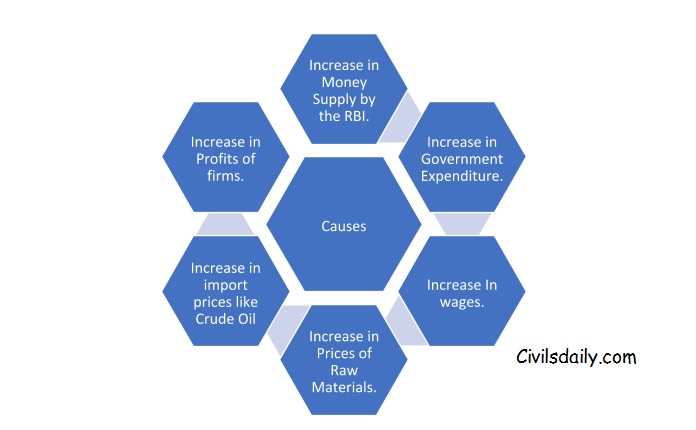
     

    Demand Pull Inflation

    • Demand Pull Inflation is mainly due to increase in Aggregate demand. The increase in Aggregate demand mainly comes from either increase in Government Expenditure (Expansionary Fiscal Policy) or by an increase in expenditure from Households and Firms.
    • The root cause of demand pull inflations is- Aggregate demand > Aggregate Supply. This simply means that the firms in the economy are not capable of producing the goods and services demanded by the households in the present time period. The shortages of goods and services due to increase in demand fuels inflation.
    • Imagine what happened when there was an outbreak of swine flu in India. Due to the outbreak of swine flu epidemic in India, the government notified a warning that people should wear Breathing Masks to protect them from the infection. As a result, the demand for mask had risen to a very high level, but the supply being limited as the producers of the mask had no anticipation of the swine flu epidemic. Due to the high demand and limited supply of masks, the prices had risen manifold. The case above captures the mechanism of demand pull inflation.
    • The above example only captures the mechanism of Demand led inflation and that too for a particular product. What happens at Macro level? What fuels inflation in the entire economy? Before answering the question. Let’s understand some basic concept related to the economy:
    • Full Employment Level: Full employment is an economic situation in which all the available resources of the economy are fully utilised, and there exists no further scope of improvement in the economy. The Full employment level represents that economy is operating at its maximum potential. The level of unemployment is minimum, the prices in the economy are stable, resources are fully utilised, whatever firms are producing is getting sold, and there exist no shortages in the economy.

    Inflationary Gap

    The Inflationary gap is a situation which arises when Aggregate demand in an economy exceeds the Aggregate supply at the full employment level.

    Inflation in a Demand-Pull scenario is basically caused by a situation whereby the Aggregate demand for goods and services in the economy rises and exceeds the available supply of the goods and services. In such a situation, the excessive pressure on demand will fuel the inflation in the economy.

    Deflationary Gap

    Deflationary Gap is a situation which arises when Aggregate demand in the economy falls short of Aggregate Supply at the full employment level.

    Cost Push Inflation

    • There exists a situation in an economy where inflation is fuelled up, not because of increase in Aggregate Demand but mainly due to increase in the cost of producing goods and services.
    • The cost can be increased mainly due to three factors:

    Wage Push Inflation Profit Push Inflation Raw Material Push Inflation
    When the employees push for an increase in wages which are not justifiable either on the grounds of employee productivity or increase in the cost of living. In such scenarios, an unwarranted wage increase leads to increase in the cost of production and hence cost push inflation. The firms sometimes decide to increase their profit margins and starts charging higher prices for their product. This phenomenon pushes the price upward and results in Profit Push Inflation. The raw material push inflation also known as supply shock inflation is the main and the most important reason for cost push inflation.

    If for any reason the economy under goes a supply shock in the form of a rise in the price of essential raw materials like crude oil, it will fuel inflation due to rise in the cost of production.

    Wage Push Inflation generally happens during high growth periods. During which workers anticipate a hike in their wages due to rising cost of living. The employer responds to their demand by increasing wages in the hope that he will pass them on to the consumers in the form of higher prices. The Profit Push Inflation generally happens when there are few of single producer producing the goods for the entire market. For Example, during the 1970s, the OPEC countries decided to increase the price of crude oil, this acted as a supply shock for the entire World economy and price of petroleum products (an essential raw material) went up, fuelling inflation.

    Let’s understand Cost Push Inflation with an Example

    Suppose, Indian economy is operating at its maximum potential. Prices are stable, resources are fully utilised, everyone who is willing to work is getting the work (unemployment is at its minimum). In such a scenario people will form the expectation that the future of the economy is good and they planned their saving and investment decision accordingly.

    However, one day the USA decides to attack Iran in order to dismantle their nuclear weapons. As a repercussion of the attack, the crude oil prices around the world start moving up. India who imports 90 percent of its oil imports suddenly find itself in trouble. The rise in crude oil price puts a break on booming Indian economy and cost of essential products start rising (crude oil is a key input for many industries and is a lifeline of transport economy). As a result of increase in cost of production, the manufacturers decide to increase the price of their product. Hence fuelling first round of cost push inflation (Raw material).

    After a lag of sometime, the final consumer gets to know that the prices of the product have increased. The consumer expectations about the future movement of prices will change as he expects prices to rise further in future. To compensate himself against the future price rise, he starts demanding more wages from his/her employer. This will fuel the second round of cost push inflation (wage push).

    Cost Push Inflation/Supply Shock

    Stagflation

    The most important difference between the Demand Pull and Cost Push Inflation is that while in the case of Demand Pull Inflation the overall output in the economy does not fall. Whereas, in case of Cost Push Inflation, along with an increase in prices the output level of the economy also falls.

    The fall in output will cause employment to fall in the economy along with fall in growth. The falling growth along with rising prices makes cost push inflation more dangerous than the demand-pull inflation. The situation of rising prices along with falling growth and employment is called as stagflation.

    Hyperinflation

    Hyperinflation is a situation when inflation rises at an extremely faster rate. The rate of inflation can increase from 50 times to 300 times.

    The effects of hyperinflation can be devastating for the economy. The situation can lead to total collapse of the value of the currency of the economy along with economic crisis and rising external debt and fall in purchasing power of money.

    The major causes of the hyperinflation are; government issuing too much currency to finance its deficits; wars and political instabilities and unexpected increase in people’s anticipation of future inflation.

    When people anticipate that future inflation will rise at a very fast pace, they start consuming more goods and services due to the fear that higher inflation in the future will destroy the purchasing power of money. As a result of this, the demand for goods and services rises and fuels further inflation. The cycle continues and results in a hyperinflation scenario.

    Structural Inflation

    • Structural Inflation is another form of Inflation mostly prevalent in the Developing and Low-Income Countries.
    • The Structural school argues that inflation in the developing countries are mainly due to the weak structure of their economies.
    • They further argue that increase in money supply and government expenditure could explain the inflationary scenario only partially.
    • The Structuralist argues that the economies of developing countries like, Latin America and India are structurally underdeveloped as well as highly volatile due to the existence of weak institutions and imperfect working of markets.
    • As a result of these imperfections, some sectors of the economy like agriculture will witness shortages of supply, whereas some sectors like consumer goods will witness excessive demand. Such economies face the problem of both shortages of supply, under utilisation of resources as well as excessive demand in some sectors.
    • Example: In India, let’s assume that the farmer produces fruits and vegetables at 10000 per quintal. But the final consumer gets the same at 20000 per quintal. The huge disparity between what farmer receives and consumer pays is due to infrastructure and agriculture bottlenecks. The bottleneck arises mainly due to lack of roads, highways, cold chains and underdeveloped agriculture markets. All these increases the cost of transporting goods from farmers to consumers leading to inflation.
    • The major bottlenecks/road blocks of developing economies that fuels Structuralist form of inflation are:

    Deflation versus Disinflation

    Deflation: Deflation is when the overall price level in the economy falls for a period of time.

    Disinflation: Disinflation is a situation in which the rate of inflation falls over a period of time. Remember the difference; disinflation is when the inflation rate is falling from say 5% to 3%.

    Deflation is when, for instance, the price of a basket of goods has fallen from Rs 100 to Rs 80. It’s the reduction in overall prices of goods.

    Reaganomics

    Reaganomics is a popular term used to refer to the economic policies of Ronald Reagan, the 40th U.S. president (1981–1989), which called for widespread tax cuts, decreased social spending, increased military spending and the deregulation of domestic markets. These economic policies were introduced in response to a prolonged period of economic stagflation that began under President Gerald Ford in 1976.

    Back to Basics:

    Headline Inflation versus Core Inflation

    The headline inflation measure demonstrates overall inflation in the economy. Conversely, the core inflation measures exclude the prices of highly volatile food and fuel components from the inflation index.

    The inflation process in India is dominated to a great extent by supply shocks. The supply shocks (e.g., rainfall, oil price shocks, etc.) are temporary in nature and hence produce only temporary movements in relative prices. The headline CPI inflation in India tends to increase whenever there is a surge in food and fuel prices. Since monetary policy is a tool to manage aggregate demand pressures, the response of the policy to such temporary shocks is least warranted according to traditional wisdom.

    Core inflation excludes the highly volatile food and fuel components and therefore represents the underlying trend inflation. The trend inflation drives the future path of overall inflation. Hence, even when food and fuel inflation moderates over time, persistently high inflation in non-food, non-fuel components pose an upward risk to overall future inflation, creating challenges to monetary policy.

    How to Control Inflation

    Let’s understand some basic relationship before proceeding further.

    Money Supply and Interest Rate

    The Money supply in an economy is controlled by the Central Banks. Whenever there is a threat of Inflation, the central bank intervenes to control the money supply to control the inflation.

    The mechanism through which the central banks controls inflation depends on interest rate. Interest Rate and Money supply moves in opposite directions. As money supply is increased the interest has the tendency to fall and vice versa.

    But why does it happen?

    Suppose at any given point in time, the economy is suffering from low growth. The central bank intervenes by using its monetary policy tools (Bank Rate, Repo Rate, Statutory Liquidity Rate). The result of such loose monetary policy is increase in money supply in the economy.

    The increased money supply means at any given point in time, there will be excess money in the economy than what the people are willing to hold. What will happen to this excess money? People will not want the excess money to be kept idle in their wallets. So they will try to invest it in alternative financial instruments like Bonds.

    As a result of this, the demand for financial assets (Bonds) will increase which will lead to increase in the price of the bonds. An established relation in financial economics is, as bond price rises, Interest will fall.

    A Fall in interest rate>>> Increase in Investment>>> Increase in output/production>>> increase in employment and national income. Hence end of slowdown.

    1. Government Spending and Interest Rate.

    Fiscal policy affects equilibrium income and the interest rate. An increase in government spending (expansionary fiscal policy) to boost economic activity will lead to increase in interest rate. This happens because, at any given point in time, the economy will have limited saving capacity. When the government increase its spending, it competes with the private sector for these limited saving. In the process, this tend to put upward pressure on the interest rate.

    Monetary Policy and Inflation

    Fiscal Policy and Inflation

     The Relationship Between Inflation and Interest Rate.

    In order to understand the relationship between Inflation and Interest Rate, it is necessary to understand the distinction between Real interest rate and nominal Interest rate.

    Back to Basics: Example, if you decide to deposit all your money (Rs 1 Lakh) in a Bank as Fixed Deposit, Banks will pay you Interest rate @ say 10%. The rate of interest that banks pay you is Nominal Interest Rate. Going by this logic, you will be expected to earn Rs 10,000 as interest on your Fixed deposit in a year. In the second year, you will be having Rs 1,10,000 in your bank account.

    But what about the value or purchasing power of your deposit? Is the money worth Rs 1,10,000 is sufficient for you to buy the same basket of goods that you were purchasing last year? Will Rs 1,10,000 will buy you the same amount of goods, less amount of goods or more amount of goods will all depend on the rate of inflation in the economy.

    Let’s say, the inflation rate in the economy during the period is 20%. What will be the value of your deposit at 20% inflation rate?

    The real value in terms of goods that can be purchased from Rs 1,10,000 is actually much less than what it used to be a year ago. The basket of goods that had cost Rs 10,0000 in the previous year is now costing Rs 1,20,000. But the bank has paid you only Rs 1,10,000 in return. The interest rate of the bank has failed to beat the inflation in the economy. Therefore, the real interest adjusted after inflation that the banks have paid you on your deposit is actually negative 10%.

    Real Interest Rate= Nominal Interest Rate – Inflation Rate.

    -10 = 10 – 20

    FAQs


    By
    Himanshu Arora
    Doctoral Scholar in Economics & Senior Research Fellow, CDS, Jawaharlal Nehru University

  • Inflation in India: CPI, WPI, GDP Deflator, Inflation Rate

    Inflation in India

    Understanding Inflation

    Back to Basics: In 1947, when India got independence, the Indian economy was suffering from low growth, poverty and resource shortages. The salary of an average Indian was very low. Ask your Grand Parents ‘how much they use to earn in the 1950’s?

    Today, an average Indian earns 100 times more than what his grandparents use to earn. Does it mean that the standard of living of the people has also risen 100 times? Before reaching to such a conclusion, one must remember that the prices of goods and services in the economy has also risen.

    In 1950’s a Delhi-Mumbai air ticket cost in some hundreds, today it cost in thousand. Similarly, the price of Wheat was in few Paisa; it cost around Rupee 50/kg. Therefore, it is not clear from income, that whether the standard of living of people have risen or not.

    To compare the salary of your grandparents to yours, we need some measure of purchasing power or price. The meaningful measure that can perform the task is “Consumer Price Index”.

    Consumer Price Index: CPI is used to monitor changes in the cost of living over time. When the CPI rises, the average Indian family has to spend more on goods and services to maintain the same standard of living. The economic term used to define such a rising prices of goods and services is Inflation.

    Inflation: Inflation is when the overall general price level of goods and services in an economy is increasing. As a consequence, the purchasing power of the people are falling. For example, if the inflation rate is 4 percent, then a basket of goods (food, clothing, footwear, tobacco, electricity etc) that costs Rs 100 in year 2016-17 will cost Rs 104 in the year 2017-18. As more money is required to purchase the same basket of goods and services, we say the value of money/purchasing power has fallen.

    Inflation Rate: Inflation Rate is the percentage change in the price level from the previous period. If a normal basket of goods was priced at Rupee 100 last year and the same basket of goods now cost Rupee 120, then the rate of inflation this year is 20%.

    Inflation Rate= {(Price in year 2 – Price in year 1)/ Price in year 1} *100

    Whole sale Price Index: WPI is used to monitor the cost of goods and services bought by producer and firms rather than final consumers. The WPI inflation captures price changes at the factory/wholesale level.

    The WPI and CPI are different indices and are used for different purpose.

    1. The WPI and CPI use different basket of goods to calculate the inflation.
    2. The weights assigned to food, fuel, manufacturing items etc. are different. For example, the weight of food in CPI is far higher at 46% than in WPI at 24%.
    3. The WPI inflation does not capture price changes of services but the CPI does.

    GDP Deflator: Another important measure of calculating standard of living of people is GDP Deflator. GDP Deflator is the ratio of nominal GDP to real GDP. The nominal GDP is measured at the current prices whereas the real GDP is measured at the base year prices. Therefore, GDP Deflator reflects the current level of prices relative to prices in a base year. Example, In India the base year of calculating deflator is 2011-12.

    The Difference

    Consumer Price Index GDP Deflator
    CPI reflects the price of goods and services bought by the final consumers. GDP deflator reflects the price of all the goods and services produced domestically.
    Example: Suppose the price of a satellite to be launch by ISRO increases. Even though the satellite is part of the GDP of India, but it is not a part of normal CPI index, since we don’t consume satellite. The price rise of the ISRO satellite will be reflected in GDP deflator.
    Similarly, India produces some crude oil, but most of the oil/petroleum is imported from the West Asia, as a result, when the price of oil/petroleum product changes, it is reflected in CPI basket as petroleum products constitute a larger share in CPI. The price change of oil products is not reflected much in the GDP deflator since we do not produce much crude oil.
    The CPI compares the price of a fixed basket of goods and services to the price of the basket in the base year. The GDP deflator compares the price of currently produced goods and services to the price of the same goods and services in the base year. Thus, the group of goods and services used to compute the GDP deflator changes automatically over time.

    Producer Price Index

    PPI measures the average change in the sale price of goods and services either as they leave the place of production or as they enter the place of production. It estimates the change in average price that producer receives. PPI measure the average change in the prices received by the producer and excludes any type of indirect taxes. Moreover, PPI includes services also.

    The PPI measure the price changes from the perspective of the seller and differs from CPI which measures price changes from buyer perspective.

    National Housing Banks: Residex

    It is India’s first housing price index which is an initiative of the National Housing Bank undertaken at the behest of Ministry of Finance. The index was formulated under the guidance of Technical Advisory Committee. It was launched in 2007 and updated periodically with 2007 as base year. The coverage of Residex expands to 26 cities.

    Initially, NHB RESIDEX was computed using market data, which 2010 onwards, was shifted to valuation data received from banks and housing finance companies (HFCs). Thereafter, data was sourced from Central Registry of Securitisation Asset Reconstruction and Security Interest of India (CERSAI) from 2013 to 2015.

    The scope has been widened under NHB RESIDEX brand, to include housing price indices (HPI), land price indices (LPI) and building materials price indices (BMPI), and also housing rental index (HRI).


    By
    Himanshu Arora
    Doctoral Scholar in Economics & Senior Research Fellow, CDS, Jawaharlal Nehru University


More posts
