The monsoonal rainfall in India is concentrated only in four months and more than 50% of the net sown area is rainfed only. Irrigation is thus essential to overcome spatial and temporal variation of rainfall.
Archaeological and historical records show that from ancient times we have been constructing sophisticated hydraulic structures like dams built of stone rubble, reservoirs or lakes, embankments and canals for irrigation. Not surprisingly, we have continued this tradition in modern India by building dams in most of our river basins. Before we look at these methods of irrigation in detail, let’s have a look at some of the hydraulic structures used in ancient India!
Some Hydraulic Structures used in Ancient India:
In the first century BC, Sringaverapura near Allahabad had sophisticated water harvesting system channelling the flood water of the river Ganga.
During the time of Chandragupta Maurya, dams, lakes and irrigation systems were extensively built.
Evidences of sophisticated irrigation works have also been found in Kalinga (Orissa), Nagarjunakonda (Andhra Pradesh), Bennur (Karnataka), Kolhapur (Maharashtra), etc.
In the eleventh century, Bhopal Lake, one of the largest artificial lakes of its time was built.
In the 14th century, the tank in Hauz Khas, Delhi was constructed by Iltutmish for supplying water to the Siri Fort Area.
Coming back to irrigation in the present day India, let’s look at some important facts and figures before we move forward:
Some important facts and figures:
The net irrigated area = 66.1 million hectares.
Total/Gross Irrigated Area = 92.6 million hectares.
Irrigation Intensity in India = (Gross Irrigated Area ÷Gross Sown Area) * 100
= (92.6 ÷ 194.4) *100
= 47.6%
More than 50% of the country’s cropped area depends exclusively on rainfall, most of which is concentrated in a few months of the year. Even where the annual overall precipitation is high, the available moisture is not adequate to support multiple cropping.
Ultimate Irrigation Potential:
As seen in the above figures, only about 66mha i.e. 47.6% of the net sown area is estimated to be irrigated. There is a need to bring more cropped area under assured irrigation so as to increase agricultural productivity and production.
The total ultimate irrigation potential of the country has been estimated as 140mha, with about 76 mha from surface water sources and about 64mha from groundwater sources.
Irrigation – Sources and Methods
The main sources of irrigation in India are:
Canals
Wells (and tubewells)
Tanks
The relative importance of these has been changing from time to time. Let’s look at these in detail:
1. Canal Irrigation:
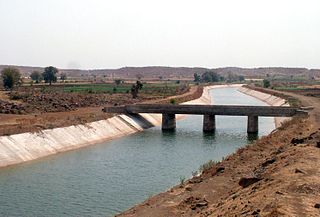
A canal is an artificial watercourse constructed for water supply and irrigation.
Inundation Canals – These are taken out from the rivers without any regulating system like weirs etc at their head. Such canals are useful only during the rainy season
Perennial Canals – These are those which are taken off from perennial rivers by constructing a barrage across the river. Most of the canals at present in India are perennial.
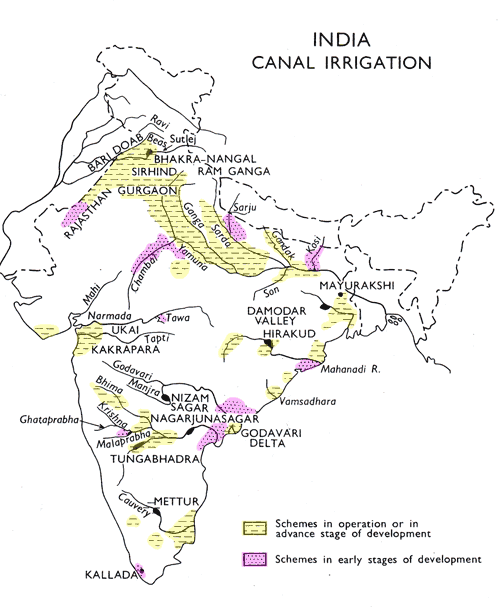
Canals can be an effective source of irrigation in areas of low relief, deep fertile soils, perennial source of water and an extensive command area. Therefore the main concentration of canal irrigation is in the northern plains.
The canals are practically absent from the peninsular plateau region because of rocky terrain. However, the coastal and the delta regions in South India have some canals for irrigation.
The percentage of canal irrigation area to total irrigated area in the country has fallen from about 40% in 1950-51 to less than 25% at present.
The states UP, Punjab, Haryana, Rajasthan and Bihar account for about 60% of the canal irrigated area in the country.
Merits of canal irrigation:
Perennial Source
Provides safety from droughts
Brings fertile sediments to the fields
Economical to serve a large area
Demerits:
Canal water soaks into the ground and leads to water logging, increases salinization, and leads to marshy conditions leading to malaria and flooding
Wastage of water.
2. Wells (and Tube Wells)
A well is a hole dug in the ground to obtain the subsoil water. An ordinary well is about 3-5 metres deep but deeper wells up to 15 metres are also dug.
This method of irrigation has been used in India from time immemorial. Various methods are used to lift the ground water from the well. Some of the widely used methods are the persian wheel, reht, charas or mot, and dhinghly (lever) etc.
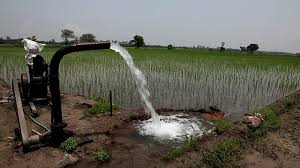
A tube well is a deeper well (generally over 15 metres deep) from which water is lifted with the help of a pumping set operated by an electric motor or a diesel engine.
Well irrigation is gradually giving way to energized tube wells. But there are many wells still in use where electricity is not available or the farmers are too poor t0 afford diesel oil.
This method of irrigation is popular in those areas where sufficient sweet ground water is available.
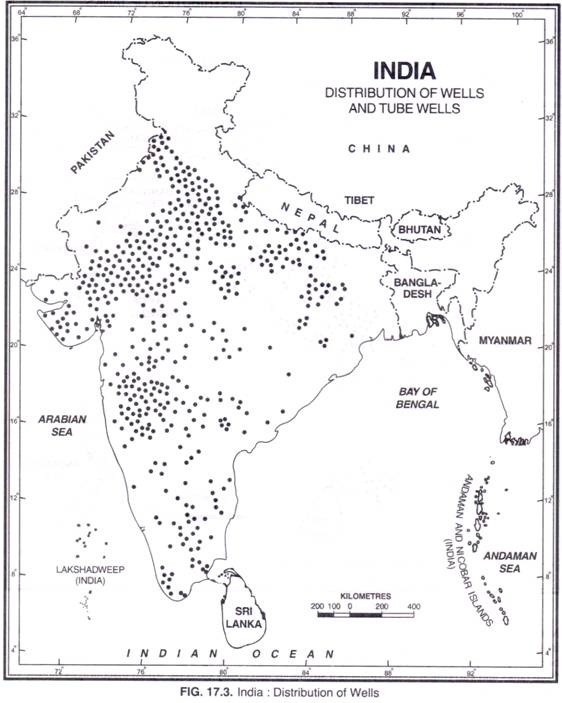
It is particularly suitable in areas with permeable rock structure which allows accumulation of ground water through percolation. Therefore wells are seen more in areas with alluvial soil, regur soil, etc. and less seen in rocky terrain or mountainous regions.
These areas include a large part of the great northern plains, the deltaic regions of the Mahanadi, the Godavari, the Krishna and the Cauvery, parts of the Narmada and the Tapi valleys and the weathered layers of the Deccan trap and crystalline rocks and the sedimentary zones of the peninsula
However, the greater part of peninsular India is not suitable for well irrigation due to rocky structure, uneven surface and lack of underground water.
Large dry tracts of Rajasthan, the adjoining parts of Punjab, Haryana and Gujarat and some parts of Up have brackish ground water which is not fit for irrigation and human consumption and hence unsuitable for well irrigation
At present irrigation from wells and tubewells accounts for more than 60% of the net irrigated area in the country.
UP has the largest area under well irrigation which accounts for 28% of the well irrigated area of the country. U.P., Rajasthan, Punjab, Madhya Pradesh, Gujarat, Bihar and Andhra Pradesh account for about three-fourths of the total well-irrigated area
Well is an independent source of irrigation and can be used as and when the necessity arises. Canal irrigation, on the other hand, is controlled by other agencies and cannot be used at will.
Some ground water salts are useful for crops
Does not lead to salinization and flooding problems
There is a limit to the extent of canal irrigation beyond the tail end of the canal while a well can be dug at any convenient place.
Demerits
Only limited area can be irrigated. Normally, a well can irrigate 1 to 8 hectares of land.
Not suitable for dry regions
Overuse may lead to lowering of water table
3. Tank irrigation
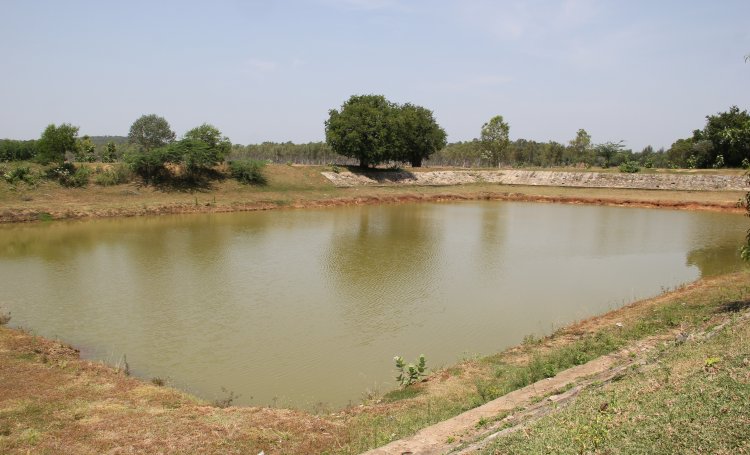
A tank is a reservoir for irrigation, a small lake or pool made by damming the valley of a stream to retain the monsoon rain for later use.
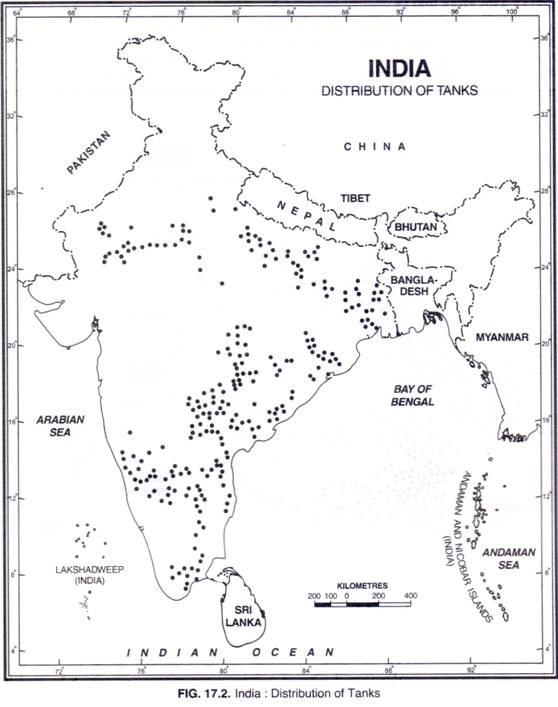
It is practised mainly in the peninsular region due to the following reasons:
The undulating relief and hard rocks make it difficult to dig canals and wells
There is little percolation of water due to hard rock structure and ground water is not available in large quantities.
Most of the rivers are seasonal; there are many streams which become torrential during the rainy season – so the only way to use this water is to impound it by constructing bunds and building tanks. Also, it is easy to collect rainwater in natural or artificial pits because of impermeable rocks.
Scattered nature of agricultural fields
Merits
Most of the tanks are natural and do not involve cost for their construction
Independent source for an individual farmer or a small group of farmers
longer life span
can be used for fishing also
Demerits
Depends on rain and these tanks may dry up during the dry season
Silting of their beds
Require large areas
Evaporation losses
Sometimes there might be a need to lift the water to take it to the field
Knowing a soil’s water, mineral, and organic components and their proportions can help us determine its productivity and what the best use for that soil may be. Several soil properties that can be readily tested or examined are used to describe and differentiate soil types. The most important properties are discussed below:
1. Colour: A soil’s colour is generally related to its physical and chemical characteristics. E.g.
Soils rich in humus tend to be dark because decomposed organic matter is black or brown. Soils with high humus content are usually very fertile, so dark brown or black soils are often referred to as ‘rich’. [Note – Some dark soils may be dark because of other soil forming factors and may have little or no humus]
Red or yellow soils typically indicate the presence of iron.
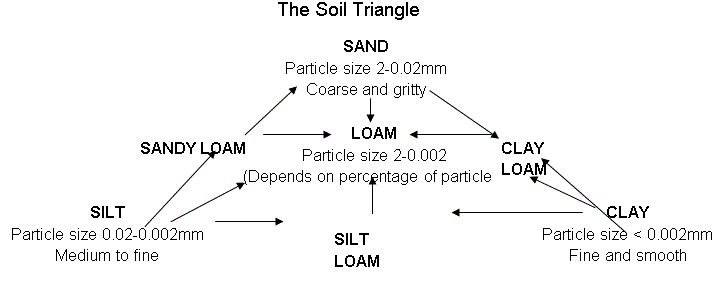
2. Texture: The soil texture refers to the coarseness/fineness of the mineral matter in the soil. It is determined by the proportion of the sand, silt and clay particles:
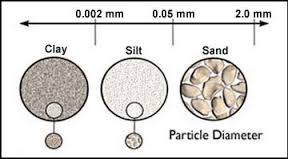
Clay: Particle Size – diameters less than 0.002 millimetre
Silt: Particle Size – diameters between 0.002 millimetres to 0.05 millimetres.
Sand: Particle Size – diameters between 0.05 and 2 millimetres.
[Rocks larger than 2 millimetres are regarded as pebbles, gravel, or rock fragments and technically are not soil particles.]
Note:
Clay being the finest of all plays the most important role in soil chemistry (offers more surface area).
Loamy Soil: Loamy soil is the one in which none of the three (sand/silt/clay) dominates the other two. In particular, loamy soil has about 40% sand, 40%silt, and 20% clay.
Generally speaking, Good Soils = Clay + Humus. The clay-humus complex is essential for a fertile soil as it provides it with a high water and nutrient holding capacity. Humus acts as a cement binding the soil particles together and thus reducing the risk of erosion.
3. Structure :
While the soil texture describes the size of soil particles, soil structure refers to the arrangement of the soil particles. The way in which sand, silt, clay and humus bond together is called soil structure. Structure can partially modify the effects of soil texture.
Some structural characteristics of soil:
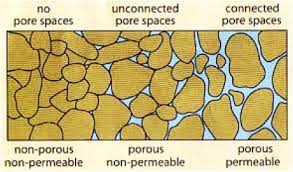
Permeability – The ease with which liquids/gases can pass through rocks or a layer of soil is called permeability. It depends on the size, shape and packing of particles. It is usually greatest in sandy soils and poor in clayey soils.
Porosity – The volume of water which can be held within a soil is called its porosity. It is expressed as a ratio of volume of voids (pores) to the total volume of the material.
Note: Most porous rocks are permeable with the exception of clay in which pore spaces are so small that they are often sealed with groundwater held by surface tension. Another exception – granite is non-porous but permeable. It is a crystalline rock and hence non-porous. Its individual crystals absorb little or no water but the rock may have numerous joints/ cracks through which the water can pass rendering it permeable.
A soil with high organic content also tends to have high porosity.
4. Soil Chemistry – Acidity or Alkalinity:
An important aspect of soil chemistry is acidity, alkalinity (baseness), or neutrality.
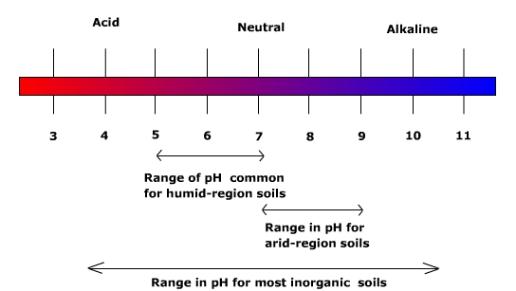
Low pH values indicate an acidic soil, and a high pH indicates alkaline conditions. Most complex plants grow only in the soils with levels between pH 4 and pH 10 but optimum pH varies with the plant species.
In arid and semi-arid regions, soils tend to be alkaline and soils in humid regions tend to be acidic.
To correct soil alkalinity and to make the soil more productive, the soil can be flushed with irrigation water.
Strongly acidic soils are also detrimental to plant growth, but soil acidity can generally be corrected by adding lime to the soil.
Now that we are done with the basics, let’s move on to the soils of India!
Soils of India
India has varied relief features, landforms, climatic realms and vegetation types. These have contributed to the development of various types of soils in India.
Various classifications adopted to study the Indian Soils:
1. In ancient times, soils used to be classified into two main groups:
Urvara (i.e. fertile), and
Usara (i.e. sterile)
2. In the 16th century A.D., soils were classified on the basis of their inherent characteristics and external features such as texture, colour, the slope of land and moisture content in the soil.
Based on texture, main soil types were identified as sandy, clayey, silty and loam, etc.
On the basis of colour, they were red, yellow, black, etc.
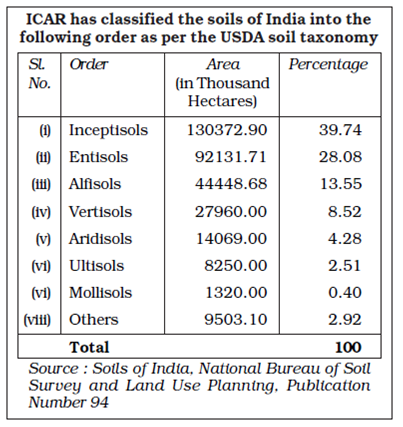
3. The National Bureau of Soil Survey and the Land Use Planning an Institute under the control of the Indian Council of Agricultural Research (ICAR) did a lot of studies on Indian soils. In their effort to study soil and to make it comparable at the international level, the ICAR has classified the Indian soils on the basis of their nature and character as per the United States Department of Agriculture (USDA) Soil Taxonomy.
Chief characteristics of these are:
Entisols – Immature soils that lack the vertical development of horizons. These soils are often associated with recently deposited sediments from wind, water, or ice erosion. Given more time, these soils will develop into another soil type.
Inceptisols – young soils that are more developed than entisols.
Vertisols – heavy clay soils that show significant expansion and contraction due to the presence or absence of moisture. These are common in areas that have shale parent material and heavy precipitation.
Aridisols – soils that develop in very dry environments.
Ultisols – associated with humid temperate to tropical climates. Warm temperatures and the abundant variability of moisture enhance the weathering process and increase the rate of leaching in these soils.
Mollisols – soils common to grassland environments
4. On the basis of genesis, colour, composition and location, the soils of India have been classified into:
(i) Alluvial soils
(ii) Black soils
(iii) Red and Yellow soils
(iv) Laterite soils
(v) Arid soils
(vi) Saline soils
(vii) Peaty soils
(viii) Forest soils.
5. Another way of classifying rocks is on the basis of dominant soil forming factors:
Zonal Soil – These soils occur in broad geographical areas or zones.
They are influenced more by the climate and vegetation of the area rather than the rock-type.
They are mature, as a result of stable conditions over a long period of time.
For example – red soils, black soils, laterite soils, desert soils etc.
Azonal Soil – It is that soil which has been developed by the process of deposition by the agents of erosion.
It means that it has been made by the fine rocky particles transported from the far-off regions.
These are immature soils and lack well-developed soil profiles. This may be due to the non-availability of sufficient time for them to develop fully or due to the location on very steep slopes which prohibits profile development.
For Example – alluvial and loess soils.
Intrazonal Soil – These soils occur within other zonal soils.
It is a well-developed soil reflecting the influence of some local factor of relief, parent material, or age rather than of climate and vegetation.
For example, calcerous soil (soils which develop from limestone), peat soil.
The major factors responsible for the formation of soil:
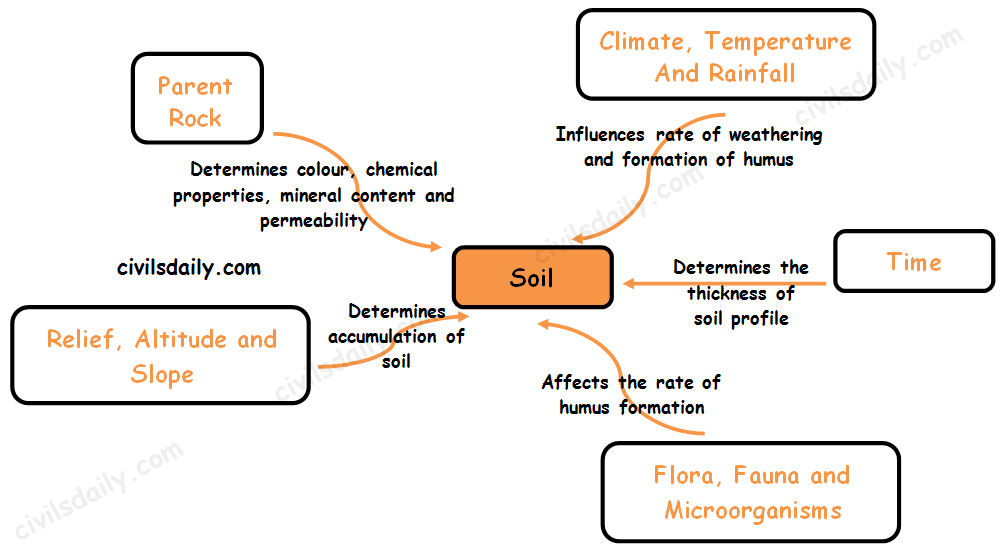
The major factors affecting the formation of soil are relief, parent material, climate, vegetation and other life-forms and time. Besides these, human activities also influence it to a large extent.
1. Parent Material
The parent material of soil may be deposited by streams or derived from in-situ weathering. Soil inherits many properties from the parent material from which it forms, for example, the mineral composition, the colour, the particle size and the chemical elements.
For Example,
The peninsular soils reflect the parent rock very much.
The ancient crystalline and metamorphic rocks which are basically granite, gneiss and schist form red soils on weathering because they contain iron oxide.
Soils derived from lava rocks are black coloured.
Sandy soils are derived from sandstone.
At the same time, the soils of the northern plains are transported and deposited from Himalayan and peninsular blocks, so they have little relation to rock material in-situ.
2. Climate
The role of climate is to vary the inputs of heat and moisture. It affects the rate of weathering of the parent rock. Hot and humid environments, in general, witness the most rapid weathering of parent materials.
Role of precipitation: In areas that experience a lot of rainfall, water percolating down through soil tends to leach nutrients and organic matter out of the upper layers, unless modified by other soil components like plant roots.
E.g. the soils underlying tropical rain forests tend to be nutrient-poor because of intensive leaching due to heavy rains; most of the nutrients are stored in the lush vegetation itself.
Conversely, in arid regions with little annual precipitation, high rates of evaporation encourage the accumulation of salts in the soil.
Role of temperature: Solar energy, usually expressed as temperature, controls the form of water falling onto the soil surface as well as in the soil. Also, it increases the rate of reactions, such as chemical reactions, evapotranspiration and biological processes. Wide fluctuations in temperature, especially in the presence of water cause shrinking and swelling, frost action and general weathering in soils.
E.g. Laterite soils are found in alternate wet and dry climate.
In Rajasthan, both granite and sandstone give birth to sandy soil irrespective of parent rock because of high temperature and wind erosion.
3. Biota (Flora, Fauna and Microorganisms):
Biota, in conjunction with climate, modifies parent material to produce soil.
The kind and amount of plants and animals that exist bring organic matter into the soil system as well as nutrient elements. This has a great effect on the kind of soil that will form.
E.g. Soils formed under trees are greatly different from soils formed under grass even though other soil-forming factors are similar.
The roots of plants also hold the soils and protect them from wind and water erosion. They shelter the soils from the sun and other environmental conditions, helping the soils to retain the needed moisture for chemical and biological reactions.
Topography is often considered a passive factor modifying the effects of climate.
Topography redistributes the water reaching the soil surface. Runoff from uplands creates wetter conditions on the lowlands, in some cases saline sloughs or organic soils. Thus, as a redistributor of the climate features, topography affects soil processes, soil distribution and the type of vegetation at the site.
Soils can take many years to form. Younger soils have some characteristics from their parent material, but as they age, the addition of organic matter, exposure to moisture and other environmental factors may change its features. With time, they settle and are buried deeper below the surface, taking time to transform. Eventually, they may change from one soil type to another.
Look at the following diagram for a quick revision of the above-discussed facts:
Note:
The above factors are not mutually exclusive but interdependent. For example, the kind of vegetation found at any one location on the earth’s surface is dependent on climate, parent material, topography, time and, in fact, soil. It is obvious that numerous combinations of the factors are possible. This leads to many different kinds of soils, each representing a certain combination of the factors of soil formation.
Soil Profile
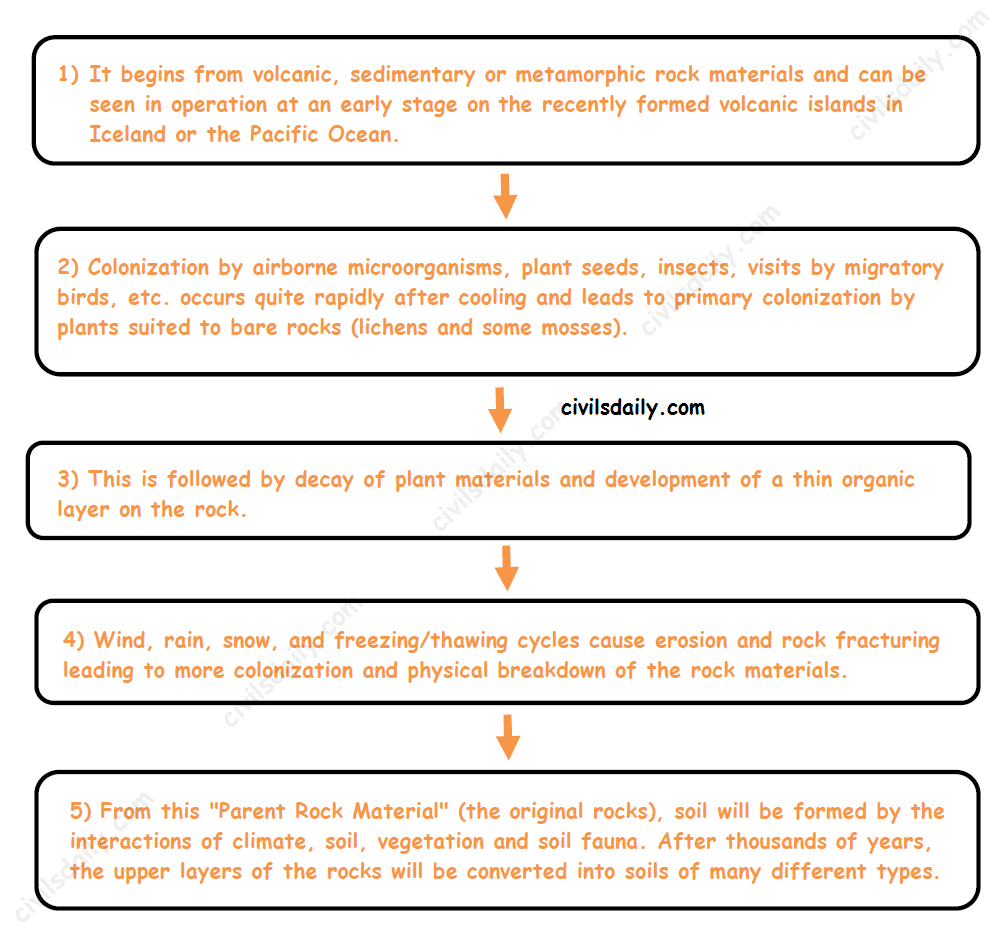
As we discussed earlier, soil development begins when plants and animals colonize rocks or deposits of rock fragments. Once organic processes start among mineral particles or rock fragments, chemical and physical differences begin to develop from the surface down through the parent material.
Initially, vertical differences result from surface accumulations of organic litter and the removal of fine particles and dissolved minerals by percolating water that deposits these materials at a lower level.
Over time, as climate, vegetation, animal life, and the land surface affect soil development, this vertical differentiation becomes increasingly apparent.
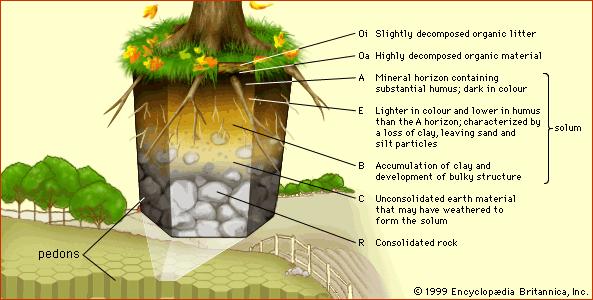
If you could dig a massive trench, about 50-100ft vertically downwards into the ground, you will notice that you would have cut through various layers of soil types. A look at the layers from a distance gives one a cross-section view of the ground (beneath the surface) and the kind of soils and rocks it is made up of. This cross section view of soil from the surface down to the parent material is called a Soil Profile.
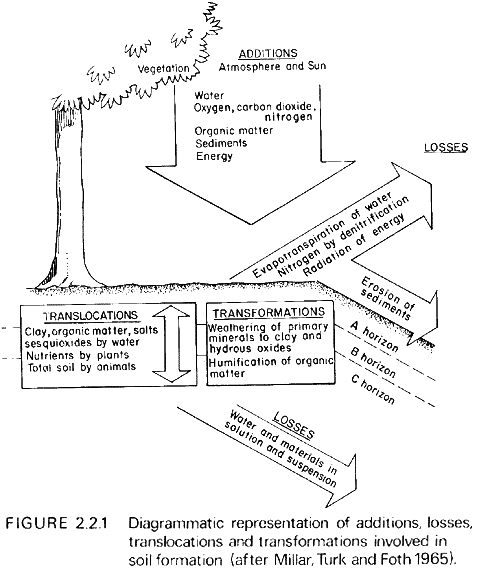
The Soil Profile is a product of the balance between the soil system inputs (i.e. additions) and outputs (i.e. losses) and the redistribution of (i.e. translocations), and chemical changes (transformations) in the various soil constituents.
The soil profile is made up of layers, running parallel to the surface, called Soil Horizons. These layers are distinguished by their physical and chemical properties.
Most soils have three major horizons. These are A Horizon, B Horizon and C Horizon. Aside these three, there are also the O, E and R horizons. How are they different? Let’s see!
O-Horizon: The O-horizon is very common to surfaces with lots of vegetative cover. It is the layer made up of organic materials such as dead leaves and surface organisms, twigs and fallen trees. In fact, the ‘O’ designation refers to this horizon’s high content of organic debris and humus. It is often black or dark brown in colour, because of its organic content. It is the layer in which the roots of small grass are found. The A-Horizon: The A horizon, immediately below the O horizon, is usually known as the topsoil. It is the top layer soil for many grasslands and agricultural lands. In general, A horizons are dark because they contain decomposed organic matter. The E-Horizon: The E horizon is usually lighter in colour, often below the O and A horizons. It is often rich in nutrients that are leached from the top A and O horizons. It has a lower clay content and is common in forested lands or areas with high-quality O and A horizons. The B-Horizon: Below the E-horizon is the B-horizon, a zone of accumulation, where much of the nutrients removed from the A and E horizons are deposited. It is the layer in which the roots of big trees end. There is a close relationship between the A and B horizons. Translocations, as well as, many biological and chemical reactions take place between them. The B horizon, however, tends to be more stable than the A for short term differences. The C-Horizon: The C horizon is the weathered parent material from which the soil has developed. This layer is the first stage in the soil formation process and eventually forms the above two layers. The C horizon is also known as saprolite. The R-Horizon: It is the unweathered parent material.
Before we discuss the various soil types and their distribution in India, it is imperative that we first go through the basics. Let’s begin with what soil is and how it is formed:
What is soil?
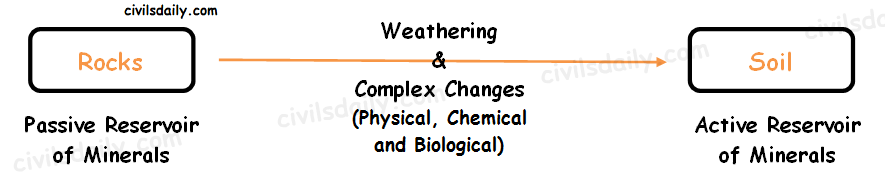
Soil is the loose material of the earth’s surface in which the terrestrial plants grow. It is usually formed from weathered rock or regolith changed by chemical, physical and biological process.
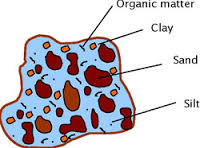
Thus the soil may be considered as an entity, quite apart from the rocks below it. It consists partly of mineral particles and partly, to a varying extent, of organic matter. Let’s look at the composition in detail:
Composition of soils:
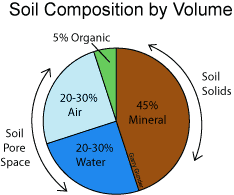
Soils have four main constituents:
Mineral matter – It includes all minerals inherited from the parent material as well as those formed by recombination from substances in the soil solution.
Organic matter – It is derived mostly from decaying plant material broken down and decomposed by the actions of animals and microorganisms living in the soil. It is this organic portion that differentiates soil from geological material occurring below the earth’s surface which otherwise may have many of the properties of a soil. (Note: The end product of breakdown of dead organic material is called humus.)
Air
Water
Normally, both air and water fill the voids in soil. Air and water in the soil have a reciprocal relationship since both compete for the same pore spaces.
For example, after a rain or if the soil is poorly drained, the pores are filled with water and air is excluded. Conversely, as water moves out of a moist soil, the pore space is filled with air. Thus the relationship between air and water in soils is continually changing.
The ratio of the components by volume is generically indicated as:
Note: The exact ratio depends on various factors like geographical location and the historical treatment of soil – by humans, by climate, by time.
Why is soil so important?
Soils are essential for life, in the sense that they provide the medium for plant growth, habitat for many insects and other organisms, act as a filtration system for surface water, carbon store and maintenance of atmospheric gases. They also support buildings and highways and contribute to the economies of our cities.
E.g. the rich, deep fertile soils of the Ganga plain especially its delta and the coastal plains of Kerala support a high density of population through agricultural prosperity. On the other hand, the shallow and coarse-grained soils of Telangana and Rajasthan do not provide a base for prosperous agriculture and thus support only a small population.
At the same time, the soil must not be regarded as a passive and inert body on the earth’s surface. It is a continually changing system within the total environment. The nature of a soil reflects the ancient environments under which it formed as well as current environmental conditions. The soil forming process, also known as pedogenesis, is described below:
How is soil formed?
Soil formation is a process taking many thousands of years.
Formation of soil from rocks.
The Pedogenic Processes:
The above-explained conversion from rocks to soils happens via four basic processes:
Additions
Losses
Translocations
Transformations
Let’s look at these soil forming processes in detail:
Additions: Most additions occur at the surface. The most obvious ones include solar energy, water controlled by climate, and organic material derived principally from the vegetation.
Losses: Losses occur both from the surface and from the deep subsoil. For instance, water is lost by evapotranspiration and carbon dioxide by diffusion at the surface and, on a more catastrophic level, large masses of soil can be stripped by erosion. Materials suspended or dissolved in water are the main forms of losses from the subsoil e.g. leaching.
Translocation: It refers to the physical movement of material within the soil. The material can be in the solid, liquid or gaseous form, the movement can be in any direction from and to any horizon. For instance clay, organic matter and iron and aluminium hydrous oxides are commonly moved from the surface horizon to a subsurface horizon. Conversely, in very dry climates salts are moved upwards in solution by capillarity, and in very cold climates solid mineral fragments are moved upwards by frost action.
Transformation: Additions, losses and translocations all involve movement as shown in the above figure. Transformations, on the other hand, involve the change of some soil constituent without any physical displacement. Chemical and physical weathering and the decomposition of organic matter are included here.
All these processes occur to a greater or lesser extent in all soils. The properties that characterise one soil are the result of a particular balance among all the processes. Other soils will be different because they have been formed by groups of processes having different balances.
The two driving forces for these processes are:
climate (temperature and precipitation), and
organisms, (plants and animals).
Passive factors:
Parent material is usually a rather passive factor in affecting soil processes because parent materials are inherited from the geologic world.
Topography (or relief) is also rather passive in affecting soil processes, mainly modifying the climatic influences of temperature and precipitation.
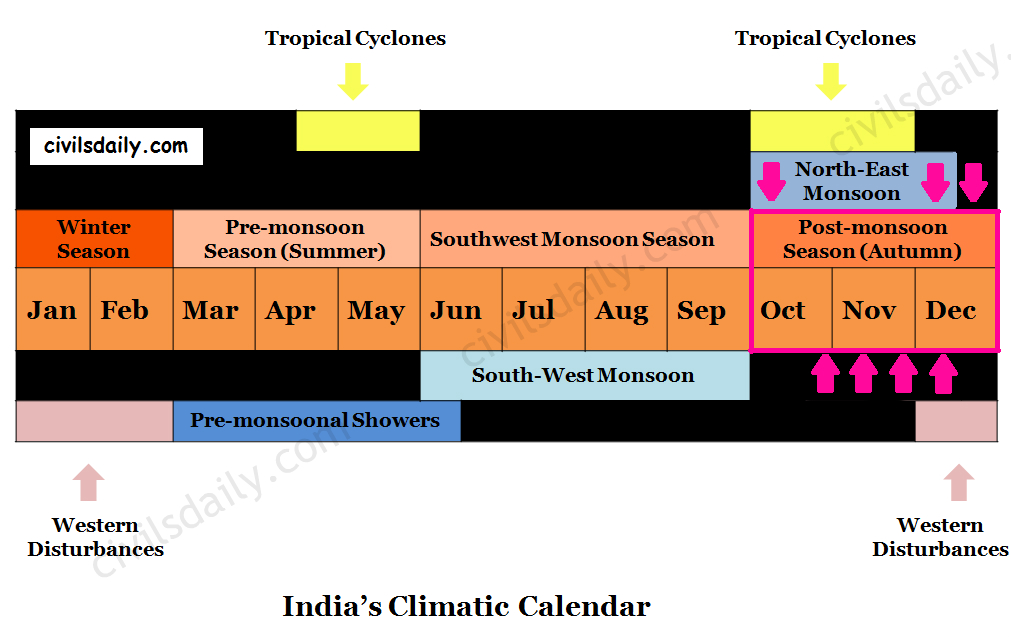
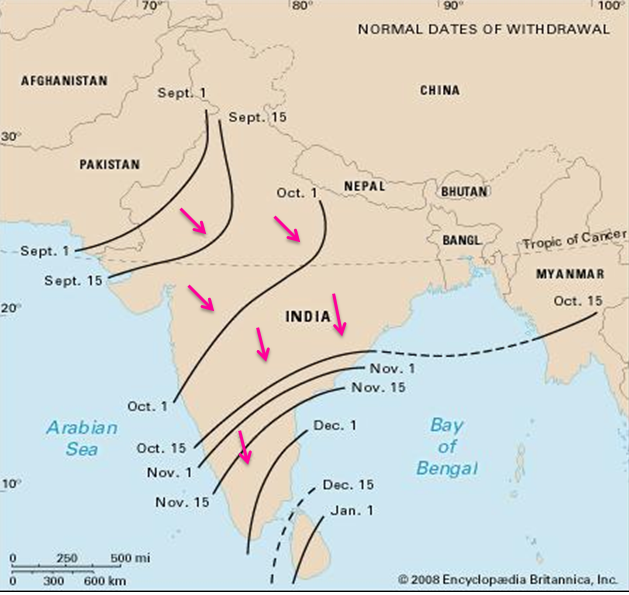
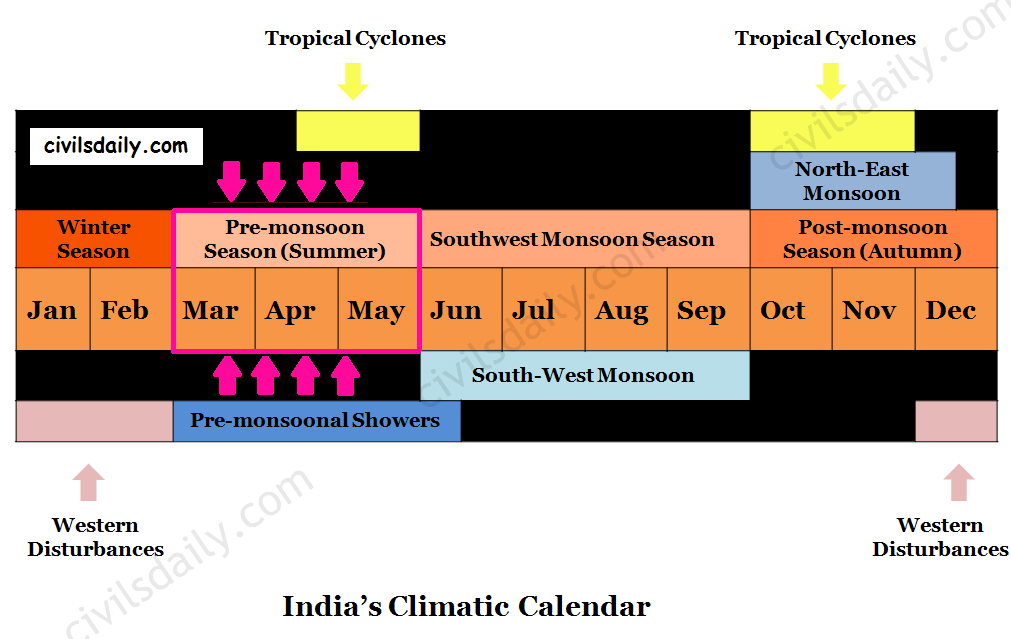
The months of October-November form a period of transition from the hot rainy season to the dry winter conditions.
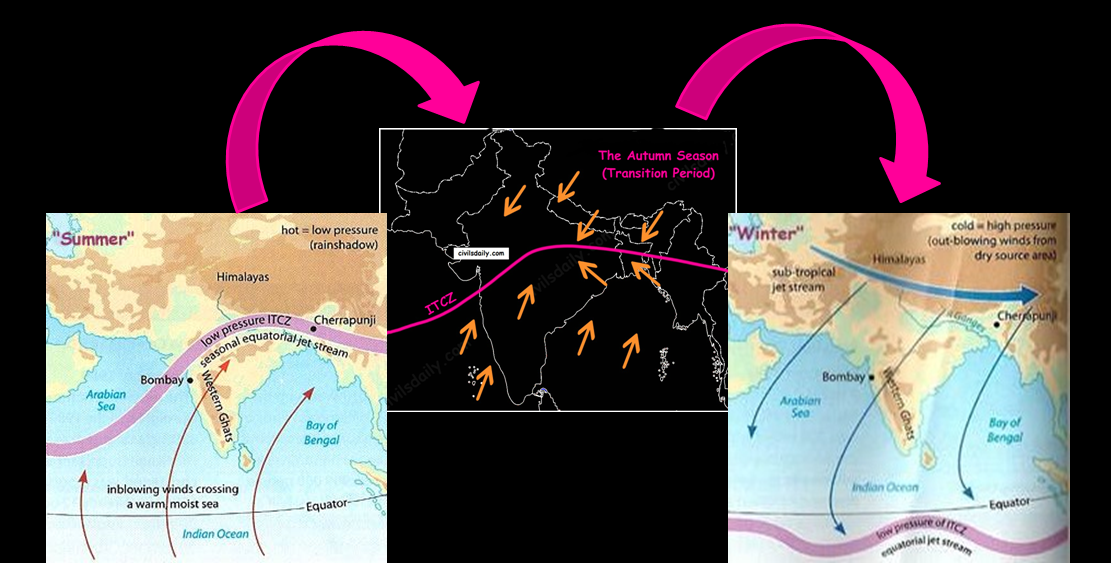
Surface Air Circulation during the Autumn Period. Source
The withdrawal of the south-west monsoon and the onset of north-east monsoon are both gradual phenomenon. They take place almost at the same time and tend to merge. This explains the popularity of the phrase “Retreating Monsoon”.
A Season of Retreating Monsoon
The retreat takes place due to the weakening of the low-pressure area over the north-western parts of India (and thus a gradual transition of ITCZ towards the south). This happens due to:
The apparent shift of sun towards the equator
Reduction in temperature due to widespread rains.
Consequently, the air pressure starts decreasing. Such changes in the atmospheric pressure cause the south-west monsoons to withdraw.
The Retreat of Monsoons is a process much slower than its arrival. It does not imply a right about turn but a gradual change of comparative pressure positions, thus gradually weakening and reducing the area of coverage and influence.
The retreat:
The south-west monsoons start retreating in the first week of September from Pakistan’s border in North-West India. Thus these winds withdraw earlier from the regions they reached the last.
The monsoon retreats from the western Rajasthan by the first week of September. It withdraws from Rajasthan, Gujarat, Western Ganga plain and the Central Highlands by the end of the month. By the beginning of October, the low pressure covers northern parts of the Bay of Bengal and by early November, it moves over Karnataka and Tamil Nadu. By the middle of December, the centre of low pressure is completely removed from the Peninsula.
This season is marked by clear skies and a rise in temperature. The land is still moist. Owing to the conditions of high temperatures (around 25°C) and humidity, the weather becomes rather oppressive and unbearable. This is commonly known as the ‘October heat’ or ‘Kwar ki Umas’.
In the second half of October, the mercury begins to fall rapidly, particularly in northern India. This continuous decrease in temperature after mid-October helps winter to set in by November or Early December.
Surface Winds and Precipitation:
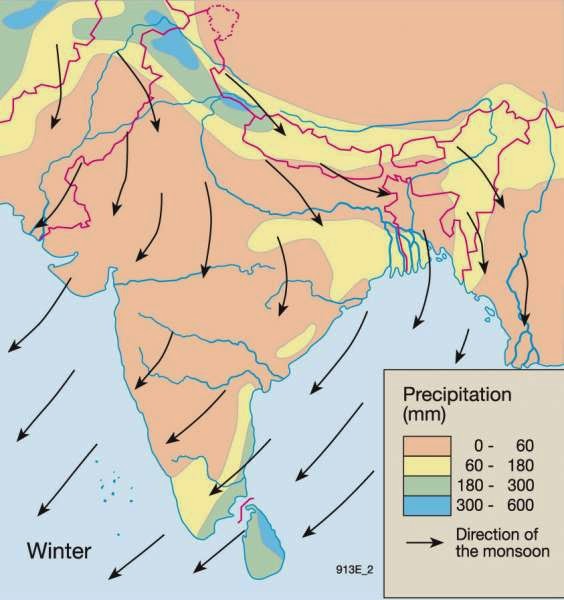
By and large, the topography of the region influences the wind direction:
The winds are westerly or northwesterly down the Ganga Valley.
They become northerly in the Ganga-Brahmaputra delta.
Free from the influence of topography, they are clearly north-easterly over the Bay of Bengal (thus the name North-East monsoon).
Precipitation:
Winter monsoons do not cause rainfall as they move from land to the sea. It is because:
They have little humidity; and
Due to anti-cyclonic circulation on land, the possibility of rainfall from them reduces.
However, there are some exceptions:
These months are the rainiest months of the year in coastal areas of Tamil Nadu. This is because the large indentation made by the Bay of Bengal into India’s eastern coast means that the flows are humidified before reaching Cape Comorin and rest of Tamil Nadu. Parts of West Bengal, Orissa, Andhra Pradesh, Karnataka and North-East India also receive minor precipitation from the northeast monsoons.
Central parts of India and northern parts of southern Peninsula also get winter rainfall occasionally.
Arunachal Pradesh and Assam in the northeastern parts of India also have rains between 25 mm and 50 mm during these winter months.
The low-pressure area lying over north-west India is transferred to the middle of Bay of Bengal by the end of October. As a result of these unstable conditions, severe cyclonic storms originate in this region.
These cyclonic storms strike along the eastern coast of India causing widespread rain in the coastal regions.
These tropical cyclones are very destructive. The thickly populated deltas of the Godavari, Krishna and Kaveri are their preferred targets. Every year cyclones bring disaster here. A few cyclonic storms also strike the coast of West Bengal, Bangladesh and Myanmar.
A bulk of the rainfall of the Coromondal coast is derived from these depressions and cyclones. Such cyclonic storms are less frequent in the Arabian Sea.
Now that we have studied all the seasons in detail, let’s have a look at the annual distribution and variability of rainfall in India:
Rainfall Distribution:
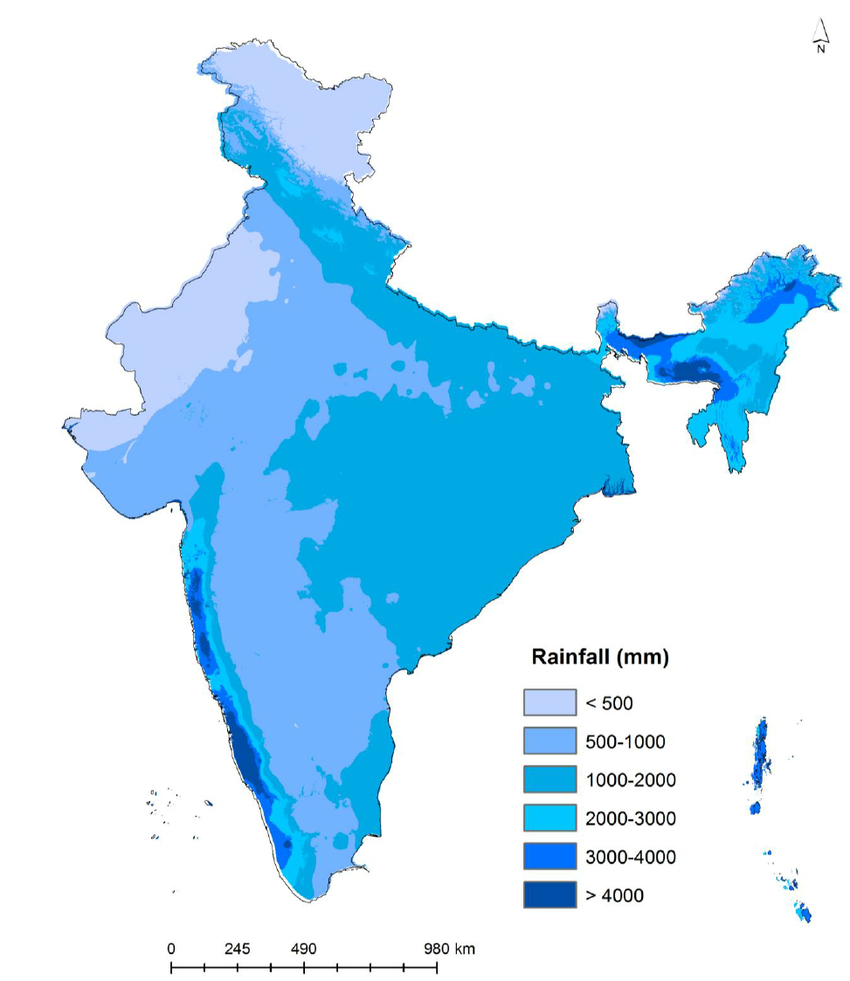
The distribution of rainfall in India is highly uneven. Its distribution is largely controlled by the nearness of the sea and orographic features. The average annual rainfall in India is shown in the following map. Notice that the regional variations in the distribution of rainfall over India are quite pronounced.
The rainfall in India is highly variable. The actual rainfall of a place in a year deviates from the average rainfall by 10-60%.The variability of rainfall is computed with the help of the following formula:
The variability of rainfall is computed with the help of the following formula:
C.V. = (Standard Deviation÷ Mean) × 100
where C.V. is the coefficient of variation.
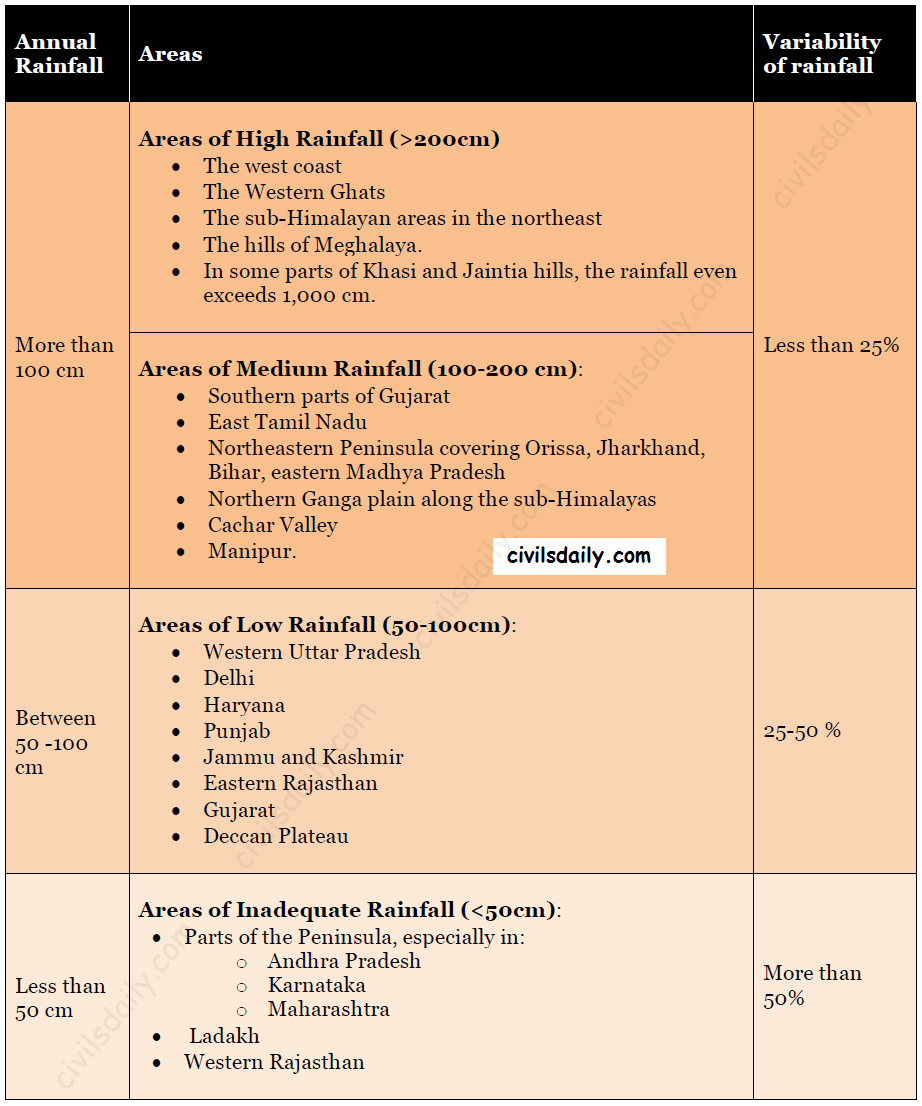
RainfallVariability in India
Notice that the regions of inadequate rainfall are also the regions with the highest variability of rainfall. The variability of rainfall has a significant role in the agricultural operations and other economic activities of a country. The areas showing high variability of rainfall have a chronic deficiency of water.
Climatic Regions of India
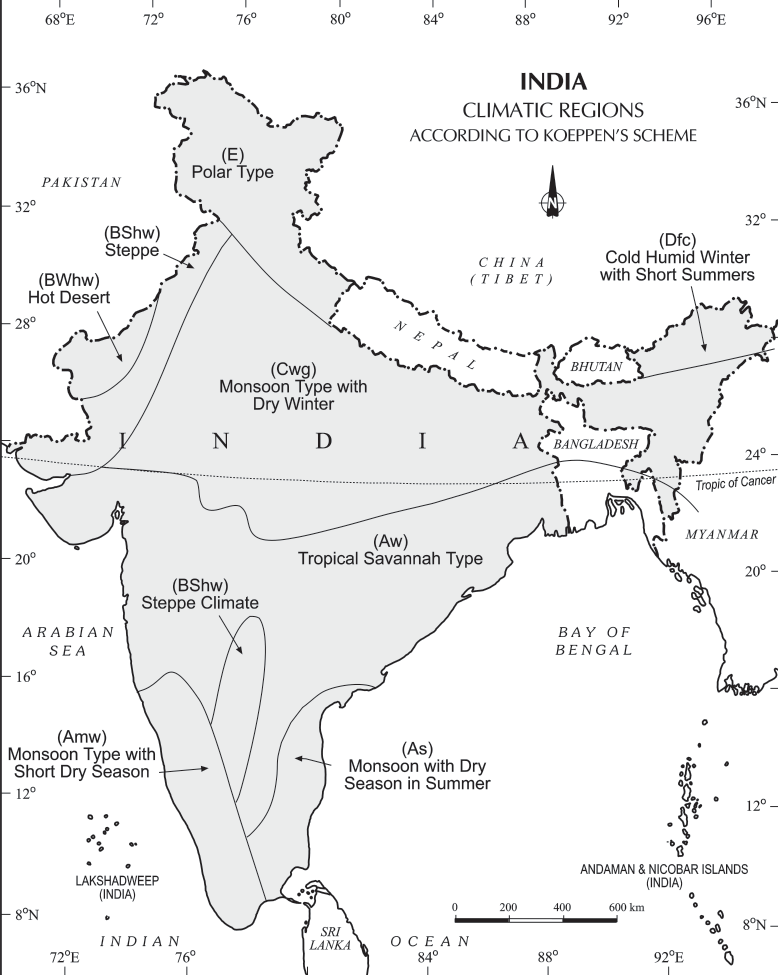
As discussed in the beginning, India has a monsoon type of climate with many regional variations. These variations represent the subtypes of the monsoon climate. It is on this basis that the climatic regions can be identified.
A climatic region has a homogeneous climatic condition which is the result of a combination of factors. Temperature and rainfall are two important elements which are considered to be decisive in all the schemes of climatic classification.
The classification of climate, however, is a complex exercise. There are different schemes of classification of climate. Two important ones are discussed here:
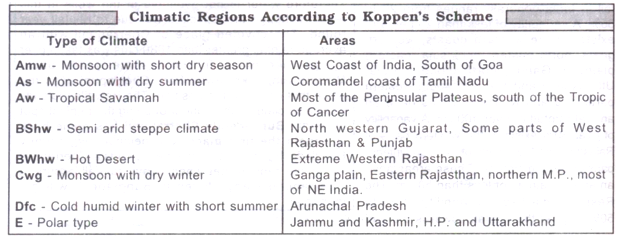
A) Koeppen’s scheme of Climatic classification
It is based on monthly values of temperature and precipitation.
He identified five major climatic types and used letter symbols A, B, C, D and E to denote them:
Tropical climates (A): [where mean monthly temperature throughout the year >18°C]
Dry climates (B): where precipitation is very low in comparison to temperature.
If dryness is less, it is semiarid (S);
If it is more, the climate is arid(W).
Warm temperate climates (C): where mean temperature of the coldest month is between 18°C and minus 3°C.
Cool temperate climates (D): where mean temperature of the warmest month is over 10°C, and mean temperature of the coldest month is under minus 3°C.
Ice climates (E), where mean temperature of the warmest month is under 10°C.
These five types can be further subdivided into sub-types on the basis of seasonal variations in the distribution pattern of rainfall and temperature. Koppen used small letters such as m, w or h to define these sub-types:
f (sufficient precipitation)
m (rain forest despite a dry monsoon season),
w (dry season in winter)
h (dry and hot)
c (less than four months with mean temperature over 10°C)
g (Gangetic plain)
Accordingly, India can be divided into the following eight climatic regions:
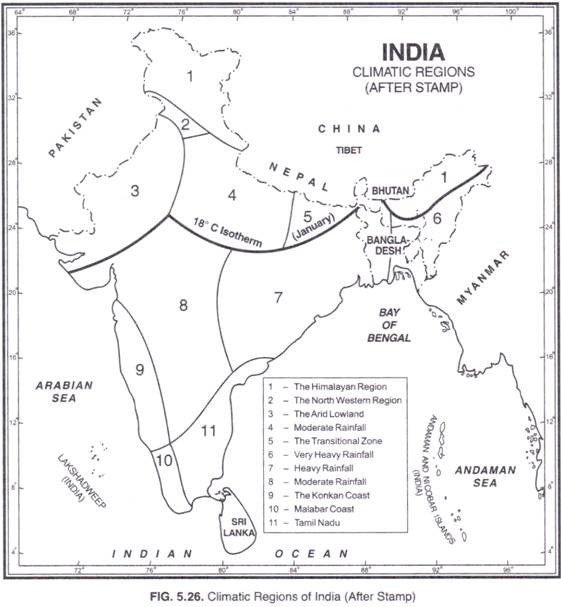
Kendrew and Stamp on the basis of the 18°C isotherm for the month of January (which almost follows the Tropic of Cancer) divided India into two major climatic regions:
Subtropical India (Continental)
Tropical
These two major climatic regions have been further divided into eleven regions as follows:
As the sun shifts northward towards the Tropic of Cancer after the vernal Equinox, the whole India experiences an increase in temperature.
In most parts of India, temperatures recorded are between 30°-32°C.
North India:
April, May and June are the months of summer in north India.
In May, the heat belt moves further north, and in the north-western part of India, temperatures around 48°C are not uncommon.
South India:
The Peninsular situation of south India with moderating effect of the oceans keeps the temperatures lower than that prevailing in north India. So, temperatures remain between 26°C and 32°C.
Western Ghats – Due to altitude, the temperatures in the hills of Western Ghats remain below 25°C.
The temperature increases from the coast towards the interior areas.
Surface Pressure and Winds:
The atmospheric pressure is low all over the country due to high temperatures.
Since the sun goes gradually towards the north (summer solstice), the Inter Tropical Convergence Zone (ITCZ) begins to move towards the north (Eventually reaching up to 25° latitude in July).
The general direction of winds is from the north-west and west in north-western India, and from the south-west in the Arabian Sea and adjoining coasts.
In the months of May and June, the high temperature in north-western India builds steep pressure gradient.
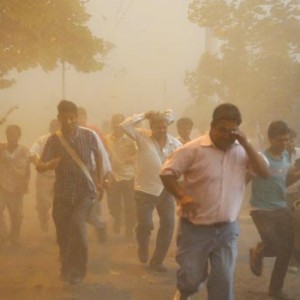
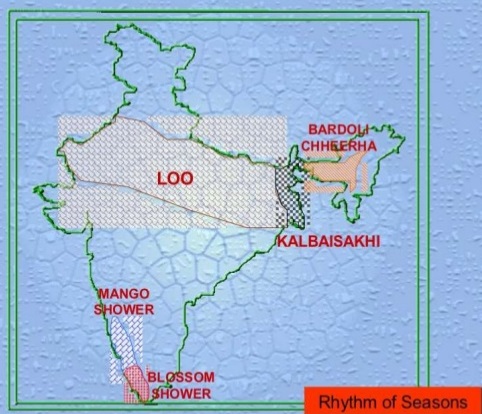
Under such conditions, hot dust-laden strong winds known as ‘loo’ blow.
These strong dust storms result from the convective phenomenon and their intensity increases in the afternoon. These are locally known as Andhis.
These are essentially short-lived thunderstorms, which move like a solid wall of sand and dust.
These bring little rainfall and give much needed relief from heat.
Dust storms in the evening are very common during May in Punjab, Haryana, Eastern Rajasthan and Uttar Pradesh.
Occasionally, the moisture-laden winds are attracted towards the periphery of the trough. A sudden contact between dry and moist air masses gives rise to local storms of great intensity. These local storms are associated with violent winds, torrential rains and even hailstorms.
The thunderstorms which originate over Chotanagpur plateau are carried eastwards by westerly winds. The areas with the highest incidence of thunderstorms are the north-eastern states, West Bengal, and the adjoining areas of Orissa and Jharkhand.
In West Bengal and the adjoining areas of Assam, Orissa and Jharkhand, the direction of squalls is mainly from the northwest and they are called Norwesters (Squall – a sudden, violent gusty wind).
The rainfall brough by norwesters is called spring storm showers.
These are often very violent with squall speeds of 60-80km/hour.
Large sized hailstones sometimes accompany these showers and harm the animals and standing crops.
The period of maximum occurrence of these storms is the month of Baisakh. These are thus locally called ‘Kal Baisakh (a calamity of the month of Baisakh)’.
In Assam, these storms are known as “Bardoli Chheerhaor Bordochila”.
In the south, thunderstorms occur in Kerala and adjoining parts of Karnataka and Tamil Nadu particularly in the evenings and nights. These pre-monsoonal showers are called by various names:
Tea showers in Assam ( they are good for tea, jute and rice)
Mango showers in Kerala and coastal areas of Karnataka as they help in the early ripening of mangoes.
Cherry Blossoms/ Coffee showers in Kerala and nearby areas (good for coffee plantations)
Tropical Cyclones (TC) are intense low-pressure systems that develop over the seas or oceans in the tropical and subtropical regions. Tropical cyclones cause destruction in the coastal areas because of:
High wind velocities.
Storm Surge ( i.e. rise of coastal waters due to approaching cyclone)
Torrential rainfall which often lead to floods in the coastal areas.
Note: The interior regions do benefit from the torrential rain associated with a tropical cyclone for agriculture and other applications of water.
The Indian sub-continent having a coast line of 7516 km is the worst affected region of the world. It is exposed to nearly 10% of the world’s Tropical Cyclones.
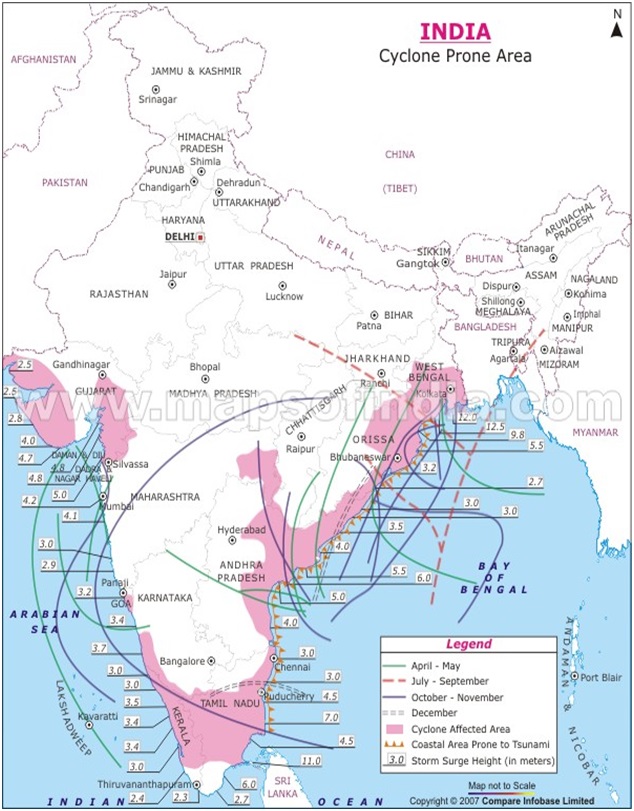
Many low-pressure systems of varying stages of development form in the Bay of Bengal and in the Arabian Sea and move west or north-westwards, sometimes re-curving north or north-east at a later stage (See the following map ). Re-curvature usually occurs when these systems are between 16° and 18°N.
Only a few of them develop fully into the mature stage and the majority remain as depressions.
The fully developed low-pressure systems called cyclones generally form in the lower latitude belt (10° N – 14°N) before and after the SW monsoon. They are very intense systems and are responsible for the major portion of rainfall over the peninsula.
These systems reach their maximum intensity before/after the monsoon period.
During the SW monsoon season, these systems form in the Bay of Bengal and generally travel west or north-west along the monsoon trough. The rainfall over northern India is to a large extent dependent on the frequency, track and intensity of these depressions (called monsoon depressions). The frequency and direction of these cyclones also influence weather conditions along the eastern coast during retreating monsoon season i.e. in October and November.
An analysis of the frequencies of cyclones on the East and West coasts of India shows that the East Coast is more prone to tropical cyclones as compared to the West Coast.
The idea of co-operation in South Asia was discussed in at least three conferences: the Asian Relations Conference held in New Delhi on April 1947, the Baguio Conference in the Philippines on May 1950 and the Colombo Powers Conference held in Sri Lanka in April 1954.
Then in 1983, the international conference held by Indian Minister of External Affairs P.V. Narasimha Rao in New Delhi, the foreign ministers of the inner seven countries adopted the Declaration on South Asian Association Regional Cooperation (SAARC) and formally launched the Integrated Programme of Action (IPA) initially in five agreed areas of cooperation namely-
Agriculture,
Rural Development,
Telecommunications,
Meteorology,
Health and Population Activities.
Officially, the union was established in Dhaka with Kathmandu being union’s secretariat-general. The first SAARC summit was held in Dhaka on 7–8 December 1985 and hosted by the President of Bangladesh Hussain Ershad. The declaration signed by King of Bhutan Jigme Singye, President of Pakistan Zia-ul-Haq, Prime Minister of India Rajiv Gandhi, King of Nepal Birendra Shah, President of Sri Lanka JR Jayewardene, and President of Maldives Maumoon Gayoom.
Member Countries:
SAARC
Observer Countries: States with observer status include Australia, China, the European Union, Iran, Japan, Mauritius, Myanmar, South Korea and the United States.
Objectives
The objectives of the association as defined in the SAARC Charter are:
To promote and strengthen collective self-reliance among the countries of South Asia,
To contribute to develop mutual trust, understanding and appreciation of one another’s problem,
To promote active collaboration and mutual assistance in the economic, social, cultural, technical and∙ scientific fields,
To strengthen cooperation with other developing countries,
To strengthen cooperation among themselves in international forums on matters of common interest,
To cooperate with international and regional organizations with similar aims and purposes.
Significance
The South Asian Association for Regional Cooperation (SAARC) is an economic and geopolitical organisation of eight countries that are primarily located in South Asia or the Indian subcontinent.
The combined economy of SAARC is the 3rd largest in the world in the terms of GDP(PPP) after the United States and China and 5th largest in the terms of nominal GDP. SAARC nations comprise 3% of the world’s area and contain 21% (around 1.7 billion) of the world’s total population and around 9.12% of Global economy as of 2015.
The SAARC policies aim to promote welfare economics, collective self-reliance among the countries of South Asia, and to accelerate socio-cultural development in the region.
The SAARC has developed external relations by establishing permanent diplomatic relations with the EU, the UN (as an observer), and other multilateral entities. The official meetings of the leaders of each nation are held annually whilst the foreign ministers meet twice annually. The 18th SAARC Summit was held in Kathmandu from 26–27 November 2014.
India’s standing:
India being the world’s 3rd & 7th largest Economy of world in GPP(PPP) & GDP(Nominal) terms respectively as well as world’s fastest growing major Economy, plays an important role in functioning of SAARC. India makes up over 70% of the area and population among these eight nations.
Journey so far
SAARC Visa Exemption Scheme–
The SAARC Visa Exemption Scheme was launched in 1992. The leaders at the Fourth Summit (Islamabad, 29-31 December 1988), while realizing the importance of having people to people contacts, among the peoples of SARC countries, decided that certain categories of dignitaries should be entitled to a Special Travel document, which would exempt them from visas within the region. As directed by the Summit, the Council of Ministers regularly kept under review the list of entitled categories.
Currently, the list included 24 categories of entitled persons, which include Dignitaries, Judges of higher courts, Parliamentarians, Senior Officials, Businessmen, Journalists, and Sportsmen etc.
SAARC Disaster Management Centre–
SAARC Disaster Management Centre (SDMC) was set up in October∙ 2006 at the premises of National Institute of Disaster Management in New Delhi. The Centre has the mandate to serve eight Member Countries of South Asia Association of Regional Cooperation (SAARC) – Afghanistan, Bangladesh, Bhutan, India, Maldives, Nepal, Pakistan and Sri Lanka – by providing policy advice and facilitating capacity building services including strategic learning, research, training, system development and exchange of information for effective disaster risk reduction and management in South Asia.
The Centre is a sleek body of professionals working on various dimensions of disaster risk reduction and management in South Asia. The Centre is networking through the National Focal Points of the Member Countries with the various Ministries, Departments and Scientific, Technical, Research and Academic institutions within and outside the Government working on various aspects of disaster risk reduction and management.
SAARC Chamber of Commerce & Industry–
Established in 1985, SAARC had hitherto avoided including core economic issues in its programme, but in the wake of the desire for a SAARC Chamber of Commerce and Industry, the SAARC Secretariat commissioned a study on Trade, Manufactures and Services in 1988. The study was completed in 1991 and strongly supported to establish a SAARC Chamber of Commerce and Industry to bring about improvement in the business environment disseminate information about potential tradable goods and identify joint ventures in the SAARC region. The objectives of the “SAARC Chamber” includes to encourage Trade, Service, Industry, Small & Medium Enterprise, Agriculture, Intra-Regional through creating strong business linkages amongst the entrepreneurs of the region of South Asia.
SAPTA = SAARC Preferential Trading Arrangement (SAPTA) was signed in 1993 and entered into force in 1995. The Agreement reflected the desire of the Member States to promote and sustain mutual trade and economic cooperation within the SAARC region through the exchange of concessions. SAPTA had no significant impact on intra-regional trade of SAARC -It was firstly, one of the least ambitious trading agreements. The agreement provided for a positive list; the trade of the items on positive list could be regulated. There was a lack of commitments on tariff reduction; it was a completely voluntary arrangement.There was no clarity on rules of origin. There was no provision for a Dispute Settlement Mechanism.
South Asian Free Trade Area–
The Tenth SAARC Summit (Colombo, July 1998) decided to set up a∙ Committee of Experts (COE) to draft a comprehensive treaty framework for creating a free trade area within the region, taking into consideration the asymmetries in development within the region and bearing in mind the need to fix realistic and achievable targets. The SAFTA Agreement was signed on 6 January 2004 during Twelfth SAARC Summit held in Islamabad, Pakistan.
The Agreement entered into force on 1 January 2006, and the Trade Liberalisation Programme commenced from 1 July 2006. Under this agreement, SAARC members will bring their duties down to 20 per cent by 2009. In 2012, the SAARC exports increased substantially to US$354.6 billion from US$206.7 billion in 2009. Imports too increased from US$330 billion to US$602 billion over the same period. But the intra-SAARC trade amounts to just a little over 1% of SAARC’s GDP.
Recent Developments
SAARC Satellite–
SAARC Satellite is a proposed communication-cum-meteorology satellite by Indian Space∙ Research Organisation (ISRO) for the SAARC region. Prime Minister of India Mr. Narendra Modi mooted the idea of a satellite serving the needs of SAARC member nations. In his visit to Nepal in August 2014, Narendra Modi announced developing a satellite to assist India’s neighbors.
Framework agreement on cooperation in power sector– During 18th SAARC summit, foreign ministers of all∙ the eight countries signed the framework agreement on cooperation in power sector which will ensure electricity trading through grid connectivity.
Outcome Analysis and Challenges
Overall, there have been no major breakthroughs at the summit and no significant move on fighting∙ terrorism which was presented as a main concern by most of the SAARC leaders, particularly India, Afghanistan, and Nepal.
Also, there were no important decisions on flow of investments and financial arrangements to push the economies towards “deeper regional integration”, which was projected as the main theme of the recently held 18th summit in Kathmandu.
However, the summit did set the target of forming a regional economic community in the coming 15 years,∙ but for now, this plan sounds more rhetorical than concrete, just like all the talk about removing poverty, fighting terrorism and speeding connectivity.
The Kathmandu Declaration, which the summit produced, lists a lot of other lofty goals like developing a∙ “blue economy” (ocean-based economy) for the region, monitoring cyber-crimes, good governance, reinforcing cultural heritage, universal health coverage, food security, etc. It remains to be seen how effective the actions and implementation on these promises will be.
Lack of progress– The SAARC’s activities has been sluggish and irritatingly slow. In its 30 years of existence, it∙ failed to hold 11 annual summits for political reasons, both at the bilateral and internal levels.
India’s Stand– India has described the 18th summit as a success, at least for its umbrella agreement on power sharing. However any hard-headed assessment of the summit may not give much satisfaction to Indian policy makers, particularly for the failure to clinch the key connectivity proposals. India’s Prime Minister Narendra Modi has made “neighbours first” as the cornerstone of his foreign policy. He invited all the SAARC neighbours to witness his oath taking in New Delhi on May 26. At the Kathmandu summit, PM Modi pitched for “reinvigorating’ and “revitalizing” SAARC. In his address at the summit, he encouraged neighbours to join India’s economic opportunities and growth. On the issues of trade, transit, visas, investments, education, health, communication and space technologies, he promised to help its South Asian neighbors. India also avoided raising any controversial and sensitive issues that may irritate others.
Pakistan’s Response
Its reluctance to come on board on the connectivity agreements appears to be a∙ response to India breaking promised bilateral talks. It also signaled its persisting resistance to India expanding its economic engagement with Afghanistan. While transportation of goods and passenger by road between India and Afghanistan through Pakistan is opposed by the associations of truck and bus operators in Pakistan for the fear of losing business, the real difficulty arises from strategic calculations of blocking India from emerging as a competitor to Pakistan in Afghanistan.
China and SAARC
Pakistan has been pleading for China’s greater role in South Asia. Most of the other∙ smaller South Asian countries are also supportive of elevating China’s status from that of an observer, to either a full member or a dialogue partner.
The Kathmandu Declaration accepted that observer countries of SAARC may be engaged in “demand driven priority areas”. Almost all of India’s neighbours are attracted to China, both for the lure of greater economic resources, as well as strategic potential of keeping India in “balance”. China has also been keen to play a greater role in South Asia. Its South Asia policy is driven by a sense of vulnerability in Tibet and Xinjiang, by the growing potential of a 1.6 billion-strong South Asian market, and by its trade and maritime interests in the Indian Ocean.
Ever since it was admitted in SAARC as an observer in 2006, China has vastly improved its economic and political engagement with the SAARC countries. At the Kathmandu summit, Chinese Vice Foreign Minister Liu Zhenmin promised a Chinese investment of $30bn for infrastructure development in South Asia and 10,000 scholarships for young South Asians, as a mark of China commitment to the region.
India’s apprehensions:
India is prepared for an intensive economic engagement with China at the bilateral level but is not ready or willing to open its strategic space in the region for Chinese presence and influence.
It is not too happy to admit China as a SAARC member or even elevate its observer status in the regional organisation. India is resisting pressure from its SAARC neighbours on China under the argument that SAARC has still to achieve internal cohesion and consolidation.
India’s unexpressed fears are on two counts. As a full member, China will get a veto in SAARC affairs as SAARC decisions are taken unanimously. China may therefore block projects that may offer strategic and economic advantage to India. After all, China did restrain both the Asian Development Bank and lately even Japan, from supporting projects in India’s north-eastern state of Arunachal Pradesh. China is also opposing Indian oil exploration projects in what it considers disputed waters off Vietnam in the South China Sea.
India is also concerned that even as a dialogue partner, China could breach SAARC solidarity if it conflicts with its perceived economic and strategic interests, as it did with ASEAN in 2012. India seems to be gearing to integrate its neighbours even in the face of the Chinese challenge and the Pakistani resistance.
SAARC issues
SAPTA =
SAARC Preferential Trading Arrangement (SAPTA) was signed in 1993 and entered into force in 1995.
The Agreement reflected the desire of the Member States to promote and sustain mutual trade and economic cooperation within the SAARC region through the exchange of concessions.
SAPTA had no significant impact on intra-regional trade of SAARC -It was firstly, one of the least ambitious trading agreements.
The agreement provided for a positive list; the trade of the items on positive list could be regulated.There was a lack of commitments on tariff reduction; it was a completely voluntary arrangement.There was no clarity on rules of origin.There was no provision for a Dispute Settlement Mechanism.
SAFTA =
The South Asian Free Trade Area (SAFTA) is an agreement reached in 2004 to create SAARC free trade area. The members of SAARC signed a framework agreement on SAFTA to reduce customs duties of all traded goods to zero by the year 2016.
The SAFTA agreement came into force on 1 January 2006 and is operational following the ratification of the agreement by the seven governments.
Major instruments of SAFTA:- Trade Liberalisation Programme, Rules of Origin, Institutional Arrangements, Consultations and Dispute Settlement Procedures, Safeguard Measures, Special Provisions for Least Developing Countries of SAARC. Though an advance over SAPTA, SAFTA has not been able to improve the trade relations of SAARC members significantly -Intra-regional trade is still below 5% of the total trade of the SAARC members.The concept of ‘sensitive list’ exists in SAFTA; trade of the commodities on sensitive list can be regulated by the countries.
The countries continue to maintain big sensitive lists. Though there is a commitment on reducing tariff barriers; non-tariff barriers still remain high. The trade between India-Pakistan, the two largest members of SAARC, is still languishing at less than 3 billion US $; studies suggest that an equal amount of trade happens through the Dubai route and illegal trade. Pakistan is yet to award India, the status of Most Favored Nation (MFN).
SAARC 18TH Summit, 2014 Outcomes =
The 36-point concluding Kathmandu Declaration states that members will continue their efforts to intensify regional cooperation on connectivity, renew their commitment to a South Asian Economic Union, strengthen the Social Window of the SAARC Development Fund, and reiterate their commitment to free South Asia from poverty.
Three important agreements related to connectivity—the Agreement for the Regulation of Passenger and Cargo Vehicular Traffic, the SAARC Regional Agreement on Railways, and the SAARC Framework Agreement for Energy Cooperation (Electricity), were expected to be signed. The first two agreements were stalled because Pakistan held back, saying it still had to complete its “internal processes” regarding these pacts. The third, on energy, was signed.
The Critical Analysis
SAARC Successes
Over the last 25 years, despite extremely difficult political circumstances, SAARC has managed to create situations, institutions and forums where Heads of State have had to shake each other’s’ hands and go into talks together.
SAARC has tackled important topics for the region such as a social charter, development agreements and even the sensitive subject of fighting terrorism.
The food and development banks, Agreement on Transportation, Energy are important steps in the right direction.
Exchanges in the areas of civil society and science have become one of the pillars of South Asian integration efforts.
SAARC Failures
In its 30 years of existence, SAARC failed to hold 11 annual summits for political reasons, both at the bilateral and internal levels. The last summit in Kathmandu was held after a gap of three years.
The intra-regional trade of SAARC amounted to $40.5 billion in 2011, which constitutes just 5% of member countries’ trade. The number pales into insignificance when compared with the volume of trilateral trade between member-countries of NAFTA, the North American Free Trade Agreement, (the US, Canada and Mexico) which hit $1 trillion in 2011.
While different regions of the world have progressed even to monetary union, SAARC has failed to even come up with a free trade agreement.
Even in the Kathmandu Summit 2014, there were three connectivity agreements on road, rail and energy, to be endorsed by the eight SAARC leaders. Only one of these – on energy – has been signed.
Reasons for failure
Weak Cultural Identities The South Asian Region comprises countries sharing common history, heritage and culture. The horrors of divisions and sub-divisions have however created fissures. These fissures are commonly articulated through the ideas of distinct cultures. Pakistan wants to assert itself as Islamic State and calls India a Hindu State. The debates regarding identity are similarly going on in Sri Lanka and Bangladesh. The pursuit of maintaining distinct cultural identity by every country has not allowed the region to come together.
Conflict between India and Pakistan Rivalry between India and Pakistan, the two largest members of SAARC, has hovered hugely on SAARC. The rivalry continues to restrain SAARC from functioning as a sub-regional organization.
Indian Foreign Policy Indian Foreign Policy actions – 1971 war, Indo-Sri Lanka Accord continue to haunt the neighboring countries. India has not forcefully articulated South Asian Vision; even the progressive ideas like the Gujral Doctrine have not been implemented on ground.
Unresolved Border and Maritime Issues The region is still beset with many unresolved border and maritime issues. These unresolved borders have led to problems of Terrorism, Refugee Crisis, Smuggling, Narco-Trade. The unresolved issues continue to mar cooperative relations.
Role of External Powers, especially ChinaIndia’s ambitions in the region crisscross with China’s ambitions to have an influence on the region. China has in past decade strengthened its relations with Bangladesh, Sri Lanka. This has led to a trust deficit in the grouping.
SAARC Charter Article X(2) of the SAARC Charter mandates that decisions, at all levels in SAARC, are only of multilateral issues, and only those issues are for inclusion in the agenda in a SAARC summit meeting on the basis of unanimity. The SAARC platform thus cannot be used to resolve bilateral issues; this has undermined the scope and potential of SAARC.
Asymmetry between Size of India and other SAARC countries
Way Forward
As South Asians we should focus on developing our South Asian identity: believe in ourselves as a region. Rather than follow the herd mindset of criticizing SAARC for what it has not done, we must value its successes and appreciate the context in which they have been achieved. We need to remember that South Asia is a diverse group of countries and SAARC has to take everyone onboard. The Association has made significant gains.
We need to recognize, support and build on them. The best assistance to SAARC would be to remove the gap between professions of collective intent and actual cooperative action.
We need to prioritize regional objectives and streamline them with national priorities. In this context, the Functional Ministries need to be sensitized to the importance of regional cooperation in domain-specific areas.
We need to develop policy approaches that take into account the political and economic complexities of SAARC, in particular the needs and developmental priorities of the less developed countries. The physical and soft connectivity among the SAARC countries needs to be developed and strengthened. Trade integration needs to be expedited through faster implementation of SAFTA.
The success of SAARC institutional arrangements will rest on identification and pursuit of the core projects which could yield tangible results. These projects can be easily identified in the area of trade facilitation, removal of barriers, improvement of regional transport, removal of transit restrictions, opening up of port facilities and promotion of trade in energy in a comprehensive way, comprising regional grids for electricity, hydropower, and gas pipelines. Cross-border transactions must be depoliticized and pursued purely on economic terms.
Recent Development
Recent SAARC SUMMIT (2016)
In the wake of the Uri attack, Indian government has launched diplomatic offensive to isolate Pakistan internationally and in its neighbourhood.
India has decided to pull out of the SAARC summit in Islamabad this November, with Afghanistan, Bhutan∙ and Bangladesh deciding to follow suit.
The decision is unprecedented as this is the first time that India has cancelled participation in the regional group’s summit meeting because of actions that it blames on Pakistan-based elements.
As per Experts, India’s cancellation might handicap economic integration in South Asia.
SAARC minus Pakistan
By pulling out of the SAARC summit in Islamabad, the government is trying to achieve two ends: sending a tough message in the wake of the Uri attack, but also that it is going ahead with its plan for ‘SAARC minus Pakistan’ instead.
Since the previous Nepal summit, Pakistan has blocked all protocols to better link the region, while India has pursued a “SAARC minus Pakistan” plan to push through with agreements it is keen on.
Motor vehicle movement agreement, railway linkages, and the SAARC satellite programme for which all SAARC countries apart from Pakistan have signed up.
With Afghanistan, which cannot be accessed by land, the two governments have discussed a separate “air corridor” for cargo.
A bigger articulation of that vision is expected in mid-October, when India hosts the BIMSTEC outreach summit on the sidelines of the BRICS summit in Goa.
Another grouping of India, Bangladesh, Bhutan, Maldives, Nepal, and Sri Lanka met for the South Asia Subregional Economic Cooperation (SASEC) programme in Delhi to release the first SASEC Operational Plan 2016-2025.
SASEC’s lead financier, the Asian Development Bank (ADB), has already approved about 40 infrastructures and IT projects worth about $7.7 billion.
Pakistan’s line of action
Pakistan continues to receive support from several other countries outside of the SAARC, most notably∙ China, and also has a new relationship with Russia that conducted its first-ever military exercises in Pakistan just days after the Uri attack. Iran too sent four naval warships to the Karachi port to participate in a Passage exercise (PASSEX).
Way forward for India
An economic union is the order of the day. If India has to achieve its global desires to be an economic power, she has to get into the driver’s seat and create an environment which provides opportunities and not just veto them for security concerns.
The 2016 BRICS summit was the eighth annual BRICS summit, an international relations conference attended by the heads of state or heads of government of the five member states Brazil, Russia, India, China and South Africa. The summit was held in Panaji, Goa in India, from 15th to 16th October 2016. India will hold the chair of the BRICS from February 2016 to December 2016.
Brazil, Russia, India, China and South Africa (BRICS) are leading emerging economies and political powers at the regional and international level.
When?
In 2008. They had their first official meeting in 2009
Origin:
The acronym, BRIC, was coined by Jim O’Neill of Goldman Sachs way back in 2001
He predicted that by year 2050, Brazil, Russia, India and China would become bigger than the 6 most industrialized nations in dollar terms and would completely change the power dynamics of the last 300 years
It was pointed out that high growth rates, economic potential and demographic development were going to put BRICS further in a lead position
Why is BRICS suddenly so important?
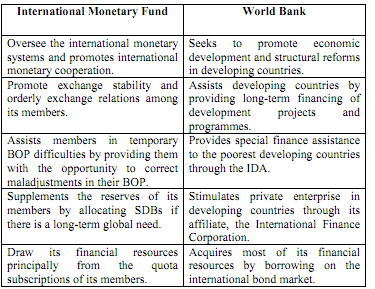
The idea of development bank (NDB) and Contingency Reserve Arrangement (CRA) has strengthen BRICS as a grouping Both of these concepts were formalised over in 2015 (@BRICS summit at Fortaleza and Brasilia) and this was seen as a strong signal to the challenge of western dominated discourses in some forums (IMF, WB)
What prompted the need for emergence of BRICS?
Most multilateral institutions were designed in the era when the West dominated the world. The US and Europe are over-represented in the IMF and the World Bank. Together with Japan, they control most regional development banks as well! That’s a big bad bully in making, right?
The main reason for co-operation to start among the BRICs nation was the financial crises of 2008
The crises raised scepticism on the dollar dominated monetary system and the need for participation by non-G7 countries became evident.
What reform did BRICS want out of the multilateral institutions?
Since their inception in 1944, the Bretton Woods institutions (IMF and World Bank) had not reformed their governance structure, to give more voting and voice to emerging economies. Both dominated by USA and developed countries. Both were out of sync with the new dynamics of world economy.
The BRICs called for the “the reform of multilateral institutions in order that they reflect the structural changes in the world economy and the increasingly central role that emerging markets now play.
BRICS managed to push for institutional reform which led to International Monetary Fund (IMF) quota reform in 2010 (although, it met with limited success as United States Congress did not ratify)!
Three new terms? Bretton Woods, Quota reforms, 2008 financial crisis. We will get to them later.
So, essentially, BRICS opened up a possibility for countries of the global South to challenge the global North. When the quota reforms were quashed in 2010, BRICS moved towards enlarging their spheres of cooperation. We will talk about the BRICS bank at a later stage.
Advantage India?
Now that NAM (Non-alignment) is almost defunct and very little wealth is left in the Commonwealth, BRICS provide a great alternate for India to build its global profile.
But don’t we have a G 20 group to further India’s interest in the global arena?Yes, that’s another big one (besides UN).
G 20 is a bloc of developing nations established on 20 August 2003. The G-20 accounts for – 60% of the world’s population, 70% of its farmers and 26% of world’s agricultural exports.
India has tried to use BRICS as a forum to engage China as the latter has become the largest market for the fast-industrializing countries of East Asia. India wants to resolve the age-old mis trust and complicated relationship between the two countries since the 1962 war between them.
What are the factors that will bolster co-operation among BRICS members?
Firstly, the common need among developing countries to construct economic order that reflects current situation will drive the BRICS’ efforts. In this matter, the idea of NDB and CRA are defining and will have a huge geo-economic and geopolitical impact
Secondly, the BRICS alternative idea in the landscape of global governance will attract support from other countries. There have been suggestions by political analysts that BRICS may expand its member quota
Thirdly, the expansion of BRICS interaction to other sector will make it more strong partnership
Lastly, Chinese support to BRICS will make sure that group remains a force to reckon with in the future
Chinese support – interesting point. Some would say that a lot depends on how China carries its might behind BRICS for the time to come.
Some concerns regarding the future of BRICS
Competition within themselves – The BRICS countries aspire to be regional powers and hence at some point will compete with each other
Different forms of governance – They have different political systems with Brazil, India and South Africa being democracies while Russia and China having authoritarian characteristics. It would be interesting to see how policy consensus is brought about!
Trade conflicts, maybe? Brazil and Russia are commodity exporting countries and thus benefit from high commodity prices while India and China are commodity importers that benefit from low commodity prices
Territorial Issues – China and India have outstanding territorial issues to resolve and India looks askance to any institution that has Chinese domination. Russia looks suspiciously at China’s interest in its sparsely populated far eastern of Siberia
The big daddy China – China spearheads three other major initiatives in this region – One Belt One Road (OBOR), Asian Infrastructure Investment Bank (AIIB) and SCO. You should know that the 7th BRICS summit was held as a joint summit with SCO. BRICS has to find a reckoning space among them to keep china’s interests alive!
Slow-down in the Growth rate of most of BRICS countries
Parting words on BRICS
These are some of the fodder points that you can use in any answer involving BRICS and world arena.
Engaging China has been one of the important components of India’s foreign policy in recent years, considering that co-operation and negotiations with China is imperative to clearing the mistrust between the two countries.
Geostrategically, BRICS are now represented on all continents of the global south. In bilateral and regional agreements, the BRICS emphasize south-south solidarity and horizontal cooperation in contrast to western dominance.
Yet, in global fora such as G20, UN Security Council or World Climate Conferences, BRICS claim to speak on behalf of the developing world (whether they actually do represent these countries is disputable) and gradually challenge western supremacy in international politics.
Success of BRICS
BRICS summits have been able to establish number of institutions. Some of it are mentioned below.
(a) The New Development Bank (NDB)
The New Development Bank (NDB), formerly referred to as the BRICS Development Bank, is a multilateral development bank operated by the BRICS states. The bank’s primary focus of lending will be infrastructure projects with authorized lending of up to $34 billion annually. South Africa will be the African Headquarters of the Bank named the “New Development Bank Africa Regional Centre”. The bank will have starting capital of $50 billion, with capital increased to $100 billion over time. Brazil, Russia, India, China and South Africa will initially contribute $10 billion each to bring the total to $50 billion.
(b)BRICS CRA
The BRICS Contingent Reserve Arrangement (CRA) is a framework for providing protection against global liquidity pressures. This includes currency issues where members’ national currencies are being adversely affected by global financial pressures. It is found that emerging economies that experienced rapid economic liberalization went through increased economic volatility, bringing uncertain macroeconomic environment.
The CRA is generally seen as a competitor to the International Monetary Fund (IMF) and along with the New Development Bank is viewed as an example of increasing South-South cooperation. It was established in 2015 by the BRICS countries Brazil, Russia, India, China and South Africa.
The legal basis is formed by the Treaty for the Establishment of a BRICS Contingent Reserve Arrangement, signed at Fortaleza, Brazil on 15 July 2014. With its inaugural meetings of the BRICS CRA Governing Council and Standing Committee, held on September 4, 2015, in Ankara, Turkey it entered into force upon ratification by all BRICS states, announced at the 7th BRICS summit in July 2015.
(C)BRICS payment system
At the 2015 BRICS summit in Russia, ministers from BRICS nations, initiated consultations for a payment system that would be an alternative to the SWIFT system. Russian Deputy Foreign Minister Sergey Ryabkov stated in an interview, “The finance ministers and executives of the BRICS central banks are negotiating … setting up payment systems and moving on to settlements in national currencies. SWIFT or not, in any case we’re talking about … a transnational multilateral payment system that would provide greater independence, would create a definite guarantee for BRICS.”
The Central Bank of Russia (CBR) also started consultations with BRICS nations for a payment system that would be an alternative to the SWIFT system. The main benefits highlighted were backup and redundancy in case there were disruptions to the SWIFT system. The Deputy Governor of the Central Bank of the Russia, Olga Skorobogatova stated in an interview, “The only topic that may be of interest to all of us within BRICS is to consider and talk over the possibility of setting up a system that would apply to the BRICS countries, used as a backup
EIGHTH BRICS SUMMIT
The Eighth BRICS Summit, held at Goa under the theme “Building Responsive, Inclusive and Collective Solutions.”
The summit concluded with adaptation of Goa∙ Declaration. The ninth BRICS Summit will be hosted by China in 2017.
Key Highlights of Goa declaration
On world Security– Strongly condemned terrorism in all its forms, committed to increase effectiveness of the UN counter terrorism framework. Also, called for need for adaptation of Comprehensive Convention on Terrorism (CCIT) in the UN General Assembly
On SDGs– Welcomed adoption of 2030 Agenda for Sustainable Development and its Sustainable Development Goals.
On UN Reforms– Reiterated urgent need to reforms of the United Nations, including International UN Security Council to increase representation of developing countries.
On New Development Bank- BRICS members were satisfied with the approval of the first batch of loans by the New Development Bank (NDB), particularly in renewable energy projects in BRICS countries.
BRICS Contingent Reserve Arrangement
CRA, established in 2015 by BRICS member nations is now operational and the central banks of the∙ grouping’s members are “fully ready to carry out” the transactions.
It is a framework for the provision of support through liquidity and precautionary instruments in response to actual or potential short-term balance of payments pressures.
BRICS RATING AGENCY
Key Facts
BRICS have agreed to set up an independent rating agency based on market-oriented principles in order to∙ further strengthen the global governance architecture.
BRICS institution-building is critical for transforming the global financial architecture to one based on the∙ principles of fairness and equity.
The BRICS countries have already set up New Development Bank (NDB), which became operational last year, to meet funding requirements of the members.
There are concerns that the methodologies of the big three global agencies- S∙&P Global Ratings, Fitch Ratings and Moody’s Investors Service- is biased against developing countries, reflected by their poor rating of these economies.
Despite having deep capital buffers, the ratings of multilateral banks like the BRICS-promoted NDB are affected due to the parent countries’ sovereign ratings.
BCIM
The BCIM Forum for Regional Economic Cooperation, earlier known as the ‘Kunming Initiative’, was founded in 1999 with the objective of promoting trade and economic development in the sub-region stretching from south west China to eastern India (‘Kunming to Kolkata’) via Myanmar, India’s north east region (NER), and Bangladesh.
It was considered as a provincial initiative and did not have much resonance among at least the policy makers and the MEA officials. Some of the earlier meetings that were attended, for instance, by India’s Secretary (East), Mr. Rajiv Sikri in 2006 questioned its utility when several other similar initiatives existed in the region.
On the other hand, later in 2011, a Kolkata-Kunming car Rally that was expected to encourage the concept of BCIM found official mention in the Joint Statement between China and India.
However, it was only in 2013 year that the BCIM grouping gained some traction when it was first mentioned in the Joint India-China communiqué during PM Li’s visit to India in May 2013 and it was again discussed between the two during PM Manmohan Singh’s visit to Beijing in October 2013. Thus, it became a Track I initiative with the prospects of the objectives of BCIM being realized.
As a follow up of Heads of State meetings, a Joint Study Group (JSG) of BCIM to chart out the modalities for achieving the goals of BCIM economic corridor was set up and it held its first meeting at Kunming in December, 2013. JSG has outlined a number of steps to be taken to convert the concept into a reality. Cooperative areas between the four members would include:-
(a) Physical Connectivity
(b) Trade in goods, services and investment including finance
(c) Environmentally sustainable development
(d) People to people contacts
China and India are adding fresh momentum to the establishment of the Bangladesh-China-India-Myanmar (BCIM) economic corridor, which is expected to develop gradually before more ambitious goals are achieved.
From the West Bengal capital, the corridor will head towards Benapole, a border crossing town in Bangladesh. After passing through Dhaka and Sylhet, it will re-enter the Indian territory near Silchar in Assam. The rest of the passage will be connected with Imphal and then pass through the India-built Tamu-Kalewa friendship road in Myanmar. Mandalay will be the next focal point of the corridor before the road enters Yunnan, after crossing Lashio and Muse in Myanmar. The Chinese stretch extends from Ruili before reaching Kunming through Longling and Dali.
The central corridor can be connected with two supplementary passages to the north and the south. Starting from Kunming, the northern passage heads towards Myitkyina, capital of Kachin state in Myanmar, before extending to Ledo in Assam. After crossing Dibrugarh and Guwahati, this road enters northern Bangladesh and joins the central corridor inside the country, before reaching Kolkata.
Problem and Prospects
Indian Approach
Even though India has agreed in principle for a BCIM Economic Corridor, it also has some apprehensions.
Firstly, there are still several insurgent and rebel groups in North East India which are involved in a host of anti national activities like gun running, drug trafficking; they are also being used by foreign intelligence agencies (e.g. Anthony Shimray incident where Chinese intelligence agencies were alleged to have been involved in fuelling insurgency by sending a huge consignment of Chinese arms to NSCN(IM) in the NE; there have also been reports of some Chinese intelligence agents being active there; ISI has also been involved in sending arms).
Secondly, Sino-Indian border problems are well known and therefore Indian sensitivities concerning the claims and possible insecurities on that account. Tirap district of Arunachal Pradesh is inhabited by Nagas and there is an insurgent activity there. Even though some funds for constructing Ledo/Stilwell Road have been earmarked, India is not in favour of reviving the old Burma/Stillwell Road linking India’s NE to Yunnan through Myanmar because of security reasons. This is despite the fact that enormous commercial benefits (especially with reduction of transportation costs) might accrue. There are apprehensions that this might give China advantage in case of a military conflict.
Thirdly, while there is a dire need to develop the North eastern states of India and China can provide the wherewithal for infrastructure development including the much needed funds, the Indian government remains reticent in involving China in ways that might be detrimental to Indian interests.
Further, during the visit of Japanese PM Shinzo Abe in January 2014, Japan has been invited to take part in the infrastructure development of NE States.
Fourthly, there is a growing trade imbalance between India and China and any free flow of trade and commerce through the envisioned economic corridor would only increase the trade imbalance against India as China has not been able to practically address India’s grievances on this issue in any meaningful way despite remonstrations by India to this effect during summits and other bilateral exchanges.
Additionally, India has several bilateral and multilateral initiatives with the regional countries to address precisely the same issues. For instance, India has Bay of Bengal Initiative for Multi Sectoral Technical and Economic Cooperation (BIMSTEC), Mekong Ganga Cooperation initiative and Trilateral between India, Myanmar and Thailand for improving connectivity; all such initiatives involve either cooperation with Bangladesh or Myanmar or both that have similar objectives to that of BICM.
There is an overlap in goals and objectives of a number of regional and sub regional groupings that remain an important sub set of India’s ‘Look East Policy’ set in motion in the mid 1990s. That is why India had not been very keen to add another sub-regional grouping to its kitty where, possibly, the central role of India in some of these platforms could be undermined. There have also been talks of merging or combining of BCIM and BIMSTEC but regional geo-political environment does not appear to be conducive for acceptance of such proposals.
Both the Ganga and the Mekong are civilizational rivers, and the MGC initiative aims to facilitate closer contacts among the people inhabiting these two major river basins. Key areas of cooperation under MGC were tourism, culture, education, and transport & communications.
Despite ASEAN’s rhetoric and posturing, it remains a weak organisation incapable of handling serious challenges, economic or strategic. There has been a proliferation of trade groups carrying many (confusing!) acronyms.
With India’s elevated status in ASEAN by 2012
the time is ripe to enter the Mekong Region. Apart from reinforcing India’s security, it will remove economic isolation of the North East Region (NER).
There is a lack of connectivity between India, Myanmar and beyond and hence a need to build connecting corridors. Unlike the European Union, with nascent Asian economies we have to follow the “hub and spoke” process which impedes in the trade process.
Latest developments:
India hosted the 6th MGC Ministerial Meeting on September 4, 2012. New Areas of Cooperation added in the 6th MGC –
Conservation of Rice GermPlasm – A new area of mutually beneficial cooperation in rice production techniques and downstream processing projects
Enhancing cooperation among SME – India circulated a concept paper
Health – Aim is to strengthen the region’s capacity to respond to the menace of drug resistant malaria and other such emerging public health threats
Common Archival Resource Centre (CARC) at Nalanda University
#2. Bay of Bengal Initiative for Multi-Sectoral Technical and Economic Cooperation (BIMSTEC)
When? 1997 | HQ: Dhaka, Bangladesh
Origins: BIMSTEC started off as the Bangladesh, India, Sri Lanka, Thailand Economic Cooperation Group in 1997. Myanmar joined in 1997, while Nepal and Bhutan joined in 2004 when the first summit was held in Bangkok.
BIMSTEC is said to have been encouraged by India’s Look East Policy (LEP) and Thailand’s Look West Policy.
Earlier also, Bay of Bengal had emerged as a vehicle for regional cooperation as BBIN grouping – Bangladesh, Bhutan, Nepal and India after Pakistan’s reluctance to sign on to the South Asian connectivity agreements at the SAARC summit, 2014.
Now, with the collapse of the SAARC summit in Islamabad, 2016 the Bay of Bengal has turned into a zone of regional cooperation.
Further, with rich history of maritime commerce across the Bay of Bengal and being high-end tourist∙ destination there exist enormous possibilities for regional economic cooperation among the members of the BIMSTEC and SAARC (minus Pakistan).
BIMSTEC was seen as a vital bridge between SAARC and ASEAN. Myanmar and Thailand are already in ASEAN while Japan is Thailand’s second-biggest export destination.
But in the present context, when the members of BIMSTEC have acquired memberships in various other regional/sub-regional organisations which also promote cooperation at different levels, it might not end up being that fruitful an organisation (that it was intended up to be).
BIMSTEC identified 14 priority areas where a member country takes lead. India is lead country for –
Transport & Communication
Tourism
Environment & Disaster Management
Counter Terrorism & Transnational Crime
Advantage India?
Pakistan and China do not form member countries and this grouping provides India an opportunity to increase its sphere of influence.
India should be more proactive towards BIMSTEC to make its LEP 3.0 a success. BIMSTEC could help India to further increase its cooperation with countries located around the Bay of Bengal along with two of its adjuncts, namely Malacca Straits and Andaman Sea.
Transport & Communication being one of the priority focus areas – Better integration with North East region & East Asian economies is a theme to look forward to.
What has India done for BIMSTEC?
India and Thailand are the two main (rich) partners of BIMSTEC. With Thailand mostly embroiled in controversies, India is looked upon to take a lead and act as a catalyst. Remember the lead areas with India? Transport, Tourism, Environment & Terrorism.
The last meeting (3rd Summit) @Nay Pyi Taw (New Capital of Myanmar) did not see any major outcomes, but a few of worth of mentioning here are –
2015 was declared as the Year of BIMSTEC Tourism
The framework agreement on the BIMSTEC FTA was signed in 2004, but it is not yet fully operational.
Ratify conventions related to other areas of responsibilities
TIP: Whenever you think about the advantage of our associations with our north eastern neighbouring countries, think of two things –
Transportation woes
Fighting crime syndicates (terrorism, smuggling, narcotics and what not)
Consequently, our associations with them will look to establish new roads, routes and pacts to counter them. Of course, there is a lot in common with culture and agricultural produce etc etc. but you get the bigger picture right?
One such project is Kaladan Multi-modal Transit Transport Project in Myanmar. It was supposed to be completed by 2015, but sigh.
Source: Indian Express
Time to Energize BIMSTEC
How long can SAARC (30+ year old organisation) wait for India and Pakistan to sort out their bilateral issues and push forward for the broader agenda of regional economic cooperation?
Given the current state of India-Pakistan relations, it is unlikely that Pakistan will agree to even a minimal set of economic cooperation arrangements within the SAARC framework, as was evident in Kathmandu when it refused to sign the multi-modal road and rail transport agreement. (Source – The Diplomat).
The most important driver is going to be the BIMSTEC Free Trade Area. While a Framework Agreement has been signed, it has yet to come into force.
Point being that India needs to reallocate its priority with the new surge @ Act East and get the best out of these regional groupings where it can play a natural leader.
BIMSTECH 2016 summit
The Summit was held in Goa in October 2016. The next meeting will be held in Nepal for the Fourth BIMSTEC Summit in 2017.
Focus Areas of Summit were Regional∙ connectivity, terrorism, development of the region, Cooperation in various sectors, promoting people-to-people contacts and tourism.
In this regard, BIMSTEC countries have issued∙ Leaders Retreat Outcome Document.
Key Highlights of document
For countering terror
Strongly condemned the recent terror attacks in the region and called for strong measures for the states⎫ that encourage, support and provide sanctuary to terrorists.
Called for early ratification of the BIMSTEC Convention on Cooperation in combating International⎫ terrorism, criminal matters, transnational organized crime and drug trafficking.
Cooperation for Environment– Agreement on greater efforts towards the conservation of the mountain ecosystems,∙ bio-diversity and agreed for implementation of the Paris Agreement on Climate Change.
Enhancing people to people contact– Proposed for establishment of BIMSTEC Buddhist Circuit and BIMSTEC Heritage Sites, decided to expedite the establishment of the BIMSTEC Cultural Industries Commission and BIMSTEC Cultural Industries Observatory in Bhutan.
Fisheries and Food Security– Cooperation in sustainable development of fisheries in Bay of Bengal region.
Eliminating Poverty- Reaffirmation to the commitment to effective implementation of the BIMSTEC Poverty Plan of Action.
For Trade– Commitment to the early conclusion of BIMSTEC Free Trade Area negotiations was renewed∙ along with directing the Trade Negotiating Committee (TNC) and Working Groups to expedite the finalization of its constituent agreements.
Exploring other areas of development-Agreement to explore ways to deepen cooperation in areas such as aquacultures, hydrography, seabed mineral exploration, coastal shipping, eco-tourism and renewable ocean energy with the objective of promoting holistic and sustainable development of the region.
RCEP
Introduction
Mega regional trade deals are in vogue in an otherwise fragile global economy. In an environment of falling aggregate demand, these trade deals are seen as a means to insulate economies from market uncertainties. Three important mega regional’s are currently under negotiation: the Regional Comprehensive Economic Partnership of Asia and the Pacific (RCEP), the Trans-Pacific Partnership (TPP), and the Trans-Atlantic Trade and Investment Partnership (TTIP).
It is expected that these agreements, once concluded and implemented, will set the stage for a new generation of global trade and investment rules.In this article we will explain What is RCEP ,what will be its significance for India and what are the point of contention among countries in RCEP.
What is RCEP?
Regional Comprehensive Economic Partnership (RCEP) is a proposed free trade agreement (FTA) between the ten member states of the Association of Southeast Asian Nations (ASEAN) (Brunei, Burma (Myanmar), Cambodia, Indonesia, Laos, Malaysia, the Philippines, Singapore, Thailand, Vietnam) and the six states with which include India,China,Australia,Japan,South Korea and Newzealand.
In total, the grouping of 16 nations includes more than 3 billion people, has a combined GDP of about $17 trillion, and accounts for about 40 percent of world trade.
If negotiated successfully, RCEP would create the world’s largest trading bloc and have major implications for Asian countries and the world economy.
Key features of the RCEP
The RCEP seeks to achieve a modern and comprehensive trade agreement among members. The core of the negotiating agenda would cover trade in goods and services, investment, economic and technical cooperation and dispute settlement.
The partnership would be a powerful vehicle to support the spread of global production networks and reduce the inefficiencies of multiple Asian trade agreements that exist presently.
At the launch of negotiations in 2012, the leaders of each relevant country endorsed the “Guiding Principles and Objectives for Negotiating the Regional Comprehensive Economic Partnership.” The key points of this document are as follows.
Scope of negotiations
RCEP will cover trade in goods, trade in services, investment, economic and technical co-operation, intellectual property, competition, dispute settlement and other issues. The agreement will encompass trade in goods and services, economic and technical issues, intellectual property and investments, and dispute settlement mechanisms.
As expected, ASEAN will be in the “driver’s seat” of this multilateral trade arrangement (though the idea was initially given by Japan), and has been repeatedly endorsed by India. The joint statement issued at the end of the first round of negotiations also reiterated “ASEAN Centrality” in the emerging regional economic architecture.
Commitment levels
The RCEP will have broader and deeper engagement with significant improvements over the existing ASEAN+1 FTAs, while recognizing the individual and diverse circumstances of the participating countries.
Negotiations for trade in goods
Negotiations should aim to achieve the high level of tariff liberalization, through building upon the existing liberalization levels between participating countries.
Negotiations for trade in services
The RCEP will be comprehensive, of high-quality and consistent with WTO rules and all service sectors will be subject to negotiations.
Negotiations for investment
Negotiations will cover the four pillars of promotion, protection, facilitation and liberalization.
Participating countries
Participants will be ASEAN members and FTA Partners. After the completion of the negotiations, countries other than the 16 states may join.
From India’s point of view, the RCEP presents a decisive platform which could influence its strategic and economic status in the Asia-Pacific region and bring to fruition its act east policy.
It would be the world’s largest trading bloc covering a broad spectrum of issues such as trade in goods, services, investment, competition, intellectual property rights, and other areas of economic and technical cooperation. Together, the RCEP group of countries accounts for a third of the world’s gross domestic product, and 27.4 per cent and 23.0 per cent of the world’s goods and services trade, respectively.
The RCEP agreement would complement India’s existing free trade agreements with the Association of South East Asian Nations and some of its member countries, as it would deals with Japan and South Korea.
India is not a party to two important regional economic blocs: The Asia-Pacific Economic Cooperation and the Trans-Pacific Partnership New Delhi fears the TPP, although years away from reality, could mean losing some textile and drugs exports to countries like Vietnam, which has embraced both the TPP and the RCEP.
TPP is set to change the landscape of global trade. For India, it is most likely to affect sectors like leather goods, plastics, chemicals, textiles and clothing. The RCEP would enable India to strengthen its trade ties with Australia, China, Japan and South Korea, and should reduce the potential negative impacts of TPP and TTIP on the Indian economy.
RCEP will facilitate India’s integration into sophisticated “regional production networks” that make Asia the world’s factory. The RCEP is expected to harmonize trade-related rules, investment and competition regimes of India with those of other countries of the group.
Through domestic policy reforms on these areas, this harmonization of rules and regulations would help Indian companies plug into regional and global value chains and would unlock the true potential of the Indian economy. There would be a boost to inward and outward foreign direct investment, particularly export-oriented FDI.
India enjoys a comparative advantage in areas such as information and communication technology, IT-enabled services, professional services, healthcare, and education services. In addition to facilitating foreign direct investment, the RCEP will create opportunities for Indian companies to access new markets.
This is because the structure of manufacturing in many of these countries is becoming more and more sophisticated, resulting in a “servicification” of manufacturing. India is well placed to contribute to other countries in RCEP through its expertise in services, not only consolidating the position of the region as the world’s factory but also developing it as the world’s hub for services.
Challenges in Final negotiation of RCEP
Finalizing the RCEP will not be a cakewalk for India and other countries involved in the negotiations as there are a range of issues that could act as spoilers.
Huge economic disparities among the negotiating countries are likely to pose a challenge
An inevitable source of trust deficit between China and the rest which has the potential to constrain regional economic cooperation is China’s aggressive postures on territorial disputes with Japan and India and with ASEAN member countries on the South China Sea disputes. This can pose as a hurdle in final negotiation of RCEP
The existing five ASEAN+1 and twenty three ratified bilateral FTAs, varying greatly in their terms, pose a significant hurdle to RCEP negotiations.
The lack of commonality across FTAs and varying internal policies of countries would prove to be a difficult task to harmonize and consolidate under RCEP.
Challenges and concerns for India from Joining RCEP
For New Delhi, following challenges lie ahead.
First, tariff barriers, which have been a matter of discontent in bilateral FTAs, particularly in the case of the ASEAN-India FTA, will be central to the negotiations in the upcoming rounds of RCEP negotiations.
Non-trade issues such as environment and labor are likely to be prickly as well and need greater attention. While many Countries in RCEP want a stricter norms and standards on environment and labor issues while India’s interest lie in liberal environment and labor norms as this makes Indian industry competitive. India therefore should bat for liberal environment and labor norms while negotiating in RCEP.
India must take steps to strengthen its Medium, Small and Micro Enterprises (MSME) sector, equipping it not only to survive the free flow of trade, but also to become a set of more competitive players. Higher investments in R&D and achieving international standards in terms of delivery are needed.
An internal commerce ministry estimate that signing the 16-country Regional Comprehensive Economic Partnership (RCEP) trade agreement will result in a revenue loss of as much as 1.6% of gross domestic product
Finally a major difficulty for India will be negotiating terms with China. India has to be firm and calculative in terms of taking tough policy decisions, while working tirelessly on capacity building of its domestic industries.
East Asia Summit (EAS)
East Asia Summit is a unique Leaders-led forum of 18 countries of the Asia-Pacific region formed to further the objectives of regional peace, security and prosperity.
Why is EAS important?
10 East Asia Summits have been held so far. India has been a part of this process since its inception in 2005. Think of it this way –
EAS has held its annual meetings without fail since its inception
As members – it has 10 ASEAN nations + 8 strategic partners including US, China, India, Japan
This is what our PM said in the 9th EAS – “No other forum brings together such a large collective weight of global population, youth, economy and military strength. Nor is any other forum is so critical for peace, stability and prosperity in Asia-Pacific and the world.”
6 priority areas of regional cooperation within the framework of the EAS
Environment and Energy,
Education,
Finance,
Global Health Issues and Pandemic Diseases,
Natural Disaster Management, and
ASEAN Connectivity
India’s involvement in regional collaboration in these 6 priority areas
#1. Education
At the 4th East Asia Summit (EAS), held in Thailand on 24-25 October 2009, the EAS Leaders endorsed the proposal for the revival of Nalanda University.
source: outlookindia.com
Nalanda was a renowned Buddhist centre of learning, in Ancient India. It taught students in medicine, mathematics, astronomy and politics
The University envisages seven schools located at its campus in Rajgir
Ministry of External Affairs has offered 6 scholarships to students from Cambodia, Myanmar, Lao PDR and Vietnam to pursue higher studies at Nalanda University
In news – Amartya Sen quits Nalanda University
#2. Global Health Issues and Pandemic Diseases
Australia and India are co-chairs of the Task Force for Access to Quality Medicines and other Technologies Task Force (AQMTF)
India has also hosted a Round table on Trauma Care and Nursing on 15-16 October 2015, in New Delhi
#3. Natural Disaster Management
2012: India hosted an ‘EAS-India Workshop 2012: Building Regional Framework for Earthquake Risk Management’ in New Delhi
2014: India also hosted the first Meeting of the 24×7 Points of Contact among the National Disaster Response Agencies of East Asia Summit (EAS) countries
Launch of Virtual Knowledge Portal (VKP). What is this?
The Virtual Knowledge Portal (VKP), a web based tool to share knowledge and best practices related to natural disaster risk assessment, mitigation and response among EAS countries. It is hosted by Natural Institute of Disaster Management, New Delhi.
#4. Launch of Regional Comprehensive Economic Partnership (RCEP)
At the 7th EAS in November 2012, the Leaders of 16 EAS participating countries launched the Regional Comprehensive Economic Partnership (RCEP)
What is RCEP?
Regional Comprehensive Economic Partnership (RCEP) is a proposed free trade agreement (FTA) between the 10 member states of the ASEAN and the six states with which ASEAN has existing FTAs (Australia, China, India, Japan, South Korea and New Zealand).
Gulf Cooperation Council (GCC)
The Gulf Cooperation Council (GCC) is a regional political organisation comprising the energy rich Gulf monarchies – Bahrain, Kuwait, Oman, Qatar, Saudi Arabia, and the United Arab Emirates.
The founding charter focused more on issues of social and cultural cohesion, environmental and scientific coordination and economic cooperation
Recently, Morocco and Jordan have applied for the GCC membership which is currently being studied by the GCC Expert Committee
India and GCC: Contours of cooperation
The Gulf constitutes the “immediate” neighborhood of India separated only by the Arabian Sea
The Gulf, as the principal source of India’s energy requirements, is central to our energy security interests: it meets 75% of our oil needs at present; as our demand increases in coming years, India’s dependence will go up to 90% by 2035.
GCC is India’s largest trading partner as an economic grouping, with two-way trade being more than our ties with the European Union, ASEAN and North America
Four GCC countries figure in India’s top 10 trade partners.
We also have an eight-million strong community in the GCC that remits annually $35 billion to the national exchequer
The India-GCC Free Trade Agreement which is in under negotiation could usher in a new era of trade
Although India and the GCC countries share a strong economic relationship, there is much progress to be achieved on the political front. Let’s have a close look at some of the important dimensions –
#1. Defence Diplomacy
India’s defence diplomacy with countries of the GCC is well reputed.
India has signed a military protocol with Oman which has facilitated joint military exercises
India has also signed a defence cooperation agreement with the UAE
Our new naval diplomacy document increases our focus on west asian countries.
#2. Counter Terrorism
The meteoric rise of the Islamic State of Iraq and the Levant (ISIS) in neighbouring countries like Iraq and Syria pose a huge threat to the peace and stability of the GCC countries.
#3. Maritime Security
Primary maritime security threats include piracy at sea, smuggling of narcotics and arms and the imminent threat of maritime terrorism.
These threats pose major challenges to the Sea Lines of Communication (SLOCs) that India depends heavily on to carry out trade by sea
India’s international trade by sea amounts to about 90% of the foreign trade, and it takes place through 13 major ports and several minor ports
In recent times the term “Indo Pacific era” has gained currency.
#4. Culture & Diaspora
We have an eight-million strong community in the GCC that remits annually $35 billion to the national exchequer
Minor concerns – If you remember, in 2013 Saudi Arabia issues a Nitaqat Law – The ‘Nitaqat’ law makes it mandatory for local companies to hire one Saudi national for every 10 migrant workers
There had been widespread perception that the new policy will lead to denial of job opportunities for a large number of Indians working there.
India had back then proactively conveyed concerns to the Saudi government
The Trans-Pacific Partnership pact reached recently between the United States and 11 Pacific Rim nations including Canada and Japan, has raised both hopes and concerns.
What is Trans-Pacific Partnership pact?
It is a trade pact that is intended to cut trade barriers and establish common standards for 12 countries.
What it does?
It would set new terms for trade and business investment among the United States and 11 other Pacific Rim nations.
It would phase out thousands of import tariffs as well as other barriers to international trade.
It also would establish uniform rules on corporations’ intellectual property, open the Internet even in communist Vietnam and crack down on wildlife trafficking and environmental abuses.
Its significance:
This is the largest trade pact in 20 years.
The agreement covers 40% of the world’s economy.
It is seen as a means to address a number of festering issues that have become stumbling blocks as global trade has soared, including e-commerce, financial services and cross-border Internet communications.
What its supporters say?
The pact would boost growth in the U.S. as well as the Asian economies.
It would be a boon for all the nations involved.
It would unlock opportunities and address vital 21st-century issues within the global economy.
Critics in the US say it would only help American companies send jobs abroad. Some people call it a “trade disaster”.
Critics in other countries say it would benefit large corporations, particularly American big pharma, with the common people at the receiving end.
Some people say it would reduce access to generic medicines in developing countries.
Internet freedom campaigners see it as a big threat.
Why is the US interested in this deal?
It is seen as a way to bind Pacific trading partners closer to the United States while raising a challenge to Asia’s rising power, China.
Traditionally, the U.S. has tried to isolate its enemies and integrate allies with its own worldview. With china it couldn’t do either.
China is now the world’s second largest economy, which has invested trillions of dollars in U.S. treasury bonds. Hence, isolating such an economy is next to impossible.
Now, with China emerging as an economic powerhouse with new institutions such as the Asian Infrastructure Investment Bank in place, the U.S. is trying to form a grand alliance that would shore up its influence in Asia.Economists such as Joseph Stiglitz have pointed out that the TPP would hardly meet either its declared commercial goals or its undeclared strategic ambitions, and could turn counterproductive.
TPP and its implications for India
Positives
India could experience huge export gains of more than US$500 billion per year—a 60 per cent increase–from joining an expanded TPP or participating in a comprehensive Free Trade Area of the Asia Pacific (FTAAP).
It would increase both India’s exports and imports. It is also likely to boost India’s services exports through less trade barriers.
Negatives
possibility of trade diversion and raised concerns about erosion of India’s share in exports to the US and Europe.
loss of competitiveness of Indian exports in European markets
lower India’s export share to the US and the EU,
Some of the export sectors such as textiles and clothing industry are likely to face stiff competition from Vietnam, and it may lead to trade diversion.
concern of investment diversion, particularly as countries like Vietnam would offer more robust investor protection
Concerns
India has to give due consideration to the costs if it is desirous of joining the TPP, as it will be required to comply with provisions relating to tariffs, SoEs, agriculture and IPR protection.
Some of the major concerns are as follows:
Openness of market: India needs to work significantly in terms of openness of market as its tariff rates are significantly higher than those in the TPP countries
Import competition: Domestic industries will face severe import competition due to tariff elimination on some of the products.
SoEs: Membership of the TPP would prevent the government from using SoEs and government procurement as vehicles for achieving social and economic objectives, including employment generation.
IPRs: The prices of pharmaceutical products can be expected to rise due to implementation of IPR agreements which will give more protection to patented medicine and may lead substantially to elimination of generic drugs from the market
Government procurement: Apart from stressing non-discriminatory, fair and transparent procurement procedures, the TPP specifies timely publication of complete information on the procuring entity, the specific procurement, the time frame for submission of bids, and a description of conditions for participation of suppliers.
As the agreement curtails the flexibility available to signatory countries to impose export restrictions on food, it will jeopardize India’s endeavour to ensure food security
Labour standards: TPP bind the members to adopt and maintain laws and practices governing acceptable conditions of work relating to minimum wages, hours of work, and occupational health and safety. These labour standards may increase the labour cost.
Environment standard in TPP agreement: The TPP agreement goes beyond the provisions in other FTAs to include wildlife trafficking, illegal logging and illegal fishing practices.
The TPP members acknowledge that inadequate fisheries management, fisheries subsidies that contribute to overfishing and overcapacity, and illegal, unreported and unregulated (IUU) fishing can have significant negative impacts on trade, development and the environment and ‘thus recognize the need for individual and collective action to address the problems of overfishing and unsustainable utilization of fisheries resources’.
This is in contradiction to India’s current policy of subsidizing the fishery industry. It may severely affect special governmental assistance programmes for around 15 million poor fishermen in India. Hence these TPP rules are likely to affect the multilateral process and impact India.
The World Bank Group (WBG) is a family of five international organizations that make leveraged loans to developing countries. It is the largest and most famous development bank in the world and is an observer at the United Nations Development Group. Its five organizations are the International Bank for Reconstruction and Development (IBRD), the International Development Association (IDA), the International Finance Corporation (IFC), the Multilateral Investment Guarantee Agency (MIGA) and the International Centre for Settlement of Investment Disputes (ICSID).
The World Bank
The International Bank for Reconstruction and Development (IBRD), better known as the World Bank, was established at the same time as the International Monetary Fund to tackle the problem of international investment.
Since the IMF was designed to provide temporary assistance in correcting the balance of payments difficulties, an institution was also needed to assist long-term investment purposes. Thus, IBRD was established for promoting long-term investment loans on reasonable terms.
The World Bank (IBRD) is an inter-governmental institution, corporate in form, whose capital stock is entirely owned by its member-governments. Initially, only nations that were members of the IMF could be members of the World Bank; this restriction on membership was subsequently relaxed.
Functions:
The principal functions of the IBRD are set forth in Article I of the agreement as follows:
To assist in the reconstruction and development of the territories of its members by facilitating the investment of capital for productive purposes.
To promote private foreign investment by means of guarantee of participation in loans and other investments made by private investors and when private capital is not available on reasonable terms, to make loans for productive purposes out of its own resources or from funds borrowed by it.
To promote the long-term balanced growth of international trade and the maintenance of equilibrium in balance of payments by encouraging international investment for the development of the productive resources of members.
To arrange loans made or guaranteed by it in relation to international loans through other channels so that more useful and urgent projects, large and small alike, will be dealt with first. It appears that the World Bank was created to promote and not to replace private foreign investment. The Bank considers its role to be a marginal one, to supplement and assist foreign investment in the member countries.
A little consideration will show that the objectives of the IMF and IBRD are complementary. Both aim at increasing the level of national income and standard of living of the member nations. Both serve as lending institutions, the IMF for short-term and the IBRD for long-term capital. Both aim at promoting the balanced growth of international trade.
Organisation:
Like the Fund, the Bank’s structure is organised on a three-tier basis; a Board of Governors, Executive Directors and a President. The Board of Governors is the supreme governing authority. It consists of one governor (usually the Finance Minister) and one alternate governor (usually the governor of a central bank), appointed for five years by each member.
The Board is required to meet once every year. It reserves to itself the power to decide important matters such as new admissions, changes in the bank’s stock of capital, ways and means of distributing the net income, its ultimate liquidation, etc. For all technical purposes, however, the Board delegates its powers to the Executive Directors in the day-to-day administration.
At present, the Executive Directors are 19 in number, of which five are nominated by the five largest shareholders — the USA, the UK, Germany, France and India. The rest are elected by the other members.
The Executive Directors elect the President who becomes their Ex-officio Chairman holding office during their presence. He is the chief of the operating staff of the Bank and is subject to the direction of the Executive Directors on questions of policy and is responsible for the conduct of the ordinary business of the Bank and its organisation.
Criticism:
The modus operandi of the Bank has been criticised on various counts from different quarters:
It is alleged that the Bank charges a very high rate of interest on loans. For example, some of the loans which India has received in recent years bear an interest of 53.4 per cent including the commission at 1 per cent which is credited to the Bank’s special reserves.
The Bank’s insistence, prior to the actual grant of loan, on the country having the capacity to transfer or repay, is open to criticism. The Bank should not apply orthodox standards to judge the transfer capacity of any borrowing country. Transfer capacity follows rather than precedes the loan.
The financial help given by the Bank does not amount to more than a drop in the big ocean of financial requirement so essential for various development projects.
It is dominated by USA which is the dominant shareholder of the bank. Till now all World Bank President have been from USA.
With the World Bank, there are concerns about the types of development projects funded. Many infrastructure projects financed by the World Bank Group have social and environmental implications for the populations in the affected areas and criticism has centred on the ethical issues of funding such projects. For example, World Bank-funded construction of hydroelectric dams in various countries has resulted in the displacement of indigenous peoples of the area.
The Bank’s undemocratic governance structure – which is dominated by industrialised countries – its privileging of the private sector and the controversy over the performance of World Bank-housed Climate Investment Funds have also been subject to criticism in debates around this issue.
There are also concerns that the World Bank working in partnership with the private sector may undermine the role of the state as the primary provider of essential goods and services, such as healthcare and education, resulting in the shortfall of such services in countries badly in need of them.
Conclusion:
It may be said that the World Bank has not come up to the expectations of many nations. Nevertheless, it has been instrumental to a very large extent in initiating and accelerating the work of economic reconstruction and development in different countries. No doubt, India has derived immense benefit from the World Bank.
The Bank may have failed to finance most of the development projects, but it should be remembered that it has financed quite a large number of them which have proved a notable success.
The Bank has also played a significant role outside financial matters by serving as a mediator between different countries on major economic and political issues. For instance, its help in the solution of the Indus Waters between India and Pakistan and the Suez Canal dispute between the U.K. and the U.A.R. has been invaluable.
International Development Association
The International Development Association (IDA) is the part of the World Bank group that helps the world’s poorest countries. Overseen by 173 shareholder nations, IDA aims to reduce poverty by providing loans (called “credits”) and grants for programs that boost economic growth, reduce inequalities, and improve people’s living conditions.
IDA complements the World Bank’s original lending arm—the International Bank for Reconstruction and Development (IBRD). IBRD was established to function as a self-sustaining business and provides loans and advice to middle-income and credit-worthy poor countries. IBRD and IDA share the same staff and headquarters and evaluate projects with the same rigorous standards.
IDA is one of the largest sources of assistance for the world’s 771 poorest countries, 39 of which are in Africa, and is the single largest source of donor funds for basic social services in these countries.
IDA lends money on concessional terms. This means that IDA credits have a zero or very low interest charge and repayments are stretched over 25 to 40 years, including a 5- to 10-year grace period. IDA also provides grants to countries at risk of debt distress.
In the fiscal year ending June 30, 2015, IDA commitments totaled $19 billion, of which 13 percent was provided on grant terms. New commitments in FY15 comprised 191 new operations. Since 1960, IDA has provided $312 billion for investments in 112 countries. Annual commitments have increased steadily and averaged about $19 billion over the last three years.
IDA is a multi-issue institution, supporting a range of development activities that pave the way toward equality, economic growth, job creation, higher incomes, and better living conditions. IDA’s work covers primary education, basic health services, clean water and sanitation, agriculture, business climate improvements, infrastructure, and institutional reforms.
IFC
The IFC was established in 1956 to support the growth of the private sector in the developing world. The IFC’s stated mission is “to promote sustainable private sector investment in developing countries, helping to reduce poverty and improve people’s lives.”
While the World Bank (IBRD and IDA) provides credit and non-lending assistance to governments, the IFC provides loans and equity financing, advice, and technical services to the private sector. The IFC also plays a catalytic role, by mobilizing additional capital through loan syndication and by lessening the political risk for investors, enabling their participation in a given project. The IFC has worked with more than 3319 companies in 140 countries since its inception in 1956.
It is a public entity, although its clientele consists of transnational, national, and local private sector companies, operating in a competitive and fast-moving business environment.
The Multilateral Investment Guarantee Agency (MIGA)
It is an international financial institution which offers political risk insurance and credit enhancement guarantees. Such guarantees help investors protect foreign direct investments against political and non-commercial risks in developing countries. MIGA is a member of the World Bank Group and is headquartered in Washington, D.C., United States. It was established in 1988 as an investment insurance facility to encourage confident investment in developing countries. MIGA’s stated mission is “to promote foreign direct investment into developing countries to support economic growth, reduce poverty, and improve people’s lives”. It targets projects that endeavor to create new jobs, develop infrastructure, generate new tax revenues, and take advantage of natural resources through sustainable policies and programs.
MIGA is owned and governed by its member states, but has its own executive leadership and staff which carry out its daily operations. Its shareholders are member governments which provide paid-in capital and have the right to vote on its matters. It insures long-term debt and equity investments as well as other assets and contracts with long-term periods. The agency is assessed by the World Bank’s Independent Evaluation Group each year.
INTERNATIONAL MONETARY FUND
The World Bank and the IMF performs different functions, but they are often confused with each other either with reference to their functions or with their operation. We are therefore, trying to clearly mark the points of difference between these two. You must remember that the name World Bank does not refers to a bank in conventional sense (this is because it performs development function). And International Monetary Fund or IMF performs the lending function(which we associate with banks).
The Great Depression of 1930s led to failure of several economies as a result the gold standard for valuation of currencies(where currencies were back by gold) dissipated.
Nations raised trade barriers, and devalued their currencies to compete against each other, in the export markets.
These factors led to a decline in world trade, which caused high unemployment, and sharp drop in living standards across many countries.
The Bretton Woods Conference after World War II in 1944, established a new international monetary system.C.D. Deshmukh was an Indian civil servant who represented India at the Bretton Woods Conference in 1944. Also remember that he was the first Indian Governor of Reserve Bank of India(RBI).[/box]
The international Bank for Reconstruction and Development( now called the World Bank) and the International Monetary Fund (IMF) were established with different mandates.
Both these IMF and World Bank are also known as ‘Bretton Woods Twins’.
Let us study the details of both on a comparative basis. This will clear the air about confusion regarding both these institutions.
Structure and Size of IMF:
The International Monetary Fund:
188 countries member.
Headquarters: Washington, D.C.
It has 2,300 staff members.
Functions of IMF
The International Monetary Fund functions :
The IMF is basically a lending institution which gives advances to members in need.
It is the mentor of its members’ monetary and exchange rate policies.
To maintain the stability in Exchange rate system around the World.
It primarily urges its members to allow their currencies to be exchanged without any restriction for the currencies of other member countries of IMF.
The IMF supervises economic policies that influence the balance of payments in member’s’ economies. This provides an opportunity for early warning of any exchange rate or balance of payments problem in its member nations.
It provides short- and medium-term financial assistance to its member nations which run into any temporary balance of payments difficulties. This financial assistance involves the option of convertible currencies to alter the affected member’s troubled foreign exchange reserves. It is done only in return for that government’s promise to reform their economic policies that have caused the said balance of payments problem.
Criticism in the working of IMF
Critics of the World Bank and the IMF are concerned about the ‘conditionalities’ imposed on borrower countries. The World Bank and the IMF often attach loan conditionalities based on what is termed the ‘Washington Consensus’, focusing on liberalisation—of trade, investment and the financial sector—, deregulation and privatisation of nationalised industries. Often the conditionalities are attached without due regard for the borrower countries’ individual circumstances and the prescriptive recommendations by the World Bank and IMF fail to resolve the economic problems within the countries.
IMF conditionality’s may additionally result in the loss of a state’s authority to govern its own economy as national economic policies are predetermined under IMF packages. Issues of representation are raised as a consequence of the shift in the regulation of national economies from state governments to a Washington-based financial institution in which most developing countries hold little voting power. IMF packages have also been associated with negative social outcomes such as reduced investment in public health and education.
There are also criticisms against the World Bank and IMF governance structures which are dominated by industrialised countries. Decisions are made and policies implemented by leading industrialised countries—the G7—because they represent the largest donors without much consultation with poor and developing countries.
Recent reforms in IMF
Recently The emerging economies gained more influence in the governance architecture of the International Monetary Fund (IMF).
The reforms were agreed upon by the 188 members of the IMF in 2010, in the aftermath of the global financial meltdown.
More than six per cent of the quota shares will shift to emerging and developing countries from the U.S. and European countries.
Which countries gained?
India’s voting rights increase to 2.6 per cent from the current 2.3 per cent, and China’s to six per cent from 3.8. Russia and Brazil are the other two countries that gain from the reforms.
Significance
For the first time, the Executive Board will consist entirely of elected executive directors, ending the category of appointed executive directors. Currently, the members with the five largest quotas appoint an executive director, a position that will cease to exist.
The significant resource enhancement will fortify the IMF’s ability to respond to crises more effectively.
These reforms will reinforce the credibility, effectiveness, and legitimacy of the IMF.
ADB
Asian Development Bank (ADB) was set up to fight poverty in Asia and the Pacific. ADB is a multilateral development finance institution dedicated to reducing poverty in Asia and the Pacific. Established in 1966, ADB is now owned by 63 members, mostly from the region. The headquarters is in Manila with 24 other offices around the world.
Functions of The Asian Development Bank:
extends loans and equity investments to its developing member countries (DMCs) for their economic and social development
provides technical assistance for the planning and execution of development projects and for advisory services
promotes and facilitates investment of public and private capital for development
responds to requests for assistance in coordinating development policies and plans of its developing member countries
AIIB & NDB
AIIB and NDB
The New Development Bank (NDB) is established by The BRICSstates (Brazil, Russia, India, China and South Africa). According to the Agreement on the NDB, “the Bank shall support public or private projects through loans, guarantees, equity participation and other financial instruments.” Moreover, the NDB “shall cooperate with international organizations and other financial entities, and provide technical assistance for projects to be supported by the Bank.
The initial authorized capital of the bank is $100 billion divided into 1 million shares having a par value of $100,000 each. The initial subscribed capital of the NDB is $50 billion divided into paid-in shares ($10 bln) and callable shares ($40 bln). The initial subscribed capital of the bank was equally distributed among the founding members. The Agreement on the NDB specifies that the voting power of each member will be equal to the number of its subscribed shares in the capital stock of the bank.
The bank is headquartered in Shanghai, China. The first regional office of the NDB will be opened in Johannesburg, South Africa.
Why There was need for NDB?
Need for the creation of NDB was felt because of the discriminatory attitude of the West towards the developing countries. The BRICS member countries accounting for almost half of the world’s population and about one-fifth of global economic output have only 11 per cent of the votes at international financial institution like the IMF. Both the WB and the IMF are based on weighted voting system, which provide the rich countries a big say in the management. There are informal arrangements whereby the American is always at the top in the WB; while the European is in top position in IMF. In those monetary institutions, the developing countries don’t have enough voting rights.
Expectation is that the NDB with its total capital of $100 billion would meet short term liquidity requirement of the member countries. An effort has been made to avoid China’s dominance on the bank; for which India is made president of the bank for the first six years and after this Brazil and Russia would have turns with five years each.
Significance of the NDB
(1)The New Development Bank is not just about setting up yet another bank. It represents a new political will among new and emerging power in the world to challenge the old architecture of growth. 2) Over the last 20 years, it has been obvious that the growth impetus has shifted to Asia and also Africa. The World Bank and the IMF, dominated by the US and Europe, cannot function with limited voting powers for the new tigers. BRICS seeks to challenge their power structure. 3) The setting up of the New Development Bank and the $100 billion currency stabilization fund will signal the emergence of new international currencies to challenge the US dollar’s hegemony. In the initial years, the Chinese yuan will get internationalized first, followed by the Indian rupee after about a decade of strong growth in India’s economic and trade shares. Even though the dollar will continue to remain the biggest international currency for the foreseeable future,its share will start falling as the yuan rises. The world will have the dollar, euro, the yen and the yuan as it main currencies over the next decade. The dollar will not remain the only option for the settlement of global trades, especially when intra-Asian, African and Latin American shares of global trade start picking up in the decades ahead. 4) With $100 billion contingency reserves pool ,it will help any of its members if they are hit by a sudden exodus of foreign capital
Challenges NDB will face
Critical details as the cost of borrowing and to whom the NDB will lend are still not clear, and much will hinge on the new institution’s credibility in terms of lending and governance standards as these will in turn affect its credit ratings.
More important of all, the CRA is likely to be too small to be useful to any of the BRICS countries at the time of a crisis.
Each of the five BRICS has a different strategic imperative for creating the bank, while China, Russia and India have a greater stake in it than Brazil and South Africa. For China, the NDB along with the Asian Infrastructure Development Bank that it is also promoting, it’s all about challenging the dominance in Asia of the Japanese. Russia is keen to participate in the NDB as a way of shoring up its falling credibility thanks to its war games in Ukraine.
The Political tensions which the BRICS countries have with each other will likely to be carried into the NDB as well, so even if the technical architecture of the NDB works out well, these strategic interplays could constrain the NDB from fulfilling its potential.
India is preparing start a large number of infrastructure projects, but they’re short of money, so they need help from China. Of course they can get money from ADB or WB, but they also need to find a balance between China and USA.
It’s a great chance to develop economy links between India and China. These two countries both has huge market, and they also keep a rapid growth of economy.
Though AIIB is a Chinese-lead financial institution, India is welcomed to play a important role in it. It’s the reason why the UK, Germany and France all want to be a member of AIIB.
WTO
Introduction
World Trade Organization, as an institution was established in 1995. It replaced General Agreement on Trade and Tariffs (GATT) which was in place since 1946. In pursuance of World War II, western countries came out with their version of development, which is moored in promotion of free trade and homogenization of world economy on western lines. This version claims that development will take place only if there is seamless trade among all the countries and there are minimal tariff and non- tariff barriers. That time along with two Bretton wood institutions – IMF and World Bank, an International Trade Organization (ITO) was conceived. ITO was successfully negotiated and agreed upon by almost all countries. It was supposed to work as a specialized arm of United Nation, towards promotion of free trade. However, United States along with many other major countries failed to get this treaty ratified in their respective legislatures and hence it became a dead letter.
Consequently, GATT became de-facto platform for issues related to international trade. It has to its credit some major successes in reduction of tariffs (custom duty) among the member countries. Measures against dumping of goods like imposition of Anti-Dumping Duty in victim countries, had also been agreed upon. It was signed in Geneva by only 23 countries and by 1986, when Uruguay round started (which was concluded in 1995 and led to creation of WTO in Marrakesh, Morocco), 123 countries were already its member. India has been member of GATT since 1948; hence it was party to Uruguay Round and a founding member of WTO. China joined WTO only in 2001 and Russia had to wait till 2012.
Why WTO replaced GATT?
While WTO came in existence in 1995, GATT didn’t cease to exist. It continues as WTO’s umbrella treaty for trade in goods.
There were certain limitations of GATT. Like –
It lacked institutional structure. GATT by itself was only the set of rules and multilateral agreements.
It didn’t cover trade in services, Intellectual Property Rights etc. It’s main focus was on Textiles and agriculture sector.
A strong Dispute Resolution Mechanism was absent.
By developing countries it was seen as a body meant for promoting interests of wests. This was because Geneva Treaty of 1946, where GATT was signed had no representation from newly independent states and socialist states.
Under GATT countries failed to curb quantitative restrictions on trade. (Non-Tariff barriers)
Accordingly WTO seeks to give more weightage to interests of global south in framing of multilateral treaties. Here, a number of other aspects have been brought into, such as Intellectual property under Trade related aspects of Intellectual Property (TRIPS), Services by General Agreement on Trade in Service (GATS), Investments under Trade related Investment Measures (TRIMS).
Uruguay Round and its Outcomes
This (8th round of multilateral negotiations) round begun in 1986 and went on till 1994. Uruguay Round of negotiations covered more issues and involved more countries than any previous round. It prescribes, among other things, that tariffs on industrial products be reduced by an average of more than one-third, that trade in agricultural goods be progressively liberalized, and that a new body, the World Trade Organization, be established both to facilitate the implementation of multilateral trade agreements and to serve as a forum for future negotiations.
Agreements to liberalize trade in industrial products include reductions in tariffs and removal of quantitative restrictions. The advanced countries agreed to reduce tariffs on industrial imports amounting to 64 percent of the total value of their imports of such products; 18 percent of their industrial imports were already duty-free under commitments made prior to the Round. By comparison, the developing countries agreed to lower their tariffs on about one-third of their industrial imports, and the participating transition countries on three-quarters of theirs. Tariff reductions are to be completed by the year 2000 except for certain sensitive sectors such as textiles, for which the reductions must be completed by 2005. Further, outcome of this round mandated reduction of import duty on Tropical Products, which are mainly exported by developing and least developed countries.
The most important of them were a fixed timetable for dismantling the multi-fibre agreement (MFA) governing trade in textiles enshrined in the agreement on textiles and clothing (ATC) and the agreement on agriculture (AOA). Consider each in turn.
As per the ATC, developed countries would progressively bring greater volumes of textile trade under the normal Gatt tariff disciplines. It was recognised that the developed countries (like any other country) also needed time for ‘structural adjustment’. The time was mainly required for achieving domestic political acceptance of structural change in these economies. Accordingly, it was decided that by January 1, 2005 all textile trade would be off quotas. What was the actual experience?
While countries like Norway did follow the time table, both the US and the EU used simple arithmetic to postpone the end of quotas on exports of developing countries till the end of the period. This was done by the simple expedient of initially bringing out of quotas only those textile and clothing items where exports of developing countries were minimal. When 2005 approached, an attempt was made to scuttle the ATC by arguing that it would be harmful for exports of less competitive developing countries!
it was decided to bring the textile trade under the jurisdiction of the World Trade Organization. The Agreement on Textiles and Clothing provided for the gradual dismantling of the quotas that existed under the MFA. This process was completed on 1 January 2005. However, large tariffs remain in place on many textile products.
Principle of the Trading System – WTO
1) Non Discrimination
a) Most Favored Nation
Treating other nations equally- Under the WTO agreements, countries cannot normally discriminate between their trading partners. If they grant some country a special favor (such as a lower customs duty rate for one of their products), then they’ll have to do the same for all other WTO members.
Some exceptions are allowed. For example,
Countries can set up a free trade agreement that applies only to goods traded within the group — discriminating against goods from outside.
Or they can give developing countries special access to their markets.
Or a country can raise barriers against products that are considered to be traded unfairly from specific countries. And in services, countries are allowed, in limited circumstances, to discriminate.
b) National Treatment: Treating foreigners and locals equally
This principle of “national treatment” (giving others the same treatment as one’s own nationals) is also found in all the three main WTO agreements (Article 3 of GATT, Article 17 of GATS and Article 3 of TRIPS)
National treatment only applies once a product, service or item of intellectual property has entered the market. Therefore, charging customs duty on an import is not a violation of national treatment even if locally-produced products are not charged an equivalent tax.(as this happens before entry into domestic market)
2) Freer Trade : Gradually through negotiation
Lowering trade barriers is one of the most obvious means of encouraging trade. The barriers concerned include customs duties (or tariffs) and measures such as import bans or quotas that restrict quantities selectively. From time to time other issues such as red tape and exchange rate policies have also been discussed
3) Predictability : Through binding and Transparency
With stability and predictability, investment is encouraged, jobs are created and consumers can fully enjoy the benefits of competition — choice and lower prices. The multilateral trading system is an attempt by governments to make the business environment stable and predictable.
The Uruguay Round increased bindings
Percentages of tariffs bound before and after the 1986-94 talks
Before
After
Developed countries
78
99
Developing countries
21
73
Transition economies
73
98
(These are tariff lines, so percentages are not weighted according to trade volume or value)
In the WTO, when countries agree to open their markets for goods or services, they “bind” their commitments. For goods, these bindings amount to ceilings on customs tariff rates. Sometimes countries tax imports at rates that are lower than the bound rates. Frequently this is the case in developing countries. In developed countries the rates actually charged and the bound rates tend to be the same.
4) Promoting fair competition
The WTO is sometimes described as a “free trade” institution, but that is not entirely accurate. The system does allow tariffs and, in limited circumstances, other forms of protection. More accurately, it is a system of rules dedicated to open, fair and undistorted competition.
The rules on non-discrimination — MFN and national treatment — are designed to secure fair conditions of trade. So too are those on dumping (exporting at below cost to gain market share) and subsidies.
The issues are complex, and the rules try to establish what is fair or unfair, and how governments can respond, in particular by charging additional import duties calculated to compensate for damage caused by unfair trade.
Many of the other WTO agreements aim to support fair competition: in agriculture, intellectual property, services, for example. The agreement on government procurement (a “plurilateral” agreement because it is signed by only a few WTO members) extends competition rules to purchases by thousands of government entities in many countries. And so on.
5) Encouraging Development and Economic Reforms
The WTO system contributes to development. On the other hand, developing countries need flexibility in the time they take to implement the system’s agreements. And the agreements themselves inherit the earlier provisions of GATT that allow for special assistance and trade concessions for developing countries.
Over three quarters of WTO members are developing countries and countries in transition to market economies.
During the seven and a half years of the Uruguay Round, over 60 of these countries implemented trade liberalization programmes autonomously. At the same time, developing countries and transition economies were much more active and influential in the Uruguay Round negotiations than in any previous round, and they are even more so in the current Doha Development Agenda.
Major agreements of WTO
All these agreements were concluded during negotiations of Uruguay round i.e. in or before 1995. In most agreements new proposals have been brought in by different countries, which we will discuss later.
Agreement on subsidies and countervailing measures – SCM
The WTO SCM Agreement contains a definition of the term “subsidy”. The definition contains three basic elements: (i) a financial contribution (ii) by a government or any public body within the territory of a Member (iii) which confers a benefit. All three of these elements must be satisfied in order for a subsidy to exist.
In order for a financial contribution to be a subsidy, it must be made by or at the direction of a government or any public body within the territory of a Member. Thus, the SCM Agreement applies not only to measures of national governments, but also to measures of sub-national governments and of such public bodies as state-owned companies.
Further, Such Financial contribution must also confer benefit to the industry. Now, in cash grants, benefit will be straightforward to identify, but in cases where there is loan or capital infusion from government/ Public body, it will not be that easy. Such issues are resolved by appellate body of WTO.
Only “specific” subsidies are subject to the SCM Agreement disciplines. There are four types of “specificity” within the meaning of the SCM Agreement:
Enterprise-specificity. A government targets a particular company or companies for subsidization;
Industry-specificity. A government targets a particular sector or sectors for subsidization.
Regional specificity. A government targets producers in specified parts of its territory for subsidization.
Prohibited subsidies. A government targets export goods or goods using domestic inputs for subsidization.
Hence there are two types of prohibited subsidies –
Subsidies contingent upon export performance.
Subsidies contingent upon use of domestic content over imported goods.
Further, there is separate category of ‘Actionable subsidies’. These are not prohibited but countries can take ‘Countervailing measures’ against these subsidies or they can be challenged in ‘dispute resolution body’ of WTO.
For a subsidy to be actionable, 3 conditions should be present –
Injury to domestic industry due to subsidized imports of other country.
There is serious prejudice: Serious prejudice usually arises as a result of adverse effects (e.g., export displacement) in the market of the subsidizing Member or in a third country market. For e.g. If India starts subsidizing its textile sector heavily, then China can claim that this subsidy is causing serious prejudice to its textile industry.
Nullification or impairment of benefits accruing under the GATT 1994. It means when benefit to be accrued from reduction of tariffs (under GATT) are nullified by increase in subsidies.
Against such subsidies members can take Countervailing Measures, such as imposing countervailing duties or antidumping duty. These can only be done in a transparent manner and a sunset period should be specified. Recently, India imposed Anti- Dumping duty on imports of stainless steel from China.
Countervailing Duty – It is imposed on imported goods to counterbalance subsidy provided by the exporter country.
Anti-Dumping Duty – At times countries resort to subsidize production or exports so heavily that exporters are able to sell goods below domestic price or even cost of production in foreign markets. It is aimed at wiping out target country’s industry. Anti-Dumping Duty is aimed at counterbalancing such subsidization.
General Agreement on Trade in Services – GATS
The GATS was inspired by essentially the same objectives as its counterpart in merchandise trade, GATT: creating a credible and reliable system of international trade rules; ensuring fair and equitable treatment of all participants (principle of non-discrimination); stimulating economic activity through guaranteed policy bindings; and promoting trade and development through progressive liberalization.
While services currently account for over 60 percent of global production and employment, they represent no more than 20 per cent of total trade (BOP basis). This — seemingly modest — share should not be underestimated, however. Many services, which have long been considered genuine domestic activities, have increasingly become internationally mobile.
This trend is likely to continue, owing to the introduction of new transmission technologies (e.g. electronic banking, tele-health or tele-education services), the opening up in many countries of long-entrenched monopolies (e.g. voice telephony and postal services), and regulatory reforms in hitherto tightly regulated sectors such as transport. Combined with changing consumer preferences, such technical and regulatory innovations have enhanced the “tradability” of services and, thus, created a need for multilateral disciplines.
Services negotiations in the WTO follow the so-called positive list approach, whereby members’ schedules of specific commitments list all of the services sectors and sub-sectors where they undertake to bind the market opening and the granting of national treatment to foreign service suppliers, apart the listed barriers that remain. Sectors and sub-sectors not included in the schedule are exempt from any obligations as regards market access and national treatment.
West is pushing hard to move from positive list approach to negative list approach. In negative list approach, services where GATS is not applicable will have to be negotiated, agreed upon and specified. India is against this concept as it will throw open almost whole Indian services sector to western multinational giants.
Negotiations is services under GATS are classified in 4 modes, interests of different countries depend upon this classification –
Mode 1 – It includes cross border supply of services without movement of natural persons. For eg. Business Process Outsourcing, KPO or LPO services. Here, it’s in India’s interest to push for liberalization given its large human resource pool and competitive IT industry.
Mode 2 – This mode covers supply of a service of one country to the service consumer of any other country. E.g. telecommunication
Mode 3 – Commercial presence – which covers services provided by a service supplier of one country in the territory of any other country. This opens door of relevant sector in one country to investments from another country. Accordingly, it is in west’s interest to push for liberalization here. There has been sustained pressure to open up higher education sector, insurance sector, Medical sector etc through this mode.
Mode 4 – Presence of natural persons – which covers services provided by a service supplier of one country through the presence of natural persons in the territory of any other country. E.g. Infosys or TCS sending its engineers for onsite work in US/Europe or Australia. Here again it’s in India’s interest to push for liberalization. In 2012, India dragged the US to the World Trade Organization’s (WTO’s) dispute settlement body (DSB) over an increase in the professional visa fee (H1B/L1).
TRIPS
The Agreement on Trade-Related Aspects of Intellectual Property Rights (TRIPS) is an international agreement administered by the World Trade Organization (WTO) that sets down minimum standards for many forms of intellectual property (IP) regulation as applied to nationals of other WTO Members. It was negotiated at the end of the Uruguay Round of the General Agreement on Tariffs and Trade (GATT) in 1994.
It remains an issue between Developed and developing countries. TRIPS was fine tuned in favor of developing countries in 2003, as part of Doha development agenda, when all members agreed to compulsory licensing in certain cases. However, now U.S. and Europe remain unhappy about current strict terms of patent allowed by TRIPS
2. TRIMS
The Agreement on Trade-Related Investment Measures (TRIMS) recognizes that certain investment measures can restrict and distort trade. It states that WTO members may not apply any measure that discriminates against foreign products or that leads to quantitative restrictions, both of which violate basic WTO principles. A list of prohibited TRIMS, such as local content requirements, is part of the Agreement. Recently India was dragged to WTO by U.S. over former’s specification of Domestic Content Requirement in relation to procurement of Solar Energy cells and equipments.
AOA
WTO’s agreement on agriculture was concluded in 1994, and was aimed to remove trade barriers and to promote transparent market access and integration of global markets. Agreement is highly complicated and controversial; it is often criticized as a tool in hands of developed countries to exploit weak countries. Negotiations are still going on for some of its aspects.
Agreement on agriculture stands on 3 pillars viz. Domestic Support, Market Access, and Export Subsidies.
Domestic Support – It refers to subsidies such guaranteed Minimum Price or Input subsidies which are direct and product specific. Under this, Subsidies are categorized into 3 boxes –
a) Green Box – Subsidies which are no or least market distorting includes measures decoupled from outputsuch as income-support payments (decoupled income support), safety – net programs, payments under environmental programs, and agricultural research and-development subsidies.
Such as Income Support which is not product specific. Like in India farmer is supported for specific products and separate support prices are there for rice, wheat etc. On the other hand income support is uniformly available to farmers and crop doesn’t matter.
US has exploited this opportunity to fullest by decoupling subsidies from outputs and as of now green box subsidies are about 90% of its total subsidies. It was easy for USA because it doesn’t have concern for food security. Further, it has prosperous agro economy, and farmers can better respond to markets and shift to other crops. But in India, domestic support regime provides livelihood guarantee to farmers and also ensures food security and sufficiency. For this MSP regime tries to promote production of particular crop in demand. And this makes decoupling Support with output very complicated.
USA was also in position to subsidies R&D expenditure in agriculture as almost all the farming in US is capitalist and commercial. Big agriculturists spend substantial amount on technology upgradations and R&D. But in India about 80% of farming is subsistence and hence, India & other developing countries can use this opportunity.
b) Blue Box – Only ‘Production limiting Subsidies’ under this are allowed. They cover payments based on acreage, yield, or number of livestock in a base year.
‘Targets price’ are allowed to be fixed by government and if ‘market prices’ are lower, then farmer will be compensated with difference between target prices and market prices in cash. This cash shall not be invested by farmer in expansion of production.
Loophole here is that there no limit on target prices that can be set and those are often set far above market prices deliberately. USA currently isn’t using this method, instead here EU is active.
c) Amber Box – Those subsidies which are trade distorting and need to be curbed.
The Amber Box contains category of domestic support that is scheduled for reduction based on a formula called the “Aggregate Measure of Support” (AMS).
The AMS is the amount of money spent by governments on agricultural production, except for those contained in the Blue Box, Green Box and ‘de minimis’.
It required member countries to report their total AMS for the period between 1986 and 1988, bind it, and reduce it according to an agreed upon schedule. Developed countries agreed to reduce these figures by 20% over six years starting in 1995. Developing countries agreed to make 13% cuts over 10 years. Least – developed countries do not need to make any cuts.
As we can note that Subsidies were bind to levels of 1986-1988, there was inequality at very beginning of the agreement. At that time subsidies which latter came under ‘Amber Box’ were historically high in western countries.
In developing countries, including India these subsidies were very limited. It is only now under pressure of Inflation in prices of agricultural Inputs, and wide differences between market prices and Minimum support Price, subsidies have grown to this level. In effect developed countries are allowed to maintain substantially higher amount of trade distorting subsidies.
De-Minimis provision
Under this provision developed countries are allowed to maintain trade distorting subsidies or ‘Amber box’ subsidies to level of 5% of total value of agricultural output. For developing countries this figure was 10%.
So far India’s subsidies are below this limit, but it is growing consistently. This is because MSP are always revised upward whereas Market Prices have fluctuating trends. In recent times when crash in international market prices of many crops is seen, government doesn’t have much option to reduce MSP drastically. By this analogy India’s amber box subsidies are likely to cross 10% level allowed by de Minimis provision.
Market Access: The market access requires that tariffs fixed (like custom duties) by individual countries be cut progressively to allow free trade. It also required countries to remove non-tariff barriers and convert them to Tariff duties.
Earlier there were quotas for Imports under which only certain quantities of particular commodities were allowed to Import. This is an example of Non-tariff Barrier.
India has agreed to this agreement and substantially reduced tariffs. Only goods which are exempted by the agreement are kept under control.
Maximum tariff has been bonded as required by WTO, under which a higher side of tariffs is fixed in percentage that should never be surpassed. Generally actual tariffs are far below this high limit. This makes custom policy transparent and tariffs can’t be fixed arbitrarily.
If India is able to diversify its production and add value by food processing, then this is a win-win deal for India. A number of commodities are exported to West and low tariffs in west will benefit Indian suppliers.
Export Subsidy: These can be in form of subsidy on inputs of agriculture, making export cheaper or can be other incentives for exports such as import duty remission etc. These can result in dumping of highly subsidized (and cheap) products in other country. This can damage domestic agriculture sector of other country.
These subsidies are also aligned to 1986-1990 levels, when export subsidies by developed countries was substantially higher and Developing countries almost had no export subsidies that time.
But USA is dodging this provision by its Export credit guarantee program. In this, USA gov. gives subsidized credit to purchaser of US agricultural products, which are to be paid back in long periods. This is generally done for Food Aid programs, such as (Public Law-480) under which food aid is send massively to under developed countries.
India also received this Aid in 1960’s. But this is only at concessional rates and credit options. But this results in perpetual dependence on foreign grain in recipient countries and destroys their domestic agriculture. So this is equally trade distorting subsidy, which is not currently under ambit of WTO’s AOA.
There is little doubt that subsidies and support to agriculture should be controlled and better targeted. WTO negotiations also claim to work towards this direction, but inherent conflicting and vested interest of few countries are too influential in WTO. Every country has different requirements and different product mix, so enough flexibility is must in any agreement.
Further, right to food is a global movement and is guaranteed by numerous UN conventions. So, ensuring food security is a domestic concern of a nation, international community can just advice but can’t coerce other sovereign country. Thus, India has to made its expenditure much more effective, with dynamic policy and resist any outside pressure which is misdirected towards negative results for Indian people.
Special Safeguard Mechanism
A Special Safeguard Mechanism (SSM) would allow developing countries to impose additional (temporary) safeguard duties in the event of an abnormal surge in imports or the entry of unusually cheap imports.
Debates have arisen around this question, some negotiating parties claiming that SSM could be repeatedly and excessively invoked, distorting trade. In turn, theG33 bloc of developing countries, a major SSM proponent, has argued that breaches of bound tariffs should not be ruled out if the SSM is to be an effective remedy. SSM is quite important in a scenario in which west has significant powers to subsidize their production and in turn, exports.
Special Products
At the 2005 WTO Ministerial Conference in Hong Kong, members agreed to allow developing countries to “designate an appropriate number of tariff lines as Special Products” (SPs) based on “food security, livelihood security and rural development”
Multifibre Arrangement and Agreement on Textiles and Clothing
The MFA was introduced in 1974 as a short-term measure intended to allow developed countries to adjust to imports from the developing world. Developing countries and countries without a welfare state] have an absolute advantage in textile production because it is labor-intensive and they have low labor costs.
The Arrangement was not negative for all developing countries. For example, the European Union (EU) imposed no restrictions or duties on imports from the emerging countries, such as Bangladesh, leading to a massive expansion of the industry there.
It was decided to bring the textile trade under the jurisdiction of the World Trade Organization. The Agreement on Textiles and Clothing provided for the gradual dismantling of the quotas that existed under the MFA. This process was completed on 1 January 2005. However, large tariffs remain in place on many textile products.
Sanitary and Phyto- Sanitary Measures
This agreement was one of the results of Uruguay Round of negotiation entered into force with the establishment of the World Trade Organization on 1 January 1995. The Agreement sets out the basic rules for food safety and animal and plant health standards. It allows countries to set their own standards. But it also says regulations must be based on science. They should be applied only to the extent necessary to protect human, animal or plant life or health. And they should not arbitrarily or unjustifiably discriminate between countries where identical or similar conditions prevail.
Doha Development Round
For the next ministerial (Seattle) meet developed countries tried to push a lopsided agreement on Singapore Issues down the throat of developing countries, but latter successfully resisted. All this while, allegations were hurled on developed countries for ignoring developmental challenges of developing and least developed countries.
This made developed countries to agree to a ‘developmental agenda’ and new round of negotiations – Doha Development Round begun at 4th ministerial meet in Doha. It is said that this was agreed to by developed countries in expectation that contents of ‘Singapore Issues’ will be agreed by dissidents.
Main issues of Doha Development Round:
Agriculture – First proposal in Qatar, in 2001, called for the end agreement to commit to substantial improvements in market access; reductions (and ultimate elimination) of all forms of export subsidies (including under Green and blue box); and substantial reductions in trade-distorting support.
The United States is being asked by the EU and the developing countries, led by Brazil and India, to make a more generous offer for reducing trade-distorting domestic support for agriculture. The United States is insisting that the EU and the developing countries agree to make more substantial reductions in tariffs and to limit the number of import-sensitive and ‘special products’ (aoa) that would be exempt from cuts.
Import-sensitive products are of most concern to developed countries like the European Union, while developing countries are concerned with special products – those exempt from both tariff cuts and subsidy reductions because of development, food security, or livelihood considerations.
Brazil has emphasized reductions in trade-distorting domestic subsidies, especially by the United States (some of which it successfully challenged in the WTO U.S.-Brazil cotton dispute), while India has insisted on a large number of special products that would not be exposed to wider market opening.
Access to patented medicines –
A major topic at the Doha ministerial regarded the WTO Agreement on Trade-Related Aspects of Intellectual Property Rights (TRIPS). The issue involves the balance of interests between the pharmaceutical companies in developed countries that held patents on medicines and the public health needs in developing countries. Before the Doha meeting, the United States claimed that the current language in TRIPS was flexible enough to address health emergencies, but other countries insisted on new language.
On 30 August 2003, WTO members reached agreement on the TRIPS and medicines issue. Voting in the General Council, member governments approved a decision that offered an interim waiver under the TRIPS Agreement allowing a member country to export pharmaceutical products made under compulsory licenses to least-developed and certain other members. It also allows members to not to allow evergreening of Patents.
Special and differential treatment (SDT) – SDT as a principle has been there since 1970’s in multilateral negotiations under GATT. In Doha round, members agreed that Developing and Least developed countries will continue to be eligible for a favorable treatment.
However, of late developed countries are dragging their feet here too. They now claim that big developing countries like India, China, Brazil and South Africa are unreasonable in their demand and only least developed countries are rightful claimant of differential treatment. Here it is inconceivable that poor countries like India are to be treated at par with western developed world. At the December 2005 Hong Kong ministerial, members agreed to five S&D provisions for least developed countries(LDCs), including the duty-free and quota-free access.
Implementation issue: Developing countries claim that they have had problems with the implementation of the agreements reached in the earlier Uruguay Round because of limited capacity or lack of technical assistance. They also claim that they have not realized certain benefits that they expected from the Round, such as increased access for their textiles and apparel in developed-country markets. They seek a clarification of language relating to their interests in existing agreements.
Apart from this, there was agreement on prevention of appropriation of Traditional Knowledge of developing world by Corporations in west Latest – Nairobi Ministerial Meet – 2015:
Recently concluded Nairobi meet was a huge disappointment for the developing and under developed world. Here, U.S. trade Representative unabashedly called Doha Development Agenda a dead, outdated and undesirable course. West is desperately trying to set aside development aspect of negotiations, to which it had agreed in Doha. Its focus is now on Trade Facilitation Agreement which was agreed to in Bali meet. Further, they are trying to introduce new issues (including some Singapore issues) such as Government Procurement, E-commerce, Investment, Competition policy. To this India and other developing countries took strong objection.
In the run-up to the Nairobi meeting, a large majority of developing countries led by India, China, South Africa, Indonesia, Ecuador, and Venezuela prepared the ground to ensure that the Doha Round of negotiations are not closed by the two trans-Atlantic trade elephants. They also tabled detailed proposals for a permanent solution for public stockholding programmes for food security and a special safeguard mechanism (SSM) to protect millions of resource-poor and low-income farmers from the import surges from industrialized countries.
Again, the two proposals were actively opposed by the US, which led a sustained campaign to ensure that there was neither an outcome on continuing DDA negotiations nor a deal on SSM and public stockholdings for food security.
Highlights of Nairobi outcomes:
There was a commitment to completely eliminate subsidies for farm exports
Under the decision, developed members have committed to remove export subsidies immediately, except for a handful of agriculture products, and developing countries will do so by 2018. Developing members will keep the flexibility to cover marketing and transport costs for agriculture exports until the end of 2023, and the poorest and food-importing countries would enjoy additional time to cut export subsidies.
Ministers also adopted a Ministerial Decision on Public Stockholding for Food Security Purposes. The decision commits members to engage constructively in finding a permanent solution to this issue. Under the Bali Ministerial Decision of 2013, developing countries are allowed to continue food stockpile programmes, which are otherwise in risk of breaching the WTO’s domestic subsidy cap, until a permanent solution is found by the 11th Ministerial Conference in 2017.
A Ministerial Decision on a Special Safeguard Mechanism (SSM) for Developing Countries recognizes that developing members will have the right to temporarily increase tariffs in face of import surges by using an SSM. Members will continue to negotiate the mechanism in dedicated sessions of the Agriculture Committee. (This means issue is not closed and still under negotiation).
There were other decisions of particular interests of least developing Countries. One of them is Preferential Rules of Origin. It entails that ‘Made in LDC’ products will get unrestricted access to markets of non-LDCs.
There was affirmation that Regional Trade Agreements (RTAs) remain complementary to, not a substitute for, the multilateral trading system (WTO).
Ministers acknowledged that members “have different views” on how to address the future of the Doha Round negotiations but noted the “strong commitment of all Members to advance negotiations on the remaining Doha issues.
Is WTO a friend or foe of India?
India is one of the prominent members of WTO and is largely seen as leader of developing and under developed world. At WTO, decisions are taken by consensus. So there is bleak possibility that anything severely unfavorable to India’s interest can be unilaterally imposed. India stands to gain from different issues being negotiated in the forum provided it engages with different interest groups constructively, while safeguarding its developmental concerns.
In absence of such a body we stand to lose a platform through which we can mobilize opinion of likeminded countries against selfish designs of west. Thanks to vast resources of developed countries they can easily win smaller countries to their side.
WTO provides a forum for such developing countries to unite and pressurize developed countries to make trade sweeter for poor countries. Accordingly, India remains committed to various developmental issues such as Doha Development Agenda, Special Safeguard Mechanism, Permanent solution of issue of public stock holding etc.
Apart from this, Dispute Resolution Mechanism of WTO is highly efficient. Chronological list of cases in WTO can be accessed here. Countries drag their trading partner to this body when action of one country is perceived to be unfair and violative of any WTO agreement, by other country.
Cases of Complaints against India
India — Certain Measures Relating to Solar Cells and Solar Modules (Complainant: United States)
India —Anti-Dumping Duties on USB Flash Drives from the Separate Customs Territory of Taiwan, Penghu, Kinmen and Matsu(Complainant: Chinese Taipei)
India —Measures Concerning the Importation of Certain Agricultural Products(Complainant: United States)
India —Certain Taxes and Other Measures on Imported Wines and Spirits(Complainant: European Communities)
Cases of Complaints by India
United States —Countervailing Measures on Certain Hot-Rolled Carbon Steel Flat Products from India (Complainant: India)
Turkey —Safeguard measures on imports of cotton yarn (other than sewing thread)(Complainant: India)
European Union and a Member State —Seizure of Generic Drugs in Transit(Complainant: India)
Hence, WTO is a body which provides opportunity to aggrieved country to bring unfair trade practices to notice of Dispute Settlement body and to bring an end to such unfair practice. This dimension of WTO makes it a desirable and neutral body as it seeks to create a just global trading system.
What is Indo – US’s WTO problem?
Since end of cold war both countries have witnessed a spectacular improvement in bilateral relations in almost all spheres. However, at WTO platform two countries remain arch rival and leaders of opposite camps. U.S. has severe disliking for India’s position in atleast two spheres – Agriculture and Intellectual Property.
Agriculture
We have already seen that Agreement on Agriculture which was hatched in Uruguay round negotiations is heavily tilted in favor of developed world. For balancing this India as part of Group of developing and least developed nations (G-33) proposed amendment to AOA in 2008.
Current quest of G-33, toward achieving permanent solution is follow up story of this proposal only. As of now, Peace Clause agreed to in 2013, allows us perpetually to continue our food stocking program at administered prices, without being dragged into WTO for violation of AOA.
Intellectual Property
Further, as part of Doha Development Agenda, developing countries managed to tweak ‘Agreement on Trade related aspects of Intellectual Property’ (TRIPS) in favor of developing countries by allowing compulsory licensing in certain circumstances. First compulsory license was granted by Indian Patent Office to NATCO for ‘nexavar’ drug produced originally by German firm Bayer AG.
Since then US pharma industry has been apprehensive of frequent evocation of this principle in developing world. US not only want this concept to be done away with, it also wants a liberal IPR regime which allows evergreening of patents.
Indian Patent Act as amended in 2005 allows protection of both product and process, but it allows patent only when there is enhanced efficacy of the substance. If a company re-invents a previously known substance in to new form e.g. from Solid to Liquid, then protection can’t be granted. India due to its promising pharmaceutical industry exploits these powers religiously. Since India’s course is not violative of TRIPS, question of India being challenged in WTO doesn’t arise
Domestic Content Requirement in Solar Panel
Recently, India lost this case to US in WTO’s dispute resolution body. India has prescribed ‘domestic content requirement’ for procurement of Solar cells/panels for its target of installing 100 GW of solar power by 2022. Under this some (about 5%) procurement was reserved to be bought from Indian vendors, to promote indigenous industry. US alleged that this is against principles of Non Discrimination and National Treatment.
India now has appealed against this decision and can get 2 year reprieve from rolling back of scheme.
Earlier this year, WTO had ruled against the Indian ban on import of poultry meat, eggs and live pigs from the US, stating that it was not consistent with international norms.
Visa problem
Recently, U.S. has double the fees for certain categories of H1B and L1 visas to $4,000 and $4,500 respectively. H1B and L1 visas are temporary work visas for skilled professionals. India is the largest user of H1B visas (67.4 per cent of the total 161,369 H1B visas issued in FY14 went to Indians) and is also among the largest users of L1 visas (Indians received 28.2 per cent of the 71,513 L1 visas issued in FY14). India is likely to pursue bilateral discussions over the issue, but as last resort it may head to WTO if nothing comes out.
Important Contemporary Issues
Currency War
China has devalued its currency twice in last 1 year, many economist believe that it is in response to Quantitative easing programme of the USA which has led to depreciation of US dollar against YUAN and hurted Chinese exports. This devaluation is termed as maturation of currency war which is prevailing in world economy since last few years.
What is currency war?
A currency war refers to a situation where a number of nations seek to deliberately depreciate the value of their domestic currencies in order to stimulate their economies. Although currency depreciation or devaluation is a common occurrence in the foreign exchange market, the hallmark of a currency war is the significant number of nations that may be simultaneously engaged in attempts to devalue their currency at the same time.
More than 20 countries having reduced interest rates or implemented measures to ease monetary policy from January 2015 and January 2016 , the trillion-dollar question is – are we already in the midst of a currency war
Why do countries indulge in currency war?
It may seem counter-intuitive, but a strong currency is not necessarily in a nation’s best interests. A weak domestic currency makes a nation’s exports more competitive in global markets, and simultaneously makes imports more expensive.
Higher export volumes spur economic growth, while pricey imports also have a similar effect because consumers opt for local alternatives to imported products. This improvement in terms of trade generally translates into a lower current account deficit (or a greater current account surplus), higher employment, and faster GDP growth.
The stimulative monetary policies that usually result in a weak currency also have a positive impact on the nation’s capital and housing markets, which in turn boosts domestic consumption through the wealth effect.
Negative Effects of a Currency War
Currency depreciation is not the panacea for all economic problems. Brazil is a case in point. The Brazilian real has plunged 48% since 2011, but the steep currency devaluation has been unable to offset other problems such as plunging crude oil and commodity prices, and a widening corruption scandal. As a result, the Brazilian economy is forecast by the IMF to contract 1% in 2015, after barely growing in 2014.
So what are the negative effects of a currency war?
Currency devaluation may lower productivity in the long-term, since imports of capital equipment and machinery become too expensive for local businesses. If currency depreciation is not accompanied by genuine structural reforms, productivity will eventually suffer.
The degree of currency depreciation may be greater than what is desired, which may eventually cause rising inflation and capital outflows.
A currency war may lead to greater protectionism and the erecting of trade barriers, which would impede global trade.
Competitive devaluation may cause an increase in currency volatility, which in turn would lead to higher hedging costs for companies and possibly deter foreign investment.
Are countries today indulging in currency war?
The Yuan has lost 5.8 per cent since August 10 when the Chinese central bank devalued the currency. The European Central Bank’s (ECB) has promised to further its quantitative easing programme, While recently Japanese central bank has brought negative interest rate in Japan which is likely to make YEN weaker. Even central bank of many emerging economies like Turkey, Brazil and South Africa are also following easy monetary policy in order to make their currency weak. This has proved that countries are indulging in currency war currently.
Should India indulge in currency war?
In 2015 the rupee has depreciated just about five per cent against the dollar, compared with a 20-35 per cent loss in currencies of Brazil, Argentina and Turkey. At the same time, the rupee’s peers in Asia have fallen about seven to nine per cent over the past year. Many experts believe that our lack of indulgence in currency war has led to fall in India’s exports and therefore India should indulge in currency war in order to protect our turf. However if we closely analyze we find that Currency war is not a solution for India for number of reasons.
Currency depreciation is not the panacea for all economic problems. Brazil is a case in point. The Brazilian real has plunged 48% since 2011, but the steep currency devaluation has been unable to offset other problems such as plunging crude oil and commodity prices, and a widening corruption scandal.
At a time when India is starved of domestic capital, foreign capital has been a savior. In fact, India has been making all efforts to attract foreign capital. A weak rupee impacts their return on capital and would starve India of foreign capital
Thirdly India’s imports are inelastic and therefore a weak currency could lead to Balance of payment crisis.
We have also seen other negative effects of currency war above, Therefore India not rely on weak currency to boost its growth and exports instead it should focus on doing real reforms including improving infrastructure, labour reforms, passing GST to have a long term stable and sustainable positive effect on growth and trade.
UNO
The United Nations is an international organization founded in 1945 after the Second World War by 51 countries committed to maintaining international peace and security, developing friendly relations among nations and promoting social progress, better living standards and human rights.
The United Nations was the second multipurpose international organization established in the 20th century that was worldwide in scope and membership. Its predecessor, the League of Nations, was created by the Treaty of Versailles in 1919 and disbanded in 1946.
Due to its unique international character, and the powers vested in its founding Charter, the Organization can take action on a wide range of issues, and provide a forum for its 193 Member States to express their views, through the General Assembly, the Security Council, the Economic and Social Council and other bodies and committees.
UN TIMELINE:
The UN has 4 main purposes :
To keep peace throughout the world;
To develop friendly relations among nations;
To help nations work together to improve the lives of poor people, to conquer hunger, disease and illiteracy, and to encourage respect for each other’s rights and freedoms;
To be a centre for harmonizing the actions of nations to achieve these goals.
How UN gets Funded
The United Nations (UN) is funded by its member states through compulsory and voluntary contributions. The size of each state’s compulsory contribution depends mainly on its economic strength, though its state of development and debt situation are also taken into account.
Over and above their compulsory contributions, member states also make voluntary contributions to:
The Specialized Agencies of the UN System such as the UN Educational, Scientific and Cultural Organization (UNESCO) and the World Health Organization (WHO)
UN Programmes and Funds such as the Office of the UN High Commissioner for Refugees (UNHCR) and the UN Children’s Fund (UNICEF).
Organisation Structure of UN :
Structure of UN
The Charter of United Nations established six main bodies of the United Nations Organisation: the General Assembly, the Security Council, the Economic and Social Council, the Trusteeship Council, The International Court of Justice and the Secretariat. Sixth principal organ, the Trusteeship Council, suspended operations in 1994, upon the independence of Palau, the last remaining UN trustee territory and now it has five Principal Organs.
Four of the five principal organs are located at the main UN Headquarters in New York City. The International Court of Justice is located in The Hague. The six official languages of the United Nations, used in intergovernmental meetings and documents, are Arabic, Chinese, English, French, Russian, and Spanish. On the basis of the Convention on the Privileges and Immunities of the United Nations, the UN and its agencies are immune from the laws of the countries where they operate, safeguarding the UN’s impartiality with regard to the host and member countries.
General Assembly:
The General Assembly is the main deliberative, policymaking and representative organ of the United Nations.
It is Comprise of all 193 Members of the United Nations.
It provides a unique forum for multilateral discussion of the full spectrum of international issues covered by the Charter.
Decisions on important questions, such as those on peace and security, admission of new members and budgetary matters, require a two-thirds majority. Decisions on other questions are by simple majority.
Each country has one vote in General Assembly.
It also plays a significant role in the process of standard-setting and the codification of international law.
The assembly is led by a president, elected from among the member states on a rotating regional basis.
Function & Powers of Assembly:
Consider and approve the United Nations budget and establish the financial assessments of Member States;
Elect the non-permanent members of the Security Council and the members of other United Nations councils and organs and, on the recommendation of the Security Council, appoint the Secretary-General;
Consider and make recommendations on the general principles of cooperation for maintaining international peace and security, including disarmament;
Discuss any question relating to international peace and security and, except where a dispute or situation is currently being discussed by the Security Council, make recommendations on it;
Discuss, with the same exception, and make recommendations on any questions within the scope of the Charter or affecting the powers and functions of any organ of the United Nations;
Initiate studies and make recommendations to promote international political cooperation, the development and codification of international law, the realization of human rights and fundamental freedoms, and international collaboration in the economic, social, humanitarian, cultural, educational and health fields;
Make recommendations for the peaceful settlement of any situation that might impair friendly relations among nations;
Consider reports from the Security Council and other United Nations organs.
Security Council:
IT has primary responsibility for the maintenance of international peace and security.
It has 15 Members, consisting of 5 permanent members—China, France, Russia, the United Kingdom, and the United States—and 10 non-permanent members.
Non Permanent seats are held for two-year terms, with member states voted in by the General Assembly on a regional basis
Five permanent members hold veto power over UN resolutions, allowing a permanent member to block adoption of a resolution, though not debate.
The presidency of the Security Council rotates alphabetically each month
The Security Council also recommends to the General Assembly the appointment of the Secretary-General and the admission of new Members to the United Nations.
Together with the General Assembly, it elects the judges of the International Court of Justice.
Economic and Social Council (ECOSOC) :
It is the principal organ to coordinate the economic, social and related work of the United Nations and the specialized agencies and institutions.
Voting in the Council is by simple majority; each member has one vote.
The president is elected for a one-year term and chosen amongst the small or middle powers represented on ECOSOC.
ECOSOC has 54 members, which are elected by the General Assembly for a three-year term.
Seats on the Council are allotted based on geographical representation with fourteen allocated to African States, eleven to Asian States, six to Eastern European States, ten to Latin American and Caribbean States, and thirteen to Western European and other States.
The work of specialised agencies and programmes of UN like WHO, FAO, UNESCO etc. is coordinated by ECOSOC.
Trusteeship Council :
It was established in 1945 by the UN Charter to provide international supervision for 11 Trust Territories placed under the administration of 7 Member States, and ensure that adequate steps were taken to prepare the Territories for self-government and independence.
By 1994, all Trust Territories had attained self-government or independence. Its work completed, the Council has amended its rules of procedure to meet as and where occasion may require.
The International Court of Justice:
It is the UN’s main judicial organ.
It is located at the Hague in the Netherlands
It settles legal disputes between states and gives advisory opinions to the UN and its specialized agencies. Its Statute is an integral part of the United Nations Charter.
ICJ has 15 judges, who serve 9-year terms; each from a different nation, elected by the General Assembly and Security Council.
The Court settles legal disputes between nations only and not between individuals, in accordance with international law. If a country does not wish to take part in a proceeding it does not have to do so, unless required by special treaty provisions. Once a country accepts the Court’s jurisdiction, it must comply with its decision.
The Court can only hear a dispute when requested to do so by one or more States. It cannot deal with a dispute of its own motion.
Difference between the International Court of Justice (ICJ) and the International Criminal Court (ICC)
The International Court of Justice has no jurisdiction to try individuals accused of war crimes or crimes against humanity. As it is not a criminal court, it does not have a prosecutor able to initiate proceedings.
International Criminal Court set up under the Rome Statute. It was established as an independent international organization in 2002 and is not governed by the UN.
All UN member states are automatically members of the ICC; Nations must individually become members of the ICJ.
The ICJ settles disputes between member states, with their consent, on issues of sovereignty, trade, natural resources, treaty violations, treaty interpretation, and etc.
The ICC tries individual people for genocide, crimes against humanity, war crimes, and crimes of aggression, according to the Rome Statute.
The ICJ issues both binding judgments and advisory opinions. Its judgments may then be enforced by the Security Council if the state fails to comply. The ICC, on the other hand, hands down criminal prosecutions or acquittals.
Secretariat:
It carries out the day-to-day work of the Organization.
It services the other principal organs and carries out tasks as varied as the issues dealt with by the UN: administering peacekeeping operations, surveying economic and social trends, preparing studies on human rights, among others.
It is headed by the Secretary-General, assisted by a staff of international civil servants worldwide.
Secretary-General is appointed by the General Assembly, after being recommended by the Security Council, where the permanent members have veto power.
Successes of the United Nations
The First and foremost it has prevented the occurrence of any further world wars. Instrumental in the maintenance of international balance of power.
It played a Significant role in disarming the world and making it nuclear free. Various treaty negotiations like ‘Partial Test Ban Treaty’ and ‘Nuclear non-proliferation treaty’ have been signed under UN.
Demise of colonialism and imperialism on one hand and apartheid on the other had UN sanctions behind them.
UN Acted as vanguard for the protection of human rights of the people of the world, Universal Declaration of Human Rights, 1948.
Despite crippled by Bretton Woods Institutions, UN has played limited but effective role on economic matters. Supported the North-South dialogue and aspired for emergence of new international economic order.
Agencies of United Nations like WHO, UNICFF, UNESCO have keenly participated in the transformation of the international social sector.
Peace keeping operations, peaceful resolution of disputes and refugee concerns had always been on the list of core issues.
Since 1945, the UN has been credited with negotiating 172 peaceful settlements that have ended regional conflicts.
The world body was also instrumental in institutionalization of international laws and world legal frame work.
Passage of various conventions and declarations on child, women, climate, etc, highlights the extra-political affairs of the otherwise political world body.
It has successfully controlled the situation in Serbia, Yugoslavia and Balkan areas.
A number of peace missions in Africa has done reasonably well to control the situation.
Failures of the United Nations
UN opinion on Hungary and Czechoslovakia were ignored by the erstwhile Soviet Union in 1950s.
Israel had been taking unilateral action through decades in its geographical vicinity and nothing substantial has come out even by September 2010.
No emphatic role in crisis of worst kinds like the Cuban Missile Crisis, Vietnam crisis etc.
UN was nowhere in the picture when the NATO rained bombs over former Yugoslavia.
Uni-polarity and unilateralism has shaken the relevance of the world body. Unilateral action in Iraq was bereft of UN sanction.
Failed to generate a universal consensus to protect the deteriorating world climate, even at Copenhagen in 2009.
Number of nuclear powers in the world has kept on increasing. UN Could not control the horizontal expansion and proliferation of weapons and arms.
Financial dependence on the industrialized nations has at times deviated UN from neutrality and impartiality.
The world body has failed to reflect the democratic aspiration of the world. Without being democratic itself, it talks of democratization of the world.
Aids is crossing regions and boundaries both in spread and intensity.
Domestic situation of near anarchy in Iraq and many regions of Afghanistan, despite on active UN. The US President scheme of withdrawal has not able to bring any specific solutions in the region. In fact, the situation has been further aggravated.
The UN totally exposed in the case of US invasion on Iraq in name for the search weapon of mass destruction. US has withdrawn its combat forces but the law and order and mutual distrust has worsened and at this juncture UN seems to be clueless.
Prelims Questions:
(Q) Which of the following organizations brings out the publication known as ‘World Economic Outlook’?(UPSC 2014)
The International Monetary Fund
The United Nations Development Programme
The World Economic Forum
The World Bank
Solution (a)
(Q) With respect to special safeguard agreements which of the following statement are correct?
WTO’s Special Safeguard Mechanism (SSM) is a protection measure allowed for developing countries to take contingency restrictions against manufacturing imports that are causing injuries to domestic manufacturers.
At the Doha Ministerial Conference, the developing countries were given a concession to adopt a Special Safeguard Mechanism (SSM).
Special safeguard mechanism is available to both developed and developing countries
(a) Only 1
(b) All of the above
(c) Only 1&2
(d) only 2
Solution: d
(Q) Which of the following statements are correct about Trans-pacific Partnership?
The Trans-Pacific Partnership (TPP) is a trade agreement among twelve Pacific Rim countries signed on 4 February 2016 in Auckland, New Zealand, after seven years of negotiations
The Yarn Forward Rule is a key feature of the TPP. It makes it mandatory to source yarn, fabric and other inputs from any or a combination of TPP partner countries to avail duty preference.
In addition to labour and environmental regulations, intellectual property rights (IPR) protection is a significant component of the TPP negotiations. The IPR standards are even more demanding than those of WTO. This is because most of the standards in the TPP negotiations are to converge to US standards or to the standards of developed markets
The TPP has came into force Since 1st march 2016.
All of the above
1,3&4
1,2&3
1&3
Solution:C
Mains Questions
(Q) Discuss about the Trans-Pacific Partnership and its likes impact on India’s foreign trade.
(Q) Critically analyse how India’s stand on various issues in WTO has changed since 2001 to recent negotiations.
(Q) What do you understand by the Doha Development Agenda (DDA) under WTO negotiations? Critically examine why DDA has been given importance by WTO and its members, also how its outcomes would affect India’s interests.
(Q) Critically analyze the contribution of International Bank of Reconstruction and Development to India’s soci0-economic development.
It is analytically sensible to divide Australia’s links to post-Independence India into four phases:
The first corresponds to the years immediately surrounding Indian Independence when Labour Party was in power in Australia.
The second period is the Menzies Years,
The third may be regared as the post 1971 re-discovery of India and
The last is the current engagement with emerging India. While the first three periods correspond largely to changes of party in power in Australia, the most recently is largely bipartisan.
Phase-I: India’s Independence and Australia
When India became independent in 1947, Australia’s relations with India under labour party, which remained in power until 1949, were close and sympathetic. At India’s invitation, two representatives from Australia participated at the 1947 Asia Relations Conference held in New Delhi.
Reports presented by the two delegates back to the Australian government noted little negativity in the relationship, although the question of restrictions on immigration was raised during the conference.
Phase II: Nehru and Menzies: The Doomed Legacy of a Clash of Dominant Personalities
What emerges in striking fashion from the interpretations of a number of the studies of the first two decades after India’s Independence in 1947 is the argument that relations in those formative years pivoted around the strong personalities of Sir Robert Menzies and Jawaharlal Nehru. Menzies, an anglophile Empire Loyalist, thought India was not yet fit for self rule, he regretted the passing of the White Commonwealth of the 1930s and decried India’s unwillingness to offer loyalty to the Crown in the changed post-colonial Commonwealth.
It was not until India’s border clashes with China in 1962 that the two nations were firmly on the same side of a major international crisis.
A difference in approach to security soon emerged after 1947, while Australia hoped to establish a regional security arrangement which included India, India expressed no interest in the proposal. Australia’s growing alignment with the USA in the emerging Cold War virtually removed any possibility of bilateral defence cooperation. There were several other issues on which the two countries differed including Australia’s Trusteeship position in Papua New-Guinea and the clash between India and Pakistan over the accession of Kashmir.
Phase III: relations 1971-1998 – Silence Punctuated by Occasional Hiccups
In these years, the Australian government has paid considerable attention to India both as a security threat and as a potential trading partner. One of the early manifestations of the ‘renaissance’ of interest was the establishment of the Indian Ocean Center for Peace Studies at the University of Western Australia in 1990.
This may well have been a response to emerging concerns in the late 1980s over the build-up of India’s defence forces, especially the extension of its naval capability. So, too was a pioneering report by the Senate Standing committee of Australia on Foreign Affairs, Defence and trade. Some of the testimony to the committee utilized a distinctly alarmist tone about Indian intentions in the Indian Ocean. The National Council of the Australian
Defence Association for example, in their submission to the Committee expressed their fears that India might use its new naval capabilities to annex Australian territory in Cocos Islands.
Another ‘hiccup’ in the India-Australia relationship also arose in the sphere of Defence when in 1990 Australia sold 50 mothballed Mirage III jets to Pakistan during a period of heightened tension over Kashmir.
Whereas, India’s neglect of the Australian relationship can most usefully be seen as part of its broader neglect of its relationship with Asia in the years before the adoption of the ‘Look East’ policy. The collapse of the principal structure of Indian Foreign Policy which followed the implosion of Soviet Union in 1989 led the country to give serious attention to its relationships with the countries of Southeast Asia and North Asia.
Phase IV: Nuclear Bombs and Terrorist Threats
The India-Australian relationship that had shown a degree of warmth in the 1990s with the publication of several reports containing recommendations for further strengthening the relationship dipped fast in the wake of India’s nuclear testing in May 1998.
Prime Minister John Howard condemned it saying it was an ‘ill-judged step’ that would have damaging consequences for security in South Asia. Canberra also withdrew its High Commissioner from New Delhi and imposed severe sanctions on India along with severing all defence ties with the country.
With the US attitude softening towards India, especially as the US President Bill Clinton visited India in March 2000, Canberra also began to warm up to New Delhi. As the reality that India was a nuclear power state hit the world and Canberra, politico/security ties began to be restored slowly and upgraded vastly in post 9/11 security environment.
In post 9/11 environment, a Memorandum of Understanding on Cooperation in Combating International Terrorism was signed in August 2003 followed by a Memorandum of Understanding on Defence Cooperation in 2006.
In the recent past, the Navy of Australia along with Japanese Navy had also been invited to participate in Malabar Exercises conducted between Indian and US Navy.
Immigration Issue and Indian Diaspora
The past decade has seen a large increase in Indian migration to Australia. In 2011-12 only, 29,018 Indians became permanent migrants, the highest such number from any one country. Fellow democracies with shared values, concerns and interests and now a growing community-centric relationship, India and Australia should have strong similarities. As flanking states in the eastern Indian Ocean, for example, they are critical to an emerging arena of geopolitics.
Students from India are pursuing undergraduate/post-graduate studies, research and special courses at all leading universities, including University of Melbourne, Monash University, RMIT University, La Trobe University, Swinburne University Victoria University and Deakin University.
Indian students are also undertaking courses at different vocational training institutes and colleges in a range of areas, including accountancy, finance, community service, child care and aged care, etc.
The number of immigrants in Australia from India remained small until the middle of the 20th century when the aftermath of the Second World War and India’s Independence resulted in a spate of immigration of nonethnic India-born British and Anglo-Indians.
Since 1966, the relaxation of racially based immigration policies in favour of educational and professional qualifications and the English language opened the doors for many professional ethnic Indians as well as migrants of ethnic Indian background from many countries outside India, like Fiji, Singapore, Malaysia, Sri Lanka, Uganda, Kenya, Tanzania, South Africa and Britain.
Compared to migrants from other Asian countries, the India-born migrants have remained a distinctive group, forming the largest proportion of ‘skilled migrants’ rather than ‘family migrants’. Unlike the 19th century settlers, later migrants are a highly urbanized group, occupying one of the highest levels of educational training and qualifications of any group in Australia.
Economic Relationship
Trade between Australia and India dates back to late 18th century and early 19th century When coal from Sydney and horses from New South Wales were exported to India. As of 2010, bilateral trade between the two countries totaled US$ 18.7 billion, having grown from US4.3 billion in 2003. This is expected to rise to touch the mark of US$40 billion by end of year 2016.
Trade is highly skewed towards Australia. India is Australia’s tenth largest two-way trading partner, with a total volume of AUD$11.9 billion in 2013. India is Australia’s fifth largest export market, with coal, gold, copper ore and concentrates and agricultural products among Australia’s major exports, while India’s chief exports are pearls, precious and semi-precious stones, textiles and clothing. Over 97,000 Indian students enrolled in Australia in 2008, representing an education export of AUD2 billion.
Issue of Nuclear Cooperation
Supply of uranium to India has become a huge political issue in the Australia-India bilateral relationship. After a civilian nuclear technology deal signed between the United States and India in 2006, pressure on Australia to consider supplying uranium to India grew from different quarters, but most notably from India.
Then Prime Minister John Howard resisted the pressure by asserting that Australia’s policy was not to supply the yellow cake to a country that has not signed the nuclear Non-Proliferation Treaty (NPT).
Some commentators criticised Australia’s hypocritical approach to the issue. They ask how Australia justifies its policy of exporting uranium to China which, though it is a signatory to the NPT, is a known proliferator as Beijing has reportedly supplied nuclear technology and materials to North Korea and Pakistan, states run by autocrats and military dictators, and has nuclear ties with Iran.
On the other hand India claims it has never proliferated nuclear weapons or technology to a third party despite not signing the treaty due to its discriminatory nature.
Providing access to Communist China and withholding such access to India, the world’s largest democracy does not go down very well among many commentators and officials in India.
Under pressure Howard later changed his tune by accepting that India’s behaviour as a nuclear weapons state had been ‘impeccable; since the country first exploded a nuclear device in 1974’. In August 2007 he announced that Australia was willing to sell uranium to India under strict conditions and Howard communicated his decision to his Indian counterpart.
The agreement would have allowed Australian nuclear inspectors to ensure that the uranium was used only for the power generation purposes. Then in Opposition, Kevin Rudd had vowed to “tear up” any nuclear deal with India if he won government.
Soon after it came to power, the Rudd Labor government reversed Howard’s decision and announced in January 2008 that Australia would scrap the deal that was signed by the Howard government in August 2007 concerning the sale of uranium to India on the grounds that India was not a signatory to the NPT, reverting to Australia’s long-held stance on the issue.
The volte-face by the Rudd administration on the sale of uranium to India came as a significant blow to India’s energy security needs especially as Australia holds the world’s largest known reserves of uranium, approximately 40% of the total worldwide supplies.
It is not just the Indian strategists who have criticized Rudd’s reversal of Howard’s policy on legal, political, strategic and pragmatic grounds but in Australia, too, politicians on the opposite side in federal parliament have ridiculed Rudd’s reversal policy.
Finally the issue settled only in late 2011 when Prime Minister Julia Gillard overcame opposition from domestic anti-nuclear lobbies and agreed to sell uranium to India.
Present Context
The recent visit by an Indian Prime Minister, after a gap of nearly 30 years (Rajiv Gandhi in 1986), for the G20 Summit in Brisbane, and then his travel to Canberra for an official bilateral visit comes at a critical time for both countries – when strategic equations are being redrawn, creating new Asian security dynamics.
There was a palpable excitement in India when Prime Minister Narendra Modi jetted off to attend the G-20 summit at Brisbane. This was partly because of the announcement that the PM would be embarking on a bilateral tour of Australia at the completion of the meeting of world leaders, and that he would be addressing the Indian Diaspora in Sydney the very next day, in what was a much anticipated recreation of the Madison Square Garden moment in New York. With only one difference, this time, the gathering of Indian Diaspora was expected to be much more than that was witnessed in Madison Square.
Other than this, a number of issues came up for discussion, but one that topped the strategic agenda was “maritime security.” Ever since Canberra officially declared its interests in the Indian Ocean last year, there has been speculation in the strategic community about an evolving maritime coalition in the Indian Ocean Region (IOR). Indeed, Australia has in recent years sought to strengthen its nautical posture in the Indian Ocean, reviving its ties with regional states. It is, however, the vigorous pursuit of its relationship with India that has provided evidence of Canberra’s desire to play a larger security role in the IOR, which this time got well promoted by the personal chemistry of the two Prime Ministers.
In spite of these expected developments, what came out to be most important point of this foreign visit was, the announcement of the next logical step to India’s famous ‘Look East’ Policy, i.e., the ‘Act East’ Policy (a more action oriented strategy, aimed to bolster cooperation with ASEAN in specific and East Asia in General).
The Prime Minister announced this Policy at the East Asia Summit held in the Myanmarese Capital city of Nay Pyi Taw. “Look East” was introduced in the early 1990s by Sri PV Narasimha Rao. It was endorsed by former Prime Ministers Atal Bihari Vajpayee and Manmohan Singh.
Act East:
There has been a serious criticism that India has only been ‘looking’ eastwards, but not pursuing a comprehensive strategy towards Southeast Asian countries, and the ASEAN.
Today, there is a conscious effort by the foreign ministry not only to ‘look east’, but also to ‘act east’ i.e., to create a more action oriented strategy in harnessing the fruit of development by engaging with East Asia.
Therefore, India’s bilateral relations with specific countries in Southeast Asia, and its interaction with the ASEAN; along with multiple other regional organisations and initiatives including the ARF and the EAS, highlight its ‘act east’ strategy.
Along with India moving into Southeast Asia, New Delhi should also take serious measures in bringing the countries east of India close to India – within the prism of economic, cultural, and societal fields
On economic and trade relations, not all countries to India’s east will have an interest or sufficient capacity to invest in the country but specific nations could be identified, and efforts could be made to attract investment from them. This investment need not necessarily be directly in context of the economic field, but could also cover other sectors such as education and tourism. While Japan, Korea, and Singapore may have adequate resources to invest economically in India, countries like Australia can be approached to invest in education and other sectors.
New Delhi should also approach other countries in Southeast Asia and East Asia to come to India; historical linkages, tourism, and religion can play a crucial role in attracting some of the countries in the east, starting from Myanmar including Thailand, Indonesia, and Cambodia. An example will be the huge asymmetry between India and Thailand, or India and Cambodia in terms of movement of people.
Comment
Since the end of the Cold War, the India-Australia relationship has had several false starts. Maritime cooperation was being discussed in even the early 1990s but accidents intervened – Canberra’s overstated response to the Indian nuclear tests of 1998; a decade later, the clumsy dismantling of the Quadrilateral (the fledgling partnership between the two countries and the United States and Japan); the uranium issue, settled only in late 2011 when Prime Minister Julia Gillard overcame opposition from domestic anti-nuclear lobbies and agreed to sell uranium to India.
Both countries need to be watchful, lest this history becomes an all-purpose excuse for not showing diplomatic urgency. Neither should problematic episodes become triggers for extreme interpretation. For example, it would be unfair if the legal quagmire and payment delays, Australian contractors have faced, often for no fault of their own, following the 2010 Commonwealth Games in New Delhi were to influence the entirety of Australian business perception of opportunities in India.
For Australia, the Indian establishment’s dexterity with the English language has been appealing but also misleading. “In the view of some Australian scholars of India,” a Australia-India Taskforce report says, “the elite’s fluency in English has acted as a barrier to deeper Australian familiarity with the country, creating the illusion that understanding Indian languages and culture – unlike their Indonesian, Japanese and Chinese equivalents – is unnecessary”.
Likewise, the street violence against Indian students in Melbourne and other cities in 2009-10 was deplorable but cannot take away from the fact that Australia remains a welcoming home for thousands of Indian migrants. Authorities in Australia have responded by cracking down on dubious educational institutions, and facilitating those students genuinely seeking education.
From India’s energy security to its food security, intelligence sharing on terrorism to joint exercises of Special Forces, naval and anti-piracy coordination to constructing a new architecture for the Indo-Pacific (the confluence of the eastern Indian Ocean and the western Pacific), the canvas for Canberra and New Delhi is vast. It awaits an overarching doctrine for India’s Australasia thrust, and political ownership in New Delhi of such a doctrine.
India- Australia nuclear deal
India and Australia signed the civil nuclear deal in September 2014.
India and Australia announced completion of procedures for India Australia Civil Nuclear Agreement. With the completion of procedures, including administrative arrangements, the India Australia Civil Nuclear Agreement will enter into force.
With this move, India becomes the first country to buy Australian uranium without being a signatory to the international nuclear non-proliferation treaty (NPT).
The deal underlines the deepening strategic ties with Australia.
Australia has about 40 per cent of the world’s uranium reserves and exports nearly 7,000 tonnes of yellow cake annually.
Trade
The bilateral trade between India and Australia, estimated at $15 billion.
To strengthen bilateral trade and investment, both counties agreed to conclude a Comprehensive Economic Cooperation Agreement (CEPA) by the end of the year.
Australia is pushing for tariff reduction in dairy products, fresh fruit, pharmaceuticals and wines. India wants zero duty on automobile parts, textiles and fresh fruit. India has also demanded greater access in the services sector.
Defence relation
India –Australia both borders the Indian Ocean and has a shared interest in the maintenance of freedom of navigation and trade.
Australia recognises India’s critical role in supporting security, stability and prosperity of the Indian Ocean region.
Australia and India are committed to working together to enhance maritime cooperation, first formal
bilateral naval exercise (AUSINDEX) held off the coast of Visakhapatnam in 2015.
People-to-people links through personnel and training exchanges have proved vital to building familiarity between our defence forces.
Multilateral Cooperation
India and Australia cooperate in various multilateral fora. Australia supports India’s candidature for a
permanent seat in an expanded UN Security Council.
Both India and Australia are members of the Commonwealth, IOR-ARC, the ASEAN Regional Forum, the East Asia Summit and the Asia-Pacific partnership on climate and clean development. In 2008, Australia became an observer in the SAARC.
INDIA AND NEW ZEALAND
President Pranab Mukherjee paid his first official visit to New Zealand. Mr. Mukherjee’s is the first ever presidential visit from India to New Zealand.
Outcome of visit
President talked about cooperation in agriculture, dairy, food processing, education and skill development as well as high technology between the two countries.
During the course of the visit, India and New Zealand also signed a deal that opens the door for direct flights between the two countries with an aim to boost tourism and trade sectors.
Significance of New Zealand
Trade: Bilateral trade between India and New Zealand stood at $ 885 million in 2015, of which Indian exports accounted for $ 429 million in 2015. There is ample scope to enhance bilateral trade. Both countries are in process to finalize free trade agreement (FTA).
Indian diaspora: New Zealand is home to more than 170,000 people of Indian origin.
Opportunity for skilled migrants from India who can contribute to New Zealand’s economy
Higher education: Indian students constitute the second largest number of foreign students in New Zealand.
New Zealand supports India’s aspirations for permanent membership of the UN Security Council.
New Zealand has great technological abilities in cold storage supply chain management and post—harvest technologies, which are of interest to India.
Two nations have “shared stakes” in a peaceful Asia-Pacific region and can successfully work as partners in promoting security and stability there.
New Zealand is important country for India’s ‘Act East’ policy.
New Zealand has strong influence of the Pacific Island countries
India and Pacific Islands
What are Pacific Island Nations (PINs)?
These are 14 island countries in Pacific Ocean – Cook Islands, Fiji, Kiribati, Marshall Islands, Micronesia, Nauru, Niue, Palau, Papua New Guinea, Samoa, Solomon Islands, Tonga, Tuvalu, and Vanuatu
Source: Wikipedia
These countries range in land area from the largest Papua New Guinea (461,700 sq km) to the smallest Nauru (21 sq km)
The size of their population ranges from Papua New Guinea (7.7 million) to Niue (1,500)
Development indicators also vary widely with per capita income ranging from USD 27,340 (Cook Islands) to USD 1020 (Papua New Guinea)
Why study about PINs?
On August 21, 2015 India hosted the second edition of Forum for India-Pacific Islands Cooperation (FIPIC) summit in Jaipur
All the 14 nations of the group participated in the summit
So obviously, this becomes an important topic for exam and you cannot ignore this as an unimportant grouping
Importance of the Pacific area:
Though these countries are relatively small in land area and distant from India, many have large exclusive economic zones (EEZs), and offer promising possibilities for fruitful cooperation
The Pacific Ocean is the earth’s largest ocean covering 46% of water surface and 33% of the earth’s total surface, making it larger than the entire earth’s land area
It is bounded by 41 sovereign states plus Taiwan, and 22 non-independent territories
It is rich in marine resources and accounts for 71% of the world’s ocean fishery catch
The Pacific has for long been an area of geostrategic interest for countries such as the US, Japan, China, Russia, Australia, and Indonesia – large economies which lie on its boundary
Two developed Pacific Island countries – Australia and New Zealand – have tended to dominate regional cooperation forums such as the Pacific Islands Forum (PIF)
Issues with PINs:
They are dispersed and low populated countries
They have logistics problems to develop their economies
Less manufacturing activity
With climate change and global warming, these countries fear of being drowned or disappeared
Their natural resources are being depleted day-by-day – sugar, timber etc.
India used to import phosphates from the Nauru Island, which is now being depleted
Problems in sugar market due to global vagaries
External influences:
#1. Australia: These countries are highly influenced by Australia due to its close proximity – for example, Australia helping the development of natural gas of Papua New Guinea etc.
#2. China
China has significantly expanded its foothold in the region, from increasing business and trade ties to setting up diplomatic missions in each of these countries
More than 3,000 Chinese companies are already operating in these Island groups in various businesses.
China is now the largest bilateral donor in Fiji and the second largest in the Cook Islands, Papua New Guinea, Samoa, and Tonga
Last year, China provided around $2 billion credit to these nations collectively 6 out of 14 Pacific Islands recognize Taiwan as a legitimate govt of China
Taiwan is already holding annual meet with these countries to engage them
#3. These island groups are forming partnerships with EU and other economic groupings
Where can India engage?
#1. UNSC: These 14 nations are supporting India’s attempts to become permanent member of UNSC
#2. Agriculture:
These are agriculture oriented economies
Major products- palm oil, sugar, and timber
We can do value addition to their products- copra, sugar, timber
They are diversifying in oil production and we are short on edible oil so this is a major area to work on
India can make use of the mahogany (timber) that is extensively grown in these islands, for getting raw materials for paper industry
#3. Minerals:
These islands have plenty of oil, gas, and minerals in their sea beds
For example, the Kiribati islands, they are spread over an area that is bigger than the Indian subcontinent and have rich sources of minerals
India can form joint ventures and explore these minerals
#4. Disaster Management: These islands are frequently affected by natural disasters like typhoons, earthquakes etc. India can help them in disaster management
#5. Services sector:
The other biggest potential area which India can leverage from these islands is the development of services sector – IT, tourism, healthcare and fisheries
We can explore tourism options to these isolated beautiful spots
Tourism also has an advantage from the fact that there are large number of ethnic Indians in these islands
Many of these countries send their nationals to India for education though programmes sponsored by the Indian Council of Cultural Relations
#6. Energy:
India is developing renewable energy and has set a target of 175 GW by 2022. It can help the Pacific Islands in this area and provide energy security
We can transplant our experience of A&N islands in establishing isolated energy grids in these countries
There has been lot of tree cutting for industrialisation and they are using more diesel for power. We can help them by providing assistance in renewable energy
#7. Democracy:
In the past, these pacific islands have faced a threat to democracy
For example- there was a coup in Fiji which overthrew the democratically elected government, there was a civil war in Papua New Guinea
In this context, India can serve as a stable and solid partner, as it is one of the largest democracies in the world, so that these islands can have an assured trade and investment relations.
#8. Ethnicity:
Unlike other proximate countries like Australia, India has intimate relations, going beyond exploration of natural resources, with these nations
Culturally they are linked to India. For example, Fiji has huge number of Indian ethnic population
We should leverage this advantage to engage & establish more intimate relations
#9. Climate Change: India should fight for their cause in the coming UN Climate Change meetings & should see to it that these islands get enough finances for disaster mitigation
#10. The Pacific Island groups have enthusiastically welcomed India’s offer in telemedicine, tele-education, space cooperation, fostering democracy and community activities
#11. These countries are in need of MSME and we have good experience in developing them
FIPIC:
The Forum for India–Pacific Islands Cooperation (FIPIC) was launched during PM’s visit to Fiji in November 2014
Source: Wikipedia
FIPIC includes 14 of the island countries – Cook Islands, Fiji, Kiribati, Marshall Islands, Micronesia, Nauru, Niue, Palau, Papua New Guinea, Samoa, Solomon Islands, Tonga, Tuvalu, and Vanuatu
Why FIPIC?
Though these countries are relatively small in land area and distant from India, many have large exclusive economic zones (EEZs), and offer promising possibilities for fruitful cooperation.
India’s focus has largely been on the Indian Ocean where it has sought to play a major role and protect its strategic and commercial interests
The FIPIC initiative marks a serious effort to expand India’s engagement in the Pacific region
At this moment, total annual trade of about $300 million between the Indian and Pacific Island countries, where exports are around $200 million and imports are around $100 million
This is a part of India’s extended Act East Policy
Summits:
#1. Suva, Fiji:
One of the key outcome of the first summit in Suva, Fiji was that top leadership of both India and Pacific Islands decided to meet at a regular interval and an annual summit was instituted in this regard
Other areas- visa on arrival for their nationals, funds for small business, line of credit for a co-generation power plant for Fiji, and a special adaptation fund for technical assistance and capacity building for countering global warming
#2. Jaipur, India:
Source: Economic Times
India announced to convene international conference on blue economy in New Delhi in 2016 and invited all the experts form the island nations
Set up Space Application Center, in partnership with ISRO, in any of the 14 countries and friendly port calls by the Indian Navy
Pacific leaders have expressed their concerns over climate change and its effect on their respective counties. India also assured them to voice their concerns and appropriate measures at the 2015 United Nations Climate Change Conference (COP 21) in Paris
In return all the 14 visiting head of state/government reiterated their support to India’s bid for a permanent memberships at the reformed United Nations Security Council
India offered to help the Pacific Islands with their hydrography and coastal surveillance, by engaging the Indian Navy. It would help them have a better understanding of their maritime zone and strengthen security of their EEZs
India also announced FIPIC Trade Office at Federation of Indian Chambers of Commerce & Industry (FICCI) to promote Trade & Investment opportunities between India & Pacific Island Countries
Way ahead:
China is already on there and giving large credit, so does it mean India can not build good relations with these nations? No
We need to build on our advantages- health tourism, building democratic institutions which they need a lot
India’s strong relations with Fiji, which has considerable influence in the region, is a strong point which could help counter the growing Chinese influence
Relations with Fiji had improved in India’s favour in the past decade and not only those of Indian origin but also Fijians were friendly towards Indians, which worked to Indian advantage
Most of the economies in the region are based on agriculture, fisheries and small-scale industries and India’s capacity in these sectors is even better than Europe and China
President visit to Papua New Guinea
President Pranab Mukherjee paid first official visit to Papua New Guinea. This was the first ever visit by an Indian Head of State since India established diplomatic ties with the country in 1975.
Highlights of the President visit
India and Papua New Guinea signed four Memorandum of Understanding (MoU)s in the areas of agriculture, health, information technology and infrastructure.
India agreed to provide a line of credit of $100 million to Papua New Guinea for infrastructure projects and signed a pact to set up a ‘Centre of Excellence’ in information technology.
India is looking to explore and develop Papua New Guinea’s vast oil and gas resources through joint ventures and investments.
Papua New Guinea reiterated its support for India’s claim for permanent membership in the UN Security Council and agreed to expedite a proposed Bilateral Investment Promotion and Protection Agreement (IPPA) to facilitate investments. It announced visa-on-arrival facility for Indian tourists.
FIPIC, the Forum for the India-Pacific Islands Cooperation, a multilateral forum launched by Prime Minister Narendra Modi in November 2014.
India considers its cooperation with the islands of the Pacific to be a key component of ‘Act East’ policy’.
INDIAN OCEAN REGION
INDIA-INDIAN OCEAN REGION (IOR)
The Indian Ocean covers at least one fifth of the world’s total ocean area and is bounded by Africa and the Arabian Peninsula (known as the western Indian Ocean), India’s coastal waters (the central Indian Ocean), and the Bay of Bengal near Myanmar and Indonesia (the eastern Indian Ocean).
It provides critical sea trade routes that connect the Middle East, Africa, and South Asia with the broader Asian continent to the east and Europe to the west.
A number of the world’s most important strategic chokepoints, including the Straits of Hormuz and Malacca.
MARITIME SECURITY AND CHALLENGES IN
THE INDIAN OCEAN REGION
‘Terrorism and piracy’, these two headings have taken centre stage particularly due to the impact on mercantile marine trade that is coming under increased pressure as they traverse through high risk areas.
There is enhanced awareness that Indian Ocean is the focus of the world due to the growing of economies and the dependence of these economies on the sea routes for development and security. So when the security challenges in the Indian Ocean is discussed issues of security which are distinctly different from the conventional security mould has to be discussed. The reference is to do with fisheries and livelihood security, environmental security, search and rescue, marine pollution and other such non glamorous issues.
The Pivot to Asia – US Policy Shift
The recalibration of the US policy which has orchestrated a policy of pivot to Asia has its own ramifications in the region.
With the rise of China and its increased assertiveness, US appears to be engaging with Asian countries in all spheres. In addition to the traditional partners in the Asia Pacific, namely, Japan, South Korea, Phillippines, Australia, New Zealand and other countries, there has been greater engagement in South Asia particularly with India.
If Pakistan despite all the differences is still considered a reluctant tactical ally in the war against Taliban in Afghanistan, India is being looked at as an important future strategic partner with enhanced interaction in many spheres, notably in defence and energy security.
South China Sea- Issues of Mistrust and CBM- ASEAN
The east west traffic that passes from the South China Sea to the Indian Ocean and vice-versa must pass through the Straits of Malacca till alternate routes are proven. The spin offs of this aggressive posturing will see the ripple effects in the Indian Ocean which provides the linkages to forces that may be interested in accessing the hot spots through the Malacca Straits. From the point of China, as a nation which carries most of its goods on its own shipping fleet, it would be definitely concerned about and security of its vessels which are moving through the Indian Ocean.
Growing Economies in the Region and their Interplay
The increased economic engagement has provided capable and strong economies such as China to increase their share of investments in various mega projects and infrastructure in many countries around the world in general and the Asia Pacific in particular.
The classic examples are about China’s investment in Gwadar in Pakistan, Hambanthota in Sri Lanka, Sitwe in Myanmar, and Chittagong in Bangladesh. While the initial intent is economic engagement; it is clear that such investments are not purely commercial. China in return will expect to be supported in its hour of need to turn round and logistically support its naval units which have increased interest in the Indian Ocean Region.
The challenge for South Asia and particularly India is to mange this Chinese advances in to the Indian Ocean and prepare for surprises.
Tsunami
After the devastating effect of tsunami in India and our neighbourhood, India and others have initiated various measures for setting up warning systems and also to have mechanisms for disaster management.
The Tsunami last year in Japan has only brought out the vulnerability of the total system when faced with natural disasters of the magnitude faced at that time coupled with human/technical failures. The need therefore is for drawing up robust contingency plans and to bring in all the players from the region that would earmark units and rehearse their role at national and regional levels during both man-made and natural catastrophe. This will constitute a greater challenge in times of calamity due to cultural, linguistic and procedural differences.
Piracy off the Coast of Somalia
The incidents of piracy went up phenomenally between 2008 and 2011 by adventurous pirates, supported and backed by land based sophisticated teams that are running the enterprise on a business model.
The estimated cost of piracy is in the region of 7 to 11 billion of US dollars annually. Due to sustained efforts by the navies of the world and other deterrent actions by ships, the first half of 2012 has seen a noticeable dip in the number of attacks and has also brought down the number of sea farers held hostage.
However, the world has not seen the end of piracy and sustained efforts are still necessary. A lot more effort is needed in Somalia where the root causes lie. The bearing on the Indian Ocean Region is the increased presence of extra regional players who are present in large numbers. This has facilitated coordinated action by some of the western navies though; there are still a large number of navies who are operating independently in a loose structure.
The initiative to get China, India, South Korea and Japan to work together is a welcome sign that will enable the navies of the Asia Pacific to work together and learn to operate together.
Neighbourhood Issues and Terrorism
The challenges of preparing for preventing acts of maritime terrorist activity have become acute following the Mumbai terror attacks in November 2008. The seaborne terrorists who landed in Mumbai killed over 166 innocent civilians including foreigners.
A slew of measures implemented include placing the Navy at the apex of the maritime security architecture, commissioning of the National Automatic Identification System (NAIS), use of light houses for fitting radars to provide seamless information to the Joint operation rooms, equipping and training the fishermen to be the eyes and ears of the fleet, establishing of Vessel Traffic Management Systems, installation of Long Range Identification and Tracking (LRIT) radars, revamping of the intelligence apparatus to bring about greater degree of coordination amongst the multiple agencies operating in the same medium, The commissioning of the National Intelligence Agency to investigate and prevent acts of terrorism, the setting up of regional hubs for National Special Group of commandos, setting up of the National Technical Research Organisation (NTRO), creation of two new CG commands in Gujrat and West Bengal, commissioning of new Coast Guard Stations and Coastal Security Groups manned by the State Maritime Police, induction of additional Air Cushion Vehicles for the Coast Guards, commissioning of additional naval stations in the island groups on both flanks, conducting of regular table top and real time exercises including all the stake holders and such other measures.
Despite the initiation of all the above measures, there is still a lot to be done to have a robust maritime security architecture that will prevent surprises at sea by proactive action and cooperation with other agencies.
Energy Routes – SLOC Vulnerability; Malacca Straits/Straits of Hormuz dependence
The growing economies depend on the seas for getting coal, oil, gas and other energy products to sustain their economies. This also brings in the threat of these vessels and products being targeted by both pirates and Non State Actors.
The example of China, India, Australia, Malaysia, Japan, South Korea and others from the region who have dispatched warships to protect the international shipping operating in the global commons is a clear indication that the security challenges would grow manifold.
The close proximity of ships from different nations also needs to be managed by a sound architecture that does not allow mistakes and misunderstandings during normal patrol missions. The challenge therefore is for establishing clear cut operating procedures, protocols and communication methods to prevent incidents while engagement in peace time missions becomes critical.
The Straits of Hormuz and the Red Sea on the west and the Malacca Straits on the east of India are critical arteries that facilitate the free flow of goods both ways. With the constant increase in the number of vessels going up each year issues of traffic separation, monitoring the traffic for both safety and security would engage the attention of the planners.
There would be greater use of technology to facilitate establishing of CISR architecture. There are issues of financing and funding of such means and methods for protection of the globally common issues. The Straits of Hormuz is on boil with the increased presence of US ships and the threat of an all out war with Iran.
In the past, Iran has threatened to close down the Strait of Hormuz and has challenged US as a result of the spat over the nuclearisation of Iran. Any such action by Iran will precipitate stern action by US and its allies and will lead to a war in the Straits that supports global traffic.
The resultant inevitable disruption of the transportation chain will have serious ramifications for the countries that are dependent on the supply of products through the Straits of Hormuz.
Fisheries and Livelihood Issues
The period after the defeat of the LTTE has seen increased incidence of the Indian fishermen coming in to conflict with their counterparts in Sri Lanka and also with the SL Navy. There have been allegations and counter allegations about use of excessive force and even fire arms to prevent fishermen from poaching.
From the Indian fishermen point of view, historically, the contested waters belonged to India and they have every right to fish in the traditional waters. Having demarcated the maritime boundary with Sri Lanka in 1974, wherein, Kacchativu was gifted to Sri Lanka, the Indian fishermen have been debarred from fishing around that rich fishing grounds around that Island leading to skirmishes and incidents.
It is not that only Indian fishermen are guilty of tresspassing, the Indian Ocean has witnessed intrusions by fishermen of Pakistan, Bangladesh, Thailand, Myanmar and Sri Lanka who do cross in to each other’s territory while looking for fish. This will remain a great challenge with security overtones.
With dwindling stocks, and irresponsible fishing in different parts of the world, conflicts and clashes would be the order of the day and there is a need to resolve this by bilateral agreements and joint monitoring of the areas allocated for fishing.
The Coast Guards or their counter parts in this part of the world will need to work out modalities to ensure that the situation does not go out of hand. The establishing of a hot line some years ago between the Coast Guard Headquarter in India and the Maritime Security Agency in Pakistan has helped in ensuring that the fishermen are not detained unnecessarily in the garb of security. Similar arrangements are required with other maritime neighbours.
Environmental Security
With some of the recent incidents of collision and grounding particularly off Mumbai, the fragile fishing grounds and Indian coast line has been exposed to the dangers of increased unmonitored coastal traffic and the resultant effects.
The absence of credible interfaced technology to monitor, regulate and control the movement of vessels of all size has remained an area of concern for maritime security agencies, ports, Law Enforcement agencies and other stake holders.
Also, the much touted word Maritime Domain Awareness is here to stay but there is lot more that needs to be done to achieve even minimum levels of MDA which is critical to deterrent operations at sea.
Role of India
The Indian Navy played a pivotal role in containing piracy on the high seas and is positioning itself as the “net security provider” in the broader Indian Ocean region with capacity building, joint exercises and increased multilateral exchanges.
India has been reaching out to the smaller Indian Ocean island nations through various Maritime Domain Awareness (MDA) exercises.
Domain Awareness (MDA) exercises includes :
Search and Rescue (SAR) support.
Oil pollution response exercises.
Assistance in legal matters.
Indian navy has supported countries in Indian Ocean region (IOR) such as Sri Lanka, Mauritius, Maldives and Seychelles with training, hydrographic surveys, surveillance operations and counter-terror patrols.
India and China are locked in efforts to widen their respective spheres of influence in the strategically vital Indian Ocean.
Given that the Indian Ocean channels carry two-thirds of the world’s oil shipments, a third of the bulk cargo and half of all container traffic, the region’s strategic significance is unquestionable. Also to counter china’s presence in Indian Ocean require strategic relation with our extended neighbourhood.
PRIME MINISTER VISIT OF INDIA OCEAN COUNTRIES
PM visited Indian Ocean counties to enhance economic and security cooperation. This highlights the renewed focus by India to take lead role in the region. China has in recent times made significant investment in infrastructure projects in these nations causing concern.
India’s role as the “net security provider” in the Indian Ocean region received a major boost when Prime Minister Narendra Modi visited three India Ocean nations of Seychelles, Mauritius and Sri Lanka.
India invited Seychelles and Mauritius to join the existing maritime security cooperation arrangement among India, the Maldives and Sri Lanka.
India seeks a future for Indian Ocean that lives up to the name of ‘SAGAR – Security and Growth for All in the Region’.
India is helping Indian Ocean littorals as part of capacity and capability enhancement in strengthening their maritime domain awareness capabilities.
Mr. Modi said those who lived in the region had the primary responsibility for peace, stability and prosperity in the Indian Ocean.
Mr. Modi said that our goal is to seek a climate of trust and transparency; respect for international maritime rules and norms by all countries; sensitivity to each other’s interests; peaceful resolution of maritime security issues; and increase in maritime cooperation.
India and Mauritius relations
India and Mauritius share unique bonds based on our shared cultural heritage and traditions. Indo-Mauritians form about 70% of the country’s population. Mauritius celebrates its National Day on March 12 as a mark of respect to Mahatma Gandhi, who began his Dandi march on this day in 1930.
India has extended a $500-million Line of Credit for development or security projects that Mauritius will decide on.
Mauritius has a vast 2.3 million sq km of Exclusive Economic Zone (EEZ).
An India-built naval patrol vessel ‘Barracuda’ for Mauritius was commissioned by Prime Minister Narendra Modi who said it will make the Indian Ocean “more safer and secure.”
Mauritius by virtue of its strategic location is recognised as a hub of maritime activities in Indian Ocean. The induction of coastal patrol vessel was yet another step for better control of its large assets besides helping in policing transnational crimes like piracy and bridging the communication gaps among its various islands.
India and Seychelles relations
Prime Minister became the first Indian PM to visit Seychelles after 34 years. Seychelles is one of the largest recipients of Indian assistance in this area.
The close relationship between the two countries is based on the twin planks of maritime security and development cooperation.
India has been involved with Seychelles in helping bolster its need for maritime security as it has a large Exclusive Economic Zone (EEZ) of 1.3 million square kilometers.
Development cooperation encompasses capacity building where more than one percent of the Seychelles’ population is trained under ITEC, provision of patrol vessels, hydrographic surveys etc besides cooperation in counter piracy and counter terrorism in high seas, which is critical for India’s extended maritime security as well.
There is a tradition of bilateral development cooperation in health, science & technology, renewable energy, providing advisors in critical areas and in bilateral exercises.
Seychelles is a part of the Pan African e-Network project between India and the African Union.
Why is Seychelles Important for India?
India is trying to influence Indian Ocean Region by extending economic, military and diplomatic cooperation and through strategic partnership.
From 2005, India has embarked upon a policy to engage four western Indian Ocean island nations and Seychelles forms a crucial part of it.
Apart from its strategic location on international sea lanes of communication, Seychelles is a leader among SIDS group (Small Island Developing States) which has multifold areas of convergence with India.
It is a leader in advancing the concept of ‘blue economy’, which covers huge panoply of aspects like environment, hydrocarbons, marine economy, renewable energy and exploration of continental shelf.
Defence cooperation
India secured a pact to develop infrastructure of Assumption Island in Seychelles, which gives a strong boost to this partnership. Spread over 11 sq.kms, it is strategically located in the Indian Ocean, north of Madagascar
Exercise Lamitye- 2016: The Seventh Joint Military Training Exercise between the Indian Army and the Seychelles People’s Defence Forces (SPDF) – LAMITYE 2016 was conducted at Seychelles Defence Academy(SDA), Victoria.
Navy’s aircraft on mission in Seychelles: Indian navy has for the first time deployed maritime reconnaissance aircraft to Seychelles for surveillance of the island nation’s Exclusive Economic Zone.
China’s Indian Ocean strategy: Implications for India
The Chinese maneuvering in the Indian Ocean — part of China’s larger plan to project power in the Middle East, Africa and Europe — aims to challenge America’s sway and chip away at India’s natural-geographic advantage. Here is a look at china’s policy in the Indian Ocean and how does it have implication on Indian interests in the region?
Introduction
The Indian Ocean is the world’s third largest body of water and has become a growing area of competition between China and India.
The two regional powers’ moves to exert influence in the ocean include deep-water port development in littoral states and military patrols. Though experts say the probability of military conflict between China and India remains low, escalated activities (such as port development and military exercises) and rhetoric could endanger stability in a critical region for global trade flows.
Importance of Indian Ocean
Indian Ocean Region is important for the various reasons. Following are few important reasons:
Trade-Indian Ocean contains the trade route to Africa, Europe, West Asia, Central Asia, ASEAN and Australia.
Energy Security- 70% of India’s oil import comes from West Asia. It is important trade route for energy access.
More than half the world’s armed conflicts are presently located in the Indian Ocean region, while the waters are also home to continually evolving strategic developments including the competing rises of China and India, potential nuclear confrontation between India and Pakistan, the US interventions in Iraq and Afghanistan, Islamist terrorism, growing incidence of piracy in and around the Horn of Africa, and management of diminishing fishery resources.
Poly metallic nodules at Ocean floor provide vital metals extraction sources from ocean.
Importance of Indian Ocean to India:
7,500km coastline linking India to Indian Ocean.
80% of India’s trade is through Sea route passes through Indian Ocean.
85% of oil and gas imported comes through Indian Ocean into the country.
Fishing and tourism depends on it due to huge marine re-courses it spreads prosperity in coastal plains of India.
Vital for managing better relation with neighbours like Vietnam, , Malaysia, Singapore, Thailand, Sri-Lanka, Maldives, Seychelles, Mauritius, Iran, etc.
China’s policy in Indian Ocean
China’s one belt one road project, port city development in Sri lanka, frequent visiting of China’s marine ship in Indian ocean is a big worry for India.
1.One belt one road initiative
The One Belt One Road initiative is the centre piece of China’s foreign policy and domestic economic strategy. It aims to rejuvenate ancient trade routes–Silk Routes–which will open up markets within and beyond the region.
Through this initiative, China’s plan is to construct roads, railways, ports, and other infrastructure across Asia and beyond to bind its economy more tightly to the rest of the world.One belt one road initiative
It refers to the network of Chinese military and commercial facilities and relationships along its sea lines of communication, which extend from the Chinese mainland to Port Sudan.
The sea lines run through several major maritime choke points such as the Strait of Mandeb, the Strait of Malacca, the Strait of Hormuz, and the Lombok Strait as well as other strategic maritime centers in Pakistan, Sri Lanka, Bangladesh, the Maldives, and Somalia.China’s string of pearls and maritime silk road
In China’s ambitions to convert the Indian Ocean into a ‘Chinese Ocean‘, the lead major accomplice role has been assigned by China to Pakistan.
China has assigned two major roles to Pakistan in this direction. The first focuses on Pakistan facilitating the Chinese development of the strategically located Gwadar Port on Baluchistan’s Makran Coast in close vicinity of the Hormuz Straits as a virtually exclusive Chinese Navy facility, though currently touted as a commercial venture.
China’s second role being assigned to Pakistan is to keep Indian Navy’s Western Fleet from exercising sea-control of the Arabian Sea by building-up Pakistan Navy’s submarine fleet as a focussed Chinese attention.
4. China getting closer to Sri Lanka
After a PLA-Navy submarine docked twice in Colombo, Sri Lanka last year, there is anxiety among Indian analysts of a renewed thrust by China for a permanent military presence in the Indian Ocean.
What does China’s rise mean for India?
Security dilemmas between China and Japan; China and India; China and Vietnam; and others will intensify due to China’s presence. In other words, the environment in which India pursues its interests will get more complex.
There are troubling questions about the motive behind China’s actions and other maritime infrastructure projects in the Indo-Pacific region.
China’s pitch for benign security in the Indian Ocean appears to be an attempt to convince Indian Ocean states of the need for Chinese support and security arrangements.
There are concerns being raised about China’s intention of making maritime power central to achieving Chinese dominance in Asia.
How can Indian secure itself in the region?
Participate in all regional connectivity –Outside OBOR, India must participate in all regional connectivity like INSTC, Ashgabat agreement etc
Harness Cultural links –We have rich cultural linkages with west and Central Asia countries. We must use it to establish relation economic, political and military relations. Through this our “Project Mausam” will also get a boost.
Soft Power –We have reputation of sharing developmental benefits, unlike China. This image should be harnessed to win more and more projects in Africa, Maldives, Sri Lanka and other littoral countries.
Naval Exercises – Joint exercises in Indian Ocean with other powers like U.S, Japan and Australia should be done to prevent hegemony of any one nation.
Military capability –Research ties with U.S, Russia and Israel should be beefed up and procurement with technology transfer have to be adopted.
Regional Growth: prosperity & security in the IO region should be increased through MAUSAM, SAGAR.
Blue Economy: development of Blue Economy should be extended to Mauritius, Sri Lanka, Maldives.
Revive Indian ocean rim association
Way ahead
As far as interests of India in Indian Ocean are concerned, it is important for India from multiple point of view. Strategically, trade, security etc.
In the recent years, India has signed several bilateral agreements with countries i.e. Maldives, Seychelles, Sri Lanka, in order to secure its interests in the region.
Though India may not have huge reserve as China and cannot do the scale of investment as it China does. But trust, good image, relations and soft power that India has developed will go a long way in countering possible threat by China.
India’s relations with the West Asian countries are historical since the independence. India has interests in economic, political, security and strategic fields with the West Asian nations.
India’s west Asia policy
For decades, India was a passive player in West Asia-a beneficiary of good relationships with multiple actors. Historically, India’s West Asia policy has been multi-directional.
During the Cold War years, India maintained close economic cooperation with both Saudi Arabia and Iran, the rival poles in regional geopolitics.
In the post-Soviet world: The bi-directional approach has been expanded to a tri-directional foreign policy to accommodate the three key pillars of West Asia — Saudi Arabia, Iran and Israel.
Importance of west Asia for India
India has huge stakes involved in the region such as energy, trade and safety of Indian community in the region.
Energy security: 70 per cent of India’s imported energy needs come from West Asia and this dependence will only increase as the Indian economy continues to grow at 8 per cent or more.
Security of Indian community :
India is the largest recipient of foreign remittances from west Asia.
11 million Indians working in West Asia. Therefore, stability in the region is high on India’s core agenda.
To counter radicalization: close cooperation is essential to counter radicalization in India.
Gate way to central Asia : West Asia is gate way to land locked and energy rich central Asia .
Geostrategic importance: To reduce the influence of china in west Asia and in Arabian Sea. China is continuously making in road to west Asia through OBOR initiative.
Challenges in west Asia
Political instability
The security situation in West Asia has been continuously deteriorating ever since the onset of the Arab Spring in December 2010.
The internal security situation in Syria, Iraq and Yemen has gone from bad to worse. The regional powers continue to fight proxy wars on sectarian lines, pumping huge amount of money and weapons to bolster their favoured groups.
The involvement of extra-regional players such as the USA and Russia in the internal conflicts in West Asia has further aggravated the situation.
The GCC-Iran rivalry, Shia-Sunni conflict, external intervention in the region, the fear of rise of religious radicalism etc have further contributed to instability in West Asia .
Terrorism: Terrorism has emerged as the biggest security threat to the region. The rise of the Islamic State in Iraq and Syria (ISIS) is the most disturbing trend.
Saudi-Iran rivalry: destabilizing West Asia and influencing West Asian geopolitics.
Pakistan factor : Pakistan is very close ally of many west Asian countries especially with GCC.
Shia- Sunni divide may impact internal security of India.
India’s close relation with Israel is another sore point with west Asia.
India’s close relation with Iran may antagonize Saudi Arabia. India has to balance its ties with all three regional power in west Asia-Iran, Israel and Saudi Arabia.
India’s “Look West” policy
India adopted look west policy in 2005. However, the policy did not get much attention since 2005. Recent visit of Prime Minister Narendra Modi to number of west Asia countries has the potential to transform our engagement with West Asia.
Change in West Asian strategic thinking
Several factors have contributed to this fundamental shift in West Asian strategic thinking.
First, the structural change in the global energy market with West Asian oil and gas increasingly heading to South and East Asian markets rather than to the Trans-Atlantic markets.
Second, partly as a consequence of this change in flows and partly owing to the fiscal stress faced by the trans-Atlantic economies, West Asia is looking to India and other Asian powers to step in and offer securityguarantees to the region. Many GCC states have welcomed defence cooperation agreements with India.
Third, in the wake of the Arab Spring and the mess in Egypt and Iraq, the Gulf states find India and China to be more reliable interlocutors than many western states.
Fourth, under pressure from radical and extremist political forces within West Asia, most states in the region have come to value the Indian principle of seeking and securing regional stability as an over-riding principle of regional security.
Analysis
“Look East” Policy succeeded because South-East Asia began to “look West” to India, seeking a balancer to China.
“Look West” Policy will succeed because West Asia is “looking East” worried about the emerging strategic instability in its own neighbourhood and the structural shift in the global energy market.
India-West Asia relation is the assertion of not just a “shared” past but of shared challenges in the present and a shared future.
FIRST INDIA ARAB MINISTERIAL CONFERENCE
The 1st Ministerial Meeting of Arab-India Cooperation Forum was held on 24 January 2016 in the Bahraini capital Manama.
From Indian side meeting was attended by Minister of External Affairs and Overseas Indian Affairs and foreign ministers of Arab States also participated in this meet.
In meeting, leaders reviewed the achievements of the Arab- Indian cooperation and adopted the Manama Declaration.
The Arab-Indian Co-operation Forum was launched in New Delhi in 2008.
Key Highlights
Regional Issues
Arab Israel Conflict – A comprehensive and permanent solution to the Arab-Israeli conflict should be achieved on the basis of UN Security Council resolutions, Madrid Peace conference of 1991 and the 2002 Arab Peace Initiative in Beirut.
Syria Issue – There is need to preserve the unity, sovereignty, territorial integrity and stability of Syria and the importance to reach a political solution to the crisis that preserves the lives of Syrians.
Israel – Palestine Conflict
Israel should end its occupation of the Palestinian “Arab” territories it seized in 1967 and dismantle all the settlements.
Global Issues
UNSC Reforms – There is a need for urgent reform of the United Nations Security Council through expansion in both permanent and non-permanent membership to reflect contemporary reality.
Terrorism – They emphasized the need for concerted regional and international efforts to combat terrorism and to develop a strategy to eliminate the sources of terrorism and extremism including its funding, and combating organized cross-border crime.
INDIA-SAUDI ARABIA
Prime Minister Narendra Modi paid first official visit to Saudi Arabia. He is the fourth Indian Prime Minister to visit Saudi Arabia after Dr. Singh in 2010, Indira Gandhi in 1982 and Jawaharlal Nehru in 1956.
Prime Minister presented a gold-plated replica of the Cheraman Juma Masjid to King Salman of Saudi Arabia.
Prime Minister was conferred the Arabian country’s highest civilian honour — the King Abdulaziz Sash.
Significance of visit
Following are the areas in which Prime Minister visit will have significant impact:
The first is the elevation of ties between the two countries. This involves upgrading three key agreements-the energy security partnership of 2008, the strategic partnership of 2010 (which hasincluded robust anti-terror cooperation), and thedefence partnership of 2014.
The second possibility is improving the trade and investment relationship. Bilateral trade at about $40 billion must be built beyond its current oil dependence.
Investment opportunities for India: The Saudi government is pitching its mega project, the King Abdullah Economic City, with a deep-sea port as a connector between the East and the West, and wants India to see it as a gateway to its new forays into Africa.
Importance of Saudi Arabia:
Maintaining vibrant ties with Saudi Arabia is imperative for India’s energy security as well as for national security.
Saudi Arabia is India’s largest supplier of crude oil.
India is the largest recipient of foreign remittances from the kingdom.
Of the 11 million Indians working in West Asia, nearly three million are in Saudi Arabia. Therefore, stability in the region, and particularly in Saudi Arabia, is high on India’s core agenda.
In recent years, bilateral ties had acquired a security dimension with both countries stepping up cooperation in counter-terrorism and intelligence-sharing.
Riyadh also extradited several terror suspects to India.
Saudi Arabia can force Pakistan to abandon its anti-India foreign policy.
Importance of India for Saudi Arabia
Economic Strain: Due to persistently weak oil prices. Also competition in oil market due to a sanctions-free Iran entering the global economic mainstream. In this context, India is a vital market for Saudi Arabia.
Change in US policy: The US is no longer as dependent on the region for energy as it used to be. Also, US is more accommodative towards Iran to bring peace in west Asia.
Friction with Pakistan: Islamabad renewing its ties with Tehran. Pakistan also refused to join Saudi Arabia’s war coalition against the Iran-backed Shia rebels (Houthi) in Yemen.
Critical Issues with Saudi Arabia
Saudi – Pakistan relation: Pakistan is a “Historic ally” of the Saudis.
Saudi-Iran rivalry: destabilizing West Asia and influencing West Asian geopolitics.
Ideological problem:
While Saudi Arabia denounces all forms of terrorism, Saudi money is funding Wahhabi Islamic groups around the world.
Many extremist outfits are inspired by the Wahhabi branch of Islam.
Saudi Arabia’s aggressive foreign policy in West Asia: foreign policy is doing great damage to regional stability, which is India’s most important goal in the region.
In Syria, the Saudi support for the rebels has played a key role in destabilising the regime, leading to the rise of the Islamic State.
In Yemen, the war has unleashed chaos and a humanitarian catastrophe, creating conditions for radicalism to flourish.
India’s west Asia policy
Despite the growing economic ties, political contacts between Saudi Arabia and India were at minimum till the Manmohan Singh government took office in 2004.
In 2010, India and Saudi Arabia signed the Riyadh Declaration, which set the framework for enhanced cooperation in the security, defence and economic spheres. Since then, there has been marked improvement in security cooperation and intelligence sharing.
Prime Minister visit to Riyadh reflects a resolve to deepen India’s engagement in West Asia.
INDIA AND IRAN
Prime Minister paid his first official visit to Iran. During the visit, the two sides signed a total of 12 of agreements on economy, trade, transportation, port development, culture, science and academic cooperation.
Chabahar port agreement
India and Iran signed the “historic” Chabahar port agreement, which has the potential of becoming India’s gateway toAfghanistan, Central Asia and Europe.
A contract for the development and operation for 10 years of two terminals and five berths;
The extension of credit lines of $500 million for the port and of Rs.3,000 crore for importing steel rails and implementation of the port;
Memorandums of understanding on provision of services by Indian Railways, including financing to the tune of $1.6 billion, for the Chabahar-Zahedan railway line — a line that is also part of the trilateral agreement between India, Iran and Afghanistan on a transit and trade corridor.
India will invest billions of dollars in setting up industries — ranging from aluminium smelter to urea plants in Iran’s Chabahar free trade zone after it signed a pact to operate a strategic port on the Persian Gulf nation’s southern coast New Delhi and Tehran had agreed in 2003 to develop the port, near the Iran-Pakistan border. But the project did not take off, mainly owing to international sanctions against Iran over its nuclear programme, but also on account of inertia in Delhi.
Economic significance of Port
Once the Chabahar port is developed, Indian ships will get direct access to the Iranian coast; a rail line to the Afghan border town of Zaranj will allow India a route around Pakistan.
The Zaranj-Delaram road constructed by India in 2009 can give access to Afghanistan’s Garland Highway, setting up road access to four major cities in Afghanistan — Herat, Kandahar, Kabul and Mazar-e-Sharif. This will surely boost trade with Iran and Afghanistan.
Once the Chabahar port is developed, goods from India will not only travel up to Afghanistan, but beyond, along the yet-to-be developed International North-South Transport Corridor (INSTC) to Central Asia.
The road, rail and port development projects, once implemented, will change the way India, Afghanistan and Iran do business.
Strategic significance
Chabahar is situated just 100 km from Pakistan’s Gwadar port, the centrepiece of a $46 billion economic corridor that China is building.
The Chabahar port will act as a gateway for India to Central Asia bypassing the China-Pakistan arc.
India’s presence in Chabahar will offset the Chinese presence in Pakistan port of Gwadar.
The trilateral trade treaty
India, Afghanistan and Iran signed the trilateral trade treaty for developing the Chabahar port.
The signing of the trilateral agreement between India, Iran and Afghanistan has been described as a “game changer”. A trilateral transport corridor project has the potential to alter the geopolitical map of South and Central Asia.
INDIA-UAE
Prime Minister made his first visit to the Gulf region and West Asia with a trip to the United Arab Emirates (UAE), marking the first visit by Indian PM to the UAE in more than three decades. In 2014-2015, trade between India and the UAE crossed $59 billion with the balance of trade in favour of India, making the UAE one of India’sbiggest trading partners.
India and UAE elevated the relationship between the two countries to a comprehensive strategic partnership.That is being seen as a significant elevation of ties as well as a sign of India’s shift in the region.
Both the countries agreed to “co-ordinate efforts to fight radicalisation and misuse of religion by groups and countries for inciting hatred, perpetrating and justifying terrorism or pursuing political aims.” It is seen as a shift in foreign policy where security and terrorism take precedence over diplomacy in driving India’s interests.
The joint statement was also significant in the way it indicted Pakistan and state sponsored terror without naming the country.
The two countries would also work towards the adoption of India’s proposed Comprehensive Convention on International Terrorism in the United Nations.
In real terms, the strategic relationship will entail regular meeting (at least every six months) between national security advisors of both countries, and improve points of contact between their security agencies to improve operational cooperation.
The UAE will also support India’s candidature for a permanent seat in the United Nation’s Security Council (UNSC).
Transformational visit
The Joint Statement between the United Arab Emirates and India is an important articulation of a significant shift in the Arab world’s view of India.
It talks of historic ties of “commerce, culture and kinship”, drawing attention to the unique history of Arab interaction with Indian communities of the west coast, from Gujarat to Kerala.
The joint statement, outlining closer government-to-government (G2G) relations, draws attention to the vibrant business-to-business (B2B) and people-to-people (P2P) relationships and commits the UAE to a sharp increase in its investment in India.
The new strategic partnership outlined by the UAE and India is not just defined by India’s “Look West” policy but that it is equally defined by the GCC’s “Look East” policy.
INDIA-QATAR
Prime Minister Narendra Modi paid his first official visit to gas-rich Qatar. During the visit following seven agreements were signed.
MoU between National Investment and Infrastructure Fund (NIIF) and Qatar Investment Authority (QIA).The MoU aims at establishing framework for facilitating participation of Qatari institutional investors in Infrastructure projects in India under NIIF
Agreement on Cooperation and Mutual Assistance in Customs Matters.
MoU between Financial Intelligence Unit – India (FIU-IND) and the Qatar Financial Information Unit (QFIU) concerning cooperation in the exchange of intelligence related to money laundering, terrorism financingand related crimes.
MoU for Cooperation in Skill Development and Recognition of Qualifications.
MoU on cooperation in Tourism.
The First Executive Programme for MoU in the field of Youth and Sports.
MOU for Cooperation in the field of Health.
Importance of Qatar
Qatar is an important trading partner for India in the Gulf region with bilateral trade in 2014-15 standing at $15.67 billion of which India’s exports accounted for nearly $1 billion.
It is also one of India’s key sources of crude oil.
India is the third largest export destination for Qatar after Japan and South Korea, with LNG being the major item of trade.
Indians comprise the single largest group of migrants in Qatar.
The Prime Minister has been focusing on improving ties with the Gulf region which is crucial for India’s energy security. He has already visited United Arab Emirates and Saudi Arabia. Qatar is member of Gulf cooperation council (GCC).
India Israel Relations
An overview
India formally recognised Israel on September 17, 1950. Relations between India and Israel were not always warm. The two countries found themselves at loggerheads for almost 4 decades. India was the leader of NAM, and tilted towards Soviet and Arab world, where as Israel was out and out an US ally. India’s large muslim population was also a hurdle in establishing good bilateral relations.
Since firmly establishing ties, both countries have benefitted immensely.
Since the upgradation of relations in 1992, defence and agriculture have been the main pillars of bilateral engagement. In recent years, ties have expanded to areas such as S&T, education and homeland security. The future vision of the cooperation is of a strong hi-tech partnership as befits two leading knowledge economies.
President Pranab Mukherjee visited Israel in October, 2015. From Israel, Prime Minister Ariel Sharon and President Ezer Weizmann visited India in 2003 and 1997 respectively . There have been frequent Ministerial level exchanges in the recent past.
India has benefited from Israeli expertise and technologies in horticulture mechanization, protected cultivation, orchard and canopy management, nursery management, micro-irrigation and post-harvest management particularly in Haryana and Maharashtra. Israeli drip irrigation technologies and products are now widely used in India. Some Israeli companies and experts are providing expertise to manage and improve dairy farming in India through their expertise in high milk yield.
India imports critical defence technologies from Israel. There are regular exchanges between the armed forces and defence personnel.
India is known in Israel as an ancient nation with strong cultural traditions.
Why India and Israel are bringing their relation out of the carpet?
Since 1992, the relations between the countries has developed steadily. Shared concerns regarding terrorism, have been key drivers. In fact, The President of India recently stated that Israel has come through for India, when needed the most.
The president referred to the assistance given during the Kargil crisis in 1999 in particular, but there has also been less publicly-acknowledged help in the past. India, for its part, has felt that the closer relationship with Israel has created a constituency for it in the United States.
The governments have also been trying to increase people-to-people interaction through educational exchanges and tourism, with some success.
Israel has talked about the relationship being “held under the carpet.” More bluntly, happy to engage intimately in private, but hesitant to acknowledge the relationship in public. The explanations for this have ranged from Indian domestic political sensitivities to its relations with the Arab countries.
In 2014, India had expressed concern about loss of life in Gaza strip, as well as provocations against Israel, and called both sides to deescalate. Yet, it then voted in support of the U.N. Human Rights Council resolution that condemned Israel, a move that left observers wondering why didn’t India abstain. Since then, however, the government has moved toward the expected approach.
The first sign of this was PM Modi’s decision to meet with Netanyahu on the sidelines of the opening of the U.N. General Assembly in 2014.Since then, there have been a number of high-level visits and interactions, including a few “firsts. Last year, Pranab Mukherjee, for example, became the first Indian president to travel to Israel. The Israeli ambassador to India has observed the “high visibility” the relationship now enjoys.
The deepening and more open relationship with Israel, however, hasn’t been accompanied by a U-turn on the Indian government’s policy toward Palestine. Government seems to be doing is trying to de-hyphenate its ties with Israel and Palestine. The de-hyphenated approach, in turn, potentially gives Indian policymakers more space to take India’s relationship with Israel further.
The government has reiterated India’s traditional position on a two-state solution, as an independent Palestinian state with East Jerusalem as its capital.
The continuity on this front is not just driven by historic and domestic political factors, but also by India’s broader balancing act in the region. Even as India’s relations with Israel have deepened, it has maintained and even enhanced its relations with Iran and the Gulf Cooperation Council (GCC) countries.
Main areas of cooperation
There is a lot of complementarity between both nations’ economic interests.
In the defense space, cooperation is only growing. India has recently bought spike anti tank missiles, and Barak Missiles, for navy, and also tested the Barak 8 missile system.
Cooperation is also continuing in the agricultural sector, with 30 centers of excellence either established or planned across 10 Indian states.
More broadly, the two governments are seeking to facilitate greater economic ties, as well as science and technology collaboration.
Israel is one of the first country which is implementing the ‘Make In India’ vision.There are already plans for joint ventures for making for India by Israeli company with the support of the Israeli government.
There are vibrant people-to-people interactions, strategic dialogues between the security forces and strategic establishments, among other on-going exchanges between the two countries.
India has been a favourite tourist destination, especially for Israeli youth. In 2010, nearly 50,000 Israeli tourists had come to India.
Israeli President’s visit to India
Mr Reuven Rivlin met both the President and the Prime Minister, and discussed working together to combat terrorism and extremism. He is the first Israeli president to travel to India since 1996
Memoranda of understanding, in agriculture and the management of water resources, were signed.
Israel and India already cooperate closely in the areas of defense and combating terrorism, but in talks between Rivlin and Modi, it was agreed to strengthen this cooperation even further.
PM and Mr Rivlin said that they deeply value the strong and growing partnership between their countries to secure their respective societies.
What challenges remain?
One area that needs attention is coproductionin order to produce cheaper products and to reduce dependency on third actors. Military exercises should be incorporated into defence cooperation since Israel has a growing interest in the Indian Ocean Region.
In the area of academics, one issue constraining better relations between Indian and Israeli academics is money.
Foreign policy concerns for the two countries are dominated by third party issues such as Iran and the Palestinian issue.
Asian alliance comprising India, Israel, South Korea, Japan and Australia could work together to deal with issues including missile defence and piracy. At the global level, the differences in outlook of both nations are evident. India seems more in favour of a multi-polar world while Israel prefers a uni-polar one. But both nations do not want to see a weakened US.
Conclusion
Over the past 60 years, India’s Israel policy has been rooted in pragmatism. Although India initially opposed the creation of Israel, strategic cooperation caused Indo-Israeli relations to warm from the 1960s onward without alienating the Arab World.
Today India maintains close relationships with both Israel and Arab nations. Due to its close ties with both parties, India has the potential to play a major role in the peace process between Palestinians and Israelis. India is in a position to serve as an honest, unbiased broker, a role that the United States has struggled to fill.
The India-Israel relationship provides a valuable lesson in international politics, especially for states whose ideological alliances prevent them from forging solely pragmatic ties. India has shown that the even-handed pursuit of diplomatic, military, and economic interests is the way to garner diplomatic credibility and popular good will without damaging other strategic relationships.
Important Contemporary issues related to West Asia
IRAQ CRISIS
A civil war is raging in Iraq. There is a deadlock between the Islamic State in Iraq and the Levant (alternatively translated as Islamic State in Iraq and Syria and abbreviated as ISIL or ISIS an unrecognized state and active Jihadist militant group in Iraq and Syria influenced by the Wahhabi movement). It is operating in Iraq and Syria.
Here we are analyzing the situation of IRAQ in FAQ form:
What was Operation Iraqi Freedom?
After the attacks on September 11, 2001, and the overthrow of the Taliban and al-Qaeda in Afghanistan, the United States Government turned its attention to Iraq and the regime of Saddam Hussein. Citing intelligence information that Iraq had stockpiled and continued to develop weapons of mass destruction (WMD) such as poison gas, biological agents, and nuclear weapons, as well as harboring and supporting members of Osama Bin Laden’s al-Qaeda terrorist network, the United States and Great Britain led a coalition to topple Hussein’s regime in March 2003.
Since the end of the Persian Gulf War of 1990-1991, the United States Air Force had maintained a continuous presence in the Middle East, enforcing no-fly zones in the northern and southern portions of Iraq, termed Operation NORTHERN WATCH, based out of Turkey, and Operation SOUTHERN WATCH, based out of Kuwait and Saudi Arabia.
Finally, Operation Iraqi Freedom (OIF), the U.S.-led coalition military operation in Iraq, was launched on March 20, 2003, with the immediate stated goal of removing Saddam Hussein’s regime and destroying its ability to use weapons of mass destruction or to make them available to terrorists. Over time, the focus of OIF shifted from regime removal to the more open-ended mission of helping the Government of Iraq (GoI) improve security, establish a system of governance, and foster economic development.
What were the outcomes of Operation Iraqi Freedom?
The outcomes were:
a) End the regime of Saddam Hussein.
b) Elimination of Iraq’s weapons of mass destruction.
c) Destruction of terrorist infrastructure in Iraq.2
d) Coalition military forces secured Iraq’s southern oil fields
e) Sanctions on Iraq were imposed by the United Nations Security Council as a result of the Hussein regime’s unwillingness to abandon its weapons of mass destruction and terrorist programs, account for individuals missing from the 1991 Persian Gulf War, and stop its repression of the Iraqi civilian population. With the military action to remove the Hussein regime a success, U.N. sanctions against Iraq come to an end.
f) Estimates on the number of casualties during the invasion in Iraq vary widely. Estimates on civilian casualties are more variable than those for military personnel. According to Iraq Body Count, a group that relies on press reports, NGO-based reports and official figures to measure civilian casualties, approximately 7,500 civilians were killed during the invasion phase. The Project on Defense Alternatives study estimated that 3,200–4,300 civilians died during the invasion.
What was Operation New Dawn?
The transition to Operation New Dawn, Sept. 1, marks the official end to Operation Iraqi Freedom and combat operations by United States forces in Iraq.
During Operation New Dawn, the remaining 50,000 U.S. service members serving in Iraq will conduct stability operations, focusing on advising, assisting and training Iraqi Security Forces (ISF). Operation New Dawn also represents a shift from a predominantly military U.S. presence to one that is predominantly civilian, as the Departments of Defense and State work together with governmental and non-governmental agencies to help build Iraq’s civil capacity.
The transition to Operation New Dawn represents the U.S. commitment to the government and people of Iraq as a sovereign, stable country that will be an enduring strategic partner with the United States. This has been made possible by the improved capability of the ISF to take the lead in securing their country.
New Dawn also signifies the success of the responsible drawdown of forces and the redeployment of thousands of U.S. Soldiers, as well as the return or transfer of war fighting equipment to the U.S. or to combat troops fighting in Afghanistan.
What happened after withdrawal of US forces in 2011?
The withdrawal of American military forces from Iraq began in June 2009 and was completed by December 2011, bringing an end to the Iraq War.
Despite the elimination of a repressive single-party cult of personality state, the invasion and occupation led to sectarian violence which caused widespread displacement among Iraqi civilians. The Iraqi Red Crescent organization estimated the total internal displacement was around 2.3 million in 2008, and as many as 2 million Iraqis leaving the country. Poverty led many Iraqi women to turn to prostitution to support themselves and their families, attracting sex tourists from regional lands. The invasion led to a constitution which supported democracy as long as laws did not violate traditional Islamic principles, and a parliamentary election was held in 2005.
In addition the invasion preserved the autonomy of the Kurdish region, and stability brought new economic prosperity. Because the Kurdish region is historically the most democratic area of Iraq, many Iraqi refugees from other territories fled into the Kurdish land.
What was the Economic and Political Situation of Iraq after withdrawal?
Iraq’s political and economic challenges dominated both its internal politics and relations with the US, Iran, and Iraq’s other neighbors. To improve economic situation Iraq needs trade and cross-border support from Iran, just as it needs aid, diplomatic, and military support from the US. Iraq’s much-reduced military capabilities make it dependent on aid, military sales, and training from the United States, and Iraq still lacks the resources and cohesion to resist against Iranian coercion and to defend against Iranian aggression.
A budget crisis that lasted from 2008 to 2010, and a political crisis that began long before the March 2010 election that produced a de facto stalemate in many aspects of governance, have added to these economic problems as well as sharply delayed critical qualitative improvements in every branch of Iraq’s national security forces.
Iraq has not been able to absorb and support many of the aid projects funded during the US occupation, and its problems in national governance have been compounded by corruption, political infighting, and sectarian and ethnic struggles at the provincial and local levels.
While the existence of vast oil reserves in Iraq are not in question, the country’s petroleum sector faces many challenges that have limited its ability to produce, export, and deliver this valuable natural resource.
Battle over Iraq’s natural resources has a significant impact on its domestic politics and divisions. Iraq faces political fallout between the central government and the Kurdish regional government (KRG) over energy contracts and the right to invite and award lucrative contracts to international companies.
In April 2012, the KRG halted its supply of oil for export through Iraq’s national pipeline, claiming that the central government owed over $1.5 billion in operating costs to companies in the Kurdish region.
For its part, the government in Baghdad has threatened to simply deduct that lost oil revenue from what the KRG’s portion of the Iraqi budget. At the same time, Iraq’s oil-rich Shi’ite provinces want a larger share of the country’s export earnings while other Arab Shi’ite and Sunni provinces want the distribution of these shares based on need of their portion of Iraq’s total population.
Internal disputes between the central government and Iraq’s oil rich regions, as well as poor infrastructure, political uncertainty, sabotage, and internal demand will further limit Iraq’s ability to produce and export oil.
What were the Criticisms for the USA Invasion on Iraq?
The Bush Administration’s rationale for the Iraq War has faced heavy criticism from an array of popular and official sources both inside and outside the United States, with many U.S. citizens finding many parallels with the Vietnam War. For example a former CIA officer who described the Office of Special Plans as a group of ideologues who were dangerous to U.S. national security and a threat to world peace, and that the group lied and manipulated intelligence to further its agenda of removing Saddam. The Center for Public Integrity alleges that the Bush administration made a total of 935 false statements between 2001 and 2003 about Iraq’s alleged threat to the United States.
Criticisms include:
Legality of the invasion
Human casualties
Insufficient post-invasion plans, in particular inadequate troop levels (a RAND Corporation study stated that 500,000 troops would be required for success)
Financial costs with approximately $612 billion spent as of 4/09 the CBO has estimated the total cost of the war in Iraq to US taxpayers will be around$1.9 trillion.
Adverse effect on US-led global “war on terror”
Damage to U.S.’ traditional alliances and influence in the region, especially Israel and Saudi Arabia. Endangerment and ethnic cleansing of religious and ethnic minorities by insurgent.
Disruption of Iraqi oil production and related energy security concerns (the price of oil has quadrupled since 2002)
After President Barack Obama was inaugurated in 2009, some anti-war groups decided to stop protesting even though the war was still going on. Some of them decided to stop because they felt they should give the new President time to establish his administration, and others stopped because they believed that Obama would end the war.
The financial cost of the war has been more than £4.55 billion ($9 billion) to the UK, and over $845 billion to the US government. According to Nobel Prize-winning economist Joseph E. Stiglitz and Harvard public finance lecturer Linda J. Bilmes it costs the United States $720 million a day to wage the Iraq war. This number takes into account the long-term health care for veterans, interest on debt and replacement of military hardware.
In March 2013, the total cost of the Iraq War was estimated to have been $1.7 trillion by the Watson Institute of International Studies at Brown University. Critics have argued that the total cost of the war to the US economy is estimated to be from $3 trillion to $6 trillion, including interest rates, by 2053.
What are the Reasons for Current Crisis?
Iraqi Prime Minister Nouri al-Maliki, a Shiite, took power in 2006 and largely left out many Sunnis from ascending in the political ranks, leaving religious strife as the centerpiece of this disagreement. In the past, al- Maliki has also been criticized for his alleged “spoils system” approach in promoting his political allies to posts in the military.
Earlier Shiite militants had encouraged by the government to conduct sectarian cleansing in mixed areas around Baghdad, particularly in Diyala province between Baghdad and the Iranian border. These events contributed to the motivation of Sunnis who have taken up arms or acquiesced in the Islamic State of Iraq and Syria’s offensive.
Even as the ISIS tide rolls southward down the Tigris, there is probably little danger of Baghdad and other Shiite areas falling into Sunni insurgent hands.
Who are the major Players in the Iraq crisis?
The major players and groups in the crisis:
Insurgents
The Islamic State of Iraq and the Levant (ISIL) is a Sunni jihadist group that has its roots in the al-Qaeda linked insurgents that formed the backbone of the resistance against U.S. forces in Iraq after the 2003 invasion.
It has since expanded operations into Syria, where it is fighting the regime of Bashar Assad, and has broken formal ties with al-Qaeda. It embraces a radical form of Islam and consists of battle-hardened fighters.
Earlier this year, the group ransacked Fallujah and Ramadi, two influential Sunni cities in western Iraq. It has managed to hold much of Fallujah and portions of Ramadi. More recently it seized parts of Mosul and was positioned to edge toward Baghdad.
ISIL is also referred to as the Islamic State of Iraq and Syria (ISIS).
Nouri al-Maliki
The prime minister of Iraq leads a Shiite dominated government that has alienated many of the Sunnis in Iraq over the past several years. Maliki has been criticized for not taking more steps to include rival Sunni leaders in his government.
Shiites are the majority sect in Iraq, but for most of Iraq’s history they were oppressed by the Sunnis, who dominated the government. Saddam Hussein and his key leaders were all Sunnis. Shiite leaders during that time were driven into exile.
Iraq’s Armed Forces
Organized, trained and, to some extent, equipped by the United States, the Iraqi military was a competent force when the United States pulled all its forces out in 2011.
But over the past several years Maliki has been accused of appointing political cronies to key leadership positions and the military has ceased to conduct regular training. Sunnis have said the army is little more than another Shiite militia and have little confidence in its ability to protect them. Many units simply collapsed when insurgents attacked Mosul and other cities in Iraq.
Shiite militias
During the U.S. occupation of Iraq, Shiite militias, some of which were backed by Iran, grew to become powerful forces. Among the strongest such militias is the Mahdi Army, a group loyal to anti-American cleric Muqtada al-Sadr.
Shiite militias at various times attacked U.S. forces and also participated in sectarian warfare in Iraq between Sunnis and Shiites, which peaked in 2006. Most of the insurgent gains were in Sunni or mixed areas. Shiite militias will likely try to protect Shiite neighborhoods if insurgents attempt to move into Baghdad.
Who are ISIS?
The Islamic State in Iraq and the Levant (alternatively translated as Islamic State in Iraq and Syria or Islamic State in Iraq and al-Sham abbreviated ISIL and ISIS, is an unrecognized state and active Jihadist militant group in Iraq and Syria. In its unrecognized self-proclaimed status as an independent state, it claims the territory of Iraq and Syria, with implied future claims intended over more of the Levant including Lebanon, Israel, Jordan,Cyprus and Southern Turkey.
It was established in the early years of the Iraq War and has pledged allegiance to al-Qaeda in 2004. The group was composed of and supported by a variety of insurgent groups, including its predecessor organisation, the Mujahideen Shura Council, Al-Qaeda in Iraq (AQI), Jaysh al-Fatiheen, Jund al-Sahaba, Katbiyan Ansar Al- Tawhid wal Sunnah, Jeish al-Taiifa al-Mansoura etc., and other clans whose population profess Sunni Islam. Its aim was to establish acaliphate in the Sunni majority regions of Iraq, later expanding this to include Syria. In February 2014, after an eight-month power struggle, al-Qaeda cut all ties with ISIS.
In addition to attacks on government and military targets, the group has claimed responsibility for attacks that have killed thousands of Iraqi civilians. Despite significant setbacks for the group during the latter stages of the Coalition’s presence in Iraq, by late 2012 the group was thought to have renewed its strength and more than doubled the number of its members to about 2,500.
In early June 2014, following its large-scale offensives in Iraq, ISIS have seized control of most of Mosul, the second most populous city in Iraq, its surrounding Nineveh province, and the city of Fallujah. ISIS has also taken control of Tikrit, the administrative center of the Salah ad Din Governorate, with the ultimate goal of capturing Baghdad, the Iraqi capital. ISIS was believed to have only 2,000–3,000 fighters up until the Mosul campaign, but during that campaign it became evident that this number was a gross underestimate
What steps can be taken to control the problem?
The problem will only get worse in the coming months. Now that the Iraqi government’s weakness in Sunni territories has been exposed, other Sunni extremist groups are joining forces with the Islamic State of Iraq and Syria to exploit the opening. The Baathist-affiliated Naqshbandi Army and the Salafist Ansar al-Sunna Army are reportedly taking part in the offensive as well, and they are drawing support from a Sunni population that believes itself persecuted and disenfranchised by al-Maliki’s government and threatened by Shiite militias that are his political allies.
The problem at its core is not just a matter of security, but politics. The Islamic State of Iraq and Syria and its allies would not have had the opportunity to seize ground in the Sunni Arab-dominated provinces of Salaheddin, Nineveh and Anbar if there had been more inclusive and sincere political outreach to the mainstream Sunni Arab community.
In the end, the solution to the ISIS threat is a fundamental change in Iraq’s political discourse, which has become dominated by one sect and one man, and the inclusion of mainstream Sunni Arabs and Kurds as full partners in the state.
If al-Maliki truly wishes to restore government control to the Sunni provinces, he must reach out to Sunni and Kurdish leaders and ask for their help, and he must re-enlist former Sons of Iraq leaders, purged military commanders and Kurdish Peshmerga to help regain the territory they once helped the Iraqi government defend. But these are steps a-Maliki has shown himself unwilling and unlikely to take.
Recommendations for a path forward
In this complicated and quickly evolving situation, the steps that can be taken are:
To weaken ISIS to prevent it from controlling substantial territory in Iraq from which it can become a threat to the region.
To reduce threats of growing sectarian conflict sparking a wider regional war
To safeguard reliable and capable partners such as Jordan, Turkey, and the Kurdistan Regional Government.
The nations should engage in a regional full-court press involving top military, intelligence, and diplomatic officials to persuade relevant regional stakeholders—Turkey, Jordan, Saudi Arabia, and even Iran—to step back from actions in Iraq and Syria that could lead to a wider regional war.
Additional security and intelligence coordination and operations with Jordan, Turkey, and the Kurdistan Regional Government are essential, along with humanitarian assistance to help care for those displaced by the crisis. These partners have intelligence and capabilities that should leverage to degrade the threat from ISIS.
Action against ISIS in Iraq alone will likely push the problem back across the border into Syria, where ISIS controls large swaths of ungoverned territory. This possibility requires more robust efforts to train and equip the moderate Syrian opposition forces that have shown a willingness and ability to fight ISIS and Assad, something CAP has called for previously. The administration and Congress should make this the first test of President Obama’s Counterterrorism Partnership Fund, using resources already dedicated to Overseas Contingency Operations. Details about vetting, the location for training, and the types of equipment necessary should be worked out rapidly.
ARAB SPRING:
The Arab Spring, a term given to the Arab Revolution. In almost all of the Arabian and African countries they are either ruled by the autocratic Kings or by the Military Rulers who had overthrown the earlier government and established an autocratic regime.
As you know in autocratic regimes it become very difficult for the citizens of the country to be heard as per Rule of Law. In most of the Arabian countries still all the Laws are as per the orthodox Sunni Rules. But now it is very true to say that : “the longer an autocrat stays in power the shorter time it takes for his regime’s ouster” upheavals in Tunisia, Egypt and Yemen, as well as the violent uprising and foreign military intervention in Libya and now the ongoing tension in Syria is the best example of that.
The main reasons for the civil uprising was:
1.Double digit Inflation Rates
2.UNEMPLOYMENT/UNDEREMPLOYMENT:
Mohammed Bouazizi
eg. The very first instance which sparked the whole Arab Spring in Tunisia is only due to Mohammed Bouazizi from Tunisia is a prime example of how unemployment can prove deadly for a regime and how the government’s indifference proves fatal for the whole country. Instead of helping out the 26-year-old who tried his best to seek a job including his attempt to get drafted into the military and applying for jobs in both public and private sectors, the government officials confiscated his vegetables kiosk and effectively barred him from feeding his family and paying for his sister’s university fees.
With no way out, he set himself on fire in front of the government building where his confiscated kiosk rested and registered his extreme condemnation of Ben Ali’s 23-year-old regime and its economic policies. He immolated himself but also burnt the outlandish castles of the ruling elite, spinning the wheel of a massive revolution that changed everything in the country.
According to the Universal Declaration of Human Rights: “Everyone is entitled to all the rights and freedoms set forth in this Declaration, without distinction of any kind, such as race, colour, sex, language, religion, political or other opinion, national or social origin, property, birth or other status.
Furthermore, no distinction shall be made on the basis of the political, jurisdictional or international status of the country or territory to which a person belongs, whether it is independent, trust, non-self-governing or under any other limitation of sovereignty
The most apt example of this is :
The civil war in Algeria is a prime example of how political or religious or both forms of oppression can lead a country to civil war. The Front for Islamic Salvation (FIS) won the first round of elections with a heavy mandate in December 1991. Then president Chadli Bendjedid invited the Algerian military to take control of the situation. The army removed the president from power and installed a military-backed government.
The FIS was banned and the army put a squeeze on religious activities across the country. A military operation was started against the armed supporters of the FIS, which then splintered into smaller militant groups that attacked the security forces, police and civilians. The army also staged bloody attacks against suspected Islamists, which ensued a full-fledged civil war, leaving at least 200,000 Algerians dead and approximately 15,000 forcibly disappeared.
The conflict continued till 2002 when the armed militants laid down the arms and accepted the new civilian government’s amnesty. By then the damage was done and the socio-economic fabric of the country was ripped apart.
Following a wave of protests in the wake of popular uprisings in Tunisia, Egypt, Libiya and Yemen, Algeria officially lifted its 19-year-old state of emergency on 24 February 2011. The country’s Council of Ministers approved the repeal two days prior.
ABSENCE OF POLITICAL DISSENT/LACK OF PARTICIPATION
Political dissent refers to any expression which conveys public dissatisfaction over the policies of the government. It may come in both violent and nonviolent forms – including protests, civil disobedience, strike, lobbying. The violent expressions may include self-immolation, rioting, arson, bombings, assassinations and armed revolution.
The lack of political dissent is the hallmark of any repressive government. Dictatorships and authoritarian regimes tend to punish any form of political dissent and are quick to quell it effectively. The suppression of freedom of speech is the first target of such government that denies an individual or group of individuals to speak freely without censorship, limitation or punishment.
Similarly, the freedom of assembly and association is the individual’s right to come together with the others to express, promote, pursue and defend common interests collectively. Any given authoritarian regime would deny this basic right to its citizens and violators would be punished sternly by employing the services of the notorious secret services and police forces. Jails and prisons in authoritarian states are full of political prisoners at any given time. Also, there is no existence of a viable political opposition group or movement.
Suppression of political dissent is very common in the Middle East and Central Asia. The Libyan example is a classic case study.
The arrest of Fathi Terbil, a human rights activist arrested in Benghazi by the security services, triggered massive anti-government protests in cities across Libya on 16 February.Instead of addressing the concerns of the general public and allowing them to peacefully air their views, the Libyan authorities commanded by Moammar Gaddafi, the 68-year-old dictator who has been in the power since the 1969 coup, opened fire on the protestors and used disproportionate force to disperse them. Initially, the masses withdrew from the streets but came back with vengeance after arming themselves with crude weapons and ammunitions.
The result was a large scale revolt that engulfed whole of Libya with large urban centres expelling the pro-Gaddafi regime elements and declaring the cities ‘free’. Though, the Gaddafi regime has mounted unprecedented attacks on the rebels controlled the cities in both east and west of Libya, the rage and determination to break away from the clutches of the authoritarianism and tyranny of the Libyan despot rages stronger than ever.
The Gaddafi regime denied the masses their right to govern themselves and address their problems. The Libyan system of the ‘People’s Committees’ was never reformed and crumbled under the weight of cronyism and nepotism. This injustice and repression turned into an insurmountable rebellion for Gaddafi’s loyal forces and mercenaries to crush.
FOREIGN INTERFERENCE
Acts of foreign interference can be described as activities carried by or on behalf of, are directed or subsidised by or are undertaken in active collaboration with, a foreign power. Such activities are usually clandestine or deceptive and are carried on for intelligence purposes. They are also carried on for the purpose of affecting political or governmental processes. Such activities are detrimental to the interests of a nation and involve threat to a person, group of people or the nation as a whole.
Middle East stands to be one of the most active regions of foreign interference. From meddling into the affairs of the state by regional players to direct/indirect interference by US and other western powers, this region has seen more than its share of foreign interference.
Lebanon is a hapless victim of foreign intervention in the Middle East region that faced brutal invasions and braved civil wars incited by regional powers. The country’s fragmented socio-political scenario provided ideal conditions to the outsiders who furthered their interests at the expense of Lebanese national interests.
Iran and Syria armed and aided Shia militants and named them Hezbollah whereas Israel propped up the Christian Phalange militias that went on to massacre thousands of people from rival sectarian groups.
On the top sat powers like US, France and Russia that benefitted from the arms trade while the country was being reduced to ashes. The situation is so grim in Lebanon today that governments in Beirut are formed or toppled on the directives coming from either Tehran, Damascus, Riyadh, Tel Aviv or Washington DC.
KLEPTOCRACY:
A group of people that engages itself in thievery to govern is known as kleptocracy. It consolidates the tyrannical powers by practicing transfer of money and power from the many to the few. The kleptocratic ruling class consists of moneyed elite that usurps justice, liberty, equality, sovereignty, and other democratic rights from the people.
Just as the Middle East and North African nations are flush with oil wealth, the region is also a haven of kleptocratic rulers from the shores of the Atlantic to the warm waters of Persian Gulf. Kingdoms upon kingdoms are ruled by dynasties that are at least a few centuries old and owe their existence to the 19th century imperial powers. In fact it was the very imperial system that not only gave birth to them but also propped and saved them from the adverse winds of political change and democracy
The 7,000-strong House of Saud is the most powerful kleptocracy in the Middle East with most power resides in the hands of 200 or so descendants of Ibne Saud, the founder of modern Saudi Arabia. Thanks to the tapping of the world’s largest proven oil reserves, the Sheikhs of the Al Saud family have enriched themselves to astronomical proportions.
With all the accumulated wealth, the richest ruling family on the planet aids and abets other dictatorships in the region and provides a safe haven after their removal. In stark contrast to their mega-rich lifestyle, thousands of Saudi families live in dire conditions and are mired in poverty and unemployment.
The Saudi government is also actively accused of supporting neo-Wahhabi Islamic extremists in Pakistan, Yemen, Iraq, Central Asia and elsewhere by funding religious seminaries (madarsas) and providing arms and weapons.
On the other hand, the very same rulers have massive stakes in US and European businesses, spread from California to French Riviera. This bizarre mix of religion and hedonism has contributed to numerous conflicts, human rights abuses and environmental disasters across the region and have resulted into the deaths of hundreds of thousands of people.
POLICE STATE
Police state can be described as a state in which the government exercises rigid and repressive controls with the help of secret police forces and agencies over the social, economic and political life of the nation.
Syria is one such state in the Middle East where the dynastic Al-Assad regime represses people with the help of the secret services and other state apparatus. The country is void of any form of political freedoms and the decades long arbitrary laws forbid any form of demonstration, activism or dissent.
Despite poverty, unemployment and harsh economic conditions, the masses are afraid of any kind of opposition to the Bashar Al-Assad regime fearing massive reprisals by the state. Many opposition political activists say the Syrian military and intelligence services were behind the 1982 Hama massacre that claimed the lives of more than 20,000 people believed to be supporters of the Muslim Brotherhood, an arch rival of the ruling secular nationalist Baath party.
The Human Rights Watch, along with Syrian Human Rights Committee, maintains that thousands of political prisoners, including bloggers and journalists critical of the Baathist regime, remain imprisoned in Syrian jails without any trials.
The country remains under a state of emergency when the Baath Party seized power in 1963. The four major organs of security forces are the air force intelligence, general intelligence directorate, military intelligence and the political security directorate. These agencies, known as Mukhabarat (intelligence), enjoy wide ranging powers including the right to detain any person on suspicion for longer periods without any arrest warrant.
Syria is one of the most repressive countries in the world in terms of freedom of expression and information. Criticism of the president, ruling Baath party or discussions on the ethno-religious issues in Syria remain particularly sensitive and are often punished.
The repression comes despite the fact that Syrian constitution enshrines the right of every citizen “to freely and openly express his/her views in words, in writing, and through all other means of expression,” while also guaranteeing “the freedom of the press, of printing, and publication in accordance with the law.” AUTOCRACY
Autocracy comes from the Greek words: “autos” meaning “self” and “kratos” meaning “power.” In an autocratic system, one person or group holds all the power, without the participation, or sometimes even the consent, of the people. It is considered as the opposite of democracy.
An autocracy lacks political competition, transparency, freedom of expression, right to have a different opinion, human rights framework, and accountability of state institutions. The autocrat of a country will definitely claim, in theory, the existence of such rights and will ask the state institutions to observe them. However, in practice, there won’t be any checks and balances or the precedent of such rights existing and laws observed by the state.
Egypt under the reign of Hosni Mubarak could be termed as a classical autocratic state where any form of dissent was not tolerated. The state was put under the firm control of the security apparatus that kept a lid on political activities, muzzled the press, and tortured opponents of the regime. Everything revolved around the policies of his cronies, known as the National Democratic Party.
Mubarak, who came in power in October 1981, stayed clung onto it by “winning” four presidential elections – three of which were not contested by any candidate and the other by a landslide. The existence of the parliament was nothing more than a sham, which acted as a rubberstamp and approved Mubarak’s authoritarian policies without any debate. The formation of political parties was technically impossible if not constitutionally restricted.
The presence of the Egyptian autocrat was overwhelming. His portraits were hung in the government offices, the parliament, courts and public places. The intention of such imposing existence was to make sure that Mubarak is present on the public psyche all around the clock with absolute control. A whole generation grew up watching him in power, who always asked the people to cooperate with the government and help him defeat the imaginary ‘enemies of the state’.
IRAN NUCLEAR DEAL
A landmark Iran nuclear agreement was reached between Iran and six world powers is a historic step forward that solves an over-a-decade-long stand-off between Iran and the West. The agreement looks like a “win-win deal” for all sides.
Under its terms, sanctions imposed by the U.S., the European Union and the UN would be lifted, in return for Iran agreeing to long-term curbs on its nuclear programme.
All of Iran’s nuclear facilities would be allowed to continue operations. This provision will let the Iranian government sell the deal to its public, pointing out that its right to generate nuclear energy stays intact.
Tehran has also agreed to a “snapback” mechanism, under which some sanctions could be reinstated after 65 days if it violated the deal.
A UN weapons embargo would remain for five years and a ban on buying missile technology for eight years.
Global implications
It sets the stage for a radical realignment of equations in West Asia, and has the potential to transform the conflict-ridden region in the long term.
The U.S. would like Iran to no longer be a spoiler power and instead play a stabilising role in West Asia, suited to its interests. On the other hand, before effecting any structural change in its foreign policy orientation, Iran would seek strategic assurance from Washington that it would not return to anti-Iranism.
Cooperation between US-Iran: Tehran and Washington are engaged in Syria and Iraq. They share common interests in Afghanistan.
Opposition to deal
Israeli Prime Minister Benjamin Netanyahu said he and his Cabinet are united in “strongly opposing” an emerging framework agreement on curbing.
Powerful sections, including the Republicans in the U.S., hardliners in Iran, and the Israelis and Saudis, remain steadfastly opposed to a U.S.-Iran rapprochement.
India’s benefit
A peaceful, stable Iran is vital for its interests, particularly for energy security and connectivity.
India has tried hard to maintain its civilizational ties with Teheran in the face of international sanctions, and pressure from the US. However bilateral trade with Iran has suffered because of banking and insurance strictures. India and Iran have an annual bilateral trade of about $14 billion, with an extremely high balance of trade problem.
The big advantage for India could be a further reduction in the price of oil that India used to source at a much higher quantity pre-2012, when Iran was India’s second biggest supplier.
An important benefit of a peace agreement will also be a renewed push to complete the Chabahar port route to Afghanistan, which for India could mean the opening up of Iran-Afghanistan trade and also a route to Central Asia.
Many people in India perceive the Mausam Project and the Spice Route as rivals to the Maritime Silk Road.
YEMEN CRISIS
A United Nations-backed ceasefire between the Saudi-allied forces and Shia Houthi rebels took effect in Yemen.
Yemen Conflict time line
September 21, 2014: Houthi rebels seize government and military sites in Sana’a. Rival groups sign a U.N.- brokered peace deal stipulating a Houthi withdrawal from the capital and formation of a new government.
October 14, 2014: The Houthis seize the Red Sea port of Hodeida, 230 km west of Sana’a, then move toward the centre without opposition from government forces but face fierce resistance from AQAP and its tribal allies.
January 20, 2015: Houthis attack Mr. Hadi’s residence and seize the presidential palace, and the President and Prime Minister resign two days later.
February 6, 2015: The rebels announce they have dissolved Parliament and installed a presidential council to run the country. The United States and Gulf monarchies accuse Iran of backing the Houthis. In the south and southeast, authorities reject what they brand a coup attempt.
February 21, 2015: Mr. Hadi flees south to Aden after escaping from weeksunder house arrest and urges the international community to “reject the coup,” rescinding his resignation and subsequently declaring Aden the temporary capital.
Saudi Arabia led air strikes
The advance of the Houthis raised Saudi fears that the Shia minority rebels would seize control of the whole of its Sunni majority neighbour and take it into the orbit of Shia Iran.
Saudi Arabia, spearheaded a coalition of nine Arab states, began carrying out airstrikes in neighbouring Yemen on 25 March 2015, heralding the start of a military intervention in Yemen,codenamed Operation Decisive Storm.
The airstrikes that followed have transformed Yemen into another arena for the regional struggle between Saudi Arabia and Iran.
But after a year of relentless bombing by Riyadh, the Houthis still hold the capital city and control much of western Yemen.
The stateless chaos amid a disastrous war has helped al-Qaeda expand its footprint steadily in the country and also country is facing serious humanitarian crisis.
Observers say the fighting in the strategic Mideast nation is taking on the appearance of a proxy war between Iran, the Shiite powerhouse backing the Houthis, and Sunni-dominated Saudi Arabia.
Saudi Arabia, the main Sunni power, believes that the rebels are backed militarily, financially and politically by its Shia regional arch-rival.
The real reason for the conflict lies in the complex geopolitics of the region. Saudi Arabia sees the Houthis as a front for Iran and does not want a Shia-dominated government in its backyard.
Impact of conflict on Yemen
The conflict has ruined large parts of the country and raised tensions in West Asia, with Saudi Arabia and its Sunni allies backing the government and Shia powerhouse Iran supporting the rebels.
Rise of extremist
The stateless chaos amid a disastrous war has helped al-Qaeda in the Arabian Peninsula (AQAP) expand its footprint steadily in the country, and it now runs a mini state from southeastern Yemen.
Humanitarian catastrophe
The war has turned Yemen into a humanitarian catastrophe.
More than 6,000 people, half of them civilians, have been killed since the Saudi bombing started, and about two million have been displaced.
An estimated 80 per cent of the population needs humanitarian assistance, while millions of children face malnutrition.
Way forward
Three previous attempts to reach a ceasefire had collapsed mainly due to difference between Iran and Saudi Arabia.
The ceasefire to succeed, the regional powers should set aside their geopolitical games and come together to address the humanitarian problem pragmatically.
Any practical solution will require an end to external military intervention and a cessation of violence, followed by the formation of a government of national unity. These cannot be achieved unless Iran and Saudi Arabia cooperate, and in a manner that puts their selfish interests aside.
Who are the Houthis?
The Houthis are followers of the Shia Zaidi sect, the faith of around a third of Yemen’s population. Officially known as Ansarallah (the partisans of God), the group began as a movement preaching tolerance and peace in the Zaidi stronghold of North Yemen in the early 1990s. The group takes its name from Hussein Badreddin al-Houthi, who launched an insurgency in 2004.
The group launched an insurgency in 2004 against the then ruler Ali Abdullah Saleh that lasted till 2010. They participated in the 2011 Arab Spring inspired revolution in Yemen that replaced Saleh with Abdrahbu Mansour Hadi.
They subsequently participated in a National Dialogue Conference (NDC), which led to President Hadi announcing plans in February 2014 for Yemen to become a federation of six regions.
2011 March – Security forces shoot dead protestors in southern city of Deraa demanding release of political prisoners, triggering violent unrest that steadily spread nationwide over the following months.
2011 protests
Pro-democracy protests erupted in 2011; the government responded with violence
President Assad announces conciliatory measures, releasing dozens of political prisoners, dismissing government, lifting 48-year-old state of emergency.
2011 May – Army tanks enter Deraa, Banyas, Homs and suburbs of Damascus in an effort to crush anti-regime protests. US and European Union tighten sanctions. President Assad announces amnesty for political prisoners.
2011 June – The government says that 120 members of the security forces have been killed by “armed gangs” in the northwestern town of Jisr al-Shughour. Troops besiege the town and more than 10,000 people flee to Turkey. President Assad pledges to start a “national dialogue” on reform.
2011 June – The IAEA nuclear watchdog decides to report Syria to the UN Security Council over its alleged covert nuclear programme reactor programme. The structure housing the alleged reactor was destroyed in an Israeli air raid in 2007.
Opposition organises
2011 July – President Assad sacks the governor of the northern province of Hama after mass demonstration there, eventually sending in troops to restore order at the cost of scores of lives.
2011 October – New Syrian National Council says it has forged a common front of internal and exiled opposition activists.
2011 November – Arab League votes to suspend Syria, accusing it of failing to implement an Arab peace plan, and imposes sanctions.
Civil war
The uprising against President Assad gradually turned into a full-scale civil war
2011 December – Twin suicide bombs outside security buildings in Damascus kill 44, the first in a series of large blasts in the the capital that continue into the following summer.
2012 February – Government steps up the bombardment of Homs and other cities.
International pressure:
2012 March – UN Security Council endorses non-binding peace plan drafted by UN envoy Kofi Annan. China and Russia agree to support the plan after an earlier, tougher draft is modified.
2012 May – France, UK, Germany, Italy, Spain, Canada and Australia expel senior Syrian diplomats in protest at killing of more than a hundred civilians in Houla, near Homs.
Opposition rifts
Divisions and concern about the role of Islamists have bedevilled the opposition
2012 June – Turkey changes rules of engagement after Syria shoots down a Turkish plane, declaring that if Syrian troops approach Turkey’s borders they will be seen as a military threat.
2012 July – Free Syria Army blows up three security chiefs in Damascus and seizes Aleppo in the north.
2012 August – Prime Minister Riad Hijab defects, US President Obama warns that use of chemical weapons would tilt the US towards intervention.
2012 October – Syria-Turkish tension rises when Syrian mortar fire on a Turkish border town kills five civilians. Turkey returns fire and intercepts a Syrian plane allegedly carrying arms from Russia.
Fire in Aleppo destroys much of the historic market as fighting and bomb attacks continue in various cities.
2012 November – National Coalition for Syrian Revolutionary and Opposition Forces formed in Qatar, excludes Islamist militias. Arab League stops short of full recognition.
Israeli military fire on Syrian artillery units after several months of occasional shelling from Syrian positions across the Golan Heights, the first such return of fire since the Yom Kippur War of 1973.
2012 December – US, Britain, France, Turkey and Gulf states formally recognise opposition National Coalition as “legitimate representative” of Syrian people.
2013 January – Syria accuses Israeli jets of attacking a military research centre near Damascus, but denies reports that lorries carrying weapons bound for Lebanon were hit. Unverified reports say Israel had targeted an Iranian commander charged with moving weapons of mass destruction to Lebanon.
International donors pledge more than $1.5bn (£950m) to help civilians affected by the conflict in Syria.
2013 March – Syrian warplanes bomb the northern city of Raqqa after rebels seize control. US and Britain pledge non-military aid to rebels.
Chemical arms claims
Government forces have faced – and denied – repeated allegations of chemical weapons use
Rise of Islamists
2013 June – Government and allied Lebanese Hezbollah forces recapture strategically-important town of Qusair between Homs and Lebanese border.
2013 July – Saudi-backed Ahmed Jarba becomes leader of opposition National Coalition, defeating Qatar-backed rival.
2013 September – UN weapons inspectors conclude that chemical weapons were used in an attack on the Ghouta area of Damascus in August that killed about 300 people, but do not explicitly allocate responsibility.
2013 October – President Assad allows international inspectors to begin destroying Syria’s chemical weapons on the basis of a US-Russian agreement.
2013 December – US and Britain suspend “non-lethal” support for rebels in northern Syria after reports that Islamist rebels seized bases of Western-backed Free Syrian Army.
2014 January-February – UN-brokered peace talks in Geneva fail, largely because Syrian authorities refuse to discuss a transitional government.
2014 March – Syrian Army and Hezbollah forces recapture Yabroud, the last rebel stronghold near the Lebanese border.
2014 May – Hundreds of rebels are evacuated from their last stronghold in the central city of Homs. The withdrawal marks the end of three years of resistance in the city.
‘Caliphate’ in east
2014 June – UN announces removal of Syria’s chemical weapons material complete.
Islamic State of Iraq and Syria militants declare “caliphate” in territory from Aleppo to eastern Iraqi province of Diyala.
2014 August – Tabqa airbase, near the northern city of Raqqa, falls to Islamic State militants, who now control all of Raqqa province.
2014 September – US and five Arab countries launch air strikes against Islamic State around Aleppo and Raqqa.
2015 January – Kurdish forces push Islamic State out of Kobane on Turkish border after four months of fighting.
2015 March -Opposition offensives push back government forces. New Jaish al-Fatah (Army of Conquest) Islamist rebel alliance, backed by Turkey, Saudi Arabia and Qatar, captures provincial capital of Idlib.
2015 May – Islamic State fighters seize the ancient city of Palmyra in central Syria and proceed to destroy many monuments at pre-Islamic World Heritage site.
Jaish al-Fatah takes control of Idlib Province, putting pressure on government’s coastal stronghold of Latakia.
2015 June – Kurds take Ain Issa and border town of Tal Abyad, Islamic State attacks Kobane and seizes part of Hassakeh, the main city in north-eastern Syria.
Russian intervention
2015 September – Russia carries out its first air strikes in Syria, saying they target the Islamic State group, but the West and Syrian opposition say it overwhelmingly targets anti-Assad rebels.
2015 December – Britain joins US-led bombing raids against Islamic State in wake of Paris suicide bombing attacks.
Syrian Army allows rebels to evacuate remaining area of Homs, returning Syria’s third-largest city to government control after four years.
2016 February – A US-Russian-brokered partial ceasefire is agreed but fails to stick, as do repeated subsequent attempts.
2016 March – Syrian government forces retake Palmyra from Islamic State, with Russian air assistance.
2016 August – Turkish troops cross into Syria to help rebel groups push back so-called Islamic State militants and Kurdish-led rebels from a section of the two countries’ border.
2016 December – Government troops, backed by Russian air power and Iranian-sponsored militas, recaptures Aleppo, the country’s largest city, depriving the rebels of their last major urban stronghold.
Palestine-Israel issue
Introduction
Few international disputes have generated as much emotion, passion, anguish, and diplomatic gridlock as∙ the Israeli‐Palestinian conflict. Rooted in decades of clashes over religion, borders, and territory, the dispute between Israelis and∙ Palestinians has engulfed scores of politicians, diplomats, and others in a peace process in which the ultimate goal has been tantalizingly close on numerous occasions only to be dismantled at the 11th hour. While the tortured history of the conflict dates back more than a century.
Historical Background
In the aftermath of WWI, the Holocaust in which six million Jewish people were killed, more Jewish peoplewanted their own country.
The European powers awarded Britain the right to determine Palestine’s fate. In 1937, desperate to separate∙ the feuding Jewish and Arab communities, Britain recommended partition of Palestine into two sovereign states, Arab and Jewish.
The Arabs rejected this proposal, unwilling to cede what they felt was Arab land to yet another colonial∙ power.
Following the Holocaust, Jewish refugees from Europe and Arab lands streamed into Palestine, and Jewish‐∙ Arab conflicts intensified. When partition was suggested a second time in 1947, and Israeli statehood was declared in 1948 with the support of a United Nations vote, Palestinians and surrounding Arab nations were ready to go to war for complete control of the territory. Jews, by now almost a third of its population, were prepared to defend their embryonic state.
The ensuing∙ War of Independence saw more than 700,000 Arabs fleeing the territory, becoming refugees under Israeli, Egyptian, or Jordanian rule. In 1948, the two sides went to war.
When it ended, Gaza was controlled by Egypt and another area, the West Bank, by Jordan. They contained∙ thousands of Palestinians who fled what was now the new Jewish home, Israel.
While the traditional Zionist narrative asserted that Arab leaders encouraged their constituents to flee (with∙ the promise of eventual victory and return), recent scholarship has shown that Jewish fighters did, at times, forcefully evict Arabs.
Eventually, the area designated for Palestinian sovereignty was conquered by Jordan’s Arabian monarchy.∙ Jerusalem was left a war zone, and an independent Palestinian state never emerged.
During the 1948 and 1967 wars hundreds of thousands of Palestinians left, or were forced out of, their∙ homes and moved to neighboring countries to become refugees. More than 4.6 million Palestinians are refugees and their descendants, many living in camps in the West∙ Bank, Gaza Strip, Syria, Jordan and Lebanon.
They get help from the United Nations. Though the Palestinians don’t have an army, rockets are regularly fired from Gaza into Israel. Israelis living in∙ border towns are used to having to take shelter and adapting their lives to deal with the rockets.
UN Partition Plan
Finally, in 1947 the United Nations decided to intervene. However, rather than adhering to the principle of “self‐determination of peoples,” in which the people themselves create their own state and system of government, the UN chose to revert to the medieval strategy whereby an outside power divides up other people’s land.
Under considerable Zionist pressure, the UN recommended giving away 55% of Palestine to a Jewish state‐ despite the fact that this group represented only about 30% of the total population, and owned fewer than 7% of the land
1947-1949 War
While it is widely reported that the resulting war eventually included five Arab armies, less well known is the∙ fact that throughout this war Zionist forces outnumbered all Arab and Palestinian combatants combined – often by a factor of two to three. Moreover, Arab armies did not invade Israel – virtually all battles were fought on land that was to have been the Palestinian state.
Finally, it is significant to note that Arab armies entered the conflict only after Zionist forces had committed∙ 16 massacres, including the grisly massacre of over 100 men, women, and children at Deir Yassin. Future Israeli Prime Minister Menachem Begin, head of one of the Jewish terrorist groups, described this as “splendid,” and stated: “As in Deir Yassin, so everywhere, we will attack and smite the enemy. God, God, Thou has chosen us for conquest.” Zionist forces committed 33 massacres altogether.
By the end of the war, Israel had conquered 78 percent of Palestine; three‐quarters of a million Palestinians had been made refugees; over 500 towns and villages had been obliterated; and a new map was drawn up, in which every city, river and hillock received a new, Hebrew name, as all vestiges of the Palestinian culture were to be erased. For decades Israel denied the existence of this population, former Israeli Prime Minister Golda Meir once saying: “There was no such thing as Palestinians.
1967 War & USS Liberty
In 1967, Israel conquered still more land. Following the “Six Day War,” in which Israeli forces launched a highly successful surprise attack on Egypt, Israel occupied the final 22% of Palestine that had eluded it in 1948 – the West Bank and Gaza Strip.
Since, according to international law it is inadmissible to acquire territory by war, these are occupied territories and do not belong to Israel. It also occupied parts of Egypt (since returned) and Syria (which remain under occupation).
Also during the Six Day War, Israel attacked a US Navy ship, the USS Liberty, killing and injuring over 200 American servicemen. President Lyndon Johnson recalled rescue flights, saying that he did not want to “embarrass an ally.” (In 2004 a high‐level commission chaired by Admiral Thomas Moorer, former Chairman of the Joint Chiefs of Staff, found this attack to be “an act of war against the United States,” a fact few news.
UN Security Council
The UN Security Council passed Resolution 242, which called for peace between Israel and its neighbors in exchange for Israel giving back the land it had acquired during the Six Day War. Negotiations about how to implement it went nowhere. The Sinai was returned to Egypt under a separate peace deal in 1979, but the Golan Heights and the Palestinian territories remain under occupation.
The Palestinians in the occupied West Bank and Gaza were not given citizenship in Israel or equal protection or benefits under the law. The Israeli government also violated the Geneva Conventions by confiscating Palestinian land and water resources and building settlements on the West Bank and Gaza. For twenty years, the Palestinians of the West Bank and Gaza were a traumatized, defeated, docile population, routinely humiliated by soldiers and used as cheap labor in the Israeli economy.
First Intifada
Then in 1987, the Palestinian population collectively rose up against Israel’s repressive policies. The uprising, which became known as the first Intifada, was characterized by mass civil disobedience, general strikes, boycotts, refusals to pay taxes, and Palestinian youths throwing stones at Israeli tanks and soldiers. The word intifada means ‘shaking off,’ and this was the Palestinians first attempt to assert their own national identity rather than waiting for Arab armies or the UN to do it for them.
More than 1,100 Palestinians and 150 Israelis were killed in the ensuing five years, and tens of thousands more Palestinians were injured or arrested. The conflict was a public relations disaster for Israel. Videos were shown around the world of Palestinians armed only with flags and slingshots facing down tanks, and of Israeli soldiers beating terrified Palestinian children.
Israel began to lose its cherished image as the David against the Arab Goliath. Instead it began to be seen as the Goliath against the Palestinian David. Israelis also began to realize that the occupation could not be maintained indefinitely without cost. Many on the Israeli left began to oppose the occupation.
The Intifada also worried Yasser Arafat, the head of the Palestine Liberation Organization (PLO), a coalition of Palestinian nationalist resistance groups with Fatah at its center. Founded in 1964, it was admitted to the UN with observer status in 1974 and was regarded as the sole legitimate representative of the Palestinian people.
It initially operated out of Jordan and Lebanon, engaging in guerrilla tactics in an attempt to regain Palestine by force of arms. It was expelled from Jordan in 1971 by King Hussein, then expelled from Lebanon in 1982 by Israel, at which point it fled to Tunisia.
By the time the Intifada broke out, the PLO was largely out of touch with life in the Palestinian territories. It had played no part in leading or organizing the Intifada. In 1988, in order to gain recognition for the PLO and save himself from irrelevance, Arafat agreed to recognize Israel and renounce terrorism. It was a historic compromise. He unilaterally surrendered Palestinian claims to 78% of historic Palestine and agreed to focus aspirations for Palestinian statehood solely on the remaining 22% ‐ the West Bank and Gaza. Five years later, in 1993, Arafat and Israeli Prime Minister Yitzhak Rabin signed the Oslo Accords, hailed as a blueprint for peace between the two peoples.
It was the first time Israelis and Palestinians publicly recognized each other as partners for negotiations toward peace rather than enemies who might be defeated by force of arms. (In October 1994, Israel signed a peace treaty with Jordan, leaving Syria and Lebanon the only countries bordering Israel still in a state of conflict with it.) After that, the ‘two‐state solution’ became the mantra of the mainstream.
The Accords created the Palestinian Authority (PA), headed by Arafat and his associates and based in Ramallah. It had limited administrative and security duties in the West Bank and Gaza while Israel retained control of water, airspace, borders, imports, exports, residency, travel, taxation, currency, etc.
This arrangement was supposed to last for a five‐year period during which Israel and the PA would engage in trust‐building measures and negotiate final‐status issues such as East Jerusalem, refugees, borders, and settlements. It was hoped that an independent Palestinian state‐and peace‐would follow.
Second Intifada
The explosive atmosphere reached a flashpoint in September of 2000, when the second Intifada erupted.Soon afterwards, Israelis voted in a new Prime Minister ‐‐ Ariel Sharon of the right‐wing Likud party. The unrest spiraled from Palestinian protests and deadly Israeli repression into riots, assassinations, suicide bombings, and massive Israeli military incursions. The conflict became known as the second Intifada.
India’s balanced attitude since past
India’s balancing act between its Israeli and Palestinian friends is a relatively recent phenomenon. For most of its pre and post‐independence history, New Delhi viewed the Israeli‐Palestinian conflict through an ideological lens and in zero‐sum terms, pursuing a foreign policy antagonistic towards the Jewish state.
India was one of the first nations to recognise Palestine’s cause and it was the first non‐Arab state to∙ recognise the Palestinian Liberation Organisation as the sole, legitimate representative of the Palestinian people in 1974.
In fact, India refused to grant Israel full diplomatic recognition until 1992, the last major non‐Muslim country to do so. Such hostility towards Israel is surprising given the similarities the two countries share.
Both nations are former members of the British colonial system, are surrounded by traditionally hostile states, are islands of democracy in the middle of generally undemocratic regions, and are constant victims of Islamic extremism. Despite these similarities, New Delhi maintained an unsympathetic posture towards Israel from its earliest days.
Several factors, including a fear of alienating its large Muslim population, Cold War politics, a desire to counter Pakistan’s influence in the Muslim world, and a need to garner Arab support for its position over the Kashmir issue compelled New Delhi to pursue an exclusively pro‐Arab and thus pro‐Palestinian foreign policy for more than forty years. Such a policy translated into India reflexively condemning Jewish aspirations in Palestine and later the Jewish∙ state itself while instinctively supporting the Palestinian position.
After more than four decades of such policy imbalance, however, a host of developments, notably the end of Cold War, exposed the discredited and anachronistic assumptions underlying India’s Middle East policy, and forced New Delhi to recalibrate its approach towards the region to reflect new international realities. India’s cherished Non‐Aligned Movement (NAM) lost its validity following the end of the Cold War and with it, New Delhi’s ideological justification for its staunchly pro‐Palestinian and anti‐Israeli position.
Additionally, the 1991 Madrid Peace Process prompted India to conclude that if the Arab world and the Palestinian Liberation Organization (PLO) were now willing to negotiate with Israel, New Delhi had no reason to maintain the status quo. India also realized by this time that its longstanding and unqualified support for the Palestinians had reaped few, if any, dividends for New Delhi over the Kashmir issue or any other dispute involving Pakistan for that matter. New Delhi has continued to deepen its relations with Israel while simultaneously showcasing its ties to the Palestinians, deftly pursuing both bilateral relationships in tandem. That neither side sees any inconsistency in India doing so is a testament to New Delhi’s newfound diplomatic dexterity.
India’s skillful balancing act between its Israeli and Palestinian counterparts is an enlightening illustration of the transformation Indian foreign policy has experienced since the end of the Cold War.
Although India has not entirely jettisoned some of its outdated instincts that previously shaped its approach to the region, it is no longer guided by zero‐sum calculations or held hostage by outdated ideologies.
Present India-Israel relations
Abandoning ideology for pragmatism and zero‐sum calculations for a more fair balanced approach, India finally extended full diplomatic recognition to Israel in 1992. Ties between the two countries have flourished since then with India and Israel sharing a congruence of interests in several areas and embarking on a multidimensional “strategic partnership” as a result.
The two natural allies have made counter terrorism and military cooperation the center piece of their bilateral relations, which is unsurprising considering both countries share similar strategic outlooks and face constant assault from Islamic terrorism.
New Delhi has benefited from Israel’s expertise in counterterrorism training and border security, while Israel has emerged as one of India’s most important sources of sophisticated military equipment and weapons systems. Economic cooperation as well as collaboration in space research, trade, science and technology, and education is also thriving between India and Israel.
Although India’s dynamic relationship with Israel advances a series of critically important Indian interests, New Delhi has not allowed its robust ties with the Jewish state to dilute its historic bonds with the Palestinian people. Whether India can sustain the success it has achieved is yet to be seen, but so far, India’s new foreign policy calculus towards the Middle East is a welcome departure from decades past.
India-Palestine relations
India’s solidarity with the Palestinian people and its attitude to the Palestinian question was given voice through our freedom struggle by Mahatma Gandhi. India’s empathy with the Palestinian cause and its friendship with the people of Palestine have become an integral part of its time‐tested foreign policy.
In 1947, India voted against the partition of Palestine at the United Nations General Assembly. India was the first Non‐Arab State to recognize PLO as sole and legitimate representative of the Palestinian people in 1974. India was one of the first countries to recognize the State of Palestine in 1988. In 1996, India opened its Representative Office to the Palestine Authority in Gaza, which later was shifted to Ramallah in 2003.
Apart from the strong political support to the Palestinian cause at international and bilateral levels, India has been contributing, since long time, material and technical assistance to the Palestinian people. With the Government of India’s aid, two projects were completed in the field of higher education i.e. Jawaharlal Nehru Library at the Al Azhar University in Gaza city and the Mahatma Gandhi Library‐cum‐Student Activity Centre at the Palestine Technical College at Deir Al Balah in the Gaza Strip.
Under India‐Brazil‐South Africa (IBSA) Forum’s assistance, an Indoor Multi‐purpose Sports Complex has been constructed in Ramallah Al Quds hospital in Gaza is in the process of reconstruction and the process of building a rehabilitation centre in Nablus has started. Trade between India and Palestine has shown steady improvement.
Products imported from India include fabrics, yarns, readymade garments, household appliances, stationery products, leather products, industrial tools and accessories, basmati rice, spices, vaccines and pharmaceutical products, sanitary wares, marble and granites.
India’s recent steps towards Israel and Palestine
Belief that is growing as India’s tilt towards the Israel is shown by following incidence:
Increase in burgeoning military relationship of India with Israel.
India refused to vote against Israel in a resolution related to strikes in Gaza over a period of two months in 2014 that left more than 2,200 dead, including 1,462 Palestinian civilians. The vote was on a report, submitted during the UNHRC’s summer session in Geneva a year later that blamed Israel for what it called “extensive use of weapons with a wide kill and injury radius.
India’s abstention from voting can be termed as a departure from India’s traditional position on Palestine∙ that has remained unwavering since the last seven decades.
India’s engagement with Israel has grown substantially in the last two decades on military, scientific, commercial and agricultural matters.
The affinity has been less ideological than pragmatic, each side understanding the other’s needs. Israel remains uncomfortable about India’s close ties with Iran, just as India looks warily at Israel’s relationship with China.