💥UPSC 2026, 2027, 2028 UAP Mentorship (March Batch) + Access XFactor Notes & Microthemes PDF

Search results for: “”

  • Myanmar: Backgrounder with Timelines

    Backgrounder

    1852 – Britain annexes lower Burma, including Rangoon, following the second Anglo-Burmese war.

    1885-86 – Britain captures Mandalay after a brief battle; Burma becomes a province of British India.

    1937 – Britain separates Burma from India and makes it a crown colony.


    Japanese occupation

    1942 – Japan invades and occupies Burma with some help from the Japanese-trained Burma Independence Army, which later transforms itself into the Anti-Fascist People’s Freedom League (AFPFL) and resists Japanese rule.

    1945 – Britain liberates Burma from Japanese occupation with help from the AFPFL, led by Aung San.

    1947 – Aung San and six members of his interim government assassinated by political opponents led by U Saw, a nationalist rival of Aung San’s. U Nu, foreign minister in Ba Maw’s government, which ruled Burma during the Japanese occupation, asked to head the AFPFL and the government.


    Independence

    1948 – Burma becomes independent with U Nu as prime minister.

    Mid-1950s – U Nu, together with Indian Prime Minister Nehru, Indonesian President Sukarno, Yugoslav President Tito and Egyptian President Nasser co-found the Movement of Non-Aligned States.

    1958-60 – Caretaker government, led by army Chief of Staff General Ne Win, formed following a split in the ruling AFPFL party.

    1960 – U Nu’s party faction wins decisive victory in elections, but his promotion of Buddhism as the state religion and his tolerance of separatism angers the military.


    One-party, military-led state:

    1962 – U Nu’s faction ousted in military coup led by Gen Ne Win, who abolishes the federal system and inaugurates “the Burmese Way to Socialism” – nationalising the economy, forming a single-party state with the Socialist Programme Party as the sole political party, and banning independent newspapers.
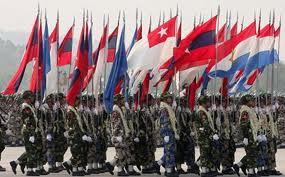
    Burma’s military junta
    source

    1974 – New constitution comes into effect, transferring power from the armed forces to a People’s Assembly headed by Ne Win and other former military leaders; body of former United Nations secretary-general U Thant returned to Burma for burial.

    1975 – Opposition National Democratic Front formed by regionally-based minority groups, who mounted guerrilla insurgencies.

    1982 – Law designating people of non-indigenous background as “associate citizens” in effect bars such people from public office.


    Riots and repression:

    1987 – Currency devaluation wipes out many people’s savings and triggers anti-government riots.

    1988 – Thousands of people are killed in anti-government riots. The State Law and Order Restoration Council (Slorc) is formed.

    1989 – Slorc declares martial law, arrests thousands of people, including advocates of democracy and human rights, renames Burma ‘Myanmar’, with the capital, Rangoon, becoming Yangon. NLD leader Aung San Suu Kyi, the daughter of Aung San, is put under house arrest.


    Thwarted elections


    Anti-government protests in 1988 triggered martial law and mass arrests
    source

    1990 – Opposition National League for Democracy (NLD) wins landslide victory in general election, but the result is ignored by the military.

    1991 – Aung San Suu Kyi awarded Nobel Peace Prize for her commitment to peaceful change.

    1992 – Than Shwe replaces Saw Maung as Slorc chairman, prime minister and defence minister. Several political prisoners freed in bid to improve Myanmar’s international image.

    1995 – Aung San Suu Kyi is released from house arrest after six years.

    1996 – Aung San Suu Kyi attends first NLD congress since her release; Slorc arrests more than 200 delegates on their way to party congress.

    1997 – Burma admitted to Association of South East Asian Nations (Asean); Slorc renamed State Peace and Development Council (SPDC).


    Release of pro-democracy supporters:

    2000 September – Ruling council lifts restrictions on movements of Aung San Suu Kyi and senior NLD members.

    2000 October – Aung San Suu Kyi begins secret talks with ruling council.

    2001 Ruling council releases some 200 pro-democracy activists. Government says releases reflect progress in talks with opposition NLD leader Aung San Suu Kyi who remains under house arrest.


    Conflicting signals:

    2002 May – Pro-democracy leader Aung San Suu Kyi released after nearly 20 months of house arrest.

    Aung San Suu Kyi taken into “protective custody” after clashes between her supporters and those of government.

    2003 November – Five senior NLD leaders released from house arrest after visit of UN human rights envoy.

    2004 January – Government and Karen National Union – most significant ethnic group fighting government – agree to end hostilities.

    2004 May – Constitutional convention begins, despite boycott by National League for Democracy (NLD) whose leader Aung San Suu Kyi remains under house arrest. The convention adjourns in July.

    New capital:

    2005 November – Myanmar says its seat of government is moving to a new site near the central town of Pyinmana; it is later given the name Nay Pyi Taw.

    2007 January – China and Russia veto a draft US resolution at the UN Security Council urging Myanmar to stop persecuting minority and opposition groups.

    2008 January- A series of bomb blasts hits the country. State media blame “insurgent destructionists”, including ethnic Karen rebels.

    2008 April – Government publishes proposed new constitution, which allocates a quarter of seats in parliament to the military and bans opposition leader Aung San Suu Kyi from holding office.

    Cyclone:
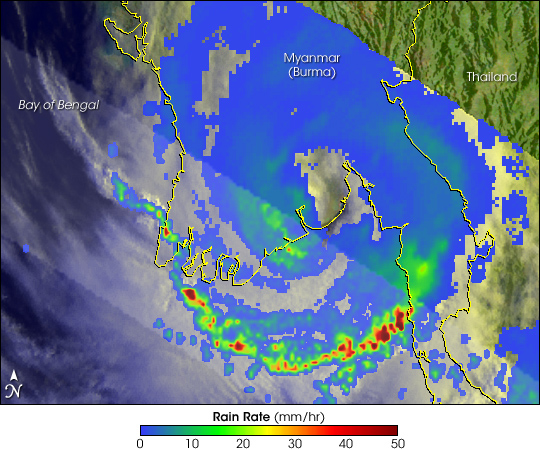
    Cyclone Nargis

    2008 May – Cyclone Nargis hits the low-lying Irrawaddy delta. Some estimates put the death toll as high as 134,000.

     The regime was accused of blocking aid, refusing initial access to humanitarian workers

    Referendum on new constitution proceeds amid humanitarian crisis following cyclone. Government says 92% voted in favour of draft constitution and insists it can cope with cyclone aftermath without foreign help.

    Junta renews Aung San Suu Kyi’s house arrest.

    2008 November – Dozens of political activists given sentences of up to 65 years in series of secretive trials.

    2008 December – Government signs deal with consortium of four foreign firms to pipe natural gas into neighbouring China, despite protests from human rights groups.

    2009 January – Thailand expels hundreds of members of Muslim Rohingya minority who appeared off its coast. Myanmar denies the minority’s existence. Several hundred Rohingyas are subsequently rescued from boats off the coast of Indonesia.

    2009 April – The National League for Democracy (NLD) main opposition group offers to take part in planned elections if the government frees all political prisoners, changes the constitution and admits international observers.

    2009 May – The EU extends the 2006 sanctions for another year, but adds that they can be reviewed in the event of moves towards democracy.

    UN and aid agencies say hundreds of thousands in the Irrawaddy Delta still need assistance a year after Cyclone Nargis. The UN says Myanmar now allows it to bring in all the staff it needs.

    Aung San Suu Kyi trial:

    2009 August – Opposition leader Aung San Suu Kyi is convicted of breaching conditions of her house arrest, following visit by an uninvited US national in May. The initial sentence of three years’ imprisonment is commuted to 18 months’ house arrest.

    The main military-backed party claimed victory in the 2010 election
    source

    2009 September – US Secretary of State Hillary Clinton announces plans for engagement with military rulers.

    2009 October – Aung San Suu Kyi begins talks with Myanmar’s military leaders and is allowed to meet Western diplomats.

    2010 March – Government announces that long-awaited election laws have been passed, with provisions for an electoral commission hand-picked by the junta.

    NLD votes to boycott polls. A splinter party – National Democratic Front (NDF) – later gains legal status and plans to compete in polls.

    2010 October – Government changes country’s flag, national anthem and official name.

    2010 November – Main military-backed party, the Union Solidarity and Development Party (USDP), claims resounding victory in first election for 20 years. Opposition groups allege widespread fraud and the election is widely condemned as a sham. The junta says the election marks the transition from military rule to a civilian democracy.

    Junta retires to wings:

    2011 March – Thein Sein is sworn in as president of a new, nominally civilian government.

    2011 August – President Thein Sein meets Aung San Suu Kyi in Nay Pyi Taw.

    2011 September – President Thein Sein suspends construction of controversial Chinese-funded Myitsone hydroelectric dam, in move seen as showing greater openness to public opinion.

    2011 October – Some political prisoners are freed as part of a general amnesty. New labour laws allowing unions are passed.

    2011 November- Pro-democracy leader Aung San Suu Kyi says she will stand for election to parliament, as her party rejoins the political process.

    2011 December  US Secretary of State Hillary Clinton visits, meets Aung San Suu Kyi and holds talks with President Thein Sein. US offers to improve relations if democratic reforms continue.

    Re-publication censorship was scrapped in 2012, but state control of media remains strong

    President Thein Sein signs law allowing peaceful demonstrations for the first time; NLD re-registers as a political party in advance of by-elections for parliament due to be held early in 2012.

    Burmese authorities agree truce deal with rebels of Shan ethnic group and orders military to stop operations against ethnic Kachin rebels.

    2012 January – Government signs ceasefire with rebels of Karen ethnic group.

    Partly-free elections held:

    2012 April – NLD candidates sweep the board in parliamentary by-elections, with Aung San Suu Kyi elected. The European Union suspends all non-military sanctions against Burma for a year.

    2012 May – Manmohan Singh pays first official visit by an Indian prime minister since 1987.

    2012 August – President Thein Sein sets up commission to investigate violence between Rakhine Buddhists and Rohingya Muslims in the west, in which dozens have died.

    Myanmar abolishes pre-publication media censorship.

    President Thein Sein tells the BBC he would accept opposition leader Aung San Suu Kyi as president if she were elected.


    Foreign ties:

    2012 November – Visiting European Commission chief Jose Manuel Barroso offers Myanmar more than $100m in development aid.

    Around 90 people are killed in a renewed bout of communal violence between Rakhine Buddhists and Rohingya Muslims.

    US President Barack Obama visits to offer “the hand of friendship” in return for more reforms. He urges reconciliation with the Rohingya minority.

    2013 January-February – The army surrounds Laiza, the biggest town controlled by Kachin rebels. The government and rebels agree to disengage and start a political dialogue after Chinese-sponsored talks.

    2013 March – Rioting between Muslims and Buddhists in Meiktila, south of Mandalay, leaves at least 10 people dead.

    2013 April – Four private daily newspapers appear for the first time in almost 50 years as the state monopoly ends.


    Violence has flared between Rohingya Muslims and Buddhists in Rakhine province
    source

    2013 May – President Thein Sein visits Washington. President Obama praises Myanmar’s political and economic progress, but criticises violence against Rohingya Muslims.

    Six Muslims are jailed over the Meiktila clashes in March. No Buddhists are convicted.

    2014 April – At least 22 people are killed in fighting between government troops and ethnic Kachin rebels in the north.

    Government announces release of 3,000 prisoners. Burma watchers say most are petty criminals, but include ex-military intelligence officers imprisoned along with former Prime Minister Khin Nyunt, who was freed in 2012.

    2015 February – Flare-up in fighting with Kokang separatists in Shan State near the border with China leaves nearly 50 soldiers dead. Government puts Kokang region under temporary martial law.

    Government withdraws temporary voting rights from Muslim Rohingyas ahead of proposed constitutional referendum, following street protests by Buddhists.


    Peace hopes:

    2015 March – A draft ceasefire agreement is signed between the government and 16 rebel groups.

    2015 May – Hundreds of Muslim Rohingyas migrants leave by sea in flimsy boats, along with migrants from Bangladesh. UN criticizes failure of south-east Asian states to rescue them.

    2015 July-August – Floods affect much of low-lying parts of country, killing 100 people and displacing a million others.

    2015 November – Opposition National League for Democracy – led by Aung San Suu Kyi – wins enough seats in parliamentary elections to form a government.

    2016 March – Htin Kyaw sworn in as president, ushering in a new era as Aung San Suu Kyi’s democracy movement takes power after 50 years of military domination.

  • Civilsdaily Listicles & Titbits | High Yield Material for Quick Prelims Revision

    When done with basic book reading and Prelims is near, many aspirants face the dilemma of how to revise entire syllabus and then remember important points from it.

    We understood this problem and our team worked together to compile all important topics at one place through excel sheets and Dr V compiled all important static syllabus points through Titbits.

    The excel sheets prepared by us are available to view and download below (best viewed on desktop/ large screens):

    1. Important Acts/bills- Bills/Acts/Amendments which have been in news from 2014-2017- Click2view
    2. Declarations, conventions, protocols- Contains important IR pacts signed in the last few years- Click2view
    3. Important Books/ Texts in Indian History – IAS Pre & beyond- Click2view
    4. Satellites, Space Missions, Space Tech by India –Click2view
    5. Important Historical Sculptures- Click2view
    6. Important Temples/Monasteries/Stupa/Caves- Click2view
    7. Key/important Terms related to Ancient/ Medieval History- contains nearly 180 terms from the most authentic history textbooks of our times Click2view
    8. Tribes in India, their festivals, and culture- Click2view


    Read all Titbits here

    1. Polity Titbits: Fundamentals of Polity and Constitution Click2read
    2. Polity Titbits: Important articles/schedules of Constitution Click2read
    3. Polity Titbits: Functions/powers of legislature Click2read
    4. Polity Titbits: Functions/powers of executive Click2read
    5. Polity Titbits: Functions/powers of Judiciary Click2read
    6. Polity Titbits: Constitution- Special provisions Click2read
    7. Polity Titbits: Constitutional, Statutory and quasi-judicial bodies Click2read
    8. Polity Titbits: Panchayati Raj- Local governance Click2read


  • [Official Answer] 21 Aug 2017 | Target Mains: GS Questions With Official Answers

    GS Paper 1 

    Q.1) Evaluate the role played by Dr. Rajendra Prasad in India’s freedom struggle and in laying the foundation of a modern India.

    Role Played in Freedom Struggle

    • Rajendra Prasad was man of courage, dedication, conviction and utmost sincerity. His name symbolised honesty and modesty. He was an active participant in crucial freedom movements like Non Cooperation Movement, Salt Satyagraha and Champaran Agrarian Agitation.
    • Rajendra Prasad came under the spell of Mahatma Gandhi in 1917 when the latter organized the Champaran Satyagraha to liberate the peasants from exploitation by the British Indigo planters. Under the active guidance of Mahatma Gandhi, he gave a new lead to the various movements in Bihar, with a view to taking the country nearer to the goal of freedom and economic regeneration Inspired by Gandhian ideology.
    • He concurred with Gandhiji that the only effective weapon to deal with the British Government’s inhuman actions and repressive laws was, ‘non-cooperation’. He was the first leader from Bihar to sign and undertake a pledge requiring every Satyagrahi to remain non-violent during the protest against the Rowlatt Act which came to be dubbed as the ‘Black Act.
    •  ln 1923, Rajendra Prasad actively participated in the Flag Satyagraha at Nagpur. The British Government arrested him for taking part in the 1930 Satyagraha. The second long spell of imprisonment that Rajendra Prasad suffered was immediately after the passing of the Quit India Resolution in 1942 and he remained in jail for nearly three years till 1945.

    Role played in making of the Constitution

    • When the Constituent Assembly was formed in 1946 to frame a Constitution for free lndia, Dr.RajendraPrasad, who had been elected as a member of the Assembly from the Bihar Province, was given the onerous responsibility of being its President. As President of the Constituent Assembly, he guided and regulated its proceedings with utmost firmness, infinite patience, incisive intellect and abundant grace. He always permitted members to have a free, frank and full discussion on issues before them and won the appreciation of every section of the House for his qualities, objectivity and impartiality.

    Role played by Him in Post Independent India.

    • Dr. Rajendra Prasad was unanimously elected as the provisional President of India on 24 January 1950.He served as the President of India for three terms the only person to do that.
    • As President Rajendra Prasad, along with India’s first Prime Minister, Pandit Jawaharlal Nehru, was able to establish many precedents and conventions culminating in a healthy political relationship between the Head of State and the Head of Government. With the passage of time, these precedents have become the cornerstone of our vibrant parliamentary democracy and have helped it in striking firm roots.
    • Even though Rajendra Prasad occupied the highest office in India, he led a very simple life. His integrity, purity of character, humility and devotion, love of humanity and depth of vision marked him out as a towering personality in our national firmament Rajendra Prasad not only gave the most precious years of his life to the freedom struggle but also worked for the betterment of the under-privileged throughout his life. He was a great humanist whose heart always went to the poor and the distressed.

    GS Paper 2

    Q.2) Given the fact there is increasing discrepancy between the seats won and votes received, should First past the post system be replaced by Proportional representation system? Discuss.

    Source: http://indianexpress.com/article/india/first-past-post-house-panel-asks-parties-if-poll-system-should-change-4806011/

    http://www.news18.com/news/politics/a-case-for-proportional-representation-system-in-india-646251.html

    http://www.dailypioneer.com/state-editions/bhubaneswar/high-time-india-adopted-proportionate-electoral-system.html

    • There has been debate since last general election about the system of election our country is having i.e. First Past the Post System. Apprehensions are now being raised that in recent years the FPTP system is not the best suited for India.
    • The reason behind this is that, the party getting maximum number of votes is declared elected (won) with majority irrespective of the votes polled even as low as 27% and the number of votes other parties get.
    • As evident from the recent UP election where results have indicated that a party getting 39 percent vote share won 312 seats and parties getting 22 percent and 21 percent got only 47 and 19 seats respectively.
    • This initiated our parliamentary panel to explore for different system of elections, other than the first past the post system.

    Our Constitutional framers favoured First Past the Post System because:

    • FTPT is simple to use and easy to understand. It provides clear-cut choice for voters between two main parties. It allows voters to choose between people rather than just between parties. Thus, voters can assess the performance of individual candidates rather than just having to accept a list of candidates presented by a party. It gives a chance for popular independent candidates to be elected.
    • However, the issue is that the victorious party has most often not secured the majority of votes. It is possible for a party to win majority of the seats with just 20-26% of vote share; by the same token, a party may not get a simple majority even with 74% of vote share. There is, hence, a mismatch between the number of seats won and the percentage of vote secured by the party.

    Further criticisms of FPTP are as follows:

    • Distortion of electoral process
    • Excludes smaller parties from fair representation
    • Encourages caste, religion, Ethnicity and regional politics.
    • Exaggerates the phenomenon of ‘regional fiefdoms’
    • We note here that during the drafting of the Constitution, various systems of proportional representation were considered, but the FPTP system was eventually adopted to avoid fragmented legislatures and to facilitate the formation of stable governments.

    Proportional Representation:

    • Concerning the above facts there has been debates and discussions regarding doing away with FPTP system and adopting the Proportional Representation system in India. Proportional representation (PR) is a concept in which the number of seats won by a party or group of candidates is proportionate to the number of votes received.
    • Proportional representation undoubtedly falls second in competition with the FPTP system in terms of simplicity in voting, but it scores higher in terms of convenience during campaign. Candidates can simply focus pointed attention on defined groups to appeal to, and consequently, the problems of campaign financing do not feature as prominently in the process.
    • Because parties are granted seats in accordance with their vote share, numerous parties get seats in the legislature in the proportional representation system, without any party gaining a majority. This detracts from the stability of the system.
    • Coalition government becomes inevitable, with challenges to such governments also becoming frequent. This is also why the Constituent Assembly decided that proportional representation would not be suited to the Parliamentary form of government that our Constitution lays down.
    • One potential drawback of this system is that the relationship between a voter and the candidate may dilute, for the candidate may now be seen as representing the party and not the constituency. The other way of looking at this is that a constituent could approach any representative of their choice in case of a grievance, which plays out as an advantage of this system.

    Conclusion:

    • As the discussion above has demonstrated, both electoral systems come with their own merits and demerits – proportional representation theoretically being more representative, while the FPTP system being more stable.
    • It can be suggested from the experience of other countries to follow a hybrid pattern combining elements of both direct and indirect elections. This, in turn will necessitate an increase in the number of seats in the Lok Sabha, which raises concerns regarding its effective functioning.

    GS Paper 3

    Q.3) The Government has recently announced that only electric vehicles (EVs) will be sold in India from 2030.Discuss what challenges India will face in achieving this target and also steps required to achieve this target.

    Source: https://www.civilsdaily.com/op-ed-snap-getting-charged-up/

    https://www.civilsdaily.com/op-ed-snap-the-hybrid-route/ 

    Electric vehicles are the future of India’s transportation system and could save billions of dollars in fuel cost while also reducing pollution, a report released by NITI Aayog. In light of this, the Government’s announcement that only EVs will be sold in India from 2030s makes great prominence. It is also believed that this would also save around one giga tonne of carbon emissions between 2017 and 2030. However, there are some major challenges in achieving this target. These are as follows:

    • Increased dependence: India will have to depend on countries like China for raw materials like Lithium required for EV Batteries due to its local unavailability
    • Huge Investment Requirement: Due to ever growing population of India, huge investment through private participation and local manufacturing units is required to cater their needs
    • Large Infrastructure Requirement: Electric Vehicles require large scale presence of Charging Infrastructure to be successful
    • Affordability issues: The demand for Electric Vehicles depends on its affordability, which is not so at present E.g. GST regime’s favor for fossil fuel run vehicles and increasing lithium prices increase cost of EVs and reduce demand.
    • Procurement of critical minerals: According to a study on India’s critical non-fuel minerals by the CEEW, manufacturing lithium-ion batteries would require critical minerals

    The steps that should be taken to promote and spur electric vehicles are:

    •  Land Acquisition should be easier for faster deployment of dedicated charging spots, charging infrastructure and setting up of Local EV Manufacturing Units.
    • Acquisition of overseas natural mineral reserves. These minerals include cobalt, graphite, lithium and phosphate.
    • There is a need to formulate policies which can encourage domestic public and private mining companies to invest in overseas lithium mining assets.
    • India must focus on creating a vibrant battery research and development ecosystem domestically.
    • Recycling lithium batteries will significantly reduce the burden in procuring fresh resources
    • Expansion of National Electric Mobility Mission and indigenous manufacturing under FAME scheme should be undertaken on a war footing.

    While India is facing rapid urbanization over the next three-to-four years, it must not follow the American model of urbanization which was essentially based on availability of cheap land, water and oil. Electric vehicles are the future of transportation and India needs to embrace them. Like it or not, electric vehicles will happen in India. The challenge is how to do it rapidly and how to do in scale and size. That should be the imperative.


    GS Paper 4

    Q.4) A young social activist has become very popular within a short period of 5 years because of his honesty, integrity, and human values. He finds rampant corruption in government offices and mismanagement is rural development schemes, which affects the poor and marginalized section of the society. He notices that it is a nexus of bureaucracy, elected representatives and contractors for this sorry state of affairs. It is unfortunate that a section of media has been managed by the nexus. The social activist, having deeply influenced by Gandhian principle wants to correct the things. What steps and action he will take to:

    (a) Unite the poor and marginalized so that they could raise their voice effectively.

    (b) Moblise the public opinion against the managed media.

    (c) Compel the state government to take remedial measures in order to set things right.

    (a) It is very important for the poor and marginalized to raise their voice to break the nexus of bureaucracy, elected representatives and contractors. The social activist can unite the people on common issues and on problems which people suffer at ground level. This will help to make sure people’s participation. Same was done by Gandhi in movements like civil disobedience when people realised that they are being heard. It will help to make sure they are united to fight for the cause they are suffering.

    (b) To mobilize the public opinion against the managed media, it is necessary people influence the media and put the pressure on it. It is seen that the actions are moved by the people’s opinion, civil society organizations etc. When the people are united, the media will have no option rather than to emerge out of the nexus which governs it. For it, it is very important to make the people stand united and stand together.

    (c) The state government is too mismanaged and driven by corrupt officials. They can be approached to tell how the things are going wrong and how are the poor and marginalized sections are suffering because of it. This can be done through NGOs or other civil society organizations. If they do not pay attention to it, a group of people can form a united organization and take steps to change the way things have been going wrong. It is worth learning from life of Gandhi that public opinion has the strength to change government functioning if they wish for it. The same can be replicated in this case also.

  • 21 Aug 2017 | GS 4 | A young social activist has become very popular within a short period of 5 years because of his honesty, integrity, and human values. He finds rampant corruption in government offices and mismanagement is rural development schemes, which affects the poor and marginalized section of the society. He notices that it is a nexus of bureaucracy, elected representatives and contractors for this sorry state of affairs. It is unfortunate that a section of media has been managed by the nexus. The social activist, having deeply influenced by Gandhian principle wants to correct the things. What steps and action he will take to: (a) Unite the poor and marginalized so that they could raise their voice effectively. (b) Moblise the public opinion against the managed media. (c) Compel the state government to take remedial measures in order to set things right.

    GS Paper 4

    Q.4) A young social activist has become very popular within a short period of 5 years because of his honesty, integrity, and human values. He finds rampant corruption in government offices and mismanagement is rural development schemes, which affects the poor and marginalized section of the society. He notices that it is a nexus of bureaucracy, elected representatives and contractors for this sorry state of affairs. It is unfortunate that a section of media has been managed by the nexus. The social activist, having deeply influenced by Gandhian principle wants to correct the things. What steps and action he will take to:

    (a) Unite the poor and marginalized so that they could raise their voice effectively.

    (b) Moblise the public opinion against the managed media.

    (c) Compel the state government to take remedial measures in order to set things right.

  • 21 Aug 2017 | GS 3 | The Government has recently announced that only electric vehicles (EVs) will be sold in India from 2030.Discuss what challenges India will face in achieving this target and also steps required to achieve this target.

    GS Paper 3

    Q.3) The Government has recently announced that only electric vehicles (EVs) will be sold in India from 2030.Discuss what challenges India will face in achieving this target and also steps required to achieve this target.

    Source: https://www.civilsdaily.com/op-ed-snap-getting-charged-up/

    https://www.civilsdaily.com/op-ed-snap-the-hybrid-route/ 

  • 21 Aug 2017 | GS 1 | Evaluate the role played by Dr. Rajendra Prasad in India’s freedom struggle and in laying the foundation of a modern India.

    GS Paper 1 

    Q.1) Evaluate the role played by Dr. Rajendra Prasad in India’s freedom struggle and in laying the foundation of a modern India.

  • 21 August 2017 | Prelims Daily with Previous Year Questions & Tikdams

    Q.1) ‘Indra Sawhney Case of 1992’ was related to
    a) Basic Structure of the Indian Constitution
    b) Part III of the Indian Constitution
    c) Reservation
    d) Validity of Indian Penal Code

    Q.2) Recently, ‘Value capture financing (VCF)’ is in news. It is a type of public financing that recovers some or all of the value that
    a) Public infrastructure generates for Private landowners
    b) Private landowners generates for Public Infrastructure
    c) Public infrastructure generated by the State Governments
    d) Public infrastructure generated by the Central Government

    Q.3) Which of the following statements regarding the ‘Ujwal DISCOM Assurance Yojana’ is/are correct?
    1. All the States have joined this Scheme.
    2. The scheme is optional for the states to join.
    Select the correct option using the codes given below.
    a) Neither 1 nor 2
    b) 2 only
    c) 1 only
    d) Both are correct

    Q.4) Consider the following statements regarding the ‘University Grants Commission (India)’:
    1. It is a statutory body.
    2. It is modelled after University Grants Committee of England.
    Which of the statements given above is/are correct?
    a) 1 only
    b) Both are correct
    c) 2 only
    d) Neither 1 nor 2

    Q.5) Recently, Union Government has launched the scheme namely Faster Adoption and Manufacturing of (Hybrid &) Electric Vehicles (FAME India) under
    a) UDAN
    b) NSAP
    c) ICDS
    d) NEMMP

    Q.6) Which of the following statements regarding ‘Green Climate Fund’ is/are correct?
    1. It is intended to assist the developing countries in adaptation and mitigation practices to counter climate change.
    2. It is founded under the aegis of UNEP, OECD, Asian Development Bank and World Bank.
    Select the correct answer using the code given below.
    a) 1 only
    b) 2 only
    c) Both 1 and 2
    d) Neither I nor 2

    Q.7) Indira Gandhi Prize for Peace, Disarmament and Development for 2014 was given to which one of the following?
    a) Bhabha Atomic Research Centre
    b) Indian Institute of Science
    c) Indian Space Research Organisation
    d) Tata Institute of Fundamental Research

    Q.8) With reference to the Cabinet Mission, which of the following statements is/are correct?
    1. It recommended a federal government.
    2. It enlarged the powers of the Indian courts.
    3. It provided for more Indians in the ICS.
    Select the correct answer using the code given below.
    a) 1 only
    b) 2 and 3
    c) 1 and 3
    d) None


    IMPORTANT STUFF: 

    1. Daily newscards have been enriched with back2basics and note2students – Make notes daily

    2. Join Full Year Prelims TS – prelims.civilsdaily.com

    3. Solutions will be uploaded at 11.30 p.m. Click here for Solutions

    4. For attempting previous Prelims Daily Questions – Click here

  • Essay challenge

    I can’t see any weekly essays.. Did u stop the weekly essay challenge.?? also pls make it available with official review similar to Target Mains.

  • Public Administration Pilot Answer Writing Programme | Daily Answer Review by UPSC Veterans | Starts 21st August

    Archive (click on highlighted days to attempt the daily quiz)

    We are coming up with a pilot programme for Public Administration optional students as a precursor to Test series being launched for them after a few days.

    The highlights of the programme are:

    • Daily 2 questions (10 marks + 20 marks) will be made available at 10 am.
    • Evaluation will be done by 8 pm.
    • Model answer will be available from 9 pm on the same day.
    • Doubts can be asked. We will get the doubts cleared on the same day.

    Other features:

    • Comprehensive evaluation. Stress will be given on-

    -Content

    -Facts, figures, value addition, Case studies, current affairs etc.

    -Structure of the answer

    -Presentation and Format

    Conducted by:

    Adarsh V Dharan in collaboration with Civilsdaily
    Marks obtained in UPSC Mains 2016 in Public Administration- 295


    PS: Confirm your participation by posting in comments below. After registering, click on the links on the top and start attempting the questions. Questions attempted on the same day before 8 PM will be checked. 

More posts