💥UPSC 2026, 2027, 2028 UAP Mentorship (March Batch) + Access XFactor Notes & Microthemes PDF

Search results for: “”

  • Intellectual Property Rights in India

    What are IPRs?

    Intellectual Property Rights (IPRs) are legal rights, which result from intellectual invention, innovation and discovery in the industrial, scientific, literary and artistic fields. These rights entitle an individual or group to the moral and economic rights of creators in their creation.
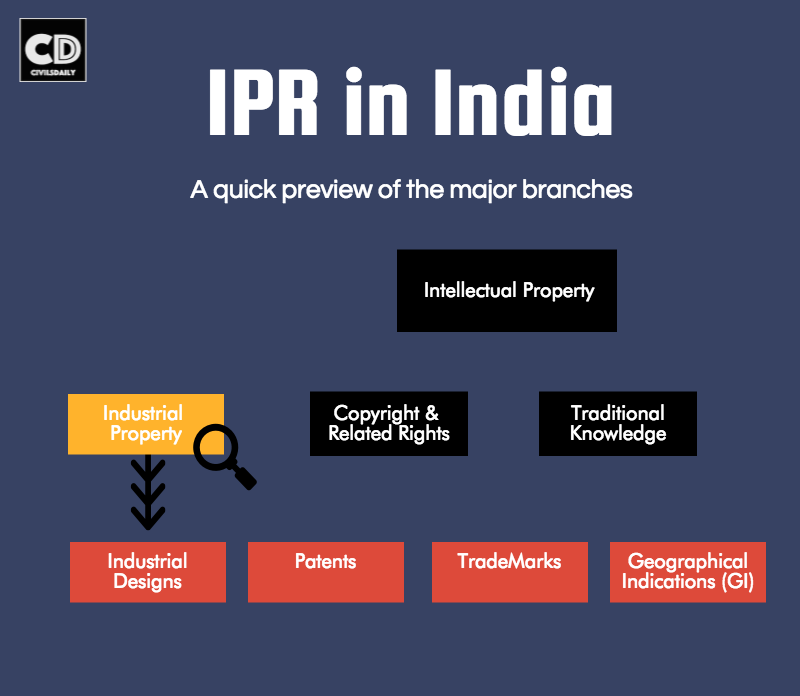


    Types:

    Patent- It is a set of exclusive rights granted by a sovereign state to an inventor for a limited period of time in exchange for detailed public disclosure of an invention.

    Copyright- It is a legal right created by the law of a country that grants the creator of an original work exclusive rights for its use and distribution. It includes literary & artistic works such as novels, poems, plays, films, musical works, drawing, painting, photography, sculpture, architectural designs

    Trademark- It is a recognizable sign, design, or expression which identifies products or services of a particular source from those of others. Trademarks used to identify services are usually called service marks.

    Industrial design right- It is an intellectual property right that protects the visual design of objects that are not purely utilitarian. An industrial design consists of the creation of a shape, configuration or composition of pattern or color, or combination of pattern and color in three-dimensional form containing aesthetic value. An industrial design can be a two- or three-dimensional pattern used to produce a product, industrial commodity or handicraft.

    Trade secret- It is a formula, practice, process, design, instrument, pattern, commercial method, or compilation of information which is not generally known or reasonably ascertainable by others, and by which a business can obtain an economic advantage over competitors or customers

    Geographical Indication (GI)- It is a name or sign used on certain products which corresponds to a specific geographical location or origin (e.g. a town, region, or country). The use of a geographical indication may act as a certification that the product possesses certain qualities, is made according to traditional methods, or enjoys a certain reputation, due to its geographical origin. A recent example is of Indian variety of Basmati rice getting GI tag.

    From above points, it is clear that IPR is a very sensitive issue in terms of businesses different kinds and international relations as well.

    IPRs in pharmaceutical sector:

    Some sectors are very sensitive in terms of IPRs like pharmaceuticals. Let’s explore briefly into IPR issues in pharmaceutical sector.

    We hear of two kinds of drugs- generic and brand name drugs:

    Generic drugs are those whose patent has expired or does not exist and which can be produced by any registered manufacturer without need of taking permission from any authority and also without any payment of royalty.

    Brand name drugs are those which are patented and cannot be produced without the consent of the patent holder. A royalty is to be paid for production of these drugs.

    But what happens if a company holds patent of an essential drug and there is an emergency in which the drug needs to be provided at low cost for vast populace? In this case, Compulsory Licensing comes to the rescue.

    What is Compulsory Licensing?

    • A compulsory license provides that the owner of a patent or copyright licenses the use of their rights against a payment. This payment is either set by law or determined through some form of arbitration
    • In essence, under a compulsory license, an individual or company seeking to use another’s intellectual property can do so without seeking the rights holder’s consent, and pays the rights holder a set fee for the license
    • This is an exception to the general rule under intellectual property laws that the intellectual property owner enjoys exclusive rights that it may license – or decline to license – to others

    Does there have to be an emergency?

    Not necessarily. This is a common misunderstanding. The TRIPS Agreement does not specifically list the reasons that might be used to justify compulsory licensing. However, the Doha Declaration on TRIPS and Public Health confirms that countries are free to determine the grounds for granting compulsory licences.

    In March 2012, India granted its first compulsory license ever. The license was granted to Indian generic drug manufacturer Natco Pharma Ltd for Sorafenib tosylate, a cancer drug patented by Bayer.

    Here, first thing first, What is TRIPS?

    • TRIPS is an international agreement administered by the World Trade Organization (WTO), which sets down minimum standards for many forms of intellectual property (IP) regulations as applied to the nationals of other WTO Members
    • It was negotiated at the end of the Uruguay Round of the General Agreement on Tariffs and Trade (GATT) in 1994
    • TRIPS requires WTO members to provide copyright rights, covering content producers including performers, producers of sound recordings and broadcasting organizations, geographical indications, including appellations of origin, industrial designs, integrated circuit layout-designs, patents, new plant varieties, trademarks, trade dress, and undisclosed or confidential information
    • The agreement also specifies enforcement procedures, remedies, and dispute resolution procedures

    Now, back to the topic…

    India is a huge market for generic drugs and hence it is very obvious that there must emerge issues out of patents for pharmaceuticals.

    One such case came up in 1998- Novartis v. Union of India & Others

    It was a landmark decision by a two-judge bench of the Supreme Court, on the issue of whether Novartis could patent Glivec in India. It was the culmination of a seven-year-long litigation fought by Novartis. The Supreme Court upheld the Indian patent office’s rejection of the patent application.

    Ground of rejection?

    Novartis claimed patent for he changed form of Glivec on the basis of the increased bio-availability in the body of the patient by making changes in chemical composition of its original anti-cancer drug Imatinib Mesylate. This changed form of the drug could not withstand the ‘enhanced therapeutic efficacy’ test enshrined under Section 3(d) of Indian Patents Act and therefore it was rejected.

    Recently, Gilead got patent for its Hepatitis C drug Solvadi. An application for the same patent was first rejected in January 2015 as lacking inventiveness and novelty. The decision, however, is seen as a major blow to the access to drug movement

    Now let’s turn towards the latest developments in the IPRs in India.

    New IPR Policy

    Govt of India recently released a new National Intellectual Property Rights (IPR) Policy which is in compliance with WTO’s agreement on TRIPS

    Why a new policy?

    • Global drug brands led by US companies have been pushing for changes to India’s intellectual property rules for quite some time now. They have often complained about India’s price controls and marketing restrictions
    • Also, an IPR policy is important for the government to formulate incentives in the form of tax concessions to encourage research and development (R&D)
    • It is also critical to strengthen the Make In India, Startup and Digital India schemes
    • The IPR policy comes at a time when India and other emerging countries faces fresh challenges from the developed world and mega regional trade agreements such as the Trans-Pacific Partnership (TPP)

    Seven objectives:

    1. IPR Awareness: To create public awareness about the economic, social and cultural benefits of IPRs among all sections of society
    2. Generation of IPRs: To stimulate the generation of IPRs
    3. Legal and Legislative Framework: To have strong and effective IPR laws, which balance the interests of rights owners with larger public interest
    4. Administration and Management: To modernize and strengthen service-oriented IPR administration
    5. Commercialization of IPRs: Get value for IPRs through commercialization
    6. Enforcement and Adjudication: To strengthen the enforcement and adjudicatory mechanisms for combating IPR infringements
    7. Human Capital Development: To strengthen and expand human resources, institutions and capacities for teaching, training, research and skill building in IPRs

    Highlights:

    • The new policy calls for providing financial support to the less empowered groups of IP owners or creators such as farmers, weavers and artisans through financial institutions like rural banks or co-operative banks offering IP-friendly loans
    • The work done by various ministries and departments will be monitored by the Department of Industrial Policy & Promotion (DIPP), which will be the nodal department to coordinate, guide and oversee implementation and future development of IPRs in India
    • The policy, with a tagline of Creative India: Innovative India, also calls for updating various intellectual property laws, including the Indian Cinematography Act, to remove anomalies and inconsistencies in consultation with stakeholders
    • For supporting financial aspects of IPR commercialisation, it asks for financial support to develop IP assets through links with financial institutions, including banks, VC funds, angel funds and crowd-funding mechanisms
    • To achieve the objective of strengthening enforcement and adjudicatory mechanisms to combat IPR infringements, it called for taking actions against attempts to treat generic drugs as spurious or counterfeit and undertake stringent measures to curb manufacture and sale of misbranded, adulterated and spurious drugs
    • The policy will be reviewed after every five years to keep pace with further developments in the sector

    International angle:

    Last month, the US Trade Representative kept India, China and Russia on its “Priority Watch List” for inadequate improvement in IPR protection. However, brushing aside concerns of the US on India’s IPR regime, the government said its intellectual property rights laws are legal-equitable and WTO-compliant. Thus, the government has not yielded to pressure from the United States to amend India’s patent laws.

    Benefits:

    • The new policy will try to safeguard the interests of rights owners with the wider public interest, while combating infringements of intellectual property rights
    • By 2017, the window for trademark registration will be brought down to one month. This will help in clearing over 237,000 pending applications in India’s four patent offices
    • It also seeks to promote R&D through tax benefits available under various laws and simplification of procedures for availing of direct and indirect tax benefits
    • Unlike earlier where copyright was accorded to only books and publications, the recast regime will cover films, music and industrial drawings
    • A host of laws will also be streamlined — on semi-conductors, designs, geographical indications, trademarks and patents
    • The policy also puts a premium on enhancing access to healthcare, food security and environmental protection
    • Policy will provide both domestic and foreign investors a stable IPR framework in the country
    • This will promote a holistic and conducive ecosystem to catalyse the full potential of intellectual property for India’s growth and socio-cultural development while protecting public interest
    • It is expected to lay the future roadmap for intellectual property in India, besides putting in place an institutional mechanism for implementation, monitoring and review
    • The idea is to incorporate global best practices in the Indian context and adapt to the same

    Challenges:

    • According to the policy, India will retain the right to issue so-called compulsory licenses to its drug firms, under “emergency” conditions
    • Also, the government has indicated that there is no urgent need to change patent laws that are already fully World Trade Organization-compliant. So India has resisted pressure from the US and other Western countries to amend its patent laws
    • The policy also specifically does not open up Section 3(d) of the Patents Act, which sets the standard for what is considered an invention in India, for reinterpretation


    Published with inputs from Swapnil


  • Don’t miss your IAS Prelims by that 1 question!

    Hello Everyone,

    Though I am really occupied with some stuff till this month end but then something happened which set me off to write this blog. Just few minutes back one of my pupils sent his Prelims mark-sheet to me and called me up to say that he just missed the Prelims by one question, for if he had one more correct answer his score would have been 108.66 which would have seen him cross the cut-off pegged at 107.34.


    Probably he was expecting some comforting words but for the knowledge that, though controlled to a large extent, I still have the remnants left in me which don’t allow me to mince words when I must not. Sometimes bitter pill becomes indispensable.

    By the way his score in Paper I is 106.66 and that in Paper II is 146.

    To cut the long story short, the point is not that he missed it by one question for which he need some comforting words (they shall anyway follow tomorrow) but that this one questions cost him one year!

    I still remember vividly when he came last year to show the paper we identified 2-3 questions where he knew the answer but marked them wrong in haste. So called silly mistakes. But then can it really be called a “silly” mistake if it can cost you a year? I guess not. Whether your score is 107 or 007, it does not matter, both won’t get the chance to write the Mains.

    The lesson is simple if you can lean it. Study. Given that these “silly” mistakes will creep in come what may, study hard enough to get enough MCQs correct that you don’t need to bother about this 1 question.

    And yes, we were planning to put in place a Prelims series and here is the schedule:

  • Request for 3 new explains with infographs.

    Please make explains on
    1. DTAA- Mauritius, the new agreement, its implications and all that.
    2. Patents n its related stuff. This we need definitely with infographs. Please?
    3.NSG-NPT link. Why is it important for India and stuffs like that.
    Please consider this, CD. These three are a bit difficult for me to understand.

  • Civil Services Prelims 2015 Official Answer Keys

    Here is the official answer key.

    http://www.upsc.gov.in/exams/answerkeys/2015/CSP_2015/CSP_15_GS_I_AKy.pdf

    http://www.upsc.gov.in/exams/answerkeys/2015/CSP_2015/CSP_15_GS_II_AKey.pdf

    No need for further mahabharat on controversial questions. Just accept the answer and move on.

    What explains the eastward flow of the equatorial counter-current?*
    a) The Earth’s rotation on its axis
    *b) Convergence of the two equatorial currents*
    c) Difference in salinity of water
    d) Occurrence of the belt of calm near equator

    Official Answer : B

    In the South Atlantic and South Eastern Pacific regions in tropical latitudes, cyclone does not originate. What is the reason?
    a) Sea Surface temperature are low
    *b) Inter Tropical Convergence Zone seldom occurs*
    c) Coriolis force is too weak
    d) Absence of land in those regions

    Official Ans: B

    A decrease in tax to GDP ratio of a country indicates which of the following?
    1. Slowing economic growth rates
    2. Less equitable distribution of national income

    Select the correct answer using the code given below.
    a) 1 only
    b) 2 only
    c) Both 1 and 2
    d) Neither 1 nor 2
    Official Ans: A

    Custodian of constitution answer is Supreme Court.

    You can put answers of other controversial questions in the comments below.

    Cut off for general category is 107.34

    Find the category wise cut off pdf attached below

    http://upsc.gov.in/exams/cut-off%20marks/2015/CS_2015/CutOff_CSM_2015.pdf

  • print issue of cd magazine

    Hi ,

    when are you going to release print magazines of cd , if you are not please ,tell me so that I will buy ecopy and get a print of it . Thank you ; praveen.singada@gmail.com

  • PROJECT CSE P IN 2.5 MONTHS

    CURRENT AFFAIRS FROM WHICH MONTH?? FOR CSE 2016 PRE

  • A story of perseverance: Jasmeet Sandhu, Rank 3


    My success mantra is ‘hardwork is the key to success‘, says the 28- year-old Jasmeet Sindhu who secured 3rd position.

    He is an IRS officer & is already working as Assistant Commissioner.

    A story of perseverance:

    An engineering graduate from IIT-Roorkee, Jasmeet started his preparations for civil services in 2010. But he was not able to clear it on his first two attempts, and got into the IRS on his third attempt. And now in 4th attempt, he stands before us as one of the toppers. Ecstatic with the result, Jasmeet’s mother Surinder Sandhu, attributed his success to his consistent hardwork.

    Friends & Family support:

    Jasmeet says his family and friends had more faith in him than him that he will not only just clear the exam but also with flying colors. He also says that he never felt a pressure for having an alternative career because of his family support and this was the Main reason he could clearly focus on The IAS.

    About coaching: Jasmeet only took coaching for a month. He prepared for the exam on his own.

    He took Psychology as his optional.

    Why IAS?

    He chooses IAS because he feels that this service has the capability to allow the individual to have a balance in the work life as well as work for the people.

    What else?

    • Other than studying Jasmeet has many other hobbies and likings. One of them is football & he loves playing football in his free time
    • Jasmeet also likes to post on QUORA and help people as much as he can he provides them with his preparation tips so that an individual can study from his home and need not go out for any coaching and spend money and time

    Advice for Aspirants:

    • Only study when your heart says and choose topic you know that you are good at. Just follow this
    • There is no fixed thing as if you do this you will crack IAS, be patient and don’t quit

    Published with inputs from Swapnil
  • The countdown to the Prelims 2016

    Hello everyone,

    source

    As I had mentioned earlier, I shall not be available now till the end of this month, so just thought of writing a piece on how to manage the days leading up to the Preliminary Examination in August. With Paper II being only qualifying in nature, your score in Paper I shall determine if you shall battle it out with the brighter among the bright in December.  Here is a sort of small to-do list:

    1. Cover the basic books that have already been mentioned in the previous blog “IAS Prelims 2016 – The bare essentials to be followed” and revise them at least three to four times.
    2. Practice previous year question papers and identify the areas where you might be getting the answers frequently wrong. Cover these areas again.
    3. Do not compare your preparation strategy with anyone else. Only you know what works for you and you should stick to that only.
    4. Apportion your time such that you still have few days left towards the end for squeezing in something which you feel requires little more effort. This shall also keep the stress level down.
    5. Do not get bogged down by the number of books your friends might have covered. You don’t need to top the Preliminary examination. It is absolutely inconsequential even if you are the last one to glide in the list of candidates who shall be writing mains.
    6. You shall find many around you who shall through random factoids at you which you may not be able to answer. Do not get perturbed. For, few chosen ones find unimaginable pleasure in digging out factoids to make other feel ‘unprepared’. One unknown factoid shall not take away from you the hard work and the smart work that you have put in.
    7. Lastly, please keep yourself stress free. It shall serve no other purpose but to eat into your health. Just focus on what you can do without racking your brain over the imponderables.

    So, that is it for now. We shall re-start the MCQs series in the first week of June. This time it shall be more structured. With more number of questions. And packed with more knowledge to crack the Preliminary.  Till then, no let-ups, no excuses.

    Remember, those who work hard don’t need a second chance and those who don’t, do not deserve a second chance. You choose your side!

  • [E&B Bodies #6] Centre for Science and Environment


    • The Centre for Science and Environment (CSE) is a public interest research and advocacy organisation based in New Delhi
    • CSE researches into, lobbies for and communicates the urgency of development that is both sustainable and equitable
    • Established in 1980, CSE works as a think tank on environment-development issues in India, poor planning, climate shifts devastating India’s Sundarbans and advocates for policy changes and better implementation of the already existing policies
    • The Director of CSE is Sunita Narain who is named among the 100 most influential persons by The Time Magazine


    Aim:

    • The scenario today demands using knowledge to bring about change. In other words, working India’s democracy
    • Thus the aim of CSE is to raise concerns, participate in seeking answers and more importantly, in pushing for answers and transforming these into policy and so practice
    • CSE does this through its research and by communicating the understanding through its publications. This is called knowledge-based activism

    Two-pronged challenge of balance:

    On the one hand, millions live within a biomass based subsistence economy, at the margins of survival. The environment is their only natural asset. But a degraded environment means stress on land, water and forest resources for survival. It means increasing destitution and poverty. Here, opportunity to bring about change is enormous. But it will need a commitment to reform, a structural reform, in the way we do business with local communities

    On the other hand, rapid industrialization is throwing up new problems: growing toxification and a costly disease burden. The answers will be in reinventing the growth model of the Western world for ourselves, so that we can leapfrog technology choices and find new ways of building wealth that will not cost us the earth

    CSE’s efforts are built around five broad programmes:

    #1. Communication for Awareness

    • CSE’s publications and informational products have been its strength and they have always combined research and readability to get the message across
    • CSE’s tools for awareness raising are periodicals, publications, films/short spots, briefing papers, exhibitions, posters and other products
    • CSE’s informational products reach people in more diverse ways such as features service, website and e-news bulletins

    #2. Research and Advocacy

    • CSE’s efforts are specifically designed to create awareness about problems and propose sustainable solutions
    • Research at CSE often consists of in-depth learning about an environmental problem and then finding answers in accordance with CSE’s core values

    #3. Education and Training

    • There is a growing interest amongst professionals, public administrators, private sector executives NGO professionals, students and others in environmental issues
    • With this in mind, CSE, has for some years, been developing programmes in the area on non-formal environmental education programmes

    #4. Knowledge Portal

    • The overall aim is to develop into an excellent resource centre with information — printed and visual — on sustainable development issues, which is possibly the best in India
    • For a knowledge-based organisation like CSE, information collection is the basic foundation for all its research and advocacy activities

    #5. Pollution Monitoring

    CSE’s Pollution Monitoring Laboratory is an independent, analytical laboratory that monitors toxic contamination of the environment and uses the results of this monitoring to advocate for improved regulation of the use of toxins in the country


    Published with inputs from Swapnil
  • Ask me anything Geography – GS Pre / mains/ optional.

    Want some help with geography? The thread is for you.

More posts
