💥UPSC 2026, 2027, 2028 UAP Mentorship (March Batch) + Access XFactor Notes & Microthemes PDF

Search results for: “”

  • A new Parliament building, please!

    Shah Jahan constructed the Taj Mahal at Agra. Sumitra Mahajan wants a new Sansad Mahal at New Delhi. If the former was an ode to love, justification for the latter is as techno-legal as it gets, ranging from the stiffly legal references of Article 81 to creating technological capacities. Such Parliamentary fervour after such amazing sessions! Really, they quite deceive us, our Sansad members.

    Why a new building?

    Top reason is Arvind Subramaniam. It’s he who has created this Shah Jahan-minus-the-love aka Keynesian furore in our to-hell-with-growth Parliamentarians. The man claims that the growth forecast stands revised downwards from 8.1% to 7.3%. So let’s make it in India and get the growth rate moving. After visiting nearly all countries that make anything at all, we’ve realized that no one wants to really make much to begin with (it’s a global slowdown, stupid!) and if at all they do, they certainly won’t make it in India.

    So let the Government spend some more. On what, is the golden question. Spend too much, and those firangi buggers at Moody’s will give us a downgrade. Spend too little, and Arvind threatens to release a new document with 7.0% growth. Do nothing and the Opposition will disrupt the Budget session. It’s quite a tricky little question.

    Hmmm. So here’s the answer. Spend on a project that gets the multipliers working, so that Arvind is happy. Spend on a project that has the capacity to raise its own revenue source, and Moody’s will be happy. Spend on a project that will be used by the Opposition as well, and keep them at bay.

    Hurrah! It’s the Parliament! Getting that going will create huge demand for steel and cement and construction material. Welcome, employment. This will push private investments as well, creating the impetus for growth. That takes care of the CEA. Next, impose a Sansad Bachao, Sansad Banao cess. What we really need is Sansad Padhao, but that’s another matter altogether. Surely Moody’s cannot get upset about such a deficit neutral project. What’s more, voters absolutely cannot resist Hindi-named taxes. Hehehe!

    As far as the Opposition is concerned, this project takes the cake. They’ll not only support it, but positively beam and urge the Government to spend more. The only condition is that we use Italian marble in the construction. Why, they may even behave themselves in the Budget session and finally pass the GST. Yeah, that the Government may have to re-name it the Great Sansad Tax is another matter altogether.

    Apart from the terrific economic benefits of the move, there are also those other, rather important issues that justify the new building. Ms. Mahajan claims that the current building is under “stress”. Being a mute witness to such high-on-adrenalin chair-upturning and yelling sessions does that to the strongest of stones.

    Making the new premises technologically capable will make the Parliament a paperless organization. That is truly a masterstroke and will end all possibilities of the Opposition flinging paper balls to disrupt the session. Wish they would make it pepper-free as well. Let’s put nation building on hold. First, the Parliament building, please.

  • Was Reading From Civilsdaily Worth Your Time? GS Mains 2015 Analysed

    Hello,

    Heartly congratulations to all who have written IAS Mains 2015. We hope that the readers of this community would have found it a tad more easier to follow with the GS papers this year, which was heavily perched on the dynamic GS.

    As the whole philosophy behind Civilsdaily hinges on “Making current affairs approachable”, CD Newscards + Stories and CD Explainers should have provided great assistance in Mains 2015.

    Here in this article we try to figure out this premise. It would provide more ammo for those appearing in 2016 to stay ahead of teh competition by dealing with the news in a better, more efficient way.


    GS Paper 1

    #Q. Mesolithic rock cut architecture of India not only reflects the cultural life of the times but also a fine aesthetic sense comparable to modern painting. Critically evaluate this comment. (12.5M)

    #1. We covered architecture extensively in this story – Indian Heritage & Culture


    #2. Ref: A Digest on Indian Painting


    #Q. Discuss the positive and negative effects of globalization on women in India? (12.5M)

    This running story (with connected newscards) deals with the theme of women & various facets of public policies + issues in India.


    #Q. Smart cities in India cannot sustain without smart vilages. Discuss this statement in the backdrop of rural urban integration. (12.5M)

    #1. Explainer written on – Shyama Prasad Mukherji Rurban Mission: Making Smart Villages

    #2. Story connected the daily newscards – Smart City: Explore The Unexplored


    GS Paper 2

    #Q. Discuss the possible factors that inhibit India from enacting for its citizen a uniform civil code as provided for in the Directive Principles of State Policy.

    #1. Explainer written on – Do We Want Uniform Civil Code in India?


    #Q. The concept of cooperative federalism has been increasingly emphasised in recent years. Highlight the drawbacks in the existing structure and extent to which cooperative federalism would answer the shortcomings.

    This topic was beaten to death in 2015. We had more than one instance where we curated news stories for you on this –

    #1. Op-ed on The distant goal of cooperative federalism

    #2. Explainer on – Key Points: Top 10 Recommendations of the 14th Finance Commission

    #3. Here’s Panagaria for cooperative federalism in higher education


    #Q. Resorting to ordinances has always raised concern on violation of the spirit of separation of power doctrine. While noting the rationales justifying the power to promulgate, analyse whether the decision of the Supreme Court on the issue have further facilitated to resorting to this power. Should the power to promulgate the ordinances be repealed?

    #1. Manasi Phadke to the rescue here – Econ Mom talks Mann ki Baat on Land Ordinance


    #Q. Examine critically the recent changes in the rule governing foreign funding of NGOs under the Foreign Contribution (Regulation) Act (FCRA), 1976.

    #1. Here’s the most comprehensive compilation on this theme – NGOs vs. GoI: The Conflicts and Scrutinies


    #Q. The quality of higher education in India requires major improvement to make it internationally competitive. Do you think that the entry of foreign educational institutions would help improve the quality of technical and higher education in the country. Discuss.

    #1. Connected newscards for this theme – The State Of Affairs In Higher Education


    #Q. Public health system has limitation in providing universal health coverage. Do you think that private sector can help in bridging the gap? What other viable alternatives do you suggest?

    Three stories, all dealing with this concept heavily!

    #1. Policy Wise: India’s Health Sector

    #2. Ministry of Health and Family Welfare: Important Updates

    #3. The Fight Against Tuberculosis


    #Q. Though there have been several different estimates of poverty in India, all indicate reduction in poverty over time. Do you agree. Critically examine with reference to urban and rural poverty indicators.

    Two newscards & one story to the rescue here –

    #1. World Bank estimates show fall in India’s poverty rate

    #2. MGNREGS reduced poverty, empowered women

    #3. India’s Urbanisation Agenda


    #Q. For achieving the desired objectives,it is necessary to ensure that the regulatory institution remain independent and autonomous. Discuss in the light of experiences in recent past.

    #1. The merger explained, here – FMC-SEBI Merger: The Road Ahead


    #Q. Increasing interest of India in Africa has its pro and cons. Critically Examine.

    #1. Explainer on Indo-Africa relations – India-Africa Forum Summit: Old Friends – Old Family

    #2. Story – Foreign Policy Watch: India-Africa


    #Q. Discuss the impediments India is facing in its pursuit of a permanent seat in UNSC.

    #1. Explainer – India’s Bid to United Nations Permanent Seat


    Project ‘Mausam’ is considered a unique foreign policy initiative of Indian government to improve relationship with its neighbours. Does the project have a strategic dimension? Discuss.

    #1. Project Mausam – Cultural ties deepen for the 39 countries
    #2. Project Mausam – India’s answer to China’s Maritime Silk Road


    #Q. Terrorist activities and mutual distrust have clouded India – Pakistan relations. To what etent the use of soft power like sports and cultural exchange could help generate goodwill between the two countries. Discuss with suitable examples.

    #1. Explainer on Indo Pak relationship (although it was written on 19th Dec) China-Pakistan Equation: Is it India’s Dilemma?

    #2. Old time readers would find this running compilation useful – Foreign Policy Watch: India-Pakistan


    GS Paper 3

    #Q. The nature of economic growth in India in recent times is often described as a jobless growth. Do you agree with this view? Give arguments in favour of your answer.

    #1. Story – Indian Economy – Growth Estimates


    #Q. How can the Digital India program help farmers to improve farm productivity and income? What step has the government taken in this regard?

    #1. Story – Digital India Initiatives: What’s Buzzing!


    #Q. Craze for gold in Indian has led to surge in import of gold in recent years and put pressure on balance of payments and external value of rupee. In view of this, examine the merits of Gold Monetization scheme.

    #1. Explainer on the issue – PM Modi Launches 3 Gold Schemes: A Golden Opportunity


    #Q. “Success of make in India program depends on the success of Skill India programme and radical labour reforms.” Discuss with logical arguments.

    #1. Story – The Mammoth Task Of Skilling India

    #2. Story – Make in India: Challenges & Prospects

    #3. Story – Labour Reforms In India


    #Q. To what factors can be the recent dramatic fall in equipment cost and tariff of solar energy be attributed? What implications does the trend have for thermal power producers and related industry?

    #1. Story – Solar Energy: The Emerging Sector


    #Q. What do you understand by “Standard Positioning System” and “Precision positioning system” in the GPS era? Discuss the advantage India perceives from its ambitious IRNSS programme employing just seven satellites.

    #1. Story – ISRO – India’s Space Program


    #Q. Discuss the Namami Gange and National Mission for Clean Ganga (NMCG) programmes and causes of mixed results from the previous schemes. What quantum leaps can help preserve the river Ganga better than incremental inputs?

    #1. Story – Mission Clean Ganga


    #Q. The frequency of earthquakes appears to have increased in the Indian subcontinent. However, India’s preparedness for mitigating their impact has significant gaps. Discuss various aspects.

    #1. Story – Nepal’s Earthquake & the Way Forward

    #2. Story – Disaster Management and Way forward


    #Q. Human right activists constantly highlight the fact that the Armed forces (Special Powers) Act, 1958 (AFSPA) is a draconian act leading to cases of human right abuses by security forces. What sections of AFSPA are opposed by the activists. Critically evaluate the requirement with reference to the view held by Apex Court.

    #1. Story – Armed Forces (Special Powers) Act

    #2. Explainer – AFSPA explained in one infograph


    #Q. Religious indoctrination via social media has resulted in Indian youth joining the ISIS. What is ISIS and its mission? How can ISIS be dangerous to the internal security of our country.

    This was the most talked about topic of the year. We wrote 2 explainers & 2 stories which we follow up till this day!

    #1. Story – Foreign Policy Watch: Cross-Border Terrorism

    #2. Story – The Crisis In The Middle East

    #3. Explainer – Syrian Civil War and The Refugee Crisis

    #4. Vienna Conference to end Syria’s endless agony


    #Q. Considering the threats cyberspace poses for the country, India needs a “Digital Armed Forces” to prevent crimes. Critically evaluate the National Cyber Security Policy, 2013 outlining the challenges perceived in its effective implementation.

    #1. Story – Cyber Security: Challenges and Developments


    PS: We know that some of the uninitiated readers may find the idea of story & newscards (and following them) a bit difficult to keep up with. We are working on further simplifying the interface so that you get to the crux of the issue right on. For now, our only advice is that you follow the daily feeds on app & web. Sooner or later, we will catch up with all the issues.

  • Internal Security | Assam Riots and Demand of Bodoland

    As we move forward to cover up Internal Security topics, we should have look for North-eastern region. So, we will see various linkages between developments and demands from North-eastern region. Let’s know Assam Riots and Bodoland demand in brief!

    Let’s know historical timeline of events?

    • In 1960s, Bodos started demanding autonomy, varying from separate statehood to outright sovereign status.
    • In 1980s and 1990s, militant Bodo movement peaked during this period large scale killings and human displacement.
    • In 2003, the signing of the Bodo Territorial Council (BTC) Accord between Militant Bodo Liberation Tigers (BLT) led by leadership of Hagrama Mohilary on one side and Centre-state government on the other side.
    • Under this accord, Bodo Liberation Tigers surrendered their weapons, and Hagrama was made the Chief Executive Member (CEM) of the Bodo Territorial council (BTC).
    • Nowadays, violence in bodoland is become a common feature in region.
    • In past 5 years some 3,500 riots have been reported, most recent being the December 2014 Violence by NDFB (songbijit) against adivasis and retaliatory violence.
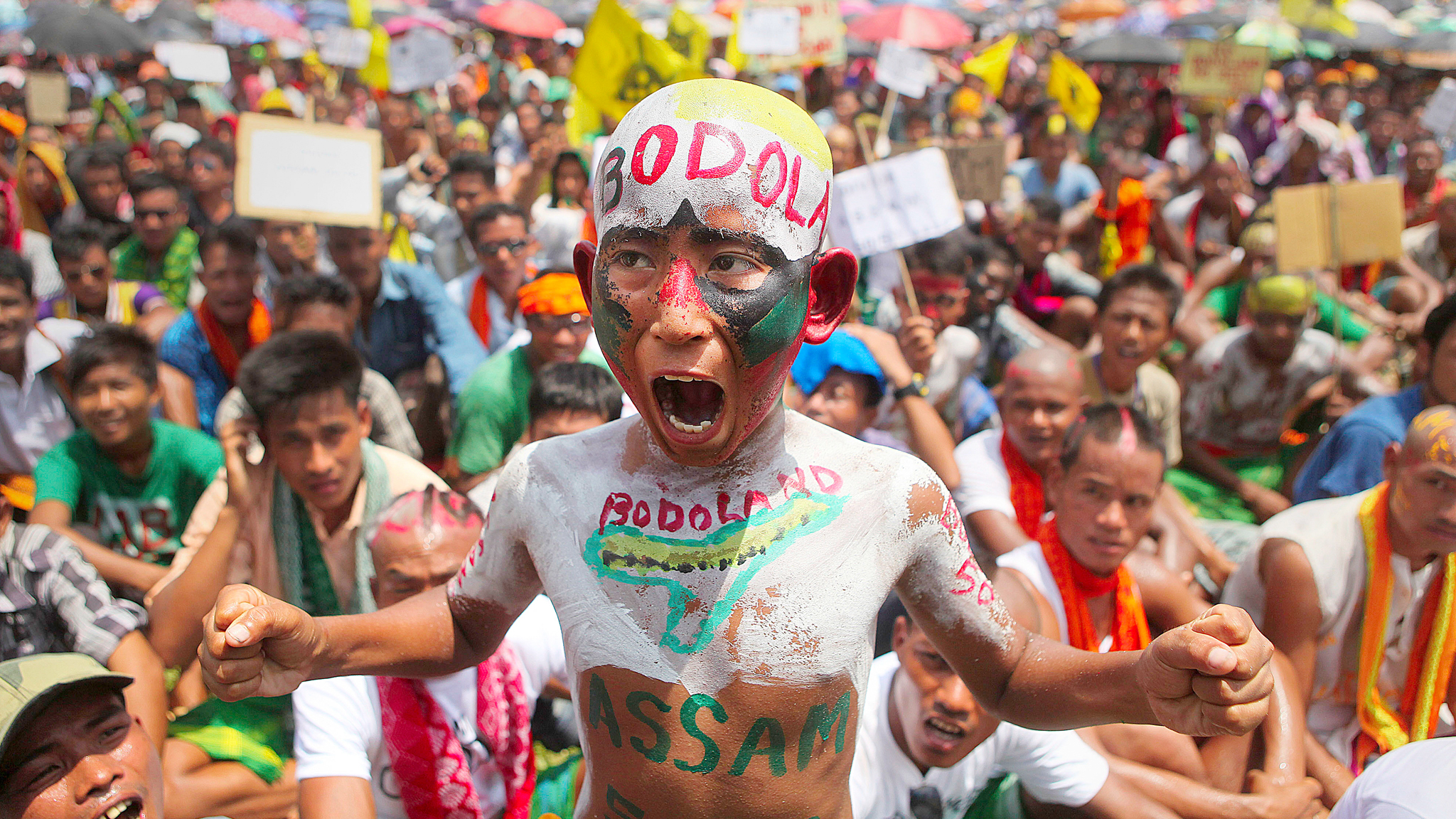
    A Bodo student with painted face shouts as hundreds of thousands of Bodo tribal people gather demanding the creation of a new state of Bodoland during a mass rally at Ghoramara in Somitpur district of Assam state, India, Aug. 20, 2013. India’s ruling coalition recently endorsed the creation of a new state called Telangana to be carved out of Andhra Pradesh state. The endorsement triggered other regions with the same demand in the country to stand up for their own states as well, including Bodo tribals. (AP Photo/Anupam Nath)
    A Bodo student with painted face shouts as hundreds of thousands of Bodo tribal people gather demanding the creation of a new state of Bodoland during a mass rally at Ghoramara in Somitpur district of Assam state, India, Aug. 20, 2013. (AP Photo/Anupam Nath)

    Then, what comprises BTC or Bodo Accord?

    It consists of 4 districts of Assam –

    • Kokrajhar
    • Chirang
    • Baksa
    • Udalguri. (Total 35% area of Assam.)

    [ Demography of bodoland: 30 % of the population is Bodos (who are STs) and rest comprises of tribals, Bengali Muslims and Hindus and Assamese.]

    BTAD


    Why were there resentment outbreaks among Bodos and Non Bodos?

    Bodos side’s demands –

    • The Bodos, constitute the largest tribal community out of a total of 34 tribal communities in Assam.
    • They feel they have been neglected, exploited and discriminated against for decades, look at this accord as a historic opportunity to fulfil their longstanding demands.
    • But due to the changing demographics of the BTAD and the consequent land alienation, they fear they may become a minority in their own state and in hitherto Bodo-dominated areas.

    Non-Bodos and Muslims side’s demands –

    • They resents the fact that Bodos constitute a meagre 25 per cent of the total population in the BTC area and believe that Bodos should not be given the right to rule over the other three-fourths.
    • Number of villages with minority Bodo population were included in the BTAD to make it a contiguous area.
    • The non-Bodos want such villages to be taken out of BTAD so that they do not feel insecure where they are clearly in the majority.

    So, was there any problem in the Bodo Accord?

    • The Bodo Accord, seeks to protect the land rights of the indigenous Bodos while allowing settler Muslims (both legal and illegal) to freely acquire land at the same time.
    • The Bangladeshi migrants easily sneak in the area, illegally procure relevant documents like ration cards to establish Indian nationality.
    • Taking advantage of the provisions in the BTC Act, such migrants are freely procuring land in the BTAD, which only adds to the woes of indigenous Bodos.
    • Both sides are demanding the review / revocation of BTC act because on one hand, Bodos feel their rights are not protected.
    • On the other hand, Non-bodos feel that Bodos are getting way too many benefits.

    Are there some concrete reason behind violence?

    • Demand for a separate state of bodoland.
    • Occupation of their land by illegal Bangladeshi migrants.
    • Illegal migration from Bangladesh who have settled on their land (loss of land rights).

    Adivasis demand to be included in ST list –

    • They argue that 34 of the 40 seats of BTC are reserved for STs. Now bodos having ST status dominates it, although they are only 34% of population.
    • This is opposed by Bodos who don’t want to lose power.

    Can we have some solutions on a table?

    Security measures

    • Have permanent security forces here.
    • Intensify operations against the militants.
    • Curb the proliferation of illegal weapons.
    • Seek amicable and strategic cooperation from Bhutan and Bangladesh.

    Solve underlying reasons

    • Stop illegal migration and update land records – [e.g. National Population Register, Aadhaar / similar biometric cards.]
    • Ensure equal rights and opportunities to all socio-religious and ethnic communities in the area.
    • If need arises then review the BTAD model, where the minority Bodos rule over the majority non-Bodos.

    Way forward

    Union and State Government need to solve it en masse and take proactive action against violence in this conflict region, unless proactive action with political will of leaders in region should come into action, there is no way out for hope to resettle from such domino effect.

    Have a look to Domino effect happened all over the country following the spirit for statehood.

    Domino_effect_statehood


    What do you think on domino effect and spirit of statehood? Let us know!


    Published with inputs from Arun | Image: BTAD
  • General Studies Paper 1, IAS Mains 2015 – Analysis

    Hi friends,


    Here is an analysis of UPSC Mains 2015 – General Studies paper 1. 

    Subject
    Total questions
    Total marks
    World History
    2
    25
    Indian History
    3
    37.5
    Culture
    2
    25
    Geography
    7
    87.5
    Society
    6
    75

    General Observations about the Question Paper

    1. 2014 has 25 questions.2015 paper had 20 questions.
    2. Increase in the number of questions from Indian Soiety.
    3. Decline in the number of questions from culture and World History.
    4. Continued emphasis on women -1 question like last two years.
    Although General Studies paper 1 contains conventional subjects ,around 50% of the paper was triggered by Current Affairs/ The Hindu.

    Here is an understanding of how a particular  news item in the current affairs triggered each question.

    1.  2015 – Celebration of 125th Birth Anniversary of BR Ambedkar and a resolution was passed in Parliament on the Constitution.
      1. Mahatma Gandhi and Dr. B.R. Ambedkar, despite having divergent approaches and strategies, had a common goal of amelioration of the downtrodden. Elucidate.
      2. It would have been difficult for the Constituent Assembly to complete its historic task of drafting the Constitution for Independent India in just three years but for the experience gained with the Government of India Act, 1935. Discuss.

    2. 8500 letters received by Mahatma Gandhi http://www.thehindu.com/news/national/8500-letters-received-by-mahatma-gandhi-to-be-published/article7932778.ece
      1. How different would have been the achievement of Indian independence without Mahatma Gandhi? Discuss.

    3. 100 years of World War 1 ,1914-2014
      1. To what extent can Germany be held responsible for causing the two World Wars? Discuss critically.

    4. Higher sex ratio among tribal groups compared to SCs,revealed by Census.  http://www.thehindu.com/news/national/higher-sex-ratio-among-tribal-sc-groups-census/article5300478.ece
      1. How do you explain the statistics that show that the sex ratio in Tribes in India is more favourable to women than the sex ratio among Scheduled Castes?

    5. Union Cabinet approves Shyama Prasad Mukherji Rurban Mission to drive smart villages.
      1. Discuss the changes in the trends of labour migration within and outside India in the last four decades.
      2. Smart cities in India cannot sustain without smart villages. Discuss this statement in the backdrop of rural urban integration.


    6. Air pollution in Delhi , highly mentioned in news.

         1. Mumbai, Delhi and Kolkata are the three mega cities of the country but the air pollution is much more serious problem in Delhi as compared to the other two. Why is this so?


    7. Ocean warming and Monsoons

        1. How far do you agree that the behavior of the Indian monsoon has been changing due to humanizing landscapes? Discuss.


    8. 2015-Year of ElNino -leading to heavy rainfall in South india.

      1. Explain the factors responsible for the origin of ocean currents. How do they influence regional climates, fishing and navigation?


    9. A report published in May 2015,that India will become water scarce by 2025.
      1. India is well endowed with fresh water resources. Critically examine why it still suffers from water scarcity.

    1. Discovery of Oil in arctic
      1. What are the economic significances of discovery of oil in Arctic Sea and its possible environmental consequences?

    2. 125th Birth Anniversary of Ambedkar(Championed the cause of dalits)

    Murder of two dalit children in Faridabad and controversy over General VK Singh’s comment.

    1. Debate the issue of whether and how contemporary movements for assertion of Dalit identity work towards annihilation of caste.Reference –http://officersiasacademy.blogspot.in/2015/12/upsc-mains-2015-general-studies-paper-1.html


    Want to read more?

  • The Last Lecture / Antim Gyan

    This is probably my last blog on the ways to do the things. From now on, more syllabus, rare gyan!

    #1. Keep the syllabus of all 3 GS papers side by side and connect the topics.

    Once the groups of connected topics are ready, apportion the time available with you according to the number of topics in the group. I have desisted from stating that time should be apportioned as per the importance of the topics because there is no “unimportant” or “less important” topic in syllabus now. The tag has been obliterated with the kind of questions UPSC has been asking.

    #2. Give specific dates to the groups by which you intend to finish them off.

    It will actually give you an idea of the time you have at hand because if you take too many days you shall reach near November-December and there shall not be days left for revision and polishing. This “10 days for this topic” approach would better be supplanted with “By 10th of this month”.

    #3. Prepare time table not just for the months as above but for every day.

    Try to stick to it to the maximum extent possible but above 80 strike rate is commendable. Anything below it needs serious introspection.

    #4. Make notes on daily basis or by next day at the maximum. If you think you can procrastinate it to the weekend then it shall never happen.

    By weekend we will have seven copies of The Hindu and note-making from them shall appear a gigantic task. One month down the line, there shall be thirty copies covered in dust. Break this “I will do this tomorrow” jinx. Tomorrow never comes, more so when you have a formidable opponent like UPSC. And not to mention, a day lost by you is a day gained by your competitors and there are lakhs of them out there!

    #5. Don’t try to study every subject together.

    History on Mondays, Polity on Tuesday, Economics on Wednesday and so no approach shall not pay rich dividends. At the max pick up two subjects at a time, finish them off and then pick up others.

    #6. Maintain safe distance from candidates with negative attitudes…

    …or who try to show off the books they have covered. If they do, randomly select a page and throw a question at them. More often than not the reply shall be “bas yahi reh gaya tha baki book to ho gayi.”

    #7. Choose one or two standard books you wish to use for covering a topic.

    Make notes. And supplement it with related news from the papers. Trying to cover a topic from ten different books shall not add anything to your preparation.

    #8. Read-Revise-Write. Enough on it already.

    No writing practice, no use of revision. No revision, no use of reading. So either R-R-W or don’t do it.

    #9. Don’t even think about being able to write the best answer to every question in the paper.

    “Best answer” in UPSC is a myth. We just have to be careful about what the question is asking and use the information we hold in the best manner possible. This “Best manner” is the “Best answer”. At the end of the day, you have to just secure about 50-52 percent marks to be the topper!

    #10. Every year the exam shall get tougher. Yes that is the harsh reality!

    As the examiners exhaust the questions, they start delving deeper into the topics, current issues keep on getting more complex, new topics keep getting added in the syllabus and then there is this sword of may-be-revised pattern/syllabus hanging over our heads. Bottom-line is finish it off as soon as possible. There should not be any let-up from your side. No excuses, as simple as that. If you have given your best shot, the best shall follow. The cardinal rule of karma – You reap what you sow.

    #11. Don’t get burdened with criticism even it is excruciatingly painful and unexpected.

    It hurts the most when it comes from close quarters but then that is how it is. Take it in your stride to come back with a vengeance. Success wins uncountable friends and failure leaves you with very few. Stay with these very few.

    #12. Exercise, eat well and keep yourself healthy.

    Stress during this examination can be unbearable at times. These are the times when your mental strength and your emotional intelligence holds you firm. Don’t lock yourself in a room. Go out, meet friends. Get refreshed. Make this preparation a part of these years of your life. Don’t make it your life.

    Iti Samaptam!

  • First look of the Civilsdaily magazine. Yay!

    Awesome content + Impeccable design = Great magazine!


    UPDATE #1

    The Edition #0 is already out and waiting for your appreciation! We are hopeful of having a great fundraising round within our Civilsdaily community and the details of both (Civilsdigest Ed #0 & fundraising) can be found here.


    Click to get your complimentary copy + Help us do more!

    He just wanted a decent book to read . . .

    Not too much to ask, was it? It was in 1935 when Allen Lane stood on a British railway platform looking for something good to read on his journey. His choice was limited to popular magazines and poor quality paperbacks. Lane’s disappointment and subsequent anger at the range of books available led him to found a company – and change the world.

    That company was Penguin Books. This magazine (to be) has nothing to do with them (gotcha!) but this is one our favorite stories on how a small but ambitious idea ends up changing reading habits and consumption patterns!

    Since our inception, we have strived to maintain our focus on doing just one thing right – news with context. We have experimented with –

    1. Daily newscards (on the app) to save your time from the opinionated newsbytes,
    2. Connected stories to help you with the backstory of a newsbyte and analyse it better,
    3. Explainers of news to help you visualise and understand news & topics in depth,
    4. Back2basics to learn static via dynamic and so on…

    What we all have got in return is an amazing community with richer and meaningful discussions + a little bit bakar 🙂 If you are reading this post on your laptop, a quick look to the right would do well to prove this point!

    These guys are discussing FDI & Salwa Judum and I already feel insecure about the internal security!

    Kidding, of course.


    This magazine is the culmination of all that we hold dear at Civilsdaily – Great content & empowering design.

    We have tried to reimagine the best way to consume content, yet again. We did this for digital screens before, we are doing this for print now and we sincerely hope that you will come to love it!


    Sounds good? Just a few more points

    1. This post has been intentionally kept short (or so we think).
    2. We will be releasing edition #0 soon. That would be an online only release.
    3. We will be writing a big one to expand upon all that the magazine would include but the screenshots would have given you some hints!
    4. These monthly magazines would be a paid product – both online & offline. Don’t worry, they would be very reasonably priced and you won’t have to part with your monthly chai sutta to make way for it. Mother promise!

    PS: There is a super-senti post in making as an appeal to all our amazing readers & aspirants to help us crowd source some real money so that we scale up across platform and languages. Fingers crossed!

  • IAS Mains Writing Essentials – Reading and answering a question as it should be!

    This question appeared in IAS Mains this time and I am just using it as an example to drive home a particular point.

    “The states of Jammu and Kashmir, Himachal Pradesh and Uttarakhand are reaching the limits of ecological carrying capacity due to tourism. Critically evaluate.

    Now just focus on 4 things in this question to help me drive home an important point – 

    No. 1: The examiners has chosen to name J&K, HP and UK particularly in this question.

    No. 2: Examiners talks about “reaching carrying capacity”

    No. 3: The reason has been attributed to “tourism”

    No. 4: The examiner asks you to critically evaluate the statement.

    To answer this question in a way that gets us marks we must know following 2 terms absolutely clearly –

    #1. Carrying Capacity:

    Technically, “the carrying capacity of a biological species in an environment is the maximum population size of the species that the environment can sustain indefinitely, given the food, habitat, water and other necessities available in the environment”.

    For our purpose, “the population size that can be supported with the given resources”.

    #2. Critically Evaluate:

    The critical evaluation means giving our verdict as to what extent a statement or finding stated is true, or to what extent we agree with it. We also need to provide evidence which both agree with and contradict an argument. Come to a final conclusion, basing our decision on what we judge to be the most important factors and justify how we have made our choice.

    The mistake most of the candidates might have made:

    Critical evaluation requires the candidates to provide evidence both to support and contradict a statement and then reach a conclusion. Unfortunately, most candidates who attempted this question would have given evidence only to support the statement.

    So, out of 12.5, basically they would have already lost 4-5 marks for the portion they just did not attempt (this is the reason for the huge difference in the anticipated marks and the actual marks that the candidate gets).

    All right? So when you answer a question, don’t just read it in a cursory manner and start writing immediately (something I had stated earlier as well). The questions are frame with a purpose.

    Examiner takes time to frame them and probably that’s the reason we don’t find any other exams coming even remotely closer to UPSC.

    So, now you know how important it is to just know what the question asks before we answer.

    Will soon write about the various terms used in the paper and what they mean to help you write exactly what the examiner wants and get marks!

  • Internal Security | Salwa Judum 2.0

    Let’s move to our next topic of Internal security.

    In may 2015, formers leaders of Salwa Judum formed Vikas Sangharsh Samiti in Dantewada of Chhattisgarh to carry forward the work of salwa judum in bastar. i.e. to finish Maoism in Bastar and bring development. Let’s know it in brief!

    Let’s first know about Naxalism?

    • Naxalism originated as a rebellion against marginalisation of the poor forest dwellers and gradually against the lack of development and poverty at local level in rural parts of eastern India.
    • It began in 1967 with an armed peasant uprising in Naxalbari village in West Bengal. The term ‘Naxal’ came from the name of the village.
    • The origin of the Naxals was a result of the split that took place in the Communist Party of India (Marxist) in 1967.
    • It led to the formation of Communist Party of India (Marxist and Leninist).
    • West Bengal being the centre of the movement initially, Naxalism spread to the lesser developed areas like Jharkhand, Odisha, Chhattisgarh and Andhra Pradesh.

    Now, Let’s clear some air from – Salwa Judum?

    SalwaJudumhubs


    • Senior Indian National Congress (INC) party leader Mahendra Karma launched the Salwa Judum in 2005 as a counterinsurgency measure to tackle the Maoist threat.
    • Salwa Judum meaning “Peace March” or “Purification Hunt” in Gondi language.
    • It is a militia mobilised and deployed as part of anti-insurgency operations in Chhattisgarh, aimed at countering Naxalite violence in the region.
    • It was started as a people’s resistance movement against the Naxalites.
    • The militia, consisting of local tribal youth, received support and training from the Chhattisgarh state government.
    • Salwa Judum was followed in 2009 by Operation Green Hunt – which was actually just a more organised version of the Judum, minus the mass rallies and the forcible regrouping.

    Then, Why did Supreme Court intervene in campaign?

    • In 2011, Nandini Sundar v/s State of Chhattisgarh case, SC declared it illegal and unconstitutional and ordered its disbandment.
    • The petitioner had alleged that the State of Chhattisgarh was actively encouraging a group called Salwa Judum, a civil vigilante structure, to counter Maoist insurgency, and that had resulted in violation of human rights.
    • The SC had declared that the recruitment and arming of tribal people as Special Police Officers (SPOs), as a counter-insurgency measure, was illegal and unconstitutional.
    • The SC forbade the state government from supporting any civilian vigilante force and declared that it was the responsibility of the state to prevent the operation of any such group.

    How did Salwa Judum version 2.0 or Vikas sangharsh samiti (VSS) came into picture?

    • Chhavindra Karma, former leader of anti-Maoist militia Salwa Judum and son of the founder of the militia, Mahendra Karma, has formed Vikas Sangharsh Samiti in Dantewada district of Chhattisgarh on 25 May, 2015.
    • Vikas Sangharsh Samiti or Salwa Judum-2 born in Bastar again. [Yes, it is Salwa Judum version 2.0]
    • The Samiti carry forward the work of Salwa Judum in Bastar.
    • Today, the Vikas Sangharsh Samiti is offering the same justification that was given by the state of Chhattisgarh earlier, that tribal volunteered to fight against the Maoists.

    Is there any Way forward to Salwa Judum 2.0?

    • A Salwa Judum 2.0 could survive constitutional challenge only if its role is restricted to helping out the state machinery during natural and manmade disasters, and to the regulation of traffic.
    • The employing and arming of untrained tribals in the fight against Maoists is unconstitutional and illegal — it doesn’t matter whether it goes by the name “Salwa Judum”, “Vikas Sangharsh Samiti” or any other.

    Is Left Wing Extremism (LWE) Division of Home Ministry helpful?

    • LWE Division was created w.e.f. October 19, 2006 in the Ministry of Home Affairs to effectively address the Left Wing Extremist insurgency in a holistic manner.
    • The LWE Division implements security related schemes aimed at capacity building in the LWE affected States.
    • The States of Chhattisgarh, Jharkhand, Odisha, Bihar, West Bengal, Andhra Pradesh, Telangana, Maharashtra, Madhya Pradesh and Uttar Pradesh are considered LWE affected, although in varying degrees.

    What concrete steps should be taken by Government in such Naxalites area?

    • The Central government should form a separate ministry which will undertake the development of areas affected by Naxal activities.
    • Ensure the safety of the civilians by stopping the Salwa Judum campaign and ensuring that no counter insurgency measures are taken by risking the lives of the civilians.
    • Checking instances of human rights violation by the security forces and the Salwa Judum.
    • Registering the crimes perpetrated by the security forces, Salwa Judum and the Maoists and bringing them to justice.
    • Banning of Bal Mandal (The child division of Naxalites) with immediate effect.
    • Ensuring safety of those who surrendered and those who lived in camps or were related with Salwa Judum activities.

    Do you find any solutions on such impasse? Let us know!


    Published with inputs from Arun | Image: Salwa Judum Hub
  • Foreign Policy Watch: India-Russia

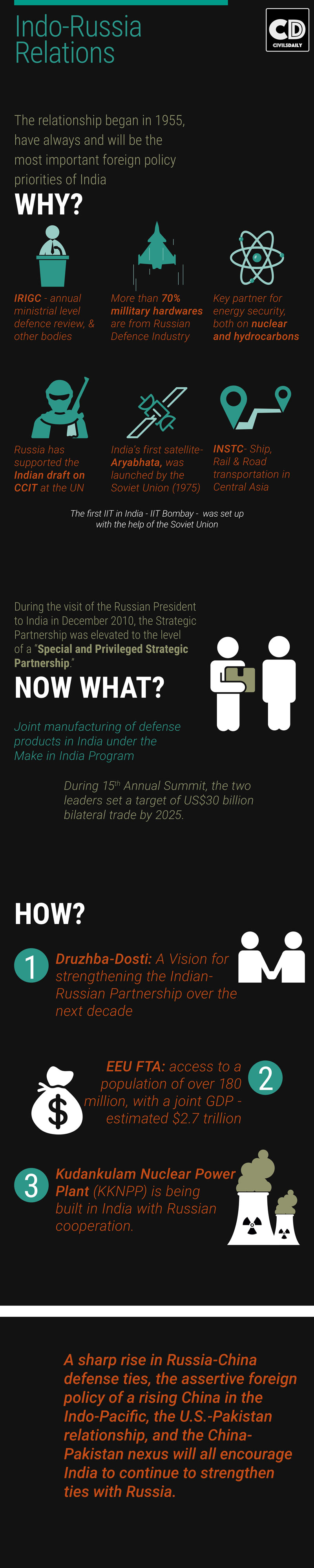
    India-Russia relations : Momentum in transforming Strategic Partnership


    In late December, Indian Prime Minister made his first state visit to Russia to take part in the 16th annual bilateral summit. PM Modi and Russian President Vladimir Putin used the summit to review bilateral ties across a number of areas. Let’s glance over revamped relations of India-Russia!


    Can we have some background of bonding legacy?

    • Relations with Russia are a key pillar of India’s foreign policy, and Russia has been a longstanding time-tested partner of India.
    • India & Russia signed “Declaration on the India-Russia Strategic Partnership” in October 2000.
    • Under the Strategic Partnership, several institutionalized dialogue mechanisms operate at both political and official levels to ensure regular interaction and follow up on cooperation activities.
    • During the visit of the Russian President to India in December 2010, the Strategic Partnership was elevated to the level of a “Special and Privileged Strategic Partnership.

    Let’s dive into the PM’s visit for bilateral summit in Russia?

    • With the signing of sixteen agreements, this is being seen as very significant in sustaining and expanding India-Russia ties.
    • One major step taken is a deepening of India’s defense partnership with Russia for Make in India.
    • On the eve of Modi’s visit to Russia, the Indian government announced the purchase of five S-400 supersonic air defense systems from Russia, costing around $6 billion.
    • For instance, the two sides agreed that the Kamov 226 helicopter would be manufactured in India.

    How will bilateral partnership boost Make in India programme?

    • India and Russia agreed to strengthen the defense partnership in line with the “Make in India” program. So while only the public sector has been involved in defense cooperation between the two countries to date.
    • The new initiatives will encourage joint manufacturing of defense products in India and motivate the private sector to play a role in developing a strong defense manufacturing base in India.
    • It should be emphasized that “Make in India” also aims at having India emerge as an essential player in the global defense market.
    • India is forecast to spend $250 billion over the next decade upgrading its military and Russia wants to seize the opportunity to become a major part of this mission, expressing its readiness to work jointly with India on defense manufacturing.

    So, How does economic and trade cooperation matters in economic growth?

    • Enhancing trade and economic cooperation between India and Russia is a key priority for the two governments.
    • On the economic front, India and Russia decided to institutionalize the CEO’s Forum, which will meet twice a year – once in India and the other in Russia.
    • During 15th Annual Summit, the two leaders set a target of US$30 billion bilateral trade by 2025.
    • Hydrocarbons is an active area for exploring cooperation between the two countries.
    • In May 2014, ONGC and Rosneft signed an MoU for bilateral cooperation in subsurface surveys, exploration, appraisal and hydrocarbons production in the offshore Arctic region of Russia.
    • In September 2015, OVL signed an agreement with Rosneft to acquire 15% stakes in Vankorneft project.


    Did you know about India-Eurasian Economic Union FTA?

    • Moscow is a gateway for India to Central Asia.
    • In this regard a significant move by PM Modi was the effort to move forward on the India-Eurasian Economic Union (EEU) Free Trade Agreement (FTA).
    • The EEU FTA will introduce the free movement of goods, capital, services and people-people contacts and provides for common transport, agriculture and energy policies, with provisions for a single currency and greater integration in the future.
    • The FTA between India and the EEU comprises of Russia, Belarus, Armenia, Kyrgyzstan, and Kazakhstan.
    • It offers India access to a huge market with a population of over 180 million, with a joint GDP of an estimated $2.7 trillion.
    • As Russia tries to re-calibrate its economic orientation towards the Asian region, India, as one of the fastest growing G20 economies can be a significant partner for Russia.

    Shall we move into Political Relations?

    • Annual Summit meeting is the highest institutionalized dialogue mechanism under the Strategic Partnership between India and the Russian Federation.
    • So far, 15 Annual Summit meetings have taken place alternatively in India and Russia with the 15th Annual Summit held in New Delhi during the visit of President Putin to India on 11 December 2014.
    • During the Summit, 20 documents were signed covering cooperation in nuclear energy, defence, hydrocarbons, science & technology, trade and investment etc.
    • Prime Minister Modi and President Putin also adopted a Joint Statement “Druzhba-Dosti: A Vision for strengthening the Indian-Russian Partnership over the next decade.”

    Let’s see our Defence Cooperation with Mighty Russia?

    • India-Russia military technical cooperation has evolved from a simple buyer – seller framework to one involving joint research, development and production of advanced defence technologies and systems.
    • BrahMos Missile System, Joint design and development of the Fifth Generation Fighter Aircraft, as well as the licensed production in India of SU-30 aircraft and T-90 tanks, are examples of such flagship cooperation.
    • An Indian contingent participated in the military parade in Moscow on 9 May 2015, during the 70th anniversary of the victory in the World War II.
    • The Inter Governmental Commission on Military Technical Cooperation (IRIGC-MTC) is in place to review defence cooperation between the two countries.

    Let’s know about importance of International North-South Trade Corridor (INSTC) ?

    • The INSTC was initiated by Russia, India and Iran in September 2000.
    • To establish transportation networks among the member states and to enhance connectivity with the land locked region of Central Asia.
    • The North-South Transport Corridor is an ancient route that connected South Asia with North Europe for centuries.
    • This route was used by the European, Indian, Russian and many other foreign traders.
    • During the late 17th and early 19th centuries, Indian traders used this route to reach out to the Central Asian markets.
    • The modern day INSTC is a multi-modal transportation route linking Indian Ocean and Persian Gulf to the Caspian Sea via Iran, and onward to northern Europe via St. Petersburg in Russia.

    How is it important to India to protect its strategic and economic interest?

    • The INSTC envisages movement of goods from Mumbai (India) to Bandar Abbas (Iran) by sea, from Bandar Abbas to Bandar-e-Anzali (an Iranian port on the Caspian Sea) by road.
    • Then from Bandar-e-Anzali to Astrakhan (a Caspian port in the Russian Federation) by ship across the Caspian Sea, and thereafter from Astrakhan to other regions of the Russian Federation and further into Europe by Russian railways.
    • Given India’s strategic interests in the West and the Central Asian region, and need for greater economic and energy cooperation between South, Central and the West Asian region.
    • New Delhi has stepped up its engagement to reconnect with its extended neighbourhood.

    Was there any momentum on Nuclear power deal?

    • Russia is an important partner in peaceful uses of nuclear energy and it recognizes India as a country with advanced nuclear technology with an impeccable nonproliferation record.
    • In December 2014, Department of Atomic Energy (DAE) and Russia’s Rosatom signed the Strategic Vision for strengthening cooperation in peaceful uses of atomic energy between India and Russia.
    • Kudankulam Nuclear Power Plant (KKNPP) is being built in India with Russian cooperation.
    • KKNPP Unit 1 became operational in July 2013, and attained full generation capacity on 7 June 2014.
    • While its Unit 2 is in the process of commissioning in the later part of 2015.
    • India and Russia have signed a General Framework Agreement on KKNPP Units 3 & 4 and subsequent contracts are under preparation.

    What’s Next to the geopolitical space?

    • Needless to say, defence remains at the centre-stage of the bilateral relationship, although with a diversified supplier base India is at a better position today to negotiate deals with Russia especially concerning technology transfer and co-production.
    • A sharp rise in Russia-China defense ties, the assertive foreign policy of a rising China in the Indo-Pacific, the U.S.-Pakistan relationship, and the China-Pakistan nexus will all encourage India to continue to strengthen ties with Russia.
    • It is clear that India-Russia relations remain vital for both countries amid a changing regional and global security environment.

    Published with inputs from Arun

More posts