Last week, three instances of forest fire were reported from the major forest belts in Uttarakhand.
The severity of the situation has prompted the deployment of Indian Air Force personnel and Mi-17 choppers, engaged in the critical operation of dousing the flames using the Bambi Bucket Method.
Causes of Wildfire:
Firstly, the general major causes of forest fires in Uttarakhand are continued dry weather and lack of moisture in the forests.
Secondly, according to the Forest Research Institute (FRI, 2019), 95% of forest fires are attributed to human activities.
The common human-induced causes include – Grazers setting fire to dry grass, Slash-and-burn agriculture, Unattended campfires, and Intentional arson.
Uttarakhand’s Forest Vulnerability:
As per the latest report from the Forest Survey of India (FSI), the Recorded Forest Area (RFA) in the State is 38,000 sq km of which 26,547 sq km is Reserved Forest, 9,885 sq km is Protected Forest, and 1,568 sq km is Unclassed Forests.
Highly flammable Chir Pine trees, covering extensive areas, increase the fire risk.
This risk is compounded by prolongeddry spells and excess biomass accumulation.
Additionally, the proximity of villages facilitates anthropogenic activities such as forest clearance and grazing.
Forest Fires in India: Recent Statistics
Odisha recorded 4,237 forest fires as compared to 1,499 between April 20 and 27 in 2023. Similarly, Chhattisgarh recorded 757 fires last year as compared to 2,116 this year, Jharkhand 633 as against 1,926 and Andhra Pradesh 527 as compared to 1,126 in 2023.
However, Uttarakhand has recorded the highest number of large forest fires in the country in the last seven days since April 28, according to the Forest Survey of India (FSI) data.
Mitigation Strategies
Localized Initiatives:
Effective measures to mitigate forest fire risks include controlled burning, biomass removal, prescribed burns, and enhanced surveillance using drones.
Community engagement and proactive involvement, as demonstrated in Kerala, provide valuable insights for forest fire management.
Government Initiatives:
The government has introduced measures such as a satellite-based fire alert system by the Forest Survey of India, aiding in early detection and response efforts.
Forest staff utilize various techniques, including counter-fires and fire beaters, to contain and manage forest fires effectively.
Wildfires Mitigating Strategies:
The Ministry of Environment, Forest and Climate Change (MoEFCC) outlines four strategies to prevent and manage forest fires:
Erecting watch towers for early detection,
Deploying fire watchers,
Engaging local communities, and
Establishing and maintaining fire lines.
The National Disaster Management Authority (NDMA) website distinguishes between two types of fire lines:
Kachha fire lines involve clearing undergrowth and shrubs while preserving trees to decrease the amount of available fuel.
Pucca fire lines are clear-cut areas that create a barrier between forest compartments or blocks to contain potential fire spread.
PYQ:
[2020] Examine the status of forest resources of India and its resultant impact on climate change.
Catatumbo lightning is a natural event seen over the Catatumbo River in Venezuela, where lightning strikes almost nonstop.
What is Catatumbo Lightning?
Catatumbo Lightning is an atmospheric phenomenon that occurs over the Catatumbo River in Venezuela.
It specifically occurs at the Catatumbo Delta, where the river meets Lake Maracaibo.
It is known as one of the world’s largest lightning displays.
This natural spectacle involves frequent and nearly continuous lightning strikes that illuminate the night sky, creating a mesmerizing light show.
Catatumbo Lightning is most prevalent during the wet season, typically from April to November.
The consistent and abundant lightning activity has earned the region the moniker “the lightning capital of the world.”
Factors behind Catatumbo Lightning
Weather Dynamics
Warm, moisture-laden air from the Caribbean Sea clashes with cooler air descending from the Andes mountains, creating a dynamic interplay of atmospheric forces.
This collision, accentuated by the local landscape, triggers rapid upward movement of warm air, leading to the formation of towering cumulonimbus clouds.
Electrical Charge Generation
Strong winds and temperature differentials within these clouds generate electrical charges.
Cumulonimbus clouds, towering over 5 km high, accumulate vast amounts of static electricity.
Lightning Discharge: When the electrical potential within the clouds reaches a critical level, it discharges in the form of lightning strikes.
Characteristics of Catatumbo Lightning
Catatumbo lightning occurs on approximately 160 nights annually, exhibiting a remarkable longevity.
At its peak, the phenomenon generates an astonishing average of 28 lightning strikes per minute.
PYQ:
[2013] During a thunderstorm, the thunder in the skies is produced by the
1. Meeting of cumulonimbus clouds in the sky
2. Lightning that separates the nimbus clouds
3. Violent upward movement of air and water particles
Select the correct answer using the codes given below:
Shellfish aquaculture using Geukensia demissa is emerging as a viable solution for mitigating excess nutrients and contaminants in coastal and estuarine waters.
About Geukensia demissa
Geukensia demissa is a species of mussel commonly known as the ribbed mussel or Atlantic ribbed mussel.
It is native to the Atlantic coast of North America, ranging from Nova Scotia in Canada to the Gulf of Mexico.
They inhabit intertidal and shallow subtidal areas, typically found in estuaries, salt marshes, and tidal flats.
They prefer areas with muddy or sandy substrates where they can burrow and anchor themselves.
Ecological Importance
Ribbed mussels play a vital role in estuarine ecosystems.
Water Filtration: They filter large volumes of water, helping to improve water quality by removing suspended particles and excess nutrients.
Key species of Food Chain: Additionally, their presence provides habitat and food for various other organisms, including small invertebrates and fish.
Organisms Filter: These mussels thrive in diverse habitats and possess the ability to filter bacteria, microalgae, and detritus laden with nutrients and contaminants.
Geukensia demissa:Experimental Deployment and Results
To assess the efficacy of G. demissa in purifying urban waters, a raft stocked with local ribbed mussels was deployed in an estuary near New York City.
Subsequent analysis revealed that the mussels exhibited robust health and accumulated significant amounts of local nitrogen isotopes, indicative of nitrogen removal from the water.
Based on the findings, it is estimated that a fully stocked raft could purify an average of 11,356 m3 of water daily and remove approximately 159 kg of particulate matter on a daily basis.
Moreover, upon harvesting, the mussels sequestered 62.6 kg of nitrogen in their tissues and shells, further enhancing the water quality.
PYQ:
[2011] Recently, “oil-zapper” was in the news. What is it?
(a) It is an eco-friendly technology for the remediation of oily sludge and oil spills
(b) It is the latest technology developed for under-sea oil exploration
(c) It is a genetically engineered high biofuel-yielding maize variety
(d) It is the latest technology to control the accidentally caused flames from oil wells
Every year on May 5, pulmonary hypertension organizations and groups around the world participate in World Pulmonary Hypertension Day.
What is Pulmonary Hypertension?
Pulmonary hypertension (PH) is a condition characterized by high blood pressure in the pulmonary arteries, which are the blood vessels that carry blood from the heart to the lungs.
This elevated pressure in the pulmonary arteries can lead to various symptoms and complications, affecting the heart’s ability to pump blood effectivelyto the lungs and the rest of the body.
Here are some key aspects of pulmonary hypertension:
Causes:
Idiopathic Pulmonary Arterial Hypertension (IPAH): In many cases, the exact cause of pulmonary hypertension is unknown, and it is referred to as idiopathic. IPAH is a subtype of PH without an identifiable cause.
Secondary Pulmonary Hypertension: PH can also develop secondary to other underlying conditions, including:
Chronic obstructive pulmonary disease (COPD)
Interstitial lung disease
Sleep apnea
Connective tissue diseases such as scleroderma and lupus
Congenital heart diseases
HIV infection
Liver disease (cirrhosis)
Genetic Factors: Some forms of PH may have a genetic component, with mutations in certain genes predisposing individuals to the condition.
Features:
Symptoms: Symptoms of pulmonary hypertension may include:
Shortness of breath, especially during physical activity
Fatigue
Chest pain or pressure
Dizziness or fainting spells
Swelling in the ankles and legs (edema)
Bluish lips or skin (cyanosis)
Diagnostic Tests: Diagnosis of pulmonary hypertension typically involves a combination of medical history review, physical examination, and diagnostic tests, including:
Echocardiogram (ECG)
Right heart catheterization
Pulmonary function tests
Chest X-ray
CT scan or MRI of the chest
Blood tests
Treatment: Treatment for pulmonary hypertension aims to relieve symptoms, improve quality of life, and slow disease progression. Treatment options may include:
Medications such as vasodilators, endothelin receptor antagonists, and prostacyclin analogs
Oxygen therapy
Pulmonary rehabilitation
Surgery or a lung transplant in severe cases
Hypertension Control Initiatives in India:
India Hypertension Control Initiative (IHCI) (2017): It was launched to strengthen the hypertension component of National Programme for Prevention and Control of Non-Communicable Diseases (NP-NCD) in primary care public sector facilities in India
75/25 initiative (2023): Union Health Ministry announced the initiative- 75 million people with hypertension and diabetes to be put on Standard Care by 2025, through the Primary Health Centres (PHCs).
PYQ:
[2021] In the context of hereditary diseases, consider the following statements :
1. Passing on mitochondrial diseases from parent to child can be prevented by mitochondrial replacement therapy either before or after in vitro fertilization of egg.
2. A child inherits mitochondrial diseases entirely from mother and not from father.
Which of the statements given above is/are correct?
Q) Discuss the role of the Election Commission of India in light of the evolution of the Model Code of Conduct. (UPSC IAS/2022)
Q) ‘Simultaneous election to the Lok Sabha and the State Assemblies will limit the amount of time and money spent in electioneering but it will reduce the government’s accountability to the people’ Discuss. (UPSC IAS/2017)
Prelims: We adopted parliamentary democracy based on the British model, but how does our model differ from that model? (UPSC IAS/2021) 1. As regards legislation, the British Parliament is supreme or sovereign but in India, the power of the Parliament to legislate is limited. 2. In India, matters related to the constitutionality of the Amendment of an Act of Parliament are referred to the Constitution Bench by the Supreme Court. Select the correct answer using the code given below. (a) 1 only (b) 2 only (c) Both 1 and 2 (d) Neither 1 nor 2
Note4Students:
Prelims: Model Code of Conduct (MCC);
Mains: Issues around Elections and Parliamentary Representation;
Mentor comments:The ongoing Lok Sabha elections spotlight manifesto deficiencies. The Prime Minister’s false claims against the Congress indicate a narrative lacking factual basis. The absence of a law governing manifestos and weak enforcement of electoral regulations contribute to the erosion of democratic principles and the malaise persists despite constitutional mandates.
Let’s learn
—
Why in the News?
The Prime Minister’s recent statement about the opposition’s intentions through their manifestos ( including gold and mangalsutra) has stirred controversy. Leaders must uphold factual accuracy and responsible discourse during this critical time.
The contents of the two Manifestos
Congress Manifesto (‘Nyay Patra’):
Wealth Creation: The manifesto emphasizes rapid growth and wealth generation, setting a target of doubling the GDP in the next 10 years.
Welfare: Prioritizes the welfare of the poor as the first charge on government resources, aiming for a fair, just, and equal-opportunity economy under the Nav Sankalp Economic Policy.
Equity: Acknowledges the disparity among marginalized communities (SC, ST, OBC) and proposes a nation-wide Socio-Economic and Caste Census to strengthen affirmative action based on data.
Constitutional References:
Preamble: The manifesto echoes the principles of the Preamble of the Indian Constitution, aiming to secure justice, social, economic, and political; liberty of thought, expression, belief, faith, and worship; and equality of status and opportunity for all citizens.
Directive Principles of State Policy (Articles 39, 38, 46): Highlights the constitutional mandate for the state to ensure adequate means of livelihood, equitable distribution of resources, promotion of welfare, minimization of income inequalities, and promotion of educational and economic interests of weaker sections, especially Scheduled Castes and Scheduled Tribes.
BJP’s Manifesto:
Uniform Civil Code: Criticizes the BJP’s aggressive push for a uniform civil code, suggesting that the BJP’s actions contradict its own manifesto’s commitments to the principles of the Constitution.
Comparison with BJP’s Manifesto: Contrasts the BJP’s manifesto promises with those of the Congress, highlighting initiatives like free rations, health insurance, and housing provided by the BJP.
Accusation of Misguidance: Accuses the BJP of misguiding the nation by turning a serious document (the Congress manifesto) upside down.
Major Challenge: No law to govern the Manifesto
S. Subramaniam Balaji v. Government of Tamil Nadu & Ors. (2013): Supreme Court highlighted the absence of legislation governing election manifestos. Consequently, the Court directed the Election Commission of India (ECI) to collaborate with political parties to formulate guidelines.
The ECI, following a meeting with political parties on August 12, 2013, issued ‘Instructions to political parties on manifestos’ on April 24, 2015. These guidelines, acknowledging that election manifesto promises are not considered corrupt practices under Section 123 of the Representation of the People Act, underscored the influence of freebies on voters and the importance of fair elections.
Violation of Model Code of Conduct (MCC): The Prime Minister’s statements against the opposition and minority communities are cited as violations of the MCC, particularly regarding the prohibition on appealing to caste or communal feelings for securing votes. This indicates a challenge in ensuring compliance with the MCC by political leaders and parties.
Corruption in Electoral Practices: The Supreme Court’s rulings identify speeches of a religious nature aimed at influencing voters as corrupt practices. However, the passage suggests that such appeals continue to occur, indicating a challenge in effectively combating corruption in electoral practices.
Weak Enforcement of Rule of Law: Despite regulations and legal provisions prohibiting certain activities during elections, such as appeals based on religion, caste, or community, there are challenges in enforcing these laws effectively. The passage criticizes the weak rule of law, indicating a broader challenge in ensuring adherence to electoral regulations and upholding democratic principles.
Composition and Functioning of the Election Commission of India (ECI): The passage suggests dissatisfaction with the ECI’s performance and its failure to ensure free and fair elections. This raises concerns about the composition and functioning of the ECI, indicating a challenge in maintaining the independence and effectiveness of electoral authorities.
Way Forward:
Legislation on Manifestos: Introduce legislation to regulate election manifestos, outlining guidelines for their content, transparency, and accountability. This law can be based on the guidelines formulated by the ECI, ensuring that manifestos align with democratic principles and do not incite communal or divisive sentiments.
Strengthening the Model Code of Conduct (MCC): Enhance the MCC to include stricter provisions against appeals to caste, religion, or community for securing votes. Ensure that violations of the MCC are swiftly addressed and penalties are imposed on erring political parties or candidates.
Improved Enforcement Mechanisms: Strengthen enforcement mechanisms to ensure compliance with electoral laws and regulations. This may involve empowering the Election Commission with greater authority and resources to monitor election campaigns, investigate violations, and take prompt action against offenders.
Since the Congress Party released its Election Manifesto ’Nyay Patra’, the word ‘redistribution’ has dominated the election discourse.
Arguments against the redistribution of wealth:
Against the fair mean: Wealth redistribution stems from a ‘zero-sum’ thought to reduce economic disparity. However, this approach conflates the process of acquiring wealth with the outcome, potentially penalizing even those who acquired their wealth through fair means.
Hindrance to Economic Growth: Implementing confrontational policies to make the rich poorer can hinder investments and trigger capital flight, which is essential for economic growth. Economic growth is necessary for increasing the overall economic pie and improving prosperity for all.
Measures needed to reduce Inequality:
On Wealth and Inheritance Taxes: Wealth and inheritance taxes are seen as potentially punitive measures that may not effectively address economic inequality. The government needs to focus on fixing systemic issues rather than penalizing the wealthy.
On Policies: Economic growth is emphasized as crucial for addressing inequality. Policies should prioritize investment and avoid hindrances that might deter capital flow.
Job Creation and Labour Market Policies: Jobless growth and imbalance in capital-labour relations contribute to inequality. Labor market-focused policy incentives, such as employment-linked schemes and promoting labor-intensive activities, are proposed to rebalance this skew.
Overhaul of the taxation structure: The taxation system is criticized for burdening the poor and middle class disproportionately compared to corporations. There’s a call for an overhaul of the taxation structure to ensure fairness and simplicity, with a focus on lowering the tax burden for the common person.
Social Welfare Programs: Social welfare programs are deemed essential to provide a safety net for the poor until they can benefit from economic growth. Funding for such programs can come from a combination of faster growth, efficient tax collection, and welfare delivery mechanisms.
Steps taken by the Government:
For addressing Social Inequality
Deen Dayal Upadhyaya Grameen Kaushalya Yojana (DDU-GKY) and Deendayal Antyodaya Yojana- National Urban Livelihoods Mission (DAY-NULM): These schemes aim to create additional employment opportunities in both rural and urban areas.
Mahatma Gandhi National Rural Employment Guarantee Act (MGNREGA): This scheme provides a legal guarantee for 100 days of employment per year to rural households
Pradhan Mantri Awas Yojana: This scheme provides affordable housing to the urban and rural poor
For improving Financial Inclusion
Atal Pension Yojana: This pension scheme targets the unorganized sector and private sector employees without pension benefits
Pradhan Mantri Jan Dhan Yojana: This scheme aims to provide universal access to banking facilities for all households
For enhancing Access to Basic Necessities
Pradhan Mantri Ujjwala Yojana: This scheme provides LPG connections to women from Below Poverty Line (BPL) households
Swachh Bharat Mission: This program focuses on providing toilets for every household and cleaning India’s cities and villages
Conclusion: The Indian government implements schemes to reduce inequality. For example targeting financial inclusion, health protection, and economic development to reduce inequality. Beneficiaries include rural and urban poor, low-income families, and women from Below Poverty Line households.
Mains PYQ:
Q Can the vicious cycle of gender inequality, poverty, and malnutrition be broken through the microfinancing of women SHGs? Explain with examples. (UPSC IAS/2021)
While the nature of war remains constant, its changing character imposes a premium on Military Education and the Academic preparation required to cope with security challenges.
It is reported that Pakistan has created two universities for its armed forces, while China has three but India has no Defence University even though such a university in India was first proposed in 1967.
Need for Professional Military Education:
Inadequacy of RRU: Comparing the Rashtriya Raksha University (RRU) to the IDU is seen as flawed because the RRU’s objectives and curriculum do not specifically address military requirements for managing warfare and executing plans.
Long Overdue Realization: The establishment of the IDU has been delayed, despite its critical importance for defense preparedness, fostering a strategic culture, and promoting inter-service integration.
Rapidly changing the dynamic of Warfare: The dynamic and chaotic nature of warfare, particularly in regions like Europe and West Asia, requires military officers to be able to produce results despite dealing with unclear initial information and rapidly changing circumstances.
Empowerment through PME: To tackle these complex challenges, military officers are empowered through a well-constructed PME continuum. This continuum enhances their abilities to adapt to changing assignments and increasing responsibilities over their long careers.
Parallels with U.S. Evolution: The evolution of PME in the United States, as exemplified by the Goldwater-Nichols Defense Reorganization Act of 1986 and ‘Ike’ Skelton’s report to the U.S. Congress, serves as an example of the importance of structured military education in enhancing professionalism and preparedness.
Slow Progress in the Establishment of IDU:
Historical Context: The idea of establishing a Defence Services University was proposed as early as 1967 by the Chiefs of Staff Committee (COSC). This indicates a long-standing recognition of the need for a broad-based education system in the Indian armed forces.
Delays in Implementation: Despite proposals and recommendations dating back to the 1960s and 1980s, significant progress towards establishing the IDU was only made after the Kargil conflict in the late 1990s. Even then, progress remained slow, with ‘in principle’ approval granted in May 2010, several years after the conflict.
Committee Formation: Following the Kargil conflict, a committee chaired by Dr K. Subrahmanyam was established to examine the issue of establishing the IDU. Based on its recommendations, in May 2010, ‘in principle’ approval was accorded for the setting up of the IDU in Gurgaon. Despite some optimistic reportage in 2017-18, the progress on setting up of the IDU has been rather slow.
Way Forward:
Government Commitment and Funding: The government should prioritize the establishment of the IDU and allocate sufficient funding for its development and infrastructure.
Streamlined Administrative Processes: Efforts should be made to streamline bureaucratic processes involved in setting up the IDU, ensuring that administrative hurdles do not impede progress.
Stakeholder Collaboration: Collaboration between various stakeholders, including the armed forces, government agencies, academic institutions, and industry partners, should be facilitated to expedite the establishment of the IDU.
Mains PYQ
Q) Taxila University was one of the oldest universities in the world with which were associated several renowned learned personalities of different disciplines. Its strategic location caused its fame to flourish, but unlike Nalanda, it is not considered a university in the modern sense. Discuss.
The inability of successive governments to articulate a shared vision has resulted in the unfair distribution of wealth and resources in Sudan.
ANKARA, TURKIYE – NOVEMBER 3: An infographic titled ”Sudanese civil war intensifies in the western cities” is created in Ankara, Turkiye on November 3, 2023. Since mid-April, the intensity of the conflicts between the army and the Rapid Support Forces (RSF) in Sudan, which have resulted in nearly 10,000 casualties, shifted from the capital Khartoum and its surroundings to the western cities. (Photo by Yasin Demirci/Anadolu via Getty Images)
Historical background of Conflict:
In 1956: The government that came to power in 1956 emphasized an Arab and Islamic identity based on Mahdist principles. It was not representative of diverse communities and demanded compliance, leading to widespread resistance.
In 1989: In 1989, a new government seized control under the National Islamic Front, an alliance between army officers and the Muslim Brotherhood. Omar al-Bashir came to power, supported by Islamist leader Hassan al-Turabi, aiming to establish an Islamic state.
In 1991: The government set up an internal security apparatus, arresting and torturing dissenters. It introduced a new penal code in 1991 to impose an Islamization agenda.
In 2003: The al-Bashir (in 2003) regime enlisted Janjaweed militias to quell an insurgency in Darfur. These militias were later designated as the Rapid Support Forces in 2013.
In 2018-19: After protests in 2018 and al-Bashir’s removal in 2019, a transitional military government was established. Despite challenges and a failed coup attempt, a power-sharing agreement was reached, but another coup led by Abdel Fattah al-Burhan derailed the democratic transition.
Causes of the present conflict in Sudan:
Deep-rooted Crisis in Governance: The conflict reflects a longstanding crisis within Sudan’s governing structure since gaining independence in 1956, characterized by power struggles and frequent coups.
Identity Crisis and Rebellion: Sudan has experienced numerous rebellions fueled by an identity crisis, with marginalized populations seeking autonomy and fair representation within the state.
Ethnic and Regional Disparities: Sudan comprises of 19 major ethnic groups and about 597 ethnic sub-groups. Since independence, the Sudanese have experienced 35 coups and attempted coups, more than any other African country.
Religious and Political Ideologies: Shifts in government ideologies, such as the establishment of an Islamic state in 1989, have exacerbated tensions and led to further marginalization of certain groups.
Role of Militias: The emergence of paramilitary forces, such as the Rapid Support Forces, has complicated the conflict dynamics, with militias vying for power and control over resources.
Other country’s involvement: External influences, including support from foreign entities like Russia, have played a role in shaping the conflict landscape, particularly in resource-rich regions like Darfur.
Economic Interests: Economic factors, such as control over lucrative industries like gold mining, have contributed to the entrenchment of certain groups in power and fueled conflict dynamics.
Way Forward:
Establish a Civilian-Led Government: Sudan needs to prioritize the establishment of a transparent, civilian-led government that represents the diverse Sudanese populace. This government should ensure inclusivity and participation in decision-making processes.
Disarm and Demobilize Militias: Urgent action is needed to disarm and demobilize militias like the Rapid Support Forces. This will prevent militia dominance over the state and reduce the risk of armed confrontations and conflicts.
International Support for Reconstruction: Sudan requires collaborative efforts from the international community to aid in post-conflict reconstruction. This support can include financial assistance, capacity-building programs, and technical expertise to rebuild infrastructure, institutions, and communities affected by conflict.
Mains PYQ
Q Africa was chopped into states artificially created by accident of European competition. Analyse. (UPSC IAS/2013)
The endosymbiotic theory suggests that tiny structures in cells called mitochondria and chloroplasts were once independent bacteria.
A biologist named Lynn Margulis came up with the idea that cells merged with bacteria, challenging the usual belief that evolution happens mainly through genetic changes.
What is the Endosymbiotic Theory?
The endosymbiotic theory proposes that organelles like mitochondria and chloroplasts were once free-living bacteria engulfed by recipient cells.
American biologist Lynn Margulis introduced Symbiogenesis, challenging the Neo-Darwinist consensus on genetic mutations driving evolution.
Margulis’s Struggle:
Margulis’s manuscript on symbiogenesis faced rejection by academic journals before finally being published in The Journal of Theoretical Biology in 1967.
It took years for mitochondria and chloroplasts to be acknowledged as former free-living bacteria turned endosymbionts.
Recent Discoveries and Endosymbiotic Theory
Recent papers published in Science and Cell have reignited interest in the endosymbiotic theory.
The focus is on nitrogen fixation, crucial for proteins and DNA in living organisms.
Despite abundant atmospheric nitrogen, plants lack the means to utilize it efficiently.
Legumes host nitrogen-fixing bacteria in root nodules, aiding in ammonia production for plant use.
Evolution of Nitroplast
Cyanobacterium UCYN-A was found in marine algae, establishing a symbiotic relationship.
Nitroplast, a new organelle, co-evolved with its host cell, satisfying criteria for organelle classification.
Nitroplast integrates into host cell function and architecture, imports host cell proteins, synchronizes growth, and is inherited during cell division.
Nearly half of nitroplast proteins are derived from the host cell.
Nitrogen Cycle:
The nitrogen cycle is a crucial biogeochemical cycle that describes the transformation and circulation of nitrogen in various forms within ecosystems. It involves several key steps:
Nitrogen Fixation: This is the process by which atmospheric nitrogen (N2) is converted into ammonia (NH3) or nitrate (NO3-) ions, which are forms of nitrogen that plants can utilize. Nitrogen fixation can occur through biological, atmospheric, and industrial processes. In biological nitrogen fixation, certain bacteria like Rhizobium spp. in the root nodules of leguminous plants or cyanobacteria convert N2 into ammonia.
Ammonification: Ammonification is the process by which organic nitrogen compounds from dead organisms, feces, and other waste materials are converted into ammonia by decomposer organisms like bacteria and fungi during the decay process.
Nitrification: Nitrification is the biological oxidation of ammonia (NH3) or ammonium (NH4+) to nitrite (NO2-) and then to nitrate (NO3-) by nitrifying bacteria such as Nitrosomonas and Nitrobacter. This process occurs in aerobic conditions and plays a crucial role in making nitrogen available to plants.
Assimilation: Plants and other organisms take up ammonia, nitrate, or organic nitrogen compounds from the soil to use them in synthesizing proteins, nucleic acids, and other vital nitrogen-containing compounds.
Denitrification: Denitrification is the process by which nitrate (NO3-) is converted back into nitrogen gas (N2) or nitrous oxide (N2O) by denitrifying bacteria under anaerobic conditions. This step completes the cycle by returning nitrogen to the atmosphere, closing the loop.
Ammonium Ionization: In soils and aquatic environments, ammonium ions (NH4+) may undergo ionization, converting to ammonia gas (NH3), which can volatilize and return to the atmosphere.
Significance of the Nitroplasts
Agriculture: Nitroplasts offer potential solutions for reducing the harmful effects of industrial ammonia production.
Biotechnology: Biotechnological applications may include engineering host cells and nitroplasts for efficient nitrogen fixation in plants.
PYQ:
[2021] In case of which one of the following biogeochemical cycles, the weathering of rocks is the main source of release of nutrient to enter the cycle?
The Eta Aquariid meteor shower, an annual event, will reach its peak on May 5 and 6.
This meteor shower is a result of Earth intersecting with the debris trail left by Halley’s Comet during its orbit.
Halley’s Comet
Halley’s Comet is a short-period comet visible from Earth every 75–79 years.
It was last seen in Earth’s skies in 1986 and was met in space by an international fleet of spacecraft. It will return in 2061 on its regular journey around the Sun.
What are Meteoric Showers?
Meteors, fragments of dust, rock and ice, are expelled from comets during their celestial orbits around the sun.
The Earth’s atmosphere heats these space rocks as they descend, leaving luminous streaks of gas in their way.
NASA’s records confirms existence of over 30 meteor showers annually.
Origin of Meteor Showers:
Meteor showers originate from comets, remnants of the solar system’s formation composed of dust, rock, and ice.
Comets orbit the Sun in highly elliptical paths, and as they approach, they heat up, releasing gases and dust to form a glowing head and a tail stretching millions of miles.
When Earth traverses through the debris left behind by comets along their orbital plane, we witness meteor showers.
About Eta Aquariids
Known for their rapid speed, Eta Aquariid meteors produce long, glowing tails lasting several minutes.
Observers in the SouthernHemisphere can witness approximately 30 to 40 meteors per hour during the peak, while those in the Northern Hemisphere may see around 10 meteors per hour.
They seem to originate from the Aquarius constellation, hence the name ‘Eta Aquariid.’
PYQ:
[2014] What is a coma, in the content of astronomy?
World Press Freedom Day, observed annually on May 3, underscores the significance of journalism in society, tracing its roots back to pivotal moments in history.
Hicky’s Bengal Gazette, founded by James Augustus Hicky in 1780, marked the inception of Indian journalism, serving as a platform for social discourse and political critique.
Who was James Augustus Hicky?
Born in Ireland in the 1730s, James Augustus Hicky ventured to India, then known as the “Jewel in the Crown of the British Empire“, in search of better opportunities.
Faced with initial setbacks, including debts that led to his imprisonment, Hicky demonstrated resilience by setting up a printing press within the jail premises.
Establishment of ‘Hicky’s Bengal Gazette’:
‘Hicky’s Bengal Gazette’ was the first newspaper ever published in India (indeed in Asia), with its inaugural edition released on January 29, 1780.
Hicky served as its founder-editor, aiming to cater primarily to the European community in Calcutta.
He initially focusing on local issues such as road repairs and maintenance.
The newspaper later delved into broader societal concerns, including government corruption and civic issues.
Despite its reputation for gossip and salacious content, the Gazette also published articles critical of the British East India Company and advocated for infrastructure development and sanitation improvements.
Hicky’s newspaper was printed once a week on Saturday, and retailed for Rs 1.
Its circulation was estimated to be around 400 copies per week, although possibly more.
Challenges and Legal Battles:
The Gazette faced legal challenges, including multiple libel lawsuits filed by prominent figures such as Governor General Warren Hastings in 1780s and missionary Johann Zacharias Kiernander.
He described Hastings in an article as being Robert Clive’s “miserable successor”.
Hicky’s bold stance against powerful figures, including scathing critiques of Hastings’ expansion policies, led to his imprisonment and financial ruin due to legal fees and penalties.
The publication was ceased on 30 March 1782.
Legacy and Impact:
Despite its eventual closure due to legal pressure and financial constraints, ‘Hicky’s Bengal Gazette’ left an indelible mark on Indian journalism.
Hicky’s pioneering efforts laid the groundwork for the development of a vibrant media landscape in India, inspiring subsequent generations of journalists and press pioneers.
The Gazette’s brief but impactful existence demonstrated the power of the press in advocating for societal change and holding the powerful to account.
PYQ:
[2020] The Vital-Vidhwansak, the first monthly journal to have the untouchable people as its target audience was published by:
The National Commission for Backward Classes (NCBC) has begun a comprehensive review of State OBC Lists to reassess the inclusion of communities benefiting from prolonged advantages.
The NCBC’s scrutiny has led to questioning the overrepresentation of Muslim communities in State OBC lists, particularly in Karnataka and West Bengal.
NCBC’s contention over Over-representation:
Despite repeated requests, states like West Bengal and Karnataka lack current socio-economic data on OBCs, hindering the NCBC’s assessment.
The absence of data complicates the task of justifying continued inclusion in OBC lists.
The NCBC plans to extend its review to Kerala, Odisha, Bihar, Maharashtra, and other states to ensure maximum OBC reservation within the 50% limit.
Who are the Other Backward Classes (OBCs)?
Other Backward Class is a collective term used to classify castes which are educationally or socially disadvantaged.
It is one of several official classifications of the population of India, along with General Class, Scheduled Castes and Scheduled Tribes (SCs and STs).
The OBCs were found to comprise 55% of the country’s population by the Mandal Commission report of 1980, and were determined to be 41% in 2006.
About National Commission for Backward Classes (NCBC)
Established
Constitution Amendment Act, 2018 (also known as 102nd Amendment Act, 2018) under Article 338B of the Indian Constitution
Jurisdiction
Ministry of Social Justice and Empowerment, Government of India
Purpose
Active participation and advisory role in the socio-economic development of socially backward classes (OBCs).
Evaluating the progress of their development.
Statutory Backing
The outcome of the Indra Sawhney & Others v. Union of India case (16.11.1992)
Composition
Chairperson (MoSJ), Vice-Chairperson, and three other members appointed by the President.
Conditions of service and tenure determined by the President.
Functions and Powers
Inclusions and exclusions in the lists of backward communities for job reservations.
Providing advice to the Central Government.
Investigating and monitoring safeguards for backward classes.
Inquiring into specific complaints related to their rights and safeguards.
Participating in socio-economic development and evaluating progress.
Reports and Recommendations
Annual reports to the President and recommendations for effective implementation of safeguards.
Recommendations for measures to protect, welfare, and socio-economic development of backward classes.
Other Functions
Discharging functions specified by the President and subject to parliamentary laws
Constitutional Amendment
102nd Constitutional Amendment Act (2018) empowered NCBC to address grievances of Other Backward Classes
PYQ:
[2022] Discuss the role of the National Commission for Backward Classes in the wake of its transformation from a statutory body to a constitutional body.
[2016] Why are the tribals in India referred to as ‘the Scheduled Tribes’? Indicate the major provisions enshrined in the Constitution of India for their upliftment.
Q Evaluate the economic and strategic dimensions of India’s Look East Policy in the context of the post-Cold War international scenario..(UPSC IAS/2016)
Q India needs to strengthen measures to promote the pink revolution in food industry for ensuring better nutrition and health. Critically elucidate the statement.(UPSC IAS/2013)
Note4Students:
Prelims: NA
Mains: Challenges facing by India in south Asia,Factors contributing to India’s regional decline,
Mentor comments:India’s paradoxical foreign policy sees a rising global stature fueled by economic growth, military strength, and multilateral engagements like the Quad and BRICS. Yet, regionally, it faces weakning influence due to relative power shifts vis-à-vis China, loss of primacy in South Asia, and evolving geopolitics in the region.
Why in the news?
In contemporary Indian foreign policy, a perplexing paradox emerges as India rises on the global stage while concurrently experiencing a decline in regional influence.
Factors contributing to India’s Regional decline:
American withdrawal and China’s influence: The withdrawal of the United States from the region has created a power vacuum, allowing China to expand its influence. This has been disadvantageous to India’s regional influence but has also led to increased interest from the United States and its allies in accommodating India’s global interests to counterbalance China.
Indo-Pacific focus: While India’s focus on the Indo-Pacific has garnered global attention, it may have stretched India’s resources too thin in its continental neighborhood. This shift in focus towards the great power balance in the Indo-Pacific has potentially contributed to India’s declining influence in South Asia.
Dynamic of comparative power: India’s regional decline is a result of the dynamics of comparative power, where the rise of China and the geopolitical choices made by the region’s smaller powers have shifted the balance of influence. Overlooking the balancing acts of smaller regional powers in favor of solely focusing on great power dynamics could be counterproductive for understanding the complexities of India’s regional decline.
Challenges faced by India in South Asia:
Rise of China: China’s ascent poses a significant challenge to India’s regional influence, with its growing power shifting the balance in South Asia.
Shift in regional dynamics: The arrival of China in South Asia, coupled with the withdrawal of the U.S. from the region, has altered the regional balance of power, creating geopolitical competition for influence.
Strategies of smaller South Asian nations: India’s smaller neighbors are adopting various strategies, such as balancing, bargaining, hedging, and bandwagoning, in response to the changing power dynamics, often viewing China as a useful hedge against India.
Obsolescence of South Asia as a geopolitical construct: The traditional concept of South Asia as a geopolitical entity is becoming obsolete, further challenging India’s hold on the region.
What needs to be done?
Revisiting traditional conceptions: India must reassess its traditional conceptions of the region and modernize its approach to maintain primacy in South Asia.
Accepting changing realities: Acknowledging the fundamental changes in the region’s geopolitics is crucial for India to effectively address the challenges it faces.
Focus on strengths: India should leverage its strengths rather than attempting to match China’s might in every aspect. Reclaiming its traditional strengths, such as its Buddhist heritage, can be beneficial.
Leveraging maritime advantages: Given the challenges in its continental strategy, India should capitalize on its maritime advantages in the Indo-Pacific to enhance trade, form minilaterals, and build issue-based coalitions.
Engaging with smaller South Asian neighbors: India should include its smaller South Asian neighbors in Indo-Pacific strategic conversations to wean them away from China’s regional grand strategy and strengthen partnerships with key players like Sri Lanka, the Maldives, and Bangladesh.
Adopting a non-India centric approach: India’s willingness to view the region through a non-India centric lens signals openness to collaborating with external friendly partners in addressing common challenges in the Indian Ocean and South Asia.
Way Forward
Diversify Engagement: India should diversify its engagement strategies to encompass both global and regional interests effectively. This could involve maintaining robust relationships with global powers while simultaneously strengthening ties with regional neighbors.
Enhance Regional Cooperation: India should prioritize enhancing cooperation and collaboration within South Asia. This could involve revitalizing initiatives like SAARC (South Asian Association for Regional Cooperation) and promoting bilateral partnerships with individual South Asian countries.
Learn the art of Mastering framework in the Ethics (GS 4) Paper. We are sharing the EXACT FRAMEWORK used by Animesh (AIR 2, UAP Student of Civilsdaily) in his Mocks.
We recently shot a Raw & Real Episode with Animesh, and we talked about how he was a below average scorer in the Interview.
But how can a below average scorer top the UPSC Exam with AIR 2? Closely analyzing his marks will tell you that he had performed SO WELL in his Mains – he had made his rank INTERVIEW PROOF.
That’s right. Even if Animesh scored 25 marks less than what he scored in the interview, he would still be Rank 11. That’s the power of an effective Mains.
But we will talk specifically about his Ethics Paper today. Animesh scored a whooping 134 marks in Ethics, one of the highest marks in the HISTORY of the Ethics Paper. Was he the most ethical person among the ~3000 odd people who wrote Mains last year?
We see students talking about how ethical they are in real life, but they aren’t getting enough marks in the paper.
The reason is simple. You don’t have to KNOW that you are ethical. You have to SHOW the examiner that you draw these principles from something concrete.
Your Ethics should be based upon theories of thinkers that you have read, or real life examples that you see in REAL world (NOTANECDOTES which are majorly forced examples), the reading that you do daily in the newspaper, the way you THINK like a THINKER.
Analyzing Animesh’s Answer Copies with Civilsdaily, we draw some insights:
1. Unlike other aspirants writing generic answers, Animesh exactly addresses the implicit and explicit demands of the question.
2. Each part of the question is addressed – benefit of a proper structure.
3. Enriched Content – Use of cliche examples (Quoting Gandhi, Kalam in all questions related to visionary leadership) is minimal. Instead, prominent usage of REAL EXAMPLES (Quoting Suo-moto cognizance of Supreme Court in Manipur – definitely a differentiator)
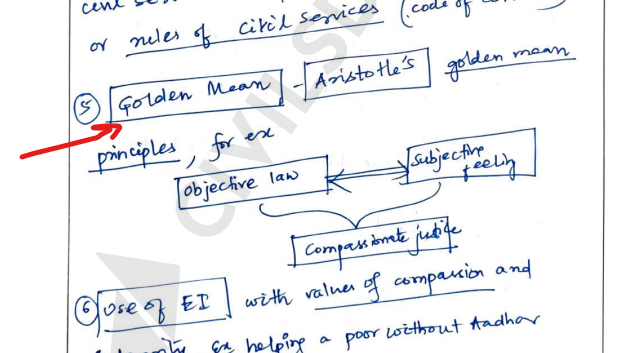
4. Quoting diagrams where required – No SUPERFICIAL LANGUAGE-BASED Answers, instead KNOWLEDGE-BASED quoting of thinkers, philosophies.
5. Writing like an OFFICER – not like the crowd who wants to sound “ETHICAL”.
This is not something we are explaining just out of our finite minds. Look at some of his answers:
Look at how he wrote a definition of Conflict of Interest. Clear and crisp. Exactly conveys the definition – leaves NO SCOPE for the examiner to deduct marks.
Similarly, look at his usage of thinkers in almost all his answers:
Starting the definition of values by Quoting how Radhakamal Mukherjee defined it.
Quoting John Rawl’s Differential Principles
Similarly, the usage of Diagrams and its correlation with his marks is EVIDENT.
Diagram 1 – Showing Government’s Role in delivery of social justice.
Diagram 2 – Explaining Role of Education through History and quoting examples (Now that’s a NEXT LEVEL of value addition!)
LET’S KNOW THIS.
Competition is FIERCE now. You MIGHT think you have a decent framework, you are quoting examples, you are quoting thinkers – but there is someone out there who is taking the competition to the NEXT LEVEL.
Quoting the MOST REAL & RELEVANT Examples which are the real differentiators
Using diagrams and quoting examples within the diagrams (NEXT LEVEL ENRICHMENT)
Most of all – having a THEME SPECIFIC FRAMEWORK (You don’t have to come up with a definition in the exam hall – know it beforehand!)
These ideas aren’t inherent. It can be built within. For how Animesh started with his first answer copy, we see a marked difference in how he improved over the time. We made sure he reached a level that competing with him would be a horse race – you lose a step, and it’s all over.
We intend to do the same thing with you guys. Shubham Sir (Senior Mentor, Civilsdaily – Mentored more than 500 rankers) will explain to you in great detail on a Strategy to Score 120+ Marks in Ethics.
This is a NO-NONSENSE STRATEGY and we’ll be delving deep into Animesh’s (AIR 2) Answer Copies, so you definitely don’t want to miss out on this.
Join us in our Webinar, where we take insights from Animesh’s (AIR 2) Ethics Answer Copies, and devise a strategy to score 120+ in Ethics Paper with an effective framework.
Even as a complaint alleging sexual harassment has been filed in Kolkata against West Bengal Governor C V Ananda Bose, Constitutional immunity bars the police from naming the Governor as an accused or even investigating the case.
What is Article 361?
Article 361 of the Constitution that deals with immunity to the President and the Governors states that they “shall not be answerable to any court for the exercise and performance of the powers and duties of his office or for any act done or purporting to be done by him in the exercise and performance of those powers and duties”.
The provision also has two crucial sub-clauses:
(1) that no criminal proceedings whatsoever shall be initiated or continued against the President, or the Governor of a State, in any court during the term of his office.
(2) No process for the arrest or imprisonment of the President, or the Governor of a State, shall issue from any court during his term of office.
Immunity power of the Governor:
Ceases to be in office: The police can act only after the Governor ceases to be in office, which is when either the Governor resigns or no longer enjoys the confidence of the President.”
Rameshwar Prasad v Union of India: In the landmark 2006 ruling in Rameshwar Prasad v Union of India, that outlined the immunity enjoyed by the Governor “even on allegation of personal malafides,” the Supreme Court held that “the position in law, is that the Governor enjoys complete immunity.”
In 2017, criminal conspiracy in the 1992 demolition of the Babri Masjid case: The trial did not take place for former UP Chief Minister Kalyan Singh since he was then the Governor of Rajasthan.
Constitutional Provisions:
Appointment: The Governor is appointed by the President of India and holds office during the pleasure of the President (Article 155).
Qualifications: The Governor must be a citizen of India, must be at least 35 years old, and must not hold any office of profit (Article 157).
Powers and Functions: The Governor is the constitutional head of a state and performs various functions including:
Executive Functions: The Governor appoints the Chief Minister and other Council of Ministers, and allocates portfolios among them (Article 164).
Legislative Functions: The Governor summons and prorogues the state legislature, addresses it, and lays down its policy. He/she also has the power to dissolve the Legislative Assembly (Article 174).
Financial Functions: The Governor causes to be laid before the State Legislature the Annual Financial Statement (budget) and has powers related to money bills (Article 202).
Discretionary Powers: The Governor has discretionary powers in certain matters, such as appointing the Chief Minister when no party has a clear majority after elections (Article 164).
Relation with the Union: The Governor is appointed by the President and acts as a link between the state and the Union. He/she can send reports to the President regarding the administration of the state (Article 356).
Oath or Affirmation: Before entering office, the Governor must take an oath or affirmation according to the form set out in the Third Schedule of the Constitution (Article 159).
Conclusion:
Article 361 of the Indian Constitution provides immunity to the President and Governors from court proceedings and arrest during their term. Police action against a Governor can only occur after they cease office.
Mains PYQ
Q Discuss the essential conditions for exercise of the legislative powers by the Governor. Discuss the legality of re-promulgation of ordinances by the Governor without placing them before the Legislature.
2024 is an election year across the world and newly elected governments need to focus on the all-important sustainability issue. Year 2024 is an election year across the world.
At least 64 countries, both developed and developing, accounting for 49% of the world population, will go to the polls.
Causes of Global Slow Progress:
Impact of Global Crises: The outbreak of the COVID-19 pandemic and other global crises virtually halted progress towards the SDGs. These crises have diverted attention and resources away from sustainable development efforts.
Neglect of Environmental Goals: There has been little to no attention towards goals related to the environment and biodiversity, including responsible consumption and production, climate action, life below water, and life on land.
Defiance of Integrated Nature of SDGs: The current practice of pursuing SDGs is criticized for defying the integrated and indivisible nature of the goals. This lack of integration hampers efforts to achieve sustainable development outcomes comprehensively.
Risk of Environmental Degradation: The slow progress and neglect of environmental goals pose a significant risk of accelerated environmental degradation. This threatens the overarching target of balancing human well-being and a healthy environment.
Why the world is not on track to achieve most SDGs by 2030?
Insufficient Progress: Despite reaffirmations of commitment by world leaders, progress towards achieving the SDGs remains slow. The world is only on track to meet 15% of the 169 targets that comprise the 17 goals.
Investment Gap: There is a significant gap in investment for SDGs, particularly in developing countries. The estimated investment gap exceeds $4 trillion, with nearly $2 trillion needed for the energy transition alone.
Lack of Synergistic Action: There is a lack of synergistic action in addressing SDGs, despite the integrated nature of the goals. Few studies and empirical evidence exist on the synergies and trade-offs among SDGs, hindering progress.
Barriers to Synergies: Various barriers, including knowledge gaps, political and institutional barriers, and economic issues, impede synergistic action.Inadequate data collection, and an inability to attribute co-benefits to specific actions hinder progress.
Misaligned Policies: Policies may be misaligned, leading to barriers for meeting greater targets. For example, ambitious renewable energy targets may not align with smaller-scale of steps taken to achieve SDG goal.
Limited Understanding of Cost Estimation: Exploiting resources without considering climate change impacts and synergistic opportunities can be detrimental to national and global efforts.
Way forward:
Call for Action: There is a call for action to strengthen the environment for synergistic action, transparently identify opportunities and limits to synergies, and develop reporting frameworks to assess the value created from specific SDG interventions.
Urgent Action Areas Identified: The UN SDG Report, 2023 identified five key areas for urgent action, including commitments of governments, concrete policies to eradicate poverty and reduce inequality, strengthening of national and subnational capacity, recommitment of the international community, and strengthening of the UN development system.
Global Reaffirmation and Commitment: World leaders acknowledged the situation and reaffirmed their commitments to delivering the SDGs by 2030. However, the effectiveness of these global pronouncements at the ground level remains uncertain.
Mains PYQ
Q National Education Policy 2020 isin conformity with the Sustainable Development Goal-4 (2030). It intends to restructure and reorient education system in India. Critically examine the statement. (2020)
After allegations of sexual abuse by Janata Dal (Secular) MP Prajwal Revanna came to light, the politician fled to Germany on a Diplomatic Passport.
What is a Diplomatic Passport?
The normal passports, which have dark blue covers and are valid for 10 years (for adults) while the diplomatic passports have maroon covers, and are valid for five years or less.
Holders of such passports are entitled to certain privileges and immunities as per international law, including immunity from arrest, detention, and certain legal proceedings in the host country.
Who can get a Diplomatic Passport?
Diplomatic Status: Individuals with diplomatic status, such as diplomats representing the country abroad, are eligible for diplomatic passports.
Government-Appointed Officials: Government-appointed individuals travelling abroad for official business can receive diplomatic passports.
Officers of Indian Foreign Service (IFS): Officers working under branches A and B of the Indian Foreign Service (IFS), typically at the rank of Joint Secretary and above, are entitled to diplomatic passports.
Relatives of IFS and MEA Officers: Relatives and immediate family members of officers employed in the Indian Foreign Service (IFS) and Ministry of External Affairs (MEA) are eligible for diplomatic passports.
Authorized Individuals for Official Travel: Select individuals authorized to undertake official travel on behalf of the government, such as union ministers and Members of Parliament (MPs), may receive diplomatic passports. The validity of these passports is concurrent with the term of the MP.
Surrender of Diplomatic Passport by MPs:
Individuals who are disqualified from their positions, such as MPs, are required to surrender their diplomatic passports. For example, Congress leader Rahul Gandhi surrendered his diplomatic passport after being disqualified as an MP.
Why did Prajwal Revanna not need a visa to travel to Germany?
Operational Visa Exemption Agreements: India has operational visa exemption agreements with certain countries, including Germany, for holders of diplomatic passports. These agreements allow diplomatic passport holders to travel to these countries without requiring a visa, provided their stay does not exceed 90 days.
Reciprocal Deal with Germany: A reciprocal deal signed in 2011 between India and Germany exempts holders of Indian diplomatic passports from obtaining a visa for travel to Germany.
India has similar agreements with other countries, such as France, Austria, Afghanistan, Czech Republic, Italy, Greece, Iran, and Switzerland, where diplomatic passport holders are exempted from visa requirements.
Operational Visa Exemption for Other Passport Holders: India also has agreements with 99 other countries where not only diplomatic passport holders but also those holding service and official passports can avail of operational visa exemption for stays up to 90 days.
Countries in this list include Bahrain, Brazil, Egypt, Hong Kong, Oman, Singapore, and the United Arab Emirates.
Despite not needing a visa, Prajwal Revanna should have applied for prior political clearance for his private visit to Germany. Members using a diplomatic passport are required to apply for political clearance directly to the Ministry of External Affairs (MEA) before proceeding abroad.
Who can revoke a Diplomatic Passport?
Court Order Requirement: The government can revoke a diplomatic passport only after a court order to that effect. The relevant provisions of the Passport Act 1967 stipulate that revocation of a diplomatic passport may occur upon orders from a court during proceedings concerning an offence allegedly carried out by the passport holder before a criminal court.
Passport Authority’s Discretion: The Passport Act empowers the passport authority to impound or revoke a passport under various circumstances. These include instances where the holder is in wrongful possession of the passport or obtained it by suppressing material information or in the interests of India’s sovereignty and integrity or friendly relations with foreign countries.
Conviction by Indian Court: A diplomatic passport can be revoked if the holder has been convicted by a court in India and sentenced to imprisonment for not less than two years.
What is the Henley Passport Index?
The Henley Passport Index is a renowned ranking system that assesses the strength of passports based on the number of destinations their holders can access without a prior visa.
It utilizes data from the International Air Transport Association (IATA) and is enhanced by Henley & Partners’ research team.
In the latest 2024 ranking, India’s rank has slipped one place to 85th, despite the number of visa-free destinations increasing to 62 countries
Way forward
Enhanced Oversight and Accountability: Implement stricter oversight mechanisms to monitor the issuance and use of diplomatic passports. Regular audits and reviews can help identify any discrepancies or misuse.
Strict Enforcement of Surrender Rules: Enforce existing rules mandating the surrender of diplomatic passports by individuals who are disqualified from their positions, such as Members of Parliament.
Mains PYQ
Q Analyse the circumstances that led to the Tashkent Agreement in 1966. Discuss the highlights of the agreement.
A recent question before the Supreme Court compelled it to deliberate on whether damages for domestic violence should be determined based on the injuries sustained by the victim or the perpetrator’s ability to pay.
The petitioner contested orders from the Bombay High Court and a trial court directing him to pay Rs 3 crore to his wife under Section 22 of the Protection of Women from Domestic Violence Act, 2005.
Domestic Violence Law: An Overview
The DV Act, 2005 aims to safeguard women’s rights by addressing violence within the family.
Key Features of the DV Act:
Details
Background
Introduced in 2005 to address limitations in civil and criminal courts regarding domestic violence (under Section 498A of the Indian Penal Code).
Definitions of Violence
Includes physical, sexual, emotional, verbal, psychological, and economic abuse (Section 3).
Even a single act of harm or injury qualifies as domestic violence.
Beneficiaries
Any woman in a domestic relationship (Section 2).
Children can also file complaints, and any person can file on their behalf (Section 2).
Respondents
Adult male members in domestic relationships (Section 2).
Relatives of the husband or male partner can also be respondents (Section 2).
Rights to Residence
Women cannot be denied access to resources during legal proceedings (Section 17).
Other Rights
Access to police, shelter, medical aid, and legal assistance.
Can obtain various court orders, including protection, residence, and compensation orders (Section 18).
Remedial Measures
Victims entitled to medical facilities, counseling, and shelter (Section 12).
Both parties may receive counseling as directed by the court (Section 14).
Respondents required to provide compensation for losses incurred by the victim (Section 20).
Courts to order respondents to pay damages for injuries, including mental and emotional trauma, resulting from domestic violence (Section 22).
Protection Officers
Appointment of officers in each district, preferably women, with necessary qualifications (Section 8).
Fixed Timeline
All complaints must be heard and disposed of within 60 days (Section 12).
PYQ:
[2022] Explore and evaluate the impact of ‘Work From Home’ on family relationships.
Geological Survey of India (GSI) explorers have made a breakthrough, uncovering ancient fossils in Tolegre, South Garo Hills of Meghalaya.
It is speculated that the fossils could be linked to the genera Rhodocetus or Amulocetus (now extinct), considered ancestors of modern whales.
About Garo Hills
The Garo Hills, located in Meghalaya, are part of the Garo-Khasi range, one of the hill ranges in the northeastern region of India.
They are situated in the western part of Meghalaya, bordering Bangladesh to the south and west.
The terrain of the Garo Hills is rugged and hilly, characterized by dense forests, steep slopes, and deep valleys.
The Nokrek is highest Peak, which stands at approximately 1,415 meters (4,642 feet) above sea level.
The climate in the Garo Hills is typically humid subtropical, with heavy rainfall during the monsoon season, which usually lasts from June to September.
Numerous rivers and streams, including the Brahmaputra, Someshwari, and Jinjiram rivers crisscross this region.
The region is also known for its picturesque waterfalls, such as the Pelga Falls, located near Tura, the largest town in the Garo Hills.
The Nokrek National Park, located within, is recognized as a UNESCO Biosphere Reserve and is home to various endangered species, including the Asian elephant and the red panda.
The Garo Hills are inhabited predominantly by the Garo tribe, one of the major ethnic groups in Meghalaya.
PYQ:
[2013] Consider the following pairs:
1. Nokrek Bio-Sphere Reserve : Garo Hills
2. Logtak (Loktak) Lake : Barail Range
3. Namdapha National Park: Daphla Hills
Which of the above pairs is/are correctly matched?