💥Mains Ready By December. Smash Mains & Smash PYQ Admissions Open

Search results for: “”

  • Unanimity at WHO

    WHO has been in news recently for all the wrong reasons. This article focuses on wide-ranging support for the resolution calling for the inquiry into the origin of the novel coronavirus. With this resolution, WHO has a chance to redeem its credibility. Until recently China seemed to be in the control of the global narrative on the pandemic. And now we witness near-unanimous support to this resolution.

    Inquiry of the origin of the virus

    • International attention is riveted on the question of an inquiry into the origin of the corona-virus.
    • The call for an international investigation was first voiced formally by the Australian prime minister, Scott Morrison.
    • Beijing reacted with open threats of trade sanctions. But Canberra pushed the investigation ahead.
    • It is working with the European Union to promote a resolution at this week’s World Health Assembly (WHA), which brings ministers from all the member states of the WHO.
    • The resolution also calls for an “impartial, independent and comprehensive” evaluation into the international response to the corona pandemic.
    • The WHA has 194 members.
    • So, the entire international community — has a voice in addressing the key issues raised by the corona crisis by debating the resolution.

    Wide support to the resolution

    • According to media reports, the resolution is close to gaining support from two-thirds of the WHA’s 194 members.
    • Australia and the EU hope to have the resolution approved unanimously.
    • Since the resolution does not mention China by name, Canberra and Brussels hope Beijing will not oppose the resolution.
    • They also hope to persuade Washington, which wanted tougher language including references to China, to endorse the resolution.
    • Whatever the fate of the resolution, the wide-ranging support it has got amidst the vocal Chinese opposition is impressive.

    So, how effective is the resolution?

    • To be sure, the resolution was watered down to get the maximum possible backing at the WHO.
    • But it is said to have enough teeth to dig deep into the issues raised by the corona crisis.

    How China controlled the corona narrative until now?

    • A few weeks ago, it seemed China and the Director-General of WHO, had full control over the corona narrative on the issues involved.
    • The Trump administration’s aggressive questioning of China’s role and WHO DG’s role had not gone down well.
    • Nor did the US threat to cut off funding for the WHO.
    • Within the US itself, opposition Democrats and the foreign policy establishment has attacked Trump for trying to “divert attention”.
    • China’s success in quickly getting things under control at home and its expansive mask diplomacy seemed to give Beijing an upper hand at the WHO.
    • China’s growing clout in the developing world and bilateral economic levers against major developed countries, including in Europe, appeared to insure against any serious international questioning of its handling of the virus.
    • What factors played the role in the passing of the resolution?
    • 1) The public pressure from the US concentrated minds at the WHO.
    • 2) Some quiet diplomacy by middle powers, including India, appears to have created the political basis for learning the right lessons from the pandemic and preventing similar eruptions in the future.

    Is it a setback for China?

    • Some observers see a unanimous approval of the resolution as a diplomatic setback for Beijing.
    • Since limiting the demands for an external inquiry has been a major political priority for Beijing.
    • There are similar demands at home for an investigation into a crisis that led to an enormous loss of life in China and punishing those responsible.
    • The leadership in Beijing is not comfortable with these demands.

    Issues with the WHO that India must pay attention to

    1. International norms for early detection

    • There is the need to develop new international norms that will increase the obligations of states and the powers of the WHO in facilitating early detection and notification of pandemics.
    • This will involve finding ways to bridge the contested notions of state sovereignty and collective security.

    2. Funding of the WHO

    • If you have a club that depends on donations rather than membership fees, donors will inevitably set the agenda.
    • Over the decades, the WHO has become ever more reliant on voluntary contributions from governments and corporations rather than assessed contributions from the member states.
    • This is going to leave the WHO rather vulnerable to pressures.

    3. WHO’s focus should be on fewer objectives

    • India must also ask if the WHO is trying to do too many things.
    • The WHO’s initial successes came when it focused on a few objectives like combatting malaria and the elimination of smallpox.
    • A limited agenda might also make the WHO a more effective organisation.

    Way forward for India

    • India knows it is one thing to pass to a resolution and entirely another to compel a great power like China to comply.
    • Any current effort to understand the origin and spread of the COVID-19 virus and a long-term strategy to deal with future pandemics must necessarily involve more than a measure of Chinese cooperation.
    • Sustained engagement with Beijing, then, is as important for Delhi as deeper cooperation with Washington and the “Quad plus” nations.
    • India should also focus on more intensive engagement with the non-aligned nations in promoting a new global regime on preventing and managing pandemics.

    Consider the question “Corona pandemic and its handling by the WHO resulted in the loss of its credibility. But the collective efforts of the nations which resulted in the passage of the resolution for inquiry of the origin of the virus, could soften the blow the credibility of WHO had suffered. Comment.”

    Conclusion

    For India, the widespread support for the resolution is a vindication of its early call for transparency and accountability in the responses of China and the WHO to the pandemic. India should take initiative to ensure the reforms at WHO and the formation of global order for preventing and managing the global order.

  • Are the U.S. and China entering a new Cold War?

    Relations between the U.S. and China plunged to a new low in recent weeks. Ties between the two countries had started deteriorating well before the COVID-19 pandemic.

    Practice question for mains:

    Q. How will economic nationalism take a lead in the post-COVID-19 Asia? Discuss in context to the rising tensions between the US and China.

    Heading for a new Cold War

    • The US President has recently threatened to “cut off the whole relationship” with China over the COVID-19 pandemic, which originated in Wuhan.
    • Earlier this month, the U.S. imposed visa restrictions on the Chinese journalists working in the country, limiting their work period to 90 days.
    • Last week, Trump extended for one more year a ban on U.S. companies from using telecom equipment made by “companies positing national security risks” (Huawei and ZTE row).

    A new national policy

    • The rising tensions between the two superpowers have prompted many experts to warn of a new Cold War.
    • A chorus of American voices now argues that confronting China should become the organizing principle of U.S. foreign policy, akin to the Cold War against the Soviet Union.
    • Hawks in the Trump administration openly push for a more aggressive approach towards Beijing.
    • In 2017, the US’s National Security Strategy called China as “a revisionist power” seeking “to erode American security and prosperity” and “shape a world antithetical to U.S. values and interests”.

    Why is the US confronting China?

    • Competition rules the relationship, and flexibility and mature handling are in short supply on both sides.
    • Uncertainty prevails, whether it on the question of resolving trade problems, or on the maritime front in the East and South China Seas, on technology, or on mutual mud-slinging on COVID-19-related issues.
    • Record high temperatures have been recorded in Sino-U.S. relations in recent years and the pandemic is no exception to this.
    • COVID-19 appears to have aggravated the crisis, pushing both countries, already reeling under trade, technology and maritime disputes, to take a more hostile position towards each other.

    How has China responded?

    • China has frequently urged the United States to abandon its Cold-War mentality and zero-sum game mindset.
    • It has sometimes through the state-run media, hit back, calling Trump’s comments “lunacy” and Mike Pompeo, the U.S. Secretary of State, an “evil politician”.

    A reminder of the ‘Novikov telegram’

    • In early April, China’s Ministry of State Security sent an internal report to the country’s top leaders, stating that hostility in the wake of the coronavirus outbreak could tip relations with the U.S. into a confrontation.
    • Intelligence community sees the report as China’s version of the ‘Novikov Telegram’, referring to a report Nikolai Novikov, the Soviet Ambassador in Washington, sent to Moscow in September 1946.
    • Laying out his analysis of the U.S. conduct, the report, sent to Russia said that the U.S. is determined on world domination and suggested the Soviet Union create a buffer in Eastern Europe.
    • Novikov telegram was a response to the “Long Telegram”, the 8,000-word report sent by George Kennan, an official at the U.S. Embassy in Moscow, to Washington.
    • It said that the Soviet Union was heavily armed and determined to spread communism, and peaceful coexistence was impossible.
    • Historians often trace the origins of the Cold War to these telegrams.

    Nationalist overdrive in US

    • The current crisis in relations clearly shows that tensions will not go away. This situation is unlikely to ease until the U.S. Presidential election.
    • Post-election, temperatures could decrease, but a deep-rooted antipathy towards China has gripped the popular and political imagination in the U.S.
    • In China, the leadership and public opinion are both on a nationalist overdrive and the Trump administration is seen as the prime antagonist.

    Relevance with the Cold War

    • There are similarities between the current crisis and the Cold War.
    • The political elites of both China and the U.S., like the Soviet Union and the U.S. back then, see each other as their main rivals.
    • We can also see this antagonism moving from the political elite to the popular perception — the targeting of ethnic Chinese professionals and others in the U.S. and of American individuals or entities in China is a case in point.

    Conclusion

    • We don’t see the kind of proxy conflicts between the U.S. and China which we did during the Cold War.
    • The world is also not bipolar any more. There are third parties such as the EU, Russia, India and Japan.
    • These parties increasingly have a choice whether or not to align with either power as they see fit and on a case by case basis.
    • This leads to a very different kind of international order than during the Cold War.

    Challenges ahead

    • The Cold War was out and out ideological between the communist and capitalist blocs.
    • For China, a country ruled by a communist party where the primary goal of all state apparatus is preserving the regime in power, it’s always been ideological.
    • The U.S. has started realizing this angle about China now. The Republican Party has ideological worldviews, too.
    • If Trump gets re-elected, the ideological underpinnings of the U.S.-China rivalry could get further solidified.

    Back2Basics: Cold War

    • During World War II, the United States and the Soviet Union fought together as allies against the Axis powers.
    • However, the relationship between the two nations was a tense one.
    • Americans had long been wary of Soviet Communism and concerned about Russian leader Joseph Stalin’s tyrannical rule of his own country.
    • For their part, the Soviets resented the Americans’ decades-long refusal to treat the USSR as a legitimate part of the international community as well as their delayed entry into World War II, which resulted in the deaths of tens of millions of Russians.
    • After the war ended, these grievances ripened into an overwhelming sense of mutual distrust and enmity.
  • Minimum Public Shareholding (MPS) Requirement

    The Securities and Exchange Board of India (SEBI) has relaxed the 25 per cent minimum public shareholding norm and advised exchanges not to take penal action till August 2020 in case of non-compliance.

    A statement based question can be asked about the SEBI in the prelim asking-

    If it is a statutory or quasi-judicial body ; Scope of its regulation; Appointment of its chairman etc..

    What is a Public Shareholding Company?

    • A Public Shareholding Company is a company whose capital is divided into shares of equal value, which are transferable.
    • Shareholders of a Public Shareholding Company are not liable for the company’s obligations except for the amount of the nominal value of the shares for which they subscribe.

    What is MPS requirement?

    • The 25 per cent MPS norms were introduced in 2013, whereby no listed company was permitted to have more than 75 per cent promoter stake.
    • The rules were aimed at improving liquidity and better stock price discovery by making higher float available with public.
    • The average promoter holding in India is among the highest globally.
    • Last year, the government had proposed to increase the minimum public float from the current 25 per cent to 35 per cent. It had met with opposition, forcing the government to drop the plan.

    Why ease MPS norms?

    • The Sebi move is aimed at easing such compliance rules amid the disruptions caused by the coronavirus pandemic.
    • The decision has been taken after receiving requests from listed entities and industry bodies as well as considering the prevailing business and market conditions.
    • As per the norms, exchanges can impose a fine of up to Rs 10,000 on companies for each day of non-compliance with MPS requirements.
    • Besides, exchanges can intimate depositories to freeze the entire shareholding of the promoter and promoter group. This circular will come into force with immediate effect.

    Back2Basics: Securities and Exchange Board of India (SEBI)

    • The SEBI is the regulator of the securities and commodity market in India.
    • It was first established in 1988 as a non-statutory body for regulating the securities market.
    • It became an autonomous body on 12 April 1992 and was accorded statutory powers with the passing of the SEBI Act 1992.
    • SEBI has to be responsive to the needs of three groups, which constitute the market:

    1) issuers of securities

    2) investors

    3) market intermediaries

  • Over 42,000 undertrials released to unclog prisons: NALSA report

    Legal services institutions have intervened to release 42,529 undertrial prisoners as well as 16,391 convicts on parole to de-congest prisons during the COVID-19 pandemic, a report from NALSA has said.

    Practice question for mains:

    Q. More than a century-old system of prisons in India needs urgent repair. Discuss with context to the increase in the cases of undertrials.

    Decongesting the prison

    • There are 1,339 prisons with approximately 4, 66,084 inmates in India with the rate of occupancy at Indian prisons at 117.6% (a/c to NCRB).
    • The report stated that 243 undertrial prisoners had been granted bail and 9,558 persons in remand had been given legal representation across the country.
    • It said the highest number of undertrial prisoners released was 9,977 in Uttar Pradesh, followed by 5,460 in Rajasthan and 4,547 in Tamil Nadu, 3,698 in Punjab and 3,400 in Maharashtra.
    • Note: Prisons/ Prisoners/persons detained is a State subject under Entry 4 of List II of the Seventh Schedule to the Constitution of India.

    Hardships of the undertrials

    • Right to a speedy trial is an integral part of the principles of fair trial and is fundamental to the international human rights discourse.
    • In Indian jails, most of the prisoners are undertrials, which are confined to the jails until their case comes to a definite conclusion.
    • In most of the cases, they end up spending more time in the jail than the actual term that might have had been awarded to them had the case been decided on a time and, assuming, against them.
    • Plus, the expenses and pain and agony of defending themselves in courts is worse than serving the actual sentence. Undertrials are not guilty till convicted.
    • In 2017, the Law Commission of India had recommended that undertrials who have completed a third of their maximum sentence for offences attracting up to seven years of imprisonment be released on bail.

    About NALSA

    • National Legal Services Authority of India (NALSA) was formed on 9 November 1995 under the authority of the Legal Services Authorities Act 1987.
    • Its purpose is to provide free legal services to eligible candidates and to organize Lok Adalats for the speedy resolution of cases.
    • The CJI is patron-in-chief of NALSA while second seniormost judge of Supreme Court of India is the Executive-Chairman.
    • There is a provision for similar mechanism at state and district level also headed by Chief Justice of High Courts and Chief Judges of District courts respectively.
    • The prime objective of NALSA is speedy disposal of cases and reducing the burden of the judiciary.

    Also read:

    [Burning Issue] Need of Prison Reforms

  • Super Cyclone Amphan and its threats

    The storm system in the Bay of Bengal, Amphan, developed into a super cyclone and is expected to make landfall along the West Bengal-Bangladesh coast very soon.

    Realted PYQ:

    Q. In the South Atlantic and South Eastern Pacific regions in tropical latitudes, cyclone does not originate. What is the reason? (CSP 2015)

    (a) Sea Surface temperature are low
    (b) Inter Tropical Convergence Zone seldom occurs
    (c) Coriolis force is too weak
    (d) Absence of land in those regions

    Super Cyclone Amphan

    • Cyclone Amphan is a tropical cyclone formed over the Bay of Bengal that has intensified and likely to turn into a “super cyclonic storm (maximum wind speed is 224 kmph)”.
    • It has been named by Thailand.
    • Amphan is the equivalent of a Category 5 hurricane on the Saffir-Simpson Hurricane Wind Scale.
    • By the time it makes landfall in West Bengal, Amphan is expected to tone down into a category 4 Extremely Severe Cyclonic (ESC) storm with a wind speed of 165-175 kmph and gusting to 195 kmph.

    What makes it a nightmare?

    • This is the first super cyclone to form in the Bay of Bengal after the 1999 super cyclone that hit Odisha and claimed more than 10,000 lives.
    • It is the third super cyclone to occur in the North Indian Ocean region after 1999 which comprises of the Bay of Bengal, the Arabian Sea and the northern part of the Indian Ocean.
    • The other two super cyclones were Cyclone Kyarr in 2019 and Cyclone Gonu in 2007.

    Recent cyclones in the region

    • From 1965 to 2017, the Bay of Bengal and the Arabian Sea collectively registered 46 ‘severe cyclonic storms’.
    • More than half of them occurred between October and December.
    • Seven of them occurred in May and only two (in 1966 and 1976) were recorded in April, according to data from the IMDs cyclone statistics unit.
    • Cyclone Phailin in 2013 and the super cyclone of 1999 — both of which hit coastal Odisha — have been the most powerful cyclones in the Bay of Bengal in the past two decades in terms of wind speed.
    • Last year, Fani, which was an ESC made landfall in Odisha and ravaged the State, claiming at least 40 lives.

    Back2Basics: Tropical Cyclones

    • Cyclones are formed over slightly warm ocean waters.
    • The temperature of the top layer of the sea, up to a depth of about 60 metres, need to be at least 28°C to support the formation of a cyclone.
    • This explains why the April-May and October-December periods are conducive for cyclones.
    • Then, the low level of air above the waters needs to have an ‘anticlockwise’ rotation (in the northern hemisphere; clockwise in the southern hemisphere).
    • During these periods, there is an ITCZ in the Bay of Bengal whose southern boundary experiences winds from west to east, while the northern boundary has winds flowing east to west.
    • This induces the anticlockwise rotation of the air.
    • Once formed, cyclones in this area usually move northwest. As it travels over the sea, the cyclone gathers more moist air from the warm sea and adds to its heft.

    What strengthens them?

    • A thumb rule for cyclones is that the more time they spend over the seas, the stronger they become.
    • Hurricanes around the US, which originate in the vast open Pacific Ocean, are usually much stronger than the tropical cyclones in the Bay of Bengal, a relatively narrow and enclosed region.
    • The cyclones originating here, after hitting the landmass, decay rapidly due to friction and absence of moisture.

    Grading of Cyclones

    • Tropical cyclones in the Bay of Bengal are graded according to maximum wind speeds at their centre.
    • At the lower end are depressions that generate wind speeds of 30 to 60 km per hour, followed by:
    1. cyclonic storms (61 to 88 kmph)
    2. severe cyclonic storms (89 to 117 kmph)
    3. very severe cyclonic storms (118 to 166 kmph)
    4. extremely severe cyclonic storms (167 to 221 kmph) and
    5. super cyclones (222 kmph or higher)
  • Species in news: Pinanga Andamanensis

    A rare palm endemic to the South Andaman Island is finding a second home at Thiruvananthapuram-based Jawaharlal Nehru Tropical Botanic Garden and Research Institute (JNTBGRI).

    Last year one  species from our newscard : Species in news: Hump-backed Mahseer made it into the CSP 2019.  The ‘Abutilon ranadei’ flower in the newscard creates such a vibe yet again.

    A stand-alone species being mentioned in the news for the first time often find their way into the prelims. Make a special note here.

    Pinanga Andamanensis

    • Pinanga andamanensis is an IUCN critically endangered species and one of the least known among the endemic palms of the Andaman Islands.
    • The name is derived from ‘Penang’, the modern-day Malaysian state.
    • Its entire population of some 600 specimens naturally occurs only in a tiny, evergreen forest pocket in South Andaman’s Mount Harriet National Park.
    • It was originally described by the Italian botanist Odoardo Beccari in 1934.
    • His description was based on an old herbarium specimen collected by E.H. Man, a late-19th century assistant superintendent in the Andaman administration.
    • After that first identification, it was thought to be extinct till 1992.
  • [pib] Shekatkar Committee recommendations on Border Infrastructure

    Government has accepted and implemented three important recommendations of the Committee of Experts (CoE) under the chairmanship of Lt General D B Shekatkar (Retd.) relating to border Infrastructure.

    Practice question for mains:

    Q. India’s unique geo-strategic location needs an all-weather and efficient border infrastructure. Comment.

    About Shekatkar Committee

    • The military reforms committee – under Lt General (retd.) DB Shekatkar – was set up by then Raksha Mantri Manohar Parrikar in 2015.
    • The committee was established with a mandate for Enhancing Combat Capability and Rebalancing Defence Expenditure.
    • Shekatkar Committee had made recommendations on enhancing the combat potential of India’s three armed forces, rationalizing the defence budget etc.
    • The committee submitted its report on December 21, 2016. It had apparently exceeded its brief with some 200 recommendations.
    • A major recommendation is that the defence budget should be 2.5% to 3% of the GDP.

    Recommendations on border infrastructure

    • On the matter related to creating border infrastructure, the Government has implemented the recommendation of CoE to outsource road construction work beyond the optimal capacity of Border Roads Organisation (BRO).
    • These were related to speeding up road construction, leading to socio-economic development in the border areas.
    • The other recommendation relating to the introduction of modern construction plants, equipment and machinery has been implemented.

    Back2Basics: Border Roads Organisation (BRO)

    • The BRO develops and maintains road networks in India’s border areas and friendly neighboring countries and functions under the Ministry of Defence.
    • It is entrusted for construction of Roads, Bridges, Tunnels, Causeways, Helipads and Airfields along the borders.
    • Officers from the Border Roads Engineering Service (BRES) and personnel from the General Reserve Engineer Force (GREF) form the parent cadre of the Border Roads Organisation.
    • It is also staffed by officers and troops drawn from the Indian Army’s Corps of Engineers on extra regimental employment.
    • The BRO operates and maintains over 32,885 kilometers of roads and about 12,200 meters of permanent bridges in the country.
  • [Burning Issues] Fiscal Push for MSME Sector of India (Part I)

    The Covid-19 pandemic has left its impact on all sectors of the economy but nowhere is the hurt as much as the Medium, Small and Micro Enterprises (MSMEs) of India. All anecdotal evidence available, such as the hundreds of thousands of stranded migrant workers across the country, suggests that MSMEs have been the worst casualty of lockdown.

    A closer look at the anatomy of the MSME sector explains why MSMEs are so vulnerable to economic stress.

    Backgrounder: India’s MSME Sector

    • The Indian MSME sector is the backbone of the national economic structure and has unremittingly acted as the bulwark for the Indian economy, providing it resilience to ward off global economic shocks and adversities.
    • With around 63.4 million units throughout the geographical expanse of the country, MSMEs contribute around 6.11% of the manufacturing GDP and 24.63% of the GDP from service activities as well as 33.4% of India’s manufacturing output.
    • They have been able to provide employment to around 120 million persons and contribute around 45% of the overall exports from India.

    What are MSMEs? How are they defined?

    • Formally, MSMEs are defined in terms of investment in plant and machinery.

    The significance of MSMEs:

    The significance of MSMEs is attributable to their calibre for employment generation, low capital and technology requirement.

    • They are also important for the promotion of industrial development in rural areas, use of traditional or inherited skill, use of local resources, mobilization of resources and exportability of products.
    • According to the estimates of the Ministry of MSME, Government of India, the sector generates around 100 million jobs through over 46 million units situated throughout the geographical expanse of the country.
    • With 38% contribution to the nation’s GDP and 40% and 45% share of the overall exports and manufacturing output, respectively, it is easy to comprehend the salience of the role they play in social and economic restructuring of India.
    • Besides the wide range of services provided by the sector, the sector is engaged in the manufacturing of over 6,000 products ranging from traditional to hi-tech items.

    Why the MSME sector is important specially for India?

    • The Indian MSME sector provides maximum opportunities for both self-employment and wage-employment outside the agricultural sector.
    • It contributes to building an inclusive and sustainable society in innumerable ways through the creation of non-farm livelihood at low cost, balanced regional development, gender and social balance, environmentally sustainable development, etc.

    How many MSMEs does India have, who owns them?

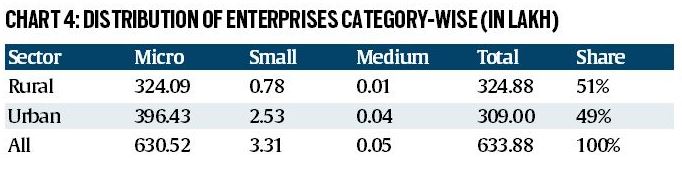
    • According to the latest available (2018-19) Annual Report of Department of MSMEs, there are 6.34 crore MSMEs in the country.
    • Around 51 per cent of these are situated in rural India.
    • Together, they employ a little over 11 crore people but 55 per cent of the employment happens in the urban MSMEs.

    • The numbers suggest that, on average, less than two people are employed per MSME.
    • At one level that gives a picture of how small these really are. But a breakup of all MSMEs into micro, small and medium categories is even more revealing.

    What kind of problems do MSMEs in India face?

    Given the shape and form of MSMEs, it is not hard to envisage the kind of problems they would face.

    • No/Low Formal registration: To begin with, most of them are not registered anywhere. A big reason for this is that they are just too small. But, as it is clear in a time of crisis, it also constrains a government’s ability to help them.
    • Away from Tax norms: GST has its threshold and most micro-enterprises do not qualify. Being out of the formal network, they do not have to maintain accounts, pay taxes or adhere to regulatory norms etc. This brings down their costs.
    • Lack of Financial buffer: According to a 2018 report by the International Finance Corporation (part of the World Bank), the formal banking system supplies less than one-third (or about Rs 11 lakh crore) of the credit MSME credit need that it can potentially fund (Chart 5).

    • They don’t have the buffers of the bigger firms or access to cheap capital to help them tide over this period.
    • Bad credit history:

    The other big issue plaguing the sector is the delays in payments to MSMEs — be it from their buyers or things likes GST refunds etc. A key reason why banks dither from extending loans to MSMEs is the high ratio of bad loans (Chart 6).

    Other problems

    • Long receivables cycles make a mess of working capital management.
    • Limited access to trained labour, technical progress and management support limit their growth.
    • Other common problems faced by small enterprises are related to the availability of technology, infrastructure and managerial competence, and limitations posed by labour laws, taxation policy, market uncertainty and imperfect competition.

    Opportunity areas for MSMEs in India

    Telecommunications

    • Domestic manufacturing of low-cost mobile phones, handsets, and devices;
    • Manufacturing of telecom networking equipment, including routers and switches;
    • Manufacture of base transceiver station equipment;
    • Mobile customer data analytics – services oriented toward analytical solutions; and
    • Development of value-added services

    Healthcare

    • Manufacturing of personal protective equipment (PPE) and face masks, as the COVID-19 pandemic has fundamentally changed social behaviour, public health and hospital needs, and created new demand;
    • Manufacturing of low-cost medical devices, and medical accessories such as surgical gloves, scrubs, and syringes;
    • Low-cost surgical procedures to reduce the cost of healthcare;
    • Telemedicine; and
    • Diagnostic labs.

    Electronics

    • Domestic manufacturing of low-cost consumer electronics, consumer durables;
    • Nano-electronics and microelectronics;
    • Electronic Systems Design and Manufacturing including semiconductor design, electronic components design and hi-tech manufacturing under India’s ‘National Electronics Mission; and
    • Strategic electronics, as the government is keen on encouraging the domestic manufacturing of products needed by the security forces.

    Others

    • Other areas that offer opportunities for MSMEs include information technology, pharmaceutical, chemical, automotive, renewables, gems and jewellery, textile, and food and agriculture.

    Part II of the BI will be published shortly…………

  • India on the margins of Afghanistan diplomacy

    From economic, strategic to security, India has many interests in “future” Peaceful and Developed Afghanistan. But India was sidelined from the recently organised meeting on Afghanistan. This article analyses what went wrong in India’s foreign and security policy. Two factors are emphasised in the article- India’s reluctance to talk with the Taliban and the US’s desperation to get out of Afghanistan.

    India’s Rigid policy toward Afghanistan

    • Recent developments in Afghanistan demand a flexible approach.
    • But India’s foreign and security planners have lacked flexibility in their approach.
    • Right approach should have included seeking to establish open connections with all its political groups, including with those perceived to be in Pakistan’s pocket.
    • Instead, they continued to rigidly cling to Afghanistan President Ashraf Ghani even as his influence diminished with each passing month.

    India’s support to Mr Ghani

    • Prime Minister Narendra Modi congratulated Mr Ghani for winning the elections, in December 2019 when the Afghanistan election commission had only announced the preliminary results.
    • And most countries had maintained a discreet silence then.
    • When the final result came it was rejected by Mr Ghani’s main rival, Abdullah Abdullah.
    • The international community ultimately supported Mr Ghani.
    • But qualified it with an insistence that he enters into a real power-sharing agreement with Mr Abdullah.

    India sidelined from meeting on Afghanistan

    • The United Nations Secretariat organised a meeting on Afghanistan where it invited the 6 current physical neighbours of Afghanistan—China, Pakistan, Iran, Turkmenistan, Uzbekistan and Tajikistan.
    • In addition, invitations were extended to the United States, Russia and the Ghani government.
    • Obviously, Mr Ghani did not condition his participation on India’s inclusion.
    • The constructive role New Delhi has played in Afghanistan’s reconstruction since the Taliban were ousted from the country in 2001-2002 after 9/11 was neglected.

    US going along with India’s absence

    • The role and action of the US proved that the U.S. acts to promote its interests in Afghanistan.
    •  It obviously expects that if in doing so Indian interests are exposed, India will protect them as best as it can.
    • U.S. Special Representative for Afghanistan Reconciliation said that ‘India should talk directly to Taliban, discuss terror concerns directly’.
    • He noted that despite India’s contributions to Afghanistan’s economic development — and these are undeniably significant covering large parts of the country, and are popular — as well as its long history of contacts with that country, it does not have a place in international diplomacy on Afghanistan.
    • He also said that when it comes to international efforts, India yet does not have a role that it could.
    • He patronisingly added that the U.S. wants India to have a more active role in the peace process.

    So, why India’s presence was not considered vital?

    • U.S. Special Representative for Afghanistan Reconciliation thinks that by avoiding open contacts with the Taliban, India has reduced its role in international diplomatic efforts.
    • That the U.S. is currently crucially dependent on Pakistan for the successful implementation of its Taliban deal.
    • It is reminiscent of the time in the 1990s when, at Pakistan’s insistence, India was considered a problem and kept out of crucial global forums on Afghanistan.

    Way forward

    • In such a situation, it is essential for India to maintain its strong links with the Afghan government, built and support its traditional Afghan allies.
    • But India should also established open lines of communication with the Taliban.
    • This is important because they are informally conveying that India should not consider them as Pakistan’s puppets and also because they have gained international recognition.
    • Contacts and discussions do not mean acceptance of their ways but its still a step forward.
    • India should act keeping in mind that there are no countries on the horizon which are really opposed to the Taliban acquiring a major place in the Afghanistan’s formal power structures.

    In 2013, the UPSC asked a question related to developments in Afghanistan against the backdrop of the proposed withdrawal of the International Security Assistance Force. Similarly, a question based on the latest development can be asked, for ex-“The return of Taliban after the US-Taliban deal in Afghanistan is fraught with major security implications for the countries in the region. Examine in the light of the fact that India is faced with a plethora of challenges and needs to safeguard its own strategic interests.”

    Conclusion

    India needs to take corrective diplomatic action even at this late stage, and even in the time of COVID-19. It must begin openly talking to the Taliban and with all political groups in the country. It must realise that its Afghan policy needs changes.

  • Atmanirbhar Abhiyan Package

    The article examines the various aspects of the recently announced Atmanirbhar Bharat Abhiyaan (ANBA). But before digging deeper into the ANBA the author ruminates over India’s growth (GDP) story. Reasons for India’s failure to deliver on the economic empowerment are also examined. In the end, the relation between the free economies and the welfare states is examined.

    The good and the bad of India’s GDP story

    • India crossed the UK two years ago, France last year, and will cross Germany and Japan in the next five years. (In terms of nominal GDP)
    • That will leave only America and China ahead of us.
    • But India’s per capita GDP story is on a different track.
    • We once equalled Korea (1960) and China (1997) but today there are 138 countries ahead of us.
    • The COVID-19 lockdown and the stories of pain inflicted on migrant workers exposes how per capita GDP is more important for our citizens than total GDP.

    A take on Economic empowerment

    • Ramchandra Guha, in his book- Gandhi: The Years that Changed India, suggests that while other patriots had used Swaraj to signify national independence, Gandhiji made India aware of its true or original meaning, Swa-Raj, or self rule- both political and economic.
    • Our collective political Swaraj hasn’t always translated into individual economic Swa-Raj because of inadequate formalisation, industrialisation, urbanisation, financialisation, and skilling.

    Atmanirbhar Bharat Abhiyaan(ANBA) – A step towards Swaraj

    • The Atmanirbhar Bharat Abhiyaan (ANBA) policy announcements are important moves in meeting Gandhiji’s vision of individual self-reliance and recognising poverty as the worst form of violence.
    • ANBA targets avoiding unemployment becoming hunger and illiquidity becoming insolvency.
    • The agriculture package of Rs 1.63 lakh crore included farm-gate and aggregation point infrastructure, fisheries, animal husbandries, and others like animal vaccination, micro food enterprises.
    • The non-bank liquidity package of Rs 5.94 lakh crore included MSMEs, NBFCs, MFIs, housing finance companies, power discoms, and others (PF, tax relief).
    • The migrant and farmer package of Rs 3.16 lakh crore included concessional credit via kisan credit card, farmer working capital, affordable housing, and others (food, street vendors, microloans).
    • The welfare and health package of Rs 1.85 lakh crore included women and pensioner benefits, MNREGA, emergency health response, and others like food, financial security.
    • RBI’s liquidity measures of Rs 5.24 lakh crore included two phases of targeted long-term repo operations, CRR cut, marginal standing facility limit increase, refinancing facilities, and mutual fund special liquidity facility.
    • The reform to the Essential Commodities Act, APMCs and contract farming directly impact prosperity as 45 per cent of our agricultural labour force generates only 14 per cent of GDP.

    How ANBA maintained fiscal health?

    • ANBA is also important for what it is not. It’s not fiscal profligacy-i.e. the government is spending with due care for fiscal deficit figures.
    • Total spending may be higher if the loans for which government has stated to stand as a guarantor turns NPAs (for ex. MSMEs loans).
    • But for now, it marginally raises our already difficult fiscal deficit.
    • It’s not an institutional assault — RBI’s role in ANBA keeps it away from the political minefield that the US Federal Reserve has entered.
    • The US Fed is buying the bonds sold by corporations (i.e. Fed is spending itself) while the RBI has only lent the money to banks.
    • There is a recognition that RBI has lending powers, not spending powers.
    • It’s not a mindless public sector expansion: The end of monopolies (public sector monopoly) and new public-private partnership opportunities signal pragmatism and efficiency targeting.
    • It’s not waiting for potential COVID upsides: it makes us worthy if risky global just-in-time supply chains get replaced by resilient just-in-case diversification.
    • It’s not shutting off India from the world i.e. Atmanirbhar is not isolationist policy.
    • It creates new openness to ideas, investment, and trade.

    What is on agenda for ANBA 2.0?

    • The unfinished agenda for ANBA 2.0 includes following-
    • Civil service reform-the steel frame has become a steel cage.
    • Government reform-Delhi doesn’t need 57 ministries and 250 people with Secretary rank.
    • Financial reform-sustainably raising credit to GDP ratio from 50 per cent to 100 per cent.
    • Urban reform-having 100 cities with more than a million people rather than 52.
    • Education reform-our current regulator confuses university buildings with building universities.
    • Skill reform-our apprentice regulations are holding back employers and universities.
    • Labour reform-our capital is handicapped without labour and labour is handicapped without capital.

    Welfare state and free economies

    • A modern state is a welfare state with formal private jobs.
    • The idealisation of Scandinavian social democracies forgets that their dense social security nets are underwritten by remarkably free economies.
    • The World Bank Ease of Doing Business scale ranks Denmark third, Norway seventh, and Sweden 12th of 190 countries.
    • Despite — or thanks to — America’s capitalism, its central government spends 37 per cent of GDP while India’s spends 14 per cent.
    • And its ferocious fiscal pandemic response involves $3 trillion government borrowing in the next three months.
    • People suggest the US can sustain its welfare state because it has the world’s reserve currency.
    • But America can afford its welfare state because of the productivity of its cities, companies and citizens. Consider the following-
    • New York’s GDP equals Russia with 6 per cent of the people and 0.00005 per cent of the land.
    • The $4.5 trillion revenue of its 25 largest companies is more than Germany’s GDP.
    • Its per capita income is $55,000.
    • India’s welfare state does not lack intentions but lacks resources.
    • No amount of CSR, philanthropy, or government borrowing can provide the resources for the care of our weak, vulnerable, and unlucky that will flow from more productive cities, firms, and citizens.
    • This is what ANBA hopes to achieve.

    Consider the question “Far from being an isolationist, Atmanirbhar Bharat Abhiyan seeks to make India a welfare state with more productive cities, firms and citizens. Comment.”

    Conclusion

    India missed the manufacturing export train that China boarded but another may be coming.  Policy reform is not the solving of a sum but the painting of a picture — 90 days after the lockdown ends, we need ANBA 2.0 to finish the job.


    Back2Basics: Just in time inventory

    • The just-in-time (JIT) inventory system is a management strategy that aligns raw-material orders from suppliers directly with production schedules.
    • Companies employ this inventory strategy to increase efficiency and decrease waste by receiving goods only as they need them for the production process, which reduces inventory costs.
    • This method requires producers to forecast demand accurately.

    Just in case inventory

    • Just in case (JIC) is an inventory strategy in which companies keep large inventories on hand.
    • This type of inventory management strategy aims to minimize the probability that a product will sell out of stock.
    • The company that utilizes this strategy likely has a hard time predicting consumer demand or experiences large surges in demand at unpredictable times.
    • A company practicing this strategy essentially incurs higher inventory holding costs in return for a reduction in the number of sales lost due to sold-out inventory.