💥UPSC 2026, 2027, 2028 UAP Mentorship (March Batch) + Access XFactor Notes & Microthemes PDF

Search results for: “”

  • Know Your Services | The Indian Police Service

    Catch up on the earlier article: Know Your Services | The Indian Administrative Service

    Intro

    • The Indian Police Service or IPS, is one of the three All India Services
    • It replaced the Indian (Imperial) Police in 1948, a year after India gained independence from Britain
    • IPS is not a force itself but a service providing leaders and commanders to staff the state police and Central Armed Police Forces

    Remember Archana Ramasundaram?<first woman to head a central armed police force> Read more about her here

    Role:

    • To fulfill duties based on border responsibilities, in the areas of maintenance of public peace and order, crime prevention, investigation, and detection, collection of intelligence, VIP security, counter-terrorism etc.
    • Leading and commanding the Indian Intelligence Agencies like Research and Analysis Wing (R&AW), Intelligence Bureau (IB), Central Bureau of Investigation (CBI), Criminal Investigation Department (CID) etc. Our own James Bond 007 (Ajit Doval), is retired Kerala cadre IPS officer who went on to head IB
    • Leading Indian Federal Law Enforcement Agencies, Civil and Armed Police Forces in all the states and union territories
    • Leading and commanding the Central Armed Police Forces (CAPF) which include the Central Police Organisations (CPO) such as Border Security Force (BSF), Central Reserve Police Force (CRPF), Indo-Tibetan Border Police (ITBP), National Security Guard (NSG), Central Industrial Security Force (CISF)
    • Serve at head of the departments in policy making in the Ministries and Departments of Central and State Governments and public sector undertakings both at centre and states, Government of India
    • To interact and coordinate closely with the members of other All India Services and with the Indian Revenue Service and also with the Indian Armed Forces primarily with the Indian Army
    • To lead and command the force with courage, uprightness, dedication and a strong sense of service to the people

    However, with changing times, more and more IPS officers are serving in departments and areas that used to exclusively be the forte of IAS officers, just as the IAS officers now at times head departments like vigilance which were exclusively given to IPS officers. This widening of opportunities and exposure has made the IPS even more attractive.

    Eligibility:

    • The eligibility criteria for the IPS exam is the same as for other services but there are some physical criteria that the IPS officers have to have.
    • Once the candidate clears the civil services and gets allotment to the IPS as per his rank, he has to go through the specified physical tests to make him eligible for service.

    Some of the special physical requirements for IPS are listed below:

    • A minimum height of 165 cm for men and 150 cm for women (the minimum height is relaxable to 160 and 145 cm for men and women respectively in the case of candidates belonging to ST and to races such as Gorkhas, Garhwalias, Assamese, Kumaonis, Nagaland Tribals, etc.)
    • The minimum chest girth, fully expanded: 84 cm for men and 79 cm for women. Expansion of 5 cm for both men and women
    • The total amount of Myopia (including the cylinder) should not exceed minus 4.00 D and the total amount of Hypermetropia (including the cylinder) should not exceed plus 4.00 D. The presence of Squint is a disqualification
    • The Distant vision for better eye(Corrected Vision) should be 6/6 or 6/9 and for the worse eye(Uncorrected Vision) should be 6/12 or 6/9 and near vision should be J1 and J2 respectively.
    • Spectacles are permitted
    • High grade color vision is required and Binocular vision is needed <colour blinds are ineligible>

    Cadre system:

    • Again being an ‘All India Service’, it follows the Cadre system
    • In this system officers are allotted to various state cadres and your service is allotted to that state. So for all practical purposes you belong to that state service and may be deputed elsewhere but you’ll always be recognized by your parent cadre
    • The cadre system is allotted on a basis of rank similar to IAS cadre allocation and the toppers of each state may get a chance to get their home states if they have opted for such a preference

    Recruitment and Training:

    • The IPS recruitment and training period is among the longest in all services and extends to almost 2 years in total
    • Usually the first part of the training is done with the other services like the IAS at Mussoorie
    • From Mussourie they go for Bharat Darshan with other services in groups
    • The second part of the training in 2 phases is done in the National Police Academy (NPA) in Hyderabad (academy website here)
    • The IPS officers also have a certain amount of training in a district of their cadre in between the 2 phases of training at the IPS academy

    The motto of the IPS academy is Satya Seva Surakshnam, Sanskrit for ‘Mean Truth, Service Security’.

    A special training in driving and mechanism of motor vehicles, and underwater survival are given to trainee oofficers


    Salary structure


    Ranks & Insignia

    Always fascinated about 3 stars on shoulder? See here what you get at different ranks

    Published with inputs from Swapnil
  • Does any one goes through DOWN TO EARTH magazine for enviro???

    they have some good articles these days… anyone here who reads them?

  • Economic Survey For IAS | Chapter 05 | Mother and Child

    If you haven’t read first four chapters, read them here firstChapter two, Chapter three, chapter four

    Despite the high economic growth during the last two decades, India has not been able to improve it’s maternal and child health indicators at the desired pace. We failed to achieve health goals related to Millennium Development Goals(MDGs) and our maternal and infant mortality remains unacceptably high.


    India is in the middle of a demographic dividend which is going to last till about 2035-2040 (25 more years or one more generation) and it’s imperative that we invest in human capital to reap the fruits of demographic dividend. This will raise our long run economic growth potential.<What is demographic dividend? How does it help raise long run growth potential? Answer in the comments below.>

    In this context, economic survey argues that given fiscal constraint <we can only spend as much as we tax plus some borrowing, never behave like arm chair pundits asking to raise budgetary allocation for everything without raising any taxes or train fares or bus fares> and state’s limited capacity to deliver public services <we know how state i.e. govts mess up almost every sector they get into, just see the performance of public schools i.e. state should not take tasks beyond it’s capacity; first improve capacity and then take additional tasks; just passing RTE or establishing 5 more AIIMS or IITs is not enough>, state should invest in relatively low cost maternal and early life health and nutrition programmes.

    What’s the rationale behind investing in mother and child?

    Intrinsic reasons– it improves quality of life directly and expands possibilities for the individual <if someone is not born healthy, chances are he would be unhealthy in later life as well>

    Narrow economic logic

    1. Research has shown that countries with better maternal and infant health “at takeoff” grew faster over the subsequent 20 years. <takeoff stages is similar to takeoff of an airplane, slow growing economy suddenly starts to grow very fast. For instance, China post economic reforms in 1979>
    2. Tomorrow’s worker is today’s child or foetus and  events which occur while a child is in the womb i.e inside pregnant mother or very young (<2 yrs) affect cognitive development and health status even in adulthood i.e. if today’s child is weak, chances are tomorrow’s worker would be less productive.

    Why does health of new born affects outcome much beyond the childhood?

    1. the most rapid period of physical and cognitive development in a person’s life occurs in the womb <rapid development phases are most susceptible to environmental insults>
    2. Dynamic complementarities in human capital accumulation- it simply means one human capital for instance health would affect accumulation of other human capital for instance education and training/skill in a dynamic way and vice versa. For instance healthy mother # healthy baby # learns better <cognitive development better in the womb as mother is healthy> and stays on in school longer. Or consider # unhealthy mother # weak baby # learns less and stays in schools for shorter period # less skilled and competent 
    • research has shown that low birth-weight children benefit less from early-life cognitive stimulus programs i.e. early we intervene the better i.e. investment in mother and fetus. very young children
    • success of subsequent interventions—schooling and training—are influenced by early-life development
    • programs targeting younger children also appear relatively cheap in comparison to investments made in older children. For instance, iodine supplementation is way more cheaper compared to improving teacher quality or re-designing institutions to raise school accountability <good for fiscally constrained govt.>, also requires less service delivery capacity from the state, for instance, improving teacher quality would require teacher training, monitoring that they actually show up and teach in schools <investing in mother and child good for capacity constrained govt.>

    The Dismal State of (Child’s) Play in India

    Height is a good proxy for early life conditions and height is determined by early life environment and net nutrition.

    net nutrition” is defined as the sum total of (i) the nutrition available from the mother in the womb and during breastfeeding, (ii) the quantity and quality of the food that complements breast milk from 6-24 months, and (iii) energy losses due to disease and infection, and poor absorption of nutrients. <part 3 is an important cause of malnutrition in India due to open defecation and subsequent infections resulting in reduced absorption and increased losses in feces as well as due to high metabolism during infections>

    Quick statistics

    1. 48% of under 5 children are stunted (low height) compared to 39% in Sub Saharan Africa
    2. 43% are underweight compared to 20% in Sub Saharan Africa
    3. 28% are born low birth weight compared to 13% in Sub Saharan Africa

    This data is taken from Amartya Sen’s book An Uncertain Glory which took data from UNICEF(2012). This condition of poor nutrition indicators comapred to much poorer and war torn Sub Saharan Africa is known as South Asian Enigma or The Indian Paradox and the low status of women is cited as one of the explanation.


    3 quick points about height for age in India

    1. there has been improvement over time in both urban and rural India
    2. there is a persistent rural-urban height gap which has not closed over the past decade
    3. despite the progress made, India remains a negative outlier—our children are on avg shorter than healthy children

    Consequences-height-cognitive development gradient

    Greater the height, greater the cognitive development (of course corrected for genetic potential for height not that because Chinese are short they are less smart then tall Caribbeans)

    • taller Indian children are considerably better readers than shorter ones (height proxy for nutrition which affects cognitive development)
    • absolute reading ability has not increased over time i.e we have not made much progress in addressing the nutrition and education challenge

    Clearly much more needs to be done to improve the nutrition situation in India.

    The Dismal State of Maternal Health

    As we have already discussed first 1000 days of life (nine month in womb plus 2 years) are most critical for a child’s development. They depend critically on maternal health (esp 9 months in the womb)

    70% of infant mortality (children who die before reaching their 1st birthday) is due to neonatal mortality(dying before 1 month). A leading cause of this is low birth weight which is clearly due to poor maternal health and nutrition.

    Consider this data-

    1. 42.2% of Indian women are underweight at the beginning of pregnancy
    2. 50% of pregnant ladies are anemic(low hemoglobin in blood) <data from An Uncertain Glory>
    3. Women from richer households in India start pregnancy heavier,suggesting that resources are at least part of the reason for low pre-pregnancy weight <poor #less to spend on nutritious food #low pre pregnancy weight>

    No surprises then that women in India gain only about 7 kgs during pregnancy, substantially less than the 12.5- 18 kg gain that the WHO recommends for underweight women.

    Very very important sociological insights

    Use these observations in paper 1 (society) and essay. They will certainly add value to your answers.

    1. reason for poor maternal health is that social norms accord young women low status in joint households. <When compared across the same ages, till about age 35, fraction of underweight women exceeds that of men by at least 5 percentage points. > within-household nutritional differentials are stark
    2. lower status of younger daughter-inlaws in families. <children of younger brothers in joint family households are significantly more likely to be born underweight than children of their older brother> Chacha’s children more likely to be born low birth weight than Tau’s<Tijori ki Key Badi bahu ke haath mein>
    3. Indian firstborn sons are found to have a height advantage over African firstborn sons, and the height disadvantage appears first in second-born children, increasing for subsequent births<preference for healthy male heir>

    Improving Maternal Health in India

    Clearly much more needs to be done to improve maternal health.

    Govt response-. The National Food Security Act of 2013 legislated a universal cash entitlement for pregnant women of at least 6,000 rupees.

    But it will only be successful if families convert these payments into more, higher-quality food and more rest for pregnant women and to make sure it happens, the cash transfer could be paired with education about how much weight a woman should gain during pregnancy and why weight gain during pregnancy is important. <cash transfer plus health education>

    You can follow the whole women empowerment story, click here

    Universal v/s conditional cash transfers

    Should cash transfer be universal i.e given to every pregnant women regardless of what she does with that money or conditional on women performing certain tasks such as visit hospital regularly, getting delivered in hospital, vaccinating her child etc as in Indira Gandhi Matritva Sahiyog Yojana (IGMSY)?

    Conditional cash transfer seems better but it entails high administrative costs, delays and often lead to significant exclusion. Hence survey suggests the cash transfer should be given in a single, lump-sum payment early in pregnancy to avoid delays, reduce administrative costs, and ensure that it is possible for the household to spend the money on better food during pregnancy.

    Case for going universal and problems with conditional cash transfer

    1. 2013-2014 Rapid Survey on Children (RSOC) finds that a little less than half of the women aged 15-18 are underweight
    2. Maternal nutrition is so poor that Indian women actually weigh less at the end of pregnancy than sub-Saharan African women do at the beginning
    3. Government should put new emphasis on educating women and their families about weight gain during pregnancy
    4. It should combat the common, though false, notion that women should eat less, not more, during pregnancy<need for health education>
    5. But conditional transfers solve only demand problems while India chiefly faces supply problems i.e. unavailability of health services.
    6. Also the need to document the fact that conditions have been met invites corruption<health worker might not give the women the proof of attending health clinic without a bribe>

    With careful design and significant investment of state capacity, maternal health could be significantly improved during pregnancy.

    The problem of open defecation

    Facts-open defecation in India is much more common than in even much poorer countries <61% in rural India v/s 37 % Nepal, 32% rural Sub Saharan Africa, just 1.8% B’Desh>

    Only lack of toilets or income constraints is not the reason, but there are sociological reasons

    Fact- many people in rural India who live in households that contain working latrines that are in use by other household members nevertheless defecate in the open.

    Research suggests that rural Indian households reject the types of latrines promoted by the WHO and the Indian government partly because their pits needed to be emptied every few years and empty the latrine pit is associated with the strong notion of purity and pollution <history of untouchability- work of disposing of human faeces is associated with severe forms of social exclusion and oppression>

    Consequences- disease, diarrhoea, environmental enteropathy (reduced absorption of food) resulting in less amount of net nutrition available to kids as we discussed above.

    Building toilets and ensuring people defecate in the open is an example of public good as even those who don’t defecate in the open get sick due to germs from people who defecate in the open.

    Addressing open defecation

    Govt. response- swatch Bharat Abhiyan

    • In the last year alone, the government built over 80 lakh toilets
    • UN’s Sustainable Development Goals commit to ending open defecation worldwide by 2030

    Historically, open defecation in India has declined by about 1 % per year  <about 50 years before India becomes open defecation free>. We need to more than triple the rate of reduction to achieve SDG. For that, it is important to understand barriers to toilet adoption in rural India and promote latrine use <as we just learnt, it;s much of a sociological, behavioral problem>

    Influencing social norms to make investment yield better return


    A big challenge is deeply entrenched norms and facilitating behavioural change. One can build clinics in villages or transfer money to pregnant mothers or build latrines, but how does one bring out the right usage of all this physical capital ?

    Govt has a progressive role to play in changing norms, and thus the importance of high pitch campaigns such as Swatch Bharat Abhiyans.

    The government has recognised the importance of influencing social norms in a wide variety of sectors—

    • persuading the rich to give up subsidies they do not need (give up lpg subsidy campaign)
    • reducing social prejudices against girls (selfie with daughter)
    • educating people about the health externalities of defecating in the open (swatch bharat)
    • and encouraging citizens to keep public spaces clean (swatch Bharat)

    Way forward-

    • Invest more resources in understanding the behavioral patterns and how to change them
    • Create a Nudge unit within government for behavior change communication as other countries have done

    You might want to read- Blog from CD published on The Better India

    7 Rights Every Pregnant Woman in India Should Know About (govt schemes for pregnant women in short, imp for exam)


    Open all the hyperlinks. Learn, understand and revise

    Ask all your doubts in the comment section below or in doubts clearing forum . All your suggestions, criticism and feedback are most welcome.


    If you like what you read, show your support to Civilsdaily and give us a hi 5 at the Android Play – Click here.

  • The Strategic Importance of Space Law for India

    • There is a growing clamour for a comprehensive, legally binding treaty to commit nations to keep outer space a zone of peace.
    • With outer space becoming the fourth dimension of warfare, India cannot remain a mute spectator to the grim reality of final frontiers emerging as a new theatre of war.
    • For India, a comprehensive space act has become a critical necessity to give a greater level of acceleration to its space activities.


    Since the dawn of the space age heralded by the launch of Soviet Sputnik way back in October 1957, there has been a burgeoning growth in the global space activities, underpinning the need for a regulatory mechanism supported by a legal framework to facilitate the smooth, robust growth of the exploration of final frontiers without any negative fall outs for earthlings.

    There is a growing clamour for a comprehensive, legally binding treaty to commit nations to keep outer space a zone of peace. For obvious reasons, USA has expressed its opposition to such a treaty.

    The 1967 UN outer space treaty ratified by all the countries of the world is perhaps the first ever comprehensive legal mechanism aimed at regulating the global space activities. This treaty specifically forbids the use of outer space for testing and deploying weapons of destruction including nuclear devices.

    For it treats outer space as the common heritage of mankind meant for peaceful uses. Even so, countries including USA, former Soviet Union and China have exploited outer space for experimenting with anti- satellite and killer satellite systems.

    However, it is imperative for India to register its entry date so that the cut off date, whenever it comes as part of this proposed treaty, does not work to India’s disadvantage in so far as preparing for the country for space war is concerned.
    Indeed, with outer space becoming the fourth dimension of warfare, India cannot remain a mute spectator to the grim reality of final frontiers emerging as a new theatre of war.

    While legally binding international treaties are vitally essential to regulate the healthy and meaningful growth of space activities without any negative or problematic consequences for earthlings, individual space faring nations too should have their own space acts to regulate their space activities in consonance with dynamics of global space activities.

    For India, which has made a mark as a leading space faring nation in the aftermath of the successful probes to moon and Mars, a comprehensive space act has become a critical necessity to give a greater level of acceleration to its space activities.

    Increased private participation in Indian space activities would allow ISRO to concentrate on cutting edge areas of research and focus on deep space probes.

    And with the Indian Government making vigorous efforts to use space technology to drive a range of developmental and governance activities in the country, the need for a well conceived space act has become all the more pronounced.

    In this context, A.S.Kiran Kumar, Chairman, Indian Space Research Organisation (ISRO) says that a detailed paper on the subject has already been submitted to the Indian Government, following a wide ranging discussions with academicians and legal experts in January 2015.

    He also made it clear that the proposed space act would need to be cleared by the Indian Parliament. According to Kumar, very few countries in the world have their own exclusive legislations pertaining to the use of outer space. But Kumar made the point that a law is necessary for the Government to spell out how it would go about tackling space related issues including untoward incidents.

    Right at the moment, ISRO continues to monopolise Indian space activities with Indian industries, in both the private and public sector, providing supplies and services on a modest scale. As such, the proposed Indian space act will have provisions to boost private participation in the rapidly expanding Indian space activities.

    On the commercial front, the proposed space law would open up the avenues for private players to enter the satellite and launch vehicle business of the country in a big way. Once the space act comes into force, private players will be in position to own and operate satellite systems as well as launch vehicles.

    For promoting Indian space business, now being spearheaded by the Bangalore based Antrix Corporation, the commercial arm of the Indian space programme, ISRO would need to step up its capability for building and delivering launch vehicles and satellites with a vastly enhanced frequency.

    For this strategy to assume a practical shape ISRO should encourage Indian industries to float consortium to build and deliver satellites and launch vehicles in a ready to use condition. Indeed, for this change over, a space act spelling out a dynamic and enhanced role for the Indian industry in the country’s space programme would work as a facilitator.

    The anti satellite test carried out by China in early 2007 heightened the clamour in India for preparing the country for the eventuality of a space war. In a stunning demonstration of its military might, China successfully destroyed its ageing weather watch satellite by using a modified version of a ground based ballistic missile.

    ISRO has already on hand a proposal to rope in private industries and encourage them float consortiums to build and launch four stage Polar Satellite Launch Vehicle(PSLV) described as a Indian space workhorse on a routine basis.
    To this end, it has mooted the idea of setting up a space industrial corridor close to Satish Dhawan Space Centre (SDSC), the Indian space port on the eastern coast of India.

    Similarly, ISRO is looking at the possibility of promoting an industrial park in Bangalore where in private industrial consortiums would take up the responsibility of building and delivering the satellites in a ready to use condition.

    For instance, the success of the European space transportation company, Arianespace, is not little due to the active participation of the European industries. Right at the moment, Arianespace accounts for around 60 percent of the global market for launching satellites on commercial terms. The Ariane vehicle deployed by Arianespace has proved to be a reliable and efficient space transportation system.

    ISRO, being a purely civilian set up with a mandate to promote the peaceful uses of outer space, the Indian defence set up will look at the prospect of having an exclusive agency to exploit the military potentials of outer space. In particular, the Indian defence establishment is exploring the possibility of setting up a launch pad dedicated to orbit military satellites.

    Against this backdrop, the Indian military set up will also scrutinise the draft of the Indian space act. Verily, the proposed space act should take care of the needs and concerns of military set up in terms of using outer space to sustain its strategic superiority.

    Indian defence experts have suggested the need for India to go in for both defensive and offensive space war strategy.

    In all probability, the Indian military establishment would press for addressing the issue of space security arising out of the efforts to deploy anti satellite and killer satellite devices.

    Similarly, the need for harnessing the potentials of space technology for military applications could be an important issue for the Indian defence set up. For ISRO, on account of its purely civilian mandate, cannot associate directly with any endeavour involving the space defence programme.

    It is in the fitness of things Indian defence experts have suggested the need for India to go in for both defensive and offensive space war strategy. The defensive aspect involves hardening of satellites against the machinations of the space based and ground based “killer devices” including anti satellite systems.
    Against this backdrop the proposed Indian space act should contain a legal provision to support a well defined space security plan to be unveiled by the Indian defence establishment.

    In particular the, tri service Indian aerospace command , which unfortunately is yet to be approved by the Indian Government , should have under its control a well equipped space and missile force to take care of all aspects of space war.

    “Agni-V can be used to launch mini satellites into a low earth orbit when access to one’s major satellite constellation gets disrupted” observed the then DRDO chief V.K.Saraswat

    Of course, Defence Research and Development Organisation (DRDO) has made it clear that it is capable of engineering “building blocks” of a killer satellite system to help prepare the country for the eventuality of a space war. What’s more, a modified version of the long range Agni-V missile can be used to launch defence satellites into a low earth orbit during emergency.

    Certainly it is well within the Indian capability to develop advanced technological elements to face the threat of a full fledged space war in the future. All that is required is the go ahead from the political dispensation in New Delhi.
    Whether the Narendra Modi led Government would take a bold decision to give a green signal for an Indian space war strategy, one would need to wait and watch.

    This article was first published here.

  • Part 7 | I am the most backward! | Landmark Judgements that Transformed India

    If you haven’t read the story upto the Mandal judgement, read it here first, Part 6|Landmark judgement | I am the most backward 

    Indira Sawhney case (Manadal Judgement)

    He challenged the govt decision in supreme court on familiar grounds of equality and non-discrimination

    9 judge bench sat in judgement and decided-

    1. 27% reservation valid but will not apply to creamy layer.
    2. 10% quota for Economically weaker section invalid.

    Why?

    • No constitutional provision of reservation solely on economic grounds
    • Purpose of reservation is to uplift historically disadvantaged groups not to eradicate poverty
    • Reservation in promotion invalid
    • Constitute National Commission for Backward Classes (NCBC) for inclusion and exclusion in the list of OBCs.
    • Not to exceed 50%

    In accordance with the judgement government constituted statutory national commission on backward classes. Note that its function was limited to inclusion and exclusion into the list of OBCs and recommendations for reservation. Its recommendations are ordinarily binding on the government except for compelling reasons.

    Obviously government wouldn’t accept not giving reservation in promotion. On such issues, there’s always all party consensus.

    77th Constitutional Amendment Act, 1995

    To nullify ruling related to promotion, it introduced art 16 (4A) to provide promotion in favour of SC and ST if in the opinion of state they were not adequately represented.

     81st Constitutional Amendment Act

    It introduced 16 (4B) which provided that unfilled vacancies of SC and ST will be carried forward and will not be counted to calculate 50% ceiling.

    Well government was not satisfied with just promotions. Promotions had to be with consequential seniority.

    85th Constitutional Amendment Act,2001

    It accorded consequential seniority to the SC and ST candidates promoted under 16(4A). If you want to know the ultimate fraud, it was to come into effect retrospectively from 1995. You could be demoted.


    M.Nagraj vs UOI case

    Challenged 77th CAA and 85th CAA

    Court held them constitutional but contended these are only enabling provison and any law must satisfy 3 conditions

    1. Proof of Social and Educational Backwardness
    2. Proof of inadequate representation
    3. It will not affect efficiency in administration (art 335)

    Court’s argument for holding them constitutional

    It is the duty of the State not only to protect human dignity but facilitate it by taking positive steps in that direction.

    UP govt promoted it’s employees which was challenged

    Rajesh Kumar v/s UP Power Corporation

    Court held such promotions invalid for no quantifiable data related to inadequate representation was presented before the court.

    117th CAB

    • SC AND ST will be deemed socially and educationally backwards.
    • Art 16 4A and 335 will not apply for promotion of SC and ST

    Meanwhile as with Indian govt, courts were also trapped in socialist utopia in which state would provide for everything, at least education and health and that for profit educational institutions were bad bad thing. For the record, education sector can not be run for profit even today.

    Unni Krishnan Vs. State of Andhra Pradesh

    Origin of fundamental right to education

    • Court held that every child/citizen has a right to free education up to the age of 14 years.
    • But very significantly it was also observed that right to establish educational institutions can neither be a trade or business nor can it be a profession within the meaning of Article 19(1)(g).

    I can only say wowwwww!

    T.M.A.Pai Foundation v. State of Karnataka

    Earlier ruling was overruled.

    1. The right to establish and administer educational institutions is guaranteed under the Constitution to all citizens under Article 19(1)(g) and 26, and to minorities specifically under Article 30.
    2. All citizens have a right to establish and administer educational institutions under Articles 19(1)(g) and 26, but this right will be subject to the provisions of Articles 19(6) and 26(a).

    Very significant aspect of this judgement was that majority community i.e. Hindus were put on equal footing with minority community in matter of administration of educational institutions. Obviously secularists of this country wouldn’t like it and they would do something to take away this equality. (Conspiracy theory)

    P.A.Inamdar v. State of Maharashtra

    Supreme court held that reservations cannot be enforced on Private Unaided educational institutions.

    93rd CAA in 2005

    It was passed to nullify Inamdar and once again put minorities on pedestal w.r.t. administration of educational institutions. This had to be done by secularists. (conspiracy theory)

    Introduced Art 15(5)

    State can by law (enabling provision) provide for reservation of seats for backward classes in educational institution including pvt unaided institutions but excluding minority educational institutions..

    Note here that it applies to majority unaided institutions but not even to minority aided institutions.

    • Parliament then passed central educational institution act providing reservation for OBCs in IITs, IIMs. AIIMS etc.
    • RTE Act provided for reservation of 25% of seats in private unaided educational institutions aided or unaided but excluding minority institutions,

    Pramati Educational and Cultural Society

    93rd CAA was challenged on grounds of freedom of profession.

    Supreme court found it consistent with reasonable restriction clause.

    Article 15 (5) is consistent with the socialistic goals set out in the Preamble and the directive principles and to ensure the march and progress of the weaker sections resulting in progress to socialistic democratic State establishing the egalitarian ethos/egalitarian equality, which is the mandate of the Constitution.

    It also contended that the minority aided educational institutions could not be compelled to provide free and compulsory education to children belonging to weaker sections from minorities themselves.

    It’s applicable to elementary education now. Govt can extend it any time to higher educational institutions.

    A few more points-

    Issue of Jat reservation (Again raised during bloody agitation)

    You all are aware that it was struck down. Reasons were

    1. Government acted against recommendations of NCBC without giving any compelling reasons.
    2. Adequate data was not collected to show backwardness while on the face of it community is very politically organized.
    3. Data was a decade old.

    These supreme court observations will help you in mains, essay and interview on issues related to caste and reservation.

    1. “caste” and “historical injustice” cannot blind a state in according backward status to a community and that new emerging groups such as transgenders must be identified for quota benefits.
    2. social groups which would be most deserving must necessarily be a matter of continuous evolution”.
    3. the principle of affirmative action under the Constitution obligated the state “to reach out to the most deserving” class.
    4. social backwardness had to be the prime consideration for granting OBC status and such recognition could not be associated with caste alone.
    5. “Backwardness is a manifestation caused by the presence of several independent circumstances which may be social, cultural, economic, educational or even political.
    6. New practices, methods and yardsticks have to be continuously evolved, moving away from caste-centric definition of backwardness. This alone can enable recognition of newly emerging groups in society which would require palliative action,”
    7. Wrong inclusion in the past can not be the ground for inclusion of similarly situated groups at present

    Issues related to sub quota for Muslims within OBCs

    Rangnath Mishra Commission and Sachar Committee suggested providing a separate 10 % quota for Muslims within OBC. This quota within quota is known as Horizontal reservation.

    • Andhra Pradesh govt provided for 4% quota for Muslims.
    • Quota was quashed by High court and high court judgement stayed by supreme court. Matter is till pending in the supreme court.
    • Whatever BJP might say about reservation on religious grounds, it is constitutionally valid provided subgroups are classified in a reasonable manner and data relating to backwardness and inadequate representation is suitably collected and presented to the court.
    • In the similar case Bombay high court while quashing separate quota for Marathas, upheld separate quota for Muslims in educational institutions.

    Issue of reservation in private sector

    • With liberalization of economy, public sector jobs have been coming down and private sector has become major employer. Data suggests representation of weaker sections is very poor especially in top echelons of private sector corporations and next battle for reservation will predictably shift to private sector.
    • As I write this article, NCBC has recommended to the government to provide for 27% quota in private sector jobs for OBCs for government provided so many benefits to private corporations.

    Issue of Reservation and Caste consciousness

    Supreme court judgement in Indira Sawhney case was roundly criticized for bringing the issue of caste to the fore in Indian politics and promoting caste consciousness. Court virtually equated caste with class but first step in resolving any social evil is recognition that evil exists. Supreme court observed that caste had become the cancer cell of Hindu society and biggest curse for India.

    Reservation, data vacuum and SECC

    Present OBC reservation is based on census conducted in 1931. Public policy of such magnitude can not be allowed to operate in data vacuum. That’s why there is urgent need to reveal findings of SECC. Of course findings should be credible, not like other data which does not match with that of NSSO.

    Consequential Seniority explained (not imp for exams)

    Consider two candidates A (General) and B (Reserved) who are in the same class of service Grade 1.  Say, A is 5 years senior to B and both are awaiting promotion to the next level ,Grade 2.  B now gets promoted over A. Eventually say after 3 years A also gets the promotion to the same grade as B. What happens now ? Under the Consequential Seniority, A will not regain his seniority of 5 years over B.

    Now A and B are in Grade 2 – B has been there for 3 years and A has recently been promoted.A is now junior to B. The fact that he was 5 years senior to B before the promotion of B is deemed immaterial. For further promotion to Grade 3 , A will be considered 3 years junior to B. In other words, A has lost 8 years inter se B.


    If you enjoyed reading this post, read up everything that we have written on this aspect of Indian Polity to help you understand things in details.

  • International Org. | Part 6 | Bretton Woods Institutions – IMF

    This post continues from the series on International Relations for IAS Prep. Read the essential posts here –

    This was the first example of a fully negotiated monetary order intended to govern monetary relations among independent nation-states.


    Where?

    In Bretton Woods, New Hampshire in 1944 during the United Nations Monetary and Financial Conference at the Mount Washington Hotel <That’s why IMF and World Bank are known as Bretton Woods twins>

    The aim was to help rebuild the shattered post-war economy ( WW2 had just finished in 1945) and to promote international economic cooperation.

    Origins of Bretton Woods

    Political origin lies in 2 key conditions –

    • Shared experiences of 2 World Wars, with the sense that failure to deal with economic problems after the first war had led to the second <Treaty of Versailles demanding massive reparation amount from Germany  being the cause of collapse of German economy and Hitler’s rise to power>
    • The concentration of power in a small number of states (US and Western Europe)

    Members of Bretton Woods Family aka Bretton Woods Twins

    #1. International Monetary Fund(IMF) – To maintain global financial stability through technical assistance, training, and loans to member states to tide over short term balance of payment crisis

    #2. World Bank (WB) Group – Consisting of 5 agencies which provides vital financial and technical assistance to developing countries around the world to reduce global poverty

    Remember that WTO has nothing to so with Bretton Woods. It officially commenced only in 1995 under the Marrakesh agreement and replace General Agreement on Tariff and trade (GATT)

    Propounder of the idea of IMF and WB group:

    Trio of  – US Treasury Secretary Henry Morgenthau, his chief economic advisor Harry Dexter White, and British economist John Maynard Keynes.

    What are some of the concerns and criticism about Bretton Woods twins?

    • Critics of the World Bank and the IMF are concerned about the conditionalities imposed on borrower countries
    • The World Bank and the IMF often attach loan conditionalities based on what is termed the ‘Washington Consensus’, focusing on liberalisation of trade, investment and privatisation of nationalised industries <so if India asked for funds from IMF, it might ask India to allow FDI in multi brand retail, to end system of minimum support prices in agriculture, privatize coal India etc.>
    • Many infrastructure projects financed by the WB Group have social and environmental implications for the populations in the affected areas
    • For example, World Bank-funded construction of hydroelectric dams in various countries has resulted in the displacement of indigenous peoples of the area
    • Criticisms against the governance structures which are dominated by industrialized countries <unwritten rule that president of World Bank will be from USA and Managing Director of IMF from Europe.> Otherwise who is more qualified than Rajan Bhai to become MD of IMF
    • Decisions are made and policies implemented by leading industrialized countries, the G7, because they represent the largest donors without much consultation with poor and developing countriesCountries which would utilize that assistance not even consulted, you see the irony>

    Let’s have a look at Bretton Woods organisations in brief

    #1. International Monetary Fund (IMF)

    Source-IMF

    Fundamental mission is to ensure the stability of the international monetary system.

    It does so in 3 ways:

    • Keeping track of the global economy and the economies of member countries (surveillance role)
    • Lending to countries with balance of payments difficulties (Lending role)
    • Giving practical help to members (technical assistance role)

    When? 1944

    Membership: 188 countries

    Headquarters: Washington, D.C.

    Publication- World Economic outlook, Global Financial Stability Report

    Objectives:

    • Promote international monetary cooperation
    • Facilitate the expansion and balanced growth of international trade;
    • Promote exchange stability
    • Assist in the establishment of a multilateral system of payments
      Make resources available (with adequate safeguards) to members
    • experiencing balance of payments difficulties

    Functioning of IMF comes under 3 Mains types –

    Surveillance –

    This involves the monitoring of economic and financial developments and the provision of policy advice , aimed especially at crisis-prevention.

    <Surveillance is the process of appraisal of the exchange rate policies of member countries. In the absence of surveillance, the financial volatility in the world today can become worse>

    We all know, how good it’s surveillance is. It failed to predict worse it failed to even recognize the stress in the system which led to financial crisis of 2008. It again failed with the prediction of euro-zone crisis.

    Lending –

    The IMF also to countries with balance of payments difficulties, to provide temporary financing and to support policies aimed at correcting the underlying problems, loans to low-income countries are also aimed esp. at poverty reduction <most criticized part, riddled with commonalities we discussed above>

    Technical Assistance –

    The IMF provides countries with technical assistance and training in its areas of expertise, which it calls capacity development


    Obviously IMF would need money to perform all these functions. Money is contributed by member states and each country’s contribution is fixed in terms of it’s quota.

    Let’s learn about Member’s Quota in IMF –

    • Quota represents the subscription by a member country to the capital fund of the IMF i.e it’s contribution to the IMF
    • the quota also forms the basis for determining its drawing rights from the IMF <simple, more you contribute, more you can withdraw at the time of crisis, fair point>
    • But the quota also determines voting power i.e. if 10% quota, your vote will carry 10% weight <this seems very undemocratic, gives all the power to rich countries or is it just fair, private companies mein bhi to same hi hota hai, jitni equity, utna vote>

    But how is quota of each country calculated?

    • Quota is calculated using a quota formula
    • The current Quota formula is a weighted average of GDP (50%), openness (30 %), economic variability (15%), and international reserves (5%)
    • In the GDP category, weight of GDP at market exchange rate is 60% and at purchasing power parity rate (PPP) is 40% <developing countries GDP is more in PPP terms and they want the IMF to change the formula to give greater weightage to GDP at PPP plus frequent revision of quotas as they grow faster>
    • The largest share of 17.5 per cent belongs to the USA, while the smallest share belongs to Palau (0.001 per cent) <now think what can tiny Palau do at IMF>
    • Any change in quotas must be approved by 85% voting power i.e USA with more than 15% quota holds virtual veto over all such decisions <now compare power of US with tiny Palau at IMF>
    • 25% of a country’s quota is to be contributed in the form of SDRs or foreign exchange and 75 per cent in the country’s own currency.

    What is this Special Drawing Rights or SDR?

    Bretton Woods established an international monetary system of fixed exchange rates pegged to dollar which was roughly pegged to gold known as gold exchange standard i.e. for every unit of currency fixed amount of dollars could be bought and with those dollars fixed amount of gold.

    But with high trade growth in world resources did not keep pace with the growth in international trade because there simply wasn’t enough gold. World needed some other asset to supplement shortfall in dollar and gold and IMF brougth in SDR. But in 1971 gold standard and dollar peg collapsed and world moved to flexible exchange rate system. Role of SDR as international reserve asset diminished.

    The value of the SDR is based on a basket of key international currencies (weighted avg value). With the addition of Renminbi, 5 currencies, dollar, yen, euro and pound-sterling form the SDR basket. (Renminbi value will be taken into account from Oct 1, 2016 only)

    Please remember that SDR is not a currency i.e it is not a claim on the IMF. On the other hand, SDR is a claim on the countries whose currency is included in the SDR basket.(claim as is written on your 500 rs note with Rajan’s signature: I promise to pay the bearer the sum of 500 rupees)

    Now, it has primarily become a unit of account i.e. IMF record keeping is done in SDR, Quotas are allocated in SDR.

    • SDRs are entitlements granted to member-countries enabling them to draw from the IMF apart from their quota. It is similar to a bank granting a credit limit to the customer
    • When SDRs are allocated the country’s Special Drawing Account with the IMF is credited with the amount of the allotment
    • Originally, SDRs were to be utilised only for meeting BOP difficulties. But as a consequence of endeavours to make it an international unit of account, the use of SDRs has been liberalised

    Current Position of SDR:

    • Now SDRs can be used directly among the members without the approval of the IMF
    • A country may swap SDRs with another country to acquire a currency it desires. SDRs may be utilised to pay charges to IMF
    • SDR has gained importance both as a reserve asset and as a unit of settlement of international transactions. Some countries have pegged their currencies to SDR.

    Reforming the IMF

    Role of IMF was criticized for following reasons –

    • One size fits all policy under which it gives the same recipe for all ills
    • Conditionalities that go with the loans that it disburses demand that spending on poor be curtailed <privatize your industries, stop subsidies, open up your markets etc.>
    • The private international flows are huge and in comparison, the IMF resource base is small and so is rendered ineffective
    • IMF MD is invariably from a European country, so India and other emerging markets are demanding that it should not be geographically confined and be merit – based
    • India wants that its economic power as it is emerging should be recognised and so is given greater voting rights
    • IMF failed to predict the global recession in 2008-09, let alone prevent it with its surveillance mode

    IMF recently passed long standing reform of changing quota share of member countries after US Senate withdrew its virtual veto. A few points

    1. With this structural shift, more than 6 % of the quota, including both the Fund’s capital and voting rights, have been transferred from developed to emerging economies
    2. India’s voting rights increase to 2.6 per cent from the current 2.3 per cent, and China’s, to 6 per cent from 3.8, as per the new division.
    3. All the directors on IMF board will now be elected and developed countries will not be able to nominate (earlier Europeans and US used to nominate up to 4 members to the board)
    4. Total resource base of IMF has doubled

    To follow the newscards related to IMF as they are pushed, follow this story, IMF and India

    India and the IMF equation –

    • India and IMF have had an amicable relationship, which has beneficial for both. IMF has provided India with loans over the years and this has helped the country in times of Balance Of Payments (BOP) crisis pressure
    • India joined the IMF in 1945, as one of the original founding members
    • IMF credit has been instrumental in helping India respond to emerging BOP problems on 2 occasions
    • In 1981-82, India borrowed SDR 3.9 billion
    • In 1991-93, India borrowed a total 2.2 billion under 2 stand by arrangements, and in 1991 it borrowed SDR 1.4 billion under Compensatory Financing Facility

    As a member of the Fund, India has derived following benefits:

    Foreign Exchange for Meeting BOP Deficits:

    Such drawings of foreign exchange have enabled the country to tide over the acute foreign exchange crisis and to maintain the imports of essentials goods

    Oil Facility from the IMF:

    India resorted to drawals from the IMF under the Oil Facility created in June, 1974 to meet larger outlays for the import of petroleum crude.

    Assistance under SDRs:

    The SDRs provide unconditional liquidity since the participants have access to foreign exchange resources at will.

    • The country has made use of the Fund’s facilities a number of time Aid from the World Bank: The country’s membership of the IMF has entitled it to become a member of the World Bank; as a member of the Bank, India has received large technical and financial assistance for the various development projects
    • Assistance under the Extended Credit Facility: Loan under this facility is contracted at softer terms but there is a serious conditionality clause attached to it
    • Preparation of Valuable Reports: The country has availed the services of the specialists in the Fund for the purpose of assessing the state of the Indian economy and for preparing valuable reports on various aspects of the economy.

    <We will take World Bank group, a part of bretton woods institutions in next article of this series>


    UPSC ke sawaal

    #1. Which one of the following groups of items is included in India’s foreign-exchange reserves? (IAS pre 2013)

    1. Foreign-currency assets, Special Drawing Rights (SDRs) and loans from foreign countries
    2. Foreign-currency assets, gold holdings of the RBI and SDRs
    3. Foreign-currency assets, loans from the World Bank and SDRs
    4. Foreign-currency assets, gold holdings of the RBI and loans from the World Bank

    #2, Regarding the international monetary fund, which one of the following statements is correct ?

    • (a) It can grant to any country.
    • (b) It can grant loans to only developed countries.
    • (c) It grants loans to only member countries.
    • (d) It can grant  loans to the central bank of a country.

    #3.Which of the following organizations brings out the publication known as ‘World Economic Outlook’? (IAS pre 2014)

    (a) The International Monetary Fund
    (b) The United Nations Development Programme
    (c) The World Economic Forum
    (d) The World Bank

    #4. The World Bank and the IMF, collectively known as the Bretton Woods Institutions, are the two inter-governmental pillars supporting the structure of the world’s economic and financial order. Superficially, the World Bank and the IMF exhibit many common characteristics, yet their role, functions and mandate are distinctly different. Elucidate. (Mains 2013)

    Further Readings –

  • Know your services | The Indian Administrative Service

    The basics:

    IAS is the premier administrative civil service of the Government of India. IAS officers hold key and strategic positions in the Union Government, States and public-sector undertakings.

    Unlike Candidates selected to other civil services, a person once appointed to Indian Administrative Service or Indian Foreign Service (IFS) becomes ineligible to reappear in Civil Services Examination conducted by UPSC.

    Why so? Because there are no higher civil services other than these two services under Government of India.

    Along with the Indian Police Service and Indian Forest Service, the IAS is one of the three All India Services.

    All India Service, what does it mean? Its cadre can be employed by both the Union Government and the individual States.

    What all positions does an IAS hold?

    1. Sub-Divisional Magistrate in a sub-division of a district (Entry)/ Section Officer in Central Govt District Magistrate in a district or Joint Secretary in State Government or Under secretary/ Principal Private Secretary in Govt of India
    2. District Magistrate in a district or a Deputy Secretary/ Senior Principal Private Secretary (Senior PPS) in the central government
    3. Divisional Commissioner/ Special Secretary of state government or a Director/Principal Staff Officer (PSO) of Central Govt
    4. Divisional Commissioner in a division or Secretary in state government or position of Joint Secretary to Government of India
    5. Principal Secretaries/ Financial Commissioners in states, Additional Secretaries to the Government of India
    6. Chief Secretary of State, Union Secretaries in charge of various ministries of Government of India

    Career Progression

    • Besides, IAS officers can be appointed in autonomous organizations/ sub ordinate organizations/ PSUs/ UN Organizations/ International organizations like World Bank, Asian Development Bank in Various capacities.
    • They also serve as Personal Secretaries to Ministers in Central Government.
    • There is provision for deputation of IAS officers to private organizations also for a fixed tenure.
    • Some of the IAS officers even become governors of states.
    • And rest assured all deputations at joint secretary level and above are cornered by IAS officers (perpetual grouse of other services)

    And obviously, we know all the famous people like Vinod Rai, T. N. Sheshan, Nripendra Mishra etc.

    Recruitment and Training

    Along with the selected Civil Service officers, the trainee IAS officers have to undergo 15 weeks training in picturesque hill resort of Mussoorie. You are taken for Bharat Darshan.

    Sourcequora
    Source: Quora

    Here after they are shifted to the two stages of training before serving the actual service.

    In stage I of the training, the officers learn to expand the perfect proficient qualities in managing the huge arrays of tasks which has to be taken up for the first 10 years of service that is for 26 weeks.

    Then there is district training for administrative responsibilities of regional sorts, including location study of assignment for the academy.

    The duration is of 52 weeks where the officers experiences about the actual execution of the regional administration. The district training aims for the allotment of Cadres for the actual appointment.

    In stage II of the training, the officers have to execute the district level tasks experiences acquired in a course of one year onsite training along with the skilled program learned in foundation training.

    On successful completion of probation for almost two years, the IAS officers are placed as SDM (Sub Divisional Magistrate also known as District Magistrate or Sub-Collector). There they get to do all sort of awesome stuff. Have you read the story of miracle man Armstrong Pame who built the road without govt help, no? Read here

    On this position the IAS officers lead the department with key responsibilities of Revenue, General Administration, Developmental Work, Law and Order as per their work assignment.

    Salary Structure

    Here comes the most important part

    Don’t get fooled by these numbers. You all must have seen the collector’s bungalow of your district. Try calculating it’s market value and you would get the idea of perks they get.


    Published with inputs from Swapnil
  • Discussing Budget 2016-17 | Financial Sector Reforms

    In this section, we will deal with the issue which is of critical importance to the growth of every economy – Financial Sector Reforms.

    Take a look at overall approach of govt. towards financial sector reforms:

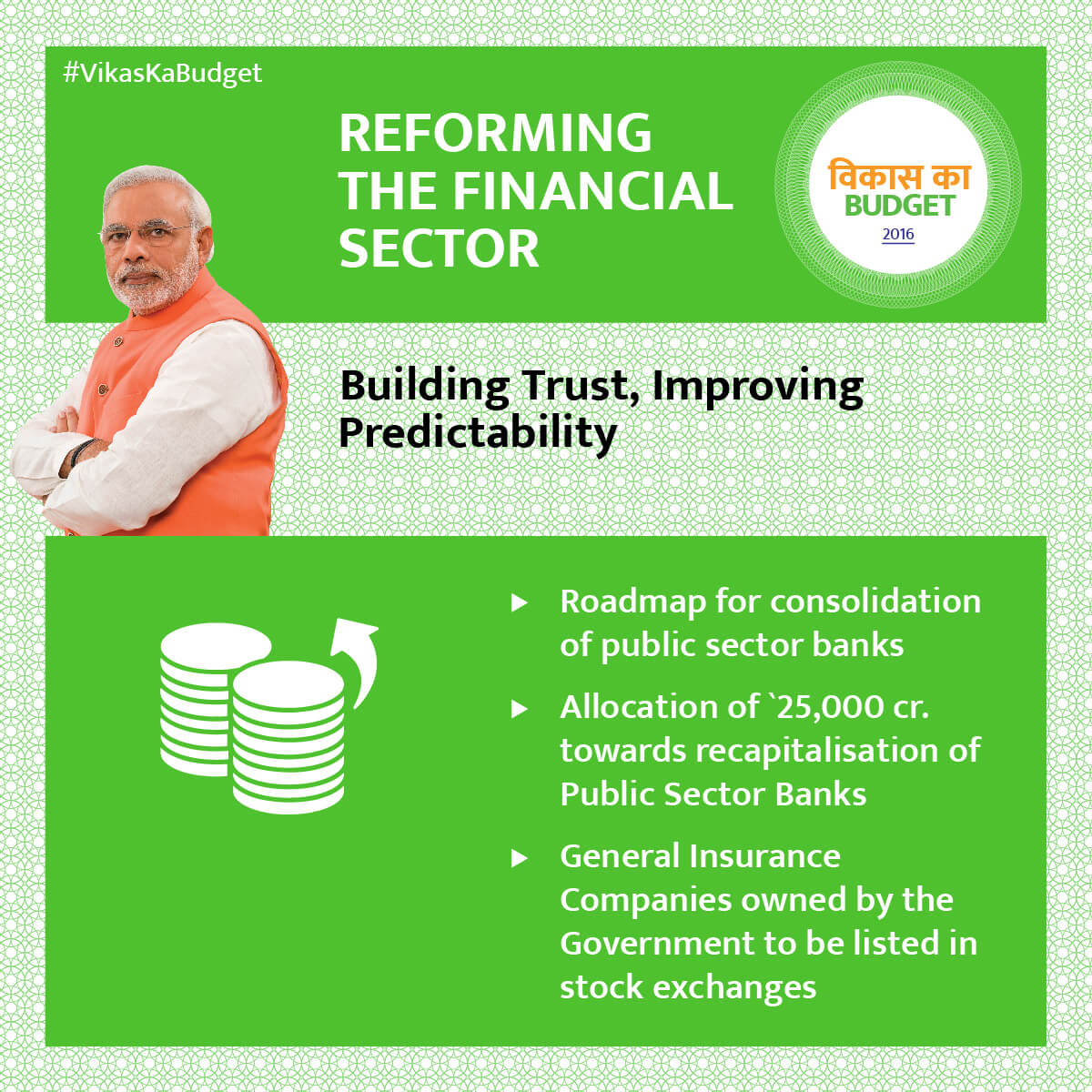
    • Rs 25,000 crore towards recapitalisation of public sector banks
    • Target of disbursement under MUDRA increased to 1,80,000 crore
    • Banking Board Bureau to be operationalised
    • General Insurance companies will be listed in the stock exchange

    budget _ finance reforms

    Focus Areas

    Monetary Policy Committee

    Govt. will amend RBI Act 1934, to provide statutory basis for a Monetary Policy Framework and a Monetary Policy Committee through the Finance Bill 2016.

    Capital Market

    • RBI will improve greater retail participation in govt securities
    • SEBI will develop new derivative products in the commodity derivatives market

    Revamping Public Sector Banks

    • Govt. to allocate Rs. 25000 crore towards recapitalization of public sector banks
    • The Bank Board Bureau will be operationalized during 2016-17
    • The Debt Recovery Tribunals will be strengthened with focus on improving the existing infrastructure for speedier resolution of stressed assets
    • Efforts are made to address structural issues in various sectors like Power, Coal, Highways, Sugar and Steel, with a focus on reviving stalled projects

    Read more about Indradhanush and PJ Nayak committee on bank reforms and do watch our video explainer on NPAs.

    Pradhan Mantri Mudra Yojana

    Govt. had launched this scheme for the benefit of bottom of the pyramid entrepreneurs. Banks and NBFC-MFIs have sanctioned about Rs. 1 lakh crore to over 2.5 crore borrowers under PMMY. Govt. has increased the target next year to Rs. 1,80,000 crore.

    Read more about Mudra bank and follow our story on Micro-finance.

    New Initiatives

    Bankruptcy code for Financial Sector Insolvency

    Govt. will introduce a comprehensive Code on Resolution of Financial Firms as a Bill, in order to provide a specialised resolution mechanism to deal with bankruptcy situations in banks, insurance companies and financial sector entities

    This code along with the Insolvency and Bankruptcy Code 2015, will provide a comprehensive resolution mechanism for our economy.

    Bill on Illicit Deposit Schemes

    Govt. will bring in a comprehensive central legislation to deal with the menace of illicit deposit taking schemes as poor and the financially illiterate are the worst-victims.

    Amendments in SARFAESI Act, 2002

    Govt. will bring necessary amendments in the SARFAESI Act 2002, tackle the problem of stressed assets in the banking sector. It will enable the sponsor of an Asset Reconstruction Companies to hold up to 100% stake in it and permit non-institutional investors to invest in Securitization Receipts.

    Financial Data Management Centre

    The centre will be set up under the aegis of the Financial Stability Development Council to facilitate integrated data aggregation and analysis in the financial sector.

    What’s Financial Stability Development Council?

    The idea to create such a super regulatory body was first mooted by the Raghuram Rajan Committee in 2008. Finally in 2010, the then Finance Minister of India, Pranab Mukherjee, decided to set up such an autonomous body dealing with macro prudential and financial regularities in the entire financial sector of India.

    Chairperson: The Union Finance Minister of India

    Post Office ATMs

    To provide better access to financial services, especially in rural areas, we will undertake a massive nationwide rollout of ATMs and Micro ATMs in Post Offices over the next three years.

    Read more about Payment Banks’ revolution.

    Listing of General Insurance companies

    The general insurance companies owned by the govt will be listed in the stock exchanges, in order to promote public shareholding in govt-owned companies as a means of ensuring higher levels of transparency and accountability.

    Read more about Reforms in Banking Sector.

    PS: Please click on the green hyperlinked text to read more about the concepts. Revise and revise & feel free to ask pertinent questions.


    Published with inputs from Pushpendra | Image: Finmin
  • Widow can’t cook for school? Here’s what a DM did to dispel the myth


    A simple act by a young IAS officer in Bihar’s Gopalganj district has set an example of how a big social change is possible even in the remotest part of rural India.

    Last week, the district administration in Gopalganj was shocked to discover that a group of local residents in Kalyanpur area had banned a widow from cooking mid-day meal in the village’s middle school.

    This, according to some villagers, was because of their perceived superstition that allowing a widow to cook meal for children would be a bad omen.

    The Gopalganj District Magistrate, Rahul Kumar, ordered the villagers to immediately stop this practice and allow the widow to resume cooking the mid-day meal.

    Kumar tweeted, “Some misled villagers opposed a widow cook and threatened to withdraw their Children from school after she was rightfully reinstated.”


    The young bureaucrat then decided to visit the village and asked the widow in question to cook meal for himself. Kumar then tweeted the photo of him eating the meal cooked by the widow, who was being ostracised by a group of ‘misled’ people.

    Kumar tweeted, “Sometimes u do symbolic things to overcome people’s beliefs. Asked the same widow cook to serve me the meal. (sic)”


    Source: Jantakareporter
  • DM ‘turns’ clerk: finds way to get 2 years’ work done in a month

    Reviewing the functioning of the lower level of administration, Patna district magistrate Sanjay Kumar Aggarwal on Sunday took to a clerk’s job and suggested method to reduce time for completing the work.

    In his two-hour visit to the legal cell of the Secretariat, Aggarwal found that 375 cases of stamp refund were pending which would take about two years to dispose.

    But, the DM, who was transferred to the state capital in December last, found a way out to cut short the time and suggested how the work could be done in a month, an official statement said.

    During the visit, the DM came across an employee who appeared over-aged while one of her certificates, alleged to be forged, stated that she was 55 years old. Aggarwal has instructed officials to constitute a medical board to verify her age, the statement said.

    Starting Sunday, the DM decided to visit different sections of district administration once a week to improve the work culture at lower level. He has also ordered Section, Block, District and Circle officers to do the same every Tuesday and review work, it said.

    Aggarwal was recently awarded by the Election Commission of India for best electoral practices during his tenure as the DM of Gaya.


    Source: HT

More posts