💥UPSC 2026, 2027, 2028 UAP Mentorship (March Batch) + Access XFactor Notes & Microthemes PDF

Search results for: “”

  • Economic Survey For IAS | Chapter 01 | Economic Outlook, Prospects, and Policy Challenges

    economic survey


    Having discussed how to read Economic Survey earlier, we now start our series on economic survey chapter by chapter. We shall follow a standard pattern across all chapters. We shall begin by highlighting ‘quotable quotes’ or observations which might not otherwise come for discussion but nevertheless very important for general understanding, general studies papers and essay. We shall then present some very basic statistics from the chapter and move to discuss broad themes of the chapter. In the end, important reading from the chapter shall be recommended.

    I have hyperlinked text with articles previously covered. So go back in time and read the articles if any doubt. Take this opportunity to revise the economy section of syllabus.

    So let’s get started

    1. It’s futile to expect “Big Bang” reforms because of two reasons
    • dispersed nature of power in India, too many veto centers
    • the absence of that impelling driver—crisis

    Note that reform of 1991 was in response to major crisis, SEBI was given statutory backing in response to major scam in stock market and recent merger of Forward Market Commission (FMC) with SEBI was also a response to major scam.

    Therefore, “persistent, creative and encompassing incrementalism” will be the key.

    2. Being pro industry and pro market or pro competition is not one and the same

    • India has moved away from being reflexively anti-markets and uncritically pro-state to being pro-entrepreneurship and skeptical about the state
    • But being pro industry must evolve into being genuinely pro competition, and the legacy of the pervasive exemptions Raj and corporate subsidies highlights why favoring business (and not markets) can actually impede competition
    • Similarly, skepticism about the state must translate into making it leaner, without delegitimizing its essential roles and indeed by strengthening it in important areas

    3. Amid the world economy which is full of turbulence and volatility, India is a refuge of stability and an outpost of opportunity
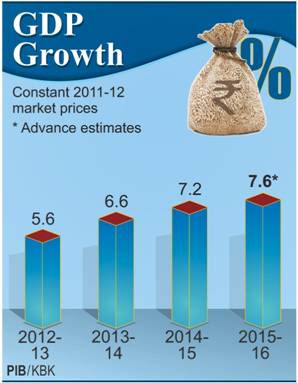
    Fastest Growing Economy
    Fastest Growing Economy


    1. Survey projects GDP growth of 7-7.75% for the financial year (FY) 17
    2. For FY16, GDP growth is estimated to be 7.6%
    3. Forex reseves have risen to >350b$

    Let’s now discuss some broad issues

    India becoming more and more intertwined with global growth

    • the correlation between India’s growth rate and that of the world has risen sharply to .42 from .2 for the period 1991- 2002 i.e. 1 % decrease in the world growth rate # 0.42 % decrease in Indian growth rates
    • India’s exports of manufactured goods and services now constitute about 18 percent of GDP, up from about 11 percent a decade ago

    Realizing long term potential growth of 8-10% requires a push on at least three fronts-

    1. Creating genuinely pro competitive market by allowing inefficient firms to exit (Chakravyuha challenge) – Govt response- new bankruptcy code, rehabilitation of stalled projects, Kelkar Committee guidelines on PPP renegotiation
    2. major investments in people— health and education- to exploit India’s demographic dividend.
    3. Don’t neglect agriculture as 42% of Indian households derive the bulk of their income from farming. Smaller farmers and landless laborers especially are highly vulnerable to productivity, weather, and market shocks changes that affect their incomes. Govt response – PM Fasal Bima Yojana

    Evolution of relative role of centre and states in the delivery of services-

    1. With increased devolution of resources (courtesy 14th Finance commission), states need to expand their capacity and improve the efficiency of service delivery.
    2. shift the focus from outlays to outcomes, and to learn by monitoring, innovating, and even erring.
    3. the Centre should focus on improving policies, strengthening regulatory institutions, and facilitating cooperative and competitive federalism
    4. while the states mobilize around implementing programs and schemes to ensure better service delivery

    How does competitive federalism help?

    Ease of Doing Business in States
    Ease of Doing Business in States


    States that perform well are increasingly becoming “models and magnets.”

    • Successful experiments in one state are models for others states to emulate by showing what can be done and stripping away excuses for inaction and under-performance.
    • They are also magnets because they attract resources, talent and technology away from the lagging states, forcing change via channel of exit.

    Twin Balance Sheet Challenge

    What are twin balance sheets – Bank balance sheet and corporate balance sheet

    Basically both are interlinked, as asset on bank balance sheet is liability on corporate balance sheet and if corporate does not repay debt, asset turns bad (Non Performing Asset or NPA) and both balance sheets get stretched. It results in banks not lending and corporate not investing resulting in vicious circle.

    Solution-

    What has been done so farIndradhanush scheme, Strategic Debt Restructuring (SDR) scheme, 5:25 scheme

    What needs to be done– 4Rs

    1. Recognition-  Banks must value their assets as far as possible close to true value i.e. recognize NPAs as NPAs
    2. Recapitalization–  capital position must be safeguarded via infusions of equity
    3. Resolution– the underlying stressed assets in the corporate sector must be sold or rehabilitated
    4. Reform–  future incentives for the private sector and corporates must be set right to avoid a repetition of the problem

    But where would resources for recapitalization would come from given that government is committed to the path of fiscal consolidation?

    1. Divest govt. equities in non financial companies and invest in PSBs
    2. Dilute RBI’s capital to capitalize banks
    3. govt can dilute its equity in banks to raise resources from the market

    What should be the stance of fiscal consolidation?

    Revised FRBM Target
    Revised FRBM Target


    Learn Various types of Budget Deficits here- Budget Deficits Explained

    Govt announced revised FRBM timeline last year with fiscal deficit target of 3.9% for FY16 and 3.5% for FY17. In this context question arises whether or not we remain committed to the same path of fiscal consolidation.

    Arguments for accelerated fiscal consolidation

    1. debt ratio of the consolidated government (Centre plus states), 67 per cent of GDP is high compared to some countries in Emerging Asia
    2. would reinforce govt’s credibility
    3. also why such a commitment should be abandoned when the economy is growing at more than 7 per cent
    4. Higher deficits may increase short term interest rates and thus hurt corporate investment and increase govt spending on interest

    Arguments against-

    1. 7th Pay commission award will increase expenditure by about .5% of GDP, to maintain same fiscal deficit, govt might need to slash capital expenditure
    2. Public investment may need to be increased further to address a pressing backlog of infrastructure needs
    3. current global environment is fraught with risks and India should not take chances against growth

    In this context it is important that government utilizes resources available to it to increase capital expenditure in roads, railways, ports etc which increases overall productivity and competitiveness of economy.

    Update- Government chose prudence and stuck to fiscal deficit target of 3.5% of GDP in the budget announced today.

    India and WTO

    WTO


    Two issues in agriculture-

    1. Special safeguard mechanism (SSM) which came for discussion in Nairobi ministerial meeting . The question which arises is whether India even needs such protection
    • We are already allowed tariff  from 40 per cent to 100 per cent (India’s modal rate in agriculture) to 150 per cent.
    • In a preponderance of tariff lines, there is a considerable gap between applied tariffs and the level of tariff binding
    • India’s only real need for SSM arises in relation to a small fraction of its tariff lines—some milk and dairy products, some fruits, and raw hides—where its tariff bindings are in the range of about 10-40 percent, uncomfortably close to India’s current tariffs, limiting India’s options in the event of import surges

    India should call for a discussion of SSMs not as a generic issue of principle but as a pragmatic negotiating objective covering a small part of agricultural tariffs.

    2. Food security/ stockholding issue

    • The particular policies (MSP) which are being defended are those that India intends to move out of in any case because of their well-documented impacts:
    • decline in water tables, over-use of electricity and fertilizers (causing health harm), and rising environmental pollution, owing to post-harvest burning of husks
    • the government is steadfastly committed to providing direct income support to farmers and crop insurance which will not be restricted by WTO rules

    The way forward in WTO on agriculture

    India should consider offering reduction in its very high tariff bindings and instead seek more freedom to provide higher levels of domestic support: this would be especially true for pulses going forward where higher minimum support prices may be necessary to incentivize pulses production

    India’s “big-but-poor” dilemma

    • India’s self-perception as a poor country translates into a reluctance to recognize and practice reciprocity (give-and-take) in trade negotiations
    • India’s policies have a significant impact on global markets and it has become a large economy in which partner countries have a legitimate stake in seeking market access

    Net effect- India is unable to play reciprocal game in trade negotiations and WTO is fast becoming irrelevant (not good for India)

    Cost of reluctant engagement-

    • India is excluded from Trans Pacific Partnership (TPP) and it is shaped in a way that do not take into account India’s important interests (the rules on intellectual property)
    • If and when India joins, it will be not on India’s terms but on terms already cast in stone, terms that India could not influence because of being perceived as not engaged fully

    What should be India’s response-

    We should use our growing markets as leverage to attain our own market interests abroad, including the mobility of labor and engage in reciprocal game to strengthen WTO.

    How should trade policy deal with ongoing stress?

    Chinese dumping, weak global environment, protectionist measures abroad, beggar thy neighbor policies etc .

    Broad principle- resist calls to seek recourse in protectionist measures, especially in relation to items that could undermine the competitiveness of downstream firms and industries. For instance– imposing higher duty on imported steel hurts domestic manufacturers such as cycle manufacturers and lead to inverted duty structure.

    Three sets of responses-

    1. Exchange rate. Keep rupee’s value fair, avoid strengthening using some combination of monetary relaxation, allow gradual declines in the rupee if capital flows are weak, intervention in foreign exchange markets if inflows are robust.
    2. India should strengthen procedures that allow WTO-consistent and hence legitimate actions against dumping (anti-dumping), subsidization (countervailing duties), and surges in imports (safeguard measures) to be taken expeditiously and effectively.
    3. India should eliminate all the policies that currently provide negative protection for Indian manufacturing and favor foreign manufacturing. Implement GST asap.

    What you have to read for yourself-

    1. All the boxes- read especially Box 1.5: El Niño, La Niña and Forecast for FY 2017 Agriculture
    2. Open all the hyperlinks. Learn, understand and revise.

    Ask all your doubts in the comment section below or in doubts clearing forum . all your suggestions, criticism and feedback is most welcome.

    Suggested Reading

  • 2016 Budget for dummies – Easy explanation (with no jargons)

    1) 60 per cent of provident fund withdrawals will be taxed from April 1, 2016, according to Budget 2016. Currently, withdrawals from Employee Provident Fund are completely exempt from income tax. (Negative for middle class)
    2) Total allocation for agriculture sector has been hiked to Rs. 35,984 crore. (Positive for agrarian sector)
    3) Thumbs up for MGNERGA: Government will spend a record Rs. 38,500 crore on rural jobs programme (MGNREGA). Rural road development schemes will get Rs. 19,000 crore, while another Rs. 20,000 crore will be used to fund irrigation schemes. (Positive to address rural stress as well as to create purchasing power in rural economy)
    4) The finance minister allocated Rs. 2.21 lakh crore for building road and rail infrastructure. (Positive for everyone)
    5) A new amnesty scheme for those holding unaccounted money and assets has been announced. Those declaring undisclosed income under this scheme will have to pay 45 per cent tax. (Negative for honest taxpayers. Also non-starter as nobody is going to pay 45% tax on black money)
    6) some good changes in dispute redressal mechanism in income tax. (positive for taxpayers but negative for CA/Lawyer)
    This budget is good combination of NDA and UPA policies. NDA has adopted AADHAR and MGNREGA with full covictions in this budgets. Trust this will give pro people (marginal population) direction to policies of the government.

  • Vikas ka Budget | Key points from the Ministry of Finance – 2016

    It is true that the Budget could be difficult to understand. Sarkar just made it easier for you to know how your tax-money is being spent. Try evaluating whether your Government is doing enough.

    This time, we were pleasantly surprised to find the lengths to which the Ministry of Finance has gone to make it easier for everyone to understand the Budget.

    What’s in it for me!

    #1. How does it helps a farmer, Khem Lal Khushwaha?


    #2. How does it helps a daily wage labourer, Mohan Patel?


    #3. How does it helps a student, Shushmita?


    There are a few more character sketches and a lot more variations across sectors/ benefits at the Finmin website. Do check out the Vikas ka budget – click here.

    If you have any questions (however basic), feel free to drop them here.

    Source: Finmin.nic.in
  • 9 important takeaways from Union Budget 2016

    The budget focuses its efforts on what needs fixing – the rural distress, the jobs problem, the banking crisis, and infrastructure deficit.


    As you prepare for your IAS examination in 2016, keep these recurring themes in mind! Even government is waking up to take them seriously.

    First, the budget sticks to the fiscal deficit roadmap and promises to bring down the deficit to 3.5 percent in 2016-17. Read more on this, click here.

    Second, the corporate sector has been let down, with the promised reduction in corporate taxes restricted to small and new companies. To know all about taxes and ease of doing business, click here.

    Third, the most exciting idea is the introduction of a tax amnesty scheme for domestic black money or undeclared incomes. Black money holders have to pay 45 percent tax – a penalty about 10 percent more than normal – to get immunity from questioning and penal action.

    Read all about black money and the economics around it, click here.

    Fourth, the big numbers are in infrastructure investment. Between railways and roads, both national highways and rural roads, the total investment in 2016-17 will be a massive Rs 2,18,000 crore – this should be a stimulant for jobs and investment. We have been following up developments in this sector for the year round. Click here.

    Fifth, the organised sector is being incentivised to take on more employees with the centre offering to pay the 8.33 percent pension contributions of new employees for three years.

    Sixth, the budget lowers the axe on rich promoters, who have benefited from the fact that dividend tax is paid by companies. They thus got a benefit not intended for the rich. Not any more. Promoters and big shareholders will now face 10 percent additional tax when dividend payments exceed Rs 10 lakh.

    Seventh, the bottom end of the middle class gets some relief. Taxpayers in the sub-Rs 5 lakh income bracket will get a tax rebate of around Rs 3,000. Two crore taxpayers will benefit.

    Eight, there is a strong financial sector angle in the budget. Jaitley has proposed a strong exit policy which will involve legislating the Indian Financial Code, the Bankruptcy Code and quicker disposal of debt recovery cases in debt tribunals.

    Follow up the developments of 2015-16, click here.

    Ninth, the big pitch was to the rural and farm sector. The FM promised Rs 2.87 lakh crore of fiscal transfers to villages, and all villages will be electrified by 2018. This government obviously believes in doing things in mission mode. After Jan Dhan, now it is time for full electrification and taking cooking gas to all rural households.

    Source: SwarajyaMag | Image: India.com
  • International Org. | Part 3 | SCO & India

    This post is a part of an ongoing series to help IAS aspirants prepare for International Relations.

    As of July 2015, India has been accorded full membership of the Shanghai Cooperation Organisation (SCO) along with Pakistan at its Ufa summit held in Russia.

    • SCO is a Eurasian economic, political and military organisation
    • HQ: Beijing, China
    • Established: 2001 in Shanghai by the leaders 6 countries viz. China, Kyrgyzstan, Kazakhstan, Russia, Tajikistan, and Uzbekistan
    • Since 2005, India was having an Observer status of SCO and had applied for full membership in 2014. India would be finally ratified in the member list by 2016

    Connecting the dots with SCO

    Per Chinese and Russian scholars, creation of SCO helped address the security problems and enhance economic cooperation in the Central Asia region. The Western discourse, however, has tended to see the SCO as a mechanism to counter-balance the influence of the United States in the region. Both are correct!

    SCO is considered and tagged as anti-west. Behind the veils, it is alleged that SCO is going to be a NATO like military alliance in East. You might expect a question on that line and be asked to put India’s context in place.

    However, China exaggeratedly says that the SCO was founded on a principle of non-alignment and functions as an effective stabilizer for regional security and peace. China has always maintained that the focus of SCO is on combating the “three evil forces” – terrorism, separatism, and extremism – and other unconventional security menaces.

    Advantage India?

    There are multiple benefits for India as well as the SCO which is concerned with security and stability in the Eurasian space.

    1. India’s presence will help moderate the anti-West bias of the grouping, which will calm Washington’s nerves to a considerable extent
    2. Greater engagement with India will also aid the organisation’s capability to improve regional economic prosperity and security
    3. Membership will give India an opportunity to play an active role in China’s Silk Road initiative which plans to link a new set of routes from the north and east of the country to an old network of routes in the greater Eurasian region.
    4. Indian interest in International North-South Transport Corridor to connect Mumbai with Abbas port in Iran. This route is shorter than the existing Suez Canal and the Mediterranean Sea
    5. SCO may also serve as guarantor for projects such as the Turkmenistan-Afghanistan-Pakistan-India (TAPI) and Iran-Pakistan-India (IPI) pipelines, which are held by India due to security concerns.

    India’s entry is also likely to tip the balance of power in favor of peace and stability in Afghanistan.

    Challenges ahead for SCO?

    It is naive to expect that India’s differences with China regarding the border or its ties with Pakistan will magically disappear. The inclusion of Pakistan in the SCO will also make it difficult for India to enjoy a level playing field.

    Pakistan, which is embroiled in a domestic political crisis, may not be so willing to challenge hardliners in its country, and go along with India in promoting peace and stability in the Eurasian space. We have seen how Indo-Pak presence in SAARC makes it difficult to ink key pacts.

    The clash of interests in a post – 2014 Afghanistan makes prospects of cooperation difficult. There is also a possibility that China may collude with Pakistan to suffocate India’s voice in the decision making process.

    Other than that, India will have to balance the geopolitical ambitions of China and Russia to evolve a mutually beneficial framework.


    Further readings:

    SCO becomes a reasonably hot topic post India’s accession to the member status. If you are comfortable with IR, try these articles  –

  • International Org. | Part 2 | SAARC (30+ years in existence)

    We discussed MGC and BIMSTEC in the last post here. We covered both of them in one single post and there is a reason for it.

    Rule of thumb for assigning importance to an organisation (for IAS Mains or Pre)

    • Who are the participating countries? Are they heavyweights?
    • Any observers? When an international organisation catches interest, lot of countries line up for an observer status. This is a litmus test for the growing importance and credibility of an organisation because the world is starting to take notice!
    • Was the organisation in news recently? A mild yes? Prelims worthy. If embroiled in some controversies (prolonged dialogues), then Mains worthy!

    As of Feb 2016, MGC has 6 member countries & 0 observers. BIMSTEC has 7 member countries & 0 observers.

    But our next guest – SAARC, has  8 member countries and 9 observers (including China, US, EU, Japan).

    The South Asian Association of Regional Cooperation (SAARC) completed 3 decades of its existence in 2015. While it is impossible to compress its evolution in a single post, we will do well to get you upto speed and be aware of the major controversies surrounding SAARC (analysis, analysis and more analysis).

    When? 1985

    Origins:

    Member countries – Bangladesh, Bhutan, India, Maldives, Nepal, Pakistan, and Sri Lanka. Afghanistan joined SAARC as its eighth member state in April 2007.

    Observers – States with observer status include Australia, China, the European Union, Iran, Japan, Mauritius, Myanmar, South Korea and the United States

    After independence, the countries of South Asia, which under British colonial rule, functioned like a composite whole that had both transport linkages and economic inter-dependence, wanted to portray a more independent image.

    They began functioning as autonomous economic units with protective trade regimes for the fear of political, economic autonomy in the region. These countries were often mired in bilateral conflicts (Indo – Pak, Pak – B.Desh) and that took a toll on region’s growth and prosperity. Hence, SAARC charter was build around a common goal of improving the foreign relations within the region.

    As a founding philosophy, SAARC prudently kept bilateral contentious issues out of the scope of the regional cooperation. It was believed that the inclusion of bilateral issues would hamper multilateral initiatives. SAARC was not set up as a bilateral dispute settlement mechanism. Did that really help evolve SAARC into a better organisation? We shall see.

    Why do nations come together to form groupings?

    Short answer – Economics & power struggle!

    Long answer

    1. Nepal – had difficulties with India on various issues. Harnessing Nepal’s river water was one of the key considerations. Nepal wanted to diversify technical cooperation on hydroelectricity with other countries (to avoid complete dependence on India)
    2. Bangladesh – Another country which was suspicious of India and wanted to diversify its foreign relations. At that time Bangladesh had serious problems with India on the issue of the sharing of the Ganga water. Even though bilateral struggles were kept outside the purview of SAARC, Bangladesh had a hope to become a major player in the region
    3. Sri Lanka – was initially reluctant to join SAARC. However, due to its own ethnic crisis it became interested in the association expecting it would help assuage some of its apprehensions regarding India
    4. Pakistan – Only one goal – counter India’s influence
    5. Bhutan & Afghanistan – Let’s leave them for time being!

    Feel good about India’s overarching influence in the region for a moment.

    What were the mandates for SAARC and how far has it come to fulfill them?

    The SAARC Charter clearly lays down that cooperation among member-states will be based on sovereign equality, territorial integrity, political independence and non-interference in internal affairs.

    The Charter further states that such cooperation will not be an obstacle to other bilateral or multilateral cooperation or be inconsistent with them.

    Brings us back to the point that SAARC chose to keep bilateral disputes out of discussion and focus on the multilateral (economic, strategic) issues. This did not always work in its favour. Smaller member countries often found it difficult to overcome their political goals and limited national agendas. This often stalled progress.

    Want to read about one such issue with SAARC?

    How does SAARC carries on with its activities?

    On the administration side, the SAARC Secretariat established in Kathmandu is supported by Regional Centres established in Member States. They are quite a few and not so relevant for your exam prep. Suffice to say that, SAARC members are supposed to meet every year (Annual Summits).

    In the last 30 years, we have witnessed 18 summits. The last one was held at Kathmandu in 2014 and the motto was – ‘Deeper Integration for Peace and Prosperity’.

     The 19th SAARC summit is to be held in Pakistan sometime in 2016.

    How did the 18th Summit (2014) go?

    1. The theme of the summit was “Deeper Integration for peace and prosperity.” But member countries failed to sign two major agreements on rail and road connectivity
    2. The pact on energy was signed though! This will enable greater cooperation in the power sector
    3. Why were the rail and road connectivity agreements not signed? Pakistan held back, saying it still had to complete its “internal processes” regarding these pacts
    4. Any new initiative proposed by India? 
      • India promised to launch a satellite for the region by SAARC Day in 2016
      • Set up a Special Purpose facility in India to finance infrastructure projects in the region
      • Ease business visas by launching a SAARC business traveller card
      • Suggestions for establishing a SAARC regional Supra Reference laboratory to fight common diseases (TB, HIV)

    China’s intrusion into SAARC?

    1. Pakistan called for a more prominent role for observers in the future—mostly China
    2. Nepal and Sri Lanka also support this, and China itself is actively seeking a greater role in SAARC
    3. India responded by saying that economic cooperation between the existing members must be strengthened before expanding membership. Close shave!

    Comparing ASEAN with SAARC

    #1. SAARC is a lost cause – The motivation for launching these two forums – ASEAN (for south east asia) & SAARC (for south asia) were almost similar. Both were guided by a common hope to resolve disputes and a thirst for economic growth.

    Asean members had serious interstate disputes which they decided to forget. On the other hand, Saarc members insisted that disputes be resolved first, before economic cooperation could start. Asean nations were inclined to be trading nations; Saarc nations were inclined to be warlike. Asean moved to conflict-avoidance mechanisms; Saarc refused to discuss bilateral disputes.

    Saarc had to suffer an Indo-Pakistan war at Kargil started by Pakistan in 1999, which prevented three Saarc summits from taking place. India has given Pakistan the most favoured nation status but Pakistan has not reciprocated.

    #2. It’s unfair to compare SAARC with ASEAN – The ASEAN countries did not have contested ideologies, such as the one based on two-nation theory (Indo-Pak). The countries comprising ASEAN came together to defend themselves from the communist threat. Such external threat was absent in the case of SAARC. Rather as you see above, India was considered as a threat by some member countries.

    Fair enough! Let’s move to the economics of SAARC.

    South Asia Free Trade Agreement (SAFTA) and the complexities surrounding it

    New to FTAs/ PTAs/ trade agreements in general? Read about the different types of trade agreements.

    Safta was signed by the South Asian Association of Regional Cooperation (SAARC) countries in January 2004, in Islamabad. The agreement was a migration from SAPTA to SAFTA (Preferential to Free).

    India allows duty-free access to goods from Sri Lanka, Nepal, Bhutan and Bangladesh.We also reduced the ‘sensitive list’ it maintains for these countries to 25 items.

    South Asian countries in general have competitive economies. The trade structure is mostly tilted towards primary goods. The countries of the region in general target their finished goods to foreign markets. Primary products are goods that are available from cultivating raw materials without a manufacturing process.

    SAFTA was expected to bring down illegal trade

    It was expected that SAFTA would bring much of the illegal trade in the region to the official level boosting all-round regional trade figures. Due to the lowering of tariff, many of the high custom duty items that are smuggled would become part of official trade. But that did not happen (to the satisfaction).

    As reality would have it, SAFTA faces an existential dilemma

    1. The volume of trade in actual terms (between SAARC nations) could is very small
    2. Intra-regional trade is still at a dismal 5% — compared to 66% for the EU and about 25% for the ASEAN. Read more – here
    3. The countries of South Asia have long negative lists and their protective trade regimes inhibit free flow of goods. Negative lists = lists of items kept outside the purview of agreement
    4. Such obstacles and restrictions have given rise to smuggling and unofficial trade
    5. The ‘rule of origin’ is a problematic clause since there are no efficient mechanisms to monitor and certify goods originating from the member countries

    What’s the silver lining for SAARC?

    Thankfully, with India pursuing its “Act East policy” with a new vigour, all is not lost. If you have been a regular with the Civilsdaily App’s Newscards, we have been closely following Indo-SAARC updates:

    If you have 20 minutes to spare, watch this RSTV sponsored discourse on 30 years of SAARC


    This post is a part of an ongoing series – An IAS Aspirant’s guide to cracking International Relations

  • International Org. | Part 1 | Mekong Ganga Cooperation and BIMSTEC

    This post continues from the series on International Relations for IAS Prep. Read the essential posts here –

    Of late, UPSC has developed a knack of asking factual questions involving India’s membership status/ important reports/ foundation year etc. Here’s a quick mind map to set you up with bare basics of the asia region. We will cover each and every one of them in great detail to help you understand their origins and evolutions (wrt. India).


    #1. Mekong Ganga Cooperation (MGC)

    When? 2000

    Origins: An initiative by 6 countries – India and 5 ASEAN countries, namely, Cambodia, Lao PDR, Myanmar, Thailand and Vietnam

    Relevance and Evolution

    Both the Ganga and the Mekong are civilizational rivers, and the MGC initiative aims to facilitate closer contacts among the people inhabiting these two major river basins. Key areas of cooperation under MGC were tourism, culture, education, and transport & communications.

    Despite ASEAN’s rhetoric and posturing, it remains a weak organisation incapable of handling serious challenges, economic or strategic. There has been a proliferation of trade groups carrying many (confusing!) acronyms.

    With India’s elevated status in ASEAN by 2012, the time is ripe to enter the Mekong Region. Apart from reinforcing India’s security, it will remove economic isolation of the North East Region (NER).

    There is a lack of connectivity between India, Myanmar and beyond and hence a need to build connecting corridors. Unlike the European Union, with nascent Asian economies we have to follow the “hub and spoke” process which impedes in the trade process.

    Latest developments:

    India hosted the 6th MGC Ministerial Meeting on September 4, 2012. New Areas of Cooperation added in the 6th MGC –

    1. Conservation of Rice GermPlasm – A new area of mutually beneficial cooperation in rice production techniques and downstream processing projects
    2. Enhancing cooperation among SME – India circulated a concept paper
    3. Health – Aim is to strengthen the region’s capacity to respond to the menace of drug resistant malaria and other such emerging public health threats
    4. Common Archival Resource Centre (CARC) at Nalanda University

    #2. Bay of Bengal Initiative for Multi-Sectoral Technical and Economic Cooperation (BIMSTEC)

    When? 1997 | HQ: Dhaka, Bangladesh

    Origins: BIMSTEC started off as the Bangladesh, India, Sri Lanka, Thailand Economic Cooperation Group in 1997. Myanmar joined in 1997, while Nepal and Bhutan joined in 2004 when the first summit was held in Bangkok.

    Relevance and Evolution

    BIMSTEC is said to have been encouraged by India’s Look East Policy (LEP) and Thailand’s Look West Policy.

    BIMSTEC was seen as a vital bridge between SAARC and ASEAN. Myanmar and Thailand are already in ASEAN while Japan is Thailand’s second-biggest export destination.

    But in the present context, when the members of BIMSTEC have acquired memberships in various other regional/sub-regional organisations which also promote cooperation at different levels, it might not end up being that fruitful an organisation (that it was intended up to be).

    BIMSTEC identified 14 priority areas where a member country takes lead. India is lead country for – 

    • Transport & Communication
    • Tourism
    • Environment & Disaster Management
    • Counter Terrorism & Transnational Crime

    Advantage India?

    Pakistan and China do not form member countries and this grouping provides India an opportunity to increase its sphere of influence.

    India should be more proactive towards BIMSTEC to make its LEP 3.0 a success. BIMSTEC could help India to further increase its cooperation with countries located around the Bay of Bengal along with two of its adjuncts, namely Malacca Straits and Andaman Sea.

    Transport & Communication being one of the priority focus areas – Better integration with North East region & East Asian economies is a theme to look forward to.

    What has India done for BIMSTEC?

    India and Thailand are the two main (rich) partners of BIMSTEC. With Thailand mostly embroiled in controversies, India is looked upon to take a lead and act as a catalyst. Remember the lead areas with India? Transport, Tourism, Environment  & Terrorism.

    The last meeting (3rd Summit) @Nay Pyi Taw (New Capital of Myanmar) did not see any major outcomes, but a few of worth of mentioning here are –

    1. 2015 was declared as the Year of BIMSTEC Tourism
    2. The framework agreement on the BIMSTEC FTA was signed in 2004, but it is not yet fully operational. Read more here
    3. Ratify conventions related to other areas of responsibilities

    TIP: Whenever you think about the advantage of our associations with our north eastern neighbouring countries, think of two things –

    1. Transportation woes
    2. Fighting crime syndicates (terrorism, smuggling, narcotics and what not)

    Consequently, our associations with them will look to establish new roads, routes and pacts to counter them. Of course, there is a lot in common with culture and agricultural produce etc etc. but you get the bigger picture right?

    One such project is Kaladan Multi-modal Transit Transport Project in Myanmar. It was supposed to be completed by 2015, but sigh.

    Time to Energize BIMSTEC

    How long can SAARC (30+ year old organisation) wait for India and Pakistan to sort out their bilateral issues and push forward for the broader agenda of regional economic cooperation?

    Given the current state of India-Pakistan relations, it is unlikely that Pakistan will agree to even a minimal set of economic cooperation arrangements within the SAARC framework, as was evident in Kathmandu when it refused to sign the multi-modal road and rail transport agreement. (Source – The Diplomat).

    The most important driver is going to be the BIMSTEC Free Trade Area. While a Framework Agreement has been signed, it has yet to come into force. What is FTA? Read this post on trade agreement first. 

    Point being that India needs to reallocate its priority with the new surge @ Act East and get the best out of these regional groupings where it can play a natural leader.


    UPSC ke sawaal

    #1. In the Mekong-Ganga Cooperation, an initiative of six countries, which of the following is/are not a participant/ participants? (Pre 2015)

    1. Bangladesh 
    2. Cambodia 
    3. China 
    4. Myanmar 
    5. Thailand

    Select the correct answer using the code given below.

    (a) 1 only  (b) 2, 3 and 4  (c) 1 and 3  (d) 1, 2 and 5

    #2. “Compared to the South Asian Trade Area (SAFTA), the Bay of Bengal Initiative for Multisectoral Technical and Economic Cooperation Free Trade Area (BIMSTEC FTA) seems to be more promising.” Critically evaluate. (Mains 2011)


  • Economics | Current Account Deficit Explained

    Countries trade with one another to buy goods not produced in domestic economy. With the advent of globalization, investment to and fro have also increased many fold. A country’s trade and other economic exchanges with the world are recorded on its external account in the form of balance of payment (BoP) transactions.

    There are two components of BoP

    1.  Current Account
    2.  Capital Account

    Let’s understand about these 2 accounts in detail and analyse what happens in case of deficit or surplus in any of the accounts.

    #1. Current Account – It deals with current, ongoing, short term transactions like trade in goods, services (invisible) etc. It reflects the nation’s net income.

    For instance, if you a buy a laptop from US, it will be a current account transaction and it will be debit on current account as you have to pay to US.

    There are 4 components of Current Account-

    1. Goods – trade in goods
    2. Services (invisible) – trade in services eg. tourism
    3. Income – investment income
    4. Current unilateral transfers – donations, gifts, grants, remittances

    Note that grants might appear as component of capital account but are included in current account as they are unilateral, create no liability. Recipient does not have to give anything back in return.

    #2. Capital Account – It deal with capital transactions i.e. those transactions which create assets or liabilities. It reflects the net changes in the ownership of national assets.

    For instance, if you buy a stocks or property in US, it will be a capital account transaction and it will be debit on capital account as you have to pay to US to buy the asset.

    Components of Capital Account

    1. Foreign Direct Investment (FDI)
    2. Foreign Portfolio Investment (FPI)
    3. External Borrowings such as ECB
    4. Reserve Account with the Central Bank

    Note here that foreign investment is under capital account but dividends and income from investment comes under current account in the category income from abroad as dividend is transferred periodically, does not result in creation of asset or liability.

    Balance of Payment (BoP) = Current Account + Capital Account = 0

    Why?

    Current Account and Capital Account always balance each other because a country always has to pay for its imports. It does so by exports or other two components of current account. If it can not, it runs deficit on current account and has to pay off by drawing off on its assets i.e. running capital account surplus.

    What is Current Account Deficit?

    • It’s simply deficit on all 4 components of current account.
    • (Export – Import) + Net income from abroad + Net Transfers
    • (Export – Import) is trade deficit
    • CAD = Trade Deficit + Net Income From Abroad + Net transfers

    Note that Trade Deficit and CAD are not one and the same. Trade deficit is only a component of CAD.

    What does deficit on Current Account imply?

    If we forget income and transfers for a moment, what it means is that we import more than what we export.

    How do we pay for that extra import?

    Either we get more foreign investment (FDI & FII) and pay via that or we borrow from foreign banks (ECB) or we will have to dip into our external reserves to pay for that amount and in the process our forex reserves come down. When forex reserves come down below a critical level, country appears on the brink of BoP crisis.

    So, is CAD such a bad thing?

    Depends on what you do with those extra imports and how you finance the deficit!

    CAD is bad because –

    1. If a CAD is financed through borrowing, it is unsustainable because borrowing lead to high interest payments in the future
    2. Attracting capital flows (hot money, FII) to finance the deficit is risky as when confidence falls, hot money flows dry up, leading to a rapid devaluation and crisis of confidence. Eg. East Asian Crisis
    3. Run a CAD necessarily means running a surplus on the capital account. This means foreigners have an increasing claim on your assets, which they could redeem any time

    However a current account deficit is not necessarily harmful

    1. CAD during a period of inward investment particularly stable long term FDI may not be a bad things as investment can create jobs. Investments will lead to higher growth will be able to pay debts back
    2. Developing countries may use CAD to buy Capital goods and later export consumer goods and thus repay the debt

    Moderate current account deficit (2% of GDP) financed mainly by stable foreign investments which creates jobs and infrastructure in the economy can be helpful in the long run as it improves productivity.

    What is this twin deficits?

    Current Account Deficit and Fiscal Deficit together are knows as twin deficits and often both reinforce each other i.e. High fiscal deficit leads to higher CAD and vice versa.

    Now it’s time to answer a few questions-

    #1. which of the following constitutes/constitute the Current Account?

    1. Balance of trade
    2. Foreign assets
    3. Balance of invisibles
    4. Special Drawing Right

    Select the correct answer using the code given below.

    1. 1 only
    2. 2 and 3
    3. 1 and 3
    4. 1, 2 and 4

    #2. The balance of payments of a country is a systematic record of

    1. all import and export transactions of a country during a given period of time, normally a year
    2. goods exported from a country during a year
    3. economic transaction between the government of one country to another
    4. capital movements from one country to another

    #3. Which of the following constitute Capital Account?

    1. Foreign Loans
    2. Foreign Direct Investment
    3. Private Remittances
    4. Portfolio Investment

    Select the correct answer using the codes given below.

    1. 1, 2 and 3
    2. 1, 2 and 4
    3. 2, 3 and 4
    4. 1, 3 and 4

    Want to read more –

    1. Budget Deficits Explained 
    2. GDP Calculation 
    3. Beggar thy neighbour
  • How to read the Economic Survey – Part 2

    economic survey


    Having already discussed how to best read volume one of economic survey,  I shall now discuss, what to focus on and what to leave in the volume two of this amazing document.

    Those who haven’t read part one, don’t move ahead without reading part one – How to read the Economic Survey

    At the very outset let me tell you that volume two is not that interesting and is full of facts and figures and not much of analysis. Hence only selective reading is recommended.

    There are nine chapters in volume two which basically cover happenings in the economy during last one year with some forward guidance. Chapters are pretty longish with most of them crossing 20 pages (only 9-13 pages in volume one).

    Chapter one gives broad overview of the economy and glimpses of what to expect from the subsequent chapters. After that there are chapters on fiscal policy, monetary policy, external sector, agriculture, economy and services, climate change and human development. As I have already mentioned, there’s not much of analysis and most of the chapters make for very boring reading and not much important for examination.

    There’s only one chapter which I would recommend you to read line to line, for every word is a virtual gold mine and that chapter is chapter eight, climate change and sustainable development. Please note down important points and try to understand the analysis of double counting of aid as climate finance, why CDM market is down and various issues associated with green finance.

    What else to study?

    1. As mentioned in the part one, boxes are important. But in this volume many boxes are rubbish. I am highlighting not to be missed boxes, rest you can skim through. Box 1.1, 2,3, 3.2, 3.3, 3.4, 3.5, 4.1(very imp), 4.2, 4.3 (very very imp), 5.1, 5.2, 6.1, 6.2 (very imp), 6.4 (imp), 6.5, 6.6, 7.1 (read), 7.2 (only first part related to medical tourism), 9.2.9.3
    2.  Following selected portions are recommended for line to line reading
    • Pathways to productivity in agriculture in chapter five from 5.26 to 5.61,
    • Tourism including medical tourism in chapter seven from 7.25 to 7.29
    • Issue of women employment, unpaid work and care economy in chapter nine from 9.5 to 9.23
    • Draft bankruptcy code on page no. A 4 of statistical appendix

    What else is important in volume two?

    Authentic data about GDP growth, share of agriculture, industry and services in GDP and employment, savings, investment, gross fixed capital formation, major export and import items, major trading partners etc.

    Data is dispersed in the survey so, let us make it easier for you. We will bring to you all the important data at one place as we cover economic survey chapter by chapter. In the meantime, start reading volume one from cover to cover for as I said before, they could be the best 150 pages you would ever read for exam purpose.

  • An Advance Letter to the Batch of 2017

    Dear Batch of 2017,

    Before I begin, let me convey my heartfelt wishes to each one of you.

    Heartiest congratulations to you for making it through one of the toughest examination against all odds, against all failures and against all hopes of those who thought you cannot do it!

    So, how are you all doing this morning?

    I know it is quite chilly these days in Mussoorie but then you have to blame yourself for being the brightest among the bright and deserving a seat here in this auditorium of LBSNAA.

    Just the other day when you all turned up for registration at the Academy, I had a chance to interact with few amongst you and the otherwise cursory introduction drifted into the stories of your struggles, your perseverance and your unflinching resolve to be here. And though unprecedented for an induction programme but that is exactly what I am going to talk about here today.

    Let me begin with the story of the one amongst you who was conveniently labelled a non-performer, a good-for-nothing fellow who had already flunked at the Mains thrice but still would not stop himself from working even harder. And finally this year he did it. He did it because, he had no other choice but to do it. It did not matter that he was not an IITian. It did not matter that he belonged to a remote village where electricity is a privilege. It did not matter that he had to borrow books. It did not matter that he had to face the scathing comments on every failure. The one thing and the only thing that mattered was his resolve. His resolve to do it. And he did it.

    Sitting two rows in front of him is a teary-eyed girl whose story itself is not an iota less remarkable. In fact, for her it was even more arduous. Born into a family where marrying off the girls at the earliest is the norm and where a girl who dares to study beyond high school is thought to have become ‘non-marriageable’, she not only had to fight the world outside but even within. She had to bear the vitriolic “Yeh Collectorni banengi”, “Shaadi karo aur ‘iske’ ghar bhejo”, “Ladko ke liye naukri hai nahi, inhe aur chahiye”. But today she is sitting amongst you. She too did it. She did it because she became deaf to all the voices who said she cannot do it. She did it because she became oblivious to anything that tried to take her eyes off her target. She did it because she believed she can.

    Each one of you is an example of indefatigable determination and unquenchable desire to be here. You marshalled all your courage and all your resources to single-mindedly focus on your goal. You did miss those weddings of distant relatives, birthdays, anniversaries, hug day, chocolate day and what-not day but now you know that your absenteeism in any of them did not make any difference to the world. But since you sacrificed it all that, you are today among those lucky ones who will make a world of difference to the world!

    Favourable situations did not make you successful. As is the case, they were not conducive for hundreds who still made it to be here. No universe conspired to get you what you wanted. You forced the universe to give you what you wanted.

    You could do it because you knew you don’t have to live an ordinary life till it ends and that for an extraordinary life, you have to make an extraordinary effort. And you did make that effort!

    Regards

More posts
