💥UPSC 2026, 2027, 2028 UAP Mentorship (March Batch) + Access XFactor Notes & Microthemes PDF

Search results for: “”

  • Financial Inclusion in India and Its Challenges

    From Jan Dhan to Jan Suraksha: A Journey towards Financial Inclusion and Security


    The budget 2015-16 had announced 3 Social Security Schemes:

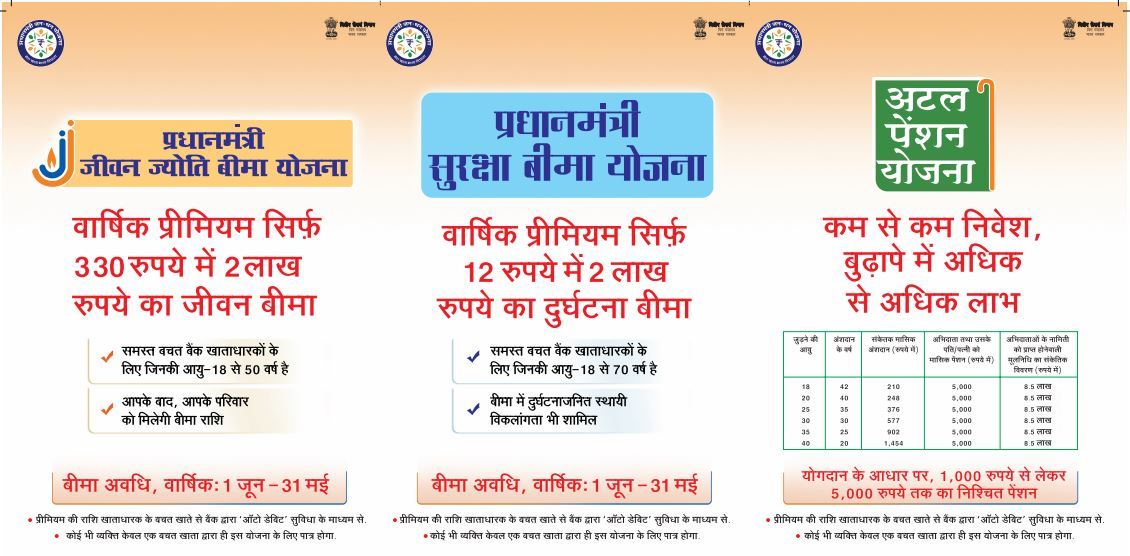
    #1. Pradhan Mantri Suraksha BimaYojna (PMSBY)
    #2. Pradhan MantriJeevan Jyoti Bima Yojana (PMJJBY)
    #3. Atal Pension Yojana (APY)

    Why the schemes?

    • India faces the biggest challenge of providing banking facilities and insurance coverage to all
    • Having access to institutional finance has so far remained a far cry to a vast chunk of rural population
    • As of May 2015, only 20% of India’s population has any kind of insurance and only 11% has any kind of pension scheme
    • Insurance is a way of managing risks & give necessary protections in case of financial loss
    • When one has an insurance policy, certain rights and protections are derived out of it to the person and his family
    • There is a dire need for providing social security at a very nominal cost to the millions and economic empowerment of the poor Answer in comments.>
    • PMJDY is a major step to bring people across the country closer to institutionalized finance, and save them from the clutches of informal financiers
    • However, most of the PMJDY accounts had zero balance initially. The government aims to reduce the number of such zero balance accounts by using these schemes Answer in comments.>

    PMSBY & PMJJBY:


    • Implementation: The scheme will be offered by all Public Sector General Insurance Companies and all other insurers who are willing to join the scheme and tie-up with banks for this purpose
    • Govt Contribution: Various Ministries can co-contribute premium for various categories of their beneficiaries from their budget or from Public Welfare Fund created in this budget from unclaimed money
    • Auto-debit: The premium amount will be auto debited from subscriber’s bank account
    • The schemes will be linked to the bank accounts opened under the Pradhan Mantri Jan Dhan Yojana scheme

    Criticisms of PMSBY:

    • Private banks have complained that the Govt should focus on upper middle class instead of the poorer section
    • Western scholars have argued that financial inclusion is a myth and serving such large number of people would only increase the burden and work-load of public sector

    Criticisms of PMJJBY:

    • The banks have complained that revenue received will be very low
    • Some bankers have claimed that amount they are receiving is not sufficient to cover the service costs
    • Insurers have also pointed out that no health certificate or information of pre-existing disease is required for joining

    Atal Pension Yojana

    • It focuses on the unorganized sector where nearly 400 million employees representing more than 80% of all employees are engaged Answer in comments.>
    • The aim is to make sure that needy people could get fixed amount when they get old
    • It is the improved version of Swavalamban scheme, launched in 2010-11, which has been found lacking in clarity with regard to pension benefits at the age after 60

    Features:

    • All citizen of India aged between 18-40 years are eligible
    • A guaranteed minimum monthly pension will be provided to the subscribers varying from Rs. 1000 to Rs. 5000 per month
    • The pension amount depends on contribution by subscriber
    • Government of India will guarantee the minimum benefit of pension
    • Most interesting part of the scheme is that the government will contribute 50% of the contribution made by the subscriber or Rs. 1000 whichever is lower
    • However, contribution by the govt is available for only those who are not income tax payers and are not covered by any Statutory Social Security Schemes
    • Bank account holder of Any Bank account is eligible

    Suraksha Bandhan drive- Spreading the social security message

    • Aim: To take forward the Govt’s objective of creating a universal social security system in the country, targeted especially at the poor and the under-privileged
    • Participating Banks supported by the participating Insurance Companies are carrying out local outreach, awareness building and enrolment facilitation under the drive
    • Public service organizations supported by peoples representatives are participating in these efforts through various outreach activities such as enrolment drives, camps etc. in large numbers during this period
  • 5 Amazingly Badass Bureaucrats You Would Be Proud To Know: Part #2

    Read the Part 1, here.

    Courage is not the absence of fear but rather the judgement that something is more important than fear; the brave may not live forever but the cautious do not live at all.

    #1. Vinod Rai

    A 1972 batch Kerala cadre IAS officer, started his career as a sub-collector of Thrissur district and became a Comptroller & Auditor General of India. Rai who pursued Masters in Economics from University of Delhi and Master of Public Administration from Harvard University, is known for his uncanny ability to cut through bureaucracy.


    Rai came into lime light for his compilation of audit reports of irregularities in Delhi Common Wealth Games 2010, CoalGate allocation & allocation of 2G spectrum licenses. Forbes quoted Rai as one of the bad-ass IAS officer of rarest breed of civil servants who knows how to get work done in the bureaucracy.  Throughout his service as an IAS officer, he made sure that everything that came under his ambit was dealt with honesty and perfection.


    #2. Ashok Khemka

    He is an IAS officer who got transferred highest number of times i.e. 45 times in 23 years. This speaks volumes about him. Khemka, who pursued Masters in Economics and is also an alumnus of IIT Kharagpur, grabbed attention of the entire nation when he cancelled Robert Vadra’s illegal mutation deal with DLF in a Congress ruled state while the Congress party was in power at centre as well.


    Haryana State Government has intentionally kept him away from important government roles. Being honest to his role, he has kept a check on all the wrong doings and scams in each department that he was posted to and brought it to public notice. Many false chargesheets & departmental inquires have been initiated against Khemka to discourage him . He was conferred ‘The Manjunath Shanmugam Trust Commendation on Public Works’ in 2009 & The S R Jindal Prize for ‘Crusader against Corruption’ in 2011.


    #3. Durga Shakti Nagpal

    This 31 year old IAS officer truly stood to her name & unearthed the nexus of ‘Sand Mafias’ in Greater Noida, UP. A Punjab cadre IAS officer, who married Abhishek Singh, also an IAS officer of UP cadre & later on moved to Gautam Budh Nagar district of UP, where she was posted as ‘Sub-Divisional Magistrate (SDM)’.


    Nagpal demolished an illegal mosque that was under construction in Kadalpur village, for which the UP government arm-twisted & suspended her on false charges. However she was reinstated later by CM Akhilesh Yadav after facing ire from national media & bureaucrat circles.


    #4. Uma Shankar

    This Tamil Nadu cadre IAS officer became the reason for defeat of CM J. Jayalalithaa in polls of 1996. He unearthed the Cremation Shed scam as additional collector of Madurai. He didn’t stop there. Further, during the regime of new government, he continued his stir to catch hold of corruption. During his stint as Joint Vigilance Commissioner, he probed Marans and the DMK patriarch’s kin for which he faced suspension too.


    During his tenure as District Collector, he made Tiruvarur the first e-district in India, introducing transparent and technology enabled administration for the public. This project got an international attention. Uma Shankar is among the few pioneers in India who initiated the e-governance project which later got implemented across India.


    #5. Rajni Sekhri Sibal

    Rajni, a Haryana cadre IAS officer who bluntly says NO when it comes to corruption & this very habit of her led to her frequent transfers. But what she did next will make every one of you spellbound. Her act of a ‘4 mtr cloth’ led to imprisonment of former CM Om Prakash Chautala, his son Ajay Chautala and 51 others. Chautala & other were involved in a scam in which interview scores of 3,200 Junior Basic Training (JBT) teachers in 1999-2000 were manipulated to give jobs to those who had paid for it.


    When Rajni was asked to take 5% of bribe money & change the result list by CM’s associates & his son, Rajni denied to do so, as a result of which she was transferred. After receiving her transfer orders, the first thing she did was, she wrapped the steel almirah with the actual list of results lying inside, with four-metre-long cloth and bandages, making it impossible for anyone to open the almirah and temper with the list. Even her successor wasn’t able to do much with tampering of files, as he knew that this would lead him into troubled waters.


    That’s all for this time. We will keep expanding our *Badass Bureaucrats* list and present it before you. But feel free to help us out. There are a lot of unsung heroes and we need to know them all!

  • Swachh Bharat Mission

    Lets get to the basics of Cess, before we explore more about Swachh Bharat Cess.

    cess-head-for-blog


    What is a Cess?

    Cess is a tax on tax, temporary levied by the govt. to achieve a specific objective. Generally, it is expected to be levied till the time the govt. gets enough money for that purpose.

    For instance, the education cess, that is levied currently, is meant to finance basic education in the country.

    What is the quantum of revenue generated through Cess?

    • The education and higher education cesses are budgeted to bring approx. Rs 30,000 crore this year.
    • The road cess on petroleum is budgeted to net just under Rs 50,000 crore.
    • There is also a cess on exports, clean energy, etc.

    The total amount from cesses is Rs 1.16 lakh crore.

    What is the criticism against Cesses?

    • The problem with cesses is that it becomes permanent in nature.
    • These levies are back door entry instead of levying taxes.

    How Cess is different from Surcharge?

    Surcharge is also a tax on tax, which is imposed on incomes above a certain level with a view to reduce the inequalities further.

    • There is a surcharge of 12% on individuals whose taxable income exceeds Rs. 1 crore.
    • Similarly, there is also a surcharge of 10% on the domestic companies whose taxable income exceeds Rs.10 crore, and also a surcharge of 5% on the foreign companies whose taxable income exceeds Rs.10 crore.

    Now, let’s now come to the core of the topic

    cess-infograph


    What is Swachh Bharat Cess?

    The resources generated from the cess will be utilised for financing and promoting initiatives towards Swachh Bharat. It is a step towards involving each and every citizen in making contribution to Swachh Bharat.

    • Govt. has introduced a cess of 0.5% on all services and 2% on air services.
    • The revenue department is preparing a list of services which will attract the additional 2% cess provided for in the Budget 2015-16, over and above the proposed 14%.

    Where does the proceeds of the Swachh Bharat Cess go?

    The proceeds of the Swachh Bharat cess would be first credited to the Consolidated Fund of India. The govt. would be able to utilise it after due appropriation is made by Parliament by law. This will later go to Swachh Bharat Kosh.

    The Government expects to collect around Rs 10,000 crore from Swachh Bharat cess for full year

    Why does it goes against the principle of fiscal federalism?

    • The central divisible pool excludes levies classified as surcharges and cess for specific purpose.
    • The entire proceeds would remain with the Centre and need not be compulsorily shared with the states.
    • Swachh Bharat cess, to some extent, is a vague pretext for a cess, unlike the ones for national highways or high-speed rail corridors, which can be more effectively implemented at the Central level.

    What will be the impact of GST on the cess?

    There is no input credit available on this cess, which goes against the very principle of the GST and thereby weakens the Centre’s case for pushing through GST.

    The cesses and surcharges would be subsumed once the GST is rolled out. So both for tax payers and states, this is for the time being.


    Published with inputs from Pushpendra
  • UPSC Syllabus | GS Paper 2 | IAS Prep


    UPSC Syllabus for GS Paper 2 with Infographics [250 marks]


    Read the IAS Mains - GS Paper 1 Syllabus already? Click Here.

    The Civil Services Main examination is designed to test the academic talent of the aspirant, also his/her ability to present his/ her knowledge in a clear and coherent manner.

    The Main Examination is intended to assess the overall intellectual traits and depth of understanding of candidates rather than merely the range of their information and memory.

    Polity and IR has a healthy mix of static + dynamic portions which makes it an interesting topic to prepare! Be wary of one thing – Do not get into Politics. Polity has nothing to do with the masala around Politics 🙂


    #1. Indian Polity and Its Constituents

    1. Indian Constitution – Historical underpinnings, evolution, features, amendments, significant provisions and basic structure.
    2. Functions and responsibilities of the Union and the States, issues and challenges pertaining to the federal structure, devolution of powers and finances up to local levels and challenges therein.
    3. Comparison of the Indian constitutional scheme with that of other countries.
    4. Parliament and State Legislatures – structure, functioning, conduct of business, powers & privileges and issues arising out of these.
    5. Structure, organisation and functioning of the Executive and the Judiciary Ministries and Departments of the Government; pressure groups and formal/informal associations and their role in the Polity.
    6. Salient features of the Representation of People’s Act.
    7. Appointment to various Constitutional posts, powers, functions and responsibilities of various Constitutional Bodies.
    8. Development processes and the development industry – the role of NGOs, SHGs, various groups and associations, donors, charities, institutional and other stakeholders.
    9. Welfare schemes for vulnerable sections of the population by the Centre and States.
    10. Important aspects of governance, transparency and accountability.
    11. Role of civil services in a democracy.

    As you can see, this part of the UPSC Syllabus is very detailed one. It is so well described that beyond a point it’s exhaustive to even list it up in full!

    We would suggest that you take up Indian Polity by Lakshmikanth and read it full. Then read it again. Keep up with News at Civilsdaily’s App and read our explainers when we try to break down issues for you.

    For advanced readers, you would have developed an eye for the trending issues. No need to slug it out on daily newspapers – just maintain key points of the major themes on news.

    Civilsdaily.com focuses on Current Polity News here - Stories @Polity
    

    #2. International Relations & World Institutions

    Truth be told, most of the aspirants neglect this part of the syllabus even though it forms a small part of the Prelims Exam. The reason is that foreign treaties are so dynamic – diplomatic relations so complex that we have no clue what UPSC can ask about it!

    Moreover, one would have little idea where to start from – how to connect the web – and with Modi Sahab doing the *Around The World In 80 Days* feat, you have more to fear <kidding>!

    At Civilsdaily, you can get help with our aggregation and curation of news items in one single place.

    Bookmark this page on WORLD NEWS  STORIES. Start with the stories that we have curated over here and then build up on your understanding.


    We are thinking of releasing full infographs of all the UPSC Syllabus in a pdf so that you may store offline and refer when you wish. Would that be cool?


  • The Concept of Currency Devaluation & The Chinese Move

    This theme will be covered in 2 parts. You are reading the Part 1.

    Recently, China devalued its currency and there was so much hue and cry across the world markets. Let us try to understand these complex processes, and the implications of Chinese move.


    Broadly speaking, what is currency devaluation?

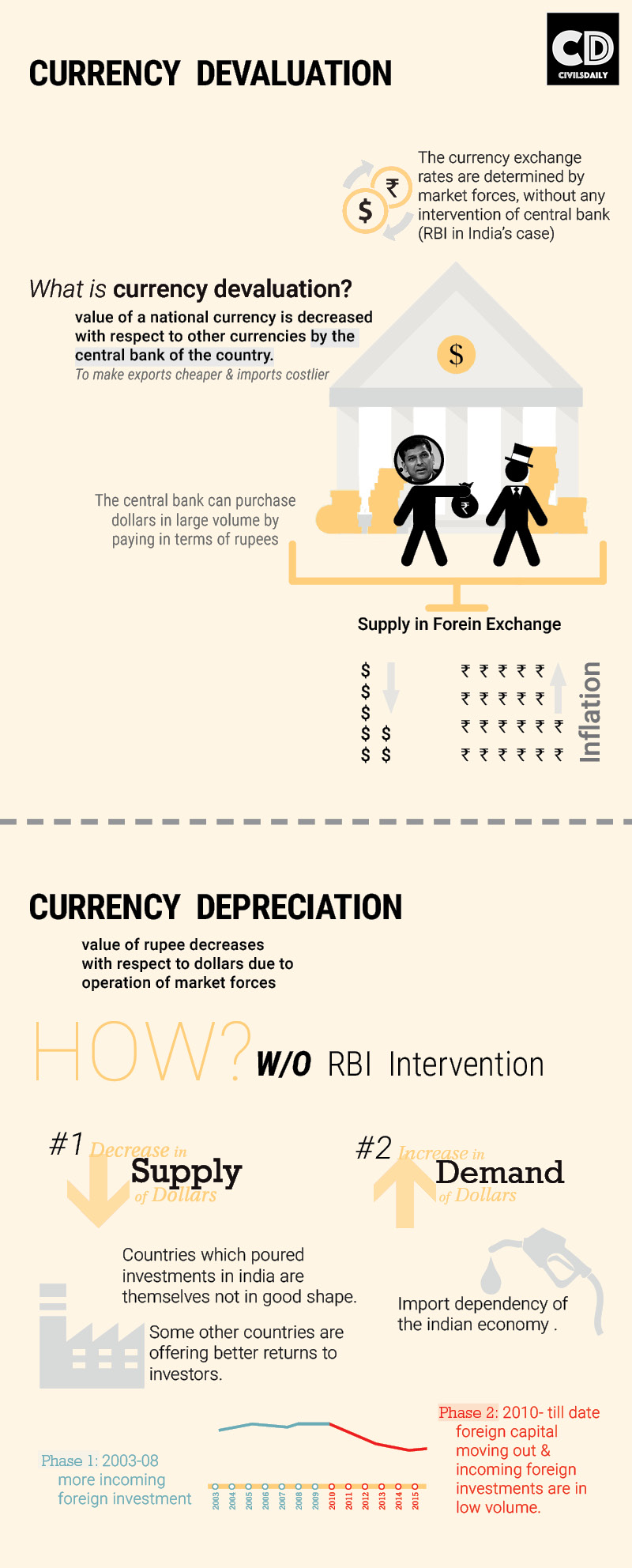
    Under currency devaluation, the value of a national currency is decreased with respect to other currencies by the central bank of the country.

    Before, we delve into the concept of devaluation, lets explore how does currency exchange rates are determined normally. The currency exchange rates are determined by market forces, without any intervention of central bank (RBI in India’s case). <Central Bank and RBI will be used interchangeably in India’s case>


    Now, we will try to understand the process of Devaluation, how it actually happens.

    So, the basic condition for devaluation to happen is that RBI has to become a player in the foreign exchange market.

    Before, we move further, lets explore who all are the players in the forex market. They are importers, exporters, investors & some dealers who deal in foreign exchange (for example exchange banks).

    What will central bank do in the foreign exchange market ?
    The central bank will change the supply of dollars in the market.

    How does it change the supply of dollars in the market?
    The central bank goes to these exchange banks & it will purchase the dollars in large volume by paying in terms of rupees. This will lead to decrease in supply of dollars.

    Now, lets understand the negative implications of such a move.
    As RBI paid in terms of rupees while purchasing dollars, it will increase the money supply in the market, leading to inflation.

    Therefore, devaluation is accompanied with selling of govt. securities.

    RBI can devalue rupee by selling it to purchase dollars in the forex market. It makes exports cheaper & imports costlier & therefore a solution to BOP crisis.


    CURRENCY DEPRECIATION:

    It is a market driven process , determined by market forces.
    Under this, the value of rupee decreases with respect to dollars due to operation of market forces.

    How do the market forces act?

    There are two ways/ causes for currency depreciation :

    #1. Decreases in supply of dollars – without RBI intervention

    This is a very realistic situation that india faced over last few years , when the foreign capital was moving out & foreign investment were not coming in huge volume.

    What could be the reasons? Countries which poured investments in india are themselves not in good shape. Some other countries are offering better returns to investors.

    Phase 1 : 2003-08 – more incoming foreign investment
    Phase 2 : 2010- till date – foreign capital moving out & incoming foreign investments are in low volume.

    #2. Increase in demand of dollars without RBI intervention

    The basic reason behind this is the import dependency of the indian economy .
    This is a traditional reason for depreciation of our currency , since we have been a net import based economy from long time.


    PS: There is another interesting blog on the same topic, written by an economics professor @Civilsdaily – Nursery Rhymes, SDRs and Devaluation of the Yuan

    While you are at it, you might want to read this as well – The Great Fall of China


  • Transition From MDG to SDG: Issues & Concern

    193 Countries Agreed on 17 Sustainable Development Goals. Why?

    After 3 years of negotiations and debate, 193 countries agreed to a set of 17 development goals more bold and ambitious than anything that has come before them.

    But what are Sustainable Development Goals? Where have they evolved from?

    These 17 Sustainable Development Goals (SDGs) – part of a wider 2030 Agenda for Sustainable Development – build on the Millennium Development Goals (MDGs).

    There were 8 MDGs and they are going to expire by the end of this year (2015).


    But why didn’t we just renew them? Why was there a need to re-evaluate and re-program the development goals?

    1. The MDGs as you can see were very focus, concrete, target oriented which was a good thing to begin with, right?
    2. Wrong – The structures and 8 categorisation metrics ended up being so rigid that we left out other more important areas.

    A 2015 UN assessment of the MDGs found they fell short for many people:

    “The assessment of progress towards the MDGs has repeatedly shown that the poorest and those disadvantaged because of gender, age, disability or ethnicity are often bypassed.”

    Okay, fair point. So what do these SDGs look like? What went into the process of coming up with these 17 blocks of SDGs?

    In response to the accusation that the MDGs were too narrow in focus, the SDGs set out to tackle a whole range of issues, from gender inequality to climate change.

    The unifying thread throughout the 17 goals and their 169 targets is the commitment to ending poverty.

    Eradicating poverty in all its forms and dimensions, including extreme poverty, is the greatest global challenge and an indispensable requirement for sustainable development. 


    The consultation process to arrive at these 17 SDGs was one of the most transparent exercise ever to be undertaken in the UN history.

    A million voices formed the part of the process.


    Very quickly then, listing down the goals:

    1) End poverty in all its forms everywhere

    2) End hunger, achieve food security and improved nutrition, and promote sustainable agriculture

    3) Ensure healthy lives and promote wellbeing for all at all ages

    4) Ensure inclusive and equitable quality education and promote lifelong learning opportunities for all

    5) Achieve gender equality and empower all women and girls

    6) Ensure availability and sustainable management of water and sanitation for all

    7) Ensure access to affordable, reliable, sustainable and modern energy for all

    8) Promote sustained, inclusive and sustainable economic growth, full and productive employment, and decent work for all

    9) Build resilient infrastructure, promote inclusive and sustainable industrialisation, and foster innovation

    10) Reduce inequality within and among countries

    11) Make cities and human settlements inclusive, safe, resilient and sustainable

    12) Ensure sustainable consumption and production patterns

    13) Take urgent action to combat climate change and its impacts (taking note of agreements made by the UNFCCC forum)

    14) Conserve and sustainably use the oceans, seas and marine resources for sustainable development

    15) Protect, restore and promote sustainable use of terrestrial ecosystems, sustainably manage forests, combat desertification and halt and reverse land degradation, and halt biodiversity loss

    16) Promote peaceful and inclusive societies for sustainable development, provide access to justice for all and build effective, accountable and inclusive institutions at all levels

    17) Strengthen the means of implementation and revitalise the global partnership for sustainable development


    Published with inputs from Sumer


  • US ke paas Google hai, China ke paas Alibaba hai, India ke paas Kya hai?

    Start-Up India Initiative has been doing the rounds for over a month now and going by the knack of the UPSC to pick-up fancy terms, let’s see if we can deep dive on this topic.


    From the ramparts of the historic Red Fort, Prime Minister announced the “Start-Up India, Stand-up India” to encourage entrepreneurship and job creation.

    Start-Up India aims to make India the hub for the “Start-Ups”.
    However, it is pertinent to discuss the roadblocks to this ambitious plan given that about 80% of the Start-Ups in India fail and also the opportunity it presents if all goes as per the plan.


    We may discuss the issue under the following heads:

    1. Regulatory impediments
    2. Risk aversion
    3. Funding Issues
    4. Gestation Period
    5. Need for Start-Ups
    6. Entrepreneurial SkillSet/ Aptitude
    7. Opportunity to absorb the young work force
    8. Role in making India developed by 2022, the PM’s mission

    Let’s start then!


  • 5 Simple Tips Which Can Turbocharge Your Reading Speed

    Just look at this picture, and tell me one thing. What if you need to revise the entire pile of books in just 5 days, because the 6th day is your doom’s day? You need to finish so you crack your IAS, okay?


    Yes! Of course I know, you people aren’t much bothered to read or memorise stuff. Even if it is the IAS exam, you hallucinate and hope some magic to happen that you remember all the stuff in the examination hall. But here’s an option! How about being able to remember everything on your own and let your confidence be the real magic that can hit the ‘bingo’ point?

    The IAS exam comes with a lot to memorise and nobody can escape that.

    You know what – There are a hell lot of ways in which you could memorise faster, without making you sit bored for hours long. The most important thing being, pacing up your reading speed. If your reading speed is pathetic, you’ll 100% get bored of finishing that entire syllabus or even revising it on the eve of your exam. On the contrary, what if you develop a great speed for reading? That’ll definitely help you retain those facts faster. Not only faster, but you could even revise the portion if you cut out that time of reading.

    Say – reading a page as this one takes you 4 minutes, what if it could get done in around 2.5 minutes? You could read more, even retain more in your brain which you think is just too small.

    So, there you go with some great ways to help you improve upon your reading speed.


    #1. STOP TALKING TO YOURSELF WHILE READING

    • While you read mutely, you tend to speak those words internally and that makes your jaws move. This puts a control on the speed of reading. The speed decreases as you clearly try to utter each word in your mind.
    • Rather, while reading in mind, stop your mind from pronouncing those words clearly internally. Skipping these clear utterances will make you run through the words faster, ending your reading session waay faster by 2/3 times.

    #2. COVER THE WORDS YOU’VE ALREADY READ


    • Covering the words you’ve already read with your palm or a ruler helps, as your eyes don’t keep moving around those extra words that are unnecessary. Covering them will help you to focus on what you’re actually supposed to read.

    #3. MAKE LESSER EYE MOVEMENTS

    • If the next words are familiar, the brain decides to move your eyes in a way that you can read faster. Training your eyes to move directly to the familiar words helps you read the entire page quickly, as you jump through and understand quickly.

    #4. UNDERSTAND EYE MOVEMENTS

    • Don’t give jerks to your eyes while reading. Let your eyes read the words naturally and smoothly all throughout the line. Make fewer movements of your eyes while reading all the words in a line.

    #5. TRUST YOUR BRAIN

    • To improve reading speed, you have to start trusting your brain. If you can start trusting your brain more, you will definitely have an easier time breaking your old reading habits and learning new ones. This is because without your brain you could not have come as far as you’ve come already.
    • Every step of the way, your brain has been right alongside you. And whether you believe it right now or not, your brain is fully capable of understanding all the information you read. Don’t just panic because it is the nervousness that tends to make you forget things you have read. Be calm and trust your memory power for a very effective quick learning.

    So, that’s it.

    I gave you enough tips to work upon your reading speed. All you need to crack an IAS exam is, a good memory, which would come with a great reading speed. Of course, common sense and intelligence stand two of the main concerns.
    Good luck! Hope you’ll have a happy speed – read.


    P.S. – Reading faster is not everything. Read fast, and UNDERSTAND your facts. Because, only if both are added, you get enough to clear an exam such as IAS. Not only could you get passing marks, but also finish any Harry Potter in 2 days! But I really hope you get extra time, from your IAS related readings!


    Want to get the best out of Civilsdaily?

  • ISRO’s growing prowess journey in launching foreign satellites

    So, you think India has made a dent in the Space world?

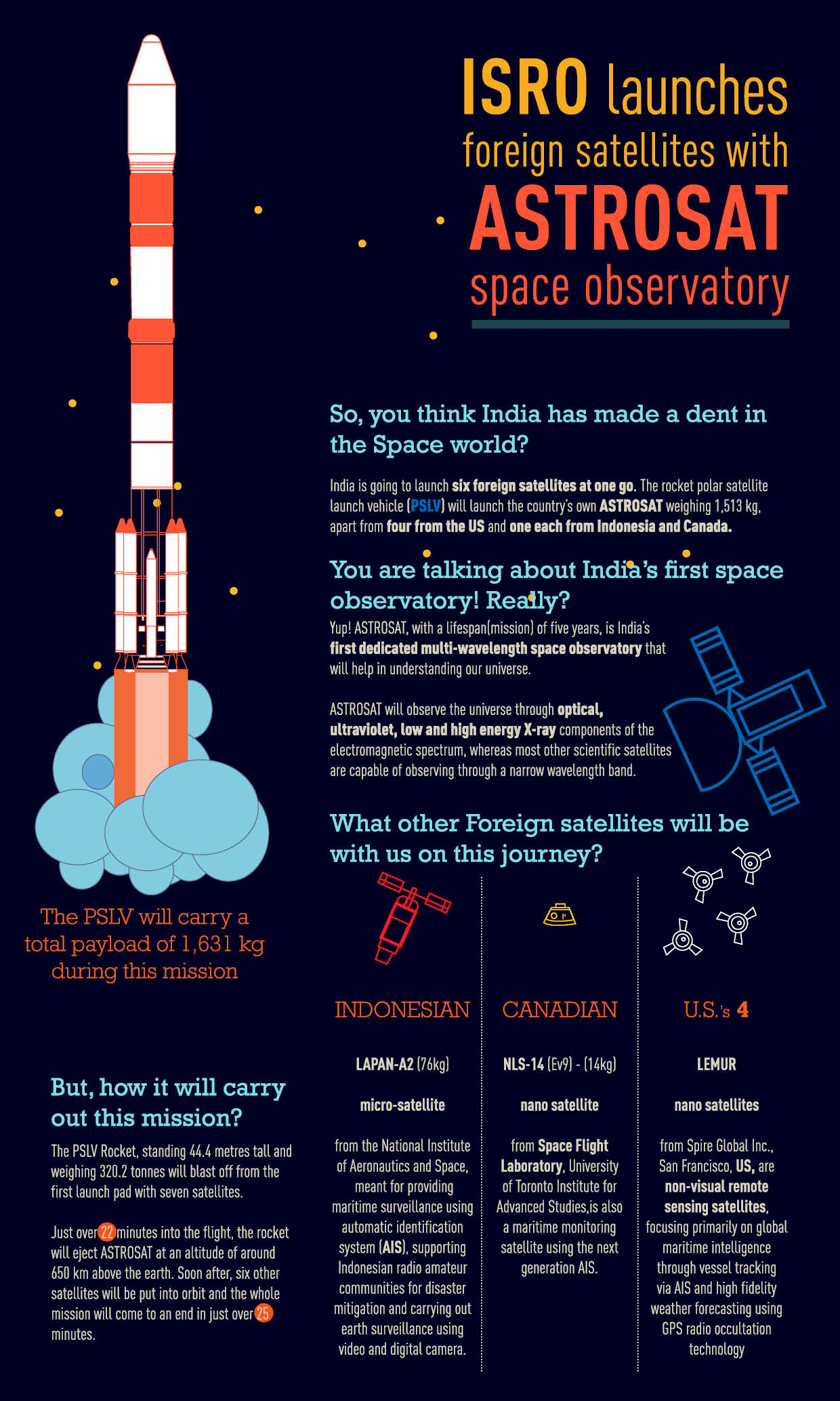
    1. India is going to launch six foreign satellites at one go. The rocket polar satellite launch vehicle (PSLV) will launch the country’s own ASTROSAT weighing 1,513 kg, apart from four from the US and one each from Indonesia and Canada.
    2. The PSLV will carry a total payload of 1,631 kg during this mission.

    But, how it will carry out this mission?

    The PSLV Rocket, standing 44.4 metres tall and weighing 320.2 tonnes will blast off from the first launch pad with seven satellites.

    Just over 22 minutes into the flight, the rocket will eject ASTROSAT at an altitude of around 650 km above the earth.Soon after, six other satellites will be put into orbit and the whole mission will come to an end in just over 25 minutes.


    You are talking about India’s first space observatory! Really?

    Yup! ASTROSAT, with a lifespan of five years, is India’s first dedicated multi-wavelength space observatory that will help in understanding our universe.

    ASTROSAT will observe the universe through optical, ultraviolet, low and high energy X-ray components of the electromagnetic spectrum, whereas most other scientific satellites are capable of observing through a narrow wavelength band.


    What other Foreign satellites will be with us on this journey?

    The Indonesian 76 kg LAPAN-A2 is a micro-satellite from the National Institute of Aeronautics and Space, meant for providing maritime surveillance using automatic identification system (AIS), supporting Indonesian radio amateur communities for disaster mitigation and carrying out earth surveillance using video and digital camera.

    The 14-kg NLS-14 (Ev9) of Space Flight Laboratory, University of Toronto Institute for Advanced Studies, is also a maritime monitoring Canadian nano satellite using the next generation AIS.

    The remaining 4 LEMUR nano satellites from Spire Global Inc., San Francisco, US, are non-visual remote sensing satellites, focusing primarily on global maritime intelligence through vessel tracking via AIS and high fidelity weather forecasting using GPS radio occultation technology, the ISRO said.

    Till date, India has launched 45 foreign satellites with stature,Isn’t it ISRO’s success makes us proud.

More posts