💥Mains Ready By December. Smash Mains & Smash PYQ Admissions Open

Search results for: “”

  • [Open Test] Modern History & Polity: Deadline Extended

    Last Date to appear- Wednesday 22 August (Till midnight). Results will be announced on Thursday 23rd August

    Attempt the test here: Click2Attempt  

    We expect students to have completed Polity and Modern History by now.
    Even if you have completed one of the two, you should appear for the test and attempt questions from that specific subject

    The questions are of moderate difficulty and primarily from the core materials.

    This is to help you assess if you are on the right track and are not passively reading books.

    Most of the questions for the Open Test are from our Test Series. The aim is to demonstrate the level of our Test Series and how it is the best source to prepare and conquer prelims.

    Questions will be from different themes ensuring complete coverage. The explanations can be regarded as a study material in itself.

    Question Types ensure the questions framed are good. Watch the video to know more

    For more details about our program click here: Click2Read

    To enroll in the latest batch click here: Click2Join

  • [Burning Issue] Artificial Intelligence

    Related image

    Why in News?

    The NITI Aayog has published an ambitious discussion paper on kick-starting the artificial intelligence (AI) ecosystem in India.

    About Artificial Intelligence

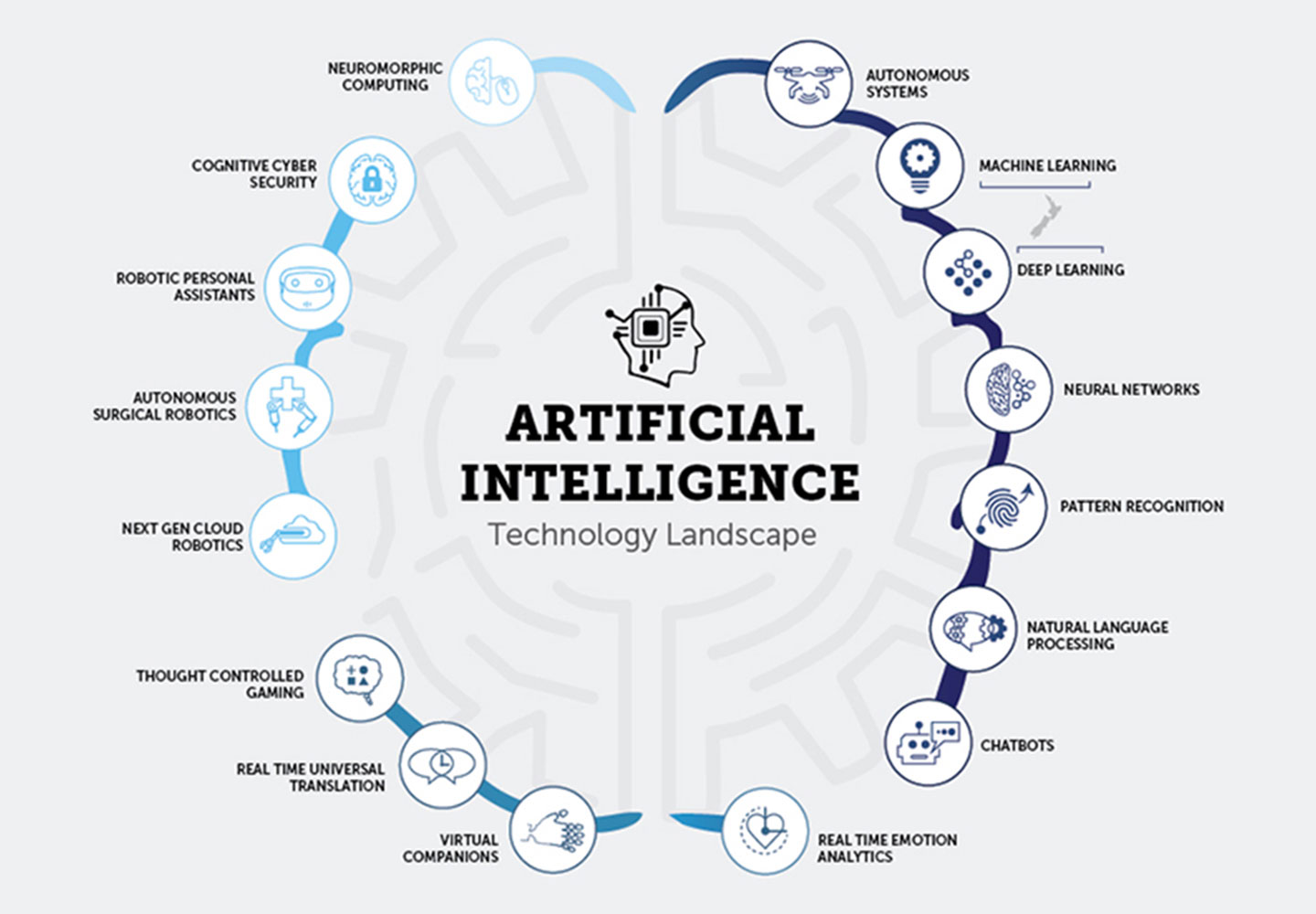
    1. AI is a constellation of technologies that enable machines to act with higher levels of intelligence and emulate the human capabilities of sense, comprehend and act. Thus, computer vision and audio processing can actively perceive the world around them by acquiring and processing images, sound and speech.
    2. The natural language processing and inference engines can enable AI systems to analyze and understand the information collected.
    3. An AI system can also take action through technologies such as expert systems and inference engines or undertake actions in the physical world.
    4. These human-like capabilities are augmented by the ability to learn from experience and keep adapting over time.
    5. AI  systems are finding ever-wider application to supplement these capabilities across various sectors.

    Potential of Artificial Intelligence

    Artificial Intelligence has the potential to provide huge value to different sectors and can become a key source of competitive advantage for firms.

    Healthcare

    Helps address the issue of access to healthcare facilities, particularly in rural areas that suffer from poor connectivity and the limited supply of healthcare professionals.

    Agriculture

    1. It can address challenges such as inadequate demand prediction, lack of assured irrigation, and overuse/misuse of pesticides and fertilizers.
    2. Improves crop yield through real-time advisory, advanced detection of pest attacks, and prediction of crop prices to informed sowing practices.

    Smart Mobility, including Transports and Logistics

    1. Autonomous fleets for ride sharing,
    2. Semi-autonomous features such as driver assist, and
    3. Predictive engine monitoring and maintenance.

    Retail

    1. To improve user experience and sale through
      1. personalized suggestions,
      2. preference-based browsing
      3. image-based product search
      4. customer demand anticipation
      5. improved inventory management  
      6. efficient delivery management

    Manufacturing

    To create a flexible and adaptable technical system to automate processes and machinery to respond to unfamiliar or unexpected situations by making smart decisions.

    Energy

    Energy system modeling and forecasting to decrease unpredictability and increase efficiency in power balancing and usage.

    Smart Cities

    Integration of AI in smart cities and infrastructure help meet the demands of a rapidly urbanizing population and provides enhanced quality of life.

    Education and Skilling

    1. Improving the learning experience through personalized learning,
    2. automating and expediting administrative tasks, and
    3. predicting the need for student intervention to reduce dropouts or recommend vocational training.

    Global Developments in AI

    Different countries have identified different focus areas for AI development and deployment

    Japan

    1. Areas of interest include industrial productivity improvement, healthcare, medical care and welfare, mobility and information security.
    2. Japan is focusing on moving from the “Industry 4.0” paradigm to “Society 5.0” through the development of AI for delivering public services

    France

    1. Areas of interest include healthcare, environment, transport, mobility, defence-security. The government is planning to support AI startups through data availability, public spending and talent reskilling.

    USA

    Areas of interest include economic prosperity, educational opportunities, quality of life, national and homeland security.

    China

    1. Areas of interest include education, healthcare, energy, transport, quality of life, city planning /IoT / robotics.
    2. China is focusing on developing and using AI for delivery of public services through financial support, developing talent pipeline, and leveraging international cooperation.

    Artificial Intelligence in India

    A national AI strategy needs to be created on a framework based on India’s unique needs and aspirations, while at the same time capable of achieving the country’s full potential of leveraging AI developments.  

    Impact of AI in India

    1. It will improve the quality of life and access of choice to a large section of the country.
    2. Increased access to quality health facilities (including addressing the locational access barriers)
    3. Inclusive financial growth for large sections of the population who have been excluded from formal financial products.
    4. Providing real-time advisory to farmers and help address unforeseen factors to increase productivity,
    5. Building smart and efficient cities and infrastructure to meet the demands of the rapidly urbanizing population

    Key challenges in adoption of AI in India

    1. Lack of enabling data ecosystems.
    2. Low intensity of AI research
             i. Core research in fundamental technologies
             ii. Transforming core research into market applications.
    3. Inadequate availability of AI expertise, manpower and skilling opportunities
    4. High resource cost and low awareness for adopting AI in business processes
    5. Unclear privacy, security and ethical regulations
    6. Unattractive Intellectual Property regime to incentivize research and adoption of AI

    Way forward

    The way forward is to factor in current strengths and weaknesses in AI and initiate large-scale transformational interventions, primarily led by the government, with the private sector providing able support.

    Practice Questions

    1. Evaluate the benefits of Artificial Intelligence (AI) across different sectors.
    2. Compare and contrast on the development of AI among different countries. How is India faring in the development of AI?
  • 14 August 2018 | Prelims Daily with Previous Year Questions

    Q.1) Consider the following statements with respect to Global Financial Inclusion (Global Findex) Database:

    1. It is launched by World Bank with the help of Bill and Melinda Gates Foundation.
    2. It measures how adults around the world – including the poor, women, and rural residents – manage their finances and plan for the future.
    3. According to this, India has made rapid progress in improving access to formal financial services.

    Which of the given statements is/are correct?

    a) 1 and 2

    b) 2 and 3

    c) 1 and 3

    d) All are correct

    Inspired by: [op-ed snap] How India should close the financial gender gap

    https://www.civilsdaily.com/news/op-ed-snap-how-india-should-close-the-financial-gender-gap/

    Q.2) Idukki Dam in Kerala was recently in news as its gates were opened for the first time due to heavy floods. This dam is built on which of the following river?

    a) Bharathappuzha

    b) Chalakudy

    c) Periyar

    d) Pamba

    Inspired by: [op-ed snap] Keeping dry: On Kerala floods

    https://www.civilsdaily.com/news/op-ed-snap-keeping-dry-on-kerala-floods/

    Q.3) Consider the following statements about Laboratory for the Conservation of Endangered Species (LaCONES):

    1. It is a dedicated laboratory of the CSIR-Centre for Cellular and Molecular Biology (CCMB), Hyderabad.
    2. It is the only laboratory in India that has developed methods for collection and cryopreservation of semen and oocytes from wildlife.
    3. It has successfully reproduced endangered blackbuck, spotted deer and Nicobar pigeons.

    Which of the given statements is/are incorrect?

    a) Only 2

    b) Only 3

    c) 2 and 3

    d) All are correct.

    Inspired by: National Wildlife Genetic Resource Bank dedicated to nation

    https://www.civilsdaily.com/news/national-wildlife-genetic-resource-bank-dedicated-to-nation/

    Q.4) Which of the given statements about “Ease of Living index 2018”, the data-driven approach to urban planning and management is correct?

    1. The index is released by NITI Aayog.
    2. It is a measure of a city’s ability to provide data on various spheres of performance in real time.
    3. A low score reflects poor state of livability in those cities.
    4. Pune and Mumbai sub-urban are the leading rank holders of the index.

    Select the correct codes from the following options:

    a) 1, 2 and 4

    b) 2 and 4

    c) 2, 3 and 4

    d) All are Correct

    Inspired by: Pune tops Ease of Living index; Patna ranked lowest of 111 cities

    https://www.civilsdaily.com/news/pune-tops-ease-of-living-index-patna-ranked-lowest-of-111-cities/

    Q.5) With an aim to harness India’s rich cultural, historical, religious and natural heritage in boosting tourism and job creation, Swadesh Darshan Scheme was launched in the country.

    Which of the following statements is/are correct with respect to the Swadesh Darshan Scheme?

    1. It is a Centrally Sponsored Scheme under Ministry of Tourism.
    2. It aims to develop theme-based tourist circuits in the country which are unique and specific to the area including beaches, culture, heritage, wildlife etc.
    3. “North East Circuit: Imphal & Khongjom” is the first project developed under the scheme.

    Select the correct codes from the following options:

    a) All are correct

    b) 1 and 3

    c) 2 and 3

    d) 3 only

    Inspired by: [pib] First project under the Swadesh Darshan Scheme the ‘North East Circuit to be inaugurated

    https://www.civilsdaily.com/news/pib-first-project-under-the-swadesh-darshan-scheme-the-north-east-circuit-to-be-inaugurated/


    For Solutions – Click Here

    Prelims Daily Archive – Click here

  • [Burning Issue] Operation Greens

    Image result for Operation Greens

    Why in news?

    The govt. proposed to launch Operation Greens scheme in the Budget 2018.

    About Operation Greens scheme

    1. It is a price fixation scheme aims at doubling the farmers’ income by the end of 2022 by ensuring them the right price for their produce.
    2. It focusses on fruits and vegetables, starting with three basic vegetables such as onion, potatoes and tomatoes. It will help in controlling the high fluctuations in the prices of these vegetables.

    Why Operation Greens?

    1. India is the second largest producer of vegetables in the world, next only to China which produces 4x more than India. It means that India has still a long way to go in vegetable production.
    2. The problem with vegetable commodities is that when their production increases sharply, their prices collapse because there is not enough modern storage capacity. Furthermore, the links to processing and organised retailing are very weak and small in India. Consequently, farmers often end up receiving less than 1/4th of what consumers pay for their produce in major cities.
    3. Operation Greens aims at addressing these challenges.

    Arguments favouring the scheme

    1. The scheme will ensure farmers with the right price for their produce and consumers with low price to buy agricultural produce, due to the control in fluctuation of price in the market.
    2. Operation Greens will increase the demand in the economy with its demand forecasting model.
    3. This scheme is modelled on the lines of highly successful Operation Flood scheme which was driven by smallholders.
    4. It will reduce rising incidents of farmers dumping potatoes and tomatoes on roads across the country due to high fluctuation in market prices.
    5. Also, the prices of vegetables were very high to the point that the government put a ban on exports, de-stocking and even enforced income-tax raids on traders.
    6. Income tax concessions to FPOs will help in bringing the much-needed infrastructure in the agro-horticultural sector.
    7. It will create both forward and backward linkages which will promote the agricultural sector.
    8. Due to the focused nature of the program, the scheme will be scalable over space and time, replicating the success of Operation Flood.

    Arguments against the scheme

    1. Linking of MSP with the cost of cultivation is a bad move as the cost of cultivation of crops is different across the country.
    2. Linking of APMCs with the e-NAM market platform is criticized due to the lack of data disclosed on the performance of the e-NAM.
    3. The scheme has no provision for institutional setup in implementing the scheme like the National Dairy Development Board (NDDB) in Operation Flood.

    Key Challenges

    1. How will farmers identify the right markets for their products that can give them the right prices on a sustainable basis?
    2. Investments in storage infrastructure require amendments to the Essential Commodities Act with respect to the storage control order.
    3. There are many different varieties of the produce grown in different climatic conditions and in different seasons, making an intervention in markets more complex.
    4. In the horticultural sector, viable technology options for long-term storage, transport, and processing are underdeveloped. Moreover, the energy intensity of the existing technologies is high which poses an additional challenge, particularly with the rising fuel prices.
    5. There is no ready market seamlessly connecting producers to consumers for those targeted vegetables which are at present very small compared to others.
    6. Operation flood was spearheaded by Verghese Kurien to implement the vision and strategy of the scheme with honesty. Can the government locate another Kurien?

    Way forward

    1. Set a target that farmers must receive at least 60% of what consumers pay. In the case of milk, farmers get more than 75% of what consumers pay under the Operation Flood.
    2. Connecting major consuming centres to the major producing centres with less number of intermediaries.
    3. Farmer Producing Organisations (FPOs) should be effectively utilized as a starting point for aggregation of commodities, assaying, sorting, grading and packing with barcodes for traceability.
    4. The market for the horticultural produces has to be developed through a viable business model.
    5. Apart from controlling the price fluctuations, the government should also encourage every farmer in increasing production of these vegetables under the Operation Greens scheme.

    Practice Question:

    1. The government has launched Operation Greens with high hopes. Given the existing conditions, do you think the scheme will deliver? Critically analyse. 250 Words, 15 Marks.
  • 14 August 2018 | High Relevance vs Low Relevance News

    Reading News for UPSC is utmost important and rising number of questions year on year in UPSC Prelims is a testimony of this

    We are starting a daily series where we will analyze news covered in The Hindu, Indian Express and other newspapers which are important from exam perspective and which are not

    Important news would have been covered in our daily news coverage in form of newscards.

    Unimportant ones will be mentioned here and a short description regarding why it is not relevant for the exam

    Click on news headlines to read the full news

    High relevance news

    [op-ed snap] How India should close the financial gender gap

    https://www.civilsdaily.com/news/op-ed-snap-how-india-should-close-the-financial-gender-gap/

    A detailed editorial discussing obstacles in financial inclusion for women. Very important for Mains.

    [op-ed snap] Huff and e-puff: On e-cigarette ban

    https://www.civilsdaily.com/news/op-ed-snap-huff-and-e-puff-on-e-cigarette-ban/

    Ban culture is now dominating the policy-making process instead of finding viable solutions to the problems. Recent proposal to ban e-cigarettes is in the same line. Read the editorial to understand the issue and possible alternates.

    National Wildlife Genetic Resource Bank dedicated to nation 

    https://www.civilsdaily.com/news/national-wildlife-genetic-resource-bank-dedicated-to-nation/

    Read about Gene Resource Bank, LaCONES. can be asked in Prelims.

    Pune tops Ease of Living index; Patna ranked lowest of 111 cities

    https://www.civilsdaily.com/news/pune-tops-ease-of-living-index-patna-ranked-lowest-of-111-cities/

    A new index to assess India’s cities. Read and note the parameters and other related details. Can be asked in Pre as well as Mains.

    [pib] First project under the Swadesh Darshan Scheme the ‘North East Circuit to be inaugurated

    https://www.civilsdaily.com/news/pib-first-project-under-the-swadesh-darshan-scheme-the-north-east-circuit-to-be-inaugurated/

    Read about Swadesh darshan scheme. Can be asked in Prelims.

    Low Relevance News

    JCOs are gazetted officers, says Defence Ministry

    Junior Commissioned Officers (JCO) in the Indian military are gazetted officers, the Defence Ministry has clarified in an order issued on August 1. The clarification follows a long-standing controversy over the issue

    No important points from exam point of view.

  • 13 August 2018 | Prelims Daily with Previous Year Questions

    Q.1) Consider the following statement about Parker Solar Probe:

    1. It is aimed to study the sun’s outer atmosphere, or corona, which is much hotter than the solar surface.

    2. The Solar Probe Cup is a sensor that will extend beyond the heat shield to take samples of the Sun’s atmosphere.

    3. The mission will be orbiting the sun until the end of the solar system.

    Which of the given statements is/are not correct?

    a) 1 and 3

    b) 2 and 3

    c) Only 3

    d) All are incorrect

    Inspired by: Parker, world’s first mission to Sun lifts off

    https://www.civilsdaily.com/news/parker-worlds-first-mission-to-sun-lifts-off/

    Q.2) Solar Orbiter or SolO, is solar mission of which of the following states?

    a) Germany

    b) France

    c) UK

    d) Australia

    Inspired by: Parker, world’s first mission to Sun lifts off

    https://www.civilsdaily.com/news/parker-worlds-first-mission-to-sun-lifts-off/

    Q.3) Tropical Tasar, Multivoltine x Bivoltine and Eri are breeds of which of the following?

    a) Bovines

    b) Goats

    c) Silkworm

    d) Sheep

    Inspired by: [pib] Central Silk Board Notifies Recently Developed Races of Silk Worm Seed

    https://www.civilsdaily.com/news/pib-central-silk-board-notifies-recently-developed-races-of-silk-worm-seed/

    Q.4) PEGylated Streptokinase, a clot buster developed by CSIR-Institute of Microbial Technology (CSIR-IMTECH), Chandigarh is used for the treatment of which of the following disease?

    a) Ischemic strokes

    b) Brain Hemorrhage

    c) Cardiac Arrest

    d) Gangrene

    Inspired by: [pib] CSIR’s new patented Clot buster, PEGylated Streptokinase set to revolutionize the treatment of Strokes

    https://www.civilsdaily.com/news/pib-csirs-new-patented-clot-buster-pegylated-streptokinase-set-to-revolutionize-the-treatment-of-strokes/

    Q.5) Harsh Mander v. Union of India and Karnika Sawhney v. Union of India Judgments are related to which of the following issue?

    a) De-criminalizing begging

    b) SC/ST reservations in Promotion

    c) Continuance of Reservation for SCs and STs

    d) Against Mob Lynching

    Inspired by: [op-ed snap] Undoing a legacy of injustice

    https://www.civilsdaily.com/news/op-ed-snap-undoing-a-legacy-of-injustice/


    For Solutions – Click Here

    Prelims Daily Archive – Click here


  • [Burning Issue] Special Category States (SCS)

    Image result for Special Category States (SCS)


    Meaning and history of the term SCS

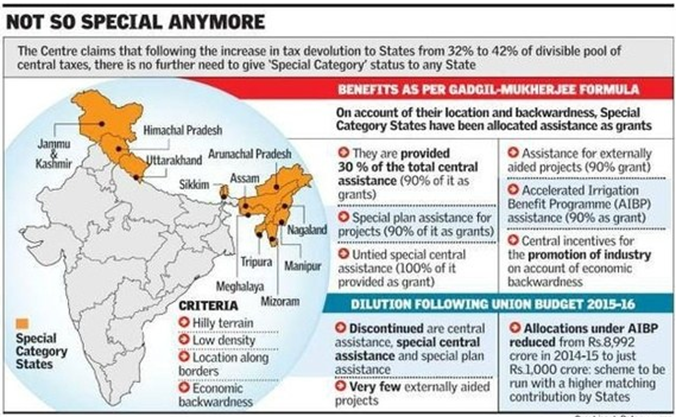
    • SCS is a classification given by Centre to assist in the development of those states that face geographical & socio-economic disadvantages like hilly terrains, strategic international borders, economic & infrastructural backwardness and non-viable state finances.
    • Introduced in 1969.
    • 5th Finance Commission sought to provide certain disadvantaged states with preferential treatment in the form of central assistance and tax breaks.
    • National Development Council grants the status of Special Category States.
    • Initially three states Assam, Nagaland and Jammu & Kashmir.
    • Since then eight more have been included – Arunachal Pradesh, Himachal Pradesh, Manipur, Meghalaya, Mizoram, Sikkim, Tripura and Uttarakhand.
    • Direct transfers subsequently abolished in 2013–14.
    • In 2013, Centrally Sponsored Schemes (CSS) were restructured into 66 schemes, including 17 flagship programmes with significant outlays.
    • In 2016, CSS restructured into only 28 schemes.
    • From 2017–18, the distinction between plan and non-plan expenditure removed,
    • Therefore the Gadgil formula is a thing of the past

    Related image

    The criteria for granting special status:

    • Hilly and difficult terrain
    • Low population density or sizeable share of tribal population
    • Strategic location along borders with neighbouring countries
    • Economic and infrastructural backwardness
    • Non-viable nature of state finances.

    Advantages of getting special category status

    • Preferential treatment in federal assistance and tax break
    • Significant excise duty concessions.
    • An interest-free loan with a rationalization of public expenditure based on the growth enhancing sectoral allocation of resources.
    • SCS don’t have a hard budget constraint as the central transfer is high.
    • SCSs avail the benefit of debt swapping and debt relief schemes (through the enactment of Fiscal Responsibility and Budget Management Act) which facilitate reduction of the average annual rate of interest.
    • 30% of the Centre’s gross budget goes to the SCSs.
    • In centrally sponsored schemes and external aid special category states get it in the ratio of 90% grants and 10% loans.
    • Income tax holidays for 10 years for setting up new industries, extendable by a further period of five years upon “substantial expansion” of the existing units.
    • Unspent money does not lapse and gets carry forward.

    Concerns regarding SCS

    • In the absence of the market, infrastructure, especially power, entrepreneurial skills and local resources, these incentives had hardly helped these states to industrialise.
    • Not much economic progress has been noticed among SCS.
    • Overwhelmingly dependent on central funding.
    • Benefits flow regularly without any accountability or performance monitoring of the states.
    • The amount of proceeds that states receive has increased after the 14th finance commission. So the structure does not seem to have any specific relevance in present context.
    • SCS has been reduced to a political rallying point.
    • Benefit of SCS may act as a stimulus but rest depends on the individual state policy.

    14th Finance Commission on SCS

    • The 14th FC does not make any mention of SCS.
    • Its recommendations have been inferred as removing SCS.
    • FC provided a fixed share of states in the net proceeds of the shareable central taxes at 42%.
    • It has been interpreted as removing the distinction between general states and SCS and grant funds on the basis of backwardness of states.
    • The interstate inequalities to be addressed through adequate tax devolutions and grants.
    • Only SCS status was restricted to the states of North-east and three hill states.
    • Under FC, some states to receive revenue deficit grants.
    • States now have much more fiscal space to spend on their own priorities, instead of depending on the centre.

    Fiscal Cooperative Federalism

    • The taxes are divided among the states on the principles of equity and efficiency.
    • From the 6th FC onwards, the FCs recommended only non-plan grants.
    • The plan component was under the Planning Commission.
    • Most of the discretionary transfers were made via the centrally sponsored schemes (CSS)
    • Large part of the total transfers were made outside the state budgets, by direct transfer of funds from the Consolidated Fund of India to the implementing agencies in the states.
    • Discretionary direct transfers have been abolished now.
    • CSS reduced in number and restructured
    • The distinction between plan and non-plan expenditure is no more.
    • The NCA has also since been done away with.

    Criticism received by the 14th FC

    • The 14th FC attracted severe criticisms on grounds of equity and efficiency.
    • Equalisation, equity and efficiency have always guided FC transfers
    • It ensured that same standards of delivery of public services extended to all states
    • This practice was aimed to prevent economic migrations across states.
    • But there are now no efficiency criteria for the transfers.
    • States, especially poor states, that have kept within their Fiscal Responsibility and Budget Management Act (FRBM) limits, have been made to suffer a cut in their shares instead of being rewarded for maintaining fiscal discipline.
    • Even when these states controlled spending at the cost of limiting their capital
      borrowings despite huge infrastructure deficits.
    • But there were no rewards for resisting populism.

    But are SCSs really suffering?

    • Whether there has been a reduction in the resources of SCSs?
    • Whether SCSs have managed to retain their relative advantages vis-a-vis other states?
    • For the SCSs as a whole, the total transfers during the first year under the XIV-FC over the previous year had actually increased by 24.7%, more than most other states.
    • The tax devolutions for the SCS increased by almost 90%.
    • The shares of SCS did not suffered any cut.
    • They had in fact registered much higher increases than under the previous commissions
    • Regarding the relative advantages enjoyed by the SCS, the latest restructuring of the CSS had made an important distinction between these and the other states, in terms of the funding pattern of these schemes.
    • For the “core of the core” schemes, it envisaged that the existing funding patterns would continue, which is 90:10 for the SCS between the centre and states, while other states have to bear a higher proportion of expenditure on their own.
    • For the “core” schemes, the restructured CSS states that the 90:10 formula between the centre and states would apply “for the 8 North Eastern States and 3 Himalayan States,” while it would be 60:40 for the other states.
    • Thus, the SCS continue to retain their relative advantages over the other states.
    • In other words, the category is far from being a thing of the past.

    Revisiting Special Category

    • The benefits of SCS are still there
    • Therefore it is important to correct the flaws in the mechanism.
    • There is a need to address the deep-rooted structural weaknesses that afflicted SCSs.
    • Re-examine the continuation of the SCS a state in perpetuity.
    • Adopting a target-based, time-bound arrangement that is focused on accountability, performance, and monitoring of achievements, with specific performance goals to be achieved by the beneficiary states for the benefits to continue.
    • We need a strategy in which funding would be just one essential element and not the most important part.
    • SCSs need supporting institutional set-up adequate to guide them towards predefined goals.
    • Monitoring and accountability and granting of the SCS to a state should be through performance expectation.
  • 11 August 2018 | Prelims Daily with Previous Year Questions

    Q.1) Consider the following statements about SCO Peace Mission Exercise, 2018:

    1. The exercise will be held in Chengdu, China.

    2. It will involve tactical level operations in an international counter-insurgency or counter-terrorism environment under SCO Charter.

    3. Indian and Pak Army will participate together for the first time in missions other than UN Peacekeeping.

    Which of the given statement is/are correct?

    a) Only 1

    b) 1 and 3

    c) 2 and 3

    d) All are incorrect

    Inspired by: [pib] Exercise SCO Peace Mission 2018

    https://www.civilsdaily.com/news/pib-exercise-sco-peace-mission-2018/

    Q.2) Consider the following statements about India Science Technology and Innovation portal:

    1. It is developed by Union HRD Ministry.

    2. The portal allows access to students about various fellowships, scholarships and funding and startup opportunities that India puts on their plate.

    Which of the given statements is/are correct?

    a) Only 1

    b) Only 2

    c) Both 1 and 2

    d) None of the above

    Answer: (b)

    Inspired by: Centre launches portal for scientific research, funding

    https://www.civilsdaily.com/news/centre-launches-portal-for-scientific-research-funding/

    Q.3) Consider the following statements about PARIVESH portal:

    1. It is developed by MoEFCC and NIC.

    2. It will use Geographic Information System (GIS) interface.

    3. The portal automates the entire process of submitting the application and tracking the status of such proposals at each stage of processing.

    Which of the given statements is/are correct?

    a) 1 and 2

    b) 2 and 3

    c) 1 and 3

    d) All are correct

    Inspired by: [pib] “PARIVESH” – an environmental single window hub for Environment, Forest, Wildlife and CRZ clearances launched

    https://www.civilsdaily.com/news/pib-parivesh-an-environmental-single-window-hub-for-environment-forest-wildlife-and-crz-clearances-launched/

    The facility of Geographic Information System (GIS) interface will help them in analyzing the proposal efficiently, automatic alerts (via SMS and emails) at important stages to the concerned officers, committee members and higher authorities to check the delays if any.

    Q.4) Hoplobatrachus tigerinus is a scientific name of which of the following species?

    a) Royal Bengal Tiger

    b) Tiger Shark

    c) Bullfrog

    d) Tasmanian Tiger

    Inspired by: Indian bull frog: the Andamans’ new colonizers

    https://www.civilsdaily.com/news/indian-bull-frog-the-andamans-new-colonisers/

    Q.5) Giant Metrewave Radio Telescope (GMRT) is located in which of the following Indian city?

    a) Pune

    b) Jaipur

    c) Surat

    d) Sriharikota

    Inspired by: Indian telescope spots distant radio galaxy

    https://www.civilsdaily.com/news/indian-telescope-spots-distant-radio-galaxy/


    For Solutions – Click Here

    Prelims Daily Archive – Click here
     

  • 13 August 2018 | High Relevance vs Low Relevance News

    Reading News for UPSC is utmost important and rising number of questions year on year in UPSC Prelims is a testimony of this

    We are starting a daily series where we will analyze news covered in The Hindu, Indian Express and other newspapers which are important from exam perspective and which are not

    Important news would have been covered in our daily news coverage in form of newscards.

    Unimportant ones will be mentioned here and a short description regarding why it is not relevant for the exam

    Click on news headlines to read the full news

    High relevance news

    More banks report tightening of credit standards, shows survey

    https://www.civilsdaily.com/news/more-banks-report-tightening-of-credit-standards-shows-survey/

    More and more banks are now coming in the ambit of NPA resolution process and the results can be seen in tightening of lending rules. Note important points for Mains.

    ISRO set to launch its TV channel

    https://www.civilsdaily.com/news/pib-isro-set-to-launch-its-tv-channel/

    A necessary step in order to promote science education in India. Note details about the channel. Can be asked in Prelims.

    Bill to allow proxy voting by NRIs passed by Lok Sabha

    https://www.civilsdaily.com/news/bill-to-allow-proxy-voting-by-nris-passed-by-lok-sabha/

    Till now, proxy voting was only available to service personnel. This demand was pending for a long time as people were unable to use their right to vote due to their settlement/work in foreign countries. Know important provisions as well as the pros and cons of the bill for Mains.

    [op-ed snap] Undoing a legacy of injustice

    https://www.civilsdaily.com/news/op-ed-snap-undoing-a-legacy-of-injustice/

    Delhi HC has given a historic decision by scrapping Begging Act. The editorial sums up all facts related to it. Must read for Mains.

    Low Relevance News

    CJI changes subject-wise roster in Supreme Court

    The Chief Justice of India has changed the subject-wise roster for judges in the Supreme Court

    The subject-wise roster was first implemented from February 5 this year after a press conference by four seniormost Supreme Court judges over “selective” allocation of cases to certain Benches by recent CJIs

  • [Burning Issue] 5G Technology

    Image result for 5g technology in india

    Why in News?

    In June 2018, The 5G committee of the Telecom Ministry recommended that 6,000 MHz of spectrum can be made available without delay for the next generation 5G mobile service

    About 5G

    • 5G is the fifth generation mobile network.
    • It’s a unified platform which is much more capable than previous mobile services with more capacity, lower latency, faster data delivery rate and better utilisation of spectrum.
    • The standards for the usage of 5G are defined and driven by 3rd Generation Partnership Project (3GPP).

    Timeline: Evolution from 1G to 5G

    • 1G: Launched in the 1980s. Analog radio signals and supported only voice calls.
    • 2G: Launched in the 1990s. Uses digital radio signals and supported both voice and data transmission with a BandWidth(BW) of 64 Kbps.
    • 3G: Launched in the 2000s. With a speed of 1 Mbps to 2 Mbps it has the ability to transmit telephone signal including digitised voice, video calls and conferencing.
    • 4G: With a peak speed of 100 Mbps-1 Gbps it also enables 3D virtual reality.
    • 5G: with a speed of more than 1Gbps,it is capable of connecting entire world without limits.

    Salient features

    • Capability: 5G will provide much faster mobile broadband service as compared to the previous versions and will provide support to previous services like mission critical communication and the massive Internet Of things(IoT).
    • Speed: With peak delivering rate of up to 20 Gbps and an average of 100Mbps, it will be much faster as compared to its predecessors.
    • Capacity: There will be up to 100 x increase in traffic capacity and network efficiency.
    • Spectrum usage: Will provide better usage for every bit of spectrum, from low bands below 1 GHz to high bands.
    • Latency: It’s expected to have lower latency with better instantaneous, real-time access of the data.
    • The 5G, like 4G LTE, also uses Orthogonal Frequency Division Multiplexing(OFDM) but the new 5G NR(New Radio)air interface will enhance OFDM and provide better flexibility in data delivery.

    Applications Of 5G technology

    • High-Speed mobile network: 5G will revolutionize the mobile experience with supercharged wireless network. Compared to conventional mobile transmission technologies, voice and high-speed data can be simultaneously transferred efficiently in 5G
    • Entertainment and multimedia : 5G can provide 120 frames per second, high resolution and higher dynamic range video streaming without interruption. Audiovisual experience will be rewritten after the implementation of the latest technologies powered by 5G wireless. Augmented Reality and virtual Reality services will be better experienced over 5G.
    • Internet of Things : IoT applications collects huge amount of data from millions of devices and sensors and thus requires an efficient network for data collection, processing, transmission, control and real-time analytics which 5G network is a better candidate.
    • Smart cities : Smart city application like traffic management, Instant weather update, local area broadcasting, energy management, smart power grid, smart lighting of street, water resource management, crowd management, emergency response etc can use a reliable 5G wireless network for its functioning.

    • Smart farming : 5G technology will be used for agriculture and smart farming in the future. Using smart RFID sensors and GPS technology, farmers can track the location of livestock and manage them easily. Smart sensors can be used for irrigation control, access control and energy management.

    • Mission critical applications : Like telemedicine services, remote control of critical infrastructure and vehicles. It has the potential to transform industries with highly reliable, low latency link.

    High-Level 5G India 2020 forum

    Government has constituted High-Level 5G India 2020 Forum with three Secretaries of key Ministries/Departments Telecom, Meity and DST, and also comprising renowned experts. The primary aims of the forum are:

    • early deployment of 5G in India.
    • A globally competitive product development and manufacturing ecosystem targeting 50% of India market and 10% of global market over next 5 to 7 years.

    Conclusion

    The new 5G technology is expected to launch at the beginning of 2019. With the government push for Digital India, the 5G technology can be a game changer. It can help in better service delivery, faster access to services and deeper penetration of digital services